


Blue-and-White Porcelain Kannon Guanyin Bodhisattva in Royal-Ease Pose with Cobalt Floral Robes
Blue-and-White Porcelain Kannon Guanyin Bodhisattva in Royal-Ease Pose with Cobalt Floral Robes
- Dispatch
- Prepared and sent from Tokyo within 7–14 days, often sooner, or as arranged
- Arrival
- United States · usually 4–7 days after dispatch, insured and tracked Check the Shipping Flowchart here
- Shipping
- Quoted for this piece before purchase ·
- Import
Duties and customs · View the estimate
A guide for this piece: about $62, based on the 10% US charge on the declared value of goods made in Japan.
The final figure is set by US Customs and depends on where the piece was made and the kind of object it is. Many antiques over a century old carry no ordinary duty; most jewellery and leather goods add a single-digit rate.
With EMS, any charge is collected by your postal service on delivery. For pieces of significant value we can often arrange duties prepaid before dispatch.
Your customs authority: U.S. Customs and Border Protection (CBP), CBP Information Center · +1 877 227 5511 within the United States; +1 202 325 8000 from abroad (Monday to Friday, 8:30 to 17:00 Eastern)
These figures are estimates for your guidance; the charge set by customs may come in over or under them.
How the estimate is reached · Ask for a figure on this piece
- Character
- Scoring underway ·
- Replies
- Within one Tokyo business day · Ask the curator team
- Guarantee
- Authenticity guaranteed · How we grade
Every piece is measured by hand, in centimetres as Japan measures. Please allow 1–2 cm (about ½ inch) for the give of the material and the hand that held the tape.
Where each figure is taken · View the plate

Object, sculpture and ceramics
Freight piece: please confirm delivery before purchase
This piece travels in a crate or by freight rather than standard mail, and may need careful dismantling before it can be packed. The shipping shown at checkout is an estimate. Japonista reserves the right to determine the final handling, crating and freight cost when your order is received, according to the piece, the destination and carrier conditions at that time.
We advise requesting a delivery quote before checkout. If the final cost is higher than the amount paid, we send the difference for your approval before dispatch. Your piece is held for you until it is settled.
Questions about delivery? Write to the curator deskCouldn't load pickup availability
All sales are final. Please read our refund policy before purchase.
Considered offers only. The Desk replies personally to figures made in good faith; those set far below the asking price receive no reply.
Examined in Tokyo, one price, insured to your door. How buying from Japonista works · Join the Circle, free
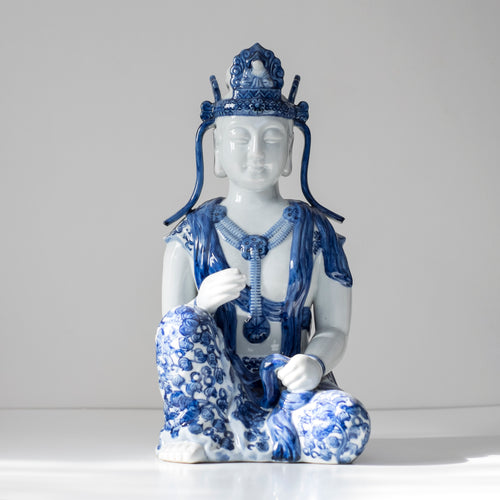
A substantial blue-and-white porcelain Kannon, or Guanyin, that turns the familiar language of cobalt decoration into a fully sculptural Buddhist image. Seated in a relaxed royal-ease pose beneath an architectural crown, the Bodhisattva of compassion reads as a bold silhouette across a room and as an intricate study in brushwork up close.
The Piece
The Bodhisattva is seated with one knee raised while the opposite leg folds beneath the body, one hand raised near the chest and the other resting naturally beside the knee. Rather than rigidly frontal or formally enthroned, Kannon appears quietly present, composed yet approachable. The asymmetrical posture, traditionally associated with forms of royal ease, communicates contemplation rather than withdrawal and gives the figure far greater three-dimensional interest than a conventional devotional image: a triangular composition from the front, a forward-projecting leg and layered drapery from either side.
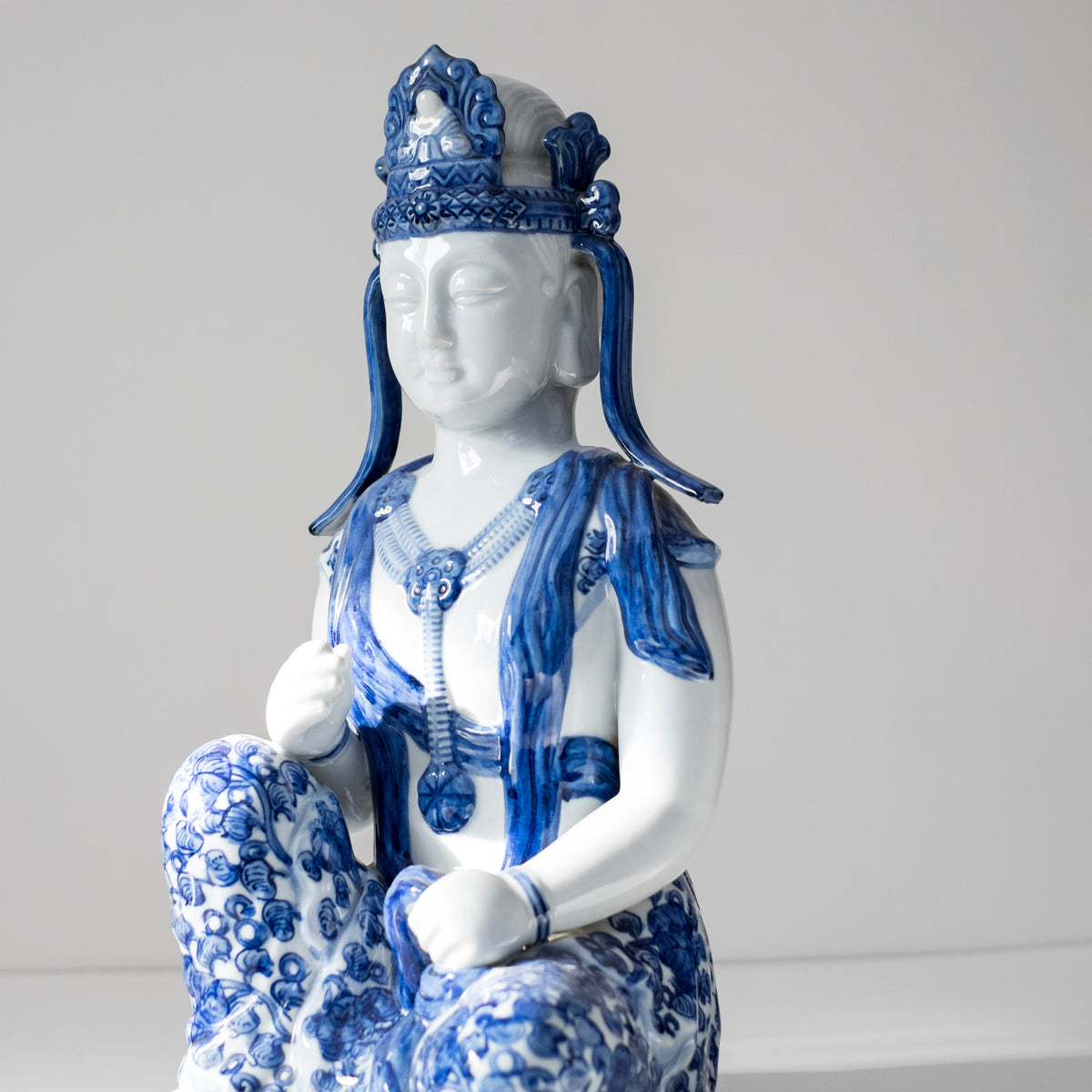
The face is deliberately restrained and left largely in luminous white glaze: subtle eyebrows, gently lowered eyelids, a softly defined nose, the slightest suggestion of a smile and large elongated ears. Rather than outlining every feature in blue, the maker relied on modeling and reflected light. Because the crown and garments around it are densely decorated, the undecorated face becomes the calm center to which the eye returns; pattern surrounds stillness, ornament surrounds calm.
The elaborate crown carries the clearest iconographic clue. At its center a small modeled sacred figure sits within an ornamental crest, surrounded by curling flame- or cloud-like forms in deep cobalt, above a patterned diadem of repeating geometric decoration with a central floral medallion; images of Avalokiteshvara and Guanyin frequently carry a figure associated with Amitabha Buddha in the headdress. Vertical elements rise behind the crown, and long ribbon-like ornaments descend beside both ears, framing the pale face in cobalt and linking the crown to the shoulders below.
The cobalt work changes across the figure: broad flowing strokes on the shoulder robe, tighter repeating bands on the jewelry, geometric ornament and relief on the crown, dense floral decoration on the trousers, and washes on the rear drapery that build folds through tonal variation rather than hard outline. Some passages are deep navy, others soften into cloudy blue, and elsewhere the pigment thins so that the white porcelain becomes part of the design, a painterly sophistication beyond a simple transfer-decorated object. Across the seated legs, large blossoms with buds, leaves and scrolling stems take on an almost textile-like density, so that the raised knee reads as an independent painted panel. On the upper robe, dark cobalt gathers in the recesses and lighter blue follows raised edges; one broad section crosses the back diagonally before falling vertically.
An elaborate necklace or pectoral ornament, modeled and painted into the porcelain, runs down to a central floral element and a long pendant ending near the center of the torso, so that crown, face, necklace and pendant form a calm vertical axis while the raised knee and flowing robes move around it. The hands, set apart by their pure white finish, are simplified but gracefully modeled. The back is fully finished: hair modeled in fine vertical ribs and gathered into a high rounded form, crown ribbons descending independently on either side, a blue floral textile panel across the shoulders and, below, the lower garment as an uninterrupted cobalt garden.
Details
- Origin: East Asia; kiln not attributed
- Era: Vintage; consistent with 20th-century production
- Material: Glazed porcelain with cobalt blue decoration
- Color: Cobalt blue and white
- Subject: Kannon / Guanyin (Avalokiteshvara), seated in royal ease
- Marks: No kiln or maker mark identified
Condition
- Presents beautifully, with a glossy white porcelain body and richly preserved cobalt decoration; the crown, long side ribbons, hands, jewelry, floral garments and modeled facial features remain visually strong.
- As with any vintage ceramic, the photographs should be reviewed for glaze variation, firing irregularities, light rubbing, crazing, minor surface marks or other age-related characteristics of older porcelain.
- The crown projections, long hanging ornaments and hands are the most delicate areas and should be handled with care.
- No kiln mark or underside image has been incorporated into the identification; the photographs form an important part of the condition description.
Iconography of Compassion
Kannon is the Japanese name associated with Avalokiteshvara, the Bodhisattva of compassion, known in Chinese tradition as Guanyin. Rather than power through command, Kannon represents the ability to perceive suffering and answer it, which is why the expression is rarely confrontational and the posture rarely tense: the figure does not dominate the viewer, it receives them. The same image can serve devotionally, as East Asian religious art, or as a contemplative sculptural centerpiece.
Attribution Notes
Blue-and-white porcelain is one of the most influential traditions in East Asian ceramics: in Japan it is associated with sometsuke, in China with qinghua, and because workshops in both countries shaped international taste for centuries, later works can blend conventions from each. The statue has previously been described with Japanese Arita and Imari terminology as well as Chinese Guanyin references. The exact kiln and date have not been established from the available photographic evidence; its materials, modeling and decoration are consistent with 20th-century East Asian porcelain production, and a more precise attribution would require maker marks, box inscriptions or provenance.
Display Guidance
The figure glows against dark wood; a black or dark lacquer platform intensifies the cobalt, natural oak gives a quieter Japanese presentation, and a neutral plaster or stone wall brings the silhouette forward. In strong daylight the cobalt turns vivid, while softer interior light deepens it toward indigo. For a tokonoma-inspired setting, leave space around it, avoid competing patterns behind it and keep the profile of the crown ribbons and raised knee visible; a restrained textile, small flower arrangement, low bronze object or simple scroll complements it, as do indigo textiles, warm timber and muted natural materials. Because the rear is fully finished, it suits open shelving or a central console viewed from several sides.
Authenticity & Care
No kiln or maker mark has been identified, so the figure is deliberately not presented as Arita, Imari or Jingdezhen manufacture; it is offered conservatively as a vintage East Asian blue-and-white porcelain Kannon / Guanyin. Every piece is examined and documented in Japan before dispatch and is offered with the Japonista authenticity guarantee.
Delivery from Japan
Packed by hand in Japan and shipped insured and tracked by EMS or an equivalent express service. Import duties and taxes, where applicable, are payable on arrival. Every sale is final; please ask anything you wish to know before you buy, and see our published policy.
Considered offers are welcome through Send an Offer, and each one is reviewed personally.
Continue browsing: Buddhist Statues & Sacred Art · Okimono
Temple to Home
Monumental statues, zushi shrines and altars travel crated and insured through our Museum-Grade Logistics Suite™. Seeking a particular deity or school? The Hunting Salon™ searches Japan for it. Arrange crating and freight →
Collectors also search: blue and white porcelain kannon · porcelain guanyin statue · sometsuke kannon figure · seated bodhisattva statue · royal ease guanyin · cobalt porcelain buddhist statue · vintage guanyin figure


Chosen for you