
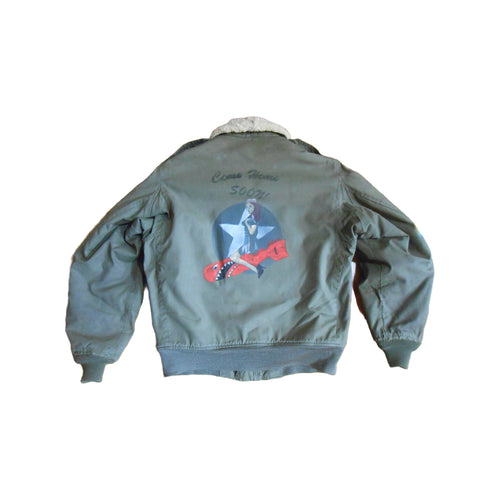


WWII USAAF Type B-10 Flight Jacket, Rough Wear Clothing Co., 20th Air Force & B-29 Patches, Painted Back Art, Size 38
WWII USAAF Type B-10 Flight Jacket, Rough Wear Clothing Co., 20th Air Force & B-29 Patches, Painted Back Art, Size 38
- Dispatch
- Prepared and sent from Tokyo within 7–14 days, often sooner, or as arranged
- Arrival
- États-Unis · usually 4–7 days after dispatch, insured and tracked Check the Shipping Flowchart here
- Import
Duties and customs · View the estimate
A guide for this piece: about $455, based on the 10% US charge on the declared value of goods made in Japan.
The final figure is set by US Customs and depends on where the piece was made and the kind of object it is. Many antiques over a century old carry no ordinary duty; most jewellery and leather goods add a single-digit rate.
With EMS, any charge is collected by your postal service on delivery. For pieces of significant value we can often arrange duties prepaid before dispatch.
How the estimate is reached · Ask for a figure on this piece
- Sizing
- Measured flat by hand, pit to pit and length, in centimetres · Find your size · Ask before you buy
- Character
- QuietResplendent Scoring underway ·
- Replies
- Within one Tokyo business day · Ask the curator team
- Guarantee
- Authenticity guaranteed · How we grade
Every piece is measured by hand, in centimetres as Japan measures. Please allow 1–2 cm (about ½ inch) for the give of the material and the hand that held the tape.
Impossible de charger la disponibilité du service de retrait
All sales are final. Please read our refund policy before purchase.
Considered offers only. The Desk replies personally to figures made in good faith; those set far below the asking price receive no reply.
Examined in Tokyo, one price, insured to your door. How buying from Japonista works · Join the Circle, free
A rare surviving cotton Type B-10 by Rough Wear Clothing Co., carrying the insignia of the Twentieth Air Force, the B-29 command whose war ran straight to Japan, with felt and hand-painted leather squadron patches and a painted back.
The Type B-10, 1943 to 1944
By 1943 the US Army Air Forces faced a problem that had nothing to do with the enemy: leather. The horsehide A-2 and the heavy sheepskin B-3 and B-6 consumed hides at a rate the wartime economy could not sustain, and they were slow to make. The answer was a new family of cloth-shelled intermediate flying jackets, and the first of them was the Type B-10. Standardised in July 1943, it married a close-woven olive cotton shell to a lining of alpaca and wool pile, with a mouton collar, knitted cuffs and waistband, and a zip front closed at the throat by a buttoned tab. It was rated for roughly 22 to 52 degrees Fahrenheit, the band of cold in which most bomber crews actually worked.
Combat issue began with the Eighth Air Force in England in March 1944, and the B-10 was intended to supplement, and in time replace, the leather A-2 and the sheepskin B-6. Its service life was short. By late 1944 the design had been refined into the Type B-15, which carried the idea forward into the 1950s, and the B-10 left production after barely a year and a half. That brief window is one reason collectors value an original Army Air Forces cotton flight jacket of 1943 so highly.
The other reason is survival. Leather jackets were kept, worn for decades and handed down; cotton jackets were worn hard, washed, patched and discarded. Collectors who have pursued the B-10 for years remark on how few remain, and fewer still with their original wartime insignia. A decorated B-10 is the cloth counterpart of a painted A-2, and it surfaces far less often.
Rough Wear and Specification 3157
The label inside this jacket reads TYPE B-10, SPECIFICATION NO. 3157, SIZE 38, followed by a stock number, a contract line and the maker's name, ROUGH WEAR CLOTHING CO., above the familiar PROPERTY AIR FORCES, U.S. ARMY. Specification 3157 is the same number recorded on other documented original B-10s, which places this label squarely within the standard wartime pattern. The contract digits are too worn to transcribe with confidence, so we do not quote them.
Rough Wear Clothing Co. of Middletown, Pennsylvania, was one of the established flight-clothing contractors of the war, holding contracts for the leather A-2 as well as for cloth jackets. Its name remains one of the most respected on a Second World War label, and Japanese makers such as Buzz Rickson's have recreated the Rough Wear B-10 in meticulous detail precisely because the original is so hard to find. For a collector, a genuine Rough Wear B-10 is the reference against which every reproduction is measured.
The Twentieth Air Force
The embroidered disc on the left shoulder, a blue field with a numeral 20 over a globe, the AAF star and wings, is the insignia of the Twentieth Air Force. It was a new kind of command. Created by the Joint Chiefs of Staff in April 1944, the Twentieth answered directly to Washington rather than to a theatre commander, and it existed for one purpose: to carry the Boeing B-29 Superfortress against Japan. XX Bomber Command was assigned to it from 19 April 1944, and XXI Bomber Command in the Marianas followed.
The B-29 was the most advanced bomber of the war, pressurised, remotely armed and capable of missions lasting twelve to sixteen hours. Lighter cloth jackets of the B-10 and B-15 families were the kind of clothing its crews favoured inside that heated cabin. We cannot document this jacket's wearer, but the right-shoulder patch, a red B 29 above a gold V and a globe, is a crew or souvenir insignia commonly encountered with Superfortress men. We have not been able to confirm it as an official unit design, and we describe it simply as what it is.
Matterhorn and the Road to Tinian
The first Superfortress campaign was mounted from India. Under Operation Matterhorn, XX Bomber Command based its B-29s around Kharagpur in Bengal and staged them through forward airfields near Chengdu in China, flying their own fuel and bombs over the Himalayan Hump before each raid. The first combat mission was flown on 5 June 1944 against Bangkok: ninety-eight aircraft launched and seventy-seven bombed. Ten days later, on the night of 15 to 16 June, B-29s struck the Yawata steelworks in Kyushu, the first attack on the Japanese home islands since the Doolittle Raid of 1942.
The campaign was punishing and logistically fragile. The Hankow fire raid of 18 December 1944 sent eighty-four B-29s with some five hundred tons of incendiaries against the Japanese base in central China. In January 1945 the China fields were abandoned, and by spring the 58th Bomb Wing, with its 40th, 444th, 462nd and 468th Bomb Groups, had moved to the Marianas; the 468th left India on 4 May 1945 and arrived at West Field, Tinian, three days later. From those islands the Twentieth Air Force flew the raids against Japan's cities that closed the war.
After V-J Day the B-29s did not simply go home. They flew supply drops to prisoner-of-war camps and show-of-force missions over Japan, and many crews remained in the Pacific and in occupied Japan through the following months. That occupation period matters to this jacket, as we explain below.
Felt, Painted Leather and Back Art
American bomber crews decorated their clothing in the same spirit as their aircraft. Squadron insignia were made in the United States as wool-felt patches with chain-stitch embroidery, the classic technique of 1943 to 1945, and the left chest of this jacket carries one: a yellow felt disc with a green, bird-like cartoon figure astride a bomb before a white star. We have compared it against the squadrons of the 58th, 73rd, 313th, 314th and 315th Bomb Wings without a confident match, so it is presented as an unidentified B-29-era squadron insignia.
In the China-Burma-India theatre, and later in occupied Japan, crews also commissioned insignia from local craftsmen, who painted them on discs of leather. These hand-painted leather patches have become a collecting field of their own. The right chest here carries one: a snarling tiger's head over a green disc, a yellow arrow below and, above it, a mushroom-shaped cloud, all within a painted blue and black border. That cloud is the telling detail. It suggests a design of August 1945 or later, which would place the patch in the post-war or occupation period rather than the India campaign, and we would rather say so than claim a CBI pedigree the jacket cannot prove.
On the back is a painted pin-up in the nose-art tradition: a red-haired girl in a dark dress riding a red, shark-mouthed bomb in front of the white star of the national insignia, beneath the script Come Home SOON. The image is handsomely executed, but it is also very clean and smoothly airbrushed, with none of the crazing or loss usually seen on paint that has flexed with a cotton shell for eight decades. Our honest reading is that the back art may be a later addition, and its date is undetermined.
Why Japan Keeps These Jackets
Japan is the deepest collector market in the world for American flight clothing, and the B-29 story is the reason this jacket resonates here more than anywhere else. The Superfortress crews of the Twentieth Air Force flew from Chengdu to Yawata and from Tinian to Tokyo; after the surrender, many of them were stationed in Japan itself. Japanese collectors and makers have spent decades studying these garments with forensic care, which is why reproductions by Buzz Rickson's and The Real McCoy's exist, and why an original such as this is treated as a historical document rather than as fashion.
The Piece
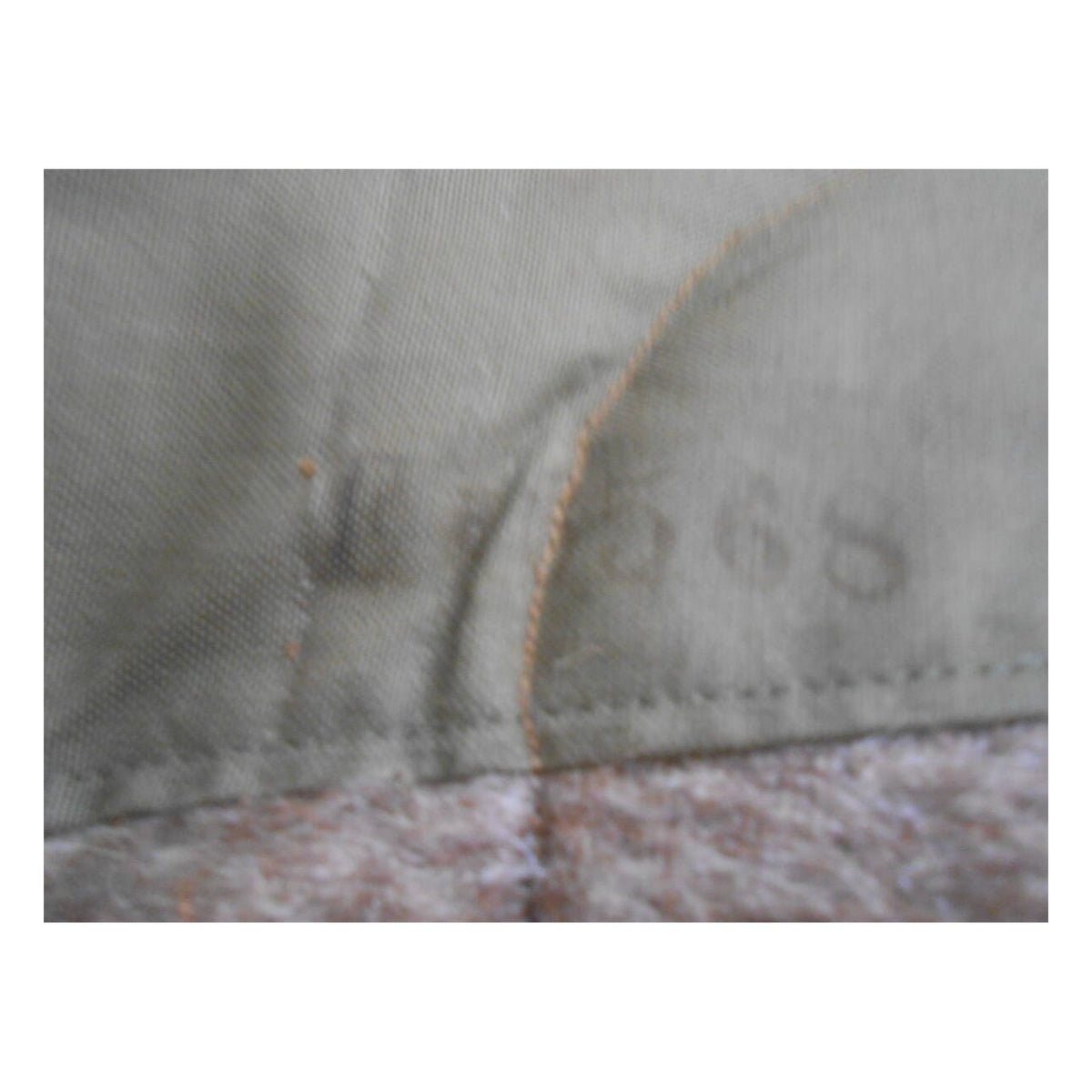
This is a genuine Rough Wear Type B-10 with its specification 3157 label intact, a Conmar zip that still runs smoothly, an olive cotton shell that keeps its body, a full mouton collar and the original alpaca pile lining. The throat tab with its two buttons is present, as are both flapped patch pockets. A partial ink stamp survives inside the lining; only the characters '...68' can be read, not a name or serial. The name tag has been removed.
The decoration is unusually complete for a cloth jacket: the Twentieth Air Force patch on the left shoulder, the B-29 V globe on the right, an unidentified felt squadron insignia on the left chest and a hand-painted leather tiger patch on the right, with the painted Come Home SOON pin-up across the back. Taken together, the insignia are consistent with Twentieth Air Force B-29 service; the theatre is not documented, and the leather patch points to the end of the war or just after it.
Although labelled a 38, the jacket is cut generously and measures closer to a modern 40. It can be worn, but we would treat it as a piece to keep, study and pass on: an object that carries the arc of the Superfortress war against Japan on its shoulders.
Details
- Type: Type B-10 intermediate flying jacket, US Army Air Forces
- Maker: Rough Wear Clothing Co., Middletown, Pennsylvania
- Contract / label: Type B-10, Specification No. 3157, Size 38, Property Air Forces, U.S. Army; contract digits partly illegible
- Era: Second World War, 1943 to 1945 (B-10 standardised July 1943)
- Leather / shell: Olive cotton shell, mouton collar
- Hardware: Conmar zip, two-button throat tab
- Lining & knits: Alpaca and wool pile lining; knit cuffs and waistband (sleeve knits possibly replaced)
- Decoration: 20th Air Force shoulder patch; B-29 V globe patch; unidentified felt squadron patch; hand-painted leather tiger patch (likely 1945 or later); painted pin-up back art, date undetermined
- Tagged size: 38 (fits nearer a modern 40)
- Measurements: Shoulder 48 cm · Chest (pit to pit) 55 cm · Sleeve 57 cm · Length 62 cm
Condition
- Cotton shell sound with good body; minor shell damage near the zip
- Small repair at the left cuff edge
- Sleeve knits sewn with a thread different from the waistband; replacement possible, period or later, undetermined
- Name tag removed; partial ink stamp inside the lining, not legible as a name
- Back art very clean with no crazing; possibly a later addition
- Conmar zip runs smoothly
Condition grade AB on the Japanese scale; see Japanese condition ranks, explained.
Authenticity & Care
The label, contract and size tags, leather, stitching, zip and hardware, paint and insignia are examined together and documented in Japan before dispatch; anything that cannot be confirmed is stated plainly in the description. Every piece carries the Japonista authenticity guarantee. Hang on a broad, padded hanger away from light and damp, and have the painted back and leather patch assessed by a textile conservator before any cleaning.
Delivery from Japan
Packed by hand in Japan and shipped insured and tracked by EMS or an equivalent express service. Import duties and taxes, where applicable, are payable on arrival. Every sale is final; please ask anything before you buy, and see our published policy.
Every figure above is taken by hand with the garment laid flat, in centimetres. Lay a shirt or jacket you already love beside them and allow a centimetre or two of margin, the quiet safeguard on a final sale. Our size guide to tops and jackets turns pit-to-pit figures into US, UK, EU and Japanese sizes, and for anything it leaves open the curator team replies within one Tokyo business day.
Considered offers are welcome through Send an Offer, and each one is reviewed personally. Pieces over $1,000 may be reserved over several payments with Layaway Privilege™.
Continue browsing: Military Flight Jacket & Nose Art · Designer Leather Jackets · Japan Luxury Archive
Superfortress crews, Matterhorn to Tinian
Seeking a named B-29 crew jacket, or insignia from a particular Twentieth Air Force bomb group? Our Hunting Salon™ locates a specific reference across Japan’s private collector circles, then inspects, documents and delivers it to you. Begin a Hunting Salon™ request →
Collectors also search: WWII B-10 flight jacket original · Type B-10 jacket Rough Wear · Rough Wear Clothing Co B-10 · USAAF B-10 alpaca jacket · original B-10 jacket 20th Air Force · B-29 crew flight jacket · 20th Air Force patch jacket · CBI flight jacket painted patch · WWII flight jacket pin-up back art · B-10 specification 3157 · XX Bomber Command jacket · Matterhorn B-29 jacket


Chosen for you