
Noh Theatre: Masks, Silence and the Hashigakari
Stage arts of Japan
Noh Theatre: Masks, Silence and the Hashigakari
能
A bare cypress stage, a painted pine, a long bridge, and a masked figure who may take minutes to cross it. Noh is the oldest major theatre still regularly performed anywhere, and one of the most patient.
Fact sheet
At a glance
- Slow by design. Movement is reduced to what is essential, so a single turn of the head can carry a scene.
- Masked lead. Usually only the principal actor, the shite, wears a mask.
- One sacred roof. The stage roof, even indoors, descends from the pavilions of Shinto shrines.
- Sung and danced. Chorus, flute and three drums frame every performance.
A theatre that begins with a walk
First lookImagine a stage with no curtain and no scenery that changes. Behind the performers, a single pine tree is painted on a wooden panel. To one side a narrow bridge runs back into shadow. A figure in a heavy silk robe and a carved mask appears at the far end of that bridge and begins, very slowly, to cross. Nothing in the next ten minutes will happen quickly, and almost everything will matter.
That is Noh (能). The character means skill or talent, and the art is a dance-drama that has been performed since the fourteenth century, which makes it Japan's oldest major theatre still regularly staged. Its plots are usually drawn from classical literature. A supernatural being, often a ghost, takes human form and tells the story; masks, costumes and a few props carry the rest. Emotion is conveyed by stylised, conventional gesture rather than by realism.

Maarten Heerlien from Voorschoten, The Netherlands, 4 September 2019 18:40. Wikimedia Commons.
Look closer: Find the painted pine on the back wall, then the bridgeway running off to the left of the stage.
Maarten Heerlien from Voorschoten, The Netherlands, Stage of the Kyoto-Kanze Noh and Kyogen theatre (48885678827). Wikimedia Commons, CC BY 2.0. Source file
The word is often paired with kyogen, the comic theatre that shares its stage. Together the two are called nogaku. UNESCO proclaimed the tradition a Masterpiece of the Oral and Intangible Heritage of Humanity in 2001 and inscribed it on the Representative List in 2008. The Japan Arts Council's own account stresses the same point: this is a living art, performed today in dedicated theatres by families of performers who trace their lines back many generations.
The stage as a sacred building
The Noh stage is complete openness. There is no proscenium and no curtain, so the audience can see actors before they enter and after they leave. What does hang over the stage is a roof of its own, supported by four pillars. It survives even in modern indoor theatres, where it floats under a larger ceiling, because the design descends from the worship and sacred-dance pavilions of Shinto shrines. The roof tells the audience that the platform below it is consecrated.

さかおり, 22 November 2016, 12:32:48. Wikimedia Commons.
Look closer: A Noh stage in the open air, at a shrine: the roofed platform and bridgeway are the same as indoors.
さかおり, Noh Stage, Itsukushima Shinto Shrine. November 22, 2016. Wikimedia Commons, CC BY-SA 4.0. Source file
The audience faces the main stage and the painted pine; the bridgeway reaches the stage from the left of the audience's view. Pillar positions follow the standard arrangement of the roofed stage.
Diagram by Japonista.
The floor is unfinished Japanese cypress (hinoki), with almost no decoration. On the back wall, a panel painted with a green pine tree is the only picture. The four pillars each have a name and a use: the principal character's pillar, the gazing pillar, the secondary character's pillar and the flute pillar. A masked actor, whose view is badly narrowed by the mask, steers by them.
The most distinctive feature is the hashigakari, the bridgeway along which actors enter. The word means a suspension bridge, and the sources are careful about the idea: it connects two separate worlds on a single level, the ordinary world of the audience and the realm from which spirits come. Kabuki's hanamichi, by contrast, is simply a path joining two places in one world. The difference in the two words is the difference between the two theatres.
Who stands where
The connoisseur's eyeA Noh performance has four kinds of performer, and each belongs to a hereditary school. The shite is the principal, who may appear first as an ordinary person and later as a ghost, god or demon; in that case the earlier role is the mae-shite and the later the nochi-shite. The waki is the counterpart or foil, usually a travelling priest, official or warrior, and generally unmasked. Companions are called tsure. Kyogen actors perform the interlude, the aikyogen, while a chorus of six to eight sits to the side and a small band sits at the back.

Sherwin John Carlquist, August 1963. Wikimedia Commons.
Look closer: Count the seated chorus on the right and the masked principal at the centre.
Sherwin John Carlquist, Noh drama in Osaka, Japan. Wikimedia Commons, CC BY 4.0. Source file
| Role | Japanese | Who it is | Mask? |
|---|---|---|---|
| Shite | シテ 仕手 | The principal; often a spirit, god or demon in disguise | Usually, yes |
| Waki | ワキ 脇 | The counterpart: a priest, traveller or warrior | Almost never |
| Tsure | ツレ 連れ | A companion of shite or waki | Sometimes |
| Jiutai | 地謡 | The chorus, six to eight singers seated at the side | No |
| Koken | 後見 | Stage assistants, one to three, who also manage costume and props | No |
| Hayashi | 囃子 | Flute, shoulder drum, hip drum and sometimes stick drum | No |
| Aikyogen | 間狂言 | Kyogen actor who bridges the two acts | Depends on role |
The band, the hayashi, has just four instruments: the nohkan, a transverse flute, and three drums, the shoulder drum (kotsuzumi), the hip drum (otsuzumi) and, in some plays, a stick drum (taiko). Silence is treated as part of the music. The Japanese word ma, a deliberate gap, is described in the sources as the heart of Noh's sound.
Five kinds of play, one afternoon
Roughly two thousand plays written for Noh are known, but only about 240 are in the current repertoire, a list shaped largely by the taste of the Tokugawa aristocracy rather than by the crowd. All of them are sorted by theme into five categories, and the sorting is not academic. A formal programme once took one play from each category in order, and the categories were designed so that the day would follow the rhythm of jo-ha-kyu: a slow beginning, a development and a fast close.
The idea of jo-ha-kyu began in gagaku, the ancient court music, where it described gradually quickening tempo. It was borrowed by Noh and, according to the sources, by tea ceremony, poetry and flower arrangement as well. Within a single play the same pattern repeats: introduction, development, conclusion. Many full programmes also begin with Okina, a ritual piece that combines dance with Shinto observance and is considered the oldest kind of Noh.
| Place | Category | Shite is | Examples |
|---|---|---|---|
| 1 | Kami-mono, god plays (waki Noh) | A deity, often in disguise first | Takasago, Chikubushima |
| 2 | Shura-mono, warrior plays | The ghost of a warrior pleading for release | Tamura, Atsumori |
| 3 | Katsura-mono, wig or woman plays | A woman, spirit or celestial maiden | Hagoromo, Matsukaze |
| 4 | Miscellaneous plays, including madness and vengeful ghosts | A distraught woman, a grieving parent, a wronged spirit | Kinuta, Aya no tsuzumi |
| 5 | Kiri Noh, demon plays | A demon, goblin or monster | Roughly thirty plays, usually brief |
Two kinds of time, dream and waking
Noh plays divide into two kinds by how they treat time. In genzai Noh, the present play, living people move through events in a straight line. In mugen Noh, the dream-and-phantasm play, the shite is a spirit. A traveller (the waki) arrives at a famous place, meets a stranger who tells its history, and the stranger vanishes. In the second half the stranger returns in his or her true form and dances. The traveller wakes, or the dream ends, and the stage is empty.
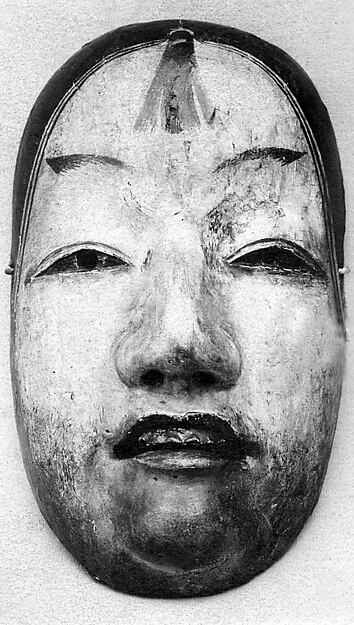
Japan, 1336–1573. Lacquered wood. The Metropolitan Museum of Art, accession 17.175.58.
Look closer: Tilting a mask upward catches light and brightens it; tilting down clouds it. The same face can seem to smile or grieve.
Japan, Noh mask, 1336–1573. The Metropolitan Museum of Art, Rogers Fund, 1917, accession 17.175.58. Public domain (Met Open Access, CC0). Museum record
This is why so many of the best-loved plays feel like visits to a haunted place. Time is not linear and the line between the living and the dead is thin. A few plays mix the two modes, with a present-day first act and a dream second act. That is the structure that Western writers, from Yeats to Britten, found most startling.
Zeami and the flower that does not fade
The deep endNoh traces its ancestry to sangaku, an entertainment of acrobats, songs, dances and comic sketches that reached Japan from China in the eighth century, and to dengaku, sarugaku, shirabyoshi, gagaku and kagura. By the fourteenth century, performers of sarugaku in Yamato Province, including the Kanze troupe led by Kan'ami, had become professional families. When Kan'ami presented his work to the young shogun Ashikaga Yoshimitsu, his child son Zeami was among the actors, and the shogun's favour fixed Noh at the centre of court taste.
Zeami Motokiyo wrote many of the texts still performed and set out the art's theory in treatises, among them the Fushikaden, usually rendered as the Flowering Spirit. Three of his ideas are worth carrying into the theatre. Hana, the flower, is the quality that an actor cultivates until it never vanishes, whatever the age of the performer. Yugen, profound sublimity, is a beauty felt rather than seen, often tied to loss. Rojaku, the tranquillity of age, is the final stage in which everything unnecessary has been taken away. The sources also record that Zeami was later exiled to Sado Island, where the drummers of Kodo now live.
| Term | Meaning | Where you meet it |
|---|---|---|
| Hana 花 | The flower: an actor's living appeal | A role performed by a young or an old actor, equally compelling |
| Yugen 幽玄 | Profound, unseen beauty | A ghost's farewell at dawn |
| Ma 間 | The charged gap between sounds | A silence before a drum stroke |
| Rojaku 老弱 | The tranquillity of age | A late-career actor doing very little, perfectly |
| Jo-ha-kyu 序破急 | Beginning, breaking, rushing | A programme, a play, a single dance |
After Zeami, the Konparu, Hosho, Kongo and Kita lines took shape alongside Kanze, and the Tokugawa shogunate named Noh its ceremonial music, the shikigaku, performed at official events. Noh then changed little. Performances were copied so exactly that the tempo gradually slowed, one reason the art strikes some modern audiences as glacial.
Robes in brief
Noh costumes (shozoku) are silk robes, wigs, hats and props. The principal's robes are the most sumptuous brocades; those of companions and kyogen actors are progressively plainer. For centuries they copied what characters would really wear, and from the late sixteenth century they became stylised. The fan is the commonest prop: carried by every performer, it stands in for a sword, a wine jug or a writing brush. The textiles themselves belong to the story of Japanese cloth, taken up in Kimono Textile Heritage and, for the masks, in the next chapter. Dedicated chapters on stage costume are being prepared in the Traditional Clothing almanac and will be linked here when they open.
Schools, survival and where to look
Five schools train shite actors: Kanze, Hosho, Komparu, Kongo and Kita. Waki actors belong to the Takayasu, Fukuou and Hosho lines, and kyogen actors to Okura and Izumi. Eleven further schools train flautists and drummers. Each shite school has an iemoto, a head family that holds the right to alter texts and performance modes.

Rs1421, September 2012. Wikimedia Commons.
Look closer: A modern public theatre built for Noh in 1983.
Rs1421, National-Noh-Theater-01. Wikimedia Commons, CC BY-SA 3.0. Source file
The fall of the Tokugawa in 1868 ended state support, and the number of performers and stages fell sharply. Noh was rescued partly by its appeal to foreign diplomats and partly by companies that played to the public in the cities. The government designated nogaku an Important Intangible Cultural Property in 1957, and the National Noh Theatre opened in Tokyo in 1983. Women were long excluded; by 2009 there were about 1,200 male and 200 female professionals.
For a first visit the sensible advice is to buy a seat for a short programme with a Noh and a kyogen play, read the synopsis before the curtainless start, and let the pace work on you. Practicalities are collected in the first-timer's guide and the guide to theatres. Masks and robes, the objects that a collector meets first, have their own chapter: Noh masks and costume.
Noh masks in stock
Two carved masks from the house collection, each photographed by us. Stock changes; the full shelf is below.


Answered plainly
What is the difference between Noh and Kyogen?
Both belong to nogaku and are performed on the same stage. Noh is a slow, sung dance-drama of masks, ghosts and gods; kyogen is a dialogue-driven comedy drawn largely from the lives of ordinary people. Kyogen is often performed between Noh plays.
How long does Noh last?
A single Noh play usually lasts about 60 to 90 minutes, and a kyogen piece 15 to 30. A typical programme today pairs one of each, or two Noh plays with one kyogen.
Do I need to understand the language?
No. Texts are in classical Japanese, so even native speakers use a synopsis. Many theatres provide printed or screen synopses; read the plot first and watch the movement.
Why do the actors move so slowly?
Because movement is reduced to what is essential, and because the tradition has valued exact copying of great masters. The slowing over centuries is recorded in the standard histories.
Is Noh still performed?
Yes. More than seventy Noh theatres are active across Japan, including the National Noh Theatre in Tokyo, and the five shite schools each maintain their own stages.
Where next
Sources and image credits
- Noh, Wikipedia
- UNESCO, Noh theatre (Representative List of the Intangible Cultural Heritage)
- FUN! JAPAN, What is Nohgaku (beginner article)
- Zeami Motokiyo, Wikipedia
- Hayashi (music), Wikipedia
- Nohkan, Wikipedia
- National Noh Theatre, Wikipedia
- Japan Arts Council, National Noh Theatre (Tokyo)
- Kodo, History
- Itsukushima Shrine, Wikipedia
- Metropolitan Museum of Art Open Access (images)
Image credits, in order of appearance:
- Maarten Heerlien from Voorschoten, The Netherlands, Stage of the Kyoto-Kanze Noh and Kyogen theatre (48885678827). Wikimedia Commons, CC BY 2.0. Source file
- さかおり, Noh Stage, Itsukushima Shinto Shrine. November 22, 2016. Wikimedia Commons, CC BY-SA 4.0. Source file
- Sherwin John Carlquist, Noh drama in Osaka, Japan. Wikimedia Commons, CC BY 4.0. Source file
- Japan, Noh mask, 1336–1573. The Metropolitan Museum of Art, Rogers Fund, 1917, accession 17.175.58. Public domain (Met Open Access, CC0). Museum record
- Rs1421, National-Noh-Theater-01. Wikimedia Commons, CC BY-SA 3.0. Source file
Last reviewed 28 October 2026. Pictures are public-domain or openly licensed and credited beneath each one; diagrams are drawn by Japonista.
Held by a family of collectors, a Noh mask is the quietest object in a room. If you are looking for one, we would be glad to help.
Private concierge
Looking for something in particular?
Describe the piece or the project you have in mind. A senior advisor in Tokyo reads every case file personally and replies within two business days, with fees set out in writing before any work begins.