
Noh Masks and Costume: The Face and the Robe
Objects of the stage
Noh Masks and Costume: The Face and the Robe
能面
Carved from a single block of cypress, coated with ground shell, and no more than a hand's breadth across, a Noh mask is asked to hold every emotion an actor cannot show. The robe beneath it does the rest.
Fact sheet
At a glance
- One block. Carved from a single piece of cypress using hand tools and natural materials.
- No varnish. No fixative is applied, so the surface is fragile and easily marked.
- Made to move. Copies are deliberately a little asymmetrical so the face changes with the tilt of the head.
- Respected. Actors bow to the mask before wearing it.
How a block of wood learns to feel
First lookAsk an actor what a Noh mask does and the answer is not that it hides. The mask fixes a type, a woman, an old man, a god, a ghost, and leaves it to the performer to bring it to life. The scholarly record is clear on the point: a mask is judged less by technical brilliance than by whether it can come alive on stage, and an actor is judged by his capacity to bring out that life.
Part of the trick is optical. Facing slightly upward, the actor lets light fall into the carving and the face seems to smile; facing downward, the brow shadows the eyes and the face seems to grieve or rage. Masks are therefore asymmetrical on purpose. One eye may look slightly up and the other down, one side of the mouth may be more pronounced, so that the face can shift expression as the head moves.

Japan, 1336–1573. Lacquered wood. The Metropolitan Museum of Art, accession 17.175.58.
Look closer: Turn the mask in your mind: a small tilt of the head changes the light across the brow and mouth.
Japan, Noh mask, 1336–1573. The Metropolitan Museum of Art, Rogers Fund, 1917, accession 17.175.58. Public domain (Met Open Access, CC0). Museum record
A wig covers the rest of the head, and the mask sits in front of the face rather than over the whole head. In that respect it differs from the older bugaku and gigaku masks of the court, which are larger and more fantastical. Noh masks are naturalistic, distinctly Japanese, and smaller.
Cypress, shell and glue
A Noh mask is carved from an unblemished block of hinoki, Japanese cypress, using hand tools. The carver works on the front and back alternately and opens holes for the eyes, nostrils and mouth. A white primer of crushed shell and animal glue, called gofun, is applied in several layers, followed by flesh tones. The finest details are drawn in ink: the hairline, the eyelids, the strokes of hair. Vermilion is used for the mouth and, on supernatural beings, gold paint or metal inlay.

Japan, 19th century. Wood with pigments and hair. The Metropolitan Museum of Art, accession 25.60.38.
Look closer: Study the deep lines at the brow and cheeks, and the hair set into the face: the old-man masks (jo) are among the oldest family in the repertoire.
Japan, Noh Mask: Kojo (Old Man), 19th century. The Metropolitan Museum of Art, Rogers Fund, 1925, accession 25.60.38. Public domain (Met Open Access, CC0). Museum record
Some masks are given thin brownish layers to suggest age, and carvers may scratch or scar the surface deliberately. Nothing is added on top: no varnish, no fixative. That is why a mask that has been worn for generations carries wear on its face in a way a lacquered object cannot. The backs are often lacquered and may bear inscriptions naming a carver, a date or an owner. The scholarly sources warn that these are not fully reliable for dating, since some were added by restorers or forged.
Reading the groups
The connoisseur's eyeSixteenth-century classification books listed about 125 mask styles; the count is now nearer 200 named types, grouped in categories, types and variants. The common scheme has five groups, for gods, women, men, spirits and demons. The Okina masks of the ritual play form another family, and kyogen masks are classified separately. A few masks serve a single character, such as those of Yamamba, Shunkan and Semimaru. Most are tied to a type and are shared across many plays.
The schools do not agree on everything. A young woman may be played with a Waka-onna in the Kanze school, a Fushiki-zo in Hosho, a Magojiro or Ko-omote in Kongo, and a Ko-omote in Komparu and Kita. This is one reason a collector should always ask what a mask was made for and in which tradition, not only what it is called.
The older scholarly division, following the history of the art, adds useful names: okinamen for the ritual play, kijinmen for the demon-gods that were probably the first masks apart from Okina, jomen for old men, onnamen for young women (devised in the late fourteenth century so that grown men could play female roles), otokomen for courtiers and historical figures, and onryomen for vengeful spirits. Roles of living men are played unmasked, in the style called hitamen.
A simplified chart after the classifications described in the sources; schools differ in detail.
Diagram by Japonista.
| Mask | Meaning | Seen in | Look for |
|---|---|---|---|
| Ko-omote 小面 | Idealised young woman of the Heian court | Hashitomi (as Yugao), many woman plays | Three hairlines, high painted brows, blackened teeth |
| Doji 童子 | A boy; a deity or spirit in disguise | Tamura, Kokaji, Shakkyo | Natural brows, elongated eyes, a gentle smile |
| Kotobide 小飛出 | A fox-god or fox-spirit | Kokaji, Sesshoseki | Eyes that appear to leap from their sockets |
| O-tobide 大飛出 | The larger version of the same type | Supernatural roles | Gold and bulging eyes |
| Kojo 小尉 | An old man | Roles of aged men and gods in age | Deep lines, hair set into the face |
| Noborihige 登髭 | A smiling rustic old man (kyogen) | Subsidiary deities in the interlude | Bristling sideburns, toothless smile |
Four faces worth knowing
The Ko-omote, the small face, is the nearest thing Noh has to a standard beauty. Used in the Kongo school for almost any young female role, it represents an idealised aristocratic woman of the Heian period, fair, with three hairlines, high painted eyebrows and blackened teeth, and is worn with a long black wig. A celebrated example, Yuki-no-Ko-omote, is attributed to the carver Tatsuemon of the Muromachi period.
The Doji shows a boy, but a boy in a particular sense: a deity or spirit in disguise, as in the first half of plays such as Tamura and Kokaji, or a Chinese immortal. The Kotobide and its larger version, the O-tobide, are masks of the fox-god in Kokaji and the fox-spirit in Sesshoseki, with eyes that seem to burst out of the face. In a gilded variant, the Dei-kotobide, the gold marks the character as other-worldly.

Japan, late 18th–early 19th century. Lacquered wood, gold. The Metropolitan Museum of Art, accession 91.1.1026.
Look closer: The bulging eyes and gold are the signs of a supernatural being; compare the plain eyes of the human masks.
Japan, Noh Mask: Ō-Tobide, late 18th–early 19th century. The Metropolitan Museum of Art, Edward C. Moore Collection, Bequest of Edward C. Moore, 1891, accession 91.1.1026. Public domain (Met Open Access, CC0). Museum record
The Hannya, the demoness, is the mask most readers know, and the Met holds a pictorial record of one: a Hannya modelled in papier-mache relief against paper by Ogawa Haritsu (1663 to 1747). It is a reminder that the mask was admired as an object, and as a subject for artists, long before it was exhibited as one.

Ogawa Haritsu (Ritsuō), 18th century. Matted painting; color on papier mache in relief, against a paper background. The Metropolitan Museum of Art, accession 29.100.444.
Look closer: Not a mask but a picture of one: Ogawa Haritsu (1663 to 1747) modelled the face in papier-mache against a paper ground.
Ogawa Haritsu (Ritsuō), Noh Mask of a Demoness (Hannya), 18th century. The Metropolitan Museum of Art, H. O. Havemeyer Collection, Bequest of Mrs. H. O. Havemeyer, 1929, accession 29.100.444. Public domain (Met Open Access, CC0). Museum record
The robe beneath
The deep endA Noh costume is a layered system of silk robes, wigs and hats. The principal's robes are the most sumptuous, shimmering silk brocades; those of the companions and the kyogen actors are progressively plainer. For centuries the robes were meant to look like what characters would genuinely wear. In the late sixteenth century they became stylised, and in the Edo period the robes that nobles and samurai had given to actors in the Muromachi period were developed into costumes.
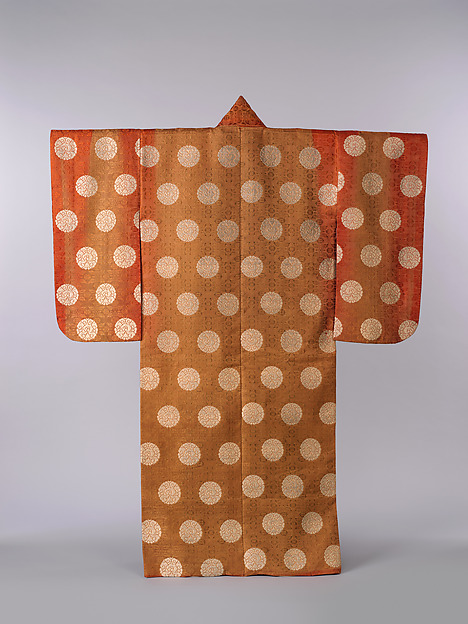
Japan, second half 18th century. Twill-weave silk with brocading in silk and supplementary weft patterning in silk (karaori). The Metropolitan Museum of Art, accession 91.1.61.
Look closer: Read the ground first, then the pattern woven into it: the cloth is the costume's first language.
Japan, Noh Robe (Karaori), second half 18th century. The Metropolitan Museum of Art, Edward C. Moore Collection, Bequest of Edward C. Moore, 1891, accession 91.1.61. Public domain (Met Open Access, CC0). Museum record
The surviving robes are among the finest textiles in Japan. A twill-weave silk karaori of the second half of the eighteenth century, brocaded in a patterned weave, sits in the Met's collection beside kariginu and embroidered nuihaku. How these cloths are woven, dyed and embroidered belongs to the story told in Kimono Textile Heritage. Dedicated chapters on stage costume are in preparation in the Traditional Clothing almanac and will be linked here when they open.
Masks you can see in person
Photographed by us, from the house collection. Stock changes; the full shelf is below.


Answered plainly
What are Noh masks made of?
A single block of hinoki, Japanese cypress, coated with a primer of crushed shell and animal glue and painted with natural pigments. No varnish is applied.
What does utsushi mean?
An utsushi is a copy of an old standard mask (honmen). Copies keep the name of the original and have been made since at least the Edo period.
Can the signature on the back be trusted?
Not alone. Inscriptions naming a carver or date appear on the backs of many masks, but scholars warn that some were added by restorers or forged, so they should be read with the carving and surface.
Why do masks look different when tilted?
Masks are asymmetrical by design, and light falls differently into the carving as the head moves. Facing upward tends to brighten the expression; facing downward clouds it.
Does everyone wear a mask in Noh?
No. Usually only the shite, and sometimes a companion, wears one. The waki and chorus are unmasked, and living men may be played unmasked in the style called hitamen.
Where next
Sources and image credits
- Noh, Wikipedia
- UNESCO, Noh theatre (Representative List of the Intangible Cultural Heritage)
- Stanford University, Noh staging: masks
- JAANUS, Japanese Architecture and Art Net Users System: nomen
- Metropolitan Museum of Art Open Access (images)
Image credits, in order of appearance:
- Japan, Noh mask, 1336–1573. The Metropolitan Museum of Art, Rogers Fund, 1917, accession 17.175.58. Public domain (Met Open Access, CC0). Museum record
- Japan, Noh Mask: Kojo (Old Man), 19th century. The Metropolitan Museum of Art, Rogers Fund, 1925, accession 25.60.38. Public domain (Met Open Access, CC0). Museum record
- Japan, Noh Mask: Ō-Tobide, late 18th–early 19th century. The Metropolitan Museum of Art, Edward C. Moore Collection, Bequest of Edward C. Moore, 1891, accession 91.1.1026. Public domain (Met Open Access, CC0). Museum record
- Ogawa Haritsu (Ritsuō), Noh Mask of a Demoness (Hannya), 18th century. The Metropolitan Museum of Art, H. O. Havemeyer Collection, Bequest of Mrs. H. O. Havemeyer, 1929, accession 29.100.444. Public domain (Met Open Access, CC0). Museum record
- Japan, Noh Robe (Karaori), second half 18th century. The Metropolitan Museum of Art, Edward C. Moore Collection, Bequest of Edward C. Moore, 1891, accession 91.1.61. Public domain (Met Open Access, CC0). Museum record
Last reviewed 28 October 2026. Pictures are public-domain or openly licensed and credited beneath each one; diagrams are drawn by Japonista.
If a mask on the shelf speaks to you, or you are looking for a particular type, we would be glad to hear what you have in mind.
Private concierge
Looking for something in particular?
Describe the piece or the project you have in mind. A senior advisor in Tokyo reads every case file personally and replies within two business days, with fees set out in writing before any work begins.