
Karatsu: Iron Brush, Ash Glaze
Pottery Almanac · Northern Kyushu
Karatsu: Iron Brush, Ash Glaze
Karatsu is the tea ware of a port. Its kilns grew up round a harbour that faced Korea, its glaze is ash and its decoration a few strokes of iron, and for the tea masters of the Momoyama period it was one of the three great names, after Raku and Hagi.
Fact sheet
At a glance
- A style named for a port. The name comes from Karatsu, the harbour in Saga Prefecture from which the ware was shipped.
- Third in a famous saying. An old saying ranks Raku first, Hagi second and Karatsu third among wares for the tea ceremony, and Wikipedia calls it one of the top styles for tea.
- Korean technique. Climbing kilns, the kick wheel and the paddle-and-anvil method are said to have come from Korean potters in the late sixteenth century.
- An iron brush. Many pieces are decorated in underglaze iron oxide, a few brushed strokes of reeds, grasses and plants on a pale ash glaze.
- A word with a wide reach. In western Japan pottery in general has often been called Karatsu ware, because so much of it came from that port.
First Raku, Second Hagi, Third Karatsu
Karatsu ware is a style of Japanese pottery produced traditionally in and around Karatsu in Saga Prefecture. Wikipedia says Karatsu has been a hub of foreign commerce and trade since ancient times, and a centre of pottery production since the Azuchi-Momoyama period. The style takes its name from the place where it is produced.
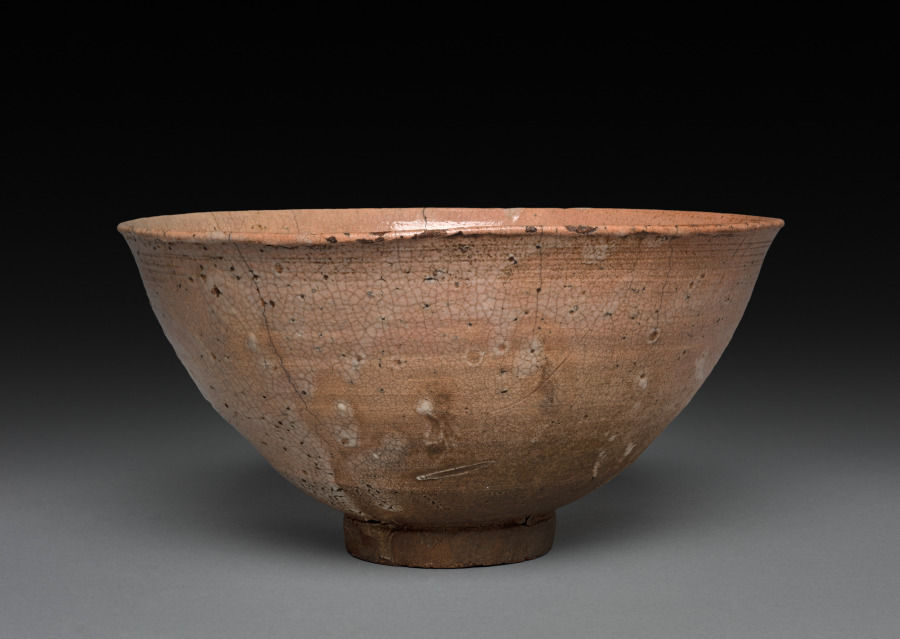
Tea Bowl, c. 1600, Glazed stoneware (Karatsu ware). The Cleveland Museum of Art, Gift of Iwao and Takako Setsu in honor of Dr. and Mrs. Sherman E. Lee, accession 1983.158.
Look closer: the bowl opens wide, the glaze is a warm earthy brown with a paler, rosy rim, and the foot is cut plainly. Nothing is added to the surface, so the clay and the fire do all the work.
Image: The Cleveland Museum of Art, Open Access (CC0)
The ware was originally made for everyday use, as tableware, pitchers and household vessels, and the article calls it a good example of the wabi-sabi aesthetic. Its bowls, plates and other implements are often used in the tea ceremony. It quotes an old saying about tea wares, first Raku, second Hagi, third Karatsu, and reports that Karatsu is considered one of the top styles of pottery for tea in Japan. Pottery in general is often called Karatsu ware in western Japan, the article adds, because of the amount produced there.
The Cleveland Museum's tea bowl, pictured here, is dated to about 1600. The museum notes that wide-mouthed bowls were used for whipped tea at the tea ceremony, that Karatsu ware like this was among the most prized of such bowls, and that the port city of Karatsu was known for kilns that produced high-fired, Korean-style glazed pottery.
The Kilns Under Kishidake
Wikipedia's article on the Hizen Pottery Kiln Sites says the pottery industry of Hizen began in the 1580s, when kilns making Karatsu ware were established around Kishitake Castle in Kitahata, Karatsu, with techniques imported from the Korean Peninsula. Hizen Province was a prominent pottery-making area from the late sixteenth century on.
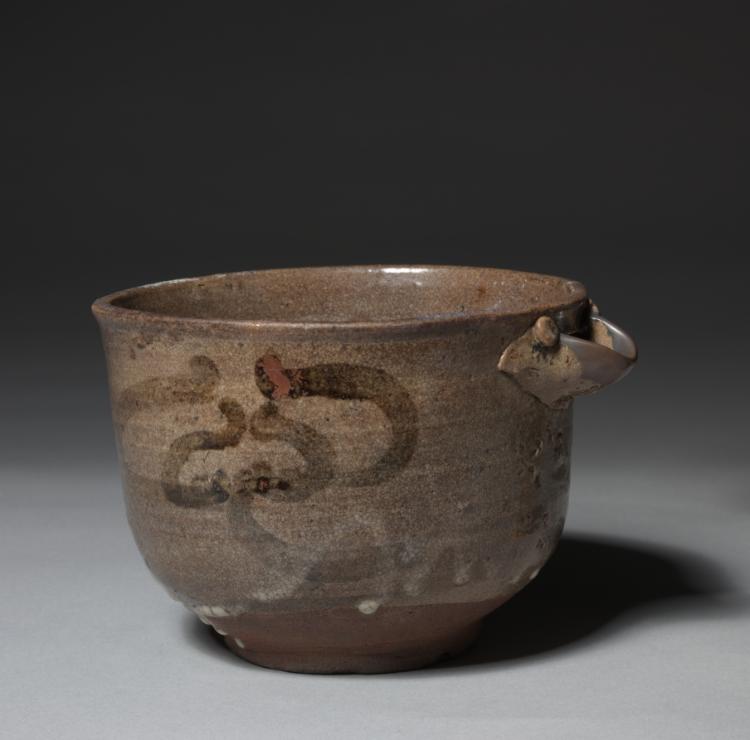
Spouted Bowl with Flower Design, late 1500s, glazed stoneware with slip decoration (Karatsu ware). The Cleveland Museum of Art, John L. Severance Fund, accession 1983.7.
Look closer: a short spout is pulled out of the rim, and a bold curling mark in dark iron is brushed across the brown glaze. The museum's title calls the design a flower.
Image: The Cleveland Museum of Art, Open Access (CC0)
The Karatsu article puts the matter more cautiously. The techniques are believed to have been imported from the Korean Peninsula during the Japanese invasions of Korea in the late sixteenth century, though some theories suggest they were in use before that. The Dictionary of Japanese Architectural and Art Historical Terminology, JAANUS, gives the setting: Karatsu stands near Nagoya Castle, the launching point of Toyotomi Hideyoshi's invasions of Korea in 1592 and 1597, and was one of the areas where Korean potters brought back by Hideyoshi's generals were resettled. Koreans may also have worked in the area before the invasions.
JAANUS lists three technical gifts attributed to the Korean potters: the kick wheel, the paddle and anvil for making thin or strong walls, and the split-bamboo style of noborigama, the climbing kiln, for high-temperature firing. Karatsu ware, as Wikipedia describes it, is made from a clay high in iron, fired in climbing kilns, and either left undecorated or painted in iron-based underglaze, which gives it an earthy, simple and natural feeling.
The Cleveland Museum's spouted bowl, pictured here, comes from the earliest phase. It is dated to the late 1500s and catalogued as glazed stoneware with slip decoration.
The Kiln Sites on the Map
Many of the old kilns still survive as ruins. The Hizen Pottery Kiln Sites are Edo-period kilns in Takeo, Taku and Karatsu in Saga Prefecture, and four of them were designated National Historic Sites in 1940. Wikipedia describes them as split-bamboo or multi-chambered climbing kilns that originated in Korean techniques.

Platter (Ōzara) with Pine Tree, early 17th century, Stoneware with underglaze iron oxide decoration (Hizen ware, Karatsu type). The Metropolitan Museum of Art, Mary Griggs Burke Collection, Gift of the Mary and Jackson Burke Foundation, 2015, accession 2015.300.266.
Look closer: a branching motif is drawn in a few quick strokes of black iron, each tip a small cluster, on a pale cream ground. The museum's title names the motif a pine tree.
Image: The Metropolitan Museum of Art, Open Access (CC0)
The four are Sabiya, which made mainly bowls and small plates, including a relatively common whale-skin pattern; Kotoge, whose products show iron decoration, brushstrokes, inlay and stencil printing, with attempts at celadon and blue-and-white porcelain; Otani, which made large plates and bowls with brushed and two-colour decoration, and also porcelain and Kyoto-style pottery; and Hashiba Monoharayama, a dump for defective products that forms a mound and is important for the study of early Karatsu ware.
Further sites were added in 2005. Five lie at the foot of Mount Kishi in Kitahata and are thought to date to the late sixteenth century, which would make them among the earliest. Another, Tojinkoba in Taku, was, according to Taku family documents, first built by Yi Sam-pyeong, the potter also credited with the beginning of Arita porcelain. The Ochawan kiln in Machida was an official kiln, in continuous use from the Edo period into the Taisho era, serving the Karatsu domain and then the Nakazato family, and its products are known as presented Karatsu.
The Met's platter, pictured here, is catalogued as Hizen ware of the Karatsu type, from the early seventeenth century, with underglaze iron oxide decoration.
Painted, Mottled and Korean
Wikipedia lists a long run of Karatsu types: brush-decorated e-Karatsu, Korean Chosen Karatsu, mottled Madara Karatsu, Mishima Karatsu, white-slip Kohiki Karatsu, Okugorai, Seto Karatsu, green Ao-Karatsu, yellow Ki-Karatsu, carved Hori Karatsu, brushed-slip Hakeme Karatsu, combed-slip Kushime Karatsu, Jakatsu and two-colour Nisai Karatsu. Variants are also named after the surrounding areas: Takeo Kokaratsu, Taku Kokaratsu and Hirado Kokaratsu.

Food Cup (Mukōzuke), ca. 1590–1610, Stoneware with underglaze iron brown (Hizen ware, Karatsu type). The Metropolitan Museum of Art, Dr. and Mrs. Roger G. Gerry Collection, Bequest of Dr. and Mrs. Roger G. Gerry, 2000, accession 2002.447.24.
Look closer: the cup is gently squared at the rim, and iron-brown reeds and grasses are painted on the grey glaze with a few strokes of the brush.
Image: The Metropolitan Museum of Art, Open Access (CC0)
The Tenpyodo dictionary, a dealer's reference, explains several. Madara Karatsu uses an opacified straw-ash glaze that forms mottled patterns, with a faint bluish tint from reduction firing and a yellowish one from oxidation, and cylindrical sake cups are notable. Mishima Karatsu inlays white slip into carved or stamped patterns and derives from Korean Mishima ware. Chosen Karatsu combines an iron glaze with a straw-ash glaze that devitrifies. Seto Karatsu uses a feldspar glaze in the Seto manner. Oku-Korai is a large tea bowl, considered the most prized type of old Karatsu and compared to Ido bowls.
The Met's painted food cup pictured here, a mukozuke of about 1590 to 1610, is catalogued as Hizen ware of the Karatsu type with underglaze iron brown. Brushed grasses climb the grey glaze.
| Type | As described | Source |
|---|---|---|
| E-Karatsu, painted | Iron pigment decoration on the glaze | Wikipedia; Tenpyodo |
| Madara Karatsu | Opacified straw-ash glaze in mottled patterns | Tenpyodo |
| Mishima Karatsu | White slip inlaid into carved or stamped patterns | Tenpyodo |
| Chosen Karatsu | Iron glaze with a devitrifying straw-ash glaze | Tenpyodo |
| Seto Karatsu | Feldspar glaze in the Seto manner | Tenpyodo |
| Oku-Korai | Large tea bowl, the most prized type of old Karatsu | Tenpyodo |
Oribe, Terazawa and the Tea Room
JAANUS records that tea masters such as Furuta Oribe, 1544 to 1615, valued the unpretentious beauty of Karatsu bowls for tea, and that Terazawa Hirotaka, 1564 to 1633, daimyo of Karatsu and an enthusiast for tea, was an important patron of the potteries. The relationship with Mino was close: Wikipedia's Oribe article says the multi-chambered climbing kiln reached Mino from northern Kyushu through Korean potters, and the Seto and Mino chapter in this almanac follows that story from the other side.
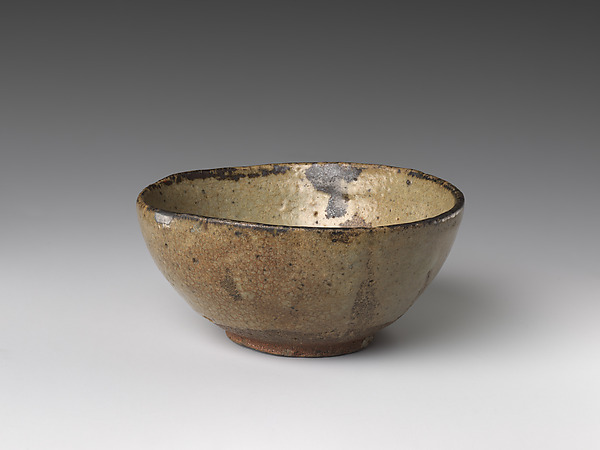
Sake Cup (Guinomi), early 17th century, Stoneware with ash and iron glaze (Karatsu ware); silver lacquer repairs. The Metropolitan Museum of Art, The Harry G. C. Packard Collection of Asian Art, Gift of Harry G. C. Packard, and Purchase, Fletcher, Rogers, Harris Brisbane Dick, and Louis V. Bell Funds, Joseph Pulitzer Bequest, and The Annenberg Fund Inc. Gift, 1975, accession 1975.268.447.
Look closer: a broad shallow cup in a warm sandy glaze, darker at the rim, with a patch at the rim that the museum records among its silver lacquer repairs.
Image: The Metropolitan Museum of Art, Open Access (CC0)
The two Karatsu pieces pictured here from the Met are both small tea-room pieces whose catalogue entries record repairs. The sake cup, a guinomi of the early seventeenth century in stoneware with ash and iron glaze, carries silver lacquer repairs. The small jar, a kotsubo of the late sixteenth to early seventeenth century, carries gold lacquer repairs. Repairs of this kind are part of how such objects are described, and they are noted, not hidden.
Decline, the Official Kiln and the Road to Hirado
Karatsu did not stand still. Tenpyodo says that in the seventeenth century Yi Sam-pyeong found porcelain stone at Izumiyama, and that the rise of Imari ware led to the decline of Karatsu. Mishima and two-colour Karatsu appeared in the early Edo period, and only the official kilns, the Ochawan kilns, continued in limited operation. The Hizen kiln-site article confirms the official kiln, serving the Karatsu domain and then the Nakazato family until the Taisho era.
Karatsu also seeded a second industry. The Hirado article records that the Matsura family, daimyo of Hirado, established a village of Korean potters in the early seventeenth century, who made stoneware of the Karatsu ware type. In the mid-1630s one of them, Sanojo, discovered a good source of kaolin at Mikawachi, and the potters there went on to make the fine blue-and-white porcelain known as Hirado or Mikawachi ware. A neighbouring chapter tells the Arita side of the same story.
For a reader of catalogues the lesson is practical. A label that says Karatsu may refer to a Momoyama tea bowl, to a later kiln in the same tradition, or, in the loose western-Japanese usage, to pottery of the region in general. The glaze, the iron painting and the foot are the clues, and the museum's own catalogue wording is the best guide.
Reeds, Repairs and Slip
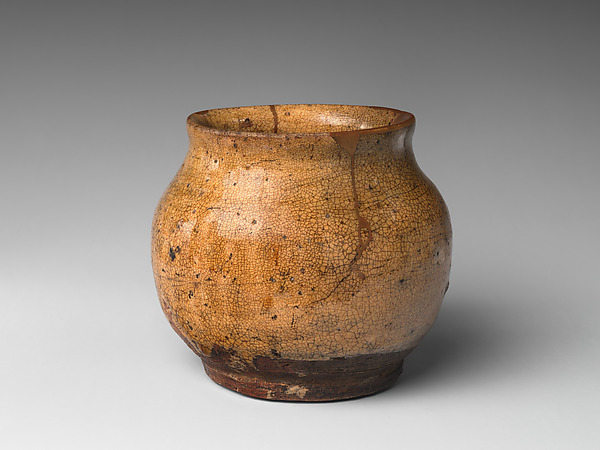
Small Jar (Kotsubo), late 16th–early 17th century, Stoneware with ash glaze (Karatsu ware); gold lacquer repairs. The Metropolitan Museum of Art, H. O. Havemeyer Collection, Bequest of Mrs. H. O. Havemeyer, 1929, accession 29.100.632.
Look closer: a small, plump jar in a warm, amber ash glaze over a darker foot. The museum lists gold lacquer repairs in its catalogue.
Image: The Metropolitan Museum of Art, Open Access (CC0)

Pouring vessel, early 17th century, Painted with underglaze iron decoration (Karatsu ware). The Metropolitan Museum of Art, The Harry G. C. Packard Collection of Asian Art, Gift of Harry G. C. Packard, and Purchase, Fletcher, Rogers, Harris Brisbane Dick, and Louis V. Bell Funds, Joseph Pulitzer Bequest, and The Annenberg Fund Inc. Gift, 1975, accession 1975.268.448.
Look closer: a short spout and a round, calligraphic mark in iron brown on a pale ash glaze. The museum catalogues it as painted with underglaze iron decoration.
Image: The Metropolitan Museum of Art, Open Access (CC0)

Jar, Stoneware with painted decoration in underglaze brown iron (Karatsu ware). The Metropolitan Museum of Art, Dr. and Mrs. Roger G. Gerry Collection, Bequest of Dr. and Mrs. Roger G. Gerry, 2000, accession 2002.447.21.
Look closer: two plant motifs are painted in brown iron on a speckled sandy glaze. The jar is small and rounded, with a short neck.
Image: The Metropolitan Museum of Art, Open Access (CC0)

Teabowl, ca. 1700, Dark brown clay (Karatsu ware). The Metropolitan Museum of Art, The Howard Mansfield Collection, Gift of Howard Mansfield, 1936, accession 36.120.497.
Look closer: a deep bowl with a dark speckled glaze and a plain, low foot. The museum describes the clay as dark brown and dates it to about 1700.
Image: The Metropolitan Museum of Art, Open Access (CC0)
Karatsu at the Desk
At the time of writing no piece catalogued as Karatsu is with the house. The concierge desk can say when one arrives, and the journal's collector's guide to Karatsu ware is the companion to this chapter.
Answered plainly
Why is it called Karatsu ware?
The style is named for the port of Karatsu in Saga Prefecture, where it was made and from which it was shipped.
What does the saying First Raku, second Hagi, third Karatsu mean?
It is an old ranking of pottery for the tea ceremony, which puts Raku first, Hagi second and Karatsu third.
Did Korean potters found Karatsu ware?
The sources say the techniques came from the Korean Peninsula, with potters brought to Kyushu during the invasions of the 1590s, though some theories suggest earlier arrivals.
What is e-Karatsu?
Painted Karatsu, decorated with brushed iron-oxide designs of plants, grasses and other motifs under the glaze.
Where next
Sources and image credits
- Karatsu ware, Wikipedia
- Hizen Pottery Kiln Sites, Wikipedia
- Hirado ware, Wikipedia
- Karatsuyaki, JAANUS, Columbia University
- Old Karatsu, Tenpyodo dictionary
- Object record, Tea Bowl, The Cleveland Museum of Art
- Object record, Spouted Bowl with Flower Design, The Cleveland Museum of Art
- Object record, Platter (Ōzara) with Pine Tree, The Metropolitan Museum of Art
- Object record, Food Cup (Mukōzuke), The Metropolitan Museum of Art
- Object record, Sake Cup (Guinomi), The Metropolitan Museum of Art
- Object record, Small Jar (Kotsubo), The Metropolitan Museum of Art
- Object record, Pouring vessel, The Metropolitan Museum of Art
- Object record, Jar, The Metropolitan Museum of Art
- Object record, Teabowl, The Metropolitan Museum of Art
Last reviewed 28 October 2026. Pictures, where shown, are public-domain or open-access and credited beneath each one.
Looking for a Karatsu tea bowl or tea-room vessel? The concierge desk replies within one to three business days.
Browse Japanese porcelain and ceramics · Make a private request
Private concierge
Looking for something in particular?
Describe the piece or the project you have in mind. A senior advisor in Tokyo reads every case file personally and replies within two business days, with fees set out in writing before any work begins.