
Hagi: The Bowl That Matures
Pottery Almanac · Western Honshu
Hagi: The Bowl That Matures
Hagi ware is soft in the hand, pale in colour and finely crazed, and it is the only pottery in this almanac that is expected to change in use. Tea works its way into the cracks, and over the years the bowl darkens and warms.
Fact sheet
At a glance
- Korean origins. Hagi ware traces back to Korean potters who came to Hagi after Japan's invasion of the Korean peninsula in the late sixteenth century.
- A lord's kiln. Mori Terumoto appointed potters in the castle town of Matsumoto, now Hagi, to make wares for his own tea gatherings and as gifts.
- Soft clay, crazed glaze. A translucent beige glaze cracks as it cools, forming the fine web called kannyu, and the surface slowly takes in tea.
- White Hagi. The Miwa family, whose kiln dates to 1663, developed the white Hagi glaze, with wood-ash and straw.
- Raku, Hagi, Karatsu. The old adage ranks Raku first, Hagi second and Karatsu third among tea wares, a ranking that, the article says, favours an earthy feel and look.
A Town on the Sea of Japan
Hagi ware is a type of Japanese pottery that originated in the town of Hagi in Yamaguchi Prefecture, on the Sea of Japan, in the former Nagato Province. Wikipedia traces it to the arrival of Korean potters at Hagi after Japan's military invasion of the Korean peninsula in the late sixteenth century. Large numbers of Korean craftsmen were, in the article's words, abducted and transported to Japan, where they played a crucial role in establishing new pottery types, among them Satsuma, Arita and Hagi ware.

Teabowl, 17th century, Glazed ceramic with notched foot (Hagi ware). The Metropolitan Museum of Art, Gift of Mrs. and Mrs. Michael Oliver, 1982, accession 1982.465.
Look closer: the glaze is pale and milky with tiny dark specks, the walls are thick and rounded, and the foot is cut with a notch. The museum catalogues it as Hagi ware of the 17th century.
Image: The Metropolitan Museum of Art, Open Access (CC0)
The local lord at the time was Mori Terumoto, who had appointed potters in the castle town of Matsumoto, now the city of Hagi, to make Hagi wares for his personal tea gatherings and as gifts. The Mori clan's story explains how such a lord came to be at Hagi. The Choshu Domain article says that after the Battle of Sekigahara the clan was moved from its ancestral lands in Aki to Nagato, which is also called Choshu, and that its holdings were reduced from 1,200,000 koku to 369,000.
Terumoto, who lived from 1553 to 1625, himself took part in Hideyoshi's Korean campaign of 1592, leading a division of 30,000 troops, and his Wikipedia entry records that he was a great patron of Hagi ware. The pottery, in other words, was a lordly enterprise from the beginning, a clan's tea kiln and a source of diplomatic presents.
The Met's seventeenth-century teabowl pictured here carries a notched foot, a detail the museum records in its catalogue entry. The Hagi article describes a related custom, taken up below.
Kilns, Lords and the Meiji Break
The potters at Matsumoto steadily increased production, Wikipedia says, and during the mid-seventeenth century more kilns were established in Fukawa territory, now the city of Nagato. The Meiji Restoration of 1868 changed the arrangement. The potters employed by the Mori lord were dismissed and began to run independent businesses, and kilns spread beyond Hagi to the Miyano area of Yamaguchi city and to the south-west of the prefecture. The article adds that Hagi ware production nevertheless continued through the Edo era, and that the tradition of tea ceremonies and tea houses continues in Hagi to this day, which creates demand for vessels.

Bowl, 18th century, Clay, light brown crackled and pitted glaze (Hagi ware). The Metropolitan Museum of Art, H. O. Havemeyer Collection, Bequest of Mrs. H. O. Havemeyer, 1929, accession 29.100.636.
Look closer: the bowl has a slightly oval mouth and a soft ochre glaze over a rounded wall, with a small, dark foot. The museum's catalogue calls the glaze light brown, crackled and pitted.
Image: The Metropolitan Museum of Art, Open Access (CC0)
The article names several well-known tea-ceremony potters, among them Koraizaemon Saka XI and XII, Sakata Deika XIII, Tahara Tobei XII, Okada Yu and Kaneta Masanao.
The Met's bowl pictured here dates from the eighteenth century, when the Hagi kilns were already well established.
Soft Clay, Fine Cracks
Wikipedia says the subtle form and natural, subdued colours of Hagi ware are highly regarded, and that the contrast between the bright green of whisked tea and the warm neutral tones of the bowl is aesthetically notable. The clay is of two fine-grained soft types, mixed with water and strained. Wood chips are often added, so that the lighter parts rise and the heavier sink, and the process is repeated for two weeks until the water is entirely filtered and a pure, fine clay is obtained from the bottom of the vat. Its reddish to orange colour determines the texture and colour of the finished surface.

Teabowl, ca. 1750, Clay; thin glaze, largely covered with a crackled overglaze (Hagi ware). The Metropolitan Museum of Art, The Howard Mansfield Collection, Gift of Howard Mansfield, 1936, accession 36.120.510.
Look closer: the glaze is crazed into a dense net of dark hairlines and stops in a wavy edge above the dark foot. The museum describes it as a thin glaze, largely covered with a crackled overglaze, of about 1750.
Image: The Metropolitan Museum of Art, Open Access (CC0)
The glaze is translucent and beige, meant to draw out the deep colours of the clay. As the piece cools in the kiln the glaze shrinks faster than the clay and cracks, giving the signature fine web of cracks and pores called kannyu, or crazing. The surface is slightly porous. The article says that a user may notice the colour of the glaze getting darker, because the tiny crackles absorb the residue of tea or sake, and that this is natural, a maturing over time.
That is why Hagi is spoken of as a bowl that changes. Two Met teabowls pictured here show the crackle at different densities. The mid-eighteenth-century bowl is crazed across most of its body with a pale glaze that stops short of the foot, and the cylindrical bowl of about 1850 is crazed in a regular net, with a soft pink glaze inside, as the catalogue records.
White Hagi and the Miwa Kiln
White Hagi, Wikipedia records, was developed by the Miwa family, one of the most highly regarded potting families in Japan. Their kiln was established in Kanbun 3, 1663, in the Matsumoto area of Hagi to make tea utensils for the Mori lord. Successive generations made much besides tea ware, including Raku ware, since two of the earlier heads studied in Kyoto, as well as figurines of mythical creatures and vessels for the table.
In the 1930s Miwa Kyuwa, who bore the name Kyusetsu X, revived the Hagi tea world with warm, sensuous bowls. He altered the old recipe by changing how straw was burned and mixed into the glaze, to create a purer white. His younger brother Miwa Jusetsu, Kyusetsu XI, added power with his Oni-Hagi, devil Hagi, bowls. The brothers were named Living National Treasures for their Hagi wares in 1970 and 1983 respectively. Jusetsu passed the name Kyusetsu XII to his eldest son Ryosaku in April 2003.
The article describes the glazing method. A black glaze rich in iron sits beneath a white glaze of feldspar and wood ash. The potter dips the vessel and, as it is withdrawn, moves it so that the glaze drips slowly in the chosen direction, and the carbon in the glaze burns away in the kiln, leaving a translucent white with the black emerging beneath. The aim, the article says, is to add dimension and movement, in one example expressing the passage of time in the flow of a drip.
| Name | Role, as the article gives it |
|---|---|
| Miwa Kyuwa (Kyusetsu X) | Revived the Hagi tea world in the 1930s with a purer white glaze; Living National Treasure, 1970 |
| Miwa Jusetsu (Kyusetsu XI) | Younger brother; made the powerful Oni-Hagi bowls; Living National Treasure, 1983 |
| Koraizaemon Saka XI and XII | Named among well-known tea-ceremony potters |
| Sakata Deika XIII, Tahara Tobei XII | Named among well-known tea-ceremony potters |
Reading and Keeping a Hagi Bowl
The Hagi article mentions an unusual feature of the foot. One may notice a chip on the bottom, it says, which was deliberately made by local potters to sell the ware to merchants, instead of presenting it as a gift to the Mori clan during the Edo period. This is the account of one source, and the house presents it as a tradition. The notched foot on the Met teabowl above is a catalogued feature, not a claim about that custom.
For a collector the lesson is simple. A Hagi piece is judged by the clay, the glaze and the foot together, and a stain or a darkening that follows the crackle is part of the material's life. The house keeps a plain guide to caring for ceramics, linked below, and the concierge desk is glad to talk through what a given piece has been through.
Crackle, Cross and Foot

Teabowl, ca. 1850, Clay; thin, crackled glaze outside and flowing over top; soft pink glaze inside (Hagi ware). The Metropolitan Museum of Art, The Howard Mansfield Collection, Gift of Howard Mansfield, 1936, accession 36.120.511.
Look closer: the glaze forms a regular net of fine cracks, and inside the rim a soft pink glaze is just visible. The catalogue describes a thin crackled glaze outside, flowing over the top, and a soft pink glaze inside.
Image: The Metropolitan Museum of Art, Open Access (CC0)

Four-Lobed Flat Bowl, 18th century, Clay covered with a crackled white glaze, the crackle stained dark (Hagi ware). The Metropolitan Museum of Art, Gift of Mr. and Mrs. Samuel Colman, 1893, accession 93.1.196.
Look closer: the broad, shallow bowl has four lobes at its rim and a surface crazed with dark-stained cracks. The museum describes a crackled white glaze, with the crackle stained dark.
Image: The Metropolitan Museum of Art, Open Access (CC0)

Teabowl, ca. 1725, Hagi pottery. The Metropolitan Museum of Art, Fletcher Fund, 1925, accession 25.215.50a, b.
Look closer: the glaze is grey and crazed, the lower wall is rough and dark, and the foot is slightly uneven. The museum dates it to about 1725 and gives its medium simply as Hagi pottery.
Image: The Metropolitan Museum of Art, Open Access (CC0)
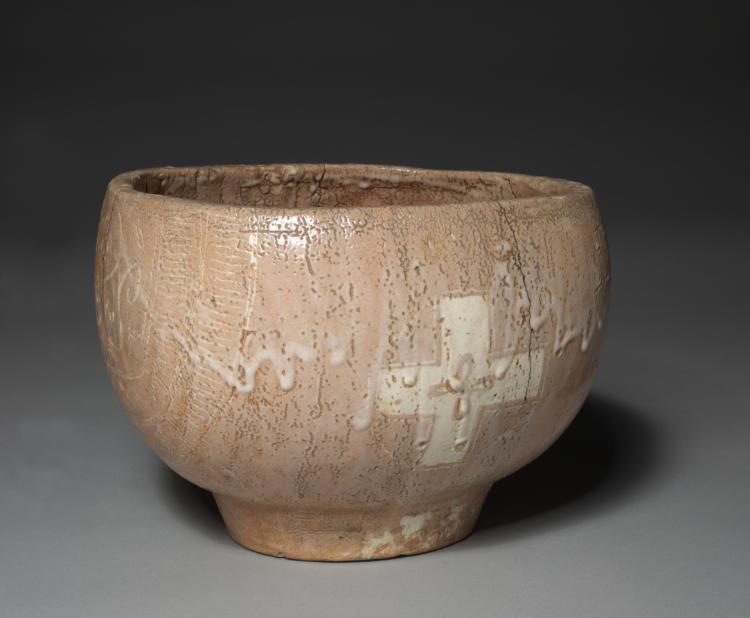
Baptismal Bowl with Christian Design of Cross and Insignia of the Society of Jesus: Hagi Ware, c. 1600, glazed stoneware, Waridawara type. The Cleveland Museum of Art, John L. Severance Fund, accession 1962.211.
Look closer: a pale, rounded bowl with a white cross on the side. The museum's title gives it as a baptismal bowl in Hagi ware of about 1600, with a cross and the insignia of the Society of Jesus.
Image: The Cleveland Museum of Art, Open Access (CC0)
Hagi at the Desk
At the time of writing no piece catalogued as Hagi ware is with the house. The concierge desk can say when one arrives. The journal's guide to Hagi ware tea bowls and the plain guide to caring for ceramics are good companions to this chapter.
Answered plainly
Why does Hagi ware change colour?
Its glaze crazes in the kiln, and the tiny cracks and pores slowly absorb tea or sake, so the surface darkens and matures with use.
Who made Hagi ware at first?
Korean potters who came to Hagi after Japan's invasion of Korea in the late sixteenth century, working under the Mori lord.
What is white Hagi?
A pure white glaze developed by the Miwa family, whose kiln dates to 1663, using feldspar and wood ash over an iron-rich black glaze.
What does Raku first, Hagi second, Karatsu third mean?
It is an old ranking of pottery for the tea ceremony, which favours wares with an earthy look and feel.
Where next
Sources and image credits
- Hagi ware, Wikipedia
- Chōshū Domain, Wikipedia
- Mōri Terumoto, Wikipedia
- Object record, Teabowl, The Metropolitan Museum of Art
- Object record, Bowl, The Metropolitan Museum of Art
- Object record, Teabowl, The Metropolitan Museum of Art
- Object record, Teabowl, The Metropolitan Museum of Art
- Object record, Four-Lobed Flat Bowl, The Metropolitan Museum of Art
- Object record, Teabowl, The Metropolitan Museum of Art
- Object record, Baptismal Bowl with Christian Design of Cross and Insignia of the Society of Jesus: Hagi Ware, The Cleveland Museum of Art
Last reviewed 28 October 2026. Pictures, where shown, are public-domain or open-access and credited beneath each one.
Looking for a Hagi tea bowl or a view on one you own? The concierge desk replies within one to three business days.
Browse Japanese porcelain and ceramics · Make a private request
Private concierge
Looking for something in particular?
Describe the piece or the project you have in mind. A senior advisor in Tokyo reads every case file personally and replies within two business days, with fees set out in writing before any work begins.