
Shuni-e and Omizutori at Tōdai-ji
Nigatsu-dō · Fire and water in March
Shuni-e and Omizutori at Tōdai-ji
修二会
Every night for two weeks in March, men carrying burning pine torches several metres long run along the wooden balcony of a hillside hall in Nara, and burning sparks fall on the crowd below. In the room behind them, eleven monks are repenting before an eleven-faced Kannon, a hidden image. At about two in the morning on the thirteenth, water is drawn from a well beneath the hall, and spring is said to arrive. This is the Shuni-e of Tōdai-ji, called Omizutori after its closing rite, and the temple dates it to 752.124
Fact sheet
Five things to notice
- The name. Shuni-e means Second-month Service; the rite began on the first day of the second lunar month.4
- The eleven. Eleven monks, closed away from the public, perform six services a day before the Kannon.24
- The fire. Each night believers carry great pine torches along the balcony; falling sparks are thought to protect against evil.124
- The water. Water is drawn from the Wakasa well in the small hours of 13 March and offered to Kannon.124
- The fire of 1667. The hall burned during the Shuni-e of 1667 and was rebuilt in 1669.3
A Service for the Second Month
First lookShuni-e is a repentance service, a rite of confession addressed to the eleven-faced form of Kannon, the bodhisattva of compassion. Its name is usually rendered Second-month Service, since it was first held on the first day of the second month of the lunisolar calendar; the Nara City tourist office adds that the hall where it takes place, the Nigatsu-dō, is likewise the Second-month Hall.24

Nigatsu-dō, Tōdai-ji, Nara; photograph by Christophe95
Look closer: The hall sits on a slope, with its front pushed out over the hillside on tall wooden posts and a long balcony running along it. That balcony is the stage on which the torches are carried each night.
Photograph: Christophe95. CC BY-SA 4.0, with attribution. Source: Wikimedia Commons. CC BY-SA 4.0 File record

The rite is held at the Nigatsu-dō, a hall on the hillside of Mount Wakakusa, east of the Great Buddha Hall of Tōdai-ji.3 Today it runs from 1 to 14 March, which the Nara City page gives as two weeks.4 The English Wikipedia article on Shuni-e gives the span as 1 March to the morning of 15 March.2 Its climactic ritual, the drawing of water, has given the whole service its popular name, Omizutori.12
The English Wikipedia article on Omizutori calls the water-drawing the final rite of a two-week ceremony meant to cleanse people of sins and to welcome spring.1 The Nara City page puts the same thought more simply: spring arrives in Nara after it ends.4
Jitchū and the Hall of the Gods
The connoisseur's eyeThe founder is Jitchū, a Kegon monk and pupil of Rōben, the clerical founder of Tōdai-ji.23 The English Wikipedia article on Shuni-e says his origins for the rite are unclear and that the earliest cited source is an illustrated text of 1586 which recounts a legend.2
In that legend Jitchū enters a cave in 751 and finds that it leads to the Tuṣita heaven, where he sees forty-nine shrines and a shrine of the eleven-faced Kannon. He asks to take part in the rite he sees there but is refused, because one day in Tuṣita is said to equal four hundred years on earth. He then reproduces the ceremony on earth. The same article notes a similar time difference in the Pali canon, at Aṅguttara Nikāya 8.43.2
The English Wikipedia article on Omizutori gives a slightly different version: in 751, it says, Jitchū saw celestial beings performing a repentance ceremony in the Kasagi mountains and resolved to bring it to humans, vowing to perform the rite a thousand times a day at running speed.1 A third legend, in the same article, has him inviting 13,700 gods to the rite. Only Onyū-myōjin, the god of the Onyū river, arrived late, having been fishing, and he offered water from the river, so that a spring rose where he stood. That spring is the origin of the Wakasa well.1
Six Services a Day Behind Closed Doors
The connoisseur's eyeThe core of Shuni-e is not the torches but a closed rite. Eleven monks, the Rengyōshū, perform the repentance. The English Wikipedia article on Omizutori says they are appointed the previous December, clean the sites, make pilgrimages to nearby shrines and temples and prepare the ritual goods, and that before the festival they may not speak or leave their lodgings.1 The Nara City page says that they isolate themselves and repent before the eleven-faced Kannon, praying for the safety of the nation and the welfare of society.4

Shuni-e, Tōdai-ji, Nara; photograph by ignis
Look closer: The photograph is titled for the Shuni-e of Tōdai-ji. The rite is held at night, and the public sees only the edge of it.
Photograph: ignis. CC BY-SA 3.0, with attribution. Source: Wikimedia Commons. CC BY-SA 3.0 File record

The English Wikipedia article on Shuni-e lists six daily sessions: shoya in the late evening, the longest at about three hours, then yahan at midnight, goya after midnight, jinjo at dawn, nitchū at midday and nichimotsu at dusk. Each follows the Eleven-Faced Avalokiteśvara Heart Dharani Sutra and includes repentance, the invocation of the bodhisattva's name, the dharani and vows to benefit all beings.2
The article stresses that this central rite is closed to the public and that the liturgy is said to be largely unchanged.2 The Omizutori article records one small curiosity of that long continuity: the earliest known use of an incense seal in Japanese religious rites is recorded at an Omizutori.1
Sparks on the Balcony
The connoisseur's eyeThe part of the Shuni-e that outsiders see is the Otaimatsu. The Nara City page says that it is held every night at 7 pm, with exceptions at 7.30 on 12 March and 6.30 on 14 March, and that selected believers escort the monks up the stairs carrying torches about seven metres long. They then run along the balcony, showering sparks on the spectators. The page calls it the ritual's highlight and a solemn and heroic ceremony.4

Omizutori, Nigatsu-dō, Tōdai-ji; photograph by Kansaikiwi (English Wikipedia)
Look closer: The Commons description calls this the main ritual of the festival, with young monks carrying torches across the balcony. Look at the torches along the balcony.
Photograph: Kansaikiwi (English Wikipedia). CC BY-SA 3.0, with attribution. Source: Wikimedia Commons. CC BY-SA 3.0 File record

The English Wikipedia article on Shuni-e gives somewhat different figures: ten believers each night and eleven on 12 March, carrying pine torches up to eight metres long and about eighty kilograms in weight.2 It adds that sparks falling on the crowd are believed to protect against evil, as does the Omizutori article.12
A series of photographs on Wikimedia Commons, titled for the bamboos for the torches of the Tōdai-ji Shuni-e, shows the bamboo being prepared in February.

Photograph by Degueulasse, February 2014
Look closer: The file title records that these are bamboos for the torches of the Tōdai-ji Shuni-e. Look at the length and quantity: each night's torches are built for the run along the balcony.
Photograph: Degueulasse. CC BY 3.0, with attribution. Source: Wikimedia Commons. CC BY 3.0 File record

Water Drawn in the Small Hours
The connoisseur's eyeThe closing rite, the Omizutori proper, takes place late on 12 March. The Nara City page puts it at about 1.30 am on the thirteenth, when sacred water is drawn from the Wakasa well beneath the hall and offered to Kannon.4 The English Wikipedia article on Shuni-e says around 2 am, after the last night of the fire ceremony.2
According to legend the well gives water only once a year.12 The water is offered to Kannon and then to the public, and is popularly believed to cure ailments.12 The Shuni-e article says that it is collected in two pots, one holding water from the previous year and one holding water from all previous observances.2
The Omizutori article adds a claim, tagged as needing a citation, that the water comes by a tunnel from Obama on the Sea of Japan and is sent by the priests of Jinguji temple. It treats this as legend and so does this page.1
- 751Jitchū's legendary vision of the heavenly rite.12
- 752The year the Shuni-e is traditionally said to have begun.24
- 756 to 772The Nigatsu-dō was probably completed.3
- 1180The hall survives the civil war.3
- 1567The hall survives the civil war in which the Great Buddha Hall is lost.3
- 1667The hall burns during the Shuni-e service.3
- 1669The present hall is rebuilt.3
The Hall That Burned and Was Rebuilt
The connoisseur's eyeThe hall burned during the Shuni-e service of 1667. The English Wikipedia article on Nigatsu-dō says that reconstruction began that year and the hall was rebuilt in 1669. It had survived the civil wars of 1180 and 1567, when the Great Buddha Hall was lost. The article notes that the dating of the 1667 and 1669 events rests on a source that is a dead link, so they are less well verified.3
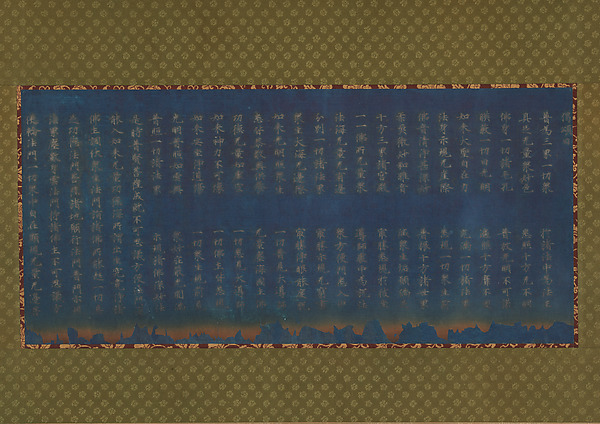
Japan · Nara period (710–794) · ca. 744 · Hanging scroll; silver pigment on indigo-dyed paper
Look closer: Silver on indigo-dyed paper, with the ruled lines of a copyist. The darkening at the edges is the damage from the fire of 1667 that the Metropolitan Museum names as its cause.
The Metropolitan Museum of Art, New York, Purchase, Mrs. Jackson Burke Gift, 1978, accession 1981.75. Public domain, Met Open Access. Museum record
The present main hall is a National Treasure. Its front projects over a sloping site and is carried on columns under the floor, a method called kakezukuri. The hall holds two Kannon statues, one large and one small, both hibutsu, secret Buddhas that are never shown to the public.3
The fire of 1667 left a mark on scripture. A set of sixty handscrolls of the Flower Garland Sutra was donated to Tōdai-ji in 744, and the sections that survive are known as the Nigatsudō Burned Sutra because they were damaged in the Nigatsudō fire of 1667.5
A Register of the Dead
The connoisseur's eyeOne document survives from the long history of the rite. The Commons description of this file calls it a registry of the deceased commemorated at the Nigatsudō Shunigatsu-e, dated to the sixteenth or seventeenth century and kept at Tōdai-ji.

Registry of deceased persons commemorated at the Nigatsudō Shunigatsu-e, sixteenth or seventeenth century; Tōdai-ji, Nara
Look closer: The Commons description calls this a registry of the deceased commemorated at the Shuni-e. It is a reminder that the service looks to the dead as well as to the living and to the nation.
Image: Artists of the Nara to Edo periods. Public domain. Source: Wikimedia Commons. File record

The Nara City page says that the monks pray for the nation's safety and the welfare of society.4 The register shows a further and personal dimension, in which individuals were remembered by name in the same service.
Fun Facts and Loose Ends
First lookA rite this old has accumulated its own small facts. These are the ones worth keeping.
- Eleven monks are appointed in December, three months before the rite begins.1
- The Otaimatsu is held nightly, but on 12 March it begins at 7.30 pm and has an extra torch.24
- In Jitchū's legend one day in Tuṣita equals four hundred years on earth, which is why he was refused.2
- The Nara City tourist page says that spring comes to Nara after the water-drawing is over.4
- The festival was held on 1 to 14 March in 2010, on the page's example.1
- The earliest known use of an incense seal in Japanese religious rites is recorded at an Omizutori.1
- Admission to the Nigatsu-dō is free, and there is no parking.4
Seeing the Rite Today
The connoisseur's eyeThe Nara City page gives the practicalities. Nigatsu-dō is in Tōdai-ji, Nara; a bus from JR or Kintetsu Nara Station takes seven minutes, and from the Daibutsuden Kasuga Taisha-mae stop it is a ten-minute walk. There is no parking, and no admission fee.4
The page also warns that the Otaimatsu is performed every night but that the times and the size of the crowds vary, so it is wise to check with the temple in advance.4
The closed rites cannot be seen at all, and the water-drawing takes place around 1.30 am. For those who want the spectacle without the late night, the evening torches are the part the Nara City page presents to visitors.4
Sister Rites and Pali Echoes
The deep endThe English Wikipedia article on Shuni-e says that the service is held at certain temples in Japan besides Tōdai-ji, in February or March depending on the temple, but does not name them.2 What it does name is a parallel in the Pali canon: the idea that a day in a heavenly realm may last hundreds of years on earth, found at Aṅguttara Nikāya 8.43, matches the time difference in Jitchū's legend.2
The connection to the Flower Garland Sutra, and to the Kegon school that still administers Tōdai-ji, runs through Jitchū, who was a pupil of the clerical founder Rōben.23 The page on the Flower Garland Sutra tells the rest of that history.
What Survives of a Night Rite
The deep endA rite performed at night in a hall closed to the public leaves little behind for the collector except paper: registers such as the Kako-chō, sutra scrolls and later prints of the torches. The fire of 1667 turned one of those, the Nigatsudō Burned Sutra, into a fragment with a story attached.5
Look for the scorch along the edge of a sutra fragment, for the ruled lines and silver-on-indigo of the 744 set, and for any record of the temple and the set it came from. As the Metropolitan Museum's entry makes clear, provenance matters more than perfection here.5
The house keeps a changing shelf of Buddhist scrolls and ritual objects, and the concierge desk can search Japan for a particular subject.
Words Worth Knowing
The terms below recur on this page and across the almanac.
| Term | Reading | Meaning |
|---|---|---|
| Shuni-e | shuni-e | The Second-month Service.24 |
| Omizutori | omizutori | The water-drawing, and the popular name of the service.1 |
| Rengyōshū | Rengyōshū | The eleven monks who perform the rite.24 |
| Otaimatsu | otaimatsu | The nightly torch ceremony.24 |
| Hibutsu | hibutsu | A secret Buddha, never shown.3 |
| Kakezukuri | kakezukuri | A building technique that carries the floor over a slope on columns.3 |
Related Pieces
The house keeps a changing shelf of Buddhist sculpture, scrolls and ritual objects from Japan. The shelf below fills with pieces on the day you read this, and the collection page lists them all.
Pieces in the house now
- Buddhist statues and sacred artSculpture, scrolls and ritual objects
Answered plainly
What is the Shuni-e?
A two-week repentance service held each March at the Nigatsu-dō of Tōdai-ji in Nara, centred on the eleven-faced Kannon.24
What is the Omizutori?
The water-drawing rite that closes the Shuni-e, held in the small hours of 13 March, and the popular name of the whole service.124
When is it held?
From 1 to 14 March each year on the Nara City tourist page, ending in the early morning of 15 March on Wikipedia's account.24
What are the torches?
Great pine or bamboo torches, about seven to eight metres long, carried along the balcony each night; falling sparks are thought to protect against evil.124
Can anyone watch?
The torch ceremony each evening is open to spectators, and admission is free. The central repentance services are closed to the public.24
Why is it called Second-month Service?
Because it began on the first day of the second month of the lunisolar calendar; Nigatsu-dō means Second-month Hall.4
Did the hall ever burn?
Yes. It burned during the Shuni-e of 1667 and was rebuilt in 1669.3
Where next
Sources and image credits
- Wikipedia, Omizutori The water-drawing, legends, the eleven priests, the Wakasa well.
- Wikipedia, Shuni-e Meaning, origin legend, the six services, the torches, the water.
- Wikipedia, Nigatsu-dō The hall, its fire of 1667 and rebuilding, the hidden images.
- Nara City Tourism Association, Shuni-e at Tōdai-ji Dates, Otaimatsu times, the water-drawing, access.
- The Metropolitan Museum of Art, Nigatsudō Burned Sutra (1981.75) The set of 744 and the fire of 1667.
Last reviewed 28 October 2026. Dates in this chapter follow the cited pages; where the sources disagree, the chapter says so. Every picture is public-domain or openly licensed, and its credit and licence stand beneath it.
If this subject has drawn you to an object, the concierge desk can search Japan for it.
Private concierge
Looking for something in particular?
Describe the piece or the project you have in mind. A senior advisor in Tokyo reads every case file personally and replies within two business days, with fees set out in writing before any work begins.