
The Flower Garland Sutra
Kegon-kyō · Avataṃsaka scripture
The Flower Garland Sutra
華厳経
Imagine a net hung over the palace of a god, with a jewel at every knot, and each jewel reflecting every other jewel and every reflection inside them. That image, Indra's net, is the best-known picture to come out of the Flower Garland Sutra, a scripture so large that its Chinese versions run to sixty and eighty scrolls. In Japan it is the Kegon-kyō. It lies behind the colossal bronze Buddha at Tōdai-ji, behind a set of sutra scrolls scorched in a temple fire, and behind a Kamakura monk who is said to have cut off his own ear to prove his resolve.134
Fact sheet
Five things to notice
- The size. It is told in eight assemblies at seven locations and runs to sixty or eighty Chinese scrolls.1
- The pilgrim. The final chapter follows the young seeker Sudhana as he is sent from teacher to teacher.15
- The net. Huayan thought pictures reality as Indra's net of mutually reflecting jewels.4
- The Buddha. The sutra centres on Vairocana, the figure cast in bronze at Tōdai-ji.35
- The fire. Fragments of a scroll set given to Tōdai-ji survive because they were scorched, not lost.6
A Scripture Too Large to Hold
First lookThe Avataṃsaka Sutra, whose title means garland or wreath, is one of the longest and most ambitious scriptures of the Mahayana. It was written in stages, beginning at least five hundred years after the death of the Buddha, and the sections that make it up probably circulated as separate sutras first.1 Scholars disagree about where they were joined: one view places the compilation in Central Asia in the late third or fourth century, while Hirakawa and Ōtake argue that the Sanskrit original was assembled in India from sutras already known under the name Buddhāvataṃsaka.1
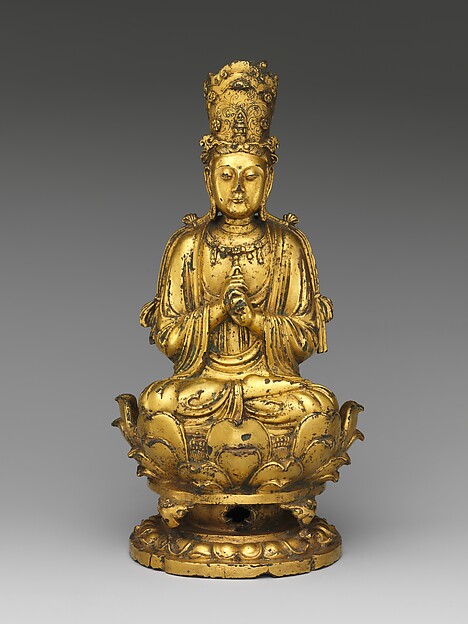
China · Liao dynasty (907–1125) · 11th century · Gilt bronze; lost-wax cast
Look closer: Vairocana is the Buddha at the centre of the Flower Garland Sutra, called Dari, the great sun, in Chinese. This eleventh-century gilt bronze comes from China; compare its seated pose with the colossal bronze of Tōdai-ji further down the page.
The Metropolitan Museum of Art, New York, Purchase, Lila Acheson Wallace Gift, 2006, accession 2006.284. Public domain, Met Open Access. Museum record
What the text describes is less a story than a vision. A cosmic Buddha, Vairocana, shows himself in a succession of heavens and meeting places. The historical Śākyamuni is presented as one of his emanations. The teaching of the whole is that phenomena interpenetrate: every particle of dust contains all lands and all beings.1
In East Asia the sutra gave its name to a school. The Chinese Huayan school, which Britannica traces to the late sixth and early seventh centuries and its systematisation to the seventh and eighth, taught that all beings form one harmonious whole, interrelated and interdependent, with Vairocana at the centre.3 In Japan the same school is Kegon, in Korea Hwaeom.13
Eight Assemblies in Seven Places
The connoisseur's eyeIn the arrangement described by Luis Gómez, the sutra has thirty-nine chapters and presents its discourses at eight assemblies held in seven locations, among them Bodh Gaya and the Tuṣita heaven.1 The themes run in order. Chapters one to five show Vairocana's enlightenment, six to twelve the Four Noble Truths, thirteen to eighteen the abodes of bodhisattvas, nineteen to twenty-two the ten conducts, twenty-three to twenty-five the ten dedications and twenty-six to thirty-seven the ten stages. Chapter thirty-eight is a summary, and chapter thirty-nine is the pilgrimage of Sudhana.1
Two of these sections, the Ten Stages Sutra (the Dāśabhūmika, book twenty-six) and the Gaṇḍavyūha, which is the last chapter, are the only parts that survive in Sanskrit. Scholars consider them among the oldest written chapters, even though the Gaṇḍavyūha stands at the end.1
The ending is the best known part. In the Gaṇḍavyūha a young seeker, Sudhana, is sent by a teacher from one master to the next, each of whom knows one door to liberation and sends him on. The journey is the pattern for the pilgrim in East Asian art: Master Foguo printed an illustrated account of it in northern Song China, and at Borobudur in Java, built under the Shailendra kings between about 750 and 860, the reliefs show Sudhana's travels.5
Translations at Different Lengths
The connoisseur's eyeFragmentary translation into Chinese probably began in the second century, and the Ten Stages Sutra was first translated in the third.1 The first complete version was made by Buddhabhadra around 420, in sixty scrolls and thirty-four chapters. The second, by Śikṣānanda around 699, runs to eighty scrolls and forty chapters and includes more sutras than the first. A third translation of the Gaṇḍavyūha alone was made by Prajñā around 798.1
The only surviving Tibetan version was translated from Sanskrit by Jinamitra and others at the end of the ninth century, and it differs considerably from the eighty-scroll Chinese text.1 A colophon on a Chinese manuscript from the Mogao Caves at Dunhuang calls the work the Bodhisattvapiṭaka Buddhāvataṃsaka Sutra.1
Modern readers meet the text through Thomas Cleary's translation of 1993, The Flower Ornament Scripture, a single volume of 1,656 pages made from the Śikṣānanda version. The Buddhist Text Translation Society at the City of Ten Thousand Buddhas has been translating the sutra with a commentary by Hsuan Hua, with more than twenty volumes produced and an estimated seventy-five to a hundred when it is finished.1
| Version | Date | Size |
|---|---|---|
| Buddhabhadra | Around 420 | 60 scrolls, 34 chapters1 |
| Śikṣānanda | Around 699 | 80 scrolls, 40 chapters1 |
| Prajñā (Gaṇḍavyūha only) | Around 798 | One section1 |
| Jinamitra and others (Tibetan) | End of the ninth century | Differs from the 80-scroll text1 |
Indra's Net and the Golden Lion
The connoisseur's eyeThe Huayan school turned the sutra into a philosophy. EBSCO's research starter lists its patriarchs: Dushun (557 to 640), who established it as a separate school; Zhiyan (602 to 668), who set out its principles; Fazang (643 to 712), often treated as its father; and Chengguan (737 to 838) and Zongmi (780 to 841), who developed it further.4
Fazang is said to have taught Empress Wu and to have explained the school by metaphor, notably with a golden lion statue, which shows how the universal and the particular exist together.4 The picture most people remember is Indra's net: an endless net with a many-sided jewel at each knot, each jewel reflecting all the others, so that nothing exists on its own.4
The school also taught a scheme of four ways of seeing reality, the four dharmadhatu. The first looks from the absolute, the second returns the absolute to the particular, the third holds that the universal cannot exist apart from particulars, and the fourth holds that the two exist together without obstructing each other.4 The Great Anti-Buddhist Persecution of 841 to 845, under the Tang emperor Wuzong, weakened the school, and it never regained its former standing in China, though its ideas fed Zen and much of later East Asian Buddhism.4
Tōdai-ji and the Bronze Vairocana
The connoisseur's eyeBritannica says the Kegon school reached Japan in the Nara period (710 to 784); around 740 its doctrine was brought by Shinshō (Chen-hsiang), Dōsen and the south Indian Bodhisena.3 EBSCO gives the same year, 740, for its introduction by the Chinese monk Shen-hsiang.4 Wikipedia's article on Rōben adds that in 740 Rōben invited Simsang, a Silla monk known in Japan as Shinjō, to help establish a sect based on Huayan thought.2

Daibutsuden, Tōdai-ji, Nara; photograph by Zairon
Look closer: This is Vairocana as the Flower Garland Sutra describes him, enormous and calm at the centre of a hall that barely contains him. The figure is the cosmic Buddha, not the historical one, and the lotus pedestal beneath him is engraved with Avataṃsaka imagery.
Photograph: Zairon. CC BY 4.0, with attribution. Source: Wikimedia Commons. CC BY 4.0 File record

The emperor was the decisive patron. Britannica says Shōmu was drawn to the school's holistic principle as a possible basis for governing, and is credited with founding Tōdai-ji together with Bodhisena, the monk Gyōki and the abbot Rōben.3 Rōben (689 to 773) is called the clerical founder of the temple. In 733 he oversaw the expansion of Kinshō-ji, now Tōdai-ji's Hokke-dō, and the casting of the bronze Vairocana.2
The bronze is sixteen metres tall, and was described by the Encyclopedia.com entry as the largest such image in the world when it was dedicated in 752. Its lotus petals are engraved with dharmadhatu scenes from the Avataṃsaka.5 Many of the objects used in the consecration are still kept in the Shōsō-in treasury, and the Kegon school, though no longer a separate active faith, still administers the temple.3
Silver on Indigo, Scorched by Fire
The connoisseur's eyeThe Metropolitan Museum's Nigatsudō Burned Sutra is a fragment of the Flower Garland Sutra, ca. 744, written in silver pigment on indigo-dyed paper and mounted as a hanging scroll. It belongs to a set of sixty handscrolls donated to Tōdai-ji in 744, and gets its name because the sections were damaged by a fire in the Nigatsudō hall of the temple in 1667.6 The museum notes that copying scriptures was believed to earn spiritual merit for donors, scribes and craftsmen alike.6
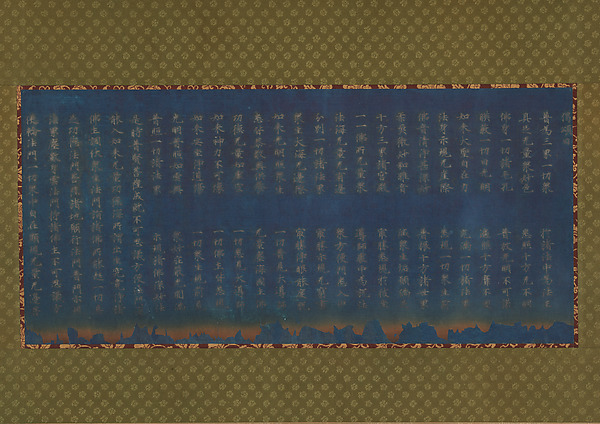
Japan · Nara period (710–794) · ca. 744 · Hanging scroll; silver pigment on indigo-dyed paper
Look closer: Silver pigment on indigo-dyed paper, with the ruled lines and the evenly spaced characters of a copyist working for merit. The darkening at the edges is damage from the fire of 1667 and is part of the fragment's history.
The Metropolitan Museum of Art, New York, Purchase, Mrs. Jackson Burke Gift, 1978, accession 1981.75. Public domain, Met Open Access. Museum record
The Met has a second burnt fragment, the Senpukuji Burned Sutra, dated to the twelfth century. It is a section of the Flower Ornament Sutra in ink on pale indigo-dyed paper decorated with flakes of gold leaf, in shakyōtai, a late Heian sutra-copying script with rapid but legible brushwork, and brown burn marks show that it also survived a fire.7 The name of the temple appears in the title but the museum gives no further history.7
Both fragments show how sutras were made: the paper is dyed first, the text is ruled and copied, and the whole is judged as an offering as much as a book. That a scroll should survive in pieces because of a fire has made the scorched sections prized objects in their own right.
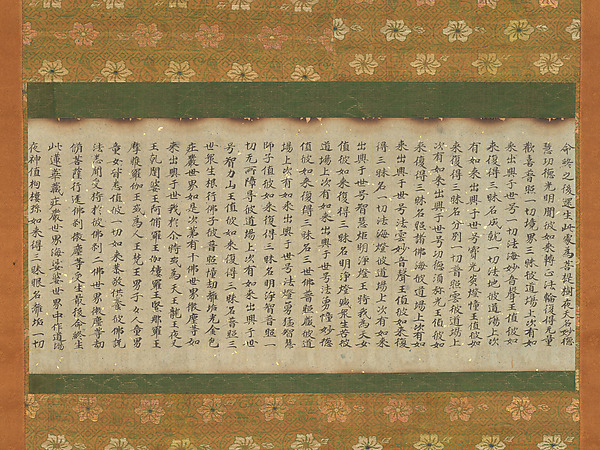
Japan · Heian period (794–1185) · 12th century · Section of handscroll mounted as a hanging scroll; ink on pale indigo-dyed paper decorated with flakes of gold leaf
Look closer: The paper is a paler indigo than the Nara fragment and is flecked with gold leaf. Look at the brown burn marks and at the rapid, upright script of a twelfth-century copyist.
The Metropolitan Museum of Art, New York, Mary and Cheney Cowles Collection, Gift of Mary and Cheney Cowles, 2024, accession 2024.412.1. Public domain, Met Open Access. Museum record

Nigatsudō, Tōdai-ji, Nara; photograph by Nekosuki
Look closer: The hall stands on a hillside above the main precinct. The Met names the Nigatsudō hall as the place where the fire of 1667 damaged the sutra scrolls.
Photograph: Nekosuki. CC BY-SA 4.0, with attribution. Source: Wikimedia Commons. CC BY-SA 4.0 File record

Myōe, Patron of the Pilgrim
The connoisseur's eyeIn the Kamakura period the Kegon school found a new advocate. Myōe was born on 21 February 1173 in Kii Province and became abbot in 1206 of Kōzan-ji, a Kegon temple near Kyoto, where he tried to unify Buddhist teachings around the Avataṃsaka Sutra. His routine at the temple is recorded as zazen, sutra recitation and the Mantra of Light.8

Vertical scroll, ink and colours on paper, first half of the thirteenth century; attributed to Enichibō Jōnin; Kōzan-ji, Kyoto
Look closer: The monk is seated for meditation and surrounded by trees. It is the image of Myōe most often reproduced, and it presents him as a solitary practitioner more than as a scholar.
Image: Enichibō Jōnin (estimated). Public domain. Source: Wikimedia Commons. File record

He kept a journal of his dreams for more than forty years, which scholars still study. A tradition, which the article reports without endorsing it, says he cut off his own ear before a Buddha image and that the bloodstain can still be seen. He also wrote the Zaijarin, "Breaking the Circle of Heresy", and a sequel to refute Hōnen's Senchaku-shū, agreeing with Hōnen's criticism of the establishment but judging exclusive nembutsu practice too narrow.8
The Encyclopedia.com entry on Huayan art credits Myōe, who worked at Kōzan-ji in the late Heian and Kamakura period, with promoting paintings of the dharmadhatu and of Sudhana's journey in Japan.5 The best known product of his circle is the Kegon Engi Emaki, a set of six paper scrolls, four on Gishō (Uisang) and two on Gengyō (Wonhyo), the Korean founders of the Hwaeom school. It is a National Treasure, and in its most famous scene Zenmyō turns into a dragon to carry Gishō's boat to Korea.9

Handscroll, Kamakura period; attributed to Enichibō Jōnin
Look closer: A handscroll is read from right to left as it unrolls. This long strip is one stretch of the illustrated history of the Kegon school, and it shows how the painter let landscape and figures run on without a frame.
Image: Attributed to Enichibō Jōnin. Public domain. Source: Wikimedia Commons. File record

A Dragon Boat and a Lion of Gold
The connoisseur's eyeTwo images from the Huayan tradition have lived outside the texts. The first is the dragon of the Kegon Engi Emaki. According to the Wikipedia article, the Gishō scrolls were painted between 1218 and 1223 on Brock's dating, and the Gengyō scrolls in the 1220s or around 1230. The creator is uncertain: an earlier legend credited Fujiwara no Nobuzane, but the article thinks Enichibō Jōnin, Myōe's favoured painter, more likely at least for part of the work.9
The scrolls were stored for a long time at Kōzan-ji and are now shown at the Kyoto National Museum (the Gishō portion) and the Tokyo National Museum (the Gengyō portion).9 The second image is Fazang's golden lion, used to teach Empress Wu how the universal and the particular exist together.4
A third, smaller legend sits in a place name. The Kegon Falls at Nikkō, a 97-metre drop from Lake Chūzenji, most probably take their name from the Flower Garland Sutra, though some sources link the name instead to azaleas that bloom on the cliffs in spring.10
- Around 420Buddhabhadra completes the first full Chinese translation.1
- Around 699Śikṣānanda completes the 80-scroll version.1
- 740The Kegon teaching is introduced in Japan; Rōben invites Shinjō.234
- 744A set of sixty scrolls is donated to Tōdai-ji.6
- 751 or 752The Great Buddha is dedicated.235
- 1173Myōe is born.8
- 1206Myōe becomes abbot of Kōzan-ji.8
- 1218 to 1223The Gishō scrolls of the Kegon Engi Emaki are painted, on Brock's dating.9
- 1667Fire at Nigatsudō scorches the sutra scrolls.6
Fun Facts and Loose Ends
First lookA scripture this large collects facts. These are the ones worth keeping.
- Cleary's English translation of 1993 runs to 1,656 pages in a single volume.1
- The Ten Stages Sutra, book twenty-six, circulated on its own and was translated into Chinese in the third century, long before the whole sutra.1
- Sokkuram in Korea, built under King Gyeongdeok (r. 742 to 765), has a central Buddha that is probably Vairocana, though it looks identical to ordinary images of Śākyamuni.5
- The 13.5-metre Vairocana at Fengxian in the Longmen grottoes dates from the late seventh century and lacks distinctly Huayan imagery, which suggests that the iconography had not yet developed.5
- Kegon Falls at Nikkō has a lift that has run since 1930 and takes about a minute to descend about a hundred metres to the basin.10
- The Great Buddha of Tōdai-ji was described as the largest bronze image in the world when it was dedicated.5
Reading and Visiting
The connoisseur's eyeTōdai-ji is open to visitors, and the Daibutsuden houses the Great Buddha described above. The Kegon school still administers the temple, which is a good reason to read the sutra's opening chapters before going.3

Relief panel, Borobudur, Java; photograph by Anandajoti Bhikkhu
Look closer: Sudhana's journey is carved in long bands around the monument. In this panel the pilgrim meets the bodhisattva Samantabhadra, as the panel title records.
Photograph: Anandajoti Bhikkhu. CC BY-SA 3.0, with attribution. Source: Wikimedia Commons. CC BY-SA 3.0 File record

For readers, the choice is between the long Cleary volume and the Buddhist Text Translation Society's multi-volume edition with Hsuan Hua's commentary, which is still in progress. A multi-volume translation by the Bukkyo Dendo Kyokai was expected around 2022; the Wikipedia article does not say whether it has been completed.1
Those who want to see Sudhana's pilgrimage on stone should look to Borobudur, whose reliefs date from the Shailendra period, or to the votive paintings of Joseon Korea, which hung tableaux of the eight assemblies in seven locations above temple altars.5 Dunhuang's Mogao Caves have wall paintings and banners with the same subject from the eighth century.5
Hwaeom, Huayan and Borobudur
The deep endThe same scripture produced three schools and one monument. In China the Huayan school, with its patriarchs from Dushun to Zongmi, built the philosophy.4 In Korea the Hwaeom tradition is represented in the Kegon Engi Emaki by Uisang and Wonhyo, who are named as the school's two founding monks in the scrolls.9
In Java the Gandavyuha was turned into architecture at Borobudur. In Japan it became a bronze Buddha, a monastery system and a literature of dreams and ear-cutting vows. The comparison between the three is the best answer to the question what a sutra is for: in each place the text was less a book to read straight through than a world to be built, painted or recited.59
How to Read a Fragment of Sutra
The deep endA collector who meets a sutra fragment on indigo paper should first ask which text it is from, then which volume, and then which hand. The Nigatsudō and Senpukuji examples show the range: silver pigment on deep indigo for the Nara court set of 744, and ink on paler indigo with gold flakes for the Heian copy.67
Fire damage is not necessarily a flaw. Both Met fragments are named for fires, and the Nigatsudō sections are known because the set was damaged in 1667 and the pieces were preserved as relics. Look at the way the burn follows the edge of the scroll, at whether the characters remain legible and at the way the mount treats the loss.67
Provenance matters more than perfection in this field. A fragment with a recorded temple, a known set and a published catalogue entry is a different object from an unattributed scrap. The house keeps a changing shelf of Buddhist sculpture, scrolls and ritual objects, and the concierge desk can search Japan for a particular subject or script.
Words Worth Knowing
The terms below recur on this page and across the almanac.
| Term | Reading | Meaning |
|---|---|---|
| Kegon-kyō | Kegon-kyō | The Flower Garland (Avataṃsaka) Sutra.1 |
| Birushana | Birushana | Japanese rendering of Vairocana, the cosmic Buddha.3 |
| Hokkai | dharmadhatu | The realm of reality seen by Huayan thought.4 |
| Indra's net | Taishaku-mō | The net of mutually reflecting jewels.4 |
| Zenzai-dōji | Sudhana | The pilgrim of the final chapter.15 |
| Shakyō | shakyō | The copying of a sutra by hand for merit.6 |
Related Pieces
The house keeps a changing shelf of Buddhist sculpture, scrolls and ritual objects from Japan. The shelf below fills with pieces on the day you read this, and the collection page lists them all.
Pieces in the house now
- Buddhist statues and sacred artSculpture, scrolls and ritual objects
Answered plainly
What is the Flower Garland Sutra?
The Avataṃsaka Sutra, a very long Mahayana scripture centred on the cosmic Buddha Vairocana and the idea that all phenomena interpenetrate. In Japan it is the Kegon-kyō.13
What does Kegon mean?
Kegon is the Japanese rendering of avataṃsaka, garland or wreath. It names both the sutra and the school based on it.3
What is Indra's net?
A net with a jewel at every knot, each reflecting all the others, used by the Huayan school to show that nothing exists on its own.4
How is it linked to Tōdai-ji?
The Great Buddha of Tōdai-ji is Vairocana, the central figure of the sutra, and the Kegon school still administers the temple.35
Who was Sudhana?
The young seeker of the final chapter, the Gaṇḍavyūha, who is sent from teacher to teacher on a pilgrimage.15
What are the burned sutras?
Scroll fragments, such as the Nigatsudō Burned Sutra of about 744, that were scorched in temple fires and survive in pieces.67
Who was Myōe?
The Kamakura-period abbot of Kōzan-ji (1173 to 1232) who worked to revive the Kegon teaching and promoted paintings of Sudhana's journey.58
Which English translation should I read?
Thomas Cleary's one-volume Flower Ornament Scripture of 1993 or the Buddhist Text Translation Society's multi-volume edition with Hsuan Hua's commentary.1
Where next
Sources and image credits
- Wikipedia, Avatamsaka Sutra Composition, translations, structure, teachings, English editions.
- Wikipedia, Rōben Rōben, Shinjō, Kinshō-ji and the Great Buddha.
- Encyclopædia Britannica, Kegon The school in China and Japan, Emperor Shōmu and Tōdai-ji.
- EBSCO Research Starters, Huayan Buddhism (Kegon Buddhism) Patriarchs, Indra's net, the four dharmadhatu, persecution.
- Encyclopedia.com, Huayan Art Vairocana images, Sudhana depictions, Japanese Kegon art.
- The Metropolitan Museum of Art, Nigatsudō Burned Sutra (1981.75) The set of sixty scrolls, the fire of 1667, materials.
- The Metropolitan Museum of Art, Senpukuji Burned Sutra (2024.412.1) Twelfth-century fragment, script and materials.
- Wikipedia, Myōe Life, Kōzan-ji, dream diary, writings.
- Wikipedia, Kegon Engi Emaki The six scrolls, their date, makers and present homes.
- Nippon.com, The Waterfalls of Nikkō Kegon Falls, its name and access.
Last reviewed 28 October 2026. Dates in this chapter follow the cited pages; where the sources disagree, the chapter says so. Every picture is public-domain or openly licensed, and its credit and licence stand beneath it.
If this subject has drawn you to an object, the concierge desk can search Japan for it.
Private concierge
Looking for something in particular?
Describe the piece or the project you have in mind. A senior advisor in Tokyo reads every case file personally and replies within two business days, with fees set out in writing before any work begins.