
Shichifukujin
Treasure Ship
The Seven Lucky Gods
七福神
Seven gods of three homelands, gathered aboard one treasure ship: the New Year company of fortune, longevity and good cheer that Japan made from Hindu, Chinese and native Japanese gods, and has been walking to, dreaming of and painting for more than five hundred years.
Identity card
Know the figure at a glance
- Ebisu. The only native Japanese god of the seven; fishing rod and large fish (Wikipedia).
- Daikoku. Mallet of good fortune and a large bag, standing on two rice bales (JAANUS).
- Bishamon. Guardian dress, spear and multi-storey treasure pagoda (JAANUS).
- Benzai. The one goddess of the modern group, playing the biwa lute (JAANUS, Wikipedia).
- Jurōjin. Chinese sage with a staff, a scroll and a deer (JAANUS).
- Hotei. Stout, smiling and half-naked, with a large bag (Wikipedia, JAANUS).
- Fukurokuju. High domed head, a staff and often a crane (JAANUS).
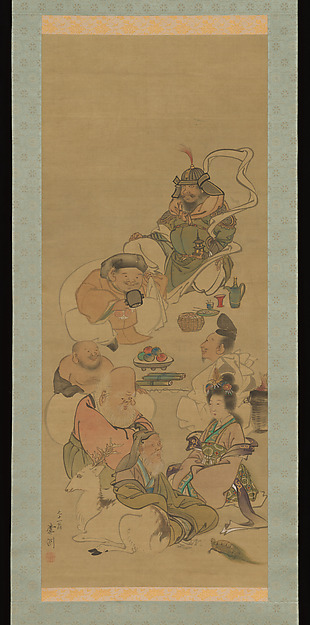
Nagasawa Roshū, Japan, 1837. Hanging scroll; ink and color on silk; 88.6 x 35.9 cm. Metropolitan Museum of Art, 2000.214.
Look closer: Note the deer beside Jurōjin, the tortoise at the foot of the scroll and the wine jar on the table, each one marking a different god.
The Metropolitan Museum of Art, Anonymous Gift, 2000. Open Access.
Seven gods, three homelands
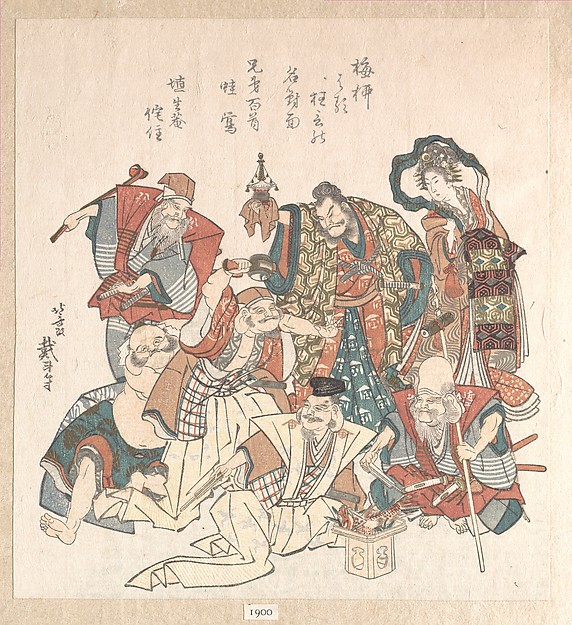
Katsushika Hokusai, Japan, 1808–27. Woodblock print (surimono); ink and color on paper; 21 x 19.1 cm. Metropolitan Museum of Art, JP1900.
Look closer: Note how the seven overlap like a single many-armed creature, with the small pagoda held high at the centre.
The Metropolitan Museum of Art, H. O. Havemeyer Collection, Bequest of Mrs. H. O. Havemeyer, 1929. Open Access.
The Japan Architecture and Art Net Users System (JAANUS), a reference compiled at Columbia University, describes the shichifukujin as seven deities of separate origin in Buddhism, Daoism and Shinto. Wikipedia sorts them by homeland. Ebisu is the only god of the seven born in Japan. Daikokuten, Bishamonten and Benzaiten arrived from India, Daikokuten by way of Buddhism in India and China, Bishamonten from Kubera, also called Vaiśravaṇa, and Benzaiten from Sarasvatī. Fukurokuju, Jurōjin and Hotei came from China, the first two from Daoist lore and the third from the tradition of a Chan monk.
Their domains read like a household's wish list for a good year. Wikipedia assigns Ebisu business and abundant food, Daikokuten commerce and crops, Bishamonten fortune in battle and authority, Benzaiten wealth, talent and music, Jurōjin old age and long life, Hotei contentment and popularity, and Fukurokuju wisdom, luck and happiness. Mark Schumacher's Buddhist statuary site, which counts Daikokuten, Bishamonten and Benzaiten as three devas of the Hindu-Buddhist world, makes a point worth keeping: the seven are better read as a meeting of deva, Buddha and kami than as a simple contest between Buddhism and Shinto.
That meeting is the whole charm of the set. A single wall scroll can hold a Shinto fisherman's god, an Indian goddess of a river, a Himalayan treasure king, a laughing Chan monk and two Daoist sages of the southern star, all of them drinking together. Nobody in the picture is asked to explain how they came to be there. The scroll at the head of this page, by Nagasawa Roshū in 1837, is exactly such a party; the surimono by Hokusai at the right shows the same company packed so tightly that they seem to share one body.
Seven faces, one boat
Each god has a chapter of his or her own in this almanac. What follows is the briefest possible introduction, enough to tell the seven apart on a scroll, a netsuke or a shrine banner, with the attributes drawn from the sources named in each line.
Ebisu
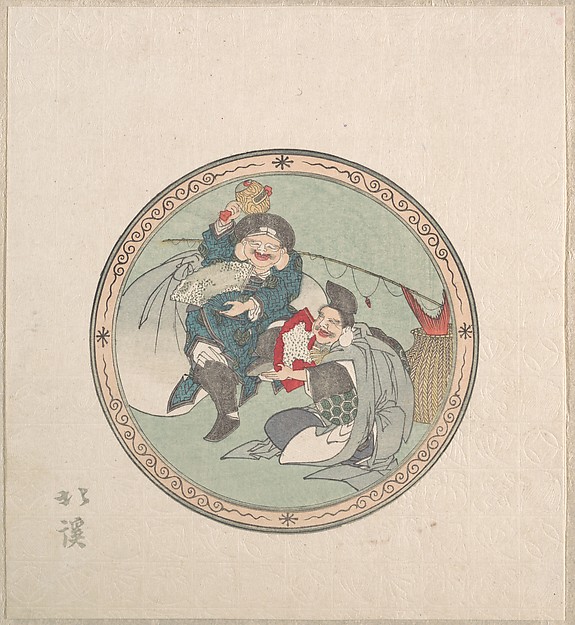
Totoya Hokkei, Japan, 19th century. Part of an album of woodblock prints (surimono); ink and color on paper; 20.2 x 18.4 cm. Metropolitan Museum of Art, JP2248.
Look closer: Note the mallet raised high and the fishing rod slanting across the circle, each framed by a scrolling border.
The Metropolitan Museum of Art, H. O. Havemeyer Collection, Bequest of Mrs. H. O. Havemeyer, 1929. Open Access.
The laughing fisherman, with a rod in the right hand and a red sea bream in the left, and a tall folded cap on his head. Nippon.com notes that the sea bream, tai, is lucky because it sounds like medetai, auspicious. He is the only one of the seven born in Japan, and in the Kansai he is called Ebessan. His full story is in the chapter on Ebisu.
Daikokuten

Yashima Gakutei, Japan, probably 1828. Woodblock print (surimono); ink and color on paper; 21 x 18.6 cm. Metropolitan Museum of Art, JP2232.
Look closer: Note the rat gnawing at the mallet, Daikoku's animal, and the peony painted on the head of the mallet.
The Metropolitan Museum of Art, H. O. Havemeyer Collection, Bequest of Mrs. H. O. Havemeyer, 1929. Open Access.
The god of the five cereals and of the household, a smiling man in a hood who sits or stands on rice bales with a bag over one shoulder and the uchide no kozuchi, the magic mallet, in his hand. Nippon.com explains how an Indian god of great blackness, Mahākāla, met the Japanese deity Ōkuninushi: the characters of Ōkuni can also be read Daikoku. Rats and mice are his animals, and the two gods Daikoku and Ebisu are often paired as father and son or as master and apprentice. See Daikokuten.
Bishamonten
The armoured guardian of the north, with a spear in one hand and a small pagoda of treasures in the other. Nippon.com recalls that he was not originally a god of war; in India he was a heavenly king who bestowed treasures, and only after the cult crossed to China did he become a warrior. Uesugi Kenshin, one of the great daimyō of the Warring States period, prayed to him before battle. See Bishamonten.
Benzaiten
The only goddess of the modern group, shown with the biwa lute and sometimes with a white snake. She descends from the Hindu river goddess Sarasvatī and presides over music, eloquence and learning, and, because the character for talent became the character for wealth, over money as well; Nippon.com mentions the zeniarai Benten shrines, where coins are washed in spring water in the hope that they will multiply. See Benzaiten.
Fukurokuju
The sage with the very long forehead, a staff with a scroll tied to it, and often a crane. Nippon.com calls him the deification of the southern pole star in Daoism and says he brings luck in having children, prosperity, health and longevity. Wikipedia notes that he is often confused with Jurōjin. See Fukurokuju.
Jurōjin
The white-bearded old man with the staff, the scroll of life and a deer. He too is tied to the southern pole star; Nippon.com says he is frequently regarded as the same deity as Fukurokuju, and that the animal beside each is the way to tell them apart. Tsunagu Japan, describing the Kyoto temple where he is enshrined, adds the tradition that he is Laozi in an enchanted form, accompanied by a deer of three thousand years. See Jurōjin.
Hotei
The stout, laughing monk with the cloth sack and the fan, the only one of the seven who is said to have been a real man. Nippon.com describes him as based on Budai, a Chinese monk of about the tenth century who wandered half-naked and foretold fortunes. Rubbing his belly is said to bring luck, a custom that Mark Schumacher records alongside the rubbing of Daikoku's head at Hase-dera in Kamakura. See Hotei.
| God | Homeland | Domain (Wikipedia) | Mark by which to know him or her |
|---|---|---|---|
| Ebisu | Japan | Business, abundant food | Rod and sea bream; folded cap |
| Daikokuten | India, by way of Buddhism | Commerce, crops | Mallet and bag; rice bales |
| Bishamonten | India, from Kubera | Fortune in battle, authority | Armour, spear, pagoda |
| Benzaiten | India, from Sarasvatī | Wealth, talent, music | Biwa lute; snake or dragon |
| Jurōjin | China, Daoist | Old age, long life | Staff, scroll, deer |
| Hotei | China, Chan | Contentment, popularity | Large sack; fan; round belly |
| Fukurokuju | China, Daoist | Wisdom, luck, happiness | Tall forehead; staff; crane |
How seven became one
JAANUS says the gods were first grouped, and named shichifukujin, in the Muromachi period, between 1336 and 1573, although the reason for the grouping is unclear. From the fifteenth century the set grew popular, especially among urban merchants and artisans, as a symbol of good luck, good fortune and long life. That social setting suits the gods themselves: most of them are patrons of trade, food, music or a long and comfortable old age.
Wikipedia dates the first mention of the seven as a group to 1420 at Fushimi, in a procession imitating those of the daimyō. Green Shinto, reporting the account given in Reiko Chiba's The Seven Lucky Gods of Japan, repeats the date and adds a livelier detail: in the 1470s and 1480s bandits dressed up as the gods and tricked people out of money, which suggests that by then the company was familiar enough to be impersonated. yokai.jp places the bundling a little later, in the late Muromachi period, among the Zen monks and painter-monks of the Higashiyama cultural circle.
The art historian Patricia Graham, quoted by Mark Schumacher, is more cautious. She finds the earliest references to some abbreviated assemblage of two, three or even five of the gods in late fifteenth-century texts, popular narrative tales and comic Nō plays, which also mention lost paintings of them, and she thinks the set of seven coalesced only in the second half of the seventeenth century, without even then being standardised. Schumacher adds that the modern seven were not fixed until the later seventeenth century, and that Benzaiten was not a member at the start.
JAANUS offers two possible models for the number seven. One is the Chinese theme of the Seven Sages of the Bamboo Grove, from the Wei and Jin dynasties. The other is a phrase in the Ninnōgyō sutra about seven adversities disappearing and seven fortunes arising. Neither is proved, and JAANUS presents both only as possibilities. Schumacher also points to the old fascination with seven itself, from the seven stars of the Big Dipper to the seven planets visible to the ancients.
A priest, a shogun and seven virtues
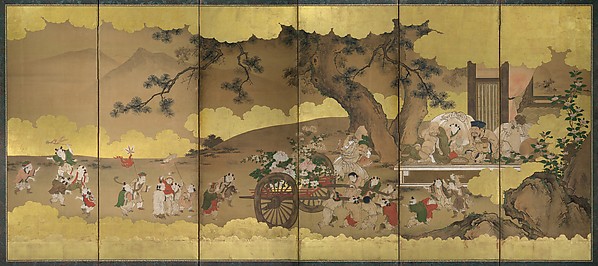
Kano Chikanobu, Japan, 17th–18th century. Six-panel folding screen; ink, color, and gilt on paper. Metropolitan Museum of Art, 29.100.498.
Look closer: Note the cart of peonies at the centre and the group of three gods half hidden at the far right.
The Metropolitan Museum of Art, H. O. Havemeyer Collection, Bequest of Mrs. H. O. Havemeyer, 1929. Open Access.
According to Wikipedia, the Buddhist priest Tenkai is said to have chosen the seven after talking with the shogun Tokugawa Iemitsu. Tenkai wanted to represent seven virtues: longevity, fortune, popularity, sincerity, kindness, dignity and magnanimity. The painter Kanō Yasunobu is said to have been commissioned to portray the gods for the first time soon afterwards. Nippon.com tells the same story with Tenkai as the founder of Tōeizan Kan'ei-ji in Ueno and onetime political adviser to Tokugawa Ieyasu, and says it became a widespread belief that the seven virtues of an ideal statesman could be bestowed as blessings by the seven gods.
Green Shinto, again following Chiba, dates the conversation to 1620 and adds that Iemitsu, who was much concerned with the deification of his grandfather Ieyasu, liked the theory and asked Tenkai to choose seven gods to typify the qualities; Tenkai then commissioned one of the leading Kanō artists. The story is a tradition rather than a documented decision, and the sources that tell it do not agree on its details.
Schumacher, in a reply published on the Green Shinto site, goes further and calls the story most likely concocted. He quotes Graham to the effect that twentieth-century sources credit Tenkai with devising the grouping for the edification of the third shogun, explaining that the seven virtues are those that kings impart to their subjects if they follow the Sutra of the Benevolent Kings, the Ninnō-kyō, but that Tenkai's known writings and the records of Rinnō-ji, where he was active, make no mention of the seven gods at all. Louis Frederic's Flammarion guide, he says, tells the same tale as Chiba without giving a source.
What the tale does show is how the group was understood. A list of virtues is a moral programme as much as a catalogue of luck, and it explains why a warrior god, a lute-playing goddess, a laughing monk and two aged sages could sit together without apology. Each stands for something a household might wish to have, or to become. The screen at the right, from the seventeenth or eighteenth century, shows the same programme at its most domestic: three of the gods, half hidden, watch Chinese children pull a cart of peonies, signs of riches and honour.
| God | Virtue in Nippon.com | Virtue in Schumacher (after Chiba and Graham) |
|---|---|---|
| Ebisu | Integrity | Candour, fair dealing |
| Daikokuten | Prosperity | Fortune |
| Benzaiten | Kindness | Amiability |
| Bishamonten | Dignity | Dignity |
| Fukurokuju | Popularity | Popularity |
| Jurōjin | Longevity | Longevity |
| Hotei | Magnanimity | Magnanimity |
Sages, immortals and a drinking party

Okumura Toshinobu, Japan, ca. 1730. Monochrome woodblock print; ink and color on paper; 22.9 x 30.5 cm. Metropolitan Museum of Art, JP817.
Look closer: Note the large sack beside Daikoku and the bearded Shōki on the opposite side of the board, the demon-queller sitting down to a game with the god of wealth.
The Metropolitan Museum of Art, Gift of Estate of Samuel Isham, 1914. Open Access.
If the grouping was Japanese, the picture of it was borrowed. Graham, in the passage Schumacher reproduces, calls a hanging scroll of the seven by Kanō Yasunobu, who lived from 1613 to 1685, the earliest surviving pictorial example of the theme, though she thinks his brother Tan'yū probably portrayed the gods together first. The scroll is datable between 1662, when Yasunobu received the honorary rank of Hōgen that appears in his signature, and his death. It places the gods beneath a pine, dressed as gentlemen, at a lively drinking party with music, dancing and singing. Graham notes that the composition so resembles Ming academic paintings of the Eight Daoist Immortals, known to have been imported to Japan in the Edo period, that such pictures must be counted their prototype.
Schumacher also shows a drawing of five of the gods by Tan'yū, who lived from 1602 to 1674, among the oldest surviving drawings of an abbreviated group: Ebisu with his fish, Daikokuten with a rice bale, Bishamonten with a spear, Benzaiten with a biwa and Hotei with a big bag and a fan. The Flammarion guide, he reports, links the seven to the Seven Sages of the Bamboo Thicket and the Seven Sages of the Wine Cup, both much loved Chinese subjects. The pattern is plain: Japan took a Chinese picture of immortals at ease, kept the ease, and replaced the immortals with its own gods.
The pattern could bend. Schumacher shows a scroll in which the Zen master Hakuin Ekaku, who lived from 1685 to 1768, replaced Bishamonten with Shōki, the Chinese demon-queller and judge of Buddhist hells. Graham, he says, explains that by Hakuin's day Shōki had become a household protector whose picture people hung at home, especially around the Boys' Day festival in the fifth month, so that he fitted naturally among the gods of the home. The Metropolitan Museum's print by Okumura Toshinobu, made about 1730, shows Daikoku at a game of chess with Shōki, the demon-queller himself, the pair seated across the board with Daikoku's sack beside him; it is a reminder that the household gods were thought to keep company with one another.
The compendium and its alternates
Wikipedia notes that the Butsuzōzui, an illustrated compendium of Buddhist images first printed in 1690, shows that the seven were not identical everywhere. In the edition reprinted and expanded in 1796, Daikoku may appear as a woman, Daikokunyo or Daikokutennyo. In the edition of 1783, Kichijōten replaces Fukurokuju. If Daikoku is also female in that version, all three of the Hindu goddesses of the Tridevi appear among the seven.
Schumacher adds a longer roll of candidates. Kichijōten, the goddess of fortune, luck and beauty, was a central devotional figure from the eighth century and was gradually displaced by Benzaiten from the fifteenth or sixteenth century; he reports one later grouping that included both goddesses and left out Fukurokuju. The sea sprite Shōjō, red and fond of drink, appears in the 1690 compendium and has since been dropped. Marishiten, a protector of warriors who became a goddess of wealth among merchants and gamblers, formed with Daikokuten and Benzaiten the trio called Santen in the Edo period. And in the Muromachi period an esoteric three-headed Daikoku combined the heads of Daikokuten, Benzaiten and Bishamonten, three members of the seven in a single body.
The Kichijōten swap is easier to understand once one knows that Wikipedia says Fukurokuju is often confused with Jurōjin. Where an artist or a sponsor wanted a different balance of male and female, or of Chinese and Indian figures, the seat could change. This almanac follows the modern seven, and each has a chapter of its own, linked above. Kichijōten, who has her own chapter, is here.
The Edo stage did its own casting. The Cleveland Museum's print by Katsukawa Shunshō, made about 1780, belongs to a group in which famous kabuki actors who never performed together stand in for the Seven Gods of Good Fortune; the Museum suggests the set may have been made for the New Year of 1780. Here Onoe Matsusuke I poses beneath curtains reading House of Ebisu, with waves on his inner robe, the clue to the god of fishermen.
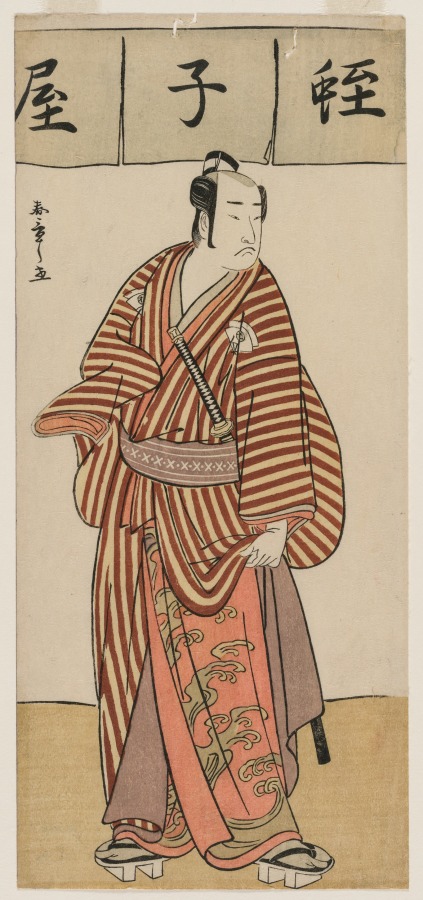
Katsukawa Shunshō, Japan, c. 1780. Color woodblock print; Sheet: 31.5 x 14 cm. Cleveland Museum of Art, 1921.1280.
Look closer: Note the curtains lettered House of Ebisu at the top and the wave pattern on the inner robe, the clues that the actor stands in for Ebisu, god of fishermen.
The Cleveland Museum of Art, Gift from J. H. Wade. Open Access (CC0).
Takarabune, the treasure ship
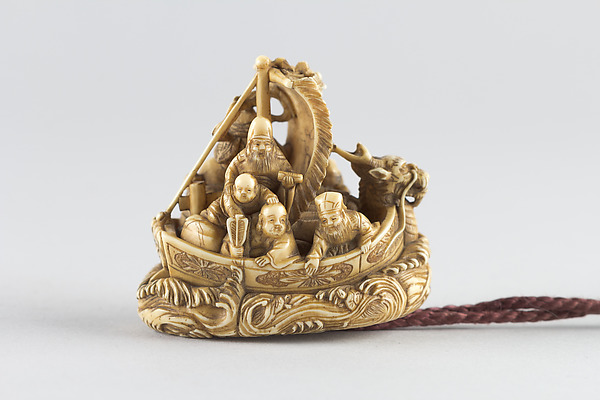
Masahiro, Japan, late 18th century. Carved ivory; H. 4.8 cm; W. 5.1 cm; D. 3.2 cm. Metropolitan Museum of Art, 10.211.819.
Look closer: Note the dragon head at the prow and the wave pattern carved around the base.
The Metropolitan Museum of Art, Gift of Mrs. Russell Sage, 1910. Open Access.
JAANUS defines the takarabune as a sailboat at full sail, loaded with rice bushels and treasures, often bearing the seven gods. Wikipedia adds that the gods are said to sail the heavens on it during the first three days of the year, and that a picture of the ship is a traditional part of Japanese New Year celebrations. Schumacher gives the usual folk version: on New Year's Eve the seven enter port together to bring happiness to everyone, and the treasure ship, often dragon-headed, carries their gifts. The ship therefore does two jobs: it explains how seven gods of different lands travel together, and it gives a household something to put under the pillow or on the wall on the first nights of the year.
The Metropolitan Museum owns a small ivory netsuke of the boat with the seven gods, carved by Masahiro in the late eighteenth century and only 4.8 centimetres high. A craftsman who can fit the company, a mast, a dragon-headed prow and carved waves onto an object that size shares the pleasure that painters took in the subject.
A boat for bad dreams
The first treasure ships were not about wealth at all. The Japanese Wiki Corpus article on the takarabune, translated from Japanese Wikipedia, says that the origin was much simpler: a ship used for yumechigae and yumebarae, rites to turn aside or purify bad dreams, on which they were floated down a river, on the logic of the great purification, oharae, in which water carries impurity away. In the Muromachi period pictures of the ship were given out on the night of Setsubun or on New Year's Eve, and collected the following morning after people had slept on them, to be floated away or buried. yokai.jp reads the same history, a boat image first made to carry bad dreams off and later given a stronger emphasis on inviting fortune.
JAANUS cannot fix the origin. One Edo-period record says the paintings began in the Muromachi period; a different source says they were originally imperial gifts to high-ranking courtiers at the New Year. What is certain is the Edo custom: placing the picture under the pillow on the second night of the year to bring an auspicious first dream, hatsuyume, and, after a bad dream, setting the picture adrift on a river or the sea to forestall bad luck.
The cargo is set out in the sources. The Japanese Wiki Corpus lists coral, gold and silver and jewels. JAANUS describes rice bales and treasures, with cranes and tortoises in the sky and the sea, and the character baku, 獏, sometimes on the sail. Baku is the Chinese chimera that devours nightmares, so a boat that carries away bad dreams could carry its own guardian on the sail. The Victoria and Albert Museum's print of the treasure ship by Utagawa Hiroshige, made about 1840, shows the gods as humorous deities, with the character ju, longevity, on the sail and the crane, the seaweed-trailing tortoise and the pine branches that go with it.

Kubo Shunman, Japan, 1816, year of the rat. Part of an album of woodblock prints (surimono); ink and color on paper; 14 x 21 cm. Metropolitan Museum of Art, JP2318.
Look closer: Note the dragon-headed prow and the rats among the treasures: the album print is dated to 1816, a year of the rat.
The Metropolitan Museum of Art, H. O. Havemeyer Collection, Bequest of Mrs. H. O. Havemeyer, 1929. Open Access.

Teisai Hokuba, Japan. Woodblock print (surimono); ink and color on paper; 20.6 x 18.6 cm. Metropolitan Museum of Art, JP2194.
Look closer: Note the great patterned sail that fills the print and the small figures sitting along the gunwale beneath it.
The Metropolitan Museum of Art, H. O. Havemeyer Collection, Bequest of Mrs. H. O. Havemeyer, 1929. Open Access.
The palindrome under the pillow
A treasure-ship print was often inscribed with a poem that reads the same forwards and backwards in sound, a kaibunka. JAANUS gives it in romanised form: nagakiyono / tō no nemuri no / mina mezame / naminori fune no / oto no yokikana. The sense, in JAANUS's gloss, is awakening from a deep sleep after a long night and hearing the sweet sound of a boat sailing through the waves. The Victoria and Albert Museum's note on Hiroshige's print records the same verse in the inscription, and the Japanese Wiki Corpus offers a slightly different translation of it. The poem works as a charm in itself: whichever way one reads it, the sleeper wakes into a good sound.
Schumacher records the rule that goes with it. If you dream well on the night of 1 and 2 January you will be lucky all year, but you must not tell anyone the dream, or you forfeit its power; if you dream badly, you pray to Baku or set the picture on a river or the sea.

Ryūryūkyo Shinsai, Japan, 19th century. Woodblock print (surimono); ink and color on paper; 18.3 x 16.7 cm. Metropolitan Museum of Art, JP2116.
Look closer: Note the picture of the ship unrolled beside the clock: the print shows the treasure boat as an object hung and looked at, a picture within a picture.
The Metropolitan Museum of Art, H. O. Havemeyer Collection, Bequest of Mrs. H. O. Havemeyer, 1929. Open Access.
Peddlers, painters and parodies
Simple, uncoloured woodblock prints of treasure boats were sold on the streets by roving vendors from the early eighteenth century until the middle of the Meiji period, JAANUS says, and many survive. At the other end of the scale, fine hanging scrolls were painted, usually in ink, by first-rate Edo artists such as Ogata Kōrin, who lived from 1659 to 1716, and Tani Bunchō, who lived from 1763 to 1840. Ukiyo-e artists introduced variations that JAANUS calls mitate-e, in which the seven gods are replaced by seven beauties or the popular kabuki actors of the day.
The Rijksmuseum catalogues a surimono by Hokusai dated 1799, a calendar sheet for that year with three poems, in which a treasure ship made of bamboo is filled with New Year gifts, among them fans, and a kite with a crane flies above it. The Metropolitan Museum's Eishi triptych of about 1795 is a mitate of the type JAANUS describes: the treasure boat carries women instead of gods. Schumacher shows a late nineteenth-century print in which the boat is shaped like a namazu, the giant catfish whose movements were thought to cause earthquakes, and the seven are dressed as carpenters, roofers, firefighters and plasterers, the trades that gained by rebuilding. After the Ansei earthquake of 1855, he says, many of Edo's ordinary people profited from the work, and catfish prints presented earthquakes as a means of world rectification, yonaoshi, a redistribution of wealth.

Chōbunsai Eishi, Japan, ca. 1795. Triptych of woodblock prints; ink and color on paper; H. 36.5 cm; W. 76.2 cm. Metropolitan Museum of Art, JP951.
Look closer: Note that the crew are fashionable women and not gods: JAANUS records that print artists changed the seven gods of the treasure boat into seven beauties or popular actors.
The Metropolitan Museum of Art, Gift of Estate of Samuel Isham, 1914. Open Access.
Gods at ease in silk, gold and the hand
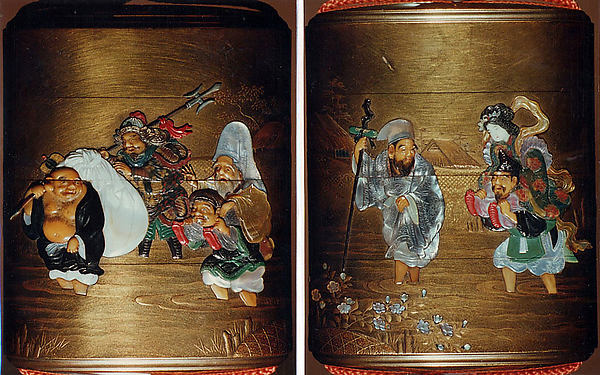
Nakayama Komin, Japan, late 19th century. Gold lacquer with gold hiramkie sprinkled and polished lacquer, nashiji (pear skin) lacquer, and mother-of-pearl, ivory, and wood inlay; 9.1 x 7.1 x 2.9 cm. Metropolitan Museum of Art, 36.100.186.
Look closer: Note the pearly robe of the wading figure against the gold ground.
The Metropolitan Museum of Art, The Howard Mansfield Collection, Purchase, Rogers Fund, 1936. Open Access.
The Metropolitan Museum's hanging scroll by Nagasawa Roshū, shown at the head of this page, is signed as an old man of seventy-one and so dated to 1837. The catalogue describes the gods as a relaxed party over a meal and wine. Most of them sit beside their attributes or animals: Jurōjin leans against a deer, Fukurokuju has scrolls, three in this work, and Bishamonten holds a miniature pagoda. Benzaiten, the only goddess, sits above a long-tailed tortoise that could belong to either Jurōjin or Fukurokuju. The catalogue adds that Roshū never matched the fame of his father Nagasawa Rosetsu but kept his soft, impressionistic brushwork.
The same company turns up in every medium, and the small objects are often the most inventive. A late nineteenth-century inrō by Nakayama Komin, the medicine case that hung from a sash, shows the seven wading a river in gold lacquer with mother-of-pearl, ivory and wood inlay. The Museum notes that its ojime, the bead that tightens the cord, is a tiny lacquer version of Daikoku's mallet, so the god appears twice on one object, once as a figure and once as a fastening. Because an inrō was worn on the body, the gods it carried were literally carried about by their owner, a portable share of the ship.
The Museum's record for a second inrō, made in the second half of the eighteenth century, is titled with the characters for longevity and good fortune and the Seven Lucky Treasures on a checkerboard ground. The treasures are a different group from the seven gods, though of the same family of New Year luck; the record does not say which emblems are meant. The Museum's record gives the title, date and materials, four cases of lacquered wood with gold, silver and red lacquer, but no description text, and this page claims nothing beyond them.
A boat to hold incense
The earliest object in the group is a seventeenth-century incense box, a kōgō, shaped as a treasure boat in lacquered wood with gold and maki-e lacquer, and only 5.1 centimetres high though 14 centimetres long. Here the vessel stops being a picture and becomes a container: the lid opens on whatever was kept inside, so the boat literally holds a cargo. The Museum's record, again, has no description text beyond the title, the date, the material and the credit line, and the box does not say what it was used for. The shape alone says that the ship was already a fixed form in the seventeenth century, a hundred years before the surimono makers began to joke about it.
A second inrō records the boat in a quieter way. Its obverse shows a treasure boat on waves and its reverse a crane in flight and a tortoise on rocks, both signs of long life, and the sail carries the character ju, longevity. The Victoria and Albert Museum reads the same sign on the sail of Hiroshige's treasure ship, so the pairing of boat and longevity was a recognised convention rather than a private joke. The Museum dates the case to the eighteenth or nineteenth century and gives its materials as lacquer in nashiji, hirame, gold, silver, black and red hiramakie, with a fundame interior.

Japan, 17th century. Lacquered wood, gold and maki-e lacquer; H. 5.1 cm; W. 14 cm. Metropolitan Museum of Art, 14.40.867a, b.
Look closer: Note how the whole box is a boat and the lid a cargo of treasures, an incense box made to sit on a New Year shelf.
The Metropolitan Museum of Art, Bequest of Benjamin Altman, 1913. Open Access.

Japan, 18th–19th century. Lacquer, nashiji, hirame, gold, silver, black and red hiramakie; 8.7 x 4.4 x 2.4 cm. Metropolitan Museum of Art, 36.100.203.
Look closer: Note the character on the sail, ju, longevity, the same sign that the Victoria and Albert Museum reads on Hiroshige's treasure ship, and the crane and tortoise on the reverse.
The Metropolitan Museum of Art, The Howard Mansfield Collection, Purchase, Rogers Fund, 1936. Open Access.
Fortune in pairs
Ebisu and Daikoku were the pair most often chosen to stand for the whole, since a household might keep only two. A surimono by Totoya Hokkei, in an album at the Metropolitan Museum, pairs them in a single round frame. An inrō by Nikkōsai, nineteenth century, goes further: gold lacquer with coloured hiramaki and ivory inlay shows the two gods dancing beneath New Year's decorations, and because each side of the case holds one god they meet only when the case is turned in the hand. The Museum's tag for the object names men and fish, the fish being the sea bream that Ebisu carries.
For the third pair the Museum has a wooden netsuke of the eighteenth or nineteenth century in the shape of a bale of rice. The bale opens, and inside are Daikoku and Fukurokuju, in the Museum's spelling of the second name, wrestling. The joke needs no text: the bale is Daikoku's customary seat, and the tall-headed sage is the one god of the seven who is least likely to throw his weight about. The record has no description text and the Museum names no maker, so the carver remains unknown.

Nikkōsai, Japan, 19th century. Gold lacquer with gold and colored hiramkie sprinkled and polished lacquer and ivory inlay; 8.6 x 5.9 x 2 cm. Metropolitan Museum of Art, 29.100.853.
Look closer: Note that each side of the case holds one god, so Ebisu and Daikoku appear together only when the case is turned.
The Metropolitan Museum of Art, H. O. Havemeyer Collection, Bequest of Mrs. H. O. Havemeyer, 1929. Open Access.

Japan, 18th-19th century. Wood; closed H. 2.5 cm, W. 4.1 cm. Metropolitan Museum of Art, 10.211.2055.
Look closer: Note that the bale itself is Daikoku's seat, and that it opens like a box on a wrestling match between Daikoku and Fukurokuju.
The Metropolitan Museum of Art, Gift of Mrs. Russell Sage, 1910. Open Access.
Gods of the kitchen and the stove

Japan, 1698. Clay glazed and gilt (Kiyomizu ware); H. 21.6 cm. Metropolitan Museum of Art, 93.3.227a, b.
Look closer: Note the hood and the heavy bag of the seated Daikoku, the form in which he sits beside kitchen pillars and household altars.
The Metropolitan Museum of Art, Gift of Charles Stewart Smith, 1893. Open Access.
Some of the seven were household gods before they were New Year visitors, and the hearth was where they lived. Wikipedia's article on Daikokuten says that the two gods Daikoku and Ebisu were enshrined together in the kitchen or beside the oven in homes, while merchants worshipped them as patrons of trade, and that Daikoku is worshipped in the kitchen for the blessing of the five cereals, which include wheat and rice. The same article gives a theory that daikoku-bashira, the name for the central supporting pillar of a traditional Japanese house, comes from his name, and notes that the word came to mean the chief breadwinner of a family and, in slang, a Buddhist priest's wife. Whether or not the etymology is right, the pillar makes the point that a god of wealth was thought of as the thing that held the house up.
The Metropolitan Museum has a glazed and gilt clay figure of Daikoku, 21.6 centimetres high, in Kiyomizu ware and dated 1698. The Museum describes it as an ornament and its record gives no more than title, date, culture, medium and size, so the use is not stated. Its hooded, seated form is the one that the Wikipedia article describes for the later Daikoku: a smiling man with a rotund belly, mallet and rice bales, a figure that emerged from the fourteenth century onwards as the wrathful early Mahākāla softened into a jovial giver. The figure's date is useful to a collector: it shows that the cheerful Daikoku was already a firm commercial type in the 1690s, a century before the Hokusai surimono.
Kōjin, the fierce god of the fire
Another household god shares the same room, though he is not one of the seven. Wikipedia describes Kōjin, also called Sanbō-Kōjin, as the kami of fire, the hearth and the kitchen, sometimes called Kamado-gami, the god of the stove. He is, the article says, a god of uncertain temper who represents violent forces turned toward the betterment of humankind, and he is responsible for watching over the household and reporting any misdeeds to the kami of the village or city, whose reports are weighed by an assembly of gods at Izumo in the tenth month of the old calendar. Statues show him with flaming hair, fangs and a contorted face, often with a bow and arrows, and some identify him as an incarnation of Fudō Myō-ō. The Fudō chapter in this almanac is here.
The idea that a household god makes a yearly report is not Japanese in origin. Wikipedia's article on the Chinese Kitchen God, Zao Jun, says that on the twenty-third day of the twelfth lunisolar month, just before Chinese New Year, he returns to heaven to report on the conduct of every household to the Jade Emperor, who rewards or punishes the family accordingly. The article gives two stories of how he became a god. In the better known, a man named Zhang Lang left his virtuous wife, went blind and became a beggar, and was fed unknowingly by her; when he recognised her and wept, his sight returned and, ashamed, he threw himself into the hearth. In the other, a man so poor that he sold his wife later served in her new husband's house and died in despair. In both, the article says, Heaven took pity and made him the god of the kitchen.
The comparison is useful because it shows what the Japanese gods of the seven are not. The Chinese stove god is a moral witness; Daikoku and Ebisu are givers of plenty, and they report to no one. When the seven are gathered on one ship, the Japanese household has found a way of keeping the benefits of the hearth gods without their anxiety. Kōjin keeps the older, sterner role of the watcher, and the ship arrives to make up for him.
Stealing luck
Wikipedia records a custom linked to Daikoku called fukunusubi, the theft of fortune. It began with the belief that whoever stole a divine figure was assured of good fortune if not caught in the act, and the year-end market held at Sensō-ji in Asakusa became the main place where such images were sold and disposed of. The custom is a reminder that the household gods were thought of as things to be handled, kept, returned and replaced, not only worshipped from a distance.
The first dream of the year
The treasure ship does its work in sleep. Wikipedia's article on hatsuyume describes it as the first dream a person has in the new year, whose content was traditionally thought to foretell the luck of the dreamer in the year ahead. Because the night of 31 December was often passed without sleeping, the dream was usually the one of the night of 1 January, and the day after it, 2 January in the Gregorian calendar, is also called hatsuyume. It is considered particularly lucky to dream of Mount Fuji, a hawk and an eggplant, a belief the article traces to the early Edo period, with mentions in the poems of Matsuo Bashō, and the saying is learned as ichi-Fuji, ni-taka, san-nasubi: one Fuji, two hawks, three eggplants. The list goes on, four fans, five tobacco, six blind acupressurers, but its origins are less well known.
The article gives two explanations for the first three. Fuji is the highest mountain in Japan, the hawk is clever and strong, and the word for eggplant, nasu, suggests achieving something, nasu. Another theory says that Fuji, falconry and early eggplants were favourites of the shogun Tokugawa Ieyasu. It adds that neither explanation is firmly established. The treasure-ship picture is a rival to this list rather than a part of it, a visual charm instead of a verbal one, and the two traditions share the same pillow.
Several accounts quoted earlier give the rule for the picture. JAANUS says it was placed under the pillow on the second night of the year to bring an auspicious first dream; Wikipedia says a picture of the ship is a traditional part of the New Year celebrations; the Japanese Wiki Corpus says that in the Muromachi period the pictures were given out on Setsubun night or on New Year's Eve and gathered the next morning, to be floated or buried if the dream had been bad. Schumacher's version adds the rule of silence: tell no one a good dream. Together they describe a small household liturgy of paper, sleep and water, and the seven gods sit at the centre of it.
Walking the seven
A pilgrimage to seven temples or shrines, one for each god, is a New Year custom of long standing. The Japanese word is shichifukujin meguri, a round of the seven gods of good fortune. Japan Experience dates the pilgrimage to the Edo period, noting that ukiyo-e artists often showed the gods between the eighteenth and nineteenth centuries and that the idea of visiting them to attract success in daily life was quickly taken up across Japan. It is usually organised for the first weekend of January, and the customary time is the first week of the year. Metropolis Japan listed the pilgrimage for 1 to 10 January 2026, 9 a.m. to 5 p.m., free to enter, with venues at Asakusa, Nihonbashi, Shinagawa, Ueno and Yanaka.
The mechanics are much the same everywhere. A pilgrim buys a board or sheet at the first stop, receives a stamp or calligraphy at each stop, and at the end holds a sheet of seven seals. Old Tokyo, the walking guide whose author has done four Tokyo circuits, describes three kinds of record: a sturdy board, a sheet of washi, and a stamp book. The Tokyo Stroll supplement lists three kinds of relic for the Asakusa round alone: a fukue, a print of the seven that is stamped at each stop; a shikishi board with calligraphy and stamp; and a fukusasa, a bamboo branch on which small ema, one for each god, are hung. At Fukagawa a plastic bamboo branch takes a small ceramic bell for each god; at Mukōjima the pilgrim can buy a small boat in which statuettes of the deities are placed. The boat is the treasure ship again, this time on the walker's own arm.
Tokyo alone has several established rounds, and the sources disagree about which is oldest. This page sets out each as its source reports it, and puts the disagreement in a box below.
Yanaka, Tokyo
The Yanaka round, in the old temple district north of Ueno, is described by Old Tokyo as about five kilometres from start to finish, with stamps collected between 1 and 10 January from 9 a.m. to 5 p.m. The author paid 1,000 yen for the sheet and 200 yen for each stamp, and recommends starting at Tōgakuji, a six-minute walk from Tabata Station, though the temples may be visited in any order. A pamphlet handed out at the first temple, he reports, asserts that Yanaka is the oldest seven-gods pilgrimage and that the custom originated there, a claim he repeats without verifying it.
In his account the seven stops are as follows: Fukurokuju at Tōgakuji in Kita-ku, where a small garden behind the temple holds a statue of each god and is opened for the ten days of the pilgrimage; Ebisu at Seiunji, a temple of the mid-eighteenth century with a monument carrying the writing of the novelist Takizawa Bakin; Hotei at Shushōin, a Nichiren temple moved to its present site in 1663; Bishamonten at Tennōji, founded in 1274 and described as the oldest temple in Yanaka, which in the Edo period was one of three temples authorised to hold lotteries; Jurōjin at Chōanji, the smallest temple on the route; Daikokuten at Gokokuin, a Tendai temple at the edge of Ueno Park with a Noh stage and garden; and Benzaiten at the Benten-dō on Shinobazu Pond. Japan Experience lists Yanaka as one of the oldest Tokyo rounds and names several of the same temples. Old Tokyo's account and Japan Experience's differ in the name of Ebisu's temple, Seiunji in one and Shōunji in the other, although the address given is the same. The Temple Guy, an American blogger, posted a hand-coloured certificate on which the seven gods are having a picnic, stamped on a one-day, seven-temple Yanaka pilgrimage on New Year's Day, 1998.
Meguro, on the Yamanote
The Meguro round runs through the higher, once wealthier Yamanote side of the city rather than the old low-lying Shitamachi. Old Tokyo reports that it is said to be the oldest in Tokyo, dating from at least the end of the eighteenth century, and warns that it should not be confused with a newer Yamanote pilgrimage around Shinjuku. Stamps are given between 1 and 7 January, 9 a.m. to 5 p.m., and the temples lie eight to ten minutes' walk apart.
The stops are Bishamonten at Kakurinji, a Nichiren temple of 1631 that honours the warrior Katō Kiyomasa; Hotei at Zuishōji, an Ōbaku Zen temple founded in 1670 whose large hall is a national important cultural property; Jurōjin and Fukurokuju together at Myōenji, rebuilt in 1954 after the bombing of 1945, where three monks write the calligraphy in front of the pilgrim; Daikokuten at Daienji, a Tendai temple with 520 small statues of arhats; Benzaiten at Banryūji, a Pure Land temple of 1648; and Ebisu at Ryūsenji, the biggest and oldest of the group, a Tendai temple founded in 808 and better known as Meguro Fudōson, the Black-Eyed Fudō from which the district takes its name. That puts the sternest of the Wisdom Kings at the end of a round of the gentlest gods.
Mukōjima, along the Sumida
The Mukōjima round follows the Sumida River. The Tokyo Stroll supplement dates it to 1804 and credits it to Sahara Kikū, a retired antique dealer who created the garden now known as Mukōjima Hyakkaen; the same page records that the stamps are available from 1 to 7 January. Old Tokyo describes it as a mixed route of shrines, temples and one garden, which for him shows the Japanese habit of mixing religious elements, and says that the first shrine gives two gods at once, so there are only six places to visit.
The route begins at Mimeguri Shrine for Ebisu and Daikoku, a shrine with a rare three-pillar torii and close ties to the Mitsui family. It continues to Kōfukuji for Hotei, an Ōbaku temple founded in 1673 with a Chinese-style hall of 1933; to Chōmeiji for Benzaiten, known for the cherry-leaf rice cakes sold behind it, in a shop whose upper floor the haiku poet Masaoka Shiki is said to have lodged in for three months in 1888; to the garden Mukōjima Hyakkaen for Fukurokuju, a small shrine in a park; to Shirahige Shrine for Jurōjin, a shrine established in the middle of the tenth century whose wooden building was burned in 1990; and to Tamonji for Bishamonten, whose thatched gate of 1718 is one of the oldest structures in Tokyo. The long gaps are between the garden and the last two shrines, a kilometre and 1.6 kilometres by Old Tokyo's count.
Ningyōchō and Nihonbashi
The Ningyōchō round, also called the Nihonbashi round, is the one pilgrimage in this list made entirely of shrines. Tokyo Stroll gives it eight shrines and two for Ebisu, with Benzaiten appearing twice, once sharing a shrine with Fukurokuju, over about 3.3 kilometres. Its dates are the longest of the group, 1 to 15 January, and Old Tokyo notes that people visit the shrines throughout the year, not only at New Year.
The stops are Suitengū for Benzaiten, famous for safe childbirth and a branch of a shrine in Kurume; Matsushima for Daikoku, where wishes are written on small paper notes; Suehiro for Bishamonten, named after an auspicious fan found there and given its name in 1675; Kasama Inari for Jurōjin, a branch of the great Kasama Inari shrine in Ibaraki; Sugimori for Ebisu, which Tokyo Stroll counts as one of three lottery shrines of Edo and whose Ebisu festival is held in October; Koami for Fukurokuju and Benzaiten, which Old Tokyo thinks the most beautiful, rebuilt in 1942 and spared in the air raids; and Chanoki for Hotei, named for the tea bushes that surround it. Takarada Ebisu Shrine is a second Ebisu stop on Tokyo Stroll's list. Several of these shrines were destroyed in the earthquake of 1923, in the war, or in both, so the round is also a map of what the city rebuilt.
Asakusa and Fukagawa
The Asakusa round is the longest in Tokyo Stroll's survey, about 7.8 kilometres, and has nine stops because Fukurokuju and Jurōjin each have two. Its New Year hours run 9 a.m. to 6 p.m. on 1 to 3 January, 9 a.m. to 5 p.m. on 4 to 7 January and 9 a.m. to 4 p.m. on 8 January, but Tokyo Stroll stresses that it can be done at any time of year. The stops are Sensō-ji for Daikokuten, Asakusa Shrine for Ebisu, Matsuchiyama Shōden for Bishamonten, Imado Shrine for Fukurokuju, Ishihama Shrine for Jurōjin, Hashiba Fudōson for Hotei, Yoshiwara Shrine for Benzaiten, Ōtori Shrine for Jurōjin and Yasaki Inari Shrine for Fukurokuju. The route passes through the former pleasure quarter of Yoshiwara, and Tokyo Stroll's addendum adds that the hill at Matsuchiyama is in fact a kofun, an ancient burial mound.
The Fukagawa round, about 4.8 kilometres long, runs from 1 to 7 January. Enjuin holds Daikoku, Fukagawa Inari Shrine Hotei, Fukagawa Shinmei Shrine Jurōjin, Fuyuki Bentendō Benzaiten, Ryūkōin Bishamonten, Shingyōji Fukurokuju, and Tomioka Hachimangū, with its separate shrine just west of the gate, Ebisu. The route has no required order.
Kyoto, where the custom is said to have begun
Kyoto's Miyako Shichifukujin claims the longest history of all. The Japanese Wiki Corpus, a translation of Japanese Wikipedia articles on Kyoto, says it is assumed that the first faith in the seven began in Kyoto in the Muromachi period and gradually spread across Japan, that all of the gods but Ebisu came from China and India, and that a festival of the seven is held on the seventh day of every month. Tsunagu Japan, a travel site, says that among all the seven-gods pilgrimages in Japan, the Miyako round is believed to have the longest history.
The seven stops, in the order of Tsunagu Japan's series, are Gyōgan-ji in Kawaramachi, founded in 1004 by a monk who, as a hunter, had shot a doe and watched her lick her newborn fawn, and whose small hall holds Jurōjin; Manpuku-ji in Uji, an Ōbaku temple, for Hotei; Tōji; Rokuharamitsu-ji, founded in 951 by Kūya and holding a golden Fukuju Benzaiten playing her biwa; the Ebisu Shrine; Sekizan Zen-in; and Matsugasaki Daikokuten. A different list, published by Leaf Kyoto for January 2023, names Akayama Zen-in, Matsugasaki Daikokuten, Kakado, Rokuharamitsuji, Kyoto Ebisu Shrine, Tōji and Ōbaku-san Manpukuji, which is the same count of seven; its spellings come from an automatic translation, and Kakado appears to be a second name for the Kawaramachi temple, a point this page has not confirmed. Leaf Kyoto gave the cost of the scroll as 500 yen and the seal book as 300 yen, with a guided bus tour at 14,765 yen, prices that were correct for 2023 and may have changed.
Kyoto's January 10 and 11
Green Shinto, a site on Japanese religion, describes two consecutive days in Kyoto at the start of the year. On 10 January the Tōka Ebisu festival is held at the Ebisu Shrine, from which participants take emblems of Ebisu and his crew aboard the treasure boat. On 11 January there is a second seven-gods round, among the subtemples of the Shingon temple Sennyū-ji, in wooded country in the south-east of the city, past the imperial cemetery where, the writer says, thirty-nine emperors are buried. Pilgrims are handed a branch with a red paper ribbon and collect an emblem from each of seven subtemples. The first stop is Fukurokuju, the second Benzaiten, the third Ebisu, the fourth Hotei, the fifth Daikokuten, the sixth Bishamonten and the last Jurōjin, so the round begins and ends with the two sages of longevity.
The writer records a custom at the Hotei subtemple: a figurine is bought, kept for a year, then returned to be ceremonially disposed of in a vessel shaped like a boat, and a larger figurine is bought the next year, which the writer notes is profitable for the temple. The disposal boat is another treasure ship, here carrying the retired gods to another world. At the Ebisu subtemple the same writer found a Kannon with an old man and woman at her feet, who looked at first like children, a statue to prevent dementia, which the writer thought would be popular in an ageing Japan.
Kamakura and beyond
Kamakura has its own round. On-Mark Productions' page on Fukurokuju names Goryō Jinja in Kamakura as one of the seven sites of the Kamakura Pilgrimage to the Seven Lucky Gods, and adds that its treasure hall holds ten old masks with exaggerated expressions, one of them of Fukurokuju. Japan Experience lists, as popular rounds, Yanaka, Nihonbashi, Kamakura, a group at Fushimi Inari in Kyoto and a boat round in the Seto Inland Sea at Hiroshima; this page has not checked the last two and records them only as that site's list. The Tokyo Stroll supplement notes that some lists substitute Kisshōten for Jurōjin or Fukurokuju, and that a round may have six, eight or nine stops depending on how many places each god has.
| Round | Dates in the source | Length or stops | Source |
|---|---|---|---|
| Yanaka | 1 to 10 January, 9:00 to 17:00 | About 5 km, 7 stops | Old Tokyo |
| Meguro, Yamanote | 1 to 7 January, 9:00 to 17:00 | 6 stops, 8 to 10 minutes apart | Old Tokyo |
| Mukōjima | 1 to 7 January, 9:00 to 17:00 | 6 stops; first shrine gives two gods | Old Tokyo, Tokyo Stroll |
| Ningyōchō and Nihonbashi | 1 to 15 January, 9:00 to 17:00 | About 3.3 km, 8 shrines | Tokyo Stroll |
| Asakusa | 1 to 8 January, with shorter hours late in the week; any time of year | About 7.8 km, 9 stops | Tokyo Stroll |
| Fukagawa | 1 to 7 January, 9:00 to 17:00 | About 4.8 km, 7 stops | Tokyo Stroll |
| Kyoto Miyako round | January; 1 to 31 January in 2023 | 7 stops | Tsunagu Japan, Leaf Kyoto |
| Kyoto Sennyū-ji | 11 January | 7 subtemples | Green Shinto |
Five hundred years in short entries
The sources can be arranged on one line, with the caveat that several entries are traditions and not records.
- Muromachi, 1336 to 1573The seven are grouped, for reasons JAANUS calls unclear (JAANUS); the treasure ship appears as a vessel for bad dreams (Japanese Wiki Corpus).
- 1420First mention of the seven as a group, at Fushimi, in a procession imitating those of the daimyō (Wikipedia, Green Shinto after Chiba).
- Late fifteenth centuryEarliest references to abbreviated groups of two, three or five gods, in tales and comic Nō plays (Graham, quoted by Schumacher).
- 1620The traditional date of Tenkai's conversation with Tokugawa Iemitsu (Green Shinto after Chiba); Schumacher doubts the story.
- 1662 to 1685Kanō Yasunobu paints the earliest surviving scroll of the seven, a drinking party under a pine (Graham, quoted by Schumacher).
- 1690The Butsuzōzui compendium is first printed, with the sea sprite Shōjō among its figures (Wikipedia, Schumacher).
- 1698The Metropolitan Museum's Kiyomizu-ware Daikoku is dated (Metropolitan Museum).
- Early eighteenth centuryPlain woodblock treasure-boat prints begin to be sold on the street by peddlers (JAANUS).
- 1783 and 1796Editions of the Butsuzōzui put Kichijōten in place of Fukurokuju and show Daikoku as a woman (Wikipedia).
- 1799Hokusai's calendar sheet shows a treasure ship made of bamboo (Rijksmuseum).
- 1804Sahara Kikū founds the Mukōjima round (Tokyo Stroll).
- 1816Kubo Shunman's rat-year treasure boat with three rats (Metropolitan Museum).
- 1837Nagasawa Roshū signs the scroll of the seven at the age of seventy-one (Metropolitan Museum).
- 1855After the Ansei earthquake, catfish prints show the seven as carpenters and plasterers (Schumacher).
- 1890sA five-piece nesting figure of Fukuruma reaches a Russian toy workshop, a possible, doubted, link to the matryoshka (Wikipedia).
- 1923 and 1945Several Nihonbashi shrines on the Ningyōchō round are destroyed and rebuilt (Old Tokyo, Tokyo Stroll).
- 1998A hand-coloured certificate of the seven at a picnic is stamped in Yanaka (The Temple Guy).
- 2026The Tokyo rounds run from 1 to 10 January at Asakusa, Nihonbashi, Shinagawa, Ueno and Yanaka (Metropolis Japan).
The seven in the present day
The rounds are very much alive. Metropolis Japan's English event notice for the 2026 pilgrimage gave dates of 1 to 10 January, 9 a.m. to 5 p.m., free of charge, in five areas of Tokyo, and the Tokyo Stroll supplement was updated in July and August 2026 with route lengths, hours and the relics each round offers. In Kyoto, Leaf Kyoto's notice for January 2023 offered both an on-foot round and a bus tour, with stamp boards and books at fixed prices, which suggests the rounds are managed as an organised seasonal event, with a central secretariat at Rokuharamitsu-ji.
The gods are also commercial. Japan Experience says that they appear frequently in Japanese popular culture, in anime and manga, as brand mascots and logos for businesses that want to associate themselves with good fortune, and in the names of products, restaurants and even train lines. It also notes that many cities and towns promote their seven-gods connections to bring in visitors. The page does not give a single example for each, and this page claims only the general pattern.
Festival life continues around the individual gods. The Tōka Ebisu festival of 10 January at Nishinomiya Shrine, head shrine of the Ebisu sect with about 3,500 shrines under it, is famous for its Lucky Men race. According to Wikipedia, the race began in the Edo period: at 6 a.m. the drum sounds, the gates open and the assembled crowd sprints 230 metres to the main hall, and the first three finishers are named fuku-otoko, lucky men. Nippon.com notes that Kansai holds festivals each January for Ebisu, among them Imamiya Ebisu Shrine in Osaka and Nishinomiya, and the Green Shinto writer found the Kyoto Ebisu Shrine holding its own Tōka Ebisu on the same date.
One curiosity from the history of toys is worth setting beside the gods. Wikipedia's article on the matryoshka records speculation that the Russian nesting doll was inspired by a nesting figure imported from Japan, and notes that the Children's Education workshop, where the first Russian set was made in the 1890s, received in the late 1890s a five-piece cylinder-shaped nesting doll featuring Fukuruma, a name for Fukurokuju, which is now in the Sergiev Posad Museum of Toys. The article adds that there are serious doubts about the link. A set of seven-gods nesting dolls made at Hakone in Kanagawa is among the illustrations of the article, so the idea has made the journey home.
Fortune in other houses
Japan's lucky gods have cousins elsewhere, and Wikipedia's articles on the kitchen gods name several. Zao Jun, the Chinese Kitchen God, reports to the Jade Emperor each year before the new year, and the Vietnamese version of the same deity is known as Táo Quân. The Wikipedia article on Kōjin lists, as related figures, Agni of the Vedic tradition, the Greek goddess Hestia, the Roman Vesta and the Lares, the Korean Jowangshin, the Ainu Kamuy-huci and the Vietnamese Ông Táo, so the household fire has had a keeper in nearly every tradition that cooked on one.
The seven themselves, though, are particular to Japan. Wikipedia's account gives the Chinese Fu, Lu and Shou, the stars of fortune, rank and longevity, as the nearest cousins of Fukurokuju and Jurōjin, and Nippon.com ties both to the southern pole star. JAANUS suggests the number seven may follow the Seven Sages of the Bamboo Grove, a Chinese subject. Schumacher shows the Seven Sages of the Wine Cup beside it. The seven gods of Japan are, in that sense, Chinese poets and Indian gods drinking with a Japanese fisherman.
How to read a Seven Lucky Gods piece
The objects in this chapter were chosen from open collections so that every claim could be checked against a published record. They also form a small course in how to look at the subject. Five questions help.
First, count and name. A boat with several figures is not always these seven. The Eishi triptych in the Metropolitan Museum shows the treasure boat crewed by fashionable women, and the Shunshō print in the Cleveland Museum gives the gods to kabuki actors. JAANUS records exactly this kind of substitution under the name mitate-e. Name each figure by its mark: the rod and fish for Ebisu, the mallet and bale for Daikoku, the spear and pagoda for Bishamonten, the biwa for Benzaiten, the long head and staff for Fukurokuju, the deer for Jurōjin, the sack and belly for Hotei. A piece that gives only two or three is not necessarily incomplete; Graham's earliest texts mention groups of two, three or five.
Second, read the cargo. The sail, the prow and the contents of the hold carry the date and the message. A rat points to the zodiac year, as in Kubo Shunman's print for the year of the rat, 1816; a crane and tortoise point to longevity; the character ju on a sail points to the same; the baku, the dream-eater, on a sail points to the pillow rite. A dragon head at the prow is the usual form, as the Masahiro netsuke and the Shunman print both show.
Third, check the scale of the object. Netsuke, inrō and ojime are made to be handled, and the gods on them are small by necessity: the Masahiro boat is 4.8 centimetres high, the rice-bale netsuke only 2.5. The Museum's records for these give the dimensions but, in several cases noted above, no description text, and a careful owner will keep the condition, the maker's name if any, and the date range stated by the museum in the same words rather than guess a closer one.
Fourth, notice the medium and the year. Surimono were privately commissioned greeting sheets, often for the New Year, with poems; the Hokusai sheet of 1799 in the Rijksmuseum is a calendar for that year, and Shunman's print is dated by its zodiac animal. Hanging scrolls such as Roshū's were signed with an age, which fixes the year. Lacquer is dated more roughly, by style, to half a century or a century, as in the Museum's second half of the eighteenth century for the checkerboard inrō.
Fifth, treat the household. A Daikoku figure of 1698 shows that the kitchen god was a commercial type long before the surimono; a bale that opens on a wrestling match shows the humour that collectors of netsuke prize. None of this fixes a price, and this page makes no claim about value. The concierge desk can search Japan for a particular god, a particular boat or a particular year, and the shelf below shows what the house holds now.
Things worth knowing
- Only one of the seven, Ebisu, was born in Japan; the other six came from India or China (Wikipedia, Japanese Wiki Corpus).
- In 1420 a procession at Fushimi imitating those of the daimyō is the earliest recorded gathering of the seven (Wikipedia, Green Shinto after Chiba), but Graham, quoted by Schumacher, places the set of seven in the second half of the seventeenth century.
- In the 1470s and 1480s bandits are said to have dressed as the gods to trick people out of money (Green Shinto, after Chiba).
- The poem inscribed on treasure-ship prints reads the same forwards and backwards in sound: nagakiyono / tō no nemuri no / mina mezame / naminori fune no / oto no yokikana (JAANUS).
- The character baku, 獏, on a treasure-ship sail is the Chinese chimera that eats nightmares (JAANUS).
- In an 1855 catfish print the treasure boat is shaped like a namazu and the seven are dressed as builders, since rebuilding after an earthquake brought work (Schumacher).
- The Zen master Hakuin Ekaku replaced Bishamonten with the demon-queller Shōki in one scroll of the seven (Schumacher, after Graham).
- At Nishinomiya Shrine the first three runners to reach the main hall on 10 January are named lucky men; the course is 230 metres (Wikipedia).
- A five-piece nesting figure of Fukuruma reached the Russian toy workshop where the first matryoshka was made, though a link between them is doubted (Wikipedia).
- At a Kyoto subtemple, Hotei figurines are bought, kept for a year and returned in a boat-shaped vessel, then replaced by a larger one (Green Shinto).
- The Asakusa round has nine stops, since Fukurokuju and Jurōjin each have two (Tokyo Stroll).
Across Asia
The seven come from three traditions that met in Japan, and none of the other countries has quite the same set. The kitchen gods, by contrast, appear almost everywhere that a hearth has been kept.
| Where | Form and name | What the record shows |
|---|---|---|
| India | Kubera, Sarasvatī and Mahākāla | The roots of Bishamonten, Benzaiten and Daikokuten, who reached Japan through Buddhism (Wikipedia). |
| China | Fu, Lu, Shou and Budai | Daoist star gods and a Chan monk, close kin of Fukurokuju, Jurōjin and Hotei (Wikipedia, Nippon.com); the Seven Sages of the Bamboo Grove are named as a possible model for the number seven (JAANUS). |
| China, hearth | Zao Jun, the Kitchen God | Reports each year on the twenty-third day of the twelfth month to the Jade Emperor (Wikipedia). |
| Vietnam and Korea | Táo Quân, Ông Táo and Jowangshin | Kitchen gods listed beside the Chinese and Japanese figures (Wikipedia). |
| Japan | Shichifukujin 七福神; Kōjin | One native god, Ebisu, joins six from abroad aboard the treasure ship (JAANUS, Wikipedia); Kōjin keeps the stove (Wikipedia). |
| Russia | Matryoshka | A possible, doubted, link through a Japanese nesting figure of Fukuruma (Wikipedia). |
A fellowship of fortune
The Seven Lucky Gods stand among the Heavenly Beings of the almanac, though three of them, Daikokuten, Bishamonten and Benzaiten, also have chapters of their own in that wing, and four have chapters here. The group is placed by company, as it has been understood since the Muromachi period.
| God | Origin | Known for |
|---|---|---|
| Ebisu | Japan | Business, abundant food; rod and large fish |
| Daikokuten | India, by way of Buddhism | Commerce, crops; mallet and bag |
| Bishamonten | India, from Kubera | Fortune in battle, authority; spear and pagoda |
| Benzaiten | India, from Sarasvatī | Wealth, talent, music; biwa lute |
| Jurōjin | China, Daoist | Old age and longevity; staff, scroll, deer |
| Hotei | China, Chan | Contentment, popularity; large bag |
| Fukurokuju | China, Daoist | Wisdom, luck, happiness; staff, scroll, crane |
Where to see them
| Place | What to look for |
|---|---|
| Yanaka, Tokyo | Tōgakuji, Seiunji, Shushōin, Tennōji, Chōanji, Gokokuin and the Benten-dō on Shinobazu Pond, in the first ten days of January (Old Tokyo). |
| Meguro, Tokyo | Kakurinji, Zuishōji, Myōenji, Daienji, Banryūji and Ryūsenji, the Black-Eyed Fudō temple, 1 to 7 January (Old Tokyo). |
| Mukōjima, Tokyo | Mimeguri, Kōfukuji, Chōmeiji, Mukōjima Hyakkaen, Shirahige and Tamonji along the Sumida (Old Tokyo, Tokyo Stroll). |
| Ningyōchō and Nihonbashi | Eight shrines in about 3.3 kilometres, from Suitengū to Chanoki, open into mid-January (Tokyo Stroll). |
| Asakusa and Fukagawa | Nine stops from Sensō-ji, and a round of seven around Tomioka Hachimangū (Tokyo Stroll). |
| Kyoto | The Miyako round from Gyōgan-ji to Matsugasaki Daikokuten, and the 11 January round at Sennyū-ji (Tsunagu Japan, Green Shinto). |
| Nishinomiya and Osaka | Nishinomiya Shrine and Imamiya Ebisu Shrine hold January festivals for Ebisu (Wikipedia, Nippon.com). |
| Kamakura | Goryō Jinja is one of the seven sites of the Kamakura round and keeps a Fukurokuju mask (On-Mark Productions). |
| Metropolitan Museum of Art, New York | The scroll by Roshū, surimono by Hokusai, Hokkei and Shunman, the Eishi triptych, inrō, netsuke and a clay Daikoku, in open access. |
| Cleveland Museum of Art | Katsukawa Shunshō's actor print in the Stand-In Seven Gods series, in open access. |
Seven portraits, each alone

Katsushika Hokusai, Japan, 18th–19th century. Ink and color on paper; 27.1 x 17.8 cm. Metropolitan Museum of Art, 56.121.33.
Look closer: Note the large fish clasped under the arm and the long rod, the two marks by which Ebisu is told from all the others.
The Metropolitan Museum of Art, Gift of Annette Young, in memory of her brother, Innis Young, 1956. Open Access.
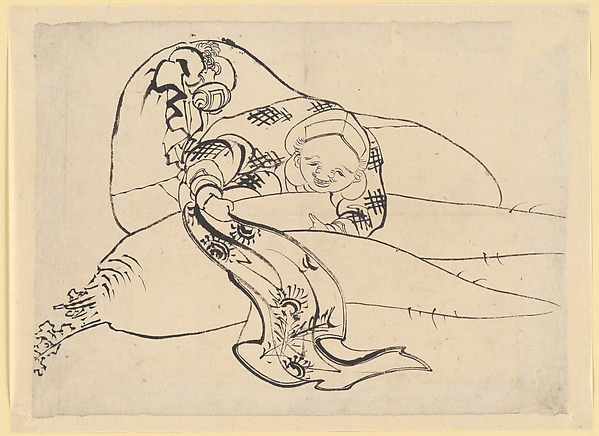
Katsushika Hokusai, Japan, 18th–19th century. Ink on paper; 24.4 x 33.3 cm. Metropolitan Museum of Art, 56.121.15.
Look closer: Note the immense radishes beneath the god, a foodstuff that, like rice, belongs to Daikoku's household blessings.
The Metropolitan Museum of Art, Gift of Annette Young, in memory of her brother, Innis Young, 1956. Open Access.

Japan, 17th century. Lacquer, roiro and rubbed fundame, gold and silver hiramakie, tortoiseshell; 6.7 x 5.4 x 2.3 cm. Metropolitan Museum of Art, 29.100.869.
Look closer: Note the armoured figure riding the clouds above the demon, the guardian aspect that Bishamonten keeps beside his role as giver of treasure.
The Metropolitan Museum of Art, H. O. Havemeyer Collection, Bequest of Mrs. H. O. Havemeyer, 1929. Open Access.
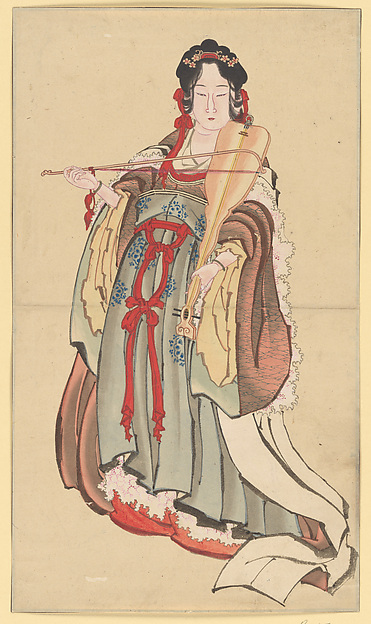
Katsushika Hokusai, Japan, 18th–19th century. Ink and color on paper; 41 x 23.7 cm. Metropolitan Museum of Art, 56.121.32.
Look closer: Note the long robe and the elegant stance, the court-lady dress in which Benzaiten is usually shown.
The Metropolitan Museum of Art, Gift of Annette Young, in memory of her brother, Innis Young, 1956. Open Access.

Katsukawa Shunshō, Japan, 1798. Hanging scroll; ink and color on paper. Metropolitan Museum of Art, 1975.268.131.
Look closer: Note the staff and the large round shape before the old man, with the inscription above; the Museum dates the scroll to 1798.
The Metropolitan Museum of Art, The Harry G. C. Packard Collection of Asian Art, Gift of Harry G. C. Packard, and Purchase, Fletcher, Rogers, Harris Brisbane Dick, and Louis V. Bell Funds, Joseph Pulitzer Bequest, and The Annenberg Fund Inc. Gift, 1975. Open Access.
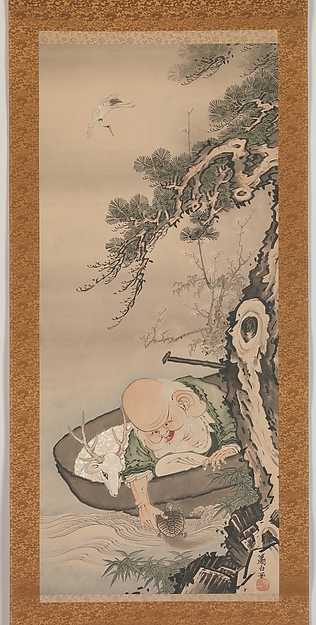
Soga Shōhaku, Japan, ca. 1773. Hanging scroll; ink and color on paper; Image 134 x 56.7 cm. Metropolitan Museum of Art, 2011.572.1.
Look closer: Note the old man in the little boat beneath the pine, a pine standing for longevity, painted about 1773.
The Metropolitan Museum of Art, Fishbein-Bender Collection, Gift of T. Richard Fishbein and Estelle P. Bender, 2011. Open Access.
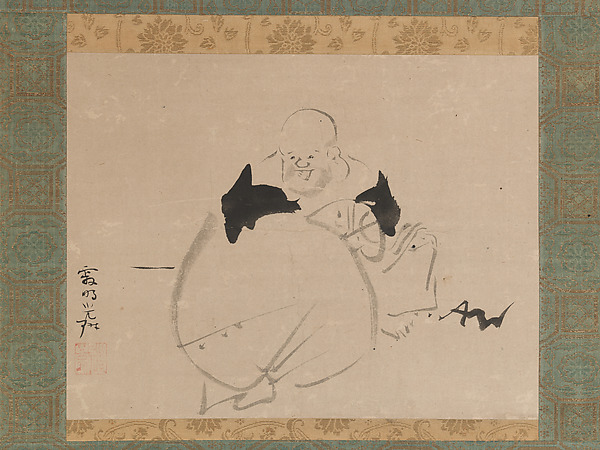
Ogata Kōrin, Japan, after 1704. Hanging scroll; ink on paper. Metropolitan Museum of Art, 2015.300.89.
Look closer: Note how the round belly is drawn in a single loop of ink, the whole figure built from a handful of brushstrokes.
The Metropolitan Museum of Art, Mary Griggs Burke Collection, Gift of the Mary and Jackson Burke Foundation, 2015. Open Access.
At the desk
A Seven Lucky Gods piece, whether a set, a boat or a single god, appears below when we hold one. If none shows, the concierge desk can search for it.
A small glossary of the seven
The words most often met on a scroll, a shrine map or a stamp sheet.
- Shichifukujin 七福神
- The seven gods of good fortune (JAANUS).
- Takarabune 宝船
- The treasure ship, a sailboat at full sail loaded with rice and treasures, often bearing the seven gods (JAANUS).
- Meguri めぐり
- A round or circuit of shrines and temples; shichifukujin meguri is the New Year round of the seven (Japan Experience).
- Shikishi 色紙
- A square board or card on which the stamps of the round are collected (Old Tokyo).
- Gohoin 御宝印
- The calligraphic stamp collected at each stop of the Kyoto round (Tsunagu Japan).
- Fukusasa
- A bamboo branch on which small ema, one for each god, are hung (Tokyo Stroll).
- Kaibunka 回文歌
- A palindromic poem, written on treasure-ship prints (JAANUS).
- Baku 獏
- The Chinese dream-eating chimera, sometimes written on a treasure-ship sail (JAANUS).
- Hatsuyume 初夢
- The first dream of the year, said to foretell the year ahead (Wikipedia).
- Mitate-e 見立絵
- A print that replaces the expected figures with others, such as seven beauties for seven gods (JAANUS).
- Surimono 摺物
- A privately issued print, often a New Year greeting with poems; several in this chapter are in the Metropolitan Museum's collection.
- Inrō 印籠
- A small stacked case worn from the sash on a cord, held by a netsuke and tightened by an ojime bead (Metropolitan Museum).
- Netsuke 根付
- A carved toggle; the Metropolitan Museum holds several of the treasure boat and of the gods.
- Kōgō 香合
- A small box for incense; one is shaped as a treasure boat (Metropolitan Museum).
- Butsuzōzui 仏像図彙
- An illustrated compendium of Buddhist images, printed from 1690 (Wikipedia).
- Daikoku-bashira 大黒柱
- The central pillar of a house, perhaps named for Daikokuten (Wikipedia).
- Kamado-gami 竃神
- The god of the stove, a name for Kōjin (Wikipedia).
- Fukunusubi 福盗み
- The theft of fortune, a custom of stealing a Daikoku image for luck (Wikipedia).
- Tōka Ebisu 十日戎
- The festival of Ebisu on 10 January, with the lucky-men race at Nishinomiya (Wikipedia, Green Shinto).
Answered plainly
Who are the Seven Lucky Gods?
Ebisu, Daikokuten, Bishamonten, Benzaiten, Fukurokuju, Jurōjin and Hotei (Wikipedia). Each has a chapter in this almanac, linked above.
Is any of them Japanese?
Only Ebisu is native to Japan. Daikokuten, Bishamonten and Benzaiten came from India by way of Buddhism, and Fukurokuju, Jurōjin and Hotei from China (Wikipedia).
When were they first grouped?
The sources give several answers: the Muromachi period (JAANUS), a procession at Fushimi in 1420 (Wikipedia, Green Shinto), the late fifteenth century for abbreviated groups, and the second half of the seventeenth century for the set of seven in its known form (Graham, quoted by Schumacher).
Why are there seven?
JAANUS gives two possible models: the Seven Sages of the Bamboo Grove of Chinese tradition, and a phrase in the Ninnōgyō sutra about seven adversities disappearing and seven fortunes arising. It presents both only as possibilities.
What is the treasure ship?
The takarabune, a sailboat loaded with rice bales and treasures, in which the gods are said to sail the heavens during the first three days of the New Year (JAANUS, Wikipedia).
Why is a picture of the ship put under the pillow?
The picture is placed under the pillow on the second night of the year to bring an auspicious first dream, and after a bad dream it is set adrift on a river or the sea (JAANUS).
Did Tenkai choose the seven?
Tradition says the priest Tenkai chose them after a conversation with Tokugawa Iemitsu, to stand for seven virtues (Wikipedia, Nippon.com). Schumacher, quoting Graham, calls the story probably later invention, since Tenkai's own writings and the records of Rinnō-ji do not mention it.
Is the group always the same seven?
No. The 1783 Butsuzōzui puts Kichijōten in place of Fukurokuju (Wikipedia), and JAANUS says membership was not fixed at first.
Who is the goddess among the seven?
Benzaiten, who descends from the Hindu river goddess Sarasvatī (Wikipedia, Nippon.com).
How do I tell Fukurokuju and Jurōjin apart?
Both are tied to the southern pole star and are often confused (Wikipedia, Nippon.com). Fukurokuju has the very tall forehead and often a crane; Jurōjin has the staff, scroll and deer (JAANUS).
When is the pilgrimage and how does it work?
Usually from 1 January for a week or ten days, though some rounds run longer or all year; Metropolis Japan listed Tokyo's for 1 to 10 January 2026, free to enter. A pilgrim buys a board, sheet or branch and collects a stamp or calligraphy at each stop (Old Tokyo, Tokyo Stroll).
Which pilgrimage is the oldest?
Kyoto's Miyako round is said to have the longest history (Japanese Wiki Corpus, Tsunagu Japan); Meguro is called the oldest in Tokyo (Old Tokyo); Yanaka's pamphlet claims the custom began there; Mukōjima is dated to 1804 (Tokyo Stroll).
What does each god bring?
Ebisu business and food, Daikokuten commerce and crops, Bishamonten fortune in battle, Benzaiten wealth and music, Jurōjin long life, Hotei contentment, Fukurokuju wisdom and happiness (Wikipedia).
Did the seven inspire the matryoshka?
Possibly not. Wikipedia records that a five-piece nesting figure of Fukuruma reached the workshop where the first Russian set was made, but says there are serious doubts about any link.
Where next
Sources and image credits
- Wikipedia, Seven Lucky Gods
- JAANUS, Shichifukujin 七福神 (Columbia University)
- JAANUS, Takarabune 宝船
- Nippon.com, Shichifukujin: Japan's Seven Gods of Fortune
- On-Mark Productions (Mark Schumacher), The Seven Lucky Gods
- On-Mark Productions, Fukurokuju
- Green Shinto, Seven Lucky Gods: origins
- Green Shinto, Shichifukujin Meguri: Seven Lucky Deities in Kyoto
- yokai.jp, Shichifukujin
- yokai.jp, Takarabune
- Japanese Wiki Corpus, Takarabune (treasure ship)
- Japanese Wiki Corpus, Miyako Shichifukujin
- Japan Experience, Shichifukujin Meguri: The 7 Lucky Gods Pilgrimage in Tokyo
- Japan Experience, Shichifukujin
- Old Tokyo, 7 Lucky Gods Pilgrimage in Yanaka
- Old Tokyo, The oldest 7 lucky god course in Tokyo, Yamanote Meguro
- Old Tokyo, Mukōjima pilgrimage along the Sumida
- Old Tokyo, Chasing the 7 lucky gods in Ningyōchō
- Tokyo Stroll Supplement, Seven Lucky Deities Pilgrimages
- Tokyo Stroll Supplement, Asakusa pilgrimage
- Tokyo Stroll Supplement, Fukagawa pilgrimage
- Tokyo Stroll Supplement, Mukōjima pilgrimage
- Tokyo Stroll Supplement, Ningyōchō pilgrimage
- Tsunagu Japan, Gyōgan-ji and the Miyako Shichifukujin
- Tsunagu Japan, Rokuharamitsu-ji and the Miyako Shichifukujin
- Leaf KYOTO, Miyako Shichifukujin Meguri
- Metropolis Japan, Seven Lucky Gods Pilgrimage 2026
- The Temple Guy, Shichifukujin Certificate, Yanaka
- Victoria and Albert Museum, The Treasure Ship, Utagawa Hiroshige
- Rijksmuseum, Hokusai calendar sheet with a treasure ship (RP-P-1991-629)
- Wikipedia, Hatsuyume
- Wikipedia, Kōjin
- Wikipedia, Kitchen God
- Wikipedia, Daikokuten
- Wikipedia, Matryoshka doll
- Metropolitan Museum of Art, Seven Gods of Good Fortune (2000.214)
- Metropolitan Museum of Art, Seven Gods of Good Fortune (JP1900)
- Metropolitan Museum of Art, Ebisu and Daikoku; Two of the Seven Gods of Good Fortune (JP2248)
- Metropolitan Museum of Art, Mallet of Daikoku, One of the Gods of Good Fortune, and a Rat (JP2232)
- Metropolitan Museum of Art, Seven Gods of Good Fortune and Chinese Children (29.100.498)
- Metropolitan Museum of Art, Daikoku and Shoki Playing Chess (JP817)
- Cleveland Museum of Art, Onoe Matsusuke I as Ebisu, from The Stand-In Seven Gods of Good Fortune (1921.1280)
- Metropolitan Museum of Art, Netsuke of Boat with the Seven Gods of Good Fortune (10.211.819)
- Metropolitan Museum of Art, Treasure Boat (Takara-bune) with Three Rats (JP2318)
- Metropolitan Museum of Art, Boat of Good Fortune (JP2194)
- Metropolitan Museum of Art, Table-Clock and Kakemono of a Treasure Boat (JP2116)
- Metropolitan Museum of Art, The Treasure Boat (JP951)
- Metropolitan Museum of Art, Case (Inrō) with Design of the Seven Gods of Good Fortune Fording a River (36.100.186)
- Metropolitan Museum of Art, Treasure Boat-shaped Incense Box [Kōgō] (14.40.867a, b)
- Metropolitan Museum of Art, Case (Inrō) with Design of Treasure Boat on Waves (obverse); Crane in Flight and Tortoise on Rocks (reverse) (36.100.203)
- Metropolitan Museum of Art, Case (Inrō) with Design of Ebisu and Daikoku Dancing beneath New Year's Decorations (29.100.853)
- Metropolitan Museum of Art, Netsuke of Bale of Rice; Inside are Daikoku and Fukurukujin, Wrestling (10.211.2055)
- Metropolitan Museum of Art, Ornament in the shape of Daikoku, God of Luck (93.3.227a, b)
- Metropolitan Museum of Art, Ebisu (God of Luck, Protector of Merchants) (56.121.33)
- Metropolitan Museum of Art, Daikoku (God of Luck) with Radish (56.121.15)
- Metropolitan Museum of Art, Case (Inrō) with Design of Bishamon on Clouds Pursuing Demon (Oni) Holding Sacred Gem (29.100.869)
- Metropolitan Museum of Art, Benten (Goddess of Love) (56.121.32)
- Metropolitan Museum of Art, Fukurokuju (1975.268.131)
- Metropolitan Museum of Art, The God of Good Fortune Jurōjin (2011.572.1)
- Metropolitan Museum of Art, Hotei (2015.300.89)
Last reviewed 28 October 2026. Pictures are public-domain or openly licensed, each credited beneath it. Diagrams on this page are drawn by Japonista.
Looking for a Seven Lucky Gods set, a treasure ship or a single god? Tell the concierge desk what you have in mind and we will search Japan for it.
Private concierge
Looking for something in particular?
Describe the piece or the project you have in mind. A senior advisor in Tokyo reads every case file personally and replies within two business days, with fees set out in writing before any work begins.