
Hotei
Laughing Monk
Hotei
布袋
The pot-bellied wandering monk with the cloth sack, a Chinese Chan saint who was taken for Maitreya and became Japan's god of contentment, children and good company.
Identity card
Know the figure at a glance
- Cloth sack. He carried his few possessions in a cloth sack, which gave him his name (Wikipedia).
- Bald head. He is shown bald, in Chinese-style robes (Wikipedia).
- Simple robe. Poor but content, he wore a simple robe (Wikipedia).
- Children. He is most joyful around others, especially children (Wikipedia).
- Maitreya. A note dated 28 March 917 called him an incarnation of the future Buddha (Wikipedia).
- Moon. Yoshitoshi shows him pointing at the moon in The Moon of Enlightenment (Wikipedia).
A beggar with a sack
Wikipedia gives the monk's historical name as Qieci, and says the nickname Budai, cloth sack, was attached to him later. The Chinese name is read Hotei in Japanese, Podae in Korean, Bố Đại in Vietnamese and Phra Pu Tai in Thai, and Chinese also calls him the Laughing Buddha, the Fat Buddha and the Happy Buddha. The Chan collection The Transmission of the Lamp is the main written record, and Wikipedia admits that it gives little biographical detail.
He was a monk in the Later Liang, in the Five Dynasties period. Poor but content, he carried what he owned in a cloth sack, and he was bald and wore a plain robe. Legends credit him with foretelling people's fortunes and the weather, and with sleeping wherever he arrived, even outdoors, because he could bear the cold. The Metropolitan Museum's note on a painting of him describes a cheerful, blissful monk who wandered near Mount Siming in southern China in the late ninth to early tenth century.
Was there a man at all?
The sources do not agree on how real he was, and the disagreement is worth setting out. JAANUS, quoted by the On-Mark Japanese Buddhism Photo Dictionary, calls Budai a semi-legendary itinerant Buddhist monk of the tenth century, gives his real name as Qici, in Japanese Keishi, and cites his biography in the Song Gaosengzhuan, the Legends of High Priests of the Song Dynasty. It places him on Mount Siming in Mingzhou, at Fenghua, where he frequently strolled through a nearby town carrying his large cloth bag. Nippon.com goes further and says that Hotei is the only one of the Seven Lucky Gods who actually existed as a person, a monk who is said to have wandered half-naked through towns predicting people's fortunes. On-Mark's own page is more careful: it says that he is reportedly based on a real person, and gives him as probably the itinerant monk Budaishi, who died in 917.
Wikipedia, for its part, says that the origins of Budai are centred on cult worship and local legend, and that the main written record of his life, The Transmission of the Lamp, gives little detail. The three accounts fit together if one reads them as three degrees of confidence about the same man: a monk of whom there was a record, about whom the stories are legendary, and whom later tradition made into a god. For the reader of an image, the difference matters little. The figure in every picture below is the one that the legend produced.
A second muddle is one of names. Flammarion's iconographic guide, again quoted by On-Mark, notes that Hotei is sometimes confused with Warai-hotoke, the Smiling Buddha, and with Fudaishi, which it gives as the Japanese version of the name of the Chinese hermit Budaishi, when he is assigned to guard monastery libraries. In that role he is accompanied by two sons who clap their hands and laugh, sometimes called Fuwaku, or Fuken, and Fukon, or Fujō. The guide adds that a legend, against all the evidence, makes Fudaishi the inventor of the rotating sutra libraries called kyōdō, and places sculptures of him with his sons at Kōmyō-ji in Kamakura and at Daikoku-ji in Kyoto. The same monk, in other words, can appear as a god of luck in the street and as a keeper of sutras in a library.
A bag that never empties
The name of the god is the bag. On-Mark gives the Japanese as nunobukuro, cloth bag, and describes a large sack carried over the back, one that never empties, since he uses it to feed the poor and needy: an inexhaustible cache of treasures, food and drink. Nippon.com has the same picture in plainer terms, a large sack from which he pulls rice and sweets to give to the poor and to children. In the iconography described by Flammarion the figure holds a non-folding fan in the right hand and leans on the sack, a kind of horn of plenty for his followers.
The fan is the second attribute. On-Mark calls it an oogi and says that it is said to be a wish-giving fan, since in the distant past this type of fan was used by the aristocracy to signal to vassals that their requests would be granted. Flammarion adds a detail that the other sources omit: in some Japanese representations an eye is drawn on the god's back, as a symbol of universal vision. The same guide says that in Japan the figure is often made as a toy for pulling or tilting, and that when it has wheels it is called kuruma-sō, the rolling monk.
The Zen reading of the bag is less generous than the popular one. JAANUS, quoted by On-Mark, says that originally the monk was said to have filled his bag with anything he came across on his wanderings, but that later Zen interpretations speak of Budai's empty bag, and adds, ironically, that in Japanese popular culture it was his bulging bag and contented appearance that led to his place among the Seven Lucky Gods. The same sack is thus a sign of plenty to the shopkeeper and of emptiness to the monk.

Japan, 19th century. Wood; H. 3.8 cm. Metropolitan Museum of Art, 10.211.1966.
Look closer: Note the staff and the heavy bundle, the two things that identify the monk even in a figure 3.8 centimetres high.
The Metropolitan Museum of Art, Gift of Mrs. Russell Sage, 1910. Open Access.

Tokoku Fuzui, Japan, late 19th century. Gold lacquer with ivory and wood inlay; 8.3 x 6.1 x 2 cm. Metropolitan Museum of Art, 13.67.76.
Look closer: Note the boy with the gourd on one face and the broad white belly of the monk on the other, the two sides of the box telling one story.
The Metropolitan Museum of Art, Rogers Fund, 1913. Open Access.
The future Buddha in disguise
The note dated 28 March 917 is the root of the belief that Budai was Maitreya, the Buddha of the future, walking the earth as a beggar. A body said to be his was displayed in the eastern section of the Great Hall at Yuelin Temple in Fenghua District, Zhejiang. The identification explains the way he is carved at Feilai Feng in Zhejiang: Wikipedia describes an eleventh-century Northern Song sculpture of Budai there, and a depiction of him as Maitreya with disciples.
The same identification is why Western visitors so often take him for the historical Buddha. Wikipedia remarks that Budai is often mistaken for Gautama, which is why he is called the Fat Buddha. In Thailand, it adds, he is sometimes confused with the arhat Kaccāyana, called Phra Sangkajai, who has a trace of hair and wears Theravāda robes where Budai is bald and wears Chinese ones. In Chinese art he is also sometimes shown in place of Angida, one of the original Eighteen Arhats.
A saint outside the lineage
According to Wikipedia, Budai was one of several uncommitted saints added to the Chan pantheon in the early to mid twelfth century, figures who represented a special transmission that did not depend on patriarchal lineage. The Chan masters Dahui Zonggao, who lived from 1089 to 1163, and Hongzhi Zhengjue, who lived from 1091 to 1157, helped to merge local legend with Buddhist tradition, with an eye to a broad audience. Bernard Faure, whom Wikipedia cites, observes that Chan turned miracle-workers into tricksters by downplaying their occult powers.
What remained was a mendicant priest who brought abundance, fortune and joy, with the cloth sack as the central motif. When Chan spread to Japan as Zen, from about the thirteenth century, Wikipedia says that Zen artists painted Budai as part of the awakening period of Zen figure painting. He was to become a favourite subject of the ink painters, for whom a few strokes were enough to make a belly, a sack and a laugh.
Seated, striding, pointing
JAANUS lists the poses in which the monk is painted. In painting he has sparse hair, a smiling face, a large bare belly and loose garments, and he carries a bag and a wooden staff. In later paintings he is shown in a variety of poses, usually seated or sleeping on his bag, but also dancing, walking or pointing upwards at the moon. In the Edo period he is frequently pictured with groups of playing children. The early Chinese examples named by JAANUS are paintings by Liang Kai, of the mid-thirteenth century, in the Kōsetsu Museum in Kobe; Muqi, of the late thirteenth; and Yintuoluo, of the late fourteenth, in the Nezu Museum in Tokyo. The Japanese versions run from Mokuan, who died in 1345, to Ogata Kōrin, and then into the many parodies of the subject in ukiyo-e prints.
Three scrolls in the Metropolitan Museum show the range between the fifteenth and the seventeenth century. Shinno Noami's Hōtei Pointing to the Moon, of the fifteenth century, is a seated figure with a raised finger and an upturned face, drawn with a few dark lines on a great deal of bare paper. Kenkō Shōkei's scroll of the late fifteenth century, titled by the Museum Hotei, flanked by panels of birds, strides forward with the staff and bundle over his shoulder; the Museum's title tells us that panels of birds flank it, and the image published by the Museum shows only the figure. Kanō Takanobu's Hotei, dated 1616, is in ink and colour: a stout monk with a staff, a faint round bag behind him, and a poem written in five lines across the upper half. The Museum's records for the three give titles, dates and materials and no description of the subject, and we have not read the inscription on Takanobu's scroll.
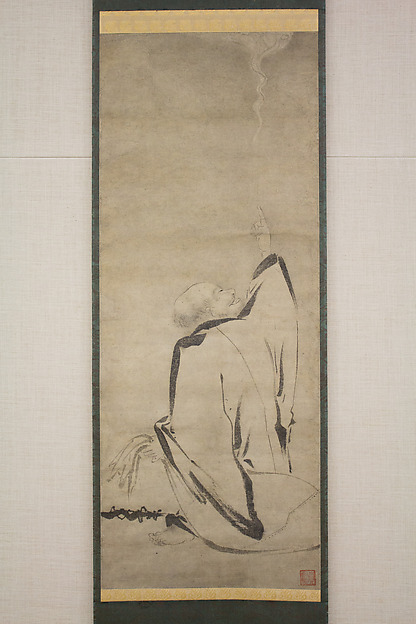
Shinno Noami, Japan, 15th century. Hanging scroll; ink on paper. Metropolitan Museum of Art, 36.100.56.
Look closer: Note the upturned face and the single raised finger, drawn with a few dark lines against a great deal of empty paper.
The Metropolitan Museum of Art, The Howard Mansfield Collection, Purchase, Rogers Fund, 1936. Open Access.
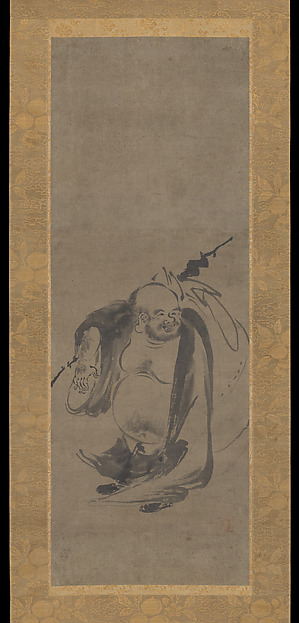
Kenkō Shōkei, Japan, late 15th century. Paint on paper. Metropolitan Museum of Art, 53.194.3.
Look closer: Note how the belly is left as bare paper inside the swinging line of the robe, and the staff slung over the shoulder with the bundle tied to it.
The Metropolitan Museum of Art, Gift of Nathan V. Hammer, 1953. Open Access.
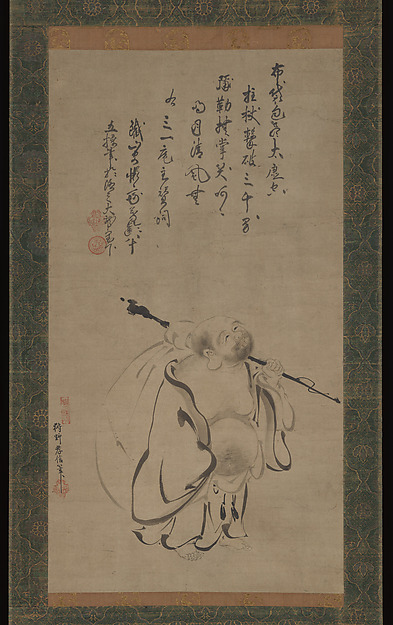
Kano Takanobu, Japan, 1616. Hanging scroll; ink and color on paper; Image 69.9 x 38.1 cm. Metropolitan Museum of Art, 2006.115.
Look closer: Note the faint circle of the bag behind the monk and the five lines of writing above him, which fill the empty upper half of the scroll.
The Metropolitan Museum of Art, Funds from various donors, 2006. Open Access.
Hotei among the seven
In Japan the monk was welcomed into the Seven Lucky Gods. The Metropolitan Museum's note on Ogata Kōrin's scroll says that Hotei later became one of the Seven Gods of Good Fortune in China and in Japan, and that Kōrin often portrayed these gods in a playful aspect. Wikipedia makes an observation that rewards a second look: among the other gods, Budai appears solemn or even depressed, and he is most joyful around others, especially children.
It also describes the iconography fixed by Hakuin Ekaku, in which Budai entertains passers-by, shelters children under an umbrella, and meditates on his sack as a cushion. A humorous Zen variation shows him smoking a pipe, a kiseru, and exhaling Otafuku, a joke on the legend of Shandao. Even the fish are named for him: the smooth lumpfish is called hotei-uo, Budai fish, in Japan, because of its round shape. The largest Budai sculpture in Japan, according to Wikipedia, stands at Miroku-ji in Himeji.
Hotei on the pilgrim's road
Each of the New Year rounds has its Hotei, and the stops are often temples of the Ōbaku school of Zen. In Yanaka, Old Tokyo describes Shushōin, a small Nichiren temple established in Nerima in 1573 and moved to its present site in 1663, at 3-7-12 Nishi-Nippori. It says that the temple is surrounded by a pink wall decorated with cute pictures of Hoteison, that it is the first temple on the route where the pilgrim must take off his shoes and may enter the building, and that Hotei is worshipped there as a god of fortune and guardian of children, most closely associated in this round with abundance.
In Mukōjima, the Hotei stop is Kōfukuji, established in 1673, with a Chinese-style main building of 1933 and a moon-viewing stage before the hall in the unmistakable style of the Ōbaku school, which Old Tokyo calls the third largest school of Zen in Japanese Buddhism. Near the gate, in an alcove, stand two statues of an archaically smiling man and woman, the Seki no Jiji Baba, which look like a large and a small round stone and are supposed to help against coughing. In Meguro, the stop is Zuishōji, an Ōbaku temple founded in 1670 at 3-2-19 Shirokanedai, with a huge main building of the early nineteenth century designated a national important cultural property and a peach carving at the front.
The Tokyo Stroll Supplement lists Chanoki Shrine as the Hotei stop of the Ningyōchō round, and Fukagawa Inari Shrine as the Hotei stop of the Fukagawa round. In Kyoto, Green Shinto describes the round of 11 January at Sennyū-ji, where the fourth subtemple, Raigo-in, keeps a heap of discarded Hotei. The custom is to buy a figurine, enjoy the benevolence of the god for a year, and then return it for ceremonial disposal in a vessel shaped like a boat, buying a larger one for the next year; since bigger figures cost more, Green Shinto observes, it is a profitable venture for the temple. On-Mark counts Jōchiji, in Kita-Kamakura, among the seven sites of the Kamakura pilgrimage, where its photograph shows a Hotei.
The Ōbaku stops invite a comparison. Flammarion's guide, quoted by On-Mark, says that Maitreya is venerated in some Zen monasteries of the Ōbaku sect, as at Manpuku-ji in Kyoto, by the name of Hotei, the Miroku with the Large Belly. The sources do not say that the Tokyo stops were chosen for that reason, and we do not claim it; we note only that Old Tokyo and the guide describe the same monk in similar terms.
| Round | Hotei's stop | Source |
|---|---|---|
| Yanaka | Shushōin, with the pink wall | Old Tokyo |
| Mukōjima | Kōfukuji, an Ōbaku temple of 1673 | Old Tokyo |
| Meguro (Yamanote) | Zuishōji, an Ōbaku temple of 1670 | Old Tokyo |
| Ningyōchō | Chanoki Shrine | Tokyo Stroll Supplement |
| Fukagawa | Fukagawa Inari Shrine | Tokyo Stroll Supplement |
| Sennyū-ji, Kyoto | Raigo-in, the temple of the yearly figurine | Green Shinto |
Painters of the belly and the bag
Wikipedia lists the long line of artists who took him up. Mokuan Reien painted a hanging scroll of Hotei in the fourteenth century, which the page dates to 1336 and which was inscribed by Liao'an Qingyu. Miyamoto Musashi, who lived from 1584 to 1645, painted Hotei watching two cocks fight. The Kanō school made its own versions, among them one by Kanō Kōi in the early seventeenth century. Odano Naotake, who lived from 1750 to 1780, painted Hotei lifting his belly after earlier Chinese copies, and Itō Jakuchū, who lived from 1716 to 1800, reduced the subject to the monk and his bag.
In the nineteenth century the subject passed into woodblock prints. Utagawa Kuniyoshi made Hotei and Children Carrying Lanterns, and Tsukioka Yoshitoshi, between 1885 and 1891, made The Moon of Enlightenment, in which Hotei points at the moon.
The monk and the children
Almost every source that describes Hotei describes the children. Old Tokyo calls him a guardian of children and a god of popularity. On-Mark calls him the god of contentment and happiness, guardian of children and patron of bartenders, and says that he is sometimes shown surrounded by small children romping and squealing in delight around his rotund shape. Wikipedia says that he is most jubilant in the presence of others, especially children, and that when he is shown with the other gods of the seven he keeps a solemn or even depressed look. JAANUS records that in Edo period painting he is frequently pictured with groups of playing children.
The Museum's collection has both the simple version and the disguised one. A porcelain figure of 1750, Arita ware of the Imari type, painted in enamels, is titled God Hotei and Children: the monk holds a small gourd aloft while two children play at his feet. The Bizen stoneware Hotei and Child of 1820, described earlier, has the child clinging to the belly. In the print by Isoda Koryūsai of about 1769, which the Museum titles Disguised or Transformed Hotei, there is no monk at all: a woman kneels in a room with a pine screen, a child climbs on her lap and two more crowd to the left. The Museum's record has no description, so we read the picture only through its title and through JAANUS, who notes that the subject was taken up in numerous mitate-e, ukiyo-e prints in which one subject stands in for another. The cartouche at the upper right, which appears to include the characters for the seven gods and for Hotei, suggests that the print belonged to a series of such transpositions, though we have not seen the rest of the series.
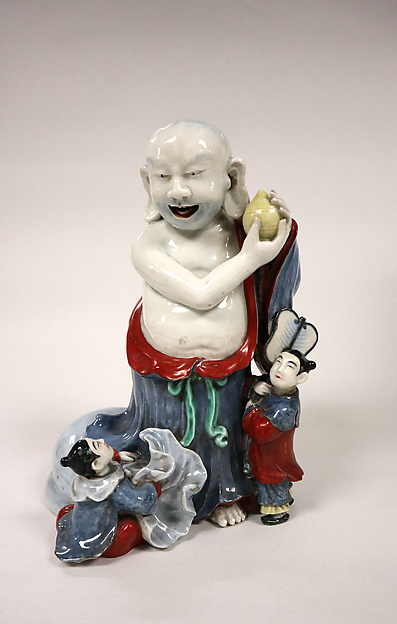
Japan, 1750. Porcelain decorated with enamels (Arita ware, Imari type); H. 26.4 cm; W. 18.4 cm; D. 19.4 cm. Metropolitan Museum of Art, 23.225.136.
Look closer: Note the two children at his feet and the small gourd held high, painted in enamels on white porcelain.
The Metropolitan Museum of Art, Gift of Mrs. V. Everit Macy, 1923. Open Access.

Isoda Koryūsai, Japan, ca. 1769. Woodblock print; ink and color on paper; H. 26 cm; W. 19.4 cm. Metropolitan Museum of Art, JP883.
Look closer: Note the three children clustered round the kneeling woman; the Museum's title says the figure is a disguised Hotei, so the children are his usual company.
The Metropolitan Museum of Art, Gift of Estate of Samuel Isham, 1914. Open Access.
Hotei in the Met
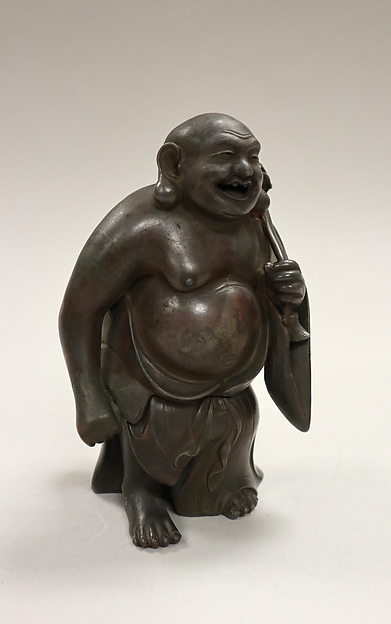
Japan, 1650. Stoneware covered with glaze (Bizen ware); H. 15.9 cm; W. 8.9 cm; D. 9.5 cm. Metropolitan Museum of Art, 23.225.32a, b.
Look closer: Note the laughing face and heavy belly of the dark-glazed figure, a censer made in the shape of the god.
The Metropolitan Museum of Art, Gift of Mrs. V. Everit Macy, 1923. Open Access.
The Museum's scroll by Ogata Kōrin, made after 1704, is a few quick strokes in ink: a bald head over a sack and a half-seen fan, with the robe set down in black. The Museum's scroll attributed to Kanō Tan'yū, probably of the seventeenth or eighteenth century, stands the monk with a staff before a pale moon. A third scroll, Hotei Admiring the Moon, probably of the nineteenth century and once attributed to Ikei Shūtoku, a follower of Sesshū, turns him away from us and gazes at the disc, with his sack beside him. The Met gives its signature as illegible.
In clay and ivory the monk grows round. A Bizen stoneware Hotei and Child of 1820 stands 92.7 centimetres tall, with the child clinging to the great belly while the monk points upward. An eighteenth-century Imbe-style Bizen figure, 22.9 centimetres high, lifts a fan; an ivory netsuke of the nineteenth century, 2.9 centimetres high, sits laughing on his sack with a fan raised. Wikipedia mentions a seventeenth-century ivory netsuke of the monk among its examples, and the Museum's small figure belongs to the same long habit of carrying him at the belt.
One more figure belongs among the clay ones. A censer of Bizen ware, dated 1650, is made in the form of the god: the Museum catalogues it as a Censer in form of a God (Hotei), 15.9 centimetres high, and the record gives no description beyond its title, material and date. The figure laughs, with a heavy belly and bare chest. That a wandering monk of Mount Siming should be made into a vessel for burning incense is a small reminder of how far the figure had travelled.
Things worth knowing
- His name is the bag: 布袋 can be read nunobukuro, cloth bag (Nippon.com, On-Mark).
- In Japan the smooth lumpfish is called hotei-uo, the Budai fish, for its rotund shape (Wikipedia).
- A pull toy of the monk with wheels is called kuruma-sō, the rolling monk (Flammarion, quoted by On-Mark).
- At Sennyū-ji in Kyoto a Hotei figurine is returned after a year and a larger one bought (Green Shinto).
- Two of the Hotei stops on the Tokyo rounds, Kōfukuji and Zuishōji, are Ōbaku Zen temples (Old Tokyo).
- The seven virtues of Tenkai give Hotei magnanimity (On-Mark, Nippon.com).
- Nippon.com says Hotei is the only one of the seven who actually lived; JAANUS calls him semi-legendary.
Across Asia
Hotei is the one member of the seven who is also a saint of the whole of East and South-East Asia.
| Where | Form and name | What the record shows |
|---|---|---|
| China | Budai 布袋 | The cloth-sack monk Qieci of the Later Liang; Laughing Buddha (Wikipedia). |
| Korea | Podae 포대 | Painted by Kim Myong-guk of the Joseon dynasty, 1600 to 1650 (Wikipedia). |
| Vietnam and Thailand | Bố Đại; Phra Pu Tai | Statues at Vĩnh Tràng Temple in Vietnam; sometimes confused with Phra Sangkajai in Thailand (Wikipedia). |
| Japan | Hotei 布袋 | A Zen subject and a member of the Seven Lucky Gods (Wikipedia, Met). |
A saint among the gods
Hotei sits with the Seven Lucky Gods in the Heavenly Beings wing, though he is by origin a Chan monk and by repute an incarnation of Maitreya, who has his own chapter among the bodhisattvas.
| Artist | Subject | Date |
|---|---|---|
| Mokuan Reien | Hanging scroll of Hotei | 14th century; Wikipedia gives 1336 |
| Miyamoto Musashi | Hotei watching two cocks fight | Musashi lived 1584 to 1645 |
| Itō Jakuchū | Minimalist Hotei and bag | Jakuchū lived 1716 to 1800 |
| Igarashi Shunmei | Triptych of Hotei with summer and winter landscapes | 1768 |
| Tsukioka Yoshitoshi | The Moon of Enlightenment | 1885 to 1891 |
Where to see him
| Place | What to look for |
|---|---|
| Yuelin Temple, Fenghua, Zhejiang | Where a body said to be his was displayed in the Great Hall (Wikipedia). |
| Feilai Feng, Zhejiang | An eleventh-century Northern Song sculpture of Budai (Wikipedia). |
| Miroku-ji, Himeji | The largest Budai sculpture in Japan (Wikipedia). |
| Shushōin, Nishi-Nippori, Tokyo | The Hotei temple of the Yanaka Seven Lucky Gods circuit (Japan Experience, Old Tokyo). |
| Metropolitan Museum of Art, New York | Three scrolls, two Bizen figures and a netsuke, in open access. |
Six ways to draw a belly
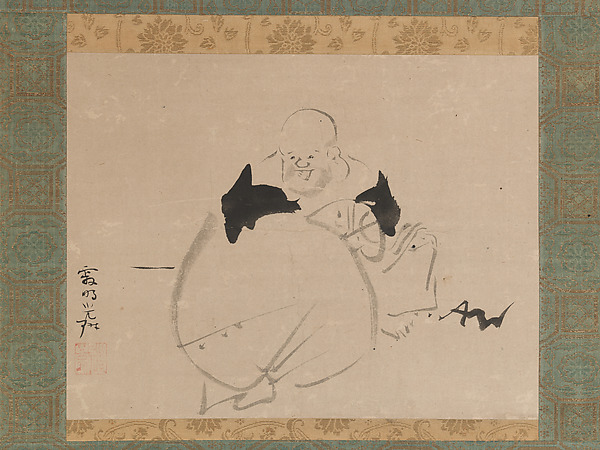
Ogata Korin, Japan, after 1704. Hanging scroll; ink on paper; image 28.5 x 36.8 cm. Metropolitan Museum of Art, 2015.300.89.
Look closer: Note how a few heavy black strokes for the robe set off the faint grey outline of the great sack.
The Metropolitan Museum of Art, Mary Griggs Burke Collection, Gift of the Mary and Jackson Burke Foundation, 2015. Open Access.
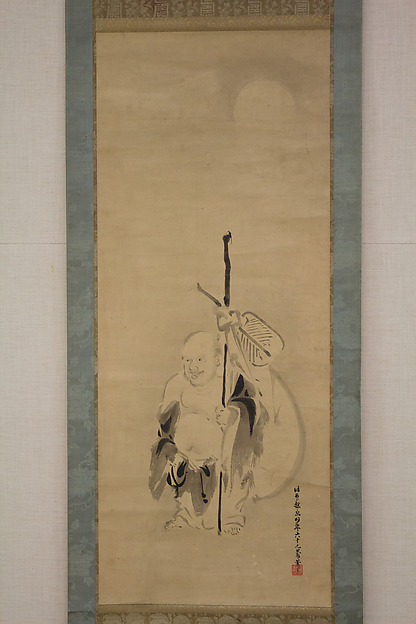
Kano Tan'yu, Japan, probably 17th or 18th century. Hanging scroll; ink on paper; image 105.7 x 47 cm. Metropolitan Museum of Art, 36.100.81.
Look closer: Note the pale moon at the top and the long staff that links it to the monk's feet.
The Metropolitan Museum of Art, The Howard Mansfield Collection, Purchase, Rogers Fund, 1936. Open Access.
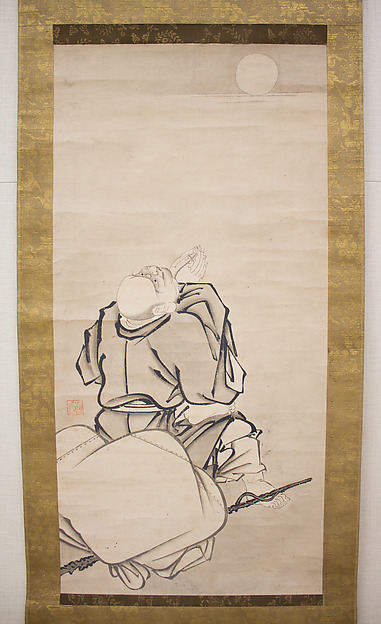
Ikei Shutoku, Japan, probably 19th century. Hanging scroll; ink on paper; image 92.7 x 45.1 cm. Metropolitan Museum of Art, 14.76.12.
Look closer: Note that the monk turns his back to us, so that the moon and the raised hand are all we are given to read.
The Metropolitan Museum of Art, Charles Stewart Smith Collection, Gift of Mrs. Charles Stewart Smith, Charles Stewart Smith Jr., and Howard Caswell Smith, in memory of Charles Stewart Smith, 1914. Open Access.

Japan, 1820. Stoneware covered with thin glaze (Bizen ware); H. 92.7 cm. Metropolitan Museum of Art, 23.225.49.
Look closer: Note the child clutching the robe and the monk's finger raised toward something out of the frame.
The Metropolitan Museum of Art, Gift of Mrs. V. Everit Macy, 1923. Open Access.

Japan, 18th century. Clay covered with a thin glaze (Bizen ware, Imbe style); H. 22.9 cm. Metropolitan Museum of Art, 93.1.78.
Look closer: Note the fan raised beside his head, with its fine lattice pattern, and the wide laughing mouth.
The Metropolitan Museum of Art, Gift of Mr. and Mrs. Samuel Colman, 1893. Open Access.

Japan, 19th century. Ivory; H. 2.9 cm, W. 3.8 cm, D. 2.5 cm. Metropolitan Museum of Art, 10.211.351.
Look closer: Note the sack that doubles as a seat and the fan held by his ear, within a figure under three centimetres tall.
The Metropolitan Museum of Art, Gift of Mrs. Russell Sage, 1910. Open Access.
At the desk
A Hotei figure, scroll or netsuke appears below when we hold one. If none shows, the concierge desk can search for it.
Words on the Hotei shelf
The words most often met on a scroll, a temple notice or a stamp sheet.
- Hotei 布袋
- The cloth bag, and the monk named for it (Wikipedia, Nippon.com).
- Nunobukuro
- The same two characters read as 'cloth bag' (Nippon.com, On-Mark).
- Budaishi
- The Chinese monk, said to have died in 917, on whom the god is based (On-Mark).
- Miroku 弥勒
- Maitreya, the future Buddha, of whom Hotei is said to be an incarnation (JAANUS).
- Oogi
- The fan said to grant wishes, held in the monk's hand (On-Mark).
- Mitate-e 見立絵
- A print in which one subject stands in for another; JAANUS notes many such prints of Budai.
- Kuruma-sō
- The rolling monk: a pull toy of the figure on wheels (Flammarion, quoted by On-Mark).
- Ōbaku
- The third largest school of Japanese Zen, whose temples hold several Hotei (Old Tokyo).
- Hoteison
- The respectful name of the god used in the Yanaka round (Old Tokyo).
- Warai-hotoke
- The Smiling Buddha, a figure with which Hotei is sometimes confused (Flammarion, quoted by On-Mark).
Answered plainly
Who is Hotei?
A Chinese Chan monk, Qieci of the Later Liang, known as Budai, the cloth sack, and honoured in Japan as one of the Seven Lucky Gods (Wikipedia).
Is he the Buddha?
No; he is often mistaken for Gautama in the West, but he was said to be an incarnation of Maitreya (Wikipedia).
Why a cloth sack?
He carried his few possessions in one, and the sack gave him his name (Wikipedia).
What is the 28 March 917 date?
The date of a note claiming he was an incarnation of Maitreya; the infobox gives it as a death date (Wikipedia).
Which Hotei is the largest in Japan?
The sculpture at Miroku-ji in Himeji (Wikipedia).
What does he do among the other gods?
He appears solemn beside them, and is most joyful with children (Wikipedia).
Was Hotei a real person?
Sources differ: JAANUS calls him semi-legendary, Nippon.com says he actually existed, and On-Mark says he is reportedly based on a real monk who died in 917.
What is in his bag?
A bag that never empties, from which he feeds the poor and children (On-Mark, Nippon.com); later Zen readings speak of an empty bag (JAANUS).
Why is he shown with children?
Edo painters pictured him with groups of playing children, and he is called the guardian of children (JAANUS, Old Tokyo, On-Mark).
Which temples hold Hotei on the Tokyo rounds?
Shushōin in Yanaka, Kōfukuji in Mukōjima and Zuishōji in Meguro, among others (Old Tokyo, Tokyo Stroll Supplement).
What virtue does Hotei stand for?
Magnanimity, in the list of seven virtues attributed to Tenkai (On-Mark, Nippon.com).
What is the Hotei figurine custom at Sennyū-ji?
A figurine is bought, kept for a year and returned for ceremonial disposal, and a larger one is bought for the next year (Green Shinto).
Where next
Sources and image credits
- Wikipedia, Budai
- Wikipedia, Seven Lucky Gods
- Japan Experience, Shichifukujin Meguri
- Old Tokyo, 7 Lucky Gods Pilgrimage in Yanaka
- Metropolitan Museum of Art, Hotei, Ogata Korin (2015.300.89)
- Metropolitan Museum of Art, Hotei, Kano Tan'yu (36.100.81)
- Metropolitan Museum of Art, Hotei Admiring the Moon (14.76.12)
- Metropolitan Museum of Art, Hotei and Child (23.225.49)
- Metropolitan Museum of Art, Figure of Hotei (93.1.78)
- Metropolitan Museum of Art, Netsuke of Hotei (10.211.351)
- On-Mark, Hotei (quoting JAANUS and Flammarion)
- Nippon.com, Shichifukujin: Japan's Seven Gods of Fortune
- Old Tokyo, Mukōjima pilgrimage along the Sumida
- Old Tokyo, The oldest 7 lucky god course in Tokyo, Yamanote Meguro
- Green Shinto, Shichifukujin Meguri: Seven Lucky Deities in Kyoto
- Tokyo Stroll Supplement, Ningyōchō pilgrimage
- Tokyo Stroll Supplement, Fukagawa pilgrimage
- Metropolitan Museum of Art, Netsuke of Hotei with Bag (10.211.1966)
- Metropolitan Museum of Art, Case (Inrō) with Design of Hotei (Putai) Carrying a Small Boy (obverse); Boy Carrying Gourd-Flask (reverse) (13.67.76)
- Metropolitan Museum of Art, Hōtei Pointing to the Moon (36.100.56)
- Metropolitan Museum of Art, Hotei, flanked by panels of birds (53.194.3)
- Metropolitan Museum of Art, Hotei (2006.115)
- Metropolitan Museum of Art, God Hotei and Children (23.225.136)
- Metropolitan Museum of Art, Disguised or Transformed Hotei (JP883)
- Metropolitan Museum of Art, Censer in form of a God (Hotei) (23.225.32a, b)
Last reviewed 28 October 2026. Pictures are public-domain or openly licensed, each credited beneath it. Diagrams on this page are drawn by Japonista.
Looking for a Hotei figure, a scroll or a netsuke? Tell the concierge desk what you have in mind and we will search Japan for it.
Private concierge
Looking for something in particular?
Describe the piece or the project you have in mind. A senior advisor in Tokyo reads every case file personally and replies within two business days, with fees set out in writing before any work begins.