
Jodo Shinshu: The True Pure Land and the Householder
Entrusting · Vow
Jodo Shinshu: The True Pure Land and the Householder
Shinran was defrocked and sent into exile in 1207, married, called himself neither monk nor layman, and taught that no practice of ours can earn the Pure Land because Amida has already done the work. Seven centuries later the school he did not mean to found claims about one tenth of Japan's citizens, and a Met scroll suggests how its followers kept Amida in the home. The sections below add Honen and the chosen practice, the forty-eight vows and the Pure Land sutras, the calling of the name, Eshinni and the household, the Tannisho and the wicked person, the armed leagues and the Ishiyama siege, the two Hongan-ji, the faith across the Pacific, the stories and fun facts, a glossary and a collector's eye for Pure Land work.
Fact sheet
Four ideas to carry in
- Other-power. Birth in the Pure Land is assured by Amida, so the nembutsu is an expression of gratitude and not a way of earning merit.1
- A householder faith. Shinran married and called himself Gutoku, the Bald Fool, neither monk nor layman; Shin priests take no traditional Vinaya precepts.12
- Letters to the people. Rennyo's pastoral letters in plain Japanese remain in the liturgy.3
- Pictures at the altar. The Met's home-altar Amida and Illustrated Life of Shinran show how the faith was seen.45
Shinran and the Years of Exile
First lookShinran was born on 21 May 1173 and died on 16 January 1263 in Kyoto. He was ordained as a Tendai monk in 1181 and lived at Enryaku-ji for about twenty years; in 1201 he left Mount Hiei to become a disciple of Honen, the founder of the Pure Land movement.2 In 1207 a ban fell on Honen's nembutsu community, and Shinran was defrocked and exiled to Echigo for five years.2 After his return he spent about twenty years preaching in the Kanto region, mainly at Inada.2

Japan · Edo period (1615–1868) · 17th–18th century · Set of four hanging scrolls; ink, color, and gold on silk
Look closer: Four hanging scrolls in ink, colour and gold on silk, probably of the seventeenth or eighteenth century, by an unidentified artist. The Met says they illustrate episodes from Shinran's life, read from right to left and bottom to top with bands of cloud dividing the scenes, and that the text follows Kakunyo's biography, written by Shinran's grandson. It does not name the scenes, and we do not name them.
The Metropolitan Museum of Art, New York, Purchase, Friends of Asian Art Gifts, in honor of James C. Y. Watt, 2010, accession 2010.366a–d. Public domain, Met Open Access. Museum record
He married. The marriage to Eshinni probably took place between about 1203 and 1207, though scholars debate the timing.2 He called himself Gutoku, the Bald Fool, to express that he was neither monk nor layman.2 The page we read adds that Shinran never presented himself as a founder, and that the name Jodo Shinshu was coined by him later.2
The Met's note on the Illustrated Life explains how such pictures worked. Illustrated versions of Kakunyo's biography began as handscrolls and later became hanging scrolls, which were displayed in temple halls during the annual memorial service for Shinran's death. Showing the whole set let viewers see every episode at once while a monk recited the story aloud, a performance called etoki, picture explaining.5
His major work is the Kyogyoshinsho, a systematic defence of Pure Land doctrine, published in 1234 with a first draft possibly finished in 1224.2 The Tannisho preserves his oral teachings; the page we read does not say who compiled it.2 Kakunyo, descended from Shinran's daughter Kakushinni, wrote the first biography, and in the fourteenth century the family's mausoleum became the Hongan-ji.2
What the Vow Promises
The connoisseur's eyeThe school's teaching is stated simply in the sources. Liberation comes through Amida Buddha's Original Vow and other-power, tariki, not through self-power, jiriki. The key concept is shinjin, true entrusting. The nembutsu is recited as gratitude for a birth in the Pure Land that Amida has already assured, not as a means to earn it.1

Japan · Edo period (1615–1868) · 18th century · Ink, color, and cut silver on silk
Look closer: An eighteenth-century Edo-period painting in ink, colour and cut silver on silk, about 14 by 6.5 inches, titled Amida Manifesting in the Dharma-body of Expedient Means by the Met. The catalogue says it was likely a private devotional image for the home altar and that much of the cut silver survives in good condition.
The Metropolitan Museum of Art, New York, Rogers Fund, 1918, accession 18.146.1. Public domain, Met Open Access. Museum record
The consequence for the clergy was radical. Shin priests do not take the traditional Vinaya or bodhisattva precepts, although they are tonsured and wear monastic robes.1
The Met's catalogue note for a small Amida painting tells the household side of the same story. It shows the Buddha radiating beams of light, an eighteenth-century work in ink, colour and cut silver on silk, likely a private devotional image for the home altar of a follower of the school. The rays stand for the forty-eight vows Amida made as a bodhisattva, and modern sets are often arranged as triptychs with Amida in the centre, Shinran on the right and Rennyo on the left, or with calligraphic inscriptions of the name, the simplest of which has six characters.4
Rennyo and the Letters
The connoisseur's eyeRennyo lived from 1415 to 1499 and was the eighth head priest of the Hongan-ji branch, a descendant of Shinran.3 In 1471 he established a new Hongan-ji centre at Yoshizaki in Echizen Province, on the Hokuriku coast, far from the reach of the monks of Mount Hiei; between 1475 and 1483 he returned to the Kyoto area and built a new head temple in Yamashina, completed in 1483.3 In 1496 he retired to a hermitage near the mouth of the Yodo River, in the area later known as Osaka, and the complex grew into the Ishiyama Hongan-ji.3
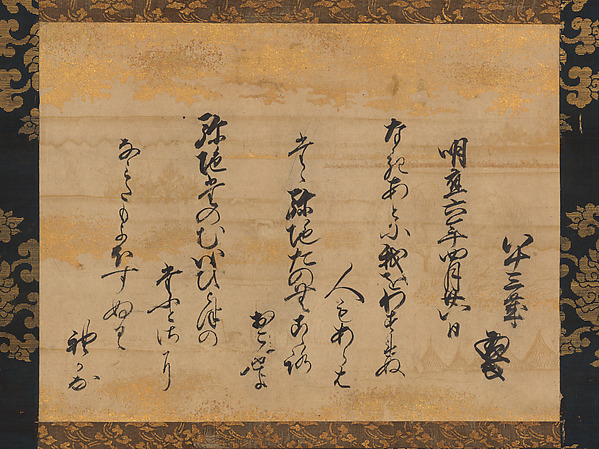
Japan · Muromachi period (1392–1573) · 1497 · Hanging scroll; ink on decorated paper
Look closer: A hanging scroll dated 1497 in ink on decorated paper, from the Muromachi period: Two Waka Poems by Rennyo, the Met's object 2025.981.2, a gift of Mary and Cheney Cowles in 2025. The catalogue gives only the title and dates, and gives no reading of the poems, so we offer none.
The Metropolitan Museum of Art, New York, Mary and Cheney Cowles Collection, Gift of Mary and Cheney Cowles, 2025, accession 2025.981.2. Public domain, Met Open Access. Museum record
A scroll in the Met preserves Rennyo's own hand late in his life. It is a pair of waka poems dated 1497, the year after his retirement to the Yodo River, written in ink on decorated paper and mounted as a hanging scroll, and it measures 27 by 35.4 centimetres as an image. The museum records the scroll as calligraphy, not currently on view, and offers no reading of the poems; the date and the retirement are the only two facts we can set side by side.36
His pastoral letters, the Ofumi, were written in accessible Japanese and are his most influential works; they are still used in Shin liturgy.3 Hongan-ji venerates him as a second founder alongside Shinran, and his doctrinal formulations became the orthodox Hongan-ji teaching; the school's article says he helped make Shin the largest Buddhist school in Japan by the sixteenth century.13
The harder part of the story is war. Followers in Kaga Province became involved with the Ikko-ikki, armed leagues of Shin believers that arose in the Sengoku period; Rennyo kept ties with the Ashikaga shogunate and did not endorse their military actions.13 How far he controlled them is a question we leave to the sources, none of which we read in enough depth to settle it.
Nishi and Higashi
The connoisseur's eyeIn 1602 Tokugawa Ieyasu formalised the division of the Hongan-ji into Nishi, led by Junnyo, and Higashi, led by Kyonyo.1 The school today counts ten branches, and all ten commemorated Shinran's 750th memorial in 2011.1 The tradition claims about ten per cent of Japanese citizens as members.1
The faith also crossed the Pacific. The Buddhist Churches of America, incorporated in 1944, has more than sixty temples and about twelve thousand members, and the school article calls it the oldest Buddhist organisation in the continental United States.1
| Date | Event | Source |
|---|---|---|
| 1173 | Shinran born in Kyoto2 | Wikipedia, Shinran |
| 1201 | Leaves Mount Hiei for Honen2 | Wikipedia, Shinran |
| 1207 | Defrocked and exiled to Echigo2 | Wikipedia, Shinran |
| 1234 | Kyogyoshinsho published2 | Wikipedia, Shinran |
| 1471 | Rennyo founds Yoshizaki3 | Wikipedia, Rennyo |
| 1602 | Hongan-ji split into Nishi and Higashi1 | Wikipedia, Jodo Shinshu |
Honen, Shandao and the Chosen Practice
First lookShinran's teacher Honen was born on 13 May 1133 (the article also gives 7 April) in Mimasaka Province and died in Kyoto on 29 February 1212.7 His father, a provincial police official, was killed in 1141; Honen entered his uncle's monastery at nine and was sent to the Tendai temple on Mount Hiei at thirteen.7 About 1175 he left Hiei to concentrate on the nembutsu after reading the commentary of the Chinese master Shandao.7 His chief work, the Senchaku hongan nenbutsu shu, was written in 1198 at the request of his patron Kujo Kanezane and was not widely circulated in his lifetime; Shinran made his own copy.7

Japan · Kamakura period (1185–1333) · ca. 1310–20 · Section of handscroll mounted as hanging scroll; ink and color on paper
Look closer: A section of a handscroll mounted as a hanging scroll, ink and colour on paper, about 1310 to 1320, from the Illustrated Biography of Honen. The Met says Honen inscribes a portrait of himself for the young Shinran, who waits, and that this is an early copy of a lost original compiled by Kakunyo in 1301. Look for the lotus pedestal bearing the character for Buddha in the portrait within the picture.15
The Metropolitan Museum of Art, New York, Purchase, Gifts of Mrs. Russel Sage, Mrs. Peter Gerhard, Mr. and Mrs. Donald Percy, Charles Stewart Smith, Mrs. V. Everit Macy, Mrs. Thomas Van Buren, Mrs. Charles Stewart Smith, Hartwell J. Staples, Mrs. George A. Crocker and Mr. and Mrs. Samuel Coleman, by exchange; Bequests of Edward C. Moore, James Alexander Scrymser and Stephen Whitney Phoenix, by exchange; Rogers Fund and funds from various donors, 1980, accession 1980.221. Public domain, Met Open Access. Museum record
The trouble came in 1207. The Jogen persecution began, the article says, with an incident at a nembutsu retreat attended by court ladies, which led to charges that the practice covered up sexual liaisons; Emperor Go-Toba banned the exclusive nembutsu, four disciples were executed, and Honen and others, Shinran among them, were exiled.7 The ban was lifted and Honen returned to Kyoto in 1211, the year before he died.7 Shortly before his death he wrote the One-Sheet Document, a brief statement of his teaching.7 His disciples had by then printed the Senchakushu from woodblocks, a carving finished in 1211 that the article calls the first printed text by a Japanese Buddhist author; Tendai monks attacked the print shop and destroyed the blocks in 1227, and followers carved them again in 1239.7

Japan · Edo period (1615–1868) · 18th–early 19th century · Wood, with traces of color and gilt and inset glass eyes
Look closer: A seated wooden figure of Honen, with traces of colour and gilt and inset glass eyes, of the eighteenth or early nineteenth century. The Met notes his hands are arranged to hold prayer beads and that it is one of a pair with a figure of Shandao; both bear ink inscriptions on the back.16
The Metropolitan Museum of Art, New York, Rogers Fund, 1912, accession 12.37.167. Public domain, Met Open Access. Museum record
The Met has Honen twice, in two different media. A seated wooden figure of the eighteenth or early nineteenth century shows him on a lotus pedestal with his hands arranged to hold prayer beads for counting recitations, and it is one of a pair with Shandao, the Tang-dynasty monk whose teachings influenced him; the catalogue says paintings of the pair rest on a dream in which Shandao endorsed Honen's mission, and that seated sculptures of the two are unusual.16 The other is a section of a handscroll, an early copy of a lost original, in which Honen inscribes a portrait of himself for his disciple Shinran, who waits as Honen copies a sutra passage about Amida's vow to save those who call his name.15
The Forty-Eight Vows
The connoisseur's eyeThe doctrine the Japanese teachers inherited rests on three scriptures: the Longer Sukhavativyuha, called the Sutra of Amitayus, the Contemplation Sutra, and the Shorter Sukhavativyuha, called the Amitabha Sutra.14 In the longer sutra the bodhisattva Dharmakara makes forty-eight vows and creates Sukhavati, the Land of Bliss, by the merit of keeping them; the eighteenth vow opens the land to beings who aspire to be reborn there, even for ten moments of thought.14 The article adds that modern scholars generally consider the Contemplation Sutra a Chinese composition, not an Indian one.14
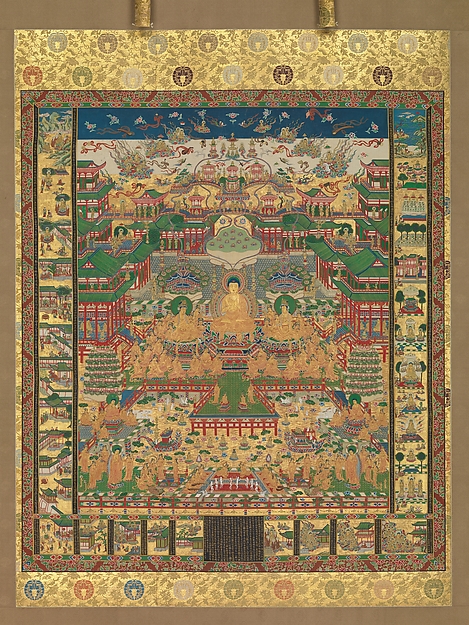
Japan · Edo period (1615–1868) · 1750 · Hanging scroll; ink, color, and gold on silk
Look closer: The Taima Mandala of 1750, a hanging scroll in ink, colour and gold on silk. Look for the large palace beside the golden pond at the centre, then the bands of text along the borders and the scenes of the nine levels of rebirth across the bottom, as the Met's catalogue describes them.20
The Metropolitan Museum of Art, New York, Charles Stewart Smith Collection, Gift of Mrs. Charles Stewart Smith, Charles Stewart Smith Jr., and Howard Caswell Smith, in memory of Charles Stewart Smith, 1914, accession 14.76.54. Public domain, Met Open Access. Museum record
Shandao, who lived from 613 to 681 and studied under Daochuo in Chang'an, is called by Charles Jones the true founder of the Pure Land tradition. He taught that ordinary beings can attain rebirth through Amida's vow and promoted oral recitation of the name as the main practice.14 The patriarch lists differ: Jodo Shu recognises five before Honen, Tanluan, Daochuo, Shandao, Huaigan and Wulong Shaokang, while Jodo Shinshu recognises seven, Nagarjuna, Vasubandhu, Tanluan, Daochuo, Shandao, Genshin and Honen, with Shinran as the final patriarch.14

Japan · Kamakura period (1185–1333) · ca. 1300 · Hanging scroll; ink and color on silk
Look closer: Descent and Return of Amida to Western Paradise with a Believer's Soul (Gosho mandara), a Kamakura-period hanging scroll of about 1300 in ink and colour on silk. The Met says it shows Amida welcoming the soul of the warrior Kumagai Naozane, and that its upper section, Amida's returning procession, is what makes it distinctive.18
The Metropolitan Museum of Art, New York, The Harry G. C. Packard Collection of Asian Art, Gift of Harry G. C. Packard, and Purchase, Fletcher, Rogers, Harris Brisbane Dick, and Louis V. Bell Funds, Joseph Pulitzer Bequest, and The Annenberg Fund Inc. Gift, 1975, accession 1975.268.21. Public domain, Met Open Access. Museum record
The picture of that land is the Taima Mandala, and the Met has an eighteenth-century version. Its catalogue says the painting shows a large palace beside a golden pond where Amida and his retinue preside, with musicians, dancers and celestial beings filling the sky and pavilions, and the reborn emerging from lotus buds in the pond; passages from the Contemplation Sutra run along the borders, the parable of Queen Vaidehi who reached the Pure Land through sixteen meditations, and the bottom scenes show the nine levels of rebirth.20 The composition is based on Chinese Tang-dynasty models and reached Japan in the Nara period with the teaching.20
A second Met painting ties the doctrine to a person. It shows Amida descending to welcome the soul of the warrior Kumagai Naozane, who lived from 1141 to 1208; the scene is based on a dream recorded by Honen, and Naozane's story is well known in Japanese war literature, since he became a monk after reluctantly killing the young Taira no Atsumori at the battle of Ichinotani.18 The catalogue calls this version distinctive for its upper section, which shows Amida's procession returning.18 Honen's disciple Rensei, the Honen article tells us, was the former samurai Kumagai Naozane.7
One Calling or Many
The connoisseur's eyeThe nembutsu, in Chinese nianfo, is in East Asian Pure Land use the oral recitation of the name, Namu Amida Butsu, a phrase the article translates as homage to Amitabha Buddha.12 The Chinese word translates the Sanskrit buddhanusmrti, recollection of the Buddha, a classical mindfulness practice, and the Chinese character can mean to think, to recall or to recite aloud.12 Jodo Shinshu often shortens the phrase in speech to na man da bu.12

Japan · Nanbokuchō period (1336–92) · late 14th century · Section of a handscroll mounted as a hanging scroll; ink and color on paper
Look closer: A Nenbutsu Gathering at Ichiya, Kyoto, a late fourteenth-century section of a handscroll mounted as a hanging scroll, ink and colour on paper. The Met says people of every class crowd around a pavilion to watch the itinerant monk Ippen perform a dancing nembutsu. Look at the faces of the crowd, which wait for the dance to begin.17
The Metropolitan Museum of Art, New York, The Harry G. C. Packard Collection of Asian Art, Gift of Harry G. C. Packard, and Purchase, Fletcher, Rogers, Harris Brisbane Dick, and Louis V. Bell Funds, Joseph Pulitzer Bequest, and The Annenberg Fund Inc. Gift, 1975, accession 1975.268.35. Public domain, Met Open Access. Museum record
How often to say it divided Honen's disciples. The one-calling party, ichinengi, held that a single calling was enough; the many-calling party, tanengi, urged repeated calling, and Honen favoured sustained practice.712 Shinran's own position, as the nembutsu article states it, was that practice centred on shinjin, total entrusting, so that the number of recitations did not matter and birth was assured through trust; for those without settled shinjin he taught reciting without calculation, in gratitude.12 The article adds that Shinran held true faith to be a gift of grace that cannot be produced by oneself.12
Others walked the same road differently. Kuya, who lived from 903 to 972, was an itinerant preacher who spread simple nembutsu recitation largely outside the great institutions.12 Ippen, who lived from 1239 to 1289, argued that worrying about one's own faith was pointless, because faith is itself a form of self-power, and taught that the nembutsu worked with or without the reciter's faith; his Ji sect became the largest Pure Land sect in the fourteenth and fifteenth centuries.12 The Met has a late fourteenth-century scene from the handscroll biography of Ippen and his disciple Ta'a: men, women and children of every class gather around a pavilion sheltering monks to watch Ippen perform the odori nembutsu, a lively dance invoking Amida to rhythmic chanting and percussion.17
The nembutsu had critics. Tendai monks accused the exclusive nembutsu of disparaging other practices, the government banned it about 1207 and lifted the ban in 1211, and after Honen's death his writings and tomb were destroyed by Tendai monks and his disciples exiled.12 Myoe, the Kegon monk we meet in the chapter on the Nara schools, criticised the exclusive nembutsu for lacking bodhicitta.12 The article also records that a Rinzai master, Ungo Kiyo, taught the nembutsu and caused controversy among Rinzai peers who thought it contrary to Hakuin's condemnation of the practice, a quarrel whose other side is in the chapter on the Zen houses.12
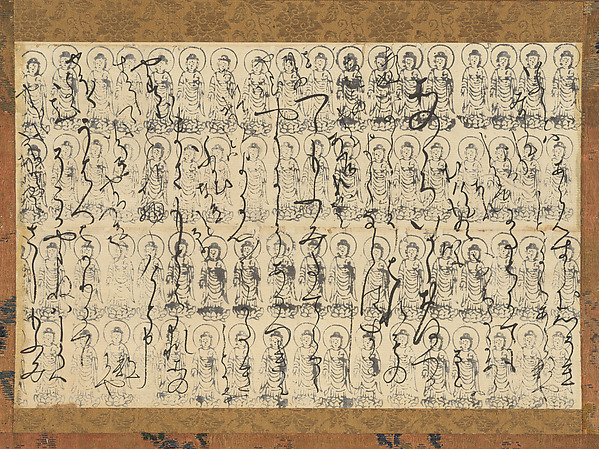
Japan · Kamakura period (1185–1333) · early 13th century · Hanging scroll; brush written letter, ink on paper (front); stamped images, ink on paper (reverse)
Look closer: Kana Letter on Stamped Images of Amida Buddha, an early thirteenth-century hanging scroll with a brush-written letter in ink on paper on the front and stamped Amida images on the back. The Met attributes the letter to the monk Jogyo, and says scholars believe the printed images were added after his death to generate merit for the deceased.19
The Metropolitan Museum of Art, New York, Mary and Cheney Cowles Collection, Gift of Mary and Cheney Cowles, 2020, accession 2020.396.3. Public domain, Met Open Access. Museum record
Eshinni and the Letters to Her Daughter
The connoisseur's eyeShinran's wife Eshinni lived from 1182 to 1268, and nearly everything we know of her comes from the letters she wrote to her daughter Kakushinni in her last years, preserved at Hongan-ji in Kyoto.13 The article says that around 1210 she married Shinran, and that they settled in Echigo, where he had been exiled since 1207.13 Between 1212 and 1219 the family moved to the Kanto region, and around 1233 they returned to Kyoto with some of their children.13 Around 1254 Eshinni went back to Echigo to manage her property and left Shinran, then eighty-two, in Kakushinni's care.13
The fact sheet at the head of this chapter, drawn from the Shinran article, gives the marriage as probably between about 1203 and 1207, with scholars debating the timing.2 The Eshinni article's date of about 1210 does not match, and neither article says why. We print both, and in the household sense the question is not trivial: it decides whether Shinran married before or after his exile. Shin Buddhism, whose priests take no traditional monastic precepts, grew from this household, and Kakushinni's descendants were to hold the family mausoleum that became Hongan-ji.29
The Tannisho and the Wicked Person
The deep endThe Tannisho is a short collection of Shinran's sayings recorded by Yuien, generally thought to be a disciple, in the late thirteenth century to clear up what he saw as deviations from the true faith.10 It has eighteen sections, some only a couple of sentences long: sections one to ten give Shinran's views on the school, the nembutsu and Amida, sections eleven to eighteen address the heretical ideas Yuien wished to correct, and an appendix tells of the exile of Shinran, Honen and other disciples under Emperor Go-Toba.10
Its best-known line is a paradox. The article gives it as the statement that if even a virtuous person can attain rebirth in the Pure Land, how much more easily can a wicked one.10 The text carries a postscript by Rennyo, who calls it one of the most valuable scriptures of the school and says that those insufficiently matured in faith should not be allowed to read it indiscriminately.10 It was also a major impetus for the Dobokai Movement in the Higashi Hongan-ji branch.10
Ikko-ikki and the Ishiyama Siege
The deep endThe Ikko-ikki were armed leagues of Jodo Shinshu members in the fifteenth and sixteenth centuries, their name, single-minded leagues, referring to the school's focus on rebirth in the Pure Land.8 The first large peasant uprising in the story was a tokusei-ikki in 1428, when leagues from Omi and Yamashiro marched on Kyoto; the first defensive Ikko league formed in Omi against the soldier-monks of Enryaku-ji, which attacked Katata in 1465 and destroyed the Hongan-ji in 1468.8 Rennyo fled to Yoshizaki in Echizen by 1471 and condemned the violence.83
Kaga Province is the best-known case. The Ikko-ikki article dates the Kaga Rebellion to 1486, which created self-rule under the Kaga ikki, and mentions 1488 only in another connection; we print the article's date.8 Later heads of the Hongan-ji were less restrained than Rennyo: Shonyo, the tenth head, mobilised forces readily, and the 1530s saw the Daisho-ikki in Kaga and the Tenbun War of 1532 to 1536, in which the ikki won the battle of Sendanno in 1536 and sacked Nara in July of that year.8
The collision with Oda Nobunaga followed. The Ishiyama Hongan-ji, founded in 1496 near Osaka, served as the league's de facto capital until 1580, and Nobunaga besieged it several times.8 Another article puts the final siege at ten years and the surrender in 1580; the Ikko-ikki article says eleven.89 Elsewhere, Ieyasu's forces defeated the Mikawa ikki at Azukizaka in 1564 with the help of Jodo Shu, and the Nagashima sieges ended in 1574 after four years.8 Kosa, the eleventh head, submitted to Nobunaga, and some holdouts resisted until 1585; the article's infobox gives 1586 as the year the confederation ended.8 Persecution of Jodo Shinshu in the following years produced the kakure nembutsu, hidden nembutsu societies.8
Nishi, Higashi and the Date 1602
The connoisseur's eyeThe Hongan-ji was first set up as a temple in 1321 on the site of the Higashi Otani, the mausoleum where Shinran was buried.9 After Nobunaga's death in 1582 the head Kosa received land in Kyoto, the site of Nishi Hongan-ji; Kyonyo received land for a temple to the east and the name Higashi Hongan-ji appeared in 1603.9 The government recognised the two as separate congregations in 1619.9 The Hongan-ji article says the popular belief that the institution was split in order to maintain control is mistaken.9
The buildings reward the visitor. At Higashi Hongan-ji the Goei-do, the founder's hall, is often the first sight on the walk north from Kyoto Station; its larger Mie-do dates from 1895 and is one of several candidates for the largest wooden building in the world.9 Nishi Hongan-ji has the Hiunkaku, a large tea pavilion that the article says was part of a medieval shogun's complex moved there in the sixteenth century, and four Noh stages, one thought to be the oldest in existence.9 In 1588 the seven Hongan-ji temples refused Ieyasu's demand for five thousand pieces of timber, citing excessive taxes; Ieyasu revoked their pardon and ordered them expelled, but Hidenaga persuaded him to rescind the order.9
The story did not stop splitting. The article records the Ohigashi schism and opposition to the creation of the Otani-ha, which caused further splits, including the Higashiyama Hongan-ji founded in 1996, and says the Higashi temple was renamed Shinshu Honbyo in 1987; the Otani-ha, the largest Higashi grouping, has about 5.5 million members.9 Some Hongan-ji members have protested visits by Japanese politicians to Yasukuni Shrine, and the Hongan-ji sects issued a statement opposing the 2003 invasion of Iraq.9
From Sacramento to Berkeley
The connoisseur's eyeJodo Shinshu reached North America with missionaries Shuya Sonoda and Kakuryo Nishijima, who arrived in San Francisco in 1899 and formed a Buddhist association; the mission that grew from it was the Jodo Shinshu Buddhist Mission of North America, and the organisation was incorporated in 1944 as the Buddhist Churches of America.11 Early temples came in Sacramento in 1899, Fresno in 1900, Seattle and Oakland in 1901, San Jose in 1902, Portland in 1903 and Stockton in 1906.11 The Hawaiian branch, begun in the 1880s as the Honpa Hongwanji Mission of Hawaii, remains separate.11
The war years shaped it. All mainland Japanese Americans were incarcerated for the duration of the Second World War, and Japanese Buddhists kept practising, at first in secret, in the camps; afterwards the churches helped returning families resettle and opened temples as temporary hostels.11 The War Department refused the church's requests for Buddhist chaplains during the Second World War and the Korean War, which it confused with State Shinto; approval came in 1987, and the first Buddhist chaplain in the American military was commissioned in 2004.11 The Institute of Buddhist Studies, begun in Berkeley in 1949 as the Buddhist Studies Center, was the first American seminary for Buddhist ministry and became an accredited graduate school in 1985.11
Today the church has more than sixty affiliated temples and about twelve thousand members.11
Stories and Fun Facts
First lookEach of these is told as the source tells it.
The portrait for a student. The Met's scroll shows Honen inscribing a portrait of himself for Shinran, copied from a lost original of 1301.15
The printed blocks. Honen's book was the first printed text by a Japanese Buddhist author, according to the Honen article, and the blocks were smashed in 1227 and carved again in 1239.7
The dancing saint. Ippen's followers watched him perform a dancing nembutsu in a Kyoto street.17
The samurai who wept. Kumagai Naozane became a monk after killing a boy at Ichinotani, and Amida descends for his soul on a Met scroll.18
The scroll that Rennyo warned about. The postscript to the Tannisho tells those insufficiently matured in faith not to read it freely.10
The long siege. The Ishiyama Hongan-ji held out against Nobunaga for ten or eleven years, depending on which page one reads.89
The tea pavilion that moved. Nishi Hongan-ji's Hiunkaku was part of a medieval shogun's complex moved there in the sixteenth century.9
The wooden record. Higashi Hongan-ji's Mie-do of 1895 is a candidate for the largest wooden building in the world.9
The stolen timber. In 1588 the seven Hongan-ji temples refused to supply five thousand timbers, and Ieyasu was talked out of expelling them.9
The hostel church. Buddhist churches in America opened their halls to returning families after the camps.11
Dates to remember: 1133, Honen born; 1198, Senchakushu; 1207, exile; 1234, Kyogyoshinsho; 1321, Hongan-ji; 1471, Yoshizaki; 1580, Ishiyama surrenders; 1619, two congregations; 1899, San Francisco.7293811
A Glossary of the Pure Land
The connoisseur's eyeTerms used in this chapter, with the language each belongs to.
| Term | Language | Meaning |
|---|---|---|
| Nembutsu | Japanese, from Chinese nianfo | Reciting the name of Amida, Namu Amida Butsu12 |
| Tariki | Japanese | Other-power, Amida's power as opposed to one's own1 |
| Jiriki | Japanese | Self-power1 |
| Shinjin | Japanese | True entrusting, the key concept of Shin Buddhism1 |
| Sukhavati | Sanskrit | The Land of Bliss, Amida's Pure Land14 |
| Dharmakara | Sanskrit | The bodhisattva who made forty-eight vows and became Amida14 |
| Ichinengi, tanengi | Japanese | The one-calling and many-calling positions on the nembutsu712 |
| Etoki | Japanese | Picture explaining, a monk reciting a story before a painting5 |
| Ofumi | Japanese | Rennyo's pastoral letters3 |
| Monshu | Japanese | The head of the Hongan-ji8 |
| Ikko-ikki | Japanese | Armed leagues of Shinshu believers8 |
| Kakure nembutsu | Japanese | Hidden nembutsu societies formed under persecution8 |
| Goei-do | Japanese | The founder's hall of a Hongan-ji9 |
| Tannisho | Japanese | The collection of Shinran's sayings recorded by Yuien10 |
| Taima Mandala | Japanese | A painting of the Pure Land after the Contemplation Sutra20 |
A Collector's Eye on Pure Land Work
The connoisseur's eyePure Land images divide into a few clear families, and the Met's holdings show most of them: the welcoming descent of Amida, the great diagram of the Pure Land in the Taima Mandala, portraits of the teachers, and small devotional sheets for the home. For the Shin home altar, the Met's catalogue note on its home-altar Amida describes triptychs with Amida in the centre, Shinran on the right and Rennyo on the left, or an inscription of the name.420
Three questions help. The first is the school: a Pure Land piece in general is not a Shin piece, and the Met's own entries carefully do not claim a school unless the evidence does. The second is the subject: Amida descending with attendants, Amida alone with rays, or a teacher in a chair are three different kinds of object. The third is the use: a hanging scroll displayed at the annual memorial service, a small devotional image for the home, and a stamped sheet placed inside a statue as merit for the dead are all different functions.519
In the house, the shelf of Buddhist statues and sacred art holds Amida Nyorai and Pure Land work under their own tags. We describe a piece by its iconography and leave the school to the evidence. The Japanese terms to search for are Amida Nyorai, raigo and Jodo; the English terms are Amida Buddha, welcoming descent and Pure Land.
Amida at Home
The Met's catalogue says a small Amida in its collection was likely made for a Shin home altar, and the house catalogues Amida and Pure Land pieces under their own tags. The strip below fills from the live shelf on the day you read this, and shows nothing if a tag is empty.
Where a piece is Pure Land work in general and not specifically Shin, our own record says so, and we do not make the claim for it.
Pieces in the house now
- Buddhist Statues and Sacred ArtAmida and the Pure Land
Filter by what you have just read
Answered plainly
What is Jodo Shinshu?
The True Pure Land school founded on Shinran's teaching that liberation comes through Amida's Original Vow and other-power, not through self-power.1
Did Shinran marry?
Yes. He described himself as neither monk nor layman, and his school does not require traditional precepts of its priests. The date of his marriage to Eshinni is debated, probably between about 1203 and 1207.12
What is shinjin?
True entrusting, the key concept of the school.1
Who was Rennyo?
The eighth head of the Hongan-ji, 1415 to 1499, honoured as a second founder and remembered for his plain-language letters.3
Why are there two Hongan-ji?
Tokugawa Ieyasu formalised the division into Nishi and Higashi in 1602.1
What did Shin believers keep at home?
The Met's catalogue note describes a small Amida painting as likely made for a home altar, often paired with Shinran and Rennyo.4
Who was Honen?
The founder of the Japanese Pure Land school, who lived from 1133 to 1212, wrote the Senchakushu in 1198 and was exiled after the persecution of 1207; Shinran was his disciple.7
What are the forty-eight vows?
Vows made by the bodhisattva Dharmakara, who became Amida, in the Longer Sukhavativyuha; the eighteenth opens the Pure Land to beings who aspire to be reborn there.14
What is the difference between Jodo Shu and Jodo Shinshu?
Jodo Shu follows Honen; Jodo Shinshu follows Shinran. They recognise different lists of patriarchs, five before Honen for Jodo Shu and seven for Jodo Shinshu with Shinran as the last.14
Is nembutsu a way to earn rebirth?
For Shinran, no. It is the expression of shinjin, total entrusting, and of gratitude; the number of recitations does not matter.12
Who was Eshinni?
Shinran's wife, who lived from 1182 to 1268 and whose letters to their daughter Kakushinni are the main source for her life. The date of her marriage is given as about 1203 to 1207 in one article and about 1210 in another.132
Who wrote the Tannisho?
Yuien, generally thought to be a disciple of Shinran, in the late thirteenth century; Rennyo wrote the postscript.10
What were the Ikko-ikki?
Armed leagues of Jodo Shinshu believers in the fifteenth and sixteenth centuries. Rennyo condemned the violence, and later heads of the Hongan-ji used them politically.83
Why did the Hongan-ji split in two?
The date is given as 1602, 1603 or 1619 depending on whether one counts the land, the name or the legal recognition. The Hongan-ji article says the idea that it was split to keep control is mistaken.91
Is there Shin Buddhism in the United States?
Yes. Missionaries arrived in San Francisco in 1899, and the Buddhist Churches of America, incorporated in 1944, has more than sixty temples and about twelve thousand members.11
Where next
Sources and image credits
- Wikipedia, Jodo Shinshu Teaching, clergy, Hongan-ji split, followers.
- Wikipedia, Shinran Life, exile, marriage, Kyogyoshinsho.
- Wikipedia, Rennyo Yoshizaki, Ofumi, Ikko-ikki, Ishiyama.
- The Metropolitan Museum of Art, Amida Manifesting in the Dharma-body of Expedient Means Catalogue entry for the home-altar Amida.
- The Metropolitan Museum of Art, The Illustrated Life of Shinran Catalogue entry for the four scrolls.
- The Metropolitan Museum of Art, Two Waka Poems Catalogue record for Rennyo's 1497 scroll.
- Wikipedia, Honen Life, Senchakushu, the persecution of 1207 and the disagreeing dates; read 29 October 2026.
- Wikipedia, Ikko-ikki Origins, Kaga, Ishiyama, Azukizaka and outcomes; read 29 October 2026.
- Wikipedia, Hongan-ji Founding, Nishi and Higashi, buildings and later splits; read 29 October 2026.
- Wikipedia, Tannisho Authorship, structure and Rennyo's postscript; read 29 October 2026.
- Wikipedia, Buddhist Churches of America 1899 arrival, 1944 incorporation, camps and the seminary; read 29 October 2026.
- Wikipedia, Nianfo Definition, one-calling and many-calling, Kuya, Ippen and critics; read 29 October 2026.
- Wikipedia, Eshinni Life dates, marriage, letters and Kakushinni; read 29 October 2026.
- Wikipedia, Pure Land Buddhism Three sutras, forty-eight vows, Shandao and patriarch lists; read 29 October 2026.
- The Metropolitan Museum of Art, Illustrated Biography of Honen (Shuikotokuden-e) Catalogue record: Honen, Shinran and the lost original.
- The Metropolitan Museum of Art, Honen Catalogue record for the seated wooden figure.
- The Metropolitan Museum of Art, A Nenbutsu Gathering at Ichiya, Kyoto Catalogue record for the Ippen scene.
- The Metropolitan Museum of Art, Descent and Return of Amida to Western Paradise with a Believer's Soul Catalogue record for the Naozane scroll.
- The Metropolitan Museum of Art, Kana Letter on Stamped Images of Amida Buddha Catalogue record for the stamped Amida letter.
- The Metropolitan Museum of Art, Taima Mandala Catalogue record for the 1750 mandala.
Last reviewed 28 October 2026. Dates in this chapter follow the cited pages; where the sources disagree, the chapter says so. Every picture is public-domain or openly licensed, and its credit and licence stand beneath it.
If a Pure Land image has called to you, the concierge desk can search Japan for it.
Private concierge
Looking for something in particular?
Describe the piece or the project you have in mind. A senior advisor in Tokyo reads every case file personally and replies within two business days, with fees set out in writing before any work begins.