
The Schools of Japan: Nara to Nichiren
Home ground · Many gates
The Schools of Japan: Nara to Nichiren
In 754 a blind Chinese abbot reached Nara after, by the Wikipedia count, about six attempts to cross the sea. Ganjin brought the monastic law, and within a year the first ordination platform stood at Todai-ji. Every school that followed, from Tendai to Nichiren, is an answer to the question he left behind: what does a Japanese Buddhist practise? The sections below add the five great places where these schools live: the mountain cemetery where Kukai is said to wait, the ridge that trained nearly every founder, the pavilion built against the last age of the Dharma, the hall of Honen and the hermitage of Dogen. They also add a glossary, fun facts, a note on the schools today and a collector's eye.
Fact sheet
Four ideas to carry in
- A school begins with a crossing. Dosho, Ganjin, Saicho, Kukai, Eisai, Dogen and Ingen each crossed the sea or came across it, and Hyegwan came from Korea.1246111214
- Hiei trained them all. Honen, Shinran, Dogen and Nichiren all first trained as Tendai monks.5
- Three Nara schools survive. Hosso, Kegon and Risshu remain today.1
- Dates are argued. Sources differ on when Kukai asked for Koya, 816 or 818, and we say so below.67
Six Schools in the Capital
First lookThe Nara period ran from 710 to 794, and Wikipedia describes Emperor Shomu as a Servant of the Three Treasures who made Buddhism a guardian of the state, with a sixteen-metre gilt-bronze Great Buddha at Todai-ji and a provincial temple in each province.3 Under that patronage the six schools of Nara, the Nanto Rokushu, took shape. Sanron was introduced by the Korean monk Hyegwan in 625, with Jojitsu as its auxiliary; Hosso was introduced in 653 by Dosho and others; Kegon, built on the Avatamsaka, was established in 736; Kusha was largely absorbed into Hosso in the eighth century; and Risshu, the school of the monastic code, came with Jianzhen in 753.1
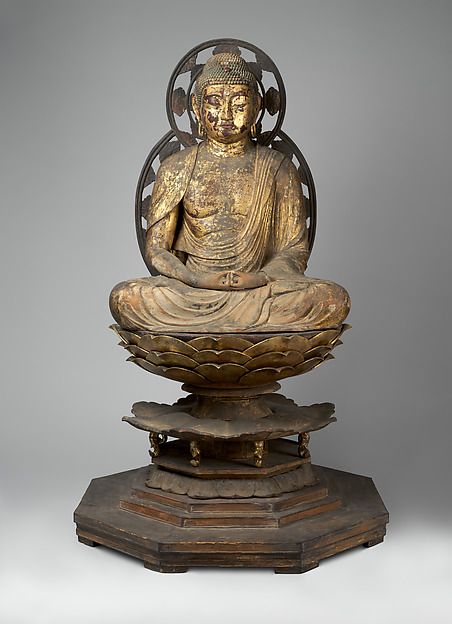
Japan · Kamakura period (1185–1333) · ca. 1250 · Wood with lacquer, gold leaf, and color
Look closer: An Amida in wood with lacquer, gold leaf and colour, which the Met dates to the Kamakura period. It is a later image than the Nara schools, but the Amida it shows, the Buddha of Limitless Light, is the focus of the schools that rose after the capital left: see the Pure Land section below.
The Metropolitan Museum of Art, New York, Rogers Fund, 1919, accession 19.140a–c. Public domain, Met Open Access. Museum record
Jianzhen, known in Japan as Ganjin, lived from 688 to 763. He accepted the invitation in the autumn of 742, made about six attempts to cross between 743 and 754, and was blind by the time he returned to Yangzhou; he landed at Kagoshima on 20 December 753 and reached Nara in the spring of 754.2 The first ordination platform was built at Todai-ji in 755, and after he retired in 759 he founded Toshodai-ji, where a dry-lacquer statue of him, made soon after his death, is reckoned one of the greatest of its type.2 The Nara period closed when the capital moved to Nagaoka-kyo in 784 and Heian-kyo in 794.3
| School | Introduced | Rooted in | Today |
|---|---|---|---|
| Sanron | 625, by Hyegwan1 | Not stated in our sources | Absorbed |
| Hosso | 653, by Dosho and others1 | Not stated in our sources | Survives1 |
| Kegon | Established 7361 | The Avatamsaka Sutra | Survives1 |
| Kusha | Largely absorbed into Hosso in the 8th century1 | The Abhidharma-kosha1 | Absorbed |
| Risshu | 753, by Jianzhen1 | The monastic code | Survives1 |
Tendai and Shingon
The connoisseur's eyeSaicho was born on 15 September 767 and died on 26 June 822.4 He reached Ningbo in 804, studied Tiantai under Daosui for about 135 days and returned in 805; in January 806 Emperor Kanmu allowed two annual ordinands for a Tendai Lotus school, which is why 806 is given as the school's official founding.45 Its teaching is the four-fold harmony of perfect doctrine, esoteric practice, meditation and the precepts, and the bodhisattva-precept platform was approved by Emperor Saga days after Saicho's death and built in 827.4 Ennin, who lived from 794 to 864 and went to China in 838, and Enchin, who lived from 814 to 891, later divided the school into the Sanmon and Jimon branches.5 Oda Nobunaga destroyed Enryaku-ji in 1571.5
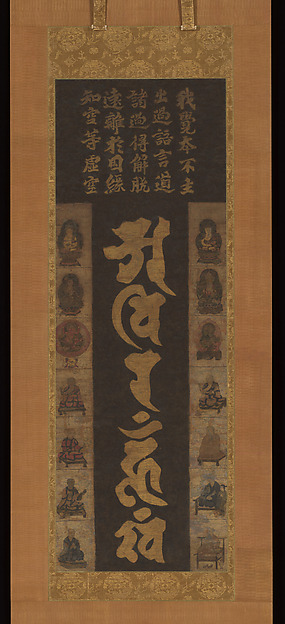
Japan · Kamakura Period (1185–1333) · 13th–14th century · Hanging scroll; ink, colors, and gold on silk
Look closer: A hanging scroll of the Kamakura period with Sanskrit seed-syllables standing for the Buddhas and bodhisattvas, and with the eight patriarchs of the Shingon sect. The Met calls it a mandala in Sanskrit. The Met's title tells us that the deities are shown in Sanskrit, in letters, together with the eight patriarchs of the sect.
The Metropolitan Museum of Art, New York, Purchase, Sue Cassidy Clark Gift, in memory of Koichi Yanagi, 2024, accession 2024.410. Public domain, Met Open Access. Museum record
Kukai was born on 27 July 774 in Sanuki and died on 22 April 835 on Mt Koya.6 He travelled in the mission of 804 led by Fujiwara no Kadanomaro, on a ship separate from Saicho's, and studied under Huiguo at Qinglong Temple in 805; he returned in 806 with texts and paintings, including the pair now known as the Two Realms mandala.6 The Wikipedia articles disagree about Koya: one reports that Emperor Saga approved the mountain retreat in 816, the other that Kukai asked for it in 818, and the monastery was consecrated in 819.67 Toji was given to him in 823.6 The Shingon doctrine rests on the Mahavairocana Sutra and the Vajrasekhara Sutra, and on three mysteries of body, speech and mind, which are mudra, mantra and mandala.7 The estimate of Yamasaki in 1988 is about ten million followers and eleven thousand temples.7
Honen, Shinran and Ippen
The connoisseur's eyeHonen was born in 1133 in Mimasaka and died in Kyoto on 29 February 1212.8 At 43 he read Shandao's commentary, and he left Mt Hiei in 1175 to preach reliance on the nembutsu alone.8 At the request of Kujo Kanezane he wrote the Senchaku Hongan Nembutsu Shu in 1198, printed in 1211, and the monks Myoe and Jokei opposed it.8 In 1207, in the persecution known as Jogen, Emperor Go-Toba banned the practice, four disciples were executed and Honen was exiled to Tosa; he returned to Kyoto in 1211 and wrote the One-Sheet Document days before his death.8

Japan · Nanbokuchō period (1336–92) · probably late 14th century · Hanging scroll; color and gold on silk
Look closer: A Nanbokucho hanging scroll of the Taima Mandala: the Western Paradise of Amida, which the Met catalogues in colour and gold on silk. The Taima Mandala is a paradise picture; the Met's own essay would be the place to read how it was used.
The Metropolitan Museum of Art, New York, Fletcher Fund, 1927, accession 27.176.2. Public domain, Met Open Access. Museum record
Shinran was born in Kyoto on 21 May 1173 and died on 16 January 1263.9 He was ordained at nine, spent about twenty years on Hiei, and met Honen in 1201 after a retreat at the Rokkaku-do; he married Eshinni between 1203 and 1207, was exiled to Echigo in 1207 and was pardoned in 1211.9 He spent about twenty years in the Kanto and completed the Kyogyoshinsho in 1234, though a draft may date from 1224.9 He described himself as neither monk nor layman, and the Hongan-ji developed in the fourteenth century from his mausoleum.9
Ippen, whose dates the Wikipedia article gives as 1234 to 1289, travelled as the itinerant Yugyo Shonin, and from about 1279 he danced the nembutsu.10 He gave out slips, and the Hijiri-e records 251,724 names; the twelve-scroll biography of 1299 was painted by En'i and edited by Shokai.10

Japan · Edo period (1615–1868) · 18th–early 19th century · Wood, with traces of color and gilt and inset glass eyes
Look closer: A wooden portrait of Honen of the Edo period, in wood with traces of colour and gilt and inset glass eyes, as the Met records. The eyes are set in, so the founder seems to look back.
The Metropolitan Museum of Art, New York, Rogers Fund, 1912, accession 12.37.167. Public domain, Met Open Access. Museum record

Japan · Kamakura period (1185–1333) · ca. 1300 · Hanging scroll; ink and color on silk
Look closer: A Kamakura scroll that the Met titles as the descent and return of Amida to the Western Paradise with a believer's soul. It is a picture of the hope the nembutsu carried.
The Metropolitan Museum of Art, New York, The Harry G. C. Packard Collection of Asian Art, Gift of Harry G. C. Packard, and Purchase, Fletcher, Rogers, Harris Brisbane Dick, and Louis V. Bell Funds, Joseph Pulitzer Bequest, and The Annenberg Fund Inc. Gift, 1975, accession 1975.268.21. Public domain, Met Open Access. Museum record
Eisai, Dogen and the Arrival of Obaku
The connoisseur's eyeEisai lived from 27 May 1141 to 1 August 1215.11 He went to China in 1168 for six months and again in 1187 to 1191, under Xuan Huaichang, and in 1191 founded Shofuku-ji in Kyushu, described as Japan's first Zen temple; in 1202 he founded Kennin-ji in Kyoto on land from the shogun Minamoto no Yoriie, and Jufuku-ji in Kamakura for Hojo Masako.11 He wrote the Kozen Gokokuron and the Kissa Yojoki, the latter about tea as medicine, and he never gave up his Tendai status.11

Japan · Muromachi period (1392–1573) · 15th century · Lacquer on wood with inlaid crystal
Look closer: A Muromachi portrait of a Zen master in lacquer on wood with inlaid crystal, in the Met's catalogue. The Met's title does not name the sitter, and neither do we.
The Metropolitan Museum of Art, New York, Purchase, John D. Rockefeller 3rd Gift, 1963, accession 63.65. Public domain, Met Open Access. Museum record
Dogen lived from 26 January 1200 to 22 September 1253.12 He entered Hiei in 1212, joined Myozen at Kennin-ji in 1217, and was in China from 1223 to 1227, where Rujing taught him at Tiantong.12 He wrote the Fukanzazengi after returning, settled at Uji in 1230, and in 1243 accepted land from Hatano Yoshishige in Echizen, where the Daibutsu-ji was renamed Eihei-ji in 1246.12 The Shobogenzo runs to ninety-five fascicles, and the practice he taught is shikantaza, sitting with nothing else; Keizan, who lived from 1268 to 1325, founded Soji-ji.12
The third wave came much later. Yinyuan Longqi, in Japan Ingen, lived from 7 December 1592 to 19 May 1673; he arrived at Nagasaki in 1654 with about thirty monks and artisans at the invitation of Itsunen Shoyu, and founded Manpuku-ji at Uji in 1661.14 His school brought Ming calligraphy, the Three Brushes of Obaku, and the ingen mame, the green bean that carries his name.14
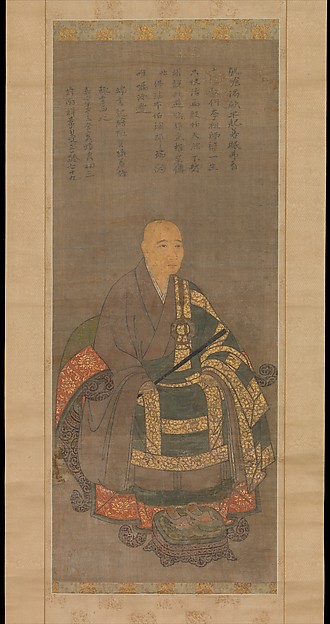
Japan · Muromachi period (1392–1573) · 1449 · Hanging scroll; ink, color, and gold on silk
Look closer: A Muromachi hanging scroll of Keinan Eibun, in ink, colour and gold on silk. The Met catalogues the portrait of this Zen monk as a Muromachi work in ink, colour and gold on silk.
The Metropolitan Museum of Art, New York, Gift of Florence and Herbert Irving, 2015, accession 2015.500.9.10. Public domain, Met Open Access. Museum record
Nichiren and the Lotus
The connoisseur's eyeNichiren lived from 16 February 1222 to 13 October 1282.13 On 28 April 1253 he chanted Nam(u) Myoho Renge Kyo for the first time, at Seicho-ji on Mt Kiyosumi.13 He presented the Rissho Ankoku Ron to Hojo Tokiyori on 16 July 1260, was exiled to Izu for about two years, survived Tatsunokuchi in 1271 and was exiled to Sado from 1271 to 1274.13 He inscribed his first full Gohonzon on 8 July 1273, the first Mongol attempt on Japan came in 1274, and he settled at Minobu; Kuon-ji was founded in 1281, and he died at Ikegami.13 The Wikipedia article counts more than forty registered organisations.13
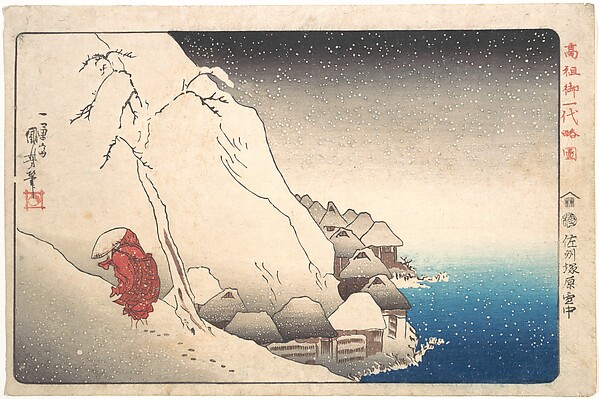
Japan · Edo period (1615–1868) · 1835–36 · Woodblock print; ink and color on paper
Look closer: An Edo woodblock print of the monk in exile on Sado, one of a series of famous monks. The print chooses the exile on Sado, a period which the biography above dates to 1271 to 1274.
The Metropolitan Museum of Art, New York, Henry L. Phillips Collection, Bequest of Henry L. Phillips, 1939, accession JP2856. Public domain, Met Open Access. Museum record
The Lotus Sutra, at the centre of Tendai, is here turned from a text into a single title that can be chanted by anyone.
How the Schools Sit in a Collection
The deep endThe Met objects on this page show how the schools reach us as things: Amida images and paradise mandalas for Pure Land, a mandala in Sanskrit for Shingon, portraits for Zen and a print for Nichiren.
The house names a school only when the object or its record does. Where they do not, we say nothing and let the piece stand as a Japanese Buddhist work.
Koya: Where Kukai Is Said to Wait
First lookMount Koya is the place where the story of Kukai stops being history and becomes devotion. The Wikipedia article on the settlement says that Kukai first settled the site in 819, that it now has about 120 sub-temples, many of which offer lodging to pilgrims, and that Kongobu-ji is the head temple of the Koyasan Shingon sect.15 The earlier section gives 816 or 818 for the request and 819 for the consecration, so the mountain article agrees with it on the date of settlement.6715

Photograph of 2015
Look closer: Look at the stones on either side of the path. Wikipedia counts more than 200,000 graves and memorials at Okunoin and calls it the largest cemetery in Japan; its sanctuary lies about two kilometres beyond the first bridge, and the page says that monks bring meals to Kukai twice a day.16
Photograph: Josep M. Gracia. CC BY-SA 4.0, with attribution. Source: Wikimedia Commons. CC BY-SA 4.0 File record

The innermost place is Okunoin. Wikipedia says that Kukai was laid in his mausoleum, the Gobyo, in 835, that popular belief holds that he entered an eternal samadhi and is still alive on the mountain, awaiting Maitreya, and that the mausoleum is closed to the public.16 In front of it stands the Torodo, the lantern hall, where the page says over ten thousand lanterns are kept lit, two of them, by one travel guide's account, for more than 900 years; that last claim rests on a single source, so we repeat it as a claim and not a fact.16
The visitor's path to the mausoleum is part of the teaching. On the approach, the page says, visitors pour water over the Mizumuke Jizo statue to pray for their ancestors, and in 1984, for the 1150th anniversary of Kukai's burial, 50,000 Jizo statues were donated.16 Among the monuments are the corporate tomb of the Matsushita company, dated 1938, and a company monument topped with a model of a Saturn V rocket.16 The mountain accommodates the pilgrim, the monk, the salaryman and the sceptic in the same forest.
| Place on the mountain | What the source says | Source |
|---|---|---|
| Danjo Garan | The heartland of the settlement, with a main hall, several pagodas, a scripture storage, a bell tower and a lecture hall15 | Wikipedia, Mount Koya |
| Kongobu-ji | Head temple of the Koyasan Shingon sect; built by Toyotomi Hideyoshi for his late mother, renamed from Seigan-ji in the Meiji era15 | Wikipedia, Mount Koya |
| Okunoin | Cemetery with more than 200,000 graves and memorials, around Kukai's mausoleum16 | Wikipedia, Okunoin |
| World Heritage | Kongobu-ji is part of the Sacred Sites and Pilgrimage Routes in the Kii Mountain Range, inscribed in 200415 | Wikipedia, Mount Koya |
Hiei: The Ridge That Trained Nearly Every Founder
The connoisseur's eyeIf one mountain explains the schools of Japan, it is Hiei. Wikipedia says Enryaku-ji was first founded in 788 by Saicho, and that the founders of Jodo-shu, Jodo Shinshu, Soto Zen and Nichiren Buddhism all spent time there.17 That list is the same one that the opening ideas of this chapter give: Honen, Shinran, Dogen and Nichiren all began as Tendai monks.517

The Tendai headquarters above Kyoto and Lake Biwa
Look closer: Find the forested ridge and the halls set into it. Wikipedia names three precincts, the Todo, the Saito and the Yokokawa, and says that the present structures date from the late sixteenth and early seventeenth centuries, the main hall being completed in 1642.17
Photograph: Guilhem Vellut from Tokyo, Japan. CC BY 2.0, with attribution. Source: Wikimedia Commons. CC BY 2.0 File record

The mountain's power had a darker side. The article records that Oda Nobunaga attacked the monastery in 1571 and levelled its buildings. The page gives no casualty count, so we give none.17 The rebuilding that followed produced the halls that stand today.17
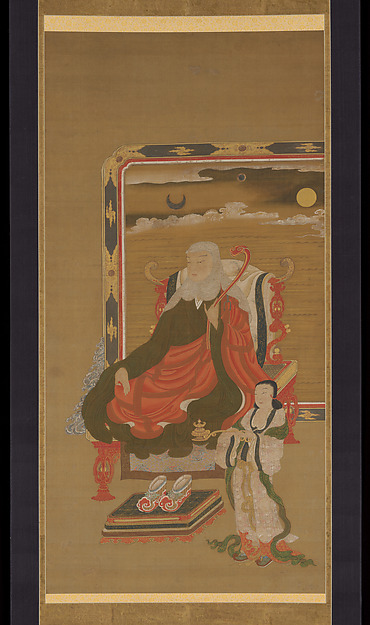
Japan · Edo period (1615–1868) · early 18th century · Hanging scroll; ink, color, and gold on silk
Look closer: The Met catalogues this hanging scroll as a Portrait of Dengyo Daishi, which is Saicho's posthumous title, of the early eighteenth century, in ink, colour and gold on silk, 117.2 by 58.1 centimetres. Portraits of founders such as this were made for the halls that honour them; look at the face and the robe.
The Metropolitan Museum of Art, New York, Mary and Cheney Cowles Collection, Gift of Mary and Cheney Cowles, 2020, accession 2020.396.6. Public domain, Met Open Access. Museum record
The mountain also holds the strangest discipline in the whole of Japanese Buddhism. The Wikipedia article on kaihogyo describes it as an ascetic walking practice of the Tendai monks of Hiei. The thousand-day course takes seven years: 100 days a year at 30 kilometres a day for the first three years, 200 days in each of the fourth and fifth, with a nine-day fast in the fifth, 100 days at 60 kilometres in the sixth, and 100 days at 84 kilometres followed by 100 at 30 in the seventh.18
- 788Enryaku-ji founded by Saicho, as the Wikipedia article gives it.17
- 806Tendai recognised by the court, as the earlier sections give it.45
- 1571Oda Nobunaga attacks the monastery and levels its buildings.17
- 1642The main hall of the present precinct is completed.17
- 1885The first recorded completion of the thousand-day course.18
The walkers dress for death. According to the same article the monk wears white robes and a hinoki hat, and traditionally carried a dagger and a hemp rope, which the page says are now symbolic.18 Only 46 men are recorded as having completed the thousand days since 1885, three of them twice.18
Byodo-in and the Fear of the Last Age
The connoisseur's eyeThe Pure Land school in this chapter begins with Honen, but the longing for the Western Paradise is older, and its best surviving monument is at Uji. Wikipedia says that Byodo-in was built in 998 as a rural villa for Minamoto no Shigenobu, that Fujiwara no Michinaga later bought it, and that his son Yorimichi converted it into a Buddhist temple in 1052.19 The Phoenix Hall followed, completed in 1053 in the text of the article, though its infobox says 1052.19

Completed in 1053, by the page's text
Look closer: Study the reflection. Wikipedia says the temple faces east and that the pond in front of the hall is said to be crossed on the way to the Pure Land; the hall is the building on the front of the 10-yen coin, and the phoenix appears on the 10,000-yen note.19
Photograph: 663highland. CC BY 2.5, with attribution. Source: Wikimedia Commons. CC BY 2.5 File record

Fear gave the building its urgency. The page says many people believed that 1052 marked the start of the Mappo age, the degenerate third age of Buddhism, and that this drew people toward Pure Land belief.19 Inside the hall sits an Amida Buddha by Jocho, made in the joined-wood yosegi technique, with the page giving 2.4 metres for the statue in one place and about three metres from face to knees in another.19 Around the walls the page counts 26 statues of the Praying Bodhisattva on Clouds.19
The building has survived by being repaired. The page records a restoration of the Phoenix Hall completed in March 2014. UNESCO inscribed it in December 1994 as part of the Historic Monuments of Ancient Kyoto.19
Chion-in: Honen's Hall in Kyoto
The connoisseur's eyeHonen's school has its head temple at Chion-in. Wikipedia gives Honen's dates as 1133 to 1212 and says that Chion-in was built in 1234 by his disciple Genchi in memory of his master.21 The older sections of this chapter tell how Honen wrote the Senchaku Shu in 1198 and was exiled in 1207; the temple is the settled, imperial-scale conclusion of a career that began in persecution.821

The great gate of the head temple of Jodo-shu
Look closer: Judge the scale against the figures at its foot. Wikipedia calls the gate the largest surviving structure of its kind in Japan and gives its date as 1619; the temple behind it was built in 1234 by Honen's disciple Genchi in memory of his master.21
Photograph: Lombroso. Public domain. Source: Wikimedia Commons. File record

The temple is a record of the Tokugawa age as much as of Honen. After fires in 1633, Wikipedia says, the shogun Iemitsu oversaw the rebuilding of the palatial structures, and the Tokugawa crest of three hollyhock leaves appears on the temple. The Great Bell, commissioned in 1633, weighs 74 tons, and the page records that it once took a team of 25 to sound it and now, by the temple's own site, takes 17.21 The corridors have nightingale floors.21

Japan · Kamakura period (1185–1333) · ca. 1310–20 · Section of handscroll mounted as hanging scroll; ink and color on paper
Look closer: This section of a handscroll, mounted as a hanging scroll, is catalogued by the Met as the Illustrated Biography of Honen (Shuikotokuden-e) of about 1310 to 1320, in ink and colour on paper. Look at how the scene is organised around a single teacher and a small group of listeners, as the biography shows him to the faithful.
The Metropolitan Museum of Art, New York, Purchase, Gifts of Mrs. Russel Sage, Mrs. Peter Gerhard, Mr. and Mrs. Donald Percy, Charles Stewart Smith, Mrs. V. Everit Macy, Mrs. Thomas Van Buren, Mrs. Charles Stewart Smith, Hartwell J. Staples, Mrs. George A. Crocker and Mr. and Mrs. Samuel Coleman, by exchange; Bequests of Edward C. Moore, James Alexander Scrymser and Stephen Whitney Phoenix, by exchange; Rogers Fund and funds from various donors, 1980, accession 1980.221. Public domain, Met Open Access. Museum record
Eihei-ji: The Hermitage Dogen Left to the Soto School
The connoisseur's eyeDogen's temple in the mountains of Echizen is where his school's discipline is still taught. Wikipedia says he founded Eihei-ji in 1244, that it was renamed Kisshozan Eihei-ji in 1246, and that the name means eternal peace.20 The earlier sections of this chapter place Dogen's study in China from 1223 to 1227; the temple is the institution he built on his return.1220

Photograph of September 2019
Look closer: Notice how the buildings are strung along a wooded slope and linked by roofed corridors. Wikipedia counts more than 70 buildings, 19 of them Important Cultural Properties, and names the Sanmon, the Hatto and the Sodo among them.20
Photograph: 雷太. CC BY 2.0, with attribution. Source: Wikimedia Commons. CC BY 2.0 File record

The page describes a day of strict routine. Monks rise at 3.30 in the morning, an hour later in winter, for zazen and chanting, followed by chores and more chanting; dinner is a ritual meal at 5 in the afternoon; and baths are taken every five days.20 About 200 to 250 priests and nuns live in training there, and the temple is one of two head temples of the Soto school, the other being Soji-ji in Yokohama, whose head priests alternate terms in leading the school.20
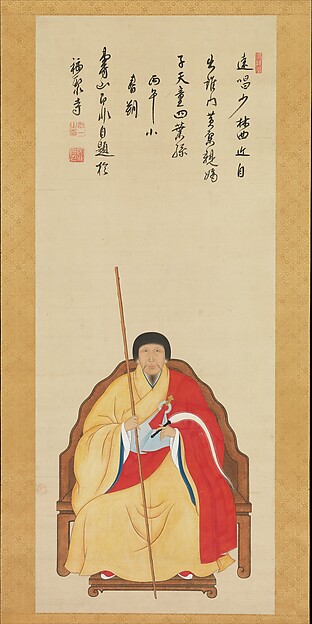
Japan · Edo period (1615–1868) · 1666 · Hanging scroll; ink and color on silk
Look closer: The Met catalogues this hanging scroll as a Portrait of the Obaku Zen monk Jifei Ruyi (Sokuhi Nyoitsu), dated 1666, by Kita Genki, in ink and colour on silk. Look at the robe, the chair and the inscription that the Met records.
The Metropolitan Museum of Art, New York, The Harry G. C. Packard Collection of Asian Art, Gift of Harry G. C. Packard, and Purchase, Fletcher, Rogers, Harris Brisbane Dick, and Louis V. Bell Funds, Joseph Pulitzer Bequest, and The Annenberg Fund Inc. Gift, 1975, accession 1975.268.78. Public domain, Met Open Access. Museum record
Soto is not the only Zen in the chapter. The Obaku school, brought by Yinyuan Longqi in 1654, kept the manners of Ming Chinese Buddhism, and the Met portrait of its monk Jifei Ruyi shows how that foreign discipline entered the Japanese record of Zen.14
The Schools Today
The connoisseur's eyeThe schools survive as institutions, and the news about them is sober. A Buddhistdoor report of 9 November 2015, citing The Guardian, put the number of Buddhist temples in Japan at about 77,000, and said that about 27,000 were expected to close over the next 25 years. The report does not name the source for the closure figure; it draws its municipal projections on a Japan Policy Council report and its vacancy figures on an Asahi Shimbun survey.22
The vacancy figures are concrete. According to the same report, the Asahi survey found 12,065 temples, 16 per cent of those affiliated with the ten largest schools, with no resident monk, and 434 temples of nine denominations had closed in the previous decade.22 The causes the report gives are shrinking rural populations, falling faith in organised religion, and the old model of community support. It describes a Kyoto temple with about 120 patrons that needs at least 200 to make a living, whose assistant head monk has a second career as a journalist.22
These are projections from 2015, and the report itself warns that closures and vacancies measure different things. We have not found a more recent figure in a source we could read, so we offer these as the last we can cite. Against them stand the pilgrims at Okunoin, the visitors at Eihei-ji and the monks on Hiei, who show that a school can remain alive in practice when its parish is thinning.22162018
Fun Facts from the Great Temples
First lookEight small facts, each from a source cited in this chapter.
- Two of the lanterns in the Torodo at Okunoin are said by one guide to have burned for more than 900 years.16
- A rocket model stands among the company monuments at Okunoin, and the Matsushita company tomb is dated 1938.16
- The phoenix of the Phoenix Hall appears on the 10-yen coin and on the 10,000-yen note.19
- Chion-in's Great Bell weighs 74 tons and once needed 25 people to ring.21
- Chion-in's corridors have nightingale floors.21
- A kaihogyo walker traditionally carried a dagger and a hemp rope, now symbolic.18
- Eihei-ji's monks bathe only every five days.20
- Only 46 men have completed the thousand-day Hiei course since 1885.18
Where Each School Came From
The deep endNo Japanese school is purely Japanese. Sanron came from the Korean monk Hyegwan in 625, Hosso from Dosho's study in China in 653, Risshu from the Chinese abbot Ganjin in 753, Tendai from Saicho's study of Tiantai in China, Shingon from Kukai's study under Huiguo, Zen from the Chan masters whom Eisai and Dogen met in China, and Obaku from the Ming monk Yinyuan Longqi in 1654.1246111214 Pure Land and Nichiren Buddhism, the two schools usually called native, grow from Chinese texts, the commentary of Shandao for Honen and the Lotus Sutra for Nichiren.813
The pattern recalls the Tibetan story told in the Tibet and Nepal chapter, where a tradition is built from teachers who come in and pilgrims who go out. The Japanese difference is that the schools, once established, stayed to be fought over, rebuilt and recorded in portraits; that is why the Met can show a Saicho of the eighteenth century, a Honen biography of the fourteenth and an Obaku portrait of the seventeenth.
A Short Glossary for This Chapter
First lookTerms in the order a reader meets them.
| Term | Meaning |
|---|---|
| Okunoin | The inner sanctuary of Mount Koya and the cemetery that surrounds Kukai's mausoleum.16 |
| Gobyo | Kukai's mausoleum, closed to the public.16 |
| Torodo | The lantern hall in front of the Gobyo.16 |
| Kaihogyo | The walking discipline of the Tendai monks of Hiei.18 |
| Mappo | The age of the decline of the Dharma, which many believed began in 1052.19 |
| Yosegi | The joined-wood technique used for the Amida of the Phoenix Hall.19 |
| Sanmon | The great gate of a temple, as at Chion-in and Eihei-ji.2021 |
A Collector's Eye on the Schools
The connoisseur's eyeA school reaches a collector through its objects, and the objects are usually portraits, implements and images. Portraits of founders are the clearest guide: a Saicho in the early eighteenth century, a Honen biography of about 1310 to 1320 and a Jifei Ruyi of 1666, all catalogued by the Met, show how the likenesses vary.
Ask three questions of any piece. Does the object name a school, or only a subject? The house names a school only when the object or its record does, as the earlier section says. Is there a seal, an inscription or a temple label? And does its record show where it was kept?
A figure of Amida suggests Pure Land only in the loosest sense, since the Amida of the Phoenix Hall was made for a court that had not yet heard of Honen.19 A Zen portrait may belong to any of the lineages. The honest label is the one that says what can be seen and leaves the rest.
Objects of the Schools
The house catalogues Japanese pieces by form, and several tags map onto the schools in this chapter. The strip below fills from the live shelf on the day you read this, drawn from the Amida, Pure Land, esoteric and Zen tags, and shows nothing if a tag is empty.
Pieces in the house now
- Buddhist Statues and Sacred ArtAmida, Dainichi, Jizo and guardians
Filter by what you have just read
Answered plainly
What were the six Nara schools?
Sanron, Jojitsu, Hosso, Kegon, Kusha and Risshu; of these Hosso, Kegon and Risshu survive.1
Who founded Tendai in Japan?
Saicho, who returned from China in 805; the school was officially established in 806.45
When did Kukai go to Mt Koya?
Sources differ: one article reports 816, another 818, and the monastery was consecrated in 819.67
What is the nembutsu?
The invocation of Amida's name, which Honen taught as the sole practice in the Senchaku Hongan Nembutsu Shu of 1198.8
Who brought Zen to Japan?
Eisai founded Japan's first Zen temple, Shofuku-ji, in 1191; Dogen founded Eihei-ji in 1246; Ingen arrived in 1654.111214
What did Nichiren chant?
Nam(u) Myoho Renge Kyo, first chanted on 28 April 1253.13
Where is Kukai buried?
Wikipedia says Kukai was laid in his mausoleum, the Gobyo, at Okunoin on Mount Koya in 835, and that popular belief holds he entered an eternal samadhi and is still alive there.16
How many graves are there at Okunoin?
More than 200,000 graves and memorials, according to Wikipedia, which calls it the largest cemetery in Japan.16
When did Kukai found Mount Koya?
Sources differ on the request, 816 or 818, and agree on 819 for the settlement and consecration.6715
Why is Mount Hiei important?
It is the Tendai headquarters and the mountain on which the founders of Jodo-shu, Jodo Shinshu, Soto Zen and Nichiren Buddhism all spent time.17
What is kaihogyo?
A thousand-day walking discipline of the Tendai monks of Hiei, spread over seven years, with a nine-day fast in the fifth; only 46 men have completed it since 1885.18
What is the Phoenix Hall?
The central building of Byodo-in in Uji, converted from a villa into a temple in 1052 and completed in 1053, with an Amida by Jocho; it is a World Heritage property and appears on the 10-yen coin.19
What is Chion-in?
The head temple of Jodo-shu in Kyoto, built in 1234 by Honen's disciple Genchi, known for its Sanmon gate, its 74-ton bell and its nightingale floor.21
What is Eihei-ji?
A head temple of the Soto school in Fukui, founded by Dogen in 1244 and renamed in 1246; about 200 to 250 priests and nuns train there.20
Are Japanese Buddhist temples closing?
A report of November 2015 cited about 77,000 temples and a projection that about 27,000 would close in 25 years, with 12,065 temples already lacking a resident monk; these are old projections, not current counts.22
Where next
Sources and image credits
- Wikipedia, Nanto Rokushu The six Nara schools.
- Wikipedia, Ganjin Jianzhen's voyages and Toshodai-ji.
- Wikipedia, Nara period Shomu, Todai-ji, the move of the capital.
- Wikipedia, Saicho Life, Tiantai study, 806.
- Wikipedia, Tendai School history, Ennin, Enchin, Hiei.
- Wikipedia, Kukai Life, Huiguo, Koya, Toji.
- Wikipedia, Shingon Buddhism Doctrine, three mysteries, Koya 818.
- Wikipedia, Honen Senchaku Shu, persecution of 1207.
- Wikipedia, Shinran Life, Kyogyoshinsho, Hongan-ji.
- Wikipedia, Ippen The itinerant Ji-shu founder.
- Wikipedia, Eisai Shofuku-ji, Kennin-ji, tea.
- Wikipedia, Dogen Life, China, Eihei-ji, Shobogenzo.
- Wikipedia, Nichiren Life, exile, Gohonzon.
- Wikipedia, Yinyuan Longqi Obaku arrival in 1654.
- Wikipedia, Mount Koya Settlement of 819, sub-temples, Kongobu-ji, Danjo Garan, World Heritage 2004.
- Wikipedia, Okunoin Cemetery, Gobyo, Torodo, Jizo statues, daily offerings.
- Wikipedia, Enryaku-ji Founding of 788, three precincts, 1571, rebuilding, alumni.
- Wikipedia, Kaihogyo The thousand-day course, dress, completions since 1885.
- Wikipedia, Byodo-in Villa of 998, conversion in 1052, Phoenix Hall, Mappo, UNESCO inscription.
- Wikipedia, Eihei-ji Founding of 1244, daily routine, buildings, Soto head temples.
- Wikipedia, Chion-in Genchi's temple, Sanmon, bell, nightingale floor, Tokugawa rebuilding.
- Buddhistdoor Global, Almost one third of Japan's Buddhist temples expected to close by 2040 (9 November 2015) Temple numbers, projections, vacancies, causes.
Last reviewed 28 October 2026. Dates in this chapter follow the cited pages; where the sources disagree, the chapter says so. Every picture is public-domain or openly licensed, and its credit and licence stand beneath it.
If a school has called to you, whether through an Amida image, a Shingon implement or a Zen portrait, the concierge desk can search Japan for it.
Private concierge
Looking for something in particular?
Describe the piece or the project you have in mind. A senior advisor in Tokyo reads every case file personally and replies within two business days, with fees set out in writing before any work begins.