
Gandhāra and the Silk Road
Crossroads · Kushan lands
Gandhāra and the Silk Road
On 30 April 630, a Chinese pilgrim stood before two standing Buddhas cut into a cliff in the Hindu Kush, one 55 metres tall, the other 38, and reported that they glittered with gold and jewels. Almost fourteen centuries later, in March 2001, they were destroyed. Between those dates lies the story of how the Buddha acquired a human face and walked the Silk Road to Japan. Added below: the kings and councils the pilgrims remembered, the Kanishka casket and the Rabatak stone, Taxila and Takht-i-Bahi on the ground today, what has and has not been done at Bamiyan since 2001, the monastery of Mes Aynak under its copper mountain, the long journey of the wind god, a comparison of the neighbouring schools, a glossary and a collector's eye for Gandhara-style pieces.
Fact sheet
Four ideas to carry in
- A Greek chisel. Gandharan Buddhas wear drapery like Roman statuary and a youthful, Apollo-like face, while the iconography beneath remains Indian.1
- Two birthplaces. Gandhara and Mathura each developed a characteristic Buddha image around the first century CE, and influenced each other.1
- Stone, then stucco. Early images were carved in schist; after the third century stucco was used increasingly, and the figures were painted and gilded.1
- A road, not a border. Monks, texts and images moved by caravan; pilgrims such as Faxian and Xuanzang left the records.78
Two Giants in a Cliff
First lookAt Bamiyan the Buddhas stood in niches carved into the sandstone cliff, and both were destroyed in March 2001.5 UNESCO lists Bamiyan as a serial property of eight sites, with remains dated from the first to the thirteenth century, and calls it the most monumental expression of western Buddhism and an important pilgrimage centre.5

Afghanistan (probably Hadda) · 5th–6th century · Stucco with traces of paint
Look closer: Red pigment survives on the lips, the lids of the half-closed eyes and the dot between the brows, and the hair is a cap of small dimpled curls. The Met places the head in Afghanistan, probably Hadda, in the fifth or sixth century. Such heads were not left white: Britannica notes that Gandharan images were originally painted and gilded.1
The Metropolitan Museum of Art, New York, Rogers Fund, 1930, accession 30.32.5. Public domain, Met Open Access. Museum record
Radiocarbon work on structural components published in 2009 dates the Eastern Buddha to 544 to 595 CE and the Western Buddha to 591 to 644, so, on these dates, neither was much more than ninety years old when Xuanzang saw them.6 He visited on 30 April 630 and counted more than ten monasteries and over a thousand monks, and described the statues as adorned with gold and jewels.6
The murals in the niches were painted between the fifth and ninth centuries.6 A team in 2004 dated them by isotope analysis of the straw they contain, and oil-bound paint of the middle of the seventh century may make some of them the oldest oil paintings known.6 Japan took part: the Tokyo Research Institute for Cultural Properties joined the analysis of the paint, and the Japanese government is among the organisations committed to rebuilding.6 On 7 June 2015 a 3D light projection recalled the lost figures in their niches.6
The Buddha Gets a Face
The connoisseur's eyeGandhara lies where India meets the Hellenistic world, whose presence in Bactria is documented at the Greek city of Ai-Khanoum in the third and second centuries BCE.2 Britannica dates the art between the first century BCE and the seventh century CE and attributes much of its flowering to the Kushan dynasty.1 The Buddha it produces is an Indian idea in a Western grammar: a youthful, Apollo-like face and robes that fall like the garments of Roman imperial statues.1
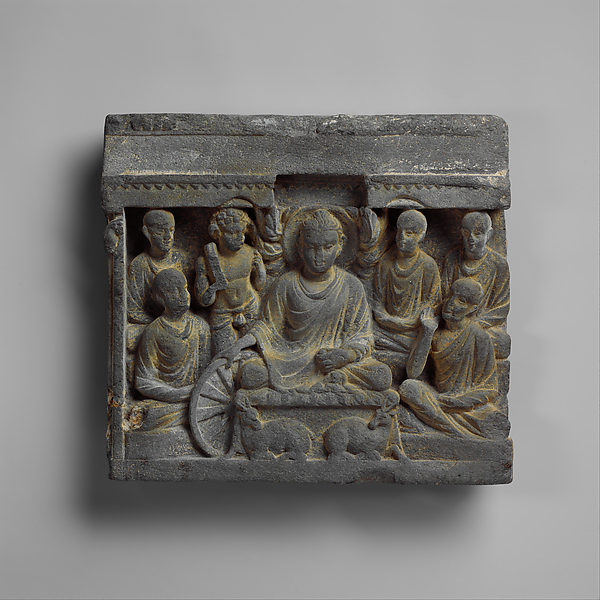
Pakistan (ancient region of Gandhara) · ca. 2nd century · Schist
Look closer: Below the seat of the Buddha, find the wheel flanked by two deer: the Deer Park of the First Sermon. At the left stands the muscular attendant holding a club, whom the Met identifies as Vajrapani, and whom Greco-Buddhist scholars compare with Herakles.2
The Metropolitan Museum of Art, New York, Gift of Daniel Slott, 1980, accession 1980.527.4. Public domain, Met Open Access. Museum record
The scholar Alfred Foucher gave the style its name around 1900, calling it Greco-Buddhist; Rowland later preferred Romano-Indian.2 The Hellenistic traits that scholars list are the himation-like robe, the halo, contrapposto stance and the curly hair gathered in a topknot, which may echo the Apollo Belvedere.2 Vajrapani, the Buddha's companion, is shown with the club of Herakles.2

Near Taxila, Pakistan. Mound of a stupa built over relics in the third century BCE
Look closer: Wikipedia reports that Ashoka built it over relics of the Buddha in the third century BCE and that Kushan-era rulers re-established it in the second century CE. The great mound is now damaged, its crowning harmika lost, though the plinth around it is largely intact.13
Photograph: SpeakingArch. CC BY-SA 4.0, with attribution. Source: Wikimedia Commons. CC BY-SA 4.0 File record

Nothing in this story is settled. Britannica notes that Gandhara and Mathura each developed a characteristic Buddha around the first century CE, and that scholars disagree about how much one owes the other.1 Boardman, cited in the Greco-Buddhist survey, argues that nothing in earlier Indian statuary suggests this kind of treatment, which is an argument for Western influence, though Britannica notes the disagreement.12 The shift from the symbol to the figure happened somewhere between the second century BCE and the first century CE, and the date is uncertain.2
| Feature | The Hellenistic echo scholars point to | Where to look for it |
|---|---|---|
| Robe | Drapery like that of Roman imperial statues1; the himation-like robe2 | The long, deep folds of the standing Buddha |
| Hair | Curls gathered in a topknot, perhaps after the Apollo Belvedere2 | The knot and the rows of curls |
| Face | A youthful, Apollo-like face1 | The smooth cheeks and straight nose |
| Halo and stance | The halo and the contrapposto stance2 | The disc behind the head; the relaxed leg |
| Companion | Vajrapani carrying the club of Herakles2 | The muscular attendant beside the Buddha |
The Japanese chapters of this wing return to the idea twice. In the Wikipedia survey, Katsumi Tanabe proposes that Vajrapani became the Nio guardians of Japanese temple gates, and that the Japanese wind god Fujin shares his origin with Boreas, the Greek north wind; the survey presents both theses as a single scholar's view, from a 2003 exhibition catalogue, and they remain contested.2
The Road to Luoyang
The connoisseur's eyeThe Silk Road carried doctrine as much as silk. The Book of the Later Han reports that an envoy of about 67 CE brought back Buddhist images, and the tradition of the White Horse Temple at Luoyang says two Indian monks, Kasyapa Matanga and Dharmaratna, arrived on white horses with scriptures, relics and images in 67.29 The temple is traditionally China's first, dated to 68, but it is not recorded in contemporary sources before 289, and the article notes that most modern scholars accept the story as a fable.9
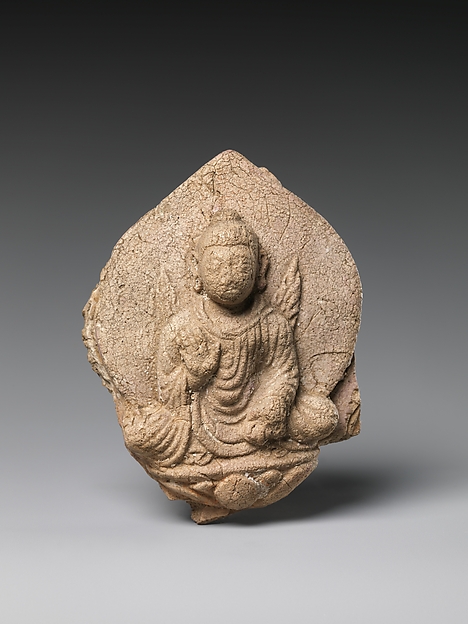
China (Xinjiang Autonomous Region) · Khotan Kingdom · 6th–7th century · Stucco
Look closer: A seated Buddha in stucco with flames rising from his shoulders. The Met places it in the Khotan Kingdom, in what is now Xinjiang, in the sixth or seventh century. Find the flames at the shoulders, which the Met's title names, and the pointed oval that frames the figure.
The Metropolitan Museum of Art, New York, Rogers Fund, 1930, accession 30.32.43. Public domain, Met Open Access. Museum record
Real travellers are better documented. A monk called Lokaksema, from Gandhara, translated texts in China between about 167 and 186.10 Faxian left Chang'an in 399 at about age sixty, crossed the icy desert and the mountain passes, entered India from the north-west and spent about ten years there, collecting texts from Pataliputra, Oddiyana and Taxila; he returned by sea, was blown by storms to an island that was probably Java, and settled at Nanjing in 412.7 Xuanzang set out in 629, passed through Agni near Turpan, Kucha, Tashkent, Samarkand and Bamiyan, spent about two years in Kashmir, studied at Nalanda and returned to Chang'an in 645 with 657 texts and seven Buddha statues.8
The translators who stayed behind did as much. Kumarajiva was born at Kucha, captured in 386, brought to Chang'an in 401 and rendered about thirty-five sutras into Chinese in roughly a dozen years, favouring sense over literal fidelity.11
- 1st century BCE to 7th century CEThe period of Gandharan art, flourishing largely under the Kushans.1
- About 67 CEAn envoy of the Han court is reported to bring back Buddhist images; the White Horse Temple tradition places two Indian monks at Luoyang in the same year.29
- About 167 to 186Lokaksema of Gandhara translates Mahayana texts in China.10
- 399 to 412Faxian's journey to India and home by sea.7
- 401Kumarajiva reaches Chang'an and begins his translations.11
- Late 5th centuryGandharan centres collapse after Hun invasions; sculpture continues in Afghanistan until about the eighth century.34
- 30 April 630Xuanzang visits the Buddhas of Bamiyan.6
- 645Xuanzang returns to Chang'an.8
- March 2001The Bamiyan Buddhas are destroyed.6
Why It Ended and Why It Did Not
The deep endThe Met's account is direct: Gandharan centres collapsed at the end of the fifth century, after the invasions of the Huns.3 Patronage declined in Gandhara itself, but it continued in Afghanistan until about the eighth century, which is why the Bamiyan niches and the Hadda stucco heads date later than the classic Kushan schist.4
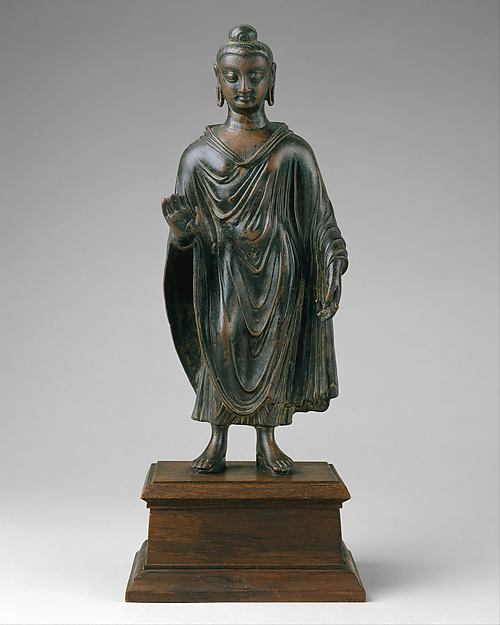
Pakistan (ancient region of Gandhara) or Afghanistan · late 6th century · Brass
Look closer: Note the robe falling in long, regular folds from shoulder to ankle. The Met catalogues this brass figure as from Gandhara or Afghanistan, late sixth century, which is to say from the last chapter of the tradition, after the collapse the Met's essay dates to the end of the fifth century.
The Metropolitan Museum of Art, New York, Gift of Muneichi Nitta, 2003, accession 2003.593.2. Public domain, Met Open Access. Museum record
Yet the style did not end. The Greco-Buddhist survey credits the Kushan king Kanishka with promoting Mahayana and its art.2 The Bimaran reliquary casket, dated to about 30 to 10 BCE by coins of Azes II, a dating that is not undisputed, figures in the debate over the earliest figurative Buddha.2 The road itself runs on: the Chinese cave temples of Dunhuang and Longmen are the subject of the next chapter.
For a Japanese collector, the question is how far the line runs. The honest answer is to cite the thesis and name the doubt: Tanabe's argument connecting Vajrapani to the Nio is one scholar's, and the house treats it as such.
Kings, Councils and a Vanished Tower
First lookGandhara keeps two memories, and they do not always agree. One is carried by the Pali chronicles, which say that Buddhism reached the region after the Third Buddhist Council at Pataliputra in the third century BCE, when a missionary named Majjhantika was sent north-west. The other is carried by the ground itself: the Wikipedia survey records that the area became part of the Mauryan empire in 321 BCE, that Taxila was the provincial capital of the north-west, and that Ashoka governed the city and ordered rock edicts there in the Kharosthi script.14
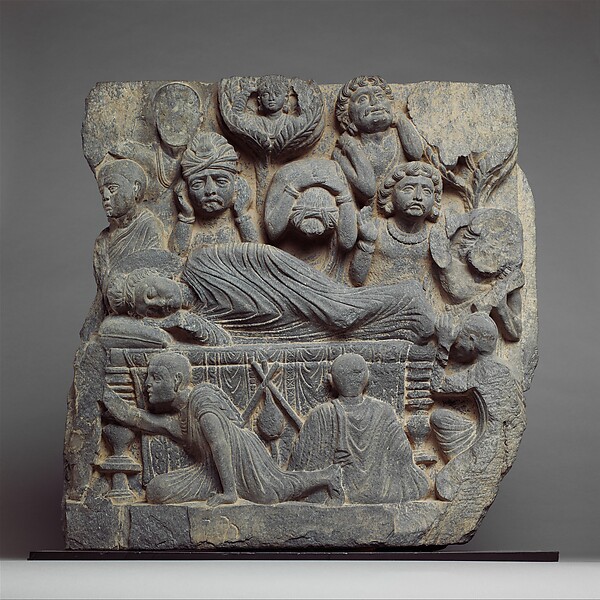
Pakistan (ancient region of Gandhara) · Kushan period · ca. 3rd century · Schist
Look closer: The Buddha lies on his right side on a couch, as the Met's title says, with mourners crowded into the register above him and figures sitting and kneeling below the couch. Notice how the relief is organised like a Roman funerary scene, yet the subject is wholly Buddhist; the Met dates the panel to about the third century and labels it Kushan period.1
The Metropolitan Museum of Art, New York, Gift of Florence and Herbert Irving, 2015, accession 2015.500.4.1. Public domain, Met Open Access. Museum record
Kharosthi is a clue to how the region worked. The survey says the script emerged under Achaemenid rule and was derived from Aramaic, and that it was deciphered in 1838 by Masson, Prinsep and Cunningham. The language written in it, Gandhari, was a Middle Indo-Aryan tongue that the same page says died out around the fourth century CE.14 A Buddhist text copied in Gandhari is therefore among the oldest that survive, and it is one more reason a reader of this wing should think of the north-west as a source and not only a waystation.
The king people remember is Kanishka. The Wikipedia article on him gives his reign as about 127 to 150 CE, with 151 in one place, and notes that older scholarship placed his accession in 78 CE as the start of the Saka era, a date historians no longer accept; Harry Falk's estimate is 127.16 His main capital was Purushapura, modern Peshawar, with Mathura as a second, and the article says he presided over a Buddhist council in Kashmir, with Vasumitra and Ashvaghosha in the chair.16 The same page treats some older claims, such as a council of five hundred monks and Chinese hostages at his court, as secondary and not firmly established.16
His monument was a tower. Archaeologists rediscovered the base of the great stupa at Peshawar in 1908 to 1909 and estimated its diameter at 87 metres, and Xuanzang, who saw it in the seventh century, reported a height of 600 to 700 Chinese feet, which the article converts to roughly 180 to 210 metres.16 Nothing of that height remains. The survey of Gandhara dates the destruction at Taxila and of the Kanishka stupa to the 460s, in the time of the Alchon Huns under Khingila, who had taken the Hindu Kush routes about 430; it names Mihirakula, around 514, as a persecutor, and says Buddhist sources report more than a thousand monasteries destroyed, a figure it does not confirm independently.14 The Met's account of the end of Gandharan art places the collapse at the close of the fifth century, after the Hun invasions.3
By the time Xuanzang passed through, about 630, the same page describes Buddhism as in decline, with Shaivism on the rise and many monasteries in ruins.14 It is a sobering corrective to the picture of a tradition that ended at a single blow. Gandhara faded in stages, and a Japanese reader meets its last chapter not in Peshawar but in the Bamiyan niches, the stucco heads of Hadda and the Chinese caves that the next chapter visits.
The Casket, the Coins and the Rabatak Stone
The connoisseur's eyeKanishka left three kinds of evidence, and each comes with a doubt attached. The first is the reliquary found in 1908 to 1909 beneath the Peshawar stupa at Shah-ji-ki-Dheri. The Wikipedia article says it is kept in the Peshawar Museum, with a copy in the British Museum, that it is dated to the first year of his reign, 127 CE, and that it was signed by a Greek artist, Agesilas. Its attribution to Kanishka is contested on stylistic grounds, because the ruler it shows is unbearded, and some scholars give it to his successor Huvishka instead.16

Pakistan (ancient region of Gandhara) · ca. 3rd–4th century · Schist
Look closer: The robe falls from the shoulders in deep, even folds and covers both arms, a drapery the Wikipedia survey compares to Roman statuary, while the hair is gathered in a topknot.2 At the left a broken piece of the halo disc survives behind the head, and the base below the feet carries a small carved scene with several figures. The Met gives the date as about the third to fourth century, in schist.
The Metropolitan Museum of Art, New York, Bequest of Adra M. Newell, 1966, accession 67.154.5. Public domain, Met Open Access. Museum record
The second is his coinage. The article says that Buddhist types are rare, under one per cent of his known coins, that they show the Buddha, Shakyamuni and Maitreya, and that only six Buddha coins are known in gold, the rest being copper.16 That is a small proportion for a king remembered as a patron of the faith, and it is a good example of why a legend and a ledger rarely match.
The third is a stone. The Rabatak inscription, in Bactrian, was discovered in 1993 and deciphered in 2000. It lists Kanishka's ancestors, among them Kujula Kadphises, Vima Taktu and Vima Kadphises, confirms that he succeeded Vima Kadphises, and records his switch from Greek to Bactrian as the language of administration.16 For the history of the Buddha image the same stone matters less than the coins, but it fixes the dynasty on which the later Gandharan style depends.
The sculpture that this royal money paid for survives in numbers. The Met's survey of the Gandharan collection stresses that more Buddhist sculpture and architecture has been found in Greater Gandhara than in any other part of ancient South Asia.4 The standing Buddha shown here, a Met schist of about the third to fourth century, shows the type in its usual form: a long robe worn over both shoulders in heavy, regular folds, a halo disc behind the head and a small scene carved on the base.
| Evidence | What it tells us | The doubt |
|---|---|---|
| Reliquary of Shah-ji-ki-Dheri | Found 1908 to 1909; dated to year one of the reign, 127 CE; signed by Agesilas16 | The unbearded ruler may be Huvishka, not Kanishka16 |
| Gold and copper coins | Buddha, Shakyamuni and Maitreya types; six gold pieces known16 | Under one per cent of known coins16 |
| Rabatak inscription | Ancestors named; Bactrian replaces Greek; found 1993, read 200016 | Its claims of conquest, including Pataliputra, rest on the inscription alone16 |
| Stupa at Peshawar | Base rediscovered 1908 to 1909; diameter about 87 metres16 | Height from Xuanzang only; figures vary by page1416 |
| Date of the reign | c. 127 to 150 or 151 CE1416 | The older 78 CE date is no longer accepted16 |
Taxila and Takht-i-Bahi on the Ground
The connoisseur's eyeA reader who visits one place should choose Taxila. UNESCO inscribed it in 1980 as a serial property of eighteen components, among them Bhir Mound, Sirkap, Sirsukh, the Dharmarajika stupa and monastery, Jaulian and Mohra Moradu.17 Alexander Cunningham rediscovered the ruins in 1863 to 1864, and John Marshall excavated them over about twenty years from 1913, a span the survey of Gandhara gives as 1912 to 1934.1417 What he found were layers of Greek, Parthian and Kushan towns one above another, and Buddhist monasteries on the hills around.14

Jaulian monastery, Taxila, Punjab, Pakistan
Look closer: Two seated Buddhas, each missing its head, sit side by side on a low base under a modern protective roof with stone walls rising behind. Look at the robes: even without heads, the long folds over the knees and the hands folded in the lap identify the type. Jaulian is one of the Buddhist components of the Taxila property.17
Photograph: Teseum. CC BY-SA 4.0, with attribution. Source: Wikimedia Commons. CC BY-SA 4.0 File record

Taxila is also the place where the legends of Alexander touch the ground. The Wikipedia article says that in 326 BCE the ruler Taxiles, called Ambhi, surrendered to Alexander without a battle, that Arrian reports he was welcomed with sacrifices and contests, and that he was kept as satrap.17 The survey of Gandhara tells the same meeting as an alliance against Porus.14 The page on the city also warns about two familiar claims. It dates the founding to about 1000 BCE but cites Neolithic remains of about 3360 BCE and Early Harappan ones of 2900 to 2600 BCE, and it records that some scholars call Taxila one of the earliest universities while others say it had no colleges or purpose-built halls in the modern sense.17 We use the older word for the monastery and leave the university question to the scholars.
Takht-i-Bahi is the best preserved of the Gandharan monasteries and is easier to read than Taxila. It stands on a hill about 150 metres high, about fifteen kilometres from Mardan in Khyber Pakhtunkhwa. The Wikipedia article says it was probably founded in the early first century CE and was used until the seventh, that an inscription naming Gondophares, who reigned 20 to 46 CE, was found there, and that UNESCO inscribed it in 1980, the same session as Taxila.15 The buildings are of local stone mortared with lime and mud and include a court of stupas, an assembly hall, rows of monastic cells around a courtyard, a dining area and a complex of small dark cells with low openings, which the article says may have been used for tantric meditation.15
Both places are open to visitors, and the pages give practical hints. Takht-i-Bahi, once remote and little visited, now has a road and a car park below the ruins and is popular with visitors, while the Taxila Museum holds a large collection of stone Buddhist sculpture of the first to the seventh century, mostly from the valley excavations, and the city is said to attract up to a million tourists a year.1517 The page gives no opening hours or fees, so check them locally and consult official travel advice before any journey, as conditions change.
| Place | What survives | Status today |
|---|---|---|
| Taxila, Pakistan | Greek, Parthian and Kushan cities; Dharmarajika stupa; Jaulian monastery1417 | UNESCO 1980 (no. 139), eighteen components; a 2026 UNESCO warning about unauthorised reconstruction at Mohra Moradu and Sirkap17 |
| Takht-i-Bahi, Pakistan | Stupa court, assembly hall, monastic cells15 | UNESCO 1980 (no. 140); restored in the 1920s15 |
| Peshawar, Pakistan | Base of the Kanishka stupa, about 87 metres across16 | Reliquary in the Peshawar Museum16 |
| Bamiyan, Afghanistan | Two niches, murals, caves56 | UNESCO 2003; on the danger list since then6 |
| Mes Aynak, Afghanistan | Monastery and settlement, 5th to 7th century18 | Under a copper concession since 200718 |
Bamiyan, Rebuilt or Remembered
The deep endThe destruction is the best documented part of the Bamiyan story, and also the most argued over. The Wikipedia article says that Mullah Omar ordered the destruction of all statues in Afghanistan on 26 February 2001, that the Taliban announced on 1 March that all statues depicting humans would be destroyed, and that work began on 2 March and went on for several weeks. Anti-aircraft guns and artillery fired for days, anti-tank mines were laid at the bases of the niches, men were lowered down the cliff to place explosives in drilled holes, and a rocket was fired at one statue after an explosion failed.6 UNESCO inscribed the valley in 2003, and the property has been on the danger list ever since.56

Bamiyan, Afghanistan. Wall painting of the 6th century CE, archival photograph, photographer undetermined
Look closer: This archival photograph records a painting of a king in the niche of the smaller Buddha, which the Commons title calls the 35-metre Buddha; the sources used here give 38 metres, a reminder that even titles disagree. The painting was made in the sixth century, and the photograph shows it as it was before 2001.6
Photograph: Painter: 6th century CEPhotographer: Undetermined. Public domain. Source: Wikimedia Commons. File record

What remains is an argument about numbers. The article gives the Eastern Buddha as 38 metres and the Western as 55, names the larger 'Salsal' and the smaller 'Shah Mama', and puts the niches themselves at 58 and 38 metres. It gives radiocarbon dates of 544 to 595 CE for the Eastern and 591 to 644 for the Western, yet the introduction offers about 570 and about 618, and Marylin Rhie argued in 2002, from style, for a third or fourth century date for the Eastern Buddha.6 The murals in the caves were carbon-dated to 438 to 980 CE, with other sources giving the fifth to ninth or the sixth to eighth century. After 2001 another fifty caves were revealed, twelve with wall paintings, and a 2008 study found drying oils in some of the murals, which would make them among the oldest oil paintings known, although the article notes that the claim sits uneasily beside the date of Theophilus Presbyter's treatise of 1100 to 1120.6

Bamiyan, Afghanistan. Murals attributed to the 7th century CE, archival photograph
Look closer: The murals of the niche of the larger Buddha showed celestial beings in the vault above the head of the statue. The article dates the murals to the fifth to ninth centuries by one study and the sixth to eighth by others; here the Commons record gives the seventh century.6
Photograph: Paintings: Unknown author 7th century CEPhotographer: undetermined. Public domain. Source: Wikimedia Commons. File record

Then comes the long argument about what to do. In 2011 a Paris meeting of experts made thirty-nine recommendations, including leaving the Western niche empty as a memorial and studying whether the Eastern Buddha might be rebuilt.6 In 2013 German ICOMOS rebuilt the foot of the smaller Buddha using iron rods, bricks and concrete, and UNESCO stopped the work because it had not approved it and it did not use original material. The article records that Japan had offered to rebuild, possibly by anastylosis, that a Swiss group and ETH Zurich had committed to the project, and that the architect Bert Praxenthaler estimated that roughly half the fragments could be reassembled. Critics say the empty niches should stay as monuments to extremism, and others that the money should go to housing and electricity.6
Two later events changed the picture. In 2015 a three-dimensional light projection of the larger Buddha's possible original appearance was installed in its niche, at a cost of about 120,000 dollars, and about 150 local people attended the unveiling.6 After the Taliban's return in 2021 tourists were again allowed to visit, preservation work stopped for a time, and UNESCO's restoration work resumed in February 2023 with new funding from the Italian government.6 The page also notes that Xuanzang described a third, larger reclining Buddha in the 630s, that no such statue has been found, and that an Indian film, Ram Setu, shows a fictional one.6
For a collector the lesson is plain. The niches are empty, the original Buddhas are gone, and the objects we can handle are the small things made in their tradition: stucco heads, schist reliefs, paintings. What Bamiyan teaches is the importance of saying exactly what a piece is, and what the evidence for its age and place actually is.
Mes Aynak: A Monastery Beneath a Mine
The deep endMes Aynak is the site where the old road and the new economy collide. It lies in Logar Province, about forty kilometres south-east of Kabul and at about 2,120 metres, and the Wikipedia article says the Buddhist settlement there flourished between the fifth and seventh centuries, declined from the eighth and was abandoned about two hundred years later. Remains may reach back to the third century BCE, and a Bronze Age layer, possibly five thousand years old and including an ancient copper smelter, lies beneath the Buddhist level.18
The reason it is endangered is in the ground. In November 2007 the China Metallurgical Group received a thirty-year lease worth three billion dollars, which the article calls the largest foreign investment and private business venture in Afghanistan's history, and it records persistent allegations that a minister of mines obstructed rival bids and took a bribe.18 The French archaeological mission DAFA, led in the field by Philippe Marquis, has worked to remove what can be carried away. The site is about forty hectares and the article gives more than 400 Buddha statues, stupas and market areas, while about 400 items were excavated between May 2010 and July 2011; the two numbers are different things and are easily confused.18
The timeline since then is one of delay and uncertainty. In June 2013 sixty-seven archaeologists and about 550 labourers were on site under 200 armed guards, with one million dollars of military funding from the United States embassy, while in June 2014 only ten international experts and fewer than twenty Afghan archaeologists remained.18 On 17 May 2020 the Taliban attacked a checkpoint near the mine, killing eight guards, and the article reports that the present government's eagerness for copper is leading to the site's destruction and not its preservation. The mine project was inaugurated on 24 July 2024 with the start of the road to the mine; the page reports no further progress.18 The copper estimate is given as about six million tons by the Afghan Mining Ministry and as 5.52 million metric tons elsewhere, units that do not compare directly, and the age of the Buddhist site is variously described as almost two thousand, two thousand and 2,600 years.18
From Boreas to Fujin, and Vajrapani to the Nio
The deep endTwo of the most startling claims in the history of Buddhist art concern guardians at Japanese temples. The first is that the muscular attendant of the Gandharan Buddha, Vajrapani, shown with the club of Herakles, is an ancestor of the paired Nio who guard temple gates in Japan. The second is that the wind god Fujin is a descendant of the Greek north wind, Boreas.219

Japan, 17th century. Pair of gold-ground screens attributed to Tawaraya Sotatsu; National Treasure
Look closer: On the gold ground the wind god Fujin at the right curves round a pale crescent, which is the bag of wind he carries over his shoulders, with ribbons streaming behind. The thunder god Raijin occupies the left screen. The Commons record gives the pair as a National Treasure of Japan, and the bag at the shoulders is the detail that Tanabe traces back through Wardo to the cloak of the Greek Boreas.19
Photograph: 俵屋宗達 (Tawaraya Sotatsu) (1570-1643). Public domain. Source: Wikimedia Commons. File record

The chain proposed for the second runs along the Silk Road. The Wikipedia article on Fujin says the iconography seems to originate in exchanges that began when Greeks held parts of Central Asia, that Boreas became Wardo, or Oado, in the Greco-Buddhist art of Bactria, that the figure then became the Chinese wind deity Feng Bo, with frescoes from the Tarim Basin cited as evidence, and that finally he became Fujin, keeping the windbag and the dishevelled appearance throughout.19 The same article admits that the link rests largely on one scholar, Katsumi Tanabe, who traces the windbag to the mantle of Boreas, that its wording is hedged, and that the section is marked as needing expansion.19 The survey of Greco-Buddhist art likewise presents Tanabe's Vajrapani and Nio argument as one scholar's view from a 2003 exhibition catalogue.2
We therefore set the pictures side by side and draw no conclusion. The Met's Gandharan relief of the first sermon, discussed earlier in this chapter, shows Vajrapani at the Buddha's side, and the screens of the wind and thunder gods attributed to Tawaraya Sotatsu show Fujin with his bag as a Japanese painter of the seventeenth century imagined him. What lies between them is a thousand years and the whole Silk Road, and the honest reading is that the resemblance is real, the route is proposed, and the proof is thin.
| Figure | Proposed ancestor | How firm |
|---|---|---|
| Vajrapani with a club | Herakles in Gandharan art2 | Widely discussed by scholars2 |
| The Nio guardians of Japan | Vajrapani, by one scholar's thesis2 | Contested; one catalogue essay2 |
| Fujin, the wind god | Wardo, from the Greek Boreas, by way of Feng Bo19 | Rests largely on one scholar; wording hedged19 |
Mathura, Hadda, Khotan and Bamiyan Compared
The connoisseur's eyeGandhara was never alone. Britannica notes that Gandhara and Mathura each developed a characteristic Buddha around the first century CE, and that scholars disagree about how much one owes to the other.1 The Met's essay on Gandharan art adds that the workshops did not stop at the old frontier: patronage continued in Afghanistan until about the eighth century, which is why the stucco heads of Hadda and the Bamiyan niches are later than the classic schist of the Kushan age.34 The table lays out the schools by material and date, using only the figures the sources give.
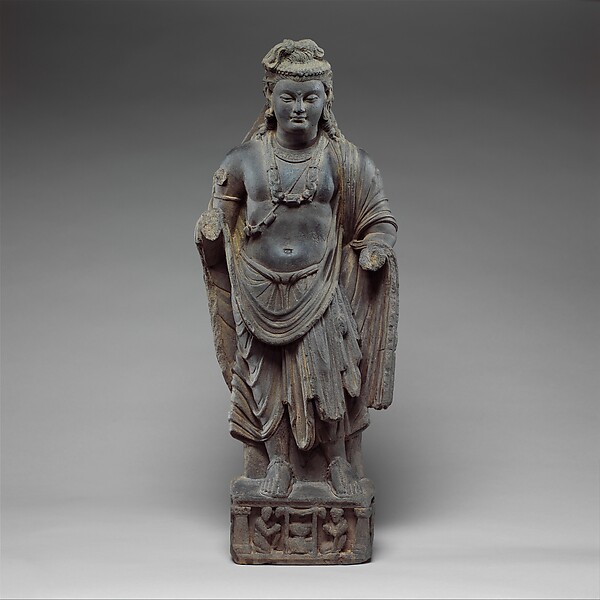
Pakistan (ancient region of Gandhara) · ca. 3rd century · Schist
Look closer: Unlike the Buddha, a bodhisattva wears jewellery: look for the heavy necklaces, the bare chest, the skirt gathered at the waist, the sandals and the elaborate topknot. The Met reads the figure as probably Maitreya, the Buddha of the future, dates it to about the third century and gives it as schist from Gandhara; the base carries a small scene of figures.1
The Metropolitan Museum of Art, New York, Rogers Fund, 1913, accession 13.96.16. Public domain, Met Open Access. Museum record
The material matters as much as the place. Schist, the grey stone of the classic Kushan figures, took a crisp edge and held deep folds. Stucco, a plaster that could be modelled while wet, took painting and gilding, and Britannica says Gandharan images were originally painted and gilded.1 In oases such as Khotan, where stone was scarce, sculptors worked in clay and stucco, as the Met's sixth to seventh century Khotan Buddha with flames at the shoulders shows.3
| School | Material and date | What to look for |
|---|---|---|
| Gandhara, Kushan age | Grey schist; from the 1st century BCE, flourishing under the Kushans1 | Deep drapery; youthful face; Hellenistic echoes12 |
| Mathura | Its own Buddha type from about the 1st century CE1 | Contested exchange with Gandhara1 |
| Hadda, Afghanistan | Stucco heads, 5th to 6th century (the Met's date for its head, probably from Hadda)4 | Painted lips and eyes; dimpled curls1 |
| Khotan | Stucco; Met's Dipankara Buddha is 6th to 7th century3 | Flames at the shoulders; pointed oval frame3 |
| Bamiyan | Rock-cut and plastered; carbon dates 544 to 644 CE6 | Niches of 38 and 55 metres; painted vaults6 |
A Short Glossary for the North-West
The connoisseur's eyeWords the chapter uses, with the Japanese form where there is one.
| Term | Meaning |
|---|---|
| Gandhara | The ancient region of the Peshawar Valley and its surroundings, in north-west Pakistan and eastern Afghanistan14 |
| Greater Gandhara | A wider cultural sphere reaching Bamyan, Kashmir and the Jhelum, a term used by scholars such as Richard Salomon14 |
| Kharosthi | The script of the north-west, derived from Aramaic and used for Gandhari14 |
| Gandhari | A Middle Indo-Aryan language written in Kharosthi; extinct by about the 4th century CE14 |
| Kushan | The dynasty under which Gandharan art flourished; Kanishka is its best known king116 |
| Schist | The grey-blue stone of the classic Gandharan figures1 |
| Stucco | Modelled plaster, used increasingly after the 3rd century and painted and gilded1 |
| Anastylosis | Reassembly of a monument from its original fragments; the method discussed for Bamiyan6 |
| Purushapura | Ancient Peshawar, a Kushan capital16 |
| Wardo (Oado) | The wind deity of Bactrian Greco-Buddhist art, proposed as a descendant of Boreas19 |
| Feng Bo | The Chinese wind deity in the proposed chain to Fujin19 |
| Nio (Niō) | The paired guardians of Japanese temple gates; one thesis links them to Vajrapani2 |
| Stupa | The relic mound that became the pagoda in East Asia (see chapter 3) |
| Vihara | A monastery; Takht-i-Bahi is the best preserved in Gandhara15 |
A Collector's Eye on Gandharan Style
The connoisseur's eyeThe first rule is to treat Gandhara as a manner, not a postcode. A piece described as Gandhara-style tells you that its drapery, face and format follow the northwestern school; it says nothing about when or where it was carved. The house uses that wording for exactly this reason, and its page on the ethics of collecting religious objects sets out what a careful description can and cannot claim.12
The second rule is to read the material. Grey schist suggests the classic Kushan figures, while stucco and clay point to Afghanistan and the oases of Central Asia, where sculptors worked in plaster and paint.13 Look for the traces: red on the lips and eyelids of the Hadda head the Met catalogues, or flaking gilt, are what survive of a painted surface.1
The third is to compare, using a museum as the yardstick. The Met's Gandharan reliefs and figures cited in this chapter, such as the Parinirvana panel, the standing Buddha, the Maitreya and the Hadda head, give four reference points of known date and region against which a candidate piece can be set. Where a piece differs in robe, face or base, the difference is itself information.34
For a first object, a small schist or stucco head, or a relief panel, is the usual starting point. A buyer should expect to be told plainly that the piece is of the style and has no secure findspot, because the great majority of Gandharan pieces on the market have none.
Gandhara-Style Pieces in the House
The house keeps a small group of grey schist Buddha heads and reliefs catalogued as Gandhara-style or Kushan-era-style. The word style matters. It describes the manner of the piece and makes no claim about when or where it was carved, and the house's page on the ethics of collecting religious objects sets out how it treats such questions.12
The strip below fills from the live catalogue on the day you read this. Each piece has its own page with photographs, measurements and condition notes.
Pieces in the house now
- Buddhist Statues and Sacred ArtWhere the Gandhara-style pieces are shelved
- Gandhara in the reference libraryA short entry on the style
Filter by what you have just read
Answered plainly
Why do Gandharan Buddhas look Greek or Roman?
Because sculptors worked in a Hellenistic-influenced idiom: Britannica notes a youthful, Apollo-like face and drapery like that of Roman imperial statues, over an Indian iconography.1
Did Gandhara invent the Buddha image?
Not on its own. Gandhara and Mathura each developed a characteristic Buddha around the first century CE, and scholars disagree about the balance of influence.1
How big were the Bamiyan Buddhas?
The Western Buddha was 55 metres tall and the Eastern 38 metres. Both were destroyed in March 2001.56
Did the White Horse Temple story happen?
Tradition dates the temple to 68 CE, but it is not recorded before 289, and most modern scholars regard the founding story as a fable.9
How does Gandhara connect to Japan?
Through China and Korea, in the long transmission of the Buddha image. One scholar, Katsumi Tanabe, goes further and traces Vajrapani to Japan's Nio guardians, a thesis that is contested.2
Who was Kanishka?
A Kushan king who ruled about 127 to 150 CE, with Peshawar as his main capital; the older date of 78 CE for his accession is no longer accepted.16
What is the Kanishka casket?
A reliquary found in 1908 to 1909 at Shah-ji-ki-Dheri, now in the Peshawar Museum with a copy in the British Museum; dated to 127 CE and signed by the Greek artist Agesilas, though its attribution to Kanishka is disputed.16
Is Taxila a World Heritage Site?
Yes, inscribed in 1980 with eighteen components; in 2026 UNESCO warned Pakistan that unauthorised reconstruction at Mohra Moradu and Sirkap could lead to an inscription on the danger list.17
Was Taxila a university?
Some scholars call it one of the earliest, while others say it had no colleges or purpose-built halls in the modern sense.17
How old is Takht-i-Bahi?
Probably founded in the early first century CE and used until the seventh; an inscription of Gondophares (20 to 46 CE) was found there.15
When were the Bamiyan Buddhas destroyed?
Mullah Omar ordered the destruction of all statues on 26 February 2001, and the work began on 2 March and lasted several weeks.6
Can the Bamiyan Buddhas be rebuilt?
It is debated. Anastylosis could reassemble perhaps half the fragments by one estimate, but a 2011 expert meeting recommended leaving the Western niche empty as a memorial, and UNESCO stopped a 2013 partial rebuild.6
Are the Bamiyan murals the oldest oil paintings?
A 2008 study found drying oils in some murals, but the claim sits uneasily with a European treatise of 1100 to 1120 and is treated as unsettled.6
What is happening at Mes Aynak?
A Buddhist monastery site of the fifth to seventh century lies over a copper deposit leased to a Chinese company in 2007; the mine road was inaugurated on 24 July 2024.18
Is the wind god Fujin really Greek?
One scholar, Katsumi Tanabe, traces Fujin through Wardo and the Chinese Feng Bo to the Greek Boreas, but the evidence is thin and the claim is hedged.19
Where next
Sources and image credits
- Encyclopaedia Britannica, Gandhara art Dates, region, materials, Greco-Roman character, Mathura.
- Wikipedia, Greco-Buddhist art Foucher, Hellenistic traits, Vajrapani, Tanabe, Bimaran casket, aniconic to figurative.
- The Metropolitan Museum of Art, Buddhism along the Silk Road (Kurt Behrendt, 2012) The collapse of Gandharan centres after the Hun invasions.
- The Metropolitan Museum of Art, The Art of Gandhara in the Metropolitan Museum of Art (Kurt Behrendt, 2007) Region, chronology, extent of surviving sculpture.
- UNESCO World Heritage Centre, Cultural Landscape and Archaeological Remains of the Bamiyan Valley Serial property, niches, criteria, destruction.
- Wikipedia, Buddhas of Bamiyan Dimensions, radiocarbon dates, Xuanzang's visit, murals, destruction, Japanese participation.
- Wikipedia, Faxian Journey of 399 to 412 and the Record of the Buddhist Kingdoms.
- Wikipedia, Xuanzang Pilgrimage of 629 to 645.
- Wikipedia, White Horse Temple Tradition and scholarly caveats.
- Wikipedia, Mahayana Lokaksema of Gandhara.
- Wikipedia, Kumarajiva Life and translations.
- Japonista, The ethics of collecting religious objects How the house describes style and provenance.
- Wikipedia, Dharmarajika Stupa Builder, dates, later additions and condition of the Taxila stupa.
- Wikipedia, Gandhara Geography, rulers, Kharosthi and Gandhari, Huns, Chinese pilgrims, archaeology.
- Wikipedia, Takht-i-Bahi Founding, structure, UNESCO 1980, restoration.
- Wikipedia, Kanishka Reign dates, council, casket, coins, Rabatak, stupa.
- Wikipedia, Taxila UNESCO 1980, excavations, Alexander, threats, 2026 warning.
- Wikipedia, Mes Aynak Location, dates, copper lease, rescue archaeology, 2024 road.
- Wikipedia, Fujin Boreas, Wardo, Feng Bo and Fujin; Tanabe thesis.
Last reviewed 28 October 2026. Dates in this chapter follow the cited pages; where the sources disagree, the chapter says so. Every picture is public-domain or openly licensed, and its credit and licence stand beneath it.
If a Gandhara-style head or relief has caught your eye, the concierge desk will search Japan on your behalf.
Private concierge
Looking for something in particular?
Describe the piece or the project you have in mind. A senior advisor in Tokyo reads every case file personally and replies within two business days, with fees set out in writing before any work begins.