
Niō: The Gate Guardians
Guardians at the Gate
Niō
仁王
Two bare-chested giants, one with the mouth open and one with it closed, who stand either side of a temple gate and whose ancestry runs back to the Greek hero Heracles.
Identity card
Know the figure at a glance
- A furious face. Fierce faces, bulging eyes and a threatening pose, meant to ward off evil spirits (JAANUS).
- A bare torso. Most are bare-chested and muscular, though the earliest examples wear chest armour (JAANUS).
- The vajra. Agyō holds a vajra, the thunderbolt-sceptre (JAANUS). The diagram draws this figure.
- The raised hand. The Met's pair show one hand raised open and another pointing upward, as in a guard on the alert.
- On rock. Both Met figures stand on a rough rock base.
Two kings at the gate
The Japan Architecture and Art Net Users System (JAANUS) defines the Niō as paired temple guardians who stand on either side of a gate. The name is written 仁王, and also 二王, and is glossed as the two kings, or the benevolent kings. They have fierce faces, bulging eyes, muscular bodies and threatening poses, all meant to ward off evil spirits. Most are bare-chested, though the earliest examples wear armour on the chest.
They share their names with a larger deity. They are called Kongō rikishi and Misshaku rikishi, understood by JAANUS as two aspects of the deity Misshaku kongō, and they are iconographically linked to Shukongōshin, a rarer single figure. JAANUS records that scholars disagree about who the Niō are, and no one view dominates.
The pair are among the few sacred figures that most visitors to Japan meet before they have decided to look at anything. They stand in the open air of the gate, under a roof but outside the hall, and the visitor walks between them. The Nippon.com summary of the subject says that they mark a temple as the place where the Buddha is enshrined, that each wears only a skirtlike mo around the waist and has a bare, muscular torso, and that one hand holds a vajra, the ancient weapon used against evil, which legend says gives them command of thunderbolts.
The Cleveland Museum of Art, which owns a pair of Kamakura-period guardian kings, gives the shortest version of the idea in its own record: wrathful protectors of Buddhism who would once have stood on either side of the main entrance gate of a temple. This chapter follows that idea from a Greek hero on a Gandharan relief to the giant straw sandals hung at a gate in Tokyo.
The sounds of A and Un
In the pair, one figure opens his mouth in the form called agyō, sounding the first syllable, and holds a vajra. The other closes his mouth in the form called ungyō, sounding the last, and holds a large sword (JAANUS). Buddhistdoor names them: Misshaku, also called Agyō, on the left with an open mouth, and Naraen, also called Ungyō, on the right with closed lips.
Armour varies. Buddhistdoor says some wear armour over the whole body and some over the lower body only, and that when bare-chested the torsos are lean and muscular.
Which figure stands on which side is not as fixed as guidebooks suggest. The Nippon.com summary says that Agyō usually stands on the right and Ungyō on the left, but that at Tōdaiji in Nara and at Zenkōji in Nagano the positions are reversed. The English Wikipedia article on the subject, which follows the Chinese naming, places the open-mouthed Guhyapāda on the right, holding a vajra mallet and baring his teeth, and the closed-mouthed Nārāyaṇa on the left, bare-handed or with a sword. The Chinese names are Mìjī Jīngāng and Nàluōyán Jīngāng, or the Generals Ha and Heng, and the Japanese are Agyō and Ungyō.
The meaning of the two mouths has an old explanation and a doubtful one. The old explanation, given by the Cleveland record and by Nippon.com, is that 'a' is the first sound of Sanskrit and 'un' (the Sanskrit hūṃ) the last, so that together they stand for the beginning and end of all things: life and death, or all creation. Nippon.com adds that many researchers believe this reading was developed later, and the Wikipedia article calls the popular form of it, that people are born saying 'a' and die saying 'hūṃ', a supposed belief. The two sounds also combine into the syllable om (Wikipedia). The reading is a good one for a gate, and a visitor can hold it lightly.
| Figure | Mouth | Name | Held object (JAANUS) |
|---|---|---|---|
| Agyō | Open, sounding 'a' | Misshaku | A vajra (kongōsho) |
| Ungyō | Closed, sounding 'un' | Naraen | A large sword |
From Gandhara to the gate
Buddhistdoor traces the Niō to the Sanskrit Vajradharas, the wielders of the thunderbolt, and to Vajrapani, the vajra-wielding deity whose epithet Shukongōshin names the Niō's split emanations. The most common scholarly theory is that Vajrapani first protected the historical Buddha. In second-century Gandhara, in modern northern Pakistan and Afghanistan, he appears as a bodyguard. He may have been modelled on the Greek Heracles, whose club he resembles, and some scholars suggest Zeus instead, because of the thunderbolt. The Niō sometimes carry clubs.
A second theory links Shukongōshin to Devadatta, the Buddha's cousin and later rival, who served as an impulsive bodyguard with a club before trying to kill him. Buddhistdoor reports that critics see this as a problem, while others note that the Buddha prophesied that Devadatta would become a Buddha.
The pairing itself was probably influenced by the Indian dvarapalas, fierce gate guardians placed in pairs at Hindu and Buddhist temples. They may derive from yakshas and from deities such as Acala. Indra, whose thunderbolt became the vajra, began as a gate-guardian yaksha. Buddhistdoor lists the Niō among the ten-bu, Hindu deities converted into protectors of the Buddhas, who are mortal and subject to rebirth but live far longer than humans.
Two features of this ancestry are worth separating. The first is the single figure. Nippon.com says the Niō were originally a single god protecting the historical Buddha Shakyamuni, who later split into two forms, and that their present forms are thought to have been settled in the Heian period (794 to 1185) with production at its height in the Kamakura period (1185 to 1333). The second is the idea of guarding a gate in pairs, which the Wikipedia article ties to a long list of parallels, among them the Indian doorkeepers Jaya and Vijaya, the Chinese Ox-Head and Horse-Face, the door gods, the Roman Janus and the twin Castor and Pollux.
A club-bearer from Gandhara
The Wikipedia article on Vajrapāṇi tells the oldest part of the story. As Buddhism spread into Central Asia and blended with Hellenistic influence into what is called Greco-Buddhism, the Greek hero Heracles was adopted to represent Vajrapāṇi. He was typically shown as a hairy, muscular athlete with a short club, which the article calls a diamond club. It lists reliefs from Gandhara of Vajrapāṇi with a Heraklean club and of Hercules and the Nemean lion of the first century. The article also records that some authors argue the figure may be Zeus, whose classical attribute is the thunderbolt, and it presents that as the view of particular authors and not as a settled identification.
The Cleveland Museum of Art says the same thing from the object. Its record for a bronze Vajrapāṇi of the 700s says that the name means 'he who holds the thunderbolt' and that Buddhists adopted him as a protector not only in India and the Himalayan regions of Nepal and Tibet but also in the art of China, Korea and Japan. The attributes of thunderbolt and club, the record continues, were derived from images of Zeus and Hercules that travellers from the Mediterranean world brought to the region as early as the 320s BC. The bronze itself sits on a pedestal in the form of a rocky mountain populated with wild lions and has tamed poisonous snakes as ornaments.
Cleveland's schist Winged Atlas-Hercules of the 200s CE shows how mixed the borrowing was. In Gandharan Buddhist art the figure of Atlas was adopted but given wings so as to appear superhuman; this figure has been conflated with Hercules, who wears the skin of the Nemean lion, and repeated images of such figures surrounded the base of the stupas as titans supporting the sky. Other examples hold a thunderbolt, which suggests an allusion to Vajrapāṇi, and the record says that images of Vajrapāṇi can combine the attributes of Hercules, Zeus and Hermes.
What Vajrapāṇi does in these early scenes is guard. The Wikipedia article says that in early legends he is a minor deity who accompanied Gautama during his years as a wandering mendicant, and that in Gandharan art he appears where the Buddha converts people or confronts opponents such as Māra. In the Pali Ambaṭṭha Sutta he stands above the Buddha's head, ready to split the head of the Brahmin Ambaṭṭha if he will not answer. The Metropolitan Museum's second-century schist relief shows Vajrapāṇi attending the Buddha at his first sermon. The Met's record gives its title and no description, and the figure that is Vajrapāṇi is not marked in the relief itself, so this page does not point to one.
The same article adds that some texts identify Vajrapāṇi with Śakra, and that Buddhaghoṣa associated him with Indra. That connects the Niō to the king of the gods in the chapter on Bonten and Taishakuten, whose thunderbolt is the same implement. The Wikipedia article also notes that the claim that Vajrapāṇi is the oldest and most powerful Mahayana figure carries a citation-needed tag, and this page does not repeat it as fact.
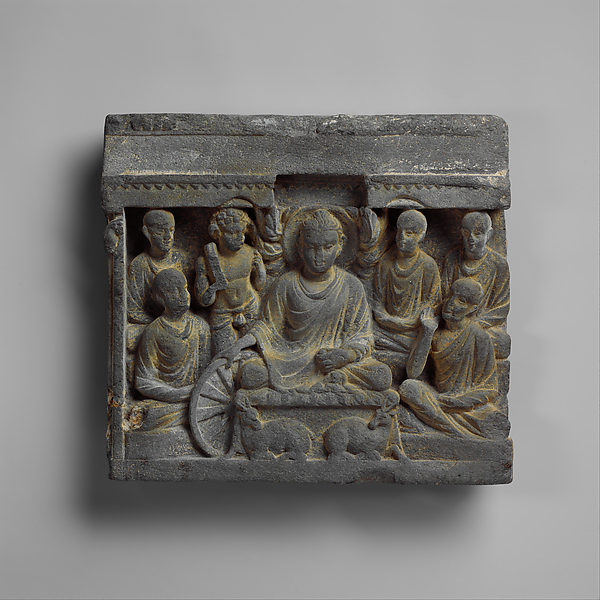
Pakistan (ancient region of Gandhara), ca. 2nd century. Schist; 28.6 cm. Metropolitan Museum of Art, 1980.527.4.
Look closer: Note the wheel at the lower left, the sign of the first sermon, and the attendants who crowd round the seated Buddha: the Met's title names Vajrapāṇi among them.
The Metropolitan Museum of Art, Gift of Daniel Slott, 1980. Open Access.
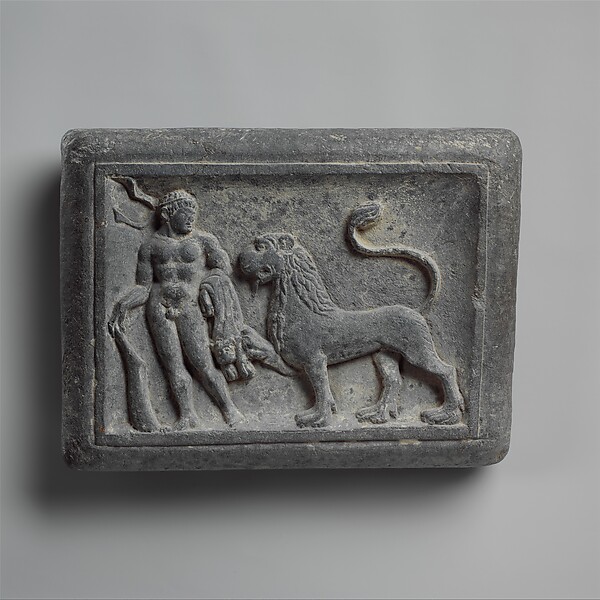
Pakistan (ancient region of Gandhara), ca. 1st century. Schist; 26 x 34.9 cm. Metropolitan Museum of Art, 1994.112.
Look closer: Note the naked athlete and the lion beside him: the hero whom Gandharan artists lent to the Buddha's thunderbolt-bearer.
The Metropolitan Museum of Art, Purchase, Florence and Herbert Irving Gift, 1994. Open Access.
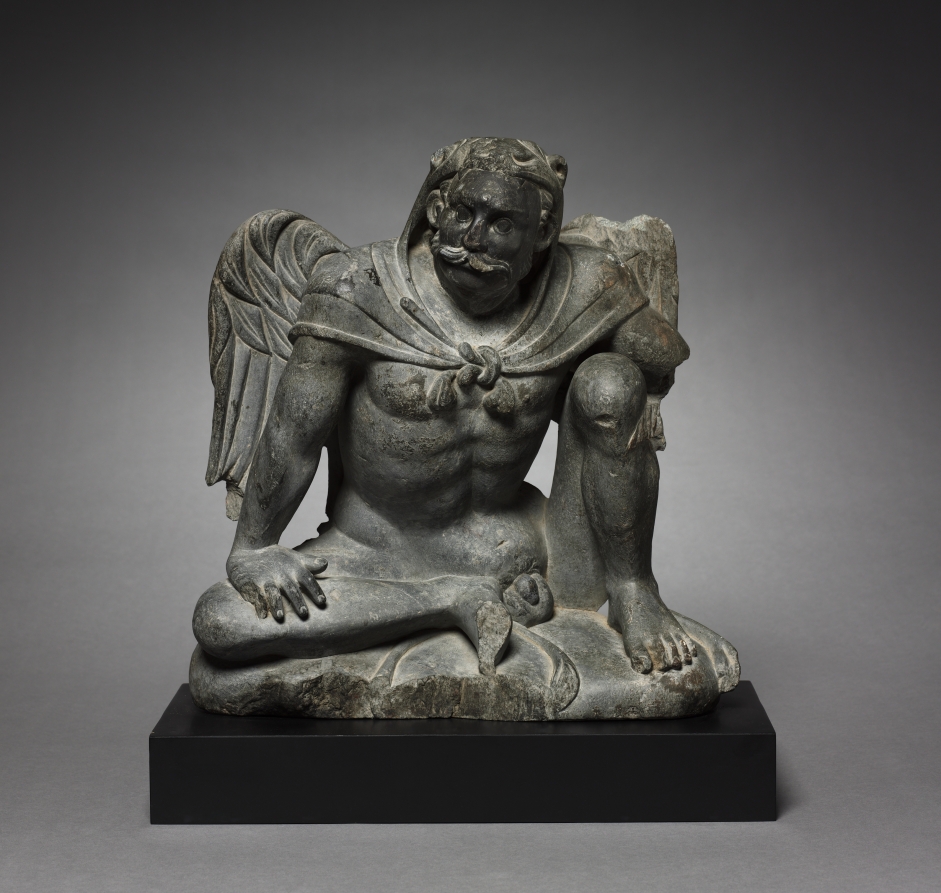
Pakistan, Gandhara, Gandhara period, 200s CE. Schist; 38.1 cm. Cleveland Museum of Art, 2011.136.
Look closer: Note the lion skin knotted at the neck and the heavy shoulders under a pair of wings: Atlas and Hercules fused into one titan.
Cleveland Museum of Art, Gift of Maxeen and John Flower in honor of Dr. Stanislaw Czuma. Open Access (CC0).
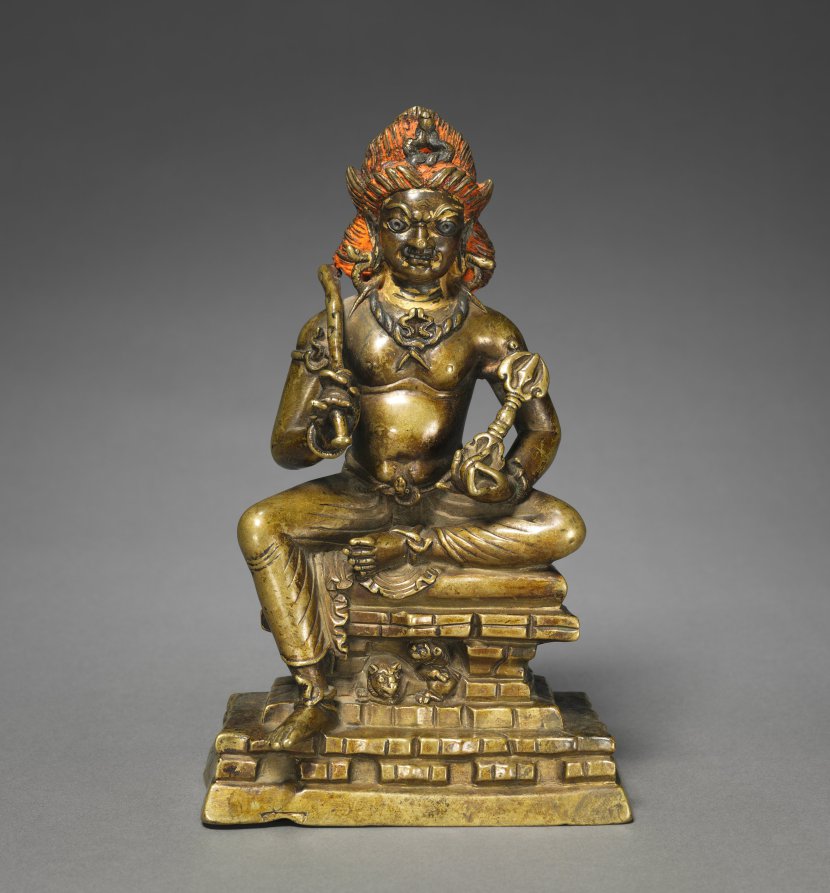
India, Kashmir, 700s. Bronze with silver overlay and gum tempera; 22 cm. Cleveland Museum of Art, 1971.14.
Look closer: Note the flaming hair, the vajra in the raised hand and the rocky seat with lions beneath: the thunderbolt-bearer in his Kashmiri form.
Cleveland Museum of Art, Purchase from the J. H. Wade Fund. Open Access (CC0).
A copper panel to a gate of timber
JAANUS says that vajra-holding protectors of the Buddha appear in India and China, with huge rock-cut examples at Longmen and Yungang. In Japan the oldest Kongō rikishi are on the right and left corners of a copper panel of the Hakuhō period at Hasedera, a late seventh-century work. The oldest sculptures made for a gate are the clay figures of the Chūmon at Hōryūji, dated 711, which are nude.
In the Nara period, dry-lacquer armoured figures were set on the altar of the Hokkedō at Tōdaiji, the hall popularly called the Sangatsudō. The best known of all is the pair at the Nandaimon, the great south gate of Tōdaiji, by the sculptors Unkei (died 1223) and Kaikei. JAANUS gives the date as 1203 in one entry and 1207 in another, and Buddhistdoor gives 1203.
The best-documented of all Japanese gate guardians are the pair at the Nandaimon, the great south gate of Tōdaiji, and they are given their own section below. Before them, JAANUS and the temple's own records show a line of earlier images that already included both the nude and the armoured type. The Hōryūji pair is nude, the Tōdaiji Hokkedō figures are armoured and made in dry lacquer, and the Hasedera panel is a sheet of copper. Copper, clay and dry lacquer all appear between the late seventh and the eighth century, a sign of how quickly the type took hold.
| Date | Work |
|---|---|
| Late 7th century | Copper panel at Hasedera with the oldest Japanese Kongō rikishi (JAANUS, Buddhistdoor) |
| 711 | Clay guardians at the Chūmon of Hōryūji, nude (JAANUS) |
| 8th century | Dry-lacquer armoured figures on the altar of the Hokkedō, Tōdaiji (JAANUS) |
| 1203 or 1207 | The Nandaimon pair at Tōdaiji by Unkei and Kaikei (JAANUS, Buddhistdoor) |
Sixty-nine days at Tōdaiji
The Tōdaiji temple site describes the Nandaimon as the temple's main gate and a National Treasure of the twelfth century. The first gate of the Nara period was destroyed by a typhoon in the Heian period; the present gate was built in the Kamakura period in the 'Daibutsu style' introduced by the monk Chōgen. The ridgepole was raised in 1199 and the gate was completed in 1203 with the two Niō. It is five bays wide and two deep, with a double hip-and-gable roof, and the temple records eighteen giant pillars of 19.058 metres and a height of 25.46 metres above the stone plinth. The temple says it was burned in 1180, and that Chōgen sought support from Minamoto no Yoritomo and the court for the rebuilding.
The two guardians are each, according to the temple, just over 8.4 metres tall and are National Treasures of the thirteenth century. The temple says they are said to have been sculpted in sixty-nine days under Unkei and Kaikei, and names four sculptors in the restoration records: Unkei, Kaikei, Jōkaku and Unkei's eldest son Tankei. A five-year restoration began in 1988, and documents and sutras were found inside the statues, among them a copy of the Hōkyōin darani-kyō naming Chōgen and the sculptors. The records give the work's start as the twenty-fourth day of the seventh month of 1203, the raising of the open-mouthed statue on the seventh day of the eighth month, and the placing of the sutra copy inside the closed-mouth statue the next day. The timber, the temple notes, came from what is now Yamaguchi Prefecture.
The English Wikipedia article on Unkei describes the same pair as the product of the yosegi technique, in which separately carved pieces of wood are joined, and has Unkei working with Kaikei, two other master sculptors and sixteen assistants. It says the team finished the figures in seventy-two days, and gives the height as about twenty-six feet. The same article describes Unkei (about 1150 to 1223) as the most distinguished member of the Kei school of Kamakura-period sculptors, whose Tōdaiji figures show a new realism compared with the work of his father Kōkei, and who after the Kōfukuji commissions of about 1208 to 1212 moved the school's headquarters to Kyoto.
The pair is also one of the two, according to Nippon.com, that reverse the usual sides: at Tōdaiji and at Zenkōji in Nagano the open-mouthed Agyō stands on the other side from the one the rule gives it.
The one who carries the vajra over his shoulder
Shukongōshin appears rarely in Japan, JAANUS notes, and is shown in armour, a single figure bearing a single-pointed vajra. The Nara-period image in the Hokkedō at Tōdaiji is particularly famous, and legend ascribes to it magical powers.
Buddhistdoor adds the story. A ninth-century collection of Japanese Buddhist tales and a fifteenth-century handscroll, the Shukongōshin engi emaki, tell how the deity helped the priest Rōben (689 to 773), second patriarch of the Kegon school, to build Tōdaiji. The statue holds a single-pronged vajra over its shoulder, and Buddhistdoor describes it as a clay statue of the eighth century.
Wikipedia's article on Vajrapāṇi records the same figure under his Chinese name Zhíjīngāng shén, 'the vajra-holding god', and gives the Japanese on'yomi reading Shukongōshin. It also says that he is associated with Acala, the Fudō Myōō of the Wisdom Kings, and that in the Womb Realm mandala his enclosure contains twenty forms of Vajrapāṇi under Vajrasattva. In Japanese iconography, the same article says, he is shown in red at the Buddha's death. The article cites Tanabe for the view that the Gandharan Vajrapāṇi, transformed in Central Asia and China, influenced the wrestler-like Niō statues, and presents it as an argument, not a settled fact.
Muscle for a warrior age
Nippon.com gives the usual explanation for the fashion. The historian Ichisaka Tarō, in a 2009 book on the Niō, is reported there as arguing that the guardians' powerful image suited the rising samurai clans of the Kamakura period, and that war-weary people also favoured the realistic statues. The Met's early fourteenth-century pair and Cleveland's thirteenth-century pair belong to that world of strong bodies and hard faces, where in each pair the ribs show under the skin and the image of a guardian at the gate is an image of readiness.
The chapter on Bishamonten treats the armoured king who guards inside the hall; the Niō are his outdoor counterpart. They do not wear armour, and the Nippon.com article says they wear only the waist cloth. JAANUS says most are bare-chested though the earliest examples wear chest armour, and the same entry gives the nude figures of the Hōryūji Chūmon, dated 711, as the oldest made for a gate. The record is mixed, and this page does not claim a single line of development from armour to nakedness.
Sandals, measles and a joke about wind
Nippon.com records that in the Edo period (1603 to 1868) people believed that worshipping the Niō brought good health and sturdy legs, which made them popular with ordinary people. The article describes a custom called matakuguri, in which a child passed between the legs of a Niō was believed to have measles or smallpox symptoms made mild. It adds that the Edo period saw many deaths from those epidemics and that the ritual is still performed for children's health.
The same legs gave rise to the giant sandals. At Hyakusaiji in Shiga Prefecture, Nippon.com says, a pair of straw sandals about three metres long hangs at the Niōmon gate; they were originally fifty centimetres long, and new sandals are woven every ten years and dedicated to the temple. At Sensōji in Tokyo, according to a Daily Star report of 15 October 2018 on the dedication of a new pair, the sandals at the Hōzōmon gate weigh about 500 kilograms each and measure about 4.5 metres long and about 1.5 metres wide. They were made by residents of the Tateokaaramachi district of Murayama in Yamagata Prefecture, and the new pair was the eighth of its kind, made once every ten years or so. The article says the sandals are meant to show the power of the Niō statues at the gate, so that the wearer is believed to guard the temple and evil is said to flee in fear at the sight of them.
The oddest folk tale in the Nippon.com article concerns a Niō who wandered at night. Folklore, the article says, has the Niō helping with farm work, and in one tale an old woman who had passed wind asked 'Niō ka?', meaning 'Does it smell?'. A Niō wandering at night heard 'Is that Niō?' and fled, thinking she had found his hiding place. The tale is quoted here to show that the great figures of the gate could be made into village comedy as well as terror.
Generals Heng and Ha
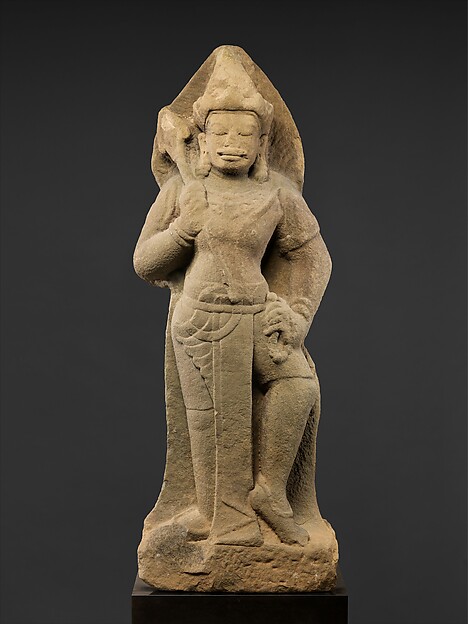
Vietnam (Champa), ca. first half of the 10th century. Stone; 128.3 cm. Metropolitan Museum of Art, 1987.478.
Look closer: Note the standing pose, the arched nimbus behind the head and the worn face: a threshold guardian in a pose far from the Japanese wrestler, from the same world of gate gods.
The Metropolitan Museum of Art, Gift of R. H. Ellsworth Ltd., in honor of Douglas Dillon, 1987. Open Access.
In China the pair are the Generals Heng and Ha, named from the two sounds. The Wikipedia article on the Niō says that in the Taoist sphere they are identified in the novel Fengshen Yanyi (chapter 99) with Zheng Lun and Chen Qi, who were appointed as the two deities, and lists their names for the Buddhist figures as Guhyapāda (Mìjī Jīngāng, General Ha) and Nārāyaṇa (Nàluōyán Jīngāng, General Heng). Guhyapāda is counted among the Twenty-Four Protective Deities of Chinese Buddhism, and is sometimes paired or identified with Ucchuṣma. Korean temples have the Inwang or Geumgang forms, and Tibetan Buddhism identifies the figure with Vajrasattva.
The most dramatic Chinese chapter of the story, from the Wikipedia article on Vajrapāṇi, is Shaolin. The article quotes Meir Shahar for the claim that Vajrapāṇi is the patron saint of the Shaolin Monastery, tells of a Tang anthology story in which the monk Sengchou (480 to 560) gains strength through prayer to him, and records a Song-dynasty stele and a stele of 1517 by the abbot Wenzai in which the vajra-club is replaced by a gun staff. It adds that the Kuomintang general Shi Yousan burned the monastery in 1928, destroying the statue of the Kinnara King, and that the shrine was re-erected in 1984. The article flags several of the stories as legendary, among them the Red Turban kitchen-worker tale, and this page treats them in the same way.
JAANUS says that vajra-holding protectors appear in India and China, with huge rock-cut examples at Longmen and Yungang. The Metropolitan Museum's Champa (Vietnam) stone figure of the first half of the tenth century, titled Standing Shiva or Temple Guardian (Dvarapala), shows the neighbouring tradition of guarding a threshold in Indian-influenced Asia. The Met's title shows the uncertainty of the identification, and the museum's record gives no description of the figure.
A Niō in the hand

Katsushika Hokusai, Japan, 18th–19th century. Ink on paper; 39.1 x 27.5 cm. Metropolitan Museum of Art, 56.121.17.
Look closer: Note the line, which makes the whole body from swirling cloth outlines: the pose of the guardian is drawn in a few turns of the brush.
The Metropolitan Museum of Art, Gift of Annette Young, in memory of her brother, Innis Young, 1956. Open Access.
The type had a second life at a much smaller scale. The Met holds an ivory Niō of the second half of the nineteenth century by Josō, only 5.4 centimetres high, in which the fierce guardian stands with one hand raised to the topknot, the belly round and the skirt flying. The small scale turns the terror of the gate into something a hand can hold, and shows how widely the image had spread.
A copper-gold-alloy sword guard of the nineteenth century in the same collection, catalogued as a tsuba depicting a guardian of the Buddha, has the other part of the fashion: the red face, the bared teeth and the flying gold scarf are set against the slot for the blade, so that the Niō glares from the guard of a sword. The drawing catalogued under Katsushika Hokusai, of ink on paper, titled Nio the Guardian and dated in the Met's record to the eighteenth or nineteenth century, shows the figure in line alone, with drapery looping around the raised arm. The Met gives no description for any of the three, and the notes here describe only what can be seen.

Josō, Japan, second half 19th century. Ivory; 5.4 cm. Metropolitan Museum of Art, 10.211.539.
Look closer: Note the raised hand, the belly and the flying skirt on a figure only 5.4 cm high: the gate guardian turned into something a hand can hold.
The Metropolitan Museum of Art, Gift of Mrs. Russell Sage, 1910. Open Access.

Japan, 19th century. Copper (suaka), gold, copper-gold alloy (shakudō); 8.9 cm. Metropolitan Museum of Art, 91.1.790.
Look closer: Note the red face with bared teeth and the gilt scarf swirling across the plate: the whole scowl fits into a hand's breadth of metal.
The Metropolitan Museum of Art, Edward C. Moore Collection, Bequest of Edward C. Moore, 1891. Open Access.
A pair from the fourteenth century
The Metropolitan Museum holds two wooden guardians of the early fourteenth century, catalogued as one of a pair. Each is 86.4 centimetres high with its base. Both are bare to the waist and stand on rough rock, in a wide stance, with a skirt that swirls around the legs.
In the first, the ribs show beneath the skin, the mouth is closed, the face scowls beneath a topknot, one hand is raised with the palm open and the other is a clenched fist. In the second, the mouth is open to show the teeth, the chest is heavy with muscle, one arm swings low and the other is raised with a finger pointing skyward. The open and closed mouths recall the pairing of agyō and ungyō, though the Met's description does not say which is which.
The Cleveland Museum of Art's Pair of Guardian Kings, of the 1200s and made of chestnut and cypress wood, is the earlier of the two sets and a useful comparison. Cleveland's record says the figures would once have stood within the sides of the main entrance gate of a temple, with one mouth open and sounding 'ah' for the beginning, or life, and the other closed and sounding 'un' for the end, or death. The figures are shown together as one view, and the ribs under the skin and the opposed raised arms are the first things the eye registers.

Japan, Kamakura period (1185–1333), 1200s. Chestnut and cypress wood; 167.9 cm. Cleveland Museum of Art, 1972.158.
Look closer: Note the ribs showing through the chest and the raised arms that mirror each other across the pair: the whole composition is built to read as two halves of one gesture.
Cleveland Museum of Art, Leonard C. Hanna Jr. Fund. Open Access (CC0).
Lion-dogs and door gods
The Niō are not the only paired guardians of a threshold. The Met's pair of Guardian Lion-Dogs of the mid-thirteenth century, in Japanese cypress with lacquer, gold leaf and colour and 42.5 and 45.7 centimetres high, are another pair of threshold guardians from the same period as the Cleveland Niō. They do not carry weapons; they sit, and their open mouths and curled manes do the work. The Met gives no description, and the pair is shown here for the habit it illustrates, which is that the Japanese temple placed guardians in twos at its limits.
The Thai stone Guardian Lion of the eleventh or early twelfth century in the Met shows the same idea in stone, and the Wikipedia list of relatives of the Niō, with Jaya and Vijaya, Janus, and Castor and Pollux, makes the point that a pair at a door is one of the oldest ideas in religious building. In Japan the pair acquired the exaggerated muscle and the opposed mouths.
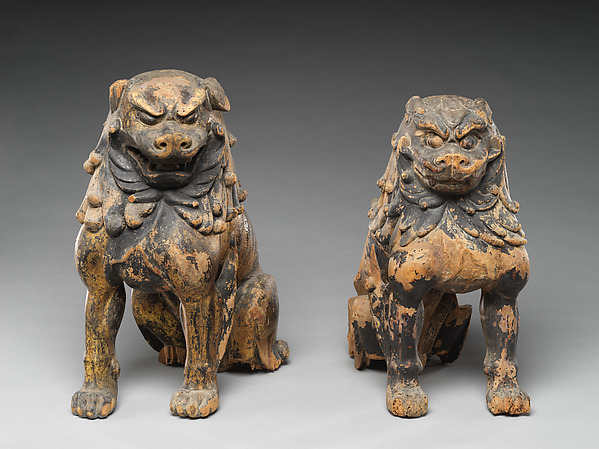
Japan, mid-13th century. Japanese cypress with lacquer, gold leaf, and color; 42.5 cm. Metropolitan Museum of Art, 2015.300.257a, b.
Look closer: Note the matching pair seated with forelegs straight and manes curled, the gilding worn away in places: the lesser guardians that sit at the same thresholds as the Niō.
The Metropolitan Museum of Art, Mary Griggs Burke Collection, Gift of the Mary and Jackson Burke Foundation, 2015. Open Access.
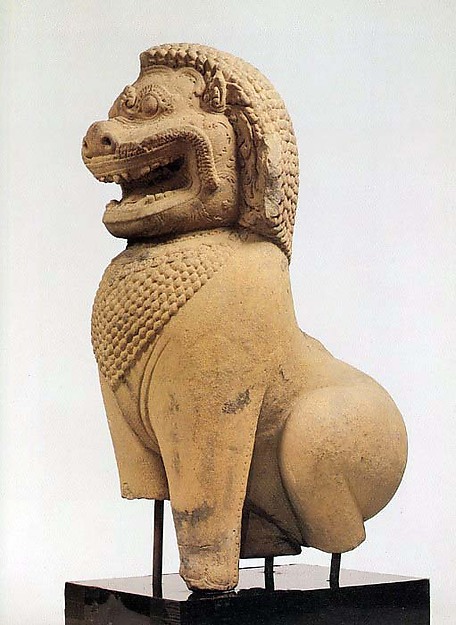
Thailand, 11th–early 12th century. Stone; 109 cm. Metropolitan Museum of Art, 1979.406.
Look closer: Note the open mouth and the curling mane carved in rows: the lion at a threshold, carved in stone.
The Metropolitan Museum of Art, Fletcher Fund, 1979. Open Access.
Niō Zen and the living gate
The Wikipedia article on the Niō records a use of the figures that is not for protecting anything. The Zen monk Suzuki Shōsan (1579 to 1655), it says, promoted what he called Niō Zen in preference to Nyorai Zen, telling practitioners to meditate on the Niō and adopt their fierce expressions and stances to build power and courage. The article marks the quotation attributed to Suzuki as needing a citation, and this page reports it as the Wikipedia article's account.
The living practice is quieter. The rituals of matakuguri and the dedicated sandals continue, and the Nippon.com article describes the changing of the sandals at Hyakusaiji as a ten-year event. At Sensōji the new pair of 2018 was, the Daily Star said, the eighth of its kind. The Tōdaiji statues were restored in the five-year project that began in 1988, which gave up the documents and sutras found inside them. Whether they are being treated again, and when, should be checked with the temple; this page has not found a current notice.
Telling a Niō from other guardians
Look at the mouths. A pair, one with the mouth open and one closed, bare-chested and muscular, standing outside the temple, is the Niō. If the figures stand inside, in armour, on small demons, at the corners of the altar, they are the Shitennō and not the Niō.
A single armoured figure with a vajra over his shoulder is Shukongōshin, and not one of the pair. A bare-chested figure with a club, as in the Gandhara images, recalls the earliest model.
A short list of questions turns the gate guardian into something a buyer can read. First, are the figures a pair, with one mouth open and one closed, or is a single one left over from a set? A single Niō without its partner has lost half its meaning. Second, which hand holds what? JAANUS gives the open mouth the vajra and the closed mouth the sword, but the Met's own pair show that carvers varied the gestures, with a raised open hand and a pointed finger in place of weapons, and a hand that has lost its weapon is not necessarily a fault. Third, how are the ribs and the muscles carved? The Kamakura manner made them hard and particular, and the later copies tend to make them soft.
Fourth, ask about scale. A Niō is an architectural figure, and the small ivories and netsuke-like pieces are another trade altogether; they should be judged as small sculpture, not as temple images. Fifth, ask about the wood and its surface: chestnut and cypress are named in the Cleveland record, and pieces that were made to stand outside have usually weathered, which is information and not a defect. The concierge desk can look for a Niō of a given size and period.
Ten small facts
- The Niō pair at the Tōdaiji Nandaimon are each just over 8.4 metres tall and are said to have been made in 69 days (Tōdaiji).
- Four sculptors are named in the restoration records of the Tōdaiji pair: Unkei, Kaikei, Jōkaku and Tankei (Tōdaiji).
- Documents and sutras were found inside the Tōdaiji Niō during the restoration that began in 1988 (Tōdaiji).
- Agyō usually stands on the right and Ungyō on the left, but at Tōdaiji and Zenkōji the sides are reversed (Nippon.com).
- The straw sandals at Sensōji's Hōzōmon gate weigh about 500 kilograms each and are renewed about every ten years (Daily Star).
- At Hyakusaiji the Niō's sandals are about three metres long and began as sandals 50 centimetres long (Nippon.com).
- Passing a child between the legs of a Niō was believed to make measles and smallpox mild, a ritual still performed (Nippon.com).
- The Greek hero Heracles was adopted in Gandhara to represent Vajrapāṇi, shown with a club (Wikipedia, Cleveland).
- Suzuki Shōsan (1579 to 1655) preached Niō Zen, meditating on the Niō's fierce stance to build courage (Wikipedia).
- A Dainichi Nyorai attributed to Unkei sold at Christie's in 2008 for 14.37 million US dollars (Wikipedia, Unkei).
Across Asia
The gate guardians crossed Asia in stages, changing dress as they went.
| Where | Form and name | What the record shows |
|---|---|---|
| India | Vajradhara; Vajrapani | Vajra-wielding protectors; the pairing probably influenced by the dvarapala gate guardians (Buddhistdoor, JAANUS). |
| Gandhara | Vajrapani as bodyguard | Second-century depictions, possibly modelled on Heracles and carrying a club (Buddhistdoor). |
| China | Rock-cut guardians | Large examples at Longmen and Yungang (JAANUS). |
| Japan | Niō; Kongō rikishi | Gate guardians from the Nara period to the present; the oldest on a Hasedera copper panel (JAANUS). |
| China | Generals Heng and Ha 哼哈二将 | The pair named from their sounds; Guhyapāda counted among the Twenty-Four Protective Deities (Wikipedia). |
| Shaolin, China | Vajrapāṇi as patron | A stele of 1517 shows the club replaced by a staff; the shrine was re-erected in 1984 after burning in 1928 (Wikipedia). |
| Korea | Inwang; Geumgang | The Korean forms of the pair at the temple gate (Wikipedia). |
| Tibet | Vajrasattva | The figure identified in Tibetan Buddhism with the Niō (Wikipedia). |
| Vietnam (Champa) | Dvarapala | A tenth-century stone threshold guardian in the Met. |
Beyond the gate
Buddhistdoor places the Niō among the ten-bu, the converted devas who protect the Buddhas. JAANUS places them in a temple's outer gates.
| Companion | Why they meet |
|---|---|
| Shukongōshin | The single armoured vajra-bearer to whom the Niō are linked (JAANUS). |
| Shitennō | Guardian kings who stand at the corners of the altar dais (JAANUS). |
| Unkei and Kaikei | Sculptors of the Nandaimon pair (JAANUS). |
Where to see them
| Place | What to look for |
|---|---|
| Nandaimon, Tōdaiji, Nara | The best-known Niō, by Unkei and Kaikei (JAANUS). |
| Chūmon, Hōryūji, Nara | Clay guardians dated 711, the oldest gate guardians (JAANUS). |
| Hokkedō (Sangatsudō), Tōdaiji, Nara | Dry-lacquer armoured figures, and the famous Shukongōshin (JAANUS). |
| Hasedera | A copper panel with the oldest Japanese Kongō rikishi (JAANUS). |
| Longmen and Yungang, China | Large rock-cut guardians (JAANUS). |
| Metropolitan Museum of Art, New York | A pair of early fourteenth-century wooden guardians, in open access. |
| Hyakusaiji, Shiga | A pair of straw sandals about three metres long at the Niōmon gate, renewed every ten years (Nippon.com). |
| Hōzōmon, Sensōji, Tokyo | Giant straw sandals of about 500 kilograms, hung at the gate and renewed about every ten years (Daily Star). |
| Zenkōji, Nagano | A pair in which the usual sides are reversed (Nippon.com). |
| Cleveland Museum of Art | A Kamakura pair of guardian kings in chestnut and cypress, and Gandharan and Kashmiri figures of Vajrapāṇi, in open access. |
A pair at the Metropolitan Museum

Japan, early 14th century. Wood; 86.4 cm high with base. Metropolitan Museum of Art, 64.292.1.
Look closer: Note the ribs under the skin, the closed mouth, and the raised open palm against the clenched fist.
The Metropolitan Museum of Art, Gift of Mr. and Mrs. Samuel Josefowitz, 1964. Open Access.

Japan, early 14th century. Wood; 86.4 cm high with base. Metropolitan Museum of Art, 64.292.2.
Look closer: Note the open mouth, the heavy muscle of the chest, and the skirt swirling around the planted legs.
The Metropolitan Museum of Art, Gift of Mr. and Mrs. Samuel Josefowitz, 1964. Open Access.
In the house
These pieces come from the house's own shelves and carry the Nio tag. The strip refills from what is available now.
A short glossary
- Niō (仁王)
- The two guardian kings of a temple gate; the name means 'two kings' or 'benevolent kings'.
- Kongō rikishi (金剛力士)
- The vajra-bearing strongmen, the other name for the pair.
- Agyō (阿形)
- The figure with the mouth open, sounding the first sound, 'a'.
- Ungyō (吽形)
- The figure with the mouth closed, sounding the last sound, 'un'.
- Shukongōshin (執金剛神)
- The single armoured vajra-bearer, the Japanese reading of Vajrapāṇi's Chinese name.
- Vajrapāṇi
- 'He who holds the thunderbolt', the Buddha's protector from whom the Niō descend.
- Vajra (金剛杵)
- The thunderbolt sceptre held by the open-mouthed guardian.
- Niōmon (仁王門)
- A gate with a Niō on either side.
- Mo (裳)
- The skirtlike waist cloth of the guardians.
- Matakuguri (股潜り)
- Passing a child between a Niō's legs to ward off disease.
- Yosegi (寄木)
- The joined-block technique of Kamakura sculpture, used for the Tōdaiji pair.
- Dvārapāla
- The Indian door-guardian, the ancestor of the idea of the gate pair.
- Heng and Ha (哼哈)
- The Chinese Generals named from the closed- and open-mouthed sounds.
- Kamakura period (1185–1333)
- The age when the muscular guardians were most produced.
- Waraji (草鞋)
- A straw sandal; the giant ones are hung at gates as the guardian's footwear.
Answered plainly
What are the Niō?
Paired fierce guardians who stand either side of a temple gate (JAANUS).
Why is one mouth open and one closed?
They sound 'a' and 'un', and Buddhistdoor says the sounds assure protection from heaven to hell and from the beginning of time to its end.
What do they hold?
Agyō a vajra and Ungyō a large sword (JAANUS).
Where are the best-known Niō?
At the Nandaimon of Tōdaiji, by Unkei and Kaikei (JAANUS).
What is the oldest gate guardian in Japan?
The clay figures of the Chūmon at Hōryūji, dated 711 (JAANUS).
Who is Shukongōshin?
A rare single armoured vajra-bearer, iconographically linked to the Niō (JAANUS).
Who made the Niō at Tōdaiji?
The temple names Unkei, Kaikei, Jōkaku and Unkei's eldest son Tankei in its restoration records; the work was completed in 1203 (Tōdaiji).
How tall are the Tōdaiji Niō?
The temple says just over 8.4 metres; the English Wikipedia article on Unkei gives about 26 feet.
Why are there giant straw sandals at some gates?
At Sensōji the sandals are said to show the power of the Niō, so that the wearer is believed to guard the temple, and they are renewed about every ten years; Hyakusaiji hangs a pair too (Daily Star, Nippon.com).
Are the Niō related to the Greek hero Heracles?
Gandharan Buddhist art gave Vajrapāṇi the club and lion-skin of Heracles, according to Wikipedia and the Cleveland Museum, and the Niō are a late Japanese descendant of that figure.
Do the Niō stand on the same sides at every gate?
No. Agyō usually stands on the right and Ungyō on the left, but Tōdaiji and Zenkōji reverse them (Nippon.com).
Where next
Sources and image credits
- JAANUS, Kongō rikishi 金剛力士 (Columbia University)
- JAANUS, Niō 仁王 (Columbia University)
- Buddhistdoor, They who guard the gate: the propagation of kongōrikishi iconography
- Metropolitan Museum of Art, Temple Guardian (Nio, one of a pair) 64.292.1
- Metropolitan Museum of Art, Temple Guardian (Nio, one of a pair) 64.292.2
- Tōdaiji, Nandaimon (Great South Gate) and the Two Niō
- Wikipedia, Nio (Buddhism)
- Wikipedia, Vajrapani
- Wikipedia, Unkei
- Nippon.com, Niō: the guardians at the temple gates
- The Daily Star, 500-kg sandals headed for Tokyo's Sensoji temple (15 October 2018)
- Cleveland Museum of Art, Pair of Guardian Kings (Niō) (1972.158)
- Cleveland Museum of Art, Vajrapani (1971.14)
- Cleveland Museum of Art, Winged Atlas-Hercules (2011.136)
- Metropolitan Museum of Art, Vajrapani Attends the Buddha at His First Sermon (1980.527.4)
- Metropolitan Museum of Art, Wrestler's Weight with Hercules and the Nemean Lion; Wrestling Scene (reverse) (1994.112)
- Metropolitan Museum of Art, Standing Shiva or Temple Guardian (Dvarapala) (1987.478)
- Metropolitan Museum of Art, Niō Guardian (10.211.539)
- Metropolitan Museum of Art, Sword Guard (Tsuba) Depicting Guardian of the Buddha (仁王図鐔) (91.1.790)
- Metropolitan Museum of Art, Nio the Guardian (56.121.17)
- Metropolitan Museum of Art, Guardian Lion-Dogs (2015.300.257a, b)
- Metropolitan Museum of Art, Guardian Lion (1979.406)
Last reviewed 28 October 2026. Pictures are public-domain or openly licensed, each credited beneath it. Diagrams on this page are drawn by Japonista.
Looking for a gate guardian figure or print for your home? Tell the concierge desk what you have in mind and we will search Japan for it.
Private concierge
Looking for something in particular?
Describe the piece or the project you have in mind. A senior advisor in Tokyo reads every case file personally and replies within two business days, with fees set out in writing before any work begins.