
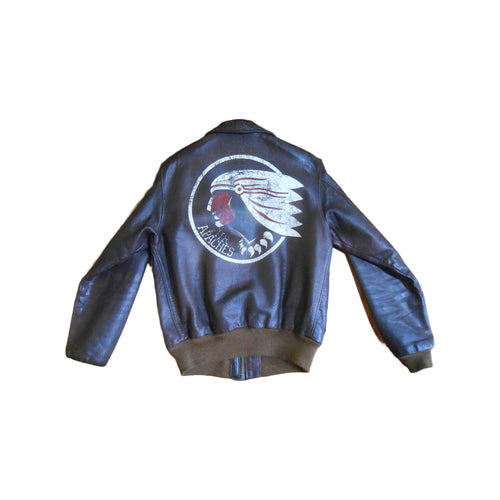


WWII Australian-Made A-2 Flight Jacket, 345th Bomb Group Air Apaches Back Paint, Goatskin, Named W.C. Perry, Size 40
WWII Australian-Made A-2 Flight Jacket, 345th Bomb Group Air Apaches Back Paint, Goatskin, Named W.C. Perry, Size 40
- Dispatch
- Prepared and sent from Tokyo within 7–14 days, often sooner, or as arranged
- Arrival
- Estados Unidos · usually 4–7 days after dispatch, insured and tracked Check the Shipping Flowchart here
- Import
Duties and customs · View the estimate
A guide for this piece: about $485, based on the 10% US charge on the declared value of goods made in Japan.
The final figure is set by US Customs and depends on where the piece was made and the kind of object it is. Many antiques over a century old carry no ordinary duty; most jewellery and leather goods add a single-digit rate.
With EMS, any charge is collected by your postal service on delivery. For pieces of significant value we can often arrange duties prepaid before dispatch.
How the estimate is reached · Ask for a figure on this piece
- Sizing
- Measured flat by hand, pit to pit and length, in centimetres · Find your size · Ask before you buy
- Character
- QuietResplendent Scoring underway ·
- Replies
- Within one Tokyo business day · Ask the curator team
- Guarantee
- Authenticity guaranteed · How we grade
Every piece is measured by hand, in centimetres as Japan measures. Please allow 1–2 cm (about ½ inch) for the give of the material and the hand that held the tape.
No se pudo cargar la disponibilidad de recogida
All sales are final. Please read our refund policy before purchase.
Considered offers only. The Desk replies personally to figures made in good faith; those set far below the asking price receive no reply.
Examined in Tokyo, one price, insured to your door. How buying from Japonista works · Join the Circle, free
A heavy goatskin A-2 attributed to Australian wartime manufacture, carrying the Air Apaches chief of the 345th Bomb Group across its back and an owner's name, W.C. Perry, stamped in red inside.
The Type A-2, 1931 to 1943
The Type A-2 was service-tested in September 1930 and made Standard for the Army Air Corps on 9 May 1931, built to specification 94-3040 with its label drawn to drawing 30-1415. The Class 13 catalogue described it in a single line: seal brown horsehide leather, knitted wristlets and waistband. Sizes ran from 32 to 54 in even numbers, and for twelve years the short, close-cut jacket with its shirt collar and snap-flap pockets was the mark of the American flyer.
By 1942 the leather was running out of favour. General Hap Arnold halted further leather contracts that year in favour of cloth flight jackets, and on 27 April 1943 the A-2 was reclassified Limited Standard. The jackets already made went on serving, and in the Pacific, where supply never quite matched demand, crews took whatever good leather they could find. That gap is where the Australian A-2 begins.
Made in Australia for Americans
Through 1942 and 1943 the Fifth Air Force fought from bases in New Guinea while its rear depots, repair centres and stores lay in Queensland. American kit reached the theatre slowly, and local manufacture filled the space: Australian-made squadron patches, insignia and, more rarely, flight jackets. On 24 June 1943 the Commonwealth of Australia Gazette recorded a contract for 'Flying jackets, for Department of U.S. Army' worth £7,252 10s 9d, awarded to Simpsons Gloves Pty Ltd of Richmond, Melbourne. Collectors connect that entry with the Australian A-2s known by the code V505.
Other Australian jackets carry a Brisbane maker's stamp and are thought to be private purchase or uncertain contract work. Little is documented about the run as a whole; collectors estimate it at perhaps up to about 3,500 jackets, and add that it may have been far fewer. What unites the surviving examples is construction rather than labels: no underarm ventilation grommets, no snaps at the collar points, a snap at the throat in place of the American hook and eye, a cotton chino-type lining, and a goatskin noticeably heavier than the hide used on most American contracts. This jacket shows every one of those features. It carries no maker's or city stamp, only its size tab, so the Australian attribution rests on that construction and remains an attribution rather than a proof.
The 345th Air Apaches
The 345th Bombardment Group (Medium) was activated at Columbia Army Air Base, South Carolina, in the autumn of 1942 and trained at Columbia and then Walterboro, where its four squadrons took the names they would carry through the war: the 498th Falcons, the 499th Bats Outa Hell, the 500th Rough Raiders and the 501st Black Panthers. The group was first earmarked for England. General George C. Kenney, commanding air forces in the South-West Pacific, asked for more B-25 Mitchells, and the 345th was sent to him instead.
It sailed in April 1943, staged through Australia and set up at Port Moresby, New Guinea, often described as the first complete USAAF combat group sent to the Pacific. The men flew their first combat mission on 30 June 1943. Under the emblem of a Native American chief in a feathered war bonnet, with the words Air Apaches, the group became one of the most recognisable units of Kenney's Fifth Air Force.
Strafers over Rabaul and Beyond
From August 1943 the group's B-25s were rebuilt in the field as low-level strafers. The bottom turret gave way to a fuel tank, the nose was refitted with four .50-calibre machine guns, and two-gun packs were added to each side of the fuselage; later versions brought as many as fourteen guns to bear forward. Flown at mast height against shipping and airfields, these aircraft defined the 345th's war. The group received a Distinguished Unit Citation for its attacks on flak positions, shore installations and barracks at Rabaul, New Britain, on 2 November 1943, and later the Philippine Presidential Unit Citation.
The Air Apaches moved with the front: New Guinea, then Biak from July 1944, the Philippines from November 1944 and Ie Shima in July 1945. Over twenty-six months of combat they logged 58,562 combat hours and 10,609 strikes, dropped about 6,340 tons of bombs, fired more than twelve and a half million rounds, and were credited with 260 vessels sunk and 367 aircraft destroyed in the air and on the ground. The cost was 177 aircraft and 712 men, 111 of them killed on 12 November 1944 when kamikazes struck the transports SS Nelson and SS Waite in Leyte Gulf. In August 1945 the group was chosen to escort the two white-painted Japanese bombers carrying the surrender emissaries to Ie Shima. It was inactivated at Camp Stoneman, California, on 29 December 1945.
Painted Leather in the Pacific
Back painting was as much a part of Pacific aircrew culture as nose art. Group and squadron emblems, aircraft names and personal motifs were painted on A-2s by unit artists and by the men themselves, and a jacket bought or issued in Australia could carry an American unit's insignia within weeks. The Air Apaches chief was painted in this way on period jackets, and it is also one of the most frequently reproduced emblems in the hobby.
That is why we describe the art on this jacket as period-style back painting of the 345th Bomb Group emblem. The crazing and flaking are consistent with age; the crisp, almost stencilled outline is the reason we stop short of calling it proven wartime work. The owner's name inside, W.C. Perry, has not yet been matched to a 345th roster. We offer it as a named jacket with research open, and note for clarity that the name has no connection with the maker Perry Sportswear.
Why Japan Collects the A-2
Japan holds the deepest A-2 collecting culture in the world. Its reproduction houses built their reputations by taking original jackets apart stitch by stitch, and the Air Apaches emblem has been recreated on Japanese-made A-2s for decades. Collectors who began with those recreations often finish by seeking the construction itself: the heavier hide, the variant hardware, the details no catalogue fully records. An Australian-built A-2 with the 345th's chief on its back sits at that end of the road. There is a quiet symmetry, too, in a jacket bearing the badge of the group that escorted Japan's surrender envoys being kept, studied and cared for in Japan eighty years on.
For the collector, the jacket's appeal is in the combination. Australian construction alone is rare; a full-back Air Apaches emblem alone is striking; a stamped owner's name alone invites research. Together they make a jacket we have not seen offered elsewhere in this form, presented with its attributions stated plainly and its research still open.
The Piece
The leather is a thick, pebble-grain goatskin that has darkened to a deep brown with a soft sheen, heavier in hand than a typical American contract jacket. The pattern follows the Australian variant throughout: no underarm vents, plain collar points without snaps, and a snap closure at the neck. The cotton twill lining is a mustard-khaki chino cloth in good order, the olive-brown knits are complete with only small holes, and the Talon zip, which by the original account came from American supply, runs smoothly.
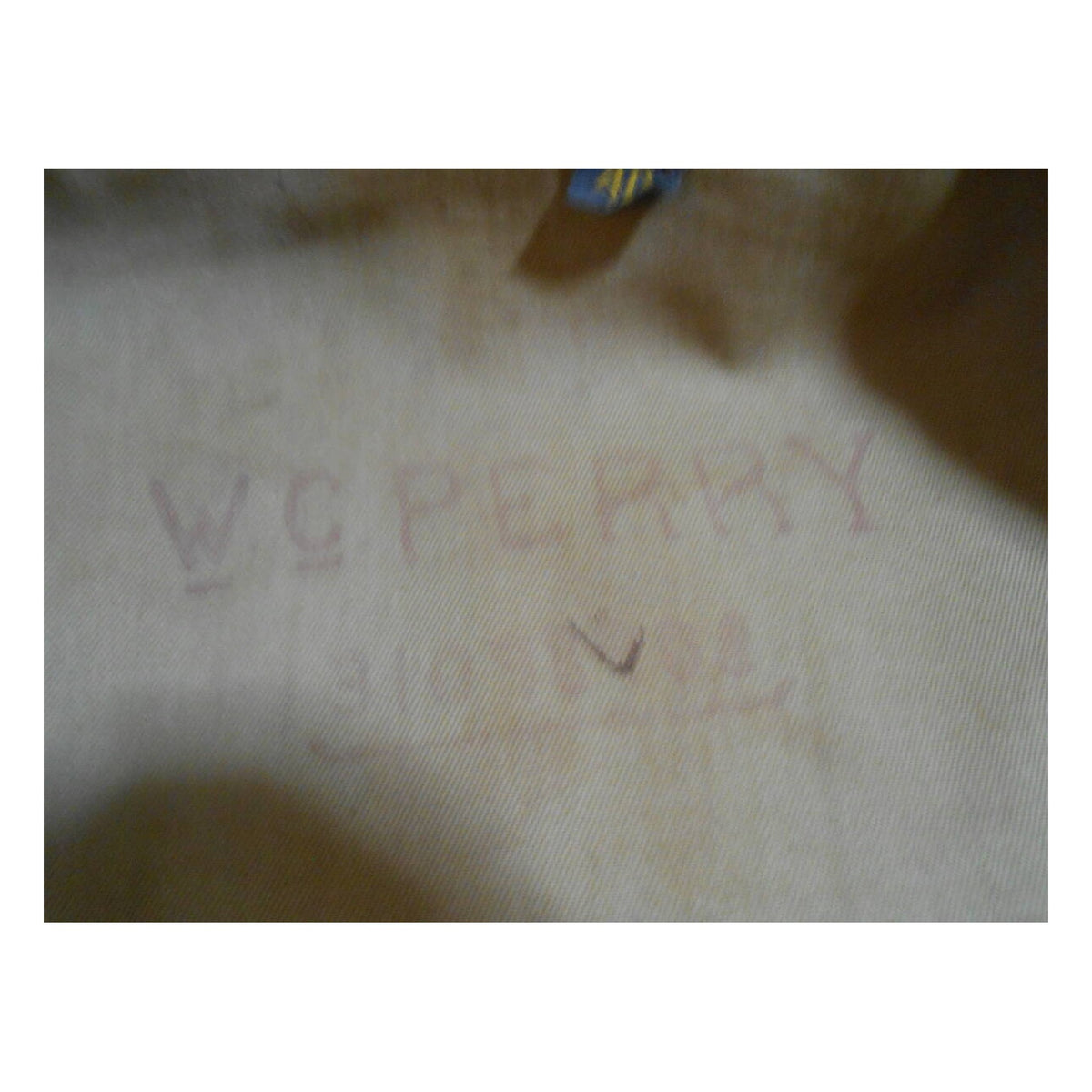
Across the back is a large white roundel with the red-faced chief in a feathered war bonnet, a bear-claw motif and the words Air Apaches, the emblem of the 345th Bomb Group, with age crazing and flaking through the white. Under the size tab the lining is stamped in red W.C. PERRY, with a partly legible number beneath that begins with a 3. Stitch holes on the left chest show where a squadron patch was once removed. Taken together, rare construction, a full back emblem and a stamped owner's name, this is a jacket that rewards the collector who already knows the American contracts and wants the Pacific variant beside them.
Details
- Type: Type A-2 flight jacket, Australian wartime variant (attributed)
- Maker: Unmarked; construction consistent with Australian manufacture for U.S. forces
- Contract / label: No contract label; size tab only
- Era: c. 1943-45
- Leather / shell: Heavy pebble-grain goatskin
- Hardware: Talon zip; snap at neck; no collar snaps; no underarm vents
- Lining & knits: Mustard-khaki cotton chino lining; olive-brown knits
- Decoration: Period-style back painting of the 345th Bomb Group Air Apaches emblem; owner's name W.C. PERRY stamped in lining
- Tagged size: 40
- Measurements: Shoulder 46 cm · Chest (pit to pit) 52 cm · Sleeve 61 cm · Length 63 cm
Condition
- Leather supple and sound, with honest wear and darkening.
- Light surface crack to the upper right back; does not affect wear.
- Slight thread lift at the right sleeve-to-shoulder seam.
- Stitch holes on the left chest from a removed squadron patch.
- Knits complete with small holes; lining in good order.
- Talon zip runs smoothly.
- No maker's mark: Australian origin attributed from construction. Back paint not independently authenticated.
Condition grade AB on the Japanese scale; see Japanese condition ranks, explained.
Authenticity & Care
The label, contract and size tags, leather, stitching, zip and hardware, paint and insignia are examined together and documented in Japan before dispatch; anything that cannot be confirmed is stated plainly in the description. Every piece carries the Japonista authenticity guarantee. Keep on a broad wooden hanger away from sunlight, and condition the leather sparingly, avoiding the painted area entirely.
Delivery from Japan
Packed by hand in Japan and shipped insured and tracked by EMS or an equivalent express service. Import duties and taxes, where applicable, are payable on arrival. Every sale is final; please ask anything before you buy, and see our published policy.
Every figure above is taken by hand with the garment laid flat, in centimetres. Lay a shirt or jacket you already love beside them and allow a centimetre or two of margin, the quiet safeguard on a final sale. Our size guide to tops and jackets turns pit-to-pit figures into US, UK, EU and Japanese sizes, and for anything it leaves open the curator team replies within one Tokyo business day.
Considered offers are welcome through Send an Offer, and each one is reviewed personally. Pieces over $1,000 may be reserved over several payments with Layaway Privilege™.
Continue browsing: Military Flight Jacket & Nose Art · Designer Leather Jackets · Japan Luxury Archive
Pacific pieces on request
Seeking a jacket from a particular Fifth Air Force group, or an Australian-made variant to complete a run of contracts? Our Hunting Salon will search on your behalf. Our Hunting Salon™ locates a specific reference across Japan’s private collector circles, then inspects, documents and delivers it to you. Begin a Hunting Salon™ request →
Collectors also search: WWII A-2 flight jacket painted back · original A-2 jacket Air Apaches · 345th Bomb Group A-2 jacket · Air Apaches jacket · Australian made A-2 flight jacket · 5th Air Force A-2 jacket · B-25 strafer jacket · WWII Pacific theatre flight jacket · named WWII flight jacket · vintage A-2 size 40 original · Real McCoy's Air Apaches A-2


Chosen for you