
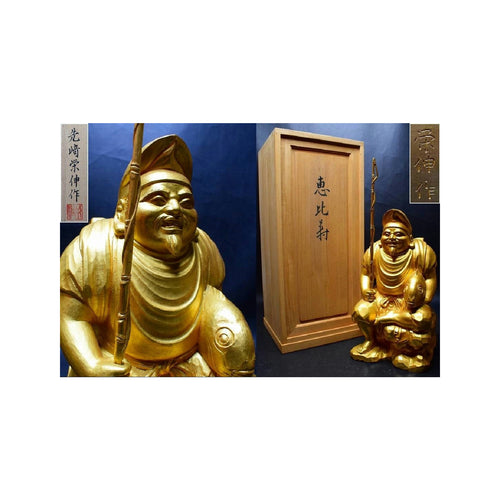

Senzaki Eishin Bronze Okimono Ebisu Gilt Gold Leaf Statue with Signed Tomobako, Showa Era, 46.3cm Japanese Art
Senzaki Eishin Bronze Okimono Ebisu Gilt Gold Leaf Statue with Signed Tomobako, Showa Era, 46.3cm Japanese Art
- Dispatch
- Prepared and sent from Tokyo within 7–14 days, often sooner, or as arranged
- Arrival
- Estados Unidos · usually 4–7 days after dispatch, insured and tracked Check the Shipping Flowchart here
- Shipping
- EMS recommended, with FedEx, DHL and UPS compared ·
- Import
Duties and customs · View the estimate
A guide for this piece: about $258, based on the 10% US charge on the declared value of goods made in Japan.
The final figure is set by US Customs and depends on where the piece was made and the kind of object it is. Many antiques over a century old carry no ordinary duty; most jewellery and leather goods add a single-digit rate.
With EMS, any charge is collected by your postal service on delivery. For pieces of significant value we can often arrange duties prepaid before dispatch.
Your customs authority: U.S. Customs and Border Protection (CBP), CBP Information Center · +1 877 227 5511 within the United States; +1 202 325 8000 from abroad (Monday to Friday, 8:30 to 17:00 Eastern)
These figures are estimates for your guidance; the charge set by customs may come in over or under them.
How the estimate is reached · Ask for a figure on this piece
- Character
- Balanced 4 of 10 ·
- Replies
- Within one Tokyo business day · Ask the curator team
- Guarantee
- Authenticity guaranteed · How we grade
Every piece is measured by hand, in centimetres as Japan measures. Please allow 1–2 cm (about ½ inch) for the give of the material and the hand that held the tape.
Where each figure is taken · View the plate

Object, sculpture and ceramics
Condition report
Very Good
- Giftable
- Mint
- Excellent
- Very Good
- Good
- Honest Wear
- As Found
Best for: tokonoma display, Japanese art collectors, corporate auspicious display
Condition notes
Statue shows strong gilding and solid form without visible major loss or breaks. Source notes standard vintage patina and minor surface marks (経年での汚れ、スレ).
Photograph review
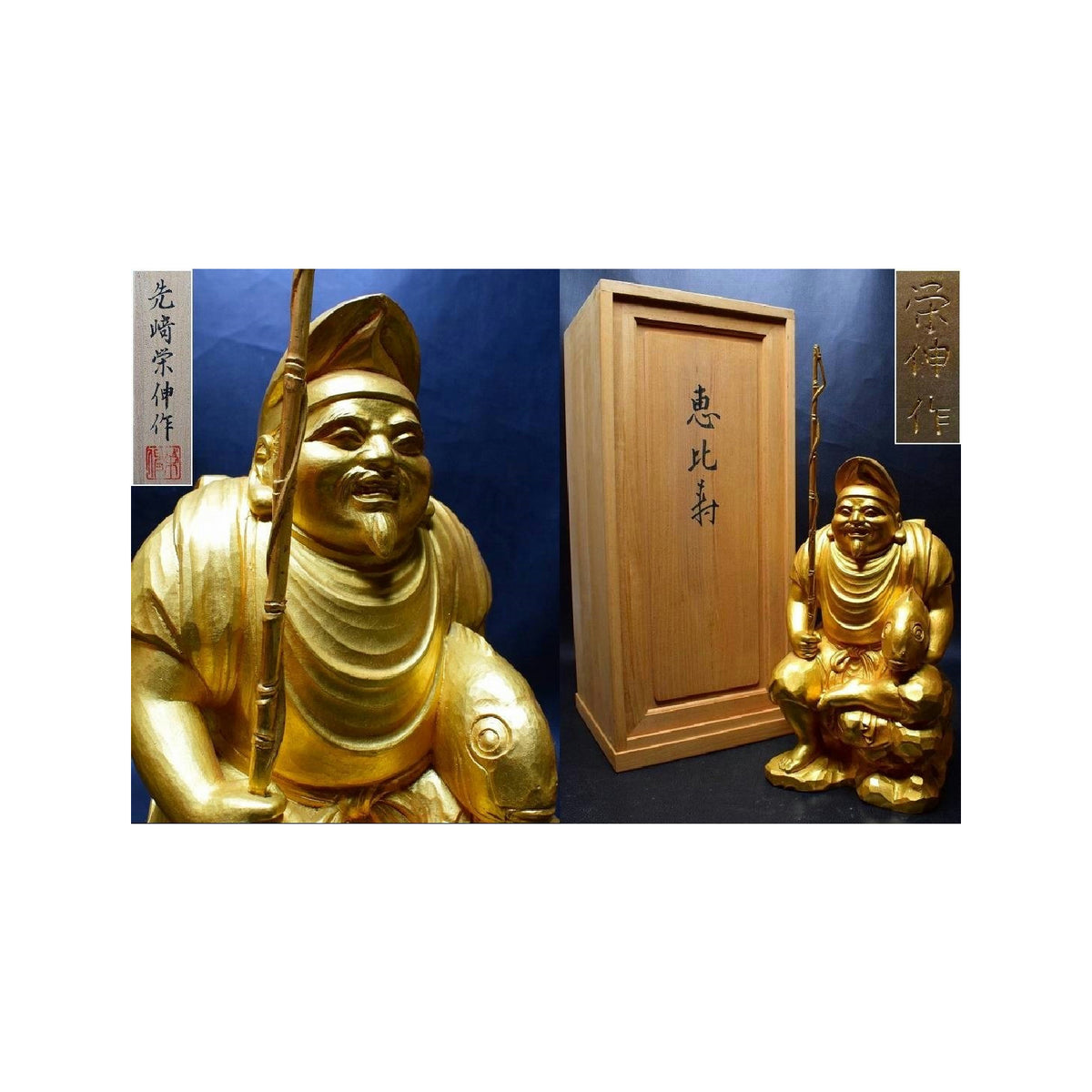
1. whole_front: Composite collage showing the gilt bronze Ebisu statue full figure beside its signed tomobako, close-up of bust, and cutouts of the artist signature/seal and box title
2. other: Japanese text notice instructing buyers to view additional photos on PC (dropped)
Grades, ratings and commentary are given to the best of our ability, knowledge and experience, and condition remains partly a matter of personal perception. What we stand behind without qualification is authenticity, truthful description and provenance, to the best of our knowledge. How we grade
No se pudo cargar la disponibilidad de recogida
All sales are final. Please read our refund policy before purchase.
Examined in Tokyo, one price, insured to your door. How buying from Japonista works · Join the Circle, free
The Piece
Japan, Showa era. This commanding 46.3 cm okimono in cast bronze with genuine gold leaf is by Senzaki Eishin (1917 to 1986), a documented Showa period Buddhist and Shinto sculptor. Ebisu, one of the celebrated Seven Lucky Gods (Shichifukujin), is depicted holding his signature sea bream and a fishing rod, signifiers of good fortune and business success in Japanese folk belief and Shinto-Buddhist tradition. The figure weighs a substantial 7.5 kg, reflecting the robust and dignified presence intended for auspicious display. Its original signed tomobako, complete with the artist's seal and hand-painted box title, confirms provenance and ensures broad appeal for discerning collectors.
Senzaki Eishin developed a distinguished career spanning decades, producing sculpture noted for its high fidelity to canonical Japanese figural technique. Raised in a tradition where sacred and folk motifs carry spiritual significance, Eishin specialised in detailed representations of Buddhist and Shinto deities, with many works now found in private and institutional Japanese collections. The Showa period (1926 to 1989) was a flourishing era for okimono, with artists like Eishin contributing to both religious and secular tastes as bronze foundries evolved new technical capabilities for larger, more intricate works. In this scale, nearly half a metre tall, the Ebisu delivers immediate visual impact on home altars, in tokonoma display alcoves, and as a centrepiece for entryways or corporate settings seeking good fortune.
Bronze okimono such as this are traditionally cast using the lost-wax (cire perdue) or sand-casting techniques honed in Japan since the Edo period, enabling the rich surface texture and crisp detail. The statue is finished in gold leaf (honkimpaku shiage), which is painstakingly applied over the entire bronze surface, a laborious process requiring expert technique. The gilding highlights the sculpted details: Ebisu’s flowing robes, the textured scales of the bream, and the benevolent, joyful facial expression, a visual invocation of prosperity and abundance. Both the statue and the tomobako bear Senzaki Eishin’s signature and seals, matching the box inscription, which is highly sought in the Japanese art market for attribution.
This Ebisu is not only an object of devotion but a showpiece of mid-century Japanese sculpture. Collectors and scholars of Showa-era okimono value original finish, completeness of accessories (such as the removable fishing rod), and documentary evidence such as the signed tomobako. Pieces of this size command attention, with proportions that emphasise verticality and substance while remaining displayable on shelves, household butsu-dan altars, or in the focal position of a tokonoma alcove. The shimmering gilded finish captures ambient light, accentuating the gold’s warmth and the sculptor’s hand. As an auspicious icon, Ebisu attracts those interested not only in decorative arts but also in the intersection of folk religion and material culture. Notably, works by Eishin are pursued by connoisseurs of Japanese fine sculpture, collectors of the Seven Lucky Gods, and those curating traditions of success and wellbeing for homes or business spaces. To care properly for gold leaf bronze, avoid direct sunlight, fluctuations in humidity, and excessive handling, as the delicate surface can be easily marred. Clean only with a soft, dry cloth. The fishing rod accessory, unique to Ebisu, should be handled lightly and stored in the tomobako when not on display. Every angle of the work displays Japanese technical discipline, bringing the divine and the artistic together.
The inclusion of the original tomobako, signed and inscribed by the artist, enhances its historical documentation and appeal. In Japanese collecting culture, tomobako are often separated from sculptures over time, so a complete set is increasingly prized, especially when featuring clear calligraphy and intact seals. The box provides both historical record and protection during storage or transportation, reflecting Japanese practices of preserving complete provenance. By owning a signed okimono of this stature and condition, collectors join a lineage of stewardship, appreciating not just decorative artistry but living tradition. As mid-century Shinto-Buddhist bronzes from the Showa era rise in international appreciation, documented works by Senzaki Eishin grow ever more sought-after for display, appreciation, and personal meaning.
Details
- Maker: Senzaki Eishin (1917 to 1986, )
- Subject: Ebisu ( ) holding sea bream and fishing rod
- Type: Bronze okimono statue
- Material: Bronze with genuine gold leaf finish
- Technique: Traditional lost-wax or sand cast, hand-finished
- Dimensions: Height 46.3 cm, width 18.5 cm, length 17.5 cm
- Weight: 7.5 kg
- Colour: Gold
- Era: Showa (1926 to 1989)
- Included: Original signed tomobako (wooden box), fishing rod accessory
- Condition grade: Very Good ( )
- Signature: Artist's seal on bronze and box inscription
- Documentation: Signed tomobako and sculptor's seal
Condition
Graded Very Good on the house scale, showing minor surface wear. The statue shows minor age-appropriate surface rubs and expected handling tarnish to areas of the gold leaf. No breaks or major losses are noted. The gold finish is strong, and the patina suits its vintage. Please review all images and written commentary for specific surface characteristics. How we grade condition.
Authenticity & Care
This work bears the signature and seal of Senzaki Eishin, corresponding to the calligraphic title and inscription on the original tomobako. Japanese bronze sculpture of this quality is valued for its preservation of craft tradition and the clarity of its documentary evidence. To care for the statue, keep in a stable, dry location away from direct sun and excessive humidity. Gently dust with a clean, dry, soft cloth only. Avoid liquids, abrasives or cleaners, as these may lift the gold leaf or disturb the original surface. Always handle with clean dry hands, supporting the base rather than projecting elements such as the fishing rod. The tomobako should be used for storage when moving the work or when it's not on display. Over time, the gold will mellow, acquiring further depth of colour, which is prized among collectors. Every sale is final.
Delivery from Japan
Your object will be shipped direct from Tokyo, packed with special care for its weight and size, and sent by registered and tracked international courier. Every sale is final. For private enquiries regarding this Ebisu or to request assistance with other Japanese sculpture or Seven Lucky Gods figures, please contact us before purchase.
Chosen for you