Japonista
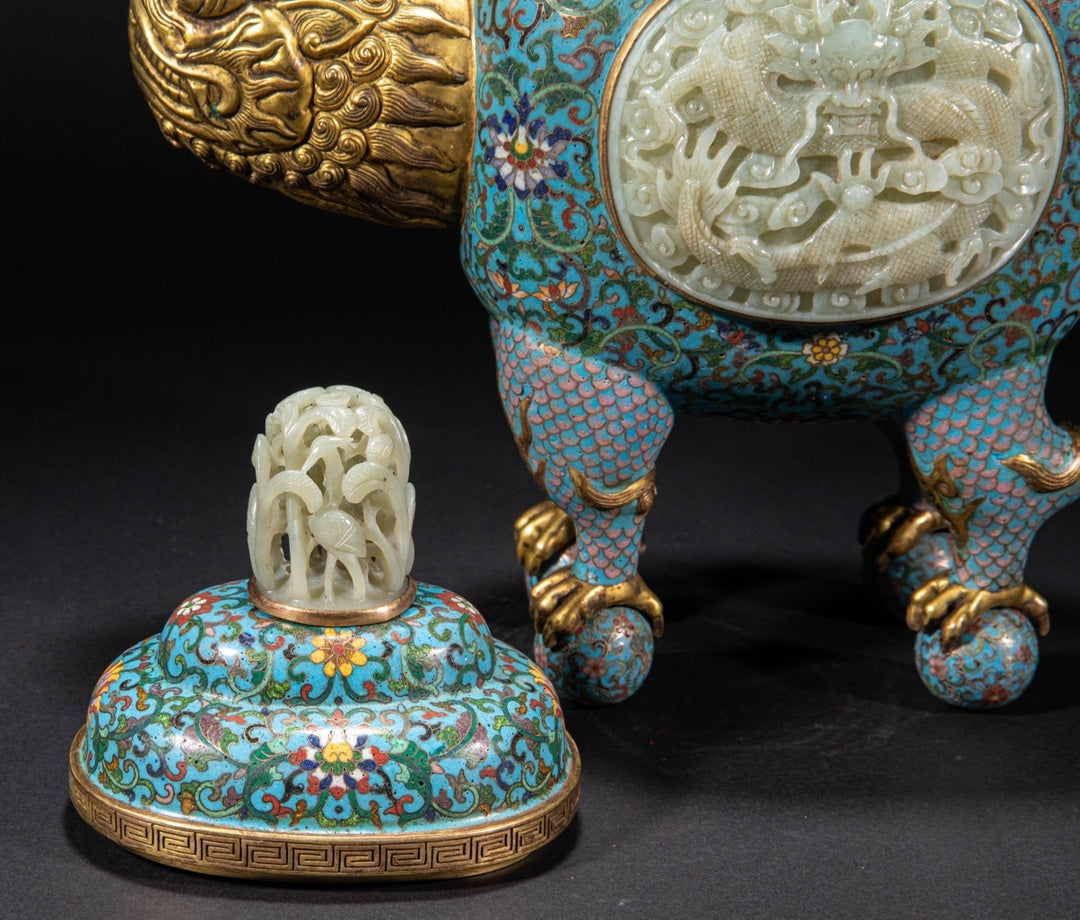
Ewer chino de vino de cloisonné de estilo cortesano Qing, con medallón de jade tallado y monturas de bronce dorado, 44 cm
Ewer chino de vino de cloisonné de estilo cortesano Qing, con medallón de jade tallado y monturas de bronce dorado, 44 cm
Freight piece: please confirm delivery before purchase
This piece travels in a crate or by freight rather than standard mail, and may need careful dismantling before it can be packed. The shipping shown at checkout is an estimate. Japonista reserves the right to determine the final handling, crating and freight cost when your order is received, according to the piece, the destination and carrier conditions at that time.
We advise requesting a delivery quote before checkout. If the final cost is higher than the amount paid, we send the difference for your approval before dispatch. Your piece is held for you until it is settled.
Request a delivery quoteNo se pudo cargar la disponibilidad de recogida
All sales are final. Please read our refund policy before purchase.
Have a reasonable price in mind? Submit your best offer and our concierge will review it personally.
A monumental wine ewer in Qing-dynasty court style, uniting dense turquoise-ground cloisonné, sculptural gilt-bronze mounts and a carved jade medallion in one high-authority display vessel. Its mixed-material refinement speaks the language of late imperial interiors, where enamel, bronze and jade together marked hospitality, hierarchy and cultivated taste.
The Piece
This monumental Chinese cloisonné wine ewer is executed in Qing-dynasty court style, with dense turquoise-ground enamel, sculptural gilt-bronze mounts, a carved jade medallion as centerpiece and a zoomorphic pouring spout. It reflects the mature decorative vocabulary of late imperial Chinese court aesthetics, where technical virtuosity and material richness combined to produce objects for both ceremonial function and elite interior display. Its commanding silhouette, elevated handle structure and sculptural spout place it firmly among statement objects rather than utilitarian ware.
The enamel body is worked in dense cloisonné, with tightly packed wire partitions forming a continuous ornamental field, evenly distributed enamel fills, consistent coloration and controlled surface leveling. The turquoise ground acts as a visual anchor, letting the surrounding motifs and metallic elements read with clarity and depth. Cloisonné of this kind required sequential firing cycles, precise temperature control and close workshop coordination, making such vessels inherently labor-intensive.
The bronze elements are structural rather than applied: the cast spout, handle framework and fittings act as architectural extensions of the form, reinforcing the vessel's weight and presence, while warm-toned gilding supplies contrast and material hierarchy and retains strong definition. At the center, the carved jade medallion introduces a second material language. Jade, traditionally associated with moral virtue, continuity, longevity and status, lifts the object beyond enamelware alone, and the deliberate pairing of cloisonné and jade signals a decorative hierarchy in which mixed-material refinement served as a visual marker of authority.
In Chinese decorative tradition, wine ewers were markers of hospitality, ritual continuity and social hierarchy, and cloisonné enamel, refined through imperial workshops, became associated with formality and visual authority. Whether commissioned for ritual wine service or created as a prestige object, this ewer reads as a fully resolved decorative form rather than a hybrid curiosity, aligned with Qing-style production for high-level interiors, scholar environments or ceremonial display. Its scale, mixed-media execution and architectural form make it a centerpiece for serious Asian art collections or refined interior installations.
Details
- Era: Qing-dynasty court style (stylistic attribution)
- Origin: Chinese
- Material: Cloisonné enamel on a turquoise ground; cast bronze spout, handle framework and fittings; warm-toned gilding; carved jade medallion
- Form: Wine ewer with elevated handle and zoomorphic pouring spout
- Measurements: Height approx. 44 cm · Width approx. 28 cm
- Weight: Estimated approx. 6.5–7.0 kg; estimated packed weight 10–12 kg
Condition
- Visually strong overall condition with no apparent structural damage.
- Surface wear consistent with age and handling.
- Gilt surfaces retain strong definition, suggesting controlled handling and careful preservation.
- Collectors are advised to review all images carefully.
Authenticity & Care
The ewer corresponds stylistically to Qing-dynasty decorative traditions, and its execution reflects workshop standards aligned with elite decorative production rather than commercial export ware; exact court attribution is not claimed, and no third-party material assay or institutional documentation is included. Every piece is examined and documented in Japan before dispatch and is offered with the Japonista authenticity guarantee.
Delivery from Japan
Packed by hand in Japan and shipped insured and tracked by EMS or an equivalent express service. Import duties and taxes, where applicable, are payable on arrival. Returns follow our published policy.
Considered offers are welcome through Send an Offer, and each one is reviewed personally. Pieces over $1,000 may be reserved over several payments with Layaway Privilege™.
Continue browsing: Chinese Decorative Arts
Related pieces: Soyuz Sokol KV-2 suit and Kazbek seat group
Armory & Export
Armor, sword fittings and historical militaria travel with export paperwork, custom crating and insured freight through our Museum-Grade Logistics Suite™. Plan a museum-grade shipment →
Collectors also search: chinese cloisonne wine ewer · cloisonne ewer jade medallion · qing style cloisonne · turquoise cloisonne vessel · gilt bronze cloisonne ewer · chinese enamel ewer large · imperial style cloisonne