
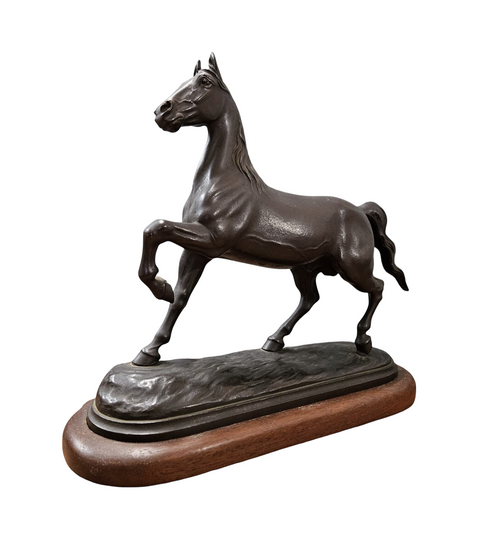


Escultura japonesa firmada de un caballo de bronce sobre base de madera original, finales del período Meiji–período Taishō, 25 cm
Escultura japonesa firmada de un caballo de bronce sobre base de madera original, finales del período Meiji–período Taishō, 25 cm
- Dispatch
- Prepared and sent from Tokyo within 7–14 days, often sooner, or as arranged
- Arrival
- Estados Unidos · usually 4–7 days after dispatch, insured and tracked Check the Shipping Flowchart here
- Shipping
- EMS recommended, with FedEx, DHL and UPS compared ·
- Import
Duties and customs · View the estimate
A guide for this piece: about $398, based on the 10% US charge on the declared value of goods made in Japan.
The final figure is set by US Customs and depends on where the piece was made and the kind of object it is. Many antiques over a century old carry no ordinary duty; most jewellery and leather goods add a single-digit rate.
With EMS, any charge is collected by your postal service on delivery. For pieces of significant value we can often arrange duties prepaid before dispatch.
Your customs authority: U.S. Customs and Border Protection (CBP), CBP Information Center · +1 877 227 5511 within the United States; +1 202 325 8000 from abroad (Monday to Friday, 8:30 to 17:00 Eastern)
These figures are estimates for your guidance; the charge set by customs may come in over or under them.
How the estimate is reached · Ask for a figure on this piece
- Character
- Scoring underway ·
- Replies
- Within one Tokyo business day · Ask the curator team
- Guarantee
- Authenticity guaranteed · How we grade
Every piece is measured by hand, in centimetres as Japan measures. Please allow 1–2 cm (about ½ inch) for the give of the material and the hand that held the tape.
Where each figure is taken · View the plate

Object, sculpture and ceramics
No se pudo cargar la disponibilidad de recogida
All sales are final. Please read our refund policy before purchase.
Considered offers only. The Desk replies personally to figures made in good faith; those set far below the asking price receive no reply.
Examined in Tokyo, one price, insured to your door. How buying from Japonista works · Join the Circle, free
Poised rather than rearing, this Japanese bronze horse lifts a single foreleg and leans almost imperceptibly forward, all latent power held in check. Mounted on the wooden base made for it, it shows how late Meiji and Taishō sculptors absorbed Western anatomical study into a distinctly Japanese feeling for rhythm and surface.
The Piece
This bronze horse presents a moment of restrained motion: one foreleg lifted, the body subtly angled forward, the musculature rendered with clarity but without exaggeration. The sculptor avoids theatrical rearing in favor of balance, tension and poise, the hallmarks of late Meiji to Taishō-period animal bronzes. The stance conveys readiness without aggression, and the horse becomes a vessel of character, of control, readiness and latent power, values deeply admired in prewar Japan.
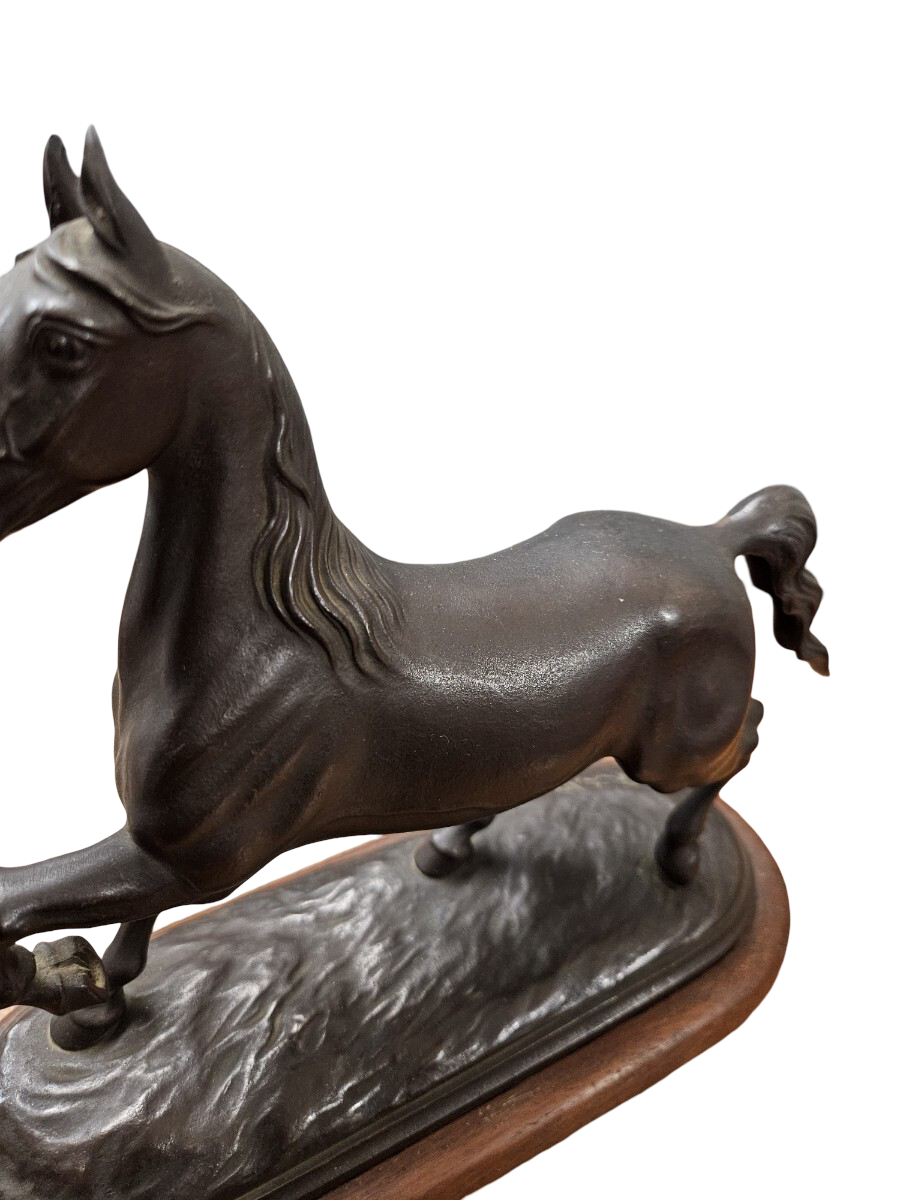
During this period Japanese bronze artists increasingly studied Western anatomy and naturalistic proportion while retaining an indigenous sensitivity to rhythm and surface, and the work reflects that synthesis. The mane is simplified yet directional, the neck elongated with quiet strength, and the torso modeled to suggest internal structure rather than surface decoration.
The horse stands on its original fitted wooden base, carved and finished, which grounds the composition and confirms its role as a display object intended for refined interiors rather than public monumentality. Such bronzes were often made for cultured interiors and study rooms, or as presentation pieces celebrating strength, endurance and disciplined movement, and were prized as symbols of strength, control and cultivated taste.
Horse imagery holds a significant place in Japanese visual culture, from Shinto votive ema to samurai heraldry and later sculptural bronzes influenced by European academic models. By the late Meiji and Taishō eras, bronze animal sculpture had become a respected genre in its own right: works were frequently signed, cast in limited numbers and intended for private ownership rather than temple or state display, with the emphasis on anatomical study, realism and expressive stance. This example, modest in scale and refined in execution, belongs to that tradition.
Details
- Era: Late Meiji–Taishō period
- Origin: Japan
- Material: Cast bronze with dark patina; carved and finished wood base
- Measurements: Height approx. 25 cm · Width approx. 26.5 cm · Depth approx. 10 cm
- Included: Original fitted wooden base
Condition
- Condition reflects age and careful use; no active damage observed.
- Surface wear is consistent with period bronzes and does not detract from sculptural integrity.
Authenticity & Care
Every piece is examined and documented in Japan before dispatch and is offered with the Japonista authenticity guarantee.
Delivery from Japan
Packed by hand in Japan and shipped insured and tracked by EMS or an equivalent express service. Import duties and taxes, where applicable, are payable on arrival. Returns follow our published policy.
Considered offers are welcome through Send an Offer, and each one is reviewed personally. Pieces over $1,000 may be reserved over several payments with Layaway Privilege™.
Continue browsing: Okimono
Cabinet of Curiosities
Okimono, netsuke and precious-metal miniatures surface rarely. Tell us the subject, material or carver you collect, and the Hunting Salon™ will search Japan for it. Begin a Hunting Salon™ request →
Collectors also search: japanese bronze horse sculpture · meiji bronze horse · taisho period bronze horse · antique japanese horse statue · signed japanese bronze horse · bronze horse on wooden base


Chosen for you