
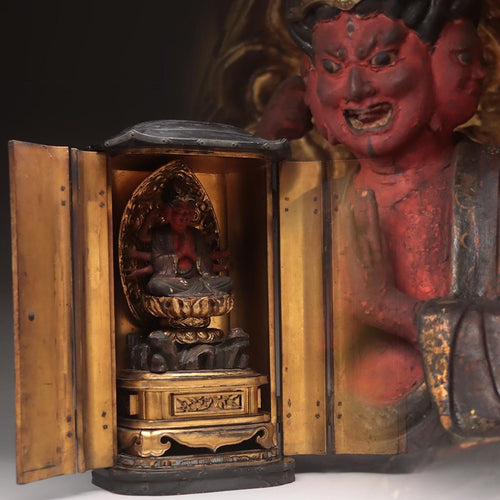


Bato Kannon Zushi, protector con cabeza de caballo y ocho brazos, en madera policromada, santuario portátil del período Edo, 37.4 cm
Bato Kannon Zushi, protector con cabeza de caballo y ocho brazos, en madera policromada, santuario portátil del período Edo, 37.4 cm
Previously in the house
This piece has found its home
Its photographs and the Japonista Reading remain here for reference. Should you wish for another of its kind, the house will watch for one and offer it to you first.
Available now, of a kind
 Yoshida Shigemasa Hannya Noh Mask, Carved and Painted Wood with Gilt Horns, Signed Reverse, Fitted Paulownia Box, 25.8 cm
$1,355.00
 Meiji Ikiningyo Shoki the Demon Queller, Japanese Ningyo Doll, Gold Brocade Robe, 43 cm on Stand
$2,165.00
 Fushimi Inari Otafuku Clay Japanese Ningyo Doll, Signed Ningyoya Koemon, 33 cm
$735.00
 Kawasaki Puppe Cloth Doll of Ragusa Tama with Hand Mirror and Dresser, Japanese Artist Ningyo, 26 cm
$1,400.00
No se pudo cargar la disponibilidad de recogida
All sales are final. Please read our refund policy before purchase.
Considered offers only. The Desk replies personally to figures made in good faith; those set far below the asking price receive no reply.
Examined in Tokyo, one price, insured to your door. How buying from Japonista works · Join the Circle, free
Bato Kannon is never gentle in presentation. In this Edo-period zushi the Horse-Head manifestation of Kannon appears in eight-armed esoteric form, compassion expressed through forceful clarity, seated within a lacquer-tone cabinet whose gilt interior opens like a small private sanctuary.
The Piece
This Edo-period Buddhist zushi enshrines Bato Kannon, the Horse-Head manifestation of Kannon (Avalokiteshvara) revered in esoteric Buddhism for pacifying rage, protecting sentient beings and guiding those bound by instinct and suffering. Rendered in the eight-armed esoteric (Myo-o) mode, the deity is distinguished by a fierce countenance and dynamic posture. Even in small domestic formats Bato Kannon is never gentle: its function is to cut through delusion, suppress harmful forces and deliver beings from states of suffering with a directness that looks fierce because its compassion is urgent.
Within Japanese devotional culture the image sits at an intersection between the familiar compassion of Kannon and the wrathful visual language of esoteric Buddhism. The horse-head crest is doctrinal rather than decorative, a sign of unstoppable momentum and an emblem of power that tramples obstacles, drives out disease and malign influence, and pulls the practitioner through karmic impasses.
This example appears as a seated polychrome wooden image within a lacquer-tone cabinet with gilt interior panels. The cabinet reads as a threshold: its doors open to reveal a concentrated ritual space, turning a shelf or alcove into a miniature sanctuary.
Wrathful Kannon forms are markedly rarer than serene devotional types, particularly in complete zushi ensembles. The piece holds strong appeal for collectors of esoteric Buddhist iconography, Shugendo-related imagery and Edo-period domestic religious art.
Details
- Era: Edo period (17th–19th century)
- Origin: Japan
- Material: Carved wood with polychrome pigments; lacquer-tone zushi cabinet with gilt interior panels
- Measurements: Total height including zushi approx. 37–38 cm (37.4 cm) · Zushi cabinet width approx. 18–20 cm
- Technique: Hand-carved, assembled and painted; zushi shrine cabinet construction
- Deity: Bato Kannon (Horse-Head Kannon), wrathful manifestation of Avalokiteshvara
- Arms: Multi-armed, interpreted as the eight-armed esoteric form
- Function: Subjugation of negative forces, karmic purification, protection
- Tradition: Esoteric Buddhist devotional sculpture
Condition
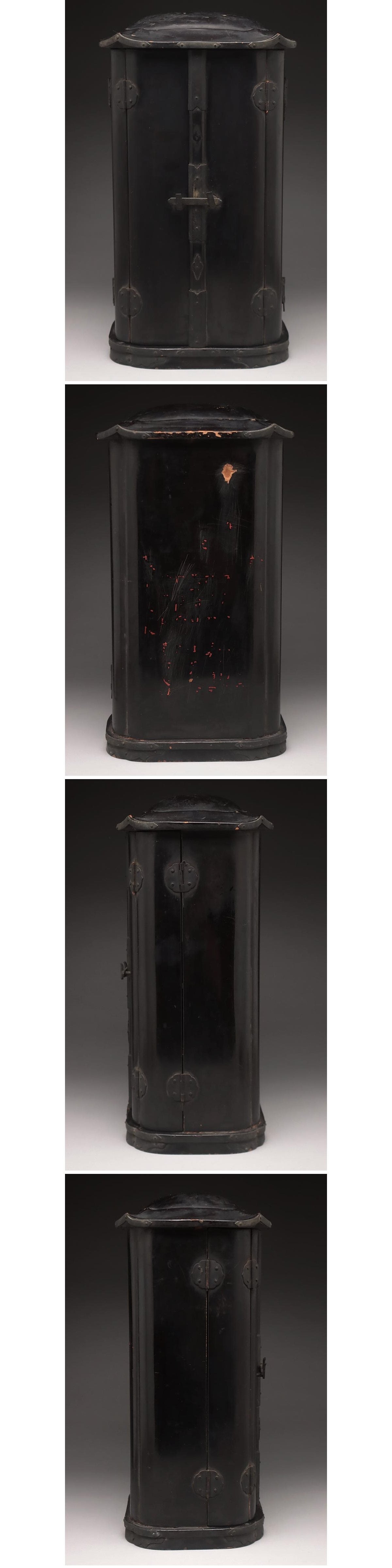
The photographs record its condition from every angle.
Authenticity & Care
The eight-armed identification is an interpretation of the multi-armed figure, and the Edo-period dating is given as a broad 17th–19th century range. Every piece is examined and documented in Japan before dispatch and is offered with the Japonista authenticity guarantee.
Delivery from Japan
Packed by hand in Japan and shipped insured and tracked by EMS or an equivalent express service. Import duties and taxes, where applicable, are payable on arrival. Returns follow our published policy.
Considered offers are welcome through Send an Offer, and each one is reviewed personally. Pieces over $1,000 may be reserved over several payments with Layaway Privilege™.
Continue browsing: Butsudan & Altars · Buddhist Statues & Sacred Art
Temple to Home
Monumental statues, zushi shrines and altars travel crated and insured through our Museum-Grade Logistics Suite™. Seeking a particular deity or school? The Hunting Salon™ searches Japan for it. Arrange crating and freight →
Collectors also search: bato kannon statue · horse head kannon zushi · esoteric buddhist shrine japan · edo period zushi · batō kannon wood carving · wrathful kannon statue · portable buddhist shrine antique


Chosen for you