
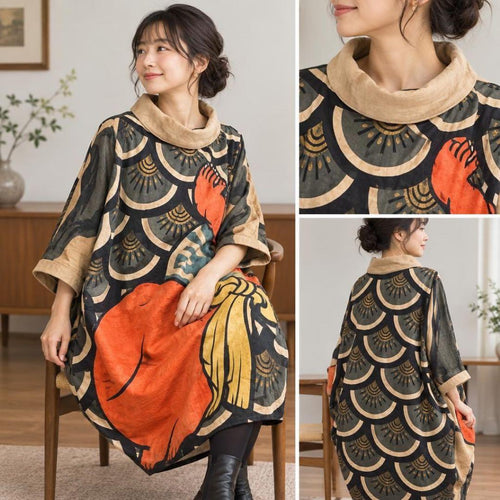


Atelier Remake Cocoon Dress, Hand-Painted Koinobori Carp Streamer with Kintaro, Repeated Kakishibu-zome Dyeing, Seam Pocket
Atelier Remake Cocoon Dress, Hand-Painted Koinobori Carp Streamer with Kintaro, Repeated Kakishibu-zome Dyeing, Seam Pocket
- Dispatch
- Prepared and sent from Tokyo within 7–14 days, often sooner, or as arranged
- Arrival
- Estados Unidos · usually 4–7 days after dispatch, insured and tracked Check the Shipping Flowchart here
- Shipping
- EMS recommended, with FedEx, DHL and UPS compared ·
- Import
Duties and customs · View the estimate
A guide for this piece: about $21, based on the 10% US charge on the declared value of goods made in Japan.
The final figure is set by US Customs and depends on where the piece was made and the kind of object it is. Many antiques over a century old carry no ordinary duty; most jewellery and leather goods add a single-digit rate.
With EMS, any charge is collected by your postal service on delivery. For pieces of significant value we can often arrange duties prepaid before dispatch.
Your customs authority: U.S. Customs and Border Protection (CBP), CBP Information Center · +1 877 227 5511 within the United States; +1 202 325 8000 from abroad (Monday to Friday, 8:30 to 17:00 Eastern)
These figures are estimates for your guidance; the charge set by customs may come in over or under them.
How the estimate is reached · Ask for a figure on this piece
- Sizing
- Measured by hand, in centimetres · Find your size · Ask before you buy
- Character
- QuietResplendent Scoring underway ·
- Replies
- Within one Tokyo business day · Ask the curator team
- Guarantee
- Authenticity guaranteed · How we grade
Every piece is measured by hand, in centimetres as Japan measures. Please allow 1–2 cm (about ½ inch) for the give of the material and the hand that held the tape.
No se pudo cargar la disponibilidad de recogida
All sales are final. Please read our refund policy before purchase.
Considered offers only. The Desk replies personally to figures made in good faith; those set far below the asking price receive no reply.
Examined in Tokyo, one price, insured to your door. How buying from Japonista works · Join the Circle, free
A cocoon-shaped dress made from a hand-painted koinobori carp streamer, dyed over and over in Kakishibu-zome, the persimmon-tannin dyeing, with Kintaro astride a carp on the front.
The Piece
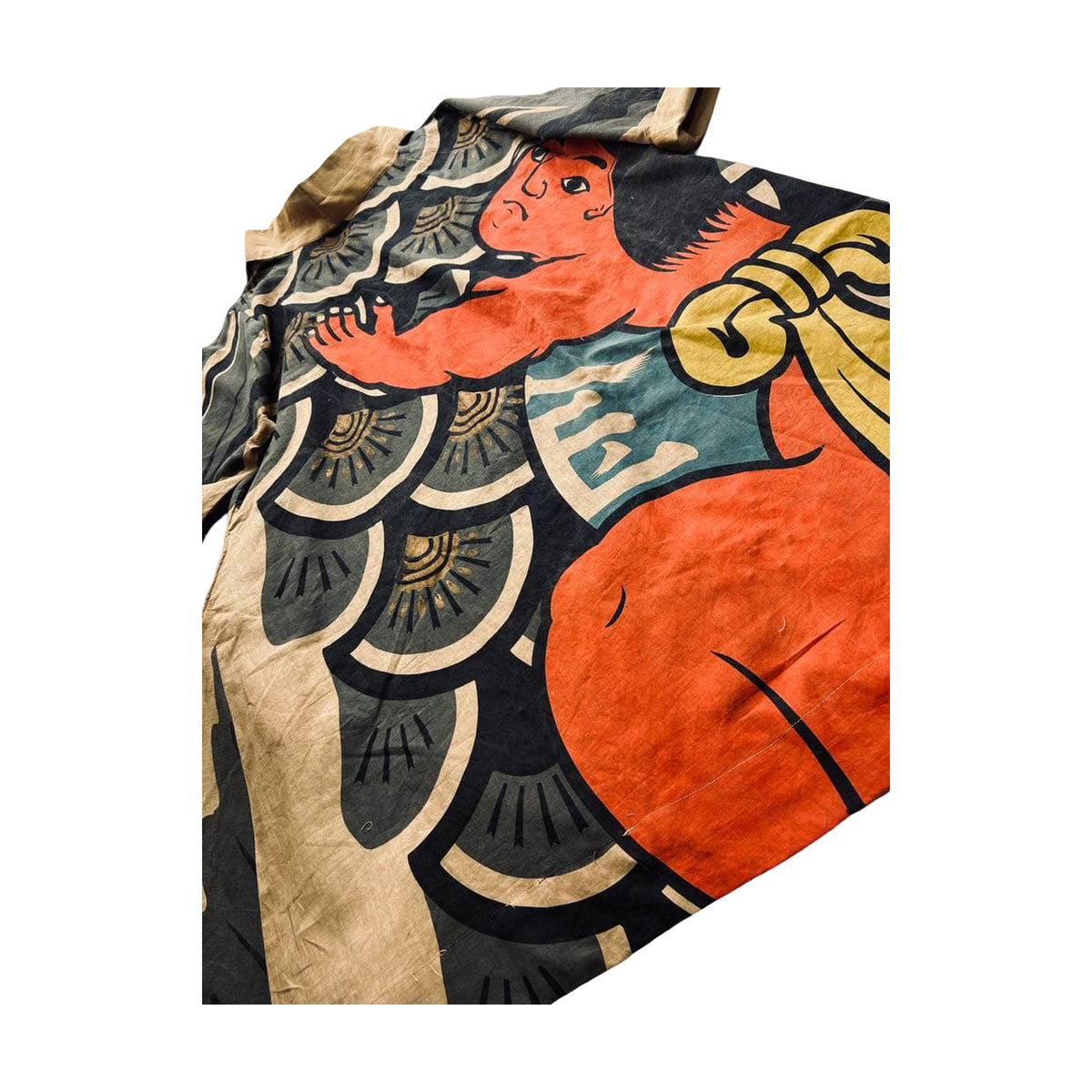
A hand-painted koinobori, the carp streamer flown in Japan for Boys' Day, was dyed again and again in kakishibu, the tannin pressed from persimmons. Astride a carp's back rides Kintaro, the folk-tale child of great strength, and the maker finds his face most endearing.
The maker followed the cloth's original shape, giving a natural cocoon cut. A seam-type pocket sits on the right, and the collar, cuffs and hem are finished in kakishibu-dyed cotton. Carp scales in grey and gold repeat over the dress, set against Kintaro's red.
Flat-measured by the maker, the shoulders are 45 cm (17.7 in), the chest 62 cm (24.4 in), the sleeve 45 cm (17.7 in) and the length 105 cm (41.3 in), with an armhole of 64 cm (25.2 in) and a neck opening of 68 cm (26.8 in). It is new and unworn.
The Craft of Persimmon Dyeing, Kakishibu-zome
Kakishibu is the fermented, tannin-rich juice pressed from unripe astringent persimmons, called shibugaki in Japanese. The suffix -zome means dyeing, so Kakishibu-zome is the traditional practice of colouring and finishing cloth with that juice. Pale tan at first, the colour warms toward russet and deep brown with wear, light and years.
The green fruit is gathered in early summer, crushed and pressed, and the juice is left to ferment and age for months or even years, which mellows its sharp smell. It is then brushed on, dipped or applied through a stencil, and the cloth is dried in the sun; the cycle may be repeated. As the tannins oxidise and bond with the fibre, the colour deepens in daylight, and no dye vat is required.
Aozome, Japan's indigo dyeing, begins with indigo leaves fermented into sukumo and kept alive in a vat. Cloth is dipped again and again, emerging yellow-green and turning blue as it meets the air, with deeper shades coming from repeated dips. Kakishibu has no vat: it is a plant tannin, used raw or aged, that deepens through oxidation and sunlight and keeps changing as the garment ages. It also tends to stiffen and strengthen fibre, and has long been valued for water resistance and for deodorising. Indigo is a cool blue; kakishibu is warm earth, red-brown.
Few dyes ask for so much patience. The fruit is harvested only in one season, the juice needs time to ferment, the application is by hand, and no two results are alike, because sun, humidity and the number of coats all leave their mark. Few workshops still keep the practice, and what it gives is a quiet, living patina rather than a fixed colour, a finish for those who value cloth that changes with them.
Details
- Maker: Hand-finished atelier remake, one of a kind
- Garment: Cocoon dress with seam-type pocket
- Cloth: Hand-painted koinobori cloth, with kakishibu-dyed cotton at collar, cuffs and hem
- Dyeing: Kakishibu-zome (persimmon-tannin dyeing), applied repeatedly
- Measurements: Flat-measured: shoulder 45 cm (17.7 in); chest width 62 cm (24.4 in); sleeve 45 cm (17.7 in); length 105 cm (41.3 in); armhole 64 cm (25.2 in); neck opening 68 cm (26.8 in)
- Pockets: Seam-type pocket on the right
- Colour: Charcoal, tan, vermilion and gold
- Origin: Made in Japan
- Included: Dress only
Model photographs are shown for illustrative styling, fitting and reference purposes only. Each piece is one of a kind; the garment itself is the piece offered.
Condition
- Grade N in Japan: new and unworn.
- The maker notes that hand dyeing gives the cloth a distinctive unevenness of tone. Old cloth and kimono fabric have been used, so unpicked-seam marks, small holes, fold ridges, fading and stains may be present; those found were mended from the front or back, and any overlooked are asked to be forgiven as part of the character of old-cloth remakes.
Condition grade N (new) on the Japanese scale; see Japanese condition ranks, explained.
Authenticity & Care
The cloth, dyeing, stitching, buttons and finish are examined together and documented in Japan before dispatch. Every piece carries the Japonista authenticity guarantee. Treat it as a hand-dyed textile: spot-clean gently or entrust it to a specialist cleaner, dry it in shade, store it away from damp and direct sun, and keep it apart from pale fabrics until you know how the dye behaves.
Delivery from Japan
Packed by hand in Japan and shipped insured and tracked by EMS or an equivalent express service. Import duties and taxes, where applicable, are payable on arrival. Every sale is final; please ask anything before you buy, and see our published policy.
Every figure above is taken by hand, in centimetres, and Japanese labels often run a size smaller than Western ones. Compare with a piece you already own and allow a little margin, the quiet safeguard on a final sale. Our size conversion guide sets Japanese sizes beside US, UK, EU and Asian ones, and for anything it leaves open the curator team replies within one Tokyo business day.
Considered offers are welcome through Send an Offer, and each one is reviewed personally.
Continue browsing: Kimono Remake Garments · Amekaji
Archive Requests
Looking for a similar piece, a different size or a particular reference? Our Hunting Salon™ locates it across Japan’s private collector circles, then inspects, documents and delivers it to you. Begin a Hunting Salon™ request.
Collectors also search: Kakishibu-zome · kakishibu · koinobori kimono remake dress · Kintaro carp dress · kakishibu cocoon dress · Japanese carp streamer clothing · persimmon dyed boho dress


Chosen for you