
Ningyo: Hina, Kimekomi, Gosho and Hakata Dolls
Toys Almanac · Court and Festival
Ningyo: Hina, Kimekomi, Gosho and Hakata Dolls
A Japanese doll is rarely only a toy. It can be a festival guest, a court gift, a charm for a child's health or a portrait in unglazed clay, and each of those lives has left a different material, a different skin and a different way of being kept.
Fact sheet
At a glance
- A festival with a deadline. Dolls are traditionally put away the day after 3 March, and a superstition says leaving them out delays the daughter's marriage.
- A wedding in miniature. Wikipedia says the hina dolls depict a Heian-period wedding in court dress.
- Cloth in grooves. Kimekomi dolls are made by pressing fabric into grooves cut in a wooden body.
- Clay from Fukuoka. Hakata dolls are unglazed fired clay, painted by hand, and shown at the Paris Exposition in 1900.
- Skin of oyster shell. Gofun, the white finish on many heads and hands, is made from ground oyster shell and glue.
A Court Wedding on Red Cloth
Hinamatsuri, also called Doll's Day or Girls' Day, falls on 3 March and is not a national holiday, says Wikipedia. It is one of the five seasonal festivals, the gosekku, and was fixed to 3 March after Japan adopted the Gregorian calendar. Because peach trees bloomed around the original date, it is also called the Peach Festival. The dolls depict a wedding in Heian court dress. Wikipedia says that around 1629, in the Edo period, the mother of Empress Meisho arranged dolls to show her daughter's wedding, and that the festival was officially named Hinamatsuri in 1687.
Diagram by Japonista. Tier contents from Wikipedia (Hinamatsuri). Sets vary by region and by price.
Look closer: Read from the top. The emperor and empress are the point of the display, and every tier below is the household that serves them.
Diagram by Japonista
A set is arranged on a tiered platform, the hina-dan, covered in red cloth, with a gold folding screen behind and artificial peach branches in vases. On the top tier sit the emperor and empress; below them come three court ladies serving sake, five musicians, two ministers and three attendants, and on the lowest tiers miniature furniture, tools and carriages. Wikipedia explains that the tiers were added so costly dolls would stay out of children's reach. The article on Japanese dolls adds that a full set has at least fifteen dolls, and that the basic set is the emperor and empress pair.
Regional habits differ. According to Wikipedia, in Kansai the male doll sits on the right, and in Kanto, the rest of Japan, on the left. The middle court lady holds a different object in Kyoto than elsewhere, and the drinker dolls carry different items by region. A set that does not match the textbook order is therefore not necessarily wrong; it may follow a regional custom, and a good description says so.
Care follows the calendar. The dolls are set out a few days before 3 March, usually by girls and their mothers, and traditionally put away the day after, with a superstition that leaving them out delays the daughter's marriage. Wikipedia notes the practical reason, avoiding the humidity of the rainy season, and that some families display them through March.
Cloth, Clay, Shell and Paper
Wikipedia's article on Japanese dolls says most of the traditional doll types known today developed in the Edo period, from 1603 to 1867, and that sets grew larger and more elaborate. Classic hina dolls have heads and hands covered in gofun, and bodies built up of layered textile. Gofun is the white lacquer skin made from ground oyster shell and glue; the Google Arts and Culture story on gosho dolls explains that it is made from itabo oyster powder, now often from scallop shells, and that layering it gives a warm white.

A kimekomi emperor and empress, as the Commons title describes them. Photograph by Yoshio Kohara, CC BY 3.0. Wikimedia Commons, File:木目込み人形 ひな人形 - panoramio.jpg.
Look closer: The fabric lies flush with the carved body, with no seam where a sleeve would join. That is the signature of the kimekomi method, which presses cloth into the wood.
Image: Yoshio Kohara, CC BY 3.0, via Wikimedia Commons
Kimekomi dolls take a different route. Grooves are carved into a wooden body, and fabric is pressed into them with glue and an awl, so that the clothing appears to be dressed on without disturbing the lines of the body. The Tokyo crafts portal, kougeihin.jp, says the technique is said to date from the mid-Edo period and to have begun at the Kamigamo Shrine in Kyoto, where the dolls were called Kamo dolls before the name changed to kimekomi when they reached Edo. It says Edo kimekomi was designated a traditional craft on 6 February 1978 and is made in Saitama, Kasukabe and several Tokyo wards, with Iwatsuki in Saitama known as a doll-making town.
Ichimatsu dolls are the well-proportioned child dolls with glass eyes. Wikipedia says the name comes from an eighteenth-century kabuki actor, and that since the late nineteenth century the term has meant child dolls in general. It adds that the exchange of friendship dolls in 1927 influenced later styles. Musha ningyo, the warrior dolls, sit, stand or ride horses, with armour and helmets of lacquered paper and metal, and they take subjects such as Emperor Jimmu and Toyotomi Hideyoshi.

Seated dolls from an exhibition of Japanese dolls. Photograph by Mo Hany.Afife, Public domain. Wikimedia Commons, File:Japanese Dolls 12.jpg.
Look closer: Dolls of this kind show how much the face and hair carry the character of a figure.
Image: Mo Hany.Afife, Public domain, via Wikimedia Commons

A seated doll in orange, from an exhibition of Japanese dolls. Photograph by Mo Hany.Afife, Public domain. Wikimedia Commons, File:Japanese Dolls 29.jpg.
Look closer: The robe is the main colour; the face is kept calm and plain.
Image: Mo Hany.Afife, Public domain, via Wikimedia Commons
Warrior dolls have a festival of their own. The trade calls the boys' display gogatsu ningyo, which means May dolls, and the house's product titles for these pieces describe them as Boys' Day figures. The sources read for this chapter do not describe the boys' festival in detail, and the section on May and carp streamers further down gives the history that the sources support.
| Type | Body | Skin or surface | Source |
|---|---|---|---|
| Hina | Layered textile | Gofun head and hands | Wikipedia, Japanese dolls |
| Kimekomi | Carved paulownia paste, grooves | Fabric pressed into grooves; gofun or white clay head | kougeihin.jp |
| Gosho | Paulownia, paste, clay or papier-mache | Layered gofun | Google Arts and Culture |
| Ichimatsu | Child proportions | Often glass eyes | Wikipedia, Japanese dolls |
| Hakata | Fired clay, unglazed | Hand painted | Web Japan; Wikipedia |
| Musha | Lacquered paper armour | Metal fittings | Wikipedia, Japanese dolls |
Plump Children and Imperial Gifts
Gosho ningyo depict fat, cute babies in simplified form. Wikipedia describes the basic type as an almost naked sitting boy, carved in one piece, with very white skin, and says the type developed as gifts associated with the imperial court. The Google Arts and Culture story says the dolls were treasured at court, that the emperor gave them to princes and princesses on birthdays and at New Year, and that their history goes back some four hundred years.
Its origin is told two ways. The same story says the gosho doll may be a doll version of a stuffed crawling baby meant to ward off filth and misfortune, or that it may have evolved from the Edo-period Saga doll. It adds that Saga dolls were dressed in brocade, and that the symbolism of the gosho covers the healthy growth of children, happiness and prosperity, with the Seven Lucky Gods on a treasure ship tied to the first dream of the year, on 2 January.

Han-no Gosho, a screen painting of a palace, as titled on Commons. Photograph by Collection of Kyoto Asney archive, Public domain. Wikimedia Commons, File:Han-no Gosho.jpg.
Look closer: Gosho dolls take their name from the imperial palace. The sources read for this chapter do not tie this screen to any doll, so it is offered as a picture of the setting.
Image: Collection of Kyoto Asney archive, Public domain, via Wikimedia Commons
The material range is wide: the story names paulownia wood, a wood composite, unglazed pottery or papier-mache as bases, covered in layers of gofun. A small lacquered figure in the Los Angeles County Museum of Art, catalogued as a Fukusuke doll of the late nineteenth century, is shown in the gallery below, and its record lists lacquer with mother-of-pearl inlay as the material. It is a different object from a gosho doll, and it is shown because the museum's alternate title links it with the gosho tradition.
Unglazed Clay and Paris in 1900
Hakata dolls are made of fired clay without a glaze, in Fukuoka in northern Kyushu. Wikipedia says their origin is commonly accepted as seventeenth-century Hakata, with artisans such as Souichi Masaki, and that early patrons were Buddhist temples and Kuroda Nagamasa, the ruler of Hakata. Web Japan gives a more specific date, around 1608, linking the craft to the construction of Fukuoka Castle, and names Soshichi Masaki, a roof-tile maker who made pottery dolls as a hobby.
The craft grew with exhibitions. Wikipedia reports that Hakata dolls were shown at the National Industrial Exhibition in 1890 and that the Dolls of the World were well received at the Paris Exposition in 1900, where they sold for one yen fifty sen. It adds that American soldiers took them home as souvenirs after the war and that exports followed, and that lower-quality factory versions appeared as the dolls became more famous.
Web Japan describes the method: a carved and sculpted original, a plaster mould, clay casting, drying, unglazed firing and hand painting, with a smooth, translucent white skin as the distinctive feature. It says 89 companies and 635 workers were engaged in the craft, and that one artisan handles the whole process, which is why a good Hakata figure has a single hand's consistency in its face and drapery.

Hakata Dontaku festival, Fukuoka. Photograph by フェレス, CC BY-SA 2.1 jp. Wikimedia Commons, File:Hakata Dontaku 78338440 org.jpg.
Look closer: Hakata is a festival city, and its clay figures often show people in motion.
Image: フェレス, CC BY-SA 2.1 jp, via Wikimedia Commons

A Hakata figure of a woman in a kimono, as titled on Commons. Photograph by 氏子, CC BY-SA 4.0. Wikimedia Commons, File:田中勇博多人形(雅).jpg.
Look closer: The face is painted with fine detail on a pale, smooth surface.
Image: 氏子, CC BY-SA 4.0, via Wikimedia Commons
How to Read a Doll
Start with the skin. Gofun that has been applied in many thin layers gives a warm, even white, and a chipped edge shows the layers. A plastic or painted surface is a different thing. Next read the construction: carved grooves and cloth pressed in point to kimekomi, a hollow textile body points to a hina, a fired clay body points to Hakata. Then read the set. Is it complete? Does the order match a regional custom? Are the small accessories, such as the miniature furniture, present?
Care is part of the reading. Wikipedia gives a practical reason for the traditional storage rule: the dolls are packed away after the festival to avoid the humidity of the rainy season. A set that has been stored well, in its own box and wrappings, usually shows it in clean gofun, bright cloth and unbroken accessories, and a set that has been left out in a damp room shows that too. Ask for photographs of the underside of each figure, the inside of the box and the smallest accessories before judging a set complete.

A doll in stage costume, from an exhibition of Japanese dolls. Photograph by Mo Hany.Afife, Public domain. Wikimedia Commons, File:Japanese Dolls 19.jpg.
Look closer: Look at the headdress and the fabric first; condition problems often begin there.
Image: Mo Hany.Afife, Public domain, via Wikimedia Commons
Finally, be honest about age. The Commons photograph below shows four ichimatsu dolls whose description names the Taisho, early Showa and Heisei periods. The faces look very similar. The difference lies in the construction and the cloth, and it is a reason to describe the evidence rather than to guess at a date.
Clay Figures, Grass Dolls and Crawling Children
The Japanese word ningyo means human form, and the Wikipedia article on Japanese dolls begins there. It says the types cover children, the imperial court, warriors, fairy-tale figures and gods, rarely demons, and the daily life of towns, and that pilgrims buy local dolls as souvenirs. It then traces the idea back through a series of ancestors: the dogu, humanoid clay figures of the Jomon culture, dated 8000 to 200 BC and linked to fertility or shamanistic rites; the haniwa, funerary figures of the Kofun culture, about 300 to 600 AD; a grass doll blessed and thrown into a river in 3 BC, which temple records of the Ise Shrine are said to mention, according to the scholar Alan Pate; and the paper katashiro of the Heian period, to which evil was transferred before they were cast into rivers or the sea.
That last custom is the root of the festival described above. The same article names another ancestor, the hoko, a soft-bodied talisman, the word meaning crawling child, carried by young and pregnant women, whose named sources appear in the Heian period and become clearer in the Muromachi period. These dolls are not playthings in the first instance. They are objects that receive and carry away harm, and the habit of thanking and retiring a doll, which appears in a later section, follows from that.
The article also records that the first professional doll makers were probably temple sculptors, who made painted wooden figures of children, the Saga dolls. The Cleveland Museum of Art holds one, dated 1688 to 1703 and made of lacquered wood, and a second, a figure of a boy with a puppy, of about 1800, which the museum describes as a Saga doll, a type thought to have originated in sixteenth-century Saga outside Kyoto. The museum says its colours and patterns resemble the fashion of the late Momoyama period, from 1573 to 1615, and that it is a nodder, with a separately carved head, whose tongue sticks out when the head moves. A doll that nods is a small piece of engineering, and it prepares the way for the mechanical dolls described below.
The Edo period, from 1603 to 1867, is where the Wikipedia article places the main development of the traditional types. Wealthy buyers wanted dolls for display and for gifts, sets grew larger, and the government regulated the trade, though the article marks the claim that makers could be arrested or banished for breaking laws on materials and height as needing a citation. The materials it names across the types are carved or composite wood, gofun and textiles.
From Floating Cups to a Doll Wedding
The Hinamatsuri article gives the festival a long ancestry. In the Nara period a custom called Kyokusui no en had people compose poems while cups of sake floated down a stream. In the Heian period aristocrats adapted it as Joshi no harai, in which an onmyoji rubbed a doll against the body to absorb impurities, and the doll was then set adrift. The festival is one of the five gosekku, the seasonal festivals, and is traditionally called the Peach Festival, because the peach trees bloomed at about that time of year.
The big dolls came with the Edo period. The article says that the doll makers made dolls up to about three feet tall until laws restricted their size, that the display grew to fifteen dolls and accessories, and that tiers were added so that costly dolls could sit out of reach of children. It also records a nineteenth-century setback: in the Meiji period the festival was deprecated in favour of holidays centred on the emperor, as the dolls were said to represent the emperor and empress and to foster respect for the throne. The festival survived, and spread through the Japanese diaspora, though the article says it remains mostly within Japanese immigrant communities and their descendants.
The cost of a set is part of its meaning. The article puts a five-tier set at about 1,500 to 2,500 dollars depending on quality, says that sets are often heirlooms, and says families aim to give a girl the two main dolls before her first festival. The Wikipedia article on Japanese dolls adds that the most elaborate sets fetch many millions of yen. The display, the Hinamatsuri article says, is retired around the age of ten, and the dolls, once toys, are now for display only. Boys and men do not take part in setting it up.

A hina pair on a striped platform, exhibited with a label; Public domain, photographed by Mo Hany.Afife. Photograph by Mo Hany.Afife, Public domain. Wikimedia Commons, File:Japanese Dolls 44.jpg.
Look closer: This is the dairi-bina, the top tier of the display. The platform cloth and the stiff robes are part of the tradition.
Image: Mo Hany.Afife, Public domain, via Wikimedia Commons

A seated court doll from an exhibition of Japanese dolls. Photograph by Mo Hany.Afife, Public domain. Wikimedia Commons, File:Japanese Dolls 30.jpg.
Look closer: The doll's sleeves spread to a wide triangle, which is how the pyramid body described in the sources looks from the front.
Image: Mo Hany.Afife, Public domain, via Wikimedia Commons

Miniature doll settings in boxes, exhibited with a label. Photograph by Mo Hany.Afife, Public domain. Wikimedia Commons, File:Japanese Dolls 36.jpg.
Look closer: The lower tiers of a full hina set hold furniture and carriages in miniature, and the same taste for small rooms appears in these boxed settings.
Image: Mo Hany.Afife, Public domain, via Wikimedia Commons
The festival is also a meal. The article lists hina-arare, multicoloured rice crackers; chirashizushi, raw fish and vegetables over rice; hishi mochi, diamond-shaped, multicoloured rice cakes; ichigo daifuku; sakuramochi; ushiojiru, a clam soup, since clam shells form a matched pair; and shirozake, also called amazake, a non-alcoholic drink. Its section on other customs names nagashi-bina, the paper or straw dolls sent down rivers on boats, which the Nagashibina Doll Museum in Tottori City still observes by the lunisolar calendar, and tsurushi-bina, hanging decorations of red cords with miniature dolls made from leftover kimono silk.

A doll displayed at the Girls' Festival, Katori City, as the file title puts it. Photograph by katorisi, CC BY 3.0. Wikimedia Commons, File:A doll displayed at the Girls' Festival,hina-ningyo,katori-city,japan.jpg.
Look closer: Displays of this kind are put out in public buildings as well as in homes.
Image: katorisi, CC BY 3.0, via Wikimedia Commons

A hina matsuri doll display, photographed by David Wiley. Photograph by 掬茶, CC BY-SA 3.0. Wikimedia Commons, File:Hina Dolls Display in the Kyōdo-no-mori Park 20130310.jpg.
Look closer: Count the tiers from the top, using the table above.
Image: 掬茶, CC BY-SA 3.0, via Wikimedia Commons
| Tier | Dolls on it | Notes from Wikipedia |
|---|---|---|
| 1 | The emperor and empress, the dairi-bina | The male holds a shaku baton and the female a fan; they sit before a gold folding screen |
| 2 | Three court ladies serving sake | Two decanters; the middle doll holds a different object in Kyoto than elsewhere |
| 3 | Five musicians | Small drum, large drum, hand drum, flute and a singer with a fan |
| 4 | Two ministers | The Minister of the Right is young; the Minister of the Left is older; between them stand diamond-shaped rice cakes |
| 5 | Three helpers or guards | The drinkers carry different items in Kyoto and in the Kanto region |
| 6 and 7 | Furniture, tea utensils, travel items | Chests, mirror stand, sewing box, nested food boxes, palanquin, ox cart |
Iris, Carp and the Warrior on the Shelf
The chapter's first festival has a counterpart on 5 May. The Wikipedia article on Children's Day says it was held on the fifth day of the fifth lunar month as one of the five annual ceremonies at the imperial court, and that its original purpose involved women thatching roofs with irises to purify houses and repel evil spirits. In the Kamakura period, as the samurai took control of government, it became a celebration for boys. Iris, shobu, was seen as a samurai plant because its leaves resemble sword blades, and its pronunciation matched a word meaning to value military affairs. The article says the festival was Boys' Day until 1948, when it was made a national holiday and renamed Children's Day to include girls and honour mothers.
The dolls are the warriors. Gogatsu ningyo, or May dolls, have their origin, according to the article, in the Kamakura and Muromachi periods, when samurai aired their armour, helmets and swords in May before the rainy season, and then began to display them to protect their children. In the Edo period, it says, samurai households displayed musha ningyo alongside real armour, and commoners displayed paper helmets. The popular subjects it names are Momotaro, Kintaro, Ushiwakamaru, Benkei, Emperor Jinmu and Shoki, and the Wikipedia article on Japanese dolls adds Empress Jingu, Takenouchi, Toyotomi Hideyoshi and his generals and tea master. A formal set is displayed on a tiered stand with a bow, a long sword, a war fan and hats.
The same article records a shift in taste that a collector can use. In the Showa era, it says, preferences moved from samurai dolls to miniature armour, and since the twenty-first century miniature helmets have grown popular, probably because of the limited space in Japanese homes. The carp streamers, koinobori, grew from the nobori and fukinuke flags of samurai yards, merged into the first streamers in Edo, and became popular in their colourful modern form in the Meiji era. The carp refers to a Chinese legend of a carp swimming upstream and becoming a dragon. The article gives the colours as black for the father, red or pink for the mother, and blue, sometimes green or orange, for each child.

A musha ningyo in armour, from an exhibition of Japanese dolls. Photograph by Mo Hany.Afife, Public domain. Wikimedia Commons, File:Japanese Dolls 27.jpg.
Look closer: The armour is made in lacquered paper and metal, as the sources say, and the doll's face is that of a child.
Image: Mo Hany.Afife, Public domain, via Wikimedia Commons

Koinobori flying at Chizu, Tottori Prefecture. Photograph by 663highland, CC BY 2.5. Wikimedia Commons, File:150425 Koinobori Chizu Tottori pref Japan01bs.jpg.
Look closer: The colours follow the family: black for the father at the top, red for the mother, and blue and others for the children.
Image: 663highland, CC BY 2.5, via Wikimedia Commons

An antique Japanese helmet, photographed in a museum case. Photograph by Thierry Bernard, CC BY-SA 3.0. Wikimedia Commons, File:Antique Japanese (samuria) topai kabuto.jpg.
Look closer: Boys' Day sets are modelled on armour like this, in miniature.
Image: Thierry Bernard, CC BY-SA 3.0, via Wikimedia Commons
The festival has its foods and its bath. Kashiwa mochi, rice cakes with red bean paste wrapped in oak leaves, symbolise prosperity for one's offspring because oak leaves stay on the tree until new ones emerge, and chimaki is sweet rice wrapped in iris or bamboo leaves. Bathing in iris-infused water, drinking sake steeped with iris root, and placing iris wrapped in washi under the pillow are customs the article reports. The house's own shelf includes a Boys' Day figure of a warrior, listed below, and the same shelf page explains why a doll of that kind is made to be admired rather than played with.
Dolls That Walk, Write and Serve Tea
A different strand of the doll tradition is mechanical. Wikipedia's article on karakuri ningyo describes them as traditional Japanese automata made from the seventeenth to the nineteenth centuries and used for entertainment through their gestures. The word karakuri means mechanism, or trick, and is applied to any device that inspires awe by hiding its inner workings. The earliest recorded reference the article gives is in the Nihon Shoki, which describes a south-pointing chariot at the court of Empress Kogyoku in 658.
The golden age came in the Edo period, after European clock-making arrived in the early seventeenth century and gears and cams were put to use in moving dolls. The article says that early owners were nobles and daimyo, and that street festivals, such as the Toshogu Matsuri in Nagoya, spread the dolls to wider audiences. It names three types: the butai, or stage, life-sized dolls for public performance; the zashiki, small table-top dolls for homes, which danced or drummed and sometimes served tea or sake; and the dashi, large dolls for festival cars that re-enacted myths and legends. In 1662, it says, the clockmaker Takeda Omi built the first butai karakuri in Dotonbori, Osaka.
The best-known mechanism is the tea-serving doll. The article says it is typically powered by a wound spring of whalebone with cams and levers, that it starts moving when a cup is set on the plate in its hands, walks a set distance in a straight line, and bows its head. It stops when the cup is lifted, and when the cup is replaced it raises its head, turns round and returns. In the nineteenth century, it adds, Tanaka Hisashige, described as the founder of Toshiba, made technically sophisticated puppets, among them the arrow-shooting boy and a letter-writing doll that dips a brush in ink and writes characters on paper.

The Kuidaore Ningyo, a mechanical clown figure with a drum, photographed at a restaurant front. Photograph by Tedmoseby, CC BY-SA 3.0. Wikimedia Commons, File:Kuidaore Ningyo Clown.jpg.
Look closer: A moving figure that advertises a shop is a modern descendant of the festival-car doll. The sources read for this chapter do not discuss this clown, so it is offered as a visual parallel only.
Image: Tedmoseby, CC BY-SA 3.0, via Wikimedia Commons
For this almanac the sentence that matters most is the last of the article's types section: cheaper toys based on karakuri existed, and Japanese tin toys made for export were sometimes modelled on them. The tin walkers and tea-bearers described in the chapters on tin plate and tin robots had a native ancestor, and the walking Robby and the cup-carrying doll are cousins. The article also quotes the view of Kirsty Boyle, a student of one of the last karakuri masters, that the tradition conceals technology because hidden mechanisms evoke feelings more effectively.
A Funeral for Dolls
A doll that has been a vessel for harm and a gift of love cannot be thrown away like rubbish, and Japan has a service for the purpose. The Discover Kyoto page describes the doll memorial service, ningyo kuyo, held every year on 14 October at 10:30 in the morning at Hokyo-ji, a nunnery in Kyoto known as the Doll Temple, where imperial princesses traditionally served as head priestesses. The princesses, the page says, often received dolls from their fathers to mark the seasons or events, and the temple still preserves many. The service is held in front of the Doll Burial Mound, where the ashes of previous years' dolls are interred, with the abbess leading the nuns, a woman dressed as a tayu presiding and two women dressed as imperial princesses, and it ends with a song and dance performance. The Kyoto Doll Commerce and Industry Cooperative supports it.
The page gives the belief that lies behind the service: tsukumogami, spirits said to form when an object reaches one hundred years old, with human-shaped objects thought especially likely to acquire a soul. A report by Heather Greene for Religion Unplugged in November 2021 describes a wider practice. Temples across Japan, both Buddhist and Shinto, hold the ritual; it thanks the dolls for their service and ends with burning them or simply discarding them; families pay a fee and say goodbye. Among the places it names is the Awashima Shrine, near Wakayama, which sends donated dolls out to sea instead of burning them, as part of its Hina Matsuri celebration. Its stated reasons include the limited living space in Japanese homes and the fear that a doll may become troublesome, and it also cites the gratitude to objects associated with Shinto animism.
The custom was still being reported on in the month this chapter was reviewed. An Associated Press report published by The Star on 15 October 2026 describes a ceremony at the Dairokuten Sakaki Shrine in Tokyo, where Shinto priests symbolically release the spirits associated with dolls and pray for the health of the owners and their families. Prayers are made over doll-shaped paper talismans, which are burned in place of the dolls. The items brought, the report says, included elaborate dolls in bright kimonos, some kept in families for more than a hundred years, and ordinary toys, among them Snoopy and plush cats. Representatives of a traditional doll company clapped their hands in prayer.
For a dealer or a collector the lesson is practical. Old dolls come to the market because families have run out of room and have not wished to burn them, and a doll that has been properly retired from a household is, in a sense, a doll that has been given a second life. A good description says what is known of its history and does not dress it up in a ghost story. The tsukumogami belief is a belief, reported by the sources, and the almanac reports it as one.
Three Great Collectors and a Catalogue of 440 Dolls
The study of dolls as a subject is a Meiji-era invention, and the Wikipedia article on Japanese dolls names its pioneers. The Gangu San Ketsu, the three great toy collectors, were Shimizu Seifu, who lived from 1851 to 1913 and published the illustrated catalogue Unai no Tomo in 1891, covering 440 dolls; Nishizawa Senko, a banker who lived from 1864 to 1914 and collected hina dolls, whose son Tekiho, 1889 to 1965, inherited the collection, much of which was lost in the Kanto earthquake of 1923; and Tsuboi Shogoro, 1863 to 1913, the founder of the Tokyo Anthropological Society, who brought a scientific approach. The Metropolitan Museum of Art holds a copy of the Book of Toys, Unai no Tomo, and it is reproduced below.
Western taste followed. The same article names James Tissot, 1836 to 1902, who saw an exhibition in London in 1862 and collected in Paris in the 1860s, including figures of beautiful women; Jules Adeline, 1845 to 1909, known as Mikika, whose collection was mostly dolls; Eloise Thomas, 1907 to 1982; and Samuel Pryor, 1898 to 1985. It lists the Peabody Essex Museum, the Kyoto National Museum and the Yodoko Guest House among the museums with important holdings.
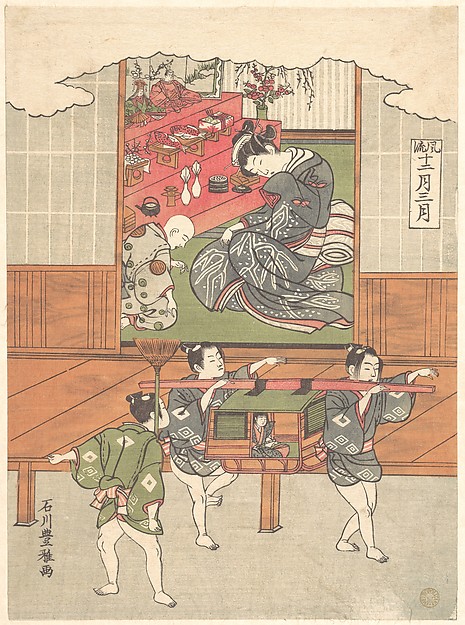
Ishikawa Toyomasa, The Festival of Dolls (Third Month), ca. 1767, Woodblock print; ink and color on paper. The Metropolitan Museum of Art, Gift of Estate of Samuel Isham, 1914, accession JP851.
Look closer: The shelf of dolls sits at the back of a living room, and the festival is a household affair. The children in front are playing at a procession.
Image: The Metropolitan Museum of Art, Open Access (CC0)
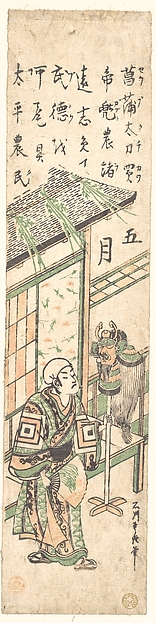
Ishikawa Toyonobu, The Fifth Month, ca. 1748, Woodblock print; ink and color on paper. The Metropolitan Museum of Art, Gift of Estate of Samuel Isham, 1914, accession JP844.
Look closer: This is the Fifth Month print in the Met's set of the months, made about 1748. The boys' festival belongs to the fifth month, and the display at the doorway is part of its scene.
Image: The Metropolitan Museum of Art, Open Access (CC0)
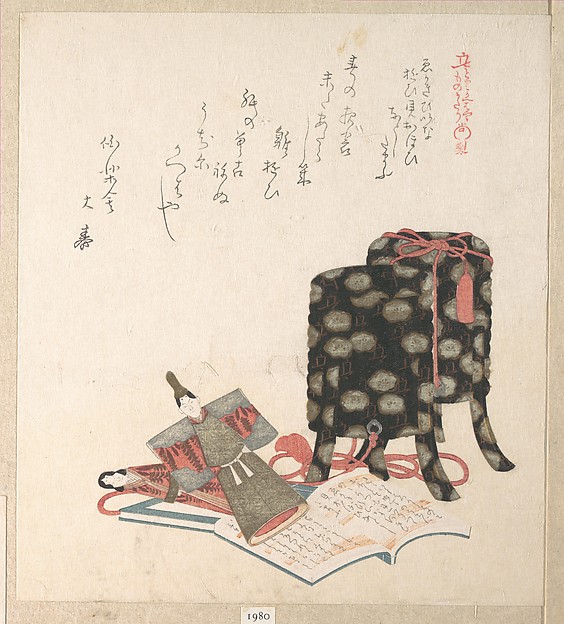
Kubo Shunman, The Doll Festival, Third Day of the Third Month, 19th century, Woodblock print (surimono); ink and color on paper. The Metropolitan Museum of Art, H. O. Havemeyer Collection, Bequest of Mrs. H. O. Havemeyer, 1929, accession JP1980.
Look closer: The doll is shown at rest, beside its chest and a book of poems. A still life of the festival's objects is a reminder that the dolls spend most of the year in storage.
Image: The Metropolitan Museum of Art, Open Access (CC0)
Two further facts show how widely dolls travelled. The article records that in 1927 an exchange of friendship dolls sent 58 ichimatsu dolls, each 32 inches tall, to the United States, and that silk-skinned dolls with mask faces were popular in the 1920s and 1930s and bought by postwar servicemen and tourists. It also describes the iki-ningyo, life-sized lifelike dolls shown in Edo-period misemono exhibitions, whose makers Matsumoto Kisaburo and Yasumoto Kamehachi pushed realism.
Prints are the best record of what the dolls looked like in use. The Metropolitan Museum's open-access images include Toyomasa's The Festival of Dolls, Third Month, of about 1767; Toyonobu's The Fifth Month, of about 1748, which belongs to the boys' festival; Kubo Shunman's The Doll Festival, Third Day of the Third Month; Torii Kiyonaga's print of a doll representing a boy playing a flute, of about 1780; and the Meiji paper-doll sheet of 1897 to 1898 called Paper Doll Clothing. Together they show the dolls displayed, played with and dressed over three centuries.
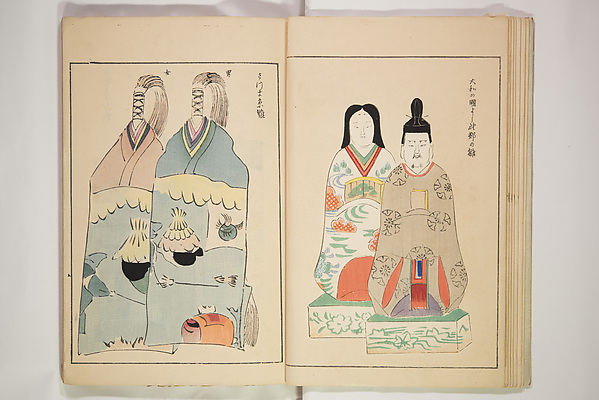
Book of Toys (Unai no to mo) うないのとも, 1891–1924, Polychrome woodblock printed book. The Metropolitan Museum of Art, Gift of Lincoln Kirstein, 1985, accession JIB197a–g.
Look closer: A catalogue like this is a collector's tool. Each doll is drawn so that it can be recognised, and the paired figure on the right is dressed as the court dolls of the hina display are.
Image: The Metropolitan Museum of Art, Open Access (CC0)
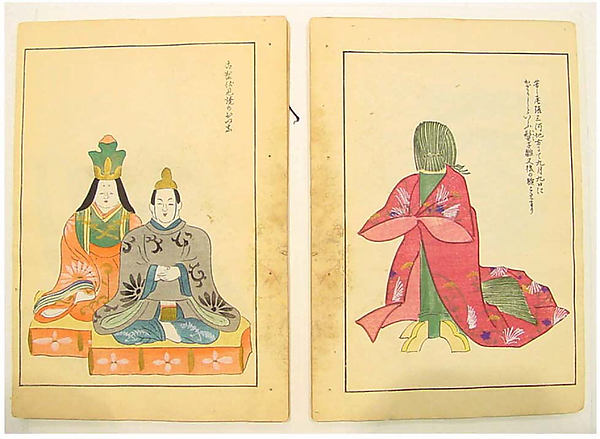
Traditional Folk Toys of Various Regions, 1891, Woodblock print; ink, colors and metallic pigments on paper. The Metropolitan Museum of Art, Gift of Erica Doctorow, 2005, accession 2005.42.2a–oo.
Look closer: The book shows the dolls from the front and, unusually, from the back, to record the cut of the robe.
Image: The Metropolitan Museum of Art, Open Access (CC0)
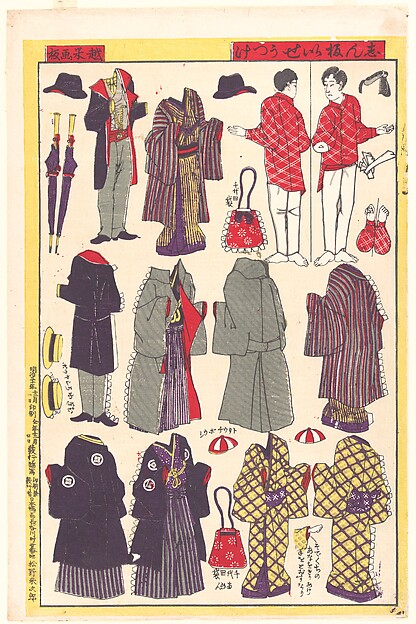
Unidentified artist, Paper Doll Clothing, 1897–98, Triptych of woodblock prints (nishiki-e); ink and color on paper. The Metropolitan Museum of Art, Gift of Lincoln Kirstein, 1960, accession JP3381a–c.
Look closer: Paper dolls dressed in changeable clothes were a children's pastime. They are a reminder that not every doll was for display.
Image: The Metropolitan Museum of Art, Open Access (CC0)
A Short Glossary of Ningyo
The terms below come from the sources named beside them.
| Term | Meaning | Source |
|---|---|---|
| Ningyo | Human form; a doll | Wikipedia, Japanese dolls |
| Gofun | White lacquer from ground oyster shell and glue, the skin of many dolls | Wikipedia; Google Arts and Culture |
| Hinadan | The red-covered tiered stand for the hina display | Wikipedia, Hinamatsuri |
| Dairi-bina | The emperor and empress pair at the top of the display | Wikipedia, Hinamatsuri |
| Musha ningyo | Warrior dolls for the boys' festival | Wikipedia, Japanese dolls |
| Gogatsu ningyo | May dolls, the boys' festival display | Wikipedia, Children's Day |
| Koinobori | Carp streamers flown on 5 May | Wikipedia, Children's Day |
| Kimekomi | Cloth pressed into grooves in a wooden body | Wikipedia; kougeihin.jp |
| Ichimatsu | Well-proportioned child dolls, named after an eighteenth-century kabuki actor | Wikipedia, Japanese dolls |
| Karakuri ningyo | Mechanical dolls and festival-float figures | Wikipedia, Karakuri puppet |
| Katashiro | Paper figures to which evil was transferred | Wikipedia, Japanese dolls |
| Hoko | A crawling-child talisman, a soft-bodied doll | Wikipedia, Japanese dolls |
| Ningyo kuyo | A memorial service for dolls no longer wanted | Discover Kyoto; Religion Unplugged |
| Tsukumogami | A spirit said to form when an object reaches one hundred years old | Discover Kyoto; Religion Unplugged |
| Nagashi-bina | Paper or straw dolls sent down a river to carry away impurities | Wikipedia, Hinamatsuri |
Twelve Small Surprises
Each item comes from a source named in the chapter.
- A grass doll said to have been thrown into a river in 3 BC is the supposed root of Hinamatsuri (Wikipedia, citing Alan Pate).
- In 1629 a mother arranged dolls to show her daughter's wedding, the first such display for the festival (Wikipedia).
- Hina dolls once stood about three feet tall, until laws restricted their size (Wikipedia).
- Tiers were added so costly dolls would sit out of children's reach (Wikipedia).
- A clam soup is served at the festival because clam shells form a matched pair (Wikipedia).
- Leaving the dolls out after the festival was said to delay the daughter's marriage (Wikipedia).
- A nodding Saga doll in the Cleveland Museum has a tongue that sticks out when its head moves (Cleveland Museum of Art).
- The 1891 catalogue Unai no Tomo covers 440 dolls (Wikipedia).
- In 1927, 58 ichimatsu dolls, each 32 inches tall, went to the United States (Wikipedia).
- A tea-serving karakuri doll stops when the cup is lifted and returns when it is replaced (Wikipedia).
- Hokyo-ji's doll service is held every 14 October (Discover Kyoto).
- Snoopy and plush cats were among the items blessed at a Tokyo shrine in October 2026 (The Star, AP).
What People Ask About Japanese Dolls
People ask whether Japanese dolls are toys. The honest answer from the sources is that the answer depends on the doll. Hinamatsuri dolls were once toys and are now display only, according to Wikipedia. Hakata dolls, gosho dolls and kimekomi are ornaments and gifts. Karakuri dolls were entertainment. Kokeshi and daruma began as toys and have taken on other roles.
People ask whether it is bad luck to keep a doll. The sources describe two beliefs, that a doll may acquire a spirit at about a hundred years, and that leaving hina dolls out after the festival delays a daughter's marriage. Both are reported as beliefs, and neither is presented as established. People ask what to do with a doll one no longer wants. The sources describe the doll memorial service at temples and shrines, a fee, and burning, or in the case of the Awashima Shrine, sending dolls out to sea.
People ask why a set of dolls costs what it does. The Hinamatsuri article gives five-tier sets at 1,500 to 2,500 dollars, and the Wikipedia article on Japanese dolls says the most elaborate fetch many millions of yen. The price reflects the number of dolls, the quality of the heads and the layered robes, and the completeness of the accessories.
Dolls in Display and in Hand
A hina display photographed in March in a park museum, as the Commons title describes it. Photograph by 掬茶, CC BY-SA 3.0. Wikimedia Commons, File:Hina Dolls Display in the Kyōdo-no-mori Park 20130310.jpg.
Look closer: Look at the lowest tiers. The small chests, trays and carriages are part of the set, and they are often the first things to go missing.
Image: 掬茶, CC BY-SA 3.0, via Wikimedia Commons

The Commons description names the Taisho, early Showa and Heisei periods. Photograph by Miyaka826, CC BY-SA 4.0. Wikimedia Commons, File:Japanese doll 4.jpg.
Look closer: The faces are similar, and the cloth and construction differ. Dating a doll by its face alone is unreliable.
Image: Miyaka826, CC BY-SA 4.0, via Wikimedia Commons

The Commons description calls them traditional dress-up dolls originating in the mid-Edo period. Photograph by Ellie from Tokyo, Japan, CC BY 2.0. Wikimedia Commons, File:Ichimatsu ningyō.jpg.
Look closer: A black and white print flattens the colour and shows the faces. The glass eyes catch the light even without colour.
Image: Ellie from Tokyo, Japan, CC BY 2.0, via Wikimedia Commons

Los Angeles County Museum of Art, M.91.250.296, 5.3 cm high; the Raymond and Frances Bushell Collection. Photograph by Unknown photographer, Public domain. Wikimedia Commons, File:Fukusuke Doll LACMA M.91.250.296.jpg.
Look closer: This one is 5.3 cm tall, and the museum records lacquer with mother-of-pearl inlay.
Image: Unknown photographer, Public domain, via Wikimedia Commons
Dolls at the Desk
The house holds an Urasaki Hakata ningyo figure of an oiran in kimono, 10 cm, and licensed warrior dolls made to order, including a Yoshitoku Batman musha ningyo, 62 cm. Stock changes; the shelf page shows what is here now.
Answered plainly
When are hina dolls displayed?
A few days before 3 March, and traditionally put away the day after, according to Wikipedia.
What is gofun?
A white coating made from ground oyster shell and glue, used for the skin of many Japanese dolls.
What is a kimekomi doll?
A doll whose cloth costume is pressed into grooves carved in the wooden body, so the fabric looks tucked into the figure.
Where are Hakata dolls made?
In Fukuoka, northern Kyushu, in unglazed fired clay painted by hand.
When is Children's Day?
On 5 May, a national holiday since 1948, according to Wikipedia.
What is a karakuri doll?
A mechanical doll from the Edo period, such as the tea-serving doll that walks and bows when a cup is placed on its tray.
What is a doll memorial service?
A ritual, held at Buddhist and Shinto sites, that thanks dolls for their service and ends with burning or discarding them.
Where is the Doll Temple?
Hokyo-ji in Kyoto, a nunnery where imperial princesses traditionally served as head priestesses, holds a doll service on 14 October.
Who catalogued Japanese dolls first?
Wikipedia names Shimizu Seifu, whose Unai no Tomo of 1891 covered 440 dolls.
Where next
Sources and image credits
- Hinamatsuri, Wikipedia
- Japanese dolls, Wikipedia
- Hakata doll, Wikipedia
- Hakata Dolls, Japan Atlas: Traditional Crafts, Web Japan
- Edo Kimekomi Ningyo, Kougeihin Japan
- Gosho Ningyo (Palace Dolls), Google Arts and Culture
- Fukusuke Doll, M.91.250.296, Los Angeles County Museum of Art (public domain, via Wikimedia Commons)
- Hinamatsuri, Wikipedia (re-read for this chapter)
- Children's Day (Japan), Wikipedia
- Karakuri puppet, Wikipedia
- Ningyo Kuyo, Doll Memorial Service at Hokyo-ji Temple, Discover Kyoto
- Japanese Temples Are Holding Funerals for Unwanted Dolls, Religion Unplugged, 5 November 2021
- Tokyo shrine honours precious dolls, The Star (AP), 15 October 2026
- Object record, File:木目込み人形 ひな人形 - panoramio.jpg, Wikimedia Commons
- Object record, File:Japanese Dolls 12.jpg, Wikimedia Commons
- Object record, File:Japanese Dolls 29.jpg, Wikimedia Commons
- Object record, File:Han-no Gosho.jpg, Wikimedia Commons
- Object record, File:Hakata Dontaku 78338440 org.jpg, Wikimedia Commons
- Object record, File:田中勇博多人形(雅).jpg, Wikimedia Commons
- Object record, File:Japanese Dolls 19.jpg, Wikimedia Commons
- Object record, File:Japanese Dolls 44.jpg, Wikimedia Commons
- Object record, File:Japanese Dolls 30.jpg, Wikimedia Commons
- Object record, File:Japanese Dolls 36.jpg, Wikimedia Commons
- Object record, File:A doll displayed at the Girls' Festival,hina-ningyo,katori-city,japan.jpg, Wikimedia Commons
- Object record, File:Hina Dolls Display in the Kyōdo-no-mori Park 20130310.jpg, Wikimedia Commons
- Object record, File:Japanese Dolls 27.jpg, Wikimedia Commons
- Object record, File:150425 Koinobori Chizu Tottori pref Japan01bs.jpg, Wikimedia Commons
- Object record, File:Antique Japanese (samuria) topai kabuto.jpg, Wikimedia Commons
- Object record, File:Kuidaore Ningyo Clown.jpg, Wikimedia Commons
- Object record, The Festival of Dolls (Third Month), The Metropolitan Museum of Art
- Object record, The Fifth Month, The Metropolitan Museum of Art
- Object record, The Doll Festival, Third Day of the Third Month, The Metropolitan Museum of Art
- Object record, Book of Toys (Unai no to mo) うないのとも, The Metropolitan Museum of Art
- Object record, Traditional Folk Toys of Various Regions, The Metropolitan Museum of Art
- Object record, Paper Doll Clothing, The Metropolitan Museum of Art
- Object record, File:Japanese doll 4.jpg, Wikimedia Commons
- Object record, File:Ichimatsu ningyō.jpg, Wikimedia Commons


Last reviewed 28 October 2026. Pictures, where shown, are public-domain or open-access and credited beneath each one.
Looking for a doll, a festival set or a figure for display? The concierge desk replies within one to three business days.
Private concierge
Looking for something in particular?
Describe the piece or the project you have in mind. A senior advisor in Tokyo reads every case file personally and replies within two business days, with fees set out in writing before any work begins.