
Daruma: Papier-Mâché Luck from Takasaki
Toys Almanac · Resilience
Daruma: Papier-Mâché Luck from Takasaki
The daruma is a hollow red doll with blank eyes and a weighted base, so that it always rises when it is pushed over. It is a monk, a wish, a toy and a political ritual, and about four in five of them are still made in one Gunma city.
Fact sheet
At a glance
- Eighty per cent from one city. Both Wikipedia and Visit Gunma say about 80 per cent of daruma are made in Takasaki.
- Nearly two million a year. Web Japan says about 100 households make roughly 1.6 million dolls a year.
- A bought wish. The doll is sold with white eyes. One is painted for a goal and the other when it is reached.
- A vote winner. Candidates fill in the second eye if elected, says Visit Gunma.
- Back on its feet. The weighted base is tied to the saying fall over seven times, get up eight.
From a Zen Monk to a Round Doll
Daruma is the Japanese name of Bodhidharma, a monk of the fifth or sixth century who is credited with bringing the Chan, or Zen, tradition to China. Wikipedia notes that Chan texts call him the blue-eyed barbarian, and that he is regarded as the founder of the Zen sect. Visit Gunma adds the legend that explains the doll's shape: Bodhidharma is said to have lost the use of his limbs after nine years of meditation, which is why the figure has none.
Diagram by Japonista. Steps from Wikipedia, Web Japan and Visit Gunma.
Look closer: The diagram follows the sources' left and right. The meaning is the same in every account: the first eye is a promise, and the second is a receipt.
Diagram by Japonista
Two things are worth separating. Bodhidharma is a monk of the fifth or sixth century, credited by Wikipedia with transmitting Chan to China. The doll that carries his name is a much later craft: Wikipedia places the red daruma in the late Edo period, in connection with beliefs about smallpox, and the Takasaki making of papier-mâché dolls anywhere from the late seventeenth to the early nineteenth century, depending on the account. The doll is an image of the patriarch and not a portrait of him, and no description of a daruma should suggest otherwise.

A daruma doll with one eye filled in for wishing, photographed by Joe Lencioni. Photograph by The original uploader was Jlencion at English Wikipedia., CC BY-SA 2.5. Wikimedia Commons, File:Daruma doll.jpg.
Look closer: This is the ritual in a single image. The painted eye is the promise, and the blank one is what remains to be done.
Image: The original uploader was Jlencion at English Wikipedia., CC BY-SA 2.5, via Wikimedia Commons
The body, though, borrows from a toy. Visit Gunma says the rounded shape came from the okiagari-koboshi, a weighted figure that stands back up when it is knocked over. Wikipedia places that self-righting monk toy in the mid-seventeenth century and says it was popular in the Kinki region. The daruma therefore joins two things: a devotional image of a patriarch and a children's toy that cannot be laid flat.
The result is an object that carries a proverb in its body. Wikipedia gives the saying, nanakorobi yaoki, fall over seven times, get up eight, and Web Japan says the doll's ability to return to its original position signifies resilience. The proverb is not an add-on. It is the mechanism, built into the weight at the bottom.
Famine, Moulds and Silkworms
Wikipedia calls Takasaki the proclaimed birthplace of the daruma doll, with Shorinzan Daruma Temple as the home of the traditional charms. The temple's own article says it was founded in 1697, was originally Soto Zen and converted to the Obaku school in the Meiji era, and that Takasaki is considered the birthplace of the dolls.
How the craft began is told with a family resemblance in each source and with different dates. Wikipedia says that in the Meiwa period, from 1764 to 1772, the ninth priest, Togaku, had parishioners make their own charms, with the temple supplying wooden block moulds and peasants making papier-mâché figures. It adds that local families farmed silkworms, a crop that needed luck. The temple's article ties the origin to the Great Tenmei famine of 1783 to 1787, when a temple Zen master taught locals to make papier-mâché daruma. Web Japan calls it late seventeenth-century famine relief promoted by the temple. Visit Gunma says around 200 years ago a monk made a mould so farmers could sell daruma at festivals.
The modern trade is large. Web Japan says about 100 households make roughly 1.6 million dolls a year, around 80 per cent of the national total, and Visit Gunma names Daimonya as the largest maker. The papier-mâché is moulded and then painted individually by hand, according to Visit Gunma, which is why even a mass-produced daruma has a face with a slight individual character.
A Wish in Two Strokes
Daruma are sold with both eyes blank. According to Wikipedia and Web Japan, the left eye is painted when a goal is set and the right when it is achieved, leaving a doll with two open eyes, the phrase for a goal realised. Wikipedia adds that, traditionally, only the head of the household painted the eyes. This is the standard description in the sources read here; the sources do not say how far individual temples and regions follow it, so the almanac does not claim a universal rule.

A hollow, round daruma doll photographed on 23 January 2005 and released to the public domain by the photographer. Photograph by Frank Gualtieri, Public domain. Wikimedia Commons, File:Daruma0791.jpg.
Look closer: Look at how the face is built from curves: the eyebrows, the moustache and the cheek lines all repeat the circle of the head.
Image: Frank Gualtieri, Public domain, via Wikimedia Commons
The doll's face is itself a small picture of longevity. Wikipedia and Visit Gunma agree that the eyebrows are cranes and the beard a tortoise, both symbols of long life. Visit Gunma says characters meaning luck and perseverance are painted on the middle of the figure.

Suzuki Harunobu, Daruma in a Boat with an Attendant, late 1760s, Woodblock print (nishiki-e); ink and color on paper. The Metropolitan Museum of Art, H. O. Havemeyer Collection, Bequest of Mrs. H. O. Havemeyer, 1929, accession JP1625.
Look closer: Harunobu gives the patriarch a boat and a servant. The picture belongs with the legend of Bodhidharma crossing a river on a reed.
Image: The Metropolitan Museum of Art, Open Access (CC0)
Red, Gold, Black and Blue
Red is the usual colour, and Wikipedia gives two explanations: the robes of high-ranking priests, and the late-Edo belief that a red daruma pacified the smallpox god. Visit Gunma gives a modern palette: red for good fortune generally, gold or yellow for wealth, black for success in business and blue for victory in sport. Wikipedia notes the five-colour set, goshiki daruma, in blue, yellow, red, white and black, and links gold to financial luck.

A black daruma inside JR Takasaki Station in Gunma, released into the public domain by the photographer. Photograph by ウィキ太郎 Wiki Taro, Public domain. Wikimedia Commons, File:Black Daruma at Takasaki Station Gunma Prefecture Japan.jpg.
Look closer: This is a station ornament rather than a pocket charm. The scale, the plinth and the plaque show how far the daruma has moved from the temple into everyday civic life.
Image: ウィキ太郎 Wiki Taro, Public domain, via Wikimedia Commons
The Black Daruma at Takasaki Station, in the picture below, is a public-domain photograph of a black figure on a plinth inside the station building, and reminds a visitor that the craft is a civic emblem as much as a temple one.
Elections and the Annual Fire
The daruma market, daruma-ichi, is held at Shorinzan on 6 and 7 January as the Shorinzan Nanakusa Taisai Daruma Market Festival, according to both Visit Gunma and the temple article. Wikipedia says more than 400,000 people attend. Visit Gunma adds that the Maebashi Hatsuichi Festival, held every January, burns daruma at Hachimangu Shrine.
The doll's best-known public use is in politics. Wikipedia reports that a 1967 Time article described Prime Minister Eisaku Sato painting the right eye of his daruma at party headquarters, and Visit Gunma says candidates fill in the second eye if elected. The doll thus has a public life as well as a private one.
The ritual has a rhythm that suits the calendar. A doll bought at the New Year market is given its first eye, kept in view through the year, and returned at the next New Year to be burned. Wikipedia says the burning, daruma kuyo, is held once a year, usually just after the New Year's holiday. The same weeks bring the market, the burning and the new purchase, so that the doll's life is a single turn of the year, and a collector who sees an old daruma with one eye painted is looking at a wish that was never finished or never returned.
Burning completes the cycle. Visit Gunma says daruma are burned at a temple, shrine or festival about a year after purchase, and Wikipedia names Nishi-Arai Daishi in Tokyo and Dairyu-ji in Gifu as major sites where tens of thousands of old dolls are burned together. Katsuo-ji's racks of red daruma, shown below, are described in the photograph's caption as dolls bought from the temple, wished on and returned once the wish is fulfilled.
Okiagari and the Falling Stack
The daruma's shape fed two games. Wikipedia describes Daruma Otoshi, in which a five-piece doll, with a man's face on top and blue, green, yellow and red pieces below, is struck out piece by piece with a hammer without letting the stack fall. It also records Darumasan ga Koronda, a children's game equivalent to Red Light, Green Light. The toy trade has made smaller versions of the doll in many materials, which is why the almanac keeps it among toys as well as charms.
A note on the shelf is needed. The house's daruma is ceramic, from Kutani, which is a different tradition from the papier-mâché of Takasaki. A buyer who wants the Gunma craft should look for a papier-mâché body, a hand-painted face and a maker's name.
Reading a Daruma
A daruma is among the few Japanese objects whose history is as much in its use as in its making. A museum case would show only the shell, while the real object is the promise written on it. That is why it is difficult to price a used one by the usual rules, and why the almanac asks a different question of it: what is the doll's evidence? A painted eye, an inscription on the belly, a temple stamp or a maker's mark each tells a part of a story, and each is worth photographing and recording.
Check the body. Papier-mâché is light, with a slightly matt interior, and a crack in the shell should be disclosed. Check the face for hand painting, which varies from doll to doll. Check whether the eyes are open or filled: a doll with one painted eye is a wish in progress, and a doll with two is a wish fulfilled. A used doll's story is part of its character, but a dealer should say what they know and what they do not.
A Glowing Tree, a German Architect and a Script Never Filmed
The temple at the heart of the story has a legend of its own. Wikipedia's article on Shorinzan Daruma Temple dates the legend to between 1673 and 1681, when a flood of the Usui River exposed a glowing, scented tree near the riverbed. Villagers placed it in an old hut that held a statue of Kannon, and a purple haze swirled around them. In a dream, the article says, Bodhidharma told a travelling monk, Ichiryo Koji, to carve his likeness from a tree exactly the height of his nose. In 1680 the monk found the tree in the flooded village, carved the statue, and had it enshrined beside the Kannon. The district came to be called Shorinzan, the sacred place where Daruma appeared.
The same article gives the temple's documented history more soberly. It was founded in 1697 by order of the local lord, to protect his castle, which was historically Maebashi Castle. It began as a Soto temple and was converted to the Obaku school in the Meiji era. A fire on 14 June 1881 destroyed important historical documents, including details of the temple's construction, which is one reason the early history rests on legend. The papier-mâché craft, the article says, grew out of the Great Tenmei famine of 1783 to 1787, when the ninth-generation Zen master helped local people by teaching them to make dolls based on the daruma.
The temple also has a modern chapter that few visitors expect. In 1934, Wikipedia records, the German architect Bruno Taut fled Nazi Germany with his wife, was invited to Japan and then to Takasaki, and lived for two years in a small empty building on the temple's outskirts. At his farewell party on 10 October 1936 he said that he wished to be buried at the temple. The building in which he lived, Senshin-tei, a Taisho-era structure of six by four tatami mats, is a prefectural cultural property. Akira Kurosawa, while still an assistant director, wrote a script called A German at Daruma Temple, set at Shorinzan, which the article says was never filmed.
These details do not belong to the doll, but they belong to the place that makes it, and they alter the picture of the craft. Takasaki's daruma are not the products of an anonymous factory district. They come from a small temple with a legend, a fire, a famine, a foreign guest and an unfilmed film. The temple's own city has taken the hint: according to the Wikipedia article, the city's public relations department calls Takasaki the Lucky Town, and the article adds that Shorinzan's daruma are said to be especially lucky.

Daruma dolls given by prime ministers from Gunma, at Shorinzan Daruma-ji in Takasaki, as the Commons file title puts it. Photograph by puffyjet, CC BY 2.0. Wikimedia Commons, File:Daruma dolls by prime ministers from Gunma at Daruma-ji (Takasaki) 2010-04-01.jpg.
Look closer: The inscriptions on the bellies are names. The doll that began as a farmers' charm is now an object of political ceremony.
Image: puffyjet, CC BY 2.0, via Wikimedia Commons
Cranes, Tortoises and a Vanished Snake
The face repays slow looking. Wikipedia says that the eyebrows form a crane and the cheek hair resembles a tortoise shell, and that a snake or dragon originally crossed the moustache and cheeks, later replaced by a tortoise for longevity. The article links the picture with a proverb that the crane lives a thousand years and the tortoise ten thousand. Visit Gunma agrees about the crane and the tortoise and adds that characters for luck, perseverance and similar words are painted in the centre of the figure.
The eyes are the most unusual feature of all. Wikipedia describes them as oversized, symmetrical and round, serving as a reminder to finish big tasks, and offers one explanation of the ritual: that by painting an eye one promises Daruma-san his full sight once the wish is granted. It notes a possible link with Buddhist enlightenment. Visit Gunma gives a kind answer to the question of what to do if the wish is not granted: the owner may still fill the second eye to mark a successful year. Few objects allow the owner such honest bookkeeping.

A traditional daruma doll photographed in Kyoto, with blank round eyes and calligraphy on the belly. Photograph by Brücke-Osteuropa, CC0. Wikimedia Commons, File:Daruma Doll.jpg.
Look closer: The eyes are large, round and symmetrical, exactly as the sources describe them, and the cheek lines are the tortoise-shell pattern.
Image: Brücke-Osteuropa, CC0, via Wikimedia Commons

Daruma dolls piled together, photographed on New Year's Day 2011. Photograph by masaki ikeda (talk), CC BY-SA 3.0. Wikimedia Commons, File:Daruma doll sai2011.jpg.
Look closer: Even in a pile, each face has a slightly different set of the eyebrows and lines. This is the hand painting that Visit Gunma stresses.
Image: masaki ikeda (talk), CC BY-SA 3.0, via Wikimedia Commons

Red daruma stacked inside a temple; the Commons file has no stated maker, and the licence is public domain. Photograph by Unknown photographer, Public domain. Wikimedia Commons, File:Daruma dolls.jpg.
Look closer: Walls of daruma like this are how temples keep the dolls waiting for their annual burning.
Image: Unknown photographer, Public domain, via Wikimedia Commons
The phrase that expresses the result is two open eyes, and the article says that traditionally only the head of the household painted them. That is a custom of the past, and the sources read do not say how widely it is kept today. A dealer describing a used doll should therefore avoid guessing at the story behind a half-painted eye. The doll records a promise, not its outcome.
Triangle, Matsukawa and the Ladies
The classic red doll is not the only form. Wikipedia describes a triangle daruma, sankaku daruma, made from a rolled cardboard cone on a rounded clay base, and the Matsukawa daruma from the Sendai area, in which the eyes are painted in advance to watch over a household. The Matsukawa doll is more slender than the Takasaki type and is typically blue, and its base is modelled on the takarabune, the treasure ship that carries the Seven Lucky Gods. It also describes the goshiki daruma, a set of five colours, blue, yellow, red, white and black, and a gold daruma that is meant to bring financial luck.
There are also feminine forms. Wikipedia lists the princess daruma and the lady daruma, hime daruma and onna daruma, and says that feminine daruma began in the Edo period. The same article says that merchants, who were at the bottom of the class hierarchy, enjoyed satirising sacred figures, and that Bodhidharma was shown in the guise of a courtesan, a joke that was linked with the okiagari idea of resilience. The Metropolitan Museum holds two examples of this humour, a scroll by Utagawa Toyoharu from about 1800 called Courtesan as Daruma, and a surimono print of about 1835 called Onna no Daruma. The pictures show how much affection and mockery lived side by side in the figure.

Utagawa Toyoharu, Courtesan as Daruma, ca. 1800; inscription ca. 1810, Hanging scroll; ink and color on paper. The Metropolitan Museum of Art, Gift of Miki and Sebastian Izzard, 2018, accession 2018.914.2.
Look closer: The robe and the hooded outline are Daruma's, and the face and the hands are a woman's. The joke only works because the original image was familiar to everyone.
Image: The Metropolitan Museum of Art, Open Access (CC0)

Keiri, Onna no Daruma, 1835?, Woodblock print (surimono); ink and color on paper. The Metropolitan Museum of Art, Gift of Estate of Samuel Isham, 1914, accession JP1040.
Look closer: The woman becomes the doll. The round body and the sleeves hold the shape of the toy as well as the patriarch.
Image: The Metropolitan Museum of Art, Open Access (CC0)
Visit Gunma gives a modern palette for the Takasaki doll: red for good fortune, purple sometimes for health and longevity, gold or yellow for wealth and prosperity, black for business success, pink for love, green for keeping a strong will, and blue for victory in sport and competition. The palette is useful but recent, and it should not be read back into old dolls. An old daruma in an unusual colour may be a local variant, a modern order or a repaint, and a dealer's description should say what is known.
Miharu: Peonies, Pot Bellies and Seventy Stalls
Takasaki is not the only school. Dr Gabi Greve, who keeps an extensive online archive on daruma, describes the Miharu daruma of Fukushima Prefecture, also called Takashiba daruma. It has a flat head, a deep-set face, a reddish tint and a pot belly, she says, with a blue outline around the glaring face. The pattern from the lining of the robe is painted around the face, a feature she says no other daruma has. The standard doll carries pine, bamboo and plum, a ceremonial paper, a wish-granting jewel and the character for luck, and large dolls add a purse, a mallet and keys at the sides.
The archive gives a few figures that deserve to be dated, because they belong to its 2005 post. Five papier-mâché workshops, all run by families named Hashimoto, were making the Miharu daruma at the Deko Yashiki in the Takashiba district of Koriyama. Sizes ran from five or six centimetres to about a metre, and the best-selling size was twenty to thirty centimetres, at about 2,000 to 4,000 yen. The peony motif is attributed to the Akita family, eleven generations of lords of Miharu, who used it as a substitute crest until the domains were abolished in 1871. The Miharu Daruma Market, held on 15 January, has more than seventy stalls, drum performances and dances.
The archive also lists other Fukushima centres, among them Fukushima city, Funehiki, Shirakawa, Bandai-Atami, Aizu-Wakamatsu and Nozawa, and records that after the disaster of 2011 Miharu-made daruma carrying written messages were used for reconstruction. It does not compare the Miharu doll with the Takasaki one, so the comparison here is the reader's to make. The point for a collector is simple. Daruma are a family of regional dolls, and the red egg of Takasaki is one member of it.
Small Daruma for Three Stricken Prefectures
The daruma has also served as a diplomatic gift. A 2014 article on the Openers site describes a set of Three Daruma Dolls presented to participants of the International Monetary Fund and World Bank annual meetings in Tokyo, on a Saturday, 13 October; the article does not give the year of the meeting. The dolls were made in Fukushima, Miyagi and Iwate, the three Tohoku prefectures struck by the disaster, and the set carried a message of hope for the recovery of Japan and the world economy and thanks for international support for reconstruction.
Each doll used a different material. The paper one is a Fukushima papier-mâché doll, in a craft the article calls about four hundred years old, from Aizuwakamatsu. The wooden one is zelkova, the tree of Miyagi, made with kokeshi woodturning techniques in the Shiroishi area by a Tsugaru kokeshi artisan from Kuroishi in Aomori. The iron one is Nanbu ironware from Oshu in Iwate: hollow, with a centre of gravity worked out by computer after many prototypes, which allows the iron doll to stand upright. Each doll is about three centimetres tall, and the set was sold at a Tokyo department store for 5,040 yen.
The set is a pleasing demonstration of the sources in this almanac. The wooden doll bridges the daruma and kokeshi chapters, the iron doll turns an old toy into an exercise in engineering, and the paper doll connects with the okiagari story told earlier. Above all it shows why the daruma suits such a gift. Its message is not luck but recovery, and it carries it in its physical shape.
The Patriarch in Ink and in Porcelain
Before the doll there was the picture. Wikipedia says that Buddhist art depicts Bodhidharma as ill-tempered, bearded, wide-eyed and non-Chinese, and that the art historian James T. Ulak has documented red-robed depictions of him before the doll existed. That is a helpful correction to the tale that red came from the smallpox belief alone. The Metropolitan Museum holds a hanging scroll by Hasegawa Hakujun dated 1671, Bodhidharma in Red Robes, in ink, colour and gold on paper, which is one of the pictures in point.
The museum's open-access collection also holds a portrait of Bodhidharma in ink by the Zen master Hakuin Ekaku from the middle of the eighteenth century, a Daruma by Katsushika Hokusai, a scroll by Kano Genshun of before 1641 showing Bodhidharma crossing the Yangzi on a reed, and a print by Suzuki Harunobu of the late 1760s showing Daruma in a boat with an attendant. The details are those given in the museum's records, and the pictures are reproduced in this chapter so that the reader can compare the monk's glower, his hood and his round body with the doll.
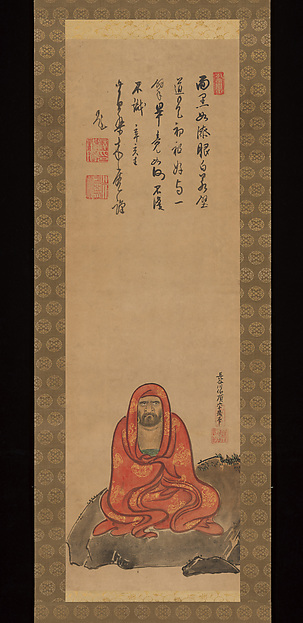
Hasegawa Hakujun, Bodhidharma in Red Robes, 1671, Hanging scroll; ink, color, and gold on paper. The Metropolitan Museum of Art, Mary and Cheney Cowles Collection, Gift of Mary and Cheney Cowles, 2025, accession 2025.795.8.
Look closer: The red robe is here more than a century before the doll is documented. The picture does not prove the origin of the doll's colour, but it shows that red and Bodhidharma went together in the painter's mind.
Image: The Metropolitan Museum of Art, Open Access (CC0)

Hakuin Ekaku, Portrait of Bodhidharma, mid-18th century, Hanging scroll; ink on paper. The Metropolitan Museum of Art, Gift of Florence and Herbert Irving, 2015, accession 2015.500.9.3.
Look closer: A few strokes make the whole figure. Compare the glare with the eyes of the doll, which are large, round and symmetrical.
Image: The Metropolitan Museum of Art, Open Access (CC0)

Katsushika Hokusai, Daruma (Buddhist Saint), 18th–19th century, Ink and color on paper. The Metropolitan Museum of Art, Gift of Annette Young, in memory of her brother, Innis Young, 1956, accession 56.121.27.
Look closer: Hokusai's Daruma is one of the many ways of seeing the same hooded figure. The roundness has already begun.
Image: The Metropolitan Museum of Art, Open Access (CC0)
The figure was made in other materials too. The Met records a figure of Daruma of 1780 in white porcelain with low relief under the glaze, an Arita ware of the Imari type, and a seated figure of about 1800 in Kyoto faience with an unglazed face and feet. It also holds a wooden netsuke of Daruma, of the nineteenth century. These are the objects that sit beside the house's own Kutani Daruma Daishi figure, and they show that the doll with blank eyes and the porcelain monk are branches of one iconography.

Figure of Daruma, 1780, White porcelain with design in low relief under the glaze (Arita ware, Imari type). The Metropolitan Museum of Art, Gift of Mrs. V. Everit Macy, 1923, accession 23.225.164.
Look closer: The Arita figure makes the patriarch into a rounded white mass. The silhouette is the same as the paper doll's.
Image: The Metropolitan Museum of Art, Open Access (CC0)
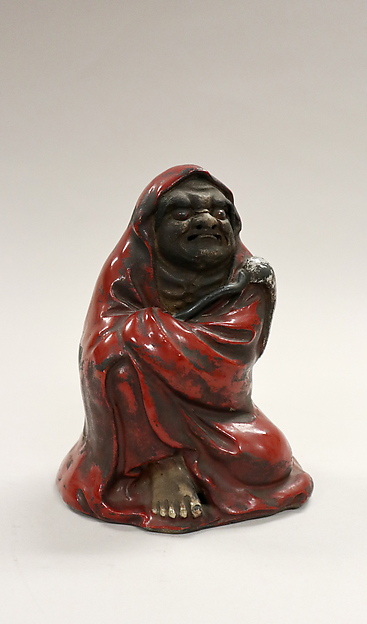
Seated Figure of Daruma, 1800, Faience with feet and face unglazed, the rest covered with enamel (Kyoto ware). The Metropolitan Museum of Art, Gift of Mrs. V. Everit Macy, 1923, accession 23.225.263.
Look closer: The bare face and feet against the coloured robe show how makers separated the flesh from the cloth.
Image: The Metropolitan Museum of Art, Open Access (CC0)

Netsuke of Daruma, 19th century, Wood. The Metropolitan Museum of Art, Edward C. Moore Collection, Bequest of Edward C. Moore, 1891, accession 91.1.710b.
Look closer: The netsuke carries the figure at the waist, as a charm. The shape is still the same rounded one.
Image: The Metropolitan Museum of Art, Open Access (CC0)
Snowmen, Pokémon and a Children's Chant
The daruma has seeped into the language and the playground. Wikipedia records the children's game Darumasan ga Koronda, the equivalent of Red Light, Green Light, and the stacking game Daruma Otoshi. It notes that the Japanese word for a snowman, yukidaruma, comes from the doll, and that Japanese snowmen usually have two sections rather than three. It also says that in 2010 the Pokémon Company created the creatures Darumaka and Darmanitan, based on the daruma.
The article describes the doll's wider symbolism: perseverance and good luck, a popular gift of encouragement, a thing that many Buddhist temples sell for goal-setting. It calls the doll a toy for some and a good-luck talisman for most, and it cites the 1967 Time report of Prime Minister Eisaku Sato painting the right eye of his doll and remarking that the eyes were as big as his own. Its references include a 2025 Indian Express article on the Indian prime minister, Narendra Modi, receiving a daruma during a trip to Japan, a reminder that the doll is also an exportable emblem.
The Met's 1935 album of folk toys, Japanese Folk Toys: Spring, by Yamashita Hakuba, shows how long the daruma has been counted among toys. It is an ink drawing, in the museum's open collection, of painted daruma in several sizes, and it appears in the picture below. The doll's two lives, as charm and as toy, were already recognised by an artist cataloguing playthings in the 1930s.

Yamashita Hakuba 山下白馬, Japanese Folk Toys: Spring (Kyōdo gangu shū: haru) 郷土玩具集: 春(きょうどがんぐしゅう: はる), 1935, Ink on paper. The Metropolitan Museum of Art, Gift of Lincoln Kirstein, 1985, accession JIB200.
Look closer: The artist catalogues daruma as folk toys, along with other playthings in the album. The shapes are familiar, the patterns inventive.
Image: The Metropolitan Museum of Art, Open Access (CC0)
Paint-Your-Own and the January Hatsuichi
In the Takasaki of today, Visit Gunma says, Daimonya Co. is the largest producer, and visitors can paint their own daruma at its shop. Daruma are on sale at the January markets in Takasaki, and Visit Gunma also records the Maebashi Hatsuichi Festival, held every January, with Shinto rituals, a daruma burning at Hachimangu Shrine, a procession and all-day stalls. The Nippon News feature on the Shorinzan market calls it Japan's most famous daruma market and says owners can bring a doll to a monk, who prays for their good luck.
Wikipedia's Daruma article adds that more than 400,000 people attend the Takasaki fair according to the city, and that the festival includes a twenty-four hour reading of sutras by Shorinzan monks for world peace. The temple article, by contrast, says only that thousands of visitors attend each year, and gives no attendance figure of its own. The two are different readings of the same event and the almanac prints both. A visitor planning a trip should expect large crowds on 6 and 7 January.
The burning that ends the doll's year is described in the same sources. Wikipedia says the ceremony, daruma kuyo, is held yearly, usually just after New Year's Day, that owners return last year's dolls, express gratitude and buy new ones, and that at the best-known sites, Nishi-Arai Daishi in Tokyo and Dairyu-ji in Gifu, the dolls are burned together with a procession of monks, readings of sutras and the blowing of horns. Visit Gunma advises that the burning should happen whether or not the wish was granted, and that someone still pursuing the goal may buy a new daruma, recommit or set a new goal.
A Short Glossary of Daruma
Each term below is explained by the source named beside it.
| Term | Meaning | Source |
|---|---|---|
| Daruma | A hollow, round doll modelled on Bodhidharma, usually red | Wikipedia |
| Okiagari-koboshi | A weighted self-righting toy; a monk-shaped version was popular in the Kinki region in the mid-seventeenth century | Wikipedia |
| Nanakorobi yaoki | Fall over seven times, get up eight | Wikipedia; Web Japan |
| Daruma-ichi | The daruma market, held at Shorinzan on 6 and 7 January | Visit Gunma; Wikipedia |
| Daruma kuyo | The yearly ceremony in which old dolls are returned and burned | Wikipedia |
| Sankaku daruma | Triangle daruma, a rolled cardboard cone on a rounded clay base | Wikipedia |
| Goshiki daruma | A set of five colours: blue, yellow, red, white and black | Wikipedia |
| Hime daruma, onna daruma | Princess and lady daruma, feminine forms dating from the Edo period | Wikipedia |
| Matsukawa daruma | A slender, usually blue daruma with pre-painted eyes, from the Sendai area | Wikipedia |
| Takarabune | The treasure ship that carries the Seven Lucky Gods; the model for the Matsukawa base | Wikipedia |
| Daruma otoshi | A stacking game of five pieces knocked out with a hammer | Wikipedia |
| Yukidaruma | A snowman, usually in two sections in Japan | Wikipedia |
Twelve Small Surprises
Each item comes from a source named in the chapter.
- A glowing tree exposed by a flood is said to have given the temple its Daruma statue (Wikipedia, Shorinzan Daruma Temple).
- The German architect Bruno Taut lived for two years in a small building at the temple from 1934 (Wikipedia).
- Akira Kurosawa wrote a script set at the temple, A German at Daruma Temple, that was never filmed (Wikipedia).
- A fire on 14 June 1881 destroyed the temple's early documents (Wikipedia).
- The doll's eyebrows are cranes and its beard is a tortoise (Wikipedia; Visit Gunma).
- A snake or dragon once crossed the doll's moustache before the tortoise replaced it (Wikipedia).
- A Japanese snowman is called a yukidaruma, usually in two sections (Wikipedia).
- Two Pokémon, Darumaka and Darmanitan, were created from the doll in 2010 (Wikipedia).
- A Miharu daruma carries the pattern of the robe lining around its face (Dr Gabi Greve).
- The Miharu market has more than seventy stalls (Dr Gabi Greve, 2005).
- An iron daruma was balanced by computer so that it could stand upright (Openers).
- A set of three small daruma was given to meeting participants in Tokyo as a message of recovery (Openers).
What People Ask About Daruma
People ask which eye to paint first. Wikipedia, Web Japan and Visit Gunma all say the left eye is painted when a goal is set and the right when it is reached. People ask what happens if the wish is not granted. Visit Gunma says that the owner may still fill the second eye to mark a successful year, and that the doll should be burned after a year whether or not the wish came true.
People ask why the doll is red. Wikipedia gives two explanations, the robes of high-ranking priests and the late Edo belief that red pacified the smallpox god, and calls the first uncertain. It adds that Ulak documented red-robed pictures of Bodhidharma before the doll existed. People ask why a Zen monk has no arms and legs. The legend, reported by Wikipedia and Visit Gunma, is that nine years of wall-facing meditation caused his limbs to atrophy, and that the doll's shape borrows from the self-righting toy as well.
People ask where daruma are made. About eighty per cent come from Takasaki, according to the city and Wikipedia, and there are other regional schools, such as Miharu in Fukushima. People ask whether they should be kept. The sources describe a yearly cycle of buying, wishing and burning, and the burning is part of the custom.
Takasaki and Beyond

Described on Commons as a typical Takasaki daruma doll for an election in Japan. Photograph by Asanagi, CC0. Wikimedia Commons, File:Takasaki Daruma doll 2023-04-23 (1).jpg.
Look closer: The belly bears large black characters on a red ground, and the eyes are left blank, ready for the ritual.
Image: Asanagi, CC0, via Wikimedia Commons

The profile shows the egg-shaped body. Photograph by Asanagi, CC0. Wikimedia Commons, File:Takasaki Daruma doll 2023-04-23 (2).jpg.
Look closer: The side view shows the rounded body that gives the doll its self-righting weight.
Image: Asanagi, CC0, via Wikimedia Commons

Racks of daruma at the temple of Katsuo-ji, as the Commons title gives it. Photograph by Chris Gladis, CC BY 2.0. Wikimedia Commons, File:Katsuo-ji daruma.jpg.
Look closer: Each small red doll in the rack is a finished wish returned to the temple, according to the photographer's description.
Image: Chris Gladis, CC BY 2.0, via Wikimedia Commons
Bodhidharma at the Desk
The house holds a Kutani ware Daruma Daishi figure, 47 cm, in brocade-pattern overglaze and gilt, a ceramic portrait of the monk rather than a papier-mâché charm. Stock changes; the shelf page shows what is here now.
Answered plainly
Why do daruma have no eyes?
They are sold with blank eyes so that the owner can paint one when making a wish and the other when it comes true.
Which eye is painted first?
Wikipedia and Web Japan say the left eye, when a goal is set.
Where are most daruma made?
In Takasaki, Gunma, which Wikipedia and Visit Gunma say makes about 80 per cent of them.
What should I do with an old daruma?
Visit Gunma says they are burned about a year after purchase at a temple, shrine or festival.
Where was Bruno Taut buried?
The sources read do not say. Wikipedia records only that he said at his farewell party in 1936 that he wished to be buried at Shorinzan.
What is a Miharu daruma?
A papier-mâché daruma from Fukushima Prefecture with a flat head, a blue outline around the face and a robe-lining pattern, according to Dr Gabi Greve.
What is a lady daruma?
A feminine form, hime or onna daruma, which began in the Edo period according to Wikipedia.
Is red the only colour?
No. Visit Gunma lists purple, gold or yellow, black, pink, green and blue, each with its own meaning.
When is the Takasaki market?
On 6 and 7 January at Shorinzan Daruma Temple.
Where next
Sources and image credits
- Daruma doll, Wikipedia
- Shorinzan Daruma Temple, Wikipedia
- Takasaki Daruma, Gunma Icon, Visit Gunma
- Japan Atlas: Traditional Crafts, Daruma, Web Japan
- Shorinzan Daruma Market, Nippon News
- Miharu Daruma, Daruma Museum (Dr Gabi Greve), 14 February 2005
- Three Daruma Dolls Born in Three Northeastern Disaster-Stricken Prefectures, Openers, 16 December 2014
- Object record, File:Daruma doll.jpg, Wikimedia Commons
- Object record, File:Daruma0791.jpg, Wikimedia Commons
- Object record, Daruma in a Boat with an Attendant, The Metropolitan Museum of Art
- Object record, File:Black Daruma at Takasaki Station Gunma Prefecture Japan.jpg, Wikimedia Commons
- Object record, File:Daruma dolls by prime ministers from Gunma at Daruma-ji (Takasaki) 2010-04-01.jpg, Wikimedia Commons
- Object record, File:Daruma Doll.jpg, Wikimedia Commons
- Object record, File:Daruma doll sai2011.jpg, Wikimedia Commons
- Object record, File:Daruma dolls.jpg, Wikimedia Commons
- Object record, Courtesan as Daruma, The Metropolitan Museum of Art
- Object record, Onna no Daruma, The Metropolitan Museum of Art
- Object record, Bodhidharma in Red Robes, The Metropolitan Museum of Art
- Object record, Portrait of Bodhidharma, The Metropolitan Museum of Art
- Object record, Daruma (Buddhist Saint), The Metropolitan Museum of Art
- Object record, Figure of Daruma, The Metropolitan Museum of Art
- Object record, Seated Figure of Daruma, The Metropolitan Museum of Art
- Object record, Netsuke of Daruma, The Metropolitan Museum of Art
- Object record, Japanese Folk Toys: Spring (Kyōdo gangu shū: haru) 郷土玩具集: 春(きょうどがんぐしゅう: はる), The Metropolitan Museum of Art
- Object record, File:Takasaki Daruma doll 2023-04-23 (1).jpg, Wikimedia Commons
- Object record, File:Takasaki Daruma doll 2023-04-23 (2).jpg, Wikimedia Commons
- Object record, File:Katsuo-ji daruma.jpg, Wikimedia Commons


Last reviewed 28 October 2026. Pictures, where shown, are public-domain or open-access and credited beneath each one.
Looking for a particular tin toy, doll or figure, or a view on one you own? The concierge desk replies within one to three business days.
Browse Retro, Vintage, Antique and Modern Toys · Make a private request
Private concierge
Looking for something in particular?
Describe the piece or the project you have in mind. A senior advisor in Tokyo reads every case file personally and replies within two business days, with fees set out in writing before any work begins.