
Kutani: Old Colours, Doubtful Origins
Pottery Almanac · Overglaze
Kutani: Old Colours, Doubtful Origins
Kutani is the most famous overglaze porcelain in Japan, painted in deep green, yellow, blue, purple and red. It is also the one whose origin has been argued longest, because much of the old Kutani may not have been made at Kutani at all.
Fact sheet
At a glance
- A name that is not a place. Ko-Kutani, old Kutani, is a style label. Wikipedia says the more prestigious wares are a complex and much mis-represented group, very often not from Kutani at all.
- Five colours, bold design. The classical palette, gosai-de, is green, blue, yellow, purple and red, applied to cover most of the surface in landscapes, nature and figures.
- A tradition and a doubt. Tradition says a Kaga retainer learned porcelain at Arita and set up a kiln at Kutani in the 1650s. Kiln-site excavations point to Arita for much of the output.
- A nineteenth-century revival. Production restarted in 1804 or 1807 as Saiko-Kutani, and the red-and-gold style reached Vienna in 1873.
- Still a living craft. Kutani became a designated traditional craft in 1975, and its masters include Living National Treasures.
A Name Without a Fixed Address
Kutani ware is a style of Japanese porcelain traditionally supposed to come from Kutani, a place now part of Kaga in Ishikawa Prefecture. The word kutani means Nine Valleys. Wikipedia divides the ware into two phases: Ko-Kutani, old Kutani, from the seventeenth and early eighteenth centuries, and Saiko-Kutani, from the revived production of the nineteenth.

Plate with Landscape Decoration, ca. 1670, Overglaze enamels (Arita ware, Ko Kutani style). The Metropolitan Museum of Art, Dr. and Mrs. Roger G. Gerry Collection, Bequest of Dr. and Mrs. Roger G. Gerry, 2000, accession 2002.447.92.
Look closer: the border is a dense green and blue pattern and the centre is left white for a landscape of hills and a fence. The museum catalogues it as Arita ware in the Ko-Kutani style, which is the question of this chapter in one label.
Image: The Metropolitan Museum of Art, Open Access (CC0)
The phrase in the first paragraph, traditionally supposed, carries the weight. The same article says outright that the more prestigious Ko-Kutani wares are recognised by scholars to be a complex and much mis-represented group, very often not from Kutani at all. In consequence the wares are now sometimes grouped with Imari ware, perhaps as Ko-Kutani type, or placed under the wider headings of Arita ware or Hizen ware.
A reader of a catalogue should therefore treat Ko-Kutani as a description of how a piece looks, and ask separately where and when it was made. The rest of this chapter shows how that distinction developed.
The Five Colours
The classical Kutani palette is called gosai-de, the five-colour style. According to Wikipedia it includes green, blue, yellow, purple and red, and the designs are bold, normally depicting landscapes, the beauty of nature and people, and covering most of the surface of each piece. The vivid dark colours, the article says, epitomise a lavish aesthetic. One theory it records is that the long, harsh, grey winters of the Hokuriku region produced a desire for strong colour. It is a theory, and it should be held lightly.

Plate with Design of Fans, ca. 1650, Porcelain with overglaze enamels (Hizen ware, Ko Kutani style). The Metropolitan Museum of Art, Dr. and Mrs. Roger G. Gerry Collection, Bequest of Dr. and Mrs. Roger G. Gerry, 2000, accession 2002.447.101.
Look closer: a field of dark green brushwork covers the plate, and fan shapes are opened up within it in yellow lattice and black lines. Note the narrow striped rim in green and black.
Image: The Metropolitan Museum of Art, Open Access (CC0)
Two old types are named. Aote uses deep green, yellow, dark blue and purple, and Iroe uses red, green, purple, dark blue and yellow. In both, the colours are deep and the design covers nearly the whole surface.
In the Met's plate with a design of fans, from about 1650 and classed as Ko-Kutani style, the green field is so dense that it reads almost as texture.
The Story of Goto Saijiro
The traditional account, as Wikipedia gives it, begins in 1655, the first mention of Kutani, during the Meireki era. Clays suitable for porcelain were said to have been found in the Kutani mines of the Daishoji clan, a cadet branch of the Maeda who ruled Kaga. Goto Saijiro, a Maeda retainer, was sent by the daimyo of Kaga, Maeda Toshiharu, to Arita in Hizen to learn how to make porcelain, and then set up a kiln in the village of Kutani. The lords of Kaga became great patrons of the ware, and the porcelains of this early period are called Ko-Kutani and are very rare.
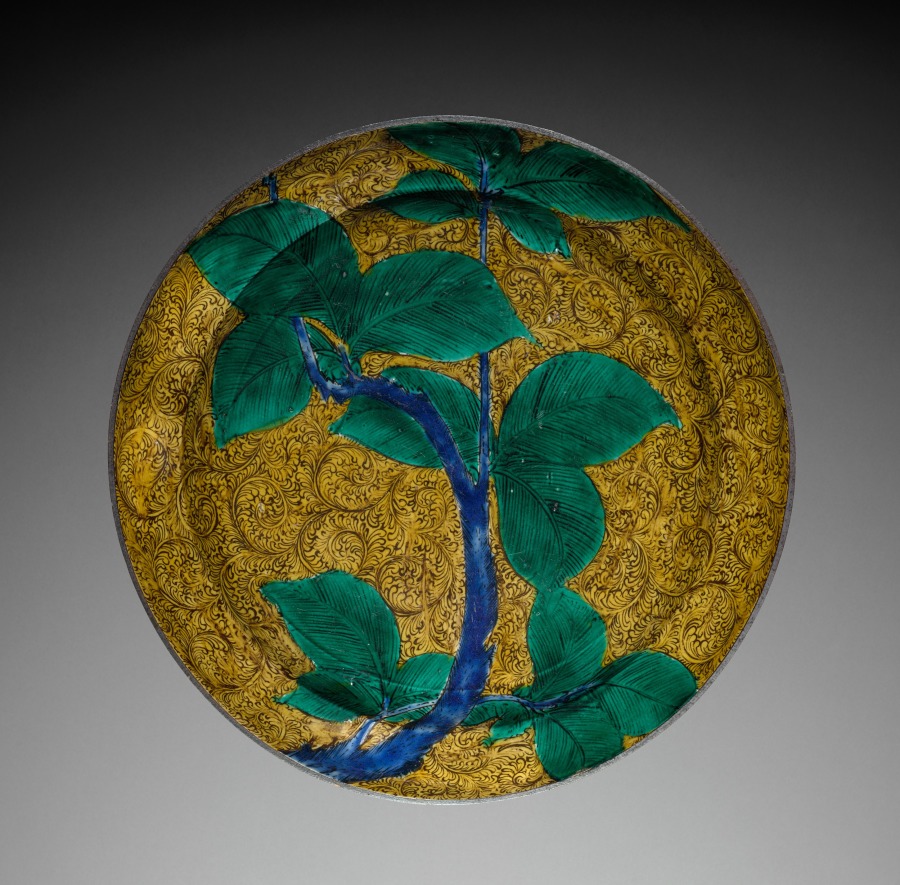
Large Dish with Persimmon Branch, mid- to late 1600s, Porcelain with underglaze black and overglaze enamel (Hizen ware, Ko-Kutani style). The Cleveland Museum of Art, Severance and Greta Millikin Collection, accession 1964.245.
Look closer: the leaves are green enamel over black outlines and the ground is a patterned yellow. The museum places the dish in Hizen ware, not in Kaga.
Image: The Cleveland Museum of Art, Open Access (CC0)
The same article gives the end of the story: production suddenly closed down in 1730. The reasons are debated. Theories include a shortage of the pigments needed for the glazes, or financial difficulties. A memorial stele to Goto stands near an old Kutani kiln in Kaga.
The dish pictured above, from Cleveland, is catalogued as Hizen ware in the Ko-Kutani style: the branch is drawn in dark underglaze lines and enamelled over a yellow ground. It shows in one object the style that the legend tries to explain.
What the Shards Say
Kiln-site archaeology changed the picture. The Arita article states that evidence from modern excavation of kiln sites shows that much of the Kutani ware, supposedly from Honshu, was in fact made around Arita. The Kutani article adds that it is now understood that much, if not most, of the Ko-Kutani production was around Arita.
The original Kutani kilns in Ishikawa were also examined. The site is a National Historic Site, designated in 1979, and an excavation survey begun by the Ishikawa Prefecture Board of Education in 1955 found two continuous-cell step kilns on the right bank of the Daishoji River. The first had a combustion chamber and 13 burning chambers up a hillside, 33.4 metres long. Among the many shards recovered, the article reports, white porcelain and celadon predominated. That hints at a kiln that made plainer wares as well.
The honest conclusion is a layered one. There was a kiln at Kutani, there were Kaga patrons, and Ko-Kutani is a real and very rare category. But the label has been applied, to a large body of Hizen porcelain whose centre of production lay in Kyushu, around Arita.
Saiko-Kutani, the Revival
In 1804, or possibly 1807, Wikipedia records, production was re-established with the help of several kamamoto, production potters, and new overglaze painting techniques went into what became known as Saiko-Kutani, revived Kutani. During the nineteenth century the style shifted to a more red design called aka-e, with intricate patterns, and with a gold technique called kinran-de the combination became aka-e kinran-de Kutani.

Deep Footed Plate with Decoration of Leaves, ca. early 19th century, Polychrome enamels (Kutani ware, Yoshidaya revival). The Metropolitan Museum of Art, Dr. and Mrs. Roger G. Gerry Collection, Bequest of Dr. and Mrs. Roger G. Gerry, 2000, accession 2002.447.100.
Look closer: yellow and green leaves cover the footed dish, and the green piece beside it carries a fan, so the revival looks back to the colouring of Ko-Kutani. The museum names it Yoshidaya revival.
Image: The Metropolitan Museum of Art, Open Access (CC0)
The article names several overglaze styles that dominate the revival, among them the Mokubei style, influenced by Chinese ink painting; the Yoshidaya style, with green, yellow, purple and dark blue; the Eiraku style, with simple gold over a first coat of red; and the Iidaya style, in which tiny figure paintings sit on a red and gold ground. Both the Yoshidaya revival and the red-and-gold manner are pictured here.
Kutani went abroad at the Vienna World Exposition of 1873, where kinran-de was shown, which helped to spread its popularity and contributed to the growth of exports to Europe. In 1975 Kutani was named a traditional craft, and the article says that several hundred companies now produce it.
The Slow Process and the Living Makers
The Kutani article describes the production process. A plain white piece is given a fine komon pattern, the same kind of small pattern found on kimono, with outlines painted in zaffre, a cobalt oxide, which is fired and turns dark in about seven hours. The five colours of vitreous enamel are then painted with thick strokes, so that the colour stands slightly proud, and the piece is fired again at about 800 degrees Celsius, when the pigment turns into translucent glass.
One feature is unique to Kutani. Saiji is calligraphy in miniature, and its founder is considered to be Oda Seizan, who in the early Meiji era wrote classical Chinese poems inside tea and sake cups with the thinnest brushes. Among his achievements the article lists the whole Ogura Hyakunin Isshu inside a Western-style cup three centimetres across. The art passed through his son-in-law to Tamura Keisei (born 1949), designated an Intangible Cultural Property of Ishikawa Prefecture in 2005.
The article names Tokuda Yasokichi III (1933 to 2009), designated a Living National Treasure for his enamel work in ao-de ko-Kutani, and Yoshida Minori (born 1932), a Living National Treasure who specialises in the yuri-kinsai technique. A directory of such makers is linked below.
| Label | What it should mean | What to ask |
|---|---|---|
| Ko-Kutani | Rare porcelain of the 17th and early 18th century in the old styles | Where is the evidence for Kutani, not Arita? |
| Ko-Kutani style or type | Made around Arita, or later, in the old manner | Is the date given, and who is the source? |
| Saiko-Kutani | Revived Kutani of the 19th century, several overglaze styles | Which style, and what is the mark? |
| Kutani ware today | Contemporary production, many companies | Which maker, and is the piece signed? |
Five Colours and Red-and-Gold

Plate with Bird and Flower, mid- to late 1600s, Porcelain with overglaze enamel (Hizen ware, Ko-Kutani style). The Cleveland Museum of Art, Gift from various donors by exchange, accession 1960.174.
Look closer: a white ground left open and a small bird perched on a rock, with a rim of green leaf scrolls. Not every Ko-Kutani piece is a dark field; this one is airy.
Image: The Cleveland Museum of Art, Open Access (CC0)

Square Plate with Design of Grapes and Squirrel, first half 19th century, Porcelain with polychrome enamels over transparent glaze (Kutani type). The Metropolitan Museum of Art, The Harry G. C. Packard Collection of Asian Art, Gift of Harry G. C. Packard, and Purchase, Fletcher, Rogers, Harris Brisbane Dick, and Louis V. Bell Funds, Joseph Pulitzer Bequest, and The Annenberg Fund Inc. Gift, 1975, accession 1975.268.576.
Look closer: yellow leaves are cut out of a dark green field, with a small squirrel below the grapes. The museum calls it Kutani type of the first half of the nineteenth century.
Image: The Metropolitan Museum of Art, Open Access (CC0)

Bowl: Kutani Ware, early to mid-1800s, porcelain with overglaze enamel and gold decoration. The Cleveland Museum of Art, Anonymous Gift, accession 1986.173.
Look closer: red lines and gold dominate and the white body hardly shows. This is the aka-e kinran-de manner of the revival.
Image: The Cleveland Museum of Art, Open Access (CC0)
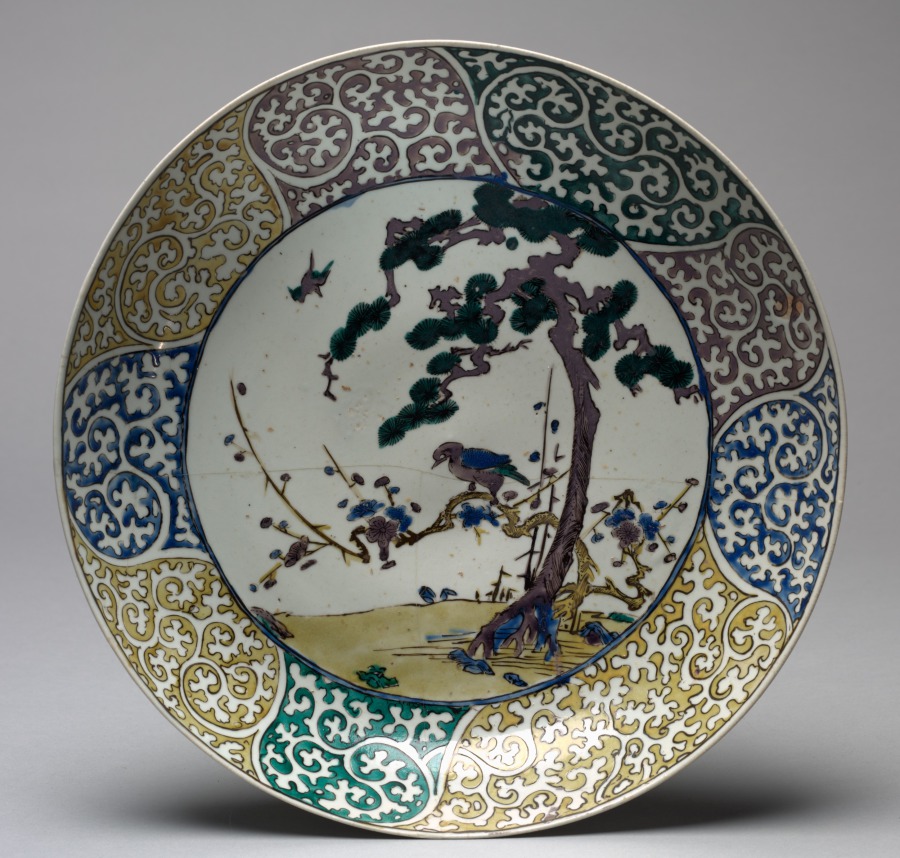
Plate with Bird and Flower, early 1900s, Porcelain with overglaze enamel (Ko-Kutani revival style). The Cleveland Museum of Art, Gift of Mrs. Terrence O. Kennedy in memory of her husband, Terrence O. Kennedy, accession 1969.253.
Look closer: the museum catalogues this as a Ko-Kutani revival style plate of the early 1900s, a century and a half after the first period. The pine and bird are drawn in dark overglaze lines.
Image: The Cleveland Museum of Art, Open Access (CC0)
A Shelf of Kutani
The house keeps a collection of Japanese Kutani ware and decorative arts. The concierge desk can say where a piece sits in the story above, and whether it is catalogued as Kutani or in the Kutani style.
Answered plainly
What does Kutani mean?
Nine Valleys. It is the name of a place now in Kaga, Ishikawa Prefecture, where kilns were set up in the seventeenth century.
Is Ko-Kutani made in Kutani?
Not necessarily. Scholars have found that much of it was made around Arita in Hizen. The label names a style, and the origin of a particular piece needs separate evidence.
What are the five colours of Kutani?
Gosai-de: green, blue, yellow, purple and red.
When was Kutani revived?
In 1804, or possibly 1807, as Saiko-Kutani, with new overglaze painting styles, and it became a designated traditional craft in 1975.
Where next
Sources and image credits
- Kutani ware, Wikipedia
- Arita ware, Wikipedia
- Imari ware, Wikipedia
- Object record, Plate with Landscape Decoration, The Metropolitan Museum of Art
- Object record, Plate with Design of Fans, The Metropolitan Museum of Art
- Object record, Large Dish with Persimmon Branch, The Cleveland Museum of Art
- Object record, Deep Footed Plate with Decoration of Leaves, The Metropolitan Museum of Art
- Object record, Plate with Bird and Flower, The Cleveland Museum of Art
- Object record, Square Plate with Design of Grapes and Squirrel, The Metropolitan Museum of Art
- Object record, Bowl: Kutani Ware, The Cleveland Museum of Art
- Object record, Plate with Bird and Flower, The Cleveland Museum of Art
Last reviewed 28 October 2026. Pictures, where shown, are public-domain or open-access and credited beneath each one.
Looking for a particular Kutani piece or a view on a label? The concierge desk replies within one to three business days.
Browse Kutani ware and decorative arts · Make a private request
Private concierge
Looking for something in particular?
Describe the piece or the project you have in mind. A senior advisor in Tokyo reads every case file personally and replies within two business days, with fees set out in writing before any work begins.