
Arita and Imari: The First Japanese Porcelain
Pottery Almanac · Hizen
Arita and Imari: The First Japanese Porcelain
Japan's first porcelain came out of a clay hill in northwestern Kyushu, was shipped from the harbour of Imari, and ended up on the tables and in the cabinets of Europe. Three words, Arita, Imari and Hizen, name the same story from different ends.
Fact sheet
At a glance
- Three names, one region. Arita is the town and the kilns, Hizen the old province, and Imari the harbour from which the wares were shipped. In Western usage, Imari came to mean the coloured style.
- Korean craft, Chinese enamel. Tradition credits Korean potters with the first porcelain and a Chinese refugee with overglaze enamel. The details are disputed, and the sources below say so.
- Made for Europe. Dutch East India Company orders from 1656 turned Arita into Japan's great export kiln until Chinese exports resumed in the mid-eighteenth century.
- Copied everywhere. Meissen, Chantilly, Chelsea, Delft and Chinese kilns all imitated Arita styles, and the style is still made.
- One domain kiln stayed home. Nabeshima ware, the finest of all, was made for the shogunate and the daimyo and was never sold on the open market.
From a Clay Hill
Arita ware is a broad term for Japanese porcelain made around the town of Arita, in the former Hizen Province of northwestern Kyushu, and Wikipedia states that this was the area where the great majority of early Japanese porcelain, and above all Japanese export porcelain, was made. It is also known as Hizen ware, after the wider province.

Small Dish (Kozara) with Chinese Male Figure, ca. 1620–30s, Porcelain with cobalt blue under transparent glaze (Hizen ware, Arita type). The Metropolitan Museum of Art, The Harry G. C. Packard Collection of Asian Art, Gift of Harry G. C. Packard, and Purchase, Fletcher, Rogers, Harris Brisbane Dick, and Louis V. Bell Funds, Joseph Pulitzer Bequest, and The Annenberg Fund Inc. Gift, 1975, accession 1975.268.495.
Look closer: there is almost nothing on the plate: one small figure, drawn in a few strokes of cobalt blue, and a lot of white. This sparseness is what separates early Arita from the crowded export styles that followed.
Image: The Metropolitan Museum of Art, Open Access (CC0)
Tradition names a Korean potter, Yi Sam-pyeong, or Kanagae Sanbee in Japanese, as the father of Arita porcelain. He is honoured as founder in Sueyama Shrine, but the same article records that the story is disputed by many historians. What is not disputed is the underlying fact: porcelain clay was found near Arita near the end of the sixteenth century, and a number of kilns opened in the area. The wider setting was the Korean campaigns of the 1590s, after which the lord of Saga domain brought Korean potters to Kyushu.
The first Arita porcelains were small and plain. The Imari article calls the earliest group Shoki-Imari, early Imari: generally small, sparsely painted in underglaze blue and made for the domestic market. A porcelain dish in the Metropolitan Museum from the 1620s or 1630s shows the type, a single standing figure floating in an expanse of white.
Blue Before Colour
Early Arita used underglaze blue, cobalt painted onto the unfired body and covered with a transparent glaze. The Metropolitan Museum owns a set of ten bowls with egrets, dated 1639, which fix the style in time: a lobed rim, a wreath of scrolling leaves and, in the centre, one bird standing in white space.
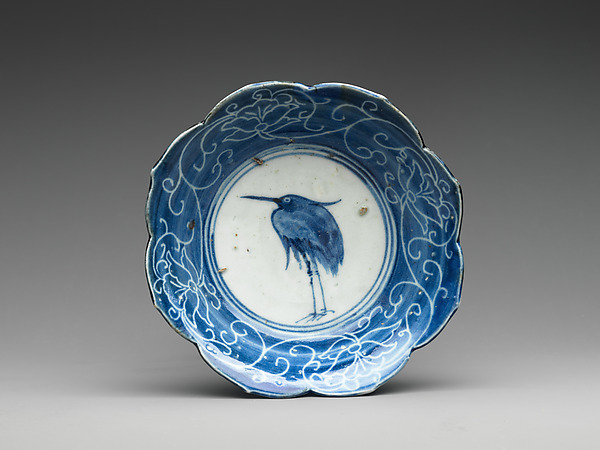
One of Ten Bowls (Hachi) with Egrets, 1639, Porcelain with cobalt blue under transparent glaze (Hizen ware, Arita type). The Metropolitan Museum of Art, The Harry G. C. Packard Collection of Asian Art, Gift of Harry G. C. Packard, and Purchase, Fletcher, Rogers, Harris Brisbane Dick, and Louis V. Bell Funds, Joseph Pulitzer Bequest, and The Annenberg Fund Inc. Gift, 1975, accession 1975.268.480.
Look closer: the egret stands in an uncluttered white circle, and the scroll pattern of the border is drawn in blue lines of varying weight. It is one of a set of ten dated 1639.
Image: The Metropolitan Museum of Art, Open Access (CC0)
The Imari article adds that there are also large green celadon dishes among the early wares, made for the markets of South-East Asia in a porcelaneous stoneware. The kilns made, besides, a plain white porcelain called hakuji, often modelled on the Chinese Dehua ware. The idea that Arita made only blue and white, or only export, is a later simplification.
Arita was also not copying slavishly. Wikipedia notes that early wares for Europe often used Western shapes with Chinese decoration, while sophisticated wares in authentic Japanese styles were made at the same time for the fastidious home market.
Enamel Arrives
By the middle of the seventeenth century, Wikipedia records, Arita was in the forefront as Japan developed overglaze enamel decoration in a range of bright colours. The Imari article gives a traditional account: many Chinese refugees were in northern Kyushu at that time because of the turmoil in China, and one of them is said to have brought the overglaze enamel technique. The wording is hedged by its own source, and so is ours.
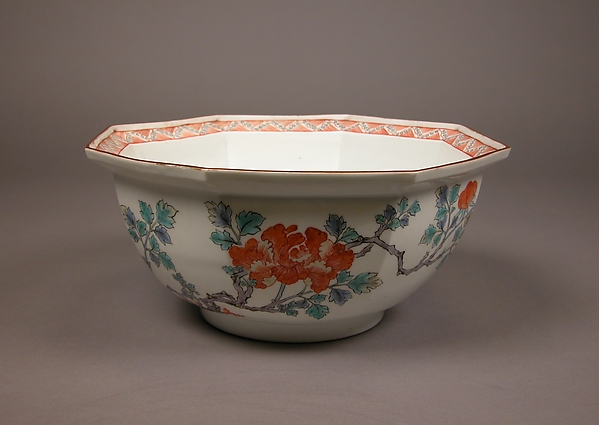
Octagonal Bowl with Design of Peonies, 1670–1710s, Porcelain with overglaze enamels (Hizen ware, Arita region, Kakiemon style). The Metropolitan Museum of Art, Dr. and Mrs. Roger G. Gerry Collection, Bequest of Dr. and Mrs. Roger G. Gerry, 2000, accession 2002.447.58.
Look closer: a few peonies spread across the bowl with space left bare around them, in soft red, blue and green over white. The orange-red band at the rim and the octagonal profile are typical of the Kakiemon style.
Image: The Metropolitan Museum of Art, Open Access (CC0)
From that point the Imari article lays out a lineage. Shoki-Imari developed into Ko-Kutani, then Imari proper, and later Kakiemon. Ko-Kutani, made around 1650 for both export and the home market, is characterised by vivid green, blue, purple, yellow and red in bold designs of landscape and nature. Evidence from kiln-site excavations, the Arita article adds, shows that much of the ware once assumed to come from Kutani on Honshu was in fact made around Arita. The question is taken up in Kutani: Ko-Kutani and the Question of Origin.
The result was a family of styles that often came from the same kilns. That is the first thing to learn about Arita: the labels, Kakiemon, Imari, Ko-Kutani, name decoration and market more reliably than they name a single workshop.
The Dutch Trade
The name Imari comes from a port. Arita's harbour at Imari in Saga was where the wares were loaded for Nagasaki, where the Dutch East India Company and the Chinese kept trading posts. In the West the coloured wares became known as Imari, a second group as Kakiemon, and the blue and white as Arita, although, as the Imari article stresses, the types were often produced at the same kilns.

Plate with Monogram of the Dutch East India Company, ca. 1660, Underglaze blue (Arita ware). The Metropolitan Museum of Art, Dr. and Mrs. Roger G. Gerry Collection, Bequest of Dr. and Mrs. Roger G. Gerry, 2000, accession 2002.447.40.
Look closer: the intertwined letters at the centre are the company's monogram, set inside a ring of floral panels. The Imari article notes that some export designs, such as kraak porcelain, were adopted from China.
Image: The Metropolitan Museum of Art, Open Access (CC0)
Wikipedia states that Imari began to go to Europe when the Chinese kilns at Jingdezhen were damaged in the political chaos of the Qing takeover and the new government halted trade from 1656 to 1684. The Dutch placed the first large order at Arita in 1656. The trade peaked in the late seventeenth century and then slowly gave way as Chinese kilns recovered, ending around the middle of the eighteenth century, because Japanese labour costs left Imari unable to compete.
The Cleveland Museum of Art holds a jug with a crest painted in blue and fitted with silver mounts, made in Arita in the 1660s or 1670s, and the Met owns a plate of about 1660 with the monogram of the Dutch East India Company. Both are visible evidence of the trade.
Kakiemon and the Milk-White Body
Kakiemon is a name that does three jobs, as Wikipedia explains: it is a family, one or more kilns, and a brightly coloured overglaze style. The potter Sakaida Kakiemon (1596 to 1666) is popularly credited with being among the first in Japan to master enamel decoration on porcelain, known as akae, and with a distinctive palette of soft red, yellow, blue and turquoise green. The kiln itself seems to have been in place by the 1680s.

Ewer with Strap Handle and Floral Decoration, ca. 1680, Porcelain with overglaze enamels (Arita ware, Kakiemon-related type). The Metropolitan Museum of Art, Dr. and Mrs. Roger G. Gerry Collection, Bequest of Dr. and Mrs. Roger G. Gerry, 2000, accession 2002.447.66.
Look closer: the flowers and a small bird are placed asymmetrically on a milky ground, with red lines at neck and foot. The museum classes it as Kakiemon-related, which is exactly the care the label requires.
Image: The Metropolitan Museum of Art, Open Access (CC0)
The style is known for delicate, asymmetrical, well-balanced designs painted sparingly to show off a fine white body, which in Japan is called nigoshide, milky white. The article records that nigoshide was hard to make because the body shrinks in firing, so production stopped from the early eighteenth century to the mid-twentieth. The twelfth and thirteenth Kakiemon succeeded in reproducing it in 1953.
Kakiemon was widely copied. Meissen, Chantilly, Chelsea, Worcester and others copied its designs, and Meissen made a hexagonal vase of the shape named after a pair at Hampton Court, recorded in an inventory of 1696. In 1971 the technique was designated an Important Intangible Cultural Property, and Sakaida Kakiemon XIV (1934 to 2013) was named a Living National Treasure.
Nabeshima, Never Sold
Nabeshima ware is the exception to everything above. Wikipedia describes it as a group of high-grade porcelain produced under the direct patronage and administration of the Saga Domain, ruled by the Nabeshima clan, and centred on the domain kiln at Okawachiyama. It was made principally for presentation to the Tokugawa shogunate, as gifts to other daimyo, and for the household. It was not for sale on the market.

Dish with Cherry Blossoms and Bundles of Brushwood, ca. 1690–1720s, Porcelain with cobalt blue under transparent glaze and polychrome enamels over the glaze (Hizen ware, Nabeshima type). The Metropolitan Museum of Art, Gift of Mrs. V. Everit Macy, 1923, accession 23.225.318.
Look closer: the blue brushwood bundles are the underglaze, and the red cherry blossoms are the enamel added in a second firing. The article notes that Nabeshima designs draw on textiles, paintings and the natural world.
Image: The Metropolitan Museum of Art, Open Access (CC0)
The characteristic piece is a round plate in a standard size, typically in sets of five or ten, with a high foot and a taut curve to the rim. The polychrome type, iro-Nabeshima, paints a design in red, yellow and green, only occasionally black and purple, over a blue-and-white design and fires it again at a lower temperature. As a rule it uses no gold leaf, unlike Imari. Designs come from textiles, paintings and the natural world, including, the article notes, plain subjects such as radishes and eggplants.
Two other points are worth knowing. Tea wares were never made at Nabeshima, although other kilns were making them in the same period. And the domain kiln was abolished in 1871 with the end of the domain system, after which the polychrome tradition was carried on by the Imaizumi Imaemon family, now recognised as an Important Intangible Cultural Property.
A Reading Table
Dealers' labels in this field use the Western names loosely. The table sets down what the sources say each term means, in the simplest form, and where it overlaps with the others. When a label and a date disagree, trust the date and ask for the reason for the label.
| Term | What it names | Period and market |
|---|---|---|
| Arita ware, Hizen ware | Porcelain from the Arita area of Hizen Province; today the umbrella term | From the early 17th century; domestic and export |
| Shoki-Imari | Early small wares, sparse underglaze blue, some large celadon dishes | Before about 1650 |
| Ko-Kutani | Bold green, blue, purple, yellow and red enamel designs, made around Arita | Around 1650; export and domestic |
| Kakiemon | Sparse, asymmetrical enamel designs on a milk-white body | From the late 17th century; Europe |
| Imari (Kinrande) | Underglaze blue with overglaze red and gold, densely patterned | From the mid-17th century to about 1740; Europe |
| Nabeshima | Standard-size plates for the shogunate and the Saga lords | Late 17th to 19th century; not sold |
| Chinese Imari | Chinese copies of the style | 18th century |
Meiji Return and Today
The Imari article ends with a point that every collector should keep in mind: export surged again in the late nineteenth century, in the Meiji era, when japonisme flourished in Europe. As a result, two different kinds of true Japanese Imari are found in the West, the wares exported in the mid-Edo period and those exported in the Meiji era. To collectors the two are completely different, though the kinrande look is similar.
The Cleveland Museum of Art holds a gourd-shaped bottle painted with Western sailing ships, dated c. 1800 to 1868 and catalogued as Arita type, a reminder that the Nagasaki trade never wholly disappeared. The rule is the old one, to judge each piece on its body, its painting and its date rather than on its label.
Imari ware, the article concludes, has been continuously produced to the present day. Meissen, whose factory imitated Kakiemon, entered a sister-city agreement with Arita in 1979.
Arita in Colour

Dish with Figures in a Chinese Garden, 1700s, Porcelain with underglaze blue and overglaze color enamel and gold, with iron oxide rim (Arita ware). The Cleveland Museum of Art, Severance and Greta Millikin Collection, accession 1964.257.
Look closer: red and gold fill the border and the centre holds a garden scene in blue, green and red. This is the kinrande combination of underglaze blue with overglaze red and gold, with very little white left uncovered.
Image: The Cleveland Museum of Art, Open Access (CC0)
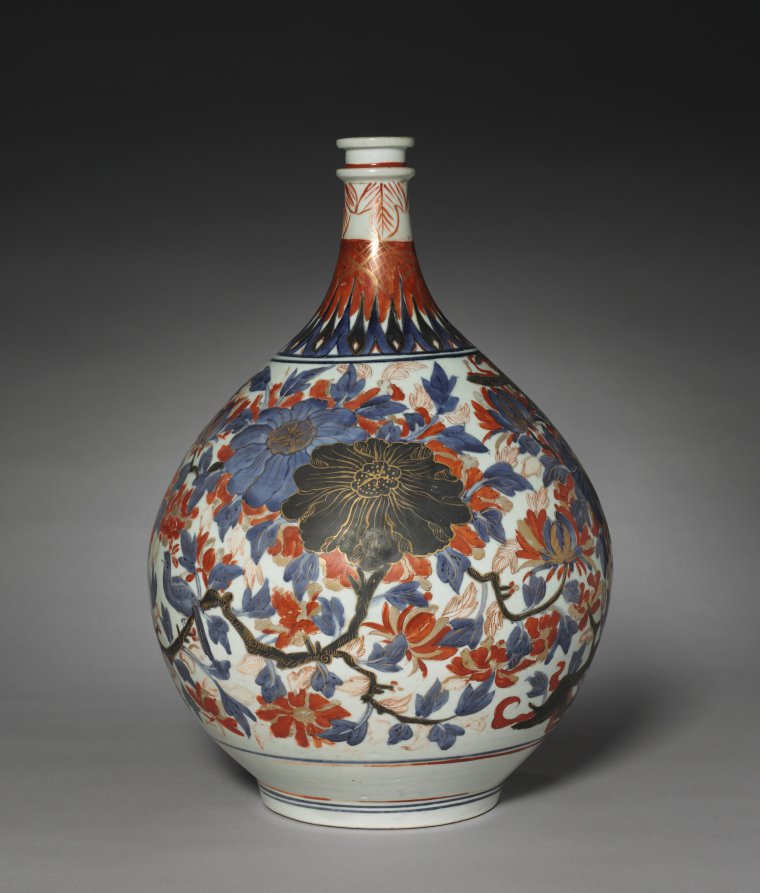
Apothecary's Bottle, 1670s, porcelain with underglaze blue and overglaze color enamels (Hizen ware, Arita type). The Cleveland Museum of Art, Gift of Mrs. James J. Rorimer in memory of Maurice Rohrheimer, accession 1971.169.
Look closer: a pharmacy bottle made in Japan: the peony sprays run round the whole belly, and the museum records both underglaze blue and overglaze colour enamels.
Image: The Cleveland Museum of Art, Open Access (CC0)

Large Dish (Shakuzara) with Cherry Blossoms and Fence, 1690–1720s, Porcelain with cobalt blue under transparent glaze and polychrome enamels over the glaze (Hizen ware, Nabeshima type). The Metropolitan Museum of Art, The Harry G. C. Packard Collection of Asian Art, Gift of Harry G. C. Packard, and Purchase, Fletcher, Rogers, Harris Brisbane Dick, and Louis V. Bell Funds, Joseph Pulitzer Bequest, and The Annenberg Fund Inc. Gift, 1975, accession 1975.268.559.
Look closer: a lattice fence of blue lines is crossed by small pink blossoms, a design that reads like a textile pattern.
Image: The Metropolitan Museum of Art, Open Access (CC0)

Dish with Dutch Landscape (Deshima Island or View of Scheveningen), early 18th century, Porcelain with underglaze blue decoration (Arita ware, Kakiemon type). The Metropolitan Museum of Art, Dr. and Mrs. Roger G. Gerry Collection, Bequest of Dr. and Mrs. Roger G. Gerry, 2000, accession 2002.447.117.
Look closer: the museum's title offers two possible sites, Deshima island or a view of Scheveningen. The figures and buildings are painted in cobalt blue with a brown-glazed rim, and the sea breaks the picture into hills.
Image: The Metropolitan Museum of Art, Open Access (CC0)
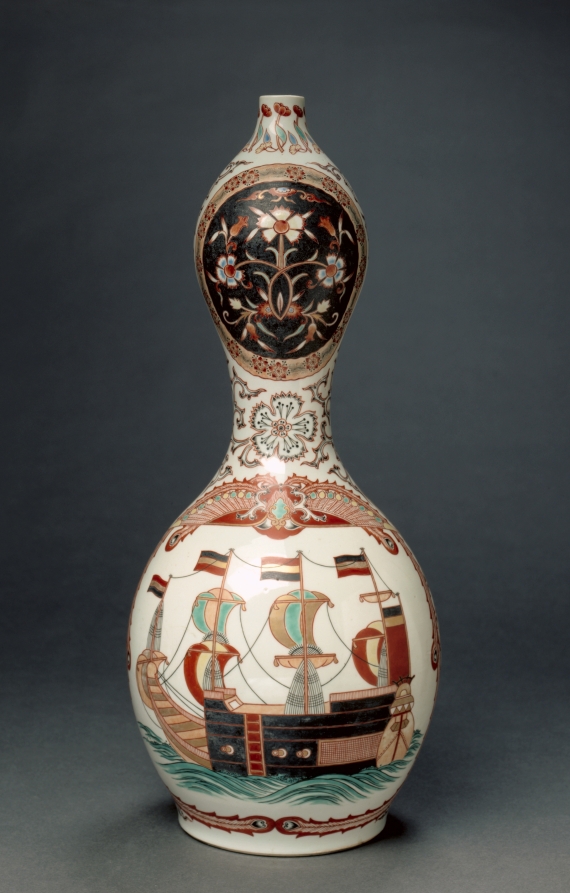
Bottle with Western Ships, c. 1800–1868, Porcelain with decoration in colored enamels and underglaze blue, overglaze enamels, and gold (Hizen ware, Arita type). The Cleveland Museum of Art, Gift of Ralph King, accession 1919.837.
Look closer: three-masted ships with flags sit in the lower bulb of the gourd, and floral panels run above. Western ships are the subject.
Image: The Cleveland Museum of Art, Open Access (CC0)
Pieces to Look For
The house shelves Japanese porcelain and ceramics, and lists Arita and Imari pieces among them when they are available. The concierge desk can say whether a particular piece is in the house.
Answered plainly
What is the difference between Arita and Imari?
Arita is the town and kiln region where the porcelain was made. Imari is the port from which it was shipped. In Western usage, Imari came to mean the coloured style with blue, red and gold, and Arita the blue and white, though the same kilns often made both.
Is Kakiemon a place?
No. Kakiemon is a family, one or more kilns and an overglaze style. Other kilns near Arita made the style too.
What is Nabeshima ware?
Standard-size porcelain plates and related pieces made at the domain kiln of the Nabeshima clan in Saga for the shogunate, other daimyo and their own use, not for sale.
Why do Imari pieces from the Meiji era differ from earlier ones?
They were made for a different market, when European enthusiasm for Japan revived in the late nineteenth century. To collectors the Edo and Meiji exports are completely different, though the kinrande look is similar.
Where next
Sources and image credits
- Arita ware, Wikipedia
- Imari ware, Wikipedia
- Kakiemon, Wikipedia
- Nabeshima ware, Wikipedia
- Object record, Small Dish (Kozara) with Chinese Male Figure, The Metropolitan Museum of Art
- Object record, One of Ten Bowls (Hachi) with Egrets, The Metropolitan Museum of Art
- Object record, Octagonal Bowl with Design of Peonies, The Metropolitan Museum of Art
- Object record, Plate with Monogram of the Dutch East India Company, The Metropolitan Museum of Art
- Object record, Ewer with Strap Handle and Floral Decoration, The Metropolitan Museum of Art
- Object record, Dish with Cherry Blossoms and Bundles of Brushwood, The Metropolitan Museum of Art
- Object record, Dish with Figures in a Chinese Garden, The Cleveland Museum of Art
- Object record, Apothecary's Bottle, The Cleveland Museum of Art
- Object record, Large Dish (Shakuzara) with Cherry Blossoms and Fence, The Metropolitan Museum of Art
- Object record, Dish with Dutch Landscape (Deshima Island or View of Scheveningen), The Metropolitan Museum of Art
- Object record, Bottle with Western Ships, The Cleveland Museum of Art
Last reviewed 28 October 2026. Pictures, where shown, are public-domain or open-access and credited beneath each one.
Looking for a particular kiln, maker or form? The concierge desk replies within one to three business days.
Browse Japanese porcelain and ceramics · Make a private request
Private concierge
Looking for something in particular?
Describe the piece or the project you have in mind. A senior advisor in Tokyo reads every case file personally and replies within two business days, with fees set out in writing before any work begins.