
Kaikei, Master of the Anna Style
Busshi · Nara, active 1189 to about 1223
Kaikei, Master of the Anna Style
快慶
Unkei is remembered for force. Kaikei is remembered for grace, and for a signature. Many of his works are signed with the name An’amidabutsu, a Buddhist name that borrows the Buddha Amida, and that habit gave the elegant manner of his workshop its name, the Anna style.13 He was a busshi, a maker of Buddhist images, of the Kei school, active in Nara in the years when the temples burned in the Genpei War had to be given new gods.2 The Boston Maitreya of 1189 is the earliest work that can be attributed to him, and a small Jizō of about 1202 in New York shows the same hand at the scale of a private chapel.57 This page follows the sculptor through those works, shows where the sources disagree about his dates, his names and the size of his masterpiece, and explains how to look at a figure that might be his.4
Fact sheet
Five things to look for
- The size. Most of his surviving works stand about three shaku high, roughly ninety centimetres, a scale for a private chapel rather than a great hall.1
- The face. Well proportioned, with a calm, dignified expression, in place of the heavy realism of his older colleague.34
- The robe. Drapery that is ordered, sharp and graceful, becoming more complex and refined in the later works.34
- The eyes. Dark-centred crystal inlaid in the eyes, a device the Kei school used to bring images to life.26
- The signature. An’amidabutsu, the name he used to sign many works, and the sign that gave the Anna style its name.13
Unkei’s Counterpart, Not His Shadow
First lookThe two names are nearly always spoken together. Kaikei is called a Japanese busshi of the Kamakura period who is known alongside Unkei, and because many sculptors of the group have a name containing the syllable kei, written 慶, the whole school is called Kei-ha, the Kei school.1 Both men trained in the workshop of Kōkei, Unkei’s father, although one writer is explicit that Kaikei was not related to Kōkei by blood.4 The difference between the two is the difference between two kinds of excellence in the same craft.
Unkei carved muscular, dramatic figures of guardians and patriarchs. Kaikei is described as intelligent, pictorial and delicate, and his manner is called the Anna style.1 One enthusiast of the period compares the pair to Michelangelo and Raphael, with Kaikei as the Raphael.4 The comparison is a popular one, and it should be read as an image rather than a measurement. What it conveys correctly is that Kaikei specialised in images of Amida and in refined finish, and that his workshop was valued for exactly that.4
The scale of his production is part of the story. Wikipedia notes that many of his works survive, and that most are about three shaku in height.1 That is a figure small enough to be placed in a private hall, a family chapel or a temple side altar, which is where much of Kaikei’s art lived. It is also small enough to travel, and several of his works have crossed oceans: the Boston Maitreya and the New York Jizō and Fudō are the clearest examples.578
A Workshop in a Burned City
First lookThe circumstances of Kaikei’s rise are inseparable from a catastrophe. In 1180, during the Genpei War, the Siege of Nara burned many prominent temples, among them Tōdai-ji and Kōfuku-ji, and in the decades that followed the Kei workshop was commissioned to carry out much of the restoration.25 Wikipedia’s account of the school adds a political reason: its strong, traditional style found favour with the Kamakura shogunate, and it lacked the imperial ties of the rival In and En schools, which made it a safe choice for the restoration.2
The Tōdai-ji project is described as lasting several generations, from roughly 1180 to 1212, and as drawing on the style of the Nara period while introducing greater simplicity and realism and more subdued colours.2 It is in this setting that the Kei school used crystals with dark centres for the eyes of statues for the first time, according to the same account.2 Kaikei’s career belongs to this rebuilding. His first attributable work is dated 1189, nine years after the fire.5
It helps to remember how large an enterprise this was. The sculptors were not working alone. Their commissions came through the monks who raised the funds, and the workshops of Nara had to produce replacement figures for halls that had been empty or ruined. Kaikei’s long working relationship with the monk who led that fundraising, Chōgen, is the thread that connects his name to the greatest temple of Nara.410
The Boston Maitreya of 1189
The connoisseur's eyeThe Boston Maitreya, Miroku in Japanese, is the earliest extant work that can be attributed to Kaikei.15 It was carved in 1189 and venerated at Kōfuku-ji in Nara until the temple parted with it in 1906.5 The Museum of Fine Arts gives its medium as Japanese cypress with gold and inlaid crystal in split-and-joined construction, the yosegi-zukuri method described on its own page.6

By Kaikei. Japanese cypress with gold and inlaid crystal; split-and-joined construction. Museum of Fine Arts, Boston
Look closer: Wikipedia describes naturalistic form and bold drapery folds in this first phase. Follow how the folds of the robe fall, then look at the eyes, where crystal is inlaid, a Kei school device for lifelikeness.25617
Photograph: Kaikei (photograph by NeverBeGameOver). CC0. Source: Wikimedia Commons. File record

What makes the statue the anchor of Kaikei’s career is a document, not a style. A sutra, the Maitreya jōshō-kyō, was placed in the cavity of the figure, and it carries the signature Busshi Kaikei.5 Wikipedia explains that sculpture studios in the years after the Genpei War were eager to be credited for their work, which is why signatures begin to appear in this period.5 The scroll is itself a museum object, photographed on Commons from the Museum of Fine Arts, and it shows how a statue could hold a text within it.18

Maitreya jōshō-kyō and Hōkyōin darani, originally enshrined in the statue. Museum of Fine Arts, Boston
Look closer: The scroll is the written proof that sits inside the figure. Compare a sealed text like this with the signature on the base of a later work: one is hidden for centuries, the other is meant to be read.518
Photograph: Kaikei. Public domain. Source: Wikimedia Commons. File record

Stylistically, the same account describes this first phase as modelled on Kaikei’s senior Kōkei, with naturalistic form and bold drapery folds, a deviation from earlier orthodox forms that would continue in later works such as the Tōdai-ji Hachiman.5 It is a useful reminder that the delicate Anna manner came after a stronger, more naturalistic beginning.5
The statue’s modern history is a small essay on Meiji Japan. The temple’s holdings were sold off for upkeep in the aftermath of the separation of Buddhism and Shinto and the movement against Buddhist institutions, and the Maitreya was bought by Masuda Takashi for 100 yen.5 It then passed to the scholar Okakura Kakuzō, and entered the Museum of Fine Arts, Boston, in 1920.56
| Detail | Account | Source |
|---|---|---|
| Height | 106.6 cm4 | Onmark Productions |
| Height | 142.2 cm overall, figure standing on base6 | Museum of Fine Arts, Boston |
| Route into the museum | Estate of Okakura gifted it on 3 June 19205 | Wikipedia, Boston Miroku |
| Route into the museum | Accessioned 3 June 1920 when the Okakura estate sold it6 | Museum of Fine Arts, Boston |
| Okakura’s birth year | 18635; 18626 | Wikipedia; Museum of Fine Arts, Boston |
Why a Sculptor Wrote Amida’s Name
The connoisseur's eyeKaikei is called a devout follower of the Pure Land teaching, and the name An’amidabutsu is how that devotion entered his work. JAANUS, the standard dictionary of Japanese architecture and art terms, explains that the Anna style began with Kaikei and his followers, that Kaikei signed these works An’amidabutsu, and that the syllable an comes from a modified Sanskrit word.3
One source adds a human story. It says that Kaikei received the name from his friend Chōgen, who from 1183 gave friends names containing Amida.4 This is the only account in the sources read for this page that describes the gift of the name, and the Wikipedia article on Chōgen does not mention Kaikei at all. It does record that Chōgen chanted the nembutsu, the invocation of Amida, a million times, and that his own memoir is titled Namu-Amidabutsu Sazenshū, the Benevolent Deeds of Namu-Amidabutsu.10 The practice of taking an Amida name was therefore real in Chōgen’s circle, even if the particular gift to Kaikei rests on one source.
The signature matters for attribution. In the strictest sense, JAANUS says, Annamiyō refers to Kaikei’s early works made from about 1192 until he received the rank of hokkyō in 1203, signed An’amidabutsu. In the broader sense it covers all of Kaikei’s works, whatever their signature, including the later ones.3 Another account puts the Anna style at about 1200 to 1208, with the late period starting in 1208, the year of the rank of hōgen.4 A third, the Boston Miroku article, treats the Anna name as belonging to the second phase of Kaikei’s career beginning in 1192.5
The practical point is simple. When someone writes Anna style, ask which of these they mean. A narrow reading means a figure made between about 1192 and 1203 and signed with the Amida name. A broad reading means any figure in Kaikei’s manner, and, as a later section explains, a manner is easier to copy than a hand.
| Question | Account | Source |
|---|---|---|
| When does the Anna style begin? | About 119235 | JAANUS; Wikipedia |
| When does it end, in the strict sense? | 1203, when Kaikei became hokkyō3 | JAANUS |
| Middle period named Annami | About 1200 to 12084 | Onmark Productions |
| Late period | From 1208 until his death4 | Onmark Productions |
| Broader use | All of Kaikei’s works, whatever the signature3 | JAANUS |
Chōgen and the Great Eastern Temple
The connoisseur's eyeTo understand Kaikei’s commissions, one has to know Shunjōbō Chōgen. He lived from 1121 to 1206, entered religious life at the Shingon centre Daigo-ji at thirteen, and in 1181 was appointed to raise funds for the reconstruction of Tōdai-ji, a task he carried out for about twenty-five years.10 Wikipedia credits him with overseeing repairs to the Great Buddha, its hall and the south gate, and with commissioning replacement images.10
Tōdai-ji’s own page records that numerous structures there were rebuilt in the Southern Song manner of China under Chōgen’s leadership.12 The Japanese setting was therefore a Buddhist temple being rebuilt with a deliberate foreign accent, and the sculptors of the Kei school were the people who gave it figures to match.212
A portrait of Chōgen, a seated wooden statue, is enshrined in the Shunjōdō at Tōdai-ji.10 Wikipedia places it among Kaikei’s attributed or alleged works, a National Treasure made between 1201 and 1206 and attributed to Kaikei, Unkei, or both.1 The attribution is uncertain, and it is better to hold it loosely than to cite it as proof of a collaboration.1
The Amida Triad at Jōdo-ji
The connoisseur's eyeWikipedia names the Amida triad of Jōdo-ji in Ono, Hyōgo Prefecture, as Kaikei’s most important work, a National Treasure.1 The temple, a Shingon foundation, was first established by Chōgen between 1190 and 1198, and its Jōdodō, the Pure Land Hall, completed in 1194, is itself a National Treasure in the Daibutsu style that blends Japanese and Chinese elements.9
The triad shows Amida flanked by two bodhisattvas, Seishi on one side and Kannon on the other, and it is finished in lacquer and gold leaf over wood.4 The date is given as 1195 by Wikipedia’s article on Kaikei, as 1195 to 1197 by the Jōdo-ji and Kei school articles, and as 1197 by the Onmark page.1249
The height of the central figure is the most striking disagreement. Wikipedia’s article on Jōdo-ji says the triad stands about 24.6 feet, or 7.5 metres, tall, while the Onmark page gives the central Amida as 371 centimetres and itself flags the number as unusual beside Kaikei’s other Amida.49 Neither source states what is being measured, and readers should not repeat either figure without checking the temple’s own information.
A 2014 article in Artibus Asiae, cited by Wikipedia’s page on the Boston Maitreya, studies Chōgen’s Jōdo-ji triad and its environment, and a theatrical effect of the raigō form, the descent of Amida to welcome the dying.5 For the idea of raigō, see the page on Pure Land raigō.
| Detail | Account | Source |
|---|---|---|
| Date of the triad | 11951 | Wikipedia, Kaikei |
| Date of the triad | 1195 to 119729 | Wikipedia, Kei school and Jōdo-ji |
| Date of the triad | 11974 | Onmark Productions |
| Height | About 24.6 ft, 7.5 m9 | Wikipedia, Jōdo-ji |
| Height of central Amida | 371 cm4 | Onmark Productions |
Hachiman, Niō and Jizō at Tōdai-ji
The connoisseur's eyeThe national treasures of Tōdai-ji show Kaikei at three scales. The first is the Hachiman of 1201, the Shinto god of war and protection rendered as a seated Buddhist priest, a National Treasure.1 The Onmark page gives its height as 87 centimetres, and The Japan Times says Kaikei oversaw the project, which involved more than thirty craftsmen.413

By Kaikei. Photograph by the Imperial Japanese Commission, from the Panama-Pacific International Exposition series
Look closer: Hachiman is a Shinto god of war and protection, shown here as a Buddhist priest, a National Treasure of 1201. Look at how a god is dressed as a monk, and at how the robe is handled.114
Photograph: Imperial Japanese Commission to the Panama-Pacific International Exposition. Public domain. Source: Wikimedia Commons. File record

The second is the pair of Niō, the guardian kings of the Great South Gate. Wikipedia names the Agyō Niō of 1203 as a joint work with Unkei, a National Treasure.1 The statues are 26 feet tall, and the team finished them in 72 days using the yosegi technique.11 Which of the two guardians Kaikei carved is not asserted in the sources read here beyond the Agyō entry, so it is safer to say that the gate was made by a team and that his name is attached to one figure.111

Niō guardian made in 1203 by Unkei, Kaikei and their team. Photograph by the Imperial Japanese Commission
Look closer: The Niō stand as a pair, one with the mouth open and one closed. Notice which of the two you are looking at, and how much muscle the carvers gave to a figure of wood. This is the forceful side of the Kei school, set beside the quieter figures Kaikei carved alone.1116
Photograph: Imperial Japanese Commission to the Panama-Pacific International Exposition. Public domain. Source: Wikimedia Commons. File record

The third scale is the quiet one. A Jizō at Tōdai-ji, photographed in the same series, is catalogued on Commons as by Kaikei, and it belongs to the same iconographic type as the small Jizō that the Met holds, a shaven-headed monk-bodhisattva.715
Taken together, the three works show why scholars write about a workshop and not only a hand. The guardians were produced in under three months by a team. The Hachiman involved dozens of craftsmen. The Jizō is a single figure. The signature and the style are what hold them together.

Photograph by the Imperial Japanese Commission, Panama-Pacific International Exposition series
Look closer: Compare this Jizō, photographed in the early twentieth century, with the small one in New York. Jizō is shown as a shaven-headed monk, so look for the staff, the jewel and the way the robe falls.715
Photograph: Imperial Japanese Commission to the Panama-Pacific International Exposition. Public domain. Source: Wikimedia Commons. File record

A Jizō and a Fudō in New York
The connoisseur's eyeThe Metropolitan Museum of Art holds two small statues that give a close view of Kaikei’s surface finish. The Jizō dates from about 1202 and is 55.9 centimetres high, made of lacquered Japanese cypress with colour, gold, cut gold and inlaid crystal.7 An inscription on the interior identifies it as a work by Kaikei.7
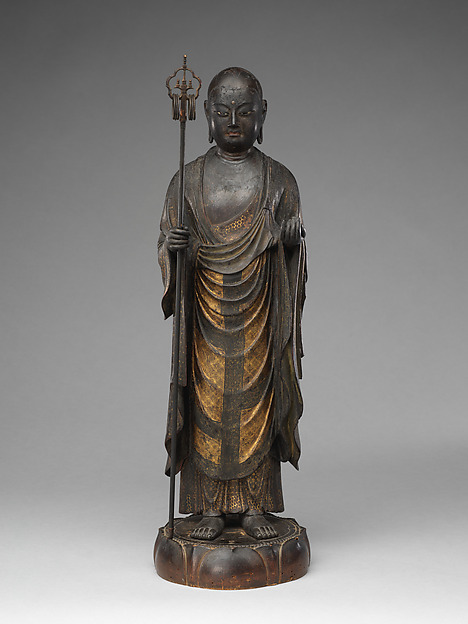
Kaikei. Lacquered Japanese cypress with colour, gold, cut gold and inlaid crystal. The Metropolitan Museum of Art
Look closer: The shaved head and monk’s robes mark Jizō. The right hand holds a staff, and the left probably held a wish-granting jewel. Cut gold lays a fine pattern over the robe.7
The Metropolitan Museum of Art, New York, Mary Griggs Burke Collection, Gift of the Mary and Jackson Burke Foundation, 2015, accession 2015.300.250a, b. Public domain, Met Open Access. Museum record
The Met’s record describes the figure as having a shaved head and monk’s robes, a staff in the right hand and, most likely, a wish-granting jewel in the left.7 The Wikipedia entry gives the date of the Burke Jizō as 1203, while the museum says about 1202; the difference of a year is typical of the uncertainty that surrounds even documented works.17
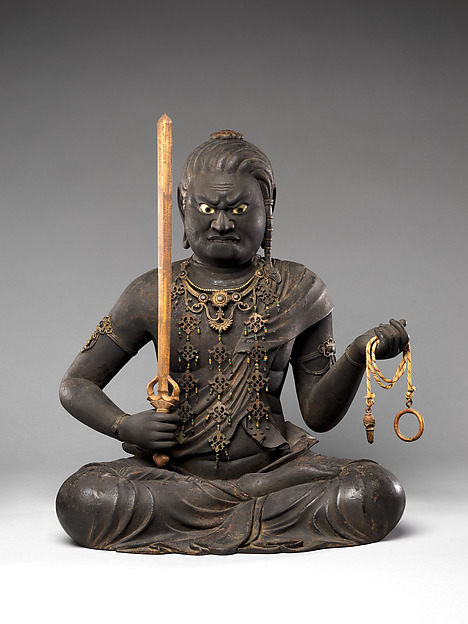
Kaikei. Japanese cypress with lacquer, colour, gold, cut gold leaf and inlaid crystal eyes. The Metropolitan Museum of Art
Look closer: At 53 centimetres the surface is the point. Look for the cut gold leaf pattern, called kirikane, and for the inlaid crystal eyes.8
The Metropolitan Museum of Art, New York, Mary Griggs Burke Collection, Gift of the Mary and Jackson Burke Foundation, 2015, accession 2015.300.252a, b. Public domain, Met Open Access. Museum record
The Fudō Myōō, the Immovable Wisdom King, in the same collection is catalogued as early thirteenth century, 53.3 centimetres high, of Japanese cypress with lacquer, colour, gold, cut gold leaf, called kirikane, and inlaid crystal eyes.8 Fudō is a fierce deity, and a figure of this size is meant to be studied at close range.8
Two details are worth stressing. First, both figures are inlaid with crystal, which is the technique the Kei school used to bring eyes to life.78 Second, both are decorated with cut gold, a pattern made from cut gold leaf laid on the surface.78 These are the surface refinements a collector learns to look for when judging whether a small Kamakura figure belongs to the Kaikei circle, although they do not by themselves prove it.
What the Anna Style Looks Like
The connoisseur's eyeDescriptions of the Anna style in the sources agree on a short list of features. JAANUS says the early works have well-proportioned faces, moderately full bodies and elegantly arranged drapery, and that in the later works the figures become somewhat more elongated and the drapery more complex and refined.3 The Onmark page says the early work to about 1200 has Kei-style realism and free-flowing robes, and that the Annami period adds delicate grace, dignified faces and sharp, graceful robe carving.4
The same page names two influences, the Song dynasty styles of China and earlier Japanese Fujiwara and Nara styles.4 That fits the Tōdai-ji setting, where Chōgen had the buildings remade in a Song manner.12 The Kei school style also recalls elements of the Nara period, although Joan Stanley Baker, as Wikipedia reports, describes the school’s works as less idealised, generic and impersonal than those of Nara.2
Compared with Unkei, the point is not a difference of skill but of emphasis. Unkei stresses solid, muscular forms and realism; Kaikei stresses order, finish and calm.3411 Both used the joined-wood method and both set crystal in the eyes.2611
- Face: well proportioned, dignified, calm.34
- Body: moderately full in the early works, more elongated later.3
- Drapery: ordered, sharp and graceful, with refined cut-gold patterns.347
- Eyes: inlaid dark-centred crystal.267
- Signature: An’amidabutsu, on many works, though the position of the inscription varies from piece to piece.357
Gyōkai, Chōkai, Eikai and the Long Tail
The connoisseur's eyeJAANUS records that Kaikei’s style was continued and developed by Gyōkai, then Chōkai and Eikai, and that over time it became increasingly stereotyped.3 The Onmark page makes the same point in another way: after his death the Anna style was copied and formalised.4 In the Edo period, JAANUS adds, the term appears in documents apparently describing contemporary images of nyorai and bosatsu made in the Kaikei tradition.3
For anyone who loves these figures, that is the honest limit. A small, gilded, crystal-eyed Amida in a refined manner may be by the master, by a follower of the following generation, or by a workshop working in the tradition centuries later. The style is the easiest part to copy; the inscription, the construction, the materials and the history of the object are harder.34 The page on Buddhist statues and their makers discusses these checks in general terms, and the page on yosegi-zukuri explains what to expect from the joins and the interior.
Late in life, one source says, Kaikei made many small Amida images, but they do not match his earlier brilliance.4 Historians treat that judgment as an opinion, not a measurement, and the same page warns that death dates differ.4
A Working Life in Order
First lookThe list below gathers the dated works named in the sources read for this page. Where the sources differ on a year or a temple, the entry says so, and the earlier sections give the detail.14
- 1189Boston Maitreya, made for Kōfuku-ji; the earliest attributable work.5
- 1192Maitreya at Sanbō-in, Daigo-ji; the Anna style is said to begin about now.13
- 1194Vairocana at Ishiyama-dera.1
- 1195 to 1197Amida triad at Jōdo-ji, Ono, a National Treasure.129
- 1200Peacock wisdom king, at Kinpusen-ji according to one source and at Kongōbu-ji according to another.14
- 1201Hachiman at Tōdai-ji, a National Treasure.1
- About 1202Jizō now in New York.7
- 1203Niō of Tōdai-ji with Unkei; Kaikei becomes hokkyō.134
- 1208Rank of hōgen, as one source states.4
- About 1223The last year the Met and the museum give for his activity.67
Where to Look at Kaikei Today
The connoisseur's eyeIn Japan, the main places are Tōdai-ji in Nara, where the Hachiman and the Niō stand, and Jōdo-ji in Ono, Hyōgo, whose address Wikipedia gives as 2094 Kiyotani-cho, Ono.19 Wikipedia also lists a Maitreya at Sanbō-in dated 1192, and a Mahamayuri, the peacock wisdom king, dated 1200 at Kinpusen-ji, while the Onmark page places a Kujaku Myōō of 1200 at Kongōbu-ji on Mount Kōya. The sources therefore disagree on the temple, and visitors should check with it before a journey.14
Abroad, the Museum of Fine Arts, Boston, holds the Maitreya of 1189, and the Metropolitan Museum of Art holds the Jizō and Fudō from the Mary Griggs Burke collection. The Met’s page shows the Jizō as not on view at the time of checking, so a visit to see it should begin with the museum’s own page.67
Before you look, read the pages of the house on the tradition around him: Unkei, the other great sculptor; Jōchō, whose canon of proportions the Kei school inherited; and Amida Nyorai, the Buddha Kaikei is most associated with.
Words Worth Knowing
The terms below recur on this page and across the almanac.
| Term | Reading | Meaning |
|---|---|---|
| Busshi | busshi | A maker of Buddhist images.1 |
| Kei-ha | kei-ha | The Kei school of sculptors, many of whose names contain the syllable kei.12 |
| Annamiyō | annamiyō | The Anna style of Kaikei and his followers.3 |
| An’amidabutsu | an’amidabutsu | The Buddhist name Kaikei used to sign many works.3 |
| Hokkyō | hokkyō | Master of the Dharma Bridge, a rank Kaikei received in 1203.34 |
| Hōgen | hōgen | Master of the Dharma Eye, a higher rank he held from 1208, as one source states.4 |
| Kirikane | kirikane | Cut gold leaf laid in fine patterns on a robe.8 |
| Nembutsu | nembutsu | The invocation of Amida, chanted by Chōgen and his circle.10 |
| Niō | niō | The pair of guardian kings at a temple gate.11 |
Related Pieces
The house keeps a changing shelf of Buddhist sculpture, scrolls and ritual objects from Japan. The shelf below fills with pieces on the day you read this, and the collection page lists them all.
Pieces in the house now
- Buddhist statues and sacred artSculpture, scrolls and ritual objects
Answered plainly
Who was Kaikei?
A busshi, or sculptor of Buddhist images, of the Kei school in the Kamakura period, known alongside Unkei and famous for graceful images of Amida and for signing works An’amidabutsu.13
What is the Anna style?
The manner of Kaikei and his followers, in which well-proportioned faces and ordered, refined drapery replace the heavier realism of Unkei. Strictly it means his works from about 1192 to 1203; broadly, all his works.13
What is Kaikei’s most important work?
The Amida triad of Jōdo-ji in Ono, Hyōgo, made between 1195 and 1197 and a National Treasure, although the sources give different dates and heights for it.149
Where can I see a Kaikei outside Japan?
The Boston Maitreya of 1189 is at the Museum of Fine Arts, Boston. The Metropolitan Museum of Art in New York holds a Jizō of about 1202 and a Fudō of the early thirteenth century, though the Jizō was shown as not on view when checked.5678
What does An’amidabutsu mean?
It is a Buddhist name formed with Amida’s name and a syllable from modified Sanskrit, which Kaikei used to sign many works. One source says his friend Chōgen gave him the name.34
Where next
Sources and image credits
- Wikipedia, Kaikei Career, works, Anna style, attributed works.
- Wikipedia, Kei school Genpei War restoration, crystal eyes, school background.
- JAANUS, Annamiyō (Anna style) Definition, features, followers, Edo-period use.
- Onmark Productions, Busshi Kaikei Name, ranks, work list, heights, style periods.
- Wikipedia, Boston Miroku History, sutra, Meiji sale, signature.
- Museum of Fine Arts, Boston, Miroku 20.723.1 Medium, size, provenance, accession.
- The Metropolitan Museum of Art, Jizō, 2015.300.250a, b Date, medium, size, inscription, iconography.
- The Metropolitan Museum of Art, Fudō Myōō, 2015.300.252a, b Date, medium, size.
- Wikipedia, Jōdo-ji (Ono) Founding, Jōdodō, triad, height, designations.
- Wikipedia, Shunjōbō Chōgen Life, Tōdai-ji fundraising, portrait statue.
- Wikipedia, Unkei Niō of Tōdai-ji, style comparison.
- Wikipedia, Tōdai-ji Rebuilding under Chōgen.
- The Japan Times, Kaikei: the name behind the gods Workshop scale of the Hachiman.
- Wikimedia Commons, Todaiji Monastery Hachiman by Kaikei (420) Photograph, licence and credit.
- Wikimedia Commons, Todaiji Monastery Jizo by Kaikei (421) Photograph, licence and credit.
- Wikimedia Commons, Todaiji Monastery Kongo Rikishi of Nandaimon I (409) Photograph, licence and credit.
- Wikimedia Commons, Miroku, the Bodhisattva of the Future Photograph, licence and credit.
- Wikimedia Commons, Scroll of the Miroku jōshō-kyō Scroll found inside the Boston Miroku.


Last reviewed 28 October 2026. Dates in this chapter follow the cited pages; where the sources disagree, the chapter says so. Every picture is public-domain or openly licensed, and its credit and licence stand beneath it.
If this subject has drawn you to an object, the concierge desk can search Japan for it.
Private concierge
Looking for something in particular?
Describe the piece or the project you have in mind. A senior advisor in Tokyo reads every case file personally and replies within two business days, with fees set out in writing before any work begins.