
Yosegi-zukuri: The Joined-Wood Method
Technique · Heian to Kamakura
Yosegi-zukuri: The Joined-Wood Method
寄木造
A Japanese Buddhist statue that looks like a single carved trunk is very often a small building. Inside the gilded skin are hollow cypress pieces, glued and pinned together, with a cavity at the centre where a pair of rock-crystal eyes is fixed from behind and, sometimes, where sacred documents were sealed. The method is called yosegi-zukuri, and it made the great statues of Japan possible, from the Amida of the Phoenix Hall to the giant guardians of Tōdai-ji.13 This chapter explains how the pieces fit, why the method spread, what a collector can read from its traces, and why the word has a second life as the name of a quite different craft, Hakone marquetry.
Fact sheet
Five things to look for
- The seams. Fine vertical joint lines, often down the centre of face and body, where blocks meet.2
- The back. Panels, wooden pins or a removable back board, where the interior can be reached.15
- The eyes. Rock crystal set from inside the head with painted pupils behind it.34
- The hands and head. Separate elements that fit into recesses, sometimes without glue.4
- The cracks. Glue lines that separate with age, which is where repairs and truth both show.4
Why One Tree Was Not Enough
First lookThe oldest way to make a wooden Buddha is to carve it from one piece of a tree. The technique is called ichiboku-zukuri, and it remained the choice for many statues, especially in provincial areas, well into the eleventh and twelfth centuries.1 It has two weaknesses. A large figure demands a very large trunk, and a solid trunk shrinks and cracks as it dries, because the outside dries faster than the heart.

Unkei’s earliest documented work, built from six main blocks of cypress
Look closer: This is a joined-wood figure under its gold: the torso and head, the legs, the topknot and the thighs were separate pieces before assembly, lacquering and gilding.3
Photograph: Nara National Museum, Nara Imperial Museum photograph (Showa 8, 1933). Public domain. Source: Wikimedia Commons. File record

Yosegi-zukuri, the joined-wood method, solves both problems. The reference dictionary of Japanese art terms defines it as a technique in which the main part of a wooden statue is made from two or more pieces of wood.1 Wikipedia, writing about Unkei’s Dainichi, gives the twin advantages: it removes the need for large timbers and it makes hollowing out easy, which reduces shrinkage and cracking.3 A secondary benefit is human. Because the figure comes apart into pieces, different sculptors can carve different parts, which suits a workshop turning out many images.1
The older names for the same method were kiyose-zukuri and yoseai-zukuri, and the dictionary lists five basic ways of combining the blocks, collectively called kiyosehō.1 The technical vocabulary grows quickly, but the principle can be said in a sentence: build the statue as a hollow assembly of carved pieces, then finish it as if it were one.
The Anatomy of a Joined Figure
The connoisseur's eyeThe best way to understand the method is to look at documented examples. Unkei’s Dainichi at Enjō-ji, finished in 1176, used six main blocks of hinoki: two vertical blocks arranged side by side and end on for the torso and head, one horizontal piece for the legs, one for the topknot, and two wedges for the thighs, with the arms assembled from further pieces.3 After carving, hollowing and assembly, the statue was lacquered and gilded.3
Jōchō’s Amida of 1053 at Byōdō-in is described in the dictionary as having four long pieces of wood, each forming a quarter of the head and body, joined at the neck axis. The back blocks were split at the nape and rejoined by the warikubi method after the head had been hollowed.1 The idea of splitting the head so that the inside can be reached is the key to everything else, because it is how the crystal eyes get in. A related term, shōchūhagi, names the seam that runs down the centre front of the face, head and body where blocks of a hollow joined statue meet.2
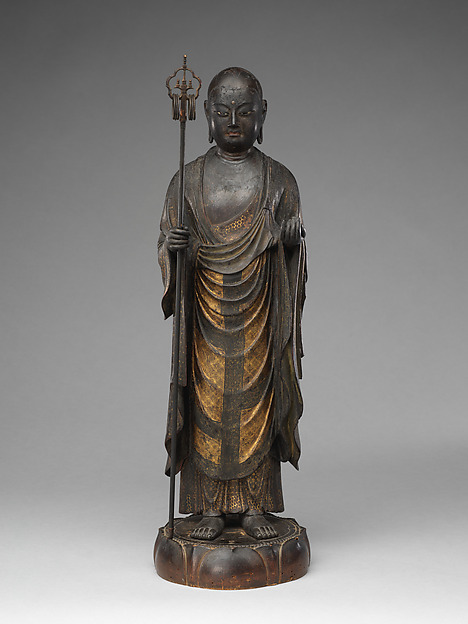
Lacquered Japanese cypress with gold, cut gold and inlaid crystal, 56 cm high
Look closer: The museum records the medium as lacquered cypress with inlaid crystal. The surface hides the construction, which is why an inscription or an X-ray is needed to see inside.6
The Metropolitan Museum of Art, New York, Mary Griggs Burke Collection, Gift of the Mary and Jackson Burke Foundation, 2015, accession 2015.300.250a, b. Public domain, Met Open Access. Museum record
Not every part is glued. A Cleveland Museum pair of guardian figures, made between about 1560 and 1625, shows the principle at a small scale: separate blocks were cut to fit each section and joined with glue, the blocks were hollowed before carving, and the heads and hands were conceived and carved as separate elements fitted into recesses without glue.4 The same entry notes that the method used far less wood than carving from a single block and made production faster.4
| Work | Date | What the source says of the construction |
|---|---|---|
| Amida, Byōdō-in (Jōchō) | 1053 | Four long pieces, each a quarter of head and body, joined at the neck axis; back blocks split at the nape and rejoined after hollowing1 |
| Dainichi, Enjō-ji (Unkei) | 1175 to 1176 | Six main blocks of hinoki, extra pieces for the thighs, arms and topknot; lacquered and gilded3 |
| Niō, Nandaimon, Tōdai-ji | 1203 | Up to about 3,000 pieces of wood in each figure, the interior mostly solid with some hollow pockets8 |
| Guardian figures (Zuishin), Cleveland | about 1560 to 1625 | Hollowed blocks, with heads and hands as separate elements fitted into recesses4 |
Crystal Eyes and the Opened Head
The connoisseur's eyeThe most striking consequence of the hollow head is the inlaid eye, gyokugan, literally the jewel eye. The Cleveland entry explains the logic: each head was cut open around the face and hollowed out so that rock-crystal eyes, painted on the back, could be inserted.4 At Enjō-ji the crystal was inserted into the open sockets from the inside and held in place with bamboo pins, with painted pupils.3
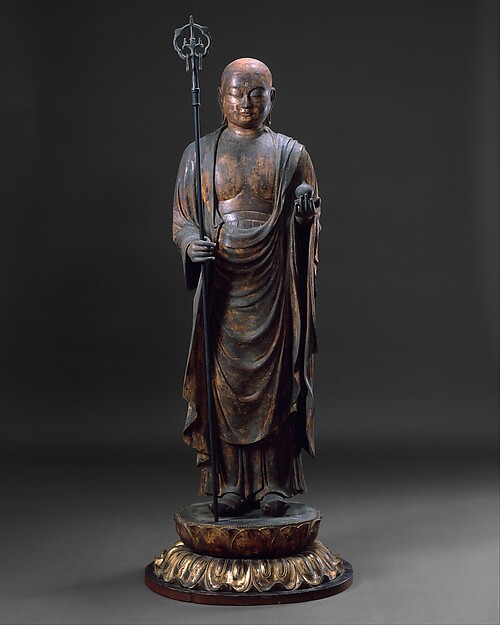
Late twelfth to mid-thirteenth century, Rogers Fund, 1918
Look closer: Look at the eyes: they are inlaid crystal, set from behind with painted pupils, and the museum lists the inlay among the materials.12
The Metropolitan Museum of Art, New York, Rogers Fund, 1918, accession 18.93. Public domain, Met Open Access. Museum record
The dictionary lists gyokugan among the devices that are often used together with the joined-block method, along with the splitting of the blocks and the splitting of the head.1 The result is a gaze with real depth: a painted surface behind a clear lens catches the light as a living eye does. It is the single most effective trick for making a wooden face seem present, and it is why the Kamakura sculptors who inherited the method are remembered for the lifelike quality of their work.113
A Method With a Long Pedigree
The connoisseur's eyeThe dictionary dates the earliest examples of joined construction to the seventh century, citing the pensive bodhisattva at Chūgū-ji in Nara, but treats the late tenth century as the point at which the method began to develop in its mature form.1 From the late eleventh century it spread, especially for large statues in Kyoto and other developed regions, and over time it became the prevailing method for statues of every size.1
Jōchō is the pivot. He made extensive and sophisticated use of the technique in the eleventh century, and the style that bears his name was built around it.17 The system of proportions, the standard parts and the division of labour all depend on the idea that a statue is an assembly. Our chapter on Jōchō follows his workshop and its descendants.
The Kamakura sculptors took the method to its limits. A conservation campaign in the 1990s found that each of the Niō at Tōdai-ji was built from up to about 3,000 pieces of wood and that the interior was mostly solid with some hollow pockets, not an empty shell.8 The two guardian figures stand about 8.5 metres tall.13
- Seventh centuryEarliest joined examples, such as the bodhisattva at Chūgū-ji.1
- Late tenth centuryThe method begins to develop fully.1
- 1053Jōchō’s Amida at Byōdō-in, the model of the style.1
- Late eleventh centurySpreads, especially for large statues in Kyoto and developed regions.1
- 1176Unkei finishes the Enjō-ji Dainichi in six main blocks.3
- 1203Niō of Tōdai-ji built from thousands of pieces.8
- 1269Kōshun’s Amida, with documents sealed in the hollow core.5

Nandaimon, Nara, 1203
Look closer: Each figure is built from thousands of pieces. The seams cannot be seen from the ground, which is exactly the point.8
Photograph: Bamse. CC BY-SA 3.0, with attribution. Source: Wikimedia Commons. CC BY-SA 3.0 File record

What Was Sealed in the Hollow
The connoisseur's eyeThe cavity is more than a cure for cracking. Hollow cores became a place for devotion. A standing Amida by Kōshun in the Cleveland Museum, dated 1269 and carved of cypress with lacquer, gold, cut gold and rock-crystal eyes, held documents inserted into its hollow core around the time of its creation. They include a copy of the Amida Sutra, a register of donors who wished to be joined together in generating karmic merit through the sculpture, and a record stating that the image was completed over 33 days in 1269 at Shitennō-ji in Osaka.5

Cleveland Museum of Art, 1960.197
Look closer: The right hand is raised in welcome. Behind the gold and the cut-gold patterns, the hollow core held a sutra, a donor register and a record of the 33 days of its making.5
Photograph: Koshun (Cleveland Museum of Art). CC0. Source: Wikimedia Commons. File record
The pattern is wider. When a Dainichi attributed to Unkei was sold at Christie’s in New York in 2008, X-rays taken after its owner suspected the figure was hollow showed three dedicatory objects sealed in the torso for more than 800 years.9 Inscriptions, sutras, relics and lists of donors are the most informative evidence that a joined statue can give, and they are a major reason why the interior of a Japanese Buddhist statue is treated as sacred as well as structural.
Reading the Seams on a Statue
The deep endFor a collector the joined structure is both a gift and a trap. It is a gift because the construction leaves traces that no later copyist can easily fake without commitment: the arrangement of blocks, the thickness of the walls, the cut of the joints. It is a trap because the same method was used by generations of workshops, so its presence says only that the object belongs to a tradition of about a thousand years.1
What the traces can tell you is limited but useful. A single carved block with no seams is the older way, and the dictionary notes that large statues in less developed provinces were often still carved from one block in the eleventh and twelfth centuries.1 A joined figure with a hollow core and crystal eyes set from within points to the Heian and Kamakura traditions or to later work in the same manner.34 Glue lines that have opened are a normal sign of age, not of damage, but they have often been repaired, and repairs deserve a note in any description. The Cleveland guardian figures, for instance, have glue joins that separated over time and were later repaired.4
A responsible description records whether the interior has been inspected, whether inscriptions or deposits are known, and whether the eyes are inlaid crystal or painted. The almanac’s guide to how to read a Buddhist statue, and its chapter on materials and making, walk through the checks in a calmer, slower order. If you would like an object assessed, the house can help you ask the right questions of any description through a private request.

Not sculpture: the marquetry craft that shares the name
Look closer: This is yosegi-zaiku, in which rods of coloured wood are glued into a pattern and sliced into thin layers. The same word, a different craft.10
Photograph: Eugene Alvin Villar (seav). CC BY-SA 4.0, with attribution. Source: Wikimedia Commons. CC BY-SA 4.0 File record

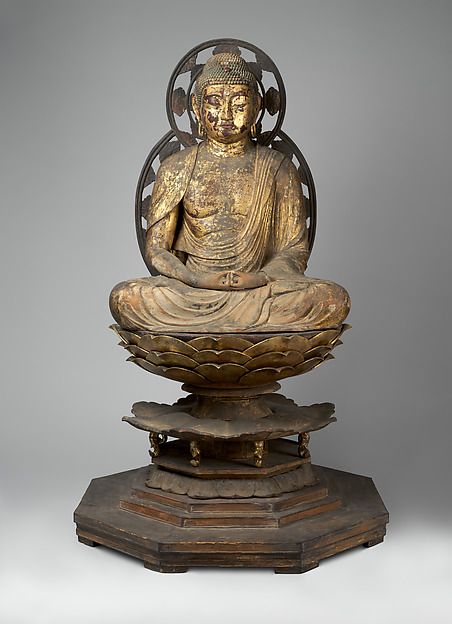
Kamakura period, lacquered and gilded wood
Look closer: A useful comparison for the finish: gilding and lacquer unify a figure that is, underneath, a set of pieces.11
The Metropolitan Museum of Art, New York, Rogers Fund, 1919, accession 19.140a–c. Public domain, Met Open Access. Museum record
Words Worth Knowing
The terms below recur on this page and across the almanac.
| Term | Reading | Meaning |
|---|---|---|
| Yosegi-zukuri | yosegi-zukuri | Building a statue from several carved pieces of wood.1 |
| Ichiboku-zukuri | ichiboku-zukuri | Carving a statue from a single block.1 |
| Uchiguri | uchiguri | Hollowing the interior of the pieces.1 |
| Warikubi | warikubi | Splitting the head at the nape so that the inside can be reached.1 |
| Gyokugan | gyokugan | Rock-crystal eyes inlaid from inside the head.4 |
| Shōchūhagi | shōchūhagi | The seam down the centre front where blocks meet.2 |
| Hinoki | hinoki | Japanese cypress, the usual wood.3 |
| Yosegi-zaiku | yosegi-zaiku | The Hakone marquetry of puzzle boxes, a different craft.10 |
Related Pieces
The house keeps a changing shelf of Buddhist sculpture, scrolls and ritual objects from Japan. The shelf below fills with pieces on the day you read this, and the collection page lists them all.
Pieces in the house now
- Buddhist statues and sacred artSculpture, scrolls and ritual objects
Answered plainly
What is yosegi-zukuri?
A method of making a wooden statue from two or more separately carved pieces of wood, usually hollowed and assembled, instead of from a single block.1
Why did sculptors use the joined method?
It removed the need for very large timbers, made hollowing easy, which reduces cracking, and let several carvers work on one statue.13
Who perfected yosegi-zukuri?
Jōchō, whose Amida of 1053 at Byōdō-in is the model of the method, made extensive and sophisticated use of it in the eleventh century.17
What are crystal eyes?
Gyokugan: rock-crystal lenses painted on the back and inserted from inside the hollowed head, which give the gaze depth.34
What is found inside joined statues?
Sometimes sutras, donor registers, inscriptions or relics. The 1269 Amida by Kōshun held a sutra, a donor register and a record of its making.5
Is yosegi the same as Hakone puzzle boxes?
No. Yosegi-zaiku is a marquetry craft from the Edo period in Hakone. The word is shared; the craft is different.10
Where next
Sources and image credits
- JAANUS, Yoseki-zukuri (yosegi-zukuri) Definition, joining, hollowing, Jōchō example, chronology.
- JAANUS, Shōchūhagi The central seam of a joined statue.
- Wikipedia, Dainichi Nyorai (Enjō-ji) Six main blocks, hollowing, crystal eyes held by bamboo pins.
- Cleveland Museum of Art, Pair of Guardian Figures (Zuishin), 2020.215 Joined construction, separate heads and hands, crystal eyes, repairs.
- Cleveland Museum of Art, Buddha of Infinite Life and Light, 1960.197 Documents in the hollow core, date, materials.
- The Metropolitan Museum of Art, Jizō by Kaikei, 2015.300.250a, b Medium, inlaid crystal, dimensions.
- Wikipedia, Jōchō The method and the proportions.
- Buddhistdoor, Lives of the Busshi: Japanese Sculpture Under the Kamakura The 1990s conservation findings on the Niō.
- The Art Wolf, Dainichi Nyorai sold X-rays and dedicatory objects of the Christie’s Dainichi.
- Wikipedia, Yosegi-zaiku Hakone marquetry and its technique.
- The Metropolitan Museum of Art, Amida, the Buddha of Limitless Light, 19.140a-c Date and medium.
- The Metropolitan Museum of Art, Jizō, the Bodhisattva of the Earth Store Date and credit.
- Wikipedia, Unkei Kamakura realism and the Niō.
Last reviewed 28 October 2026. Dates in this chapter follow the cited pages; where the sources disagree, the chapter says so. Every picture is public-domain or openly licensed, and its credit and licence stand beneath it.
If this subject has drawn you to an object, the concierge desk can search Japan for it.
Private concierge
Looking for something in particular?
Describe the piece or the project you have in mind. A senior advisor in Tokyo reads every case file personally and replies within two business days, with fees set out in writing before any work begins.