
Japanese Tea Types: Matcha to Hojicha
Chanoyu Almanac · Leaf, Powder, Roast
Japanese Tea Types: Matcha to Hojicha
Every tea of Japan comes from one plant, and the differences between them are made by shade, steam, fire and the calendar. A powder is whisked in a bowl, a rolled leaf is steeped in a small pot, a brown leaf is roasted after dinner and a green leaf is blended with popped rice. This chapter sorts the leaf into its families, follows each one from the field to the cup, reads an 1803 scroll of tea-making from Uji and sets out the figures that sources give for today's fields and farms.
Fact sheet
At a glance
- One plant. Matcha, gyokuro, sencha, bancha and hōjicha all come from Camellia sinensis, and the difference lies in shade, steam and fire.
- Steam, not pan. Wikipedia says most Japanese green tea is steamed, unlike the pan-firing used for Chinese green teas.
- Shade makes umami. Shading raises theanine and lowers catechins, which is why gyokuro and matcha taste sweeter and less bitter.
- A scroll from 1803. The Metropolitan Museum holds a scroll that follows Uji tea from the field to the drying frames.
- Shrinking fields. A tea retailer's data page counts 53,687 commercial farms in 2000 and 20,144 in 2015.
One Plant, Many Teas
A single species, Camellia sinensis, makes every tea in this chapter. The range that Japan draws from it is wide. There is a powder that is whisked in a bowl, a rolled leaf that is steeped in a small pot, a roasted brown leaf that is served after the evening meal, a green leaf that is blended with popped brown rice and a rough leaf that is drunk daily. Wikipedia's article on sencha says that sencha is the most popular tea in Japan and about eighty per cent of the tea produced there.

Katsushika Hokusai, Fuji from the Katakura Tea Fields in Suruga (Sunshū Katakura chaen no Fuji), from the series Thirty-six Views of Mount Fuji (Fugaku sanjūrokkei), ca. 1830–32, Woodblock print; ink and color on paper. The Metropolitan Museum of Art, Henry L. Phillips Collection, Bequest of Henry L. Phillips, 1939, accession JP2955.
Look closer: a woodblock print in blue, gold and cream: a snow-capped mountain stands at the left under a band of blue sky, gold-yellow fields run towards it, a stream curves through the foreground, and a long open-sided building and rocks and a pine tree occupy the right, with small figures walking along the paths. The museum catalogues it as Fuji from the Katakura Tea Fields in Suruga, from the series Thirty-six Views of Mount Fuji, by Katsushika Hokusai, about 1830 to 1832, woodblock print, ink and colour on paper.
Image: The Metropolitan Museum of Art, Open Access (CC0)
The page on Japan's many varieties of green tea at nippon.com sorts them into four groups. The sun-grown teas are sencha, fukamushicha, bancha and guricha. The shade-grown are gyokuro, kabusecha and tencha, the leaf that becomes matcha. The by-products are kukicha and konacha, and the reprocessed teas are hōjicha, bōcha and genmaicha. Camellia Sinensis, a retailer, makes a related point: Japanese tea names, it says, relate more to production and processing methods than to terroir.
This chapter follows that sorting. It begins with the plant and its flushes, draws the family tree and the two main paths from leaf to cup, and then reads a scroll painted in 1803 that the Metropolitan Museum of Art holds. It turns to history, from the monk Eisai to the official tea masters of Uji, and then takes the teas in turn: the shaded teas, matcha, sencha, the everyday teas, the roasted teas and the pan-fired. It ends with the map of the fields, the picking calendar, today's figures, the vessels each tea asks for and the label terms a buyer meets. Wikipedia, a bilingual corpus of its Kyoto articles, nippon.com and the Metropolitan Museum are the main sources; retailers' claims are marked as attributed.
Yabukita, Cultivars and the Flushes
Wikipedia says that most sencha comes from the Yabukita cultivar, and that gyokuro is often made from specialised varieties such as Asahi, Okumidori, Yamakai and Saemidori. TeaLife, a Singapore tea company whose data page is used here as an attributed retailer's source, gives Yabukita 71.5 per cent of Japan's plantings in 2019, 91 per cent in Shizuoka and 32 per cent in Kagoshima. Wikipedia's article on Kagoshima green tea puts Yabukita at 30 per cent of that prefecture's fields, a much lower share than elsewhere, and names two others: Yutakamidori, which buds early and resists disease and tastes slightly better than Yabukita but is vulnerable to frost, and Saemidori, which also buds early and is valued for its colour and high amino acid content, though its yield can suffer from damage to the plant.
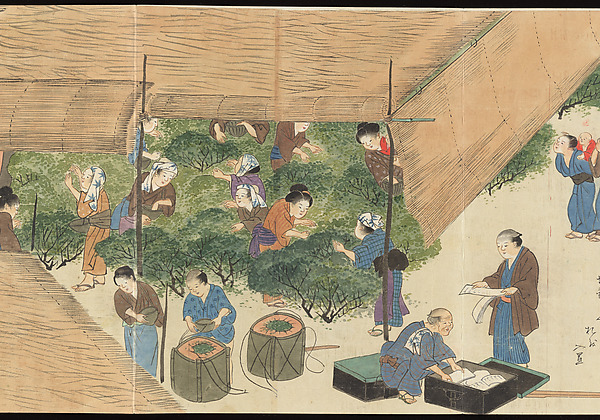
Saitō Motonari, Illustrations of Uji Tea Production (Uji seichanozu), 1803, handscroll of thirty-two sheets reformatted as a folding album; detail, image 26 of 66 in the museum's record. The Metropolitan Museum of Art, Purchase, Friends of Asian Art Gifts, 2023, accession 2023.237.
Look closer: a painted scene of green tea bushes beneath a sloping canopy of straw matting, with several pickers in headcloths and short robes reaching into the bushes, two round lidded tubs in the foreground, a man in a brown robe holding a sheet of paper at the right and another man kneeling beside an open black box. The museum's record dates the scroll to 1803 and describes it as showing every stage of production from early spring growth through harvesting, culling and drying.
Image: The Metropolitan Museum of Art, Open Access (CC0)
The year is divided into flushes. During the winter, says Wikipedia, tea plants store nutrients, and the tender new leaves that sprout in spring contain them in concentrated form. Shincha, the new tea, represents those leaves, and tea-picking begins in the south and moves north with the warmth. In Kagoshima the first, shaded flush is among the earliest of the year. Later flushes are put to other uses: Wikipedia says that second flushes there are now also used for black tea, and that third and fourth flushes are often blended for the bottled tea sold in shops and vending machines.
The matcha standards add one more condition. Both the International Organization for Standardization's ISO 20715:2023 and the Japanese food labelling standard require the powder to be made from Camellia sinensis var. sinensis, the Chinese small-leaf tea, so the plant is part of the definition and not only the process.
A Family Tree of Japanese Green Teas
The two diagrams in this chapter show the structure at a glance. The first sets the teas on a tree in the four groups of the nippon.com page. Kamairicha, the pan-fired tea, is added to the sun-grown branch from the corpus and from retailers' accounts. The nippon.com page puts guricha, the curled-leaf tea, in the sun-grown group, and says that in Shizuoka's Izu region guricha is commonly made.
Diagram by Japonista. After the grouping on the nippon.com page; kamairicha is added from the Kyoto corpus and retailers.
Look closer: a box at the top names the plant and four boxes below it name the groups. Under sun-grown come sencha, fukamushicha, bancha, guricha and kamairicha, under shade-grown come gyokuro, kabusecha and tencha, under by-products come kukicha and konacha, and under reprocessed come hōjicha, bōcha and genmaicha.
Diagram by Japonista
The bilingual corpus of Wikipedia's Kyoto articles points out how loosely the words are used. In everyday Japanese, it says, green tea generally means sencha in the broad sense, which covers gyokuro, bancha, hōjicha, genmaicha and others, and in the broadest sense even matcha. In the narrow sense sencha is the middle-grade green tea between gyokuro and bancha. Its page also lists tsukemono-cha, fermented tea resembling Chinese black tea, as a separate category made mainly in Shikoku and in Toyama, so that the family is wider than green tea alone.
The tree is therefore a map of usage, not a strict classification, and the chapter says so each time a word shifts. The shade-grown group is the most important to the temple and the tea room, because it contains tencha, from which matcha is ground, and gyokuro, the shaded leaf that is steeped.
Steaming, Rolling and Drying
Wikipedia describes how sencha is made. The tea process by which sencha and other Japanese ryokucha are created differs from that of Chinese green teas, which are initially pan-fired. Japanese green tea is first steamed for between fifteen and twenty seconds to prevent oxidation of the leaves, then rolled, shaped and dried, which creates the thin cylindrical shape, and finally sorted into groups of different quality. The steaming gives Japanese green tea a more vegetal, almost grassy flavour, and some taste of seaweed. The infusions are greener and slightly more bitter than those of Chinese-style green teas.
Diagram by Japonista. Figures follow Wikipedia's articles on sencha and matcha.
Look closer: two rows of boxes run left to right. The top row, for sencha, reads pick, steam, roll and shape, dry, sort. The bottom row, for matcha, reads shade, pick, steam, dry flat, age and blend, stone-mill. A note beneath says that kamairicha is pan-fired in an iron pot instead of steamed.
Diagram by Japonista
Steaming times vary. Wikipedia lists asamushi, lightly steamed; chūmushi, steamed for thirty to ninety seconds; and fukamushi, steamed for one to two minutes. The nippon.com page says that fukamushicha is steamed two to three times longer than regular sencha. The teas made for matcha follow a different path after the plucking. The leaves, called tencha, are steamed at about 100 °C for ten to fifteen seconds, then dried in a machine at about 170 to 200 °C, although the temperature of the leaves themselves is about 70 °C, and are not rolled. They are aged for several months in cool, dry conditions and blended by expert tasters before being ground.
The older drying method is described in the same article. Until the tencha dryer was invented, in the Taishō to early Shōwa period, leaves were dried on a hoiro, a charcoal-fired hearth with paper supports, by hand. The next section looks at a painting that shows frames and fires of this kind, although the chapter does not claim to identify them.
A Scroll of Uji Tea Made in 1803
The Metropolitan Museum of Art holds a work that records the whole process: Illustrations of Uji Tea Production, called in Japanese Uji seichanozu, painted in 1803 by Saitō Motonari with a preface by Nindō Sōen. It is a handscroll of thirty-two sheets that has been reformatted as a folding album, an orihon, to be viewed from right to left. The museum gives the length of the painted surface as 1,647.8 centimetres, and the height as 32.1. The Met bought it in 2023 with the Friends of Asian Art gifts.
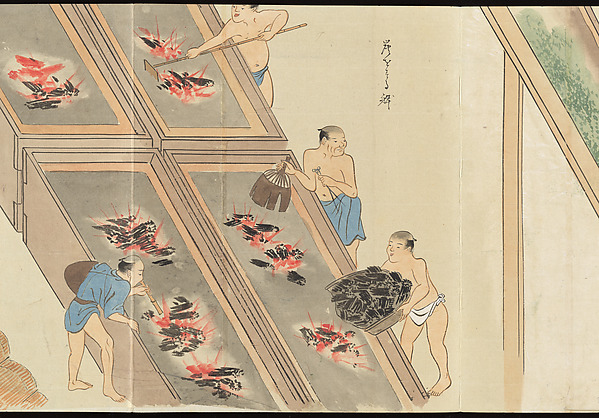
Saitō Motonari, Illustrations of Uji Tea Production (Uji seichanozu), 1803, handscroll of thirty-two sheets reformatted as a folding album; detail, image 46 of 66 in the museum's record. The Metropolitan Museum of Art, Purchase, Friends of Asian Art Gifts, 2023, accession 2023.237.
Look closer: a painted scene of long wooden frames set side by side, with orange-red embers and sparks glowing on a grey bed in each, and four men tending them: one at the top rakes the fire, one fans, one in a blue robe bends at the left, and one at the lower right carries a flat basket of black charcoal. The museum catalogues the scroll as Illustrations of Uji Tea Production, 1803, by Saitō Motonari.
Image: The Metropolitan Museum of Art, Open Access (CC0)
The museum's description says that the album captures every stage of the production process in remarkable detail, from early spring growth through harvesting, culling and drying. It sets the scroll in a history: in the second half of the sixteenth century Uji developed a new cultivation method for the bright green powdered tea of the wabi-cha culture linked with Sen no Rikyū, and in the eighteenth century Uji also successfully grew high-quality sencha, the green tea that is steamed and rolled after picking, which became common at gatherings of Kyoto's literati.
The museum's record carries sixty-six further photographs of details, and the chapter shows eight of them. They are read here only for what they show. The painting is a first-hand record of working practice, but the Met's text does not label each sheet, and the chapter does not match sheets to named stages unless the picture itself makes the stage plain. In the sheet beside this text long wooden frames hold glowing charcoal, and four men tend the fires, one with a fan and another carrying a basket of charcoal. Wikipedia's article on matcha describes the older drying method as a charcoal-fired hearth, the hoiro, with paper supports, but the chapter does not identify the frames as hoiro.
From Eisai to the Uji Tea Masters
The earliest documented reference to tea in Japan, says Wikipedia, is an entry of the ninth century in the Nihon Kōki about the monk Eichū, who served what is called sencha to Emperor Saga on an imperial excursion in the year 815. The article adds that this sencha is believed to have been Chinese compressed tea and not the infused leaf of today. In 816, by imperial order, tea plantations were established in the Kinki region, but public interest soon declined.

Tea jar, ca. 1775, Pottery (Ko Bizen ware). The Metropolitan Museum of Art, Fletcher Fund, 1925, accession 25.215.26.
Look closer: a squat, rounded jar with a dark, speckled grey-black surface and a flat metal lid with a small knob, photographed against a grey ground. The museum catalogues it as a Tea jar, about 1775, pottery (Ko Bizen ware), 7 cm high and 7.6 cm in diameter, from the Fletcher Fund, 1925. It is shown as a reminder of the vessels in which tea is kept, and the sources used here give no size for the jars of the Ochatsubo Dōchū.
Image: The Metropolitan Museum of Art, Open Access (CC0)
Powdered tea arrived in the twelfth century. Wikipedia credits the monk Myōan Eisai, who travelled to China in the late 1180s and brought back the Song style of whisked tea, with introducing it around 1191, and says that he presented his Kissa Yōjōki, the Book of Drinking Tea for Health, to the third shōgun of Kamakura, Minamoto no Sanetomo, in 1214. In that book leaves were plucked in the morning, steamed at once and left overnight on a roasting rack, and the result was a brownish-black lump and not the bright green powder of today. Eisai's disciple Myōe, the article adds, received a tea urn with seeds from Eisai and planted a garden at Togano'o in Kyoto, where the tea was known as honcha, real tea, while teas from other places were called hicha, non-tea. Myōe also established plantations at Uji, which became the foremost tea-producing region.
The powder was refined over the next centuries. Until the thirteenth century tea was ground with a yagen, a grinder that left rough particles, and in the fourteenth century a stone mill specialised for tea appeared and produced a finer powder. The Muromachi manual Kundaikan sōchōki, in its versions of 1476 and 1511, illustrates jars for matcha, and the dictionary Unpo Iroha Shū of 1548 records the characters for the word. In the sixteenth century, says Wikipedia, tea masters such as Murata Jukō and Sen no Rikyū emphasised simplicity and gave rise to the tea ceremony.
The Edo period gave Uji its privileged place. From the Muromachi period a chashi was a tea manufacturer or merchant, and in the Edo period the word came to mean specifically the official tea masters, goyō chashi, of Uji, whose status the Tokugawa shogunate guaranteed. They were divided into three ranks, the gomotsu, the ofukuro and the otōri, and were allowed to use family names and carry swords like samurai. They dealt only with the shogun, the court and the lords. Shaded cultivation was permitted only to them, and they held a monopoly on the production of high-grade matcha and gyokuro. The tea was shipped to Edo in jars of unground tencha in the Ochatsubo Dōchū, the tea-jar journey, from 1633 to 1866, and lords were required to stand aside when the procession passed. The oldest known brand, Baba Mukashi, was named for Myōshūni, who died in 1598 and whom Tokugawa Ieyasu called Baba; Hatsu Mukashi, Ato Mukashi, Taka no Tsume and Shiro were others.
The Meiji Restoration ended all this. The article says that the shōgun, lords and court nobles who had been the clientele for matcha disappeared, the Uji producers lost their monopoly and shaded cultivation spread to other regions. The industry adapted by technology: the tencha dryer, invented from the Taishō to early Shōwa period, replaced the hoiro, and bodies such as the Kyoto Prefectural Tea Industry Research Institute were set up.
Tencha, Gyokuro and Kabusecha Under Cover
The Japan Tea Central Association, quoted by Wikipedia, defines gyokuro as a tea made in the same manner as sencha from leaves picked from covered gardens that are almost completely shaded from sunlight for about twenty days, with reed screens, straw or shading nets, from the time the new shoots of the first flush start to grow. Wikipedia adds that the period can vary from twenty to thirty days, that anything shaded for under twenty days is considered kabuse tea, and that the shading is often done in stages, first blocking 70 per cent of the sunlight, then 80 and 90 per cent before harvest. The higher grades are shaded more extensively and for longer. The shading may be done with a scaffolding over the field or, with the method called jikagise, by covering the plants directly.
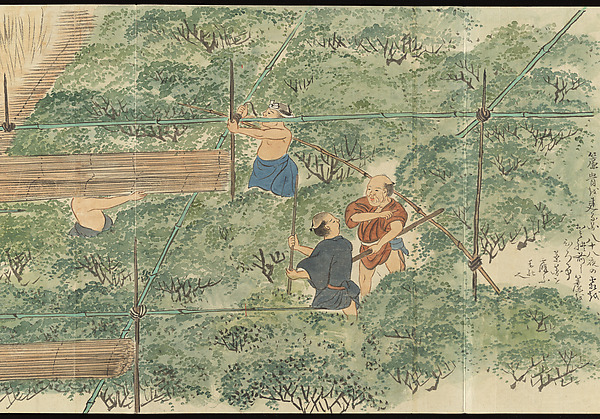
Saitō Motonari, Illustrations of Uji Tea Production (Uji seichanozu), 1803, handscroll of thirty-two sheets reformatted as a folding album; detail, image 14 of 66 in the museum's record. The Metropolitan Museum of Art, Purchase, Friends of Asian Art Gifts, 2023, accession 2023.237.
Look closer: a painted scene of dense green tea bushes under a lattice of green bamboo poles lashed together at the crossings, with reed screens at the edges, and men in short robes standing among the bushes holding long poles. A few lines of writing appear at the right. The museum catalogues the scroll as Illustrations of Uji Tea Production, 1803, by Saitō Motonari.
Image: The Metropolitan Museum of Art, Open Access (CC0)
The chemistry follows. Shading increases the amino acid L-theanine and caffeine in the leaves and decreases the catechins and tannins, and the leaves have more chlorophyll, which accounts for their dark green. Gyokuro therefore has more umami, a savoury sweetness, and less bitterness and astringency than sencha. Wikipedia's article on matcha makes the same argument for tencha: limiting sunlight prevents the plant from converting theanine into the tannins that cause bitterness, and the leaves keep a vivid colour and a distinctive aroma. That aroma, the ooikou or covered scent, is described as like green laver and is due to dimethyl sulfide.
Gyokuro's story, according to Wikipedia, begins in the 1830s, when the merchant Yamamoto Kahei, the sixth owner of Yamamotoyama, discovered in 1835, in the Tenpō era, that farmers were covering tea plants with netting to protect them from frost and that this changed the flavour and aroma. He introduced the tea to Edo, where it was popular at once, and the process was completed by another manufacturer at the start of the Meiji period. Gyokuro is one of the most expensive teas in Japan. Hand-picked gyokuro exists and commands higher prices, and the stems and by-products of its processing are used for a higher-end kukicha called karigane or shiraore.
More than forty per cent of gyokuro is produced at Yame in Fukuoka Prefecture, and in the national tea jury of August 2007 Yame tea held every place from first to twenty-sixth. Uji produced 140 tonnes of gyokuro in 2008, and Mie Prefecture 132 tonnes, up from three the year before. Kabusecha, the lightly shaded tea, is made by hanging nets, the kabuse, over the plants, and the corpus says that Mie leads Japan in its production.
Matcha, Koicha and Usucha
Wikipedia describes matcha as a finely ground powder of green tea specially processed from shade-grown tea leaves. It gives the definitions of two standards, the ISO 20715:2023 classification and the Japanese food labelling standard of the Japan Tea Central Association. Both require that matcha be made from Camellia sinensis var. sinensis, grown in the shade, steamed and dried without rolling, and ground to a fine powder. The Japanese standard requires two to three weeks of shading with materials such as yoshizu, reed screen, komo, straw mat, or cheesecloth, and calls the leaf after the first three steps tencha. ISO allows tender leaves, buds or shoots, and the Japanese standard allows only leaves. Cheaper powdered tea made by crushing non-shaded leaves, hunmatsucha, is sometimes sold as matcha although it does not meet the definitions.
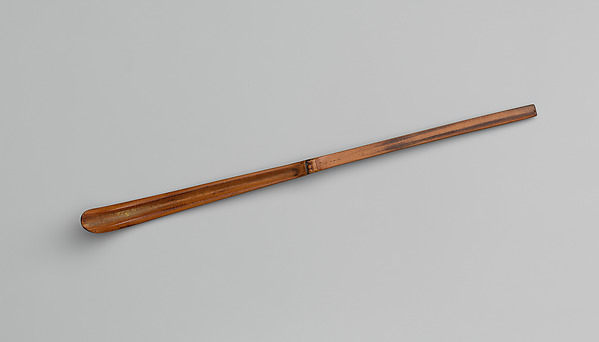
Sen Sōtan, Chashaku, named "Imogase", first half 17th century, Bamboo. The Metropolitan Museum of Art, Gift of Peggy and Richard M. Danziger, 2024, accession 2024.553.11a, b.
Look closer: a slender, reddish-brown bamboo scoop lying diagonally on a grey ground, with a single node near its middle and a small, shallow, curved scoop at the lower left end. The museum catalogues it as a Chashaku, named Imogase, first half of the 17th century, bamboo, by Sen Sōtan, 17.5 cm long, a gift of Peggy and Richard M. Danziger, 2024.
Image: The Metropolitan Museum of Art, Open Access (CC0)
The article notes that matcha is rich in umami, with twice the amino acids of sencha, and that its colour is bright green and its aroma that of green laver. It also says that, like all tea, it contains oxalates, and that a study found shading may raise oxalate concentration, so that matcha may have more than unshaded teas such as sencha. The ceremonial use is set out briefly: koicha, the thick tea, is the main part of the Japanese tea ceremony and usucha, the thin tea, a sub-part. Koicha is made from 4 grams of higher-grade matcha with 30 millilitres of water at 80 °C and is not foamed. Usucha is made with half the powder in twice the water at 90 °C and is foamed to reduce astringency.
The utensils follow the powder. According to the same article, matcha for koicha and for usucha is stored in the chaire and the natsume respectively, scooped out with the chashaku, whisked in the chawan with the chasen and drunk from the bowl, and one drinks matcha after finishing the sweets so as to prolong its taste. The chapters of this almanac on the tea caddies, on the whisk and scoop and on the tea bowl take each of these in turn.
Sencha, Grades and Shincha
Sencha means infused tea, and Wikipedia contrasts it with matcha: the processed whole leaves are infused in hot water and discarded, where in matcha the powder is mixed with water and the leaf is drunk. The article gives its types as jō sencha, superior; tokujō sencha, extra superior; hachijūhachiya sencha, harvested after the eighty-eighth night from the beginning of spring; kabusecha; the steaming grades asamushi, chūmushi and fukamushi; shincha or ichibancha, the first-picked of the year; karigane sencha, which includes stems and other parts; and matcha sencha, a blend with powder. It adds that the best colour is a greenish gold, and that with more temperate water the cup is mellow and with hot water more astringent.
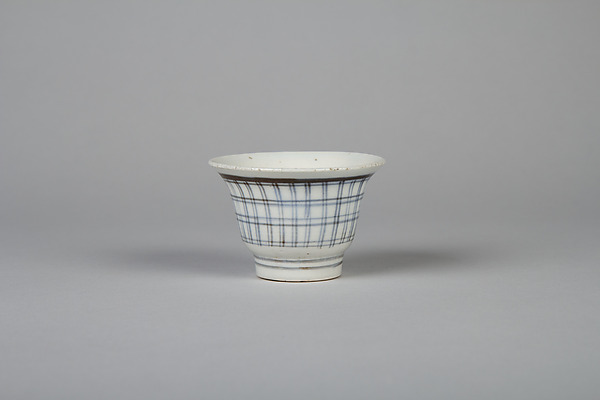
Set of Five Sencha Teacups (Sencha wan) with Lattice Pattern, 18th century, Porcelain painted with cobalt blue under a transparent glaze (Hizen ware). The Metropolitan Museum of Art, The Harry G. C. Packard Collection of Asian Art, Gift of Harry G. C. Packard, and Purchase, Fletcher, Rogers, Harris Brisbane Dick, and Louis V. Bell Funds, Joseph Pulitzer Bequest, and The Annenberg Fund Inc. Gift, 1975, accession 1975.268.673.
Look closer: a small, flaring white porcelain cup with a wide mouth and a narrow foot, its body painted in blue with a lattice of fine crossing lines, photographed against a grey ground. The museum catalogues it as one of a Set of Five Sencha Teacups (Sencha wan) with Lattice Pattern, 18th century, porcelain painted with cobalt blue under a transparent glaze (Hizen ware), 5.1 cm high and 7.9 cm in diameter, from the Harry G. C. Packard Collection.
Image: The Metropolitan Museum of Art, Open Access (CC0)
The new tea has its own lore. The shincha season runs, depending on region, from early April to late May, specifically the eighty-eighth day after Setsubun, a day that usually falls around 4 February and is traditionally considered the start of spring. Wikipedia adds that, because Setsubun, or Risshun, is the beginning of the sexagenary cycle, by drinking sencha one can enjoy a year of good health. Path of Cha, a retailer, says that hachijūhachiya sencha is harvested around 2 May and is considered auspicious, bringing good luck and health, and describes shincha as fresh, lively and naturally sweet, available only briefly and usually costing more.
Wikipedia gives caffeine figures: superior sencha has 31.01 milligrams per gram of dry leaf and deep-steamed sencha 26.70, and a cup is estimated to hold 20 to 30 milligrams. The brewed values depend on time, temperature and ratio, since higher temperatures extract more caffeine. The brewing figure in the infobox is 80 °C for one minute. The chapter on the sencha table takes up the pot, the cups and the two-step method of the sencha schools.
Bancha, Kukicha, Konacha and Mecha
Bancha, common tea, is harvested from the third and fourth flushes of sencha, between summer and autumn, according to Wikipedia. It is cut from the same plant as sencha but later, which gives it a lower market grade, and the article calls it one of the lowest grades of Japanese green tea, with twenty-two grades of its own. It can be found roasted, unroasted, smoked, matured, fermented for three years or post-fermented, as in goishicha. The flavours it names range from smoke and roasted nuts to green grass, earth and wet leaves, and some have a stronger straw smell. Path of Cha says bancha is made from larger leaves and upper stems that sencha production discards, and that it is less aromatic and more astringent, with a robust flavour. The corpus lists regional names, among them Awa-bancha, Uji bancha, Miyazaki-bancha and Tosa-bancha.
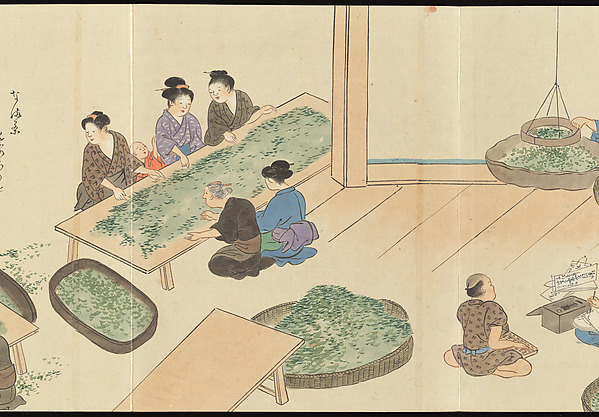
Saitō Motonari, Illustrations of Uji Tea Production (Uji seichanozu), 1803, handscroll of thirty-two sheets reformatted as a folding album; detail, image 34 of 66 in the museum's record. The Metropolitan Museum of Art, Purchase, Friends of Asian Art Gifts, 2023, accession 2023.237.
Look closer: a painted scene of a long table covered with spread green tea leaf, at which several women in patterned robes sit and work, with a shallow oval basket of leaf and a round woven tray of leaf in the foreground, a man seated at the lower right, and a hanging balance with a basket at the upper right. The museum's record names harvesting, culling and drying among the stages that the scroll shows.
Image: The Metropolitan Museum of Art, Open Access (CC0)
Kukicha, twig tea, is made primarily from the twigs and stems of the plant. Wikipedia says that a higher-end kind, karigane or shiraore, is made from the stems of gyokuro, which have a high concentration of theanine and less caffeine. The nippon.com page lists kukicha and konacha among the by-products. Path of Cha describes konacha as the lowest and cheapest grade, the dust left from processing sencha and gyokuro, which looks like matcha but is not, and nicknames it sushi restaurant tea. It describes mecha as a rolled tea made from the buds and leaves of early spring, in grades from high to low, and aracha as the unprocessed whole leaf. The matcha article's hunmatsucha, mentioned earlier, is a different thing again.
The fermented teas are a separate and little-known branch. The corpus names tsukemono-cha, a fermented tea resembling Chinese black tea, with Awa-bancha of Tokushima, goishi-cha of Kochi and Ishizuchi kurocha of Ehime made in Shikoku, and batabata-cha in Toyama. The scroll gives a picture of a related step: in the sheet beside this text women and men work at a long table covered with leaves while shallow round baskets hold more, and the Met's description names culling among the stages. The chapter does not say how the grades were drawn.
Hōjicha, Genmaicha and Bōcha
Hōjicha, roasted tea, is distinct from other Japanese green teas because it is roasted and not steamed. Wikipedia says that it is roasted at 150 °C in a porcelain pot over charcoal to prevent oxidation and produce a light golden colour, that its base is generally leaves from the second harvest or after, and that it is often made from bancha but also from sencha and kukicha. The leaves turn from green to reddish-brown, the infusion is a clear light to reddish brown with a nutty, toasty, sweet flavour and little or no bitterness, and it has lower astringency because roasting removes catechins. It has less caffeine, and because of its mildness it is a popular evening tea and is preferred for children and the elderly. Hōjicha is sometimes sold in powdered form for steamed milk drinks.

Isoda Koryūsai, At the Ise-ya Tea-house, ca. 1773, Woodblock print; ink and color on paper. The Metropolitan Museum of Art, Gift of Estate of Samuel Isham, 1914, accession JP890.
Look closer: a woodblock print of the front of a shop under an indigo curtain with a white character, with a woman in a patterned robe standing at the left, another woman seated on a bench at the right with a small tray at her side, and a kettle on a brazier set on a tall chest of small drawers behind them. The museum catalogues it as At the Ise-ya Tea-house, about 1773, by Isoda Koryūsai, woodblock print, ink and colour on paper.
Image: The Metropolitan Museum of Art, Open Access (CC0)
Wikipedia's account of its origin is a story of accident. In 1920 a Kyoto merchant had unsaleable bancha, and by roasting it created a new flavour. The infobox gives a brewing guide of 82 °C for thirty seconds to three minutes, and the article adds that hōjicha has a mild, smoky flavour when brewed at 100 °C.
Genmaicha, brown rice tea, is a green tea combined with roasted popped brown rice. Wikipedia says it is called popcorn tea because a few grains pop in the roasting, and people's tea because the rice served as a filler and cut the price, making the tea available to poorer Japanese; it was also used by people fasting for religious reasons. It is warm and nutty from the starch and sugar of the rice, mild, and light yellow in the cup. There is a version with powdered tea added, matcha-iri genmaicha, which is stronger in flavour and greener. Path of Cha describes the base as bancha or sencha, and a similar tea in South Korea is called hyeonminokcha, brown rice green tea. Bōcha is the nippon.com name for the roasted twig tea, which that page says is said to have originated in Kanazawa, in Ishikawa Prefecture.
Guricha, Tamaryokucha and Kamairicha
The curled-leaf teas are the least known abroad. The nippon.com page lists guricha, also called tamaryokucha, in the sun-grown group, and says that in Shizuoka's Izu region it is commonly made, and that in Kyushu a sencha-style tea called guricha is made by roasting fresh leaves in an iron pot. Camellia Sinensis, a retailer, separates two kinds. Mushi-sei tamaryokucha, also called guricha, is steam-dried, produced across Japan but mainly in Shizuoka, and aims to recall the look and taste of various Chinese green leaf teas. Kamairi-sei tamaryokucha, also called kamairicha, is dried in vats, produced mainly on Kyushu, and is mostly automated now, although a few factories still make hand-made batches.
The corpus says that kamairicha is roasted in an iron pot instead of steamed, that the roasting resembles that used for Chinese tea, and that Ureshino-cha of Saga is a famous example. Path of Cha says that kamairicha is pan-fired in a traditional method, while most Japanese teas are steamed, and is noticeably sweeter, and that tamaryokucha is most popular in Kyushu, with a distinctly citrusy, fruity, tangy and grassy taste. These are retailers' descriptions and are marked as attributed.
The pan is a reminder that steaming is a choice and not a necessity. Wikipedia's article on sencha draws the same line against Chinese green teas, which are initially pan-fired, and the fact that a pan-fired tea survives in Kyushu shows that the Japanese range includes both.
Where Tea Grows, North to South
Wikipedia says that Kagoshima and Shizuoka together account for roughly seventy per cent of Japan's dried unrefined tea. The Kagoshima name has been used since about 1992. The tea there goes back, Wikipedia says, to about 1319 or 1320, when a chief priest from Uji began growing tea at a temple in Yoshimatsu, and the Satsuma clan encouraged it in the Edo period. A Kagoshima tea association was founded in 1887 to improve quality, and production became full-scale around 1975, with a regional brand strategy strengthened about 1985. The largest area is the Nansatsu plateau, with Shibushi and Kirishima next.
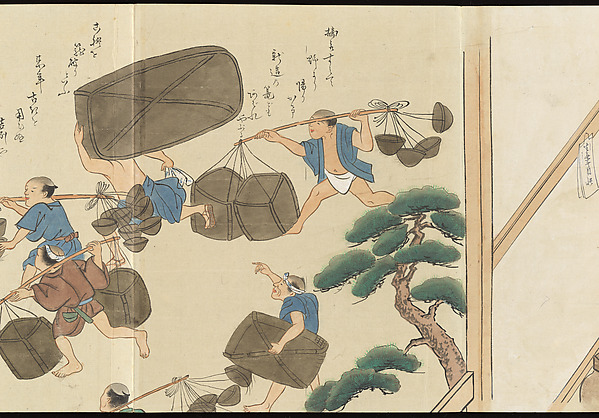
Saitō Motonari, Illustrations of Uji Tea Production (Uji seichanozu), 1803, handscroll of thirty-two sheets reformatted as a folding album; detail, image 52 of 66 in the museum's record. The Metropolitan Museum of Art, Purchase, Friends of Asian Art Gifts, 2023, accession 2023.237.
Look closer: a painted scene of five men in short robes and loincloths running or striding with carrying poles, each balancing large lidded baskets and square bundles, some on their backs, in front of a pine tree and an upright post. The museum catalogues the scroll as Illustrations of Uji Tea Production, 1803, by Saitō Motonari.
Image: The Metropolitan Museum of Art, Open Access (CC0)
The bilingual corpus lists local names prefecture by prefecture, in order of prefecture and without regard to renown. It records a saying from the song Sayamachatsumi-uta that the best-coloured tea is Shizuoka, the best-flavoured is Uji and the best-tasting is Sayama, and notes that there is no theoretical basis for treating these as Japan's three great teas. It also marks the limits of the map: Hiyama-cha of Akita is regarded as the northern limit of tea production and is not sold on the open market, and Murakami-cha of Niigata is the northern limit among teas sold on the open market.
Path of Cha adds that Uji tea has a history of hundreds of years and, until the Meiji era, was carried ceremonially from Uji to Edo, and that Yamecha accounts for 45 per cent of Japan's gyokuro production.
| Prefecture | Names and notes in the sources |
|---|---|
| Shizuoka | Shizuoka-cha, produced across the whole prefecture; the Izu area is where guricha is commonly made; Kawane-cha, Okabe-cha, Kakegawa-cha and others. |
| Kagoshima | Kagoshima-cha; Chiran-cha and Satsuma-cha among its local names. Kagoshima and Shizuoka together are said to account for about 70 per cent of dried unrefined tea (Wikipedia). |
| Kyoto | Uji tea, Uji bancha, Wazuka-cha; in a broad sense, teas of the Yamashiro area are called Uji tea. |
| Fukuoka | Yame-cha, famous for gyokuro and dominant in the national tea jury's rankings. |
| Mie | Ise-cha and its local names; leads Japan in kabusecha production. |
| Saga | Ureshino-cha, famous for kamairicha. |
| Saitama | Sayama-cha and Kawagoe-cha; Tokyo Sayama-cha is a related name. |
| Aichi | Nishio tencha, the one tencha place name the corpus lists; also Mikawa-cha and Shinshiro-cha. |
| Niigata | Murakami-cha, the northern limit among teas sold on the open market. |
| Akita | Hiyama-cha, regarded as the northern limit of tea production and not sold on the open market. |
| Tokushima, Kochi, Ehime and Toyama | Fermented teas, tsukemono-cha: Awa-bancha, goishi-cha, Ishizuchi kurocha and, in Toyama, batabata-cha. |
Six Pickings and the Eighty-Eighth Night
The bilingual corpus gives a calendar of pickings by date, which turns the loose talk of flushes into a table. Ichibancha, the first picking, runs from 10 March to 31 May; nibancha from 1 June to 31 July; sanbancha from 1 August to 10 September; yobancha from 11 September to 20 October; shūtō bancha, the autumn and winter cutting, from 21 October to 31 December; and tōshun bancha, the winter and spring cutting, from 1 January to 9 March. The table shows the six periods as the corpus states them.
Wikipedia ties the new tea to the old calendar. The shincha season runs, depending on the region, from early April to late May, and the article names the eighty-eighth day after Setsubun specifically. The year of the plant begins in the south and moves north, which is why a tea label that says shincha is not a statement about a single date.
| Picking | Dates (corpus) | Note |
|---|---|---|
| Ichibancha, first picking | 10 March to 31 May | Shincha is essentially the same as ichibancha, says Wikipedia. |
| Nibancha, second picking | 1 June to 31 July | Second flush. |
| Sanbancha, third picking | 1 August to 10 September | Third flush; Wikipedia says bancha is harvested from the third and fourth. |
| Yobancha, fourth picking | 11 September to 20 October | Fourth flush. |
| Shūtō bancha, autumn and winter | 21 October to 31 December | Named in the corpus as an autumn and winter bancha. |
| Tōshun bancha, winter and spring | 1 January to 9 March | Named in the corpus as a winter and spring bancha. |
Fields, Farmers and the Matcha Shortage
The figures that TeaLife, a retailer, gives on its market data page show a trade that has contracted. The planted area fell from 49,000 hectares in 2004 to 41,000 in 2019, and production from 101,000 tonnes to 82,000. Commercial farms fell more sharply, from 53,687 in 2000 to 20,144 in 2015, and the page says fewer than 40 per cent of the farms of 2000 survived to 2015. Farms in Shizuoka fell from 24,019 to 9,617, and in Kagoshima from 4,309 to 1,744, while the average farm grew, in Shizuoka from 0.7 to 1.2 hectares and in Kagoshima from 1.5 to 3.3. The share of farmers aged 65 or over rose from 49 per cent in 2000 to 56 per cent in 2015. These are a retailer's figures and are marked as attributed.
Matcha's recent history is a story of demand. Wikipedia says that the powder has become popular worldwide, helped by its photogenic colour on social media, and that a shortage followed: major Japanese producers, among them Marukyū Koyamaen and Ippodo, announced limited availability or suspended sales of matcha in late 2024, and the 2025 harvest yielded 20 per cent less than the year before. Some Kyoto tea companies have set purchase limits on premium matcha because of constrained supply, particularly of first-flush matcha, which was historically reserved for tea ceremonies. The article names the labour of production, the limited grinding capacity and the shrinking number of tea farmers as additional strains, and says that China began mass production of matcha in Guizhou Province in 2018 after inviting Japanese specialists for technical guidance, with a quality that is improving.
None of these figures should be read as a forecast. They are a snapshot of what the sources say, and the chapter has been reviewed on the date given; for the current position of a producer or a price, the producer's own notices are the right source.
| Measure | Figures | Source |
|---|---|---|
| Planted area | 49,000 hectares in 2004; 41,000 hectares in 2019 | TeaLife market data page (retailer, attributed) |
| Production | 101,000 tonnes in 2004; 82,000 tonnes in 2019 | TeaLife market data page (retailer, attributed) |
| Commercial tea farms | 53,687 in 2000; 20,144 in 2015 | TeaLife market data page (retailer, attributed) |
| Shizuoka farms | 24,019 in 2000; 9,617 in 2015 | TeaLife market data page (retailer, attributed) |
| Kagoshima farms | 4,309 in 2000; 1,744 in 2015 | TeaLife market data page (retailer, attributed) |
| Average farm, Shizuoka | 0.7 hectares in 2000; 1.2 hectares in 2015 | TeaLife market data page (retailer, attributed) |
| Average farm, Kagoshima | 1.5 hectares in 2000; 3.3 hectares in 2015 | TeaLife market data page (retailer, attributed) |
| Farmers aged 65 or over | 49 per cent in 2000; 56 per cent in 2015 | TeaLife market data page (retailer, attributed) |
| Yabukita share of plantings | Japan 71.5 per cent; Shizuoka 91 per cent; Kagoshima 32 per cent (2019) | TeaLife market data page (retailer, attributed) |
Vessels for Every Leaf
A tea carries its equipment with it. The table below sets the water and the vessel for each of the teas as the sources give them, and leaves a cell plain where the sources used here say nothing. The heat is given as the sources state it, and the chapter does not average figures that differ.
The cross-references are to chapters of this almanac. The iron kettles heat the water of the matcha room, the water vessels hold and move it, and the sencha table is where the small pot, the cooling bowl and the small cups are used for the leaf.
| Tea | Water and measure | Vessels in the sources |
|---|---|---|
| Matcha, koicha | 4 g in 30 mL at 80 °C, not foamed | Stored in a chaire; scooped with the chashaku, whisked with the chasen, drunk from the chawan (Wikipedia, Matcha) |
| Matcha, usucha | Half the powder in twice the water, at 90 °C, foamed | Stored in a natsume; the same scoop, whisk and bowl (Wikipedia, Matcha) |
| Sencha | 80 °C for 1 minute, says the infobox | A kyūsu and small cups; see the chapter on the sencha table |
| Gyokuro | 40 to 70 °C, about 5 g in 150 mL, first infusion about 2 minutes | Small pots such as the koburi or the hōhin, and small cups (Wikipedia, Gyokuro) |
| Hōjicha | 82 °C for 30 seconds to 3 minutes in the infobox; a mild smoky note at 100 °C | No vessel is named in the sources used here |
| Genmaicha | No figure is given in the sources used here | No vessel is named in the sources used here |
China, Korea and the Same Leaf
The powder began in China. Wikipedia says that powdered tea originated in the Tang dynasty, when leaves were pounded and milled and shaped into cakes, and that Lu Yu's Classic of Tea, written about 760 to 762, documented how powdered tea was steeped in hot water. In the Song dynasty, whisks, bowls and other tools appeared, and the Zen monks from Japan who visited Chinese temples met the drink and its preparation. The Record of Tea by Cai Xiang, of 1049 to 1053, and Emperor Huizong's Treatise on Tea, of 1107, describe the preparation of high-grade compressed tea, which was ground into powder, sifted, poured into a bowl and whisked.

Tea Bowl with Hare’s-Fur Decoration, 11th–12th century, Stoneware with copper-oxide glaze (Jian ware). The Metropolitan Museum of Art, H. O. Havemeyer Collection, Bequest of Mrs. H. O. Havemeyer, 1929, accession 29.100.227.
Look closer: a deep, dark tea bowl with a glossy black-brown glaze that shows fine brown streaks from the rim down the inside, a narrow brownish rim and a small unglazed foot, photographed against a soft grey ground. The museum catalogues it as a Tea Bowl with Hare's-Fur Decoration, 11th to 12th century, stoneware with copper-oxide glaze (Jian ware), China, 6.4 cm high and 11.7 cm in diameter.
Image: The Metropolitan Museum of Art, Open Access (CC0)
In China the practice ended. The Ming founder Zhu Yuanzhang banned the production of compressed tea in 1391, loose tea steeped in hot water became the mainstream, and powdered tea fell out of use. In Japan, the article says, a tradition of powdered tea was preserved, and through shade cultivation and stone-milling it became what is now called matcha. Tea ceremonies at Kennin-ji in Kyoto and Engaku-ji in Kamakura are thought, the article says, to preserve traditions from the Song dynasty, and in the Muromachi period the elite drank tea from expensive Chinese ceramics known as karamono. The Met holds Chinese bowls of the Song period, such as the Jian ware bowl shown beside this text.
Korea keeps parallel terms. The matcha article gives Korean names for the powder, malcha and garucha, and a very similar tea to genmaicha, hyeonminokcha, brown rice green tea, while hyeonmicha, the cognate of genmaicha, is an infusion of roasted brown rice in water. China and Vietnam also produce matcha for export, and the article says that Japan still produces the finest, though Chinese quality is improving fast enough that it is used in the food industry at more competitive prices.
How to Read a Tea Label
A label can be read from the definitions in this chapter. The table sets out the terms a buyer meets and what the sources say they mean. The chapter does not recommend a brand or a price, and every claim made by a dealer or a producer is marked as attributed wherever it is used.
Three habits help. Read the name of the tea first, since matcha, gyokuro and sencha are defined by process, and a powdered tea crushed from non-shaded leaves is, by Wikipedia's account, hunmatsucha and not matcha. Read the picking, since shincha, the first of the year, differs from tea cut in a later flush. Read the steaming, since asamushi, chūmushi and fukamushi lead to different leaves and different cups. For the leaf itself, the producer's own page is the authority.
| Term | What the sources say |
|---|---|
| Matcha | ISO 20715:2023 and the Japanese labelling standard both require Camellia sinensis var. sinensis, shade growing, steaming and drying without rolling, and fine grinding; the Japanese standard adds 2 to 3 weeks of shading. |
| Hunmatsucha, 粉末茶 | Cheaper powdered tea made by crushing non-shaded leaves; sometimes sold under the name matcha although it does not meet the definitions (Wikipedia). |
| Gyokuro | The Japan Tea Central Association definition: sencha-style processing of leaves from covered gardens almost fully shaded for about 20 days (Wikipedia). |
| Shincha or ichibancha | The first picking of the year; shincha stresses that it is the year's first tea (Wikipedia, Sencha). |
| Asamushi, chūmushi, fukamushi | Light, middle (30 to 90 seconds) and deep (1 to 2 minutes) steaming (Wikipedia, Sencha). |
| Place names | Uji, Yame, Shizuoka, Ise, Sayama and the rest name where a tea was grown or processed; Camellia Sinensis, a retailer, says Japanese tea names relate more to production and processing than to terroir. |
| Cultivar | Yabukita is the commonest; Saemidori, Okumidori, Asahi and Yamakai are named for gyokuro (Wikipedia). |
Fun Facts
- Wikipedia says the Japanese word for brown, chairo, literally means tea colour, because the powdered tea once imported from China was brown.
- The oldest known matcha brand, Baba Mukashi, is named after Myōshūni, whom Tokugawa Ieyasu called Baba, according to Wikipedia.
- Lords had to stand aside when the tea-jar procession from Uji to Edo passed, says Wikipedia.
- Uji's official tea masters could use family names and carry swords like samurai, says Wikipedia.
- Gyokuro's discovery is dated to 1835 and credited to the merchant Yamamoto Kahei, who saw farmers covering plants against frost.
- Genmaicha is called popcorn tea because a few grains of rice pop in the roasting, says Wikipedia.
- Hōjicha is said to have been invented in 1920 by a Kyoto merchant with unsaleable bancha, says Wikipedia.
- Path of Cha nicknames konacha sushi restaurant tea.
- The corpus notes that the saying about Shizuoka's colour, Uji's flavour and Sayama's taste has no theoretical basis.
- The Met's Uji scroll is 1,647.8 centimetres long as painted, nearly sixteen and a half metres.
- Wikipedia says a cup of sencha holds about 20 to 30 milligrams of caffeine.
A Timeline of Tea in Japan
Dates are given as the sources give them, with the source named. Where an event is only an account, it is marked as such.
| Date | Event | Source |
|---|---|---|
| 815 | Eichū is said in the Nihon Kōki to have served sencha to Emperor Saga at Karasaki, probably Chinese compressed tea. | Wikipedia, Matcha |
| 816 | By imperial order, tea plantations are established in the Kinki region. | Wikipedia, Matcha |
| 960 to 1279 | Song dynasty: powdered tea is whisked in a bowl with a bamboo whisk. | Wikipedia, Matcha |
| 1173 to 1232 | Lifespan of Myōe, who planted Eisai's seeds at Togano'o and established plantations at Uji. | Wikipedia, Matcha |
| About 1191 | Eisai is credited with bringing the Song style of tea to Japan. | Wikipedia, Matcha |
| 1214 | Eisai presents the Kissa Yōjōki to the shogun Minamoto no Sanetomo. | Wikipedia, Matcha |
| About 1319 to 1320 | A chief priest from Uji begins growing tea at a temple in Yoshimatsu, the first tea in Kagoshima. | Wikipedia, Kagoshima green tea |
| 14th century | A stone mill specialised for tea appears and produces a finer powder. | Wikipedia, Matcha |
| 1391 | The Ming founder bans compressed tea in China. | Wikipedia, Matcha |
| First half of the 15th century | Soil analyses suggest shaded cultivation at Uji began by this time at the latest. | Wikipedia, Matcha |
| 1476 and 1511 | The Nōami and Sōami versions of the Kundaikan sōchōki illustrate matcha jars. | Wikipedia, Matcha |
| 1548 | The dictionary Unpo Iroha Shū records the characters 抹茶. | Wikipedia, Matcha |
| 1633 to 1866 | The Ochatsubo Dōchū, the tea-jar journey from Uji to Edo. | Wikipedia, Matcha |
| 1738 | By this year sencha is popular enough that an Uji grower develops a tea named for the brewing method. | Wikipedia, Baisao |
| 1803 | Saitō Motonari paints the Uji tea-production scroll. | The Metropolitan Museum of Art |
| 1835 | Yamamoto Kahei is said to discover that covering the plants changes the tea; the result is gyokuro. | Wikipedia, Gyokuro |
| 1868 | The Meiji Restoration removes matcha's traditional clientele and, in time, the Uji monopoly on shaded cultivation. | Wikipedia, Matcha |
| 1887 | A Kagoshima tea association is founded to improve quality. | Wikipedia, Kagoshima green tea |
| 1920 | A Kyoto merchant roasts unsaleable bancha and creates hōjicha, according to Wikipedia. | Wikipedia, Hōjicha |
| Taishō to early Shōwa | The tencha dryer replaces the charcoal-fired hoiro. | Wikipedia, Matcha |
| 2007 | Yame tea holds every place from first to twenty-sixth in the national gyokuro jury. | Wikipedia, Gyokuro |
| 2023 | ISO 20715:2023 classifies tea types and defines matcha. | Wikipedia, Matcha |
| 2024 to 2025 | Major Kyoto producers limit or suspend matcha sales; the 2025 harvest is reported 20 per cent lower. | Wikipedia, Matcha |
A Glossary of Leaf and Powder
The words of the chapter, with the sense the sources give them.
| Term | Meaning |
|---|---|
| Ocha | お茶. The everyday word for tea; the Path of Cha blog lists it with nihoncha as a name for green tea. |
| Ryokucha | 緑茶. Green tea; sencha is the commonest. |
| Sencha | 煎茶. Infused tea, made by steeping whole processed leaves. |
| Gyokuro | 玉露. Jade or jewel dew; shaded for about 20 days. |
| Kabusecha | 冠茶. Sencha shaded for a shorter time than gyokuro. |
| Tencha | 碾茶. The unrolled, dried leaf that is ground into matcha. |
| Matcha | 抹茶. Finely ground powder of shade-grown tea leaves. |
| Koicha, usucha | 濃茶, 薄茶. Thick tea and thin tea; usucha is foamed and koicha is not. |
| Bancha | 番茶. Common tea, cut from the later flushes. |
| Hōjicha | 焙じ茶. Roasted tea. |
| Genmaicha | 玄米茶. Green tea with roasted popped brown rice. |
| Kukicha, bōcha | 茎茶, 棒茶. Twig tea, made mainly from stems and stalks. |
| Karigane, shiraore | 雁が音, 白折. Names for kukicha made from gyokuro or sencha stems. |
| Konacha | 粉茶. Tea dust left from processing. |
| Mecha | 芽茶. Rolled tea from early spring buds and leaves, according to Path of Cha. |
| Tamaryokucha, guricha | 玉緑茶, ぐり茶. Curled-leaf tea; guricha is the steamed kind. |
| Kamairicha | 釜炒り茶. Pan-fired in an iron pot rather than steamed. |
| Aracha | 荒茶. Unrefined tea: a rough mix of leaf, stalk and stem. |
| Shincha, ichibancha | 新茶, 一番茶. New tea; the first picking. |
| Nibancha, sanbancha, yobancha | 二番茶, 三番茶, 四番茶. The second, third and fourth pickings. |
| Hachijūhachiya | 八十八夜. The eighty-eighth night after the start of spring. |
| Asamushi, chūmushi, fukamushi | 浅蒸し, 中蒸し, 深蒸し. Light, middle and deep steaming. |
| Yabukita | 薮北. The commonest cultivar of Japanese tea. |
| Kabuse | Shading nets hung over the plants. |
| Jikagise | Covering plants directly with shading material. |
| Yoshizu, komo | Reed screen and straw mat, two of the shading materials in the Japanese labelling standard. |
| Ooikou | 覆い香. The laver-like aroma of shade-grown tea, from dimethyl sulfide. |
| Tsukemono-cha | Fermented tea made mainly in Shikoku and in Toyama. |
| Chashi | 茶師. A tea manufacturer or merchant; in the Edo period, specially the official tea masters of Uji. |
| Ochatsubo Dōchū | 御茶壺道中. The tea-jar journey from Uji to Edo, 1633 to 1866. |
| Hoiro | 焙炉. A charcoal-fired hearth with paper supports on which leaves were dried by hand. |
| Chairo | 茶色. Tea colour; the Japanese word for brown, from the brown powdered tea of the past. |
More Tea Fields, Sheets and Houses to Look At
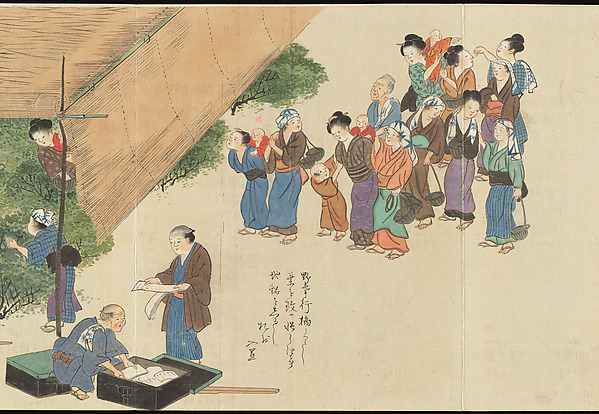
Saitō Motonari, Illustrations of Uji Tea Production (Uji seichanozu), 1803, handscroll of thirty-two sheets reformatted as a folding album; detail, image 25 of 66 in the museum's record. The Metropolitan Museum of Art, Purchase, Friends of Asian Art Gifts, 2023, accession 2023.237.
Look closer: a painted scene beneath a sloping straw canopy, where a crowd of men, women and children in blue, red and brown robes gather at the edge of the tea bushes, and in the foreground a man holds a sheet of paper while another kneels at an open black box. The museum catalogues the scroll as Illustrations of Uji Tea Production, 1803, by Saitō Motonari.
Image: The Metropolitan Museum of Art, Open Access (CC0)
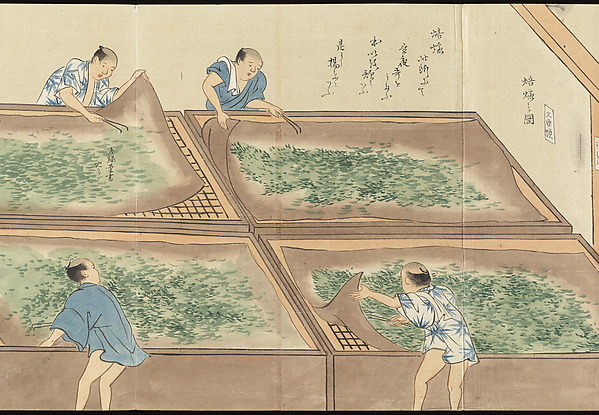
Saitō Motonari, Illustrations of Uji Tea Production (Uji seichanozu), 1803, handscroll of thirty-two sheets reformatted as a folding album; detail, image 43 of 66 in the museum's record. The Metropolitan Museum of Art, Purchase, Friends of Asian Art Gifts, 2023, accession 2023.237.
Look closer: a painted scene of four large rectangular wooden frames set together, each holding a bed of green leaf over a lattice, with men in blue and white short robes lifting or smoothing sheets of brown paper over them. The museum catalogues the scroll as Illustrations of Uji Tea Production, 1803, by Saitō Motonari.
Image: The Metropolitan Museum of Art, Open Access (CC0)
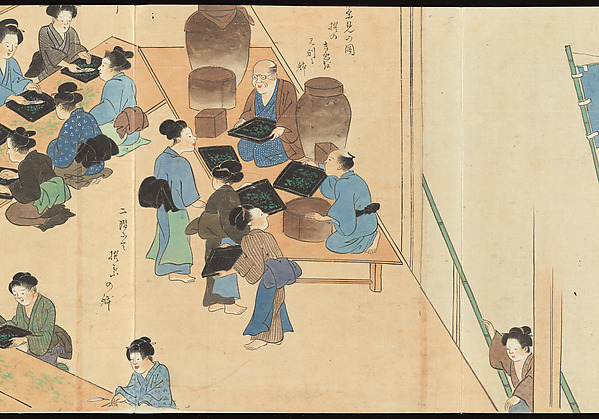
Saitō Motonari, Illustrations of Uji Tea Production (Uji seichanozu), 1803, handscroll of thirty-two sheets reformatted as a folding album; detail, image 56 of 66 in the museum's record. The Metropolitan Museum of Art, Purchase, Friends of Asian Art Gifts, 2023, accession 2023.237.
Look closer: a painted scene of a room in which men and women in blue and brown robes sit and stand at long tables, each working with a black rectangular tray, with tall brown storage jars at the back and a man in a brown robe at the centre. The museum catalogues the scroll as Illustrations of Uji Tea Production, 1803, by Saitō Motonari.
Image: The Metropolitan Museum of Art, Open Access (CC0)
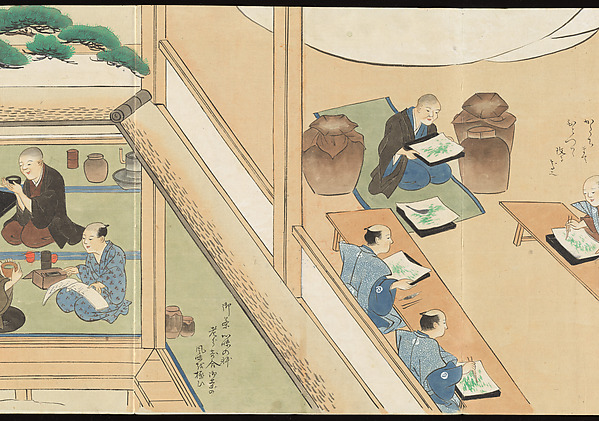
Saitō Motonari, Illustrations of Uji Tea Production (Uji seichanozu), 1803, handscroll of thirty-two sheets reformatted as a folding album; detail, image 64 of 66 in the museum's record. The Metropolitan Museum of Art, Purchase, Friends of Asian Art Gifts, 2023, accession 2023.237.
Look closer: a painted scene of men in dark and blue robes seated at low wooden benches with trays of green leaf and large jars behind them, and at the left a small room in which one man holds a bowl and another reads from a scroll. The museum catalogues the scroll as Illustrations of Uji Tea Production, 1803, by Saitō Motonari.
Image: The Metropolitan Museum of Art, Open Access (CC0)

Utagawa Hiroshige, Tea house in Hakusen district, ca. 1835–42, Woodblock print; ink and color on paper. The Metropolitan Museum of Art, Rogers Fund, 1919, accession JP1168.
Look closer: a woodblock print of a row of two-storey buildings under blue and white shop curtains, a fan-shaped title cartouche at the upper right, and a crowd of travellers and porters in the street at the right. The museum catalogues it as Tea house in Hakusen district, about 1835 to 1842, by Utagawa Hiroshige, woodblock print, ink and colour on paper, Rogers Fund, 1919.
Image: The Metropolitan Museum of Art, Open Access (CC0)

Kitagawa Utamaro, Teahouse girl and servant: Snow from the series Comparison of Snow, Moon and Flower Beauty, late 18th century, Woodblock print; ink and color on paper. The Metropolitan Museum of Art, Museum Accession, accession JP1095b.
Look closer: a woodblock print of two women in patterned robes and elaborate hair ornaments, one with a striped fan, set against a cream ground with a cartouche at the left. The museum catalogues it as Teahouse girl and servant: Snow, from the series Comparison of Snow, Moon and Flower Beauty, late 18th century, by Kitagawa Utamaro, woodblock print, ink and colour on paper.
Image: The Metropolitan Museum of Art, Open Access (CC0)

Utagawa Hiroshige II, Young girl at tea house in Iriya, mid-19th century, Woodblock print; ink and color on paper. The Metropolitan Museum of Art, Museum Accession, accession JP1093.7.
Look closer: a woodblock print of a young woman in a dark blue robe patterned in white, standing on a veranda and looking down, with pine trees and a garden beyond. The museum catalogues it as Young girl at tea house in Iriya, mid-19th century, by Utagawa Hiroshige II, woodblock print, ink and colour on paper.
Image: The Metropolitan Museum of Art, Open Access (CC0)
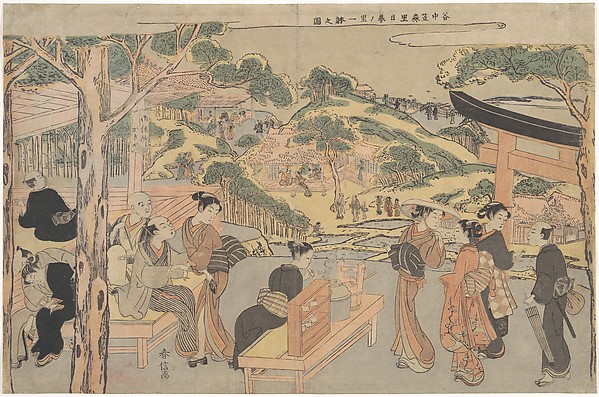
Suzuki Harunobu, Osen of the Kagiya Teahouse at Kasamori Shrine with a View of Nippori in Yanaka, ca. 1768, Woodblock print; chuban; ink and color on paper. The Metropolitan Museum of Art, Gift of Mrs. Morris Manges, in memory of her husband, Dr. Morris Manges, 1947, accession JP3052.
Look closer: a woodblock print of a teahouse beside a shrine path, with people seated and walking beneath trees and a view across to a distant town. The museum catalogues it as Osen of the Kagiya Teahouse at Kasamori Shrine with a View of Nippori in Yanaka, about 1768, by Suzuki Harunobu, woodblock print, chuban, ink and colour on paper.
Image: The Metropolitan Museum of Art, Open Access (CC0)
Tea-Room Ware from the Collection
The shop's tea-room ware passes through the house with the rest of the tea room. The concierge desk will say in plain words what each piece is made of, who made it where the record says so, whether it has been used or repaired, and what the record does and does not show. The atlas of utensils and the glossary of tea utensils are companions to this chapter.
Answered plainly
What are the main kinds of Japanese tea?
The nippon.com page groups them as sun-grown (sencha, fukamushicha, bancha, guricha), shade-grown (gyokuro, kabusecha, tencha), by-products (kukicha, konacha) and reprocessed (hōjicha, bōcha, genmaicha).
What makes matcha different from sencha?
Matcha is ground from shade-grown tencha, which is steamed and dried without rolling, and the powder is drunk; sencha is rolled leaf that is infused and discarded.
How long is gyokuro shaded?
About twenty days, says Wikipedia, which adds that the period can run to thirty; sources differ, and the chapter's note on the sources that differ gives them.
What is shincha?
The first picking of the year, essentially the same as ichibancha, with a fresh aroma and sweetness, says Wikipedia.
What is bancha?
Common tea, cut from the later flushes of the plant; Wikipedia says the third and fourth, between summer and autumn.
How is hōjicha made?
It is roasted tea, roasted at 150 °C in a porcelain pot over charcoal, according to Wikipedia; two retailers give about 200 °C.
Why is genmaicha called popcorn tea?
Because a few grains of the rice pop during the roasting and resemble popcorn, says Wikipedia.
Is steaming the usual Japanese method?
Yes for most; Wikipedia says the leaves are steamed for fifteen to twenty seconds, unlike the pan-firing of Chinese green teas; kamairicha is pan-fired.
Where does most Japanese tea grow?
Shizuoka and Kagoshima together account for roughly seventy per cent of dried unrefined tea, according to Wikipedia.
What is the Uji scroll?
A scroll of 1803 in the Metropolitan Museum that shows the stages of tea-making at Uji from early spring growth to drying.
Is cheap powdered tea matcha?
Wikipedia says tea made by crushing non-shaded leaves, hunmatsucha, does not meet the definitions of matcha, though it is sometimes sold under the name.
Where next
Sources and image credits
- Sencha, Wikipedia
- Gyokuro, Wikipedia
- Hōjicha, Wikipedia
- Genmaicha, Wikipedia
- Bancha, Wikipedia
- Matcha, Wikipedia
- Kagoshima green tea, Wikipedia
- Japanese tea, a bilingual corpus of Wikipedia's Kyoto articles
- Japan's Many Varieties of Green Tea, nippon.com
- The Nomenclature of Japanese Teas, Camellia Sinensis (retailer, attributed)
- The Different Types of Tea Found in Japan, Path of Cha (retailer, attributed)
- Planted Area and Production Volume, TeaLife (retailer, attributed)
- Japanese tea, o-cha.net (tea portal, attributed)
- Object record, Illustrations of Uji Tea Production, The Metropolitan Museum of Art
- Object record, Fuji from the Katakura Tea Fields in Suruga, The Metropolitan Museum of Art
- Object record, Tea jar, Ko Bizen ware, The Metropolitan Museum of Art
- Object record, Chashaku, named Imogase, The Metropolitan Museum of Art
- Object record, Sencha teacup with lattice pattern, The Metropolitan Museum of Art
- Object record, At the Ise-ya Tea-house, The Metropolitan Museum of Art
- Object record, Tea Bowl with Hare's-Fur Decoration, The Metropolitan Museum of Art
- Object record, Tea house in Hakusen district, The Metropolitan Museum of Art
- Object record, Teahouse girl and servant: Snow, The Metropolitan Museum of Art
- Object record, Young girl at tea house in Iriya, The Metropolitan Museum of Art
- Object record, Osen of the Kagiya Teahouse, The Metropolitan Museum of Art
Last reviewed 28 October 2026. Pictures, where shown, are public-domain or open-access and credited beneath each one.
Looking for a tea bowl, a caddy or another piece of tea-room ware? The concierge desk replies within one to three business days.
Browse tea ceremony and chagama pieces · Make a private request
Private concierge
Looking for something in particular?
Describe the piece or the project you have in mind. A senior advisor in Tokyo reads every case file personally and replies within two business days, with fees set out in writing before any work begins.