
Chawan: The Anatomy of a Tea Bowl
Chanoyu Almanac · Clay, Glaze, Hand
Chawan: The Anatomy of a Tea Bowl
Every object in the tea room is looked at; one is held. The bowl travels from the host's hands to the guest's, is turned, lifted, drunk from and admired, and in that short journey it is judged by weight, warmth and the feel of the foot against the palm. This chapter takes the bowl apart in words, names every part the sources name, and follows its shapes from the dark bowls of Song China to the hand-built bowls of Kyoto.
Fact sheet
At a glance
- A bowl with parts. JAANUS names five: rim, body, waist, foot and well. Tea teachers add the places where the whisk and cloth wear the glaze.
- Three origins. Chinese bowls are called karamono, Korean bowls kōrai chawan and Japanese bowls kuniyaki.
- The foot speaks. Wikipedia lists a score of foot forms, from the plain ring to the whirlpool and the crescent moon.
- A saying of rank. Raku first, Hagi second, Karatsu third, as the tea schools put it.
- Repair is part of the story. Kintsugi mends a break with lacquer and gold, and a mended bowl is read as a history and not a flaw.
A Bowl That Is Held
A guest in a tea room is asked to look at many things, but only one is placed in the hands. The scroll hangs in the alcove and is read from a distance; the kettle sings on the hearth and is heard; the caddy and the scoop are admired on the mat. The bowl is lifted. The Cleveland Museum of Art, writing of an early seventeenth-century bowl in its collection, says that tea bowls are the most important objects used in tea practice, and the sentence is a fair summary of how the tradition behaves. A guest drinks from it, turns it, wipes its rim and, at the end, is invited to look closely at the thing that has just been used.
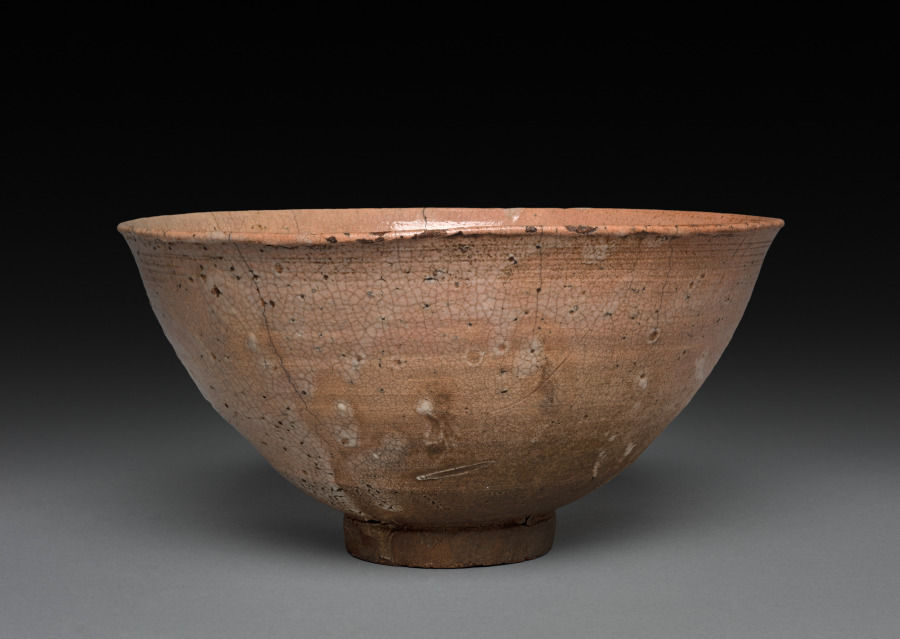
Tea Bowl, c. 1600, Glazed stoneware (Karatsu ware). The Cleveland Museum of Art, Gift of Iwao and Takako Setsu in honor of Dr. and Mrs. Sherman E. Lee, accession 1983.158.
Look closer: the sides rise in one broad flare from a small foot to a thin, slightly uneven rim, and the glaze is mottled where the clay shows through. The museum catalogues it as a Tea Bowl, about 1600, Momoyama period, Karatsu ware, glazed stoneware, 18.4 cm across and 9.5 cm high. The museum's own note calls such wide-mouthed bowls those used for whipped tea.
Image: The Cleveland Museum of Art, Open Access (CC0)
That is why a bowl is described in the language of the body. The Japanese vocabulary for it speaks of a lip, a torso, a hip and a foot; it speaks of a place where the whisk rubs and a place where the cloth wipes, and of a pool where a little leftover tea settles. These words are not decoration. They tell a buyer, a host or a guest where to look, and what the wear of years will have done to each part.
The tea bowl also carries more history than almost any other tea utensil. It began as an import from China, was joined by plain bowls from Korea that the Japanese tea masters read as images of rustic simplicity, and was then taken over by Japanese kilns, of which three are ranked above the rest in a saying the tea schools repeat. Each family brings its own body, its own glaze and its own way of being picked up.
This chapter takes the bowl in order. It starts with the names, draws the parts in a diagram, looks at the foot, the shapes and the seasonal rule for choosing between them, and then follows the three families: Chinese tenmoku, Korean Ido and Japanese Raku, with the kilns that followed. It ends with repair, with cloths, boxes and bags, with the guest's handling, and with a collector's questions, a timeline and a glossary. The sources are Wikipedia, JAANUS, the Kyoto National Museum's guide to chanoyu, the catalogues of the Metropolitan Museum of Art and the Cleveland Museum of Art, and a small number of tea-ware retailers and tea schools, which are named wherever they are used.
Chinese, Korean and Japanese Names
JAANUS, the Japanese Architecture and Art Net Users System, gives the word two senses. In the first, chawan is a general term for ceramic wares made between the ninth and the sixteenth centuries, first used for tea drinking and only much later for rice. In the second, it is the ceramic bowl used for drinking tea in the tea ceremony. Japanese bowls are the most common, the entry says, but Chinese and Korean bowls are also prized, and it gives the three families their names: Chinese imports are karamono, Korean bowls are kōrai chawan, and Japanese-made bowls are kuniyaki.
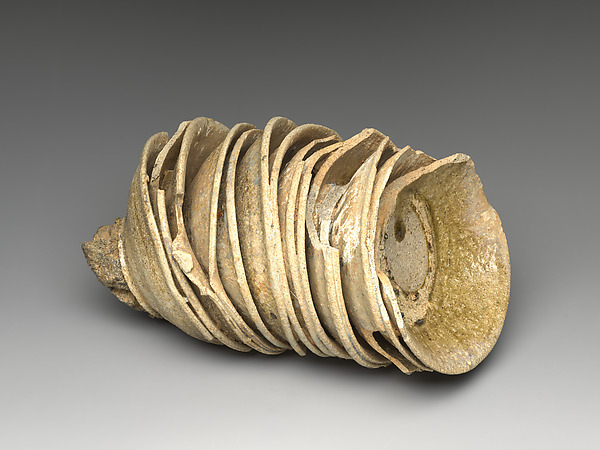
Cluster of mountain tea bowls (yama-chawan), 13th century, Stoneware with ash glaze (Seto ware). The Metropolitan Museum of Art, Purchase, Olive Lam Fund, 1980, accession 1980.152.
Look closer: a dozen or more shallow bowls are stacked rim to foot and welded into one lump by the heat of the kiln, their glaze running pale yellow-green over the edges. The museum catalogues it as a Cluster of mountain tea bowls (yama-chawan), 13th century, Seto ware, stoneware with ash glaze, 27.8 cm long.
Image: The Metropolitan Museum of Art, Open Access (CC0)
The Wikipedia article on the chawan agrees that the bowl began in China. The earliest chawan in Japan were imported from China between the thirteenth and the sixteenth centuries, and, according to tradition, the word tenmoku comes from Mount Tianmu, where Japanese priests acquired the bowls from Chinese temples. A tea school or a museum will often classify a bowl by country of origin, by potter or kiln, by shape, or by the type of tea it was made for, and the Wikipedia article on tea utensils says as much.
Which bowl is chosen depends on the kind of gathering. JAANUS says the choice follows the three levels of formality, shin, gyō and sō, the formal, semi-formal and informal. The most formal bowl is the tenmoku, which the entry says is today used only with the large portable shelf called the daisu and the stand called the tenmokudai. The domestic bowls, plainer and more irregular, came to be favoured for simple, quiet gatherings and spread widely in the late sixteenth century, varying greatly in type and design partly because of the tea masters' own preferences.
Not every early Japanese bowl is elegant. The Metropolitan Museum catalogues a cluster of mountain tea bowls, yama-chawan, of the thirteenth century, in ash-glazed Seto stoneware, 27.8 centimetres long; the photograph shows a heap of plain bowls fused together in the kiln. The museum's record gives the name, the period and the place, and the picture is a useful reminder that Seto, where the Wikipedia article says the first Japanese copies of tenmoku were made, was a working kiln before it was a source of tea ware.
| Family | Name | What the sources say |
|---|---|---|
| Chinese | Karamono | Imported bowls; the earliest in Japan, and the preferred bowl of the tea ceremony until the sixteenth century (Wikipedia, Chawan) |
| Korean | Kōrai chawan | Korean bowls, including the Ido type (JAANUS) |
| Japanese | Kuniyaki | Japanese-made bowls (JAANUS) |
| Formal | Tenmoku | The most formal bowl, used with a daisu and a tenmoku stand (JAANUS) |
| Informal | Domestic bowls | Plain, irregular bowls, used from the late sixteenth century (JAANUS) |
What a Bowl Is Made Of
JAANUS illustrates the bowl with five parts: the rim shape, kuchizukuri; the body, dō; the waist, koshi; the foot, kōdai; and the interior, mikomi. Other tea teachers give a longer list. The Terebess and World Green Tea Association page names thirteen: the lip, the area touched by the cloth, the area the whisk brushes, the tea pool, the deflection below the lip, the body, the hip, the base outside the foot ring, the angle between the base and the foot ring, the foot, the inside of the foot, the hill inside the foot and the area that touches the mat. The retailer Tezumi names the same group in a shorter form. The diagram below combines the three lists.
Diagram by Japonista. Schematic; the part names follow JAANUS, Tezumi, the World Green Tea Association page and Japan Classic.
Look closer: the thick dark line is the wall of the bowl in section, rising from a ring foot at the bottom. The red stroke on the inner left wall marks where the whisk rubs, the dotted blue stroke on the right marks where the cloth wipes, and the small notch in the centre of the floor is the tea pool. The little hill under the floor, inside the foot, is the tokin.
Diagram by Japonista
The rim comes first, because it is where the bowl meets the mouth. Tezumi says the lip is where the mouth touches, and the sources agree that the shape of the rim matters to the feel of the tea. A thicker rim gives a softer mouthfeel, the World Green Tea Association page says, while a curved rim is better for hot tea because one can pinch the top and carry the bowl comfortably. Tezumi adds that the outside of the lip on a tenmoku bowl has an indentation where the lower lip rests, a detail it draws from the history of that form.
The body is the wall and the largest surface for decoration, whether painted, carved or glazed. The waist is the transition from the wall to the base, and Tezumi remarks that a well-sized one makes the bowl easier to handle. Below it sits the foot, which Tezumi calls one of the most highly regarded features of a bowl and says should be large enough to hold comfortably. It adds that the foot should let the bowl be held in one hand, with the thumb on the rim and the fingers inside the foot ring.
The inside of the bowl has its own names. The retailer Japan Classic, in an article by Hayato Eihara dated March 2025, calls the interior floor the mikomi and names two places on it. The area that the cloth wipes, chakin-zuri, is usually a shallow part of the well and is often glazed or finely trimmed so that the cloth does not snag. The area that the whisk stirs, chasen-zuri, is typically deeper, and the page says older bowls often show glaze loss there from use. A small central depression, the chadamari, collects a little leftover tea; Tezumi says it is common in Raku bowls but not universal.
Under the bowl are the names a collector reads first. The side of the foot ring, kōdai-waki, is often left unglazed to show the clay. The inside of the foot, kōdai-ura or kōdai-nai, may carry a small hill, the tokin, which Japan Classic describes as a spiral trimming pattern in the centre, and the foot may be cut in a crescent shape, the mikazuki kōdai, slightly offset. The tatami-tsuki is the edge on which the bowl stands, where the glaze may peel. Japan Classic also names the herame, the trimming marks that run from the waist to the foot ring. The figure shows these in a schematic section; real bowls vary, and the wear marks sit differently on each.
The Foot and Its Names
The Wikipedia article on the chawan lists the forms of the foot. The most common is the ring, wa kōdai, and the next the snake's eye, janome kōdai or futsū kōdai, the ordinary foot. After them come a series of forms named for what they resemble: the double foot, the crescent moon, the shamisen plectrum, the bamboo node, the cherry blossom, the four directions, the go stone, the nail-carved, the spiral shell, the whirlpool, the helmet, the crinkled cloth, and a series of split and cut forms with names such as wari, kiri, and their one-line and cross variants. The article repeats some of the entries, and two of them share a single kanji spelling, so the list should be read as a vocabulary and not a classification.

Tea Bowl with Chrysanthemum Decoration, probably second half of the 17th century, Stoneware with inlaid and stamped design (Kyoto ware). The Metropolitan Museum of Art, Gift of Mr. and Mrs. Samuel Colman, 1893, accession 93.1.94.
Look closer: a plain, round-sided bowl is banded with small stamped flowers and fine lines round the upper wall, and below the band the surface runs smoothly to a low ring foot. The museum catalogues it as a Tea Bowl with Chrysanthemum Decoration, probably the second half of the 17th century, Kyoto ware, stoneware with inlaid and stamped design, 7.9 cm high and 13 cm across.
Image: The Metropolitan Museum of Art, Open Access (CC0)
The foot matters for a plain reason. It is where the hand takes hold, and it is where the clay is left bare. Tezumi says the foot should be large enough to hold comfortably. The Cleveland Museum of Art notes of a Korean bowl in its collection that it has an elongated foot, and says the bowl was exported to Japan and circulated as a luxury; Tezumi observes that the foot is among the most highly regarded features of any bowl.
Japan Classic describes the parts of the foot that a reader meets. The side of the foot ring, it says, is often left unglazed to show the clay, and at the tatami-tsuki, the point of contact, glaze may peel. A reader of an object description should therefore expect the foot to be described, with its form named, and should treat a description that skips it as incomplete; that is the chapter's advice and not a claim made by any one source.
The Metropolitan Museum's bowl with chrysanthemums, catalogued as Kyoto ware and dated probably to the second half of the seventeenth century, shows a plain ring foot under a band of stamped and inlaid decoration. The museum gives it as stoneware with an inlaid and stamped design, 7.9 centimetres high and 13 across, and its Kyoto ware label is the museum's. It is a good bowl to look at when learning where the body ends and the foot begins.
| Name | Kanji | Meaning |
|---|---|---|
| Wa kōdai | 輪高台 | Ring foot |
| Janome kōdai | 蛇ノ目高台 | Snake's-eye foot, also called the ordinary foot |
| Nijū kōdai | 二重高台 | Double foot |
| Mikazuki kōdai | 三日月高台 | Crescent-moon foot |
| Bachi kōdai | 撥高台 | Shamisen-plectrum foot |
| Takenofushi kōdai | 竹節高台 | Bamboo-node foot |
| Sakura kōdai | 桜高台 | Cherry-blossom foot |
| Uzumaki kōdai | 渦巻高台 | Whirlpool foot |
| Tokin kōdai | 兜巾 | Helmet foot |
| Chirimen kōdai | 縮緬高台 | Crinkled-cloth foot |
| Wari kōdai | 割高台 | Split foot |
| Kiri kōdai | 切高台 | Cut foot |
Shapes and Their Seasons
The Wikipedia article gives more than twenty named shapes and repeats a few. The list includes the circle shape, wa-nari, also called the iron bowl; the wooden-bowl shape, wan-nari; the cylinder, tsutsu-gata, and the half cylinder; the go-stone-box shape; the waisted shape; the rider's cup; the cedar shape; the Ido or well shape; the tenmoku shape; the Komogai shape, named for a bowl formerly imported from a Korean port; the curving-lip shape; the flat shape, hira-gata; the horse bucket; the clog or shoe shape, kutsu-gata; the shoreline shape; the peach; the brush-washer shape; the straw hat; the triangular shape; and the four-sided shape. The names describe forms, and a bowl can be described by more than one.
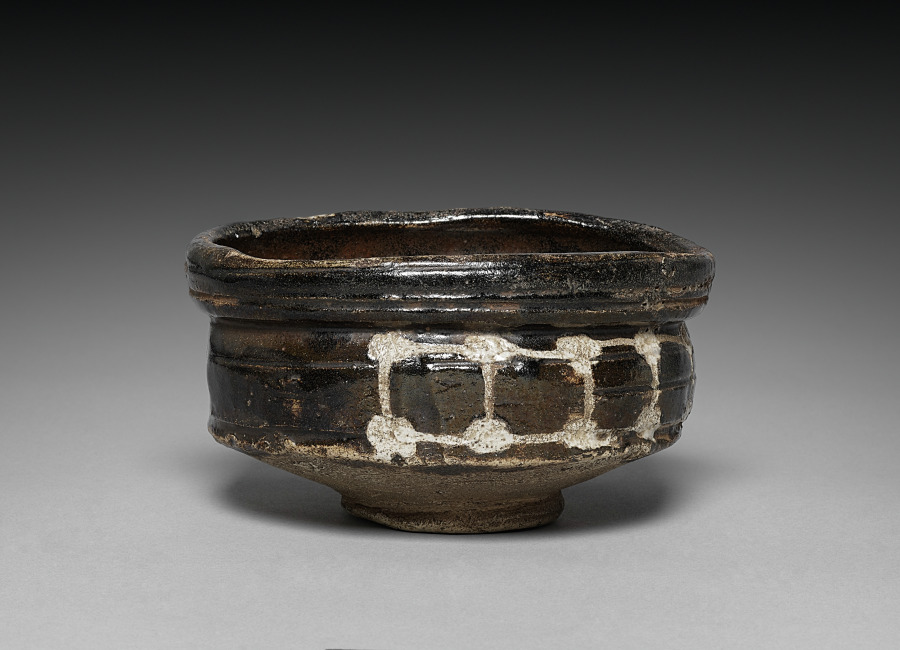
Clog-shaped Teabowl, early 1600s, Glazed stoneware (Mino ware, Oribe type). The Cleveland Museum of Art, Severance and Greta Millikin Purchase Fund, accession 2020.214.
Look closer: the bowl is dark and glossy with a row of pale rectangular panels running round it like a fence, and its rim is pinched into an oval. The museum catalogues it as a Clog-shaped Teabowl, early 1600s, Momoyama period, glazed stoneware, Mino ware, Oribe type, 8 by 14.2 by 11.5 cm.
Image: The Cleveland Museum of Art, Open Access (CC0)
The seasonal rule is simple and the sources agree on it. The Wikipedia article on the tea ceremony says that guests drink tea from a more cylindrical bowl in winter to keep in the heat, and use a flat bowl in summer to release heat, and that the designs depicted on the bowl change with the season. JAANUS says summer bowls tend to be shorter and winter bowls barrel-shaped. The retailer Musubi Kiln, in a guide dated April 2026, names three shapes and attaches a season to each: the straight-sided tsutsu-nari, deeper versions of which hold more and retain heat and are recommended for winter; the wan-nari, the most traditional form, a gentle curve from base to rim; and the hira-nari, flat with a wide mouth and a shallow interior, ideal for summer.
Tezumi gives the practical limits of the form. A bowl should be neither too large nor too small for whisking; it should not be so shallow that tea splashes, nor so tall that the whisk cannot reach the bottom; and it should not be so heavy that drinking becomes tiring. The retailer observes that high walls and a lower centre of gravity make a half-cylindrical Raku-shaped bowl easy to whisk in, and it implies, without saying so outright, that a summer bowl pushes the shallow limit and a winter bowl the tall one.
The Cleveland Museum of Art owns a good example of a distinctive shape. Its clog-shaped bowl, kutsu-gata, of the early seventeenth century, was made in Mino in the Oribe style, and the museum's note says that the oblong shape and bold abstract designs are the signature style of the time, named for the tea master who championed the aesthetic. The shape is deliberate: the sides are pinched and the rim is no longer round, which is a very long way from the Chinese cone.
The materials follow the season too. Musubi Kiln calls stoneware the usual body, with a suitable thickness and weight and an earthy texture, and porcelain thinner and well suited to summer, since its smooth rim and white surface show off the colour of the tea. It adds lacquerware, which does not transfer heat to the hands, and glass, cool in summer but harder to whisk in for a beginner. The World Green Tea Association page recommends pottery for everyday tea because it insulates heat, and says glass is unsuitable for hot tea. These are retailers' and teachers' advice, and the bowls used in a formal chaji are chosen by the host.
| Shape | Kanji | What it is |
|---|---|---|
| Wa-nari | 鉄鉢形 | Circle shape; also called iron-bowl shape |
| Wan-nari | 椀形 | Wooden-bowl shape; the gently curving traditional form |
| Tsutsu-gata | 筒型 | Cylinder; keeps warmth, a winter form |
| Han tsutsu-gata | 半筒型 | Half cylinder |
| Gokezoko-gata | 碁笥底型 | Go-stone-box base |
| Dōjimari-gata | 胴締 | Waisted |
| Sugi-nari | 杉形 | Cedar shape |
| Ido-gata | 井戸型 | Ido or well type |
| Tenmoku-gata | 天目型 | Tenmoku type |
| Hatazori-gata | 端反り型 | Curving lip |
| Hira-gata | 平形 | Flat, wide; a summer form |
| Kutsu-gata | 沓形 | Clog or shoe shape |
| Sankaku-gata | 三角形 | Triangular |
| Shiho-gata | 四方形 | Four-sided |
Heaven's Eye
The first bowls of the Japanese tea tradition were Chinese. The Wikipedia article on tenmoku says the word names a type of glaze that originates in imitation of the Jian ware of the Southern Song dynasty, and the original Chinese pieces are also called tenmoku in Japan. Jian bowls are conical, with a slight indentation below the rim, and the article gives a width of about 10 to 13 centimetres and a height of about 5 to 9. Their glaze, a variable black or brown, produces effects that include an element of chance, which the article says had a philosophical appeal to the Japanese.

Tea Bowl with Hare’s-Fur Decoration, 11th–12th century, Stoneware with copper-oxide glaze (Jian ware). The Metropolitan Museum of Art, H. O. Havemeyer Collection, Bequest of Mrs. H. O. Havemeyer, 1929, accession 29.100.227.
Look closer: the bowl is a deep cone on a tiny foot, its black glaze streaked with long, fine, russet lines that run from rim to centre like the fur of an animal. The museum catalogues it as a Tea Bowl with Hare's-Fur Decoration, 11th to 12th century, Northern to Southern Song dynasty, Jian ware, stoneware with copper-oxide glaze, 6.4 cm high and 11.7 cm across.
Image: The Metropolitan Museum of Art, Open Access (CC0)
An eleventh-century resident of Fujian, quoted in the Wikipedia article on the chawan, wrote that tea is light in colour and looks best in black cups, and that the cups of Jianyang are bluish-black and marked like the fur of a hare. They are thick, he added, so that they retain heat and cool slowly. The hare's-fur glaze is the one the Cleveland Museum of Art describes in a large Fujian bowl of the twelfth or thirteenth century: the enjoyment of Jian ware, the note says, rests on the transmutation of the glaze through iron, which develops reddish-brown streaks and spots against a rich black glaze, and connoisseurs called these formations hare's fur.
The Wikipedia article on tenmoku lists the glaze families by their Japanese names: yōhen, yuteki, haikatsugi, nogime, konoha, moji and ran. The article calls these the most common types of the glaze, and it describes the oil-spot glaze in particular. The article explains the chemistry briefly. The glaze is made of feldspar, limestone and iron oxide; the faster a piece is cooled, the blacker the glaze will be; and a longer cooling allows the maximum surface crystals, which is why potters sometimes fire down a kiln, continuing to add a little fuel after the maximum temperature to slow the cooling. Oil spots are more common in an oxidation firing.
Japanese records of the importation are specific. The same article says that, according to chronicles of 1406, the Yongle Emperor of the Ming dynasty sent ten Jian bowls to the shogun Ashikaga Yoshimitsu, and that a number of Japanese monks who travelled to monasteries in China also brought pieces home. Three Southern Song vessels of the type are so highly valued that the Japanese government included them in the list of National Treasures. The Kyoto National Museum's guide to chanoyu shows a Chinese bowl of another kind: the Bakōhan, the Locust Clamps bowl, of the Southern Song dynasty, thirteenth century, an Important Cultural Property held by the Tokyo National Museum, repaired with metal clamps.
By the end of the Kamakura period, the article on the chawan says, tea drinking had spread through every rank of Japanese society and the tenmoku bowl was desired by all, so the Japanese began to make copies at Seto, in what is now Aichi Prefecture. They liked the tapered shape best, and most Seto tenmoku are tapered. Today the glaze is made by a small circle of artists, the tenmoku article says, naming Kamada Kōji, Nagae Sōkichi, Hayashi Kyōsuke and Oketani Yasushi, and it notes that renewed interest in Jian ware in China in the 1990s allowed a master in the village of Shuiji in Fujian to restart production using the original raw materials.
The Rice Bowl of the Wabi Eye
The second family came from the Korean peninsula, and it changed what a Japanese tea master was willing to hold. JAANUS describes the Ido bowl as a deep bowl of Korean lineage, and the Wikipedia article on the chawan says that the Ido chawan, which originated from a large bowl used for rice in Korea, became highly prized with the rise of wabi tea in the late Muromachi period and was favoured by Sen no Rikyū for its rough simplicity.
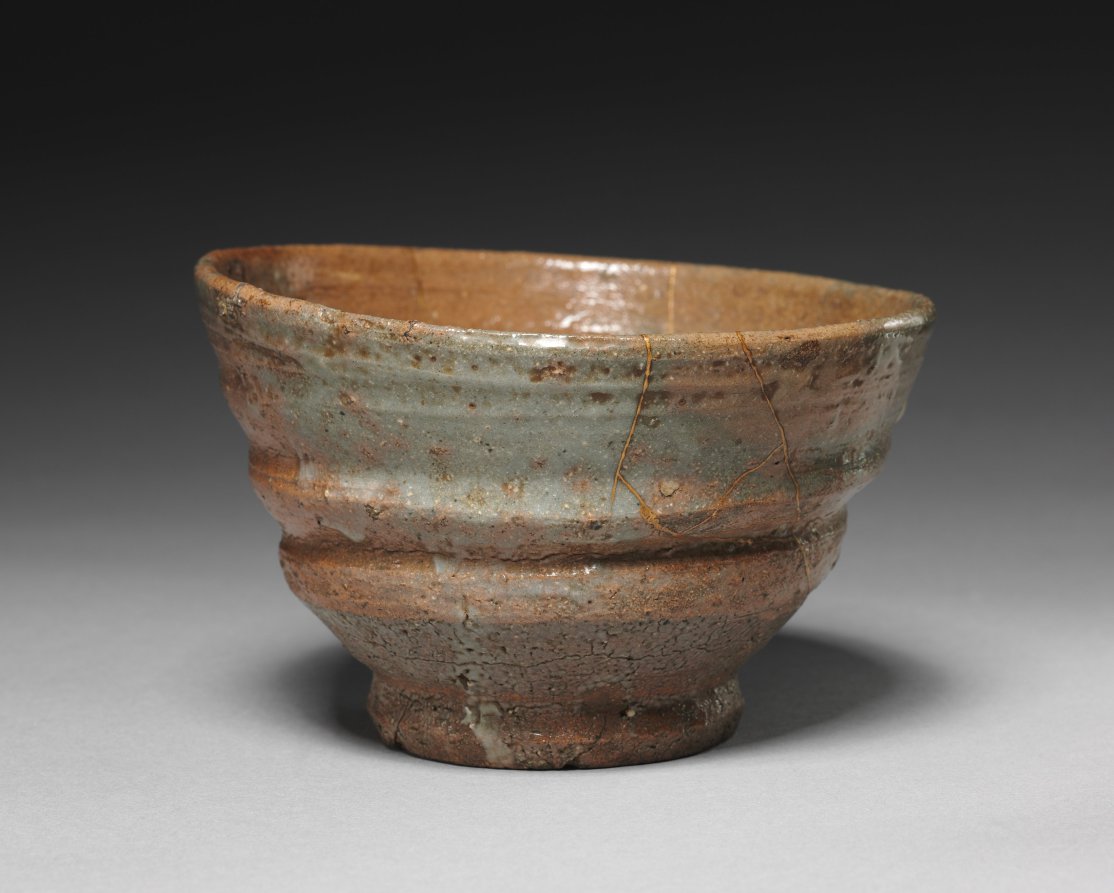
Tea Bowl, 1600s, glazed stoneware. The Cleveland Museum of Art, Cornelia Blakemore Warner Fund, accession 1996.4.
Look closer: the sides swell outwards in two soft ridges, the glaze shifts from grey to rust where it has run, and the rim is a little uneven. The museum catalogues it as a Tea Bowl, 1600s, Joseon dynasty, Korea, glazed stoneware; its note says this wide-mouthed type was an everyday bowl in Korea before Japanese tea men took it up.
Image: The Cleveland Museum of Art, Open Access (CC0)
The Cleveland Museum of Art puts it more plainly in two entries. A wide-mouthed bowl of the seventeenth century, it says, was used every day in Korea, and not only for tea; when this type of bowl was introduced to Japan around the early sixteenth century, its imperfect appearance evoked the aesthetics of wabi-sabi and caused it to be repurposed as a tea bowl. Korean tea bowls then circulated as foreign luxuries among the Japanese military elite, and the museum suggests that the type may have been produced in kilns established by the trading office, the Waegwan, at Busan, as an export for Japanese collectors. A second Cleveland bowl, with an elongated foot, is described as exported in the same way, and the museum says the pinholes in its pinkish glaze were meant to resemble the spots of a fawn.
The Kyoto National Museum's guide shows the Japanese reverence for the type. It illustrates an Ōido-type tea bowl named Tsutsuizutsu, the Well Curb, Korea, Joseon dynasty, sixteenth century, an Important Cultural Property, described in the guide as one of Hideyoshi's favourites. The Japan Times, reporting in 2013 on an exhibition of seventy Korean tea bowls at the Nezu Museum in Tokyo, says Ido bowls became the standard ware of daimyo and tea masters, among them Sen no Rikyū, Kobori Enshū and Matsudaira Fumai, and that the exhibition included the National Treasure Ido bowl known as the Kizaemon.
The Kizaemon has a literature of its own. A Japanese ceramics web page that does not name its author says the bowl is named for Takeda Kizaemon, an Osaka merchant of the Keichō era, and that after passing through several hands it was given to the temple Kōhō-an in Kyoto in 1822. The page repeats a story that several owners suffered tumours and that some blamed the bowl; the story is a legend, told here as attributed, and the chapter does not endorse it. The bowl's present location is not stated by the page, and this chapter does not state it either.
The same web page describes the Kizaemon's body in detail, and the description shows what such a bowl offers the eye: a loquat-coloured glaze with bluish tints, fire holes on the body, a long, narrow carp-shaped repair, a high foot shaped like a bamboo joint, a visible wheel-thrown pattern inside, and exposed clay at the foot where a rough glaze-like material has adhered. The page counts several small lacquer repairs on the rim and a few short vertical cracks. It is a description of one bowl, given here as the page's, and it is the best available picture of what the tea masters meant by rustic simplicity.
Raku and the Bowl Built by Hand
The third family is the one that defines the Japanese bowl for most readers. The Wikipedia article on Raku ware says that in the sixteenth century Sen no Rikyū, who was involved with the construction of the Jurakudai, had a tile-maker named Chōjirō produce hand-moulded tea bowls for the wabi-style tea ceremony that was his ideal. The bowls were first called ima-yaki, contemporary ware, and were also distinguished as Juraku-yaki from the red clay they employed. Toyotomi Hideyoshi, the article says, presented Chōjirō's son Jōkei with a seal bearing the character for raku, meaning enjoyment, and Raku then became the name of the family. The line has passed through the present sixteenth generation, Raku Kichizaemon XVI.

Black Raku Tea Bowl, early 17th century, Earthenware with black raku glaze (Raku ware). The Metropolitan Museum of Art, Rogers Fund, 1917, accession 17.118.74.
Look closer: the bowl is nearly a cylinder, black and softly matt, with a lip that dips and rises slightly and an even, dark glaze. The museum catalogues it as a Black Raku Tea Bowl, early 17th century, Momoyama period, earthenware with black raku glaze, 9.2 cm high and 9.5 cm across.
Image: The Metropolitan Museum of Art, Open Access (CC0)
JAANUS gives the same family a place in the bowl's history: Raku ware is the most popular Japanese bowl, the entry says, and is thought to have been introduced by Sen no Rikyū. The Kyoto National Museum's guide shows a Black Raku bowl named Mukiguri, the Shelled Chestnut, by Chōjirō, whose date of death it gives as 1589, an Important Cultural Property. The Wikipedia article says that Raku ware marked an important point in the history of Japanese ceramics, as the first ware to use a seal mark and the first to focus on close collaboration between potter and patron.
The making is what separates it from the other bowls of the tea room. Raku is traditionally characterised by hand-shaping, a high degree of porosity from low firing temperatures, lead glazes, and the removal of the pieces from the kiln while still glowing hot, after which they cool in the open air. The retailer Sazen Tea adds that Raku bowls are not thrown on a wheel but built by the technique of tezukune, in which a clay disk is slowly shaped by hand and with a paddle, and that tongs leave marks on the outside. It says the marks on a black Raku bowl, which comes from the kiln at about 1,200 degrees Celsius, are clearer, and that the page treats them as evidence of an authentic piece. It also says the uneven rim has five peaks, gogaku, which help to hold the whisk and the scoop. These are the retailer's claims, given as attributed.
The Metropolitan Museum's Black Raku bowl is a plain example, dated to the early seventeenth century, earthenware with a black Raku glaze, 9.2 centimetres high and 9.5 across, from the Rogers Fund of 1917. It stands nearly straight-sided, close to what the shape list calls a cylinder, and its glaze is matt. The museum's Red Raku bowl, in the style of Hon'ami Kōetsu by an unknown potter, is of the eighteenth century, with a red slip under a milky glaze and, unusually, repairs in gold lacquer; it is the subject of a later section of this chapter.
The saying that ranks the three great wares appears in the Wikipedia article on the chawan and again on the Sazen Tea page: Raku first, Hagi second, Karatsu third. It is a tea school's saying, not a market statement, and it reflects the old preference for the warm, soft and quiet over the glittering. The Raku and Hagi bowls are treated in the companion chapters on Raku ware and Hagi ware, and the Karatsu bowl in the chapter on Karatsu ware.
Hagi, Karatsu and Oribe
Raku was joined, and in time outranked in some opinions, by the bowls of the provincial kilns. The Wikipedia article on the chawan says that with the development of the tea ceremony as a distinct form, local Japanese pottery and porcelain became more highly priced and developed, and that by the Edo period the chawan was often made in Japan. Raku, Hagi and Karatsu are the three it names as the most esteemed.

Clog-shaped tea bowl (kutsu-gata chawan) with plum blossoms and geometric patterns, early 17th century, Stoneware with iron-oxide decoration (Mino ware, Black Oribe type). The Metropolitan Museum of Art, Dr. and Mrs. Roger G. Gerry Collection, Bequest of Dr. and Mrs. Roger G. Gerry, 2000, accession 2002.447.28.
Look closer: the bowl is dark and glossy at the lip and black below, with two white panels, one bearing a small plant and one a crossed pattern, and a rim that has been pinched into a soft oval. The museum catalogues it as a Clog-shaped tea bowl (kutsu-gata chawan) with plum blossoms and geometric patterns, early 17th century, Momoyama period, stoneware with iron-oxide decoration, Mino ware, Black Oribe type.
Image: The Metropolitan Museum of Art, Open Access (CC0)
The Cleveland Museum of Art's note on its Karatsu bowl, the one that opens this chapter, explains why Karatsu belongs to the story. The port city of Karatsu, in Saga Prefecture, Kyushu, was known for its kilns, which produced high-fired, Korean-style glazed pottery; Toyotomi Hideyoshi invaded Korea in 1592 and 1597 and returned with families of Korean potters, who were resettled in that region among others. The museum says that wide-mouthed bowls of this kind were used for whipped tea, and that Karatsu ware was among the most prized of them.
Mino supplies the fourth strand. The Cleveland and Metropolitan museums both own black Oribe clog bowls. The Metropolitan Museum catalogues a clog-shaped tea bowl with plum blossoms and geometric patterns, early seventeenth century, stoneware with iron-oxide decoration, Mino ware, Black Oribe type, 7.6 centimetres high and 14.3 wide. The shape is the one the Wikipedia article calls kutsu-gata, and the pattern, as the museum's title has it, is plum blossoms and geometric figures on a dark ground. The Cleveland Museum says the shape and the designs are the signature style of the time, which is called Oribe, after the tea master who championed the aesthetic.
Seto, Mino, Hagi, Karatsu and the Raku kilns of Kyoto are covered in the pottery almanac. The chapter on Seto and Mino follows the first two, the chapter on Hagi ware the third, and the chapter on Karatsu ware the fourth. This chapter keeps to what a person can see in the hand: the thickness of the wall, the width of the mouth, the warmth of the clay, and the way the glaze has sunk.
Rustic Simplicity in the Hand
The aesthetic that made these bowls desirable has a name. The Wikipedia article on the Japanese tea ceremony says that in the sixteenth century Sen no Rikyū introduced a much smaller tea house and rustic, distorted ceramic tea bowls specifically for the tea ceremony, and emphasised a tea ceremony based on the aesthetic of wabi. The article on wabi-cha describes that taste as rustic simplicity and notes that in modern times achieving the aura of rustic simplicity can be an expensive endeavour; even the simple, cheap items used by Rikyū and his followers have gained both status and value.
That sentence is the central paradox of the tea bowl, and the same article adds that authentic Raku tea bowls are among the most expensive available today and among the most sought after. A bowl chosen for its modesty becomes, through the reputation of its chooser, an object that museums catalogue and families keep in a box. The Cleveland note on a Korean bowl says exactly this about its origin: a bowl used daily in Korea was repurposed by Japanese tea men because its imperfect appearance evoked wabi-sabi, and it was then sold to Japanese collectors as a luxury. The change in the object's fortune is not a change in the clay.
The social form of the gathering changed with the bowl. The Wikipedia article on the tea ceremony says the most important part of a chaji is the preparation and drinking of koicha, thick tea, followed by usucha, thin tea, and that the host serves thin tea to each guest in an individual bowl, while one bowl of thick tea is shared among several guests, symbolising a deep connection among them. The custom of sharing a bowl of koicha first appeared in documents in 1586 and is considered to have been invented by Sen no Rikyū, the article says.
The same article describes the bowl's journey through the thick-tea procedure. After bows are exchanged, the guest raises the bowl in a gesture of respect to the host, turns it slightly so as not to drink from the side that faces the host, takes a sip and compliments the host on the tea. After a few sips the guest wipes the rim and passes the bowl on; when all have drunk, each has an opportunity to admire the bowl before it is returned. The turn is slight, the wipe is quiet, and the admiration is the last step. It is the one moment in the day when the guest is asked to say something of the bowl itself.
Gold in the Crack
A bowl that is used for centuries will chip and crack, and the tea world has a tradition of repair. The Wikipedia article on kintsugi, golden joinery, also called kintsukuroi, says that it mends broken pottery with urushi lacquer dusted or mixed with powdered gold, silver or platinum, and that it treats breakage and repair as part of an object's history rather than something to hide. It adds that kintsugi became closely associated with the ceramic vessels of chanoyu.

Style of Hon'ami Kōetsu, unknown potter, Red Raku Tea Bowl (Chawan), 18th century, Earthenware with red slip under milky glaze (Raku ware, unknown workshop); gold lacquer repairs. The Metropolitan Museum of Art, The Howard Mansfield Collection, Gift of Howard Mansfield, 1936, accession 36.120.525.
Look closer: the bowl is a squat, round-sided cylinder in speckled brick red, with a milky glaze over its upper wall and a fine dark seam, the gold lacquer repair, branching across one side. The museum catalogues it as a Red Raku Tea Bowl (Chawan), 18th century, in the style of Hon'ami Kōetsu, by an unknown potter, earthenware with red slip under a milky glaze and gold lacquer repairs, 8.9 cm high and 12.4 cm across.
Image: The Metropolitan Museum of Art, Open Access (CC0)
The origin of the technique is told in two accounts, and the article gives both as accounts. In one, the shogun Ashikaga Yoshimasa sent a damaged Chinese tea bowl to China for repair in the late fifteenth century; it came back mended with simple metal staples, which may have led Japanese craftsmen to seek a more beautiful method. In the other, the Bakōhan Saōki, a record of a tea bowl with a locust clamp, treats such visible repairs as inspirational and Zen-like; the bowl is a celadon porcelain valued for its large staples, which resembled a locust. The Kyoto National Museum guide shows the bowl itself, the thirteenth-century Bakōhan of the Southern Song dynasty, repaired with clamps, an Important Cultural Property.
The materials are specific. The article names ki urushi, a pure lacquer; bengara urushi, an iron-red lacquer; mugi urushi, half lacquer and half wheat flour; sabi urushi, lacquer mixed with two kinds of clay; and powder of gold, silver or platinum; and it says the piece is cured in a humid chamber, the furo, at about 90 per cent humidity for anything from two days to two weeks while the lacquer hardens. It names two repair styles: the crack repair, in which gold dust and lacquer join broken pieces with minimal overlap, and the piece method, used when no replacement fragment is available and the missing area is made entirely of gold or a gold and lacquer compound.
The Metropolitan Museum's Red Raku bowl is a quiet example. Its record gives the medium as earthenware with a red slip under a milky glaze, with gold lacquer repairs, and the photograph shows a fine seam branching across one side. The museum catalogues it as in the style of Hon'ami Kōetsu, by an unknown potter, of the eighteenth century, 8.9 centimetres high and 12.4 across; the style of Kōetsu is a statement of manner and not of authorship, and the museum's wording is a good model of how such a bowl should be described. The article on kintsugi adds that collectors became so enthusiastic that some were accused of deliberately smashing valuable pottery to have it repaired with gold seams, an anecdote the article relates without confirming it.
Cloths, Boxes and Bags
The bowl is not kept bare. The Wikipedia article on the chawan says a cloth called a chakin is used to wipe it clean, and the article on tea utensils describes the chakin as a small rectangular cloth of white linen or hemp, mainly used to wipe the bowl, in two sizes, the small one about 30.3 centimetres long and 15.2 wide, with a narrow rolled hem on each lengthwise side. The two hems, it adds, face opposite sides of the cloth.
For storage, the article on the chawan says, the bowl is normally wrapped in an orange, turmeric-coloured cloth called ukon-nuno, which apparently helps to ward insects away. A bag of silk or brocade, the shifuku, can hold a special bowl, especially a tenmoku type, supported by four small cushions inside the wooden box; a simpler cloth bag, the gomotsu-bukuro, can be used instead. The article on tea utensils describes shifuku as bags for storing caddies and other implements, made of silk and often patterned or brocaded, tied with a braided silk cord in prescribed ways. The two articles give shifuku a slightly different purpose, and this chapter reports both without choosing.
The Wikipedia article on the chawan describes a wooden box, with cushions that hold a special bowl in its bag. The journal essay on tomobako and hakogaki explains the inscriptions that a fitted box may carry. The point for this chapter is the plain one: the bowl, its cloth, its bag and its box are a set, and the loss of any one of them is the loss of a piece of the object's record.
Care follows the clay. Sazen Tea describes Raku ware as porous, which it says helps the bowl withstand rapid temperature changes but also makes it fragile. The sensible practice, which is the chapter's advice and not a source's, is to ask a specialist before cleaning, using or repairing an old, porous or already mended bowl.
In the Hands of the Guest
A bowl is made to be handled, and the tea schools teach the handling. The obon temae, the simplest procedure, described in the Wikipedia article on the tea ceremony, places the bowl, whisk, scoop, cloth and caddy on a tray, and is usually the first the student learns. New students, the article says, begin by observing, then learn how to enter the room, how to bow, and how to wash, store and care for the equipment, including the ritual cleaning of tea equipment and the washing and folding of the chakin. The tea schools' students pay a monthly fee that covers the use of the school's or teacher's bowls.
The sharing of one bowl of thick tea among several guests means that the bowl passes through several pairs of hands. Tezumi's remark that a bowl should nestle comfortably in the hands and be held with the thumb on the rim and the fingers in the foot ring is the practical rule behind the handling.
The guest's last act is to look. The article on the tea ceremony says that each guest has an opportunity to admire the bowl before it is returned. What there is to see is set out in the sections above: the form of the rim, the foot and its name, the glaze, and, in an old bowl, the places where use has left its mark. The retailer Japan Classic says that older bowls often show glaze loss where the whisk has stirred, and that the area the cloth wipes is often glazed or finely trimmed so that the cloth does not snag.
The Bowl in Our Own Day
The Raku line continues; the Wikipedia article says the name and the style have passed down the family, sometimes by adoption, to the present sixteenth generation. It adds that there are branch kilns, wakigama, founded by Raku family members or by potters who apprenticed at the head family's studio, and names Ōhi ware as one of the best known. After the publication of a manual in the eighteenth century, the article says, Raku ware was also made by amateur potters and tea practitioners in Kyoto and by professional and amateur potters around Japan.
Outside Japan, the word has acquired a second life. The article says that the Western version of raku was developed in the twentieth century by studio potters, who fire at a high temperature, remove the pieces and place them in a container of combustible material, a practice that it states is not a traditional Raku practice in Japan. Bernard Leach, the article records, is credited with bringing Raku to the West after he attended a party in 1911 at which he saw a raku firing. The reader of a bowl described as raku should therefore ask whether the maker means the Japanese tradition or the Western process.
Modern bowls also take the older forms. The Wikipedia article on tenmoku names four living artists who still make the glaze, and the Kyoto National Museum guide shows a tea bowl with waves and triangular scales by Nonomura Ninsei, of the seventeenth century, an Important Cultural Property held in the Kitamura Museum in Kyoto. Retailers sell matcha bowls in Kutani and Kiyomizu wares, and the Musubi Kiln guide names a Kutani white plum bowl, a Kiyomizu wind-god and thunder-god bowl and a lacquered bowl from Yamanaka. These are shop examples and are given as such.
Finally, the bowl has become a matter of collecting. The Wikipedia article on the chawan cites an international touring exhibition of contemporary bowls, the Joy of the Noble Teacup. The Metropolitan Museum's description of its holdings and the Cleveland Museum's catalogue show how museum language has come to describe the bowl, with the medium, the kiln, the dimensions and the credit set out in the plain terms this chapter has used throughout.
What to Ask of a Bowl
The questions that follow from the sources are plain. The first is which family the bowl belongs to: a karamono from China, a kōrai chawan from Korea, or a kuniyaki from Japan. The second is the shape, and whether it fits the season its owner means to use it in; a deep cylinder is a winter bowl and a flat, wide one is for summer. The third is the foot, and whether the description names its form and records what the unglazed clay looks like.
The fourth is the surface and its wear. Japan Classic's remark that older bowls often show glaze loss where the whisk has rubbed is a useful guide: a bowl that has been used for tea has marks where the whisk and the cloth have passed, and a bowl without them has perhaps not been used for tea; the inference is the chapter's. The fifth is repair. A mended bowl is not a lesser one in the tea world, as the Metropolitan Museum's gold-lacquer repair shows, but the repair should be described and the material of the seam named, since the article on kintsugi says that the materials range from lacquer with gold to metal staples.
The sixth is the attribution. The Metropolitan Museum's Red Raku bowl is catalogued as in the style of Hon'ami Kōetsu by an unknown potter; the museum's wording separates the manner from the hand. Where a dealer or a catalogue attributes a bowl to a famous potter, the claim should be read as attributed until the record shows its basis. The pottery almanac's chapter on made in Japan and collected in Japan sets out how style names and attributions are used, and the chapter on marks, seals and signatures explains the stamps.
The seventh is the set. The bowl should come, where it has them, with its box, its bag and its cloth, and with any inscription that records the maker or an earlier owner. The last question is purpose: a bowl for use should be examined for cracks and repairs, and a bowl for display should be looked after as an antique; both are the chapter's advice and not a claim of any source. The concierge desk will say in plain words what an object does and does not claim, and whether a bowl has been used for tea.
Tales of the Bowl
The first story is of ten bowls from an emperor. The Wikipedia article on tenmoku says that, according to chronicles of 1406, the Yongle Emperor of the Ming dynasty sent ten Jian ware bowls to the shogun Ashikaga Yoshimitsu, who ruled during the Muromachi period. The gift is a measure of what the bowl meant: the diplomacy of two states carried a handful of tea bowls.
The second is of a bowl for a rice meal. The Korean Ido bowl, a vessel of everyday use in Korea according to the Cleveland Museum, was taken up by Japanese tea masters because its imperfect look spoke of wabi, and it became the property of daimyo and the subject of exhibitions. A bowl that cost almost nothing in its own country passed into the care of lords.
The third is of a roof tiler. The Wikipedia article on Raku ware says that Chōjirō was a tile-maker at the Jurakudai, the palace Hideyoshi built, and that Rikyū had him make hand-moulded bowls for wabi tea. The family that followed took its name from the seal that Hideyoshi is said to have given, and that name is on bowls to this day, though the source for the seal's donor is contested, as the box earlier in this chapter shows.
The fourth is of a bowl said to be cursed. The legend of the Kizaemon Ido, repeated by one Japanese ceramics web page, says that several of its owners suffered tumours and that some blamed the bowl, and that one earlier owner who lost his fortune kept it in a sack around his neck for the rest of his life. It is a legend, attributed here to the page that tells it, and nothing in the chapter treats it as fact.
The fifth is of a clamp that looked like a locust. The article on kintsugi says the Bakōhan bowl, a celadon of the Southern Song, was valued for its large staples, which resembled a locust and gave the bowl its name. A visible repair became the bowl's title, and the damage became a reason to prize it.
Fun Facts
- JAANUS says the word chawan was also used for ceramics in general between the ninth and the sixteenth centuries.
- The Wikipedia article on the chawan lists about two dozen named bowl shapes, including one named for a horse bucket.
- A Jian bowl, according to the Wikipedia article on tenmoku, is conical with a slight indent below the rim.
- The glaze of a tenmoku bowl is blacker the more quickly it is cooled.
- A single bowl of thick tea shared among guests first appears in documents in 1586, the Wikipedia article on the tea ceremony says.
- The ukon-nuno, the orange cloth that wraps a bowl, apparently helps to ward off insects.
- The chakin is about 30.3 centimetres long and 15.2 wide, according to the Wikipedia article on tea utensils.
- A bowl shape may be named for a go-stone box, a cedar tree, a peach or a straw hat.
- The Cleveland Museum says the pinholes in one Korean bowl's glaze were meant to resemble the spots of a fawn.
- The Raku seal, in the Wikipedia account, bears the character for enjoyment.
A Timeline of the Bowl
Dates are given as the sources give them, with the source named. Where an event is only an account, it is marked as such.
| Date | Event | Source |
|---|---|---|
| 11th century | A resident of Fujian writes that tea looks best in black cups and praises the bowls of Jianyang. | Wikipedia, Chawan |
| Southern Song, 13th century | The Bakōhan bowl, repaired with clamps, is made in China; it is now an Important Cultural Property. | Kyoto National Museum, Chanoyu guide |
| Kamakura period, 13th century | Mountain tea bowls of ash-glazed Seto stoneware are made. | The Metropolitan Museum of Art |
| By the end of the Kamakura period | Japanese potters at Seto begin to copy tenmoku bowls, favouring a tapered shape. | Wikipedia, Chawan |
| 1406 | A chronicle records that the Yongle Emperor sent ten Jian ware bowls to the shogun Ashikaga Yoshimitsu. | Wikipedia, Tenmoku |
| Late Muromachi period | With the rise of wabi tea, Ido bowls of Korean origin become highly prized. | Wikipedia, Chawan |
| About the early 16th century | The wide Korean bowl is introduced to Japan and taken up as a tea bowl. | Cleveland Museum of Art |
| 1586 | The sharing of a single bowl of thick tea first appears in documents; it is credited to Rikyū. | Wikipedia, Japanese tea ceremony |
| 1589 | Chōjirō, maker of the Black Raku bowl Mukiguri, is recorded as having died in this year. | Kyoto National Museum, Chanoyu guide |
| Late 16th century | Plain Japanese bowls come into wide use, following the tea masters' preferences. | JAANUS, Chawan |
| Early 17th century | Black Oribe clog-shaped bowls are made at Mino. | The Metropolitan Museum of Art; Cleveland Museum of Art |
| Mid 18th century | Sencha grows popular and smaller bowls come into use. | JAANUS, Chawan |
| 18th century | A published manual leads amateur potters in Kyoto and elsewhere to make Raku ware. | Wikipedia, Raku ware |
| 1822 | The Kizaemon Ido bowl is said to come to Kōhō-an in Kyoto. | A Japanese ceramics web page (attributed) |
A Glossary of the Bowl
The words of the chapter, with the sense the sources give them.
| Term | Meaning |
|---|---|
| Chawan | 茶碗. A tea bowl; JAANUS also gives an older sense for ceramics in general. |
| Karamono | 唐物. Chinese imports; the earliest tea bowls. |
| Kōrai chawan | 高麗茶碗. Korean tea bowls, including the Ido type. |
| Kuniyaki | 国焼. Japanese-made tea bowls. |
| Shin-gyō-sō | 真行草. The formal, semi-formal and informal levels of a gathering. |
| Tenmoku | 天目. The dark, iron-glazed bowl of Jian type; also the glaze family. |
| Tenmoku-dai | 天目台. The stand on which a tenmoku bowl is placed. |
| Ido chawan | 井戸茶碗. A deep bowl of Korean lineage, much prized for its rustic simplicity. |
| Rakuyaki | 楽焼. Hand-built bowl tradition of the Raku family. |
| Kuchizukuri | 口造り. The shaping of the rim. |
| Dō | 胴. The body or wall of the bowl. |
| Koshi | 腰. The waist, where wall and base meet. |
| Kōdai | 高台. The foot ring. |
| Kōdai-waki | 高台脇. The side of the foot ring, often left unglazed. |
| Kōdai-nai | 高台内. The inside of the foot. |
| Tokin | 兜巾. A small hill inside the foot; also a name for a foot type. |
| Tatami-tsuki | 畳付. The edge of the foot that rests on the mat. |
| Mikomi | 見込. The well, the inside of the bowl. |
| Chadamari | 茶溜り. A small pool in the floor where leftover tea gathers. |
| Chasen-zure | 茶筅摺れ. The area rubbed by the whisk. |
| Chakin-zure | 茶巾摺れ. The area wiped by the cloth. |
| Chakin | 茶巾. The small white linen cloth that wipes the bowl. |
| Ukon-nuno | ウコン布. An orange, turmeric-coloured wrapping cloth. |
| Shifuku | 仕服. A silk or brocade bag; the sources link it to special bowls and to caddies. |
| Gomotsu-bukuro | 御物袋. A simpler cloth bag for a bowl. |
| Tsutsu-gata | 筒型. The cylinder shape, kept for the cold months. |
| Hira-gata | 平形. The flat, wide shape, kept for the warm months. |
| Kutsu-gata | 沓形. The clog or shoe shape. |
| Kintsugi | 金継ぎ. Repair with lacquer and powdered gold. |
| Wabi | 侘. Rustic simplicity, the taste that Rikyū favoured. |
More Bowls to Look At
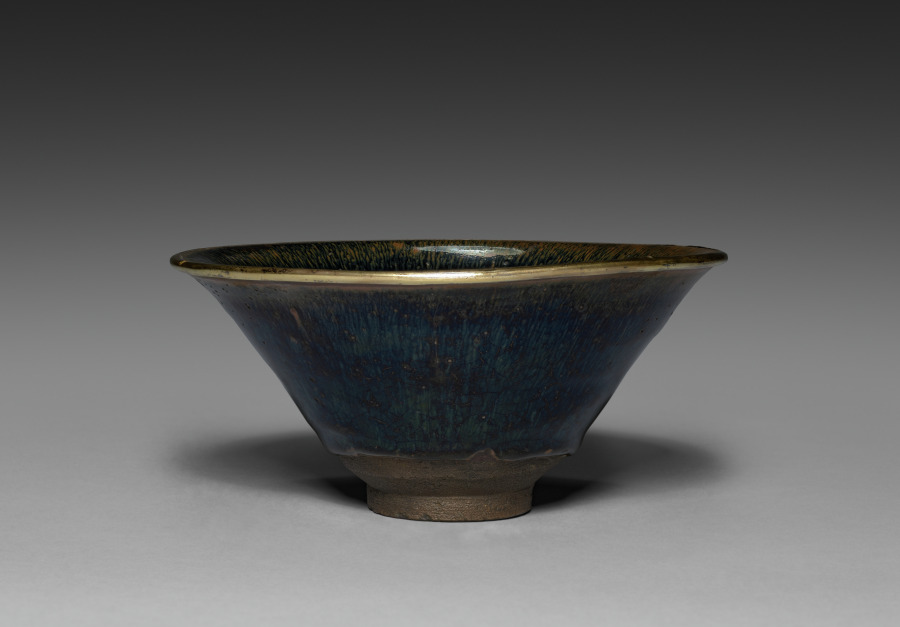
Tea Bowl, 1100s–1200s, Stoneware with black “hare’s fur” glaze and metal-bound rim, Jian ware. The Cleveland Museum of Art, Purchase from the J. H. Wade Fund, accession 1948.206.
Look closer: a large, deep conical bowl in glossy black with a thin gilt metal band on the rim, the colour deepening toward a dark foot. The museum catalogues it as a Tea Bowl, 1100s to 1200s, Southern Song dynasty, Fujian province, stoneware with black hare's fur glaze and metal-bound rim, Jian ware; its note says the bowl is rare because of its exceptional size.
Image: The Cleveland Museum of Art, Open Access (CC0)
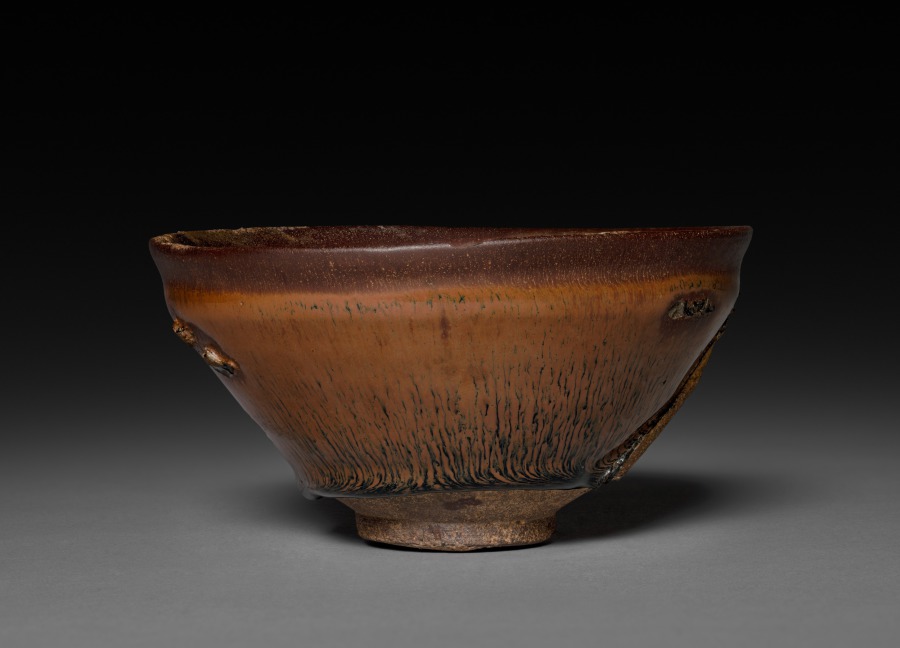
Tea Bowl: Jian ware, 960–1279, stoneware. The Cleveland Museum of Art, John L. Severance Collection, accession 1942.129.
Look closer: a rounded bowl with a thin brown glaze burnt back at the lip and dark blue-black streaks over the base, standing on a small foot. The museum catalogues it as Tea Bowl: Jian ware, 960 to 1279, near Shui-chi, China; its note says the lip shows signs of much use.
Image: The Cleveland Museum of Art, Open Access (CC0)
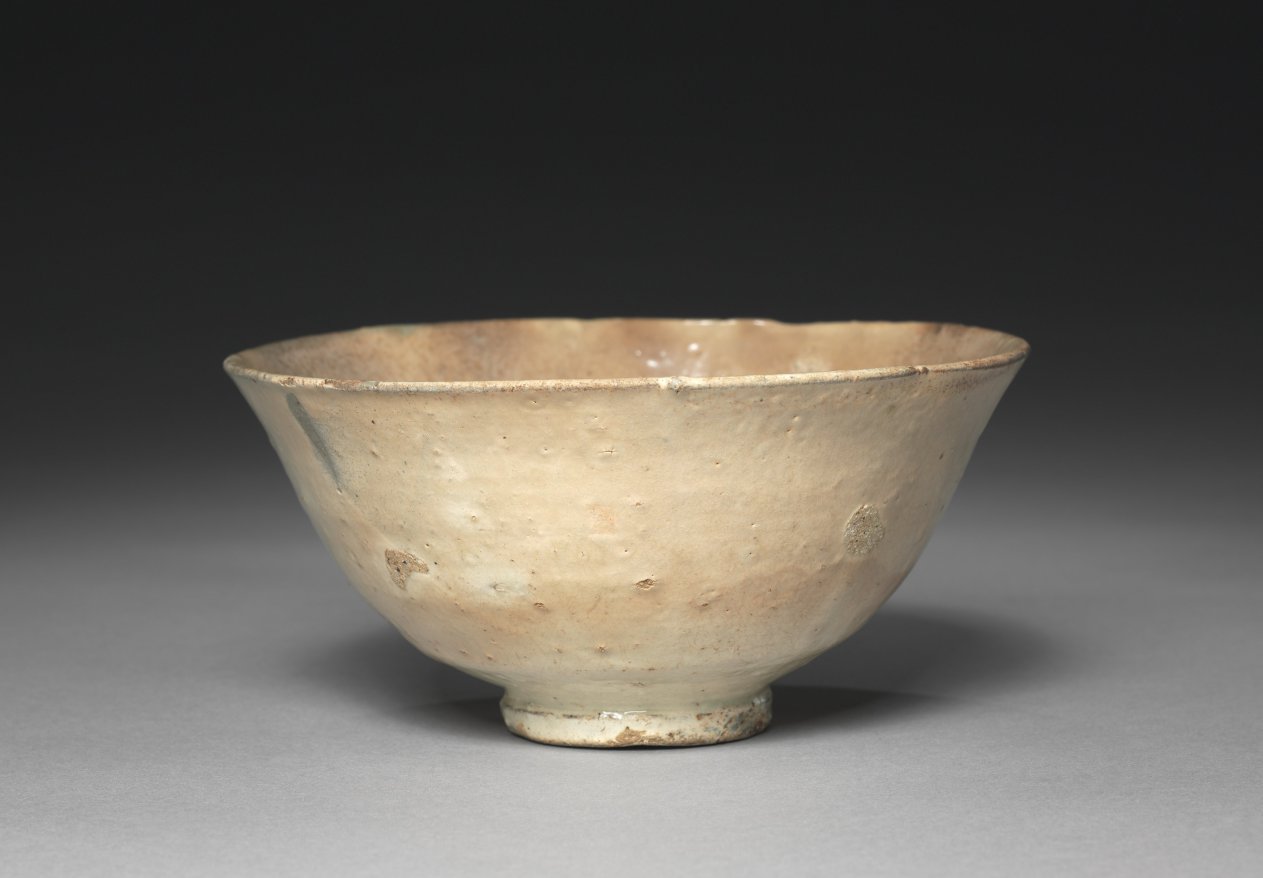
Tea Bowl, 1700s, stoneware with white slip and overglaze. The Cleveland Museum of Art, John L. Severance Fund, accession 1991.106.
Look closer: the bowl is pale and plain, its sides opening in a straight cone from a small foot, with a faint crack running down one side. The museum catalogues it as a Tea Bowl, 1700s, Joseon dynasty, Korea, stoneware with white slip and overglaze, a wide-mouthed everyday type later sold to Japanese tea collectors.
Image: The Cleveland Museum of Art, Open Access (CC0)

Tea bowl, 11th–12th century, Stoneware with iron-oxide glaze (Jian ware). The Metropolitan Museum of Art, H. O. Havemeyer Collection, Bequest of Mrs. H. O. Havemeyer, 1929, accession 29.100.226.
Look closer: a small, dark cone with a clean, glossy interior and a tiny foot. The museum catalogues it as a Tea bowl, 11th to 12th century, Song dynasty, Jian ware, stoneware with iron-oxide glaze, 6.4 cm high and 11.7 cm across.
Image: The Metropolitan Museum of Art, Open Access (CC0)
Bowls and Tea Ware on the Shelf
Tea bowls, caddies, kettles and the small pieces of the tea room pass through the house. The concierge desk will say in plain words what a bowl is, which family and kiln it belongs to, whether it has been repaired, and what the record does and does not show. The atlas of utensils and the glossary of tea utensils are companions to this chapter.
Answered plainly
What is a chawan?
A bowl used for preparing and drinking tea. JAANUS also gives the word an older sense for ceramics in general, from the ninth to the sixteenth century.
What are the parts of a tea bowl?
JAANUS names the rim, the body, the waist, the foot and the well. Tea teachers add the area the cloth wipes, the area the whisk rubs, the tea pool, the side and inside of the foot, and the edge that rests on the mat.
Which tea bowls are most prized?
Wikipedia says the most esteemed are Raku, Hagi and Karatsu, and quotes the tea schools' saying that ranks them in that order.
Why do tea bowls change shape with the season?
Wikipedia and JAANUS say that winter bowls are deeper and more cylindrical to keep in the heat, and summer bowls flatter and wider to release it.
What is a tenmoku bowl?
A bowl of Jian type with a conical shape and a dark iron glaze, first imported from China and later copied at Seto. JAANUS calls it the most formal bowl.
What is an Ido bowl?
A deep bowl of Korean lineage, taken up by Japanese tea masters for its rough simplicity. Sources describe it as an everyday bowl in Korea.
Why is Raku ware special?
It is hand-shaped, low-fired and drawn from the kiln while hot, and the Wikipedia article calls it the first ware to use a seal mark and to focus on close collaboration between potter and patron.
What is the foot of a tea bowl?
The kōdai, the ring on which the bowl stands. Wikipedia lists about twenty forms of it, from the plain ring to the whirlpool.
What is kintsugi?
Repair of broken pottery with lacquer dusted or mixed with powdered gold, silver or platinum, closely associated with the ceramic vessels of chanoyu.
How do guests handle the bowl?
Wikipedia says the guest raises it to the host, turns it slightly so as not to drink from the front, sips, wipes the rim and passes it on, and each guest may admire it before it is returned.
Is a raku bowl always made in Japan?
No. The Western raku process, which the Wikipedia article says developed in the twentieth century, is not a traditional Japanese practice.
Where next
Sources and image credits
- Chawan, Wikipedia
- Tenmoku, Wikipedia
- Raku ware, Wikipedia
- Kintsugi, Wikipedia
- Japanese tea ceremony, Wikipedia
- Japanese tea utensils, Wikipedia
- Wabi-cha, Wikipedia
- Chawan, JAANUS
- Chanoyu guide, Kyoto National Museum
- What Makes a Bowl a Chawan, Tezumi
- Chawan, Japanese Tea Bowl, Tealao, World Green Tea Association and Terebess
- Does each part of pottery have its own name, Japan Classic
- Guide for Matcha Bowls, Musubi Kiln
- Welcome to the World of Raku Tea Bowls, Sazen Tea
- Ido tea bowls, treasured possessions of Muromachi daimyo, The Japan Times
- Kizaemon Well, Ceramics story
- Object record, Tea Bowl, The Cleveland Museum of Art
- Object record, Cluster of mountain tea bowls (yama-chawan), The Metropolitan Museum of Art
- Object record, Tea Bowl with Chrysanthemum Decoration, The Metropolitan Museum of Art
- Object record, Clog-shaped Teabowl, The Cleveland Museum of Art
- Object record, Tea Bowl with Hare’s-Fur Decoration, The Metropolitan Museum of Art
- Object record, Tea Bowl, The Cleveland Museum of Art
- Object record, Black Raku Tea Bowl, The Metropolitan Museum of Art
- Object record, Clog-shaped tea bowl (kutsu-gata chawan) with plum blossoms and geometric patterns, The Metropolitan Museum of Art
- Object record, Red Raku Tea Bowl (Chawan), The Metropolitan Museum of Art
- Object record, Tea Bowl, The Cleveland Museum of Art
- Object record, Tea Bowl: Jian ware, The Cleveland Museum of Art
- Object record, Tea Bowl, The Cleveland Museum of Art
- Object record, Tea bowl, The Metropolitan Museum of Art
Last reviewed 28 October 2026. Pictures, where shown, are public-domain or open-access and credited beneath each one.
Looking for a tea bowl, a caddy or a piece of tea ware? The concierge desk replies within one to three business days.
Browse Japanese porcelain and ceramics · Make a private request
Private concierge
Looking for something in particular?
Describe the piece or the project you have in mind. A senior advisor in Tokyo reads every case file personally and replies within two business days, with fees set out in writing before any work begins.