
Japanese Furniture Glossary: N–Z
Japanese Furniture · Reference · N–Z
The second half of our glossary of 185 terms, from nagamochi to zenibako: regional chests; Japanese woods, lacquer and crafts; the European porcelain houses; and the Western chairs, tables, styles and makers that sit alongside Japanese pieces. Terms A to M, including most kinds of tansu by use, are on the first page.
How to use it. Look up a word you have met in a description, or follow the cross-references from one entry to the next to learn a whole family of pieces. Japanese terms are given in romanised form; -dansu and -tansu are the same word, "chest", softened when it follows another word. Entries marked with a lighter link in the index are on the A–M page. Measurements and units are explained in How we measure Japanese furniture; condition words in Character or fault.
Index
A B C D E F G H I J K L M N O P Q R S T U V W Y Z
A · Acanthus ornament · Adam style · Antique · Arabia (Finnish ceramics maker) · Arita-yaki (Arita porcelain) · Aynsley (English bone china)
B · Baroque style · Bentwood chair · Bobbin turning (bobbin-turned leg) · Bracket foot · Bulbous leg (cup-and-cover leg) · Bun foot · Butterfly table
C · Cabriole leg (nekoashi) · Canister · Captain's chair (smoker's bow) · Cha-dansu and chadana (tea chest, tea shelf) · Chaise longue · Chataku (saucer for tea) · Chawan (tea bowl and rice bowl) · Chesterfield sofa · China cabinet · Chinoiserie · Choba-dansu (merchant's chest) · Choba-zukue (merchant's desk) · Church chair (chapel chair) · Claw-and-ball foot · Clear finishes on furniture · Comb-back chair · Commode · Console chest
D · Daruma-dokei (daruma clock, figure-eight wall clock) · Doctor's chair (Japanese swivel chair) · Draw-leaf table · Dressing chest · Drop-leaf table
E · Easy chair · Edo-kiriko (Edo cut glass) · Extension table
F · Folding chair · Funa-dansu (sea chest) · Furudogu (old tools and everyday things) · Fuzukue (writing desk)
G · Gateleg table · Grillage door (wire-mesh door)
H · Half-moon cabinet (demi-lune) · Hasami-yaki (Hasami porcelain) · Herend porcelain · Hibachi (charcoal brazier) · Hoop-back chair
I · Iko (kimono stand) · Imari-yaki (Imari porcelain) · Isho-dansu (clothing chest) · Itto-masu (one-to measure) · Iwayado tansu
J · Jidai-dansu (period chest) · Jizai-kagi (adjustable hearth hook) · Joseon chests (Korean chests)
K · Kaidan-dansu (stair chest) · Kannon-dansu (chest with kannon doors) · Kansai mizuya (Kansai kitchen chest) · Kanto mizuya (Kanto kitchen chest) · Karaki (imported tropical hardwoods) · Kasukabe kiri-dansu (Kasukabe paulownia chest) · Katana-dansu (sword chest) · Katchu (Japanese armour) · Kebinto (glazed medical cabinet) · Keyaki (Japanese zelkova) · Kiri (paulownia) · Kishu tansu · Kneehole desk (pedestal desk) · Ko-Imari (old Imari) · Kokutan (ebony) · Kumiko (wooden lattice work) · Kuri (Japanese chestnut) · Kuruma-dansu (wheeled chest) · Kusuri-dansu (apothecary chest) · Kutani-yaki (Kutani porcelain)
L · Linenfold · Lladró porcelain · Lloyd Loom · Louis XV style · Louis XVI style · Lounge chair
M · Mahogany · Mikawachi-yaki (Mikawachi porcelain) · Milk glass · Mingei furniture (folk-craft furniture) · Minton · Mirror-back sideboard · Mizume-zakura (Japanese cherry birch) · Mizuya-dansu (kitchen chest) · Mukuzai (solid wood) · Music cabinet
N · Nagamochi (long chest) · Nagoya kiri-dansu (Nagoya paulownia chest) · Nara (Japanese oak) · Natsume (lacquered tea caddy) · Neoclassicism · Nest of tables · Nihonmatsu tansu · Nire (elm) · Noritake · Nursing chair
O · Oak · Occasional table · Old Charm (English furniture maker) · Ottoman
P · Pad foot · Paper cord · Parquetry (yosegi zaiku) · Pie-crust table · Pine · President's desk (partners' desk) · Pressed glass (kataoshi garasu)
Q · Quaker chair · Queen Anne chair · Queen Anne style
R · Raden (mother-of-pearl inlay) · Ranma (transom panel) · Rattan (to) · Refectory table · Renaissance style · Retro kanban (signboards) · Rocking chair · Rococo style · Roll-top desk · Rosenthal · Rosewood · Royal Copenhagen · Royal Doulton
S · Sado tansu · Sakura (Japanese cherry wood) · Salon chair · Scandinavian furniture (hokuo kagu) · Sendai tansu · Senshu kiri-dansu (Senshu paulownia chest) · Settee · Sewing table · Sewing-machine table · Shell chair · Shikki (lacquerware) · Shinchu (brass) · Shippo-yaki (cloisonné enamel) · Shitan (rosewood) · Shitomido (top-hung lattice shutter) · Shonai tansu · Showa retro · Side-by-side · Singer · Spindle chair · Stacking bookcase · Strapwork · Sugi (Japanese cedar) · Suichu (water ewer for tea) · Sukashibori (openwork carving) · Suzuri-bako (writing box)
T · Tabako-bon (smoking set box) · Tachiita (kimono cutting board) · Taisho roman (Taisho romanticism) · Tama-moku (jewel figure) · Tatamizuri (tatami runners) · Teak · Temoto-dansu (hand chest) · Tetsubin (cast-iron kettle) · Toro (lantern) · Tsukiita (veneer) · Turned leg · Twist leg
U · Ukibori (relief carving) · Ura-shoji (removable inner shoji) · Uretan shiage (urethane finish) · Urushi (Japanese lacquer)
V · Vintage
W · Wa-modern (Japanese modern) · Wajima-nuri (Wajima lacquer) · Walnut · Washstand · Wheel-back chair · Windsor chair · Writing bureau
N
Nagamochi (long chest)
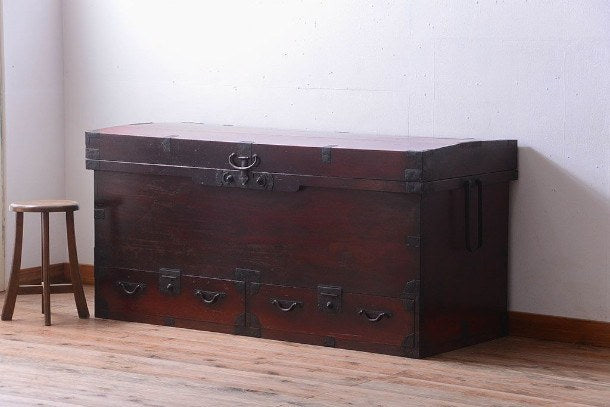
The nagamochi is a long rectangular wooden box with an overlapping lid, used to store clothing, furnishings and bedding. Used mainly in the Edo period, it spread from samurai households and in time reached ordinary homes. From the Meiji era the chest of drawers took over, and the nagamochi fell largely out of use.
Features
A typical nagamochi is about 8 shaku 5 sun long (about 174 cm), with width and height each about 2 shaku 5 sun (about 75 cm): a large box with a lockable overlapping lid. There are no divisions inside, so anything can be stored freely; some have drawers in the base. Iron fittings on both ends take a carrying pole, so two people could carry it. In the Edo period the nagamochi was an indispensable part of a bride's trousseau.
Materials and decoration
Nagamochi are made of paulownia, zelkova, camphor and chestnut. They range from plain designs to weighty ones with ironwork; the finest are lacquered and sometimes bear the family crest. Many have elaborate ironwork, showing that they also served as furniture to be seen.
History
The nagamochi goes back to the Edo period. Before and during the Muromachi period, clothing was kept in large wooden boxes called hitsu. In the Edo period, as cotton spread, bedding grew bulkier, and furnishings and clothing multiplied, until the hitsu could no longer hold them all. The nagamochi was the answer. With far greater capacity than earlier storage, it was first used by samurai households and gradually reached ordinary people; it was an important part of the Edo-period trousseau.
In the Meiji era the chest with drawers became the main storage for clothing, and the nagamochi was used less and less. Its period of making is therefore mainly the Edo period, and it is now valued as an antique.
Kinds
There are two main kinds: the ordinary nagamochi that stands on the floor, and the wheeled kuruma-nagamochi, which could be moved when needed. In the Edo period, with its many fires, people could be seen pulling their nagamochi to safety. But when fire broke out in Edo's crowded streets, the throng of people pulling wheeled chests made escape dangerous, so in Edo, Osaka and Kyoto the making and owning of wheeled nagamochi was forbidden. In the provinces, it seems, they continued to be made.
Box chests elsewhere
Storage like the nagamochi was made in other countries too. The Korean bandaji resembles it, a large undivided box; the French coffer and the Italian cassone are similar. The bandaji's decoration is also close to the Japanese nagamochi's, but with even more ironwork. The French coffer makes the most of its grain; few have iron decoration, but some are carved. The Italian cassone, by contrast, is decorated with very fine carving and painting, by far the most lavish, because it was made as marriage furniture.
Nagoya kiri-dansu (Nagoya paulownia chest)
Nagoya paulownia chests are made around Nagoya and Kasugai in Aichi Prefecture and are a traditional craft. An indispensable part of the Nagoya bride's trousseau, they are among the most lavish of paulownia chests.
Features
Nagoya chests are made about 20 cm wider than those of other regions. Their ironwork is enriched with gold and silver, and the sliding doors carry gold-leaf paintings: a lavishness not seen in other paulownia chests, because Nagoya has long spent generously on the trousseau and celebrated it splendidly.
Materials and decoration
The chests are paulownia, with pegs of hiba (Japanese arborvitae) or an equivalent wood; the paulownia is often carefully selected timber from Hida. The fittings are plated in gold, silver or brass for a glittering finish. Most beautiful of all are the pictures on the cupboard doors, in gold leaf or lacquer maki-e.
Kinds
Meoto-dansu (paired chests). A clothing chest and a seiri-dansu sold as a set; in Nagoya they are more often sold in pairs than singly. The pictures on the cupboard doors are designed to answer each other, adding to the splendour.
Clothing chests. Fairly simple by Nagoya standards. Trays stand behind kannon doors, and the lavishness of openwork carried even onto the trays is pure Nagoya.
Paulownia chests of drawers. A modern reworking that makes the most of paulownia's character, at home in Japanese or Western rooms, with the splendour restrained to a simple design.
History
The Nagoya paulownia chest began some four hundred years ago, when craftsmen who had worked on Nagoya Castle settled in the castle town and began to make nagamochi, chests and other storage.
In the late Edo period, as life settled and grew more prosperous, clothing and furnishings multiplied, and solid storage furniture such as the chest became necessary. Fine chests such as Nagoya's spread as storage for costly kimono.
The glittering style of gold, silver and maki-e on the sliding doors dates from the Meiji era, when the Nagoya form was completed. In 1981 it was designated a national traditional craft.
With the idea of the trousseau fading, demand for traditional designs is falling, but the makers are applying their know-how to new work, such as paulownia chests of drawers for Western rooms and apartments.
Nara (Japanese oak)
Nara, Japanese oak, is a deciduous broad-leaved tree of the beech family, genus Quercus. It is famous as the tree that bears acorns, a familiar sight in parks and streets, and long known to the Japanese. With the vitality to live for centuries, and able to form pure stands that build a forest by their own strength, it is called "king of the forest".
In Japan it grows widely across Honshu, Shikoku and Kyushu; nara from Hokkaido is especially fine, prized as a luxury timber for its looks and qualities. Abroad it comes from China, Russia and elsewhere.
In English nara is called oak, and it looks so alike that nara and oak are often confused, but strictly they are different. "Oak" means the related trees of North America and Europe; white oak in particular is so close to nara that even professionals find them hard to tell apart. Fine nara is called "Japanese oak" abroad and is much sought after.
Kinds
Six kinds grow wild in Japan: mizunara, konara, kashiwa, kunugi, naragashiwa and abemaki. As a timber, "nara" generally means mizunara.
Mizunara (Japanese oak, Quercus crispula). The heartwood is pale brown, the sapwood pale yellow. It takes its name, "water oak", from the great quantity of water that pours from it when felled. Holding so much water, it is slow to burn, and it prefers colder ground than konara or kunugi. Large trees reach 35 metres, and it is also called onara, "great oak". Heavy, hard and strong, and easy to work and stain, it has been used for furniture, building, ships and spirits casks. Japanese nara was once exported to Europe in great quantities, but overcutting has made it scarce and hard to get; with restrictions on foreign oak too, it grows rarer and dearer.
The appeal of nara
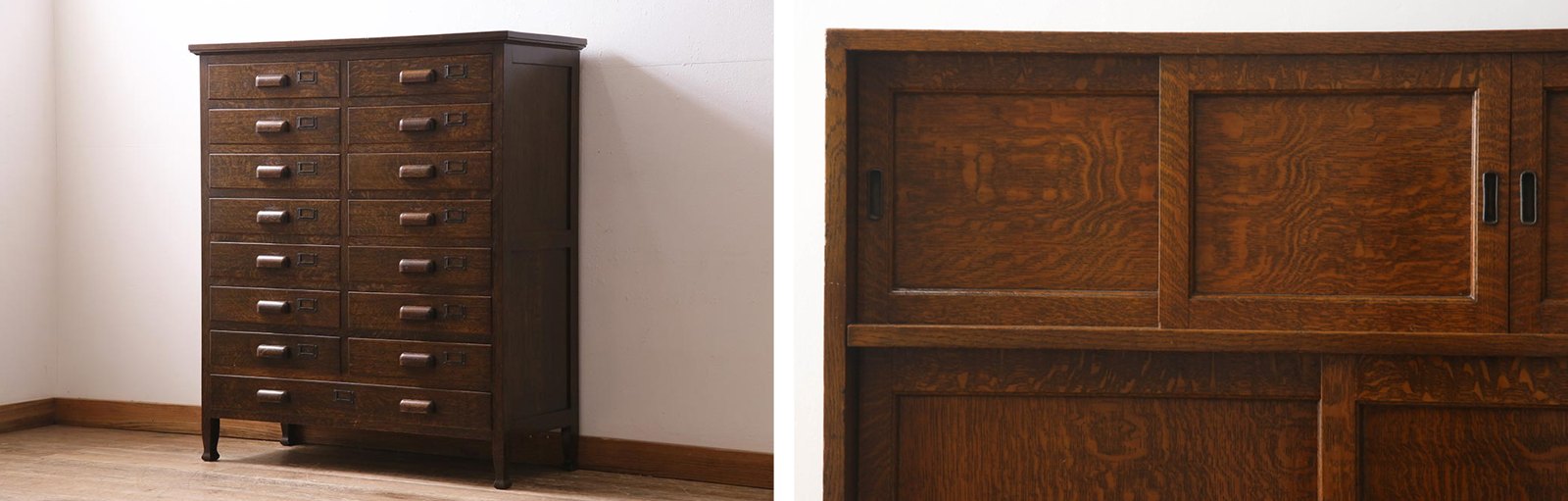
Tiger-stripe figure (torafu). Its greatest visual mark is the tiger-like figure (torafu) that appears on quarter-sawn faces. It glints silver in the light and so is also called silver grain. It is sometimes mistaken for a scratch or dent, but it marks the rays where the tree stored nutrients; it does not appear in all nara, only in old natural trees, so it is a sign of fine, selected timber. Its distinctive pattern has a devoted following; the architect Frank Lloyd Wright is said to have been captivated by it.
Durable and watertight. Like hardwoods generally, nara is hard and resists splitting, so it is very durable. It resists scratches and dents, so it is much used for furniture and floors that are knocked, shaken and rubbed every day; strong enough to hand down to one's children. It contains tyloses, growths that block the vessels, so it is watertight and is used for maturing whisky casks. The wood carries a scent reminiscent of sandalwood and aloeswood (kyara), the woods of incense, and whisky matured in mizunara casks is admired worldwide for its noble aroma. Its tannin also deters insects, even near water.
Beautiful ageing. Nara furniture has a natural, simple, gentle grain. Flat-sawn it shows a strong cathedral figure; quarter-sawn, a flowing straight grain lit by the tiger-stripe flecks. Naturally light in colour, it deepens with use from yellow to amber. That ageing, and the long service its durability allows, are among its greatest charms.
Nara furniture
Antique nara furniture. Abroad, nara, that is oak, has been a furniture wood since early times; in Europe the sixteenth and seventeenth centuries are called "the age of oak". In England that era produced oak furniture in many styles: the Tudor style, carved in relief with Tudor heraldry and Gothic motifs; the Elizabethan style with its flamboyant bulbous legs; and the Jacobean style with bobbin turning, turned work and linenfold. In the 1920s, when English oak was scarce, nara from newly opened Hokkaido was exported to Britain in great quantities, and much English antique furniture of that time is made of Hokkaido oak. In Japan, where hinoki, keyaki and sugi had been the main furniture woods, the merits of nara were at last recognised around then, and it came into use for furniture. See bulbous leg, bobbin turning and linenfold.
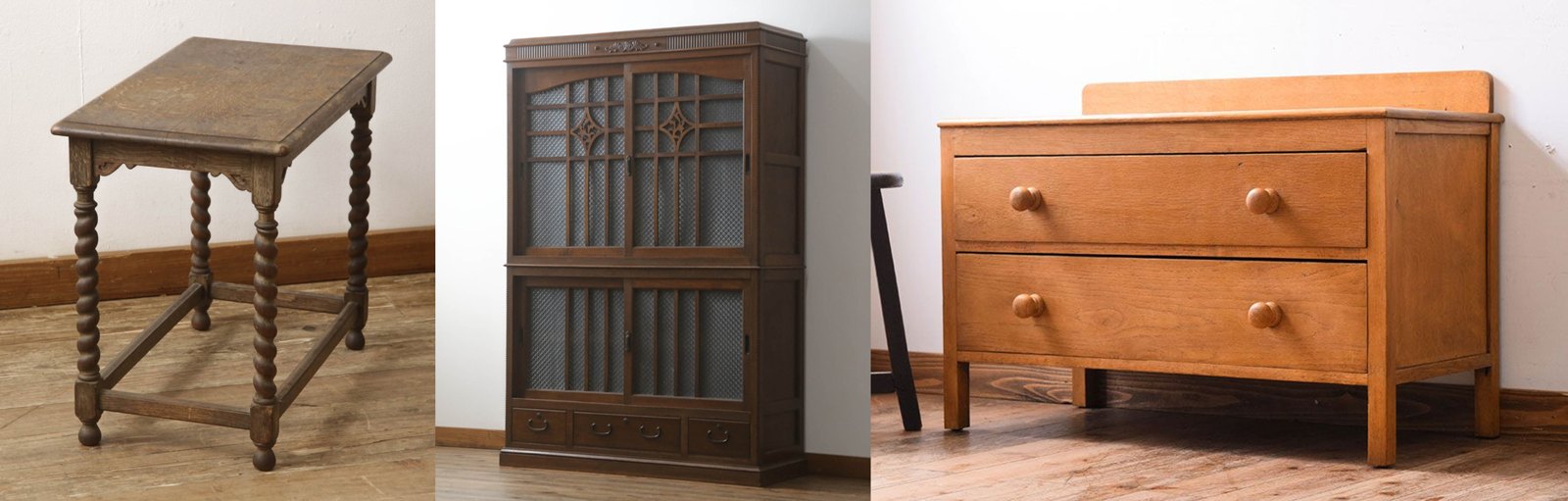
Vintage nara furniture. Nara furniture is plentiful on the vintage market too, though the oak in foreign vintage furniture is usually white oak. English vintage, Scandinavian vintage and Japanese vintage each have their own character, but nara, with its handsome grain, natural colour and simple yet weighty presence, is a versatile wood that suits both classic and modern rooms.
Modern nara furniture. Nara furniture is still prized today. In Japan, Matsumoto Mingei, Nagata Ryosuke Shoten, Karimoku, the makers of Kobe Western-style furniture, Asahikawa in Hokkaido and Conde House, among others, all go on making it. Nara is one of the most popular solid woods, letting you enjoy the texture and character of the material directly. With Japanese nara now scarce, North American white oak is widely used instead. Its place has changed over time, but nara will go on being loved worldwide as an indispensable timber.
Natsume (lacquered tea caddy)
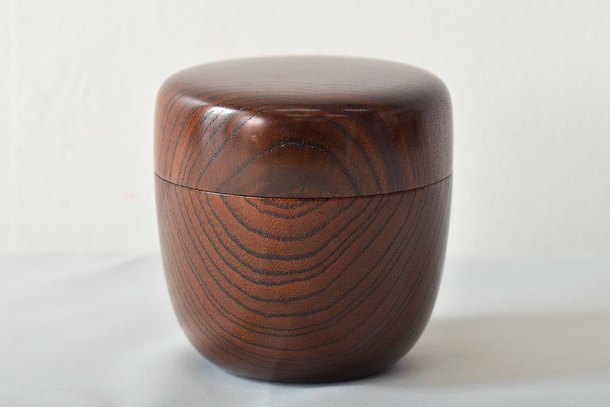
A natsume is the container for usucha, "thin tea", the lighter preparation of powdered tea in the tea ceremony. It takes its name from the jujube fruit (natsume), whose shape it resembles. It is thought to have appeared in Japan in the Muromachi period (1336 to 1573) and spread widely in the Edo period.
Features
The natsume has three main features.
A jujube shape. First, its shape resembles the jujube fruit: a cylinder that narrows gently towards the base, with a lid fitting so closely that the join almost disappears.
Light, easy materials. Second, it is as a rule made of wood or bamboo. The natsume was made for ease and informality in the tea room, so light, easily handled materials were chosen.
Lacquered. Third, it is lacquered. Urushi is water-resistant and rot-resistant, and protects the quality of the tea. Fine pieces are also decorated with mother-of-pearl (raden), maki-e or kinpun-dame, a ground of dense gold powder under translucent lacquer. See shikki (lacquerware).
History
The natsume appeared in the Muromachi period. Powdered tea had been kept in the ceramic chaire, but as the way of tea developed, wooden and bamboo natsume are thought to have been made.
Natsume and chaire
The tea utensil most like the natsume is the chaire, which is also a container for powdered tea. In the tea ceremony, though, the two are clearly distinguished by use and material.
| Name | Use | Material |
|---|---|---|
| Natsume | Usucha (thin, frothy tea) | Wood, lacquered |
| Chaire | Koicha (thick, viscous tea) | Ceramic |
When tea first reached Japan, there was no distinction of container by kind of tea: thick and thin tea alike were kept in the ceramic chaire. At the formal tea gathering (chaji), the costly thick tea was the centre, and thin tea a mere supporting player; a gathering of thin tea alone was hardly known.
As the way of tea developed, the informal gathering (chakai) devoted to thin tea alone spread, and the natsume appeared as an easier container for it. As the natsume spread, the tea room came to distinguish containers clearly by kind of tea.
In the Edo period tea gatherings and thin tea came within reach of ordinary people, and the natsume became an everyday tea utensil, loved all the more. On an antique natsume, look for an even, softly worn lacquer where hands have lifted it, a lid that still seats closely, and a maker's or lacquerer's signature on the base; the fitted wooden box (tomobako) with inscriptions adds to its standing.
Neoclassicism
Neoclassicism is the movement in thought and style fashionable in the West from the mid-eighteenth to the early nineteenth century, applied chiefly to architecture, the crafts and painting. Replacing the over-decorated, aristocratic Baroque and Rococo, it is characterised by a refined expression that rationally reconstructs the art of ancient Greece and Rome. See Baroque style and Rococo.
Features
In sharp contrast to the Baroque and Rococo, Neoclassical design is straight-lined and symmetrical. A current arose that re-evaluated classical styles such as the Renaissance of the fifteenth to early seventeenth centuries, and designs and architectural forms inspired by ancient Rome and Greece were eagerly adopted. See Renaissance style.
Its emergence was bound up with the changing state of European society: the rise of new wealth and the bourgeoisie, revolutionary advances in industry, international wars, a turbulent age. Neoclassicism, born in its midst, can be said to carry a spirit of defiance against the excessive ornamental culture of the Rococo and Baroque, which had flourished around the aristocracy, and its hierarchy.
Classical motifs. Designs inspired by Roman and Greek buildings recur: rosettes, garlands, flower baskets, laurel, musical instruments, acanthus leaves, female figures, animals, scrolls, shells, scrolling foliage, trophies, geometric patterns and mythical beasts, together with urns, swags, paterae and fluted columns. In furniture, legs become straight and tapering, often fluted; forms are rectilinear or oval; and surfaces are veneered, inlaid or painted rather than heavily carved. See acanthus and turned leg.
History
Neoclassicism began in mid-eighteenth-century Europe. Since the Renaissance, aristocratic cultures such as the Baroque and Rococo had stood at the centre of Western art. But the situation across Europe was growing very unstable: the movements that led to the French Revolution, Britain's Industrial Revolution and the American Declaration of Independence shook the absolute, dominant position of the nobility and clergy everywhere. Amid this, learned architects and philosophers gave birth to Neoclassicism, carrying a spirit of opposing the conduct of nobility and clergy with order and reason.
Another current that raised it was the re-evaluation of Greek and Roman culture and philosophy. Excavations of ancient sites such as Herculaneum and Pompeii in Italy drew Western interest. The overwhelming power, simple, rational character and perfection of the ancient remains shocked people, and deeply influenced the Neoclassical style that followed. Rejecting the free, extravagant culture of the aristocracy and re-evaluating long tradition, Neoclassicism was a pioneering idea: preserving tradition while reconstructing it with a rational interpretation fit for the coming age.
Neoclassicism by country
France. Under Louis XVI in the later eighteenth century, splendid, refined furniture of straight forms was produced, called the Louis XVI style, which also reached England. After Louis XVI's death, Napoleon Bonaparte, the soldier who united a France in turmoil, expressed his authority in the style called Empire. With Napoleon, Neoclassicism became more archaeological and rational, with Egyptian and Roman imperial motifs. See Louis XVI style.
England. In England, from the mid to late eighteenth century, the Adam style appeared, advocated by the architect Robert Adam, who drew directly on his studies of Roman remains; the style influenced, and was influenced by, French taste, and was developed further in the furniture designs of George Hepplewhite and Thomas Sheraton, and later in the Regency style. See Adam style.
America. In the later eighteenth century, after the War of Independence, the Federal style appeared in America, based on the English Georgian and Adam styles, with symmetrical design and refined detail inspired by ancient architecture: never showy but dignified, a style that might be said to symbolise American discipline.
Nest of tables
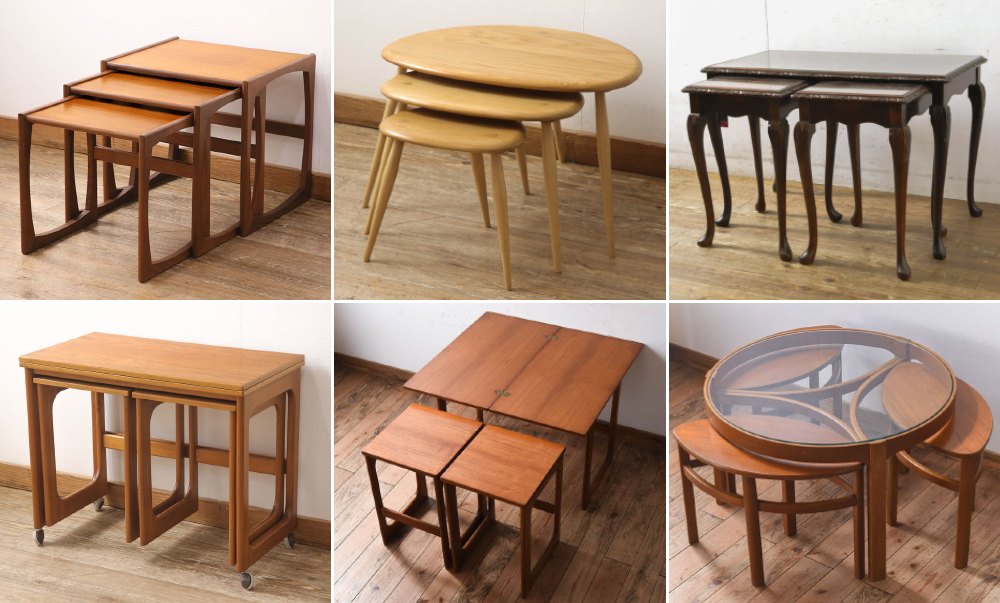
A nest of tables is a set of tables of different sizes that fit one inside another. "Nest" means a bird's nest, or nesting; just as a bird settles into its nest, the smaller tables slide neatly under the larger. They can be gathered into one, set side by side or used separately, an unusually flexible way of using tables, with much to offer in practicality, function and design.
Features
Construction. Generally a set of tables of the same design in different sizes, large, medium and small; a set of three is sometimes called a "trio table". There are also sets of two, sets of one large and two small, and sets of four or five. Besides small ones that are easy to move, some are large enough to serve as a main table. Some have castors, extensions, or fold away tables of equal size; tops are round or square, a rich variety.
Practicality. Made of several tables of different sizes, a nest can be rearranged for every place and occasion. When not needed, to carry together or to clean, they store compactly and are easy to move. Many find this practicality their greatest appeal. See occasional table.
Kinds
Tops. The top, the face of the table, shapes its impression. Even in wood alone, a top of beautiful grain gives dignity and warmth, and one of marquetry or inlay gives artistry. Clear glass feels modern, leather classical, tile retro. A glass sheet over wood or leather adds elegance, wipes clean and gives a steady surface for writing. See parquetry.
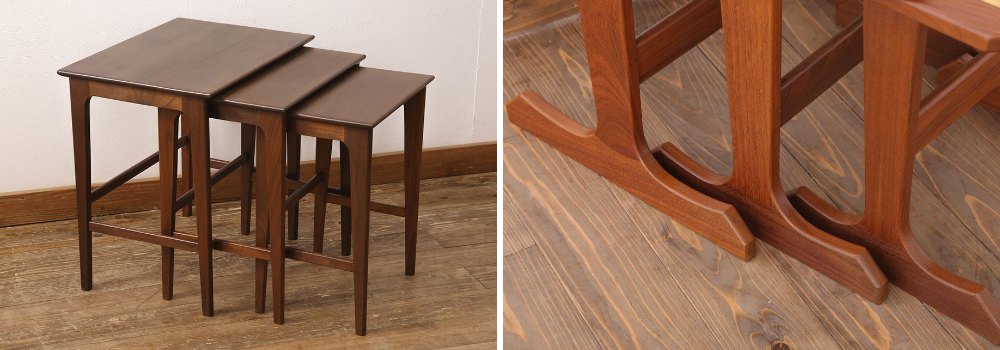
Legs. Legs carry function and design too; nesting several tables neatly needs precisely made legs. Broadly there are two types. The English antique type has cabriole legs or turned work, with the elegance of English antique furniture, heightened by oak, mahogany or walnut. The Scandinavian vintage type has the refined simplicity of Scandinavian vintage furniture. In Britain, where the wartime and post-war Utility scheme restricted timber and ornament, Scandinavian-influenced design was adopted and made in great numbers. See cabriole leg and Scandinavian furniture.
History
The nest of tables is said to have been born in England in the late eighteenth century, a relatively new piece in the history of antique furniture. Sets of four were then usual, called "quartetto tables", a name recorded by Thomas Sheraton in 1803. Compact and versatile, they suited rooms where space was precious, and became popular through the nineteenth century as homes grew more crowded in industrial cities. In the mid-twentieth century, British makers influenced by Scandinavian design, such as G-Plan and A. H. McIntosh, produced nests of tables combining stylish beauty and function, often in teak with tops of glass or veneer. See teak.
In use
Flexible and versatile: gathered as a single side table, spread around a sofa when guests come, as bedside tables, plant stands or display stands. Find the use that suits your own way of living.
Nihonmatsu tansu
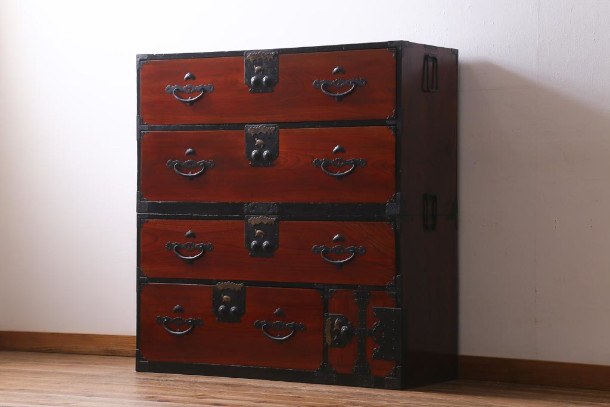
Nihonmatsu tansu are chests made in Nihonmatsu, Fukushima Prefecture. What sets them apart is that a single craftsman makes the whole chest, rather than several woodworkers and metalworkers sharing the work: a thoroughbred chest that still keeps that tradition.
Features
Nihonmatsu is famous for kasane chests in upper and lower sections. They are meant to be stacked, but can usefully stand side by side as a low piece.
The ironwork that conceals the keyhole is also characteristic. At first there seems to be no keyhole; slide part of the motif aside and it appears. Many have such playful designs.
Materials and decoration
Fukushima is famous for its paulownia, and most Nihonmatsu chests are made from it, though some fine chests use zelkova. Decoration is fairly restrained, calmer than the best-known names of other regions.
Kinds
Kasane chests. The essence of Nihonmatsu: two or more sections stacked to make one chest, some of three or more. They can be stacked or set side by side like a low sideboard.
Merchant's chests. Nihonmatsu also made merchant's chests, the chests of the old accounts counter where valuables were kept. Many have zelkova faces, and many are lacquered to a gloss.
Tea and kitchen chests. Nihonmatsu now makes tea chests and kitchen chests as well as clothing chests, usually with strong zelkova outside and thick paulownia within, combining the beauty of zelkova with paulownia's regulation of humidity.
History
The Nihonmatsu chest began with the major rebuilding of Nihonmatsu Castle in the seventeenth century, when the lord commissioned furniture and furnishings along with the works. He asked not specialist furniture makers but the carpenters already at work, who made chests as part of the building work.
With no separate woodworkers or metalworkers, the carpenters made every part of the chest themselves. The tradition of one craftsman making one whole chest continues today.
Antique and modern
What antique and modern Nihonmatsu chests share is precise construction without distortion: drawers close with a perfect fit and open without rattling. The designs differ.
Antique Nihonmatsu chests are rather homely, with modest ironwork, but let you enjoy the beauty of the grain to the full. The lock plates use auspicious motifs, with a certain charm.
Modern Nihonmatsu chests are mostly stylish and modern; many sit naturally in a Western room, evolving with today's way of life.
Both have their own merits; look at modern pieces as well as antiques.
Nire (elm)
Nire, elm, is the collective name for the broad-leaved trees of the genus Ulmus, in the elm family. It grows in China, Korea and Siberia, and in Japan widely across Hokkaido, Honshu, Shikoku and Kyushu, so you may well have seen one without knowing it.
Some species exceed 30 metres. With its graceful spreading crown, its flowers, fresh leaves and autumn colour, it is a favourite street tree, counted with the plane, the linden and the horse chestnut among the "four great street trees of the world". It is an excellent timber as well, used for building, furniture and instruments.
Kinds
Three kinds grow in Japan: harunire, akinire and ohyo. Close relatives with similar looks and properties grow abroad; European elm and American elm are famous furniture timbers.
Harunire (Japanese elm, Ulmus davidiana var. japonica). "Nire" usually means harunire, and it is the species most used as timber. The name means "spring elm", because it flowers in spring. Abroad it grows in China and Korea; in Japan, above all in the cold of Hokkaido and Tohoku. It grows 25 to 35 metres tall and about 2 metres across, the largest of the Japanese elms, and looks much like its relative keyaki. The sapwood is yellowish white, the heartwood pale brown, clearly divided; the grain is straight, and timber with rare figure has high decorative value. Moderately heavy and hard, and resistant to splitting, it is easy to work, and its toughness suits it to bending. It is used mainly for furniture, implements, vehicles, and mortars and pestles.
Akinire (Chinese elm, Ulmus parvifolia). "Autumn elm", named because it flowers and fruits at the start of autumn. It grows in China, Korea, Indochina and Taiwan, and in Japan mainly in the west. At most 15 metres tall and under a metre across, it is smaller than harunire. It too resembles keyaki, but it is so hard and tough that it is also called ishi-geyaki, "stone zelkova". Its grain is bold and clear, and it is used for turnery, vehicles, implements, firewood and charcoal.
Ohyo (Ulmus laciniata). About 30 metres tall and a metre across, growing in the mountains of China, Korea, Siberia and Japan. Its uses are the same as harunire's, but as a furniture wood ohyo is reckoned finer: heavy and hard, warm to the touch, with a silky grain and a gentle character. In the 1950s it was exported to Britain and elsewhere in great quantities. Its bark is extremely tough, and the Ainu famously wove cloth (attush) from its fibres.
European elm. Found across almost all of Europe and a familiar sight in towns there. It grows to 40 metres and more than a metre across. Sapwood and heartwood are both pale yellowish brown, a little darker towards the heart but much the same overall. Timber with the rare burr figure (kobu-moku) is prized and costly. Strong enough for cartwheel hubs, it bends exceptionally well and is used for flooring and interiors as well as furniture.
American elm. From central and southern North America, 20 to 30 metres tall and about a metre across. North American elms were devastated by Dutch elm disease. The sapwood is yellowish white, the heartwood a greyish pale brown, sometimes reddish, clearly divided, with moderate strength and hardness. The grain is usually straight and distinct, but some timber shows interlocked grain, the fibres spiralling alternately one way and the other to form stripes. It too suits bentwood furniture, and is also used for sports equipment and boats.
The appeal of elm
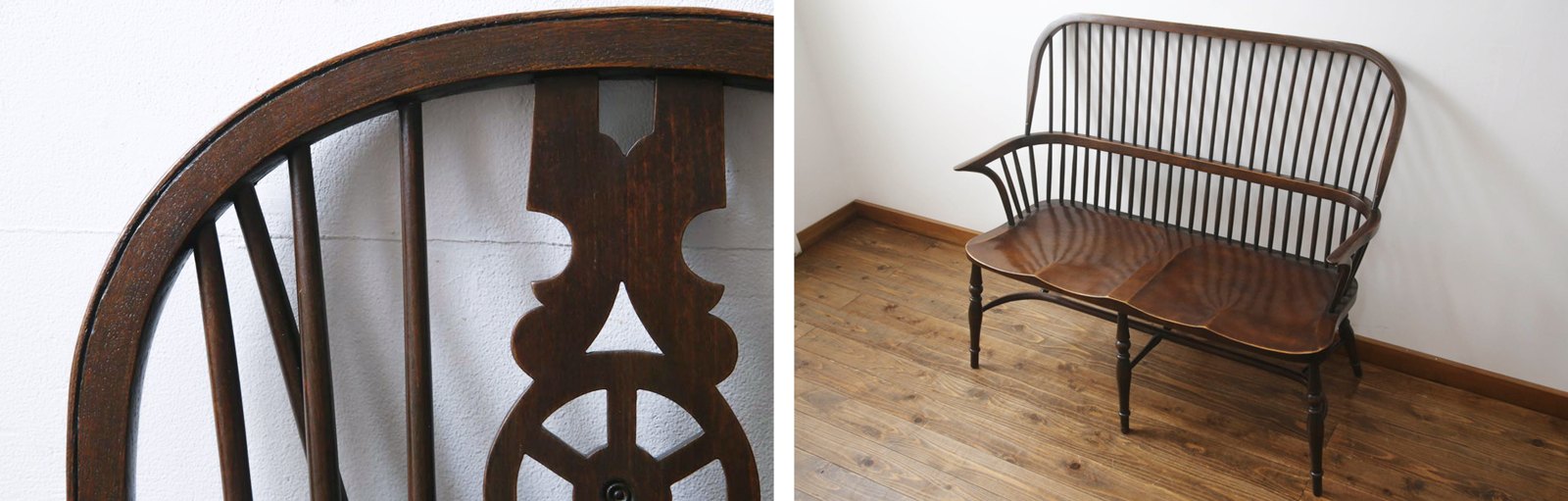
Easy to bend. Elm bends well, which widens what furniture design can do. It has been much used for chairs; famously, for the seats of the English Windsor chair, made with traditional bending techniques. Ercol, the celebrated English maker, excels at steam-bending wood, and elm is its main timber. These long-established bending techniques are handed down undimmed, and go on extending what furniture can be. See Windsor chair.
A natural, handsome grain. Quarter-sawn, elm shows a straight, flowing grain; flat-sawn, a wavy, curving one. That handsome, refined grain is one of its great charms. The grain stands out clearly, but the colour is a soft, calm yellowish brown, gentle in character with the simple feel of natural wood. Japanese elm tends to be finer-grained than American, and sometimes stands in for decorative keyaki. With age it darkens to a deep brown, adding weight to its natural feel, and the grain deepens and grows more striking.
Elm furniture
Antique and vintage elm furniture. Elm has been used since around the sixteenth century, when oak was the main furniture wood, and European elm is famous as a material of antique furniture. It was long the wood of ordinary people's furniture, and many practical pieces that speak of the life and culture of their time survive. It is indispensable to the Ercol chair, the timber behind countless simple, well-made pieces. In Japan elm was used for many kinds of chest that were necessities of life, the wheeled chest, the kitchen chest, the stair chest, and for bridal furniture. Deepened by time, these nostalgic pieces suit Japanese, Japanese-modern, Taisho-romantic and old-house interiors beautifully. See kuruma-dansu, mizuya-dansu and kaidan-dansu.
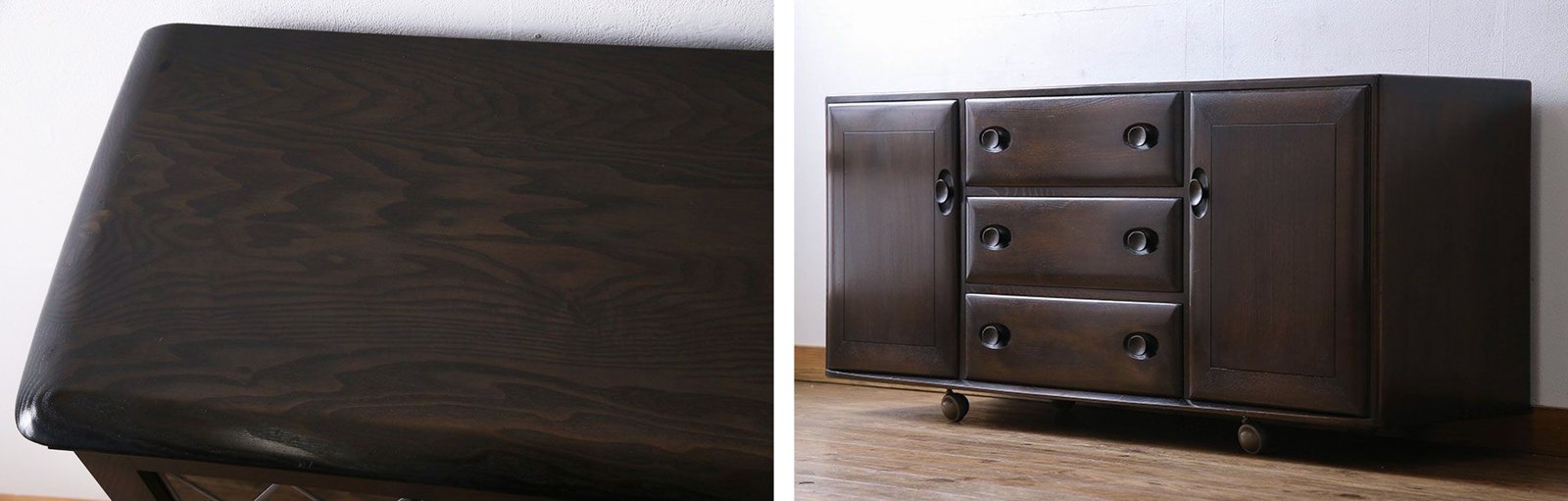
Modern elm furniture. Elm is still a working furniture wood. It does not machine especially well, so designs tend to be simple, which lets its beautiful grain be enjoyed all the more. Elms grow large, so wide single slabs can be cut, another of its attractions. Natural and calm in appearance, it combines easily with other furniture and décor, and gives a room a warm, homely feel.
Noritake
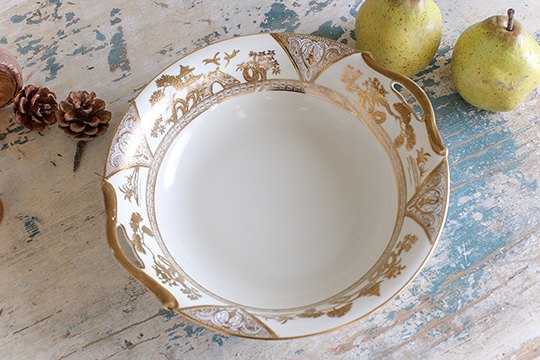
Noritake is a Japanese maker of fine porcelain and its wares. Winning popularity with Japan's first domestically made white porcelain dinner service and with high-quality products that caught Western taste and fashion, it became a world brand that continues today. Here we look at its beautiful porcelain and at the history that made Noritake sought after worldwide.
Decorative techniques
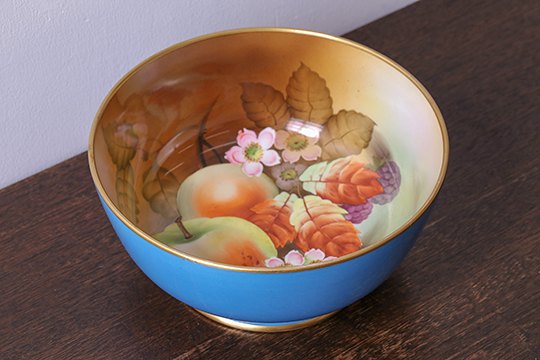
Raised decoration. Moriage, drawing raised patterns on the surface with piped clay; gilded moriage; "beading", dots of raised slip, coloured or gilded; and raised enamel giving a jewel-like, cloisonné lustre. See shippo-yaki.
Textured techniques. Etching, removing the surface with chemicals or sand to give patterns in gold of varying depth; relief, cameo-like decoration in slip on a marbled body; "tapestry", pressing cloth onto the unfired body to give a woven texture; and applied clay modelling.
Other techniques. Transfer printing, applying printed paper to transfer a pattern; lustre, a technique of Middle Eastern origin giving an iridescent sheen; sprayed graduated colour; deep cobalt blue; and silver. Painting is mostly freehand, and forming often uses plaster piece moulds.
Wares
Tableware, vases, figurines, plates, lamp bases, bonbonnières, small boxes, tea wares (cups and mugs), smoking accessories, porcelain dolls ("Morimura dolls"), braziers (hibachi) and lampshades.
Designs
White porcelain in relief alone; Sèvres-style colour and gold on dark grounds; Wedgwood-style relief on blue; rose patterns in the manner of English bone china; oriental birds, flowers and landscapes in underglaze blue or enamels; Rococo-style realistic miniature painting; and dazzling gilded Empire style. Many draw on ethnic patterns: Japonisme and chinoiserie, fairy-tale designs, ancient Greek and Egyptian patterns, Native American motifs, Art Nouveau abstract flowers, refined Art Deco patterns, cartoon designs, and fusions of these. Pieces made for export before the Second World War are known to collectors as "Old Noritake". See chinoiserie.
Representative wares
Japan's first white porcelain dinner service, "Sedan" (1914), and later collections reinterpreting the great Western factories in bone china, reviving "Old Noritake" designs, and gathering the company's best craftsmanship.
History
A private trading company. In 1876 the founder, Ichizaemon Morimura, set up Morimura-gumi in Ginza, Tokyo, aiming to enrich the nation through trade. He sent his half-brother Yutaka Morimura, fifteen years younger and educated at Keio, the school of his adviser Yukichi Fukuzawa, to New York, where he founded a shop, "Hinode Shokai". Begun with all their capital and deliberately without government help, the venture went well, thanks to the talent for procuring goods of Magobei Okura, Ichizaemon's brother-in-law. In 1878 the shop was renamed Morimura Brothers, and the following year Yasukata Murai, recommended by Fukuzawa, joined Yutaka in America.
Reading overseas demand. In 1882, on Murai's proposal, the firm turned from retail to wholesale; from 1884, as ceramics became its mainstay, it began contracted production and product design with kilns across Japan. Yutaka corresponded with Japan, adapting products to American taste and improving them; this policy of treating local requests as absolute was remembered as "letters from America are sacred".
Western-style ceramics. In 1893 contracted production of blanks began, but Magobei Okura, sensing the limits of Japanese-style design from visits to world's fairs, led a shift to Western-style ceramics with Western-style painting. In 1895 a design department was set up at Morimura Brothers to bring in local and world fashions, and from the following year the making of white hard-paste porcelain for Western tableware was considered. Morimura-gumi quickly became one of Japan's leading trading houses, but in 1899 Yutaka died suddenly at forty-six.
Noritake. To fulfil Yutaka's hopes, Ichizaemon decided to build a factory in Nagoya, where painting and blank production had been concentrated. In 1904 Nippon Toki Gomei Kaisha was founded at Noritake, the factory site, with Okura's son Kazuchika Okura as president, the birth of the Noritake name at the company's home in Noritake, Nakamura-ku, Nagoya, to this day.
The white dinner service. With its own factory running, production of "fancy ware", vases and ornaments with gold and realistic flowers, made with great care, gained momentum, but the white porcelain Yutaka had hoped for proved elusive. After years of effort, in 1913 they succeeded, and in 1914 Japan's first white porcelain dinner service was exported to acclaim. Dinner services became the mainstay, and Noritake became known as a world brand of Western tableware; bone china followed in 1932.
A world-recognised maker. Exported worldwide, its products spread the Noritake name. In 1917 it became Nippon Toki Kabushiki Kaisha, branching into many fields from its ceramic technology, and in 1981 took its present name, Noritake Company Limited. Through war and the declining share of tableware in its business, it has carried on its skills and aims, and remains loved at home and abroad.
For collectors
Backstamps help to date a piece: early export pieces carry "Nippon" marks, and the "M in wreath" mark of Morimura is among the best known; marks changed many times through the twentieth century.
Nursing chair
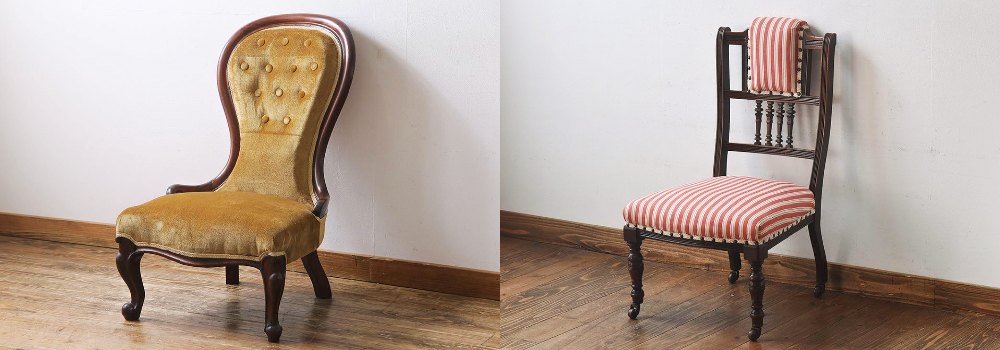
A nursing chair is a chair made for a mother to feed her baby and care for small children. Born in earlier times, it was especially popular in England. Nursing chairs show many refinements for comfortable feeding and childcare, and have changed with the times into modern designs, still made around the world today.
Features
1. A low seat. Its chief feature is the height of the seat, lower than an ordinary chair so that even a small woman's feet rest firmly on the floor and so as to match the height of the cots of the time. The low centre of gravity also feels steadier than a high chair. When the nursing chair was born, European women wore tight corsets as part of fashion, making it hard to bend; a low seat let them meet a small child's eyes without strain.
2. A broad seat and back. Seat and back are generous so that one can sit comfortably holding a baby. Most have no arms, so one can sit down quickly from any side, and they make good use of space. Seats are softly upholstered for long sitting; backs may be of wood alone, or cushioned like a sofa.
3. Beauty. Made for women and shaped by the art of the time, nursing chairs are especially elegant and festive even among highly decorative antique chairs. Woods were mainly fine ones: mahogany, walnut and rosewood. Fine carving on backs and legs, curving lines and elegant fabrics bring calm through looks as well as comfort. Many have castors to move easily while holding a baby, and some unusual ones have storage. See mahogany and walnut.
History
The nursing chair was born in the nineteenth century, when Queen Victoria reigned, at first partly upholstered. Used almost entirely in upper- and middle-class homes, nursing chairs reflected the grace and splendour of Victorian style in great variety, including button-backed, spoon-backed and balloon-backed models on turned or cabriole legs. Over time designs simplified, and today many modern, high-function nursing chairs are made. Different as they look, through every age their practicality has supported the bodies of mothers and children, an important chair that has given comfort to body and mind.
Similar chairs
Other single chairs often made with low seats include the salon chair, the lounge chair and the rocking chair; similar in build, they are sometimes used for feeding and childcare too. For such use, the nursing chair's virtues, soft, steady comfort and a broad seat and back, are what count. See salon chair, lounge chair and rocking chair.
Today
The antique nursing chair has a classical, elegant air and decorates an interior beautifully. Beyond feeding and childcare, its easy comfort for anyone widens its uses today: a bedroom chair, a reading chair, or a chair for the hall. On antiques, check the frame for firmness and whether the upholstery is original or renewed; an experienced restorer can re-cover it in a fabric of your choice.
O
Oak
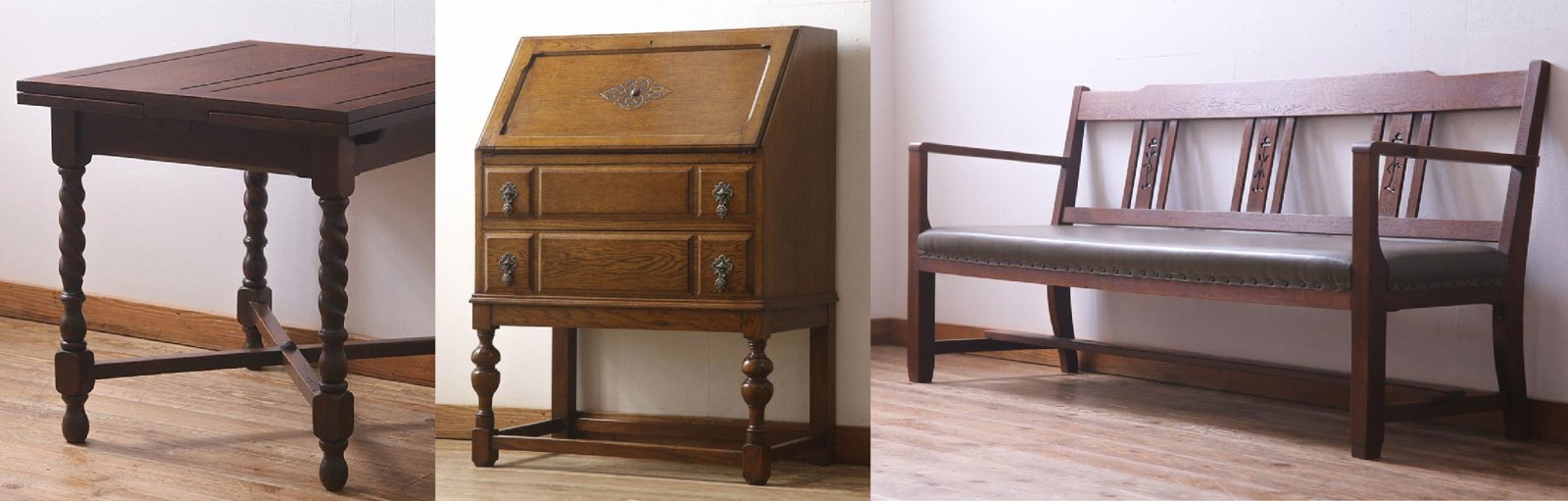
Oak is the general name for trees of the genus Quercus in the beech family (Fagaceae). Some 300 to 350 species are distributed mainly in the temperate regions of the northern hemisphere. With beautiful grain, hardness and durability, oak has long served in Europe and America for furniture, flooring and wine barrels. In Japan, mizunara is an oak, and its timber is called both nara and "oak". As timber, oak is relatively moderately priced among hardwoods, but Japanese mizunara and boards showing the "tiger" ray figure are rare and costly. See nara.
Species
Mizunara (Japanese oak). Most nara timber comes from mizunara (Quercus crispula), an acorn-bearing tree living for centuries; huge trees can be seen in the natural forests of Hokkaido. Also called onara ("great oak"), larger in height and leaf than konara, it grows 10 to 35 metres tall. Its name means "water oak", for the moisture in its trunk and branches, which makes it slow to burn. It grows in relatively cold regions, Hokkaido, Tohoku and the Russian Far East, and its slow growth gives a fine, close grain. Used for furniture, building, ships and casks, it is famous for whisky casks, its sandalwood-like aroma prized by connoisseurs. Hokkaido mizunara, called "Japanese oak", was a sought-after quality timber abroad, but has declined and become rare.
White oak. From North America; heavy, hard and water-resistant. Yellowish-brown to pale reddish-brown and similar to Japanese mizunara, it is now widely used as a substitute: whiter, bolder and coarser in grain than mizunara, but at a glance barely different. Hard, strong, resistant to marking and to water, it is much used for dining furniture, bed frames and casks for wine, whisky and bourbon.
Red oak. Also from North America, including northern red oak and southern red (Spanish) oak. Faintly reddish with distinct grain. Its open pores make it less water-resistant, unsuited to casks or wet places, but it dries more easily than white oak with less warping, and demand has grown. Strong in colour, weighty and impact-resistant, it is popular for substantial table tops and floors.
Its appeal
Strong and workable. Durable, strong and heavy, oak makes furniture that resists damage, for daily use for many years; oak furniture survives in good condition after more than a century. Hard as it is, it carves well, and carved English antique furniture is often oak.
Beautiful grain. Oak shows strong character depending on how it is cut from the log. Quartersawn boards show flowing straight lines; flatsawn boards show bold, arched "cathedral" figure. Especially notable is the "tiger" figure (torafu), the silver ray fleck that appears when oak is quartersawn, rarely so strongly in other woods; its beauty and rarity make such oak costly.
Natural durability. Oak is rich in tannin, which helps the heartwood resist decay and insects; this is one reason oak furniture has lasted long enough to become antique. (Tannin also reacts with iron, which is why oak can stain black around old iron nails.)
Oak in antique furniture
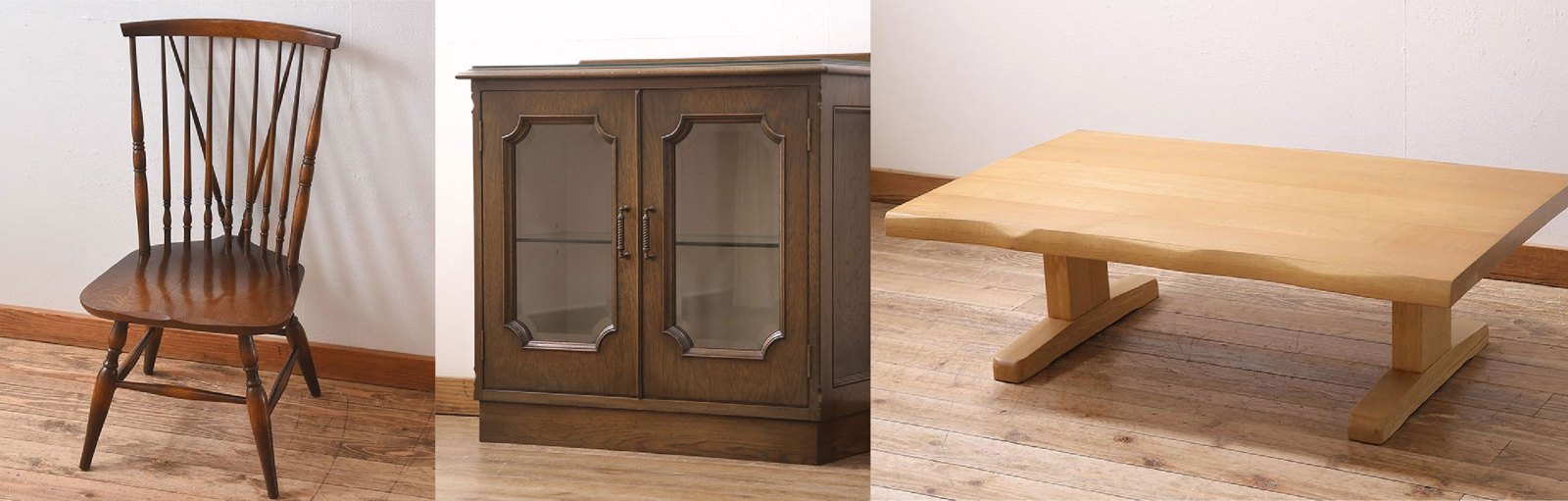
Oak has been a favourite furniture timber for centuries. Many English antiques, and Japanese antique furniture of the Taisho to early Showa eras, are oak. England built furniture from native oak (the medieval and Tudor "age of oak"), and in the late nineteenth and early twentieth centuries imported Japanese oak from Hokkaido in quantity, prized for its even colour and figure; so some English antique oak furniture now in Japan has, in a sense, come home. See linenfold and gateleg table.
Oak in vintage furniture
Much vintage furniture, Scandinavian, English and Japanese, is oak; by the vintage period of the 1950s to 1980s Japanese mizunara had become scarce, so most vintage oak is white oak. With timber supplies restricted, veneer rather than solid oak was usual: solid wood sliced thin and glued to a core board. Even so, the slices are around a millimetre thick, easier to work than solid wood and equally beautiful. See tsukiita and Scandinavian furniture.
Oak in contemporary furniture
Oak furniture remains very popular; white and red oak are often used for dining tables to enjoy the texture of solid wood, and many leading Japanese makers continue to make fine furniture in white oak and nara, in solid wood and veneer alike.
Occasional table
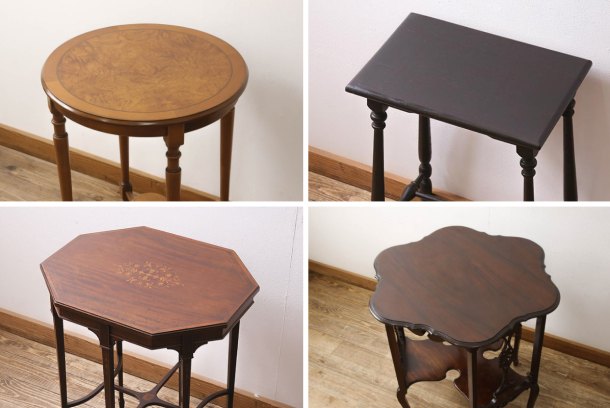
An occasional table is a small auxiliary table that arose among the upper classes of France and England from the eighteenth century. "Occasional" means "from time to time", and so "a table with no fixed use, serving whatever the occasion requires"; it was used constantly in every part of daily life.
Features
Its defining feature is a small top compared with desks and dining tables. It was made so as not to block the way or the view through a room, to be carried easily, and above all to be auxiliary. So although designs varied with region and period, most are simple with little ornament. Small enough to stand anywhere, it served for tea, card games, writing and reading, as a lamp stand, washstand or plant stand. Today's side tables, coffee tables and nests of tables are its successors. See nest of tables.
Tops. Mostly rectangular or square, but also round, oval, triangular and octagonal.
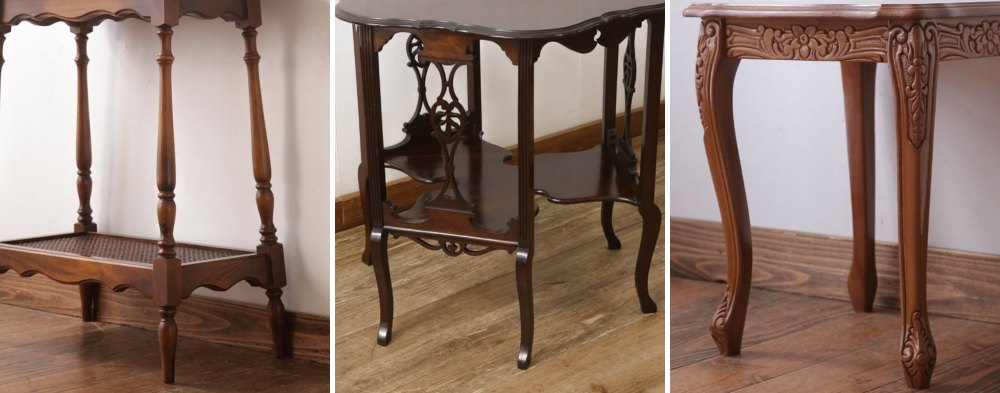
Legs and stands. While the top is simple, stands and legs are often elaborate: cabriole or twist legs with fine detail and carving, sometimes with drawers or undershelves. See cabriole leg and twist leg.
Carving. Carving follows the fashion of its day: Renaissance, Baroque and Rococo ornament in the seventeenth and eighteenth centuries, and classical Greek and Roman ornament with the rise of Neoclassicism in the later eighteenth. Motifs include shells, acanthus leaves, animals, figures, flowers, fruit and scrolls; delicate detail and graceful design were the craftsman's showpiece, much loved by an upper class for whom fine furniture was a mark of status. Inlay, veneering and gilding, and painted finishes were also used. See acanthus and Neoclassicism.
Materials. From the seventeenth to the nineteenth centuries, walnut, oak, beech, elm and mahogany; in modern times also papier-mâché, metal, stone, glass and resin.
History
Its origin is uncertain, but its prototype is thought to be the side table that appeared in England in the late seventeenth century. Behind it lay the fashion among the upper classes for tea, card games and salon culture; upper-class daily life nurtured the occasional table. It was natural that "a small table that can be used anywhere", short of a large dining table, should become popular. The Victorians in particular filled their drawing rooms with small tables of every kind.
Today's occasional tables
Nurtured in upper-class furniture culture, the occasional table served tea, cards and writing alike, and lives on in our own Westernised lives. Side tables, end tables, sofa tables, coffee tables, games tables, card tables, cocktail tables, lamp tables and nests of tables are all used in much the same way. Since it is meant to be used with chairs, very low tables and display console tables are generally not included. See console chest.
Old Charm (English furniture maker)
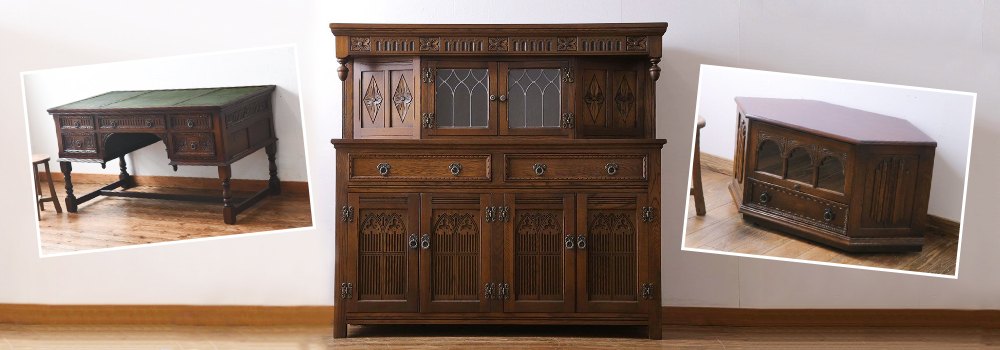
Old Charm is the name of a traditional English furniture range, made by a firm founded in 1924 and long counted among the best-known makers of reproduction English oak furniture. The business has since closed, bringing a long history to an end, but its furniture is still widely found and still loved as furniture that enriches daily life.
Four features
1. Widely loved. A design that pursues practicality to the end, and beautiful construction that makes the most of classical design, are the great reasons it is still sought after.
2. Quality oak. Old Charm is famous for its use of oak, a hard, durable, fine timber. Oak has a handsome grain, and pieces showing the ray figure called torafu in Japanese (tiger stripe, or silver figure) are especially prized. Its mellowing to a honeyed amber with age is full of character. See oak.
3. Hand carving. Old Charm furniture shows beautiful carving, painstakingly done by hand. It continues a tradition of decoration from the Tudor and Elizabethan periods, faithfully inherited in technique and design as an essential part of the antique feel. The carved parts carry the weight and elegance particular to England, a great part of the range's charm. See linenfold.
4. Striking glazed doors. Many Old Charm pieces have glazed doors set with clear leaded lights. The leading (cames) is arranged in diamonds, pointed Gothic arches and other shapes, a chic, beautiful design that gives the furniture an air of luxury.
Kinds
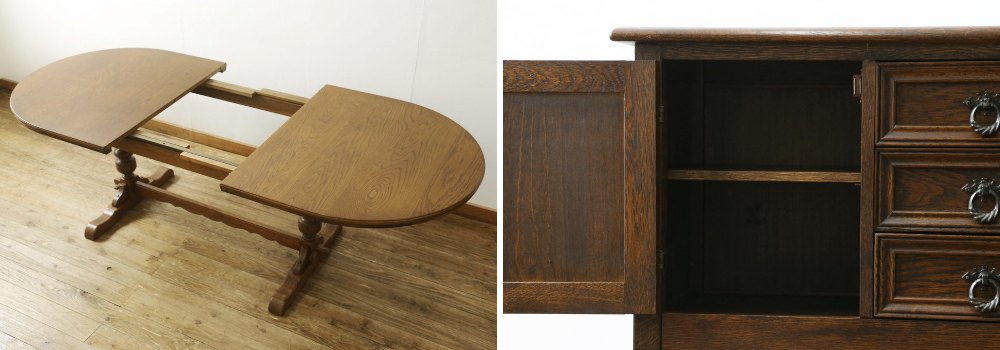
Old Charm made a great many kinds of furniture: draw-leaf and gateleg tables, sideboards and dressers, bureaux and writing desks, glazed bookcases and display cabinets, corner cupboards, telephone seats, nests of tables, chairs and more. See draw-leaf table, gateleg table and writing bureau.
History
Old Charm was founded in 1924 in Hertfordshire, England, by Herbert Wood. Under the founding ideal of making "tomorrow's antiques", it produced for more than ninety years a great deal of furniture to be used and loved for a long time, untouched by fashion. It was known for its insistence on quality, design and manufacture, and that spirit will be handed down to the next generation through its furniture.
For collectors
Old Charm pieces are usually twentieth-century, so they are vintage rather than antique; they often carry a maker's label or stamp inside a drawer or on the back. Solid oak with crisp hand-finished carving and original leaded glass is the mark of a good example. See vintage.
Ottoman
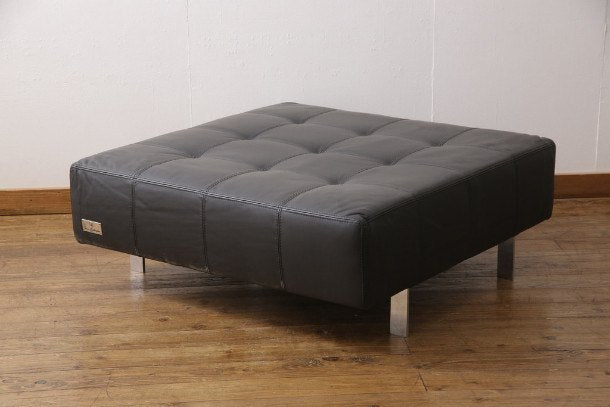
An ottoman is a piece set in front of a chair or sofa as a footrest. Cushioned, without back or arms, many can also serve as stools.
Features
Used mainly as a footrest, most ottomans are simple with little ornament. Many are made in sets with sofas or chairs, matched for a unified look. Ottomans sold singly, by contrast, are often original in shape or decorated, adding a decorative note beside a chair or sofa.
History
"Ottoman" means "of the Ottoman Empire", the great power centred on what is now Turkey. Low, deep, cushioned seats in the Turkish manner reached Europe in the eighteenth century, and low upholstered couches came to be called ottomans. The name then shifted to upholstered seats without back or arms. In the nineteenth century the Victorians made circular and "box" ottomans, the latter with a hinged lid for storage, and the word came to mean today's footstool and pouf.
Kinds
Antique. Antique ottomans are not numerous and hard to find, since as footrests they wear easily and seldom survive in fine condition. A good antique ottoman is a rare find.
Vintage. Some vintage ottomans have legs and frames of fine woods now hard to obtain. Many are leather, but fabric ones often show care in patterned upholstery, more festive than today's, an accent for a room.
Designer. Ottomans by makers such as Ercol and Herman Miller, notably the ottoman of the Eames Lounge Chair, have real presence, used with their chairs or alone. See lounge chair.
Ottoman and stool
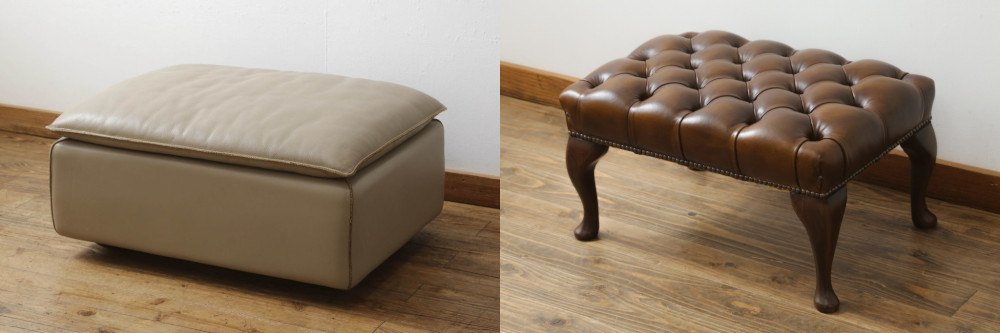
An ottoman is a footrest, a stool is a seat. The ottoman began as a companion to sofa or chair, and most can still be sat on; but with its low, well-cushioned seat it is closer to a sofa. A stool is a chair without back or arms, made first and foremost for sitting, with little cushioning, often none at all.
Uses
Having evolved from a couch, most ottomans serve as stools too: a footrest every day, a spare seat when guests come. Where a sofa would crowd a room, an ottoman can stand in for one, and since it can be sat on from any side, it is easy to place. Its simple design is what makes it so adaptable.
P
Pad foot
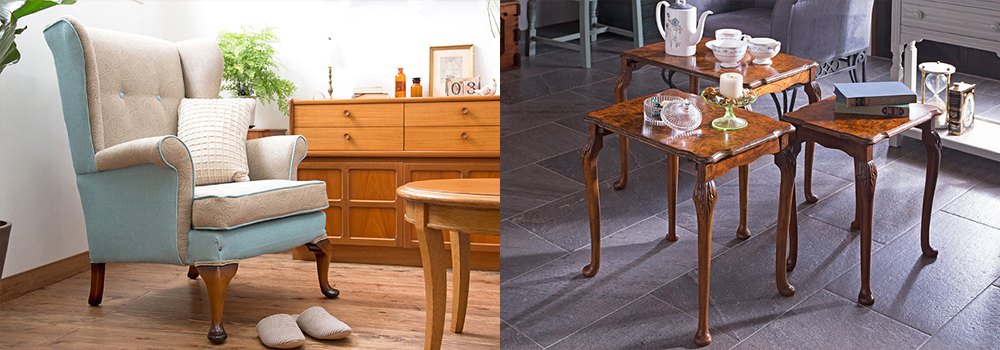
The pad foot is a design for the foot of furniture, shaped as if a flat, disc-like pad were attached. Seen mainly in English antique furniture, it is a traditional design representative of the history of English antiques, and its design and techniques are still used in making classical, elegant furniture.
Features
Almost all pad feet end S-curved cabriole legs. Cabriole feet include elaborate designs such as the French scroll foot and the claw-and-ball, but the pad foot is the simplest and lightest. Its simplicity makes it easy to use anywhere, and its smooth curves give an elegant, soft air. Antique and vintage pad-foot furniture is usually of walnut, mahogany or oak; without lavish ornament, one can enjoy the beautiful grain to the full. Rounded in design, the pad foot is flat beneath, giving stability to support even heavy furniture. See cabriole leg and claw-and-ball foot.
Kinds
Refined and simple as it is, each pad foot differs in shape; some resemble a spoon or a golf club and are called "spoon foot" or "club foot". A pad set on a thin disc is sometimes called a "cushioned" or "padded" pad foot, and a three-toed version is the "trifid" foot, found on Irish and American furniture.
History
The age of Queen Anne. From the late seventeenth into the eighteenth century, the cabriole leg was the height of fashion, and in France the feet of furniture were adorned with scrolls and hoofs. In England, the furniture of Queen Anne's reign (1702 to 1714), though influenced by the Baroque, emphasised function and practicality rather than lavish splendour, and in contrast to France its cabriole legs ended in a simple foot of its own: the pad foot, born in the early eighteenth century. The pad foot is a hallmark of the Queen Anne chair; the period is also called "the age of walnut", for the many pieces made in beautifully figured walnut. See Queen Anne style, Queen Anne chair and walnut.
Developing under the Georges. When George I succeeded Queen Anne, furniture became more decorative and luxurious while still influenced by Queen Anne design. The Georgian period, from George I to George IV, coinciding with the beginnings of the Industrial Revolution, was a golden age of English furniture. Walnut gave way to mahogany, whose strength and workability lent themselves to delicate piercing, producing many splendid pieces; cabriole legs became slimmer and more stylish, giving the pad foot a different expression from Queen Anne walnut. The design has been carried on ever since and remains a classic of Western furniture. See mahogany.
Furniture with pad feet
Chairs, tea and side tables, lowboys and highboys, bureaux, stools and settees all appear on pad feet.
In the interior
With its quiet elegance, the pad foot suits Japanese and Western rooms alike, a perfect design for bringing style and character to a modern interior.
Paper cord
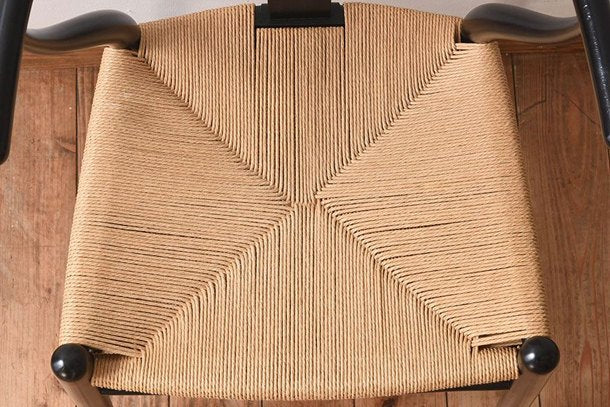
Paper cord is, as the name says, cord made of paper: not plain paper, but paper impregnated with resin and twisted. It is used mainly for chair seats. A paper-cord chair is made by weaving about 120 metres of cord, by hand, onto a wooden frame. Often seen in Scandinavian interiors, such chairs are now also made widely in Japan. Simple, beautiful and highly practical, the paper-cord chair is loved around the world, beyond time.
Features
Beautiful design. Made of contrasting materials, a paper-cord chair has a charm that an all-wood chair lacks. Its inviting texture and carefully woven seat carry the warmth of handwork, and a delicate, soft mood. The material and shape of the frame and the weave of the cord change its design and effect, so comparing them is a pleasure.
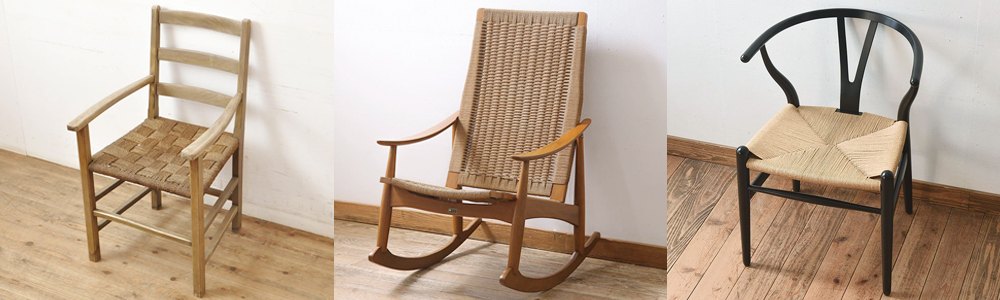
Durable. "Paper" may suggest something that tears or breaks easily. But paper cord is usually made from strong, long-fibred natural pulp, and three strands of that tough paper are twisted together, so it is very durable, as strong as leather or upholstery, sometimes more so. Being paper, it is also uniform in quality and appearance.
Comfortable. Paper has a pleasant give, receiving the sitter gently. Taut and firm at first, the cord gradually shapes itself to the body with use: a seat that becomes one's own, for many its greatest charm. It is also airy and light. Woven, it lets air through: in summer heat escapes and it never feels clammy, and in winter it lets warm air through and the seat never feels cold. And a paper-cord chair is lighter than an all-wood one, welcome in a chair moved often every day: a material uniting function and beauty.
Easy care. Each strand is coated in resin, so it repels water. Wipe spills or dirt at once, before they soak in, and they leave no stain. A well-wrung cloth can be dabbed on gently, but if the cord is used while still damp it can stretch or mould, so let it dry fully first. Everyday care is simple: vacuum dust and crumbs from the gaps, flick it with a dry cloth, or turn the chair over and tap the seat from beneath.
Weaves
Paper-cord seats are woven in two main ways.
Flat weave. Called kanoko-ami ("fawn-spot weave") in Japan, it alternates over and under stitches across and down. Highly textured, it touches the skin in fewer places, feeling dry and airy, rather like the knit of a polo shirt or sweater. It feels flatter and firmer than the envelope weave.
Envelope weave. Shaped like the back of an envelope. It is said to be harder than the flat weave: the tension must stay even and the diagonals run straight. The cord grows slightly less taut towards the centre, giving an enveloping, relaxed seat.
History
Paper cord was originally used during the First World War as twine for binding crops such as wheat. In the 1940s, being less costly than leather, strong, durable and comfortable, it came to be used for chair seats. Classic paper-cord chairs include Hans J. Wegner's Y chair and PP68 and Borge Mogensen's J39. The Y chair, with the curves of its back and rear legs and its envelope-woven seat, is especially popular in Japan; light and simple yet kind to the body, it is famous the world over as an enduring classic. Paper cord is still made today, and its craft carefully handed down. See Scandinavian furniture.
When to re-cord
After years of use the cord inevitably slackens, breaks or shows dirt. Re-cording restores the tension and texture of a new seat. As a guide it lasts about ten to fifteen years, sometimes nearly twenty depending on use and conditions. A durable material, it rewards patience as it slowly shapes itself to you.
Paper cord and Lloyd Loom
Lloyd Loom looks like paper cord and is hard to tell apart at a glance. Lloyd Loom is paper wound round steel wire. It has the delicate warmth of a woven surface, and because it is woven separately from the frame it allows great freedom of design. Both use paper and are woven onto wooden frames. The difference is Lloyd Loom's steel wire, treated against water and rust so that it will not corrode and snap, with the paper waterproofed too; so it stands up to damp better than paper cord, and takes colour easily, so comes in many colours. See Lloyd Loom.
Parquetry (yosegi zaiku)
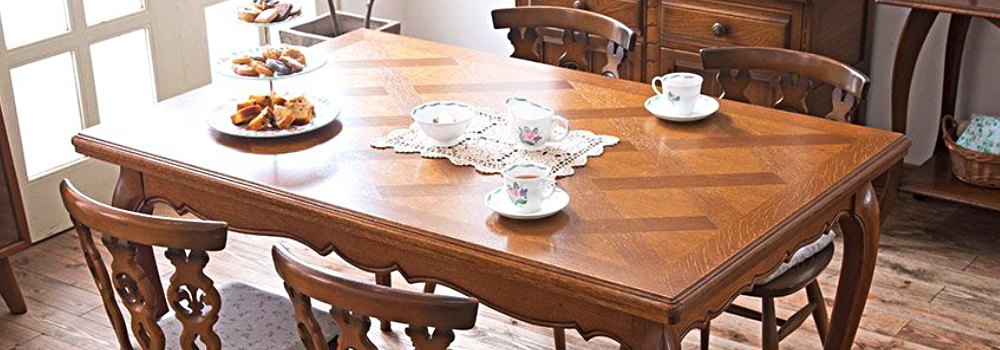
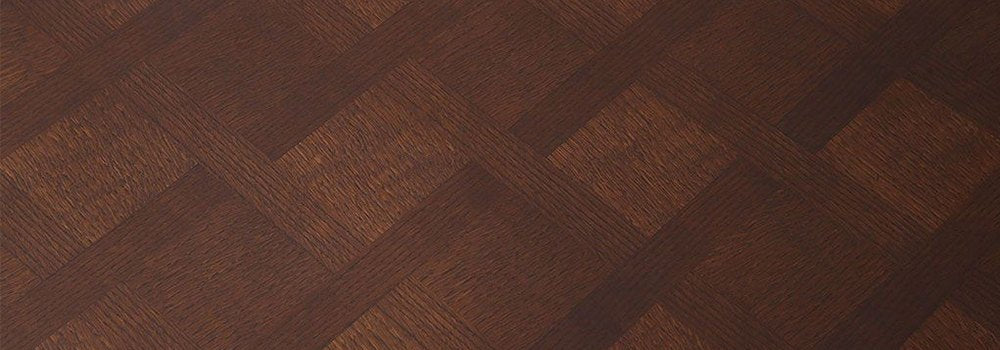
Parquetry (in Japanese yosegi zaiku) is a decorative technique that combines various woods to make patterns, or the things made by it. The name comes from the French parquet, "small compartment", and it is sometimes simply called parquet. It is used for floors, fittings and furniture, and in antique furniture is especially common on French pieces. Assembling woods of different grain and colour, any geometric design can be made, with a finish like a work of art.
Features
Its great feature is that the pattern is woven from grain alone. Patterns are generally built of squares, triangles and lozenges, sometimes with curves. In one method, the pattern is cut out of a base veneer, veneers of other grain are fitted into it, and the assembled sheet is laid onto the furniture. Mahogany, oak, walnut, cherry, pine, maple and many other woods are used, alone or in combination. Making pattern from differences of grain, direction and colour alone is very difficult and demands precise work, so the skill of an experienced craftsman is essential. The unique look that only natural grain gives, geometric patterns unknown in nature, and a texture festive and refined without insisting, are its great charms. See tsukiita.
Patterns
Herringbone. Named for its likeness to the bones of a herring; a design of stacked Vs. A related form, quartering, is strictly different from herringbone, but four leaves set against one another's grain can make a herringbone-like pattern, often used to decorate furniture.
Versailles. Named for its use on the floors of the Palace of Versailles: square or rectangular frames filled with diagonal lines that seem woven together.
Hexagon. Hexagons laid in a regular pattern. Each is made from three pieces of different grain, so it looks three-dimensional, the "tumbling block" effect.
Chequer. Familiar in Japan as ichimatsu, and long loved abroad as the chequerboard: squares of two colours, or of grain in different directions, laid alternately.
History
Parquetry is said to have been born in ancient Egypt, where pharaohs' grave goods made in the technique have been found. It spread around the world, to Europe and to Japan, developing its own forms in each.
In Europe, it began to spread in the late seventeenth century, when it was adopted as the design for the boards that replaced marble on the floors of Versailles; many rooms there still show parquetry of various designs.
In Japan the best known is Hakone yosegi zaiku, first made in the late Edo period. Its patterns were simple at first and grew more complex in the Meiji era, and in 1984 it was designated a national Traditional Craft. The techniques and pieces developed in each country are carefully handed down, and their popularity has never faded. Hakone work is made by gluing strips of naturally coloured woods into blocks and slicing them into thin sheets of repeating pattern, applied to boxes, trick puzzle boxes and trays.
Parquetry and marquetry
The other kind of inlaid wood work is marquetry. Both make pictures from wood, but method and motif differ, so they look very different. Marquetry depicts not repeating patterns but pictures, plants and animals and more. Thin leaves of different colours are cut, layered and joined to draw the picture with contrast, and the result is set into one sheet and laid on the surface of the furniture.
Similar in look to marquetry is inlay (zogan): the pattern is cut into the furniture itself and other woods set into it. It looks so like marquetry that the two often cannot be told apart.
Parquetry in furniture and the interior
Parquetry appears on table tops, the fronts of chests of drawers, sideboards, writing desks, side tables and cabinets. Furniture with parquetry brings quiet refinement and festivity; in a room it brightens the space and lends an air of quality. On antique pieces, check for lifting or missing pieces, which an experienced restorer can usually make good.
Pie-crust table
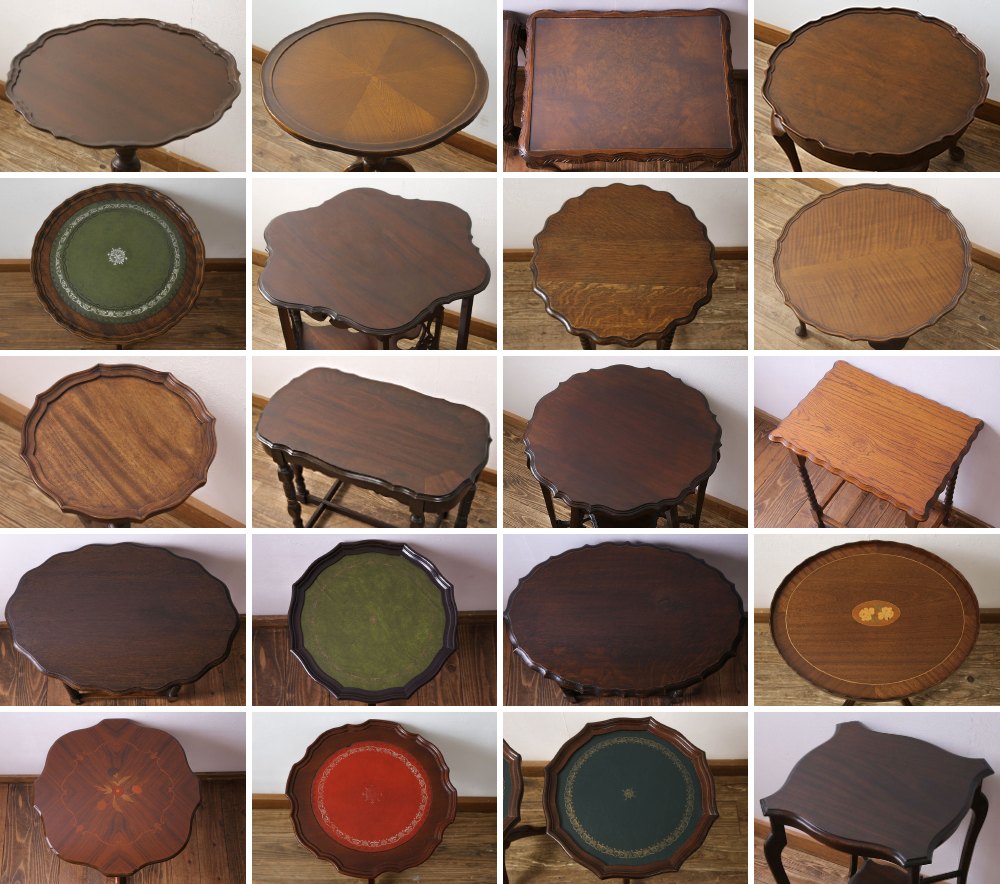
"Pie crust" is a carved decoration on the tops of antique tables, the edge waved like the crust of a pie, as the name says. Often found on English and, in other forms, Continental antique tables, it is a precious top design seldom met today. Its beautiful wavy curves give an elegant, festive air and have long been valued in Europe as furniture that brightens a room.
Features
1. A beautiful edge. Above all, the edge of the top is shaped like pie crust. Its smooth, beautiful carving shows the high skill of the cabinetmakers of the time. Mahogany was the usual timber, and to show its grain the top was often made from a single board. Most have one top, but some stack two or three tops of different sizes in tiers, the "dumb waiter". See mahogany.
2. Graceful legs. Below the pie-crust top there are often elegant cabriole legs ending in claw-and-ball feet, as well as twist legs and pieces finely carved all over. See cabriole leg and claw-and-ball foot.
3. Practical. Pie-crust tables are usually small and fit any setting. Some tops are flat, but many have a raised, moulded rim like a real pie crust, helping keep things from falling off. The pie crust is often found on tilt-top tables, whose tops can turn (on a "birdcage" mechanism) and tilt vertically, so they can be folded away compactly when not in use.
Kinds
Pie-crust designs that look alike prove each to differ, and besides the edge, leather and inlay are also used, a great variety of design that is one of its charms.
History
The pie-crust table was born in England in the mid-eighteenth century, made originally as a tea table for serving guests. Then only well-to-do households of the middle classes and above could serve tea, so the pie-crust table was a symbol of rank and wealth. Pie-crust tables of the Chippendale period, especially those with tripod bases (three legs supporting a central column), are famous, and in America Philadelphia makers produced celebrated examples. Pie-crust design, changing with material, technique and period, has charmed many, and its traditional design and construction remain popular. Many fine reproductions were made in the nineteenth and twentieth centuries; on period tables, the top and edge are carved from the solid, not applied. See Queen Anne style.
Today
With its classical beauty, a pie-crust table brings festivity and refinement to a room; small and practical, it is an excellent design for modern interiors.
Pine
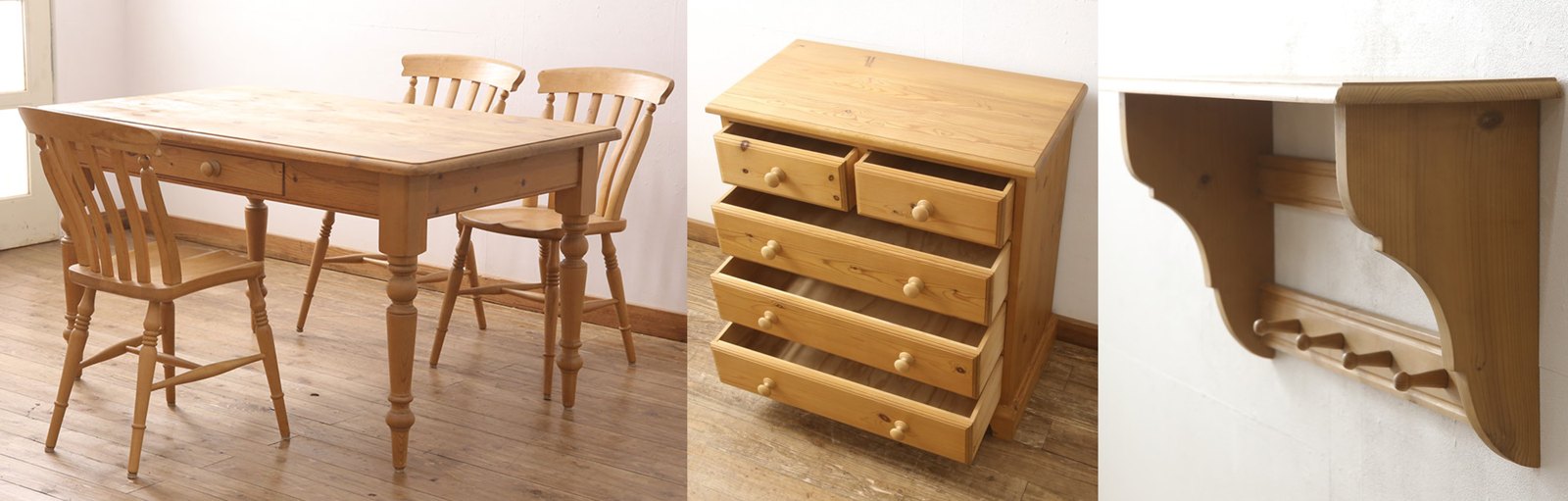
Pine (matsu in Japanese) is a conifer of the pine family (Pinaceae). Familiar in Japan, the pines number more than fifty species worldwide, and mainly North American and European pines are used as pine timber. Its gentle, bright colour that lights up a room and its characteristic knots bring the naturalness and warmth of wood.
Species
Of the many pines, only a few are used for furniture. Three main ones:
White pine. Found widely from southern Canada through the north-eastern United States. Whitish, as its name says, soft and light, quick to dry with little movement, so relatively easy to work; used for building, woodwork and DIY as well as furniture.
Yellow pine. Chiefly from the south-eastern United States; heartwood pale reddish-brown, sapwood pale yellowish-brown. Tall trees reach about 45 metres, with thick, straight trunks, and it is among the stronger and harder pines, resistant to wear. Fast-growing, it reaches a large diameter in about thirty years.
Scots pine (European redwood). Distributed widely from Europe to Russia, slightly deeper red-brown than Japanese red pine but similar in look and quality. Grown slowly over a century in cold regions, it has dense growth rings and excels in strength, resilience, durability and resistance to decay.
There are also ponderosa, lodgepole, Merkus and radiata pines, varying greatly in character and price by origin. Among antique pine, the highest grade and price is "pitch pine", from the southern United States: closer-grained than other pines, hard, heavy and red-brown, and rare because little of the tree is usable, it was used in Victorian churches and schools.
Its appeal
Colour and knots. Bright grain and many knots, a natural look full of warmth. Rich in resin, it gains lustre with use, mellowing to a deep honey colour, a pleasure of age. Its fragrance is pleasant too, reminiscent of a walk in the woods.
Easy to work. Soft, quick to dry and stable, it is easy to work. Gentle to the touch and low in thermal conductivity, it feels comfortable all year round, and is widely used for floors, chairs and tables that we touch every day, and loved for DIY.
Accessible. Plentiful worldwide, pine is relatively inexpensive among timbers, so it can be used generously for floors and makes furniture easy to acquire. It also grows quickly, about thirty years from planting to felling, against forty to fifty for Japanese cedar and cypress. But pine grown slowly in harsh cold regions, and knot-free pine, are rare and costly. See sugi.
Pine in antique furniture
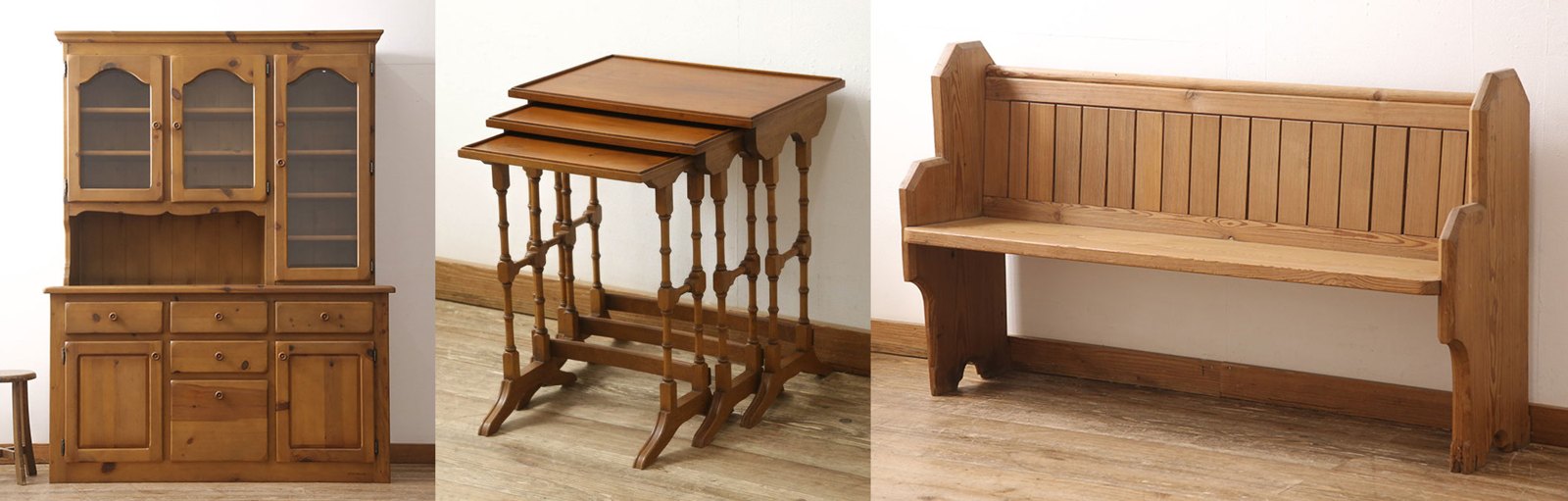
In earlier centuries knotty pine was not thought fit for fine furniture. It was used mainly for carcasses and for servants' and kitchen furniture, often painted, grained or stained to imitate finer woods. Gradually its own appeal was recognised, and in the nineteenth century it became popular among ordinary people who could not afford walnut or mahogany. Without lavish ornament, simple and warm, much old painted pine was stripped in the later twentieth century, giving the "stripped pine" look now familiar. Furniture of "old pine", reclaimed from demolished buildings, is also much sought after, and good old pine grows harder to find each year.
Pine in vintage furniture
There is much vintage pine furniture, chiefly English, Scandinavian and American. Danish designers working in Hans J. Wegner's time, such as Rainer Daumiller and Børge Mogensen, used their country's abundant pine in many designs, and the Swedish designer Hans-Agne Jakobsson used Nordic pine in his celebrated lamps. The English mid-century maker Ercol also used pine. Beautiful, refined and functional, these designs have been loved for decades. See Scandinavian furniture.
Pine in contemporary furniture
Pine remains very popular, made in great quantity in Japan and abroad; it is almost indispensable for Scandinavian and country interiors. Its directness of wood suits Japanese tatami rooms too, and many new pieces use reclaimed timber or distressed finishes for an antique or vintage feel.
President's desk (partners' desk)
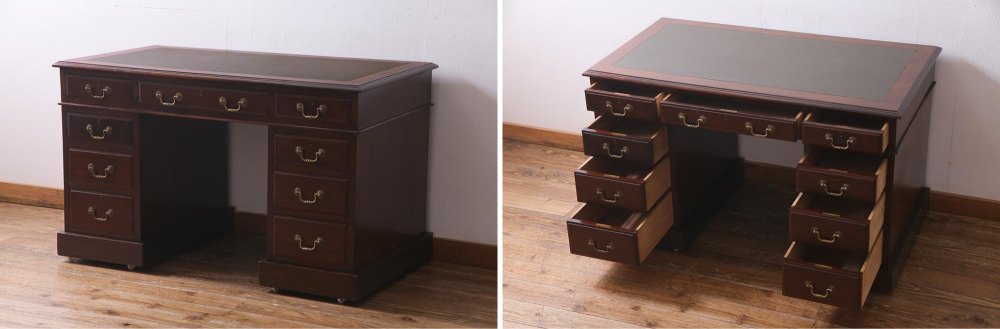
A president's desk is a large, fine office desk made for the head of an organisation or senior executives to work at, also called an executive desk or, in Japanese, shacho-zukue ("company president's desk"). It usually means a double-pedestal desk, substantial and richly decorated.
Features
As "president" and "executive" suggest, it was originally the desk of the head or senior officers of an organisation, so antique examples show the finest quality and craftsmanship. Tops are broad, often leather-lined or with carved edges; fronts and sides are richly decorated, more splendid and weighty than an ordinary office desk. The name is also used for desks with drawers on both front and back, at which one can sit from either side, in English the "partners' desk". See kneehole desk.
History
Its prototype, the pedestal desk. Its origin is uncertain, but it is thought to derive from the double-pedestal desk born in later seventeenth-century France. A desk associated with Cardinal Mazarin, chief minister in the mid-seventeenth century, the "bureau Mazarin", has three drawers on each side and one in the centre, with four legs under each bank, a luxurious double-pedestal desk. Following it, in the later seventeenth century, royal cabinetmakers made still more richly decorated writing desks for Louis XIV, perhaps the prototype of the "desk at the top".
The facing design, born in England. In England, double-pedestal desks with a shallow arched drawer over the knee space appeared, smaller, straighter and simpler than the French, the forerunner of later office and study desks. Among them arose desks for use from both sides: with drawers front and back and room to sit opposite, the partners' desk leads to today's president's desk.
The "president's desk" in America. In 1880 Queen Victoria sent President Rutherford B. Hayes a desk made from the timbers of HMS Resolute, a British Arctic exploration ship abandoned in the ice, recovered by American whalers and returned to Britain by the United States, in gratitude. The "Resolute desk" has been used in the White House ever since, and many presidents have worked at it in the Oval Office. From then on the desks of heads of organisations came to be called "president's desks", and the name became established as a type of furniture. From the nineteenth century it spread worldwide, chosen for its practicality and luxury in public and private; today its craft value, of precious materials and advanced techniques, is also recognised.
Today
Historically used by presidents and kings, the president's desk is now valued for creating a substantial study or office, and makers in many countries, in the West and in Japan, produce desks of this kind. On antique examples, check the leather or baize top (often renewed), the running of the drawers and the locks; an experienced restorer can re-line a worn top.
Pressed glass (kataoshi garasu)
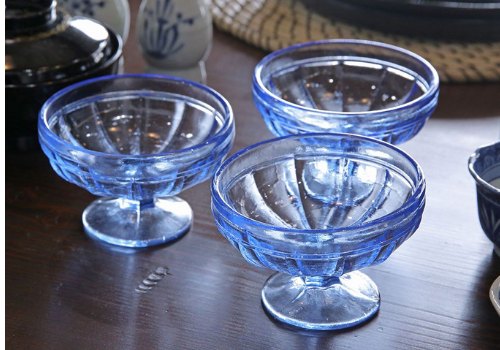
Pressed glass (puresu garasu, also kataoshi garasu, "mould-pressed glass") is made by a glass-forming technique in which molten glass is poured between two moulds and pressed into shape. Developed in America in the nineteenth century, it made mass production possible for glassware that had been made only in small numbers. It is highly decorative, thick and durable.
Features
Pressed glass was born in America in the early nineteenth century. Molten glass is poured into a mould, pressed, then cooled and finished. It allowed beautiful glass with complex designs and patterns to be mass-produced inexpensively, a true revolution in glassmaking. After its appearance it became popular worldwide until the early twentieth century, and was used in decorative furniture and interior fittings too.
Thickness. There are two main reasons for its thickness. The first is the technology of the time: in the nineteenth and early twentieth centuries glassmaking was not yet consistent, and glass that was not of even thickness could crack from temperature differences as it cooled, so a certain thickness was needed for uniformity. The second is fragility: there was no toughened glass, and glass broke easily, so to make it durable many pieces were made thick.
Rich decoration. The method itself explains the decoration: pouring glass into a mould reproduces complex, minute, delicate patterns precisely, and because it could be mass-produced, adding more moulds gave a wealth of designs. Not technique alone: the particular clarity and texture created by reflected light give a festive, elegant effect.
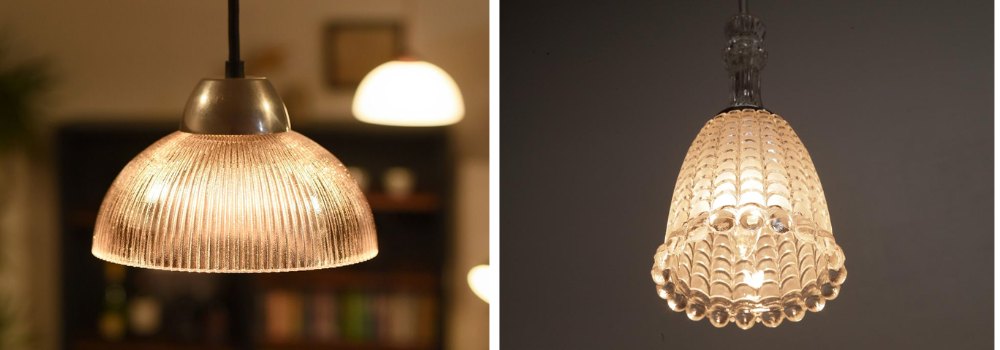
Bubbles and distortion. These come from the process: air easily becomes trapped as glass is poured into the mould, and can remain as bubbles after cooling, while shrinkage on cooling causes slight distortion. Nineteenth- and early twentieth-century methods could not wholly prevent such irregularities, which were accepted as part of the ware. Today they are valued as the character of vintage glass, a defining element of pressed glass and essential to its antique charm.
History
Pressed glass goes back to early nineteenth-century America: in the 1820s machines were developed that could form glass by pressing in a mould, allowing complex designs and mass production impossible in hand-blown glass. In the Victorian era of the later nineteenth and early twentieth centuries pressed glass was hugely popular throughout Europe; pieces with fine cut-like patterns and festive decoration spread quickly into ordinary homes as symbols of prosperity.
Pressed glass in Japan
Arrival. Pressed glass reached Japan in the late Edo and Meiji eras, one of the things introduced as Western culture was eagerly adopted. From the Taisho era, pressed glass was made in quantity in Japan; pieces of the Taisho and Showa eras fuse Western festivity with traditional Japanese taste in distinctive designs. See Taisho roman and Showa retro.
Varied designs. Natural motifs such as flowers, stars and snow crystals, and geometric patterns: the designs are many, said to number more than three hundred. Colours range from simple white and clear to retro pop shades.
Beautiful and practical. Mostly thick and sturdy, it served as everyday tableware, and as lampshades and small interior pieces. In interiors today its nostalgic charm is prized for creating a retro mood; pressed glass in tiles, light fittings and window panes especially lends modern rooms new value with its sparkle and delicate design.
Telling pressed from cut glass
Pressed glass shows soft, rounded edges to its pattern, faint mould seams, and a smooth interior where the plunger formed it; cut glass has sharp, crisp edges that feel almost keen to the finger. See Edo-kiriko.
Q
Quaker chair
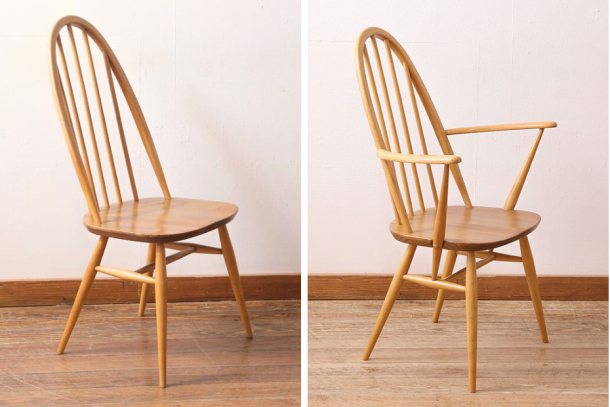
The Quaker chair is a kind of Windsor chair made by Ercol, distinguished by a tall back frame bent into the shape of a U. It puts to work the bentwood technique in which Ercol excelled, and its high back gives the chair a strong presence in a room. Ercol is a long-established English furniture maker founded in 1920, best known for its Windsor chairs, and it has sent many celebrated designs into the world. See Windsor chair.
Features
The defining feature of the Quaker chair is, above all, its tall back. It is a hoop-back chair that draws the most from Ercol's command of bent wood, and the back frame, bent almost to its limit, has a sharpness no other hoop-back chair quite matches. Sit in one and the back wraps the whole of the sitter's back, which makes it comfortable for long sitting. Yet it keeps the lightness peculiar to the Windsor chair, so it does not crowd a room. See hoop-back chair.
There is also a Quaker rocking chair, and its high back, against which one can lean at ease, makes it ideal for an hour of rest. See rocking chair.
Kinds
Arms. Quaker chairs come in the standard form with a back only and in a form with arms. One can choose by purpose: without arms for the dining table, with arms for the study.
Colour. Ercol's Quaker chairs come in finishes that make the most of the wood's own tone, mainly three: natural, a graded mid tone, and dark brown. It is part of their appeal that one can match the colour to a dining table and the furniture around it.
Legs. As well as the standard four legs, the chair is made as a rocker. Because the tall back supports the whole body firmly, its shape is just as comfortable for a rocking chair, made for unhurried sitting.
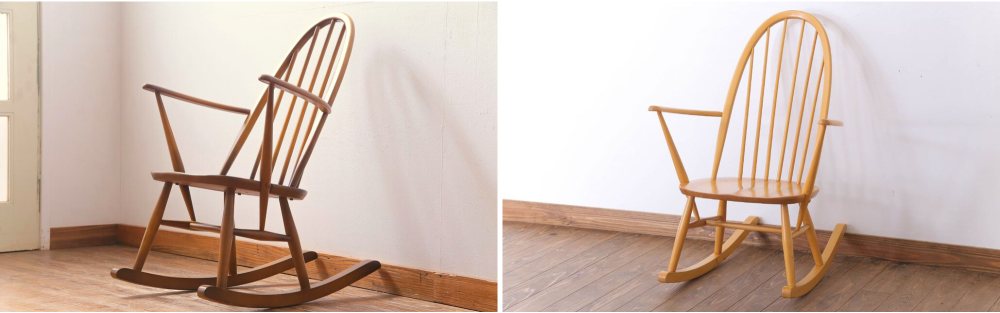
History
Ercol and the Windsor chair are so closely bound that one might almost say Ercol means the Windsor chair. The forerunner of the Windsor chair is the comb-back chair, in which several sticks run from a top rail straight down into the seat. Comb-backs were made by and for ordinary people, but their practicality and strength made them hugely popular in the eighteenth century. See comb-back chair.
Next came the hoop-back chair, whose back uses a strongly curved frame in place of the top rail. Compared with the comb-back, until then the basic type, it needs fewer parts, so it is sturdy and cheaper to produce, and it became very fashionable.
Ercol was among the first makers to establish the technique of steaming wood and bending it, so as to raise the productivity of Windsor chairs. The Quaker chair is an evolution of a hoop-back that Ercol once produced for the kitchen. Only Ercol's accumulated skill made it possible to bend the back frame almost into a U, and the Quaker chair may fairly be called the distillation of Ercol's craft.
Quaker chair and hoop-back chair
The hoop-back chair closely resembles the Quaker chair, so what is the difference between them? It lies in the shape of the back. The back of a hoop-back chair rises to about the lower edge of the shoulder blades, whereas the Quaker chair's back is much taller and enfolds the whole of the back.
The hoop-back has a rounded, endearing look; the Quaker chair is more graceful. Its back narrows sharply towards the crown, giving a clean silhouette, so the chair has presence and still feels light.
Queen Anne chair
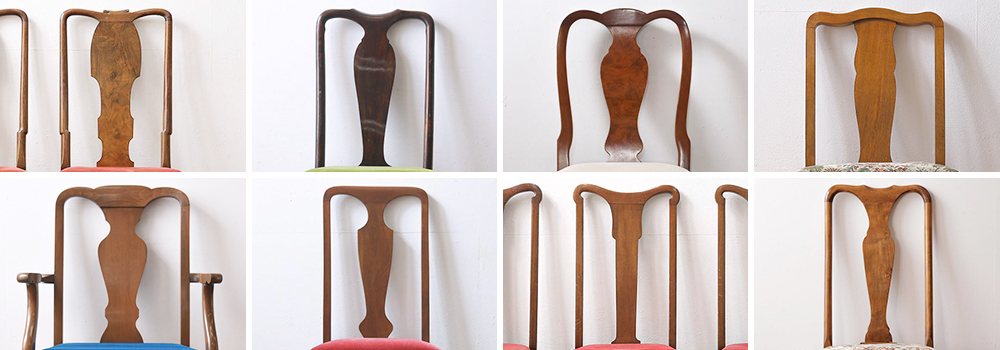
The Queen Anne chair is a chair in the Queen Anne style, born in England in the reign of Queen Anne at the beginning of the eighteenth century. Its simple construction, revolutionary for its time in putting ease of use first, and a design that makes the most of graceful curves won many hearts, and it remains firmly popular across the centuries. See Queen Anne style.
Three features
The back. The first thing one notices, the striking back, is built as a splat back, with a long, slender board at its centre. The pierced splat takes the violin or the vase as its motif and draws graceful curves that give an air of refinement. Many details consider the sitter's comfort: a smooth curve at the lumbar region shaped to fit the skeleton, and a back raised high so one can sit at ease.
A cushioned seat. A thick cushion on the seat is another major feature. With cushioning one could sit for long periods, and many were captivated by a comfort far beyond the old board seat. The seat alone can also be lifted out, which makes everyday care and re-covering easy.
The graceful cabriole leg. The rear legs sweep back slightly, while the front legs describe a gentle S-curve, the cabriole leg. Also called the "cat's leg" in Japanese, the cabriole leg was born in France, but the version on the Queen Anne chair is an English design. It carries carved acanthus or shell, yet compared with France the design is very simple, and the foot too is understated, a pad foot for example. Its practical style, never too ornate, found wide acceptance and became the foundation of later English furniture. See cabriole leg and pad foot.
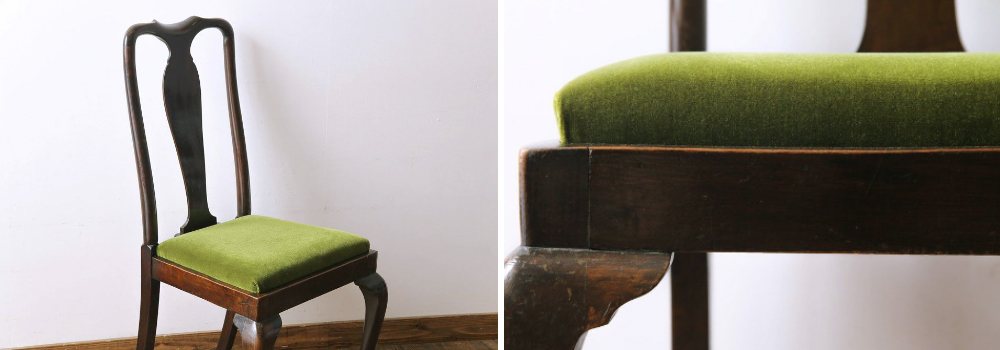
Kinds
As described, the legs basically consist of rear legs that sweep back, cabriole front legs and simply made feet. What designs and materials are found in the back and seat?
Back designs. Designs that look alike at first glance each differ subtly on close inspection, and the range is wide. Queen Anne style is also called "the age of walnut", and handsome, strong walnut was often used. See walnut.
Seat materials. Antique chairs are often offered with the seat already re-covered, but leather and raised-pile fabrics of real distinction are used.
History
In the early eighteenth century, while Queen Anne was on the throne, buildings and furniture in the Queen Anne style appeared in numbers. Earlier furniture had been made sumptuous for the aristocracy, but in Queen Anne style showy ornament was omitted for simple construction that valued function and practicality, and pieces became smaller and lighter. Trade between East and West lay behind this: techniques of chair-making from China, meant to support a healthy posture, are strongly reflected in the Queen Anne chair.
Its beauty was not neglected either. Flowing curves influenced by the Baroque and Rococo styles, and delicate carved ornament, give it an elegant, gentle air. See Baroque style and Rococo style.
Anne's reign, from 1702 to 1714, was short, but as the opening of the golden age of the English antique chair it greatly influenced chair-making at home and abroad. After her reign ornament came to matter again and design and construction changed, but the Queen Anne chair holds a great deal that only the Queen Anne style offers. Beautiful, and attentive to ease of use in every detail, it charmed its own time and charms ours, and it remains loved as a fine chair that sits well in modern interiors.
Queen Anne style
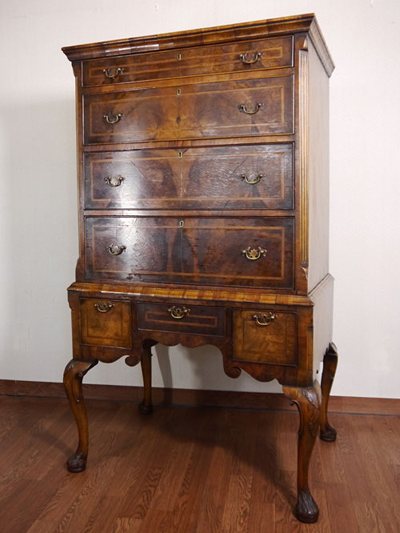
Queen Anne style is the manner of decorative art that arose in England in the reign of Queen Anne at the beginning of the eighteenth century, applied to furniture and interiors. Compared with the preceding style, which favoured heavy, rectilinear ornament, its furniture became smaller and lighter, and comfort improved. It kept the flowing curves and ornament of the rich and stately French Baroque, but joined them to lightness and comfort, and as a relatively simple, practical style it was influential at home and abroad. See Baroque style.
The furniture and its character
Queen Anne style is generally said to appear from about 1710. Its designs have a gentleness about them, and its furniture, combining the beauties of earlier styles, was finely made and functional. Unlike earlier furniture, which put ornament first and sacrificed ease of use, Queen Anne furniture united beauty of form with function, and it may be called the first furniture suited to the English national character. Imported walnut was used along with home-grown timbers, now carefully selected, and ornament was reduced. See walnut.
Chairs
In the Queen Anne period the chair back was shaped in a curve to fit the human back, and because the sitter's weight was carried by a pierced splat, chairs came to be made of strong timber. See Queen Anne chair.
The splat-back chair. The splat is the central upright board of a chair back. The Queen Anne armchair is distinguished by a frame of gracefully swelling curves, a back with a vase-shaped splat, a thick cushion, S-curved cabriole front legs and rear legs that sweep backwards. Scallop-shell carving on the knees, the seat rail and the front stretcher, a feature associated with Rococo ornament, was also fashionable. The decoration otherwise amounts to little more than a carved shell or acanthus leaf on the knee of the cabriole leg; these are dining chairs that put lightness and the function of sitting first. See cabriole leg and acanthus.
The claw-and-ball foot. This is the ornament found at the foot of a cabriole leg: a dragon's, lion's or eagle's claw gripping a ball. Many pieces made in the eighteenth century carry very finely carved examples, and the foot is used on cabinets as well as chairs. Other forms of foot for the cabriole leg include the pad foot, which looks as if a pad were fixed beneath it, and a foot shaped rather like the head of a golf club. See claw and ball and pad foot.
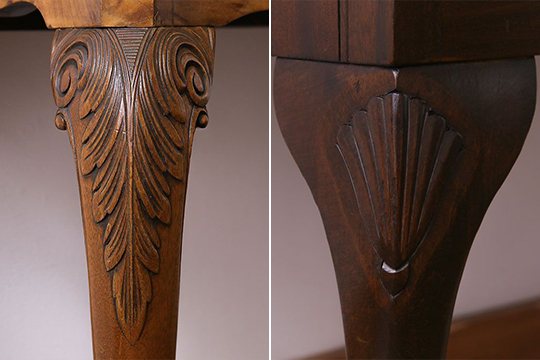
A chair grown stronger and more beautiful. Advances in design and construction improved strength and stability so much that the stretchers between the legs became unnecessary. This type of chair went out of fashion quickly, however, replaced by luxurious chairs with seat and back fully upholstered in fabric.
The wing chair. The large easy chair with side wings to the left and right of the back, the forerunner of today's high-back chair, also appeared at this time. See easy chair.
The reading chair. An unusual chair for library and study, with armrests and a book rest, was also made in this period.
Chests
The tallboy. By the Queen Anne period rooms and interiors had changed: large tall windows, fireplaces and entrance halls began to appear. To suit them, a tall chest on curved legs, the tallboy, became fashionable. Some tallboys have a cornice, and some are luxurious pieces in the Chinese taste, with lacquer and gilt decoration; these are thought to be connected with tea drinking, which was then becoming popular. See chinoiserie.
The lowboy. The lowboy served much as a dressing chest does in Japan. Today, as well as under the name lowboy, such pieces are also classed as console tables or side chests. See dressing chest and console chest.
Tables
Among the tables that appeared in the Queen Anne period is the games table, made, as the name says, for card games; it appeared in France too, in the time of Louis XV. Its top folds, and it has the storage a game needs, such as drawers and candle stands. See Louis XV style.
Ornament from the Rococo
Carved decoration is restrained overall, but much of it derives from the French Rococo or from the Netherlands, with some in the Chinese taste. Because Dutch influence can also be seen, the style is sometimes grouped with the preceding William and Mary style as Anglo-Dutch. Typical motifs are scallop shells and acanthus leaves; scrolls, leaves, flowers, landscapes, animals, trophies and Chinese figures and scenes also occur. Besides carving, decoration includes marquetry, inlay, veneering, lacquer, and gilded decoration in the manner of Japanese maki-e. See Rococo style and parquetry.
Woods
At first walnut predominated; mahogany later became the main timber. Beech, maple, pine, cedar, ash, cherry and poplar were also used. See mahogany.
History
Furniture made for comfort. In 1702, on the death of William III, Anne succeeded to the thrones of England and Scotland. She sent the Duke of Marlborough to the War of the Spanish Succession, which had begun on the Continent the year before; he won victory after victory, and the war in North America also went England's way. In 1707 England and Scotland were united as the Kingdom of Great Britain, the basis of today's United Kingdom. With these events England grew dramatically in Anne's reign. With the stability of the monarchy since the Glorious Revolution of the previous century, classes below the elite also prospered, and demand rose for middle-rank furniture with comfort and grace, which drove the fashion.
A style established in a few years. Anne's reign (1702 to 1714) lasted only twelve years, yet the Queen Anne style itself continued until about the middle of the eighteenth century. Curved legs and feet were also taken into the Chippendale style (about 1740 to 1765).
Influence in America. From the 1720s the style reached the North American colonies, where economic growth and the arrival of immigrant craftsmen made it popular in furniture and interiors alike. The fashion lasted from the 1730s into the 1750s and, evolving in its own ways and taking on regional character, it has been loved ever since.
Into the Georgian period. Anne died in 1714 and the Georgian period began with George I. Queen Anne style lived on in part, in curved legs and feet, but ornament, the weight of line and luxury steadily increased; from the 1720s came the fashion for mahogany and the Early Georgian style, including the style of William Kent.
R
Raden (mother-of-pearl inlay)
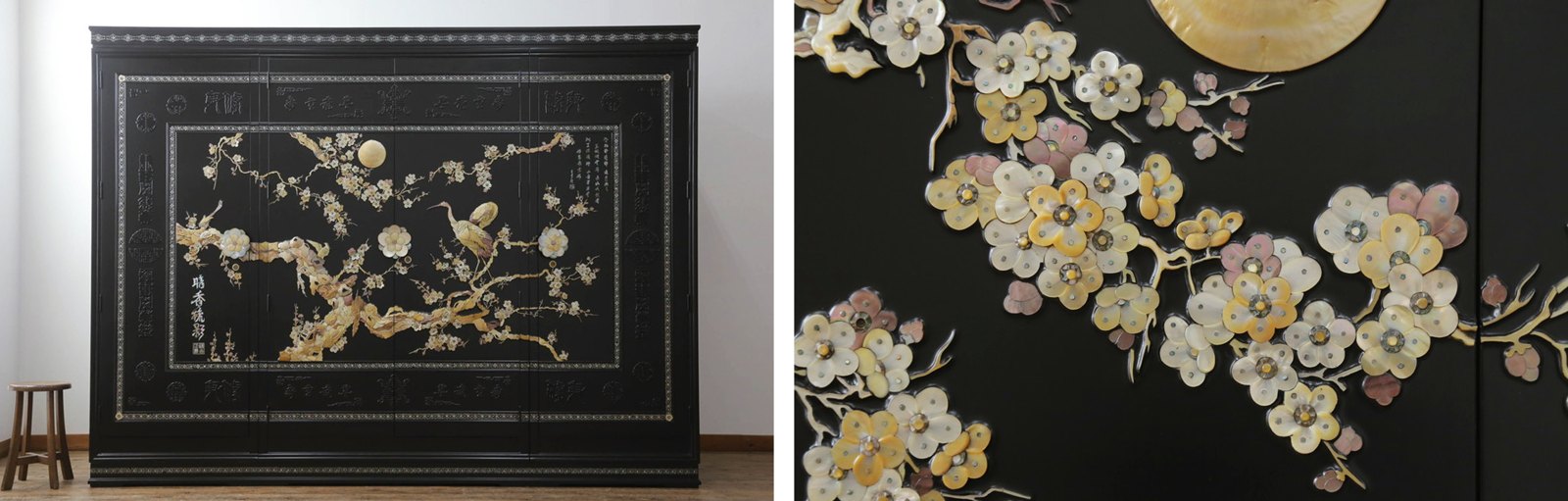
Raden is a decorative technique used chiefly in lacquer. In its name, ra means a spiral shell and den means to decorate with metal or shell; it uses shells such as the great turban shell (yakogai) and the pearl oyster (chogai).
Anyone who has picked up a shell on the shore and seen its rainbow lining knows the material: raden uses that lustrous nacre, the mother-of-pearl, and its luxurious, highly artistic effect is admired around the world.
Originating in the ancient Near East and Persia, it travelled along the Silk Road to China and reached Japan in the Nara period. Meeting with lacquer, it developed greatly and became a Japanese traditional craft.
In neighbouring Korea, too, mother-of-pearl (najeon) is a traditional craft, expressing the nation's own culture in designs drawn from Korean poetry and folk tales and in auspicious motifs, so each country has a charm of its own.
Undimmed in popularity across the ages, raden has always brought splendour and grace to daily life with its breathtaking beauty.
Kinds
Raden uses many shells, great turban shell, pearl oyster, "blue shell", abalone and the akoya pearl oyster among them, and sometimes coral, amber, tortoiseshell, metal or gems as well. The techniques divide into two great families, thick-shell (atsugai) and thin-shell (usugai). There are dozens of others besides, sprinkled shell (makigai), cracked shell (warigai), coloured shell (irogai) and relief, and every one is put to work in fine raden.
Thick-shell raden (atsugai-ho). Shell ground to a thickness of 1 to 2 mm. The curved shell is cut into pieces about 3 cm across to flatten it, filed to about 2 mm, and the design cut out. The pieces are then set into recesses carved in the wooden base or embedded in the ground. Thick shell shows the shell's own colour fully, giving a deep, weighty, soft lustre that seems to glow from within; each piece has real presence, and the effect is striking. Historically thick shell is the older: shell inlay is thought to have been made in ancient Egypt as early as 3500 BC. After reaching Japan in the Nara period, it developed its own path in the Heian period, combined with maki-e.
Thin-shell raden (usugai-ho). Shell ground down to less than 0.1 mm. The nacre is ground by machine and then filed by hand to the very limit, cooled with water so that friction does not scorch it. Before machines, the shell was boiled for days and the nacre peeled away in thin layers, a traditional method still sometimes used. Thin enough to see through, the shell cuts easily with a blade, allowing extremely delicate designs. Its thinness and translucency are often exploited with fuse-saishiki (or irosoko raden), in which gold leaf, metal powder or coloured lacquer is applied to the back of the shell. Having no depth, thin shell strongly reflects surface colour and tends to look blue, so it is also called aogai, "blue shell". Thin-shell work is said to have begun in China under the Yuan dynasty, from the thirteenth century.
Famous raden
Ryukyu lacquer. Lacquer made in Okinawa since the time of the Ryukyu kingdom around the fourteenth century, known for its many decorative techniques, raden among them. Trees grown in Okinawa's warm climate, such as the coral tree (deigo, the prefectural flower), shitamaki and chinaberry, provide the wood, and designs such as hibiscus, yuna, bitter gourd and dragons evoke Okinawa's own nature and culture.
Nagasaki lacquer. Lacquer made in Nagasaki from about 1587. Nagasaki lacquer with shell inlay, called "Nagasaki raden", was exported in great quantities. From the nineteenth century the fuse-saishiki technique developed, and in this busy trading port foreign styles and techniques left their mark, producing many pictorial, painterly works of raden. More affordable than maki-e, and beautiful, raden furniture was hugely popular.
Takaoka lacquer. Lacquer made in Takaoka, Toyama prefecture, from 1609. Its signature techniques are aogai-nuri and Yusuke-nuri. Aogai-nuri is thin-shell work; Yusuke-nuri, devised by Ishii Yusuke, is a composite technique that paints Chinese-style designs in sabi-e (raised lacquer paste) and gold leaf and adds thin shell, leaf and stones. Using thin shell skilfully with sabi-e and coloured lacquer, Takaoka created a delicate, splendid raden of its own.
The appeal of raden
A jewel-like gleam. Above all, raden is loved for the jewel-like brilliance of shell. With the light and the angle of view its face changes continuously, like an aurora. Thick nacre gives deep colour; thin slices reveal different colours layer by layer, for vivid effects. Grinding shell thin is delicate, exacting work, where the slightest difference changes the colour and lustre, and the skill of the raden craftsman draws out the shell's full beauty. Each shell has its own nature and charm, so the choice of material and technique is everything, and every work shows the craftsman's care. And because shell is a natural material, no two pieces are ever the same.
Raden furniture
Antique raden furniture. The treasures of the Shoso-in in Nara include many pieces inlaid with shell, above all the five-stringed lute of red sandalwood with mother-of-pearl, cherished by Emperor Shomu and Empress Komyo in the eighth century. When raden on lacquer became the norm in the Heian period, it was used on the furniture of the nobility and on familiar things such as writing boxes (suzuri-bako) and Chinese-style chests (karabitsu). In the Azuchi-Momoyama period, chests and small pieces with raden were made in great numbers as Namban lacquer and exported to Europe, where they were prized as luxuries; with the closing of the country that followed, raden furniture came to be made for Japanese buyers instead.
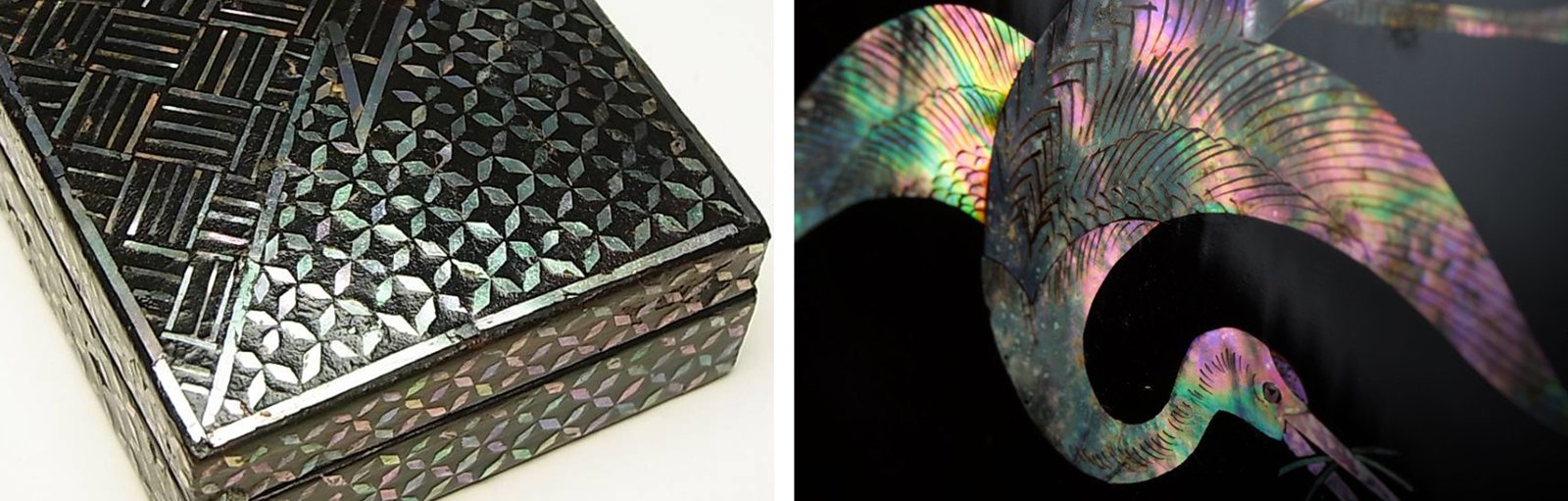
Vintage raden furniture. Tables, chairs, shelves, chests and desks with raden were made in the vintage years too, and many survive. Raden on Western-style furniture in particular has an exotic air that suits an Asian-style room especially well.
Modern raden. Raden furniture, glittering and luxurious, may seem hard to approach, but many pieces and small things are made for daily use. Some are covered in shell, others carry a single gleaming accent, and the range of designs is wide enough to suit any taste or room. Wherever it is placed, the gleam of raden brings elegance and splendour. Beyond furniture it appears on chopsticks, glasses, jewellery and phone cases, and in art far beyond lacquer, a far more familiar pleasure than it once was.
Ranma (transom panel)
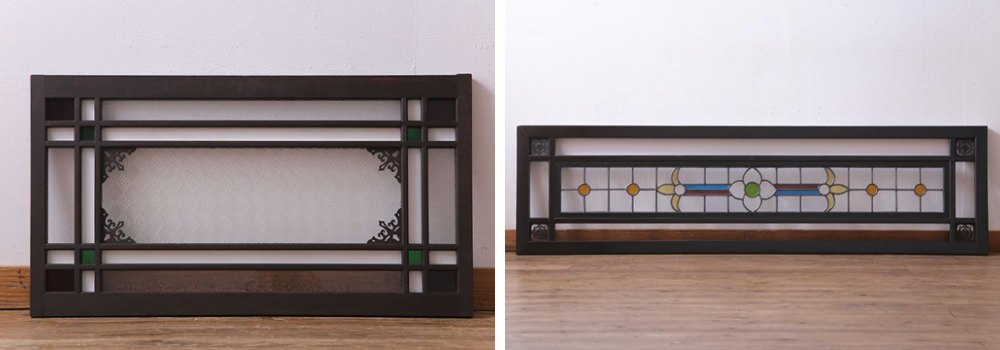
A ranma is an architectural fitting of the Japanese house: the open panel set between the ceiling and the lintel (kamoi) or the tie beam (nageshi) of a Japanese room, to let air and light pass. Over time it came to carry advanced carving and openwork, and grew more and more decorative.
Features
The ranma is the opening above the lintel of a Japanese room, below the ceiling. Its main features are these.
Practical and decorative. In the traditional Japanese room the ranma helped bring in light and air and made the room more comfortable. It was also prized as something that raised the standing of a room, and so was lavishly decorated.
Openwork and lattice. Ranma are known for beautiful pierced carving (sukashibori) and lattice work (kumiko). Auspicious motifs dominate: dragons and phoenixes, pine, bamboo and plum, waves. In the Edo period, when ranma decoration flourished, delicate, intricate patterns were the craftsman's chance to show his skill.
Fine timber. Ranma were made of fine, high-quality woods such as hinoki, keyaki and sugi. Some modern designs incorporate metal or glass. The timber was chosen for the beauty of its grain and with an eye to how it would age.
History
The ranma goes back to the Nara period, around the eighth century, when it was introduced in temple buildings for light and ventilation. From the Heian period it spread to the houses of the nobility, and its role as decoration grew.
In the Muromachi period (fourteenth to sixteenth centuries), ranma decoration developed further in warrior residences and temples and shrines, and in the Edo period it spread to town houses and merchant houses. In the late Edo period especially, craftsmanship advanced and openwork carving and fine lattice developed dramatically. Gifted ranma makers worked in Kyoto and Edo, and the great buildings that survive from that time show ranma of high artistry. Inami in Toyama, still Japan's best-known centre of ranma carving, rose to fame in this period.
In the Meiji and Taisho eras, under the influence of Western architecture, refined new designs merged with the traditional Japanese room and the ranma developed further. From the later Showa era, though, as houses grew more Western, ranma were used less and less.
At the same time their value as antiques has been rediscovered, and they are prized again in old-house renovations and as interior decoration. The ranma also matters for the survival of craft skill: there are efforts to hand on ranma techniques as a traditional craft, and to find new designs and uses for them.
Using antique ranma in the interior
Ranma are being rediscovered as antique fittings and brought into modern interiors.
As wall decoration or an art panel. Hang a finely carved ranma on the wall as an art panel. It suits Japanese-modern interiors and mixes well with Scandinavian vintage.
As lighting. The openwork of a ranma can make a light; as a wall light it casts shadows through the room and creates a magical Japanese atmosphere.
As decoration on furniture. Remaking an antique ranma into furniture is popular, as a cabinet door or a table top for example, keeping its distinctive character while bringing it easily into modern life. Such work, sizing, repair and finishing, is best entrusted to an experienced restorer.
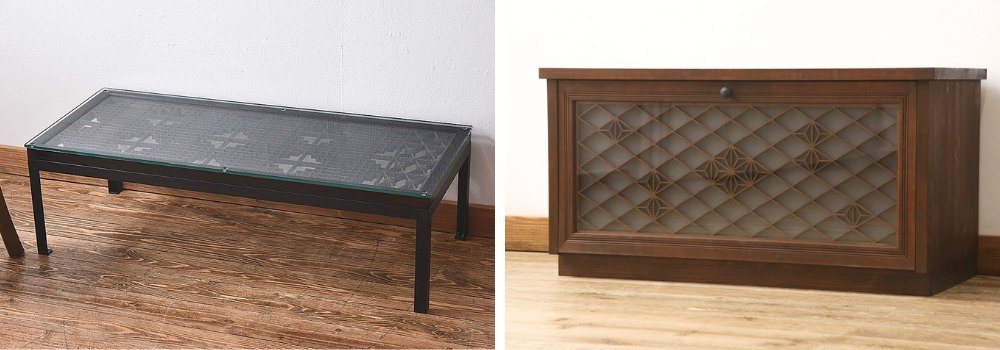
Rattan (to)
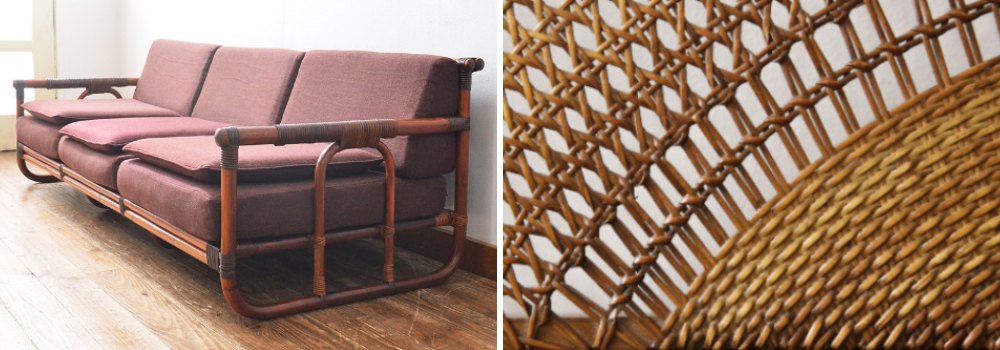
Rattan (in Japanese to) is the general name for a group of climbing palms, and also for the natural material made from their stems. It grows in the tropical and subtropical regions of South East Asia, Indonesia above all, and does not grow wild in Japan. Yet as to it has been part of Japanese life since early times, and its natural texture brings many people a nostalgic calm.
Features
Material and making. More than two hundred plants count as rattan, of which about thirty are used as material. They vary in colour, shape, thickness and hardness, but broadly divide in two: thick canes for furniture frames, and thin ones for wrapping and weaving. Rattan furniture is known for flowing curves: the structural canes are softened with steam or heat for bending and shaped to moulds, assembled into a frame, and then wrapped and woven with thin split rattan (wari-to) to finish. Even in an age of machines, this work is still done piece by piece by hand.
Individual beauty. As a natural material, no two pieces of rattan are alike. The skin is usually stripped for an even look, but it may be left on for an antique feel, or the cane dyed for design. Weaves are many, and each changes the look. With material, process and expression, rattan furniture can turn Asian, European or Japanese at will, full of personality; and with use it deepens in colour and texture, the great charm of a natural material.
Strong, supple and light. Rattan grows long, like a vine, quickly and vigorously, and is known as a plant with very long, very strong fibres, so it is extremely strong. Strong yet supple, it is ideal for bending, allowing curves hard to achieve in wood, and complex, delicate weaving: a material of great expressive range. Fibrous, it is also much lighter than other furniture materials, so even large pieces are easy to handle.
Humidity and air. Countless vessels within the cane absorb moisture when it is humid and release it when it is dry. Woven rattan furniture is also very airy: dry and never clammy in summer, letting warm air through in winter. That is why rattan baskets and furniture are often seen in bathrooms and washrooms; but in damp places it must be wiped dry, ventilated and dried thoroughly to prevent mould. In the right conditions it makes a comfortable room in every season.
Materials
Of the many kinds of rattan, the finest is said to be sega (Calamus caesius), so common that in Japan "rattan" almost means sega. Hard and strong, its glassy, enamel-like skin gives a beautiful lustre like ivory; it is airy, regulates humidity and is pleasantly smooth to the touch. Others include tohiti, heavy, hard and supple, often used for frames, and manau (Calamus manan), thick, tough and handsome with its glassy skin. Craftsmen judge which suits each use.
To become furniture, rattan is processed. Structural canes for frames are maru-to, "round rattan", with the skin on, hard and strong. Split rattan, wari-to, is made by separating the core and the skin of the round cane, and is flexible and easy to bend; split rattan is further named by part, shin-to (core) and kawa-to (peel).
Weaves
The variety of weaves shows how flexible rattan is, in nature and in design. A chair has weaves suited to seat, back and arms, chosen for strength and beauty. Examples include kagome-ami (hexagonal basket weave), yotsume-ami (square open weave) and mezumi-ami (close weave). The open hexagonal cane webbing on many European chairs is the kagome pattern.
History
Rattan has a very long history: rattan and similar woven seats are said to have been used in ancient Egypt. In Europe, rattan furniture is said to have grown popular among the aristocracy from around the fourteenth century, with finely woven, sumptuous chairs. In Japan it has been used for more than a thousand years, at first for baskets, bows and the grip-binding of weapons and in building; by the Edo period it was made into mats, pillows, tobacco pouches and other daily things. In the Meiji era rattan furniture-making techniques came from China, and amid "civilisation and enlightenment" rattan furniture became part of the new way of life. Today a shortage of successors is a concern, but demand for rattan has not faded and it remains important in many fields. See bentwood chair.
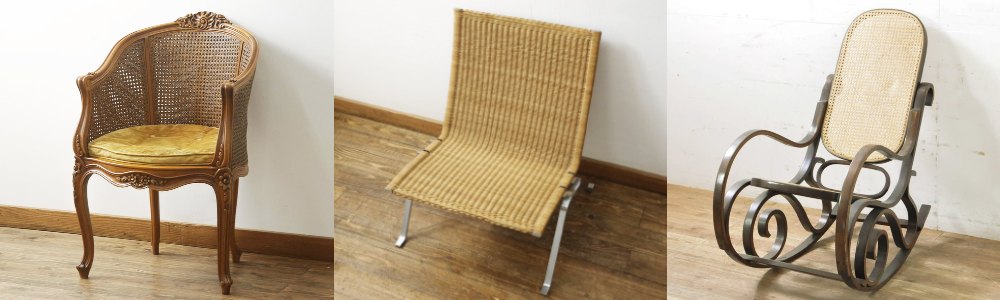
Care
Rattan dislikes direct sun; keep it out of constant sunlight or hot air. It also dislikes extreme damp and dryness: dry it properly if wet, and in dry seasons wipe it with a well-wrung cloth. Remove dirt or stains by wiping gently with a well-wrung damp cloth, and always dry it afterwards. If splinters appear, trim them with scissors or nail clippers to prevent injury. Everyday care needs only a dry cloth, a vacuum cleaner or a brush. A seat too broken to use can be rewoven, like paper cord. With a little care at key moments, rattan ages not into decline but into deeper character. See paper cord.
Natural and synthetic rattan
Synthetic rattan is an imitation made from PVC, polyethylene, polypropylene and the like. Both share the delicate beauty and expressive range of woven designs. The difference: natural rattan has the varied character of a natural material, while synthetic is uniform in quality and look, though some deliberately imitate uneven colour. Both are light, but synthetic, often plastic, is lighter still. Natural rattan needs care and maintenance; synthetic, waterproof and UV-resistant, is relatively easy to keep, and weather-resistant types can be used outdoors. Both last long in suitable conditions, but only natural rattan ages beautifully. Weigh both before choosing.
Refectory table
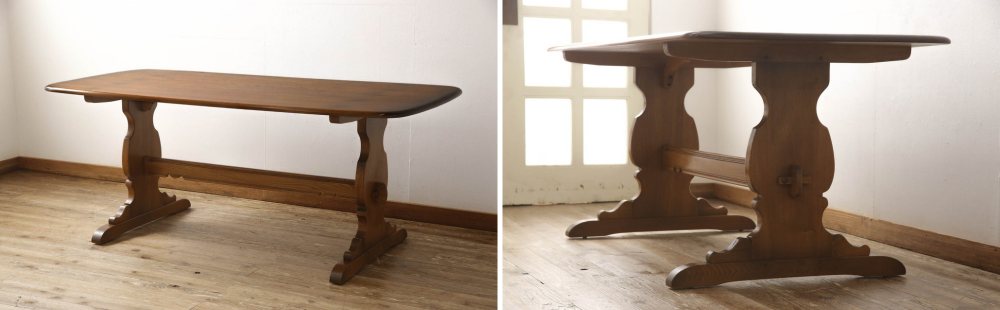
The refectory table is a large table with a long top, made to seat many people. Its construction is simple, a rail joining the two end supports and rails beneath the top, and in Europe it is one of the standard kinds of dining table.
Features
A refectory is the dining hall of an institution such as a monastery or a school, and the table takes its name from the large tables for many diners that stood there. The basic construction is a rectangular top, two thick end supports, and a stretcher joining them for strength. Plainly made, it is sturdy and has real weight.
Because it was used in dining halls, the table was originally large, but from the modern period household sizes for four to six people have also been made.
There is also a type with four legs braced to one another by stretchers on all sides, the four-stretcher type. Chairs cannot be pushed beneath it so readily, but it is all the more strongly built.
Ornament
Many refectory tables are striking for the carving on the edge of the top and on the legs. The ornament shows strong influence from the Renaissance and Baroque styles and gives a sense of weight and history. The supports take many forms: solid end panels pierced by a through-tenoned stretcher, traditional lathe-turned bulbous legs, twist legs and bobbin legs. See Renaissance style, Baroque style, bulbous leg, twist leg and bobbin turning.
History
A long table for feasting. Earlier tables were made to be taken apart and cleared away after a meal in the great hall, so that there was room for dancing and games. Gradually they came to stand permanently in a dining room separate from the hall, and changed into tables with a fixed, stable top. Until about the thirteenth century they were simple, plain tables of legs and top; in the late sixteenth century the form spread across the countries of Europe and came to carry a wide range of ornament.
A nineteenth-century revival. The refectory table fell out of use in the eighteenth century, but in the nineteenth it drew attention again under the influence of revivalism, the longing for the older culture of the Middle Ages. As it was made in many places, smaller tables and tables that could be dismantled, suited to town houses, began to be made alongside the original large ones. With so many sizes and designs to choose from, it has settled today as one of the ordinary forms of dining table.
A favourite among antiques today
Plainly built yet handsome in its carved ornament, the refectory table gives an impression of real craftsmanship, and it is popular as an antique. Many later examples are relatively small or can be taken apart, so they suit Japanese homes and are used in Japan too. See draw-leaf table.
Renaissance style
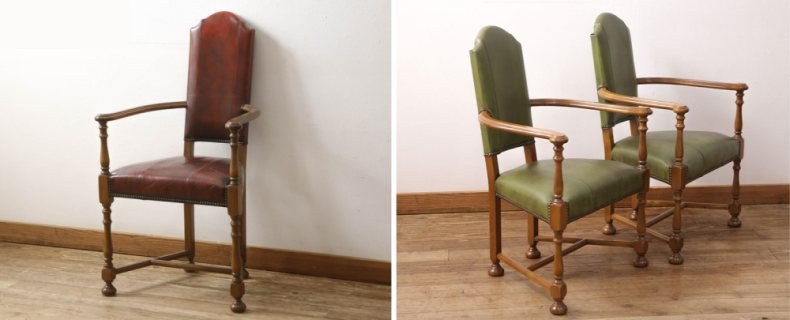
Renaissance style is the style of cultural and artistic expression of the Renaissance, the classical revival that began in Italy. It has a grace and harmony unlike the Gothic style before it, and, following the classical art of Greece and Rome, it produced architecture, sculpture and painting that were refined and splendid, of high artistry and functional too. It spread not only through Italy but across Europe, influencing architecture and the arts of many kinds.
The furniture
Renaissance furniture, influenced by ancient Rome, carries brilliant, finely worked carving. Its character is luxurious and weighty: marriage chests on feet carved in relief (the cassone), placed in palaces and great houses; splendid chests with ingeniously made metal fittings; beds with ornamented canopies. Chairs and tables were made gracefully too, making the fullest use of pierced patterns and curves. The cassone above all was valued as a sign of authority.
Another feature is the many motifs of high artistry in the ancient Roman manner. Among plants, acanthus, the vine, the rose and laurel; among creatures, lions, horses, sheep, birds and dolphins, all richly rendered. See acanthus and relief.
History
The early period. In the fourteenth century, exiles bringing classical learning from the Eastern Roman Empire came into Italy, a land already rich in the remains of ancient Rome, and the Renaissance movement arose. In the fifteenth century the architect Filippo Brunelleschi, who studied ancient buildings and devised linear perspective, built the cathedral dome and chapels of Florence by revolutionary methods, and the Renaissance style opened out.
The high period. Begun in Florence, the style developed further from the mid-fifteenth century with the patronage of the Medici, the family that in effect ruled the city. Supported masters, Leonardo da Vinci and Michelangelo among many others, worked abundantly and made the Renaissance secure.
The end. The Renaissance, in which natural science developed alongside the arts, and which was bound up with the Reformation and the formation of sovereign states, laid foundations for the modernisation of the West. From the sixteenth century it began to decline, with rising military costs from wars between cities, the Reformation and the rise of absolute monarchies, and the art that had grown in Italy and Florence gradually moved to France.
Where the record differs. The arrival of Byzantine scholars is usually dated to the decades around the fall of Constantinople in 1453, later than the first stirrings of the Renaissance in fourteenth-century Florence; most historians treat it as one strand among several rather than the cause.
By country
Italy. Florence became the centre of furniture-making and produced richly ornamented furniture strongly influenced by ancient Rome. Best known are the chest, the box settle (cassapanca), the octagonal table and the dantesca, an X-framed armchair. Ivory, precious stones, gold leaf and inlay were among the decorative materials.
France. French pieces resemble Italian designs but are often lighter and more domestic, with influences from before the Gothic mixed in. The caquetoire, a chair made for ladies to sit and talk, was hugely fashionable, and designs drew on many styles.
England. In England the Renaissance blended with the Gothic to give the Tudor and Elizabethan styles. Tudor furniture carries finely carved linenfold, like linen folded in layers, and the Tudor rose, the traditional English floral emblem. The Elizabethan style brought heavy construction and lavish, showy ornament such as the bulbous leg. See linenfold and bulbous leg.
Retro kanban (signboards)
A retro kanban is a kind of signboard, mostly for outdoor use, used to advertise products from the Meiji and Taisho eras to the middle of the Showa era. Once seen everywhere, on streets and shopfronts, they declined as newspapers and television grew. Today they draw attention in the vintage and antique world as retro pieces that sum up the townscape of Showa. See Showa retro.
Features
Retro signboards have three broad features: industrial materials such as tinplate, corrugated iron and enamel; varied shapes, square, oval and rectangular; and bright, eye-catching design.
Japanese signboards were originally of wood or cloth. From the Meiji era, with Western culture arriving under "civilisation and enlightenment", glass and metal were used more and more, and above all enamel. The enamel signboard (horo kanban), the very byword for the retro sign, could stand up outdoors and was invaluable for advertising. Introduced in Meiji and at its height in the mid-Showa era, it was the star of advertising until mass media took over.
Retro signboards were put up everywhere in town, on telegraph poles and the walls of houses, and all sorts of designs were devised to catch the eye: elaborate lettering, unusual shapes, company logos, pictures of popular performers of the day. Colourful and fashionably modern, they did more than advertise; they brightened the streets.
History
Roots in the Nara period. The roots of the signboard reach back to the Nara period. The Taiho Code of 701 required that goods at the monthly markets of the capital be marked with signs. There was not yet a word for signboard; shops hung thin wooden tablets bearing their mark, called hyocho, which did the work of a sign. Few people could read, so many showed pictures of the goods, or simply set them out in front.
In the Heian period the shop curtain (noren) appeared, and in the late Kamakura period lettered tablets of bamboo or wood, called kanban, began to be used. As time went on, shop names and product names were added to signboards and noren, and by the end of the Azuchi-Momoyama period and into the Edo period this style was established.
The Edo period. With the country closed and the shogunate's policies, domestic consumption flourished, private commerce grew ever busier, and signboards developed with it. In the commercial centres of Kyoto, Osaka and Edo, styles became standardised by trade. Besides lettered and pictorial signs, shapes multiplied, including lantern forms usable outdoors at night. Merchants came to spend large sums on advertising, and lavish signs appeared, with gold and silver leaf, maki-e and gilding.
From Meiji. From 1868 trading areas widened, and company signboards aimed at passers-by rather than only at the shopfront spread. Alongside paper and wood came modern signs of imported tinplate and corrugated iron, painted. By the late Meiji era they developed rapidly and sign-makers flourished. Then the enamel sign appeared: emblem of the modern Japanese signboard, it could be painted or printed, was glossy, and stood up to water and fire. Usable outdoors without worry, it soon became the main kind of sign, made in great numbers for all kinds of goods and services, in all shapes and designs, and put up all over town.
Enamel signs flourished from Meiji through Showa, peaking in the mid-Showa era. From about 1975 they gradually declined, as new products came and went faster, changes in housing left fewer places to put them, and advertising moved to newspapers and television.
Collecting retro signboards
Enamel signs faded away with economic growth and the changing times. In recent years, though, their retro look, so evocative of an era, has won fans of every generation.
They come in many kinds, shapes, sizes and messages: medicines, foods, clothing, household goods, cosmetics, electrical goods, vehicles. Almost every company once made them. Company representatives sometimes delivered signs by hand to customers and shops; hard to imagine in today's world of advertising agencies, but retro signs tell us how hands-on that age was. Well-known examples advertised breath fresheners and patent medicines, curries, tonic drinks, socks, insecticides and ointments, many of them products still sold today; all have a retro atmosphere no modern sign can match.
Their work as advertising is done, but as retro signboards they continue to charm collectors as interior pieces. When buying, look for original enamel with its gloss intact and chips that reveal the iron beneath rather than fresh paint, and beware of modern reproductions, which are lighter and sharper in their printing.
Rocking chair
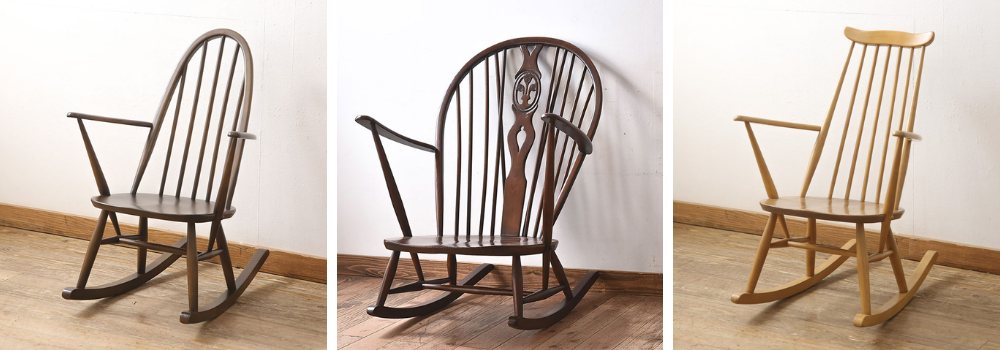
A rocking chair is a chair with curved, bow-shaped members fixed beneath its legs. Built to rock back and forth, it is also called a "swing chair" in Japanese, and it is designed above all for relaxation.
Features
Unlike an ordinary chair, the rocking chair has curved runners fitted to its legs. The weight of the sitter sets the whole chair rocking back and forth, and the gentle motion, like a cradle's, lets one relax and unwind.
Look at the seat and back too. The back of a rocking chair is high and the seat wide, and many are shaped so one can give the whole body to the chair. That it stays comfortable for long use is another point of difference from an ordinary chair.
History
Origins. The exact origin of the rocking chair is uncertain, but it is said to have appeared in North America at the beginning of the eighteenth century. It is thought to have begun with curved boards fitted to the Windsor chair used in England, and at first it was an outdoor chair for resting in the garden or on the porch. See Windsor chair.
When it first appeared, the rocking chair won popularity in America, but in Europe, where etiquette counted for much, it was poorly received: it was bad for posture, people said, and leaning back was unbecoming.
The turning point. In the mid-nineteenth century, however, the rocking chair introduced by the German furniture maker Michael Thonet (1796 to 1871) became popular. Thonet developed the technique of bending wood by steaming it, and from it came the graceful rocking chair we know today. It transformed the image of the rocker, and it quickly won great popularity in England and France as well. In Victorian England it found favour in the upper classes, and it was improved again and again as an indoor chair. See bentwood chair.
In the twentieth century the rocking chair spread widely, practical and also a symbol of ease at home. Folding designs and designs in metal and plastic were made in great variety, and it became furniture loved around the world.
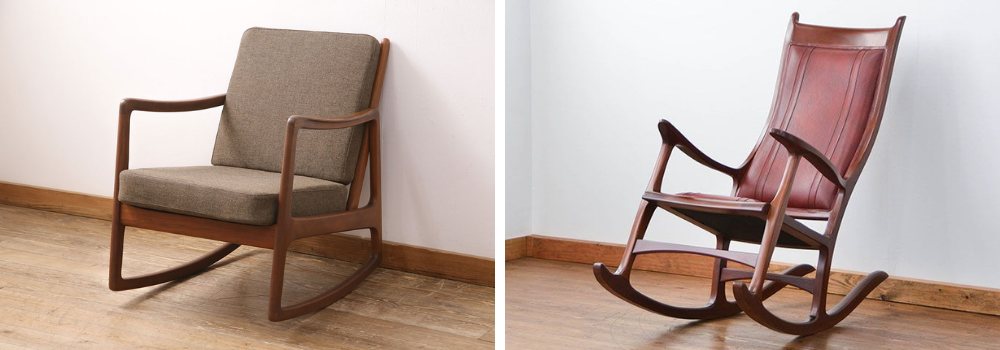
Kinds
Different countries and periods produced many designs: the standard wooden rocking chair, designs in luxurious fabric and designs devoted to ornament.
English antique rocking chairs. Among English antique rockers, the work of Ercol is popular around the world. Its hallmarks are warm timber and dynamic curves. It has a solid presence, yet its simple design suits any room. Restful and easy to place in any interior: this is surely why it has been loved for more than a century. See Quaker chair.
Scandinavian vintage rocking chairs. These are simple, functional and warm in design, natural materials in harmony with clean lines, with the soft feeling typical of the North. See Scandinavian furniture.
Mid-century rocking chairs. Simple yet distinctive, they are characterised by contemporary touches: the innovative combination of plastic and wood, bright colours and smooth lines. See shell chair.
Japanese antique rocking chairs. These fuse Japanese tradition with Western culture in a blended Japanese-Western design, keeping a calm Japanese feeling while giving a pleasant rocking motion. A well-known Japanese example is the work of Matsumoto Mingei Furniture: a dark brown colour, a lustrous surface and curved ornament on the arms and spokes, a design at home in both Japanese and Western rooms. See mingei furniture.
Contemporary rocking chairs. Rocking chairs are still made around the world. Their designs are refined for modern life, but the emphasis on relaxation is unchanged. Today they are used not only in living rooms and bedrooms but on hotel terraces and in lobbies, and new materials, combinations of different materials and sofa-like cushioning all aim at still greater ease.
Rococo style
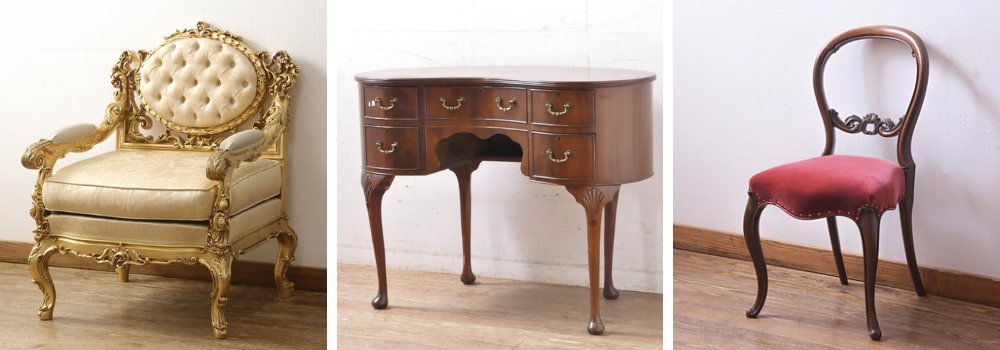
Rococo is the style of art and architecture that began in France in the early to mid-eighteenth century, used above all in painting and interior decoration. Its hallmarks are pale colour, curves, and a light, elegant manner. It began at the French court and spread to the nobility and townspeople across Europe. The name is said to derive from the French rocaille, the ornament of rockwork and shells.
Features
The features of the Rococo fall broadly into three.
Lavish ornament. The Rococo is characterised by ornament rich almost to excess. Behind it lay the salon culture of the nobility. To receive the celebrated figures of every field, nobles vied to perfect their interiors, from ceilings and walls to furniture and even tableware. Its rooms are dazzling and splendid, combining gilt ornament, carving and painting.
Soft, intermediate colours. The Rococo favours pale, pastel-like tones: white, gold, pink, pale blue and green. A soft, bright atmosphere without strong contrast is peculiar to it.
Elegant, feminine design. Asymmetry and curves give the Rococo an elegant, feminine air. Interiors and furniture make great use of carved shells, acanthus leaves and scrolls, giving a light and graceful impression overall. Besides carving, inlay, marquetry depicting plants and animals in pieced woods, and parquetry in geometric patterns flourished. See acanthus and parquetry.
The cabriole leg. Among the designs established in the Rococo is the cabriole leg, used for furniture legs and distinguished by its S-curve; in Japan it is known affectionately as the "cat's leg". See cabriole leg.
History
The Rococo developed in France from the early to the mid-eighteenth century. It follows on from the Baroque style that prevailed until the end of the seventeenth century, and is sometimes treated as a style derived from it.
A reaction to the Baroque. The Baroque is indispensable to the story of the Rococo. Until the Rococo appeared in France in the early eighteenth century, the Baroque was the main style across Europe. It was the style Louis XIV favoured, its designs severe and grand; the Palace of Versailles itself was built in the Baroque style. In 1715 Louis XIV died and his great-grandson Louis XV succeeded, and at court the mood turned away from Baroque grandeur. People sought a style that was freer and more open, more intimate and more brilliant, and the result was the Rococo. It began by changing furniture, painting and interior decoration: buildings of the Baroque age were left as they were, and the style developed chiefly in the decoration of rooms. See Baroque style.
The height. When Louis XV came of age in 1723 the Rococo reached its height. Salon culture lay behind its rapid growth: nobles delighting in freedom held salons, gatherings for meeting celebrated people of every field. The room in which a salon was held displayed the power of its host, so interiors of competing luxury and brilliance were made. Louis XV and his official mistress, Madame de Pompadour, are famous as leading figures in the flowering of salon culture. The Rococo spread from interiors to every kind of furnishing: furniture, paintings, tableware and ornaments. With the support of salon hosts, highly skilled cabinetmakers appeared one after another, and the advanced techniques still seen at Versailles and elsewhere were established then. Marie Antoinette's beloved Petit Trianon belongs to this world.
The end. In the later eighteenth century the Rococo gradually declined. Behind this lay the French Revolution of 1789 and the Industrial Revolution under way in Britain; powerful figures emerged among the townspeople, and the mood of rejecting aristocratic culture grew. In place of the Rococo rose Neoclassicism, which sought simple, classical design; as townspeople gained power, the luxurious Rococo drew ever stronger hostility and declined. See Neoclassicism.
Even so, the Rococo was technically superb and has deeply influenced later ages. At the end of the nineteenth century Art Nouveau became fashionable, in some accounts a revival of the Rococo. Its importance holds today: the furniture-making and painting techniques established in the Rococo became foundations of architecture and the arts and are admired worldwide.
Where the record differs. The Industrial Revolution is usually dated from about the 1760s rather than the 1730s, and Art Nouveau is more often described as drawing on nature and on Japanese art than as a Rococo revival, although its whiplash curves owe something to rocaille. Queen Anne furniture (1702 to 1714) predates the French Rococo, and English furniture in the Rococo taste is more usually associated with Chippendale.
The Rococo across Europe
The French-born Rococo had great influence on the other countries of Europe, each taking up its designs in its own way.
Italy. Showy ornament of curves and flowers; light-toned timbers with marquetry and carving; furniture and picture frames coated with gold paint, of great splendour.
England. England has the Queen Anne style (1702 to 1714), which took the new manner in its own way, with a very simple design that puts function first. The cabriole leg is much used, but fine carving and gilding are rare. Queen Anne style has enduring popularity and has been revived again and again since the queen's death; widely admired, it was even adopted in Japan after the Meiji Restoration, and the Marunouchi building of Tokyo Station is a celebrated example of the revived Queen Anne manner. See Queen Anne style.
Furniture born of salon culture
Salons held in great houses were furnished with chairs for talking at ease and with storage furniture strong in decorative character. Among the furniture that appeared with the salon:
The settee. A long seat with back and arms, usually for about two people, said to be the forerunner of the sofa. See settee.
The chaise longue. A chair on which one can sit with the legs stretched out or lie down, also called a day bed. Its design pursues a brilliant appearance and ease, and backs may be square, gondola-shaped or curved. See chaise longue.
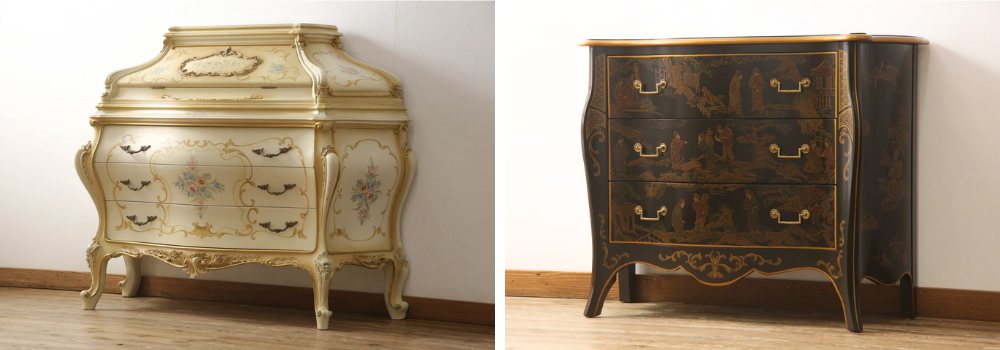
The commode. A small chest of drawers, often placed in the room of the salon host and much in demand as decoration. Though storage furniture, it values appearance over capacity, and it carries lavish ornament: fine carving, inlay and gilding. See commode.
Roll-top desk
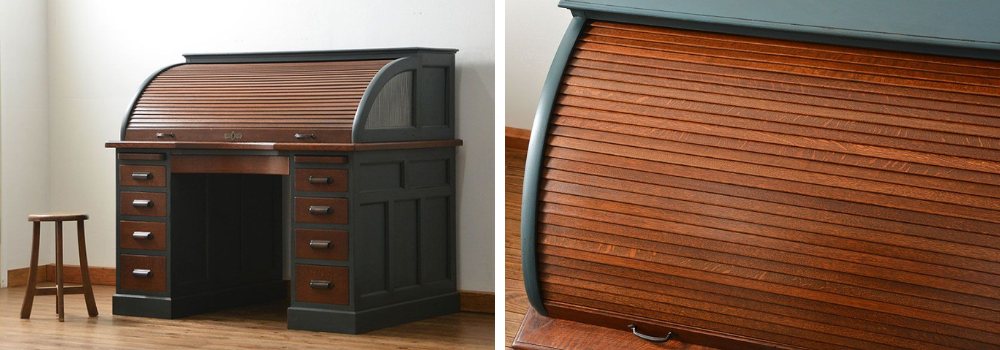
A roll-top desk is a desk fitted with a flexible sliding shutter, the "roll" or tambour. In nineteenth-century England it was used chiefly as a desk for banks and businesses. Its attention to security is another feature: many were made with a lock on the roll.
Features
The greatest feature of the roll-top desk is the tambour shutter that covers the desk surface. The roll-top is built of thin wooden slats and slides to cover the whole desk. Many have a lock on the roll, which served for security and the protection of important papers. Open the roll and one finds many drawers and pigeonholes, which are practical for sorting stationery and documents into their places.
A weighty, dignified appearance is another characteristic. Fine timbers such as oak, mahogany and walnut were used, and the desk was designed so that handsome grain shows when the roll is closed. In offices, banks and other public places, the roll-top desk was furniture that shaped first impressions, and it was treated with care. See oak, mahogany and walnut.
History
The roll-top desk is thought to have developed from the cylinder-top desk, distinguished by its curved, quarter-cylinder lid. Cylinder-top desks were made in eighteenth-century France and placed mainly in the studies of royalty, the nobility and the upper classes. Lockable shutters were highly convenient, valued for keeping confidential papers and securing a private space.
The best-known surviving desk of this kind is the one said to have been used by Louis XV, now at the Palace of Versailles. Its makers are given as the cabinetmakers Jean-François Oeben and Jean-Henri Riesener, and it took nine years to make. Its features are the sophisticated mechanism of the lid and sumptuous ornament of marquetry and gilt bronze. See Louis XV style and parquetry.
Soon after the cylinder-top desk came the tambour roll-top desk. In the nineteenth century, carried by the Industrial Revolution, mass production of roll-top desks began in America. In Victorian England they grew popular as desks for home and office, and many designs were produced. In the early twentieth century new office equipment such as the telephone and typewriter changed what was needed of a desk, and as the required shape changed the roll-top desk gradually disappeared.
Today it is enduringly popular among antiques. The precise mechanism of the roll and its delicate construction, craftsmanship hard to reproduce today, are surely why it is so admired, and the classic, luxurious design peculiar to antique furniture adds to its appeal.
Kinds
Wide designs are the norm, but rare tall, upright types also exist. Their appearance owes much to the roll-top's function and look: the shutter was very convenient for hiding and protecting what lay on the desk, and the weighty design is handsome and lends a room a sense of quality. These qualities particular to the roll-top desk gave rise to roll-tops of many shapes. See writing bureau.
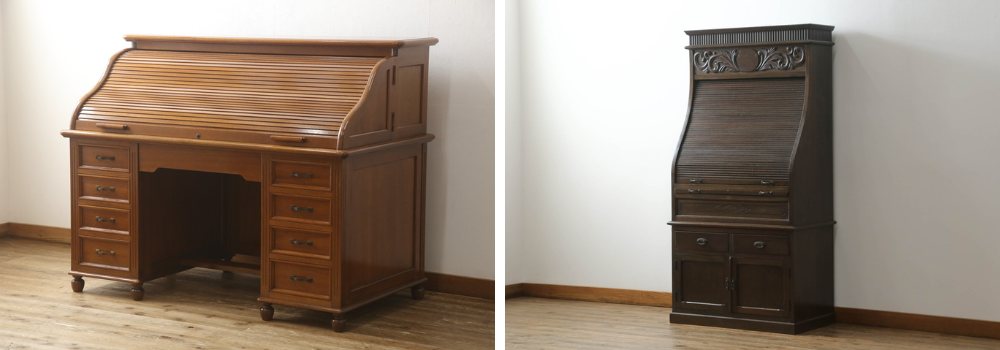
Differences by country and period
Roll-top desks differ in design with where and when they were made, and antique ones in particular give glimpses of the life and fashions of their day.
English antique roll-top desks. Since the roll-top desk developed in England, antique furniture offers English roll-tops in many styles: the double-pedestal type with ample storage, for example, and the single-pedestal type suited to small spaces. Considering that these desks were used in workplaces such as offices and banks, one can imagine the storage they needed to keep many important papers. Oak is often the timber, and its durability is a hallmark; that so many survive as antiques after more than a century proves their strength. See kneehole desk.
Japanese antique roll-top desks. Compared with English ones, Japanese roll-top desks are generally smaller. Japanese homes and offices are often more cramped than those abroad, with limited space per person, and Japanese people were also smaller in build than people in Western countries. Note the height too: since sitting on the floor was the norm in Japan, many were designed low, to be used while seated on tatami. Picture the Western roll-top desk joined to the low writing desk long used in Japan. Japanese roll-tops are often of nara, oak that grows widely in Japan; handsome in grain and suited to furniture, it is also very durable. See nara and fuzukue.
Contemporary roll-top desks. These are refined to suit modern life. Some, for example, deliberately omit the drawers and storage on either side and keep only the roll-top, in a simple, stylish design. Even as it is rearranged for today, the classic appeal is carried on: the tambour shape that is the emblem of the roll-top desk has not changed across time. The roll-top desk is furniture that keeps long-established, precise techniques alive and passes on a traditional beauty.
Rosenthal
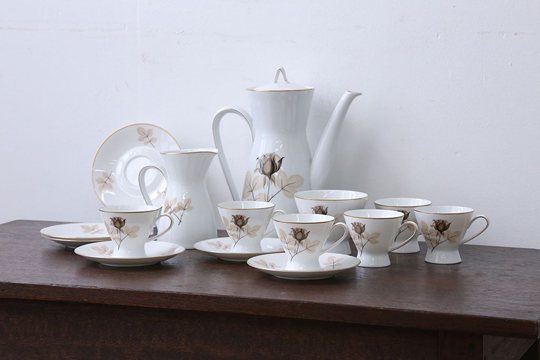
Rosenthal is a porcelain, and its maker, from Selb, a town in east-central Germany. Here we set out the character of Rosenthal ware and the history of how its founder, Philipp Rosenthal, built the style the company has today.
The brand strategy behind the Studio Line
After porcelain manufacture began at Meissen, in present-day Germany, at the beginning of the eighteenth century, porcelain works imitating Chinese and Japanese porcelain sprang up across Europe, most of them producing luxury tableware for royalty and the aristocracy. Rosenthal was born of that tradition, but it avoided the excessive ornament of the past and pursued the functional beauty of its time, and that brought success. It went on developing, taking in the fashions of each period; after the war it adopted the Rosenthal Studio Line, a way of making that united artistry, function and the spirit of the age, and its distinctiveness grew.
Celebrated artists. The designers who took part include artists of world renown such as Salvador Dalí, Tapio Wirkkala, Bjørn Wiinblad and Versace, and they established Rosenthal's line of designs ahead of their time.
Tradition behind the beauty. Even so, Rosenthal put value on pursuing the new while respecting classical beauty. At times it produced avant-garde work, but the assurance of products backed by traditional methods is surely one reason the ware is loved around the world.
The founder, Philipp Rosenthal
Philipp Rosenthal went to America at seventeen and rose from washing dishes to buying ceramics; after seven years of training he returned home to Germany. In 1879 he set up a porcelain-decorating workshop at Erkersreuth Castle near Selb and founded the Rosenthal works. At first it was a family-scale business, but it prospered with finely made, original ashtrays and grew rapidly.
From decorating to making porcelain. In 1891 Philipp built a factory to begin making porcelain itself, and in 1897 added production facilities at Kronach, west of Selb. By 1904, its twenty-fifth year, the company employed more than 1,200 people. In 1910 it founded an art department for porcelain figures, until then the privilege of royal manufactories, and raised the name of the brand. In 1916 Philipp married his second wife and launched a dinner service named after her, "Maria White"; simple white porcelain with relief alone on a classical form, it was much admired and became a lasting success. In the same year his son and successor, Philip Rosenthal II, was born.
Through hard times. In 1929, the fiftieth year, 7,000 employees were at work making fine porcelain, and Rosenthal products, admired worldwide, were highly popular exports. Under the Nazi regime, however, Philipp, of Jewish descent, was forced out of the company in 1934, and he died in 1937 at the age of eighty-two. Deprived of its founder, the thriving company was made to continue operating with the swastika added to its factory mark.
Philip Rosenthal II and the Studio Line
In 1950, after the Second World War, Philip Rosenthal II, who had been in exile, joined the company. He was at first in charge of advertising, later of design, and as head of sales he came to have a decisive influence on product development. Proclaiming the union of art and use, he brought in designs by outstanding artists to improve the products. His design-led thinking bore fruit in the opening of the Studio House in 1960, a fitting place to present and sell new products, and in the launch of the Studio Line in 1961. In 1967 a new factory was built with automated production and an exterior of beauty fit for its artistic aims.
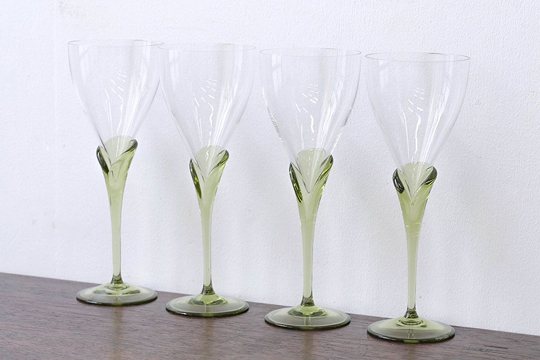
Made with artists
Rosenthal kept to its design-led course and secured its name as an original maker of luxury porcelain. By 2016 more than 150 celebrated artists had taken part in the Studio Line, and it had received more than 500 awards. From the late 1980s it faced structural recession and falling consumption, but overcame them by consolidating plant and improving production, and from 2009 it became part of the Arcturus Group. Philip Rosenthal II died in 2001, but the creative making he pursued goes on unchanged.
Techniques and methods
Rosenthal porcelain was at first made by hand, later with increasing mechanisation and automation. For forming, a craftsman makes the original model by hand; a master mould is made from it in resin or similar, and plaster working moulds are made from that.
Preparing the body. Mechanically crushed raw materials are mixed with water and ground further in drum mills, and impurities are removed by magnets and filters. Surplus water is pressed out hydraulically and air removed in a vacuum press, and the body is ready. It is then formed by isostatic pressing, slip casting, pressure casting or machine jiggering, and seams are trimmed with blades and sponges.
Glazing. Glaze is applied by hand dipping, machine dipping or spraying, and the firing uses fast-firing kilns that need no stacking.
Decoration. Painting is by hand, by transfer or by spraying; transfers have been made more precise and beautiful with computers. Relief decoration is produced with moulds or by acid etching, sometimes combined with gilding. See relief.
Wares
Besides tea and dinner services, jars and vases, the range includes plates for the wall, figures, ornaments and objects, figurines, clocks and watches, photo frames, small boxes, ashtrays, candlesticks, lighting, coat hooks and small dishes. Decoration ranges widely: undecorated white porcelain; blue-and-white with flower sprays in the Meissen manner; Sèvres-style ware with enamels and gilding on a deep ground; enamelled porcelain with Oriental birds and flowers or landscapes; plain coloured grounds, or colour applied in lines alone; Rococo-style realistic miniatures; Neoclassical continuous borders in the ancient Greek manner; Japonisme drawing on Japanese painting; Art Nouveau abstract flowers; the simple, refined beauty of Art Deco; Scandinavian enamels; and Pop Art. See Rococo style and Neoclassicism.
Celebrated designs
The white dinner service "Maria White"; "Sanssouci", enamelled tableware introduced in 1894 after the palace of Sanssouci; "The Magic Flute" (1968), gilt relief white porcelain by Wiinblad; "TAC" (1969), functional white porcelain by the architect Walter Gropius; "Suomi White" (1976), rounded white porcelain by Timo Sarpaneva; Fornasetti's white porcelain "Julia (Tema e Variazioni)", enlarging details of black-and-white prints; Versace's gilt and enamelled "Le Papillon" on the Mythos shape and "Marco Polo"; as well as "Belgravia" and "Dream Team".
Rosewood
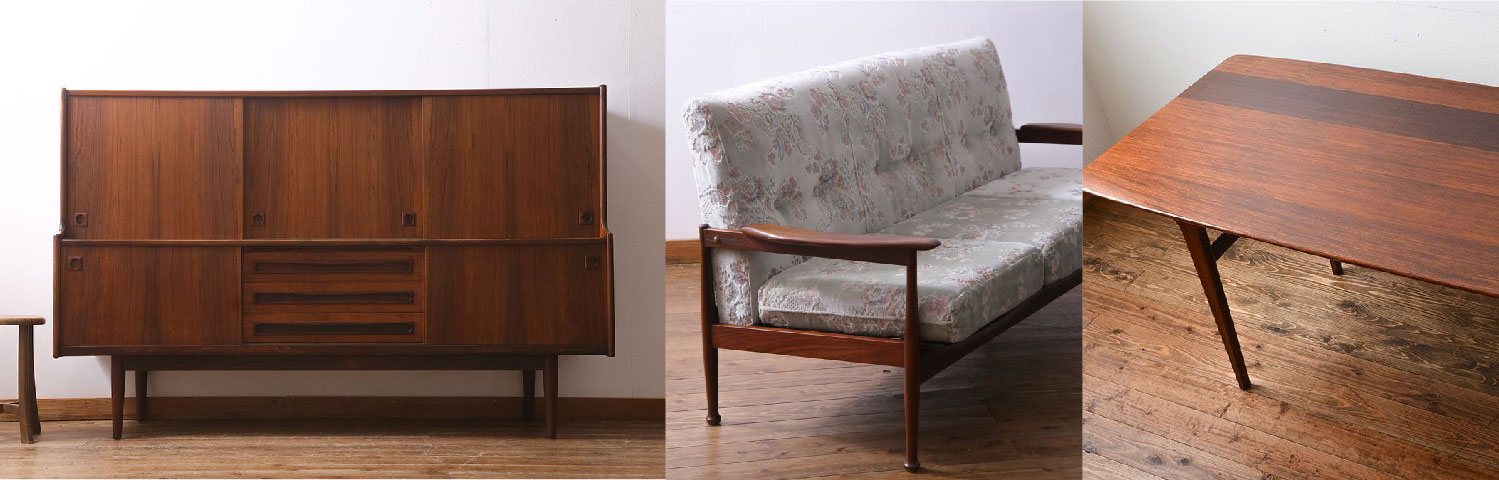
Rosewood is the general name for broad-leaved trees of the genus Dalbergia in the pea family, native chiefly to the tropics and subtropics. The name comes from the scent of roses given off by a freshly cut surface.
A luxury timber, rosewood has declined abroad through illegal felling, and under the Washington Convention (CITES) of 2017 to 2019 the import and export of some rosewoods is now prohibited, so that rosewood furniture can no longer be made in Japan. Rosewood furniture can therefore only be had as antique, vintage or used pieces made before the 2017 regulation, and it has become furniture of high rarity value.
Where the record differs. CITES placed Brazilian rosewood (Dalbergia nigra) on its strictest list, Appendix I, in 1992; the 2017 decision put the rest of the genus on Appendix II, which requires export permits rather than banning trade, and the 2019 amendment exempted most finished goods such as musical instruments. New rosewood furniture is therefore rare and heavily regulated rather than strictly impossible.
Kinds
There are more than thirty kinds of rosewood; here are four typical of furniture.
1. India rosewood. Regarded as the finest of all, India rosewood is called the original rosewood. Native mainly to India, where it was called sheesham, it has long been loved in Japan as shitan, a name thought to derive from it. In earlier times it reached Japan by way of China, and it is a timber of such distinction that it appears in national treasures. Compared with other rosewoods it is dense and strong; the heartwood is reddish-purple brown to purplish dark brown, with distinctive black to dark brown stripes; the sapwood is greyish-white, sharply divided from the heartwood. It grows extremely slowly, said to take more than about 120 years to reach a diameter of 70 centimetres. See shitan.
2. Brazilian rosewood. Native to Brazil, it is also called jacarandá. Individual logs vary greatly in appearance, from reddish to jet black, and the figure from flamboyant to plain, so each piece has a grain of its own. Now a timber of the very highest price, it has a long history: it was felled along the Brazilian coast from the sixteenth century, then travelled to the countries of Europe. At the Palace of Versailles it has been used for some four hundred years, in the arms of Louis XIV's throne and in beds, chairs and other furniture; a timber long loved by royal courts. Long felling, however, reduced it, and it was listed as endangered in Brazil and under CITES, and export was prohibited. Today planting and conservation are active in Brazil, and its domestic endangered status has been lifted; under CITES, though, import and export require permits from each country, and as logs are now hardly imported into Japan at all, it has become a phantom timber.
3. Indian rosewood. As Brazilian rosewood grew scarce, Indian rosewood (East Indian rosewood, Dalbergia latifolia) came into wide use as a substitute. It grows faster than other rosewoods and is planted, so it is more readily available; most furniture described today simply as "rosewood" means Indian rosewood. It is often confused with India rosewood, but they are different timbers. It grows mainly in western India and Sri Lanka, and across South-East Asia. It is light and soft among rosewoods, easy to work, and polishes to a fine lustre, which makes it a popular timber for antique and vintage furniture and for instruments such as basses and guitars. Its colour is a deep brown, with stripes of dark brown. Since the partial relaxation of CITES in 2019, musical instruments made of Indian rosewood can again be imported.
4. Kingwood, "the king of woods". Native to Brazil, kingwood grows only in a very small area even there, and is among the rarest of rosewoods. The trees range from 15 to 30 metres tall; the heartwood is reddish-purple to black, with very beautiful figure in which golden stripes occasionally appear, and the white sapwood is sharply distinct. Very hard, yet workable with the right tools, it has been used for woodwind instruments, knife handles and carving. Prized for the beauty of its figure, its durability and workability, it has long been used for the finest furniture, and is said to take its name from the favour of Louis XIV and Louis XV. Alongside kingwood there is the "queenwood", tulipwood, a rosewood with pink wood and vivid orange figure.
Its appeal
Distinctive colour and figure. The first thing that comes to mind is surely the purplish dark brown surface, sometimes called shitan colour, and the characteristic stripes. One enjoys the contrast between the deep purple figure standing out clearly and the ground of the wood, and the depth of colour gives an impression of weight and dignity. Rosewood furniture tends less to decorative forms than to simple designs that emphasise the wood's own colour and figure, which shows where its greatest appeal lies. Colour also differs by region and by the growth of the tree, so antique and vintage pieces show different faces depending on when they were made and where the timber was gathered.
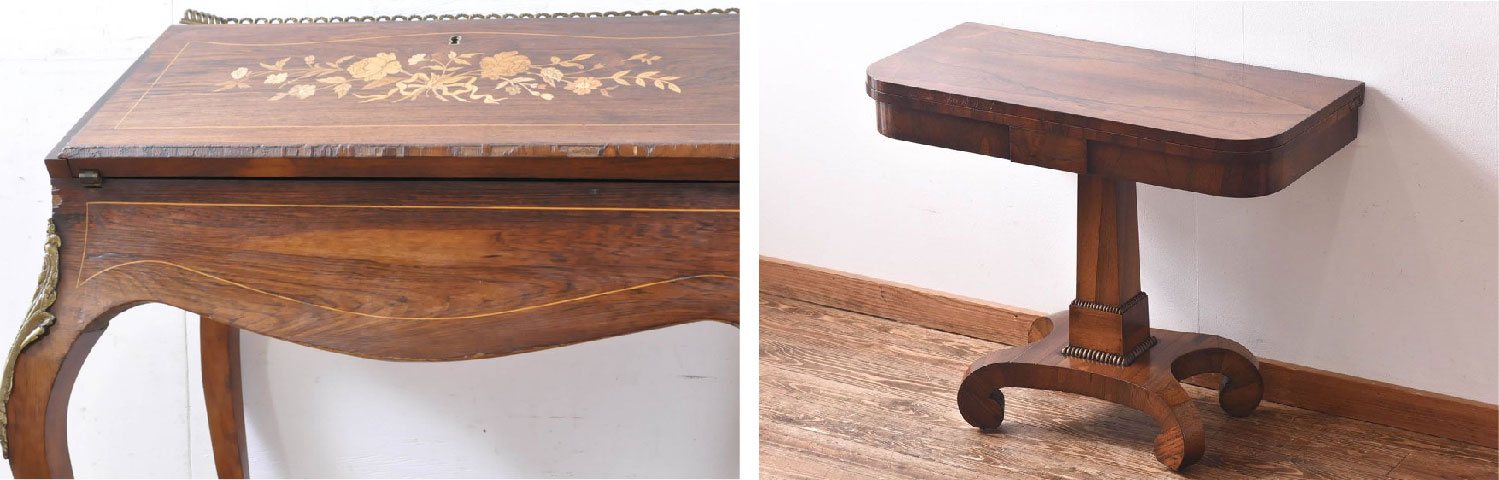
High durability. Rosewood's density makes it famously hard and heavy; with some kinds, plane and saw blades are worn down in working, and nailing and screwing are said to be difficult. Rosewood dried slowly over time is therefore stable, with little movement, and has long been loved for building, furniture and instruments. Rich in resin, it repels insects, withstands changes of temperature and resists decay, which is why it keeps its beauty across the generations it takes to become antique or vintage.
Rarity. With import and export regulated by CITES, rosewood is hard to obtain both as finished goods and as timber. And as it is hard to work with plane and saw, furniture made of rosewood before machinery could be used is few in absolute number, and pieces that survive intact are of very high rarity value.
Rosewood furniture
Antique furniture. Rosewood, which became fashionable in Europe in place of mahogany from the late eighteenth century, is much used in furniture of the Regency style, heavy and simple: a style that shows off the beauty of rosewood's figure. Some pieces carry delicate inlay, but with rosewood the effect is refined rather than sumptuous. In Japan too it has long been loved as shitan; here as well the purplish colour is put to use in calm designs, but some pieces carry mother-of-pearl inlay or openwork carving, and given the difficulty of working the wood, one can see that they were made as the finest goods. See mahogany, raden and sukashibori.
Vintage furniture. Vintage rosewood furniture is also of high rarity value; from Japanese vintage to Scandinavian and English pieces, almost all are one of a kind. Rosewood suits simple, refined Scandinavian furniture especially well, and many designers took it up in about 1950 to 1960. Most rosewood in European vintage furniture is Brazilian rosewood, Brazil having been a Portuguese colony. Brazilian rosewood was first imported into Japan around 1960 (Showa 35); logs were imported whole, and rosewood furniture was made by Tendo Mokko, a celebrated Japanese furniture maker, among others. See Scandinavian furniture.
Maker furniture. Rosewood furniture by named makers is very popular in Japan and abroad: among Japanese makers Tendo Mokko and Yamashina Mokko; abroad A. H. McIntosh, Jason Møbler and Rasmus Solberg. All are makers known for their woodworking skill, and many of their pieces are simply made to let one savour the rosewood's figure.
Royal Copenhagen
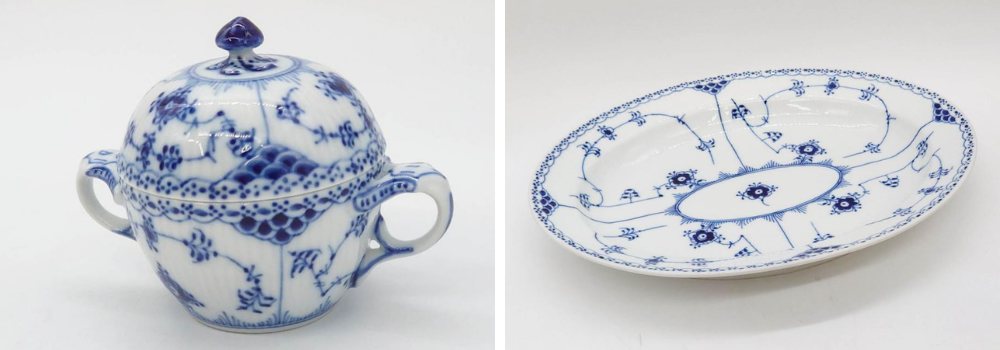
Royal Copenhagen is the leading ceramics brand of Denmark. Since its founding in 1775 its hand painting and outstanding technical skill have won it admirers around the world. It is famous for the Blue Fluted series, known for its painting in blue, and for the Flora Danica series, its finest line.
Features
Royal Copenhagen is known for beautiful hand-painted decoration on a pure white body. On the underside of each piece are the factory mark, the painter's signature and a shape number, so no two are the same. Its greatest appeal is that, keeping faith with the tradition maintained since its founding, every piece is made by hand from firing to painting. The three wavy lines in the mark represent the three straits that surround Denmark.
History
Royal Copenhagen began in 1775 as the Danish Porcelain Factory, with the support of the Danish royal house. Skilled technicians were invited from Germany, which had succeeded in making porcelain before Denmark, and the country put its weight behind the work. At almost the same time as the founding came "Pattern No. 1", the original of the later Blue Fluted, and in 1790 the Flora Danica series was introduced.
As the factory's output grew, it began making and selling wares for a wider public, and they spread among ordinary households. The factory was even presented as a sight of Denmark, and the maker established itself as a ceramics house of world standing.
Long prosperous as the Danish royal porcelain factory, it began to struggle under the influence of the social upheavals around Europe, the French Revolution among them. In 1868 the royal house transferred the factory to private ownership on condition that it keep the title "Royal", and Royal Copenhagen was privatised. Some 140 years later, in 2012, it was acquired by the Finnish company Fiskars, which owns it today.
Flora Danica, the lasting masterpiece
Flora Danica is the finest of all series, created as a gift from King Christian VII of Denmark to Empress Catherine II of Russia. It took as its model the botanical atlas Flora Danica, and the painter was Johann Christoph Bayer, who alone painted some 1,800 pieces. The work took twelve years, and as the supreme series of Royal Copenhagen it drew attention at home and abroad. Flora Danica has established itself as a lasting masterpiece and is still used at Danish state banquets.
Where the record differs. Catherine II died in 1796, six years before the first service was completed in 1802, so it never reached Russia; it stayed in Denmark, where much of it remains in the royal collection. Accounts also differ on whether the original commission was ever formally meant for her.
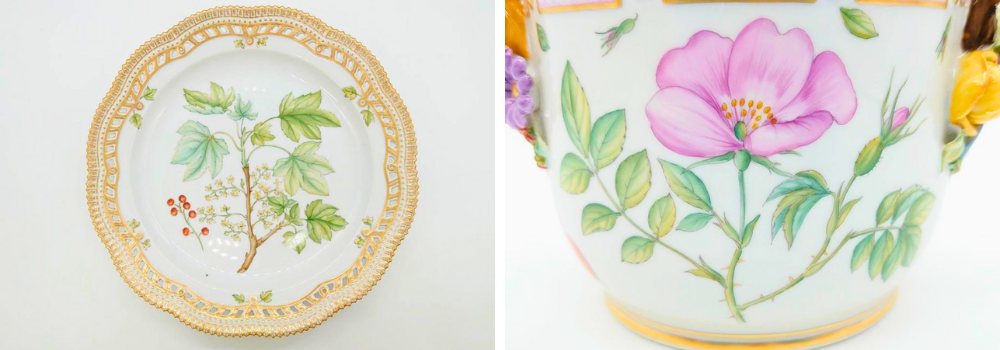
Blue Fluted, the signature
The signature work of Royal Copenhagen is surely the Blue Fluted series, in continuous production for more than 240 years since the founding in 1775. It falls broadly into five variations.
Blue Fluted Plain. The first design to be released, distinguished by its simplicity, without the painted "scale" border or the lace rim.
Blue Fluted Full Lace. Distinguished by a lace-like rim and the painted "scale" pattern; some plates also have pierced openwork.
Blue Fluted Double Lace. A still more lavish version of Full Lace, with double lace, piercing and more of the "scale" painting. So much handwork makes it the most expensive of the Blue Fluted range.
Blue Fluted Half Lace. The third design to be released: a lace border painted inside the rim of the Blue Fluted Plain plate.
Blue Fluted Mega. Introduced in 2000, distinguished by the pattern drawn very large and by its asymmetric design.
An unexpected link with Japan
The Blue Fluted series still has many admirers in Japan, and its roots in fact lead back there. When Royal Copenhagen was founded at the end of the eighteenth century, tea culture was flourishing in the countries of Europe; for tea wares, Asian ceramics from China, Japan and elsewhere were preferred, and they strongly influenced European ceramics. Royal Copenhagen was no exception: the hand-painted cobalt blue of Blue Fluted is said to have taken its cue from Japanese Arita and Imari ware. Perhaps so many people in Japan are drawn to Blue Fluted because its roots lie there. See Arita ware and Imari ware.
Royal Doulton
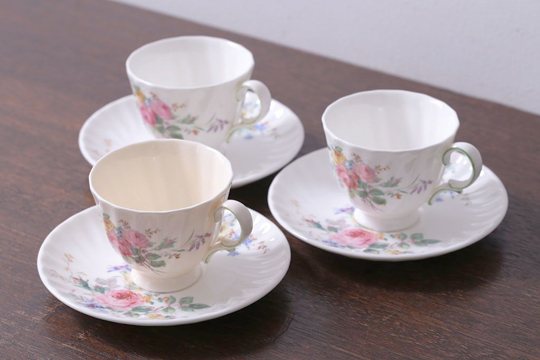
Royal Doulton began working as a pottery in the early nineteenth century and is today one of the largest ceramics makers in the world, with such celebrated names as Minton, Royal Crown Derby and Royal Albert among its brands. Its success has been spectacular, yet at its founding it was not the maker of luxury dinner services it is today. Following its history to the point of glory gives a different view of the house. See Minton.
Beginnings in stoneware
In 1815 John Doulton opened the Doulton pottery at Lambeth, then a village on the Thames near London. At first it made everyday wares and ornaments in salt-glazed stoneware: beer jugs, character jugs in human form, whisky bottles and the like. The early mark had no lion; only the flower-like geometric device beneath the crown has been carried on, as on the mark of the White Nile range of 1978.
In 1835 his son Henry Doulton, the architect of the company's growth, joined the firm; by applying the steam engine to the potter's wheel, among other measures, he dramatically raised the efficiency of the works.
Success by meeting demand. Large jars, now easier to make, came to be prized as containers for chemicals, then in rising demand. Henry next noticed that French-style garden-making was fashionable among the newly wealthy, and made a wide variety of garden pottery. In the 1840s orders came from government for drainpipes for urban improvement, and in 1845 he set up at Lambeth the world's first factory for sanitary ware, extending the range to washbasins, baths and lavatories. Doulton products were exported around the world with great success, and the pottery grew by leaps, turning its new strength towards fresh challenges.
From mass production to the one-off
From the 1870s Henry began making "Lambeth ware", introducing the ideas of the unique piece and the signed artist's piece. He hired graduates of the art school and adopted free, highly individual design and creation. The venture succeeded, with acclaim at the international exhibitions and purchases by Queen Victoria, and in 1878 it won the grand prix at the Paris Exposition. Other firms followed with design departments of their own, and the movement spread across Britain, giving rise to the art pottery movement.
A pottery honoured by Britain. Doulton then opened an art studio at Stoke-on-Trent, convenient for the pottery trade, making highly decorative tableware and ornaments (commemorative display pieces), and began to introduce bone china. For these achievements Henry received the Albert Medal of the Royal Society of Arts in 1885 and a knighthood from the queen in 1887. In 1897 he died, closing a glorious life.
Bone china and European porcelain. From about the sixteenth century the brilliant hard-paste porcelains of China and Japan, brought to Europe, astonished the West, and royalty and aristocracy competed to collect them. Imitation was attempted in many countries, and early in the eighteenth century the Meissen works, in present-day Germany, succeeded, and the knowledge spread across Europe. Porcelain-making, which demanded high scientific and artistic skill, touched national prestige and profit; in England, where the raw materials were found late, bone china developed as a substitute, along with stoneware of Continental origin. Stoneware is a material combining qualities of porcelain and earthenware: it does not transmit light and does not absorb water, and it is fired hard and strong.
Royal Doulton and dinnerware
In 1901 Edward VII granted the royal warrant and the honour of bearing the word "Royal" in the company name, and it began calling itself Royal Doulton, the name it carries today. At Lambeth, meanwhile, production of tiles and other building materials flourished, and they were used in buildings around the world. When the Lambeth works closed in 1956, the company, now based at Stoke-on-Trent, became a general maker of Western tableware, producing dinnerware, children's tableware, ornaments, crystal and more. In the 1970s it absorbed celebrated potteries such as Minton, Royal Crown Derby and Royal Albert, growing into the Royal Doulton group, one of the largest in the world.
Two materials
Stoneware, the foundation. As described, Royal Doulton grew dramatically on building materials and other goods in stoneware, a material that had arrived in England in about the seventeenth century. Among its stoneware products, small pieces in particular are basically stoneware with a decorative slip coating: coloured with slip (a mixture of clay and water) by the technique called engobe, and finished with a glassy salt glaze.
Bone china, the luxury line. The other main material, bone china, devised in England in the mid-eighteenth century, uses a clay body containing cattle bone ash. Its pure white body could be fired at lower temperatures, which made a wide range of colours possible. Gilding and enamel painting are done by hand and by transfer, and pieces are formed on the wheel and in plaster moulds.
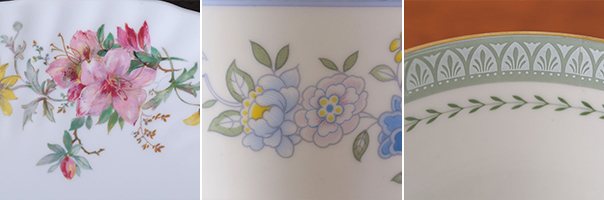
More than tableware
Excluding industrial ceramics, Royal Doulton's range includes tea wares, drinking vessels, tableware, jars and vases, and also plates, statues, ornaments, figurines, clocks and money boxes; among the figurines, the Bunnykins series is popular. Its designs range from realistic depiction to compositions of geometric form: Sèvres-style gilding on deep blue grounds; Rococo-style realistic and romantic miniatures; Neoclassical continuous borders in the ancient Greek manner; geometric patterns; Art Nouveau abstract flowers; Japonisme drawing on Japanese painting; and the simple, refined beauty of Art Deco. Painted plates are said to have predominated in the early years. Among them is the limited plate "Ondée" by Erté, the celebrated Art Deco artist. See Rococo style.
Celebrated designs
"Doulton red", the flambé glaze, is a technique yielding a deep, fiery red from copper fired in a reducing kiln, found on both stoneware and porcelain. Others include "Carlyle" (1972), tableware with a formal flower pattern repeated on a navy rim; "Biltmore" (1996), dignified with marbled ground and gilding; "Orchard Hill", with a border of bright fruit and flowers; "Classic Pooh" tableware and figures after the beloved children's book Winnie-the-Pooh; tableware and figures from the popular Brambly Hedge stories; and many more, such as "Countess", "Baroness", "Desire", "Hannah", "Centennial Rose" and "Gordon Ramsay". Overall, the designs are refined and have real breeding, with gilding kept modest to set off the white of the bone china.
S
Sado tansu
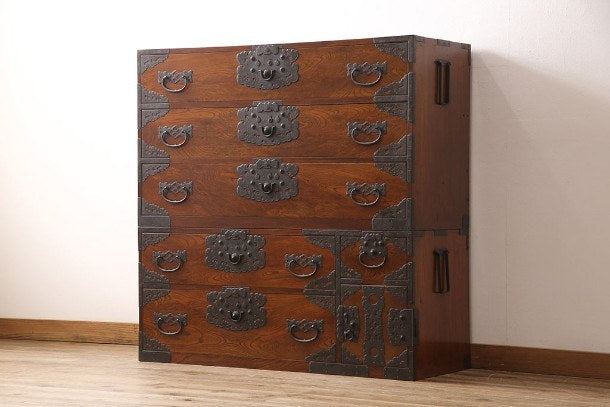
Sado tansu are chests made on Sado Island, which prospered as a port of call for the kitamaebune trading ships. Many are extremely lavish, and they rank among Japan's foremost chests. They divide into chests of the Ogi and Yawata districts, those of Ogi being considered the more valuable.
Features
Opulent is the word for the Sado chest: popular as the summit of Japanese chest-making, with value as works of art. As a port of call, Sado made many sea chests, and its chests inherit their spectacular ironwork. Ogi chests above all show the sea chest's character strongly, with thick fittings and an imposing zelkova body. Yawata chests use thinner fittings than Ogi's, but with openwork and engraved patterns, a different kind of splendour.
Materials and decoration
Ogi chests were made mainly of zelkova, with thick fittings, often in abstract designs of flowing curves. Yawata chests are mainly paulownia, with thin fittings used in straight lines, set with openwork patterns.
Kinds
Sado sea chests. Regarded as the finest sea chests of all and the envy of mariners, with ironwork that seems to cover the wood. In zelkova and paulownia, they are close-fitting and precisely designed to keep water out.
Ogi chests. Begun as chests that ships' masters commissioned as gifts for geisha, hence the name geisha-dansu. In the sea-chest tradition, they have thick ironwork and sound construction; the lacquer is rubbed in ten times or more. Made with the full woodworking and metalworking skill of the sea chest, they are especially lavish and now valued as works of art.
Yawata chests. These flourished as bridal chests; the Yawata district made the island's wedding furniture. Mostly paulownia, they are finished in lacquer. Their fittings are thinner than Ogi's but cover more of the wood, with delicate openwork and a splendid design.
History
In the Edo period Sado was a port of call for the kitamaebune. In the busy port towns, many sea chests were made to order for ships' masters. Woodworkers and metalworkers competed, and the sea chests grew ever more lavish and beautiful until they became coveted status pieces.
Ships' masters then began to commission chests to give to geisha, and splendid chests drawing on sea-chest techniques were made. This was the beginning of the Ogi chest.
In Yawata, a storage piece made on the orders of the Sado magistrate led to the making of bridal chests. Because a bride was judged in part by the quality of her chest, families vied to commission fine designs.
Sakura (Japanese cherry wood)
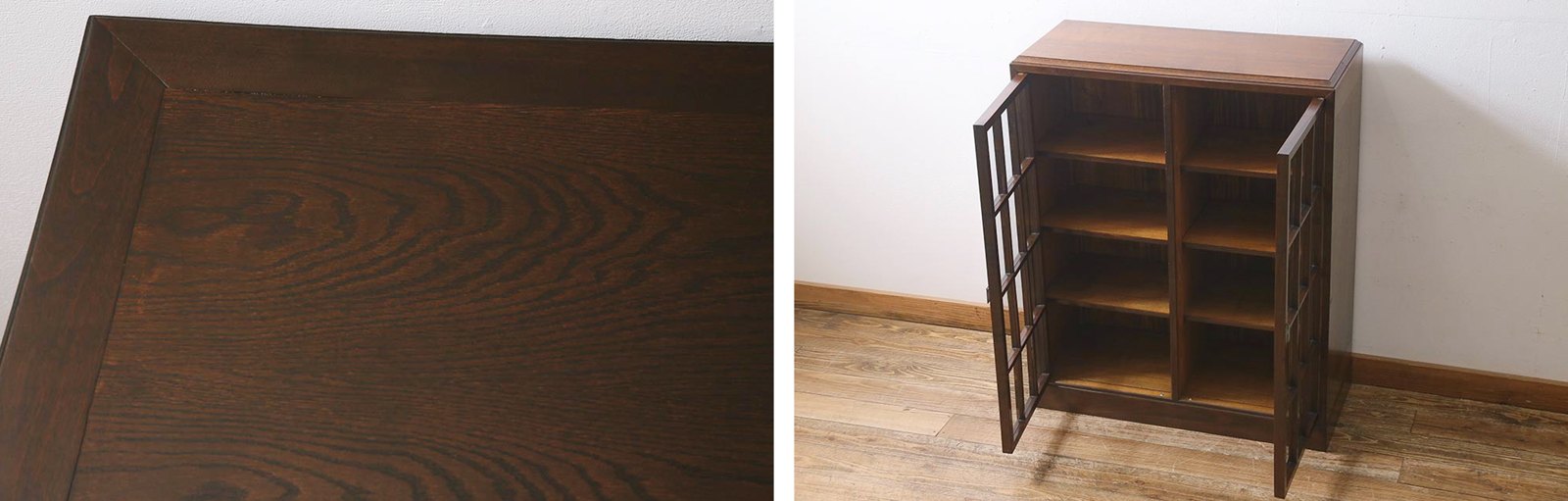
Sakura, cherry, is the collective name for deciduous broad-leaved trees of the rose family, genus Prunus (sometimes placed in Cerasus). The cherry is Japan's national flower, loved since ancient times as the symbol of spring and the flower of flowers, familiar from blossom viewing (hanami) and throughout Japanese culture. It grows across almost all of Japan, and widely in the temperate northern hemisphere, in Siberia, China, the United States and Canada.
Much loved for its blossom, the cherry is also a valuable timber. Its qualities have long made it a fine wood for furniture, building, carving and instruments.
In the timber trade, "sakura" is often used for kaba-zakura (birch) and mizume-zakura (cherry birch), which are entirely different from true cherry. To avoid confusion, true cherry is sometimes called ji-zakura, "native cherry". Both appear side by side as furniture and building timber, so it is worth checking when buying.
Kinds
There are said to be eleven basic wild species of cherry in Japan's hills and fields; with natural hybrids and garden cultivars the total exceeds six hundred. The famous blossom trees such as Somei-Yoshino and the weeping cherry (shidare-zakura) are planted mostly for viewing, and very little reaches the timber trade. These are the cherries used as timber.
Yamazakura (hill cherry, Prunus jamasakura). The most commonly used cherry timber, also called hon-zakura, "true cherry". One of the basic wild species, it grows 15 to 25 metres tall. The sapwood is pale yellowish brown; the heartwood brown to reddish brown, sometimes with dark green streaks; the grain fine and nearly straight. Among cherries it is especially hard and stable once dry, and excellent in durability, water resistance, insect resistance, workability, staining, strength and toughness; polished, it takes a beautiful lustre. Its bark is used for kaba-zaiku, the bark-clad tea caddies and boxes of Kakunodate, as a raw material for throat remedies, and left on the trunk for the decorative alcove post (tokobashira), so it is famous for leaving little waste. Yamazakura is much sought after, but stocks at home and abroad are small, and it is very precious.
Shiuri-zakura (Prunus ssiori). Also called shuri-zakura, miyama-inuzakura, shiori-zakura and shiore-zakura. It bears many white flowers in spikes like ears of rice, so unlike a cherry that it hardly seems one. It grows from the north of the Chugoku region to Hokkaido, the Kurils, Sakhalin and mainland China; timber from the Hidaka district of Hokkaido is reckoned the best. Similar to yamazakura but lighter, softer and paler, it is used mainly for furniture for its looks.
Uwamizu-zakura (Prunus grayana). Also called kongo-zakura, anningo, uwamizo and hahaka. It closely resembles shiuri-zakura, but they can be told apart by habitat and the base of the leaf: shiuri-zakura grows in cold uplands and has a heart-shaped leaf base, while uwamizu-zakura grows in lowlands and has a gently rounded one. Its fruit, buds and flowers are all edible. Its wood is hard yet light, used for building, printing blocks, carving and tool handles, and its bark, like yamazakura's, for kaba-zaiku.
The appeal of cherry
Quality. Moderate hardness, high durability and water resistance, good workability, a fine, straight, gentle grain, and a silky lustre when polished: cherry has many virtues as a timber. Among hardwoods its vessels are fine and its grain close, so its surface is very smooth to the touch. All this gives it refinement, and it is often used for fine furniture.
A contrast all its own. With pale yellowish-brown sapwood and brown to reddish-brown heartwood, cherry shows a marked difference in colour between the outside and inside of the tree, and furniture can come out mottled. That may be a reason to avoid it where uniformity is wanted, but the contrast is part of the character and depth of cherry, and adds to the value of a one-of-a-kind piece.
Beautiful ageing. Cherry is known for its soft, bright reddish colour, which deepens with age into a rich amber and grows more luxurious with time. Compared with yamazakura, American black cherry, North America's cherry and hugely popular worldwide, changes colour faster and more dramatically, and is redder. The two related woods are very alike in substance; in grain, yamazakura looks wilder and stronger. Side by side, Japanese cherry has a calm, reserved character quite different from cherry abroad.
Cherry furniture
Antique and vintage cherry furniture. In the Heian period the court took to blossom viewing, and in the Edo period it spread to ordinary people and the cherry came to be loved by all. Yet containers of cherry wood and handles wrapped in cherry bark have been found in strata six to seven thousand years old: cherry wood was familiar long before blossom viewing drew attention to the tree. The deep colour of antique and vintage cherry furniture speaks of history and weight.
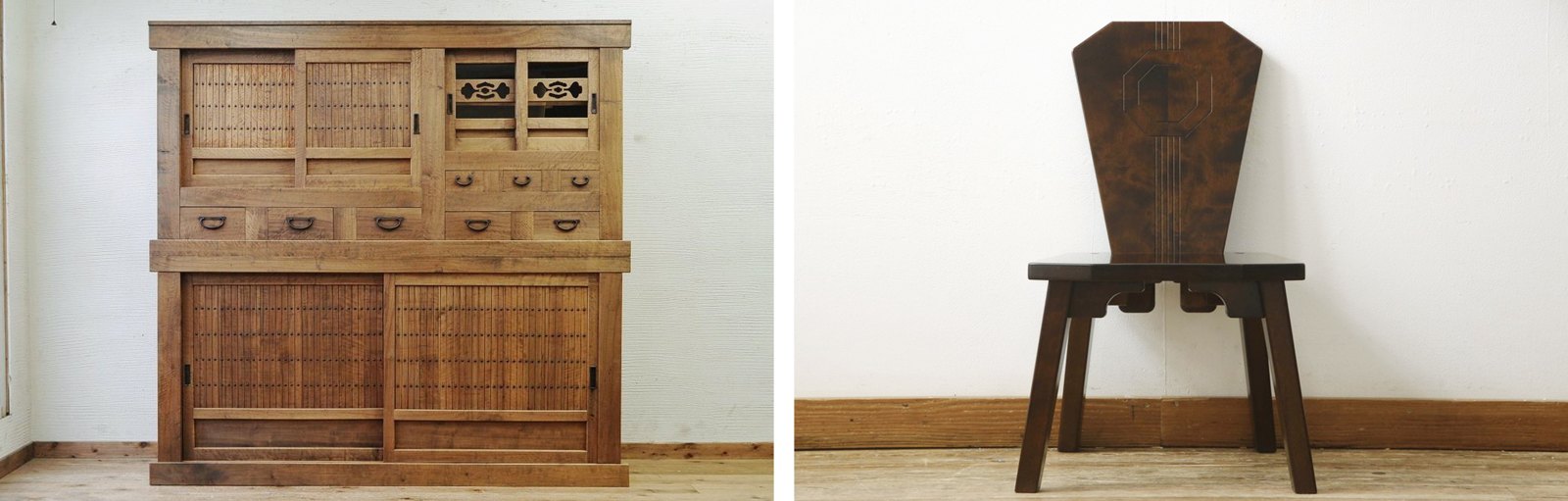
Modern cherry furniture. Warm and soft in feel, cherry furniture suits Japanese and Western rooms alike. Now rare and costly, it is still made by many Japanese makers. "Sakura" timbers such as birch and cherry birch are more plentiful and less costly, and look much like cherry, but true cherry has qualities nothing else can replace. The blossom falls in about two weeks, the very symbol of fleeting beauty; the wood, durable, can be enjoyed for many years as it ages, and in many forms brings richness and colour to life. The cherry is a tree of particular meaning in Japan.
Salon chair
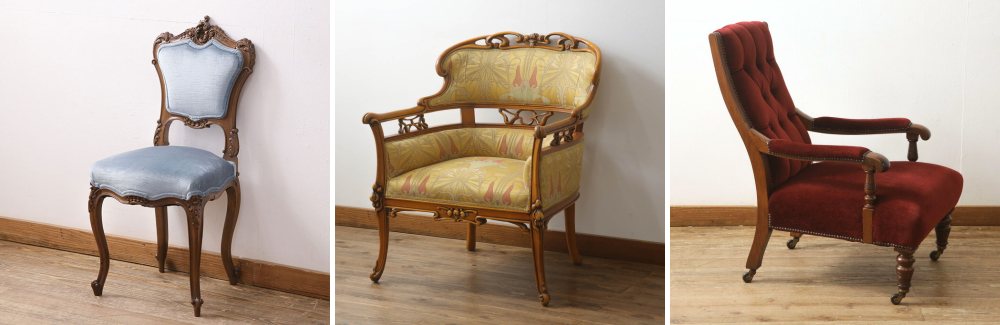
A salon chair is a chair used in the living room or drawing room of a private house for conversation and taking tea with guests or family. It was born among the French upper classes in the eighteenth century and later spread to England and around the world. Its hallmarks are an elegant appearance that values artistry and a comfort devoted to ease. The salon chair is regarded as a symbol of the flowering of salon culture, and it was born in the period when furniture reached its height of artistry and technique.
Features
The salon chair's greatest features are a design conscious of its presence in a room and a comfort that considers relaxation. Its appearance varies somewhat with the period and country of making, but certain qualities are basic: first, a form composed of curves; second, cushioning and luxurious upholstery; third, showy design. And, as is true of all furniture raised in salon culture, it is made small and light, to allow for the changing number of guests and for moving it about.
Kinds
Salon chairs are of many kinds: the armchair with arms, the side chair without, the stool without a back, the high-back with a tall back. With the fashion for salon culture came also the long seat called the settee and the chaise longue, on which one sits with the legs stretched out. See settee and chaise longue.
Styles of design
Beginning with the Rococo, the styles used for salon chairs include chinoiserie, Queen Anne, Chippendale, Adam, Neoclassicism, eclecticism, revivalism, Art Nouveau and Art Deco. Carved ornament covered not only the back but the legs, seat and stretchers, very elaborate and luxurious. Many motifs were classical, from ancient Greece and Rome through the influence of the Renaissance and Baroque: shells, acanthus leaves, rosettes, arabesque scrolls, volutes and geometric patterns. See Rococo style, chinoiserie, Queen Anne style, Adam style, Neoclassicism and acanthus.
Ornament beyond carving. Besides carving, marquetry, inlay, veneering, gilding, lacquer and colouring were used. See parquetry.
Materials
Woods included walnut, beech, rosewood, mahogany, satinwood and oak; for the upholstery and cushions, silk, leather, cane, straw and feathers were used. See walnut, rosewood, mahogany, oak and rattan.
History
A chair nurtured by French salon culture. The history of the salon chair begins with the salon culture fashionable in France from the early eighteenth century. Under Louis XIV, France had seen a brilliant court culture flower in the Baroque style, and was renowned as the most advanced country of Western culture. When Louis XIV died in 1715, however, the severe, formal Baroque declined. Freed from oppressive values, the aristocracy made social life livelier; they set up second houses in Paris and its suburbs, and in small rooms held salons, gatherings of the celebrated from every field. Painters and artists took part as well as famous figures, enjoying company over conversation and tea.
While salon culture was in fashion, the open, light Rococo style began to rise. To enjoy the bright atmosphere of the salon, demand for salon chairs grew and grew. At the same time they took on a meaning as objects to be admired, and both artistry and practicality, the means to relax elegantly, were required. Salon hosts became patrons and invested in cabinetmakers and architects, and the artistry of the salon chair peaked, reaching its height in the mid-eighteenth century. Salon culture later spread to the middle classes, and salon chairs came into use in drawing rooms and living rooms, becoming furniture in general use.
The salon chair in England. Salon culture became fashionable in England too, under French influence. With the arrival of Neoclassicism in the later eighteenth century, England developed in its own way; above all the Adam style advocated by the architect Robert Adam won popularity with ornament refined yet restrained. One of the salon chair designs fashionable then was the "balloon back", with a back frame in the shape of a balloon.
Salon chairs today
Salon chairs are still made by long-established furniture makers and luxury furniture houses, and are widely used as furniture for receiving guests, as interior pieces that add colour to daily life, and as a means to real ease. Many makers work faithfully to the traditional techniques of the European countries, carrying culture and technique forward. Raised in the culture of the upper classes, the salon chair keeps a trace of aristocratic splendour for us today, and has its place in history as proof of the high skill it fostered in furniture-making.
Scandinavian furniture (hokuo kagu)
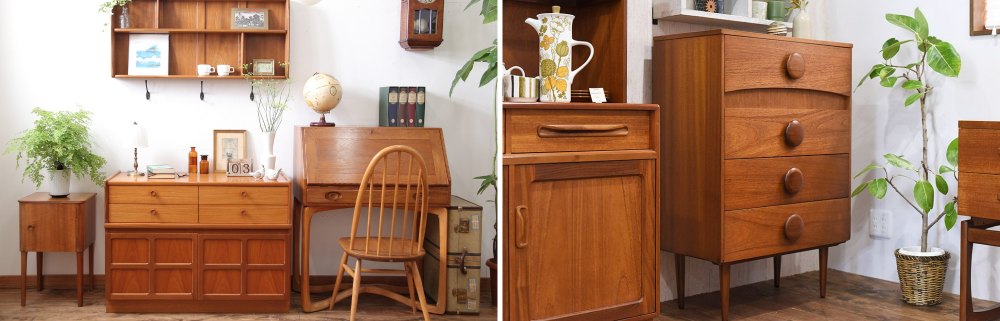
Scandinavian furniture (in Japanese hokuo kagu, "Northern European furniture") means furniture made in the Nordic countries of northern Europe: Denmark, Finland, Norway and Sweden. With short daylight hours and much time spent indoors, the Nordic countries have long put great effort into furniture, so as to spend that time in comfort. Much of it is furniture one wants to use with care for a long time, and in Japan it is popular as an emblem of "careful living".
Features
Natural texture. Designs make the most of natural grain, with soft forms and refined style. Most are simple, suiting many interiors, one reason for their popularity.
Comfort in use. Carefully made, it feels good to the touch and reassuring to use. Nordic nights are long, and much time is spent at home, so furniture is made for comfort; the result is furniture pleasant for anyone to use.
Woods. Oak, teak, rosewood and others, worked to let the character of the wood show, with natural finishes, another hallmark. See oak, teak and rosewood.
History
Nordic furniture-making has a long history, said to go back to the eighth to eleventh centuries, when Vikings traded widely, bringing home furniture and spreading its techniques. In the seventeenth century the Renaissance style, moving north, became fashionable, chiefly in architecture; then the Baroque, Rococo and Georgian styles brought from France and England were taken up one after another by the Nordic nobility. There was then no original Nordic style; most pieces imitated the fashions. Yet the existence of a cabinetmakers' guild in Denmark shows how active furniture-making was. See Renaissance style, Baroque style and Rococo.
In the twentieth century the Modernist movement spread, and under the principle "less is more" Nordic furniture design grew simple and spare. Designers emerged, and an age of original designs began. Danish cabinetmaking was renewed through craftsmanship and teaching, notably by Kaare Klint at the Royal Danish Academy, and in Finland Alvar Aalto pioneered bent laminated birch. In the 1950s American magazines and touring exhibitions featured Nordic furniture, and it leapt into the spotlight. Since then its careful, sturdy making and spare design have been recognised, and it remains popular.
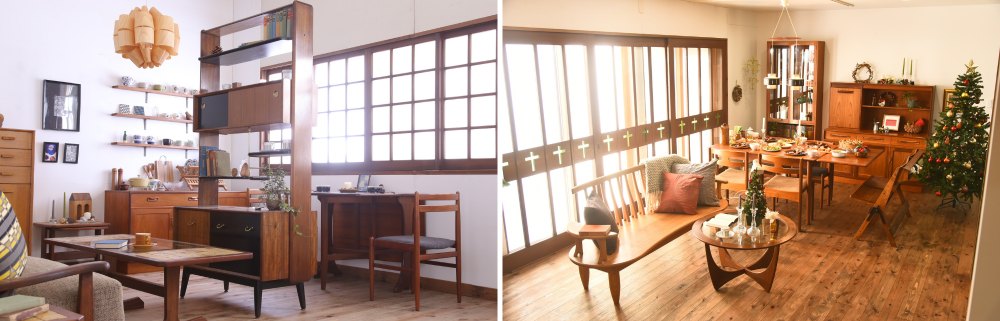
Designers
The Nordic countries produced many master furniture designers: Hans J. Wegner, Finn Juhl, Børge Mogensen, Arne Jacobsen and Kai Kristiansen among them, without whom Scandinavian furniture cannot be discussed. Wegner, called "the master of the chair", designed chairs still reproduced today, such as the Y chair (CH24). Mogensen designed widely under the motto of providing simple, practical furniture at a reasonable price. Their designs are still made, and countless designs and products show their influence. See easy chair.
Makers
As important as the designers are the long-established makers. Among vintage favourites are Fritz Hansen and Carl Hansen & Søn. Fritz Hansen, a Danish maker of simple, refined designs, produced Arne Jacobsen's Egg chair. Carl Hansen & Søn makes many of Wegner's designs, including the Y chair. In Britain, makers such as G-Plan, Nathan, A. H. McIntosh and Ercol, strongly influenced by Scandinavian design, are also popular among lovers of mid-century furniture.
For collectors
Vintage pieces of the 1950s to 1970s often carry maker's labels, brands or burnt-in marks under seats and inside drawers; Danish furniture may bear a "Danish Furniture Makers' Control" mark. Teak and rosewood veneers should be checked for lifting and sun-bleaching; an experienced restorer can revive an oiled finish.
Sendai tansu
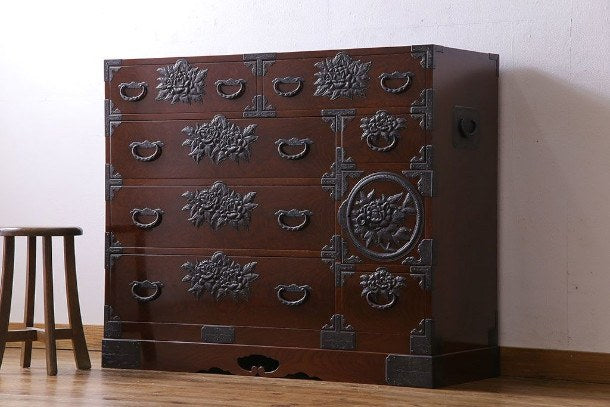
Sendai tansu are chests made around Sendai, Miyagi Prefecture. Made from the end of the Edo period, they are now a traditional craft designated by the Minister of Economy, Trade and Industry. Their lavish hand-forged fittings in relief make for striking designs, and they are popular abroad as well as in Japan.
Features
First comes the lavish ironwork. The hand-forged fittings in relief stand out among all chests; a single Sendai chest has overwhelming presence. The ironwork is not only beautiful but strengthens the chest, and with strong timber it makes for robust construction.
Materials and decoration
Zelkova, cedar, chestnut and paulownia are the main timbers, and the metalworker's fittings are applied one by one. In the Edo period the fittings had little relief; from the Meiji era, raised designs worked in repoussé (uchidashi) came into use. A single chest carries 100 to 200 decorative fittings, with splendid motifs such as dragons, Chinese lions, peonies and chrysanthemums. The finish is usually kijiro-nuri, a transparent lacquer, so the beauty of the grain stands out.
Kinds
Clothing chests. The fullest expression of the Sendai chest, with ironwork far beyond the pulls: a lavish design and a beauty seen in no other chest, the centrepiece of any room.
Small chests. Many Sendai chests are made smaller than usual. Smaller does not mean less lavish; the ironwork is, if anything, more densely packed.
Wheeled chests. Sendai wheeled chests are sometimes found, movable as needed and once taken out in fires and emergencies; they combine weighty design with strength.
History
The Sendai chest began at the end of the Edo period as a local industry of craftsmen gathered in the castle town of Sendai. Loved first by samurai and merchant households, it kept swords, hakama and valuables. From the Meiji era, as ordinary households came to own chests, production peaked. There are records of exports, and the ironwork took on more decorative designs for overseas buyers.
Production fell during the war but revived afterwards, and the Sendai chest remains at the forefront of Japanese chest-making. In 1990 (Heisei 2) it was designated a traditional craft by the Governor of Miyagi, and in 2015 (Heisei 27) by the Minister of Economy, Trade and Industry. Production continues, and it keeps growing as a chest valued worldwide as well as in Japan.
Antique and modern
Antique and modern Sendai chests share prominent ironwork. Modern chests carry more intricate fittings and feel sharper overall, while antiques have the depth of character that only time brings.
Senshu kiri-dansu (Senshu paulownia chest)
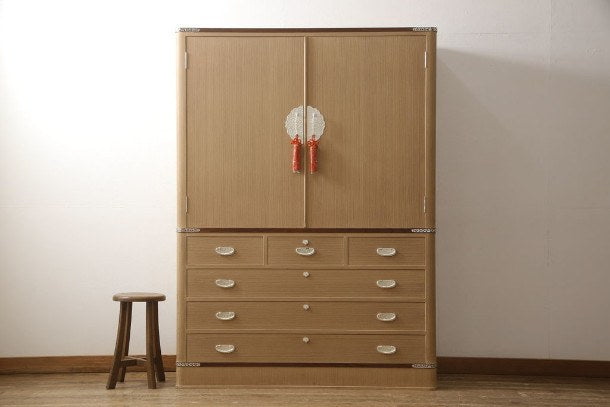
Senshu paulownia chests are made around Kishiwada and Sakai in Osaka Prefecture and are a designated traditional craft. Paulownia chests resist humidity and fire, and serve as clothing chests; among them, the Senshu chest is regarded as the summit, for its delicacy, elegance and craftsmanship.
Features
Senshu chests are made of thick, high-quality paulownia, 20 mm or more, a thickness seldom seen elsewhere, so the character of the wood is there to enjoy. The technique most worth noting is edge-jointing (hagi-kako): to gain width, several paulownia boards are glued edge to edge into one. Matching the grain so it runs beautifully demands great skill; in a veteran's hands the joints are so fine they cannot be found. Senshu excels at this, which is why its chests are ranked above other paulownia chests.
Materials and decoration
Senshu chests are made entirely of paulownia. Most are finished to show the wood, the paulownia's own beauty. The grain is raised with a tool called an uzukuri, and the colour applied with a mix of tonoko stone powder and yashabushi (alder cone) stain. Ironwork is restrained, to let the paulownia shine, but refined; pulls in gold or silver tones that suit the colour of the chest are common.
Kinds
Clothing chests. Paulownia's close fit and humidity control make it ideal for clothing chests. Senshu drawers close with not a hair's breadth of play. Though the custom has faded, these beautifully made, delicate chests were loved as trousseau pieces.
Kimono chests. Made in Senshu as often as clothing chests, with trays behind kannon doors to keep kimono beautifully: the chest anyone with many kimono longs for.
History
The origins of the Senshu chest are unclear, but chest-making is thought to have begun around three hundred years ago, in the middle of the Edo period.
Osaka sat at the very centre of Japan and was a hub of distribution. It was a rich city, and its people owned many things; chest-making, furniture to keep them in, developed naturally. So the usefulness, strength and beauty of the Senshu chest were refined.
Settee
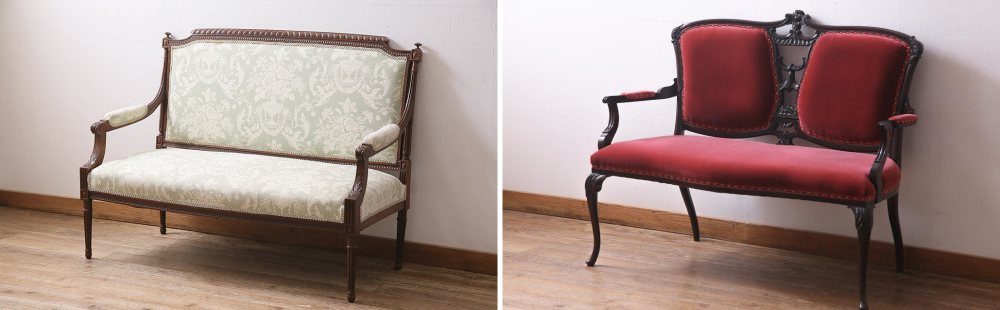
A settee is a long seat with a back and arms. The seat is upholstered in fabric, but with less cushioning than a sofa; think of it as lying between a sofa and a bench. Most are rather compact, the usual size seating about two people, and the sofa is said to have developed from the settee.
Features
A settee is chiefly a long seat with a wooden frame and legs, its seat and back cushioned and covered in fabric. Overall it has less cushioning than a sofa; one may fairly regard it as a chair with padding added. Relatively compact, it is about two seats wide. In a room it is less imposing than a sofa, and being light it is easy to move, which is another advantage.
Some have graceful curved forms in the line of the French Rococo, with backs and seats in showy upholstery, and many are more decorative in design than benches or sofas. Light and compact, the settee is still popular today as a sofa substitute for single households, and with those who love the Rococo look. See Rococo style.
History
The settee spread with salon culture in France. Salon culture means a freer social culture, unlike the authoritarian, ceremonial culture before it: people gathered in the great room, relaxing at leisure on settees as they exchanged views and enjoyed conversation. From France salon culture spread across Europe, and with it comfortable, handsome long seats like the settee, fit for receiving guests. See salon chair.
Where the record differs. Some accounts date the settee's spread to the seventeenth century; most furniture historians place the salon, and the light upholstered settee that served it, in the eighteenth, though the word "settee" and the high-backed wooden settle it grew from are older.
Settee, bench and sofa
Furniture like the settee includes the bench and the sofa. All are seats with a long seat; put simply, a bench has no cushioning, while a sofa has considerably more than a settee. Lately, though, many benches use padding too, and the line has become hard to draw.
Another way to distinguish them is that a settee is small and light, whereas benches and sofas are often too heavy to move casually; this too is a useful guide. And the decisive difference is design. The settee is a long seat for receiving guests, and many are beautifully ornamented, made to be kept on show. A design in the Rococo manner can almost always be called a settee.
A seat that recalls a brilliant culture
The settee played its part in the brilliant salon culture of France and beyond, and today its elegant, compact design is much loved. Bring a settee into a room and the whole atmosphere brightens at once. See chaise longue.
Sewing table
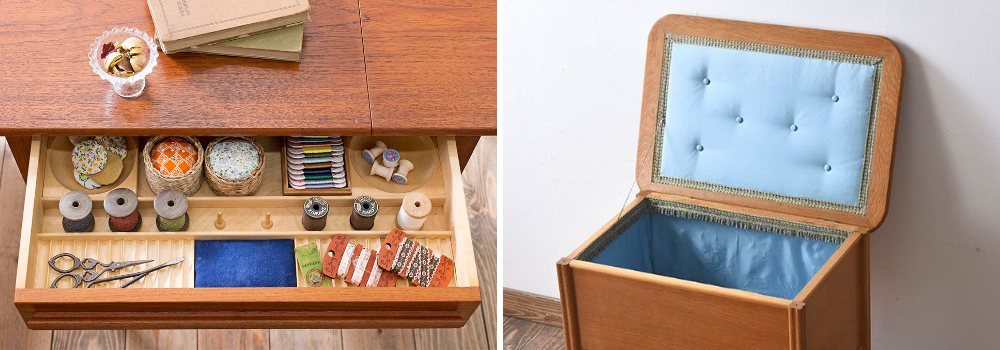
A sewing table is a table made chiefly as a work table for needlework, fitted with many features devoted to sewing so the work can be done in comfort. Over a long history sewing tables of many styles have been made, and their beauty and practicality are still valued and loved today.
Features
A top made for work. So that a long length of cloth hangs down as little as possible when spread out, and so that work can be done comfortably and efficiently, the top usually offers a wide, flat surface. Some are made with a slightly raised edge around the top, to stop needles and other small things falling off.
Generous storage. To hold the many things sewing needs, there is storage beneath the top: drawers, or a box whose lid is the top itself. Drawers are often finely divided so small items can be kept in clear order, and in the box type the underside of the lid may carry storage pockets or a pin cushion: many devices for working in comfort. Most distinctive of all are designs with a fabric bag or a rattan basket for keeping wool and the like, a feature peculiar to sewing tables and not found on ordinary tables, which remains popular today. See rattan.
Kinds with useful features
Easily moved. Small ones, handy for a quick piece of work, and those with castors on the legs are made for mobility and portability.
With an extending top. A type like the drop-leaf table, compact when not in use and quickly extended for work, is often seen. See drop-leaf table.
Adjustable in height. Many are designed at a height of about 50 to 65 centimetres, comfortable for work, but some can be adjusted to suit working standing or sitting.
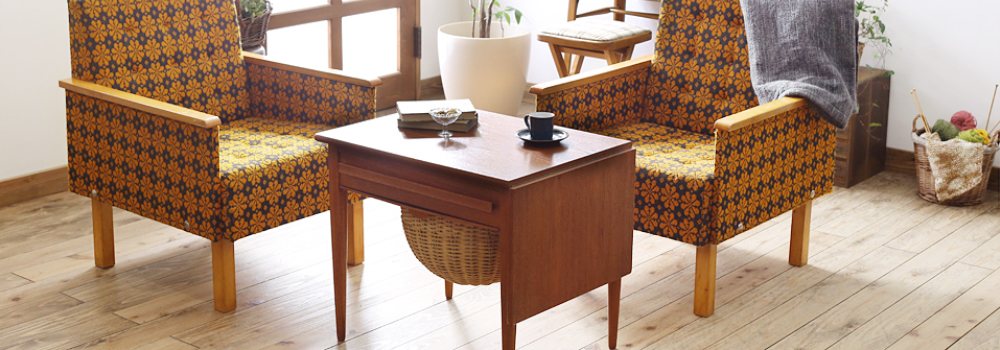
History
The origins of the sewing table go back to about 1770. It is said to have begun in wealthy English households as a table at which ladies enjoyed needlework and leisure, made light and delicate so a woman could handle it with ease.
In the 1780s, after the War of Independence, America took up the sewing table too. There it was mostly of mahogany and almost always in the Sheraton style, striking for its slender, vertical, simple lines, or the Empire style, distinguished by a weighty, brilliant design. In Europe too, sewing tables in many styles suited to their times were produced, Gothic and Rococo among them. See mahogany and Rococo style.
They were varied and excellent in function as well as design: some had a simple arrangement with a single drawer, and many were cabinet-like, holding not only sewing things but stationery and board games.
When the sewing machine was commercialised in the early 1800s, sewing, until then done by hand by individuals, began to move into factory work against the background of the Industrial Revolution. Later, with the arrival of the treadle machine, the sewing-machine table, a work table for the machine alone, spread. The sewing table, an all-purpose piece of household furniture, has an appeal different from the sewing-machine table devoted to machine work, and, as popular now as then, it continues to be made in many designs. See sewing-machine table.
Where the record differs. Early sewing machines were patented and tried from the 1790s to the 1840s, but practical machines were commercialised only around 1850; "the early 1800s" stretches the start of a long, contested invention.
Uses today
Long loved not only for sewing but for writing letters, reading and playing chess, the sewing table's practicality can be fully used today: as a side table, coffee table or dressing table, its uses limited only by one's ideas. It keeps small things neatly stored, its design is a little out of the ordinary, and the beautiful grain of fine timber draws the eye in a room, so it is furniture of real decorative merit.
Sewing-machine table
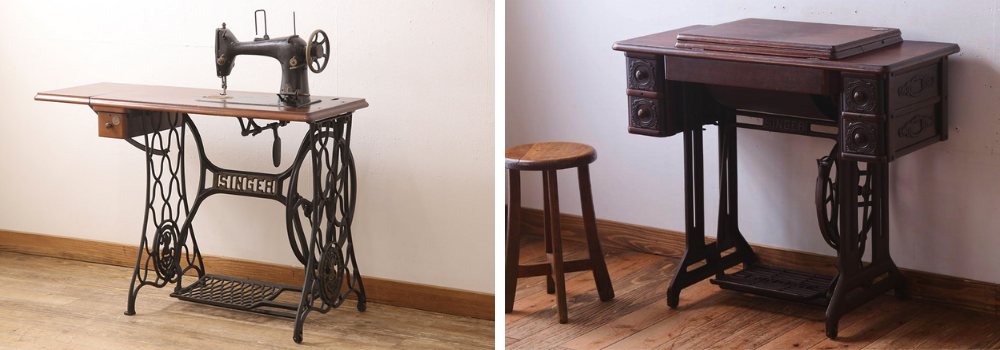
A sewing-machine table is a work table made for setting up and using a sewing machine. From the late nineteenth to the early twentieth century it was widely used in homes and workshops. Built to support the heavy machine securely, it is sturdily made. In the past it was indispensable to women's handwork and home sewing; today it has grown popular as antique furniture, and the original wooden tables and iron legs have been reappraised as attractive pieces for the interior.
Four features
Sturdy construction. The great feature of the sewing-machine table is its strength. A sewing machine is heavy and vibrates as it works, so the table itself had to be solidly built to give a stable working setting. Strong materials such as wood and cast iron were used, and it is practical while also attentive to design.
The top. The top has an opening in which the machine is fixed. Some types have shelves or drawers, so the machine can be stowed when not in use, and many can serve as an ordinary desk or work table; practical ingenuity is built in.
The treadle. The pedal at the bottom is another feature. Early machines were driven by treadle: the operator worked the machine by pressing the pedal. The treadle is a part found only on sewing-machine tables.
Storage. Drawers and storage spaces are fitted, convenient for keeping needles, thread, other sewing things and cloth in order. Drawers are placed at either side where they can be pulled out quickly, a careful detail for efficient work.
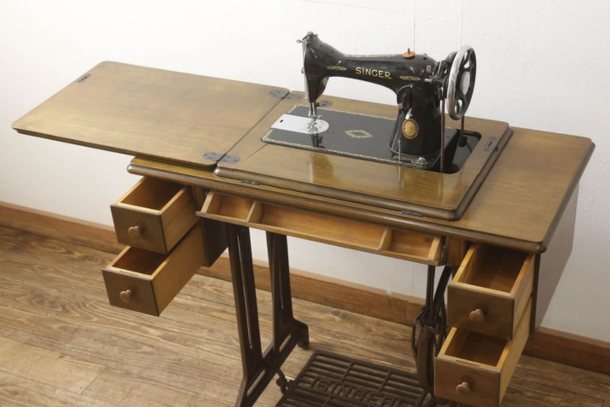
History
The history of the sewing-machine table follows the development of the sewing machine. The machine was first invented in the early nineteenth century; in the 1850s Isaac Singer popularised the treadle machine, and the dedicated table spread with it. In the late nineteenth century many sewing-machine makers began producing tables, devising decorative designs that were easy to use at home and in the workshop and distinguished them from rivals. See Singer.
In the twentieth century smaller, lighter models appeared. In Japan from the Taisho era to the early Showa era Western dressmaking flourished, and many homes used treadle machines and their tables. In later Showa, however, the electric machine became the norm, and dedicated tables were used less and less. Today the function and design of the sewing-machine table are drawing attention again as antique furniture; the treadle table in particular is much loved by antique enthusiasts as a symbol of the age before electricity.
Japan and the sewing machine
The sewing machine was first introduced to Japan in 1854 (Ansei 1): when Perry came to Yokohama, a sewing machine is said to have been among the gifts presented to the Tokugawa shogunate. Thereafter, in the early Meiji era, Japan imported machines in large numbers to make military uniforms and women's dresses. Spreading out from port cities such as Yokohama and Kobe, they reached ordinary homes in time. In the Taisho era domestic machines began to be made, and sewing-machine tables were produced in Japan too. Machine and table played an important part in sustaining the boom in Western dressmaking in Japanese homes and workshops; they became indispensable to daily life, and the efficiency of handwork, mostly done by women, rose markedly. See Taisho roman and Showa retro.
Its appeal as an antique
The antique sewing-machine table is attractive furniture in which the beauty of age stands out. The combination of warm wood and heavy iron legs suits industrial and retro-modern interiors well, and cast-iron bases with ornament in the Art Nouveau or Art Deco manner are a feature peculiar to antique machine tables. Its potential for new uses also deserves attention: its precise detailing and robust construction make it reusable as a side table or desk. Keeping the antique table's character just as it is while harmonising with modern life is its great appeal; it is used less as a sewing-machine table today, but its appearance, emblematic of its age, still captures people's hearts. See Old Charm.
Shell chair
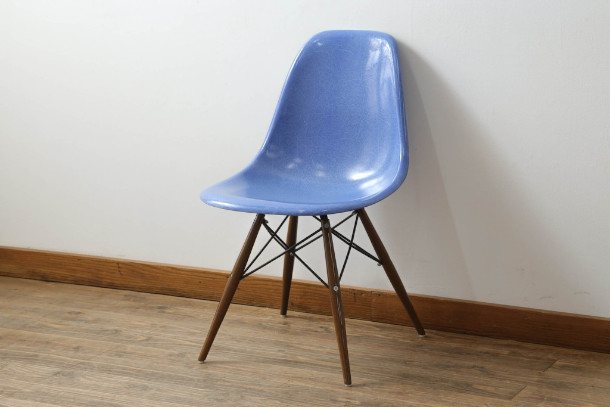
A shell chair is a chair in which back and seat are one piece, the seat gently curving. One of the celebrated chairs designed by Charles and Ray Eames, it is named for its shape, which recalls a seashell.
Features
The shell chair's hallmark is surely its look, with something of Pop about it: a back made in one continuous piece with a seat of moulded resin, set on legs, a design anyone can recognise at a glance. It is not only stylish but comfortable; sit in it and it fits closely around one, with a pleasing flexibility one would not expect of resin. Another distinctive feature is that the base can be chosen to taste: steel, wood, and even a rocker, which is part of the fun of the shell chair. See rocking chair.
Kinds
Shell side chair. A shell of seat and back only. One can slip in from either side and sit down easily. Its clean, spare design fits any interior, and still serves as an accent.
Shell armchair. The type with arms, in which the arms too are one with seat and back, enfolding the sitter. Compared with the side chair it gives a more relaxed seat and a greater sense of security.
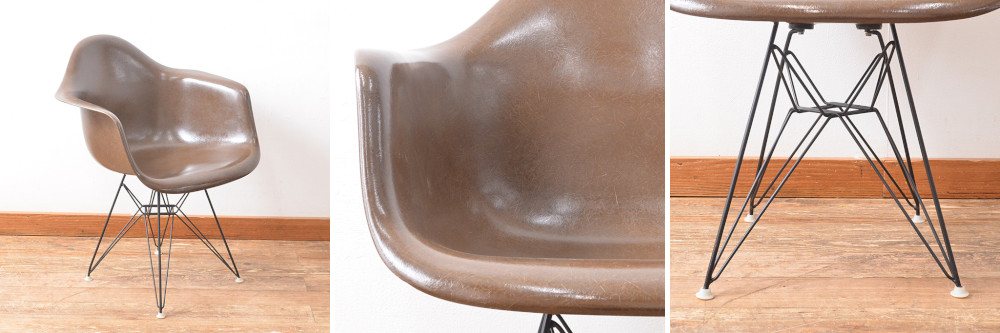
Wood shell chair. The Eames shell chair is strongly associated with plastic, but a technique for making the shell from bent wood has also appeared. Wooden models let one enjoy the changes of age peculiar to wood, with a flavour plastic does not have.
History
The shell chair was born in 1950, formed in FRP, a new plastic reinforced with glass fibre. The first shell chair was the type with arms; three years later the armless side chair was introduced. Light, strong and low in cost, the chair, today also called simply the Eames chair, became a great success as a mass-produced product. For environmental reasons the material has since changed, to recycled plastic among others, but the form remains as it was at its birth.
The Eames shell chair is produced by Herman Miller, but reproductions are now so plentiful that the authorised chair can be hard to find among them. This happens because, in many countries, copies of the design can be made and sold without legal hindrance; it is at the same time proof of how popular the shell chair is.
Shikki (lacquerware)
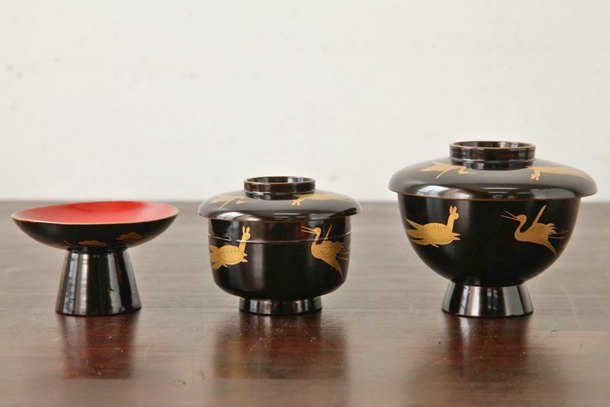
Shikki, lacquerware, are crafts made by applying coat upon coat of urushi lacquer to wood, bamboo and other materials. Urushi is the processed sap of the lacquer tree. Waterproof, rot-resistant and antibacterial, it has served since ancient times as both a coating and an adhesive. In English, lacquerware was long called simply "japan", which says much about how closely the craft was identified with the country.
Lacquerware has been made chiefly across Asia, and every period, country and region has developed its own kinds. Its appeal lies in its lustre, its smoothness to the touch and its beautiful decoration.
Features
Lacquerware is known for its gloss and its silky feel. As urushi dries it hardens into a strong film. Water-resistant, durable and resistant to decay, it has been prized for everything from everyday tableware to the furnishings of great houses.
Its merits are not only practical. Lacquerware is also highly decorative, with meticulous ornament such as maki-e, pictures sprinkled with gold and silver powder, and raden, mother-of-pearl inlay. This work is done by skilled craftsmen and is handed down as a living tradition in every lacquer region.
History
Origins in the Jomon and Yayoi periods. Lacquerwork is ancient: lacquering techniques already existed in the Jomon period. At the Torihama shell mound in Wakasa, Fukui prefecture, a red-lacquered comb and fragments of lacquer-tree wood were found. Two views exist on its origin, one that the technique came from China, the other that it arose in Japan. In the Yayoi period lacquer was applied to farming and fishing tools too, and its uses multiplied.
Artistry in the Asuka, Nara and Heian periods. Decorative lacquer advanced in the Asuka (538 to 710), Nara (710 to 794) and Heian (794 to 1185) periods. With the arrival of Buddhism, lacquer took on an artistic role, decorating temples, Buddhist images and ritual implements. In the Heian period decoration grew richer still, and lavish ornament combining lacquer with gold leaf was developed. Beautifully decorated lacquerware furnished the houses of the nobility and was given as tribute.
Technical progress in the Kamakura, Muromachi and Azuchi-Momoyama periods. In the Kamakura period lacquer making came to be divided among specialist trades, and mother-of-pearl and maki-e techniques advanced. From the end of the Muromachi period into the Azuchi-Momoyama period, lacquered furnishings were exported abroad, the so-called Namban lacquer made for Portuguese and Spanish buyers.
A national culture in the Edo period. Under the closed-country policy of the Edo period, lacquerware followed a path of its own in Japan. Works ranging from the practical, such as writing boxes and sword mounts, to crafts that reached the level of fine art were made. Lacquer could then be tapped all over Japan, and each domain encouraged lacquer making. The result was a wealth of regional lacquers: Tsugaru-nuri in Aomori, Hidehira-nuri in Iwate, Wajima-nuri in Ishikawa and many more. Lacquer making spread nationwide, and everyday lacquered rice bowls, chopsticks and meal trays (zen) reached ordinary people.
Reaching the world in the Meiji, Taisho and Showa eras. After the Meiji Restoration lacquerware was exported to Europe and America and spread around the world; Japanese lacquer, practical and artistic at once, won international regard. After the war, in the age of Japan as a manufacturing power, output kept growing until it peaked around 1990.
Today, with changing ways of life, demand has fallen. Yet for its outstanding qualities, and as a traditional craft that stands for Japan, lacquerware is still loved at home and abroad, and still graces celebrations and gifts.
How lacquerware is made
Methods and techniques differ by region, but the usual sequence runs as follows.
1. The base (kiji). Wood is turned on the lathe or otherwise shaped into the core of the piece.
2. Ground preparation (shitaji). The base is shaved and often covered with hemp or other cloth so that it takes the lacquer well and gains strength.
3. Middle coats (nakanuri). When the ground is dry, middle coats are applied. Repeated coat upon coat, the lacquer thickens and grows stronger.
4. Top coats (uwanuri). The final finishing coats are applied, again many times over. When the lacquer has cured, the whole surface is polished.
5. Decoration. Finally ornament such as maki-e or raden is added, and the piece is complete.
Kinds of decoration
Breathtaking decoration is what lacquerware is known for.
Maki-e. A technique unique to Japan: a design is drawn in lacquer on a dried lacquer ground and, before it dries, gold powder is sprinkled (maku) over it to form the picture.
Chinkin. A design is engraved into the surface with a blade, and gold or silver leaf or powder is fixed into the lines with lacquer.
Raden. Decoration with shell. Recesses are cut into the lacquer and shell, cut to the shape of the design, is set into them. Abalone and the great turban shell (yakogai) are the main shells used. See raden.
Kinds of lacquering
There are two broad methods of applying lacquer.
Red and black lacquer (shu-nuri, kuro-nuri): colour and gloss. Lacquer is built up coat upon coat until it covers the ground completely. Being opaque, it shows the colour and lustre of the lacquer itself.
Wiped lacquer (fuki-urushi): coat and wipe. Instead of building up coats, lacquer is applied and wiped off again and again. The result is translucent, and it is used to show the grain of the wood. It is the finish of many tansu, especially zelkova chests.
The great lacquer centres of Japan
Several lacquer regions, renowned for outstanding technique and tradition, are traditionally counted as Japan's three great lacquer centres. Accounts vary in which three they name.
Wajima-nuri (Ishikawa). Made in Wajima, Ishikawa prefecture, and known for splendid maki-e and chinkin over an exceptionally strong ground, which gives it great durability as well as beauty. It began about six hundred years ago and in the Edo period, with the support of the Kaga domain, rose to become a great centre. See Wajima-nuri.
Yamanaka-nuri (Ishikawa). Made in the Yamanaka hot-spring area of Kaga, Ishikawa prefecture. It excels at turned work and is called "Yamanaka of the wood base", known for fine carving and graceful curves. It began some four hundred years ago in the Azuchi-Momoyama period and spread across Japan in the Edo period.
Kishu-nuri (Wakayama). Made chiefly in the Kuroe district of Kainan, Wakayama prefecture. Simple in appearance, sturdily made and reasonably priced, it was loved by ordinary people as "lacquer for use". It began in the Muromachi period and flourished as a major centre in the Edo period.
Aizu-nuri (Fukushima). Made in the Aizu region of Fukushima prefecture and known for auspicious maki-e and splendid gold-powder decoration. It began in the Muromachi period, and in the Edo period its techniques developed under the protection of the Aizu Matsudaira, a branch of the Tokugawa.
Shinchu (brass)
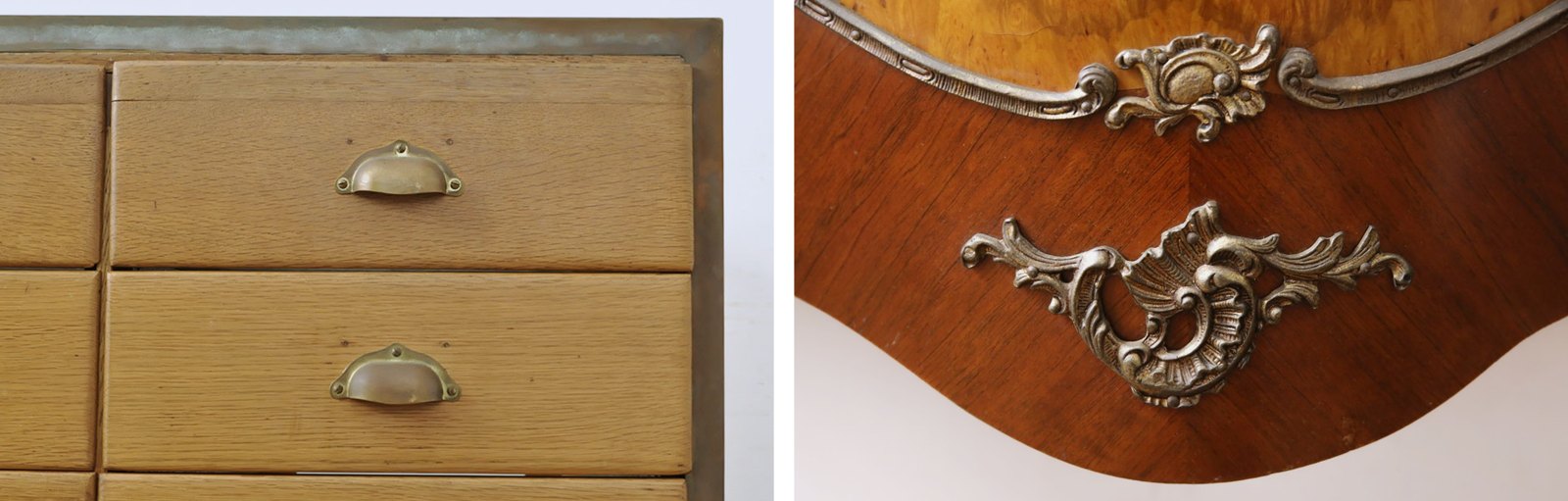
Shinchu, brass, is an alloy of copper and zinc, also called odo or kodo ("yellow copper"). It may not be a familiar word, but it is all around us: the fittings of leather goods, the pins of plugs, some of Japan's coins, crafts, jewellery, Buddhist altar fittings and brass instruments. Its golden gleam has an air of luxury and festivity, and it is a common metal in furniture. Beautiful and full of practical virtues, it has been loved worldwide for millennia.
Kinds
Brass is classified by its zinc content. The more zinc, the harder it becomes, but above about 45 per cent it turns brittle and cracks under shock. More zinc also makes it more golden; less makes it redder. Colour and strength both change with the proportions.
Tombac, or red brass (tando). High in copper, with 5 to under 20 per cent zinc. Strongly reddish, hence "red brass". It is easy to work, resists corrosion and has a fine lustre, and ages to a character of its own. It is used for building materials, ornaments and brass instruments.
70/30 and 65/35 brass (brass grades 1 and 2). About 65 to 70 per cent copper and 30 to 35 per cent zinc. Well suited to cold working, shaping without excessive heat, and to thread rolling, deforming under high pressure without cutting. It excels at precise, complex shapes, and is used for electronics, terminal connectors, cameras and vacuum flasks.
60/40 brass (Muntz metal, brass grade 3). About 60 per cent copper and 40 per cent zinc. Excellent for hot working, rolled while softened by heat; easily worked, it suits mass production and is very economical. Strong, tough and easy to plate, it is used for wiring parts, sheet metal and name plates, a highly versatile material. Copper alloys with more than 60 per cent copper are also antibacterial.
Others. Free-cutting brass has lead added to make it easy to machine, with good weldability, plating and press-forming. Forging brass is the brass best suited to hot forging, moderately strong, ductile and machinable. High-tensile brass has manganese, aluminium and iron added, giving very high strength and hardness, good hot-forging, mechanical and wear properties. Naval brass has a little tin added to resist seawater, and is also hard and strong.
The appeal of brass
A dignified, elegant colour. The golden gleam that catches the eye at once is brass's great attraction. Its deep colour speaks of luxury and refinement, and it partners beautifully with wood and leather, prized in interiors and fashion alike. In furniture it is used decoratively, and very often in touches: handles, knobs, frames. Even used sparingly it has presence, an accent that lifts the whole piece.
Beautiful ageing. Brass that gleamed brightly softens over time. Its quiet colour and the particular dullness it takes on are attractive too, with a sober, weighty air. Solid brass without plating or lacquer ages as the copper oxidises and darkens on contact with air, moisture and hands, but a light polish with a metal polish easily restores the shine, and you can stop at whatever degree of patina you like. Water and salt readily cause verdigris (rokusho), which polish also removes. Daily care is no more than a wipe with a cloth. Bright or aged, brass can be enjoyed freely as you wish.
Endlessly workable. If brass's nature were summed up in two phrases, they would be "slow to corrode" and "easy to work". Even in kitchens and dining rooms where it meets water, it lasts long with a little care while its character slowly changes. Its many grades, each worked by suitable methods, can take almost any form; machinable and ductile, brass offers great freedom of design and expression.
Brass on furniture
Antique and vintage. Brass is thought to have been used from about 1000 BC, and was a common material in antique and vintage furniture. Europe in particular is rich in gracefully curving and finely elaborate brass. English work tends to calm, weighty designs; French to splendid and elegant ones. In the vintage years, by contrast, furniture with simple handles and sliding doors appeared. Brass differs by country and period, and comparing them is a pleasure.
In Japan brass is said to have come into use in the Edo period. On tansu it ranges from plain, practical fittings to lavish decorative hardware such as hand-chased, hand-hammered fittings (chokoku teuchi kanagu), showing the care and skill of the craftsmen of the time. Lamps, display shelves and tables made largely of brass also survive in numbers and sit easily in modern rooms. Most kanagu on antique tansu, though, are iron; brass and copper appear on finer chests and on later pieces. See isho-dansu.
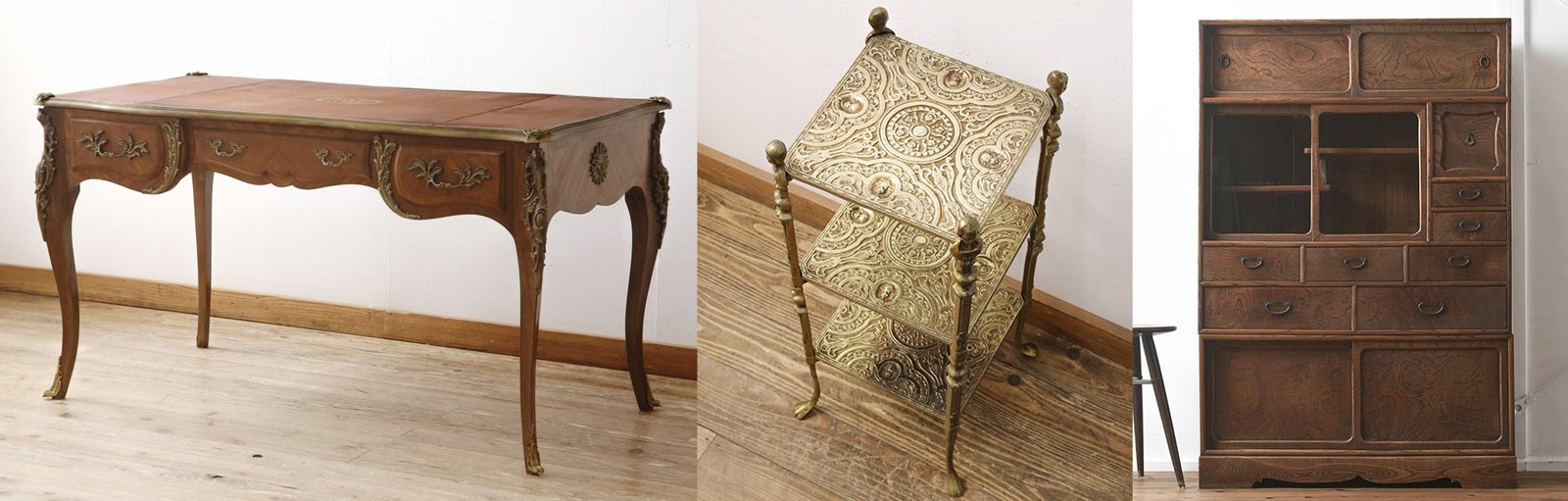
Modern. Brass has kept its popularity for centuries, untouched by fashion, and modern furniture uses it widely. Today the tendency is less towards lavish ornament than towards small areas and simple designs, which show off its beauty and carry an antique air, suiting luxurious and shabby-chic rooms alike. Ageing beautifully, brass is a companion for the long term.
Shippo-yaki (cloisonné enamel)
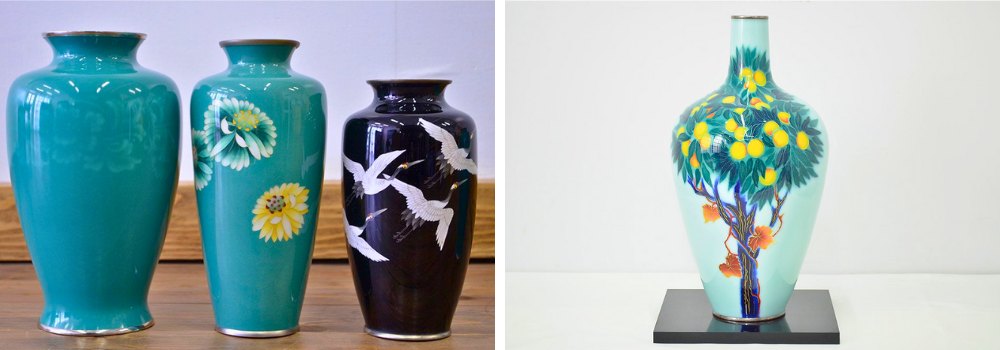
Shippo-yaki is the traditional craft of fusing glassy enamel onto the surface of metal. The name comes from the "seven treasures" (shippo) of the Buddhist sutras: gold, silver, lapis lazuli, crystal, coral, agate and pearl. It is used chiefly for ornaments and works of craft, and charms with its vivid colour and particular lustre.
Features
Shippo is distinguished by beautiful colour and a particular gloss. Fired hard at about 800 degrees, it is also very durable.
Techniques
Shippo has many techniques; six are representative.
Yusen shippo (wired cloisonné). The most representative technique: enamel is filled into outlines formed of metal wire. Because of the wire outlines, adjacent colours never mix, so it is used mainly for fine designs and patterns.
Musen shippo (wireless cloisonné). Enamel applied without visible wires. As in yusen, enamel is first laid within wire outlines, but the wires are removed before firing; with no boundary between colours, beautiful gradations and soft, blurred effects become possible. It was perfected in the Meiji era by Namikawa Sosuke of Tokyo.
Zogan shippo (champlevé). The ground is carved or shaped into recesses and the enamel set in them, either poured straight into the hollows or made separately and inlaid. Common in Europe, it gives depth and complex design.
Shotai shippo (plique-à-jour). Fired as for yusen, after which the metal base is dissolved in acid, leaving only the enamel, a translucent work like stained glass.
Moriage shippo. Enamel is built up high and fired. Where other techniques are polished flat, moriage deliberately keeps the relief, giving a plump, three-dimensional effect.
Frit shippo. Patterns are drawn with granular enamel called frit, which fires into round patterns with soft edges.
History
The exact origins of enamelling are uncertain, but related techniques of setting glass into metal were already practised in ancient Egypt; the gold mask of Tutankhamun, inlaid with coloured glass and stones, is the famous example. It reached Japan by way of China in the Asuka and Nara periods, at first as a technique for decorating Buddhist art. In the Heian period it developed for aristocratic ornaments and furnishings, and in the Edo period it spread among ordinary people, with many craftsmen.
In the Meiji era shippo became enormously popular. It was soon exported and highly regarded as a Japanese craft; Owari shippo of Nagoya and Kyo-shippo of Kyoto are the best known, winning many prizes at home and abroad at the great international exhibitions. Namikawa Yasuyuki of Kyoto, master of fine wired cloisonné, was among the most celebrated.
From antiquity to the Edo period, inlaid (zogan) techniques were the norm; wired cloisonné, now the representative technique, is said to have been developed in the late Edo period under Dutch influence, by Kaji Tsunekichi of Owari.
For collectors
Fine Meiji cloisonné shows very thin, even wires, smooth, bubble-free enamel and a high polish; many later export pieces have thicker wires and duller colours. Check for chips and hairline cracks in the enamel, especially at the rim and foot, and for dents in the metal body.
Shitan (rosewood)
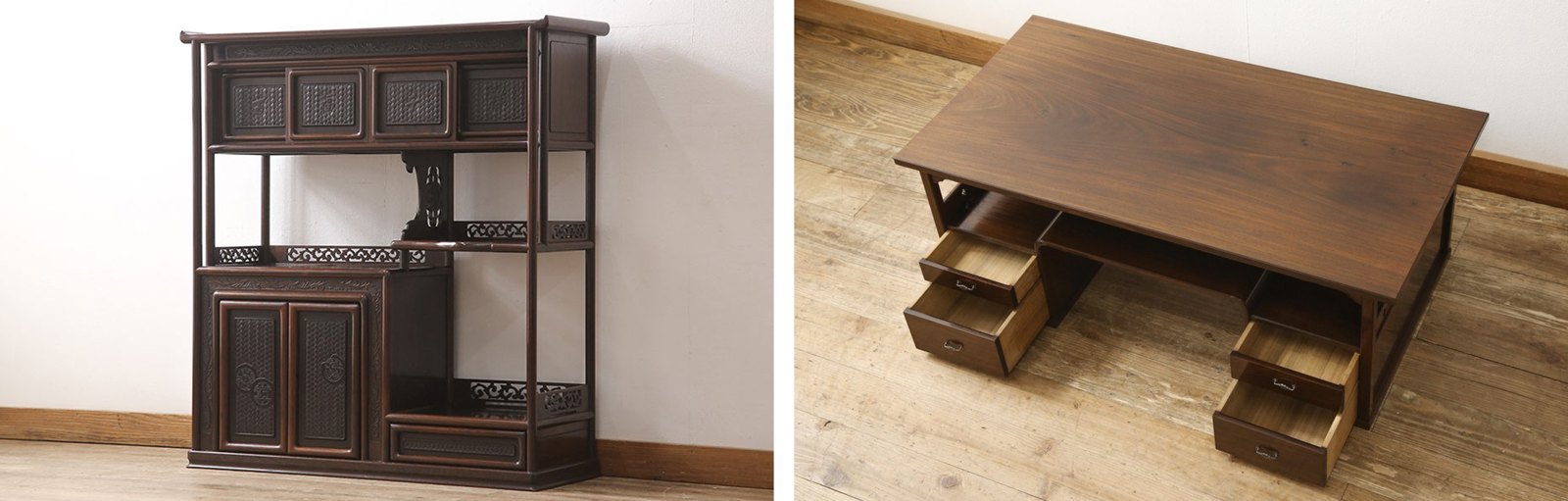
Shitan is the collective name for several broad-leaved trees of the legume family, in the genera Dalbergia and Pterocarpus. They grow from the tropics to the subtropics, in Brazil, Central America and South East Asia. With kokutan (ebony) and tagayasan (ironwood) it is one of the three great karaki, a luxury timber treasured since ancient times. The trees give off a faint rose-like scent, hence the Western name rosewood.
It has long been used for crafts, Buddhist altars and fittings, karaki work, furniture, floors and instruments, and it is famous as the wood of one of the rarest treasures of the Shoso-in, the eighth-century five-stringed lute of shitan inlaid with mother-of-pearl. Beautiful and durable, it is renowned worldwide, but demand led to overcutting, and many rosewoods are now protected under the Washington Convention (CITES), which makes the timber very precious.
Kinds
Hon-shitan (true rosewood). A tree of the genus Dalbergia, from Vietnam, Laos and neighbouring countries (Siamese rosewood, Dalbergia cochinchinensis). Sometimes called "queen of woods", it is the finest shitan. Very heavy and hard, it shows interlocked grain, the fibres crossing alternately one way and the other, yet it finishes to a very smooth surface. Its grain forms beautiful stripes of purplish dark brown and black-purple, and it feels moist and settles well in the hand.
Techigai-shitan. Also Dalbergia, from Thailand, Myanmar and neighbouring countries. It so resembles true shitan that it was confused with it in trade, hence its name, "mistaken shitan". In substance, heavy and hard with interlocked grain, it is almost the same; the difference is in the stripes, which are less distinct, and in the colour, a pinkish red-purple brown, so it looks paler and softer than true shitan.
Koki-shitan (red sanders). A Pterocarpus, closer to padauk than to rosewood, and the heaviest and finest of its genus (Pterocarpus santalinus). From south-eastern India and Sri Lanka, it is also called red sanders. Its properties are like the two above, but it is redder, varying greatly from red-purple to deep crimson; deep colour and figure are especially high grade. It is famous as the finest wood for the neck of the shamisen.
Woods often used in place of shitan, Bolivian rosewood, granadillo, pau rosa and bubinga among them, are sometimes grouped as "shitan-type" (shitan-kei), a term most often seen on Buddhist altars.
The appeal of shitan
Beautiful grain and lustre. The stripes woven by its distinctive purplish "shitan colour" and black-purple grain are beautiful and luxurious. It polishes to a superb lustre that deepens with use, growing ever more distinguished. Emperor Shomu loved it deeply, as the Shoso-in treasures show.
Heavy, hard and durable. So close-grained that it sinks in water, it is heavy, hard and tough. It is somewhat difficult to dry and work, but once worked it is strong and stable, an excellent timber. It resists insects and fungi without any special treatment, and is outstandingly resistant to decay. For its looks and qualities it served as a furniture wood for nobles and royalty.
Shitan furniture
Antique shitan furniture. Shitan was one of the karaki brought from Tang China by the envoys of the Nara period, and the use of karaki as a whole increased in the Azuchi-Momoyama period. When imports by steamship began in the Meiji era it was used more widely still, and drew attention worldwide as "the rosewood of the East". Many antique shitan pieces survive; their deep, dark colour speaks of history and gives a room a taut, settled calm.
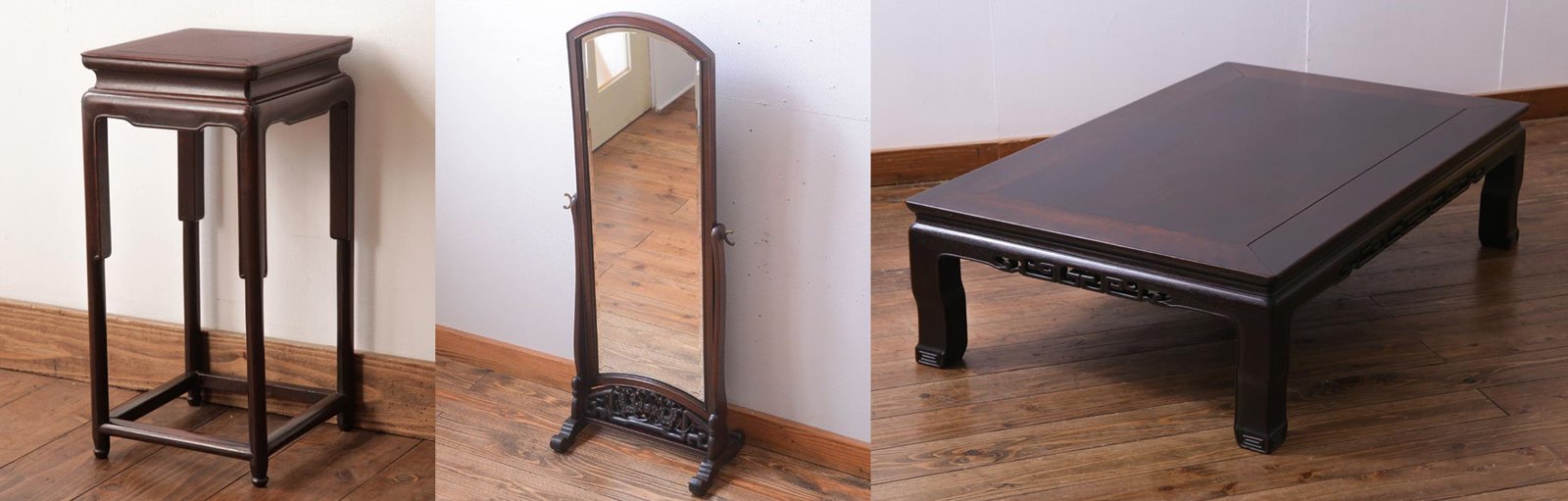
Vintage shitan furniture. Japanese vintage furniture includes many shelves and low tables that recall the Showa era, simple designs that let the shitan grain be enjoyed to the full, set with fine carving and ornament, with a dignified, commanding presence. Imports of shitan to Japan peaked around 1970 and then all but dried up.
Modern shitan furniture. Shitan furniture is still popular, above all Osaka karaki sashimono. Karaki cabinetwork took root in Osaka, the commercial centre of the Edo period; sashimono means woodwork assembled from boards jointed together without nails or screws, and this traditional craft, with three hundred years of history, is carefully handed on today. Osaka karaki is known for a smooth lustre built up with coats of lacquer and a deep, weighty colour. Alongside furniture made to suit modern life while keeping tradition, small things such as ballpoint pens, chopsticks and sweet picks bring the charm of shitan closer to hand. See karaki.
Shitomido (top-hung lattice shutter)
A shitomido is a traditional Japanese fitting used in the shinden-zukuri mansions of the Heian nobility: a board door with lattice applied to front and back, sometimes called simply shitomi. It is known for the texture of its wood and its handsome lattice, and both connects inside and outside and divides the living space from them. Its lattice and detailing were made to blend with the landscape and the nature of the four seasons, and that harmony of beauty and function is admired as one of the finest expressions of Japanese architecture. The shitomido is also regarded as the forerunner of the window, a glimpse of an older Japan that cherished the seasons.
A fitting born in the Heian period
The shitomido is best known from Heian shinden-zukuri, where it divided the main living space (moya) from the outside. Developed from the board door, it is a timber lattice with boards sandwiched between. It opens upwards: the door, hung from the tie beam (nageshi), is pushed up and outwards and held with an L-shaped iron hook.
Its sturdy construction made it heavy work to open and close, but closed it became a wall against rain, wind and sun, a great support to life at the time. One theory derives shi from "wind and rain" and tomi from "stop": a fitting developed, in hot and humid Japan, to keep out rain, wind and strong sun and make life comfortable.
History
Beginnings. Its exact origin is unclear, but it appeared between the end of the Nara period and the Heian period, in the later eighth century, in the inner palace where the emperor lived, in the imperial residences and in the mansions of the nobility. Before it, board doors of Chinese origin opening in two leaves (kannon-biraki) were used; with shinden-zukuri, the shitomido was born as a fitting of Japan's own.
After the Heian period. From the Middle Ages it became widespread, used in the Japanese rooms of warrior residences and in tea rooms. In the Edo period merchants used it too, because it displayed goods well. It was very heavy, though, and once easier sliding doors appeared, the shitomido gradually declined.
Features
Materials. Light, strong woods with a handsome grain, chiefly sugi and hinoki. Supple yet robust, some still survive in buildings more than a thousand years old.
Kinds. The best-known form is the half shitomi (hajitomi), divided into upper and lower panels, of which mainly the upper opens. Others include the single-panel shitomi (ichimai shitomido), one door lifted whole, and the standing shitomi (tatejitomi), set between posts as a screen.
Lattice. The lattice is the shitomido's most striking feature. It is made by hand, fitting together long members up to five metres in length. Building the wood as a lattice increased its strength, making it far sturdier than the single-board doors before it. Being a lattice, it divided inside from outside while letting air through, and also gave shade and privacy.
Weight. A single-panel shitomido was very heavy; large ones are said to have needed four adults to open. The shitomido of temples, palaces and shinden mansions were large and heavy, and opening them was hard labour; a picture of the palace cleaning ceremony at the Seiryoden shows a T-shaped tool, the shumoku, being used to push one open.
Its roles
The shitomido was used throughout shinden-zukuri, which had few walls or doors. Closed, its sturdy, weighty construction served as wall, storm shutter and screen against light, and gave privacy. Open by day, it let the whole landscape be seen, much like a window today.
Because opening it was so laborious, it might seem that no one could come or go once it was shut; but small doors were set into some shitomido, and at the ends of the building hinged double doors (tsumado) allowed people in and out even when it was closed.
Used on its own. Besides serving as door or wall, a shitomi could stand alone as a partition or screen, as in the tatejitomi. Set simply against a wooden base, one panel served as a windbreak or a screen; two stood at right angles made a temporary room. In gardens, and indoors too, they divided the open halls of shinden-zukuri into as many rooms as were needed.
In merchant houses. In the Edo period merchant houses and town houses adopted the shitomido too, for good reason. The shop occupied the front of the house facing the street, and goods set out at the front had to be easily seen from outside, with a wide opening for people and goods to pass. The wide-opening shitomido was ideal for trade.
Born of a court culture that loved nature
Courtly taste. The shinden mansions of the nobility were built to be refined and delicate, in harmony with nature through the seasons. Broad, carefully shaped gardens surrounded them, and fittings like the shitomido joined building and garden into one. Walls or side-opening doors in those open halls would have blocked the view; a door that opens upwards leaves the whole landscape in sight, a rational fitting.
The view through the shitomido. As the seasonal poems of the Heian poets show, the Japanese have long cherished the seasons, and a culture that sharpened its sensibility with each turn of the year is one of Japan's own. The shitomido framed the landscape the Japanese saw. Beyond writing poems, people recorded it in picture scrolls, and felt it with every sense. The shitomido still carries the reverence for nature, and the love of the passing seasons, of the Japanese aesthetic.
Shonai tansu
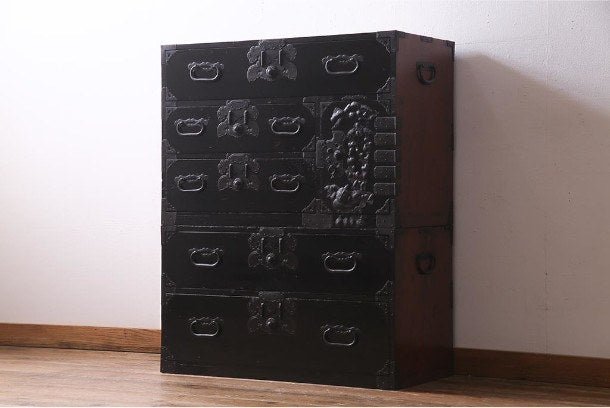
Shonai tansu are chests made in the Shonai district of Yamagata Prefecture, centred on Sakata and Tsuruoka. Those of Sakata and Tsuruoka have different characters: Sakata made mostly sea chests and merchant's chests, while Tsuruoka made lacquered clothing chests.
Features
Sakata chests. Chests made in Sakata are also called Sakata-dansu. Mainly sea chests and merchant's chests, their lock plates carry patterned designs, and some have square pulls. Compared with Tsuruoka chests, the grain shows through the finish. Most are zelkova, with the lavish construction proper to sea and merchant's chests.
Tsuruoka chests. Chests made in Tsuruoka are likewise called Tsuruoka-dansu. Mainly clothing chests, finished in black lacquer, with decorative fittings in relief and rounded pulls. As clothing chests, many have paulownia interiors.
Kinds
Chiku-dansu. Made mostly in Sakata. The chiku was the officer on a merchant ship responsible for accounts and paperwork, and this was his chest. It held papers and stationery and also served as a desk, so decoration is restrained and the height low.
Sea chests. Made mostly in Sakata. Weighty in design, they nonetheless float, and are so precisely made that contents stay dry even if the chest is wetted.
Merchant's chests. Made mostly in Sakata. Like sea chests they kept money and valuables, though without special resistance to water. Standing at the choba, the accounts counter, in view of customers, many are lavishly made.
Clothing chests. Made mostly in Tsuruoka. Many have paulownia interiors that protect clothes from mould and insects. Tsuruoka chests are known for black lacquer, which makes them look more luxurious than brown-toned chests.
History
Shonai chests were made from the late Edo period, with a golden age from Meiji 30 (1897) through the Taisho era. Shonai prospered as a port of call for the kitamaebune; visiting merchant ships led to the making of sea chests, and as a trading port it also produced many merchant's chests.
From the mid-Meiji period, as ordinary life grew more prosperous, a chest for clothing became indispensable, and clothing chests took over from sea and merchant's chests.
Having made such finely built chests as sea and merchant's chests, the Shonai makers carried that skill into their clothing chests, and the name remains popular today.
Showa retro
Showa retro describes things that evoke the atmosphere of the Showa era (1926 to 1989), made out of nostalgia for and fascination with that time. It also describes things actually made in the Showa era that have a nostalgic feel. Across every genre, it covers anything that recalls the image of Showa.
Features
Showa retro is marked by the lauan (Philippine mahogany) plywood typical of Showa furniture and by colourful palettes. Typical pieces are things once seen in the penny-sweet shop (dagashi-ya), the low dining table (chabudai), and tableware in bright pop colours and patterns, the nostalgic things in fashion from about 1955 to 1975 (Showa 30 to 50).
Japan then took in many designs that mixed Japanese taste with Western culture, and together with the times they have a flavour all their own. There is something a little unpolished about them, and that is part of what draws people. The style shows most clearly in things close to daily life, such as furniture and tableware: the glass-fronted sideboard, the cabinet radio, the stand-alone hand-cranked shaved-ice machine, the floral enamel pot.
Showa retro and Taisho retro
Showa retro and Taisho retro (Taisho roman) share the word "retro", but how do they differ? As the names say, Showa retro calls up the nostalgic scenes of the Showa era, while Taisho retro goes back further, to the mood of the Taisho era (1912 to 1926). Showa retro feels nostalgic because of its background: the years after the war when Japan settled down, Western culture took full hold, and old-fashioned warmth between people still lingered. Taisho retro, by contrast, is the moment when Japan, having taken in Western culture from the Meiji era, developed it in its own way and fused Japanese and Western taste. See Taisho roman.
A fashion that is still running
Today Showa retro draws attention even among people in their teens and twenties who never knew the Showa era; its nostalgic designs look fresh to them. Simple yet playful, these things are popular not only with people in their forties and fifties but with the young as well.
Side-by-side
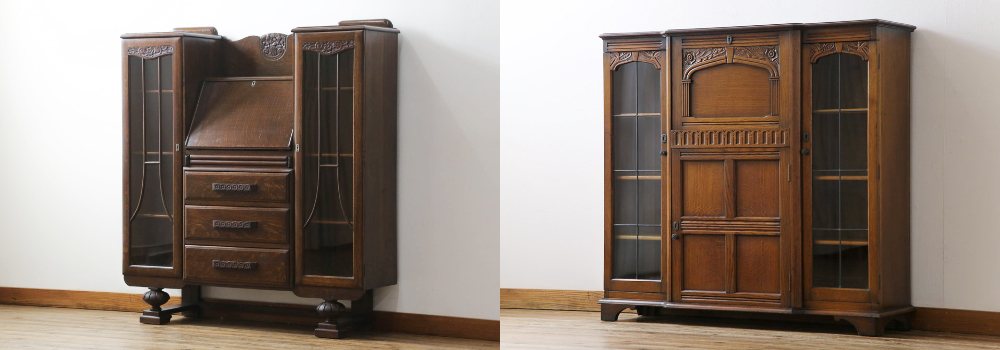
A side-by-side is a multi-purpose piece combining a writing bureau and bookcases. A writing bureau is a desk with storage like a chest or cabinet; the side-by-side takes its name from the bookcase set on each side of it. Among antique furniture it has a relatively short history, but as convenient furniture uniting three functions, desk, storage and bookcase, it has served in many settings. See writing bureau.
Features
Multi-purpose and space-saving. Its great feature is an innovative construction that gathers into one piece a desk, storage and a bookcase, normally separate furniture, so it is outstanding in function and practicality alike. Being multi-purpose, it serves in the study, the living room and elsewhere, and with its functions concentrated it can be used where space is short.
Beauty of grain and design. Oak and walnut are often used, so one can savour beautiful, luxurious grain. The bookcase doors are mostly glazed, and their bright presence gives a sense of openness and quality. Fine carving and elaborate detailing throughout enhance the design of the whole. See oak and walnut.
Kinds
Designs. The basic construction, bookcases at either side of a writing bureau, is consistent, but sizes and designs are truly varied: the Victorian style, with the weighty classical feeling of England; the Art Nouveau style, with curving designs on motifs from nature; the Art Deco style, combining straight lines and geometric patterns. Country of making and style give it many faces. Some go further in function, with a mirror above so the piece can serve as a dressing chest, or with space beneath the desk so a chair can be put away. See dressing chest.
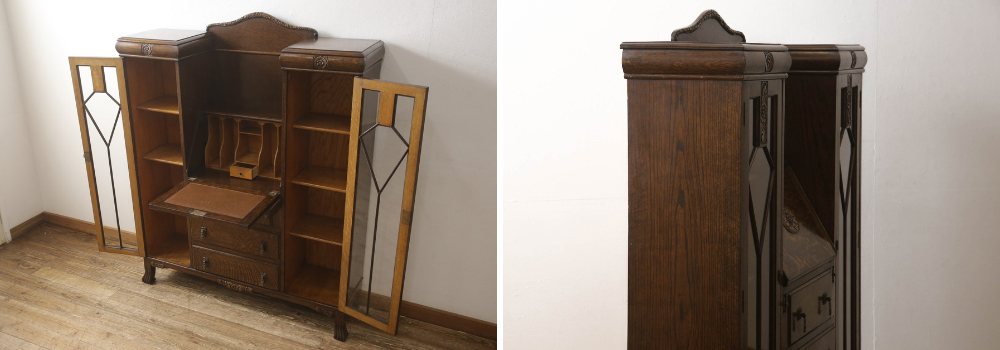
Arrangements. There is also an arrangement with a bookcase on one side of the writing bureau only, and this too is sometimes called a side-by-side.
History
The writing bureau, the prototype of the side-by-side, was born in seventeenth-century England. Later, as the population grew with the Industrial Revolution and living space could no longer be had in sufficient amounts, the side-by-side was developed to use space effectively, and its making began in the late nineteenth and early twentieth centuries. For this reason it seems to have won popularity as furniture for the middle classes rather than for the aristocracy or the wealthy. The period was just where the Victorian and Art Nouveau styles crossed, and side-by-sides were made in many designs reflecting each. Beautifully ornamented, the side-by-side was regarded not as mere furniture but as a cultural emblem, and it brought richness to people's lives.
Side-by-sides of that period are now precious, much-sought pieces, seldom seen among antiques today, and their construction greatly influenced home-office furniture as an early model.
Side-by-side and bureau bookcase
A bureau bookcase, like a side-by-side, combines a writing bureau and a bookcase, but in a bureau bookcase the bookcase is fitted above the bureau, so the construction is different.
Uses today
With its many functions and handsome looks, the side-by-side serves not only as furniture for the study but, depending on one's ideas, as a showcase for a collection, a bar cabinet or a bathroom cabinet. Born in Britain, an island nation like Japan, it suits the limited space of Japanese homes well, and makes a comfortable setting for living.
Singer
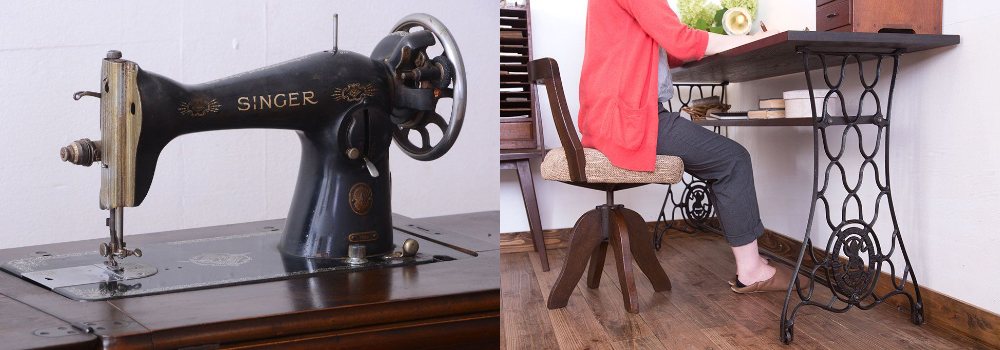
Singer is the long-established sewing-machine maker, founded in 1851, that developed and sold the first practical sewing machine. It takes its name from its founder, Isaac Merritt Singer. Singer spread machines of every kind around the world, hand-cranked, treadle, electric, electronic and computerised, and contributed greatly to technical innovation; its quality, design and reliability established an unshakeable position in the sewing-machine industry. It remains a popular brand, used by people around the world today. See sewing-machine table.
Features
As the oldest and largest sewing-machine maker in the world, Singer's great feature is a sure quality built on tradition and achievement. Its machines are designed to be easy for everyone from beginners to experts, with rich functions for many kinds of stitching and embroidery. Over its long history it has produced machines in a remarkable range of styles: tables made almost like chests, iron bases bearing the Singer name, portable hand-cranked machines. And it has diversified beyond industrial and domestic sewing machines into products such as printers and multi-function devices.
Representative machines
The first machine (1852). Singer's first product was sold packed in a wooden crate. The machine could be set up on the crate itself, and by assembling the treadle and the balance wheel (pulley) and linking them, one could sew. One turn of the balance wheel made one stitch; with the wheel removed and combined with the treadle mechanism, three stitches. This arrangement became the basis of the sewing machine.
The Standard series. The year after the first machine, Singer offered the "No. 1 Standard", an improved industrial version. The "No. 2 Standard" of 1854 looked much like the No. 1 but was heavier, with more room under the arm and presser feet that could be changed to suit the work. The "No. 3 Standard" of 1856 was devoted to sewing leather for harness and carriages, with some 45 centimetres of space under the arm.
The Turtleback (1856 to 1859). The first small, handsome machine made for the home, named for its resemblance to a turtle's back. Its iron treadle stand, decorated with leaf forms, was innovative, improving both ease of use and design. A shaft driving the needle and the take-up moved the reciprocating shuttle (the hook or bobbin case) and the needle, and the up-and-down motion of the treadle was designed to transmit more power through a belt to the rotating wheel.
The New Family (1865 to 1890). A lighter, more practical domestic machine. Very costly at the time, it nevertheless sold more than four million units by about 1890, chiefly to the well-to-do, with many changes of design: a famous model. Its elegant decoration with acanthus motifs is striking, and the black of the whole machine is sometimes said to show the influence of Japanese lacquer. One turn of the handle sent the long boat-shaped shuttle back and forth beneath the machine, making three stitches. See acanthus and urushi.
Class 41. A visually arresting industrial machine that made two to twelve parallel rows of stitching in a single operation. By arranging three to twelve needles as one liked within a range of about 1 to 5 centimetres, the stitch spacing could be set freely. Because of this special construction the lower-thread bobbin could not be placed in the shuttle, so the lower thread was fed steadily from a winder through a hole in the centre of the shuttle. Class 41 was used mainly for sewing corsets, dress stays, boots and shoes, and greatly raised productivity.
Class 15 (1895). A long-lived design, improved and produced for more than a century. Over a long period of evolution, with the tension assembly moved and the ability to sew forwards and backwards added, Class 15 acquired many features that became standard on modern machines. The 15U150 in particular, made at the Utsunomiya factory, is closely tied to Japan.
The Mon Ami series (1973). A household machine series born in France in 1973, popular with everyone from beginners to experts. Simple operation reassuring to beginners, durability and quiet running, the power to sew thick fabrics and a beautiful design of smooth curves made it excellent in every respect, and it is still made. Its name means "my friend" in French, and true to the name it is loved as a dependable companion.
History
Birth and success. Research towards the sewing machine is traced to William Lee of England in 1589, and in 1790 Thomas Saint of England invented a machine something like a prototype sewing machine. Isaac Merritt Singer, born in America in 1811, was so skilled in mechanics that he invented machines himself; one day the sight of an unfinished sewing machine showed him its future, and he began improving it. In 1851 he founded the company with the lawyer Edward Clark, at first a small machine shop in Boston. Taking a patent on a lockstitch machine whose seams were hard to unravel, he began selling the first Singer machine. Light and small enough for home use, with strong needles, a sewing action that could run for long periods and an excellent mechanism for gripping the cloth, it won many hearts and quickly became popular.
Where the record differs. William Lee's machine of 1589 was a stocking frame for knitting rather than a sewing machine, and Elias Howe's lockstitch patent of 1846 preceded Singer's; Singer's machine is more usually called the first commercially successful sewing machine than the first practical one.
A revolution in sewing. In 1855 the Singer machine won the top prize at the Paris Exposition Universelle. On this success a shop opened in New York, and manufacturing expanded into Europe; the Singer name became widely known and the company grew into a global enterprise. Singer was the first in the world to introduce payment by instalments, which brought the then very costly machine to many people. Manufacturing began in Scotland in 1867, making Singer one of the first companies in the world to operate abroad, and the world-famous "S" logo was introduced, its design varying by period and country.
The electric machine. In 1886 Singer began selling in Turkey too, and in 1889 the first electric sewing machine was made. In 1891, as part of its marketing and advertising, it adopted what is called the world's first jingle: a song written for the company, "The Merry Singer", which did much for the machine's reputation. Singer also put effort into sewing instruction: free sewing courses opened in New York in 1927 were taken by some three million women over thirty years. From 1939 to 1945, during the Second World War, product manufacture stopped, and production for the war industries began instead.
A centenary, and today. Reaching its centenary around 1950, the company counted its shareholders in thousands and achieved annual sales of 307.8 million dollars. Its advance continued: in 1994 it made the "Quantum XL-1000", the world's first computerised sewing machine of its kind, with built-in functions making complex embroidery easy. In 1999 it contracted with Nintendo to make a fully computerised machine, and the resulting digital machine went on sale the following year. In 2005 came the "Futura CE-200", which connected to a computer by USB cable. Past its 170th year, it continues to evolve.
Singer in Japan
The sewing machine is said to have reached Japan in 1854, when a machine by Wheeler and Wilson was among the gifts on Perry's second visit. Wheeler and Wilson, like Singer, was a leading maker; it was absorbed by Singer in 1905. As Japan began using machines to sew military uniforms and ladies' dresses, Singer machines arrived in 1900, with main shops opened in Kobe and Yokohama. Singer introduced instalment payment in Japan as well, bringing the costly domestic machine within reach.
Most Japanese then wore kimono, and Singer, judging that the spread of Western clothes was essential to its success, founded in Tokyo in 1906 a private school, the Singer Sewing Girls' Academy, to teach machine sewing. It contributed greatly both to the spread of Singer machines and to the flourishing of Western dressmaking education. In 1921 Pine Sewing Machine, later Janome, developed the first domestically produced machine; Brother followed in 1928 and JUKI in 1947, as Japanese companies entered the industry one after another. Deeply involved in the history of the sewing machine in Japan, Singer continues to have great influence today. See Taisho roman.
Uses today
An antique Singer in good condition may still be used as a working machine, but today it is also very popular as an interior piece, making a picture simply standing in a room. Sewing-machine tables, too, are often used as antique furniture: one can savour the retro look that age has enriched, or have them remade to harmonise with a modern interior. In many ways they add richness and colour to our lives. See Old Charm.
Spindle chair
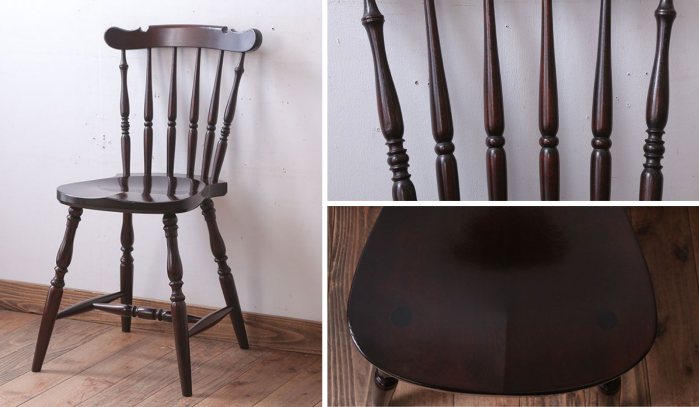
A spindle chair (spindle-back chair) is a kind of Windsor chair, the traditional English wooden chair, distinguished by back sticks of spindle-shaped design. The form, thick in the middle and tapering gradually to each end, looks like a spindle for winding thread, hence the name. It is said to have been born in England in the first half of the nineteenth century, and it is still used and loved around the world. See Windsor chair.
Features
The spindle chair's greatest feature is that, on the basic structure of the Windsor chair, its back sticks, legs and stretchers are designed in spindle form. It is a variation of the comb-back chair (bow-back chair), itself a kind of Windsor, and designs differ with the place, period and maker. See comb-back chair.
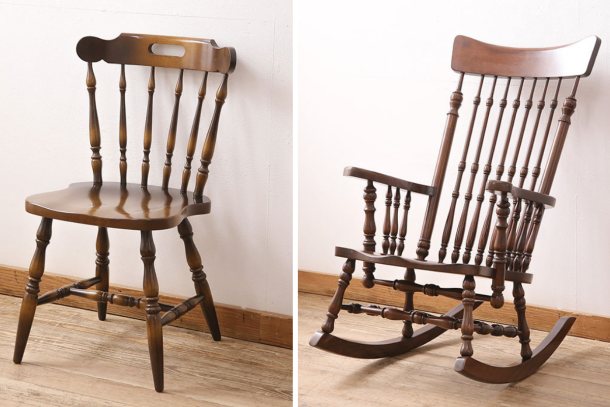
History
The spindle chair appeared in the first half of the nineteenth century, but its roots lead back to the Windsor chair, born in England in the later seventeenth century. The Windsor chair was a wooden chair that came from ordinary people; it began, when furniture was costly, as an imitation of chairs used by the upper classes. As time went on, many derived designs appeared, and the spindle chair is one of them, a design produced through many changes.
The Roman spindle Windsor
One spindle chair is the design called the Roman spindle Windsor, said to have appeared in the mid-nineteenth century. Compared with earlier spindle chairs its top rail is wider and thicker, and its back sticks and legs are more decorative still. Turning, the technique of shaping wood on the rotating lathe, is used lavishly: the waisting of the sticks is more strongly emphasised, and classical motifs such as balls and rings are added. The Roman spindle Windsor was loved in the dining rooms of ordinary English homes, and was the most widely loved of all spindle chair designs. See turned leg and bobbin turning.
Stacking bookcase
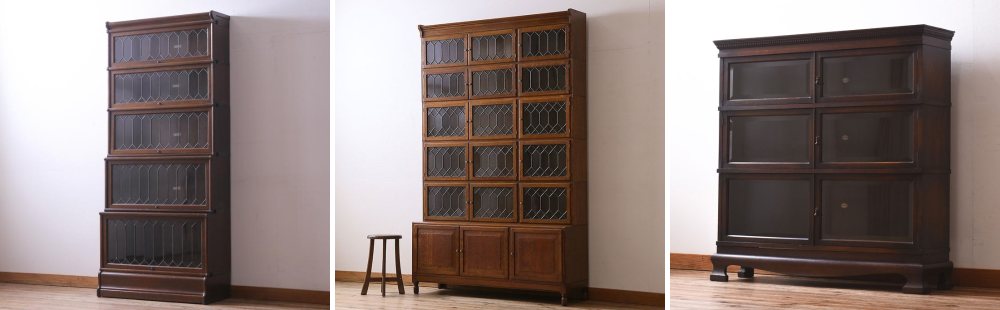
A stacking bookcase is a bookcase made of separate single-tier cases that can be stacked one on another. Because each tier is separate, it is easy to carry even with the books still inside, and easy to rearrange as the room or one's needs change.
Features
The stacking bookcase's defining feature is that each tier is separate. Beyond that, most designs have glazed doors to each case, a device to keep the contents from tumbling out when it is carried. Many of the glazed doors are decorative too, adding a touch of splendour. Stack several tiers and it becomes a fine bookcase at once; that it can be moved as circumstances require is its chief appeal. See china cabinet.
Kinds
Open rack type. A design without doors, rare among stacking bookcases. Few were made abroad; most are by Yamaha of Japan, made when the company still traded as Nippon Gakki. Without doors, somewhat deeper things are easy to keep, and it serves as a display shelf as well as a bookcase.
Flap-door type. A stacking bookcase whose front doors are flaps; the flap slides back into the case when opened. This design makes up the majority of stacking bookcases. The contents are easy to see and to take out.
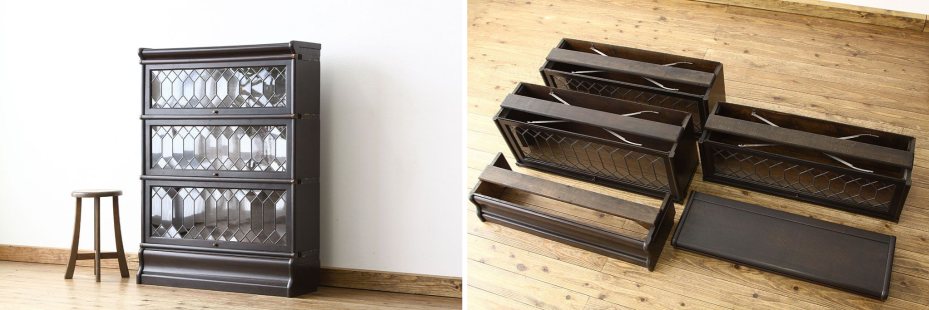
Double-door type. A stacking bookcase with paired doors opening from the centre. Each side opens separately, so what one needs can be taken out quickly.
Sliding-door type. A rare stacking bookcase with sliding doors. Even without locking, its contents are unlikely to spill out when it is moved. The design is often seen in Japanese-made pieces and English vintage ones.
With a writing bureau. A type with a writing bureau beneath the stacked cases. It holds books and allows a little desk work, and with drawers as well it suits storage beyond books. See writing bureau.
History
The stacking bookcase is, as its name says, a bookcase used by stacking. Bookshelves began as fixtures built into walls, in libraries and the like, because ordinary people could not own precious books: books were shared in churches, universities and palaces, so bookcases were never moved. By about the seventeenth century books were circulating and individuals came to own them, and smaller bookcases began to be made.
In the eighteenth century bookcases with glazed doors came to be made, and the stacking bookcase was born as an office bookcase that was nimble, could be taken apart, had doors and could be moved. Separable tier by tier, it could be moved without emptying it, which made it ideal for offices. Its relatively simple design is typical of office furniture, and yet pieces with stained-glass-style designs in their glazed doors, showing the taste of their time, have their own charm.
Where the record differs. Sectional, stacking bookcases with glazed doors are generally dated to the later nineteenth century, made in quantity in America and Britain from the 1890s, rather than to the eighteenth, when glazed bookcases were still built as single large pieces.
Strapwork
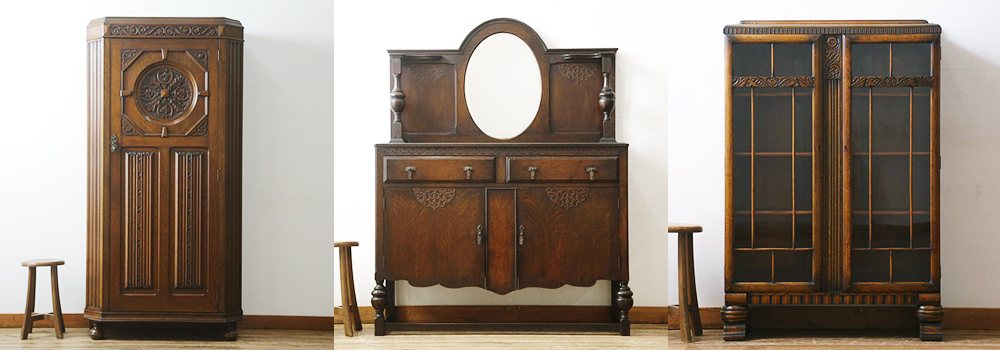
Strapwork is the name of a pattern used in the decoration of architecture, art and furniture, made of lines that take a flat leather strap as their motif. As the name says, it denotes a pattern of strap-like lines that fold back and cross one another. An ornament of long standing, it has been used on historic buildings, furniture, sculpture, textiles, bookbindings and paintings, on the decorative parts of almost everything. Traditional as it is, its very adaptability keeps it in use in many settings today.
Features
Its greatest feature, naturally, is that the pattern is formed by shapes modelled on flat leather straps. Some designs consist simply of strap forms; others are complex, interwoven with scrolls, arabesques and lozenges, or used as the background and framework of grotesque ornament, in which plants, figures and animals are fused.
History
Strapwork is said to have been born in France and the Netherlands in about the fifteenth century, in the Renaissance, and it grew in popularity as it was taken into Baroque architecture. As noted, it developed in its own ways in many fields beyond architecture: textiles, bookbinding, prints and crafts. See Renaissance style and Baroque style.
When strapwork reached England in the fifteenth and sixteenth centuries, it was used in the mouldings of house doors and the like, and was favoured in Elizabethan furniture. England then had settled its Reformation and its foreign policy, and people's lives became more stable. As servants who had lived in came to have houses of their own, the furniture industry developed, and many kinds of furniture suited to the ways people lived were produced. The finer the furniture, the more lavish its strapwork, which brought richness and splendour to people's lives.
Where the record differs. Most historians place the birth of strapwork in the 1530s, in the decoration by Rosso Fiorentino and his workshop at Fontainebleau, rather than the fifteenth century; it reached England chiefly through Flemish pattern books in the later sixteenth century.
Kinds
Designs. Strapwork designs differ by period, country, style, use and material, and their variety is immense. A clear classification is therefore difficult, but broadly they divide into two: scrollwork and bandwork. Scrollwork is three-dimensional, the ends of the straps curling or rolling into scrolls; it became common in the Baroque period. Bandwork is two-dimensional, without modelling in depth, and is sometimes called "interlaced band". The design common on garden benches, flat bands laid side by side to form the back and seat, is also sometimes called strapwork.
Materials. Strapwork has been taken into objects of every material and has long been a familiar ornament: stone, wood, plaster, metal, leather, textile and paper alike.
Techniques. The technique varies with the material, but in furniture strapwork is made mainly by relief carving, inlay and pierced carving. The strapwork often seen on English antique furniture adds understated splendour and serves as an accent, giving the weight and dignity typical of traditional English furniture; and in beautifully, precisely carved strapwork one can see the high skill of the cabinetmakers of the time. See relief, sukashibori and linenfold.
Furniture with strapwork
Strapwork appears on the frieze of court cupboards and hall cupboards, on the rails of chests and the cresting of chairs, and on the panels of sideboards and bookcases, each piece with a character of its own. See mirror-back sideboard.
Sugi (Japanese cedar)
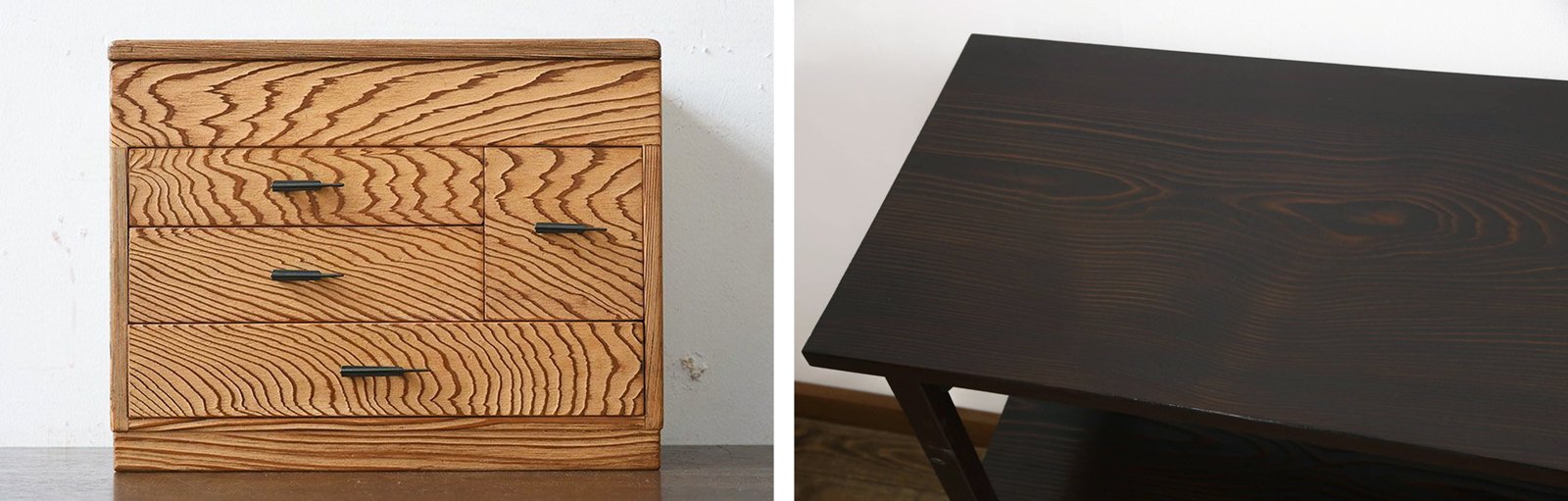
Sugi, Japanese cedar (Cryptomeria japonica), is an evergreen conifer of the cypress family. Endemic to Japan, it grows widely from Honshu to Kyushu and nowhere else in the wild, so for anyone living in Japan it is a familiar tree. It has formed natural stands since antiquity and has been planted energetically, and today it covers the largest planted area of any tree in Japan.
The image of sugi is a trunk rising dead straight into the sky. Its shape and qualities have made it a timber for furniture, building, civil engineering, boats, geta and sake casks; it is revered as the sacred tree of shrines; and some, like the cedars of Yakushima, are protected natural monuments. Its scientific name, Cryptomeria japonica, is often glossed as "Japan's hidden treasure" (strictly, "hidden parts", from the concealed seeds). True to that reading, it has enriched and supported life in Japan since time out of mind, a truly national tree.
Kinds
Sugi is the only species in its genus, but by where it grows it divides into "front" cedar (omote-sugi) and "back" cedar (ura-sugi). Apart from living trees, cedar long buried in the ground, jindai-sugi, is also used for furniture.
Sugi. It grows straight up, the largest trees reaching 60 metres tall with trunks some 5 metres thick. It grows fairly fast and is long-lived, about five hundred years on average. The Jomon cedar (Jomon-sugi) of Yakushima is said to be the oldest tree in Japan, estimated at between 2,170 and 7,200 years. The sapwood is white, the heartwood reddish brown, sometimes blackish, though reddish timber is thought more beautiful; the boundary is distinct. The grain runs in clear, straight lines, often with knots. Low in oil, light and soft, the tree gives off a fresh, clean scent.
Omote-sugi (Pacific-side cedar). Cedar of the Pacific side of Japan, with a slender trunk, branches spreading horizontally and broad needles. Representative are Yoshino, Nikko, Sanbu, Mikawa, Hita and Yaku cedar.
Ura-sugi (Sea-of-Japan-side cedar). Cedar of the Sea of Japan side, hardy to snow. Its lowest heavy branches bend down under the snow and take root where they touch the ground; the branches reach upwards, with small, narrow needles. Representative are Akita, Kaneyama, Chizu, Wakasa and Oguni cedar.
Jindai-sugi (ancient buried cedar). Among timbers there is umoregi, "buried wood": trees buried by disaster that, over long ages, slowly carbonised rather than rotted, and were then dug up. Wood buried more than a thousand years is called jindai-boku, "wood of the age of the gods", and cedar of that kind is jindai-sugi, produced mainly at the foot of Mount Chokai on the border of Akita and Yamagata. Blackish dark brown with a particular depth, fine-grained, and lustrous when polished, it is used for furniture, crafts and taiko drums. Very little exists, and it is very precious.
The appeal of sugi
Grain and scent. A clear, straight grain and expressive natural knots give sugi a natural beauty that catches the eye. Timber with rare figure such as bamboo-leaf (sasa-moku) or quail figure (uzura-moku), and knot-free timber, have long been prized for their decorative value. Being soft, it marks easily, but taken as character, that only makes it more loved. With age its colour deepens, and the mellowed wood is very attractive. Its fresh scent is another charm; its aromatic compounds are reported to be antibacterial and insect-repellent, and many people find the scent relaxing.
Practical and comfortable. Light, soft and straight, it is easy to handle and work. Light cedar furniture is easy to move and use. The wood holds a great deal of air, so it feels warm to the hand, and it is much used for floors, furniture and interiors that the body touches every day. It also regulates humidity, steadying the indoor air through the changing seasons.
Easy to own. With the largest planted area in Japan, sugi is relatively inexpensive. But as the saying goes, "the humblest wood is cedar, and the dearest wood is cedar": famous premium timbers such as Yoshino and Yaku cedar are the exception. Even among ordinary cedar, timber from trees centuries old, thoroughly dried, is far more durable, while fifty-year-old, under-dried timber costs less. That wide range of quality and price is one of sugi's defining traits.
Cedar furniture
Antique and vintage. Used as timber since the Jomon period, sugi has a long history in furniture, and much antique and vintage Japanese furniture in cedar survives. Most designs are simple, letting the grain be enjoyed to the full. All-cedar pieces exist, but its softness also suits it to shelves, bottoms and backs, so cedar plays many parts. On many antique tansu a keyaki or kiri front is paired with a cedar carcase, and on sea chests and wheeled chests cedar is often the main wood.
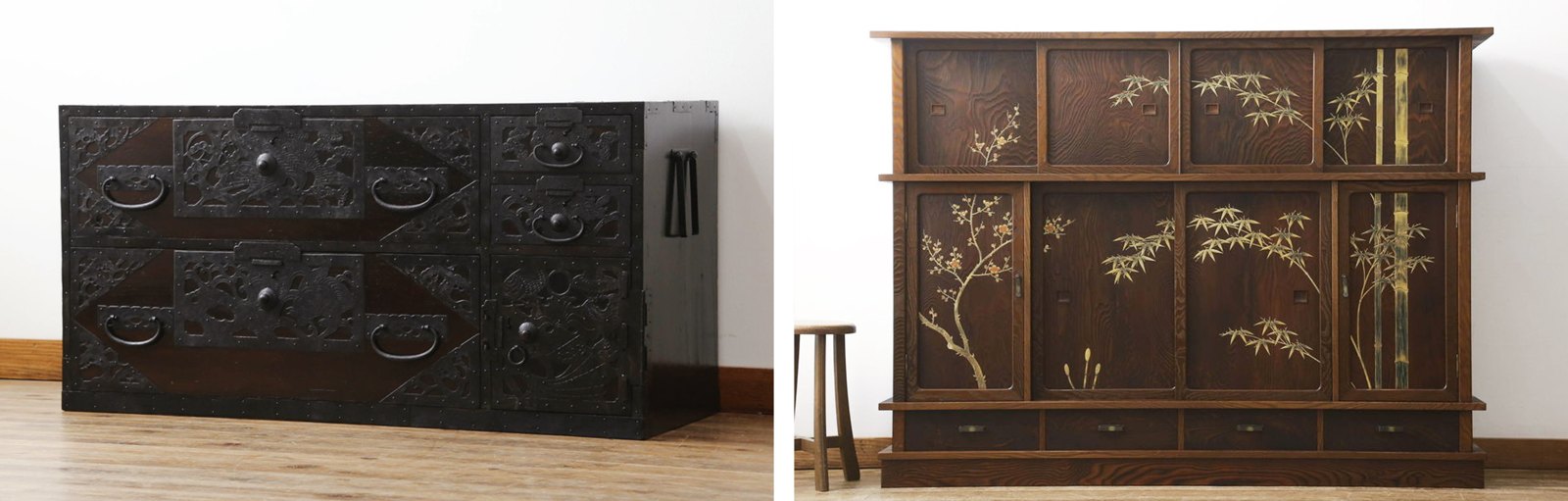
Modern. Some people think cedar is too weak compared with hardwoods, or dislike its knots. It is true that it is less strong and durable than hardwoods, yet hard cedar is strong enough for historic buildings such as Horyu-ji, and it has all the virtues described above. As a native of Japan, cedar furniture is a natural partner for a Japanese room, but modern designs with iron legs are also popular, for work desks and café tables, its natural character fitting many kinds of space.
Suichu (water ewer for tea)
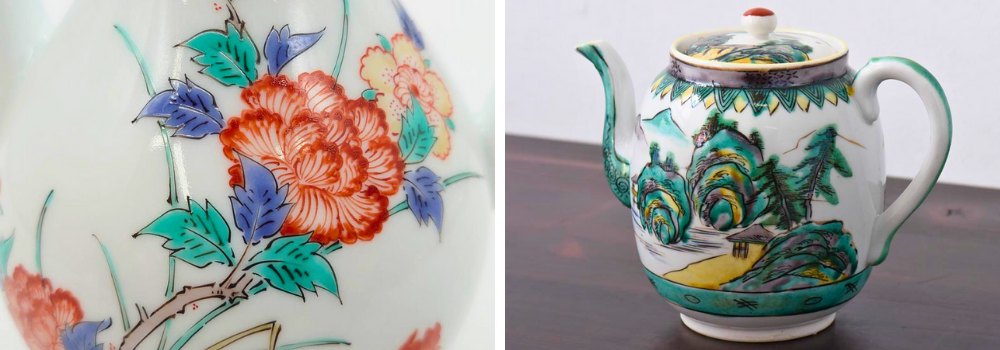
A suichu is a vessel for pouring water in the way of tea, both the ceremony of powdered tea (chado) and the way of leaf tea (senchado). Because it is used at the tea gathering, it is known for bright painting and unusual forms. The same characters may also be read mizutsugi, and some schools write it differently again.
Features
The suichu has three broad features.
Made of ceramic. A suichu is as a rule made of pottery or porcelain. The kettle-like yakan resembles it closely but is made of metal. Both pour water, so in use there is no difference between them.
Many forms. The suichu comes in many shapes, with the handle and lid in all sorts of positions and forms. Fine examples in particular put decoration before ease of use.
The body, where the water is held, takes several main forms: melon-shaped, cylindrical, square, hexagonal, peach-shaped, the jewel shape (hoju-gata, the flame-tipped sacred jewel), and the gourd shape (hisago-gata).
The handle also gives its name to the form. There are two main kinds: the overhead handle across the top (uwade), and the side handle set opposite the spout (atode).
Bright decoration. The suichu is said to have begun in China as a wine vessel turned to a new use, so many are lavishly designed. Overglaze enamels (iro-e), gold brocade decoration (kinrande) and combinations of the two were all developed for it. On the old Imari (ko-imari) ewers of Japan, the octopus-scroll pattern (tako-karakusa) appears again and again: the endless tendrils reaching out in every direction suggest long life and prosperity, and it was loved as an auspicious design.
History
The suichu has a long history. In Japan it begins with tea culture, brought from China by the envoys to the Tang court in the Nara period (710 to 794). When drinking tea took root among nobles and monks in the Heian period, tea utensils began to be made in Japan too. From the Kamakura (1185 to 1333) into the Muromachi period, the way of tea developed among monks and the warrior class.
When Sen no Rikyu brought the way of tea to completion in the late sixteenth century, the water ewer became an indispensable utensil. It also became something more than a tool for tea: a mark of wealth and standing. Ewers from China of high artistic merit were sometimes traded among the daimyo for great sums.
In the Edo period the habit of drinking tea spread to ordinary people, and the suichu entered daily life. The great porcelain centres such as Imari and Arita made a wealth of bright and practical ewers.
Today the suichu is used not only in chado and senchado but widely at home, and light, strong, easy materials such as heat-resistant glass and wood have joined porcelain.
Sukashibori (openwork carving)
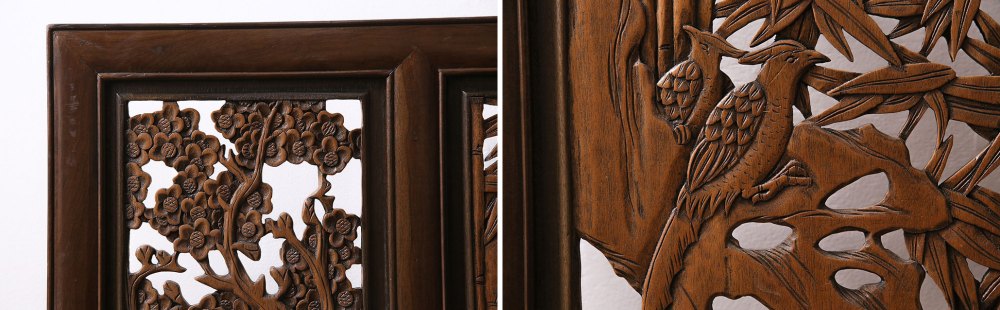
Sukashibori, openwork or pierced carving, is a carving technique that creates designs by cutting right through wood, metal, stone or other material. There are two methods: ji-sukashi, "ground piercing", which leaves the design standing and cuts away the ground around it, and mon'yo-sukashi, "pattern piercing", which cuts out only the design itself.
It is especially widespread in China and across Asia, and Asian furniture and Asian antiques show many delicate, beautiful examples.
Features
Openwork is applied to wood, ceramics, metal, stone and many other materials. The finer the pattern or carving, the harder it is to mass-produce, so every piece reflects the maker's skill and sense: a traditional technique with real value as art.
Openwork in wood. Much used for the haloes of carved Buddhist images and for transoms (ranma). Because parts are cut away, light and air pass freely; in buildings, openwork keeps air moving and, by letting the eye through, makes a room feel less enclosed.
Openwork in metal. Seen in chased metalwork such as Japanese sword blades and sword guards (tsuba). Openwork on a tsuba is decorative, while carving on a blade often reflects the religious outlook of its maker or owner; carving also lightened the blade.
Openwork in ceramics. Piercing makes a vessel more decorative, giving it a cool, stylish look, and lets light, and glimpses of the food within, play through the pattern.
Openwork in accessories. Combs, hairpins (kanzashi) and obi clasps (obidome) are sometimes finely pierced, the shadows of the cut-outs making them all the more splendid. Combs were usually carved from boxwood (tsuge); hairpins in boxwood, tortoiseshell or ivory.
History
Beginnings. In Japan openwork goes back more than ten thousand years, to the Jomon period: famous Jomon pottery with pierced work has been found, the oldest instance in the country.
In Buddhist art. In the Nara period, carving techniques from Tang China brought a rapid advance. Art and religion were then very closely bound, and almost all surviving works of the period are Buddhist. Openwork was used above all for the haloes of Buddhist images; the halo of the Fukukenjaku Kannon in the Hokke-do of Todai-ji is extraordinarily intricate, showing how far the technique had come.
From the warring-states period. In the age of the warring states, Buddhist influence waned and lavish, grand art came into fashion. Openwork now appeared on arms and armour and in architecture: on sword blades, and above all in the ranma, set chiefly above the sliding doors of castles, intricate and magnificent. Ranma were both practical, for air and light, and a statement of a building's rank.
Recent times. With mechanisation, some openwork can now be carved quickly by machine, but patterns that need adjustment to a hair's breadth are still worked carefully by hand. Today finely pierced ceramics and openwork in silver rings and earrings are popular. Openwork remains a delicate technique demanding great skill, handed down and evolving both as tradition and as art.
Kinds of Japanese openwork
Ji-sukashi (ground piercing). Animals and plants, seasonal landscapes and imaginary creatures are portrayed with great life. On sword guards ji-sukashi is mostly shallow, so as not to weaken the guard, while on ranma and other architectural carving it is deep and dynamic; some carving seems to burst out of its frame.
Mon'yo-sukashi (pattern piercing). Mostly smaller, repeating designs: circles, drops and polygons cut in rhythmic geometric patterns, or shapes of flowers such as plum and cherry. Usually on ceramics and metal, it is flat and rather simple in finish.
Traditional techniques
Kagome sukashibori (basket-weave piercing). A form of openwork on Satsuma ware, used mainly for incense burners and now also for lampshades, flower vessels and tea utensils. The body is cut away in a pattern like a woven bamboo basket. The work is extraordinarily fine, and only a handful of potters now have the skill.
Inami carving. Wood carving from the Inami district of Nanto, Toyama, famous for openwork ranma: dynamic, lifelike landscapes, animals and plants, and imaginary creatures such as dragons and lions (shishi), carved with chisels alone.
Mokume sukashibori (grain piercing). A technique that brings out a pattern by cutting along the growth rings. On a quarter-sawn board, the soft summer wood is cut away in places and the hard winter wood left, drawing the pattern in light and shade; the winter wood left behind gives a delicate, misty translucency.
Hotaru-de ("firefly" ware). An application of pattern piercing to ceramics: fine pierced patterns are cut and then filled with glaze, so the openings become glaze alone, translucent. The pattern lets only light through, beautiful and practical, since nothing can leak.
Traditional crafts with openwork
Woodcraft: Edo wood carving, Osaka karaki sashimono, Inami carving, Osaka ranma and others.
Ceramics: Tokoname, Mikawachi, Hirado, Shigaraki, Arita, Hasami and Satsuma ware and others. See Mikawachi ware and Hasami ware.
Accessories: Nara tortoiseshell, Edo tortoiseshell, Naniwa tortoiseshell and others.
Motifs
Some openwork motifs are pure decoration, but most carry a meaning: protection from harm, a wish, good fortune.
| Motif | Meaning |
|---|---|
| Pine (matsu) | Stays green through the cold; long life and immortality |
| Bamboo (take) | Grows fast; many descendants and a flourishing family |
| Plum (ume) | Flowers at the start of spring; vitality and splendour |
| Cherry (sakura) | Blooms all at once; prosperity and plenty |
| Dragon (ryu) | A charm against fire, protecting the house |
| Phoenix (ho-o) | An auspicious pair of birds; harmony between husband and wife |
| Hawk (taka) | Sees to the heart of things and far ahead; seizing good fortune |
| Tiger (tora) | Returns by the road it came, so customers return; good for trade |
| Basket weave (kagome) | Since ancient times, a charm against evil |
| Waves (seigaiha) | In openwork usually simplified; used for happy occasions |
| Scales (uroko) | Rows of equilateral triangles; protection from harm |
| Seven treasures (shippo) | Equal circles overlapping by a quarter; spreading in every direction, auspicious |
| Scrolling vine (karakusa) | Tendrils spreading every way; long life and many descendants |
Openwork around the world
Openwork is found worldwide: in China, which deeply influenced Japanese openwork; in Asian cultures such as Bali; and in Europe.
China. Chinese openwork, which so influenced Japanese carving, was in use by around the sixth century BC; there are records of crafts made by piercing thin materials. Its best-known form is the louchuang, the lattice window pierced across its whole frame, framing the view of the garden; such windows serve for air and light and also as decoration, with patterns from the geometric to auspicious motifs and scenes from old tales. The folding fan, surprisingly, originated in Japan, and Chinese fans are said to have begun as copies; but China developed its own sandalwood fan, a traditional craft of Suzhou, prized as a luxury for the sweet scent of sandalwood and its fine piercing.
Bali. On Bali, openwork appears on gates, walls and ornaments of every kind, above all in stone and wood. Balinese carving traditionally drew on mythology, though plant motifs with less religious content are increasingly common. Balinese stone carving uses a soft volcanic sandstone that carves easily, producing pierced stonework rarely seen elsewhere, mostly reliefs and plinths that open up a view; each piece is carved by hand. Balinese wood carving came from Java in the fifteenth century; wood, which does not crumble like stone, allows finer work. Most is ground-pierced, with further carving layered on to give depth, and it is used for reliefs, mirrors, frames, lamps and furniture.
Europe. Delicate openwork is said to have entered European furniture from the late seventeenth century. Graceful pierced work adorned chair backs and picture frames, and it is common on English antique furniture. Sculptural carving with pierced areas is called "pierced carving" in English: mostly organic designs such as plants, lively and curving, seen on chair backs and cabinet ornament. Flat, cut-out openwork, by contrast, is "pierced fretwork": mostly geometric, favoured on thin boards and used on table legs and glazing bars, wherever a flat surface suits. Florentine engraving is a traditional technique of Florence for precious metals: shallow engraving, and openwork cut with a fretsaw blade as fine as a hair to draw extremely delicate patterns, which looks splendid and cool and also lightens the jewel.
Suzuri-bako (writing box)
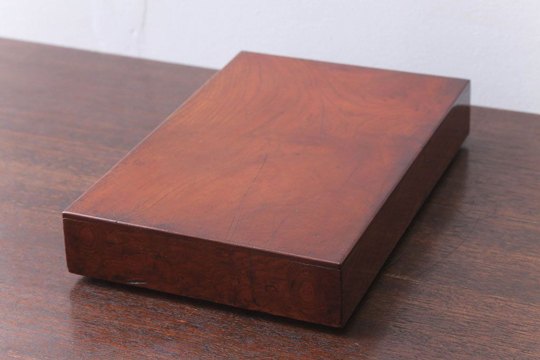
A suzuri-bako, as the name says, is the box that holds the tools of writing with a brush: the inkstone (suzuri), the brushes (fude), the ink stick (sumi), the water dropper (suiteki) for adding water to grind the ink, and other tools such as a small knife and an awl. The word covers every box that holds these implements. Writing boxes are still made, but this entry is about the antique writing box.
Two types of antique writing box
The flat writing box (hira-suzuri-bako). Most have a deep lid that closes over the body. They range from simple wiped-lacquer pieces to lavish ones with maki-e and mother-of-pearl. Flat writing boxes stacked in tiers like food boxes are called ju-suzuri-bako.
The writing box with drawers. Most have a hinged lid on top and several drawers below; some have a handle on top for carrying. Some carry large fittings like a decorative chest (isho-dansu), standing like a small portable tansu.
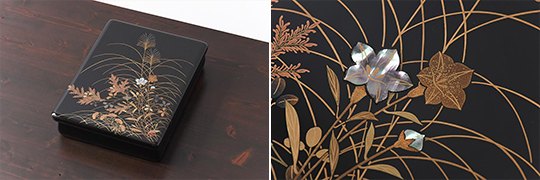
Inside, the tools are often arranged in shaped recesses (otoshikomi) so that each has its place, or with fitted dividers to keep the brushes from rolling.
Materials and decoration
Lacquer, the most popular finish. Most writing boxes are lacquerware on a wooden base, decorated likewise with maki-e or with brightly coloured shell inlay (raden), and maki-e masters and lacquer artists have left many writing boxes to posterity. See shikki (lacquerware).
Carved decoration on the lid. Some are left unlacquered to show the wood, or finished with carved decoration such as Kamakura-bori, carved wood under coloured lacquer.
Fine woods such as keyaki. Writing boxes are also notable for luxury timbers: keyaki, black persimmon (kurogaki), rosewood, oak, padauk and shitan. These are usually finished in wiped lacquer (fuki-urushi), which shows the grain.
The writing box in Japan
The writing box is thought to have begun in the Nara period, when writing with brush and ink became common. Through the Heian, Muromachi and Edo periods its forms and decoration evolved, and like other antiques it gained value as a work of art, especially favoured among the nobility and the warrior class. Writing boxes are still made and used today, ranging from antiques of national-treasure rank to inexpensive everyday pieces.
In The Tale of Genji and The Pillow Book. The writing box (called on-suzuri in the texts) appears in passages of The Tale of Genji and The Pillow Book, both written in the Heian period around the year 1000, so we can imagine one at the writer's side as these works were written, and that the writing box was usual for anyone who wrote at the time.
Other Asian countries with a culture of brush writing, such as China and Korea, seem not to have kept the inkstone in a box in the Japanese way, so the writing box, like maki-e, may be called a lacquer form particular to Japan.
T
Tabako-bon (smoking set box)
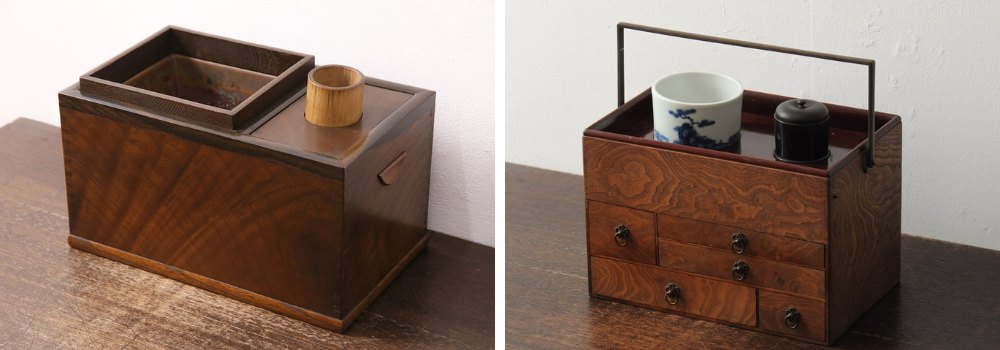
A tabako-bon is the stand that held and carried a full set of smoking tools: the pipe (kiseru), the fire holder, the ash receptacle and so on. It spread in the Edo period and was used until the early Showa era, the equivalent of today's ashtray, lighter and cigarette case in one.
Features
A tabako-bon is made up mainly of these:
- Kiseru: the long, slender pipe for smoking finely cut tobacco.
- Hi-ire: the fire holder, a small vessel holding embers of charcoal.
- Haifuki (hai-otoshi): the ash tube, usually a section of bamboo, for knocking out ash and spent tobacco.
- Hoya: a cover that fits over the fire holder.
- Tabako-ire: the container for the cut tobacco.
Everything is arranged so that it can be reached at once. In use, charcoal is kept alight in the fire holder and moved with fire tongs when needed to light the pipe. After smoking, the ash and spent tobacco are knocked into the ash tube, fresh tobacco taken from the tobacco container, and the pleasure begins again.
Materials and decoration
Tabako-bon were mostly made of wood, usually a square or round box with drawers and a handle. Practical as they were, many are highly decorative: fine tabako-bon made as furnishings were lavishly finished with lacquer, maki-e and mother-of-pearl.
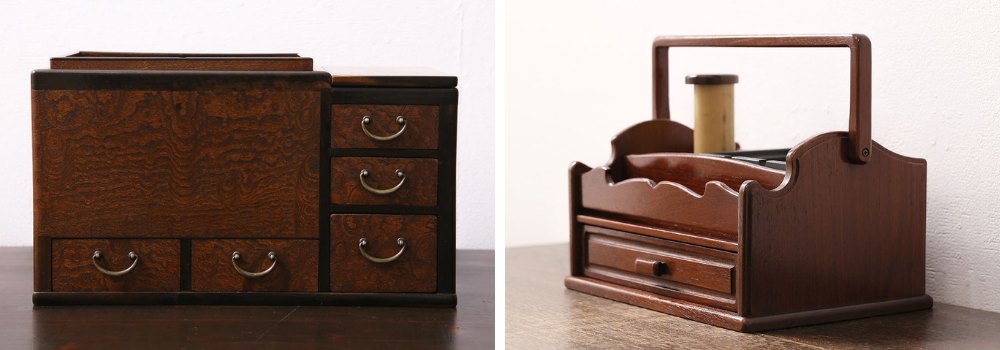
Their decoration owes much to Japan's culture of hospitality. From the Edo period into the Meiji era especially, setting out a tabako-bon for a visitor was a courtesy, and, as in the tea ceremony, handling the tools with care before a guest was part of welcoming him. Hence the many fine lacquered pieces and delicate decoration that show the craftsman's hand. A tabako-bon is still set out at the formal tea gathering today, as part of the waiting-room arrangements.
History
The tabako-bon begins with the arrival of tobacco in Japan between the Azuchi-Momoyama period and the early Edo period. At first people mostly smoked outdoors, and the portable tobacco pouch (tabako-ire) was the norm; indoors, any tray to hand held the tools.
By the mid-Edo period smoking had spread among ordinary people, and the tabako-bon appeared to keep the tools together and carry them. Smoking on social occasions and at rest became a habit, and the tabako-bon became a symbol of leisure.
The times matter too. The mid-Edo period saw townspeople's culture flower and the culture of making things flourish. Luxurious tabako-bon of choice materials and decoration appeared, and among samurai and wealthy merchants they became status symbols. Given as gifts, they were used as interior pieces as well as tools.
From the Meiji era, as modern smoking goods spread, the tabako-bon gradually disappeared. Hardly anyone smokes from one today, but its beautiful design and traditional craft, maki-e and lacquer, are valued as art and craft.
Antique tabako-bon in the interior
Antique tabako-bon are now used in the interior for their fine decoration and design.
For small storage. A tabako-bon with drawers is ideal for jewellery, stationery or sweets, practical and stylish on a desk or in the hall.
As a flower stand, planter cover or display stand. Set a small vase or ornament on it for an old-fashioned Japanese air; one with a large fire holder can serve as a planter cover.
As an object. A lacquered tabako-bon with maki-e is a beautiful craft in its own right. On a shelf or stand it brings dignity to a room, ideal for a Japanese or Japanese-modern interior.
Tachiita (kimono cutting board)
A tachiita is the low table used for cutting cloth in Japanese dressmaking (wasai), the work surface on which fabric was cut straight. It is made of a single plank of solid timber and is known for its long, narrow top. When families made their own clothes, a great many homes had one.
Features
The tachiita is defined by a shape and height suited to kimono making. A standard bolt of kimono cloth (tanmono) is about 12.5 metres long and about 37 cm wide. The tachiita is long, so the bolt can be unrolled easily, and a little deeper than the width of the cloth. Because the work was done seated on tatami, it is built low.
Single planks of keyaki, sugi and hoonoki (Japanese bigleaf magnolia) are the main materials, each with its own virtues: keyaki is hard and durable, while hoonoki is light and soft and spares the blade. All share a smooth surface that does not snag the cloth. Strong, stable timber that would not harm the fabric was preferred.
History
The tachiita's history follows that of Japanese dressmaking, which is thought to go back to the Yayoi period; sewing was certainly established by the Nara and Heian periods. In the Edo period kimono culture took its settled form, cotton and hemp growing spread, and the craft of wasai advanced; the tachiita is thought to have come into wide use then as the tool for cutting cloth accurately.
Until the Showa era clothes were made at home, and the tachiita was a household necessity. After the war, as ready-made Western clothes took over, home dressmaking declined. It is seldom used in ordinary homes today, but it remains an indispensable tool wherever kimono are tailored.
As antique furniture
Few tachiita are now used for dressmaking, but they draw attention as antique furniture, for their single planks of now precious Japanese timber and for the character that only age brings. A well-used tachiita also tells of the history of handwork, by craftsmen and in the home, and is valued not only as an interior piece but as a link with Japan's culture of making by hand. On an old board, look for a softly dished, silky top worn by decades of cloth and spatula, and fine knife marks along the edges.
In the interior
As a low table. A tachiita makes an ideal living-room low table. Built low, it pairs easily with a sofa, and as a solid single plank it suits Japanese and Western rooms alike, with the luxury and texture of real wood.
As a television stand. Thick and sturdy, it also serves well as a television stand. Simple, with the warmth of wood, it suits Japanese and natural interiors, its antique character adding atmosphere.
As a display stand. Its long, narrow top makes a fine display stand; its weight sets off a favourite vase or piece of pottery.
For the garden. On a balcony or in the garden it makes a stand for plants; its antique character makes the green all the fresher.
Taisho roman (Taisho romanticism)
Taisho roman, Taisho romanticism, names the ideas, culture and art that carry the atmosphere of the Taisho era (1912 to 1926). Western culture, arriving from the Meiji era, had by Taisho blended with Japanese culture and evolved in its own way; that is Taisho roman.
Features
The Meiji era, after the closed country ended, brought a flood of Western things, ideas and culture. In Taisho, a culture of Japan's own developed, taking in Western culture while drawing on Japanese tradition. The festive mood of that time is Taisho roman.
Taisho roman may first call to mind schoolgirls in hakama and boisterous schoolboys in the rough bankara style. But the period showed itself not only in dress but in buildings, furniture and everyday things, forming a culture in which Japanese and Western worlds merged.
The interiors of the time have a particular character that still draws attention. A sofa might have a rich, heavy, glossy wooden frame upholstered in velvet; tables had decorated legs, set out in rooms with a Japanese feel. Festive yet nostalgic, it is easy to see why these interiors are popular. This flowering of Japanese-Western fusion is still much admired, and loved as Taisho roman.
History
The Taisho era was an age of mass culture. Offices, department stores and transport developed, and ordinary citizens, never before in the spotlight, came into their own. The First World War, following the wars of the Meiji era, drove rapid industrialisation, and life grew more prosperous. Newspapers, magazines and books flourished, and the public took an interest in politics; it was in Taisho that popular movements for democracy began. Winds of change blowing everywhere are the background of Taisho roman.
A golden age between Meiji and Showa
The Taisho era lasted only some fourteen years, yet people never stop admiring it. Perhaps because it is so rich, set between the long Meiji and Showa eras. Meiji was a time of straining to absorb the Western culture that poured in with the opening of the country; Showa was the era of the Second World War; both were turbulent. Taisho, by contrast, was the moment Japan at last emerged from Meiji Westernism and regained its composure, and a time of peace before the great war. Perhaps that is why it looks so festive, and still shines.
Taisho roman interiors
As described, Taisho roman interiors are marked by festive Western ornament: sofas in deep, glossy velvet, tables and chairs of dark wood with elaborate carving, with something of the feel of European antiques.
Fittings set with coloured glass like stained glass are emblematic of the Taisho roman interior. See wa-modern and Showa retro.
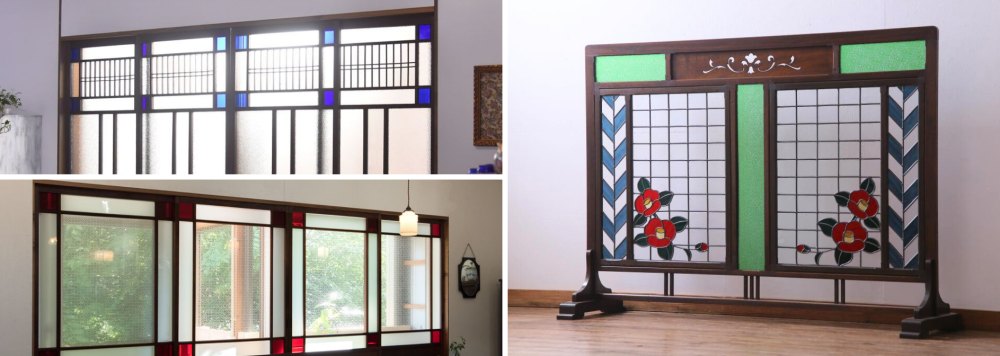
Besides antiques, many pieces are made today in the Taisho roman manner, a sign of its popularity. Genuine Taisho pieces usually show hand-cut joinery, solid timber under the upholstery, old wavy glass and the wear of a century; later pieces in the style tend to be machine-made and veneered.
Tama-moku (jewel figure)
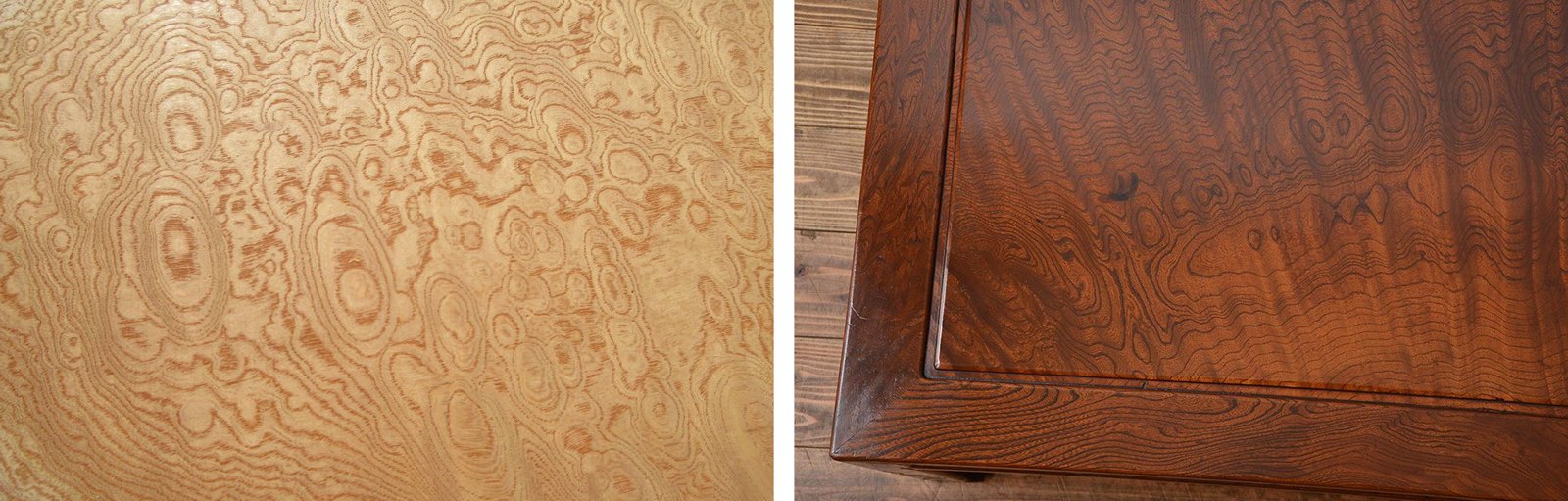
Tama-moku (or tama-mokume), "jewel figure", is a figure that appears when a burr-like swelling on the trunk of a tree is cut flat-sawn. Wood shows many figures, jorin-moku (fish-scale), tora-moku (tiger), awa-moku (bubble), chijimi-moku (crinkle) and more, but tama-moku is among the rarest, seldom met and highly prized.
It shows concentric circles, ring within ring: sometimes one large "jewel", sometimes many small ones scattered across the board.
Why does figure appear at all? Growing conditions affect the fibres of a tree, and they show in the grain as a special pattern. The older the tree, the more likely it is, and the unique curves nature draws are beautiful and much sought after; boards with figure across a wide area are extremely rare and treated as the very finest.
Woods that show tama-moku
Keyaki (zelkova). The great Japanese timber, a deciduous hardwood of outstanding beauty and strength; keyaki tama-moku is so famous that "tama-moku" means, above all, keyaki. It does not appear in keyaki under three hundred years old. Keyaki tama-moku is counted the rarest and most beautiful of all, and trades for astonishing prices. See keyaki.
Kusu (camphor). Known as a giant, long-lived tree, camphor branches freely and often forms the burrs from which tama-moku arises. Its camphor scent deters insects. Camphor tama-moku often looks like small jewels scattered across the board, standing out within its large, bold grain.
Tamo (ash). Natural in colour, with a clear, even grain, hard and tough, ash serves for floors, furniture and sports equipment. Like its grain, ash tama-moku is boldly drawn, a strong, three-dimensional pattern in which the jewels seem to rise from the surface.
Bubinga. A giant tree of Africa, said locally to be a dwelling of the gods for its size. Reddish and calm in colour and highly durable, it is used for furniture and building. Grown in the seasonless tropics, its growth rings are faint, but bubinga tama-moku rises beautifully and showily.
Karin (padauk). The Japanese quince, also karin, bears fruit used for liqueurs and throat sweets, but the timber karin is an entirely different tree, heavy and strong, from South East Asia and Africa. Within its wavy, interlocked grain, karin tama-moku draws beautiful circles, and polished to a superb lustre it has all the dignity of a luxury timber.
Kuwa (mulberry). Very hard and slow to decay, with a close yellowish-brown grain that polishes to a distinctive lustre, mulberry is a celebrated timber; "island mulberry" (shima-kuwa) from Mikurajima and Miyakejima in the Izu islands is famous as the finest. Mulberry tama-moku glitters like gold in the light, different at every glance.
Sen (castor aralia). Sen is relatively soft and light for a hardwood, and pale. Its grain resembles keyaki and is very handsome, so it is widely sold as boards. Its gentle, flowing, delicate grain is very refined, and sen tama-moku likewise has a perfectly judged presence that never insists.
Furniture with tama-moku
Antique and vintage. Since early times tama-moku, like other figures, has been treasured as exceptionally decorative and used in many ways. Figured wood was at first far from ordinary people's reach, but in the Taisho era, as veneer (tsukiita) came into wide use, figure began to be applied as a decorative face to cabinetwork (sashimono), and it charmed far more people. The love of figure is universal: in Europe, with its long history of furniture, figure has been treated as special since very early times, and many antique and vintage pieces with tama-moku exist in Europe and America. Ever rarer and more precious, such furniture deepens with age into a weightier presence. See tsukiita.
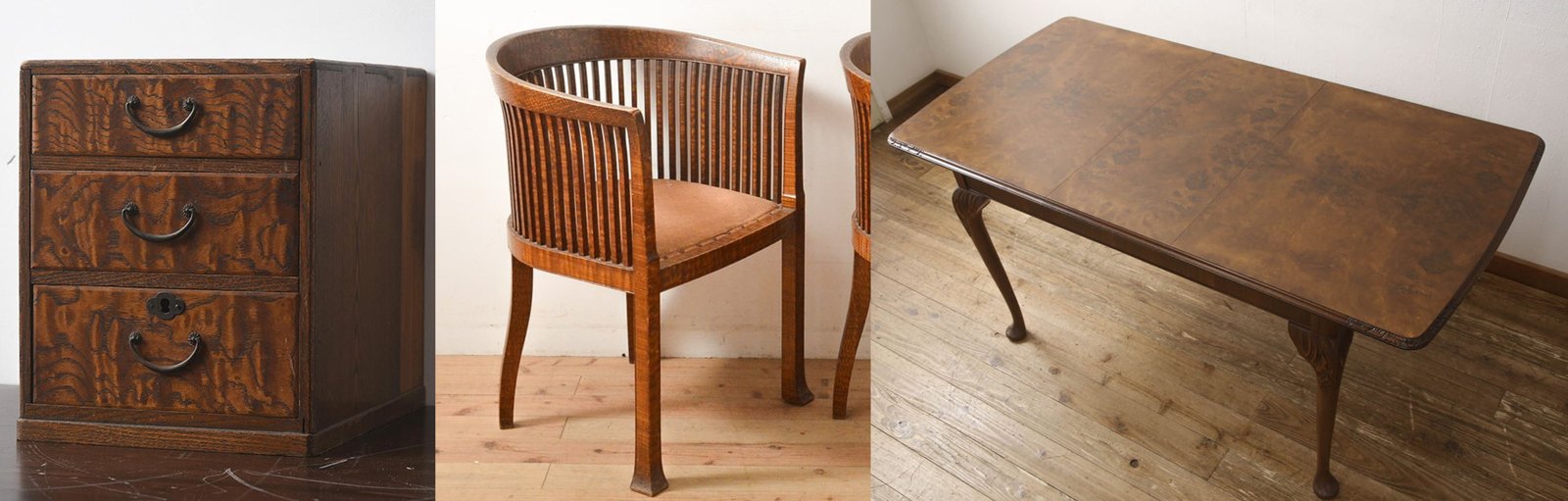
Modern. Figured wood is still used for furniture, turnery, small things and instruments. Whether a tree holds figure cannot be told from outside; only sawing reveals it, and even seasoned professionals are said to feel surprise and joy at the moment they meet it. Tama-moku looks completely different from wood to wood, and whether it covers a whole surface or a part changes the effect of the same design entirely. The single-slab table is one of the pieces that best shows it off; keyaki slab tables are common, and one with figure such as tama-moku is valued almost as a work of art. Tama-moku also appears on things to carry and wear, jewellery, pens, walking sticks.
Tatamizuri (tatami runners)
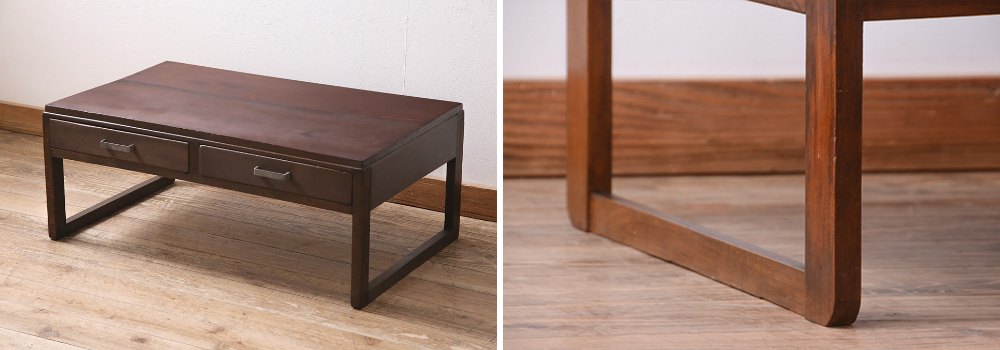
Tatamizuri, "tatami runners", are the horizontal rails fitted to the feet of furniture used on tatami. They reduce the damage and dents caused when furniture is moved often or bears down with its weight. They also steady the piece and let it slide smoothly, and for that usefulness they have long been valued in Japan. They are found mostly on chairs and desks, and because they are made to suit the material, size and design of each piece, they do not spoil its beauty and sit naturally in a Japanese room: a leg design particular to Japan, with its devotion to tatami.
Features
Their great feature is a construction designed to protect tatami: front and back legs joined by rails, like a sledge. The piece rests on lines rather than points, widening the contact with the floor and spreading the load. The wider contact also stops any wobble and makes the piece feel stable. And because nothing catches when it is pushed or pulled, it moves smoothly. Steady, wobble-free use is a particular help to the elderly and to small children.
Kinds
Designs. Tatamizuri are common on Japanese furniture and mingei furniture, but appear on many kinds of furniture, chairs and desks above all, and their form and design vary with the piece. See mingei furniture.
Functions. Some have stacking or folding functions.
Materials. Most are wooden, but many are made of metal or synthetic resin. Besides Japanese pieces designed for tatami, leg designs like tatamizuri are found abroad too, made to spare the floor and give stability, so tatamizuri take many forms regardless of country or material.
History
The folding stool called shogi, used as early as the Kofun period, is built much like tatamizuri, but it was not made for tatami and was used mainly outdoors. Tatamizuri made for use on tatami were born of Meiji-era "civilisation and enlightenment". Tatami had gradually spread to ordinary people after the mid-Edo period, and by the Meiji era ordinary homes had rooms of six or eight mats with alcoves. At the same time, under Western influence, Western furniture came into Japan and chairs began to stand in tatami rooms. Chair legs inevitably damaged the tatami, so tatamizuri were devised: a design born of the meeting of Japanese and Western culture. From the Showa era they spread widely as the usual way of bringing Western furniture into a Japanese room, and a stream of tatamizuri furniture, well designed and practical, made life more comfortable.
Today, with less demand for tatami and floors of boards and carpet, tatamizuri furniture, gentle on any floor, still does fine service, and many modern designs with real interior appeal are made.
Furniture with tatamizuri
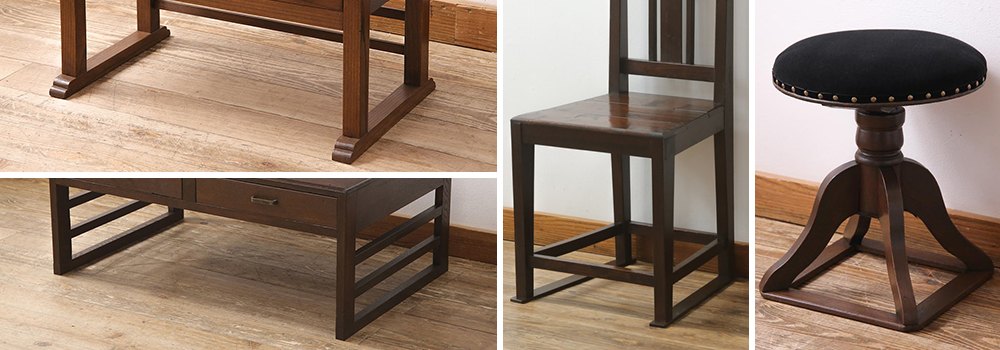
Chairs like the tatamizuri chair
Other chair designs also spare the floor. The rocking chair, for example: its curved runners spread the load as it rocks, so it is gentle on tatami while giving firm, supported comfort. The revolving "doctor's chair" is quite different in form, but most have four stout legs splaying out from the centre, so the load never falls on one point; and because the seat turns, the chair need be pushed and pulled less when sitting down and getting up, which also protects the tatami. See rocking chair and doctor's chair.
In the interior
Some tatamizuri are added later, but chairs and tables made with them from the start are usually built low to suit a Japanese room, and look as stable as they feel. Low furniture makes a room feel more spacious and gives it the calm, unhurried air of a Japanese room. They suit many interiors besides tatami rooms, and are highly practical, a fine choice for a comfortable room.
Teak
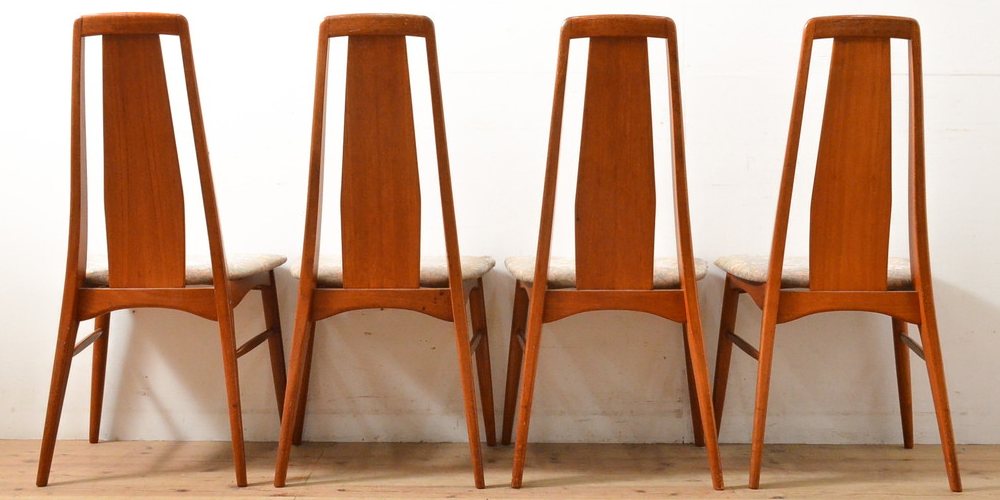
Teak is the timber of trees of the genus Tectona in the mint family (Lamiaceae). A tall deciduous tree native from India to South-East Asia, it is famous, with walnut and mahogany, as one of the "three great fine woods of the world". Since long ago it has been used for the interiors of luxury liners and trains, for historic buildings and the furniture made for them; in recent years, with the loss of forest in its native lands, some regions restrict felling and export, and supply has fallen. The native teak of Myanmar has also been designated as endangered, so it is a timber of high rarity value. See walnut and mahogany.
Kinds
Teak is classified by where it grows; here are the representative kinds.
Myanmar (Burma) teak. Natural teak from Myanmar, said to be the finest of all and also called "true teak". Trees that have grown slowly in the wild have a closer figure and are said to last two hundred years. Large trees reach some 45 metres in height and 3.7 metres in girth. Figure grown slowly over a long time has a depth not seen in fast-grown plantation timber, and a high content of natural oil that makes it feel moist to the touch. The colour is a deep brown, sometimes called golden brown, with a lustre. Teak of the time survives in temples in India built more than a thousand years ago, which shows its excellent durability. Its high resistance to water also made it known in Europe from about the seventeenth century, and gradually famous worldwide: it was worked into the decks and furniture, the dining tables among them, of the luxury liner Titanic. In Japan it was first imported around the time of the First World War and used in buildings such as the National Diet Building and resort hotels.
Indonesian teak. Teak grown in plantations for commercial use. It grows faster than natural Myanmar teak, so wide single boards are hard to obtain, but although costly it is relatively easy to find. It is a little paler than Myanmar teak and slightly less dense, but has ample teak strength and workability, and it shares teak's characteristic ageing, deepening to an amber colour with long use. Most teak in circulation in Japan today is said to be Indonesian.
Old teak. Teak timber reused after its service in buildings and ships is done, taking advantage of its durability and long life. Some is decades or even centuries old, with a flavour of distinctive age that makes it very popular. Furniture made of old teak, its colour deepened by time, has an exquisite sense of weight.
Its appeal
Highly water-resistant and durable. That it survives in temples built more than a thousand years ago, and was used for large ships, shows its excellent resistance to water and its durability. Beyond simple strength, once dried it hardly ever warps or splits. With little movement, it is an excellent timber valued for building and furniture alike.
Resistant to decay. Teak contains a great deal of oil, which gives it resistance to oxidation, insects, moisture and decay. The tar-like oils in the wood make it strong against water and rot and keep out termites and other pests, so teak furniture has a long service life, and much of it survives in good order as antique furniture.
Beauty. Teak attracts as much by the beauty of its figure as by its strength. Its lustrous surface deepens with age into a richer amber, and the fine oils it contains give it a moist feel and a sheen, an elegant impression.
Workable and easy to live with. Thoroughly dried teak, thanks to its oil, does not warp even when sliced thin or worked, so teak furniture can be handed down through generations. Used in ships and buildings in many forms, teak serves in our lives too, as table tops and as veneer on furniture. Teak furniture's water resistance makes it less prone to ring marks, the rings left on a wooden table by a glass, dish or vase, one of the common worries with wooden tables and shelves; a great advantage that eases the use of wooden furniture. And its resistance to changes of temperature and humidity means it is little affected by the continuous heating, floor heating and humidifiers of modern life; some woods warp or split in such conditions, and that teak gives less cause for concern is another strength. See tsukiita.
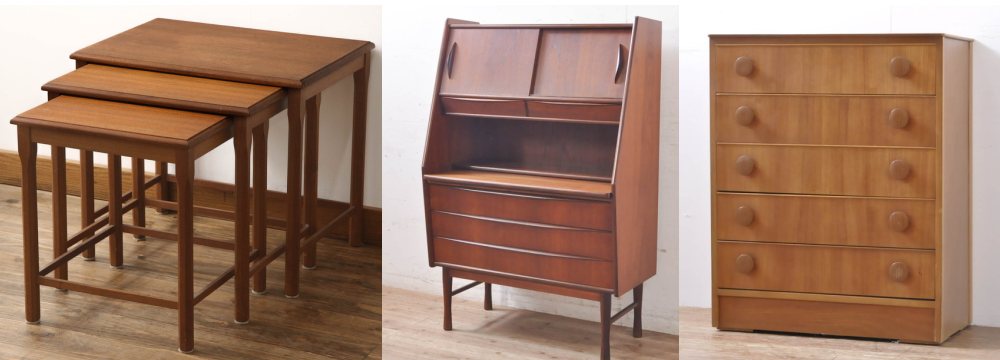
Teak furniture
Antique and vintage furniture. Many pieces made of teak survive, from European antiques to Japanese ones. The leading English makers G-Plan and Nathan also made a great deal of teak furniture. Post-war English vintage teak furniture is mostly simple and natural in feeling, easy to combine with other things, and it is a perennial favourite in Japan. See nest of tables and Scandinavian furniture.
Contemporary furniture. Furniture of Indonesian teak is still made today as luxury furniture. Because teak is easy to work, many pieces carry elaborate carving and other ornament, letting one savour luxury along with the beauty of the grain. New teak is bright in colour, and one can enjoy watching it change, over time, to a deep amber.
Temoto-dansu (hand chest)
The hand chest is a small chest for valuables and personal things. As the name ("at hand") says, it is kept within easy reach, in the living room for example.
Features
Hand chests are small, about 500 to 700 mm in both height and width, with drawers of many different sizes, a way of keeping everything from larger papers to small stationery in order. Besides drawers they often have sliding-door shelves and hinged-door compartments, so all sorts of things you want nearby can be kept in them.
Materials and decoration
Because they keep precious things close, many are splendidly decorated. Small as they are, they are lavish pieces with real presence: lacquered, set with plenty of decorative ironwork, some covered all over in glittering maki-e.
Kinds
Sendai hand chests. Sendai chests are known for fine ironwork in relief, and even at hand-chest size the beauty of their fittings is in a class of its own. The ironwork reinforces the whole chest, and the pull plates carry characteristic Sendai designs.
Yonezawa hand chests. Yonezawa brings to mind a plain chest marked by round lock plates, but recent Yonezawa hand chests are positively dazzling, set with many decorative fittings.
Gold maki-e hand chests. Lustrous from every side, with paulownia-crest maki-e scattered all over and plum blossom in maki-e on the sliding doors as a single accent.
History
The hand chest is said to have begun in the bedroom, where women kept their personal things, valuables such as hairpins and obi clasps; some, it is said, kept secret savings in them. It became a chest for the small things of daily use, and then for papers, letters and valuables.
Small but striking, it is ideal for a living room, and is still made today for those who love Japanese design.
Tetsubin (cast-iron kettle)
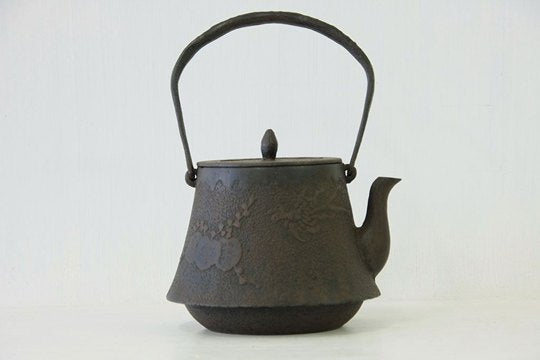
A tetsubin is a cast-iron kettle for boiling water. Many districts of Japan make them, each with its own character. They are made mainly by casting (chuzo), pouring molten metal into a mould, a technique that has developed differently in every centre and is still handed down as a traditional method. Here we look at three of the most famous and long-established: Nanbu ironware, Takaoka ironware and Yamagata ironware, their methods and their history.
Nanbu ironware, a traditional craft of Iwate
The tetsubin has a long history and many centres, but the Nanbu ironware (Nanbu tekki) of Iwate Prefecture is popular as a traditional craft not only in Japan but abroad.
Born with the history of tea. Nanbu ironware goes back to the Edo period. The long peace let the enjoyment of tea spread widely, and the lord of the Nanbu domain, Nanbu Shigenao, ordered tea kettles (chagama) to be made from the fine iron and other materials of his domain. He took into his service the domain's casters (imoji) and a kettle-maker from Kyoto, the first Koizumi Nizaemon, and the tea kettles they made were the beginning of Nanbu ironware. After much trial and error the resulting kettles came to be called Nanbu-gama, and in the time of the third Koizumi Nizaemon the tetsubin was created.
Kettles that double as teapots. Water boiled in a tetsubin is said to taste mellow and good. Teapots (kyusu) are usually porcelain or stoneware, but Nanbu ironware teapot-kettles are also made: even in the oldest centres, work to fit the tetsubin to modern life goes on.
A craft of fine decoration
Fine decoration delights the eye. Over time the tetsubin spread through society, and all sorts of crafted ironware came to be made. All of it is known as Nanbu ironware, and in that era almost every commission was handled by four Nanbu families, Arisaka, Suzuki, Fujita and Koizumi; it is no exaggeration to say that the history of Nanbu ironware is the history of those four houses.
Is the tea kettle the tetsubin's ancestor?
The history of Koizumi Nizaemon overlaps with that of the Nanbu-gama. The tea kettle made by the first Nizaemon, Kiyoyuki, at the command of Lord Shigenao in 1659 came to be called the Nanbu-gama, and the third Nizaemon created a handier kettle for boiling water: what we now call the tetsubin. Nizaemon's craft remains highly regarded and has been handed down through ten generations, and the family's work is prized as an outstanding traditional craft, in Japan and around the world.
Surface patterns
The tetsubin spread with the name of Nizaemon in many patterns, each with its own name.
Muji (plain). A kettle with no pattern at all. Even so, because the casting mould is made of sand, it has the fine texture of a sanded ground.
Arare (hailstone). A surface covered in raised studs. There are degrees: chu-arare has slightly larger studs, and o-arare large ones, also called oni-arare ("demon hail").
Others. A pattern of many fine lines is itome, and cherry petals sakura-mon. Every one of these patterns expresses Nizaemon's wish that as many people as possible might enjoy the world of tea.
Yamagata ironware
Yamagata ironware traces its history to the Kohei era (1058 to 1065). When Minamoto no Yoriyoshi, ordered to pacify the north-east, campaigned in the Yamagata district, casters travelling with him found the sand and soil suited to casting and settled there. Under the patronage of successive lords, among them Shiba Kaneyori and Mogami Yoshiaki, the district of Domachi became one of Japan's foremost casting centres. Yamagata kettles remain popular with ironware enthusiasts in Japan and around the world.
Methods that allowed mass production. In the Yamagata method a pattern is first taken with a metal mould, and the piece is then made by the dried-mould method, which allows many identical pieces to be made from the same mould. Yet the finest Yamagata ironware is still made one piece at a time in fired moulds, and these pieces are without exception superbly finished and full of character.
Takaoka: bold design
Lost-wax casting allows three-dimensional decoration that seems to rise from the body. The Takaoka kettle is known for the ground patterns this method creates. Nurtured over four hundred years of casting, lost-wax casting, capable of motifs both delicate and dynamic, is the very essence of the Takaoka kettle. In Takaoka it goes back to the early Edo period: by the Kan'ei era (from 1624) the technique was already said to be established. It was used for small castings, chiefly Buddhist altar fittings. Today Takaoka lost-wax casting is recognised as an intangible cultural property and its craft highly regarded, and craftsmen still carry the tradition on.
Lost-wax casting (rogata chuzo). In casting, sand is packed around a pattern, the pattern removed, and molten metal poured into the cavity. To release the casting smoothly, the shape must taper in the direction of withdrawal, the "draft angle" (nuke kobai). Allowing for that draft limits the shapes that can be made. Lost-wax casting uses a wax pattern that melts away as the metal is poured, freeing the maker from draft and allowing freer, more complex forms.
Kettle making in western Japan
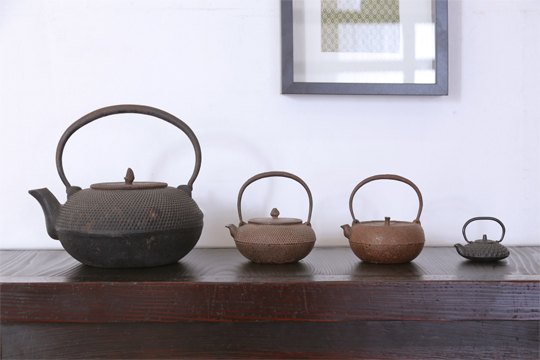
Besides these three centres, ironware is now also made in Kyoto, Osaka, Shiga and elsewhere, producing many ironware artists. Kettle making will surely continue for a long time as one of Japan's fine traditional crafts.
Caring for an old tetsubin
A traditional unlined tetsubin builds up a pale mineral scale inside, which protects the iron; it should never be scrubbed away. After use, empty the kettle and let it dry with the lid off over residual heat. Old kettles with a cast maker's mark, a bronze or silver-inlaid lid, or fine lost-wax decoration are the most sought after; many modern export kettles are enamelled inside and are teapots for brewing rather than kettles for the flame.
Toro (lantern)
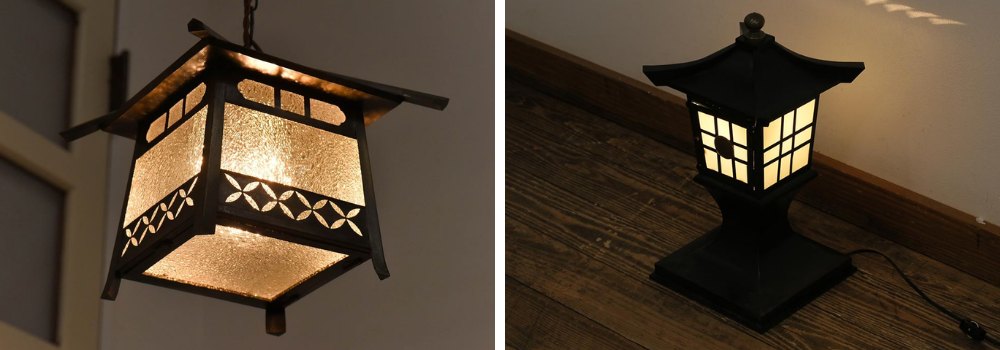
A toro is a lantern, an outdoor light handed down in Japan since early times. It is said to have come from China with Buddhism, and is used chiefly at temples and shrines, in Japanese gardens, at graves and at festivals. It is known as a traditional light across East Asia as well as in Japan.
Features
A toro is made of several parts. From the ground up: the base (kiso), the shaft (sao), the middle platform (chudai) that supports the light chamber, the light chamber itself (hibukuro), the roof over it (kasa) and, at the top, the jewel finial (hoju). The hibukuro is the heart of the lantern: cloth stretched on a frame of bamboo or wood surrounds the flame so the wind will not blow it out.
Kinds
Lanterns divide by form and use. The main Japanese kinds are these.
Ishi-doro (stone lantern). Stone lanterns stand mainly at shrines, temples and in Japanese gardens, and grow more beautiful as they weather.
Mokusei-doro (wooden lantern). Often used indoors and at festivals, and highly decorative, with carving and lacquer.
Tsuri-doro (hanging lantern). Metal lanterns hung from eaves or indoors, often finely worked and highly decorative.
Yukimi-doro (snow-viewing lantern). Usually placed as an ornament in a Japanese garden; lower than other stone lanterns.
Kami-doro (paper lantern). Light lanterns of paper, widely used at festivals and for floating lanterns (toro nagashi).
History
The lantern is thought to originate in ancient China. It came to Japan in the Asuka period with Buddhism. In the Nara period it was used in temples to light the altar, and in the Heian period it was placed at aristocratic mansions and gardens. From the Kamakura period, with the rise of warrior culture, it became an established ornament of shrines, temples and castles.
In the Muromachi period the lantern came to be used as a practical light, and related lights appeared: the andon, a paper-shaded lamp for indoors, and the portable chochin.
In the Azuchi-Momoyama period it joined the culture of tea, lighting the Japanese garden at dusk. Strongly religious when it first arrived, the lantern took on more and more the character of an ornament as culture developed. In the Edo period ordinary people came to use paper lanterns, and with the andon and chochin they are still loved today as lights of quiet atmosphere.
In Japanese culture
The lantern is bound up with Japanese culture and religion. In shrine and temple precincts and in gardens, stone lanterns are indispensable, lighting the path gently underfoot. At Obon and at festivals, paper lanterns and andon are lit, scenes that embody the mood of Japan. In historic cities such as Kyoto and Nara, lanterns remain part of the traditional townscape. Toro nagashi, floating lanterns in memory of the dead, and lantern festivals are held throughout the country: the lantern's role, rooted deep in culture and custom, goes far beyond lighting and lives on today.
Antique lanterns in the interior
Antique lanterns charm with the texture that only age brings and the fine handwork of their makers. Stone lanterns are beautiful in their moss; wooden and metal lanterns gain a character all their own with use. Their designs, too, are full of appeal: Japanese-Western fusion designs sit easily in modern interiors and suit a wide range of tastes. Outdoors, a lantern in the garden or by the entrance heightens the charm of the night. Uniting tradition and modern sensibility, an antique lantern adds individuality and atmosphere to any interior. Many old wooden lanterns were made for candles or oil and have since been wired for electricity; check any wiring with a qualified electrician before use.
Tsukiita (veneer)
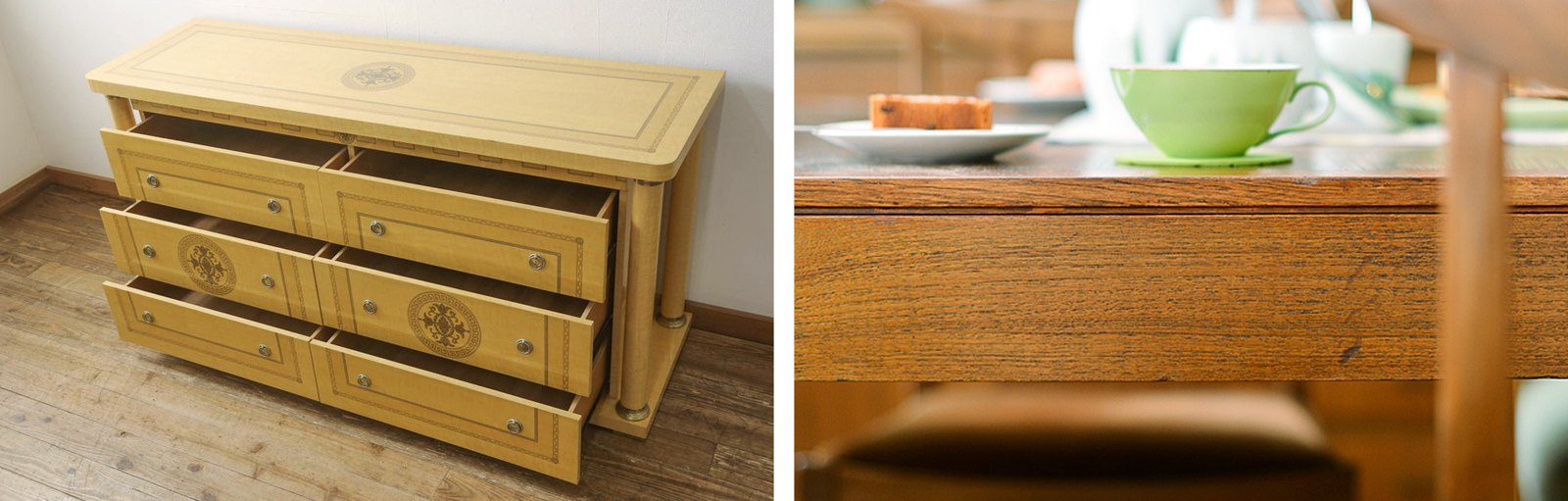
Tsukiita is veneer: natural timber sliced to about 0.2 to 0.6 mm. So thin a sheet cannot be used as timber on its own; it is used only once pressed onto the surface of a thicker board such as plywood or medium-density fibreboard (MDF). The resulting board is called natural-wood decorative plywood, and it is used in interiors, fittings, floors and furniture, all around us. In furniture shops, it is fair to say, almost everything on sale is either solid wood or veneered.
Why slice timber so thin, and why is veneer so widely used? Let us look more closely at tsukiita and its appeal.
Structure and figure
Decorative veneered board has two parts: the core (shinzai), which gives strength, and the face (keshozai), which gives beauty. Veneer is the face, so handsome, precious timbers are chosen for it. There are also decorative boards without real wood, where a paper, cloth, printed sheet, paint or synthetic resin imitating grain is applied to the board. In every case the core is plywood, MDF or inexpensive solid timber.
How the log is cut changes the figure of the veneer, and a precious figure raises its decorative value. There are three main cuts.
Masame (quarter-cut). Cut at right angles to the growth rings, giving straight, parallel lines.
Itame (crown-cut). Cut along the rings, giving a pattern like the section of a bamboo shoot.
Mokume (rotary-cut). Peeled from the log like a long ribbon, as one peels a daikon radish; it draws distinctive ripple-like lines and gives very wide sheets.
Ways of laying veneer
Three methods are most used, but there are many more, diagonal, diamond and arrow-feather (herringbone), and the same veneer looks entirely different depending on how it is laid.
Slip match. Leaves of equal width laid side by side in sequence; the most common.
Book match. Leaves turned over alternately, like the pages of a book, giving a mirror-image pattern.
Mismatch (random). Leaves combined without matching cut, width or even species.
Timbers used for veneer
Many timbers are used, but the rarest are costly even as veneer, and some are hard to obtain. A few popular ones:
Oak. A tree of the beech family, genus Quercus, in Japanese nara (mizunara). Of its many species, North American white oak is much used. Light in colour with a clear, elegant grain, highly durable and water-resistant. See oak and nara.
Walnut. A tree of the walnut family, genus Juglans, often counted with teak and mahogany among the world's three great timbers. Its deep, chocolate-brown colour, handsome grain and lustre are distinctive, and it is durable, easy to work and stable. See walnut.
Tamo (ash). A tree of the olive family, genus Fraxinus, with a strong, distinctive grain of real dignity; strong, springy and tough, valued for building, furniture and sports equipment.
The appeal of veneer
Real grain at lower cost. Fine solid-wood furniture can be hard to afford, but veneered furniture, being real wood, offers its grain, touch and scent at lower cost. At a glance, decorative veneered board looks no different from solid wood. A single tree yields a great deal of material, which is kind to the environment, and veneer is easy to work. Solid wood shows the character of timber best, but many people hesitate to commit to it; veneer offers the best of both. It is true, though, that it feels harder than solid wood and has less of its character.
Light and stable. Veneered furniture is lighter than solid or laminated timber, easier to handle even in large pieces, and resists warping and splitting, keeping its shape and quality. On the other hand a deep scratch can lift it, and even unscratched, because it relies on glue, it may one day lift, stain or discolour with age. Solid wood can be repaired by planing; veneer must be replaced. It is also vulnerable to water and damp: if the core absorbs a lot of moisture it can swell and distort. To avoid this, a protective urethane or oil finish and regular care matter. A urethane finish forms a thick film that hides some of the wood's character but protects strongly against scratches and water, and needs almost no maintenance. An oil finish soaks in without forming a film, keeping the wood's character, but protects less and needs regular re-oiling. Finish the surface, avoid damp places and wet areas, and wipe up water at once after spills or damp cleaning: with such care veneered furniture lasts a long time, and many antique veneered pieces survive. See urethane finish.
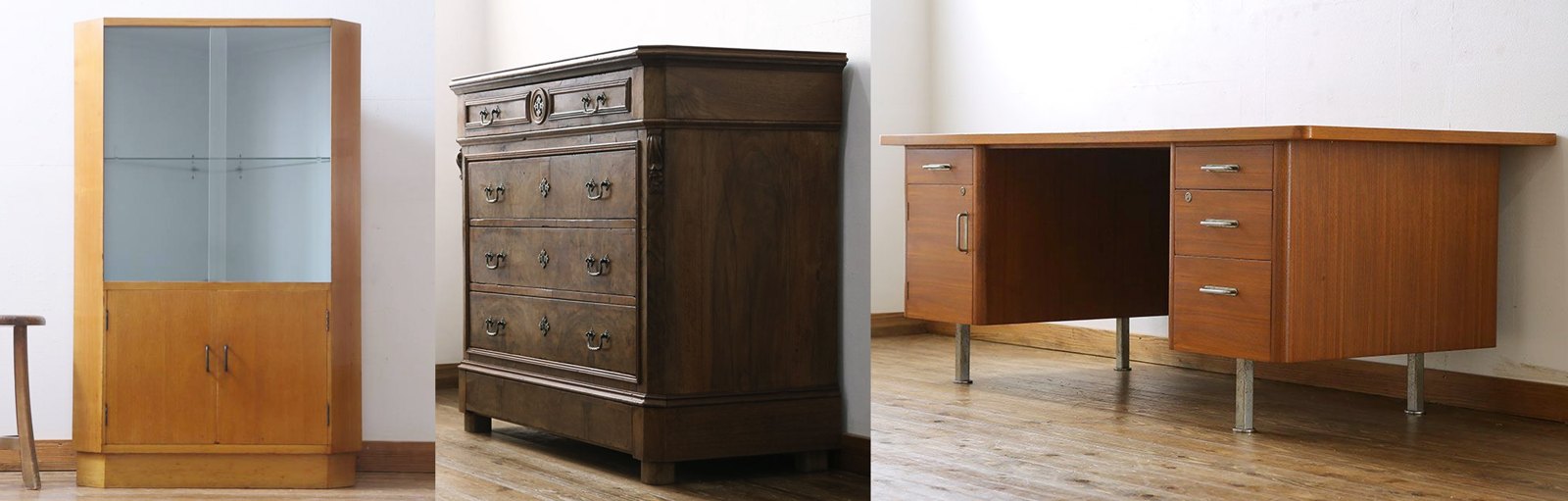
Freedom of design. Because it is so thin, veneer allows designs that would be hard in a single board. Species, combination and method of laying create endless effects and widen the range of design. Its uniform grain is ideal for consistent designs, making it possible to produce many matching pieces, and to give large pieces such as tables and television cabinets their grain even from small trees.
Veneer in antique and modern furniture
Antique and vintage. Veneer is used constantly in antique and vintage furniture from Scandinavia, Europe and America. In those times and places, beauty mattered more than cost or efficiency: the finest figured parts were chosen, patterns were composed from the grain, and precious veneers were laid even over handsome solid wood, a lavish use found in many pieces. In Japan, veneer spread from the Taisho era, bringing figured faces such as tama-moku to ordinary cabinetwork.
Modern. Veneered furniture is everywhere today, made by large manufacturers such as Karimoku and many others. Beyond furniture, many works of contemporary art exploit veneer's distinctive shapes and patterns. For all its points of care, veneer has many virtues, and is indispensable for making good use of forest resources that will only grow more precious.
Turned leg
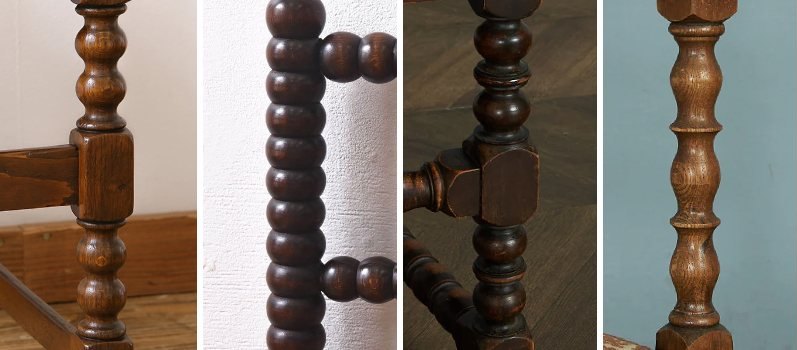
A turned leg is a form of shaped decoration on traditional furniture, made by turning: shaping wood by holding a cutting tool against it while it rotates. One of the oldest ornaments in antique furniture, and known as a design typical of English furniture, the turned leg has changed its design in many ways to suit periods and styles of art, and has long adorned furniture with splendour.
Features
The turned leg's greatest feature is its smooth, curved form. By cutting the wood as it rotates on a lathe, precise and well-proportioned shapes can be made. Today the lathe can be turned by electric power, but before electricity it was turned by hand, by pulling a strap wound round the work, or by a treadle mechanism. Made beautifully by these techniques, the turned leg is ornamental and also keeps the stability a furniture leg needs; that too is one of its features.
History and kinds
As noted, the turned leg has changed its design brilliantly with the succession of styles. Representative kinds include the bulbous leg, the bobbin-turned leg and the twist leg. How each was born and what character it has is set out here in chronological order. See bulbous leg, bobbin turning and twist leg.
The Tudor style: the bulbous leg. The Tudor dynasty of England, beginning with Henry VII, continued through Henry VIII, Edward VI, Jane Grey, Mary I and Elizabeth I over a long period. The bulbous leg born in the Tudor style of this time is said to be the origin of turnery. It is bulb-shaped, and its rounded form gives it the other names "pineapple leg" and "melon-bulb leg". At this time it was made in a simple design without showy ornament, the "cup and cover" leg.
Where the record differs. The Tudor dynasty reigned from 1485 to 1603, not from the twelfth century, and turned furniture is far older than the Tudors, known from ancient Egypt and Rome; the bulbous leg is rather the first great English fashion in turning.
Sixteenth century, the Elizabethan style: the bulbous leg. In the Elizabethan style the plain bulb of the bulbous leg came to be decorated with carving in high relief. This reflected the settling of affairs in England: people's lives became stable and many came to own their own houses. As demand for furniture grew and large pieces were made in numbers, the splendour of the bulbous leg grew too.
Seventeenth century, the Jacobean style: bulbous and bobbin-turned legs. James I succeeded Elizabeth, and in his reign the Jacobean style was born. Simple, refined ornament came to be preferred to the luxury and glitter of before, and the bulbous leg, which had had presence by its round form and large size, changed into a slender, cleaner design; the most popular was the vase shape. Turned furniture gradually became fashionable, and the bobbin-turned leg was born in this period too. A bobbin is a spool for thread, and the design is formed of a row of spool-like balls. Because the wool industry flourished in England, the design was devised after spools wound with yarn. Designs differ in the shape and size of the balls, and the variety is wide.
Later seventeenth century, the Carolean style: the twist leg. When Charles II became king and the Carolean style followed, turned legs twisted into spirals, called twist legs, began to be made. Their proper name is the "barley-sugar twist" leg; barley refers to the "twisted sweet" then made from barley, from which the idea is said to have come. Names change with the degree of twist and the thickness, and twist legs in all their variety were used on chairs, tables and every kind of furniture. The prototype of the twist was in fact born in ancient Rome, where columns of buildings were made in twisted form; after a long time it was taken into furniture, and became popular in the later seventeenth century. Its renewed popularity is thought to be due to the development of a technique for sliding the lathe's cutter, which made spiral turning more stable and allowed complex designs.
Afterwards. In the eighteenth century legs making the most of curves, like the cabriole leg, became fashionable; later straight, plainer legs were preferred; and revivals brought the turned leg back into the spotlight. Furniture legs changed in many ways with the times, but the turned leg never went out of use. It has been handed down with care and still charms many today as an emblem of traditional furniture. See cabriole leg.
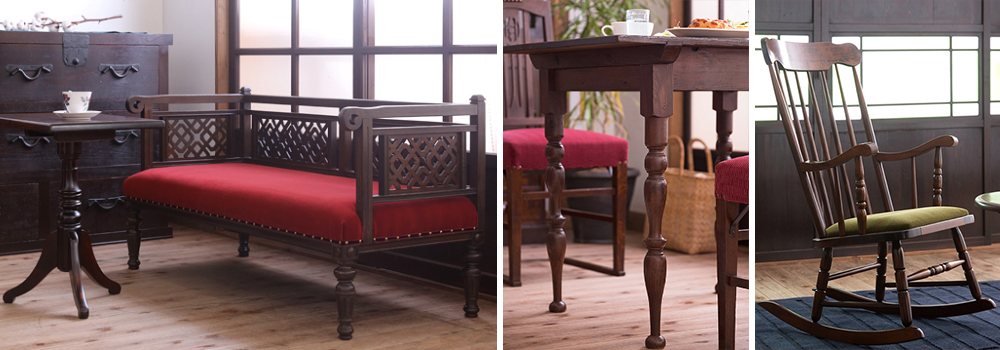
Turned legs in the interior
Classic English antique style. A room full of distinction, where one could enjoy an elegant afternoon tea; a gorgeous bulbous leg gives weight and draws the eye.
Elegant European antique style with accents of colour. Cabinets and chairs in light colours wrap the room in a bright, refined mood; turned and twist legs together heighten its elegance.
Shabby-chic garden style. An interior that enjoys the worn charm only antiques have, where the turned legs of a cupboard create a quietly delicate air.
Natural country style. An interior that brings out natural materials, unpretentious and warm; the curves of turned legs on tables and chairs soften the room.
Taisho roman style. Furniture blending Japanese and Western in the Taisho roman manner, full of exotic feeling and nostalgia; deep colours make a quiet whole, and the turned legs look crisper for it. See Taisho roman.
Dark brown, refined and moody. A room built on rich, fine wood surfaces takes on a grown-up atmosphere, and understated turned legs add a sense of quality.
Japanese-modern style with mingei furniture. Lustrous grain and powerful, weighty forms give a noble Japanese feeling, and the turned legs stand with dignity to match. See mingei furniture and wa-modern.
Twist leg
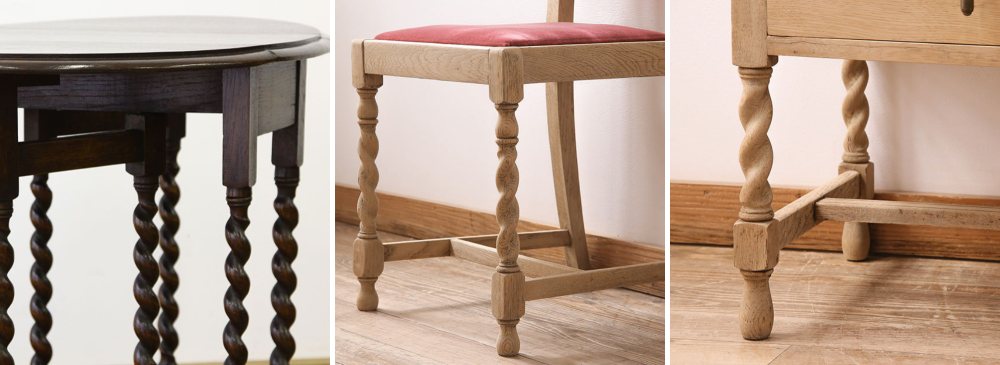
A twist leg is a furniture leg in the form of a twisted rod. Its proper name is the "barley-sugar twist" leg, and the idea is said to have come from sweets twisted into a spiral. Used for the legs of chairs, tables and the like, it is a decorative ornament that won popularity in about the seventeenth century.
Features
The twist leg's hallmark is, above all, its repeated twisting pattern. It is one of the techniques of turning (lathe work), and its name changes with the slenderness of the twist.
Barley-sugar turn. The most popular twist leg. Solidly thick, it is often used on dining tables and the like.
Twist turn. Slimmer in line than the basic twist and more loosely wound; delicate and feminine, a refined design.
Barley twist. A twist turned very gently. Compared with other twists it has a distinctly sinuous, individual look, with something rustic about it.
Plain twist. A twist whose turns are tightly packed. Close twisting gives an effect near a straight line, with a sense of strength.
Double twist. A twist leg in which two rods are twisted together as if plaited. It is sometimes used for the legs of small furniture such as lamps.
History
The twist leg has a long history; similar forms existed in ancient Rome. Columns modelled on those of the ancient temple of Israel were made in Rome, and thereafter twisted columns were taken into monasteries and other buildings. In the seventeenth century it came back into fashion, taken into furniture as well as buildings, which is said to be because the lathe's sliding carriage had developed, so that a round rod could be turned into a stable spiral. Today the twist leg is most often seen on antique furniture, and the beauty of its form keeps it popular. See turned leg and gateleg table.
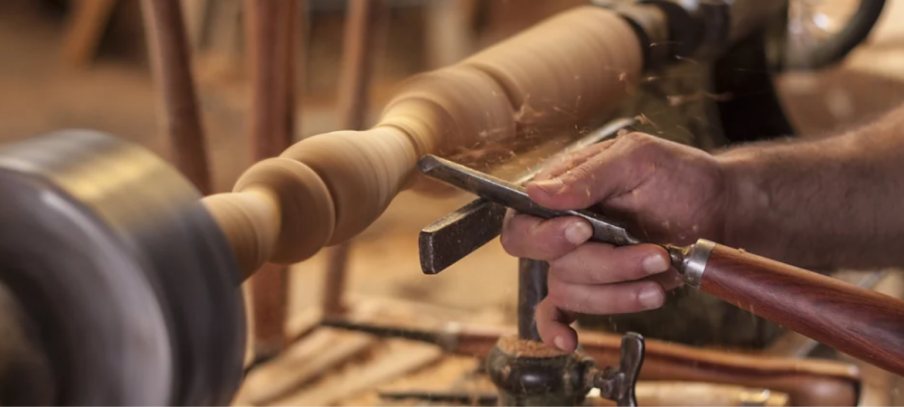
How a twist leg is made
A carving cutter fixed to the sliding carriage is held against the wooden rod, and the twist pattern is cut by sliding it along as the rod turns. Changing the speed of rotation, the depth of cut and the speed of the slide changes the degree of twist, so many kinds of twist can be made.
The twist leg in antiques
The twist leg takes much labour to make, and today legs are seldom worked in this form on purpose. In antique furniture, however, it is often seen, and with a fine lustre it makes a most attractive leg; antiques are the place to savour the craftsman's skill in the twist leg. See occasional table and draw-leaf table.
U
Ukibori (relief carving)
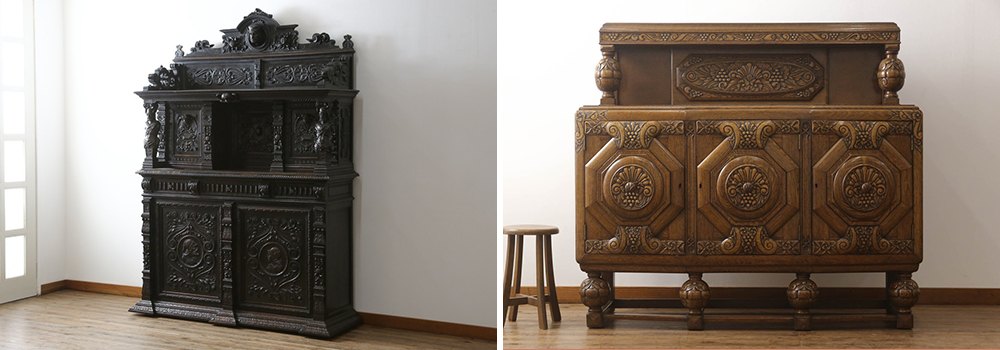
Ukibori, relief, is a carving technique in which a design is cut into a flat surface of wood, stone or metal so that it stands out in three dimensions; the word also means a work made that way. It has been used in every field, architecture, portraiture, coins, gravestones, works of art. It is common on antique furniture, where relief ornament gives a weighty, graceful air.
Features
Its three-dimensional expression is the essence of relief. Depth gives a design character, richness and weight, and lifts the whole piece. Today relief is often made by machine, but before machines it was carved by hand, piece by piece, with a range of chisels and gouges, so each was one of a kind. Carefully, minutely carved relief shows the craftsman's skill and devotion and the depth that only handwork has. Beyond its looks, relief offers the pleasure of its texture under the fingers.
Kinds
Relief divides into two broad kinds.
Low relief (bas-relief). Shallow carving into the surface is called low relief. Very hard oak was the usual material. It has less depth but more presence than flat ornament, and its delicate designs have a refined air. Typical low-relief motifs are the Gothic arch, the Tudor rose and the linenfold, which imitates the soft folds of linen. See linenfold.
High relief. Deep carving is called high relief. Walnut, relatively stable and easy to work, was much used. Its depth gives greater impact and force, and the strongly projecting carving makes a bold, powerful impression. Plants, animals and figures were its subjects, and much high-relief ornament is as artistic as free-standing sculpture.
Other kinds. Many other forms exist, depending on depth and technique. Mezzo-rilievo, middle relief, is carved to a depth between low and high relief and is hard to tell clearly from either. Rilievo schiacciato, "flattened relief", is shallower still than low relief, adjusted by fractions of a millimetre, so that it reads almost like a painting. Sunk relief (often called intaglio) is the reverse of relief: the carved design is cut below the background, so that it seems to sink in, a technique often seen in the wall reliefs of ancient Egypt.
History
Origins. Relief carving goes back to antiquity, and in the Middle Ages it was used to decorate churches and cathedrals and became widely loved.
As furniture ornament. Relief is said to have entered furniture decoration in the Tudor style under Henry VII, who ruled England from 1485. Furniture of that era was usually oak, and its hardness lent itself to low relief. Later, in the Carolean style under Charles II, walnut began to be imported, and its ease of working made high relief the norm. Charles II, a devoted lover of the arts, had much furniture made under French, Dutch, Spanish and Chinese (chinoiserie) influence. Traditional techniques and designs were handed on, and relief developed widely, combining low and high relief to suggest perspective and using many materials and styles. See chinoiserie.
Relief in Japan. In Japan, relief has been used on Buddhist images and buildings since the Asuka period in the sixth century, and it is common on antique Japanese furniture. Its subjects are mostly traditional: auspicious cranes, tortoises, cherry blossom and pine, bamboo and plum, and dragons, carp and tigers, thought to bring good fortune. Among Japan's famous carving traditions are Karuizawa carving (Karuizawa-bori) and Nikko carving (Nikko-bori). Loved the world over since ancient times, relief is still used on furniture in antique style today, alongside a great variety of new, modern designs.
Relief furniture by country
Relief furniture differs in design and mood by the country that made it.
England. Classical and weighty in design, refined and deeply settled in mood.
France. Elegant and graceful together; slender, curving designs overflow with grace.
Italy. Artistic, weighty designs in luxurious materials, many as practical as they are handsome.
China. Lavish designs with characteristic motifs such as dragons and the thunder fret (raimon); fine carving in hard karaki speaks of luxury. See karaki.
Japan. Practical, simple designs that evoke wabi-sabi; traditional motifs give them a quiet, chic beauty.
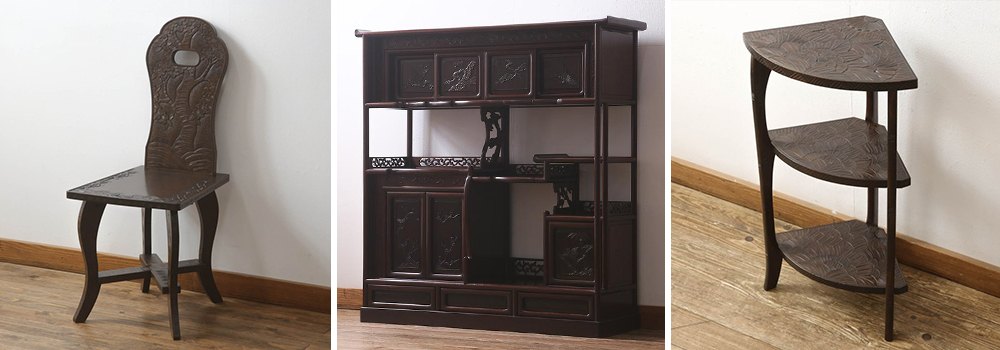
In the interior
Furniture with relief carving has luxury and character, and brightens a room at once, an eye-catching piece with real presence.
Ura-shoji (removable inner shoji)
Ura-shoji, "back shoji", are small paper screens (ko-shoji) fitted to the back of a lattice door (koshido) and the like. They are made in the kendon style, lifted slightly and lowered to come out. Fitted when the room needs to be draught-proof and warm, removed when it needs air and coolness, they keep a home comfortable all year as season and conditions change. With the ura-shoji in place, the door looks entirely different from front and back, a contrast that is part of its charm. Raising function while keeping the beauty of lattice and shoji, the ura-shoji is a traditional Japanese fitting full of the wisdom of earlier generations.
Features
Highly practical. The great feature is that the small screens come on and off: lift a little and draw the bottom towards you, and the screen is out. This raises airtightness or ventilation, and helps regulate light and protect privacy.
Two faces. A lattice door with ura-shoji is a double construction, so its design differs from front and back. Choosing between two faces is a pleasure an ordinary lattice door cannot give.
Kinds
Designs. Fittings with ura-shoji look alike at first, but on closer inspection the thickness and spacing of the lattice, and the arrangement of the bottom panel (koshiita) and band of glass (obi-garasu), give each its own character. See kumiko.
Fittings. Ura-shoji are most often found on lattice doors, but also on free-standing screens (tsuitate) and transoms (ranma); some lattice doors are remade as screens or transoms. A screen in particular offers the convenience of ura-shoji easily and fits readily into an interior. See ranma.
Materials. Despite the name, ura-shoji are now often left unpapered to enjoy the woodwork itself. For design and convenience, glass (called ura-garasu) or plastic shoji are often used instead of paper, so ura-shoji come in many materials. Each has its own appeal and function; the right one depends on use and setting.
History
The history of the ura-shoji is not clearly known, but both lattice doors and shoji, from which it derives, came into use in the Heian period. A lattice door lets air and light through when closed, screens the interior while letting one sense passers-by, and was much used in temple architecture before spreading to ordinary people in the Edo period. The shoji door is said to derive from the sliding door (yarido) of shinden-zukuri mansions; in the late Heian period the akari-shoji, ancestor of today's shoji, appeared, dividing rooms while letting in soft light, much as now. Japanese paper was at first costly and used only by court nobles and warriors, but in the Edo period, as papermaking improved, shoji gradually became common among ordinary people. The nekoma-shoji is said to have appeared in the Edo period, and the ura-shoji is thought likely to have been in use by then too. Lattice doors and shoji went on developing, and after the Meiji era, as glass became available, the yukimi-shoji and others were made. Today the beauty and practicality of the ura-shoji are still highly valued, for atmospheric rooms and comfortable living alike.
Similar shoji
Suriage yukimi-shoji. A yukimi-shoji ("snow-viewing shoji") has paper above and glass below; when a small sliding-up screen is fitted over the glass, it is a suriage yukimi-shoji. Like the ura-shoji its small screen can come out, but it is normally slid up and down. The yukimi-shoji was made so that one could look out at the scene through the glass from indoors; with a screen that rises and falls, it can be used as an ordinary shoji when needed, an expression of Japan's love of enjoying the changing seasons.
Nekoma-shoji ("cat-gap shoji"). A small sliding screen set into part of a shoji as a door for the cat. It is similar in construction to the suriage yukimi-shoji, but its small screen is usually smaller. By method of opening there are suriage (sliding up), katabiki (sliding to one side) and hikiwake (parting to both sides) nekoma-shoji. Originally it let the cat come and go with the door closed; it is no longer used that way, and glass is now often set in for practicality. Such pieces are generally still called nekoma-shoji, and the suriage yukimi-shoji is sometimes called a nekoma-shoji too.
In the interior
Lattice doors have a strongly Japanese image and suit a refined Japanese room perfectly. Yet their simple, unpretentious design and characterful wood also suit Western and modern rooms beautifully. With removable screens, front and back can set different moods, offering many ways to enjoy them. When buying antique fittings, check that the small screens come with the door and still slide and lift freely, and measure carefully: old doors were made to the opening of a particular house.
Uretan shiage (urethane finish)
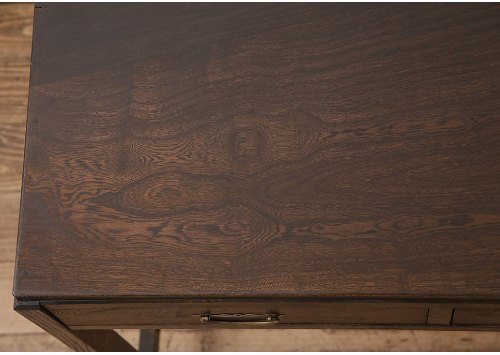
A urethane finish (uretan shiage) is a finish applied with paints whose main ingredient is urethane resin. It forms a film on the surface of the furniture that protects it from water, scratches and stains. Its sheen, from high gloss to none, and its colour can be adjusted by the choice of paint, so the finish can be suited to taste; to the touch it is smooth and slick. Water-resistant, durable, stain-resistant and hard-wearing, and easy to care for day to day, urethane is today the main finish for furniture the world over.
Kinds and features
Urethane finishes can be classified in several ways: by main ingredient, by when the hardener is mixed, by whether they are water- or solvent-based, and by whether they are clear or coloured.
1. By main ingredient. By the type of urethane resin, they divide broadly into polyurethane resin paints and acrylic urethane resin paints. Polyurethane paints are already highly durable and weather-resistant; acrylic urethane was developed as an improvement on them, so its performance is generally better, though its film may be thinner.
2. By when the hardener is mixed. A hardener is an agent that cures the paint for greater durability; by when it is added, paints are one-pack or two-pack. One-pack paint comes with the right amount of hardener already mixed in, so it is easy to use and relatively inexpensive, and popular for home projects. Two-pack paint must be mixed with its hardener just before use. It takes more trouble but forms a tougher, more durable film than one-pack, and adheres so well that it can coat metal and other materials. It needs specialist knowledge and skill, and suits professional work.
3. Water- or solvent-based. Resin and hardener alone are hard to apply, so the paint is thinned with a solvent that adjusts its viscosity and disperses the ingredients evenly; the solvent determines whether it is water- or solvent-based. Water-based urethane, thinned with water, has less of urethane's smell and is kinder to the environment. Solvent-based urethane, thinned with organic solvents such as thinners, is more durable, adheres better and cures faster. Almost all water-based urethanes are one-pack; solvent-based ones come in both one- and two-pack forms.
4. Clear or coloured. Urethane paints come clear, with no colourant, or coloured. The clear kind, sometimes simply called clear finish, uses its transparency to set off the beauty of the grain; the coloured kind can be finished in any colour, expressing individuality. See clear finish.
Sheen, as much as colour, changes the look. Mixing in a flattening agent (flat base) or paints of a different sheen adjusts it, and finishes are graded in five steps: full gloss, seven-tenths, half, three-tenths and matt. Gloss gives a strong, brilliant shine; matt gives a soft finish that keeps the natural feel of the wood. Sheen affects performance as well as looks: gloss, for example, picks up dirt less readily and is more durable and weather-resistant than matt.
History
The birth of the urethane finish. The story of urethane begins in 1937, when polyurethane chemistry was developed in Germany by the chemist Otto Bayer and the research team he led at Leverkusen. Polyurethane was put to use in fibres, rubber substitutes, adhesives and insulation. Its great step into coatings came in the early 1940s, during the Second World War, when protective "DD" lacquers for aircraft were developed there; their qualities became known around the world. Development continued after the war, and performance improved until urethane became the main finish for wooden goods. (Otto Bayer shared his surname with, but did not found, the company where he worked.)
In Japan. Polyurethane technology was introduced to Japan after the Second World War, during rapid industrialisation and economic recovery, and demand for polyurethane resin, a new material indispensable to industry, rose. Paint makers sprang up across the country, and the first Japanese-made polyurethane resin paint went on sale in the mid-1950s. As domestic supply steadied, prices fell and urethane finishes became commonplace. From the late 1990s environmentally considerate paints were developed, and water-based and low-VOC (volatile organic compound) polyurethane paints came onto the market. Environmentally minded products continue to appear, with interest in polyurethane resins made from renewable resources, and performance keeps rising: many urethane paints of excellent durability and weather resistance are available today.
Urethane and antique furniture
Because urethane did not exist before the late 1930s, and spread to Japanese furniture only after the war, an original urethane film is a sign of later manufacture. On older Japanese pieces, a urethane surface usually means a later refinish. It is not a fault: a good restorer may choose urethane for a table top that will see hard daily use. But collectors who prize the original surface look for urushi, shellac or oil, which age and can be repaired in ways urethane cannot. Urethane is also used over veneer to protect it; see tsukiita.
Urushi (Japanese lacquer)
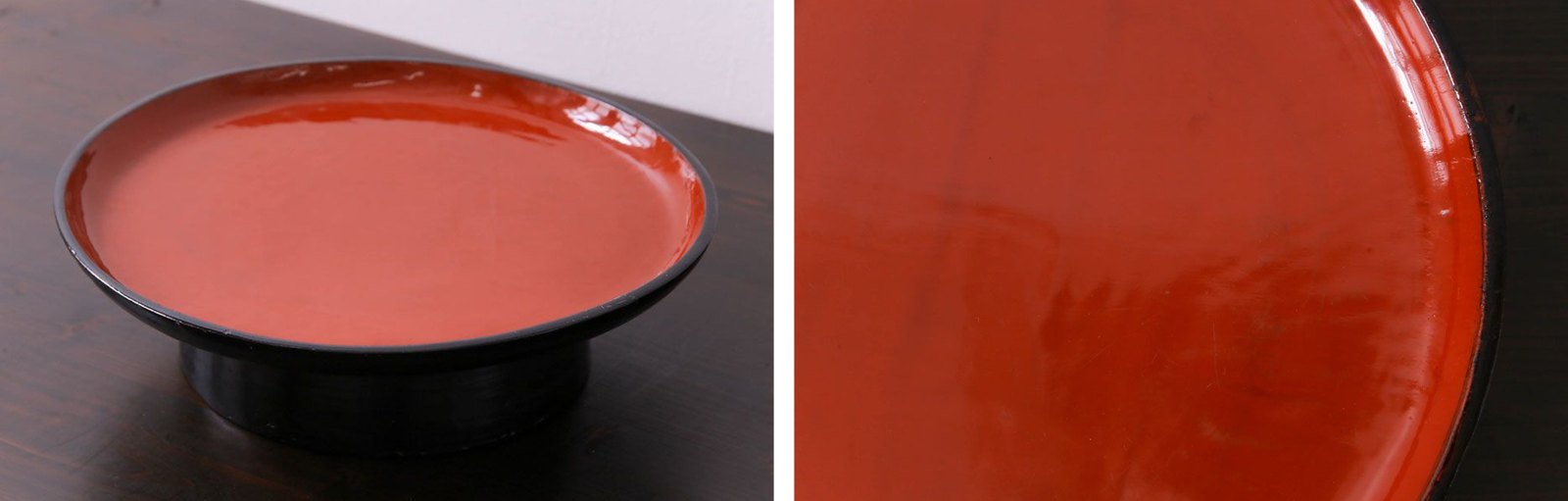
Urushi is the sap of the lacquer tree (Toxicodendron vernicifluum), a deciduous broadleaf of the cashew family. A tree takes ten to twenty years to grow, and yields only about 200 g of sap. That sap, as coating and as adhesive, has served crafts and works of art, buildings, furniture, tableware and instruments, and has long sustained Japanese culture and daily life.
A lacquered surface takes on a moist, deep colour wrapped in a radiant lustre. Lacquer and lacquerware are known abroad as "japan", and lacquering is a traditional Japanese craft admired around the world. See shikki.
Lacquer trees grow across Japan, China, Korea and South East Asia. The lacquer of Japan and China is based mainly on urushiol, the substance behind lacquer's beautiful gloss and toughness; lacquer from elsewhere has a different main component. Japanese lacquer, rich in urushiol, is said to be the best, but with falling production it has become a scarce luxury, and most lacquer used today is imported from China.
Besides hon-urushi, true lacquer made from the sap alone, there are imitations such as synthetic lacquer, cashew lacquer and urethane lacquer; worth checking when buying lacquered furniture.
Lacquer techniques
A single piece of lacquered furniture passes through a finely divided sequence of processes, each in the hands of a specialist. Fine furniture is made by weaving their skills together. There are many techniques, varying by grade and use; here are the main ones.
Hana-nuri (nuritate). Lacquer mixed with oil is brushed on and left to dry as the finish. Thanks to the oil, it gains gloss and lustre from brushing alone, with no polishing.
Fuki-urushi (suri-urushi, wiped lacquer). The raw sap (arami-urushi) cleaned of impurities is ki-urushi; it is rubbed into the wood with a cloth and left to dry, again and again, giving a beautiful lustre that keeps the character of the grain.
Roiro-nuri. Lacquering proceeds from undercoat to middle coat to top coat; roiro-nuri is a further finish on the top coat, applying and polishing refined transparent lacquer (suki-urushi) over and over. It takes great effort but gives a deep, immaculate, mirror-like gloss.
Kijiro-nuri. The same work as roiro-nuri, but with transparent lacquer at every stage. Coat upon coat of clear, amber suki-urushi sets off the grain that shows through, so beautifully figured woods such as tochi (horse chestnut) and keyaki are often used. See keyaki.
Kashoku (decoration). Lacquer art has a family of decorative techniques, kashoku, using lacquer as an adhesive for gold powder, shell and more; they are many, and of great artistry. Among the best known: maki-e, designs drawn in lacquer and sprinkled with gold, silver or coloured powders; raden, thin slices of the pearly inner shell set into the surface; and chinkin, gold leaf or powder pressed into lines engraved along a design. There are many others, choshitsu (carved lacquer), hyomon (cut metal-sheet inlay), urushi-e (lacquer painting), haku-e (leaf painting), rankaku (eggshell) and more than can be listed here. See raden.
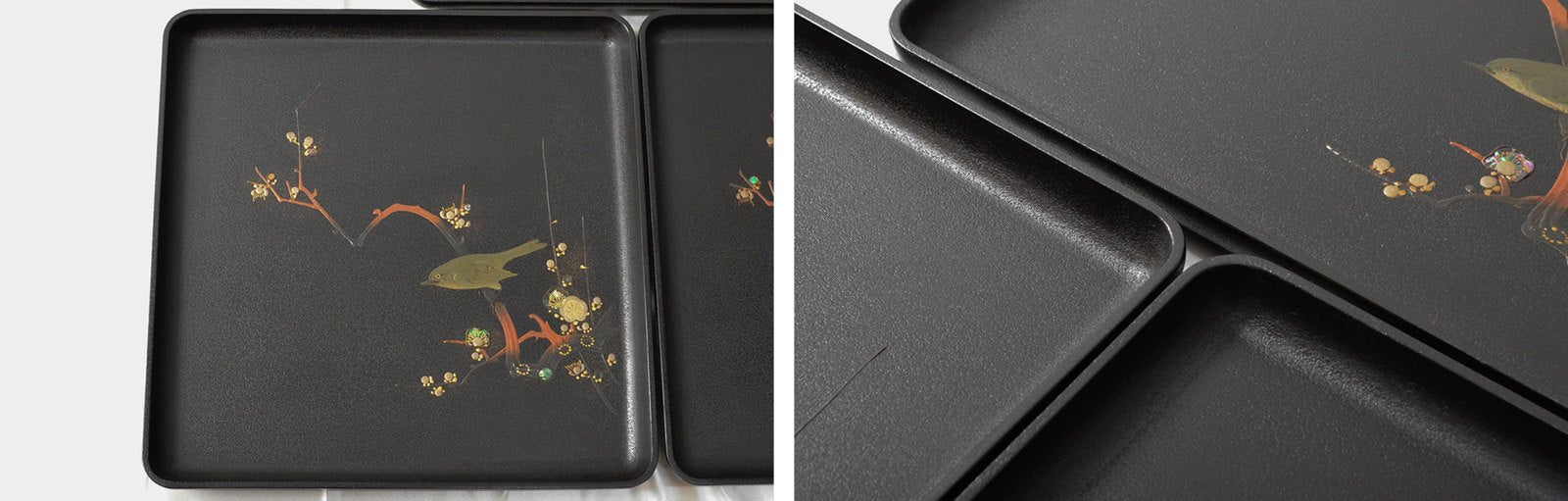
Famous lacquered furniture
Wajima-nuri. Made in Wajima, Ishikawa Prefecture. A ground containing a fine powdered earth found only at Wajima gives great strength and durability, and graceful decoration in maki-e and chinkin is characteristic; a piece passes through more than a hundred processes. See Wajima-nuri.
Aizu lacquer. Made in the Aizu district of Fukushima Prefecture, a traditional craft continuing from the Edo period. Its charm is auspicious designs in many techniques, above all keshifun maki-e, using the finest metal-leaf powder.
Kishu lacquerware. Made mainly in the Kuroe district of Kainan, Wakayama Prefecture, and so also called Kuroe-nuri. Since the Edo period it has produced simple, practical wares for everyday life. It is famous for Negoro-nuri, vermilion lacquer over black, and keeps evolving in materials and decoration to meet each age. See Kishu.
The appeal of lacquer
Lustre. The gloss of a lacquered surface is so beautiful that Europeans who reached Japan in the age of exploration carried it home; lacquerware became a precious Japanese export, and Marie Antoinette, queen of Louis XVI, was among its devoted collectors. "Beautiful gloss" barely covers it: there is the strong, mirror-like gloss that reflects everything before it, a calm, soft gloss, and a refined gloss that keeps the character of the grain, each born of the lacquer and the technique used. We often picture lacquer as vermilion or black, but there are also urumi (between vermilion and black), beige, yellow, blue, green, purple and orange; these coloured lacquers (iro-urushi), developed with advances in pigments, create a bright, festive mood. And because lacquer hardens and grows more transparent with time, its lustre deepens year by year, an ageing to be enjoyed.
A tough film. Lacquer does not only beautify; its film protects furniture. It deters insects, resists decay and water, and stands up remarkably well to acids, alkalis and alcohol. Applied to furniture it strengthens and preserves it, an outstanding coating. Care is simple: keep it out of ultraviolet light, its weakness, and dust it with a soft cotton cloth. To remove dirt, wipe with a damp cloth, then dry. Such easy everyday care matters greatly for furniture meant to last many years.
Lacquered furniture
Antique. Lacquer is thought to have been used since the early Jomon period, and much old lacquered furniture survives. Desks and chairs essential to daily life, and chests (tansu), which spread from the late Edo period, were lacquered, and with the many decorative techniques already established, pieces appeared that were works of art beyond mere utility. Lacquer was then gathered all over the country, so local techniques arose, and these traditions are still carefully handed down.
Vintage. The mingei movement, begun in 1926, spread the search for beauty in everyday things made by unknown craftsmen, lacquerware among them. Matsuda Gonroku, called "the god of lacquer", became the first lacquer artist named a Living National Treasure, and lacquer art flourished further. See mingei furniture.
Modern. Festive and auspicious, lacquer is prized as a gift. At the 1998 Nagano Olympics the medals used Kiso lacquerware, the local traditional craft, drawing wide attention. Lacquered furniture keeps evolving to suit modern ways of living, and will surely grace modern interiors.
V
Vintage
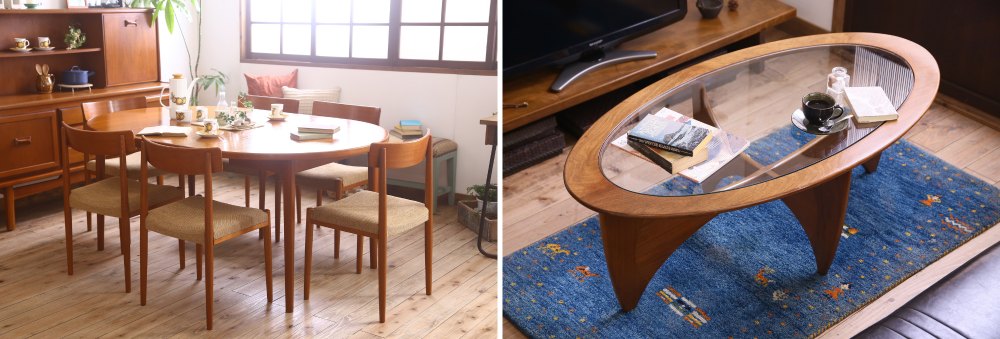
"Vintage" (bintēji in Japanese usage) refers to a well-made item some twenty or thirty to about a hundred years old. Younger than an antique, it is mostly something made after the Second World War.
Features
"Vintage" was first a wine term, used of a year when the grapes were good and fine wine was made. Today it is used not only of wine but of clothes, furniture and cars, for things that are "old and good". Yet it is rarely used of anything more than a hundred years old, because such things are generally called antiques. Most vintage items date from after the Second World War, when accelerating mechanisation produced many good things in quantity; good things handed down from that time to ours are what is most often called vintage.
History
The word comes, by way of French, from the Latin for the grape harvest, and once meant the whole process from picking the grapes to making and bottling the wine. At some point it came to mean a good year for wine, and more recently "old and valuable things".
One common account of this shift holds that items under a hundred years old, not antiques, were once dismissed in the trade as "junk". Yet some of that junk was too good and too valuable to deserve the name, and calling such pieces "vintage" set them apart.
Vintage and antique
"Antique" is often seen with "vintage". As a rule of thumb, an antique was made more than a hundred years ago, though the definition is loose, and things younger than that are sometimes called antiques. That might seem to blur the line, but the two can be clearly distinguished.
An antique is expected to be rare and of high quality, to carry on a tradition with an honourable pedigree, and not to be mass-produced. A vintage piece need only have been made thirty to a hundred years ago and be rare and of high quality. So even a mass-produced piece without special design merit can be vintage, if its quality is high. See antique and Showa retro.
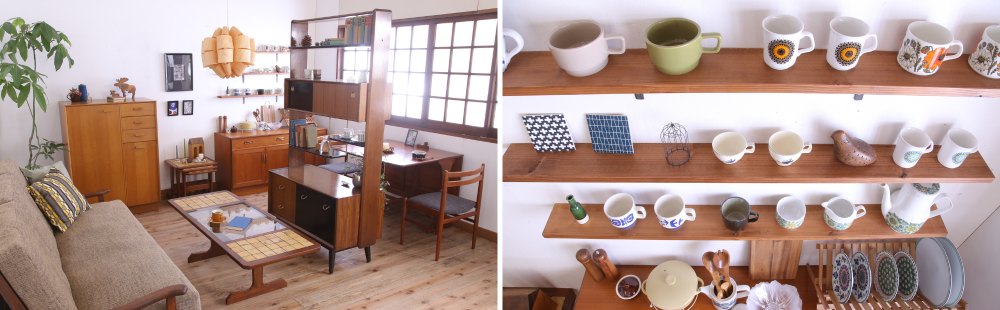
For Japanese furniture, "vintage" usually covers the Showa decades after the war: the solid-timber dining sets, sideboards and low tables of the 1950s to the 1970s, and the work of the great Japanese furniture makers of that time. When judging a vintage piece, look for solid construction, honest wear and original fittings, rather than age alone.
W
Wa-modern (Japanese modern)
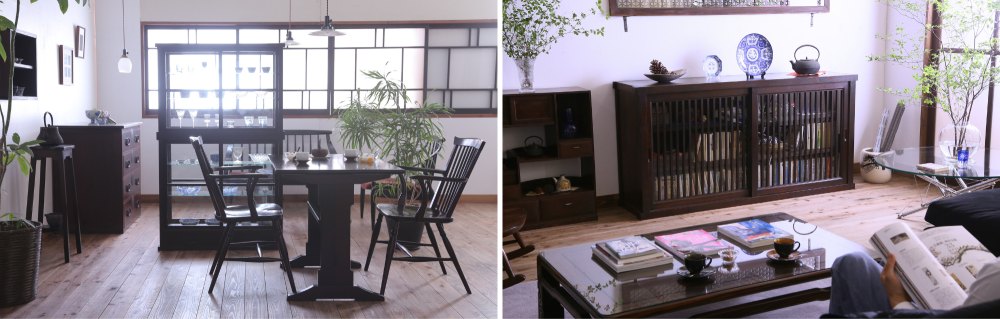
Wa-modern, "Japanese modern", is a design that fuses traditional Japanese design with a modern feel: a sofa or bed in a room with tatami, shoji and fusuma, for example, combining Japanese fittings with Western function. As homes and interiors grow ever more Western, it suits anyone who longs for the nostalgia and calm of Japan.
Features
Wa-modern blends age-old Japanese design with modern, functional design: a sofa in a room of shoji, or one floor divided into a tatami area and a boarded area. Many Japanese feel at ease and at peace in a Japanese room, but many also find its inconveniences irksome. Wa-modern keeps the Japanese spirit while making the room functional and modern: a bed where lifting and folding futons is a chore, a dining set where sitting formally on the floor is hard, combining the best of Japan and the West to enjoy a Japanese mood in comfort, an inventive way of styling.
History
Wa-modern goes back to the Meiji era. With the opening of the country, things and knowledge flooded in from the West, and Japan eagerly adopted Western furniture and architecture. Japanese houses did not become Western overnight, however, and a mixed style emerged by necessity.
In the Taisho era, the Taisho roman style, a deft combination of Japanese and Western, took shape; its fusion of Western function and Japanese tradition can be called the prototype of today's wa-modern. From the mid to late Showa era the style evolved further, establishing itself as a functional, stylish category with a distinctly Japanese feel.
Wa-modern and Taisho roman
If Taisho roman is the prototype of wa-modern, how do the two differ? Taisho roman, unlike the West-leaning Meiji era, skilfully mixed Japanese and Western design; its distinctive culture was Western design and function combined with traditional Japanese things. Wa-modern, by contrast, often feels strongly Japanese: Western things are there for their function. Japanese design as the base, with modern function laid on top, is its essence. See Taisho roman.
Wa-modern interiors
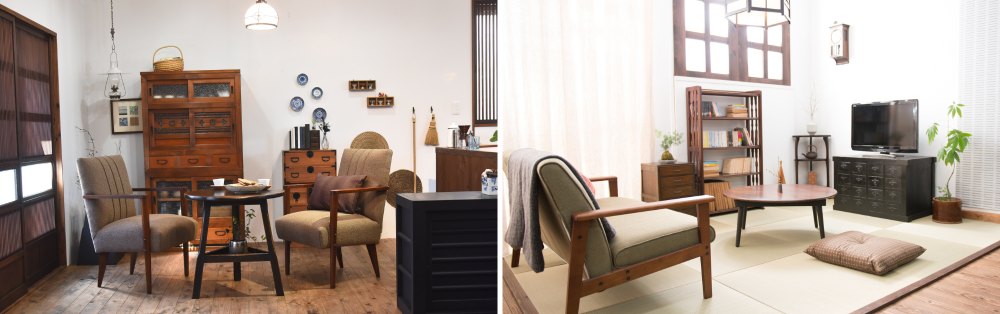
Wa-modern works in a Japanese or Western room alike; it is all in the choice of furniture. Old Japanese pieces are its natural partners: a kaidan-dansu or mizuya-dansu against a plain wall, lattice doors as a room divider, a low table on tatamizuri beside a sofa. Keep the palette quiet, natural wood, paper, iron, indigo, and let a few strong pieces carry the room.
Wajima-nuri (Wajima lacquer)
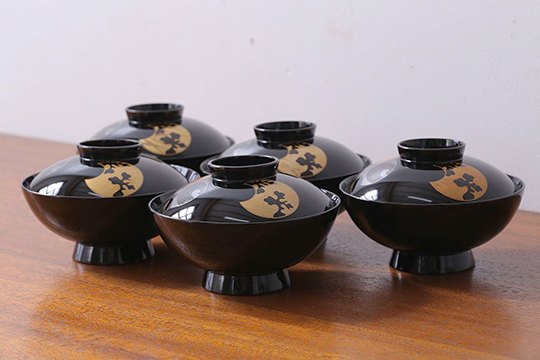
There are lacquerware centres all over Japan, but it is no exaggeration to call Wajima-nuri, the lacquer of Wajima on the Noto peninsula in Ishikawa Prefecture, the most famous of them. Its record bears that out: it has produced Living National Treasures, and it is the only lacquerware centre recognised as an Important Intangible Cultural Property. Besides its high quality, Wajima is distinguished by the way the whole district organised itself to make better things. Here we look at that quality from several angles.
Roots
The origins of Wajima-nuri are debated and uncertain. The most common view traces it to Negoro-nuri of Wakayama Prefecture, still a lacquer centre today, which shares many methods with Wajima. Negoro-nuri has so long a history that it is called the root of everyday lacquerware techniques. Wajima built on Negoro's methods while developing its own processes and ways of selling, and so grew into the great name it is today. Its beginnings are placed in the Kamakura or Muromachi period, when lacquerware-making in something like its later form flourished, or a little after; the oldest surviving Wajima lacquer, a lacquered shrine door, is dated 1524.
Why so famous? Quality above all
Several reasons can be named for Wajima's fame. The first is quality, practical as well as visual, and above all an exceptionally strong ground.
Wood. Records of the details are scant, but in the past local timbers of strength such as ate (hiba, Thujopsis) and keyaki were used, and woods were chosen to suit the piece, furniture or bowl. See keyaki.
Lacquer. Wajima mixes into its lacquer Wajima ji-no-ko, a diatomaceous earth that is fired and ground to powder, and uses this as the ground coat. Diatomaceous earth and lacquer are said to combine superbly, giving a stronger, more resilient ground than lacquer alone. Lacquer cures by drawing moisture from the air and needs a degree of humidity; Wajima's damp climate suits it perfectly, another help to the quality of its work.
The ground. Not only earth: Wajima also uses nunokise, laying cloth over vulnerable parts to strengthen the ground. And for beauty, its decoration in maki-e and chinkin is superb. See urushi and shikki.
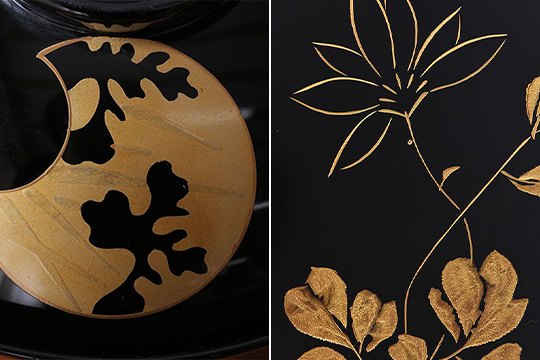
Masters of organisation
Division of labour, efficiency and quantity. To maintain this quality, Wajima organised its makers into guilds and kept control of quality, and this is thought to be a great reason for its rise. The work is finely divided: kijishi who make the wooden bodies, nushi who lacquer, chinkinshi who engrave and gild, makieshi who do maki-e. The wood-workers are divided again by the work: hikimonoshi (turners), sashimonoshi (joiners), magemonoshi (bent-wood makers) and hoo-kijishi (carvers of complex curved and sculpted parts, named for the magnolia wood they use). There are even specialists, often women, who do nothing but polish the ground. Lacquering alone takes twenty to thirty-seven steps, and a piece may pass through as many as 124 in all. Dividing and organising the work made quantity possible and gave a stable environment for making.
Selling ahead of its time. Through its guilds, Wajima also unified its rules of sale, prices included. Arrangements much like modern financial products long kept the guilds' trade stable, and helped sales further. Wanko, "bowl associations", were something like a modern instalment plan, making it easier for customers to buy. Tanomoshi-ko were mutual credit associations within a community: members contributed in turn, and each in turn received the pooled funds to use for household or business, so neighbours supported one another's work and living. The nearby port of Wajima was also a great asset in selling.
Through its quality and the efforts of all involved, Wajima not only sold more but came to be held in special regard among Japan's many lacquerwares.
Living National Treasures
Wajima's chinkin and maki-e, drawn with extraordinary precision by skilled hands, are recognised at home and abroad for their technique and artistry. Today more than a hundred Wajima artists at any time are prizewinners at the Nitten and the Japan Traditional Crafts Exhibition, and naturally many fine makers appear among antique pieces too.
In the Edo period, Daiku Gorobei is credited with founding chinkin at Wajima; Tachi Junsuke and Kasaya Sajiemon were also famous chinkin masters, and Iida Zenshichi a celebrated maki-e master. In the Meiji era came the chinkin masters Hashimoto Sesshu, Kurokawa Sekishu, Funakake Sojiro and Funakake Teiji. From the Showa era to the present the names include Harima Masao, Enoki Mori, Mitani Goichi, Inami Tadashi, Kadono Iwaji, Shioda Keishiro, Takezono Jiko, Tasaki Shoichiro and Mae Fumio; among them are makers designated as holders of Important Intangible Cultural Properties, Living National Treasures.
The only lacquerware designated an Important Intangible Cultural Property
Of all Japan's lacquer centres, Wajima alone is designated an Important Intangible Cultural Property, and its tools are designated Important Tangible Folk Cultural Properties. To pass on its skills, there are institutions devoted to lacquer art: the Ishikawa Wajima Urushi Art Museum and, since March 2015, the Wajima-nuri Kaikan, which holds some four thousand folk materials on Wajima's history. Wajima-nuri remains unrivalled in popularity, skill and reputation.
Recognising old Wajima pieces
Old Wajima lacquer feels dense and solid, with crisp edges that do not chip easily, thanks to its earth-and-cloth ground; worn rims sometimes reveal the layers of ground beneath. Bowls and boxes often come in their original inscribed wooden boxes. Note that Wajima was badly struck by the Noto earthquake of January 2024, and its makers are rebuilding.
Walnut
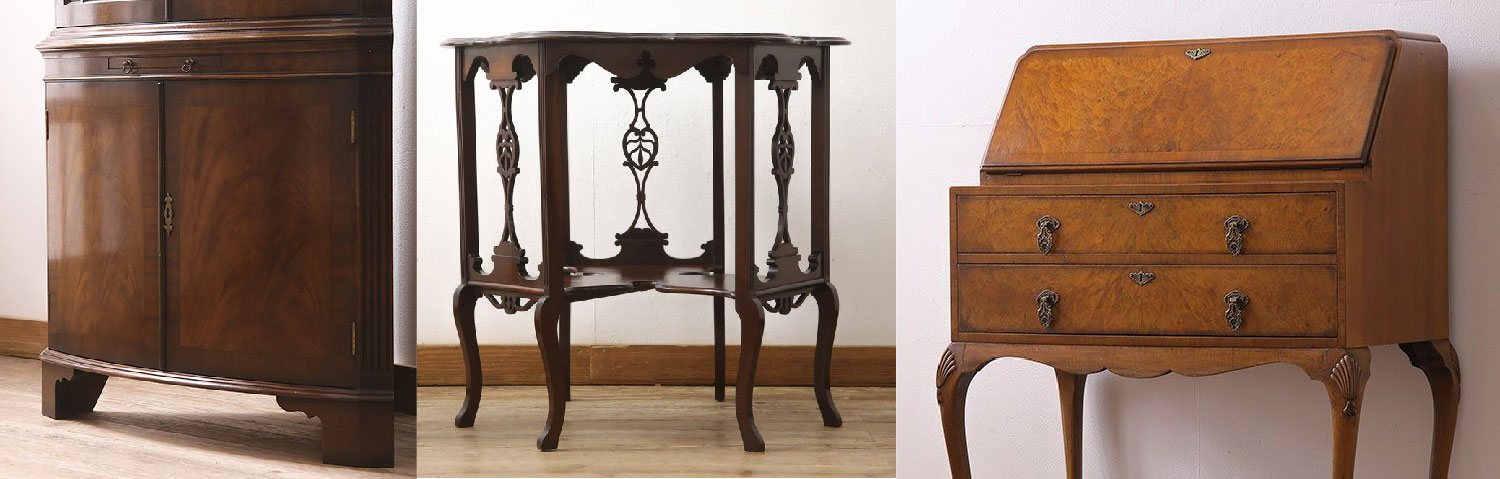
Walnut is a deciduous broad-leaved tree of the genus Juglans in the walnut family (Juglandaceae), found mainly in Europe and North America. Its figure is soft but the wood is hard and very durable, moves little and is easy to work, a timber of high quality; with teak and mahogany it is called one of the "three great fine woods of the world". For its quality it has long been used in Europe for fine furniture, interior finishes and fine instruments, and in America for the presidential lectern and the furniture of the Supreme Court. See teak and mahogany.
Walnut translates into Japanese as kurumi, but walnut timber and the timber called kurumi in Japan are different. Walnut is a dark purplish or greyish brown, whereas kurumi timber comes from onigurumi, the Japanese walnut that bears edible nuts, and has a natural pale tone.
Kinds
Two kinds are mainly traded: European walnut, found across Europe, and American walnut, from cold regions of North America only.
European walnut. Found throughout Europe, it has been used since the Middle Ages for luxury furniture and interiors for people of high rank, so French and English antique furniture often uses European walnut along with oak. The wood is tenacious and hard, suited to bending, and easy to work; compared with American walnut it is lighter in colour, with a gentle-looking figure. Its beautiful figure is used in carving and marquetry, and logs of especially fine figure are sliced thin for veneer, solid wood sliced and glued to a core board. Today European walnut has become rare, and American walnut, below, is the mainstream. See oak, parquetry and tsukiita.
American walnut. Almost all walnut traded today is American walnut from North America, also called American black walnut for its dark colour. The tree grows straight, so the figure is even; in the log, the outside is a pale cream and the inside chocolate, a contrast one can enjoy. Besides its luxurious figure, it is durable, resists impact and is little given to warping or splitting, ideal for working, so it is used for fine furniture, flooring and rifle stocks. Trade is restricted, however, to prevent overcutting, and wide boards that make a table top in one piece are hard to obtain and have risen steeply in price.
Its appeal
A luxurious colour and figure. Walnut's chief appeal is a colour unlike any other timber: a deep, chocolate-like purple or greyish brown that deepens with use. That depth gives walnut furniture and instruments an air of distinction. Walnut is sensitive to ultraviolet light, though, and fades in sun; to enjoy its depth of colour, use walnut furniture where the sun seldom falls. Growing in cold regions, walnut grows slowly, so its grain is close and smooth, and with a moderate oil content it has a lustre that gives it a more delicate, refined impression than other hardwoods.
Workability. Walnut resists splitting and is little affected by changes in temperature and humidity, so it is little given to warping or twisting and suits precise work. With moderate hardness and tenacity it suits many kinds of work, from bentwood, softening the wood with steam and bending it, to carving. For this workability it has long been used not only for furniture but for instruments such as pianos, harps and violins, and even for aircraft propellers. See bentwood chair.
A smooth touch. Even unfinished, walnut has a fine texture, smooth and silky to the hand. Finished, it gains still more lustre, so its quality can be felt by touch as well as by eye. Tables with a single-board walnut top, which let one enjoy that quality to the full, are costly but very popular. See mukuzai.
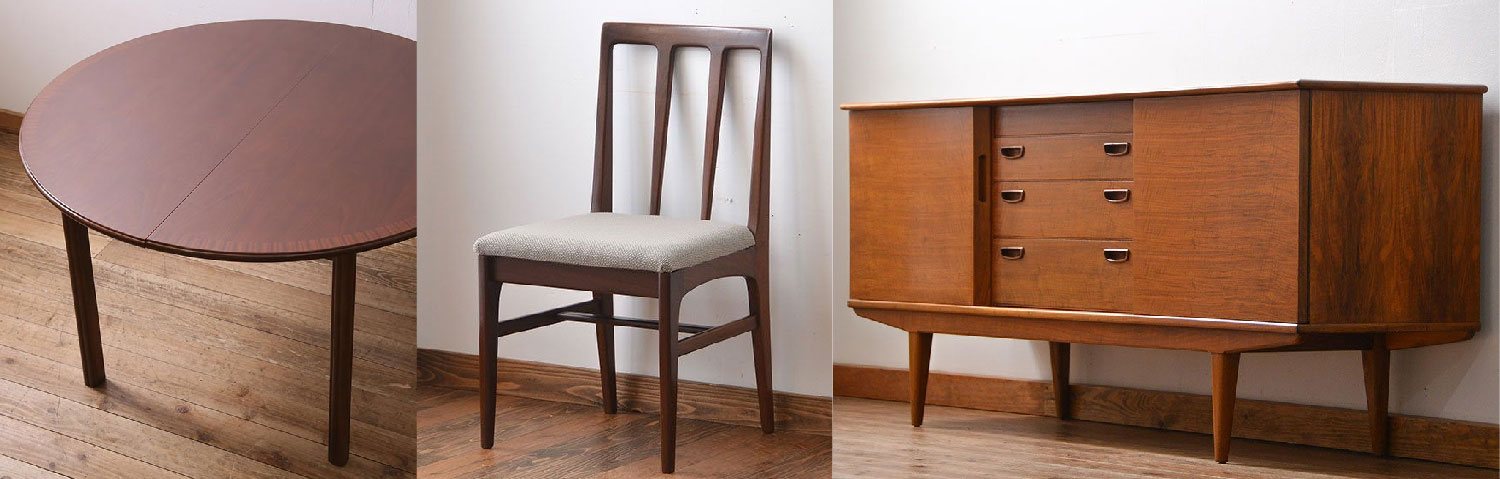
Walnut furniture
Antique furniture. In Europe walnut has been used for furniture and furnishings since the Middle Ages, and owning walnut furniture was "a symbol of wealth". In French and English antique furniture one sees luxurious walnut worked with great artistry: bentwood, carving, inlay. Some antique furniture also uses veneer cut from the part of the log showing "bird's-eye" figure, letting one enjoy another face of walnut. See Queen Anne style.
Vintage furniture. In the vintage period, from about the 1950s to the 1980s, much furniture was also made of walnut. The mood changes completely from antique furniture to simple, stylish design, and it is precisely its simplicity that lets the quality of walnut come through directly, which is the appeal of vintage furniture. Because the worldwide shortage of materials after the Second World War restricted timber imports, veneer became the norm even for a fine timber like walnut; very occasionally, though, one meets a high-end model lavishly made of solid walnut.
Contemporary maker and designer furniture. As a fine wood, walnut is used in maker and designer furniture, and what all of it shares is a design that brings out walnut's appeal to the full. Designers such as the celebrated George Nakashima and Hans J. Wegner sent out many pieces, art one might call them, that could not have been expressed in anything but walnut. A recent fashion in walnut furniture is solid walnut combined with iron; combined with another material, walnut's beauty stands out further, and the stylish, luxurious mood is popular.
Washstand
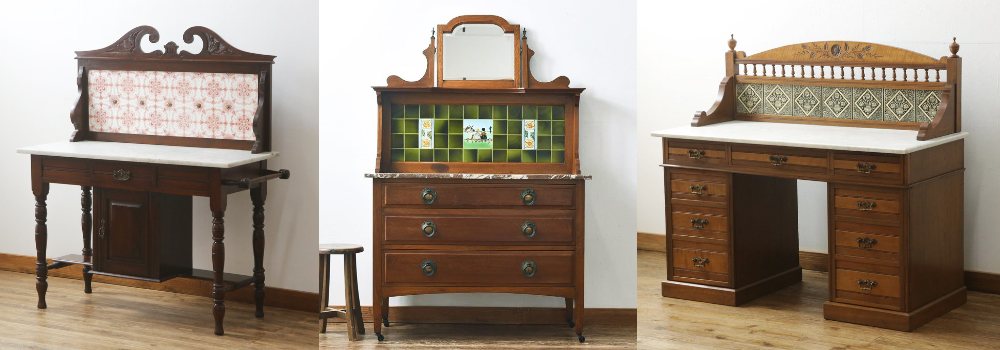
A washstand is furniture placed in bedrooms, kitchens and living rooms, in the days before running water was common, for tasks needing water. Its formal name is "washhand stand". A jug and bowl stood on the top, used for washing the face, washing clothes or rinsing the soil off vegetables. It is furniture unseen in modern life with running water, an antique form that carries the feeling of its age.
Features
Washstands are often shaped like a desk or cabinet, usually standing on three or four legs. Much used among the aristocracy, they were generally made of fine timbers with handsome figure, such as mahogany, teak and rosewood. Another feature is the use of water-resistant marble or other stone, or tiles, on the top and the backsplash, the raised part at the back, where water readily splashes. See mahogany, teak and rosewood.
Kinds
Small types. When the washstand first appeared, all were small and simply made. As familiar furniture in daily use they were excellent in ease of handling. The three-legged type could stand in the corner of a room, and simple designs with no wasted space, just a hole in the top into which the bowl was set, show many devices for neat use.
Large types. Large types, sized like the other furniture in a room, are stable and well equipped: plenty of storage, a towel rail, and in some a mirror. Fine timbers, marble and tiles give a handsome appearance, and elaborate ornament throughout makes them highly designed, a great part of their appeal.
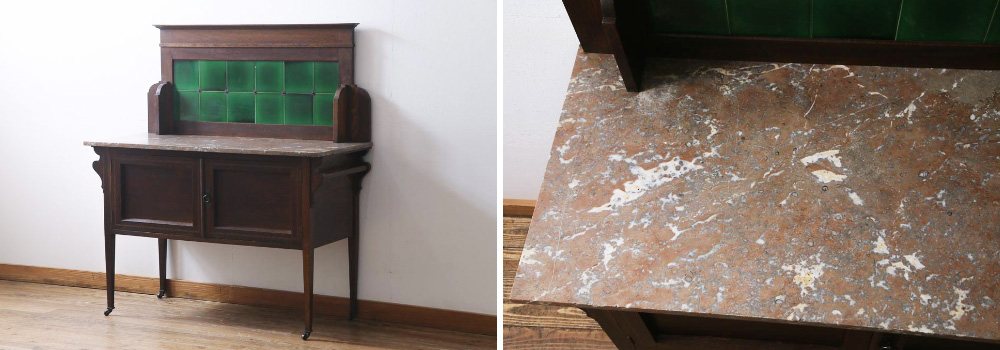
Metal types. Simpler and lighter in feeling than wooden ones, metal washstands, with their slender, gracefully curving lines, blend in anywhere and are easy to handle. There are many kinds, some with room for two bowls side by side, some with castors on the legs as is often seen on wooden ones too. Metal washstands are found in Japanese antiques as well, and were used in medical settings then, as they still are now.
History
Furniture that was the prototype of the washstand is said to have been born before the fifteenth century: a simple piece of a small top into which a bowl was set and a shelf beneath. In the seventeenth century washing the face with soap became a habit, and shaving took root as part of an English gentleman's grooming. With these changes in life and culture the washstand gradually grew more functional, and it was in the early nineteenth century that the style using marble appeared. In Victorian England it was valued as one of the essential pieces of the luxurious, elegant Victorian bedroom. In the twentieth century, as running water and plumbing spread, it was seen less in its old role, but its practicality and design keep it firmly popular as antique furniture that serves well today. See dressing chest.
Where the record differs. Queen Victoria reigned from 1837, so the marble-topped washstand of the early nineteenth century belongs first to the Regency and late Georgian years; the great Victorian era of the tiled washstand runs from about the 1850s to 1900.
Uses today, room by room
In modern life with running water there may be little chance to use it as it once was, but it has many other uses.
Kitchen and dining room: a work top or a stand for appliances. Types with water-resistant marble can be used in the kitchen without worrying about splashes. Marble also resists heat, so it serves as a stand for appliances, and there is ample storage for kitchen things and plates.
Living room or shop: a display stand. In the living room it keeps books and blankets neatly stored while the top displays favourite objects or flowers, making a handsome setting. In a shop, a washstand used to display goods makes unusual, stylish shop furniture that is sure to draw the eye.
Study: a desk or workspace. With a chair it can be used as a desk, in a mood unlike an ordinary desk that lifts the spirits. Many washstands have a generous top, made for jug and bowl, so there is ample space to work.
Bedroom: a dresser. The washstands once placed in bedrooms were for washing face and hands and also for making oneself presentable in the mirror, so washstands with mirrors are ideal as dressers. With elements of chest and desk, they make a special space of one's own, for keeping favourite small things or reading at leisure.
Garden or entrance: for plants. Metal ones are well used as flower or plant stands in the garden or by the door, and indoors they display plants stylishly too. One can plant a mixed arrangement in the set-in bowl or float flowers in water, and since it has some height, tending plants is easy.
Wheel-back chair
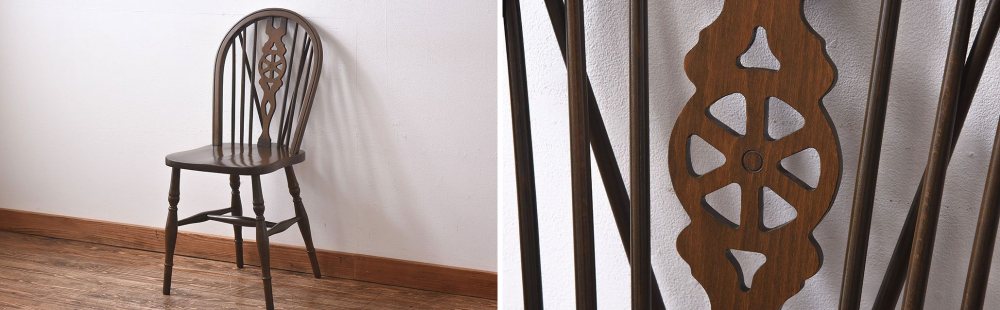
The wheel-back chair is one of the representative designs of the Windsor chair, the wooden chair born in England. The name describes a chair with a splat in its back pierced in the pattern of a wheel; whether it has arms, and the design and size of its other parts, vary with the period, country and maker. See Windsor chair.
Features
As its name says, its greatest feature is the wheel motif on the central splat of the back. The design is much used in the bow-back form of Windsor back, and as a dining chair it was hugely fashionable from the eighteenth into the nineteenth century, becoming the mainstream. Simple yet traditional and functional, the design is still loved around the world today.
Kinds
As with Windsor chairs in general, the kinds are many: the double bow-back armchair, made with a bow and arms; the rocking chair; the single bow-back without arms. Ercol, known worldwide for its Windsor chairs, also makes several wheel-back chairs. See rocking chair and hoop-back chair.
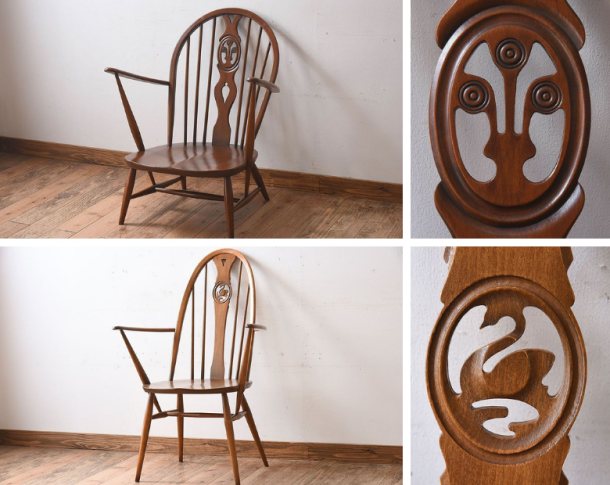
History
Roots in the Windsor chair. The wheel-back was born as a new variety of the Windsor chair, the English folk chair. Who devised the design is uncertain, but it is said to have been born, like the Windsor chair itself, at High Wycombe, the home of the Windsor chair.
Born in the making of the bow-back. The bow-back chair was devised to remedy the weakness of the back of the comb-back, the early Windsor. Bracing a steam-bent frame with several back sticks kept it strong, and for its design, function and price it quickly became popular. At first, as with the comb-back, chairs with simple sticks only were the norm, but soon chairs with a decorative splat in the centre of the back appeared, and among them the wheel-motif "wheel-back" was born. With its moderate ornament and ease of use it became a design loved by many, and gradually established itself as one of the basic forms of the Windsor chair. See comb-back chair.
Popular worldwide, antique and new
In the later twentieth century the Windsor chair and the wheel-back declined for a time, but makers who survived the tides of the age, Ercol among them, worked to modernise them and revived them to the present. In Japan in the same period, as tansu makers and makers of Japanese furniture began making Western furniture, many Japanese Windsor chairs came to be made; many wheel-back chairs use Japanese timbers and are sized for Japanese physiques and homes. Today they are still made in many regions, led by Matsumoto Mingei Furniture and Hida Sangyo, and they remain perennially popular as chairs for the dining room, living room and study. In Japan, as well as Japanese-made ones, English antique and vintage wheel-backs are offered by many furniture and antique dealers. See mingei furniture.
Windsor chair
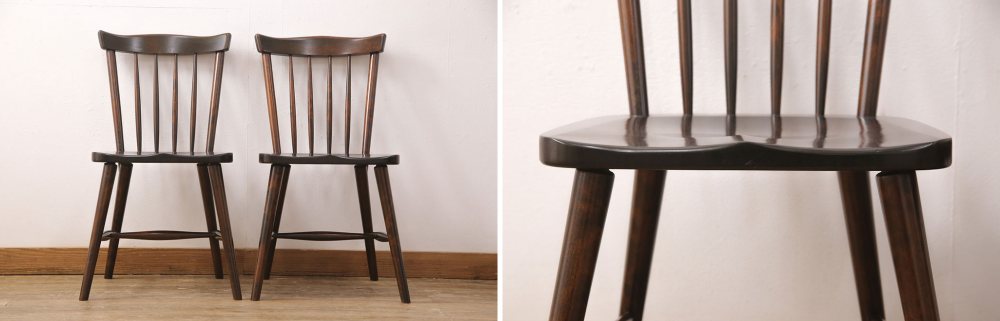
The Windsor chair is a country chair, a folk chair, born among ordinary people in rural England in the later seventeenth century. Its defining feature is that the legs and the parts of the back are jointed directly into a wooden seat. The name is said to come from the back sticks having been made in the Windsor district, or from chairs being carried from the direction of Windsor Castle. Easy to use, strong and easy to mass-produce, Windsor chairs were used in public buildings, schools and town halls; their practicality also won them popularity in the upper classes, and they are known as a rare piece of furniture that passed from ordinary people upwards.
Features
The Windsor chair's great features are that the spokes (back sticks) of the back and the legs are fitted directly into the seat, and that the legs splay outwards. Another is that the wooden seat is often "saddled", hollowed to the shape of the sitter. Carved ornament and materials vary by maker, country and period. See nire.
Kinds
Windsor chairs fall broadly into three kinds: the comb-back (bow-back), the oldest form; the hoop-back, distinguished by bentwood; and the scroll-back, which has no vertical sticks, only horizontal rails. From these main lines they developed into many styles by use and decorative design.
The comb-back chair (bow-back chair). A Windsor whose back is shaped like a comb; because the top rail looks like a bow, it is also called the bow-back. Its hallmark is the vertical sticks running down from the top rail. The style is thought to have been established in about the seventeenth century and is considered the oldest form of Windsor. Designs derived from it include the fan-back, the Goldsmith chair, the stick-back and the X-back (cross-back). See comb-back chair.
The hoop-back chair. A Windsor whose spokes are enclosed by a bentwood back frame. It appeared in about the mid-eighteenth century and, more durable than the comb-back, the norm until then, and cheaper to produce with fewer parts, it overtook the comb-back in popularity. In the nineteenth century derived designs appeared one after another, giving decorative, practical Windsors such as the wheel-back and the Quaker chair. See hoop-back chair, wheel-back chair and Quaker chair.
The scroll-back chair. A very simple Windsor with no vertical spokes, only cross rails: a top rail and two side uprights, with rails between them. It is named for the scroll carved at the top of the uprights. So simple a design led to stacking versions, valued in schools and other places needing many chairs. The school chair and the ladder-back are considered Windsors derived from the scroll-back.
History
Sixteenth century: begun in longing for the upper classes. The history of the Windsor chair is long, beginning in sixteenth-century England. Ornamented furniture was then a costly thing only the upper classes could own; for ordinary people it was naturally out of reach, an object of longing. The origin of the Windsor chair was ordinary people's attempts to make, by imitation, the furniture the upper classes used. Between farm work and handwork they applied themselves to furniture-making, and from that life came a work chair called the "stool with back": a very simple thing, a stool with a slot cut in the seat and a board inserted for the back. This is regarded as the prototype of the Windsor chair.
Seventeenth century: the comb-back. In the seventeenth century there appeared a chair with showy ornament on its back, the Derbyshire chair. Combining the structure of the old stool with back and the design of the new Derbyshire chair gave the Windsor chair. Then, in about the later seventeenth century, came the stick-back, with stick-like back sticks and legs fitted into the seat, which developed into the comb-back known for its comb-shaped back.
Eighteenth century: the hoop-back. In the mid-eighteenth century bentwood techniques arrived and the hoop-back was born. The fine curves of bentwood quickly became popular and the main design of the Windsor. At about the same time the fan-shaped fan-back, an evolution of the comb-back, appeared too, and Windsor designs multiplied.
Where the record differs. Some accounts say the bending technique came from Austria, but steam-bending of chair parts was long practised in England; the Austrian connection belongs to Michael Thonet's industrial bentwood of the 1840s and later, a century after the first hoop-backs. See bentwood chair.
Twentieth century: decline and revaluation. In the twentieth century, with labour shortages from war, ageing craftsmen and chairs in new materials, the Windsor chair declined for a time. Thanks to its revival by the English maker Ercol, though, it came back into the spotlight: Ercol mechanised the bending of wood and established a system for mass production. Later, with the influence of the worldwide Modernist movement and the boom in Scandinavian furniture, wooden furniture returned to fashion, and the Windsor chair made a fine comeback as one of its representative chairs. Today it has an unshakeable popularity as a traditional English chair, and those made in the mid-twentieth century are highly valued as vintage furniture, still drawing attention around the world. See Scandinavian furniture.
Ercol and the Windsor chair. Ercol is the definitive maker of the Windsor, the chair one might call the royal road of chairs. As noted, it is known for rescuing the Windsor in its hour of need and for establishing the enduring popularity it enjoys today. One of its signature products, the Goldsmith chair, is simple in form, yet its dynamic bentwood back gives it a presence like no other.
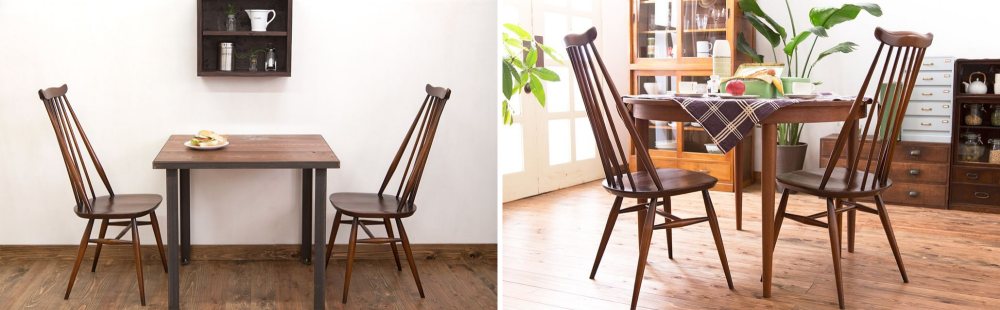
The Japanese Windsor, a blend of East and West
The Windsor chair reached Japan around 1930. Riding the wave of the mingei movement then spreading across the country, Japanese craftsmen began making Windsor chairs in numbers. Today large Japanese furniture makers such as Matsumoto Mingei Furniture, Hida Sangyo, Kashiwa Mokko and Takayama Woodworks still make them, continuing to produce Windsor chairs found only in Japan, with deep colour and lustre as their character. See mingei furniture.
Writing bureau
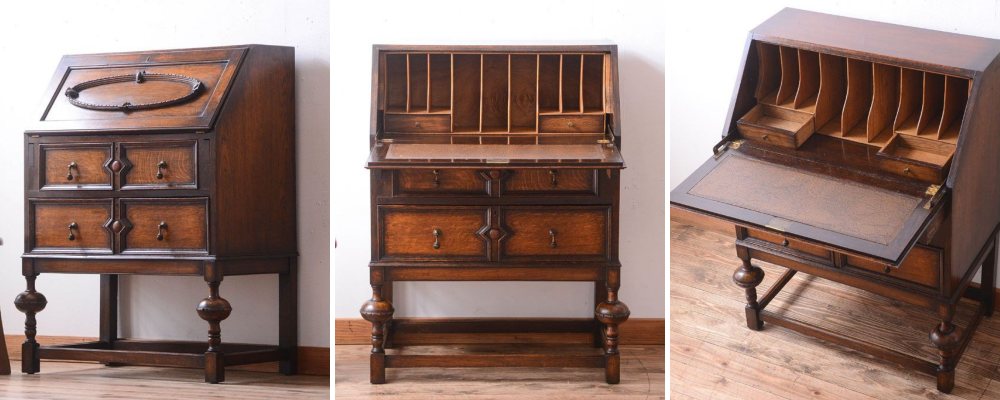
A writing bureau is furniture uniting storage and a desk. At first glance it looks like a chest or cabinet, but by lowering the door called the fall or flap towards oneself it can be used as a desk. "Writing" joined to "bureau", which here means storage, gave a distinctive design in which one piece plays two parts.
History
Accounts of the writing bureau's origins vary, but it is said to have been born in seventeenth-century England. England then imported, through the East India Company, large lidded chests called hitsu from Japan and China, and the custom spread of fitting them with legs or stands, ornamenting them and using them as storage furniture. This style developed into the cabinet on stand, a cabinet on high legs; adding a flap-down writing surface and storage to it produced the prototype of today's writing bureau. See shikki.
Its appeal
The writing bureau's greatest appeal is that it can serve as a study in a small space. Desk and storage are one, so a single piece plays several roles, highly practical furniture. Many are about 450 millimetres deep with the flap closed, so they can stand almost anywhere. Even if the desk tends to get cluttered, closing the flap hides the interior neatly away, so it suits shared spaces such as living rooms, and its design makes it attractive as an interior piece. Many have locks, which suits the keeping of important papers and valuables. Uniting function and beauty, the writing bureau is practical furniture that secures a comfortable place to work even in limited space.
Kinds
Writing bureaux fall broadly into three kinds: the desk type with a chest, the bookcase type with shelves above, and the cabinet type with cupboards at each side.
Desk type. The desk type with a chest is the most standard form of writing bureau. Its design is not imposing and the bureau section is not tall, so with the flap closed it looks neat.
Bookcase type. The type with shelves above has a tall bookcase on top. Because it values storage it is also called a bureau bookcase. Space-saving yet tall, it has real presence and brings splendour to a room. See stacking bookcase.
Cabinet type. This type has cabinets at both sides, like a desk-type bureau with door-fronted storage attached either side. Also called a side-by-side, it is a rare design among antiques. See side-by-side.
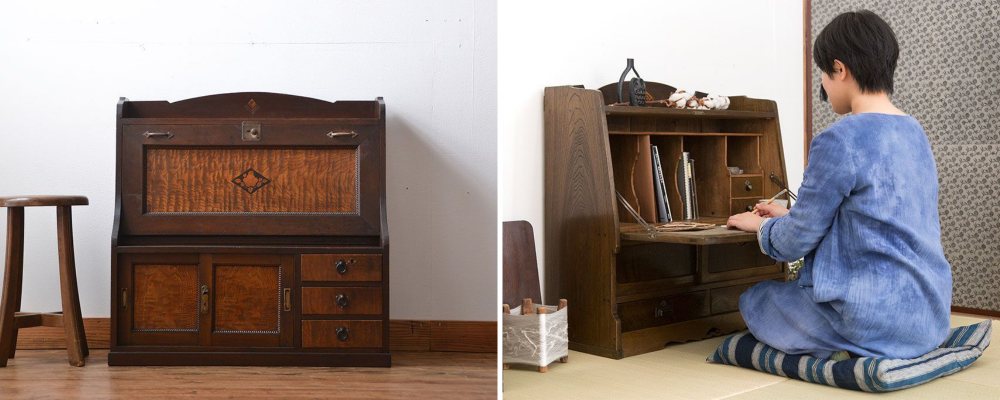
Differences by period and country
Writing bureaux vary greatly in design with period and country, from the elegant to the stylish, so they suit a wide range of interiors.
English antique writing bureaux. England, the home ground of antique furniture, offers bureaux of real quality. Fine timbers such as oak and mahogany show beautiful figure, and carving, inlay and other ornament give much to look at, creating a dignified setting. See oak and mahogany.
Scandinavian vintage writing bureaux. These are stylish designs that pursue function. Their spare, simple exteriors suit any interior, yet they are not merely simple: handles and legs have individual details, and the arrangement of storage or the mechanisms and devices of the flap show designs thought through to the utmost for use. See Scandinavian furniture.
Japanese antique writing bureaux. Some are low, without legs, designed on the assumption that they would be used on tatami. Fine timbers such as nara and keyaki are used, and the design is usually simple with restrained ornament; another feature is that they are made smaller overall to suit Japanese physiques. In Japan the writing bureau is also called boki-zukue, the "bookkeeping desk", because it appeared after the Meiji era when bookkeeping and Western furniture arrived from the West. See nara, keyaki and choba-zukue.
Contemporary writing bureaux. The writing bureau is long established, but beyond antique and vintage pieces, many makers offer designs suited to the homes of today. Leading names include the mingei furniture makers Matsumoto Mingei Furniture and Hokkaido Mingei Furniture, and the Western-furniture makers Yokohama Classic Furniture Daniel and Nagata Ryosuke Shoten. Each, keeping its own character, carries the high-quality writing bureau forward today. See mingei furniture.
Y
Yakusugi (Yakushima cedar)
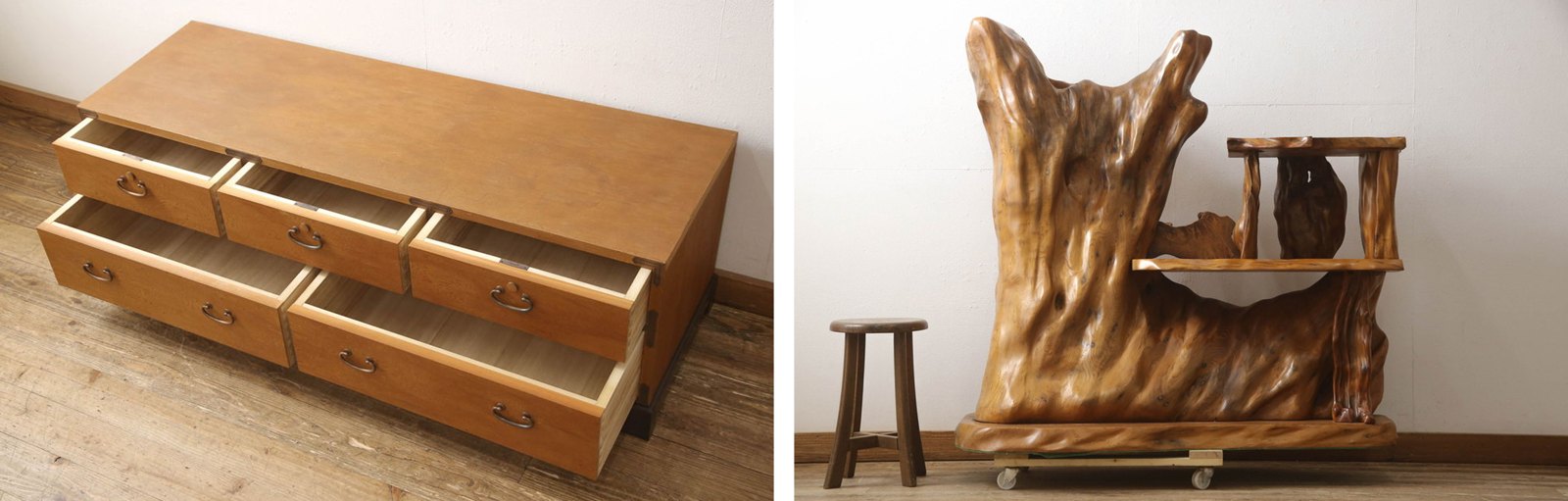
Yakusugi are Japanese cedars (Cryptomeria japonica, cypress family) growing wild above about 500 metres on the island of Yakushima, Kagoshima Prefecture. Almost everyone in Japan has heard of them; long revered as "trees where the gods dwell", they are a much-loved destination today.
They are the same species as the familiar sugi, but while ordinary cedar lives at most about five hundred years, the name yakusugi is given only to trees over a thousand years old; younger ones are called kosugi. The most famous, the Jomon Sugi, estimated at anything from 2,170 to 7,200 years old, is renowned as the oldest tree in Japan. Felling is now prohibited, and yakusugi has become a rare and precious timber. See sugi.
Named trees
Yakusugi has no varieties, but many individual trees bear names: Jomon Sugi, Daio Sugi, Kigen Sugi, Meoto Sugi, the Wilson Stump. Each tree's character, shaped by where it stands and how it has survived over the ages, shows in its form; giving them names has made them loved, and they have been cherished as treasures of Japan.
The timber
Many yakusugi are over two thousand years old; the largest, the Jomon Sugi, measures 16.4 metres around the trunk and 25.3 metres tall. The sapwood is white, the heartwood pale pink to reddish brown, sometimes darkening to blackish brown. Growing on granite mountains, poor in nutrients, the trees grow very slowly, with tightly packed grain. Raised in heavy rain and high humidity, the wood is said to hold more than six times the resin of ordinary cedar, keeping fungi and insects away and resisting decay. Light, strong and water-resistant, it is used mainly for building, furniture, boats and crafts.
Its appeal
Figure. Yakusugi grows only a few millimetres a year, giving an extremely dense, complex grain; set beside ordinary cedar, the difference in ring width is plain at a glance, and the wood is darker and harder. The struggle to survive in a harsh environment sometimes shows as beautiful figure: komyo-moku, tora-moku (tiger), chijimi-moku (crinkle), awa-moku (bubble), sasa-moku (bamboo-leaf), uzura-moku (quail) and kobu-moku (burr). All are uncommon, each with its own charm, and highly prized. See tama-moku.
A strong scent. The refreshing scent one breathes in a forest comes from aromatic compounds the trees release, sometimes called phytoncides, by which a tree that cannot move protects itself against its enemies. Yakusugi gives off this scent strongly: unlike ordinary cedar, it is fresh yet calm and mellow, a refined fragrance that lingers in the timber and brings something of the forest into a room.
Durability. Its abundant resin and resistance to fungi and insects make it highly durable, and its dense grain makes it stronger than ordinary cedar in tension, compression and bending. Most fallen trees are weathered, colonised and in time decomposed without trace, but fallen yakusugi keep their form for centuries, a testament to their durability.
Yakusugi furniture
Antique. Sacred and an object of worship, yakusugi were long left uncut. After they were first used for a special building in the late sixteenth century, perhaps half to seven-tenths of the yakusugi were felled by the end of the Edo period. Most of the timber was split into hiragi, roofing shingles, more than it was used for building or boats; shingles were paid as tax or bought in exchange for rice and goods, serving almost as currency. Among what remains are transoms (ranma), screens, ceiling boards, tea cabinets (cha-dansu) and Buddhist altars, which tell of the life of the time. See ranma and cha-dansu.
Vintage. Opposition to felling natural forest grew. In 1954 the yakusugi forest was made a Special Natural Monument, in 1993 Yakushima became a World Heritage Site, and in 2001 felling of yakusugi was halted; in 2019 the official sales of stored timber also ended, making it essentially unobtainable new. What appears today was felled before the ban, or is domaiboku, trees felled in the Edo period and left lying on the forest floor. When these too run out, the furniture of the antique and vintage eras will be all the more precious. See vintage.
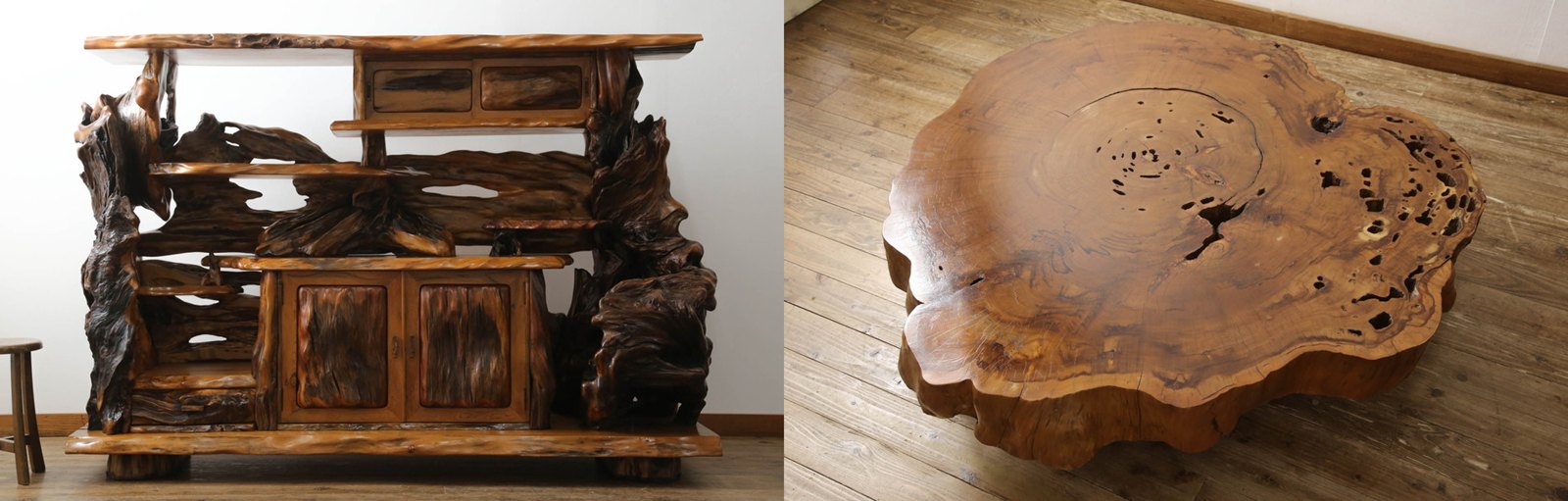
Modern. Long life brings discoloration and undulation, sometimes hollows within the trunk, or renkon ("lotus root"), where a fungus leaves many small holes; all are seen as character, the very charm of yakusugi, which is famous as "a timber nothing of which is wasted". Tea shelves built around hollows, display shelves that keep the shape of the bark or root, and slab tables that let one savour the tree's history and the grandeur of nature: many beautiful pieces made today can take centre stage in any room.
Yonezawa tansu
Yonezawa tansu are chests made in Yonezawa, Yamagata Prefecture: zelkova on the face and paulownia within, known for large round fittings with engraved decoration.
Features
Yamagata has long been a centre of chest-making, and the Yonezawa chest is the most individual in looks. Large round lock plates on the drawers are its trademark. It excels at clothing chests, but unusual pieces such as wheeled chests and nagamochi were also made.
Materials and decoration
Most are of zelkova, chestnut, cedar and paulownia, finished in lacquer, with paulownia interiors suited to clothing. The large round lock plates are engraved with butterflies, cherry blossom and other patterns; look at the engraving of the fittings as well as the chest as a whole.
Kinds
Clothing chests. The most numerous Yonezawa chests. Many are kasane chests in two or more sections, usable stacked or side by side. The round lock plates set off their simple construction.
Wheeled chests. Yonezawa wheeled chests are built like merchant's chests, unlike the clothing chests, with heavy use of iron and a weighty design. They could be moved when needed, and were taken out in fires.
Hand chests. Small chests for personal things and valuables, compact enough to keep close by. Yonezawa hand chests are known for lavish ironwork and a weighty design.
History
Rich in timber and other resources, Yonezawa has long made cabinetwork (sashimono). Wheeled nagamochi and wheeled chests go back to the Edo period, and from the late Meiji into the Taisho era Yonezawa began to make clothing chests in numbers. This coincided with the decline of the kitamaebune, showing how closely chests were tied to the merchant ships.
Only one workshop now continues to make Yonezawa chests in Yonezawa, working to carry the tradition into the future.
Antique and vintage
Antique Yonezawa chests are mostly plain apart from the round lock plates: homely and calm. Vintage pieces, by contrast, often return to Yonezawa's origins, wheeled chests and hand chests. There are clothing chests too, with richer ironwork than the antiques. The Yonezawa chest has evolved with the times.
Z
Zataku (low floor table)
A zataku is a low table designed for a way of life seated on the floor. The word joins za, "to sit", and taku, "table"; it is made to be used on the floor or on tatami, without chairs. Used for reading, writing, meals and much else, it is known as a piece of furniture that embodies Japanese domestic life.
Features
Its defining feature is the height of the top, usually about 30 to 40 cm, comfortable for sitting cross-legged or kneeling formally (seiza). Many are light and easy to move, convenient for rearranging a room or carrying. Tops come square, rectangular, round or oval, to suit the number of users and the use.
Materials. Zataku are made in traditional Japanese timbers such as keyaki, cherry and cedar; the beauty of the grain and the durability of the wood are the key to a table's quality. See keyaki, sakura and sugi.
Similar furniture
The zataku is easily confused with the chabudai, the low table and the irori table.
Chabudai. A long-loved piece, very like the zataku, another traditional Japanese table; the great difference is that its legs fold. It is said to have arisen to make the best use of limited space in Japanese homes.
Low table. Made to stand in front of a sofa; used mainly in Western-style rooms rather than for sitting on the floor, and usually Western in design.
Irori table. A zataku of distinctive design with a space in the centre for a sunken hearth (irori), made for the family to gather round the fire; its rarity is part of its appeal. See jizai-kagi.
History
The zataku goes back to the Edo period. As tatami spread, it gradually came into use, though not, as now, for meals and family time; it was usually a desk for study. Behind this lay the household hierarchy of the Edo period: families did not gather at one table, and the usual way of eating was from an individual tray table (zen) set before each person on the floor.
In the Meiji era, under Western influence, the custom of the family meal at one table began to take root, and by the Showa era the zataku came into full use. In the 1955 to 1964 decade especially, the scene of the whole family eating around the zataku became widespread.
Today, as ways of life change, more households eat at a dining table. But in Japan, with its deep culture of living at floor level, the zataku remains indispensable in the living room, for relaxing together around it.
As antique furniture
The zataku is highly valued as antique furniture; the dignity that only time brings gives a modern room rich character.
Distilled craftsmanship. An antique zataku is full of the skill of seasoned craftsmen, never stinting from the choice of fine timber through precise working to beautiful decoration. Some are works of art, the very essence of craftsmanship. Each made with care, no two are alike, and each carries its own character and story.
The character of age. A zataku cherished and handed down over long years has a character no new table can give. Wood deepens in colour and texture with time, taking on a particular warmth and dignity; ageing is the special charm of an antique. Marks of use and fading become part of the story of the table and its home. On a fine old zataku, look for a solid single-board or carefully joined top, hand-cut joints at the apron, and, on folding examples, original iron fittings.
At home in modern rooms. A zataku is not only for a Japanese room; it sits naturally in a modern Western one too. On a boarded floor, a wa-modern or Asian scheme suits it well. Its low line brings openness to a room and balances easily with other furniture. See wa-modern.
Zenibako (coin box)
The coin box is a wooden box used to hold and manage coins and small change. It has a slot on top for coins and a locked opening below. Used from the Edo period to around the Taisho era, it did the work of today's money box or safe.
Features
Coin boxes were built of hard timber for durability, with a coin slot above and a lockable opening below. Many have small drawers or divisions so coins could be sorted by kind or purpose.
Designs vary by region and period, and many are beautiful, with traditional carving, lacquer and fine ironwork. Because they often stood at the shop front, dignified designs were preferred: the box stood for the standing and prosperity of the house.
Some have a funnel at the slot, others a lockable lid, among many practical refinements. More than a container, the coin box at the shop front was a symbol of the house's standing and prosperity.
History
The coin box developed with the money economy of the Edo period. The shogunate established the "three-currency system" of gold, silver and copper coins, and coins came into everyday use among ordinary people; the copper Kan'ei tsuho in particular circulated widely and was essential for daily purchases and small transactions.
For merchant houses the coin box became an essential tool for keeping takings safe and efficiently. It remained a necessity for handling cash into the Meiji era, but as paper money spread and banks appeared, its role faded.
Kinds
Coin boxes come in many designs: with drawers, with a funnel-shaped measure (masu) on top to receive money, with a hidden drawer behind a drawer. Strong timbers such as zelkova and chestnut were common, making them hard to break. Some have elaborate fittings and decoration, a pleasure to look at.
Because they mainly held small change, coin boxes are generally small. A similar wooden box, the senryo-bako, "thousand-ryo box", held costly coins such as koban, and is long and larger.
As antique furniture
Coin boxes are now sought after as antique furniture and old tools, for the lavish decoration and sturdy construction that reflect the craftsmen of their time. They are often used as accents in old-house (kominka) and Japanese-modern interiors, and in shop displays.
Where the record differs
Much of what is written about Japanese furniture is passed from one account to the next, and some of it does not survive a look at the record. Where we know an account is disputed, or a common claim is wrong, we say so inside the entry. On this page you will find notes of this kind under: Renaissance style, Rococo style, Rosewood, Royal Copenhagen, Settee, Sewing table, Singer, Stacking bookcase, Strapwork, Turned leg, Washstand, Windsor chair. On the A–M page: Funa-dansu (sea chest), Iwayado tansu, Kuruma-dansu (wheeled chest).
Answered plainly
What is the difference between tansu and dansu?
None. It is the same word, "chest"; it is voiced as dansu after another word, as in kusuri-dansu.
Are regional names guarantees of origin?
No. A regional name describes a style; attribution depends on construction, fittings and timber. Each piece’s description says how firmly it can be placed.
Is every old chest an antique?
We use "antique" for pieces of roughly a century or more, and "vintage" for later pieces. Each piece’s description gives the period as precisely as the evidence allows.
Why does a Japanese furniture glossary include Western forms?
Since the Meiji era Japanese makers have built Western forms, from writing bureaux to china cabinets, and Japanese homes have mixed the two. The vocabulary of both belongs in one reference.
Japanese furniture guides. The tansu guide · Japanese furniture glossary A–M · Japanese furniture glossary N–Z · Condition grades and restoration options · Character or fault · How we measure Japanese furniture · The Japonista furniture standard · Japanese interiors gallery · Before you buy · When your furniture arrives · Delivering large furniture · How we pack furniture · Customising antique furniture · Remaking old doors and fittings · Fitting old doors with confidence · Aftercare and repairs
Private concierge
Looking for something in particular?
Describe the piece or the project you have in mind. A senior advisor in Tokyo reads every case file personally and replies within two business days, with fees set out in writing before any work begins.