
Forms: Jars, Bowls and Parts
Pottery Almanac · Vocabulary
Forms: Jars, Bowls and Parts
A Japanese pot has a vocabulary of its own, from the mouth and the waist to the ring on which it stands. Learn a dozen words and a catalogue entry, a dealer's note or a museum label becomes something you can read.
Fact sheet
At a glance
- Standard names. Wikipedia says the opening, rim, neck, wall, inside, foot and surface markings of a vessel all have standardised names in Japanese.
- The foot ring. Kōdai, the foot, is treated as a place to appreciate a tea bowl, and its inside is its back.
- A jar is any round body. A reference entry says all vessels with rounded bodies and hollow mouths are called jars.
- Tea bowls have shapes too. Wikipedia lists more than twenty named chawan shapes and eleven foot shapes.
- Forms follow use. Storage, sake, tea and flowers each have vessels with their own names.
The Parts of a Vessel
Wikipedia's article on Japanese pottery lists some typical vessel types, among them the tea bowl, chawan, the jar, tsubo, the bowl, hachi, and the tea caddy, chaire, and adds that the opening, rim, neck, wall, inside, foot and surface markings all have standardised names in Japanese. The names that follow come from a guide published by Japan Classic, an online shop for Japanese pottery, and from a glossary compiled by Harding and Giannini from Morgan Pitelka's Japanese ceramics page.
Diagram by Japonista. Schematic profiles, not a particular piece. Terms from Japan Classic, Harding and Giannini, and Wikipedia.
Look closer: Both profiles stand on a foot, and in the bowl the foot ring and the tea pool sit directly below one another.
Diagram by Japonista
The diagram above sets out the words on a schematic jar and a schematic tea bowl in section. The guide explains that the mouth, kuchi, is the rim or opening of a vessel and the waist, koshi, its lower section, and that the skin, hada, is the surface of the piece. It names the body, dō, without defining it, and says handles are called ears, mimi, with jars of two, three and four handles known as sōjiko, sanjiko and shijiko. For a bowl or plate it names the interior, mikomi, the foot ring, kōdai, and the point where the foot meets the surface, tatami-tsuki.
Two compound names show the other words. The guide gives the kata-tsuki chaire, a tea container named for its prominent shoulder, kata, and the tsuru-kubi tokkuri, a sake bottle with a long, slender neck, kubi. It also lists herame, the trimming marks seen from the waist to the foot ring.
| Term | Meaning | Source |
|---|---|---|
| kuchi 口 | Mouth: the rim or opening of a vessel | Japan Classic |
| koshi 腰 | Waist: the lower section of a vessel | Japan Classic |
| hada 肌 | Skin: the surface of the piece | Japan Classic |
| mimi 耳 | Ears: functional and decorative handles | Japan Classic |
| mikomi 見込み | The interior of a bowl or plate | Japan Classic |
| kōdai 高台 | Foot ring: the ring at the base that lifts the piece | Japan Classic |
| tatami-tsuki 畳付 | The area where the foot meets the surface | Japan Classic |
| chadamari 茶溜まり | Tea pool: a small central depression where leftover tea collects | Japan Classic; Harding and Giannini |
Why the Foot Matters
The foot gets its own chapter of vocabulary because, in tea, it is looked at. A translated reference on the turuta.jp ceramics-story site, which does not name its publisher, says the base of tea bowls is an important part of tea utensils for appreciation, and that the inside of the foot is its back and the low outer part of the vessel its side, both being points of appreciation. It suggests the foot originally stabilised the vessel, and says some late earthenware dishes had clay rings attached to the bottom, called tsuki-taidai.
The same reference reports the usual explanation, that trimming prevents the bottom cracking while a thrown piece dries, and calls it incomplete because it ignores the past. It adds other reasons, among them stability, the economy of firing heavy bottoms, and formal beauty. It notes that feet may be circular, rhombic or square, as in Raku and Oribe ware.
Wikipedia's article on the chawan lists eleven foot shapes: the ring foot, the snake's-eye foot, the double foot, the crescent-moon foot, the shamisen-plectrum foot, the bamboo-node foot, the cherry-blossom foot, the four-directions foot, the Go-stone-box foot, the nail-carved foot and the spiral-shell foot. The Japan Classic guide names parts of the matcha bowl as well, among them the point where the tea cloth wipes the bowl, chakin-zuri, the point where the whisk stirs, chasen-zuri, and the side and the inside of the foot, kōdai-waki and kōdai-ura. It also names a crescent-shaped foot, mikazuki-kōdai.
Jars, Bottles and Flasks
The turuta.jp reference on the jar, tsubo, says the word means a jar for storing water, that all vessels with rounded bodies and hollow mouths are called jars, and that they are made of lacquer, ceramics, metal and other materials. It gives kame as another name for these jars. The Harding and Giannini glossary defines tsubo simply as a storage jar and the tokkuri as a bottle or flask, usually used to hold sake.
Museum labels use these words with care. The Met catalogues a wide-mouthed jar of the sixteenth century as a kame, in Echizen ware with natural ash glaze, 19.7 centimetres high, and an early eighteenth-century Tamba bottle as a tokkuri, 23.2 centimetres high. The first has the short, flared mouth of a storage vessel, and the second a narrow neck above a body that widens towards the base.
Larger storage jars have chapters of their own: the Tamba jar of the Six Ancient Kilns, the Tokoname and Shigaraki jars, and the Bizen tsubo. Reading about them in turn shows how one form, the rounded jar, takes a different character in each kiln.
Bowls, Cups and Plates
A chawan, Wikipedia says, is literally a tea bowl, used for preparing and drinking tea, and it lists more than twenty named shapes, from the wooden-bowl shape and the cylinder to the Ido or well type, the tenmoku type, the clog shape and the peach shape. It also reports a saying from the tea-ceremony schools about preferred ware, Raku first, Hagi second, Karatsu third. The chawan has a chapter of its own, linked below.
The Harding and Giannini glossary gives the other everyday words: yunomi, a tea cup, guinomi, a sake cup, and sara, a plate. The Met's early seventeenth-century Karatsu guinomi is catalogued with silver lacquer repairs, and measures only 3.8 centimetres high by 7.9 across, small enough to sit in the palm. Its glaze is catalogued as ash and iron.
For the table the Met has one of a set of five squared food vessels, mukōzuke, for a tea-gathering meal, in Mino ware, and a small porcelain dish, kozara, of about the 1650s. Both belong to the tea meal as much as to the tea bowl.
Caddies, Water Jars and Flower Holders
The glossary defines the tea caddy, chaire, as a small container used to hold powdered tea, matcha, and the water jar, mizusashi, as a lidded fresh-water container used in the tea ceremony. The Met catalogues a late sixteenth-century Bizen mizusashi in the shape of a seed jar, tane-tsubo, with a black-lacquered wooden lid, 18.4 centimetres high.
A flower holder is a hanaire, which the glossary translates as flower vase. The Met's Brown Oribe example of the early seventeenth century has handles and stands 29.5 centimetres high. The Met also catalogues a Bizen vessel of about 1775 as a waste-water basin, a reminder that the tea room has a name for every vessel it uses.
Each of these forms has a chapter in the tea half of the almanac: the caddy and the lacquered natsume, the water jar and its companions, and the tea bowl itself.
Reading a Museum Label
Museum catalogues follow a pattern that you can borrow. They give the form, the ware and the material, as in a stoneware jar of Echizen ware with natural ash glaze, then the date and the size. The Met's own lines in the gallery below follow it: a title with the Japanese term in brackets, a date, the medium with the ware named in brackets, and the height in centimetres. Naming the form correctly helps a search: a hanaire, a mizusashi and a tokkuri are catalogued separately.
When a record gives an unfamiliar word, the glossary linked below is the first place to look, and the chapters on marks and on firing and glaze explain the signs that appear on the surface.
Eight Forms, One Shelf
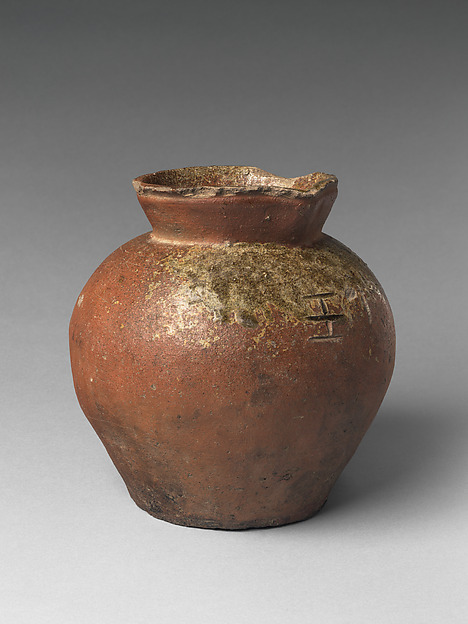
Wide-Mouthed Jar (Kame), 16th century, Stoneware with incised kiln mark and natural ash glaze (Echizen ware). The Metropolitan Museum of Art, The Harry G. C. Packard Collection of Asian Art, Gift of Harry G. C. Packard, and Purchase, Fletcher, Rogers, Harris Brisbane Dick, and Louis V. Bell Funds, Joseph Pulitzer Bequest, and The Annenberg Fund Inc. Gift, 1975, accession 1975.268.429.
Look closer: the mouth is short and flared, the shoulder carries a patch of ash glaze, and a small incised mark sits on the body. The museum catalogues it as Echizen ware, 16th century, stoneware with incised kiln mark and natural ash glaze, 19.7 cm high.
Image: The Metropolitan Museum of Art, Open Access (CC0)
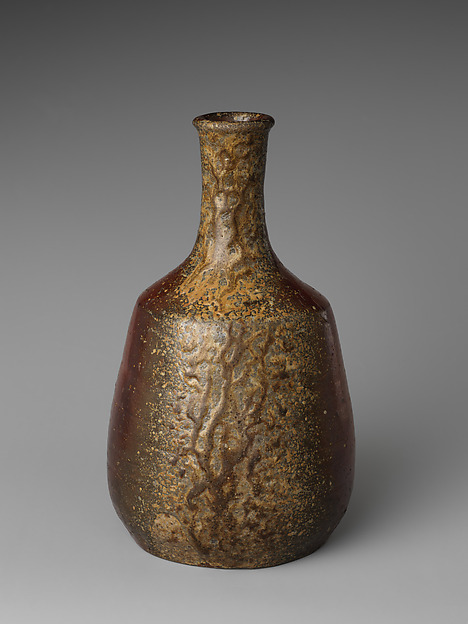
Sake Bottle (Tokkuri), early 18th century, Stoneware with iron slip glaze and green drip glaze (Tanba ware). The Metropolitan Museum of Art, The Harry G. C. Packard Collection of Asian Art, Gift of Harry G. C. Packard, and Purchase, Fletcher, Rogers, Harris Brisbane Dick, and Louis V. Bell Funds, Joseph Pulitzer Bequest, and The Annenberg Fund Inc. Gift, 1975, accession 1975.268.431.
Look closer: a narrow neck rises from the shoulder, the body widens towards the base, and the surface is rippled. The museum catalogues it as Tanba ware, early 18th century, stoneware with iron slip glaze and green drip glaze, 23.2 cm high.
Image: The Metropolitan Museum of Art, Open Access (CC0)
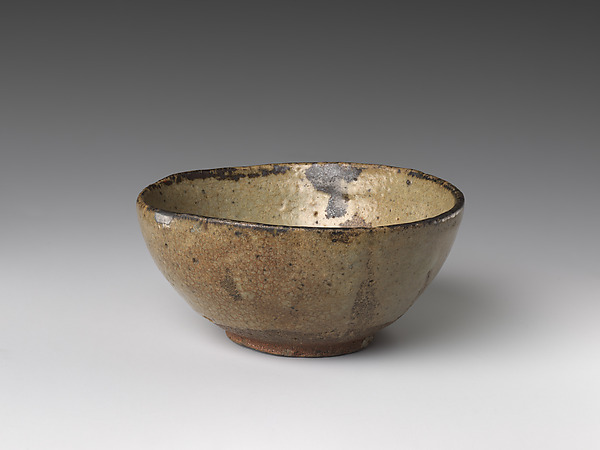
Sake Cup (Guinomi), early 17th century, Stoneware with ash and iron glaze (Karatsu ware); silver lacquer repairs. The Metropolitan Museum of Art, The Harry G. C. Packard Collection of Asian Art, Gift of Harry G. C. Packard, and Purchase, Fletcher, Rogers, Harris Brisbane Dick, and Louis V. Bell Funds, Joseph Pulitzer Bequest, and The Annenberg Fund Inc. Gift, 1975, accession 1975.268.447.
Look closer: the cup is wide and shallow on a low foot, and a lighter patch shows on the inside wall. The museum catalogues it as Karatsu ware, early 17th century, stoneware with ash and iron glaze and silver lacquer repairs, 3.8 cm high.
Image: The Metropolitan Museum of Art, Open Access (CC0)
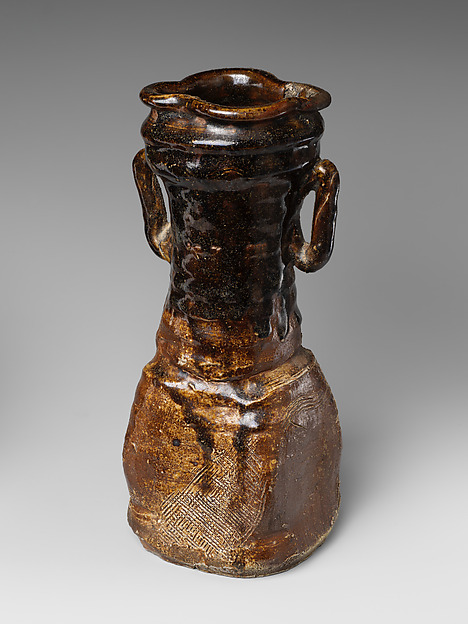
Brown Oribe Flower Holder (Hanaire) with Handles, early 17th century, Stoneware with natural ash, feldspar, and iron glaze (Mino ware, Kuro-Oribe type). The Metropolitan Museum of Art, Purchase, William R. Appleby Fund and Gift of Mrs. Samuel T. Peters, by exchange, 2024, accession 2024.123.
Look closer: two loop handles flank the neck, the mouth is lobed, and a net pattern shows low on the body. The museum catalogues it as Mino ware, Kuro-Oribe type, early 17th century, 29.5 cm high.
Image: The Metropolitan Museum of Art, Open Access (CC0)
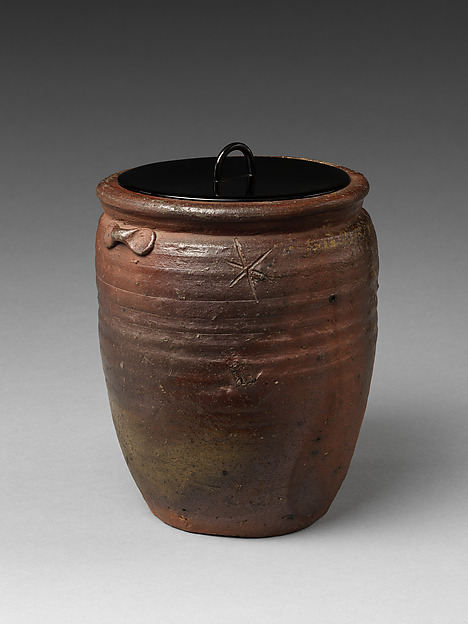
Freshwater Jar (Mizusashi) in the Shape of a Seed Jar (Tane-tsubo), late 16th century, Stoneware with natural ash glaze (Bizen ware, Ko-Bizen type); black-lacquered wooden lid. The Metropolitan Museum of Art, Mary Livingston Griggs and Mary Griggs Burke Foundation Fund, 2023, accession 2023.326a–c.
Look closer: ribs run round a reddish body and a black lid carries a loop knob. The museum catalogues it as Ko-Bizen type, late 16th century, stoneware with natural ash glaze and a black-lacquered wooden lid, 18.4 cm high.
Image: The Metropolitan Museum of Art, Open Access (CC0)
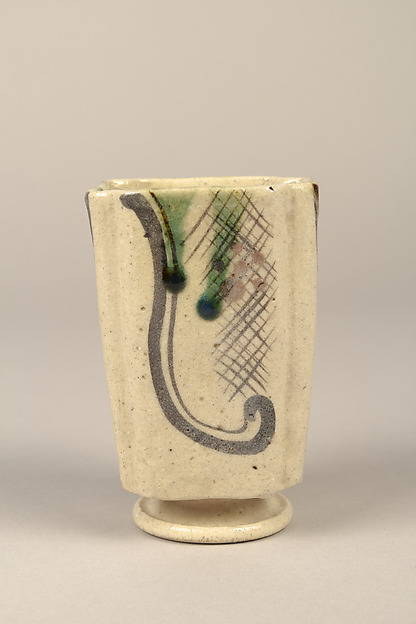
One from set of five squared food vessels (mukōzuke) for tea-gathering meal, early 17th century, Stoneware with iron-oxide and copper green overglaze decoration (Mino ware, Yashichida Oribe type). The Metropolitan Museum of Art, Purchase, Mary Livingston Griggs and Mary Griggs Burke Foundation Gift, 1973, accession 1973.80.5.
Look closer: the sides are squared and the glaze is cream with a green drip and grey cross-hatching beside a curved line, on a round foot. The museum catalogues it as Mino ware, Yashichida Oribe type, early 17th century, 9.8 cm high.
Image: The Metropolitan Museum of Art, Open Access (CC0)
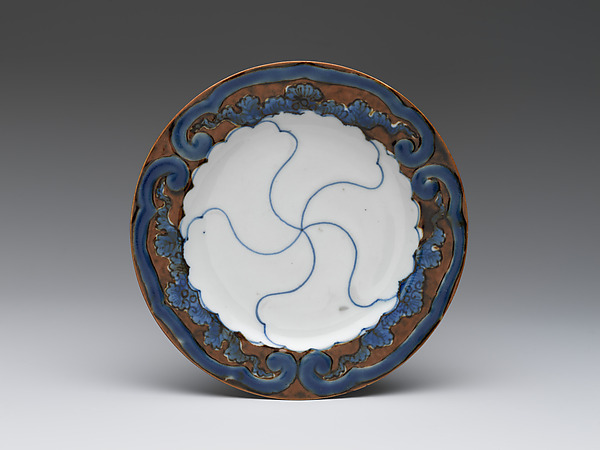
Small Dish (Kozara) with Stylized Flowers, ca. 1650s, Porcelain with cobalt blue under transparent glaze and iron-brown pigment and blue enamel over the glaze (Hizen ware, Nabeshima type). The Metropolitan Museum of Art, The Harry G. C. Packard Collection of Asian Art, Gift of Harry G. C. Packard, and Purchase, Fletcher, Rogers, Harris Brisbane Dick, and Louis V. Bell Funds, Joseph Pulitzer Bequest, and The Annenberg Fund Inc. Gift, 1975, accession 1975.268.544.
Look closer: a scalloped border in blue and brown surrounds a white well with four curved lines. The museum catalogues it as Hizen ware, Nabeshima type, about 1650s, porcelain, 14.6 cm across.
Image: The Metropolitan Museum of Art, Open Access (CC0)

Waste-water basin, ca. 1775, Pottery (Bizen ware). The Metropolitan Museum of Art, Fletcher Fund, 1925, accession 25.215.44.
Look closer: the basin is low and wide with ribbed walls and a pair of small lugs, and the photograph is black and white. The museum catalogues it as Bizen ware, about 1775, pottery, 7 cm high.
Image: The Metropolitan Museum of Art, Open Access (CC0)
Forms at the Desk
Vessels with these names pass through the house from time to time, under tags such as porcelain and ceramics and tea ceremony. The glossary of Japanese ceramics terms is the companion to this chapter.
Answered plainly
What is a kōdai?
The foot ring at the base of a vessel, which lifts the piece.
What is the difference between a tsubo and a kame?
A reference entry says both are jars, with kame given as another name for tsubo.
What is a tokkuri?
A bottle or flask, usually used to hold sake.
What is a mizusashi?
A lidded fresh-water container used in the tea ceremony.
Where next
Sources and image credits
- Japanese pottery and porcelain, Wikipedia
- Chawan, Wikipedia
- Does each part of pottery have its own name, Japan Classic (an online shop's guide)
- Japanese ceramics glossary, Harding and Giannini
- Koudai (high ground), turuta.jp ceramics story (publisher not named)
- Tsubo, turuta.jp ceramics story (publisher not named)
- Object record, Wide-Mouthed Jar (Kame), The Metropolitan Museum of Art
- Object record, Sake Bottle (Tokkuri), The Metropolitan Museum of Art
- Object record, Sake Cup (Guinomi), The Metropolitan Museum of Art
- Object record, Brown Oribe Flower Holder (Hanaire) with Handles, The Metropolitan Museum of Art
- Object record, Freshwater Jar (Mizusashi) in the Shape of a Seed Jar (Tane-tsubo), The Metropolitan Museum of Art
- Object record, One from set of five squared food vessels (mukōzuke) for tea-gathering meal, The Metropolitan Museum of Art
- Object record, Small Dish (Kozara) with Stylized Flowers, The Metropolitan Museum of Art
- Object record, Waste-water basin, The Metropolitan Museum of Art
Last reviewed 28 October 2026. Pictures, where shown, are public-domain or open-access and credited beneath each one.
Looking for a particular form, or a name on a label you cannot read? The concierge desk replies within one to three business days.
Browse Japanese porcelain and ceramics · Make a private request
Private concierge
Looking for something in particular?
Describe the piece or the project you have in mind. A senior advisor in Tokyo reads every case file personally and replies within two business days, with fees set out in writing before any work begins.