
The Tsuba and Its Schools | Japonista
Heritage Wing · Iron and Gold
The Tsuba and Its Schools
鍔
It is the smallest plate of metal on a sword and the one most likely to hang alone on a wall. This chapter reads the tsuba as the warrior’s portable picture frame: a function, a surface and a signature in the space of a palm.
Fact sheet
At a glance
- A job. The guard stops the hand sliding onto the blade; it was not chiefly a shield against an opponent’s cut.
- A balance. Giuseppe Piva notes that the guard also affects how a katana balances in the hand.
- A school. Makers worked in schools and families, from the Gotō of Kyoto to the Hosokawa’s four Higo houses.
- A surface. Openwork, carved iron, and gold on shakudō turned the guard into a small picture.
What the Guard Is For
Strip the romance away and the tsuba is a plate with a hole in it. Wikipedia’s article on sword fittings says its main purpose was to keep the hand from sliding onto the blade, and Giuseppe Piva’s history of the tsuba says the same, adding that it was not mainly a shield against an opponent’s cut and that it also affected the balance of the sword. The Met’s own catalogue puts it in one sentence, repeated across its records: a tsuba is a sword guard and part of a sword mounting, fitted between the blade and the grip, where it shields the wielder’s hands.
Size follows the sword. Wikipedia gives a diameter of about 7.5 to 8 centimetres for a katana, 6.2 to 6.6 for a wakizashi and 4.5 to 6 for a tantō. The Met’s catalogue shows how small and how heavy these objects are: a seventeenth-century shakudō and gold guard in the museum measures 7 by 6.4 centimetres and weighs 107.7 grams; a nineteenth-century example measures 6.8 by 6.4 and weighs 113.4 grams.
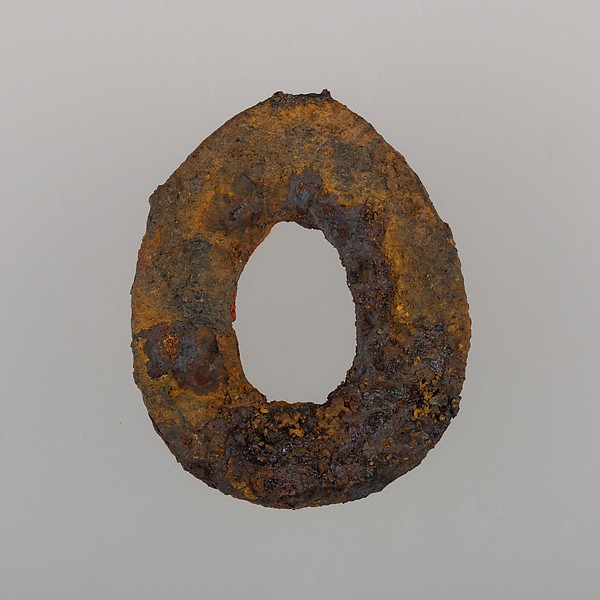
Sword Guard (Tsuba) · ca. 3rd century–538 · Iron
Look closer: The earliest guard in this chapter is almost featureless: a worn ring of iron.
The Metropolitan Museum of Art, Funds from various donors, 1946, accession 46.122.2. Public domain (Open Access).
It is worth remembering where the guard sat. Piva notes that when the uchigatana, the sword worn thrust through the sash, became popular in the medieval period, the guard was at the centre of what the viewer saw, and decoration at first was minimal: motifs pierced through iron. That is the beginning of the story.
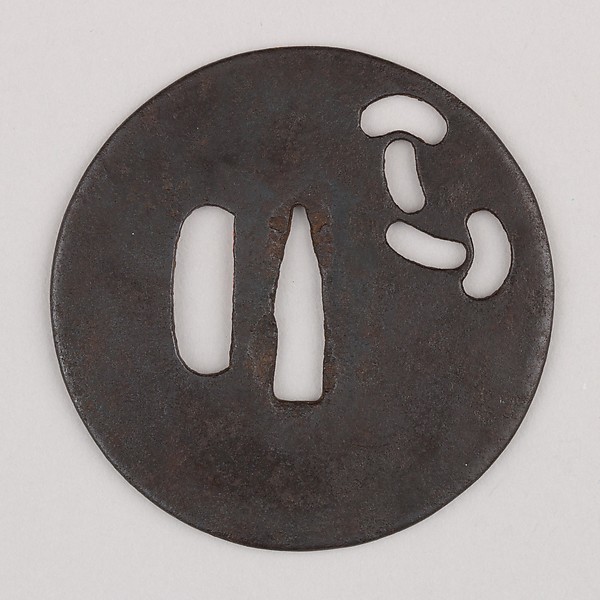
Sword Guard (Tsuba) · late 16th–early 17th century · Iron, copper
Look closer: Pierced openings, not carved pictures: the early manner of decorating a guard.
The Metropolitan Museum of Art, Funds from various donors, 1946, accession 46.122.16. Public domain (Open Access).
| Met object | Date | Metal | Size and weight |
|---|---|---|---|
| Sword Guard, 46.122.2 | About 3rd century to 538 | Iron | 5.2 × 4.3 cm |
| Sword Guard, Ko-kinko school, 2007.478.5 | Late 16th century | Shakudō, gold, copper | 7.6 × 7 cm, 147.4 g |
| Sword Guard, Ko-kinko school, 2018.833.23 | 17th century | Shakudō, gold | 7 × 6.4 cm, 107.7 g |
| Sword Guard, 38.25.40 | 17th century | Iron, gold, silver, shakudō, copper | 7.9 × 7.3 cm, 130.4 g |
| Sword Guard, inscribed Gotō Ichijō, 43.120.728 | 19th century | Shakudō, silver, gold, copper | 6.8 × 6.4 cm, 113.4 g |
Kyoto, Kumamoto and the Workshops
The tsuba’s history is, to a great extent, a history of families. Piva’s account traces the earliest makers to swordsmiths and armourers, and says that in the Muromachi period openwork guards appeared in which the background was cut away, with named schools in Owari, in Kyoto and the Ko-Shōami. Wikipedia adds that in the Muromachi period, 1333 to 1573, and the Momoyama, 1573 to 1603, guards were mainly functional, made of stronger metals.
Periods and developments as reported by Wikipedia, Giuseppe Piva and the Met. Dates are those of the sources.
Look closer: Notice how the 16th-century bar and the Momoyama bar overlap with the long Muromachi span; schools do not start on tidy dates.
Diagram by Japonista. Original drawing, no source image.
Then comes gold. Piva says that in the sixteenth century the Gotō family in Kyoto introduced a new style, applying pictorial designs in gold to a ground of shakudō, a copper-gold alloy with a finely textured nanako surface, and that the family became the leading makers for about four hundred years. The Met’s collection bears this out, with sets by named Gotō masters from the second generation, Gotō Sōjō, who is dated about 1461 to 1538, through to the eleventh, Gotō Tsūjō, who lived from 1664 to 1721, and the Met catalogues certificates from a thirteenth-generation master, Mitsutaka, confirming earlier pieces as authentic Gotō work. The Met also holds guards of the Ko-kinko school, “old gold-metal makers”. It calls one, of the late sixteenth century, an early and rare guard of shakudō and gold, and notes that few pieces from this early Momoyama period survive; it calls another, of the seventeenth century, notable for a finely engraved wave pattern framed by a thick band of gilding.
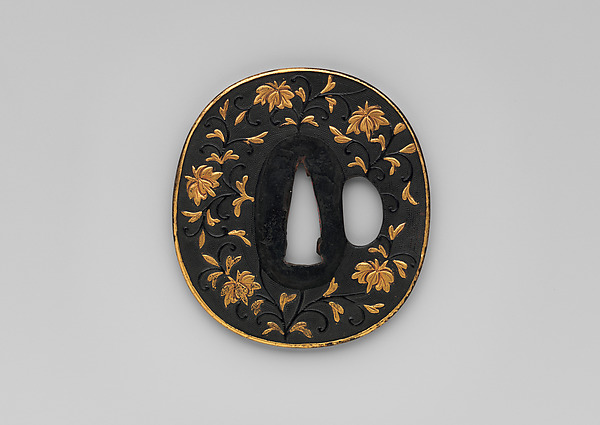
Ko-kinko school · Sword Guard (Tsuba) · late 16th century · Copper-gold alloy (shakudō), gold, copper
Look closer: Gold set into a black ground: the early version of the manner the Gotō would refine.
The Metropolitan Museum of Art, Gift of Etsuko O. Morris and John H. Morris Jr., in memory of Dr. Frederick M. Pedersen, 2007, accession 2007.478.5. Public domain (Open Access).
In the early Edo period the patronage turned. Piva records that the Hosokawa clan hired four makers, Hayashi Matashichi, Hirata Hikozō, Nishigaki Kanshirō and Shimizu, who founded the Higo schools; the Google Arts and Culture story on Higo Kinko adds that the metalwork was made in Kumamoto, in Higo province, and that Hosokawa Sansai, who lived from 1563 to 1645 and was both a commander and a tea master, encouraged and guided its development. The same story says that Higo guards were designed with the “Higo koshirae”, Sansai’s favourite style of mounting, in mind. Later, Piva says, carved guards, machi-bori, became standard in the mid and late Edo period, the Sōmin and Nara workshops appeared, and the late work grew exaggerated, much of it aimed at European buyers, with Kano Natsuō producing the last masterpieces of the age.
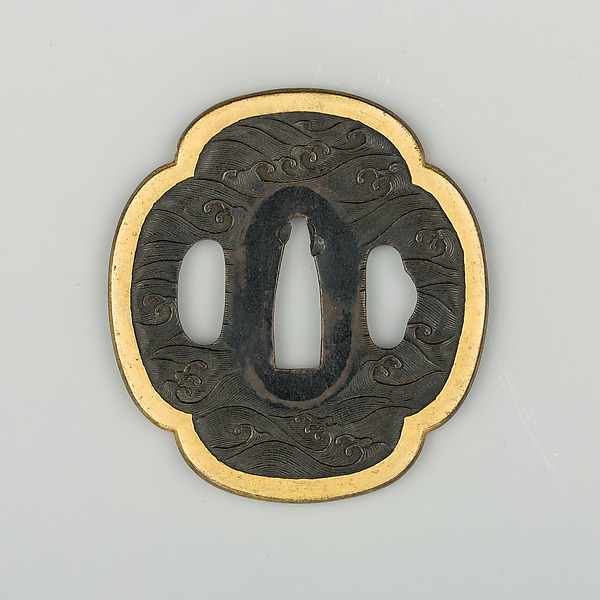
Ko-kinko school · Sword Guard (Tsuba) · 17th century · Copper-gold alloy (shakudō), gold
Look closer: The waves are engraved; the thick gold band frames them like a mount.
The Metropolitan Museum of Art, Gift of Etsuko O. Morris and John H. Morris Jr., 2018, accession 2018.833.23. Public domain (Open Access).
Pictures in Iron
The Edo period is the age of the tsuba as picture. Wikipedia says that with peace the guards became more ornamental and were sometimes made of gold, and the Met’s collection runs from austere iron openwork to guards on which an entire scene is carved and inlaid. A seventeenth-century iron guard in the Met has a bald, robed figure inlaid in gold, silver and shakudō, with calligraphy beside it; the museum’s description is brief, so we will not guess at the subject. A nineteenth-century guard inscribed by Gotō Ichijō, who lived from 1791 to 1876, shows a heron in a stream, in shakudō with silver and gold.
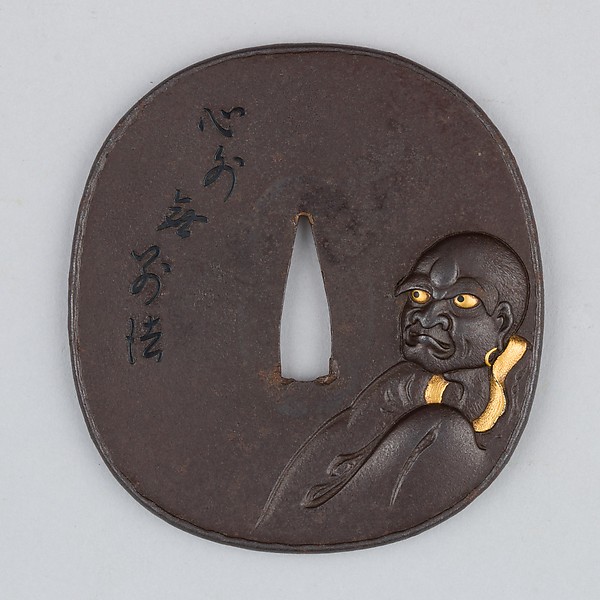
Sword Guard (Tsuba) · 17th century · Iron, gold, silver, copper-gold alloy (shakudō), copper
Look closer: The figure is raised from the iron; the calligraphy fills the empty ground.
The Metropolitan Museum of Art, Gift of Mrs. George A. Crocker (Elizabeth Masten), 1937, accession 38.25.40. Public domain (Open Access).
A guard can also quote a world. An iron guard of the Edo period at the Met shows a bearded figure on a mountain shore beside waves; another, of the nineteenth century, by Gotō Mitsuakira, has a figure and a deer in gold and shakudō at the foot of a quatrefoil ground. These are not stock images: they are chosen scenes from poetry, legend and the tea room, small enough to hold between thumb and finger, and, because the guard sat in the sash, visible to everyone the swordsman met.
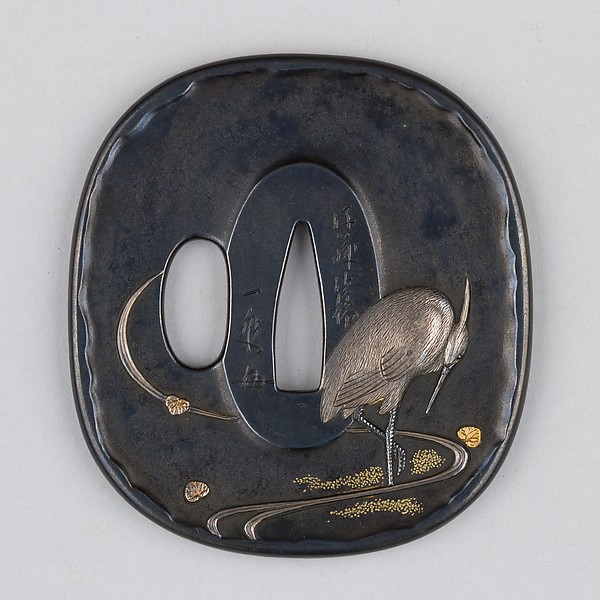
Gotō Ichijō · Sword Guard (Tsuba) · 19th century · Copper-gold alloy (shakudō), silver, gold, copper
Look closer: The heron stands in a ground the maker hammered to look like water-worn metal.
The Metropolitan Museum of Art, Gift of Herman A. E. and Paul C. Jaehne, 1943, accession 43.120.728. Public domain (Open Access).
Even the art world noticed. A woodblock print in the Met by Kubo Shunman, who lived from 1757 to 1820, titled “Tsuba (Sword Guard) and Bags”, is a nineteenth-century surimono, the small privately commissioned prints made for poetry circles, and its subject is simply a guard and cloth bags laid on paper. We do not know what its poems say; we know that by then a guard was a fit subject for a print.

Kubo Shunman · Tsuba (Sword Guard) and Bags · 19th century · Woodblock print (surimono); ink and color on paper
Look closer: A print of a guard: the object was a subject for collectors as well as a fitting for swords.
The Metropolitan Museum of Art, H. O. Havemeyer Collection, Bequest of Mrs. H. O. Havemeyer, 1929, accession JP1991. Public domain (Open Access).
Reading a Guard at Arm’s Length
Collectors speak of the ground, the design and the signature, and a first look can sort the three. The ground is the metal: iron for the earliest and the plainest; shakudō and other soft alloys for the gold-decorated guards; and, as Wikipedia’s sword-mounting article lists, brass and copper. The design is the subject and the technique: pierced openwork, carved relief, inlay. The signature, where there is one, is a statement that must be tested, and the Met’s catalogue shows the care taken: its Gotō sets are accompanied by a certificate, an orikami, from a later head of the school, and the museum records that the certificate in one set refers only to the pair of grip ornaments. A paper is a claim about a piece, not part of it.
Know the neighbours, too. Wikipedia’s account of the mounting places the guard between two parts: the habaki, a wedge-shaped metal collar that holds the blade in the scabbard and locks the guard in place, and the seppa, washers that tighten the fittings around it. Beyond the guard come the collar and cap of the hilt, fuchi and kashira, which in a good mounting echo its design; the next chapter in this almanac is about those and the other small fittings.
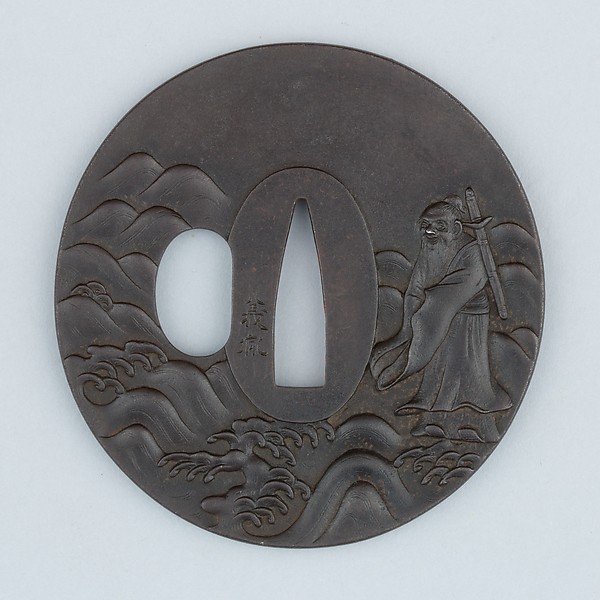
Sword Guard (Tsuba) · ca. 1615–1868 · Iron, gold, copper
Look closer: Relief carving in iron: the figure and the waves are raised, the ground is left plain.
The Metropolitan Museum of Art, H. O. Havemeyer Collection, Bequest of Mrs. H. O. Havemeyer, 1929, accession 29.100.1060. Public domain (Open Access).
Piva adds a note on taste that is easy to miss. In the Momoyama period, he writes, signed guards appeared, by makers named Nobuie and Kaneie, with designs that stayed simple and martial and were influenced by the aesthetic of the tea ceremony; it was only in the early Edo period that samurai families commissioned guards as works of art. That sequence is why a plain iron guard of 1600 and a pictorial guard of 1700 can both be right, and neither is a poor relation of the other.
Wikipedia records one last piece of etiquette. In peacetime a mounted sword was presented with the hilt to the left, and Edo-period rules said the hilt should face right in wartime so that the sword could be drawn quickly. The fittings, in other words, belonged to manners as well as to metalwork.
Five more guards
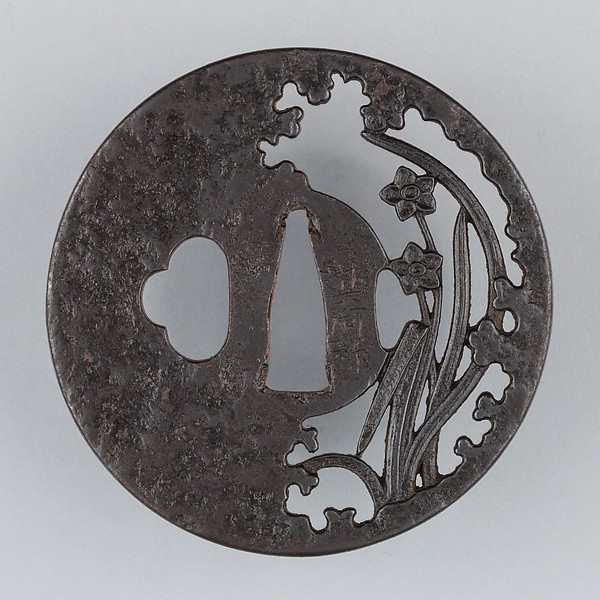
Sword Guard (Tsuba) · late 17th century · Iron, copper
Look closer: The cutaway areas are as important as the metal that remains.
The Metropolitan Museum of Art, The Howard Mansfield Collection, Gift of Howard Mansfield, 1936, accession 36.120.53. Public domain (Open Access).
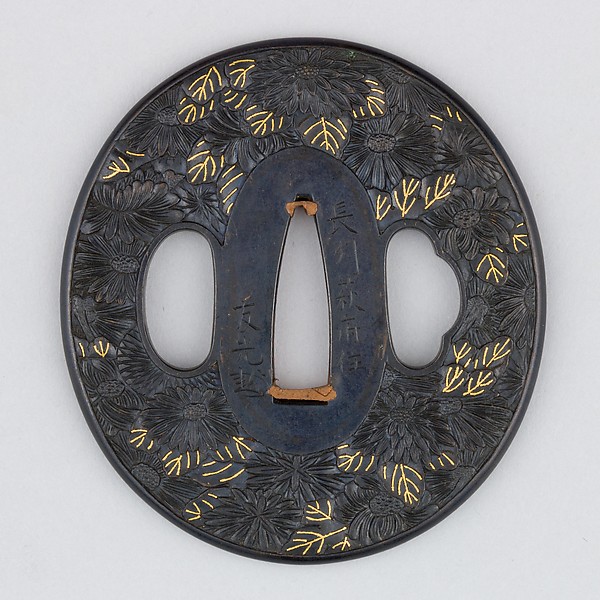
Sword Guard (Tsuba) · 17th century · Copper-gold alloy (shakudō), gold, copper
Look closer: A repeated leaf ground in gold on black.
The Metropolitan Museum of Art, Bequest of Edward G. Kennedy, 1932, accession 33.40.21. Public domain (Open Access).
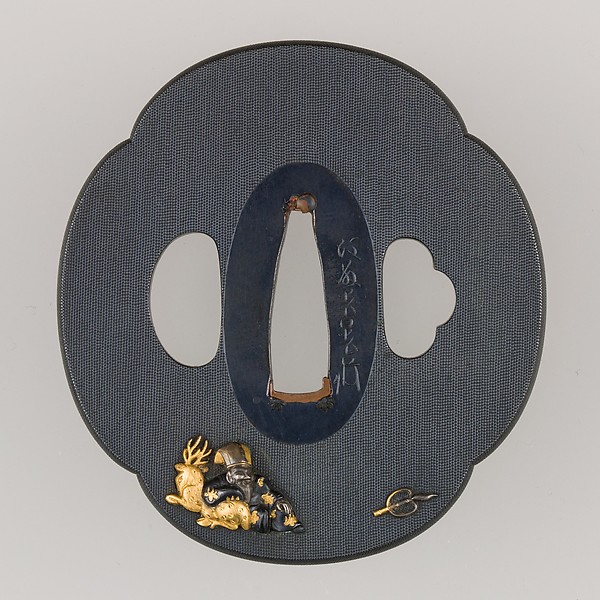
Gotō Mitsuakira · Sword Guard (Tsuba) · 19th century · Copper-gold alloy (shakudō), gold, silver, copper
Look closer: A tiny scene beside a large empty field: restraint is part of the design.
The Metropolitan Museum of Art, Gift of the Baber Family, in loving memory of Charles Chenault Baber, 2012, accession 2012.528.3. Public domain (Open Access).
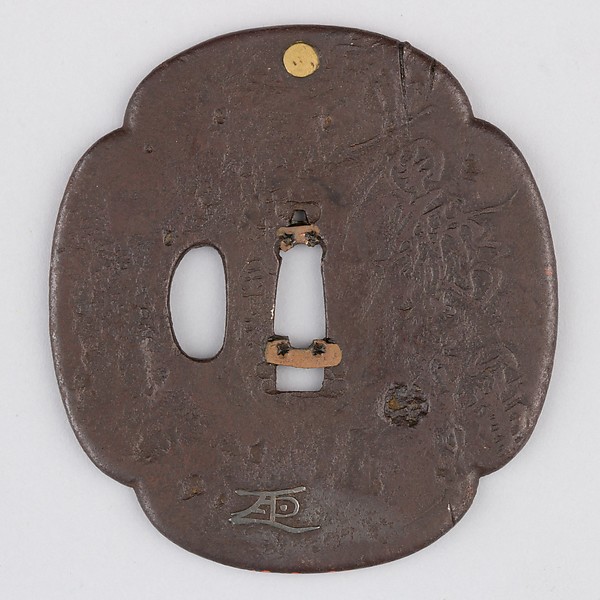
Sword Guard (Tsuba) · ca. 1615–1868 · Iron, copper
Look closer: A worn iron surface; the gold spot is a lone accent.
The Metropolitan Museum of Art, Gift of Bashford Dean, 1919, accession 19.154.97. Public domain (Open Access).
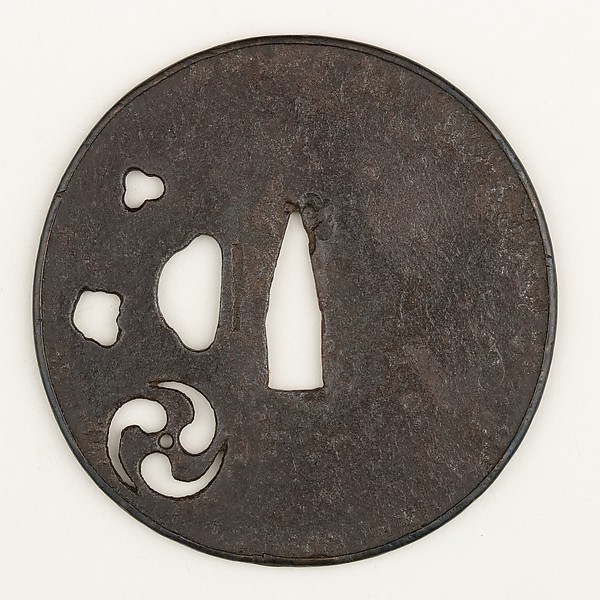
Sword Guard (Tsuba) · 17th century · Iron, copper
Look closer: A shallow relief that rewards raking light.
The Metropolitan Museum of Art, The Howard Mansfield Collection, Gift of Howard Mansfield, 1936, accession 36.120.166. Public domain (Open Access).
Fittings and Stands
The house’s sword-fittings and stands are shelved with the samurai heritage pieces; the tsuba guide and the tosogu glossary explain the terms, and the concierge desk can advise on a guard’s school, signature and condition.
Answered plainly
What does a tsuba do?
It keeps the hand from sliding onto the blade, according to Wikipedia and Giuseppe Piva. It was not chiefly a shield against an opponent’s cut.
What is shakudō?
A copper-gold alloy with a dark, blue-black patina. The Met catalogues it in many guards and fittings, often decorated with gold.
Who were the Gotō?
A family of metalworkers in Kyoto who, in the sixteenth century, introduced gold pictorial designs on a shakudō ground and, by Piva’s account, led the field for about four hundred years. The Met holds sets by named masters across eleven generations.
What is Higo Kinko?
Metalwork made in Kumamoto in Higo province, highly regarded in the Edo period. The Hosokawa clan hired four makers who founded the Higo schools.
How big is a guard?
About 7.5 to 8 centimetres for a katana, 6.2 to 6.6 for a wakizashi and 4.5 to 6 for a tantō, according to Wikipedia.
Does a signature prove authorship?
No. The Met’s own catalogue records certificates written by later masters and notes which fittings they cover; a signature or paper is evidence to be weighed.
Where next
Sources and image credits
- Tsuba, Wikipedia
- Japanese sword mountings, Wikipedia
- Tosogu, Wikipedia
- Tsuba, history of the sword guard, Giuseppe Piva
- Higo Kinko, Google Arts and Culture
- Sword Guard (Tsuba), Ko-kinko school, The Metropolitan Museum of Art
- Sword Guard (Tsuba), Ko-kinko school, The Metropolitan Museum of Art (17th century)
- Set of Sword Fittings, Gotō Sōjō, The Metropolitan Museum of Art
- Tsuba (Sword Guard) and Bags, Kubo Shunman, The Metropolitan Museum of Art
- Bashford Dean and Japanese Arms and Armor, The Metropolitan Museum of Art
- Image: Sword Guard (Tsuba), Unknown maker (Public domain (Met Open Access))
- Image: Sword Guard (Tsuba), Unknown maker (Public domain (Met Open Access))
- Image: Sword Guard (Tsuba), Unknown maker (Public domain (Met Open Access))
- Image: Sword Guard (Tsuba), Gotō Ichijō (Public domain (Met Open Access))
- Image: Sword Guard (Tsuba), Unknown maker (Public domain (Met Open Access))
- Image: Sword Guard (Tsuba), Unknown maker (Public domain (Met Open Access))
- Image: Sword Guard (Tsuba), Unknown maker (Public domain (Met Open Access))
- Image: Sword Guard (Tsuba), Gotō Mitsuakira (Public domain (Met Open Access))
- Image: Sword Guard (Tsuba), Unknown maker (Public domain (Met Open Access))
- Image: Sword Guard (Tsuba), Unknown maker (Public domain (Met Open Access))
Last reviewed 28 October 2026. Pictures are public-domain or openly licensed and credited beneath each one; diagrams are drawn by Japonista.
Looking for a guard with a known school, a signed set of fittings or a mounting to match? The concierge desk replies within one to three business days.
Private concierge
Looking for something in particular?
Describe the piece or the project you have in mind. A senior advisor in Tokyo reads every case file personally and replies within two business days, with fees set out in writing before any work begins.