
The Folk Crafts Museum and the Makers of Mingei
Rooms, Kilns and Looms
The Folk Crafts Museum and the Makers of Mingei
In 1936 Yanagi Sōetsu opened a museum beside his own house in Tokyo so that the public could see what he had been trying to explain. Around it stood a circle of potters, dyers and printmakers who made the idea visible with their hands.
Fact sheet
At a glance
- A museum next to a house. Yanagi opened the museum in September 1936, beside his own residence in Komaba, with money offered by Ōhara Magosaburō in 1935.
- A gate from the country. The museum’s Nagaya Gate came from Tochigi Prefecture, the same region of farmhouses and gatehouses that Hamada was saving at Mashiko.
- Two directors, one idea. Yanagi directed the museum until his death in 1961. Hamada Shōji, his friend and a potter, became the second director.
- Seven makers, four crafts. Clay, glaze, stencil-dyed cloth and carved wood: Hamada, Kawai, Leach, Tomimoto, Serizawa, Munakata and Shimaoka gave the movement its working examples.
- A village that does not sign. At Onta in Ōita Prefecture, ten families of potters mark their wares with the sign of the village, not their own names.
A Museum Built to Teach the Eye
The Japan Folk Crafts Museum, the Nihon Mingeikan, stands in Komaba, in Meguro Ward in Tokyo. It was founded in 1936 by Yanagi Sōetsu, the philosopher and critic who had spent the previous decade arguing that the most beautiful things in Japan were the plain objects of ordinary use. The earlier chapter in this almanac, Yanagi Sōetsu and the Mingei Idea, follows that argument. This chapter follows the objects, the house that holds them and the people who made new ones in the same spirit.
A museum is an odd instrument for such a movement. Yanagi had written that beauty belongs to anonymous things made by hand in quantity and used until they wore. A museum takes objects out of use, puts them in cases and invites people to admire them from a distance. The paradox was not lost on Yanagi’s critics, and it is taken up in the chapter on his ideas. What he wanted from the building was simpler: a place where a visitor could stand in front of a jar or a quilt cover or a basket, with no label that told them whom to admire, and learn to look.
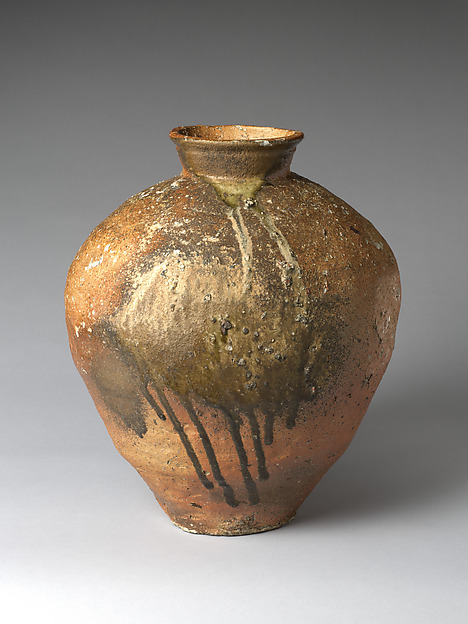
late 15th century. Stoneware with natural ash glaze (Shigaraki ware). The Metropolitan Museum of Art, accession 1975.268.428. The Harry G. C. Packard Collection of Asian Art, Gift of Harry G. C. Packard, and Purchase, Fletcher, Rogers, Harris Brisbane Dick, and Louis V. Bell Funds, Joseph Pulitzer Bequest, and The Annenberg Fund Inc. Gift, 1975. Open Access.
Look closer: A late fifteenth-century storage jar with natural ash glaze: a kitchen and field vessel that later generations came to admire.
The Metropolitan Museum of Art, public domain (Open Access). Source: https://www.metmuseum.org/art/collection/search/44637
He had a model in his own earlier work. In 1924 he had founded a folk art museum in Seoul in a palace building, and the Tokyo museum was the second attempt to do the same thing for Japanese objects. This time he had a patron, a site beside his house and the support of the circle of potters he had gathered since 1925. Between them they could fill the rooms with things collected on journeys, and with new work by makers who shared his convictions.
The rest of this chapter takes the story in two halves. The first is the building: its founding, its architecture, what it holds and how it changed. The second is the makers. Hamada Shōji and Kawai Kanjirō were potters and friends from student days; Bernard Leach was the Englishman who carried the idea to Cornwall; Tomimoto Kenkichi was a potter whose own career ran parallel to theirs; Serizawa Keisuke dyed cloth with stencils; Munakata Shikō carved woodblocks; Shimaoka Tatsuzō was Hamada’s apprentice. At the end stands a village, Onta, that put the movement’s ideal of anonymity into practice without needing a manifesto.
The Gift and the Opening, 1935 and 1936
According to Wikipedia’s article on the museum, the money came from Ōhara Magosaburō, a figure of the business world. In March 1935 Ōhara offered Yanagi a sum of 100,000 yen to build a museum. The museum was built beside Yanagi’s own house in Komaba, to hold the collection he had been forming for years.
The building opened in September 1936. Its first exhibition was titled Exhibition of Crafts by Contemporary Artists, a name that sounds, to a modern ear, rather less like a manifesto of anonymity than the museum’s later reputation might suggest. It is a useful reminder that the movement had always lived with a double life: the old nameless things it admired and the new work by named makers that it encouraged. Hamada, Kawai and the other potters of the circle were all, in their ways, contemporary artists, and the museum was meant to show their work beside the older objects.
The date places the museum in a tight cluster of events. In 1935, the year of Ōhara’s offer, Yanagi also saw the woodblock prints of Munakata Shikō at an exhibition and bought twenty-five of them, an episode told below. In 1936 the museum opened. In 1939 Munakata completed the Ten Great Disciples of the Buddha, which Wikipedia calls his greatest masterpiece. The museum and the circle were thus growing together in the second half of the 1930s, before the war closed that chapter of Japanese cultural life.
Hamada became the museum’s second director after Yanagi died in 1961. That succession mattered. It meant that a potter, and not a scholar or a critic, was in charge of the collection when the postwar boom in folk crafts arrived, and that the museum’s directorship passed from the man who had named the movement to one of the men who had helped to coin its word.
Main Building, Western House and Gatehouse
The museum is a small group of buildings, not one. The Main Building is a two-storey wooden structure of the 1930s. Wikipedia’s article lists it, together with its connected wall, among the Tokyo designated tangible cultural properties. The Western Building, which was Yanagi Sōetsu’s residence, is also on that list, and so is the Nagaya Gate attached to it, with its connected wall.
The gate is the detail that tells most about the museum’s spirit. A nagaya-mon is a gatehouse of the kind that once belonged to rural estates in the Edo period, a long building that held living space and storage as well as an entrance. The museum’s Nagaya Gate was brought from Tochigi Prefecture. Hamada Shōji, who lived in Mashiko in southern Tochigi, spent decades buying, moving and refurbishing nagaya-mon gatehouses, farmhouses and stone warehouses on his own property. The two men were saving the same kind of building, a hundred kilometres apart.
Over the years the complex grew. A new building was added in 1982 to give the museum more space for its collection and exhibitions. In 2001 the museum was renovated with support from the Nippon Foundation. The pattern is familiar from many small museums: a founder’s house at the centre, a modern wing added when the collection outgrew it, and a renovation when the older rooms needed care.
The sources used for this chapter do not describe the rooms in detail, and this house has not inspected them for this page. A two-storey wooden building beside a family house is, at least, a domestic scale, which suits the founder’s aim. Anyone planning a visit should check the museum’s own website for opening hours and current exhibitions.
What the Rooms Hold
The museum’s collection grew from Yanagi’s own travels in Korea, Okinawa and the Japanese regions. Yanagi collected woodwork, lacquerware, pottery and textiles, among other things, and the museum’s purpose is to collect, preserve, research and exhibit such work. The museum has also published a Guide of the Japan Folk Crafts Museum, whose first edition appeared in 2016 and revised edition in 2025.
The one object that Wikipedia singles out is a painted Karatsu jar with a reed pattern. It was registered as an Important Cultural Property in 2003, and the museum’s article calls it a representative example of Karatsu pottery. Karatsu ware, from the Hizen region of Kyushu, was a plain, practical ware, often decorated with a few quick strokes of brown iron under a clear or ash glaze. The jar’s designation is a reminder that something made for use in a kitchen can, in time, be recognised by the state as a cultural property.

Stoneware with painted decoration in underglaze brown iron (Karatsu ware). The Metropolitan Museum of Art, accession 2002.447.21. Dr. and Mrs. Roger G. Gerry Collection, Bequest of Dr. and Mrs. Roger G. Gerry, 2000. Open Access.
Look closer: A small Momoyama-period Karatsu jar painted in iron brown under the glaze, an example of the painted Karatsu type that the Tokyo museum also holds in a famous reed-pattern jar. It is not that jar.
The Metropolitan Museum of Art, public domain (Open Access). Source: https://www.metmuseum.org/art/collection/search/49276

early 17th century. Stoneware with underglaze iron oxide decoration (Hizen ware, Karatsu type). The Metropolitan Museum of Art, accession 2015.300.266. Mary Griggs Burke Collection, Gift of the Mary and Jackson Burke Foundation, 2015. Open Access.
Look closer: An early seventeenth-century Karatsu platter with a pine drawn in a few quick strokes of iron oxide.
The Metropolitan Museum of Art, public domain (Open Access). Source: https://www.metmuseum.org/art/collection/search/53007
This page shows a small Karatsu jar from the Metropolitan Museum of Art, not the Tokyo jar. It is there to give a sense of the type. A pine drawn on a platter, a few lines on a jar, a bottle with a pine in iron brown and copper green over white slip: the vocabulary is small, and the freedom with which it is used is what Yanagi admired.
It is worth saying what a museum like this cannot do. It cannot show the work of making, or the household in which the object was used. What it can do is gather, in one place, enough examples that the similarities become visible: the same brushwork across a century, the same glaze running down the same kind of jar, the same stitch in a quilted coat. That, rather than any single masterpiece, is the argument of the collection.
| Cultural designation | Item | Detail |
|---|---|---|
| Important Cultural Property | Painted Karatsu jar with reed pattern | Registered in 2003; described as a representative example of Karatsu pottery |
| Tokyo designated tangible cultural property | Main Building and connected wall | The two-storey wooden building of the museum |
| Tokyo designated tangible cultural property | Western Building | Yanagi Sōetsu’s former residence |
| Tokyo designated tangible cultural property | Nagaya Gate and connected wall | Attached to the Western Building; the gate came from Tochigi Prefecture |
Hamada Shōji: Second Director, Kiln at Mashiko
Hamada Shōji, born in Kawasaki in 1894, studied ceramics at the Tokyo Institute of Technology, then known as Tokyo Industrial College, with Kawai Kanjirō under Itaya Hazan. They were the only two students at the school who wanted to be artist-potters, according to Wikipedia, and they became friends. In Kyoto they worked together at an institute of industrial technology, experimenting with glazes made from various minerals. They became acquainted with Yanagi Sōetsu and Tomimoto Kenkichi while visiting potteries and exhibitions.
In 1920 Hamada travelled to England with Bernard Leach, whose Tokyo exhibition had impressed him, and helped to build the Leach Pottery at St Ives. After three years he returned to Japan in 1923, visited potteries, stayed for weeks at Tsuboya in Okinawa, and then settled in Mashiko, in Tochigi Prefecture about a hundred kilometres north-east of Tokyo. There he built his own pottery and committed himself to using local materials: the clay, the glazes he devised, even the brushes, which he made from dog hair and bamboo.
In 1955 the government named him a Living National Treasure, the first person in the field of crafts to receive the designation. That year follows an amendment to the Cultural Property Protection Act in 1954, which had created the category of preservers of important intangible cultural properties. He later received the Purple Ribbon medal in 1964 and the Order of Culture in 1968. When Yanagi died in 1961 Hamada succeeded him as the second director of the Japan Folk Crafts Museum.

mid-17th century. Stoneware with iron-brown decoration and copper-green glaze over brushed white slip, under transparent glaze (Old Takeo ware). The Metropolitan Museum of Art, accession 1975.268.452. The Harry G. C. Packard Collection of Asian Art, Gift of Harry G. C. Packard, and Purchase, Fletcher, Rogers, Harris Brisbane Dick, and Louis V. Bell Funds, Joseph Pulitzer Bequest, and The Annenberg Fund Inc. Gift, 1975. Open Access.
Look closer: A mid-seventeenth-century bottle with a pine in iron brown and copper green over brushed white slip: slip and iron, the materials of the folk potter.
The Metropolitan Museum of Art, public domain (Open Access). Source: https://www.metmuseum.org/art/collection/search/50350
He was also a teacher and a host. He supported young potters who came to Mashiko, among them his apprentice Shimaoka Tatsuzō and Kamoda Shōji, provided housing and workplace for visiting potters from abroad, and helped to make the town a destination for day visitors. In 1952 he took part with Leach in the Pottery seminar at Black Mountain College in the United States, an event that introduced the folk-pottery idea to a generation of younger American potters.
Mashiko itself had a long history of clay work. Wikipedia’s article on Mashiko ware dates modern Mashiko pottery to 1853, when a potter discovered that the local clay was ideal for ceramics, and says that the style was popularised when Hamada set up a kiln there in 1930. Hamada’s particular gift was to give a rustic kiln town a vision of itself. The brown, with a little red, of Mashiko glaze, simple and sturdy, became, in his hands and in the hands of his followers, a style that the whole country recognised.
Mashiko Sankōkan and a Village of Farmhouses
Hamada did not only make pots. From the time he moved to Mashiko he bought, moved and refurbished traditional farmhouses, stone warehouses and nagaya-mon gatehouses of the Edo period that were characteristic of southern Tochigi. The first was his residence, in 1930. Others followed, which he used as workshops and for entertaining guests and apprentices; the last, used from 1942, became his workshop.
The effect was to turn a pottery into a small village of salvaged buildings, each of them an example of the folk architecture that his friend Yanagi admired. The farmhouse was a mingei object on the scale of a room. It had been built by carpenters whose names nobody recorded, in local materials, for use, and it had been about to disappear.
In 1977, the year before his death, Hamada opened his own museum at his home. The Mashiko Sankōkan, now the Shōji Hamada Memorial Mashiko Sankokan Museum, displayed his collection of folk crafts from Japan and abroad. It is a small echo of the Tokyo museum, built on one potter’s taste rather than a movement’s, and it showed the objects that Hamada lived with and learned from.
In 1989 his residence was donated to the Mashiko Museum of Ceramic Art, also called Ceramic Art Messe Mashiko, and rebuilt there after the house was designated a cultural property of Mashiko. Wikipedia says the museum remains open, and that visitors can see Hamada’s studio, his living quarters and his craft collections. The house had moved, but its purpose had not changed.
The arrangement says something about how the movement saw preservation. It was not a matter of fencing off a monument. It was a matter of using old buildings, filling them with work and with collections, and letting a new generation walk through them. Mashiko today holds a pottery and crafts festival twice a year, during Golden Week in the first week of May and again in the first week of November, when potters and craftspeople from Mashiko and the surrounding area set up stalls in the town.
Kawai Kanjirō: A Kiln of Eight Chambers
Kawai Kanjirō was born in Yasugi in Shimane Prefecture in 1890. As a child he watched a nearby farmer who made pottery in his spare time, and by sixteen he knew that he wanted to be a potter. He graduated from the Tokyo Higher Polytechnical School in 1914 and worked briefly at the Kyoto Research Institute for Ceramics, where, according to Wikipedia, he and Hamada are said to have conducted over ten thousand experiments with glazes.
In 1920 he built his own climbing kiln in Kyoto, a noborigama with eight chambers that he called the Shōkeiyō, and began to hold exhibitions. He was trained in chemical glazes and became widely recognised for them in his early twenties, yet he was dissatisfied with that early work. A chance encounter with Yanagi and Hamada, Wikipedia says, turned him towards natural glazes and towards nature itself. He is regarded as a master of glazes, especially the warm red of copper, the brown of iron, and chrome and cobalt.
He was more than a potter. He was a calligrapher, sculptor, writer and philosopher, and he collected the work of poor craftspeople from all over Asia. Wikipedia quotes his admiration for what he called ordered poverty. His pots came in asymmetrical shapes and used expressive techniques: tsutsugaki, slip-trailed decoration; ronuki, wax resist; hakeme, brushed white slip.

ca. 1800. Stoneware with brown drip glaze (Tanba ware, Tachikui type). The Metropolitan Museum of Art, accession 1975.268.624. The Harry G. C. Packard Collection of Asian Art, Gift of Harry G. C. Packard, and Purchase, Fletcher, Rogers, Harris Brisbane Dick, and Louis V. Bell Funds, Joseph Pulitzer Bequest, and The Annenberg Fund Inc. Gift, 1975. Open Access.
Look closer: A Tanba jar of about 1800 with a brown glaze left to run, a household vessel and a lesson in how a plain glaze can look alive.
The Metropolitan Museum of Art, public domain (Open Access). Source: https://www.metmuseum.org/art/collection/search/56587
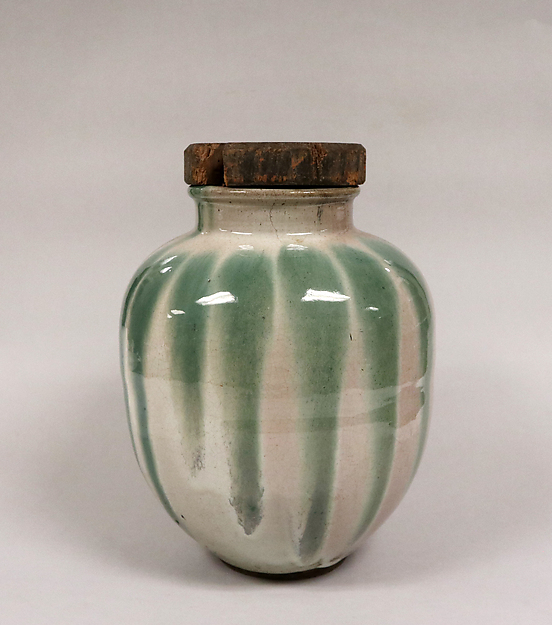
19th century. Stoneware covered with thick glaze; vertical dripped glaze over wooden top (Shigaraki ware). The Metropolitan Museum of Art, accession 1988.373.2. Stanley J. Love Gift, 1988. Open Access.
Look closer: A nineteenth-century Shigaraki jar with the glaze dripped down in vertical lines.
The Metropolitan Museum of Art, public domain (Open Access). Source: https://www.metmuseum.org/art/collection/search/44572
Like Hamada, he never signed his work. His own explanation, as Wikipedia gives it, was that his work itself was his best signature. Unlike Hamada, he refused every official honour, including the designation of Living National Treasure. In November 1953 he held one of his largest exhibitions at the Kōrin-kaku in Tokyo, with more than five hundred pieces, and each year the Takashimaya department store held a show of his work in its Tokyo and Osaka shops.
A book entitled We Do Not Work Alone was published in 1953, and its title also stands as a summary of the whole movement. A potter depends on the clay, the fire, the people who dig and carry, the apprentices, and the long chain of makers before him. The book’s title is a quiet answer to the question of why a folk craftsman should be anonymous.
Bernard Leach and the Kiln at St Ives
Bernard Leach, born in Hong Kong in 1887, spent his first three years in Japan with his father before moving back to Hong Kong. He studied at the Slade School of Fine Art and the London School of Art, where he learned etching, and reading the books of Lafcadio Hearn made him curious about Japan. In 1909 he returned there with his wife intending to teach etching.
In Tokyo he joined the Shirakaba group, the circle of writers and artists around Mushanokōji Saneatsu, Shiga Naoya and Yanagi Sōetsu who were introducing Western art to Japan. About 1911 he went to a raku pottery party and became fascinated by ceramics. He studied with Urano Shigekichi, who stood as the sixth Kenzan in the tradition of Ogata Kenzan, and the potter Tomimoto Kenkichi helped him as interpreter for technical terms. In 1919 the young Hamada Shōji visited him for the first time. Leach received a kiln from Kenzan and set it up in Yanagi’s garden.
In 1920, before leaving, he met Kawai Kanjirō at an exhibition in Osaka. Then he sailed for England, accompanied by Hamada, on the invitation of Frances Horne, who was founding a Guild of Handicrafts in the artists’ colony at St Ives in Cornwall. The two men found a site beside the Stennack river and built the Leach Pottery, with a Japanese climbing kiln, a noborigama, which Wikipedia says was the first built in the West. It was poorly built and was reconstructed in 1923 by Matsubayashi Tsurunosuke.
Leach’s book A Potter’s Book appeared in 1940 and defined his craft philosophy and techniques. It went through many editions and was his breakthrough to recognition. His work combined traditional Korean, Japanese and Chinese pottery with English and German traditions such as slipware and salt glaze. He advocated simple and utilitarian forms, set what he called ethical pots against the fine-art pot, and made a range of standard ware for the general public alongside work that was exhibited as art.

early 17th century. Stoneware with ash and iron glaze (Karatsu ware); silver lacquer repairs. The Metropolitan Museum of Art, accession 1975.268.447. The Harry G. C. Packard Collection of Asian Art, Gift of Harry G. C. Packard, and Purchase, Fletcher, Rogers, Harris Brisbane Dick, and Louis V. Bell Funds, Joseph Pulitzer Bequest, and The Annenberg Fund Inc. Gift, 1975. Open Access.
Look closer: A tiny early seventeenth-century Karatsu cup mended with silver lacquer, a reminder that handled things are repaired as well as used.
The Metropolitan Museum of Art, public domain (Open Access). Source: https://www.metmuseum.org/art/collection/search/52211
The Leach Pottery trained potters from all over the world, who carried its style and beliefs back to their own countries. His influence on the American counter-culture and modern design of the 1950s and 1960s is described in Wikipedia’s article, and the Black Mountain College seminar of 1952 is one occasion on which Leach and Hamada taught side by side. Leach is remembered as the father of British studio pottery, and as the man who made it a Japanese-English dialogue.
Tomimoto Kenkichi: The Potter in the Circle
Tomimoto Kenkichi was born on 5 June 1886, and his family came from Nara Prefecture. He appears in the stories of all the others: he helped Bernard Leach as an interpreter of technical terms when Leach began to study pottery, and Hamada and Kawai were acquainted with him, as with Yanagi, while visiting potteries and exhibitions. He belongs to the same generation and the same friendships, even if his own career took a somewhat different line.
Wikipedia records that he received a commission to design a large lacquered zelkova shelf for the Ume-no-Ma audience room of the Tokyo Imperial Palace. It is a reminder that the circle of the folk-craft movement included makers who also worked for the highest official patrons. In November 1914 he married Otake Kazue, who had been associated with the feminist literary group Seito, and the couple moved to Nara, where they had three children.
He was a recipient of the Order of Culture and was named a Living National Treasure. Wikipedia’s list of museums that hold his work is long: it includes the Gifu Prefectural Ceramics Museum, the Ōhara Museum of Art, the Museum of Fine Arts, Boston, the Cleveland Museum of Art, the Victoria and Albert Museum and the National Museum of Asian Art. The Tomimoto Kenkichi Memorial Museum opened in 1974 at Ando in Nara, eleven years after his death on 8 June 1963.
The sources used for this chapter say little about his relationship with the mingei movement as such, and this page does not try to say more than they do. What they show is that he was close to the founders, that he was a significant and honoured potter in his own right, and that the Tokyo museum’s own article lists his memorial museum among its related institutions. The honest summary is that he was a friend and fellow traveller of the movement whose career deserves its own chapter.
Serizawa Keisuke and the Stencil
Serizawa Keisuke, born on 13 May 1895 and died on 5 April 1984, was a textile designer and a leading member of the mingei movement. In 1956 the Japanese government designated him a Living National Treasure for his katazome, or stencil dyeing. His son was the archaeologist Serizawa Chōsuke.
Katazome is a way of dyeing by resist. A stencil is cut from paper, and a paste is pressed through the cut openings onto the cloth. When the cloth is dyed, the paste keeps the dye off the covered places, and when the paste is washed away the pattern appears as the colour of the cloth itself. Wikipedia explains the distinctive thing about Serizawa’s method: the starch paste produces not a coloured area, as in direct dyeing, but a blank, undyed one that forms part of the pattern, which can then be coloured by hand in several colours or one, as the designer decides.
The stencils shown here are nineteenth-century paper stencils from the Metropolitan Museum of Art. They make the principle plain. The pattern is not painted; it is the space left by the knife. The thin paper bridges that hold a cut leaf or wave in place become part of the look of the finished cloth, a restraint that the designer turns into a style. A continuous fret such as the sayagata repeats without visible join, so that a long length of cloth can be printed from a single short stencil.

19th century. Paper, silk. The Metropolitan Museum of Art, accession 42.91.16. Gift of Mrs. Horace Havemeyer, 1942. Open Access.
Look closer: A nineteenth-century katazome stencil: the cut paper is the tool that carries a pattern from one length of cloth to the next.
The Metropolitan Museum of Art, public domain (Open Access). Source: https://www.metmuseum.org/art/collection/search/64388

19th century. Paper, silk. The Metropolitan Museum of Art, accession 42.91.65. Gift of Mrs. Horace Havemeyer, 1942. Open Access.
Look closer: A nineteenth-century stencil with boats, shore and pines. The paper bridges between cut shapes are part of the design.
The Metropolitan Museum of Art, public domain (Open Access). Source: https://www.metmuseum.org/art/collection/search/64387

19th century. Paper. The Metropolitan Museum of Art, accession 37.14.45. Fletcher Fund, 1937. Open Access.
Look closer: A nineteenth-century stencil with the continuous fret called sayagata, a pattern that repeats without a visible join.
The Metropolitan Museum of Art, public domain (Open Access). Source: https://www.metmuseum.org/art/collection/search/65305
Serizawa visited Okinawa several times and learned the Ryūkyū technique of bingata dyeing, a resist-dyeing in which colours are painted into outlines of reserved cloth. The Met holds Okinawan bingata robes and panels of the nineteenth century that show what he went to study. Serizawa’s bingata studies tied his work to the Ryūkyū tradition.

19th century. Paper reinforced with silk. The Metropolitan Museum of Art, accession 42.91.225. Gift of Mrs. Horace Havemeyer, 1942. Open Access.
Look closer: A nineteenth-century stencil, paper reinforced with silk, for a textile of bush clover and a winding stream.
The Metropolitan Museum of Art, public domain (Open Access). Source: https://www.metmuseum.org/art/collection/search/64389

19th century. Paper. The Metropolitan Museum of Art, accession 1981.10.11. Purchase, Mrs. Helen M. Meserve Gift, 1981. Open Access.
Look closer: A nineteenth-century paper stencil of the Edo period, shown to make plain how the design lives in what is cut away.
The Metropolitan Museum of Art, public domain (Open Access). Source: https://www.metmuseum.org/art/collection/search/70669
His folk-art output was wide: kimono, paper prints, wall scrolls, folding screens, curtains, fans and calendars. He also produced illustrated books, among them Don Quixote, Vincent van Gogh and A Day at Mashiko. Two museums were opened to his work, the Municipal Serizawa Keisuke Art Museum in Shizuoka in 1981 and the Serizawa Keisuke Art and Craft Museum in Sendai in 1989. His work is also held by the Brooklyn Museum, the Metropolitan Museum of Art, the Harvard Art Museums, the Seattle Art Museum, the British Museum, the University of Michigan Museum of Art and the Museum of New Zealand.

19th century. Resist-dyed and painted (bingata) silk crepe. The Metropolitan Museum of Art, accession 1983.417a, b. Purchase, Seymour Fund, Gift of Mr. and Mrs. Harold Bach, by exchange, 1983. Open Access.
Look closer: A nineteenth-century Okinawan robe in bingata, the Ryūkyū resist-dyeing that Serizawa travelled to study.
The Metropolitan Museum of Art, public domain (Open Access). Source: https://www.metmuseum.org/art/collection/search/51083

19th century. Resist-dyed and painted (bingata) silk crepe. The Metropolitan Museum of Art, accession 2001.428.56. Purchase, Roy R. and Marie S. Neuberger Foundation Inc. and several members of The Chairman's Council Gifts, 2000 Benefit Fund, and funds from various donors, 2001. Open Access.
Look closer: A second nineteenth-century bingata robe, spread flat, to show how the colour sits within reserved outlines.
The Metropolitan Museum of Art, public domain (Open Access). Source: https://www.metmuseum.org/art/collection/search/61851
The Wider Tradition Behind the Stencil
Serizawa did not invent stencil dyeing. He worked inside a tradition that is visible in Edo-period garments. The kosode shown here is a stencil-dyed plain-weave silk robe of the eighteenth or nineteenth century in the Metropolitan Museum’s collection, a reminder that stencils had been used for clothing long before the folk-craft movement began to value them. The museum also holds paper stencils of the same period, and the two kinds of object belong together: one is the tool and the other the thing the tool made.

18th–19th century. Stencil-dyed plain-weave silk. The Metropolitan Museum of Art, accession 2001.428.44. Purchase, Roy R. and Marie S. Neuberger Foundation Inc. and several members of The Chairman's Council Gifts, 2000 Benefit Fund, and funds from various donors, 2001. Open Access.
Look closer: An Edo-period silk kosode patterned by stencil dyeing, the kind of cloth the katazome tradition produced.
The Metropolitan Museum of Art, public domain (Open Access). Source: https://www.metmuseum.org/art/collection/search/61839
What the mingei movement added was a way of looking. A stencil-dyed cloth was a product of workshops, a pattern repeated for many customers. Yanagi’s circle asked whether such cloth could be good in the way a folk jar was good, and answered that it could, if it was made with honest materials, traditional method and a sense of use. Serizawa then proved the case by working as a designer who respected those conditions yet signed his name to results.
That is where the paradox sharpens. A Living National Treasure designation recognises an individual, not a village. Serizawa accepted it and thereby became a named artist-craftsman, as Hamada had. The stencil that had once been an anonymous workshop tool became the signature of a single maker. The tension is the same one that runs through the postwar boom, and the story of Onta, below, is partly a story of a place that resolved it differently.
Munakata Shikō: Carving Without Drawing
Munakata Shikō was born on 5 September 1903 in Aomori, in northern Honshū, the third of fifteen children of a blacksmith. His family was poor and he had only an elementary education, yet he drew from childhood: in the third grade he began to illustrate kites for his classmates. At seventeen, Wikipedia says, a reproduction of Van Gogh’s Still Life: Vase with Five Flowers decided him to become the van Gogh of Aomori. In 1924 he moved to Tokyo to be an oil painter.
The early years were hard. He repaired shoes and sold nattō to survive and was rejected four times by the Bunten exhibition before a painting was accepted in 1928. By then his attention had turned to woodblock printing. In 1926 he saw Kawakami Sumio’s black-and-white woodcut Early Summer Breeze and decided to work in black and white. From 1928 Hiratsuka Unichi, another sōsaku-hanga printmaker, taught him wood carving. His prints were accepted by exhibitions in 1929 and 1930, and his work was part of the art competitions at the Olympic Games of 1932 and 1936.
The turning point came in 1935. At the spring exhibition of the Kokugakai, Yanagi Sōetsu saw Munakata’s prints and bought twenty-five of the Yamato shi Uruwashi series. From then on Munakata was closely associated with the folk art movement. In 1936 he went to Kyoto, saw many Buddhist temples and sculptures, and was changed by what he saw. Ten Great Disciples of the Buddha, of 1939, is considered his greatest masterpiece.
The war brought a loss and a rescue. His house and most of his woodblocks were destroyed in the firebombing of Tokyo in May 1945. During the war, however, he had used the original blocks of the Ten Disciples series to reinforce the walls of an air-raid shelter that he had dug in his yard, and so those blocks, together with two accompanying bodhisattva blocks, survived. He moved to Fukumitsu in Toyama Prefecture and stayed until 1951.
After the war he made prints, watercolours, oil paintings, calligraphy and illustrated books. In 1945 he created the series Shokei sho hangakan as a tribute to his friend and patron Kawai Kanjirō. It was here that he first developed the technique that became his own: bold black outlines carved in reserve and coloured by hand on the reverse of the paper, so that blue, purple or light brown bleeds through to the front. The method is called urazaishiki, and Wikipedia says that he adopted it on the advice of Yanagi.
He won the Prize of Excellence at the Second International Print Exhibition in Lugano in 1952, first prize at the São Paulo Bienal in 1955, and the Grand Prix at the Venice Biennale in 1956. In 1970 he received the Order of Culture. He died on 13 September 1975, and his gravestone in Aomori is patterned after that of Van Gogh. Wikipedia reports his saying about carving, that the mind goes and the tool walks alone, a sentence that Yanagi might have recognised as his own idea of self-surrender.
Shimaoka Tatsuzō: Rope, Slip and Salt
Shimaoka Tatsuzō was born in 1919 near Ikebukuro in Tokyo. At nineteen, Wikipedia says, he decided to become a mingei potter after a visit to the Japan Folk Crafts Museum that he found deeply inspiring. He was a student at the Tokyo Institute of Technology then, graduated early in wartime in 1942, served as an officer in Burma and was for a time a prisoner of war. It was not until 1946 that he could begin his apprenticeship with Hamada.
The apprenticeship in Mashiko ran from 1946 to 1949. After three years at the Tochigi Prefecture Ceramic Research Center he set up his own pottery next to Hamada’s in 1953 and held his first exhibition, in Tokyo, the following year. From 1963 he held yearly exhibitions at the Matsuya Ginza department store in Tokyo, and later at Hankyu in Osaka. His first American exhibition was in Boston in 1974 and his first in Europe was at the Museum für Kunst und Gewerbe in Hamburg in 1977. He lectured and taught often in the United States and Canada.
He is best known for jōmon zōgan. The jōmon part takes its name from the cord-marked pottery of prehistoric Japan: Shimaoka pressed silk and other dense cords, often the obihimo that ties a kimono’s obi, into clay that had reached leather-hard to make impressions. The zōgan part is a method from Korea’s Yi dynasty, in which white slip is laid into decorative indentations. He applied slip into the impressed patterns in several layers and then carved it back to the clay so that the pattern stood out.
The inlaid ware shown here is from the Karatsu kilns of the eighteenth century and is described by the Met as of the mishima type. It shows the kind of method on which Shimaoka drew, and it is not his work. It is a reminder that his invention was a recombination of old techniques, and that the same practice of pressing a pattern into soft clay and filling it with white slip has been used across centuries and borders.

18th century. Clay with inlaid mishima design under transparent glaze (Karatsu ware). The Metropolitan Museum of Art, accession 93.1.205. Gift of Mr. and Mrs. Samuel Colman, 1893. Open Access.
Look closer: An eighteenth-century Karatsu bowl with inlaid mishima design: patterns pressed into the clay and filled with slip, the kind of inlay that Shimaoka’s own work drew on.
The Metropolitan Museum of Art, public domain (Open Access). Source: https://www.metmuseum.org/art/collection/search/47827

ca. 1780, or earlier. Pottery with inlaid designs, covered with a transparent glaze (Karatsu ware, Mishima type). The Metropolitan Museum of Art, accession 91.1.223. Edward C. Moore Collection, Bequest of Edward C. Moore, 1891. Open Access.
Look closer: A shallow bowl of about 1780, or earlier, with inlaid designs in the mishima manner.
The Metropolitan Museum of Art, public domain (Open Access). Source: https://www.metmuseum.org/art/collection/search/62565
He was also a master of salt glaze, a technique that Hamada is reputed to have brought to Japan after a visit to Europe in the early 1950s, and he designed one of the first noborigama kilns in Mashiko to have a different atmosphere in each chamber. The chambers were for ash-covered ware, charcoal-reduced ash-covered ware, high-temperature reduction feldspathic ash glazes, traditional Mashiko glazes such as seiji, nuka, kaki and kuro, and a last chamber for salt glaze. He also imported clays from other parts of Japan, such as Shigaraki.
In 1996 he was designated a Living National Treasure, the second in Mashiko after Hamada, and in 1999 he received the Order of the Rising Sun. He died in Mashiko in December 2007 after supervising the loading of what would be his last noborigama firing. He worked with a group of workers, students and apprentices, Japanese and foreign, throughout his career, which fits the idea of a craft carried by a community rather than one hand.
Onta: A Place That Signs Nothing
Onta ware, Onta-yaki, is made in and around the village of Onta in Ōita Prefecture, on the island of Kyushu. Wikipedia dates its production to the early eighteenth century and says that it is closely associated with mingei folk art. In 1995 the national government inscribed it as an Intangible Cultural Property, and the area is also one of the protected 100 Soundscapes of Japan.
The sound is the water. The clay is found in the mountains around the village, usually in the form of rocks, and it has to be ground to a powder. This is done by wooden mills called kara-usu, water scoops that rely purely on the flow of the river. The powder is washed and filtered several times, dried and sometimes warmed over a large oven. The village has set itself a limit on how much earth may be taken from the mountains each year so that there will be enough for future generations.
The village is a tightly-knit community of ten families of potters, as of 2024, and the families go back generations. Wikipedia says the work such as the purification of the earth is done by women, while men make the wares. The pieces are never signed by an individual. They carry only the sign of the village, to show that a single vessel is the combined work of the community, not of one person.
Onta ware is a utility ware: bowls, plates and teacups, most often slipware, in which clay slip is used to decorate the surface. The bowl shown here, a Karatsu bowl on a white slip ground, belongs to a different kiln tradition and is not Onta ware; it is shown only to give an idea of what a slip surface looks like.

18th century. Clay with white slip and transparent glaze; a crackled overglaze decorated in enamel (Ye Karatsu or painted Karatsu). The Metropolitan Museum of Art, accession 93.1.204. Gift of Mr. and Mrs. Samuel Colman, 1893. Open Access.
Look closer: An eighteenth-century painted Karatsu bowl on a white slip ground.
The Metropolitan Museum of Art, public domain (Open Access). Source: https://www.metmuseum.org/art/collection/search/47926
Onta is the nearest living example of Yanagi’s ideal in the movement’s own sources. Anonymity is not an aesthetic choice made by a lone artist; it is the practice of a place. The limit on the earth, the water-driven mills, the division of labour and the village mark are all arrangements that make the individual author disappear without making the work any the less careful. It shows that the mingei ideal can be a working arrangement in a modern country, not only a theory.
The Makers Compared
The table gives the principal makers of this chapter in one view. Dates and honours are those given in the Wikipedia articles named under Sources.
| Maker | Dates | Craft and place | Honours and notes |
|---|---|---|---|
| Hamada Shōji | 1894 to 1978 | Potter, Mashiko in Tochigi | Living National Treasure 1955; Order of Culture 1968; second director of the museum |
| Kawai Kanjirō | 1890 to 1966 | Potter, Kyoto | Refused all official honours; never signed his work |
| Bernard Leach | 1887 to 1979 | Potter, St Ives in Cornwall | Father of British studio pottery; A Potter’s Book, 1940 |
| Tomimoto Kenkichi | 1886 to 1963 | Potter, Nara | Order of Culture and Living National Treasure; memorial museum opened 1974 |
| Serizawa Keisuke | 1895 to 1984 | Textile designer, katazome and bingata | Living National Treasure 1956; museums in Shizuoka and Sendai |
| Munakata Shikō | 1903 to 1975 | Woodblock printer, Aomori and Tokyo | Venice Biennale Grand Prix 1956; Order of Culture 1970 |
| Shimaoka Tatsuzō | 1919 to 2007 | Potter, Mashiko | Living National Treasure 1996; Order of the Rising Sun 1999 |
| Onta potters | From the early 18th century | Slipware, Onta in Ōita | Production inscribed as an Intangible Cultural Property in 1995; ten families as of 2024 |
Regional and International Parallels
The circle was never only Japanese. Its first teacher was a Korean jar, its first foreign member an Englishman who learned to be a potter in Tokyo, and its early museum stood in Seoul. The movement gave the West a model of the potter as a person who lives by his craft, and it took from the West the studio-pottery idea of the individual maker.
In Cornwall, Leach Pottery at St Ives became the main western centre of the idea. In the United States the Black Mountain College seminar of 1952, which Leach and Hamada attended, introduced the ideas to many younger potters, and Wikipedia lists several exhibitions in the United States, Britain and Australia that paired Hamada with Leach and other potters. In India, a young Sardar Gurcharan Singh met Hamada and developed his own style of pottery from the encounter.
In San Diego the Mingei International Museum has kept the name of the movement alive in the United States. It organised the retrospective of Shimaoka’s ceramics in 2000 and is credited in Wikipedia’s article on Serizawa for a video about his art. Its name carries the movement’s word into another country.
Within Japan, the parallels are regional. Mashiko in the north-east, Kyoto and Nara in the west, Okinawa in the south, Aomori in the north and Onta in Kyushu all appear in the stories above. Each is a place with its own clay, its own dye and its own habits of work, which is why Yanagi could say that the beauty of folk craft was always the beauty of a region.
The Museum and the Makers by Era
Dates are those given in the Wikipedia articles cited in the Sources section.
| Date | What the sources say | Source |
|---|---|---|
| 1909 | Bernard Leach returns to Japan to teach etching | Bernard Leach, Wikipedia |
| 1916 | Yanagi Sōetsu makes his first journey to Korea | Yanagi Sōetsu, Wikipedia |
| 1920 | Leach and Hamada build the Leach Pottery at St Ives; Kawai builds his eight-chamber kiln in Kyoto | Bernard Leach and Kawai Kanjirō, Wikipedia |
| 1923 | Hamada returns to Japan from St Ives | Shōji Hamada, Wikipedia |
| 1925 | The word mingei is coined | Mingei, Wikipedia |
| 1930 | Hamada’s first residence at Mashiko, with a kiln | Shōji Hamada and Mashiko ware, Wikipedia |
| 1935 | Ōhara Magosaburō offers 100,000 yen; Yanagi buys twenty-five Munakata prints | Japan Folk Crafts Museum and Shikō Munakata, Wikipedia |
| 1936 | The museum opens in September | Japan Folk Crafts Museum, Wikipedia |
| 1939 | Munakata completes Ten Great Disciples of the Buddha | Shikō Munakata, Wikipedia |
| 1945 | Munakata’s house is destroyed in May; the blocks of the Ten Disciples survive | Shikō Munakata, Wikipedia |
| 1953 | Shimaoka sets up his own pottery; Kawai holds a large exhibition | Tatsuzō Shimaoka and Kawai Kanjirō, Wikipedia |
| 1955 | Hamada becomes a Living National Treasure | Shōji Hamada, Wikipedia |
| 1956 | Serizawa becomes a Living National Treasure; Munakata wins the Venice Biennale Grand Prix | Keisuke Serizawa and Shikō Munakata, Wikipedia |
| 1961 | Yanagi dies; Hamada becomes the second director | Shōji Hamada, Wikipedia |
| 1974 | The Tomimoto Kenkichi Memorial Museum opens at Ando, Nara | Kenkichi Tomimoto, Wikipedia |
| 1977 | Hamada opens the Mashiko Sankōkan | Shōji Hamada, Wikipedia |
| 1982 | A new building is added to the Tokyo museum | Japan Folk Crafts Museum, Wikipedia |
| 1995 | Onta ware is inscribed as an Intangible Cultural Property | Onta ware, Wikipedia |
| 1996 | Shimaoka becomes a Living National Treasure | Tatsuzō Shimaoka, Wikipedia |
| 2001 | The Tokyo museum is renovated with support from the Nippon Foundation | Japan Folk Crafts Museum, Wikipedia |
| 2003 | The painted Karatsu jar with reed pattern is registered as an Important Cultural Property | Japan Folk Crafts Museum, Wikipedia |
| 2007 | Shimaoka dies in Mashiko in December | Tatsuzō Shimaoka, Wikipedia |
Sites to Visit
Hours, fees and exhibitions change; check each institution’s own site before travelling. The list follows the places named in the sources.
| Place | What there is | Source |
|---|---|---|
| Japan Folk Crafts Museum, Komaba, Meguro, Tokyo | The Main Building, the Western Building and the Nagaya Gate; the painted Karatsu jar with reed pattern | Japan Folk Crafts Museum, Wikipedia |
| Mashiko Museum of Ceramic Art, Tochigi | Hamada’s rebuilt residence, studio, living quarters and craft collections | Shōji Hamada, Wikipedia |
| Mashiko Sankōkan, Tochigi | The museum Hamada opened in 1977 at his home | Shōji Hamada, Wikipedia |
| Kawai Kanjirō’s House, Gojōzaka, Kyoto | The house, restored in 1973, with ceramics, sculpture, woodcarving, tansu and tatami, and the studio and noborigama kiln at the rear | Kawai Kanjirō, Wikipedia |
| Tomimoto Kenkichi Memorial Museum, Ando, Nara | The museum opened in 1974 | Kenkichi Tomimoto, Wikipedia |
| Serizawa Keisuke Art Museum, Shizuoka | The municipal museum opened in 1981 | Keisuke Serizawa, Wikipedia |
| Serizawa Keisuke Art and Craft Museum, Sendai | The museum opened in 1989 at Tohoku Fukushi University | Keisuke Serizawa, Wikipedia |
| Onta, Ōita Prefecture | The village of ten potter families, the water-driven kara-usu mills and a protected soundscape | Onta ware, Wikipedia |
| Leach Pottery, St Ives, Cornwall | The pottery founded in 1920 beside the Stennack river | Bernard Leach, Wikipedia |
| Mingei International Museum, San Diego | Folk art of the world; organiser of the 2000 Shimaoka retrospective | Tatsuzō Shimaoka, Wikipedia |
Stories from the Circle
The blocks in the dugout. Munakata had dug an air-raid shelter in his yard and strengthened its walls with the original blocks of his greatest series. When the firebombing destroyed his house and nearly all his other blocks, the ten disciples and two bodhisattvas survived because he had put them underground to hold up the earth. It is a story in which a work of art, for once, saved itself by being used as a building material.
The apprentice who came because of a visit. Shimaoka was nineteen, a student of engineering, when he went to the Japan Folk Crafts Museum and found it so inspiring that he decided to become a mingei potter. The war took him to Burma and into captivity and delayed him by years, yet he began his apprenticeship with Hamada in 1946 and set up next door in 1953. The museum had done what its founder wanted: it had taught an eye to look.
The cover of Seito. Tomimoto’s wife Otake Kazue had belonged to the feminist literary group Seito, and Wikipedia notes that Tomimoto may have drawn an early draft of the woodblock print that she finished and submitted for the magazine’s cover in 1913. It is a small story, and it shows the circle’s members already mixing woodcut, pottery and literary politics before the movement was named.
The kiln that came to a garden. In Yanagi’s garden stood Leach’s Tōmon-gama, a kiln given to him by Kenzan. When Leach left for England in 1920 he took Hamada with him, and the two of them built a climbing kiln in Cornwall. The sequence from a garden in Tokyo to a riverside site in St Ives shows how one man’s house, one potter’s kiln and one friendship could cross a continent.
The village mark. At Onta no individual signs a pot. The sign is the village’s. Seen next to Kawai’s remark that his work itself was his best signature, it shows two different answers to the same question: how can a maker be honest about the fact that no pot is made alone?
Fun Facts for the Curious
Each of these comes from one of the sources named at the end of the chapter.
- Munakata moved from oil painting to woodblocks after seeing a black-and-white woodcut in 1926.
- He carved so close to the wood, being extremely shortsighted, that his face almost touched it.
- Shimaoka sometimes pressed the cord that ties a kimono’s obi into clay to make his impressions.
- Shimaoka’s last noborigama firing was loaded only weeks before his death in December 2007.
- Kawai held an exhibition of more than five hundred pieces at the Kōrin-kaku in Tokyo in November 1953.
- In 2026 the Japan Society in New York showed Kawai Kanjirō: House to House, the first United States retrospective of his work, from 10 March to 10 May.
- Onta limits the amount of earth that may be taken from the mountains each year.
- Serizawa’s illustrated books included Don Quixote and Vincent van Gogh.
- Hamada’s second museum, the Mashiko Sankōkan, opened the year before he died.
- Leach’s first kiln at St Ives was rebuilt in 1923, three years after it was first built.
Modern Facts: Museums, Memory and Mashiko
The Japan Folk Crafts Museum is still active as a museum and publisher. Its Guide, first issued in 2016, was revised in 2025, and its Main Building, Western Building and Nagaya Gate are protected as Tokyo cultural properties. Its painted Karatsu jar with reed pattern is a nationally designated Important Cultural Property.
Mashiko is a living kiln town. Pottery and crafts festivals take place twice a year, in Golden Week in early May and again in the first week of November. Hamada’s rebuilt residence can be visited at the Mashiko Museum of Ceramic Art. Mashiko ware today is made in many styles, because, as Wikipedia notes, the creative freedom that Hamada brought to the town allowed them to develop.
Kawai’s house in Kyoto is a museum run by his relatives, and in 2026 a retrospective at the Japan Society in New York brought his ceramics, wood sculptures and furniture to an American audience. Serizawa has two museums in Japan, and the Tomimoto museum in Nara is also open. Onta continues with ten families, its mills still turned by the river.
The museum’s and the makers’ legacies are not free of the questions raised in the earlier chapter. Whether a movement devoted to anonymous craft can honour named Living National Treasures, whether the nostalgia for vanishing crafts is itself a kind of consumption, and whether the village mark at Onta is a more convincing answer than the signature-less pot of a famous potter are open questions, and visitors are invited to put them to the objects.
Glossary of the Museum and the Makers
A short vocabulary of the terms used in this chapter.
| Term | Meaning |
|---|---|
| Nihon Mingeikan | The Japan Folk Crafts Museum in Tokyo |
| Nagaya-mon | A gatehouse building of the Edo period with rooms beside the entrance; the museum’s gate came from Tochigi |
| Noborigama | A climbing kiln of several chambers on a slope, fired from the lowest upward |
| Katazome | Stencil dyeing with a paste resist |
| Bingata | Okinawan resist-dyeing in which colour is painted within reserved outlines |
| Urazaishiki | Colouring a print from the back of the paper so that the colour bleeds through; Munakata’s method |
| Jōmon zōgan | Shimaoka’s technique of rope impressions filled with slip and carved back |
| Zōgan | Inlay; in pottery, filling impressed patterns with slip |
| Mishima | Decoration by pressing a pattern into the clay and filling it with white slip |
| Slip | Clay thinned with water, used to coat or decorate pottery |
| Kara-usu | A water-driven wooden mill used at Onta to grind clay |
| Living National Treasure | The popular name of the holder of an Important Intangible Cultural Property, a title created by the 1954 amendment |
| Tsutsugaki | Slip-trailed decoration, one of Kawai’s techniques |
| Ronuki | Wax-resist decoration |
| Hakeme | Brushed white slip |
A Collector’s Eye for Makers and Museums
This house does not value or authenticate individual pieces in its chapters. The points below are a way of reading the sources, not a test of age or authorship.
Look first at the signature, and ask what its absence or presence means. Hamada and Kawai never signed their work. Onta potters sign with the village. A piece with a box inscription or a seal is part of the world of named artist-craftsmen, which is a perfectly honest world, but it is a different one from the nameless jar. A reader should be wary of any account that treats a signature as the only proof.
Look next at the clay and the glaze, and ask whether they belong to the place named. Mashiko clay and its seiji, nuka, kaki and kuro glazes, Onta slip and the Karatsu iron brown are all distinct. Hamada’s own insistence on using the materials of the place is a good rule for the viewer as well as the maker.
Look at cloth for the cut and the resist. A stencil-dyed piece shows its pattern as the undyed ground between the dyed areas, and the paper bridges of the stencil leave small, regular breaks in the line. A printed imitation will not have them in the same way.
Look at a woodblock print for the carving and the colour. Munakata’s outlines are bold black carved in reserve, and his colours are applied from the back so that they bleed. An even, mechanical colour is a reason to ask questions.
Last, remember that museum designation does not equal value. The painted Karatsu jar in Tokyo is an Important Cultural Property, but a plain bowl of the same kind in a household is no less an example of the tradition. If you are thinking of adding a related object to a home, write to the concierge desk with a question, and ask first what it is for.
Folk Craft on the Shelf
The house holds no pieces by the makers named in this chapter at present, and this chapter does not value or authenticate individual objects. For furniture and household objects of a related kind, see the temple furniture on the shelf, or write to the concierge desk with a question.
Answered plainly
What is the Japan Folk Crafts Museum?
The Nihon Mingeikan, founded by Yanagi Sōetsu in 1936 in Komaba, Meguro, Tokyo, to collect, preserve, research and exhibit mingei, the folk crafts of Japan.
Who paid for the Japan Folk Crafts Museum?
Ōhara Magosaburō offered Yanagi 100,000 yen in March 1935 for the building, according to Wikipedia.
When did the Japan Folk Crafts Museum open?
In September 1936, next to Yanagi’s house, with an exhibition titled Exhibition of Crafts by Contemporary Artists.
Who was the second director of the Japan Folk Crafts Museum?
Hamada Shōji, the potter, who succeeded Yanagi after Yanagi’s death in 1961.
What is the Nagaya Gate at the museum?
A gatehouse of the Edo-period type, brought from Tochigi Prefecture and attached to the Western Building. It is protected as a Tokyo designated tangible cultural property.
Which object in the museum is an Important Cultural Property?
The painted Karatsu jar with reed pattern, registered in 2003 and described as a representative example of Karatsu pottery.
Who were the main makers of the mingei movement?
Hamada Shōji, Kawai Kanjirō, Bernard Leach, Tomimoto Kenkichi, Serizawa Keisuke, Munakata Shikō and Shimaoka Tatsuzō are named together in Wikipedia’s account of Kawai.
Why did Kawai Kanjirō refuse the Living National Treasure title?
The sources say only that he refused all official honours, including that title, and that he said his work itself was his best signature.
What is katazome?
Stencil dyeing: a paste resist is pressed through a cut paper stencil, and the dye colours only the uncovered cloth. Serizawa Keisuke was named a Living National Treasure for it in 1956.
What is urazaishiki?
Munakata Shikō’s method of colouring a woodblock print from the back of the paper so that the colour bleeds through to the front, adopted on Yanagi’s advice.
What is Shimaoka Tatsuzō known for?
Jōmon zōgan pottery, in which rope impressions are inlaid with slip and carved back, and for his salt glaze work and multi-chamber noborigama in Mashiko.
Why are Onta pots unsigned?
They carry only the sign of the village, to show that each vessel is the combined work of the community, not one person.
Where next
Sources and image credits
- Japan Folk Crafts Museum, Wikipedia
- Shōji Hamada, Wikipedia
- Kawai Kanjirō, Wikipedia
- Bernard Leach, Wikipedia
- Kenkichi Tomimoto, Wikipedia
- Keisuke Serizawa, Wikipedia
- Shikō Munakata, Wikipedia
- Tatsuzō Shimaoka, Wikipedia
- Onta ware, Wikipedia
- Mashiko ware, Wikipedia
- The Metropolitan Museum of Art, Open Access collection
Last reviewed 28 October 2026. Pictures, where shown, are public-domain or open-access and credited beneath each one.
Looking for a piece of Japanese furniture or folk craft with its history intact? The concierge desk replies within one to three business days.
Private concierge
Looking for something in particular?
Describe the piece or the project you have in mind. A senior advisor in Tokyo reads every case file personally and replies within two business days, with fees set out in writing before any work begins.