
Siddham: The Script of the Mantra
Letters · Sound
Siddham: The Script of the Mantra
Kukai could find no one in Japan to explain the Sanskrit in the Mahavairocana Tantra, so he went to China to learn to read it. He came home in 806 with the alphabet. More than twelve centuries later, Shingon monks still copy mantras in that alphabet, and in the Met's collection a deity can be built from nothing but its letters. The sections below add a reading guide to the letters themselves, the thirteen figures who each own a syllable, the meditation on the letter A, the legends of the mountain where Kukai is said to rest, the stones and tablets that carry the script, its cousins across Asia, and a collector's eye for the objects that bear it.
Fact sheet
Four ideas to carry in
- A script, not a language. Siddham writes Sanskrit. Chinese could not record Sanskrit sounds accurately, which is why the script survived in East Asia.1
- One crossing. Kukai studied Sanskrit with Prajna in Chang'an and returned in 806 with texts on the language and the script.2
- The letter is the deity. In a seed-syllable painting each figure is drawn in letters that stand for it.48
- Reading is not magic. Jiun Onko rejected magical readings of the letters and used Sanskrit grammar instead.6
From Gupta India to the Silk Road
First lookSiddham is an abugida, a script in which each character stands for a consonant with an inherent vowel, written from left to right and used chiefly for Sanskrit. Wikipedia reports that it evolved from Gupta Brahmi in the late sixth century CE and was in use until about 1200.1 The name is linked to the practice of writing a word meaning may there be perfection at the head of a document; the script is also called bonji in Japan, and in Chinese xitan.1
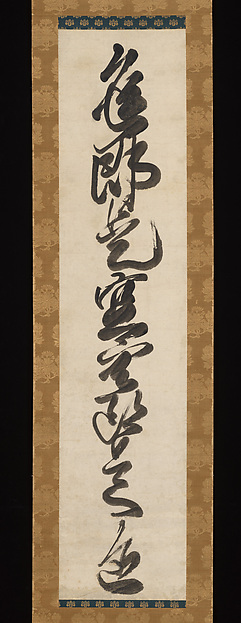
Japan · Momoyama (1573–1615) or Edo (1615–1868) period · early 17th century · Hanging scroll; ink on paper
Look closer: A passage from the Heart Sutra, an early seventeenth-century hanging scroll in ink on paper, in the Met's catalogue. The Sutra is chanted across East Asia in Chinese; the palm-leaf manuscript at Horyu-ji is the Sanskrit side of the same story.
The Metropolitan Museum of Art, New York, Mary and Cheney Cowles Collection, Gift of Mary and Cheney Cowles, 2025, accession 2025.795.6. Public domain, Met Open Access. Museum record
Buddhist texts travelled the Silk Road in a version of the script, and the same article gives a reason for its long life in East Asia: Chinese characters could not write Sanskrit sounds accurately, and for the transmission of tantric texts accuracy was the point.1 There is evidence of its use in Central Asia by the early seventh century, Korea developed forms that differ markedly from the Chinese and Japanese ones, and in India itself Devanagari largely replaced it.1
The oldest Siddham object in Japan's collections may be a book. A palm-leaf manuscript from Horyu-ji, now in the Tokyo National Museum, carries the Sanskrit Heart Sutra and a dharani; the museum dates it to the seventh or eighth century, and Wikipedia calls it the earliest undated extant Sanskrit manuscript of the Heart Sutra.3 The same article records a long scholarly argument that the sutra may have been composed first in Chinese and later rendered into Sanskrit, a view put by Jan Nattier in 1992 and rejected by Harada Waso, Fukui Fumimasa, Ishii Kosei and Siu Sai Yau; Jayarava Attwood, writing in 2021, still finds Nattier's case the most convincing, so the question is open.3
Kukai, Prajna and the Alphabet
The connoisseur's eyeKukai's interest in Sanskrit grew out of a single book. Much of the Mahavairocana Tantra was in untranslated Sanskrit set down in Siddham letters, and the Chinese version was hard to follow; there was no one in Japan to explain it, so he went to China.2 In Chang'an he studied Sanskrit with Prajna, a Gandharan pandit educated at Nalanda who lived from 734 to about 810, and he met Huiguo at the Qinglong Monastery in 805.2 The Siddham article adds that the overland routes to India had by then been closed by the expanding Abbasid Caliphate.1
Kukai returned to Japan in 806 having learned Sanskrit and the Siddham script, and he brought back several texts on the language and the script as well as the esoteric scriptures and paintings.12 In 809 he submitted the Catalogue of Imported Items, an inventory that Wikipedia calls the first attempt to distinguish the new Buddhism from existing Japanese practice.2 In 817, at Takaosan, he wrote three short works on enlightenment in this very existence, on the meaning of sound, word and reality, and on the word hum.2
Two warnings keep the story honest. The first is a legend that Kukai invented the kana syllabary and the Iroha poem; Wikipedia presents it as legend, not as history.2 The second is a gap. In the middle of the ninth century China carried out purges of foreign religions, which cut Japan off from Siddham texts.1
Seed Syllables in Paint
The connoisseur's eyeA seed syllable is called bija in Sanskrit and shuji in Japanese. Bija are mystical syllables that sit inside mantras or stand alone; they have no ordinary linguistic meaning, and may stand for principles, deities, powers or ideas.4 Om is the best known and a is described as the most important seed syllable in Buddhism; hum is the blue syllable of the enlightened mind in Tibetan practice.4
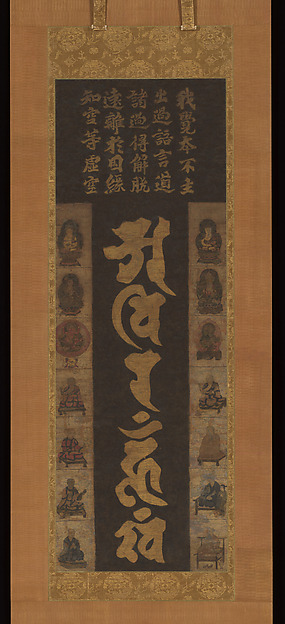
Japan · Kamakura Period (1185–1333) · 13th–14th century · Hanging scroll; ink, colors, and gold on silk
Look closer: The Met calls this a mandala in Sanskrit with Buddhas, bodhisattvas and the eight patriarchs of the Shingon sect, a hanging scroll in ink, colours and gold on silk. The Met's catalogue note for another work says that this scroll uses the same five Womb Realm syllables.
The Metropolitan Museum of Art, New York, Purchase, Sue Cassidy Clark Gift, in memory of Koichi Yanagi, 2024, accession 2024.410. Public domain, Met Open Access. Museum record
Shingon turns that idea into a picture. Mantra, mudra and mandala are the three mysteries it inherits from the Chinese esoteric tradition, and its name is the Japanese reading of the Chinese for true word, which is the word for mantra.5 The article on mantras records that Siddham is used in Shingon to visualise the letter a, and that mantras in Japan may be written in Japanese script or in Siddham.5 The Met's mandala in Sanskrit is one result: a Kamakura hanging scroll that stands the deities up as letters and sets the eight patriarchs of the sect beside them.7

Japan · Muromachi period (1392–1573) · Second half of the 15th century · Hanging scroll; ink and color on paper
Look closer: The Met describes Fudo Myoo with four youthful attendants built from tiny seed syllables in black ink, with the syllables of the sword and the lasso outlined in red. The painter, Chikai, lived from about 1422 to about 1503 and was a Shingon-linked monk known for Fudo images.8 The page does not name the script as Siddham, and neither do we.
The Metropolitan Museum of Art, New York, Mary Griggs Burke Collection, Gift of the Mary and Jackson Burke Foundation, 2015, accession 2015.300.2. Public domain, Met Open Access. Museum record

Japan · Nanbokuchō period (1336–92) · mid- to late 14th century · Hanging scroll; ink and color on silk
Look closer: The Met's title counts eight sacred Sanskrit syllables with Monju Bosatsu, a hanging scroll of the Nanbokucho period in ink and colour on silk. We do not read the syllables for you: the title tells us there are eight, and no more than that.
The Metropolitan Museum of Art, New York, Rogers Fund, 1912, accession 12.134.15. Public domain, Met Open Access. Museum record
Jakugon, Jiun and the Living Hand
The connoisseur's eyeSiddham was copied by hand as an act of devotion long after printing existed. The Met holds a pair of hanging scrolls by Jakugon Taijo, who lived from 1702 to 1771; he was a Shingon monk known for Sanskrit scholarship and for his Chinese calligraphy, and scholars rank him with Jiun Onko and Ryokan Taigu among the three great calligraphers of the Edo-period Buddhist clergy.7 He retired in 1767 and lived until his death at Gyokusen-ji in Kurashiki.7 The scrolls date from about 1767 to 1771; the right-hand one carries a mantra of Dainichi Nyorai in the Diamond Realm, and the left-hand one the five-syllable mantra of the Womb Realm, whose syllables correspond to the five elements and the five wisdoms.7
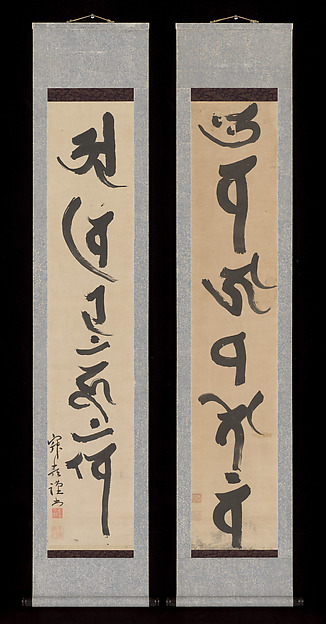
Japan · Edo period (1615–1868) · ca. 1767–71 · Pair of hanging scrolls; ink on paper
Look closer: A pair of hanging scrolls in ink on paper by Jakugon Taijo, ca. 1767 to 1771: the mantras of the Two Realms in Sanskrit script. The Met records the right scroll as the Diamond Realm mantra of Dainichi and the left as the Womb Realm mantra of five syllables.
The Metropolitan Museum of Art, New York, Purchase, Sue Cassidy Clark Gift, 2025, accession 2025.296a, b. Public domain, Met Open Access. Museum record
Jakugon wrote the letters with an East Asian animal-hair brush in the manner called flying white, in which the paper shows through the stroke to suggest energy, and the Met notes that Shingon practitioners used an adapted form of Siddham, bonji, to copy sutras, mantras and dharani.7
Jiun Onko, who lived from 1718 to 1805 and is also honoured as Jiun Sonja, took the other road. A Shingon monk who stressed the monastic rule, he wrote the thousand-volume Bongaku Shinryo, which rejected magical readings of Siddham letters and used Sanskrit grammar to read Buddhist scriptures accurately; the Wikipedia article reports that Sylvain Levi praised the work.6 Myoe, the Kegon monk who lived from 1173 to 1232, had already made mandalas with Japanese calligraphy and Siddham script, although the article flags the date it gives for his description of them as needing verification.9
| Term | Language | What it names |
|---|---|---|
| Bonji | Japanese | The Japanese name for Siddham used in copying mantras and sutras17 |
| Shuji | Japanese | The seed syllable, from the Sanskrit bija4 |
| Bija | Sanskrit | A seed syllable with no ordinary linguistic meaning that may stand for a deity or principle4 |
| Shingon | Japanese | True word, the Japanese reading of the Chinese for mantra5 |
| Bongaku Shinryo | Japanese | Jiun Onko's thousand-volume work on Sanskrit studies6 |
Who Still Writes It
The deep endSiddham was added to Unicode in version 7.0 in June 2014, in the block that runs from U+11580 to U+115FF.1 The Wikipedia article adds that computer fonts still cannot reproduce all the conjuncts, and that the script remains largely handwritten.1
The script is still taught and used in the esoteric schools of Shingon and Tendai and in Shugendo, for writing mantras and copying sutras; formal calligraphy uses a special brush, the bokuhitsu, and informal writing is called fude.1 The Heart Sutra, in Japan the Hannya Shingyo, is chanted in most East Asian schools, and Kobo Daishi wrote a Shingon commentary that treated it as a tantra.3
For a reader looking at an object, the lesson of this chapter is modest. Whether a letter on a scroll is Siddham, whether a syllable names a given deity, and whether a hand is a particular monk's are matters for the object's own record. When the Met says a work is built from seed syllables, we say so; when it does not name the script, we do not name it either.
How a Siddham Letter Is Built
First lookA reader who has learned the outline of the alphabet can tell, even without Sanskrit, what kind of object is in front of them. Siddham has ten vowels, five long and five short, together with two vocalic consonants and two part-vowels, the dotted anusvara and the paired-dot visarga; its consonant table is followed by two conjuncts that are counted with the alphabet as if they were letters of their own.1 Every consonant carries an inherent a, so a bare letter is already a syllable, and a small mark called the virama strips the vowel away.1 The consequence for the eye is that the single most common letter on a Japanese scroll is the plain one: the letter a, which needs no extra stroke at all.14
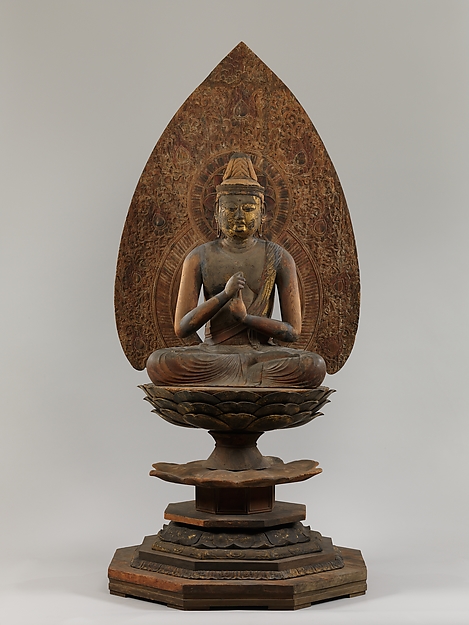
Japan · Heian period (794–1185) · 12th century · Wood with lacquer and gold leaf
Look closer: Dainichi, the Cosmic Buddha, seated on a lotus with the hands held together at the chest, before a flame-shaped mandorla. The letter a is his seed syllable, so the carved figure and the single letter are two ways of naming the same Buddha.14
The Metropolitan Museum of Art, New York, Rogers Fund, 1926, accession 26.118a, b. Public domain, Met Open Access. Museum record
Direction matters when a text mixes languages. Siddham was normally written from left to right and then downward, as other Indic scripts are, and a bilingual manuscript turns the sheet a quarter-turn clockwise for the Japanese gloss, then back again for the Sanskrit.1 The brush matters as well. Formal calligraphy uses a stiff brush called the bokuhitsu, informal writing is called fude, and some texts were written with a bamboo pen, which explains why a good deal of surviving Siddham looks angular beside the rounded strokes of Chinese ink writing.1
A seed syllable is a letter that has been promoted. Wikipedia's article on seed mantras gives the commonest assignments in the Esoteric tradition: a for the unborn and for Mahavairocana, hum for Akshobhya, hrih for compassion, Amitabha and Avalokiteshvara, vam for Mahavairocana in the Diamond World, man for Manjushri, ham for Acala, who is Fudo in Japan, and bhah for Shakyamuni.15 The table below sets out a few of them beside the Japanese names a visitor will meet. The Sanskrit values are those the article reports; the Japanese readings of the same letters sometimes differ, and a catalogue that gives one should say which tradition it follows.
| Seed syllable | Figure it is assigned to | Japanese name | What the letter is said to carry |
|---|---|---|---|
| a | Mahavairocana | Dainichi Nyorai | The unborn; emptiness; the dharma body1415 |
| vam | Mahavairocana in the Diamond World | Dainichi, Kongokai | The voice of the Buddha, from the Sanskrit for speech15 |
| ham | Acala | Fudo Myoo | No gloss given by the source15 |
| man | Manjushri | Monju Bosatsu | No gloss given by the source15 |
| hrih | Amitabha and Avalokiteshvara | Amida; Kannon | Compassion15 |
| hum | Akshobhya | Ashuku Nyorai | Usually closes a mantra15 |
| bhah | Shakyamuni | Shaka Nyorai | No gloss given by the source15 |
The Thirteen Buddhas and Their Letters
The connoisseur's eyeOne of the most useful objects for learning the script is not a text at all. The Met's Mandala of the Thirteen Buddhas is a hanging scroll in ink, colour and gold on silk, dated to the sixteenth or seventeenth century, with thirteen deities stacked in tiers on a gold-brown ground.13 The Met describes five buddhas, seven bodhisattvas and one wisdom king, each the focus of one of thirteen memorial services held in the days, weeks and years after a death, and each worshipped in the Shingon school.13 In practice a Shingon family follows the sequence for a lost relative: the first service falls on the seventh day, and the last on the thirty-second or thirty-third anniversary, depending on how the years are counted.1011
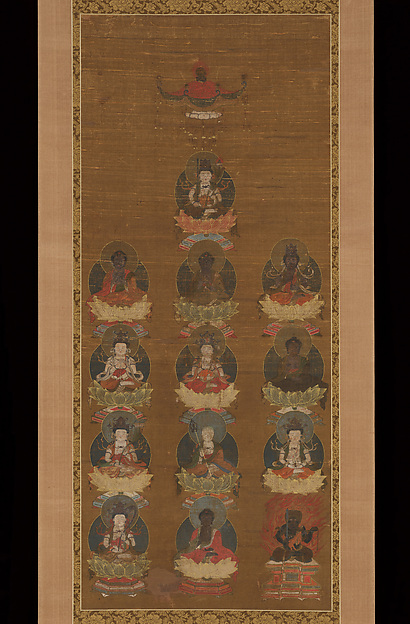
Japan · Muromachi 1392–1573), Momoyama (1573–1615), or Edo (1615–1868) period · 16th or 17th century · Hanging scroll; ink, color, and gold on silk
Look closer: Count the tiers of seated figures on their lotus seats, then look at the lower right, where one dark figure sits among flames: it appears to be the single wrathful figure of the group, which the sequence below gives the first memorial service. The Met does not name the thirteen individually, so read the order from the table, not from the picture.13
The Metropolitan Museum of Art, New York, Gift of Sue Cassidy Clark, in honor of Barbara Brennan Ford, 2021, accession 2021.396.1. Public domain, Met Open Access. Museum record
Each of the thirteen has a seed syllable, and temples and families used the syllables where an image would have been too costly or too large. JAANUS, the Japanese Architecture and Art Net Users System, a standard English-language reference on Japanese art terms, notes that the stone tablets called itabi, which stood by roadsides and graves, either portray the Buddhas or are inscribed with their seed syllables, so a carved Sanskrit letter beside a road or a grave may be the name of one of the thirteen.11 The same entry gives the sequence and the anniversaries.
| No. | Figure | Sanskrit name | Service, Wikipedia count | Service, JAANUS count |
|---|---|---|---|---|
| 1 | Fudo Myoo | Acala | 7th day | 7th day |
| 2 | Shaka Nyorai | Shakyamuni | 14th day | 27th day |
| 3 | Monju Bosatsu | Manjushri | 21st day | 37th day |
| 4 | Fugen Bosatsu | Samantabhadra | 28th day | 47th day |
| 5 | Jizo Bosatsu | Kshitigarbha | 35th day | 57th day |
| 6 | Miroku Bosatsu | Maitreya | 42nd day | 67th day |
| 7 | Yakushi Nyorai | Bhaishajyaguru | 49th day | 77th day |
| 8 | Kannon Bosatsu | Avalokiteshvara | 100th day | 100th day |
| 9 | Seishi Bosatsu | Mahasthamaprapta | 1st anniversary | 1st anniversary |
| 10 | Amida Nyorai | Amitabha | 2nd anniversary | 3rd anniversary |
| 11 | Ashuku Nyorai | Akshobhya | 6th anniversary | 7th anniversary |
| 12 | Dainichi Nyorai | Vairocana | 12th anniversary | 13th anniversary |
| 13 | Kokuzo Bosatsu | Akashagarbha | 32nd anniversary | 33rd anniversary |
The history of the group is a second argument. The Met says the practice emerged in Japan in the fourteenth century and was widespread in the Muromachi period, and relates it to the worship of the Ten Kings of Hell.13 Onmark Productions, a long-running single-author reference site on Japanese Buddhist deities, reports a different emphasis: images of the thirteen appear in Japan in the late twelfth century, but texts that name them do not appear until the Muromachi era, which began in 1392, and the standard grouping was formed about the middle of the fourteenth century and spread in the fifteenth.12 Both agree on the fourteenth and fifteenth centuries for the form we know, and both agree that it grew out of an older sequence of ten kings. Scholars quoted on that page describe a development from ten kings with ten buddhas, to ten kings with eleven, to eleven buddhas with the kings dropped, and finally to thirteen.12
Looking at the Letter A
The connoisseur's eyeThe practice that gathers all this together is Ajikan, the contemplation of the letter a. In the Shingon account, the practitioner visualises a Siddham a on a moon disc. The moon stands for the unborn Buddha nature of every being and for Vairocana, and the letter is his seed.14 The Mahavairocana text itself, the one that sent Kukai to China, is said to call a the essence of all mantras.14 It is a quiet exercise, closer to a long look than to chanting, and for a beginner the main discipline is to keep the eyes slightly open and the breath slow.16

Japan · Edo period (1615–1868) · 19th century · Gold maki-e on black lacquer
Look closer: A single gold Siddham letter, drawn in one flowing stroke on a ground of scattered gold powder, with leaves of gold around it. The Met catalogues it as a portable shrine of Miroku Bosatsu with a sacred Sanskrit syllable: the letter stands for the deity, and the shrine needs no figure. The museum does not say which letter it is, so we do not name it.23
The Metropolitan Museum of Art, New York, The Howard Mansfield Collection, Purchase, Rogers Fund, 1936, accession 36.100.174a, b. Public domain, Met Open Access. Museum record
It is also a practice a traveller can try. At Eko-in, a lodging temple on Mount Koya, guests can take part in a session of about fifteen minutes in the main hall, and visitors from overseas are taught separately in a large room called the Ajikan Dojo, which seats fifty to sixty people.16 A deacon explains the method at the start. The posture is the traditional one, with the right leg crossed over the left, the hands forming a circle before the belly, and cushions for those who cannot cross their legs.16 The writer of the account notes that what hangs before the sitter is a Sanskrit letter set inside a moon, and that it stands for Dainichi, the great sun-like Buddha.16
The Mountain Where Kukai Is Said to Rest
The connoisseur's eyeThree stories surround the man who brought the letters to Japan, and each of them has left an image behind. The first is the story of how the mountain was found. According to the legend recorded in Wikipedia's article on Kukai, when he came to Mount Koya the local deities, Kariba and Niu, welcomed him, and Kariba appeared as a hunter who guided him with a white dog and a black dog.2 The emperor Saga had approved Kukai's request for a mountain retreat in 816, the ground was consecrated in the middle of 819, and the project was not complete until after his death.2

Japan · Muromachi period (1392–1573) · 16th century · Hanging scroll; ink, color and gold on silk
Look closer: At the foot of the steps, a white dog and a black dog. The Met identifies the four seated figures as the main deities of Niutsuhime Shrine at the foot of Mount Koya: Niu and her male counterpart Kariba, the hunter, at the top, with Kehi and Itsukushima below. The dogs are the pair said to have led Kukai to the site, with their master Kariba.17
The Metropolitan Museum of Art, New York, Mary Griggs Burke Collection, Gift of the Mary and Jackson Burke Foundation, 2015, accession 2015.300.15. Public domain, Met Open Access. Museum record
The second story concerns the end. Kukai is believed to remain alive in eternal meditation at Okunoin on Mount Koya until the future Buddha Maitreya arrives, and a tale recorded in the same article says that when the tomb was opened later, the body was found unchanged.2 He died, on the dates the article gives, on 22 April 835, aged sixty-two, and was laid to rest on the eastern peak.2
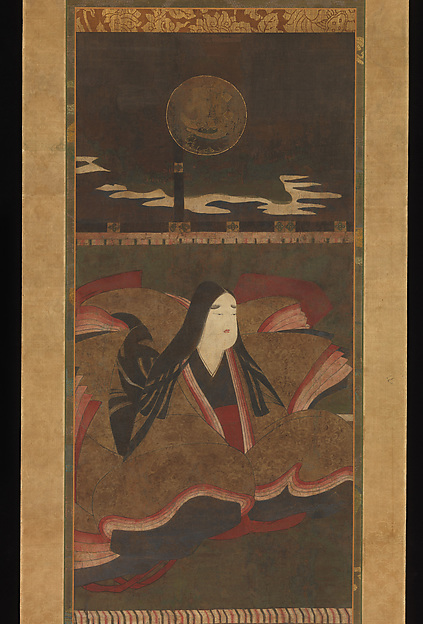
Japan · Kamakura period (1185–1333) · early 14th century · Hanging scroll; ink, color, and gold on silk
Look closer: The mountain's own goddess, Niu Myojin, shown as a court lady in layered robes beneath a full moon, in ink, colour and gold on silk of the early fourteenth century. Her shrine lies at the base of Mount Koya, below the Shingon centre that Kukai founded, so the founder's temple and the local deity share one landscape.17
The Metropolitan Museum of Art, New York, Mary Griggs Burke Collection, Gift of the Mary and Jackson Burke Foundation, 2015, accession 2015.300.14. Public domain, Met Open Access. Museum record
The third story is a tale of manners, the sort of morality tale that gives a legend its warmth. In the article's retelling, a rich man called Emon Saburo drove away a travelling monk, later sought forgiveness, and was reborn with a stone inscribed with his own name.2 The moral is the one the legend of the dogs and the hunter also teaches: the stranger at the door may be more than he seems.
Around the same legend a modern festival has grown. The 1,200th anniversary of the founding of Koyasan was marked in 2015 with a fifty-day service called the Daihoe that ran from 2 April to 21 May, the cypress roofing of the Okunoin mausoleum was refurbished, a gate in the Danjo Garan precinct was rebuilt, and the railway promoted a special ticket for visitors from abroad.20 The same report predicted more than 300,000 visitors.20 We give the figure as a forecast, since the report does not give a final count.
Letters on Slats, Stones and Tools
The connoisseur's eyeWalk through a Japanese cemetery and the Sanskrit is everywhere. The tall wooden slats called sotoba take their name from the Sanskrit for stupa, and are described by Wikipedia as strips of wood divided into five sections, inscribed with sutras and the posthumous name of the dead.18 The five divisions echo the five-part gravestone called the gorinto, which is built of a cube for earth, a sphere for water, a pyramid for fire, a crescent for air and a lotus-shaped finial for the void, and which the same page notes is also called the gorin sotoba.18

Japan · Heian period (794–1185) · 12th century · Gilt bronze
Look closer: A gilt-bronze vajra with three curved prongs at each end, from the twelfth century. Count the prongs, then look at the band of lotus-petal ornament around the central grip: the grip is the part that is held in the hand.22
The Metropolitan Museum of Art, New York, Purchase, Richard and Peggy Danziger, 1987, accession 1987.151. Public domain, Met Open Access. Museum record
A third group of objects belongs to the letters by association. The vajra is the best-known implement of Esoteric ritual, and the Met's twelfth-century three-pronged vajra in gilt bronze is a good example from the century when the written tradition was already established in Japan.22 We do not claim that any particular vajra was used with any particular text; the point is that on a Shingon altar the written letter and the ritual tool belong to one equipment.

Japan · Edo period (1615–1868) · Hanging scroll; ink on paper
Look closer: The Heart Sutra written out in Chinese characters above a small ink landscape of a rock and a flowering branch. It is not Siddham, but it shows the same habit of treating writing as a picture; the sutra is the one whose Sanskrit palm-leaf manuscript survives at Horyu-ji.324
The Metropolitan Museum of Art, New York, Purchase, Friends of Asian Art Gifts, 2009, accession 2009.233. Public domain, Met Open Access. Museum record
Letters of the Same Family in Nepal, Tibet and Korea
The deep endSiddham was never alone. It belongs to a family of Brahmic scripts, and its relatives took root in other Buddhist lands. The closest in time and style is the Ranjana script of Nepal, which Wikipedia reports developed around 1100 CE and lists Siddham among its parent systems.19 It was used by the Newar people from the eleventh century until the middle of the twentieth, and has recently seen a revival, with local governments in the Kathmandu Valley using it on signs and letterheads.19 In Tibet the same script is called Lantsa, a transcription of the Sanskrit for tail or foot, and it was used for Sanskrit texts such as the Diamond Sutra and the Perfection of Wisdom in eight thousand lines, and it appears on Tibetan title pages and prayer wheels.19 The same page gives mantras that are still written in it, among them the mantra of Avalokiteshvara and that of Tara.19
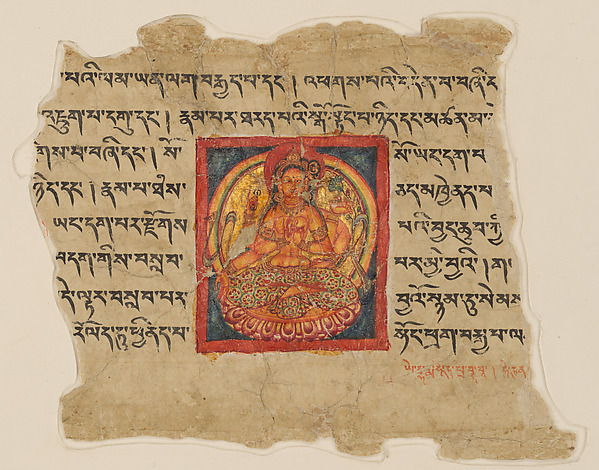
Kashmir or western Tibet · 12th century · Gold, lapis lazuli, cinnabar, indigo, and orpiment pigments and black ink on paper
Look closer: A fragmentary leaf of the twelfth century from an Ashtasahasrika Perfection of Wisdom manuscript, from Kashmir or western Tibet, with a small painted goddess framed by lines of Tibetan script. The Ranjana article lists this very sutra among the texts that were written in Lantsa in Tibet; the leaf shows the sutra in the Tibetan letters used for translation, the third script of this chapter's family of neighbours.1925
The Metropolitan Museum of Art, New York, Gift of Chino Franco Roncoroni, in celebration of the Museum’s 150th Anniversary, 2020, accession 2020.74.2. Public domain, Met Open Access. Museum record
Korea took a different path. Wikipedia notes that special forms of the script were used in Korea that varied markedly from the Chinese and Japanese ones, and that Korean Buddhists still write seed syllables in a modified form.1 In China, the script survived through the Esoteric tradition, and the Taisho Tripitaka, the great modern edition of the Chinese canon, preserves Siddham characters for most of its mantras.1 The mid-ninth-century purge of foreign religions in China cut Japan off from new Siddham texts, which is why the Japanese tradition has a flavour of its own.1
Stories and Fun Facts
First lookSeveral small stories and facts cluster round the script, and each is a good way into the larger subject. Taken together, they show how a writing system became a religious object.
A script with a thesis. A 2012 University of Washington master's thesis by Susan Dine, Sanskrit Beyond Text, traces how Siddham spread across Japanese visual culture from the Heian to the Kamakura period. Its abstract says that the practice began by the ninth century with the import of Esoteric texts and objects bearing Sanskrit, and that later uses stood for ideas that supported the union of Shinto and Buddhism.21
A letter that sat still. The same abstract says the sign's capacity for many meanings is a recurring theme: one Siddham letter might stand for a deity, a doctrine or a sound, depending on where it was drawn.21
A calligrapher bought by a museum. The Met's credit line for the Jakugon scrolls is a purchase of 2025, so a visitor to New York is looking at one of the newest additions to its Japanese calligraphy.7
A script in your pocket. Siddham joined Unicode in version 7.0 in June 2014, in the block U+11580 to U+115FF, and the block is still current in Unicode 17.0.1
The mother of all sutras. A text called the Perfection of Wisdom Mother in One Syllable is described as having the single letter a as its whole teaching.14
- Dates to remember: 806, Kukai returns with the script; 816, the mountain retreat is approved; 835, he enters his last meditation.2
- Numbers to remember: ten basic vowels, thirteen Buddhas, one letter a.110
- A word to remember: bonji, the Japanese name for the script, with fude for informal brushwork and bokuhitsu for the formal brush.1
A Glossary of the Letters
The connoisseur's eyeTerms used in this chapter, with the language each belongs to.
| Term | Language | Meaning |
|---|---|---|
| Siddham, Siddhamatrka | Sanskrit | The script; the name is linked to a word of good wishes written at the head of a document1 |
| Bonji | Japanese | The Japanese name for the script, literally Brahma characters1 |
| Shittan | Japanese | The Japanese reading of the same name as Siddham; also the study of the script1 |
| Xitan | Chinese | The Chinese form of the name1 |
| Bija, shuji | Sanskrit, Japanese | A seed syllable that stands for a deity or principle4 |
| Mantra | Sanskrit | A formula recited or written; in Shingon, the word for true word5 |
| Dharani | Sanskrit | A longer spell or protective formula, as copied beside the Heart Sutra at Horyu-ji3 |
| Ajikan | Japanese | Meditation on the letter a set on a moon disc14 |
| Anusvara, visarga | Sanskrit | The dot and the paired dots that end a syllable with a nasal or a breath1 |
| Bokuhitsu | Japanese | The stiff brush used for formal Siddham1 |
| Itabi | Japanese | A stone tablet, often carved with a Buddha or a seed syllable11 |
| Sotoba | Japanese | A wooden slat with five divisions, from the Sanskrit for stupa18 |
| Gorinto | Japanese | A five-part stone marker for earth, water, fire, air and void18 |
| Lantsa, Ranjana | Tibetan, Newar | Cousin scripts of the same family19 |
A Collector's Eye on Sanskrit Letters
The connoisseur's eyeA collector meeting Siddham for the first time should resist two temptations. The first is to read any strange glyph as a Siddham letter: other scripts, and decorative marks, look similar to an untrained eye. The second is to assume that a letter means a particular deity without the object's own record saying so. The Met's practice is a good model. When a work is catalogued as built from seed syllables, the museum says so, and when its text does not name the script or the figure, the page stays silent.78

Japan · Heian period (794–1185) · 1083 · Handscroll; ink and color on paper
Look closer: A handscroll of ink line drawings dated 1083, the Met's Scroll of Deities of the Diamond World Mandala: deities in roundels, and in the lower middle a row of black Sanskrit letters set beneath a larger central figure. Drawing and letters sit side by side on one sheet, which is how a Shingon painter kept the image and its seed syllables together.26
The Metropolitan Museum of Art, New York, The Harry G. C. Packard Collection of Asian Art, Gift of Harry G. C. Packard, and Purchase, Fletcher, Rogers, Harris Brisbane Dick, and Louis V. Bell Funds, Joseph Pulitzer Bequest, and The Annenberg Fund Inc. Gift, 1975, accession 1975.268.3. Public domain, Met Open Access. Museum record
Three questions help at the bench. Does the letter appear on a carrier that belongs to the school, such as a portable shrine, a hanging scroll in a Shingon format or an itabi? Are the strokes made with the confident, tapering brush that a trained monk would use, or are they traced? And does the object carry a temple or a hand that can be checked? A scroll with a documented hand, such as the Jakugon pair, is easier to place than an undated letter.7
In the house, the shelf of Buddhist statues and sacred art holds Dainichi, Fudo and the esoteric guardians, and the same shelf takes in pieces where a letter replaces the figure. The Japanese terms to search for are bonji, shuji and Shingon; the English terms are seed syllable, Sanskrit character and mantra scroll. We describe a letter only as far as the piece allows.
Objects of Letter and Mantra
The house catalogues Japanese esoteric pieces by deity and form, and the Shingon tags are the nearest the shelves come to this chapter. The strip below fills from the live shelf on the day you read this, and shows nothing if a tag is empty.
A piece of Shingon work may carry a seed syllable on a halo, a base or a scroll. Where our own record does not read a syllable, we say so, in the same spirit as the Met.
Pieces in the house now
- Buddhist Statues and Sacred ArtDainichi, Fudo and the esoteric guardians
Filter by what you have just read
Answered plainly
What is the Siddham script?
An abugida for writing Sanskrit that evolved from Gupta Brahmi in the late 6th century and was in use until about 1200; in Japan it is called bonji.1
Who brought Siddham to Japan?
Kukai, who learned Sanskrit and the script from Prajna in Chang'an and returned in 806 with texts on both.12
What is a seed syllable?
A bija, or shuji in Japanese: a mystical syllable with no ordinary linguistic meaning that may stand for a deity, a power or an idea.4
Why does Shingon write deities as letters?
Because in Shingon the letter is a way to visualise the deity; the mantra article records Siddham being used to visualise the letter a.5
Is the Heart Sutra a Sanskrit text?
A Sanskrit palm-leaf manuscript survives at Horyu-ji, but scholars dispute whether the sutra was first composed in Chinese.3
Can I read Siddham on a scroll myself?
Rarely without training. Jiun Onko wrote a thousand volumes to teach reading by grammar rather than by magic.6
What is Siddham script?
An Indic writing system used for Sanskrit, which evolved from Gupta Brahmi in the late sixth century. In Japan it is called bonji and is still used in the Shingon and Tendai schools and in Shugendo to write mantras and copy sutras.1
Is Siddham the same as Sanskrit?
No. Sanskrit is a language and Siddham is one of the scripts it was written in. In East Asia the script was kept because Chinese characters could not record Sanskrit sounds accurately.1
What does the letter A mean in Shingon?
It is the seed syllable of Mahavairocana, called Dainichi in Japan, and stands for the unborn and for emptiness. Shingon practitioners visualise it on a moon disc in the meditation called Ajikan.14
What is the seed syllable of Fudo Myoo?
Wikipedia's article on seed mantras lists ham for Acala, who is Fudo in Japan. The Met's painting of Fudo with four attendants outlines the whole figure in seed syllables.158
Who brought Siddham to Japan?
Kukai, who returned from China in 806 having studied Sanskrit in Chang'an with the Gandharan scholar Prajna. Earlier Siddham objects exist, such as the Horyu-ji palm-leaf Heart Sutra, which the Tokyo National Museum dates to the seventh or eighth century.123
What are the Thirteen Buddhas?
Thirteen Shingon deities, five buddhas, seven bodhisattvas and one wisdom king, who each preside over one of thirteen memorial services after a death. The services run from the seventh day to the thirty-third year by the Japanese count.101113
Can I try Ajikan meditation in Japan?
At Eko-in on Mount Koya, guests can take part in a session of about fifteen minutes, with English explanation for overseas visitors, according to a recent account.16
Is Siddham in Unicode?
Yes. It was added in Unicode 7.0 in June 2014, in the block U+11580 to U+115FF. Computer fonts still cannot reproduce all the conjuncts, and the script remains largely handwritten.1
Where next
Sources and image credits
- Wikipedia, Siddham script Origin, spread, Japanese use, Unicode.
- Wikipedia, Kukai Sanskrit study, Prajna, 806, 809 and 817.
- Wikipedia, Heart Sutra The Horyu-ji manuscript and the Chinese-origin debate.
- Wikipedia, Bija Seed syllables.
- Wikipedia, Mantra Shingon, true word, the letter a.
- Wikipedia, Jiun Onko Life and the Bongaku Shinryo.
- The Metropolitan Museum of Art, Mantras of the Two Realms in Sanskrit Script Catalogue entry for the Jakugon scrolls.
- The Metropolitan Museum of Art, Fudo Myoo with Four Attendants, Outlined in Seed Syllables Catalogue entry.
- Wikipedia, Myoe Kegon, the Mantra of Light and Siddham mandalas.
- Wikipedia, Thirteen Buddhas The thirteen figures, their Sanskrit names and memorial services; read 28 October 2026.
- JAANUS, jusanbutsu (the Thirteen Buddhas) The alternative schedule, and the note on itabi tablets and seed syllables.
- Onmark Productions, Thirteen Buddhist Deities of Japan Dating of the group, the Ten Kings sequence and the scholars quoted; facts only, no text reused.
- The Metropolitan Museum of Art, Mandala of the Thirteen Buddhas Catalogue entry: five buddhas, seven bodhisattvas, one wisdom king; fourteenth-century origin.
- Wikipedia, A in Buddhism The letter a, Ajikan, emptiness and Kukai.
- Wikipedia, Bijamantra Seed syllable assignments.
- Journal One, Experiencing Ajikan at Ekoin Temple, Koyasan A visitor's account of the session.
- The Metropolitan Museum of Art, The Four Deities of Mount Koya The four deities of Niutsuhime Shrine and the dogs of the Kukai legend.
- Wikipedia, Sotoba The wooden slat, the gorinto and their forms.
- Wikipedia, Ranjana script The Nepalese and Tibetan cousin of Siddham.
- Japan Travel, 1,200th Anniversary at Koyasan The 2015 Daihoe service, restorations and the forecast of visitors.
- Susan Michelle Dine, Sanskrit Beyond Text, University of Washington, 2012 Abstract of a master's thesis on bonji in Japanese mandalas and images.
- The Metropolitan Museum of Art, Three-Pronged Vajra (Sankosho) Catalogue entry: twelfth-century gilt bronze.
- The Metropolitan Museum of Art, Portable Shrine of Miroku Bosatsu with Sacred Sanskrit Syllable and Monju Bosatsu with Eight Sacred Sanskrit Syllables Catalogue entries for the lacquer shrine (36.100.174) and the Monju scroll (object 45596).
- The Metropolitan Museum of Art, Heart Sutra (Hannya Shingyo) and Landscape Catalogue entry.
- The Metropolitan Museum of Art, Fragmentary Leaf from an Ashtasahasrika Prajnaparamita Sutra Catalogue entry: Kashmir or western Tibet, twelfth century.
- The Metropolitan Museum of Art, Scroll of Deities of the Diamond World Mandala Catalogue entry: Heian period handscroll dated 1083.
Last reviewed 28 October 2026. Dates in this chapter follow the cited pages; where the sources disagree, the chapter says so. Every picture is public-domain or openly licensed, and its credit and licence stand beneath it.
If a Shingon scroll or a mantra in Siddham has called to you, the concierge desk can search Japan for it.
Private concierge
Looking for something in particular?
Describe the piece or the project you have in mind. A senior advisor in Tokyo reads every case file personally and replies within two business days, with fees set out in writing before any work begins.