
Mahāyāna and Vajrayāna
Two vehicles · Doctrine
Mahāyāna and Vajrayāna
The Great Vehicle has no founder and no founding day. It surfaces in the record in a trickle of inscriptions and translated scrolls, then spreads across Asia until East Asian Mahayana alone counts about 53 per cent of the world's Buddhists. Its tantric sibling arrived later, and reached Japan in a monk's luggage.2 The sections added here gather the parables that carry the Great Vehicle, the legends of the founders who brought the Diamond Vehicle to Japan, a comparison table, the Heart Sutra and its disputes, regional parallels from Java to Kathmandu, news from the mountains today, a glossary and a collector's eye for objects that carry this doctrine into the home.
Fact sheet
Four ideas to carry in
- An ideal, not a sect. Mahayana began as a way of reading the path, with the bodhisattva who delays release to save others replacing the arhat as the model.1
- Slow and small at first. Inscription evidence suggests it was, in India, an extremely limited minority movement until about the fifth century CE.2
- Emptiness and mind. Two great philosophical schools, Madhyamaka and Yogacara, took shape in India.12
- Ritual as method. Vajrayana adds mantra, mudra and mandala; Shingon in Japan is its direct descendant.35
Setting Out on a Wider Road
First lookThe Great Vehicle enters the record without a founder, a council or a date. What the sources can describe is a change of ideal: the arhat, the saint who attains release, is no longer the highest goal, and the bodhisattva, who vows to remain in the world until every being has crossed over, takes his place.1
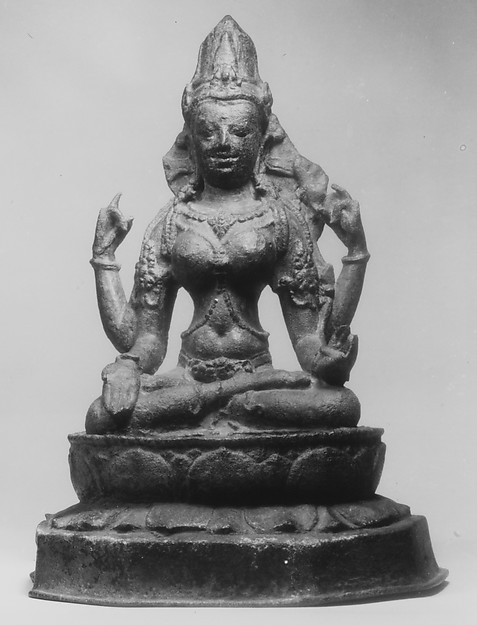
Indonesia · Sailendra style · 9th century · Bronze with traces of lacquer
Look closer: A crowned goddess seated on a lotus throne, in the style the Met labels Sailendra, the dynasty that raised Borobudur. Prajnaparamita, the Perfection of Wisdom, is at once a body of Mahayana texts and, as here, a personified goddess.
The Metropolitan Museum of Art, New York, Gift of Mr. and Mrs. Perry J. Lewis, 1985, accession 1985.395.1. Public domain, Met Open Access. Museum record
That, in outline, is the Mahayana. Britannica dates its rise to India in the first century CE and identifies its defining move as the replacement of the arhat ideal by the bodhisattva ideal.1 The Wikipedia survey adds a caution that matters for a collector: the name itself, Great Vehicle, was probably an honorific for the older Bodhisattva-vehicle, and the movement did not begin as a self-declared school.2
The long history of religion is full of slogans that outrun their evidence, and this is one. The same survey notes that before the fifth century CE the Mahayana in India appears, from the inscriptions, to have been an extremely limited minority movement.2 Its first firm foothold in the written record is outside India: a monk from Gandhara named Lokaksema, active between about 167 and 186, translated its texts in China, and an inscription from Mathura of about 180 CE names the Buddha Amitabha.2
Bodhisattva, Perfection, Emptiness
The connoisseur's eyeBritannica's survey identifies the moving parts. The bodhisattva path is divided into ten stages, with irreversibility attained from the seventh, and the practice is built on perfections such as generosity, morality, patience, vigour, concentration and wisdom.1 The texts that carry the Perfection of Wisdom range from a vast version of 100,000 verses down to the Heart Sutra, the briefest of them.1
Britannica treats the Lotus Sutra as a transitional text and ties its Buddha to the dharmakaya.1 The Avatamsaka is the basis of the Avatamsaka school, known in Japan as Kegon, whose headquarters are at Todai-ji in Nara.110 Alongside them stands the doctrine of three bodies of the Buddha, named nirmanakaya, sambhogakaya and dharmakaya.1
| Idea | Older ideal | Mahāyāna turn | Where it echoes in Japan |
|---|---|---|---|
| The saint | The arhat who attains release1 | The bodhisattva who delays it to save others1 | Kannon, Jizo and Monju in the temple hall |
| The Buddha | A teacher who passed into nirvana | Three bodies: nirmanakaya, sambhogakaya, dharmakaya1 | The Great Buddha of Todai-ji, seat of the Kegon school10 |
| The text | The early discourses | Perfection of Wisdom, Lotus, Avatamsaka1 | Heart Sutra copying, Lotus devotion |
| The practice | Monastic discipline and meditation1 | Ten stages and the perfections1 | The bodhisattva precepts platform on Mount Hiei11 |
The philosophical engine came with Nagarjuna, who Britannica places at about 150 to 250 CE and names the founder of the Madhyamika, the Middle school, with its doctrine of two truths.1 By the fifth and sixth centuries the Madhyamika divided into the Prasangika line, associated with Buddhapalita, Chandrakirti and Shantideva, and the Svatantrika line of Bhavaviveka and Santaraksita.1 The mind-only school, Yogacara, was formulated by the brothers Asanga and Vasubandhu in the Gupta period.2 Both reached China through Silk Road translators, and the great translator Kumarajiva, born at Kucha in 344, rendered about thirty-five sutras into Chinese in roughly a dozen years at Chang'an after 401, among them the Diamond, Lotus and Vimalakirti sutras.8
Scrolls on the Silk Road
The connoisseur's eyeFrom Gandhara, the Mahayana moved along the Silk Road to Central Asia and China.2 By the time it reached Japan, the old Indian vocabulary had passed through Chinese and Korean hands. Britannica gives a precise example: the Korean monk Ekwan, whom the Korean reading calls Hyegwan, brought the Madhyamika to Japan as the Sanron school in 625.19
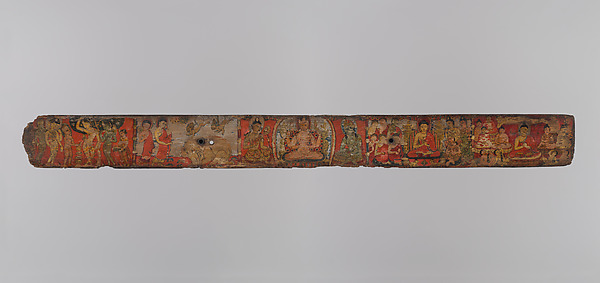
Nepal, Kathmandu Valley · Thakuri-Malla periods · 10th–11th century · Ink and color on wood, with metal insets
Look closer: A long, narrow wooden cover with small painted figures set in a row, and metal inlay at the centre. The Met catalogues it as the cover of an Ashtasahasrika Prajnaparamita, the Perfection of Wisdom in Eight Thousand Lines, from the Kathmandu Valley; the book it protected would have been long and narrow too, a form that came to East Asia in a different shape as the folded scroll.
The Metropolitan Museum of Art, New York, Gift of John and Evelyn Kossak, The Kronos Collections and Mr. and Mrs. Peter Findlay, 1979, accession 1979.511. Public domain, Met Open Access. Museum record
The pattern repeats through this wing: a text arrives, and a monk arrives with it. East Asian Mahayana now accounts for about 53 per cent of the world's Buddhists, according to a 2010 estimate cited in the Wikipedia survey.2
Mantra, Mudra, Mandala
The connoisseur's eyeVajrayana, the Diamond or Thunderbolt Vehicle, emerged in India in the fifth to seventh centuries.3 It goes by several names, Mantrayana, Tantrayana, Zhenyan in Chinese, Mikkyo in Japanese, and its practices are the ones this almanac's Wisdom Kings chapters turn on: mantra, mudra, mandala, deity yoga and initiation.3
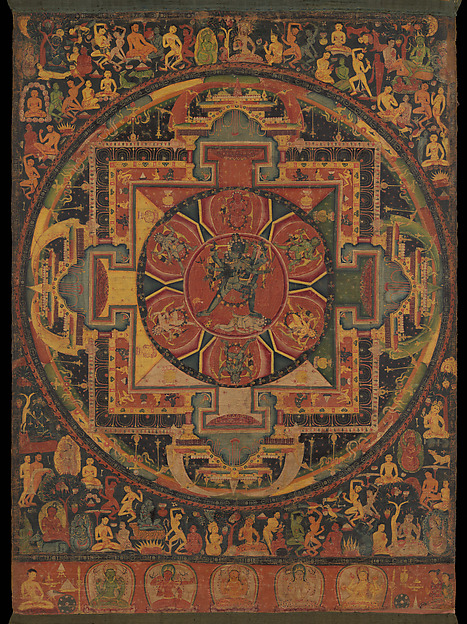
Nepal · Thakuri–early Malla periods · ca. 1100 · Distemper on cloth
Look closer: Start at the middle, where the principal deity is painted, and read outward through the nested squares and circles to the border of small figures. A mandala is read the way a palace is entered: gate by gate, towards the centre.
The Metropolitan Museum of Art, New York, Rogers Fund, 1995, accession 1995.233. Public domain, Met Open Access. Museum record
The vajra, the thunderbolt-diamond, stands for indestructibility and method; the bell stands for wisdom that realises emptiness.3 The Pala kings of Bengal patronised the tradition at Nalanda and Vikramashila, even as they founded rival monasteries.37
Two texts mattered most to East Asia: the Mahavairocana Tantra and the Vajrasekhara Sutra, which became the root of the Zhenyan school in China and the Shingon school in Japan.3
| Name | Where used | What it stresses |
|---|---|---|
| Vajrayana | India, Tibet and Himalayan regions3 | The diamond or thunderbolt as indestructible method3 |
| Mantrayana | Sanskrit usage3 | The recited syllable3 |
| Tantrayana | Sanskrit usage3 | The tantras, the ritual texts3 |
| Zhenyan (真言) | Tang China3 | “True words,” the Chinese rendering of mantra3 |
| Mikkyo (密教) | Japan3 | The hidden or esoteric teaching, treated in the house's Mikkyo chapter |
From Chang'an to Mount Koya
The deep endThe transmission to China is told through a short list of names. Subhakarasimha and Vajrabodhi reached the Tang capital between 716 and 720, and Amoghavajra followed them; together they translated and taught the tantric texts that Kukai would later carry east.3 In Tibet, the eighth century belongs to Padmasambhava and Santaraksita, who stand at the roots of the Nyingma tradition.6
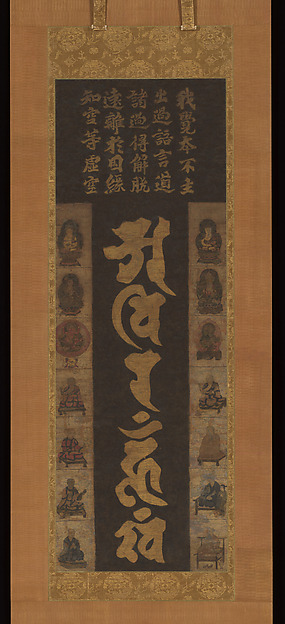
Japan · Kamakura Period (1185–1333) · 13th–14th century · Hanging scroll; ink, colors, and gold on silk
Look closer: Here the centre is not a figure but a column of large Sanskrit letters, flanked by rows of small seated figures. The Met's title names Buddhas, bodhisattvas and the Eight Patriarchs of the Shingon sect, so the lineage from India to Japan is painted into the diagram itself.
The Metropolitan Museum of Art, New York, Purchase, Sue Cassidy Clark Gift, in memory of Koichi Yanagi, 2024, accession 2024.410. Public domain, Met Open Access. Museum record
Kukai, born in 774 on Shikoku, sailed with the embassy of 804 on the same mission as Saicho, studied under Huiguo at Qinglong Temple in 805, and came home in 806 with texts and paintings.4 He founded Shingon, whose Mount Koya retreat the emperor approved, and whose Toji temple came to him in 823.4 The Shingon page of the survey records three mysteries of body, speech and mind, expressed as mudra, mantra and mandala, and the doctrine of becoming Buddha in this very body, which Kukai set out in 817.45
Saicho's Tendai absorbed the same esoteric currents within a fourfold scheme of the perfect teaching, esoteric teaching, meditation and precepts.11 Chapter 10 of this wing follows the schools in detail.
Parables and Pilgrim Stories
First lookMahayana teaching travels in stories, and four of them explain more of what a visitor sees than any summary of doctrine. The longest is the pilgrimage of the youth Sudhana, whose name means Excellent Riches. In the Gandavyuha, the last chapter of the Avatamsaka Sutra, he is sent from teacher to teacher until he has met fifty-three advisors, twenty of them women. Among them are an enlightened courtesan named Vasumitra, a slave, a child, a physician and a ship's captain; the last teacher is the bodhisattva Samantabhadra, who tells him that wisdom exists to be practised and is valuable only so far as it benefits living beings.18 The Wikipedia article dates the text to about 200 to 300 CE. On Java, the Borobudur reliefs of the same story occupy 460 panels, on the third and fourth galleries and about half of the second.16

Central Java, Indonesia, 8th to 9th century
Look closer: The seated figure is half hidden by the diamond-shaped openings of its stupa. Borobudur has 72 such stupas on its upper platforms, each with a Buddha inside, and the article records 504 Buddha statues in all; the pilgrim climbs from the Sudhana reliefs on the lower galleries to this upper silence.16
Photograph: Andrew Otto. CC BY-SA 2.0, with attribution. Source: Wikimedia Commons. CC BY-SA 2.0 File record

The Lotus Sutra supplies three more. In the parable of the burning house (chapter 3), a father lures his children out of a blazing house with promises of toy carts, then gives each one a single great cart; the carts stand for the three vehicles, and the small deception is skilful means.15 In chapter 8 a friend sews a jewel into the robe of a man who has fallen drunk asleep, and the man lives in poverty until he learns that he was rich all along; the hidden jewel is often read as buddha-nature.15
The third Lotus story is the most argued over. In chapter 12 the bodhisattva Manjushri says that the daughter of the dragon king Sagara can become a Buddha; Shariputra objects that a woman cannot; she offers a jewel to the Buddha, changes into a male bodhisattva, and attains Buddhahood. The article reads the episode as showing that everyone, women included, can reach awakening, and it records that Saicho cited it in Japan as evidence of the sutra's 'great direct path'.15 The transformation of the body is itself an old point of debate, and we record both the promise and the condition.
A last story belongs to the twenty-fifth chapter, the Universal Gateway, which describes Avalokiteshvara as the bodhisattva who hears the cries of the world and rescues those who call his name. It is so loved that it is recited on its own, and it is the textual root of the Kannon devotion that fills the Japanese hall.15
Kukai, the Hunter's Dogs and the Sleeping Saint
The connoisseur's eyeKukai (774 to 835) is the most legend-laden figure in Japanese Buddhism, and the legends are worth reading carefully because they show what believers want him to be. The Wikipedia article on his life tells how, when he searched for a temple site, two mountain deities, the male Kariba and the female Niu, welcomed him; Kariba appeared as a hunter and guided him with a white dog and a black dog, and both deities were later read as manifestations of Vairocana.4 The same article records a Shikoku tale, dated by a 1567 inscription, of the wealthiest man on the island, Emon Saburo, who broke a mendicant's bowl, lost his eight sons, and walked the island twenty times in vain before Kukai appeared to grant forgiveness; it is the founding story of the 88-temple Shikoku pilgrimage.4

Wakayama Prefecture, Japan
Look closer: Stone lanterns line the approach to the mausoleum where Kukai is held to be in eternal samadhi. Many carry dedicatory inscriptions; the lanterns are gifts, and each one is a small act of belonging to the saint's company.17
Photograph: lumoplank. CC0. Source: Wikimedia Commons. File record

The deepest legend is that he did not die. By the account in the same article, Kukai entered eternal samadhi on Mount Koya to await Maitreya, the future Buddha, and when his tomb was later opened he seemed to be sleeping, his complexion unchanged and his hair a little longer. Believers hold the view today, and it organises devotion at Okunoin, where the Wikipedia survey of the mountain says his spirit is treated as living and attended daily by priests.417 A Koyasan heritage guide adds that two ritual meals are carried to the mausoleum every day, a custom it dates over twelve hundred years, and that the forest holds over 200,000 monuments, which it links to the belief that those buried near him will rise with him when Maitreya comes.22 We report these as the tradition's claims; the guide is a travel publication, and the figures are not independently verified.

Wakayama Prefecture, Japan
Look closer: The vermilion Great Pagoda stands at the centre of the Garan precinct. The Wikipedia survey gives its height as 48.5 metres and the heritage guide as 45; the difference is a reminder that even a landmark is measured more than one way.1722
Photograph: Adam Jones from Kelowna, BC, Canada. CC BY-SA 2.0, with attribution. Source: Wikimedia Commons. CC BY-SA 2.0 File record

Alongside the legends stands a record of public works that needs no embellishment. In 821 Kukai took on the restoration of the Manno reservoir, which the article calls still the largest irrigation reservoir in Japan. In 828 he opened the Shugei Shuchi-in, a private school open to all ranks, which served free meals and taught Confucianism and Daoism as well as Buddhism, and which closed about ten years after his death. In 823 the retiring Emperor Saga gave him Toji, and a decree allowed fifty monks to train there.4 The saint of the legends and the administrator of the records are the same man, and his reputation as a polymath is the reason he is also credited, without proof, with inventing the kana syllabary.4
Reading the Two Vehicles on One Page
The connoisseur's eyeThe easiest way to hold the chapter's arguments together is to read them across a single table. The columns separate what Mahayana teaches in general from what Vajrayana, and its Japanese branch Shingon, adds. Every cell is drawn from the sources cited in the chapter.
| Question | Mahayana in general | Vajrayana and Shingon |
|---|---|---|
| What is the ideal? | The bodhisattva who delays release to save others1 | Buddhahood in this very body (sokushin jobutsu)5 |
| What is the method? | Ten stages and the perfections1 | Mantra, mudra, mandala, deity yoga and initiation3 |
| Which texts? | Perfection of Wisdom, Lotus, Avatamsaka1 | Mahavairocana and Vajrasekhara sutras35 |
| When did it emerge? | From the 1st century CE, a small minority until about the 5th12 | In India, the 5th to 7th centuries3 |
| Who carried it to Japan? | Hyegwan (Sanron, 625)19, the Nara schools9, Saicho11 | Kukai, who returned from Tang China in 8064 |
| What do you see in the hall? | Kannon, Jizo, Monju, the Great Buddha10 | Dainichi, the Wisdom Kings, mandala scrolls, vajra and bell35 |
| How is it taught? | By sutra study, meditation and devotion1 | By initiation (abhisheka); for laypeople the single rite is Kechien Kanjo, which builds a bond with Mahavairocana5 |
Read down the middle column and the practical consequence is plain. A bodhisattva figure in a Japanese temple is a Mahayana object, and a Wisdom King or a mandala scroll is a Vajrayana object, yet both can stand under one roof, because the Japanese schools did not treat the two as rivals but as stages of a single path. That is the reason Tendai could absorb esoteric ritual within a fourfold scheme and why Shingon could grow beside it.51119
Mount Hiei, Toji and the Two Esoteric Lines
The deep endJapan received esoteric Buddhism along two lines, and they are named for their capitals. Taimitsu, 'Tendai esotericism', belongs to the school Saicho founded in 806 on Mount Hiei, where the monastery of Enryaku-ji stands northeast of Kyoto, a quarter thought auspicious for protecting the city. Tomitsu, 'Toji esotericism', belongs to Kukai's Shingon.19 The Wikipedia article on Tendai makes a point that explains the rivalry: Saicho did not regard the esoteric teaching as higher than the exoteric Tendai teaching, whereas Kukai held that esoteric practice was fully superior, and the two men fell out around 816.19
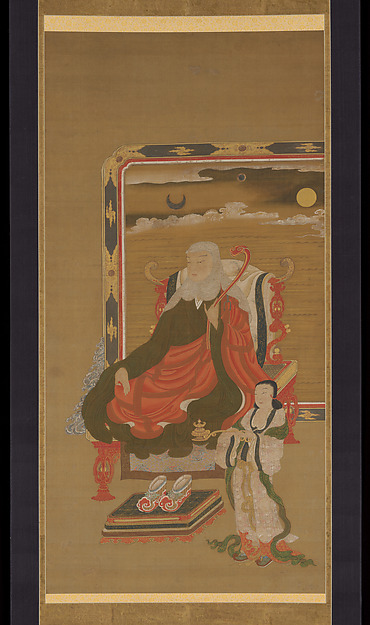
Japan · Edo period (1615–1868) · early 18th century · Hanging scroll; ink, color, and gold on silk
Look closer: Saicho (Dengyo Daishi) is shown as a seated monk, in an eighteenth-century hanging scroll painted in ink, colour and gold on silk. The Met's title gives the posthumous name; compare the face and hands with the portraits of Kukai and Ennin, who stand beside him in the school's lineage.11
The Metropolitan Museum of Art, New York, Mary and Cheney Cowles Collection, Gift of Mary and Cheney Cowles, 2020, accession 2020.396.6. Public domain, Met Open Access. Museum record
Neither mountain stayed small. Nichiren, Honen, Ippen, Shinran, Eisai and Dogen all began as Tendai monks, so that the monastery on Hiei is the common ancestor of Pure Land, Zen and Nichiren Buddhism.19 Hiei was also a power: in 1571 the warlord Oda Nobunaga sacked its headquarters in order to break its political and military strength, and it was rebuilt with the support of Toyotomi Hideyoshi and the Tokugawa shoguns.19 Tendai also kept a strenuous practice, kaihogyo, the 'circling of the mountain', developed from the simple mountain asceticism of Soo (831 to 918), a student of Ennin, and it remains important today.19

Otsu, Shiga Prefecture, Japan
Look closer: This is the central hall of the Tendai headquarters, a National Treasure. Notice how the hall sits low among the cedars; the monastery was designed to be a retreat, not a display.19
Photograph: 663highland. CC BY 2.5, with attribution. Source: Wikimedia Commons. CC BY 2.5 File record

Toji, in the capital, has a different character. Kukai was given charge in 823; in 825 he added a lecture hall designed along Shingon principles, with fourteen Buddha images, and in 826 he began a great pagoda that he did not live to complete. The pagoda that stands today was built in 1644 by Tokugawa Iemitsu.4 The pairing is instructive for the eye: a visitor who sees both mountain and city temple sees the two settings Japanese esotericism was designed for, the retreat and the court.

Kyoto, Japan
Look closer: The pagoda seen across the lotus pond is the Edo-period rebuilding of 1644, not Kukai's own, but it keeps the plan of the temple he made the first esoteric centre in the capital.4
Photograph: Jakub Hałun. CC BY 4.0, with attribution. Source: Wikimedia Commons. CC BY 4.0 File record

The Heart Sutra: Short, Famous and Disputed
The connoisseur's eyeThe Heart Sutra is the shortest of the Perfection of Wisdom texts and, in the words of the Wikipedia article, the single most commonly recited, copied and studied scripture in East Asian Buddhism. Xuanzang's canonical Chinese text has 260 characters, and it contains the line that every visitor to a Japanese temple eventually hears: form is emptiness, emptiness is form.14 Xuanzang translated it after returning to China in 649, and his is the first extant text to carry the title 'Heart Sutra'.14
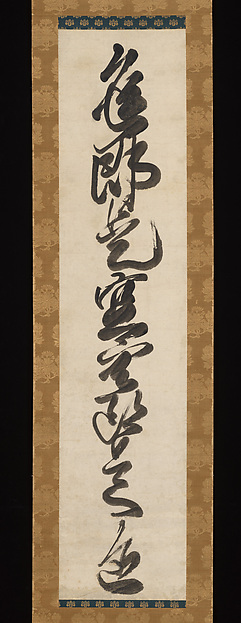
Japan · Momoyama (1573–1615) or Edo (1615–1868) period · early 17th century · Hanging scroll; ink on paper
Look closer: This hanging scroll is a passage from the Heart Sutra written by the Emperor Go-Yozei in the early seventeenth century. Look at how the brush gives each column a different weight; copying the sutra, shakyo, is both a devotion and a calligraphic training.
The Metropolitan Museum of Art, New York, Mary and Cheney Cowles Collection, Gift of Mary and Cheney Cowles, 2025, accession 2025.795.6. Public domain, Met Open Access. Museum record
Its authorship is a live argument. Jan Nattier proposed in 1992 that the text was composed in China, in Chinese, noting that no Sanskrit commentary appears before the eighth century and estimating that about forty per cent of the text quotes Kumarajiva's translation of the Mahaprajnaparamita commentary. Harada Waso, Fukui Fumimasa and others reject the hypothesis, pointing out that Avalokiteshvara and the Perfection of Wisdom were linked in belief from at least the fourth or fifth century. The question remains open.14 The earliest dated copy is a stone stele of 661 at Yunju Temple near Beijing, and the oldest undated Sanskrit manuscript is the palm-leaf at Horyu-ji, which the Tokyo National Museum places in the seventh or eighth century.14
In Japan the sutra has a long afterlife. Kukai wrote a Shingon commentary that treated it as a tantra, and Hakuin wrote a Zen one. The ghost story of Hoichi the Earless, drawn from a text of 1782 and retold in Kwaidan in 1904, uses the sutra as protection.14 In 2011 the Taiwanese temple Foguangshan was reported to have buried one million handwritten copies. In popular culture the sutra has been sung by Faye Wong in a 2009 Mandarin version and heard in the 2019 film Godzilla: King of the Monsters.14
Regional Parallels from Java to Kathmandu
The connoisseur's eyeTo see how particular Japan's esotericism is, it helps to set it beside the other regions that kept the Mahayana and Vajrayana alive. The comparison below gives a feature of each, drawn from the cited pages. Nothing here is a ranking; the point is that the same ideas produced very different buildings, priesthoods and festivals.162021
| Region | Form | A feature worth knowing |
|---|---|---|
| Java, Indonesia | Borobudur, 8th to 9th century, Sailendra dynasty16 | About 2,672 relief panels and 504 Buddha statues; UNESCO World Heritage since 1991; Vesak is a national holiday16 |
| Kathmandu Valley | Newar Buddhism, a Vajrayana tradition with a non-celibate clergy20 | Vajracharya priests; nine Sanskrit sutras, the Navagrantha, include the Perfection of Wisdom in 8,000 lines20 |
| Tibet | Vajrayana established from the 8th century6 | Padmasambhava and Santaraksita are at the roots of the Nyingma school6 |
| China | Zhenyan, the Tang school of the Chinese esoteric tradition3 | Subhakarasimha, Vajrabodhi and Amoghavajra translated the tantric texts that Kukai carried east3 |
| Korea | Chinon and the Jingak Order, both largely based on Shingon5 | A modern revival of the same current under Japanese influence5 |
| Hong Kong, Taiwan, Malaysia | Chinese Shingon lineages, some with Tibetan elements5 | Chinese monks Wang Hongyuan (1876 to 1937) and Chisong trained in Shingon5 |
Borobudur deserves a fuller note because it holds the Gandavyuha in stone. The article gives its date as the ninth century in the introduction and the eighth in the body, with Miksic placing the start at about 760 to 770 and Dumarçay about 780; its base is about 123 metres a side in one place and 118 in another. The Dutch engineer Theodoor van Erp restored it from 1907 to 1911, and a UNESCO project dismantled over a million stones and rebuilt the five square platforms between 1975 and 1982, at a cost of about US$6.9 million. The eruption of Merapi in November 2010 dropped ash up to 2.5 centimetres thick on the statues and required more than 55,000 blocks to be dismantled to restore drainage. The article reports that after vandalism in 2020 access was restricted, and that visitors now go with a guide, in bamboo slippers, for a limited time.16
The scholarly caution on Borobudur is the one this chapter keeps applying to esoteric art generally: the temple is often described as a tantric mandala when seen from above, but some scholars reject the reading because there is no clear evidence that the Sailendra rulers practised Vajrayana, and the traditional three-realm reading of its levels is also questioned by recent work.16
Mountains, Monks and Mantras Today
The connoisseur's eyeThese traditions are not museum matters. Mount Koya is inscribed by UNESCO, since 2004, as part of the Sacred Sites and Pilgrimage Routes in the Kii Mountain Range, and the survey of the mountain counts 120 sub-temples, many of which offer pilgrims lodging, an evening meal and the chance to join the morning services.17 The Danjo Garan, Okunoin, Kongobu-ji, the Hideyoshi-era head temple built in 1593 for his mother, and the stone markers every 109 metres along the Choishi-michi path give a visitor a full day on foot.1722 Koya-dofu, freeze-dried tofu, is credited to the monks, as the guide records, and corporate memorials stand in Okunoin.22
The size of Shingon is stated unevenly. The survey cites an estimate of 1988 that gave about ten million followers, sixteen thousand priests and eleven thousand temples, and notes about eighteen major Shingon schools with their own head temples; it is the figure of one scholar and a generation old, and we treat it as an order of magnitude.5 The same page records overseas temples in Hawaii, Los Angeles, Portland and Seattle and the influence of Shingon on the new religions Shinnyo-en, Agon-shu and Gedatsu-kai.5
Pop culture keeps the vocabulary alive. The 2015 film I Am a Monk centres on a Shingon monk chanting the Heart Sutra, and Lou Harrison's cantata La Koro Sutro sets the same text in Esperanto.14 The Perfection of Wisdom has even been dated by radiocarbon: a damaged Kharoshthi manuscript of the 8,000-line sutra published in 2012 by Harry Falk and Seishi Karashima points to the first or early second century.21
A Glossary of the Two Vehicles
The connoisseur's eyeThe vocabulary of this chapter in the order a reader is likely to meet it. Japanese forms are given where they differ.

Central Tibet · ca. 1500 · Distemper on cloth
Look closer: This Tibetan painting of the protector Mahakala, from about 1500, shows the wrathful form of a Vajrayana deity. Compare its flames and crown of skulls with Fudo Myoo in a Japanese hall: both are wrathful guardians produced by the same tantric logic.
The Metropolitan Museum of Art, New York, Zimmerman Family Collection, Gift of the Zimmerman Family, 2012, accession 2012.444.4. Public domain, Met Open Access. Museum record
| Term | Meaning |
|---|---|
| Arhat | The saint who attains release; the older ideal that the bodhisattva replaces1 |
| Bodhisattva (bosatsu) | One who vows to remain in the world until all beings have crossed over1 |
| Upaya | Skilful means; the teaching adapted to the listener, as in the burning house15 |
| Sunyata | Emptiness; the central idea of the Perfection of Wisdom, voiced in the Heart Sutra14 |
| Prajnaparamita | The Perfection of Wisdom, both a body of texts and a personified goddess121 |
| Dharmakaya | The truth body, one of the Buddha's three bodies with nirmanakaya and sambhogakaya1 |
| Mantra (shingon) | A sacred syllable or formula; Zhenyan in Chinese, shingon in Japanese3 |
| Mudra (in) | A hand gesture; the body mystery of the three mysteries5 |
| Mandala (mandara) | A diagram of the awakened mind; the Womb Realm and Diamond Realm are the pair used in Shingon5 |
| Vajra (kongosho) | The thunderbolt-diamond; indestructibility and method, paired with the bell for wisdom3 |
| Abhisheka (kanjo) | Consecration; the rite that introduces a practitioner to mantra, mudra and mandala5 |
| Sokushin jobutsu | Buddhahood in this very body; Kukai's doctrine of 81745 |
| Ajikan | Meditation on the letter A; an early source is Jitsue (786 to 849)5 |
| Goma | The fire ritual descended from the Vedic homa, usually centred on Fudo Myoo5 |
| Taimitsu and Tomitsu | Esotericism of Tendai and of Toji (Shingon) respectively19 |
| Navagrantha | Nine Sanskrit sutras preserved in Newar Buddhism20 |
| Siddham | The script in which Sanskrit mantras are written in Japan5 |
A Collector's Eye on the Two Vehicles
The connoisseur's eyeObjects that carry these doctrines to the table are of three kinds. The first is the ritual set: the vajra, the bell and the mandala, which the Shingon rite uses together because the vajra stands for indestructibility and method and the bell for wisdom.3 The second is the devotional image: a Kannon, a Jizo or a Monju, which belongs to the Mahayana of the bodhisattva. The third is the written object: a sutra copy, a Heart Sutra scroll, a printed mantra.
A few questions help to place a piece. Does it carry Siddham seed syllables? Mantras in Japan are written in the Siddham script, so such a mark points to esoteric use in a Japanese setting.5 Is the central figure Dainichi or one of the Wisdom Kings? Then the rite is Shingon or Tendai. Does it show a mandala with a central deity and nested squares and circles, read from the gate inwards? The Met's Chakrasamvara mandala from Nepal and the Japanese Sanskrit mandala of the Eight Patriarchs belong to the same family of picture, yet differ in lineage.
Most important of all is honesty about origin. A Tibetan-style or Himalayan-style object found in Japan is a description of manner, not a statement of the maker's country, and the house's page on the ethics of collecting religious objects explains why the catalogue says only what it can support.13 For a first object, a Heart Sutra scroll or a small bell and vajra pair is a modest way to live with the doctrine without claiming more than the object can show.
Himalayan and Esoteric Pieces in the House
Mahayana and Vajrayana are the two doctrines that Japan's collections inherited most visibly: the wisdom kings, the mandala scrolls, the ritual vajra. The house holds Japanese Buddhist art in depth, and a smaller group of Himalayan-style and Tibetan-style pieces found in Japan. The catalogue labels each by its style and the strip below fills from the live shelf on the day you read this.
Where a title reads Tibetan Style or Himalayan Art, the wording is the catalogue's description of manner, not a claim about the maker. The page on the ethics of collecting religious objects explains the house's habit of saying only what it can support.13
Pieces in the house now
- Asian Antiques Found in JapanTibetan, Himalayan, Chinese and Korean pieces
- Buddhist Statues and Sacred ArtWisdom kings, Dainichi and the esoteric hall
Filter by what you have just read
Answered plainly
What does Mahayana mean?
Great Vehicle. The name appears to have begun as an honorific for the older Bodhisattva-vehicle.2
What is the difference between a bodhisattva and an arhat?
In the Mahayana, an arhat attains release for himself, while a bodhisattva vows to remain and help all beings to cross over; the bodhisattva path, with ten stages and the perfections, is the higher ideal.1
Who founded the Mahayana?
Nobody. Its origins are debated, with theories of lay, forest, book-cult and Mahasamghika roots, and in India it appears to have been a small minority until about the fifth century CE.2
What is Vajrayana?
A tantric current that emerged in India between the fifth and seventh centuries, using mantra, mudra, mandala, deity yoga and initiation.3
How is Shingon related to Vajrayana?
Shingon is the Japanese form of the same current. Kukai brought its texts and mandalas from Tang China in 806, and its two root scriptures are the Mahavairocana and the Vajrasekhara.34
Why is a vajra paired with a bell?
The vajra stands for indestructibility and method, and the bell for wisdom that realises emptiness.3
What is the parable of the burning house?
A father lures his children out of a blazing house with promises of toy carts and then gives each a single great cart; the carts stand for the three vehicles and the deception is skilful means. It is in chapter 3 of the Lotus Sutra.15
Is Kukai still alive on Mount Koya?
In the devotion of Shingon, yes: tradition holds that he entered eternal samadhi at Okunoin to await Maitreya, and priests attend his mausoleum daily. Historians record his death in 835.417
What is the difference between Tendai and Shingon esotericism?
Tendai esotericism, Taimitsu, was set within a broader scheme by Saicho, who did not rank it above the exoteric teaching; Shingon esotericism, Tomitsu, was held by Kukai to be fully superior.19
Who wrote the Heart Sutra?
It is disputed. Xuanzang translated the canonical Chinese text in 649, but Jan Nattier argues it was composed in China and others reject that; no consensus exists.14
How many Buddha statues are there at Borobudur?
The Wikipedia article gives 504 original statues, of which 432 sit in niches on the balustrades and 72 inside perforated stupas on the upper platforms. More than 300 are damaged and 43 are missing.16
How many followers does Shingon have?
An estimate of 1988 gave about ten million followers, sixteen thousand priests and eleven thousand temples. It is a single scholar's figure and is now old.5
Can a layperson receive Shingon initiation?
The only ceremony for laypeople is the Kechien Kanjo, which builds a bond with Mahavairocana.5
What is Ajikan?
A Shingon meditation on the letter A. An early source is the Record of Oral Instruction by Jitsue (786 to 849).5
Which Buddhist text is the oldest Perfection of Wisdom manuscript?
A damaged Kharoshthi manuscript of the 8,000-line sutra, published in 2012 by Falk and Karashima, is dated by radiocarbon to the first or early second century.21
Where next
Sources and image credits
- Encyclopaedia Britannica, Buddhism: Mahayana Bodhisattva ideal, ten stages, perfections, Prajnaparamita, Nagarjuna, Madhyamika, Ekwan 625.
- Wikipedia, Mahayana Name, origin theories, Lokaksema, Mathura inscription, Yogacara, 2010 share.
- Wikipedia, Vajrayana Emergence, names, practices, Pala patronage, texts, transmission to China.
- Wikipedia, Kukai Life dates, Tang study, return 806, Koya and Toji.
- Wikipedia, Shingon Buddhism Root sutras, three mysteries, sokushin jobutsu, Koya date.
- Wikipedia, Tibetan Buddhist History Padmasambhava and Santaraksita.
- Wikipedia, Nalanda mahavihara Pala patronage and rival foundations.
- Wikipedia, Kumarajiva Life dates and translation work at Chang'an.
- Wikipedia, Nanto Rokushu Sanron introduced by Hyegwan in 625.
- Wikipedia, Todai-ji Kegon headquarters.
- Wikipedia, Saicho Tendai and the precepts platform.
- Wikipedia, Buddhism in Japan The major Japanese schools.
- Japonista, The ethics of collecting religious objects How the house describes style and provenance.
- Wikipedia, Heart Sutra Characters, translation history, Nattier hypothesis, Horyu-ji manuscript, Japan and modern appearances.
- Wikipedia, Lotus Sutra Kumarajiva translation of 406, the parables, Dragon King's daughter, chapter 25, Tendai and Nichiren use.
- Wikipedia, Borobudur Dates, structure, Gandavyuha panels, restorations, Merapi 2010, visitor limits.
- Wikipedia, Mount Koya UNESCO 2004, 120 sub-temples, Okunoin, Kongobu-ji, Konpon Daito, pilgrim routes.
- Wikipedia, Gandavyuha Sudhana, 53 advisors, 20 women, Maitreya, Manjushri, Samantabhadra.
- Wikipedia, Tendai Saicho 806, Taimitsu and Tomitsu, kaihogyo, Kamakura founders, 1571.
- Wikipedia, Newar Buddhism Vajracharya priests, Navagrantha, festivals.
- Wikipedia, Prajnaparamita Texts and line counts, Kharoshthi manuscript, dating.
- Koyasan heritage guide, 1,200 Years of Esotericism Daily meal offering, Okunoin monuments, 816 founding date; a travel publication, used for tradition only.
Last reviewed 28 October 2026. Dates in this chapter follow the cited pages; where the sources disagree, the chapter says so. Every picture is public-domain or openly licensed, and its credit and licence stand beneath it.
If a mandala scroll, a vajra or a Himalayan-style figure has caught your eye, the concierge desk will search Japan on your behalf.
Private concierge
Looking for something in particular?
Describe the piece or the project you have in mind. A senior advisor in Tokyo reads every case file personally and replies within two business days, with fees set out in writing before any work begins.