
Ikebana Schools and Styles | Japonista
Craft and Ceremony Wing · Way of Flowers
Ikebana Schools and Styles
生け花
In 1462 a Zen monk noted in his diary that the people of Kyoto crowded to see a flower arrangement. It is among the earliest written records of a school that still exists. This chapter follows the forms it began, and the schools that carried them.
Fact sheet
At a glance
- A sacred beginning. Flowers were set upright before Buddhist images and in the Shinto idea of the yorishiro, the object that draws a spirit down.
- Two branches. Formal rikka and casual nageire grew side by side, and most later forms descend from one or the other.
- A Meiji turn. Shallow dishes and Western flowers produced moribana, which could stand in a room without an alcove.
- A twentieth-century break. Sōgetsu declared in 1927 for a new style, and free-form arrangement followed.
A Crowd in Kyoto
On 25 February 1462, by the record of Wikipedia’s article on the Ikenobō school, a Zen monk named Unzen Taigyoku wrote in his journal that Senkei had made an arrangement in a golden vase at the invitation of a patron, and that the refined people of Kyoto vied to see it. The same article treats that entry as the start of some 550 years of recorded ikebana history. It is a small scene, a vase, a crowd and a diarist, and it holds the whole idea of the art: that arranging flowers is a performance with an audience, and that a person can become famous for it.
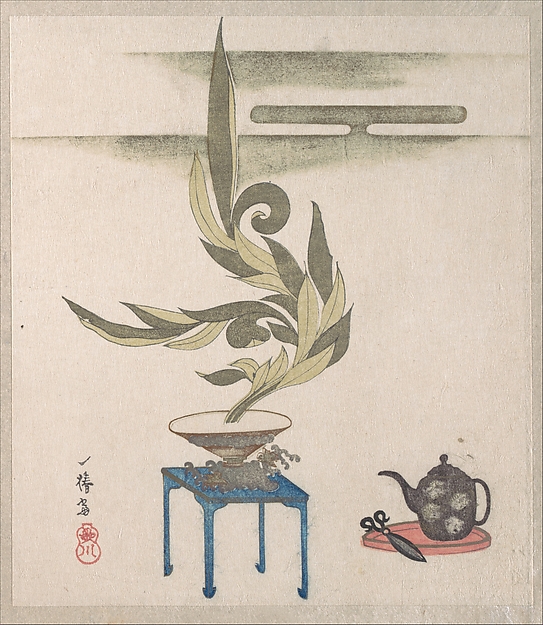
Utagawa Itchinsai · 19th century · Part of an album of woodblock prints (surimono); ink and color on paper
Look closer: the scissors and teapot at the lower right place the arranger’s table in the picture.
Utagawa Itchinsai, Flower Arrangement, 19th century. The Metropolitan Museum of Art, H. O. Havemeyer Collection, Bequest of Mrs. H. O. Havemeyer, 1929 (accession JP2366). Public domain, Met Open Access. Record
Ikebana, written 生け花 or 活け花, means roughly “enlivened flowers” or “arranged flowers”. It is also called kadō, the way of flowers, which places it beside kōdō, the way of incense, and chadō, the way of tea. The three are often named together as the classical arts of refinement. Anyone who studies the tea room will meet the flower sooner or later, because in the tea room the flower sits in the alcove with the scroll.
This chapter is the guide to the forms and the schools. The vessels have their own chapter, Ikebana Containers: Vessels, Baskets and Bronze, and the hub that holds both is The Ikebana Almanac.
Standing Flowers and Spirits
Wikipedia’s article on ikebana traces the practice to the old custom of setting up evergreen trees and decorating them with flowers as a yorishiro, a place where the gods are invited to rest. The coming of Buddhism added a second root, the flowers offered at altars, and the article notes that recent scholarship treats the two beliefs together as the origin of the practice that became ikebana. In Japan the offerings were of native seasonal flowers rather than the lotus of India.

Yoshida Tōgetsu 吉田桃月 · 1822 · Monochrome Woodblock printed books; ink on paper
Yoshida Tōgetsu 吉田桃月, A Book on Flower Arrangement: Hare's-Foot Fern (Shinobugusa) 師廼部供作 (vol. 2); 思乃父魚砂 (vol. 3), 1822. The Metropolitan Museum of Art, The Howard Mansfield Collection, Gift of Howard Mansfield, 1936 (accession JIB96a, b). Public domain, Met Open Access. Record
The first formal arrangement was the tatebana or tatehana, “standing flowers”. It was one of the three ceremonial objects of the Buddhist altar, the mitsugusoku, which also included a lit candle and an incense burner. The article describes the early arrangement as a central main branch with seasonal flowers placed around it, shin at the centre and lower plants beneath, and says such arrangements appear in religious pictures of the fourteenth century as an early attempt to represent natural scenery.
A second change came with architecture. In the Muromachi period (1336 to 1573), says the same article, the shoin style of room gave scrolls and containers a place on display, in the oshiita that preceded the tokonoma and on the staggered shelves beside it. Flowers moved from the altar into the reception room. The patron most often named is the eighth shōgun, Ashikaga Yoshimasa, whose Silver Pavilion in Kyoto is where, the article says, ikebana “received its greatest development” alongside tea and incense appreciation. The painter Sōami, a friend of Yoshimasa, is credited with the idea of heaven, human and earth as the three elements, from which later schools drew their principles.
Treat the founders’ dates in this period with caution. The accounts disagree about when the Ikenobō school begins: one article places its organised founding in the fifteenth century, another traces its roots to the building of the Rokkaku-dō in 587, and a third speaks of the eighth century. The firm point is the diary entry of 1462.
Rikka and the Nine Lines
Rikka is the grand form. Wikipedia’s article calls it a Buddhist expression of the beauty of landscapes in nature, in which pines may stand for endurance and eternity, trees for mountains, and grasses and flowers for water. It was a display art of the military leaders, nobility and priests, set in reception rooms for ceremonial and festive occasions. The same article gives the typical height as between 1.5 and 4.5 metres, and adds that building one takes the highest technical and artistic skill.
The structure is numbered. The Ikenobō article says the arrangement began with seven main parts and later settled into the modern nine: shin, soe, uke, mikoshi, nagashi, doe, hikai, maeoki and shoe-shin, as the article spells them. The accounts vary on when the nine arrived. One says the seven-line form held until about 1700 and the nine-line form from roughly 1800; the Ikenobō article places the standard nine-part form earlier, in the age of Senkō. Both agree that the number grew over time.
Two names matter in the history. Ikenobō Senkō I (about 1536 to 1621) and Senkō II (about 1575 to 1658) are credited in the Ikenobō article with completing the rikka style in the Azuchi-Momoyama period, and paintings of Senkō II’s arrangements survive at several Kyoto temples and at the Tokyo National Museum. The oldest surviving manuscript on ikebana, the Kaō irai no kadensho of 1486, and Ikenobō Senno’s teachings of 1542 belong to the same story. After Senkō II, says the article, rikka became more complex and mannered, and its popularity yielded to shōka.

Rikka, shōka and moribana, schematic outline
Diagram by Japonista. Drawn from the facts cited in this chapter; schematic, not to scale.
Nageire, Chabana and the Rise of Shōka
Beside rikka ran a plainer way. Nageirebana, “thrown-in flowers”, is described in Wikipedia’s article as a casual style that grew up in contrast to the regulated altar arrangement. A late legend, which the article records as a legend, tells of a bored samurai tossing plant material into a tall vase across a hot summer room. The practical description is better: a narrow-mouthed, tall container, often without a pin holder, and a single stem or a few, arranged upright, slanting or cascading below the rim. Several schools, among them Mishō-ryū, Ohara-ryū and Saga Go-ryū, call the same form heika.

Utagawa Toyohiro · Woodblock print; ink and color on paper
Look closer: a flat dish, a few tall leaves and low flowers: the proportion of a shallow-vessel arrangement.
Utagawa Toyohiro, Flower Arrangement of Suisen (Narcissus) in a Flat Green Dish. The Metropolitan Museum of Art, Gift of Estate of Samuel Isham, 1914 (accession JP1008). Public domain, Met Open Access. Record
Tea gave the casual flower its refinement. When the tea ceremony emerged, according to Wikipedia’s article on ikebana, another style arrived for tea rooms: chabana, which stresses rustic simplicity, and which the article describes as separate from ikebana proper. The simplicity of chabana helped create nageire as an art. The article observes that rikka displayed the taste of the Higashiyama years and nageire the taste of the Momoyama.
The townspeople preferred nageire. A merchant named Toichiya Taemon wrote the Nageire kadensho in 1684, and in 1697 Ikenobō Sen’yō published the Kodai shōka zukan, a picture record of earlier shōka. Shōka, “living flowers”, is the formalised descendant of nageire. The Ikenobō article says it began with two principal branches, yin and yang, and developed into three, shin, soe and tai. The Ikebana article gives the same three as ten, chi and jin, heaven, earth and human, in some schools. Shōka was firmly established, it says, in Ikenobō Senjō’s Shōka hyakki of 1820.
Moribana and the Meiji Window
The nineteenth century opened Japan to Western flowers and Western rooms, and an arrangement that could stand in either was needed. The answer was moribana, “piled-up flowers”. Cleveland Museum of Art’s article on the art says Ohara Unshin founded the Ohara school in 1895 and used a round, flat container to bring colourful Western flowers into traditional ikebana. Wikipedia’s account adds that Unshin developed shallow, circular ceramic vessels for the purpose, and that moribana spread quickly to other schools. (One page gives 1912 as the school’s official founding year; the discrepancy is in the published accounts.)

Kubo Shunman · 1798 · Woodblock print (surimono); ink and color on paper
Look closer: the scissors resting at the foot of the arrangement.
Kubo Shunman, Arrangement of Plum, Fukujusō (Adonis Flower), and Scissors, 1798. The Metropolitan Museum of Art, Purchase, Marjorie H. Holden Gift, 2012 (accession 2012.248.31). Public domain, Met Open Access. Record
The method is mechanical and beautiful. In moribana the flowers are set on a kenzan, the many-pointed pin holder, in a shallow dish, in clusters, like water plants. The visible water changes with the season, with more shown at the front in spring and summer. Cleveland’s article describes the Ohara principle as balance through a scalene triangle of three main lines, which Wikipedia’s moribana article names primary, secondary and ornamental. In the upright form as the article describes it, the primary stem is about as long as the container’s diameter and depth together, the secondary about two thirds of that and the ornamental about half. The basic styles are upright, slanting and cascading.
Because it needs no alcove, moribana travelled. It could be set on a table in a Western-style room or an entrance hall, and so the practice left the tokonoma.
Sōgetsu and the Free Form
Sōfū Teshigahara was born in Sakai, Osaka, in 1900, the eldest son of an ikebana artist, and founded the Sōgetsu school in 1927, according to the school’s own history. The record is rich in firsts. He held the first Sōgetsu exhibition in 1928 in a fruit parlour in Ginza. From November 1929 he broadcast a lesson on NHK radio titled “Nageire and Moribana Anyone Can Do”. In 1932 he experimented with an integrated arrangement, using music and lighting.
The school’s history says the first overseas classroom was founded in Tennessee in 1939 after the first foreign instructor returned to the United States, and that from autumn 1946 Sōfū taught ikebana to the wives of Allied Occupation personnel. In 1951 he exhibited plant works covered in plaster or coloured, acclaimed as “Objet Ikebana”. Wikipedia’s ikebana article adds that his son Hiroshi, the film director, made a film titled Ikebana in 1957. The iemoto line, the headmasters, runs Sōfū, then Kasumi from 1979, Hiroshi from 1980 and Akane from 2001, and the school will mark its centenary in 2027.
What Sōgetsu changed was the permission. The Ikebana article says that in the twentieth century, with the advent of modernism, the three classical schools partially gave way to “free style”, jiyūka, in which any material is allowed, non-floral included. Ikenobō answered in its own way: its 45th headmaster Sen’ei introduced shimpūtai, the “new style” of shōka, in 1977, with two main parts, shu and yō, and often a third, ashirai, as a finishing touch. Rikka shimpūtai followed.
The Schools Compared
The table sets the three leading schools beside two others named in the record. Dates are as the accounts give them; where they disagree, the note says so. A glossary compiled by an Ikebana International chapter records that each school names the three principal stems differently: shin, soe and tai in the Ikenobō school; shin, soe and hikae in Sōgetsu; and shu, fuku and kyaku in Ohara. The same triangle, three vocabularies.
| School | Founder and date | Known for | Note |
|---|---|---|---|
| Ikenobō | Kyoto, Rokkaku-dō; organised school from the fifteenth century, by one account | Rikka, shōka, shimpūtai, jiyūka | Oldest school; the only major school without “-ryū” in its name |
| Ohara-ryū | Ohara Unshin, 1895 (official founding 1912 in one account) | Moribana, landscape arrangements, rimpa and bunjin styles | Created the shallow-dish form |
| Sōgetsu-ryū | Teshigahara Sōfū, 1927 | Free-form work, objet ikebana | Centenary in 2027 |
| Mishō-ryū | Ippo Mishōsai (1761 to 1824), Osaka | Kakubana; heika for nageire | Listed in Wikipedia’s survey of schools |
| Saga Go-ryū | Roots traced to Emperor Saga (reigned 809 to 823); founded in the 1930s | Buddhist altar style, shōgonka | Also based in Kyoto |
How to Read a Print of Flowers
Ikebana left a paper trail that collectors can read. Edo woodblock prints show arrangements in their vessels, often on a low stand, with scissors and the tea things beside them. Manuals such as the Mishō-style book of the early twentieth century show the same schools in print. The Metropolitan Museum’s collection, which the print glossary will help you read, holds a print by Suzuki Harunobu, probably of 1765, titled as an arrangement in the Ikenobō style, and surimono of 1798 and about 1805 where the arranger’s scissors sit in the corner of the picture.

Suzuki Harunobu · probably 1765 · Woodblock print; ink and color on paper
Look closer: the container and its low stand are drawn as carefully as the branches; in the print the vessel is part of the composition.
Suzuki Harunobu, Ike Bana (Flower Arrangement) in the Ike-no-bo Style, probably 1765. The Metropolitan Museum of Art, Gift of Estate of Samuel Isham, 1914 (accession JP863). Public domain, Met Open Access. Record
When you meet such a picture, look first at the vessel, then at the proportion of stem to container, then at the stand. The flower is the least stable witness. A moribana dish is wide and shallow; a nageire vessel tall and narrow; a rikka arrangement is built upright on a single axis. Read the vessel and you can usually name the form before you read the label.

Hayakawa Shōkosai I · ca. 1870s–80s · Timber bamboo and rattan
Look closer: the maker’s name is recorded: basketry had its own masters, and a flower arrangement could be judged with its container.
Hayakawa Shōkosai I, Karamono-Style Flower Basket (Hanakago), ca. 1870s–80s. The Metropolitan Museum of Art, Edward C. Moore Collection, Bequest of Edward C. Moore, 1891 (accession 91.1.2068). Public domain, Met Open Access. Record
Legends, Scenes and Succession
Ikebana is old enough to have a founding legend, and the legend is worth telling with the caveats attached. Wikipedia’s article on the art says that, in the Asuka period, the official envoy Ono no Imoko is said to have brought the practice of placing Buddhist flowers on altars from China and to have become a priest at the temple. The Ikenobō article gives the name of the school a gentler origin: ike is the pond in which Prince Shōtoku is said to have bathed, and bō the priest’s hut built nearby. Rokkaku-dō, the temple beside which the school still stands, is said to have been founded by Shōtoku to enshrine Nyoirin Kannon, and “rokkaku” refers to its six-sided plan. Wikipedia’s own text places the school’s origin in different centuries in different passages, which is a reminder that these are traditions, not dated records.
The record becomes firm in 1462, when the monk Unzen Taigyoku noted in his journal, Hekizan Nichiroku, the arrangement that Senkei made in a golden vase. A few decades later the culture of the Silver Pavilion carried ikebana into the heart of Kyoto life. Wikipedia names the eighth shōgun, Ashikaga Yoshimasa (1436 to 1490), as a major patron of both ikebana and tea, and credits his friend the painter Sōami with the idea of the three elements of heaven, human and earth. The arrangement of the flower had become a thing that cultivated people could discuss.

Utagawa Toyohiro · ca. 1805 · One sheet of a triptych(?) of woodblock prints; ink and color on paper
Look closer: two arrangements share the picture: the boat-shaped hanging vase above, and below it a single narcissus rising from a flat dish with its leaves curved like a bow.
Utagawa Toyohiro, A Woman Tying up a Curtain, a Flower Arrangement of Chrysanthemums in a Boat-shaped Hanging Vase, and Narcissus Arranged in a Flower Vase, ca. 1805. The Metropolitan Museum of Art, Gift of Estate of Samuel Isham, 1914 (accession JP1007). Public domain, Met Open Access. Record
Another moment shows the art at ease. A triptych print of 1895 by Hashimoto Chikanobu, from the series Chiyoda Inner Palace, shows ladies of the shogun’s former household taking turns to arrange flowers: one kneels at a low table with her materials while the others sit in their bright robes and wait. The Met titles it Flower Arranging in Turn. The date matters, because by 1895 the shogunate was gone and the Inner Palace had become a memory worth printing. The same year, Ohara Unshin founded the school that would make the shallow dish a standard of modern ikebana.
The twentieth century brings the most dramatic personal story. Teshigahara Sōfū, the founder of Sōgetsu, was the son of an ikebana master and had been taught from childhood, yet he wanted to be a painter. According to Wikipedia he felt that the strict rules of the traditional schools left no room for individual expression, and he broke away. In the beginning he promoted the new school through the radio. The founding year is given as 1927 in one passage and 1926 in another. His daughter Kasumi became the second headmaster and died at forty-seven; her elder brother, the film director Hiroshi Teshigahara, took over, and the present headmaster, Akane, is Sōfū’s granddaughter. Hiroshi had made a film, Ikebana, in 1957.

Hashimoto Chikanobu · August 1895 · Triptych of woodblock prints; ink and color on paper
Look closer: one woman works at the low table at the far left while the rest wait; note the flower in a vase in the alcove behind them.
Hashimoto Chikanobu, Chiyoda Inner Palace: No.20 Flower Arranging in Turn (Chiyoda no Ōoku: Chanoyu mawaribana), August 1895. The Metropolitan Museum of Art, Gift of Mrs. W. Walton Butterworth, 1979 (accession JP3539.1, .2). Public domain, Met Open Access. Record
A smaller story belongs to our own century. After the earthquake and tsunami of 2011, the flower artist Toshiro Kawase, Wikipedia records, posted a daily arrangement under the title “One Day, One Flower”, a use of the art as a quiet daily answer to grief. And in the oldest house, the same article on Ikenobō reports that Yuki Ikenobō, the eldest child of the 45th headmaster Sen’ei, is headmaster-designate and will take the name Senkō IV, breaking the rule that only a son may succeed.

Unidentified artist · early 19th century · Woodblock print (surimono); ink and color on paper
Look closer: the scissors are the tool of the art; the verse above them is a poem for a poetry circle, not a signature.
Unidentified artist, Scissors for Flower Arrangement with a Bag, early 19th century. The Metropolitan Museum of Art, H. O. Havemeyer Collection, Bequest of Mrs. H. O. Havemeyer, 1929 (accession JP2146). Public domain, Met Open Access. Record
Dates from 1462 to 2027
Dates in this list come from the articles cited at the foot of the page. A few are given by Wikipedia in the Japanese era form, which the table converts.
| Year | Event |
|---|---|
| 1462 | Senkei’s golden-vase arrangement noted in Hekizan Nichiroku, the start of recorded ikebana at Ikenobō |
| 1542 | Senno Kuden, a manuscript of Ikenobō Senno |
| 1560 to 1600 | Large rikka arrangements decorate Momoyama castles |
| 1661 | Kawari Kaden Hisho published in Kanbun 1 |
| 1672 | Kokon Rikka-shu, the oldest published work on rikka |
| 1683 | Kokon Rikka-taizen, the most famous rikka manual |
| 1684 | Toichiya Taemon’s Nageire Kadensho |
| 1697 | Ikenobō Sen’yō’s Kodai Shōka Zukan |
| 1781 to 1789 | Tenmei era: nageire rises rapidly in favour |
| 1895 | Ohara Unshin founds the Ohara school; Chikanobu prints the Inner Palace flower-arranging triptych |
| 1927 | Teshigahara Sōfū founds Sōgetsu (one passage of the article says 1926) |
| 1956 | Ikebana International founded |
| 1957 | Hiroshi Teshigahara’s film Ikebana |
| 1977 | Ikenobō Sen’ei, 45th headmaster, develops shimpūtai |
| 2011 | Toshiro Kawase begins “One Day, One Flower” |
| 2027 | Centenary of Sōgetsu |

Katsushika Hokusai · ca. 1799–1810 · Woodblock print (surimono); ink and color on paper
Look closer: the flowers are tucked into a lattice basket and the rolled blind frames them; the tassels trail across the foreground.
Katsushika Hokusai, Basket of Flowers with Bamboo Blind, ca. 1799–1810. The Metropolitan Museum of Art, The Francis Lathrop Collection, Purchase, Frederick C. Hewitt Fund, 1911 (accession JP659). Public domain, Met Open Access. Record
Fun Facts for the Curious
Each item is attributed to the article named at the foot of the page.
- Ikenobō is the only major school without the ending -ryū after its name, because it is regarded as the original school.
- The word ikebana joins ikeru, “to arrange” or “to have life”, with hana, flower. The art is counted with incense (kōdō) and tea (chadō) as one of the three classical Japanese arts of refinement.
- The oldest published ikebana manual is the Sendenshō, from the early Edo period. The most famous manual of rikka, Kokon Rikka-taizen, appeared in 1683.
- The lacquer artist Kōrin is said to have strongly influenced ikebana in the Genroku era, in the late seventeenth century.
- Odd numbers of flowers are considered lucky and even numbers are avoided, and flowers given as gifts are given in bud so that the recipient can watch them open.
- Sōgetsu was one of the first schools to publish English textbooks, and its credo is that the art can be done by anyone, anywhere, at any time, with any kind of material.
- The mother of the actress Marcia Gay Harden, Beverly Harden, practised Sōgetsu and later became president of the Ikebana International chapter in Washington, DC.
- Ikebana International, described by Wikipedia as the oldest international organisation of its kind, was founded in 1956; Princess Takamado is its honorary president.
- The Met holds an iron sword guard of the Edo period cut in the form of a bamboo vase for ikebana with a branch of plum, a reminder that the vessel and the flower were themes in every craft.

ca. 1615–1868 · Iron
Look closer: the bamboo tube is cut as an open silhouette, and the plum branch curls round the central opening.
Sword Guard (Tsuba) Depicting Bamboo Vase for Ikebana and Plum Branch, ca. 1615–1868. The Metropolitan Museum of Art, Edward C. Moore Collection, Bequest of Edward C. Moore, 1891 (accession 91.1.750). Public domain, Met Open Access. Record
Glossary of Terms Used Here
The words below recur in the chapter and in catalogues of vessels and prints.
| Term | Meaning |
|---|---|
| Ikebana | “Enlivened flowers”; the Japanese art of flower arranging, also called kadō, the way of flowers |
| Yorishiro | An evergreen tree decorated with flowers, set up in ancient custom to invite the gods |
| Mitsu-gusoku | The Buddhist offering set of three items, popular in the Kamakura and Nanboku-chō periods |
| Tatebana | “Standing flowers”; the early upright arrangement, also spelt tatehana |
| Rikka | The formal, systematised standing style of the mid-fifteenth century onward |
| Nageire | “Thrown-in flowers”; the casual branch, usually in a tall vase |
| Shōka, seika | The formal style built on the three elements of heaven, human and earth (ten, jin, chi in the source’s wording) |
| Shimpūtai | A modern shōka style developed in 1977 by the 45th Ikenobō headmaster |
| Moribana | “Piled-up flowers”; arrangement in a shallow dish, associated with Ohara |
| Kenzan | The pin-holder that fixes stems in a shallow dish |
| Hanaire | A flower container, for example the bamboo or bronze vessel hung or stood in a tea room |
| Iemoto | The headmaster of a school of an art |

Kōgetsu Sōgan · early 17th century · Bamboo, lacquer, gold
Look closer: the vessel is cut twice, with a window in the upper tube, and it holds a single camellia: a small flower matched to a simple vessel.
Kōgetsu Sōgan, Double-cut (Nijū-giri) Flower Container (Hanaire), named Cool Summer Morning (Shinryō), early 17th century. The Metropolitan Museum of Art, Purchase, Diane and Arthur Abbey Gift, 2019 (accession 2019.571a, b). Public domain, Met Open Access. Record
What Is Showing and Happening Now
Ikebana is in a year of anniversaries. Sōgetsu is preparing to celebrate its centenary in 2027, and the Embassy of Japan in Canada held Celebrating a Century of Sogetsu: The Avant-Garde Spirit in Ottawa on 6 and 7 June 2026, with about 720 visitors and a project, “Ikebana Inspired by the Number 100”, in which visitors helped create one hundred miniature arrangements. The school’s core idea, “anytime, anywhere, by anyone”, was the theme.
In Kyoto the Ikenobō Spring Exhibition ran from 13 to 16 March 2026 in two terms, with about 800 arrangements by students and faculty of the Central Institute of Ikebana, including the headmaster and the headmaster-designate, at the headquarters buildings beside Rokkaku-dō; admission was 1,000 yen. In New York, the Noguchi Museum hosts Noguchi Museum × Ikenobō: 40 Years in New York on Saturday 17 October 2026, from 11 am to 5 pm, a commemorative exhibition of about 45 arrangements by the New York chapter paired with the sculptures of Isamu Noguchi, free with museum admission; the headmaster-designate Senkō Ikenobō travels to New York to present a special arrangement.
Beyond the exhibition hall, the headmaster-designate was reported to be the godmother of the cruise ship Mitsui Ocean Fuji, named at a ceremony in Tokyo Bay in December 2024, and the ship’s owners likened its blend of nature, tradition and culture to the artistry of ikebana. Whether on a ship, in a museum or in a tea room, the art is still travelling.

mid-19th century · Bamboo, rattan
Look closer: the basket is itself a sculpture: a flared bowl on a stem wound with coils and a loop that makes a handle.
Flower Basket (Hanakago) in the Shape of a Flower, mid-19th century. The Metropolitan Museum of Art, Edward C. Moore Collection, Bequest of Edward C. Moore, 1891 (accession 91.1.2120a, b). Public domain, Met Open Access. Record
Flowers on paper

Yagi Unkei 八木雲渓 · 1889 · Ink on paper
Yagi Unkei 八木雲渓, Examples of the Flower Arrangement (Meiji shinsen risshō senkashiki) 明治新撰千花式, 1889. The Metropolitan Museum of Art, The Howard Mansfield Collection, Gift of Howard Mansfield, 1936 (accession JIB119). Public domain, Met Open Access. Record

Mishōsai Kōho · possibly 1931 · Monochrome woodblock printed book
Mishōsai Kōho, Illustrated Book of Floral Arrangements in the Mishō Style, possibly 1931. The Metropolitan Museum of Art, Gift of Lincoln Kirstein, 1960 (accession JIB175a–j). Public domain, Met Open Access. Record
Vessels for the Flower
The vessels that carry these forms, tall bronze usubata, shallow dishes and woven baskets, are gathered on the ikebana shelf. Each piece is described with its dimensions, condition and maker where known.
Answered plainly
What is the oldest school of ikebana?
Ikenobō, based at the Rokkaku-dō temple in Kyoto. Wikipedia’s article calls it the oldest and largest school. The earliest dated record of its master Senkei making an arrangement is the diary entry of 1462.
What is the difference between rikka and nageire?
Rikka is the formal, tall, structured arrangement built from named lines, associated with ceremony and reception rooms. Nageire is the casual form in a tall narrow vessel, arranged with few stems and without a pin holder.
What is moribana?
An arrangement in a shallow dish, held on a kenzan, in which clusters of flowers rise from the visible water. It is associated with Ohara Unshin and is now taught in many schools.
Did Sōgetsu invent free-form ikebana?
The school’s own history credits Sōfū Teshigahara with founding it in 1927 to pursue a new style, and records his experiments from 1932. Jiyūka, the free style, is now taught by other schools too, including Ikenobō.
Why are odd numbers used?
Wikipedia’s article notes that an odd number of flowers is thought lucky and avoids symmetry, which is seldom found in nature.
How many ikebana schools are there?
The sources read for this page give no count and describe the schools only as numerous; the three most often named are Ikenobō, Ohara and Sōgetsu.
What are the three elements of ikebana?
Heaven, human and earth. Wikipedia credits the painter Sōami, a friend of the shōgun Ashikaga Yoshimasa, with the idea, and the formal seika style uses the terms ten, jin, chi.
Who leads Ikenobō now?
Sen’ei Ikenobō is the 45th headmaster. His eldest child, Yuki Ikenobō, is headmaster-designate and will take the name Senkō IV, breaking the rule that only a son may succeed.
What is the oldest ikebana manual?
The Sendenshō, from the early Edo period, according to Wikipedia; the oldest published work on rikka is Kokon Rikka-shu of 1672.
When was Sōgetsu founded?
1927, according to one passage of Wikipedia’s article (another says 1926); the school will mark its centenary in 2027.
Where can I see ikebana now?
In New York on 17 October 2026 at the Noguchi Museum, where Ikenobō’s New York chapter marks 40 years with about 45 arrangements; Kyoto’s Ikenobō headquarters hold seasonal exhibitions, such as the spring exhibition of March 2026.
Why are flowers given in bud?
Wikipedia reports that gift flowers are given in bud so that the recipient can see them open.
Who made the 1957 film Ikebana?
Hiroshi Teshigahara, who later became the third headmaster of Sōgetsu.
Where next
References and image credits
- Ikebana, Wikipedia
- Ikenobō, Wikipedia
- Rikka, Wikipedia
- Nageirebana, Wikipedia
- Moribana, Wikipedia
- Ohara-ryū, Wikipedia
- History of Sōgetsu, Sōgetsu School of Ikebana
- Glossary of Ikebana Terms, Ikebana International Chapter 167
- The Art of Ikebana, Cleveland Museum of Art, 2022
- Sōgetsu-ryū, Wikipedia
- Celebrating a Century of Sogetsu, Embassy of Japan in Canada
- 2026 Ikenobo Spring Exhibition, Ikenobo
- Noguchi Museum x Ikenobo: 40 Years in New York
- Senko Ikenobo is Mitsui Ocean Fuji’s godmother, Seatrade Cruise News
- Metropolitan Museum of Art Open Access: Asian Art collection records (credited beneath each image)
Last reviewed 28 October 2026. Every photograph is public domain or openly licensed and credited beneath it; drawn diagrams are by Japonista.
Looking for a vessel to match a form, or a print of flowers with a documented history? The concierge desk replies within one to three business days.
Private concierge
Looking for something in particular?
Describe the piece or the project you have in mind. A senior advisor in Tokyo reads every case file personally and replies within two business days, with fees set out in writing before any work begins.