
Dainichi in Japan
Halls, Mountains and Carvers
Dainichi in Japan
日本の大日
Where the Great Sun can be visited: a Kyoto hall where twenty-one figures stand as a diagram, a mountain laid out as a lotus, a tomb where monks still carry meals, and the carver whose Dainichi fetched a record price in New York.
Identity card
Know the places at a glance
- The five-storey pagoda. At Tō-ji it stands 54.8 metres high and is described as the tallest wooden tower in Japan (Wikipedia).
- The Lecture Hall. Twenty-one figures stand on a platform as a three-dimensional mandala, with Dainichi at the centre.
- The Konpon Daitō. The vermilion pagoda of the Danjō Garan at Kōyasan, with a Dainichi at the centre of its own mandala.
- The lanterns. Wikipedia counts more than ten thousand in the hall at Okunoin.
- The wisdom fist. The Diamond Realm gesture of the Great Sun, described in the first chapter.
A hall built as a diagram
Tō-ji was founded in 796, two years after the capital moved to Heian-kyō, as a state temple to protect the new city; its partner, Sai-ji, stood on the other side of the Rashōmon gate and has vanished. In 823 Emperor Saga placed Kūkai in charge of it, and it became the first Esoteric Buddhist centre in Kyoto. UNESCO listed the temple in 1994 as part of the Historic Monuments of Ancient Kyoto (Wikipedia, “Tō-ji”).
Its Lecture Hall, Kōdō, stands at the centre of the grounds. Tō-ji’s own page says the original building went up about 835 and that the present hall dates from 1491, after the fire of 1486. The figures inside follow the mandala, as the multilingual database of the Japan Tourism Agency sets out: Dainichi at the centre, the Five Great Buddhas around him on the central platform, the Five Great Bodhisattvas on the east side, the Five Wisdom Kings on the west, the Four Heavenly Kings at the corners, and Bonten and Taishakuten at the two ends. These are the four ranks of this almanac, seen from the inside: Nyorai, Bosatsu, Myōō and Ten. The pair of ninth-century Ryōkai mandala scrolls belonging to the temple is a National Treasure and is not on public display.
Kūkai’s idea was that a believer who walked in front of the figures was standing in the diagram. The Miedō, the Founder’s Hall, stands on the site of his own residence (Wikipedia), where the gltjp.com travel guide says he reportedly conceived the arrangement; a morning ritual there, Shōjinku, begins at six o’clock and anyone may take part.
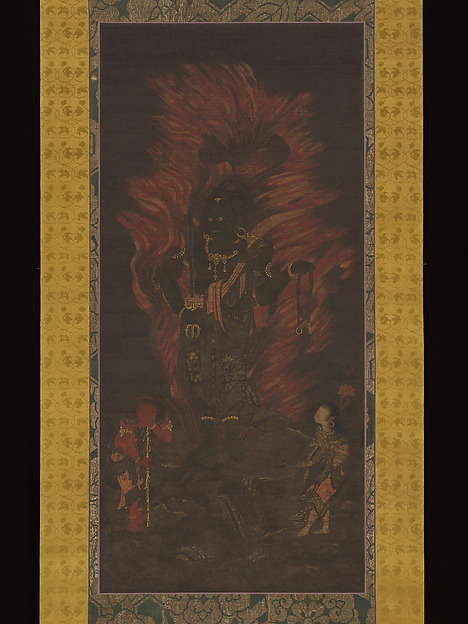
Japan, mid-13th century. Hanging scroll; ink, color and gold on silk; image 76 × 35.2 cm.
Look closer: Look at the sword and the rope in his hands and at the flames of the halo, then at the two small attendants at his feet, one pale and one red. Fudō stands at the centre of the five wisdom kings in the hall, and the Met calls him a wrathful avatar of Dainichi.
The Metropolitan Museum of Art, Mary and Cheney Cowles Collection, Gift of Mary and Cheney Cowles, 2021 (2021.398.7). Public domain, Open Access.
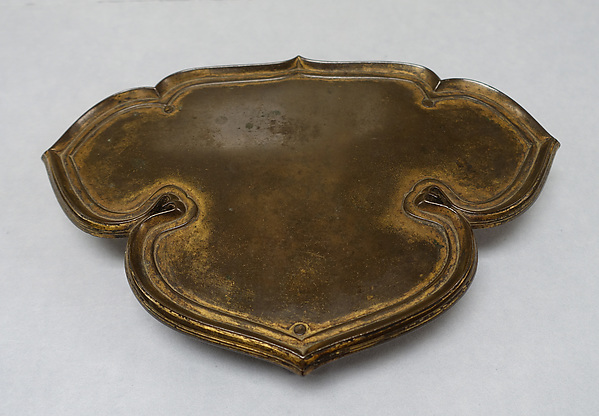
Japan, 13th century. Gilt bronze; height 3.8 cm, width 21 cm, length 28.6 cm.
Look closer: Look at the lobed outline of the tray, which the Met says carried a set of vajra pestles and a bell, and at the three curved feet the Japanese call cat feet. The Met adds that the oldest kongōban in Japan is believed to be the one at Tō-ji, brought by Kūkai from China.
The Metropolitan Museum of Art, The Harry G. C. Packard Collection of Asian Art, Gift of Harry G. C. Packard, and Purchase, Fletcher, Rogers, Harris Brisbane Dick, and Louis V. Bell Funds, Joseph Pulitzer Bequest, and The Annenberg Fund Inc. Gift, 1975 (1975.268.171). Public domain, Open Access.
The pagoda, the market and the treasure hall
The five-storey pagoda stands 54.8 metres high and is described as the tallest wooden tower in Japan. The original was built in the ninth century, and it has been destroyed by fire and rebuilt four times; the present tower dates from the time of Tokugawa Iemitsu and became a National Treasure in 1952 (Wikipedia, “Tō-ji”). It is usually closed; the first floor opens only during special openings in spring and autumn.
On the twenty-first of every month, the day of Kūkai’s death, the grounds fill with the market called Kōbō-san or Kōbō-ichi. Wikipedia says the one on 21 December is the largest. The gltjp.com guide counts more than a thousand stalls and about two hundred thousand visitors a month; Wikipedia gives no figures, and I treat the guide’s as an estimate. The first market of January is called Hatsu-Kōbō. The temple’s treasure hall opens only for special exhibitions, in spring and autumn, and the temple issues nine kinds of goshuin seals, among them one for Dainichi Nyorai.
| Group | Figures and positions | What the group does |
|---|---|---|
| Five Great Buddhas | Dainichi (centre); Ashuku (north-east), Hōshō (south-east), Amida (south-west), Fukūjōju (north-west) | Represent the five fundamental wisdoms |
| Five Great Bodhisattvas | Kongō Haramitta (centre); Kongō Satta (north-east), Kongō Hō (south-east), Kongō Hō (south-west, 金剛法), Kongō Gō (north-west) | Compassionate beings, each paired with one of the five Buddhas |
| Five Great Wisdom Kings | Fudō (centre); Kongō-Yasha (north-east), Gōzanze (south-east), Gundari (south-west), Daiitoku (north-west) | Protect Buddhism by subduing the wicked; each an aspect of one of the five Buddhas |
| Four Heavenly Kings | Tamonten (north-east), Jikokuten (south-east), Zōchōten (south-west), Kōmokuten (north-west) | Guardians of the four directions |
| Two guardians | Bonten (east) and Taishakuten (west) | Protectors of the historical Buddha, derived from Brahma and Indra |
A mountain laid out as a lotus
Kūkai chose the site for his monastic centre with the mandala in mind. Wikipedia says the ground, consecrated in 819, lies on an eight-hundred-metre plain amid eight peaks. Its article on Kūkai adds that he envisioned the area as a representation of the Mandala of the Two Realms, with the central plateau as the Womb Realm, the peaks as lotus petals, and the Diamond Realm temple, Kongōbu-ji, at its centre. He could not stay to build it, and the work was not fully realised until after his death (Wikipedia, “Kūkai”, “Mount Kōya”).
The sacred centre is the Danjō Garan, the training complex laid out when Kūkai founded the mountain. At its heart stands the vermilion Konpon Daitō, the Basic Great Pagoda, which rises 48.5 metres and is said to be the central point of a mandala covering Japan. The present tower is a Shōwa-era rebuilding, and its interior holds a three-dimensional mandala: Dainichi at the centre, with sixteen great bodhisattvas around him (Watabi Koyasan guide). The main gate, the Daimon, is about twenty-five metres high and flanked by Kongō guardians. Kongōbu-ji, the head temple of the Kōyasan Shingon sect, which the Watabi guide describes as the headquarters for some three thousand temples across Japan, was built by Toyotomi Hideyoshi for his late mother; it was first called Seigan-ji and took its present name in the Meiji era. Its Bonryūtei garden is one of Japan’s largest rock gardens.
Wikipedia counts about 120 sub-temples; the Watabi guide counts more than a hundred, of which about fifty give lodging. Visitors stay in shukubo, temple lodgings where, in the Watabi guide’s account, two meals and a bed cost about 12,000 to 30,000 yen a night, the meals are strictly vegetarian shōjin ryōri, and guests may join the morning prayers at about six, sometimes with a goma fire ritual. UNESCO inscribed the mountain in 2004 as part of the Sacred Sites and Pilgrimage Routes in the Kii Mountain Range. The old pilgrim way up the mountain, the Chōishi-michi, has a stone marker every 109 metres.

Japan, 16th century. Hanging scroll; ink, color and gold on silk; image 102 × 49.5 cm.
Look closer: Look at the four figures seated before screens, and then at the small animals at the very bottom: two dogs, one black and one white. The Met says they and their master Kariba are said to have guided Kūkai to the mountain.
The Metropolitan Museum of Art, Mary Griggs Burke Collection, Gift of the Mary and Jackson Burke Foundation, 2015 (2015.300.15). Public domain, Open Access.
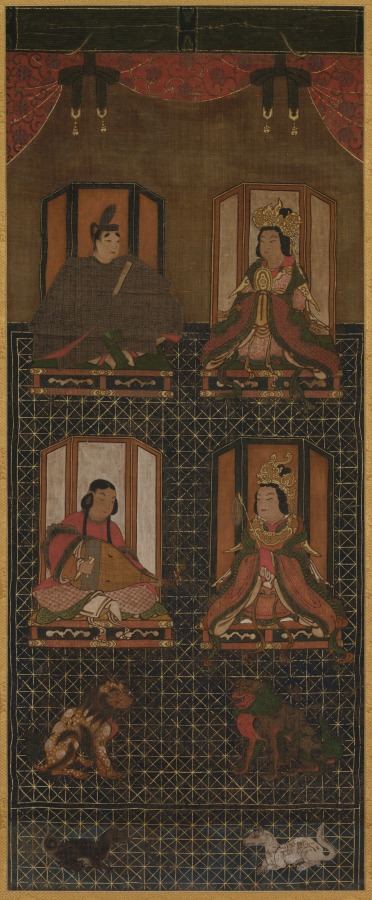
Japan, Muromachi period, 16th century. Hanging scroll.
Look closer: Compare this painting with the Met’s: the same four deities, in nearly the same plan. Cleveland names the lower pair as Kehi Myōjin, a lady with a whisk, and the youthful Miyajima Myōjin, who plays a lute; the Met names the lower left as Itsukushima, a female deity.
Cleveland Museum of Art, Gift of Rosemarie and Leighton Longhi (1999.262). CC0, Open Access.
Okunoin and the meal that is still carried
Beyond the Garan a cobbled path of about two kilometres runs through cedars to Kūkai’s mausoleum. Okunoin is described by Wikipedia as the largest cemetery in Japan, with more than 200,000 graves and monuments. Warlords lie there, among them Oda Nobunaga, Takeda Shingen and Uesugi Kenshin (Watabi guide), and so do the corporate memorials that began when Matsushita Kōnosuke, the founder of Panasonic, built the first in 1938. Wikipedia mentions a memorial to termites killed by an extermination company and a ShinMaywa Industries monument that features a Saturn V model.
The path ends at the Gobyō bridge, where visitors pour water over small bronze Jizō before crossing to the inner sanctum; the Jizō there wear red bibs. Beyond the bridge, the Watabi guide says, photography and eating are not allowed. The Tōrō-dō, the Lantern Hall, stands before the mausoleum. Wikipedia says more than 10,000 lanterns donated by pilgrims burn there, and two of them have burned without pause for more than nine hundred years; a Kōya guesthouse’s page and the Watabi guide say “nearly a thousand”. The mausoleum behind it is closed to the public. Monks carry meals along the path to Kūkai at six in the morning and half past ten (Kōya guesthouse), which is why the believers speak of him as someone at rest, not as someone dead.
A prince in cypress: Unkei’s Dainichi
The most famous Dainichi in the world, among art historians at least, is a small one. Unkei, who lived from about 1150 to 1223, made it for Enjō-ji in Nara. A pedestal inscription, found when the figure was repaired in 1921, records that work began on 24 November 1175 and was completed on 19 October 1176, and that Unkei, who is named as the “true apprentice” of the sculptor Kōkei, received forty-three lengths of silk from Hachijō-jima for it. It is the earliest work attributable to him with certainty (Wikipedia, “Unkei” and “Dainichi Nyorai (Enjō-ji)”).
The statue is carved in the joined-block technique, yosegi-zukuri, from six main blocks of cypress with separately assembled arms, hollowed, lacquered and gilded. The eyes are rock crystal set from inside with bamboo pins, a feature that became a mark of the Kamakura sculpture that followed a decade later. The lips are red, the hair painted blue, and the jewels and crown are of gilt bronze. He sits bare-chested and bejewelled in the wisdom fist of the Diamond Realm, on a six-tier lotus pedestal, with a double halo. Wikipedia describes the style as gentle and tranquil, in contrast to the heavier and more powerful works Unkei made in the early 1180s for eastern Japan and to the giant guardians he led at Tōdai-ji in 1203. The statue was in the pagoda of Enjō-ji; it survived the fire of the Ōnin War, which destroyed the pagoda, and was moved to the main hall, and it returned to the third pagoda, built between 1986 and 1990. It was designated a National Treasure in 1920, redesignated an Important Cultural Property under the 1950 law, and made a National Treasure again in 1993.
The Tokyo National Museum’s 2017 exhibition “Unkei: The Great Master of Buddhist Sculpture” opened on 26 September and ran until 26 November. It began with the Enjō-ji Dainichi, which the museum says Unkei is thought to have made in his mid-twenties, and ended with the seated Daiitoku Myōō at Kyōmyō-in, made in his later years.
A second Dainichi, and a record
In March 2008 a second Dainichi attributed to Unkei appeared in New York. Christie’s described it as a Kamakura figure of the 1190s in cypress, seated in the lotus position in princely dress, with a topknot, crown and jewellery, in the knowledge-fist gesture. It had been unknown: it was believed to have left a temple in the Meiji period, passed into a prominent family’s collection in the northern Kantō, and been sold to a Buddhist art dealer. The owner suspected that it was hollow and consulted a curator at the Tokyo National Museum, where X-rays found three dedicatory objects tied with bronze wire in the torso and sealed for more than eight hundred years: a wooden five-stage pagoda, a crystal ball on a bronze stand and a crystal five-stage pagoda (The Art Wolf).
It was estimated at 1.5 to 2.5 million US dollars and fetched about 14.4 million, a record for Japanese art and for any Asian work sold in New York, replacing a record of 1.76 million set by a Rakuchū Rakugai screen in 1990. The Asahi Shimbun reported on 26 March 2008 that the buyer was the Buddhist group Shinnyo-en, with about 840,000 followers, acting through the Mitsukoshi department store, that the price was 1.4 billion yen, that the figure was 66.1 centimetres tall, and that the group planned to lend it to public museums for research and exhibitions over five years and to build a facility in western Tokyo in which to show it in about ten years.
The sun and the kami
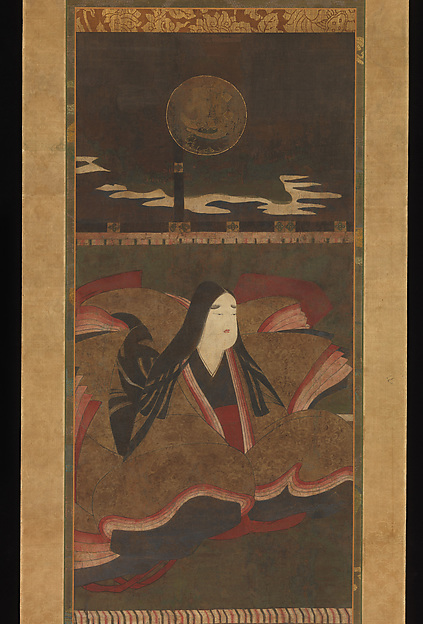
Japan, early 14th century. Hanging scroll; ink, color and gold on silk; image 82.9 × 36.7 cm.
Look closer: Look at the gold disk above her head: it carries a Sanskrit seed syllable, which the Met says stands for her original Buddhist form as Dainichi. Then look at the layers of the robe, spread on the mat like petals.
The Metropolitan Museum of Art, Mary Griggs Burke Collection, Gift of the Mary and Jackson Burke Foundation, 2015 (2015.300.14). Public domain, Open Access.
Under the theory called honji suijaku, “original ground and trace”, Japan’s native kami were seen as local traces of Buddhist deities, and Amaterasu was regarded as a trace of Dainichi (Wikipedia, “Honji suijaku”). The page records that the expression was developed in China, used by Tendai Buddhists to separate an absolute truth from its historical appearance, and that the oldest text in which it appears in this sense is the Eizan Daishiden, believed to date from 825. The first known use of the pairing for buddhas and kami is in the Sandai jitsuroku of 901. By the tenth and eleventh centuries the pairings were common, often arising from a dream or revelation to a famous monk, and around the start of the Kamakura period they were codified in large temples and shrines.
Ryōbu Shintō took the identification furthest, treating buddhas and kami as two sides of one coin. Ryōbu, “two parts”, is the same word as in Ryōbu mandara, the Dual Mandala (Wikipedia, “Diamond Realm”). Its opposite, the inverted theory, gave the kami primacy: it was first fully formulated by Jihen, a monk tied to Ise, about 1340, in the Kuji hongi gengi, and it was developed by the Sengoku-period priest Yoshida Kanetomo into Yoshida Shintō. Wikipedia notes that the theory was never systematised and that different identifications could coexist in one shrine.
On Kōya the honji is plain to see. The Met’s hanging scroll of Niu Myōjin shows the mountain’s female kami in layered robes with the long hair of a court lady, beneath a disk that contains a seed syllable, which represents her original Buddhist form as Dainichi. She is believed to have given Kūkai leave to build his monastery in 816, and the painting is usually paired with one of Kariba Myōjin, the male kami of the mountain. The Cleveland Museum’s painting of the Four Deities adds that Niu and Kariba are described as mother and son, that Niu’s robes are modelled on Tang court dress and Kariba’s on Japanese, and that Hōjō Masako (1157 to 1225), the wife of the first Kamakura shogun, invited the four to Kōya.
A letter, a mantra and a fire

Japan, Heian period, 11th to 12th century. Handscroll; ink on paper; 28.4 × 247.6 cm.
Look closer: Look at the pairs of hands, drawn with a few lines each, and at the two standing figures at the right. The Met says practitioners form these seals in meditation and also use them to read painted and sculpted images. The scroll was kept at the Tendai temple Shōren-in.
The Metropolitan Museum of Art, The Harry G. C. Packard Collection of Asian Art, Gift of Harry G. C. Packard, and Purchase, Fletcher, Rogers, Harris Brisbane Dick, and Louis V. Bell Funds, Joseph Pulitzer Bequest, and The Annenberg Fund Inc. Gift, 1975 (1975.268.1). Public domain, Open Access.
Shingon practice is a practice of the body, voice and mind, and Dainichi is its object at every level. Wikipedia’s Shingon article lists the main forms. Abhiṣeka, or kanjō, is the initiation required for many practices, and the four-fold training for becoming a master, shidokegyō, includes the Juhachidō, Kongōkai, Taizōkai and Goma courses. The goma is the fire ritual, usually centred on Fudō Myōō, who the Met’s catalogue calls a wrathful avatar of Dainichi. Ajikan is meditation on the Siddhaṃ letter A, the seed syllable of Vairocana; Jitsue’s record is the earliest source, and more than a hundred manuals were written later. Gachirinkan is a visualisation of the full moon, and Gojigonjingan a visualisation of the five elements in the body.
The five elements are a point at which Dainichi enters the body. Shingon teaches six great elements, earth, water, fire, wind, space and consciousness, interfused in harmony, and Wikipedia’s Vairocana article says he is the sixth element, consciousness, added to the other five. The Shingon five-element mantra is a vi ra hūṃ khaṃ.
The best-known Dainichi mantra in Japan is the Mantra of Light, kōmyō shingon. The Vairocana article says it was introduced to Japan by Kūkai in the ninth century, popularised by Myōe in the thirteenth and promoted by Eison and Ninshō, and that it is used in dosha kaji, the sprinkling of blessed sand on the dead. Its place in the memorial cycle is the other side of the same idea: in the sequence of the Thirteen Buddhas, Dainichi presides over the twelfth anniversary of a death, the twelfth of the thirteen rites.
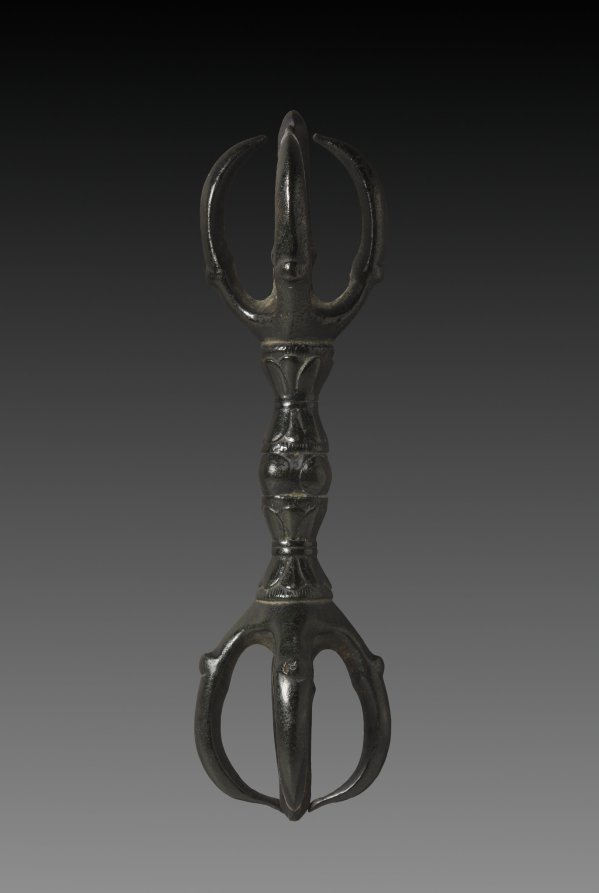
Japan, Heian period, 10th century. Bronze.
Look closer: Look at the two clusters of five curved prongs, which close at both tips around the central point. Cleveland explains that the number of prongs matters: single, three and five-pronged vajras are used for different purposes, and “vajra” means both diamond and thunderbolt.
Cleveland Museum of Art, Gift of Dr. and Mrs. Sherman E. Lee (1954.785). CC0, Open Access.
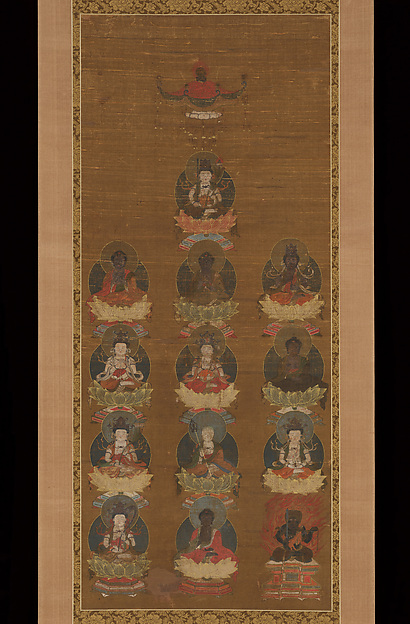
Japan, 16th or 17th century. Hanging scroll; ink, color and gold on silk; image 94 × 40 cm.
Look closer: This is the memorial sequence painted as one picture: thirteen figures, one for each rite, with one at the head and four rows of three below. Find the dark figure seated in red flames at the lower right, the usual way of painting a wisdom king. Then look at the small red figure at the very top, floating apart from the rows.
The Metropolitan Museum of Art, Gift of Sue Cassidy Clark, in honor of Barbara Brennan Ford, 2021 (2021.396.1). Public domain, Open Access.
A record price, an autumn exhibition and lit nights
The 2008 sale of the second Unkei Dainichi, described above, was the largest public event the figure has had in the last two decades, and the Tokyo National Museum’s Unkei exhibition of 2017 returned attention to the Enjō-ji original. Since then the news has been slower and more seasonal.
The Kōyasan Reihokan, the mountain’s museum, held its 2025 autumn special exhibition, “Koyasan Okunoin: The Origin and Spread of the Faith in Kōbō Daishi”, from 11 October 2025 to 12 January 2026, in two periods. It linked the mountain to the world of the Ryōkai mandala, centred on Dainichi, and combined belief in Miroku with belief in Amida; it concentrated on the ossuary faith that lies at the root of those practices and traced how it developed. Objects in the list included a gilt-bronze treasure-box pagoda said to hold the remains of Nanbō Matajirō, a complete sutra written in gold on dark blue paper, standing figures of Bishamonten and Fudō, finds from excavations at Okunoin, and a brocade-style statue of Kōbō Daishi.
At Tō-ji, Leaf Kyoto’s page records, the autumn special exhibition of the treasure hall ran from 20 September to 25 November 2025, and the autumn night illumination from 1 November to 14 December 2025. The gltjp.com guide gives the spring night opening for 2026 as 14 March to 12 April and the autumn illumination as 31 October to 13 December 2026, from six to half past nine in the evening, with the Kondō and Kōdō open in the evening. As this page is reviewed, the autumn illumination is two days away.
At Okunoin a Kōya guesthouse’s page, which is marketing and not an official notice, reports that guidance on dress takes effect in April 2026: no tank tops, off-shoulder tops, short skirts or short shorts, and temple staff may ask visitors to cover up. It also notes that drones are forbidden in the whole of the World Heritage area, and that a guided night walk, certified by Kongōbu-ji, runs from seven to half past eight in the evening. Check with the temple before travelling.
| When | What | Where | Source |
|---|---|---|---|
| 18 to 20 March 2008 | A Dainichi attributed to Unkei sold for about 14.4 million dollars | Christie’s, New York | The Art Wolf; Wikipedia |
| 26 Sep to 26 Nov 2017 | Unkei: The Great Master of Buddhist Sculpture, beginning with the Enjō-ji Dainichi | Tokyo National Museum | Tokyo National Research Institute for Cultural Properties |
| 20 Sep to 25 Nov 2025 | Autumn special exhibition, Treasure Hall | Tō-ji, Kyoto | Leaf Kyoto |
| 11 Oct 2025 to 12 Jan 2026 | Koyasan Okunoin: The Origin and Spread of the Faith in Kōbō Daishi | Kōyasan Reihokan | Kōyasan Reihokan |
| 31 Oct to 13 Dec 2026 | Autumn night illumination | Tō-ji, Kyoto | gltjp.com |
| From April 2026 | Dress guidance at Okunoin, reported by a guesthouse | Kōyasan | Koyasan Guest House |
The sun in games, novels and woodblock

Japan, Edo period, late 1760s. Colour woodblock print.
Look closer: Look at the small inset panel at the upper left, with its text and tiny picture, and then at the woman below it. The title ties the scene to Kūkai at Mount Kōya, and the print belongs to a series on the six Tama rivers in everyday life.
Cleveland Museum of Art, Gift from J. H. Wade (1920.156). CC0, Open Access.
Dainichi has had less of the screen than Jizō or Kannon, and what exists is mixed up with an older namesake. In the Shin Megami Tensei series, as the fan encyclopedia Megaten Wiki records, he is a demon: in the original CD-ROM version of the first game he can be obtained only by fusing Missionary, Amaterasu and Crusader, in the second he presides over a Buddhist temple in the region called Chesed and attacks players whose alignment is neutral or lawful, and in a Persona 2 compendium entry he is described as a Hindu sun god and king of the asuras. That last description is the confusion Wikipedia and JAANUS both warn about.
Wikipedia’s Vairocana article records that the Jesuit Francis Xavier first used “Dainichi” to translate the word for God and then abandoned it in favour of “Deusu”. The Mahāvairocana article notes that a 2010 novel by the Chinese writer Xu Haofeng, Da ri tan cheng, takes its title from the sutra.
Among the older arts is a woodblock print by Utagawa Hiroshige of the late 1840s or early 1850s, titled Otake Dainichi Nyorai no den, held by the Náprstek Museum and recorded in the Cultural Japan database; I read the record’s title and date only and do not describe the story. The Cleveland Museum’s tall pillar print, catalogued as The Priest Kukai by the Tama River at Mt. Koya from a series on the six Tama rivers, shows the founder reaching the popular print by the late 1760s.
What the sources count
Each figure below is given in the source named in the last column. They are not all of one kind: some are counts, some are dates, and some are claims by a temple or a writer.
| Figure | Number | Source |
|---|---|---|
| Statues in the Tō-ji Lecture Hall | 21: five Buddhas, five bodhisattvas, five wisdom kings, four heavenly kings and two guardians | Japan Tourism Agency database |
| Original figures in the hall, and replacements | 15 original, 6 replacing the loss of 1486 | Japan Tourism Agency database |
| Height of the Tō-ji pagoda | 54.8 metres | Wikipedia |
| Height of the Konpon Daitō | 48.5 metres | Wikipedia, Mount Kōya |
| Sub-temples on Kōya | about 120 | Wikipedia, Mount Kōya |
| Graves and monuments at Okunoin | more than 200,000 | Wikipedia, Okunoin |
| Lanterns in the Tōrō-dō | more than 10,000 | Wikipedia, Okunoin |
| Statues given at Okunoin in 1984 | 50,000, for the 1150th anniversary of the burial | Wikipedia, Okunoin |
| Deities in the two mandalas | up to 414 | Wikipedia, Diamond Realm |
| Unkei’s fee for the Enjō-ji Dainichi | 43 lengths of Hachijō silk | Wikipedia, Dainichi Nyorai (Enjō-ji) |
| The Christie’s Dainichi | 66.1 cm; about 1.4 billion yen | The Asahi Shimbun, via World Religion News |
| Followers of Shinnyo-en, the buyer | about 840,000 | The Asahi Shimbun, via World Religion News |
| Shingon followers, priests and temples (1988 estimate) | about 10 million, 16,000 and 11,000 | Wikipedia, Shingon Buddhism |
| Spring Temple Buddha, Henan | 128 m, or 153 m with the pedestal | Wikipedia, Spring Temple Buddha |
Small facts worth the detour
- The oldest kongōban, the three-footed stand for ritual implements, is believed to be the one at Tō-ji that Kūkai brought from China in the ninth century (The Met).
- Unkei was paid forty-three lengths of silk from Hachijō-jima for the Enjō-ji Dainichi, and the inscription naming him as Kōkei’s “true apprentice” was found only when the figure was repaired in 1921 (Wikipedia).
- The Christie’s Dainichi had been sealed with a wooden pagoda, a crystal pagoda and a crystal ball for more than eight hundred years, and an X-ray at the Tokyo National Museum showed them tied together with bronze wire (The Art Wolf).
- In Tō-ji’s Lecture Hall Bonten stands on the east and Taishakuten on the west, the reverse of the usual arrangement (Japan Tourism Agency database).
Monuments to the great sun
Vairocana appears across Asia in the largest images ever made, and in some of the smallest. The rows below record the forms and monuments given in the sources I read. The Spring Temple Buddha shows how much a figure depends on how it is measured: Wikipedia gives 128 metres for the statue, 153 metres with the pedestal, and a later figure of 208 metres after the hill was reshaped, and it also notes that the page’s identification of the figure as Vairocana lacks a citation.
| Where | Form and name | What the record shows |
|---|---|---|
| Java | Vairocana at Mendut | A temple of the early ninth century near Borobudur, credited to the Shailendra dynasty, holds a Vairocana about three metres tall flanked by Avalokiteśvara and Vajrapāṇi, the three said to free devotees from the karma of body, speech and thought (Wikipedia, Mendut). Restoration ran from 1897 to 1925. |
| Japan | Dainichi Nyorai; Birushana | The Daibutsu at Tōdai-ji is described as the largest bronze image of Vairocana in the world; see the Birushana chapter. |
| China | Lushan Dafo (Spring Temple Buddha) | The Spring Temple Buddha in Lushan County, Henan, completed on 29 September 2008; Wikipedia gives 128 metres for the statue, 153 with its pedestal and 208 with the reshaped hill, and notes that the identification as Vairocana lacks a citation there. |
The sun among the Buddhas
Among the Nyorai Dainichi is the central deity of Esoteric Buddhism, where, JAANUS says, he replaces Shaka as the one who expounds the teaching. In the Thirteen Buddhas he presides over the twelfth anniversary of a death. The five Buddhas on his crown are the key to the structure: in the Diamond Realm they are Dainichi himself with Ashuku, Hōshō, Amida and Fukūjōju. The Met’s catalogue calls Fudō Myōō his wrathful avatar, and the wisdom kings of the Lecture Hall stand to his west, each an aspect of one of the five Buddhas.
| Memorial occasion | Figure | Role |
|---|---|---|
| 2nd anniversary | Amida Nyorai | The Western Pure Land |
| 6th anniversary | Ashuku Nyorai | The sixth-anniversary Buddha |
| 12th anniversary | Dainichi Nyorai | The Great Sun, centre of the two mandalas |
| 32nd anniversary | Kokūzō Bosatsu | The last of the thirteen |
Where to see him
| Place | What to look for |
|---|---|
| Tō-ji Lecture Hall, Kyoto | The central Dainichi, rebuilt in 1497, among twenty-one figures arranged as a three-dimensional mandala; open daily 8:00 to 17:00, with the Treasure Hall open only for spring and autumn exhibitions. |
| Kōyasan, Wakayama | The Konpon Daitō, 48.5 metres tall, with a Dainichi at the centre of its three-dimensional mandala, and Okunoin, Kūkai’s mausoleum; UNESCO listed the mountain in 2004. |
| Enjō-ji, Nara | The Dainichi Unkei made in 1176, his first work that can be attributed to him with certainty, in the third pagoda built between 1986 and 1990. |
| Jingo-ji, Kyoto | Kūkai’s base from 809 and the temple of the Takao Mandala, a faithful copy of the lost root mandala; the temple holds sixteen National Treasures (Wikipedia). |
| Tōdai-ji, Nara | The Daibutsu, the largest bronze image of Vairocana in the world; see the Birushana chapter. |
| Metropolitan Museum of Art, New York | A twelfth-century wooden Dainichi, a 1083 scroll of Diamond World deities, and a Thirteen Buddhas mandala, all in the public domain. |
A small bronze from Java
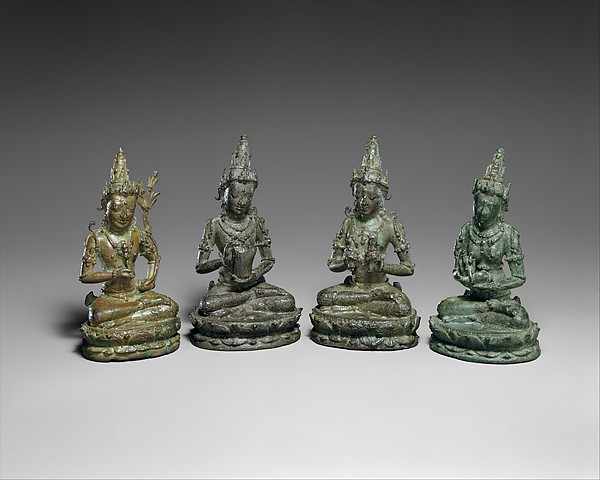
Indonesia (Java, Nganjuk), 10th to 11th century. Bronze; height about 8.9 cm each.
Look closer: Look at the high pointed headdresses and the different hand gestures of each of the four, which the Met catalogues as parts of a Diamond World mandala group. They are each about 9 cm tall and were made in East Java.
The Metropolitan Museum of Art, Samuel Eilenberg Collection, Gift of Samuel Eilenberg, 1987 (1987.142.5, .7–.9). Public domain, Open Access.
In the house
The house keeps pieces that carry the Great Sun. The strip below reads the live shelves, so it shows what is available now.
A short dictionary of practice and place
Terms are given in Japanese with the Sanskrit or Chinese root where the sources supply one.
- Goma (護摩)
- The fire ritual, usually centred on Fudō Myōō.
- Ajikan (阿字観)
- Meditation on the Siddhaṃ letter A.
- Kōmyō shingon (光明真言)
- The Mantra of Light, introduced by Kūkai.
- Honji suijaku (本地垂迹)
- Native kami as traces of Buddhist deities.
- Shukubo (宿坊)
- Temple lodging on Kōya.
- Kongōban (金剛盤)
- The three-footed stand for vajra and bell.
- Yosegi-zukuri (寄木造)
- The joined-block carving technique.
- Okunoin (奥之院)
- The inner sanctuary at Kōyasan, where Kūkai is entombed.
Answered plainly
Why is Tō-ji’s Lecture Hall famous?
Kūkai commissioned its twenty-one statues as a three-dimensional mandala, with Dainichi at the centre. Fifteen date from the early ninth century and six replaced figures lost in a fire in 1486.
Is Dainichi connected to Amaterasu?
Under honji suijaku, the sun goddess Amaterasu was regarded as a trace of Dainichi, and Ryōbu Shintō treated buddhas and kami as two sides of one coin. The Met’s painting of Niu Myōjin shows a Kōya kami whose original form is Dainichi.
Who made the finest Dainichi?
Unkei’s Dainichi for Enjō-ji in Nara, finished in 1176, is the earliest work attributable to him with certainty. A second Dainichi attributed to Unkei was sold in New York in March 2008 for about 14.4 million dollars.
Can I visit Kūkai’s mausoleum?
Okunoin is free to enter and its paths are open all day, but the mausoleum itself is closed to the public, and past the Gobyō bridge photography and eating are not allowed. Monks carry meals to it twice a day.
Where can I see the Dainichi of Kōyasan?
The interior of the Konpon Daitō, the vermilion pagoda in the Danjō Garan, holds a Dainichi at the centre of a three-dimensional mandala. Entry costs about 500 yen; check the temple for current hours.
Where next
Sources and image credits
- The Metropolitan Museum of Art, object 701262
- The Metropolitan Museum of Art, object 671016
- The Metropolitan Museum of Art, object 72451
- The Metropolitan Museum of Art, object 45523
- The Metropolitan Museum of Art, object 36118
- The Metropolitan Museum of Art, object 853186
- The Metropolitan Museum of Art, object 853237
- Cleveland Museum of Art, Mandala of the Four Deities of Mt. Kōya (1999.262)
- Cleveland Museum of Art, Five-pronged Vajra Pestle (Gokosho) (1954.785)
- Cleveland Museum of Art, The Priest Kukai by the Tama River at Mt. Koya (1920.156)
- Wikipedia, Vairocana (names, mudras, scriptures, monuments)
- Wikipedia, Mahāvairocana Sūtra (Vairocanābhisaṃbodhi)
- Wikipedia, Womb Realm (Garbhadhātu)
- Wikipedia, Diamond Realm
- Wikipedia, Kūkai
- Wikipedia, Shingon Buddhism
- Wikipedia, Tō-ji
- Wikipedia, Mount Kōya
- Wikipedia, Okunoin
- Wikipedia, Jingo-ji
- Wikipedia, Unkei
- Wikipedia, Dainichi Nyorai (Enjō-ji)
- Wikipedia, Honji suijaku
- Wikipedia, Spring Temple Buddha
- Wikipedia, Mendut
- Japanese Architecture and Art Net Users System, Dainichi
- Japan Tourism Agency multilingual database, the three-dimensional mandala at Tō-ji
- Tō-ji, Lecture Hall
- Butuzou, Chiken-in mudra
- The Art Wolf, Dainichi Nyorai sold
- World Religion News, Buddhist sect wins Unkei statue (Asahi Shimbun, 26 March 2008)
- Tokyo National Research Institute for Cultural Properties, the Unkei exhibition opened
- Kōyasan Reihokan, 2025 autumn special exhibition
- Watabi, Koyasan guide
- Megaten Wiki, Dainichi Nyorai
- Cultural Japan, Otake Dainichi Nyorai no den (Hiroshige)
Last reviewed 29 October 2026. Pictures are public-domain or openly licensed, each credited beneath it. Diagrams on this page are drawn by Japonista.
Looking for a Dainichi, a mandala scroll, or a small altar piece for a home shrine? Tell us what you have in mind and we will look.
Private concierge
Looking for something in particular?
Describe the piece or the project you have in mind. A senior advisor in Tokyo reads every case file personally and replies within two business days, with fees set out in writing before any work begins.