
Bronze Casting in Japan: Wax, Sand and Takaoka
Metal and Mould
Bronze Casting in Japan: Wax, Sand and Takaoka
A cast bronze begins as something that will not survive: a wax model, a clay core, a shell that must be broken. What remains is the single chance the founder had to get it right. This chapter follows that chance from the sandstone moulds of the Yayoi period to the temple bell, the great Buddhas and the casting town of Takaoka.
Fact sheet
At a glance
- Pour, then break. In lost-wax and bell casting the mould is destroyed in the making, so every cast piece is unique, and a failed pour cannot be repeated.
- Only the mould differs. JAANUS says stages two and three, pouring and finishing, are the same for every cast metalwork; only the making of the mould changes.
- Bells fail often. Wikipedia reports that only about half of temple-bell castings succeed on the first attempt.
- The giants. The Nara Buddha was cast in eight castings over three years, according to Wikipedia, and weighs 500 tonnes.
- A town of casters. Takaoka grew as an industrial city under the Maeda clan after 1615, and its Goin Festival honours the lord who looked after its casters.
The First Bells and Mirrors
The Ministry of Land, Infrastructure, Transport and Tourism’s multilingual glossary says that cast metal came to Japan from mainland Asia, that casting at home appears to have begun in the early Yayoi period, and that by the first century CE Japanese artisans were making bronze swords, mirrors and dōtaku, the bell-shaped ritual objects. The Japanese Architecture and Art Net Users System, JAANUS, names the earliest mould as ishigata, a stone mould: molten bronze was poured into a form carved in sandstone, as for Yayoi halberds and dōtaku.

1st–2nd century. Bronze. The Metropolitan Museum of Art, accession 18.68. Rogers Fund, 1918. Open Access.
Look closer: Look at the flat flanges that rise like fins along the sides and the loop at the top. The museum notes that dōtaku had no clapper.
The Metropolitan Museum of Art, public domain (Open Access). Source: https://www.metmuseum.org/art/collection/search/44831
The dōtaku is the best teacher of the method. Wikipedia reports that the bells were used for about four hundred years, from the second century BCE to the second century CE, that they were first cast in two-part sandstone moulds with the design carved into them, and that clay moulds came later, which allowed larger, thinner bells with more detailed decoration. Sizes ranged from about ten centimetres to 127. More than four hundred have been found, mainly in western Honshu, the Tōkai district, Shikoku and the Kansai.
The Metropolitan Museum’s example, from the first or second century, stands 110.5 centimetres tall. The museum records that the bell has no clapper, that it is thought to descend from smaller Korean bells hung on horses and other domestic animals, and that later examples had walls so thin they would hardly have resonated, so their purpose was probably ritual. It adds that dōtaku were buried singly, in pairs or in large groups, sometimes with bronze mirrors and weapons, in isolated places often on hilltops, perhaps to secure a community’s fertility.
The Met’s mirror from the fourth or fifth century belongs to the next chapter of the story. It is catalogued as based on a Han dynasty prototype, with relief figures of Chinese deities and legendary creatures on the reverse; the museum says Chinese bronze-casting technology spread and that such mirrors were produced in Japan from the Kofun period. It is 19.7 centimetres across.
Lost-Wax Casting
JAANUS defines rōgata, the lost-wax technique, as a method in which a basic model of the vessel or statue is made first in clay or plaster, coated with beeswax mixed with pine resin, shaped to the required form and engraved with surface detail. Soft clay or plaster goes over the wax; metal fragments or pins hold the outer mould and inner core together; firing hardens the mould and melts the wax out; molten metal fills the gap. When the metal has cooled the mould is removed and the pin marks are repaired. Solid statues are cast from a wax model made without an inner core.

Original drawing after the JAANUS entry on rōgata. Simplified.
Look closer: Notice that the model never appears in the finished work: the wax is melted out at step four, and the mould is broken at step six.
Diagram by Japonista (original drawing), The Japonista Curation and Concierge Team, Tokyo, Japan.
The glossary says the great advantage is freedom. Wax is easy to work, so the method suits complex forms and fine detail and gives a smooth bronze surface. The ministry glossary agrees that rōgata handles the most complex forms, and adds the price: the mould and the model are both destroyed in the process. JAANUS reports that Japan adopted the method in the sixth century, beginning with small gilt-bronze statues of the Asuka and Nara periods, and that in the Edo period the same technique served for netsuke.
A small Buddha at the Met shows the evidence of the process. It is gilt bronze, 16.9 centimetres high, of the tenth or eleventh century; the museum says its hands were cast separately from the main figure. The Japanese national art platform adds the other end of the scale: it describes Suzuki Chōkichi, the Meiji caster discussed in the previous chapter, as known for very large lost-wax castings.
Sand, Clay and the Temple Bell
The simplest method, according to JAANUS, is the sand mould, sunagata: a clay model is pressed into sand held in a frame and metal is poured into the impression. The glossary names coins and mirrors as its products and dates its use in Japan to the Edo period. A neighbouring technique, fumigaeshi or replica casting, takes a clay mould from a flat object such as a mirror and casts a copy that is slightly smaller and less detailed than the original.
Bells use a different logic. Wikipedia’s article on the bonshō says each bell is cast in one piece with a core and a shell, a method largely unchanged since the Nara period. The core is a dome of stacked bricks made from hardened sand. The shell is shaped with a large wooden strickle board turned around a vertical axis to form the clay mould, and inscriptions and decoration are carved or pressed into the clay. The shell fits over the core with a narrow gap; bronze is poured in at more than 1,050 degrees Celsius; and the mould is broken to release the bell, so a new one is needed for every casting.
The article gives the alloy as usually about seventeen parts copper to three of tin, notes that the mixture and the speed of cooling can change the tone, and reports that only about half of all castings succeed on the first attempt, free of cracks and flaws. It names the Okikichō bell at Myōshin-ji, cast in 698, as the oldest bell in the world still in use, and the bell at Chion-in, cast in 1636, at 70 metric tons, as the largest, needing a team of seventeen to sound it.
One note of caution. The two glossaries consulted for this chapter define the terms for piece moulds, komegata and sōgata, in different ways, so this chapter does not use them. What both agree on is the principle: the mould is built from clay and sand, and what differs between methods is only how it is made.
| Method | Japanese term | What the sources say it was used for |
|---|---|---|
| Stone mould | ishigata (石型) | Yayoi halberds and dōtaku (JAANUS) |
| Lost wax | rōgata (蝋型) | Bronze sculpture from the sixth century; later netsuke (JAANUS) |
| Sand mould | sunagata (砂型) | Coins and mirrors; Edo period in Japan (JAANUS) |
| Replica casting | fumigaeshi (踏返) | Copies of flat objects such as mirrors (JAANUS) |
| Core and shell | not named in the source | Temple bells since the Nara period (Wikipedia) |
The Great Buddhas
Wikipedia’s account of the Great Buddha of Nara at Tōdai-ji states that the Vairocana was commissioned in 743, begun at Shigaraki and resumed at Nara in 745, completed in 751, with the eye-opening ceremony in 752. The statue was cast in eight castings over three years, with the head and neck cast together as a separate element. It weighs 500 tonnes. The article says the project used much of Japan’s bronze and relied entirely on imported gold. In 855, it adds, the head fell and a new one was made with donations; the present hands date from the Momoyama period and the head from the Edo period.

Great Buddha of Takaoka, Toyama Prefecture. Completed in 1933 according to Wikipedia. Photograph, 2019.
Look closer: The statue stands at the end of a street, among houses and trees. That is the scale of a town’s own Great Buddha: it belongs to the neighbourhood.
Zairon (via Wikimedia Commons), CC BY-SA 4.0, via Wikimedia Commons. Source: https://commons.wikimedia.org/wiki/File:Takaoka_Daibutsu_1.jpg
The Great Buddha of Kamakura tells a different story. The article on its temple, Kōtoku-in, reports that a giant wooden Buddha was finished in 1243 after about ten years of work, that a storm damaged it and destroyed its hall in 1248, and that the bronze statue, which dates from around 1252 according to temple records, was proposed in its place. It stands 13.35 metres high including the base, is hollow and can be entered, and was once gilded; traces of gold leaf remain near the ears. The article says it was probably cast by Ōno Gorōemon or Tanji Hisatomo. It gives two different weights, and this chapter gives neither. The hall was washed away by the tsunami of the Nankai earthquake of 20 September 1498, and the statue has stood in the open since.
Takaoka made its own. Wikipedia reports that the current bronze Great Buddha of Takaoka, nearly sixteen metres tall and the third largest in Japan, was completed in 1933 after the earlier wooden statue burned down.
Takaoka, a Town of Casters
Wikipedia reports that in 1609 Maeda Toshinaga of the Kaga domain took control of the city and named it Takaoka; after the shogunate ordered the castle destroyed in 1615, the Maeda clan promoted Takaoka as an industrial city, and Takaoka copperware and lacquerware, in the article’s words, took off at this time. The article does not say that Toshinaga founded the casting craft, and this chapter does not claim it. It adds that the Goin Festival, held on 19 and 20 June, honours Toshinaga’s kindness in looking after the city’s casters.
The town’s living tradition is recorded in the same article. It names Kanamori Eiichi (1908 to 2001), recognised as a leading metal engraver of Takaoka copperware, and Ozawa Komin (1941 to 2023), recognised as a master of the chūkin casting technique, both as Living National Treasures. The wider technique has its own status: the ministry glossary says chūkin techniques were collectively designated an Important Intangible Cultural Heritage in 1964.
Gilding, Lacquer and Patina
The cast is not the end. The ministry glossary says that once the metal has cooled the mould is broken away and the warm piece is often coated with lacquer or a black iron-based dye, for colour and protection. JAANUS adds that Japan often gilded its lost-wax bronzes. The Met’s eleventh-century Zaō Gongen is catalogued as gilt bronze with incised decoration and stands 34.6 centimetres high; the twelfth-century votive mirror with the Eleven-Headed Kannon, 18.1 centimetres across, is also gilt bronze, and its image is incised.
Later pieces show the other end of the range. The Met catalogues a nineteenth-century incense burner, 14 centimetres high, as bronze with gold inlay, and another from the Moore bequest as bronze of a light colour. Wikipedia’s biography of Shibata Zeshin, discussed in the previous chapter, records that the lacquer artist used bronze to imitate the look of iron during the restrictions on gold and silver of the 1830s and 1840s, and then in the 1880s polished a tray to the look of aged bronze. The metal had become a surface effect as well as a substance.
The kettle is the quiet cousin. JAANUS lists iron tea-ceremony kettles among the Japanese uses of casting, and the Met’s sixteenth-century Tenmyō kettle in cast iron, 17.5 centimetres high, is a reminder that the tea almanac and this one share a foundry. See The Japanese Tea Ceremony Almanac.
Lost Wax Around the World
Wikipedia’s article on lost-wax casting places the oldest known examples at roughly 6,500 years old, gold artefacts from the Varna Necropolis in Bulgaria dated to 4550 to 4450 BCE. It adds a copper amulet from Mehrgarh, in present-day Pakistan, dated to about 4000 BCE, and cast copper objects from the Nahal Mishmar hoard in southern Israel, estimated from carbon dating at about 3500 BCE. Japan arrives very late in that story, and arrives with a method that was already ancient.
The same article reports that the technique was widespread in Europe until the eighteenth century, when piece-moulding came to predominate, and that in China the lost-wax method did not appear in the north until the sixth century BCE, since piece-mould casting was the principal technique for bronze vessels there. For Japan it says the technique dates to the Yayoi period and names the bronze image in the temple of Tōdai-ji at Nara as the most famous piece made by it. This chapter reports that sentence and notes that JAANUS gives the sixth century for Japan; because the two accounts differ, no start date is claimed here.

early 6th century. Bronze. The Metropolitan Museum of Art, accession 1975.268.384. The Harry G. C. Packard Collection of Asian Art, Gift of Harry G. C. Packard, and Purchase, Fletcher, Rogers, Harris Brisbane Dick, and Louis V. Bell Funds, Joseph Pulitzer Bequest, and The Annenberg Fund Inc. Gift, 1975. Open Access.
Look closer: Count the five bells around the rim; they are cast as part of the mirror.
The Metropolitan Museum of Art, public domain (Open Access). Source: https://www.metmuseum.org/art/collection/search/44836

12th century. Bronze. The Metropolitan Museum of Art, accession 1975.268.160. The Harry G. C. Packard Collection of Asian Art, Gift of Harry G. C. Packard, and Purchase, Fletcher, Rogers, Harris Brisbane Dick, and Louis V. Bell Funds, Joseph Pulitzer Bequest, and The Annenberg Fund Inc. Gift, 1975. Open Access.
Look closer: Look at the fine engraved lines: the design is cut into the surface after casting.
The Metropolitan Museum of Art, public domain (Open Access). Source: https://www.metmuseum.org/art/collection/search/45338
The word that Western workshops use is cire perdue, French for lost wax, and the article records the variant called lost mould, which acknowledges that tallow, resin, tar or textile can stand in for wax. The Japanese rōgata describes the same logic: beeswax and pine resin, in the glossary’s account, take the place of the model and are given up to the fire.
The practical lesson of the comparison is that the Japanese foundry was never isolated. Wikipedia says the Yayoi craft specialists made bronze ceremonial bells, mirrors and weapons, and that Chinese influence was obvious in the bronze and copper weapons, the dōkyō and the dōtaku. The founder’s craft, in other words, was imported, then tuned to local sand, clay and taste over many centuries.
Japanese Bronze by Date
Dates are those given in the sources named at the end of the chapter. Where the sources differ on a year, the year is left out.
| Date | What happened | Source |
|---|---|---|
| 2nd century BCE to 2nd century CE | Dōtaku bells are cast and used | Dōtaku, Wikipedia |
| 1st or 2nd century | The Met’s dōtaku, 110.5 centimetres tall, with no clapper | Metropolitan Museum |
| 4th or 5th century | Mirrors based on Han dynasty prototypes | Metropolitan Museum |
| Early 6th century | The Met’s mirror with five bells | Metropolitan Museum |
| 698 | The Okikichō bell now at Myōshin-ji, in Kyoto | Bonshō, Wikipedia |
| 743 to 751 | Commission and completion of the Great Buddha at Nara | Great Buddha of Nara, Wikipedia |
| 10th or 11th century | The Met’s small gilt-bronze Buddha, with hands cast separately | Metropolitan Museum |
| 12th century | Haguro mirror engraved with birds, flowers and butterflies | Metropolitan Museum |
| 1243 and 1248 | Wooden Buddha at Kamakura finished, then damaged by a storm | Kōtoku-in, Wikipedia |
| 1609 and 1615 | Takaoka is named; the Maeda clan promotes it as an industrial city | Takaoka, Wikipedia |
| 1933 | The bronze Great Buddha of Takaoka is completed | Takaoka, Wikipedia |
Places to See Cast Bronze
Hours and displays change; check each institution’s own site before travelling.
| Place | What there is | Source |
|---|---|---|
| Tōdai-ji, Nara | The Great Buddha, the Vairocana cast in eight castings | Great Buddha of Nara, Wikipedia |
| Kōtoku-in, Kamakura | The open-air bronze Great Buddha | Kōtoku-in, Wikipedia |
| Chion-in, Kyoto | The bell cast in 1636, which Wikipedia calls the largest, shown in the gallery | Bonshō, Wikipedia |
| Takaoka, Toyama Prefecture | The bronze Great Buddha of 1933 and the casting tradition of the town | Takaoka, Wikipedia |
| The Metropolitan Museum of Art, New York | The dōtaku, the mirrors, the gilt-bronze Buddha and the Tenmyō kettle | Metropolitan Museum |
Glossary of Casting
A short vocabulary of the terms in this chapter.
| Term | Meaning |
|---|---|
| Chūkin | Metal casting |
| Rōgata | Lost-wax casting, with a wax model burned out of the mould |
| Ishigata | Casting in a stone mould, used for Yayoi halberds and dōtaku |
| Sunagata | Casting in a sand mould, used for coins and mirrors |
| Fumigaeshi | Replica casting from a model, used for flat objects such as mirrors |
| Dōtaku | The bronze bell of the Yayoi period, cast without a clapper |
| Bonshō | The Buddhist temple bell, cast in one piece with a core and a shell |
| Cire perdue | The French term for lost-wax casting |
| Patina | The surface colour that develops on bronze, green when it is buried or aged |
Fun Facts for the Curious
Each of these comes from the sources named at the end of the chapter.
- The Met’s dōtaku stands 110.5 centimetres tall and has no clapper.
- Only about half of all temple-bell castings succeed on the first attempt, Wikipedia reports.
- A bell is usually about seventeen parts copper to three of tin, according to the same article.
- Prayer papers and sprigs of sacred mulberry are added to the molten bronze of a bell, with sutra chanting, Wikipedia says.
- The Great Buddha of Nara was cast in eight castings.
- The bronze Great Buddha of Takaoka is nearly sixteen metres tall and the third largest in Japan, Wikipedia reports.
- The Met’s small gilt-bronze Buddha has hands cast separately and joined to the figure.
Cire Perdue, Piece Moulds and the Bronze Age
The comparison with the wider world is useful because it shows what is particular here. In China, Wikipedia says, piece-mould casting was the principal technique for bronze vessels and lost wax came late to the north. In Europe the lost-wax method held until the eighteenth century and was then displaced by piece-moulding. Japan used both ideas at once: stone and clay for the early bells, wax for the sculpture, sand for coins and mirrors, and a core and shell for the bell.
What the sources do not do is rank them. The ministry glossary calls rōgata the method for the most complex forms and says it is costly, which is a statement about price and detail rather than quality. The reader looking at a bronze in a museum can ask the same two questions of any founder: how was the mould made, and what had to be destroyed to make it.
Bronze Across the Ages

Kōtoku-in, Kamakura. Bronze, 13.35 metres high including the base according to Wikipedia. Photograph, 2021.
Look closer: Compare the figures at its feet with the statue. The green is the patina of centuries in the open air since the hall was washed away in 1498.
Dandy1022 (via Wikimedia Commons), CC BY-SA 4.0, via Wikimedia Commons. Source: https://commons.wikimedia.org/wiki/File:The_Great_Buddha_of_K%C5%8Dtoku-in.jpg

The bell at Chion-in, Kyoto, cast in 1636 according to Wikipedia. Photograph, 2006.
Look closer: The red beam is the striker; the wooden frame is built around the bell. A team of seventeen is needed to sound it, says Wikipedia.
MShades (via Wikimedia Commons), CC BY 2.0, via Wikimedia Commons. Source: https://commons.wikimedia.org/wiki/File:Chion-in_bell_1_by_MShades_in_Kyoto.jpg

4th–5th century. Bronze. The Metropolitan Museum of Art, accession 1975.268.383. The Harry G. C. Packard Collection of Asian Art, Gift of Harry G. C. Packard, and Purchase, Fletcher, Rogers, Harris Brisbane Dick, and Louis V. Bell Funds, Joseph Pulitzer Bequest, and The Annenberg Fund Inc. Gift, 1975. Open Access.
Look closer: This is the reverse: the relief figures and bands are cast, while the front was polished.
The Metropolitan Museum of Art, public domain (Open Access). Source: https://www.metmuseum.org/art/collection/search/44835
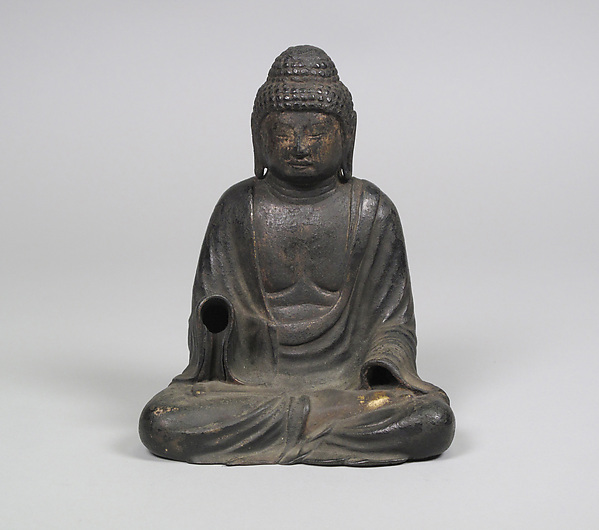
10th–11th century. Gilt bronze. The Metropolitan Museum of Art, accession 1975.268.153. The Harry G. C. Packard Collection of Asian Art, Gift of Harry G. C. Packard, and Purchase, Fletcher, Rogers, Harris Brisbane Dick, and Louis V. Bell Funds, Joseph Pulitzer Bequest, and The Annenberg Fund Inc. Gift, 1975. Open Access.
Look closer: Notice the hands: the Met says they were cast separately and joined to the main figure.
The Metropolitan Museum of Art, public domain (Open Access). Source: https://www.metmuseum.org/art/collection/search/42586

11th century. Gilt bronze with incised decoration. The Metropolitan Museum of Art, accession 1975.268.155. The Harry G. C. Packard Collection of Asian Art, Gift of Harry G. C. Packard, and Purchase, Fletcher, Rogers, Harris Brisbane Dick, and Louis V. Bell Funds, Joseph Pulitzer Bequest, and The Annenberg Fund Inc. Gift, 1975. Open Access.
Look closer: The figure balances on one leg, wrathful and alive. The surface is blue-green.
The Metropolitan Museum of Art, public domain (Open Access). Source: https://www.metmuseum.org/art/collection/search/39707
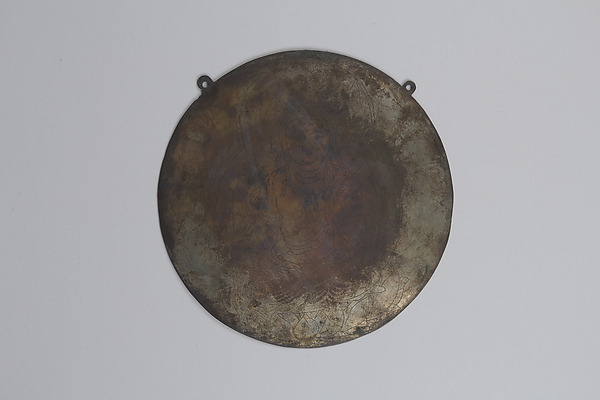
12th century. Gilt bronze. The Metropolitan Museum of Art, accession 1975.268.157. The Harry G. C. Packard Collection of Asian Art, Gift of Harry G. C. Packard, and Purchase, Fletcher, Rogers, Harris Brisbane Dick, and Louis V. Bell Funds, Joseph Pulitzer Bequest, and The Annenberg Fund Inc. Gift, 1975. Open Access.
Look closer: The two loops at the top are for hanging, as the Met notes; the image is incised.
The Metropolitan Museum of Art, public domain (Open Access). Source: https://www.metmuseum.org/art/collection/search/45522
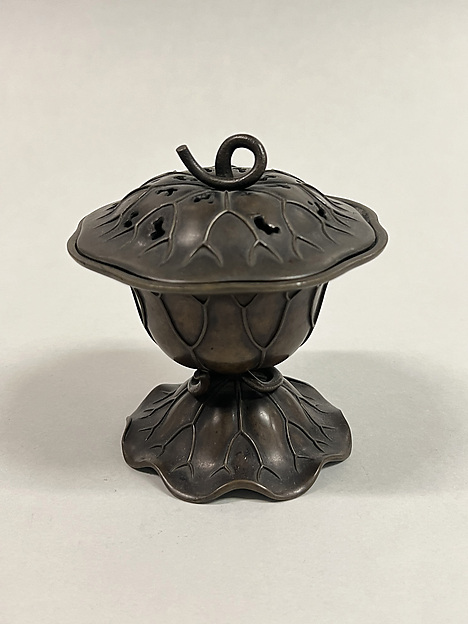
18th–19th century. Bronze. The Metropolitan Museum of Art, accession 14.58.163a, b. Bequest of John L. Cadwalader, 1914. Open Access.
Look closer: Count the leaves in the lid; each is pierced so that smoke can escape.
The Metropolitan Museum of Art, public domain (Open Access). Source: https://www.metmuseum.org/art/collection/search/59962
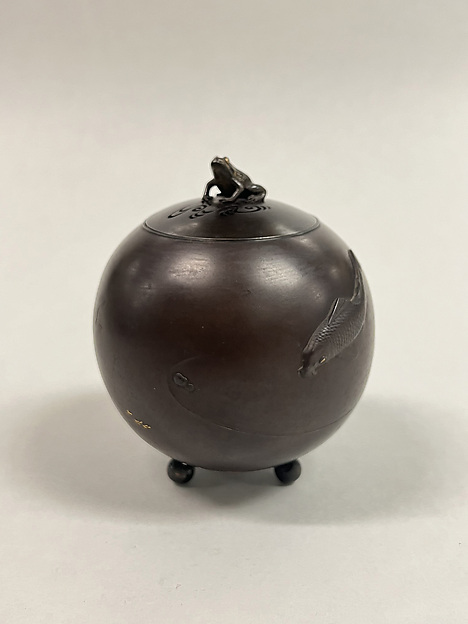
19th century. Bronze inlaid with gold. The Metropolitan Museum of Art, accession 06.97a, b. Rogers Fund, 1906. Open Access.
Look closer: The Met catalogues it as bronze with gold inlay.
The Metropolitan Museum of Art, public domain (Open Access). Source: https://www.metmuseum.org/art/collection/search/52173
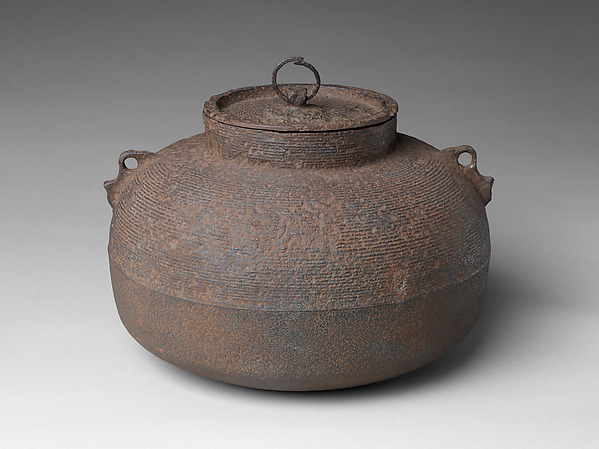
16th century. Cast iron. The Metropolitan Museum of Art, accession 2024.553.7a–c. Gift of Peggy and Richard M. Danziger, 2024. Open Access.
Look closer: A cast-iron kettle of the sixteenth century. The surface carries a fine texture from the mould.
The Metropolitan Museum of Art, public domain (Open Access). Source: https://www.metmuseum.org/art/collection/search/913854
Kettles, Okimono and Metalwork
Cast metal appears in the house in several forms. The shelf of Tetsubin shows cast-iron kettles, the shelf of Japanese Okimono, Figurines and Statues shows display bronzes, and the earlier house guide to Okimono and Jizai covers the articulated metal creatures.
Answered plainly
What is lost-wax casting?
A method in which a wax model is covered in clay, the wax is melted out by firing, and metal is poured into the space. JAANUS describes the steps and says Japan adopted it in the sixth century.
Why are temple bells so difficult to cast?
Wikipedia reports a high failure rate, with only about half of castings succeeding on the first attempt, and notes that the mould is broken after each pour.
What is the difference between bronze and cast iron in Japanese casting?
The Met catalogues the dōtaku and mirrors as bronze, and the Tenmyō kettle as cast iron. JAANUS lists iron tea-ceremony kettles among Japanese cast works.
Is Takaoka where Japanese bronze casting began?
No source consulted for this chapter says so. Wikipedia describes Takaoka as developing after 1609 and 1615, while the earliest casting evidence in Japan is from the Yayoi period.
Are old bronzes always signed?
No. The next chapters of this almanac return to attribution; the previous chapter shows that even a large and celebrated bird is catalogued as unsigned.
Where next
Sources and image credits
- Metal casting (Chūkin), JAANUS, Japanese Architecture and Art Net Users System
- Rōgata, JAANUS (lost-wax casting)
- Metal Casting (Chūkin), Multilingual glossary, Ministry of Land, Infrastructure, Transport and Tourism, Japan
- Dōtaku, Wikipedia
- Bonshō, Wikipedia (bell casting)
- Great Buddha of Nara (Tōdai-ji), Wikipedia
- Kōtoku-in, Wikipedia (Great Buddha of Kamakura)
- Takaoka, Toyama, Wikipedia
- Dōtaku (Bronze Bell), 18.68, The Metropolitan Museum of Art
- Mirror (Shinjūkyō), 1975.268.383, The Metropolitan Museum of Art
- Seated Buddha, 1975.268.153, The Metropolitan Museum of Art
- Zaō Gongen, 1975.268.155, The Metropolitan Museum of Art
- Tenmyō Kettle, 2024.553.7a–c, The Metropolitan Museum of Art
- Suzuki Chōkichi, Japanese national art platform
- Image credit: Zairon, CC BY-SA 4.0, Wikimedia Commons

Last reviewed 28 October 2026. Pictures, where shown, are public-domain or open-access and credited beneath each one.
Looking for a cast bronze, a tetsubin or a bell with its history intact? The concierge desk replies within one to three business days.
Private concierge
Looking for something in particular?
Describe the piece or the project you have in mind. A senior advisor in Tokyo reads every case file personally and replies within two business days, with fees set out in writing before any work begins.