

PRIDE OF YOKOSUKA: Sukajan’s Postwar Origin, Dobuita Street, and the Museum Exhibition That Preserves Japan’s Most Iconic Souvenir Jacket Culture
Approximately 140 valuable vintage Skajan jackets owned by Taylor Toyo (Toyo Enterprises Co., Ltd.) are gathered here!
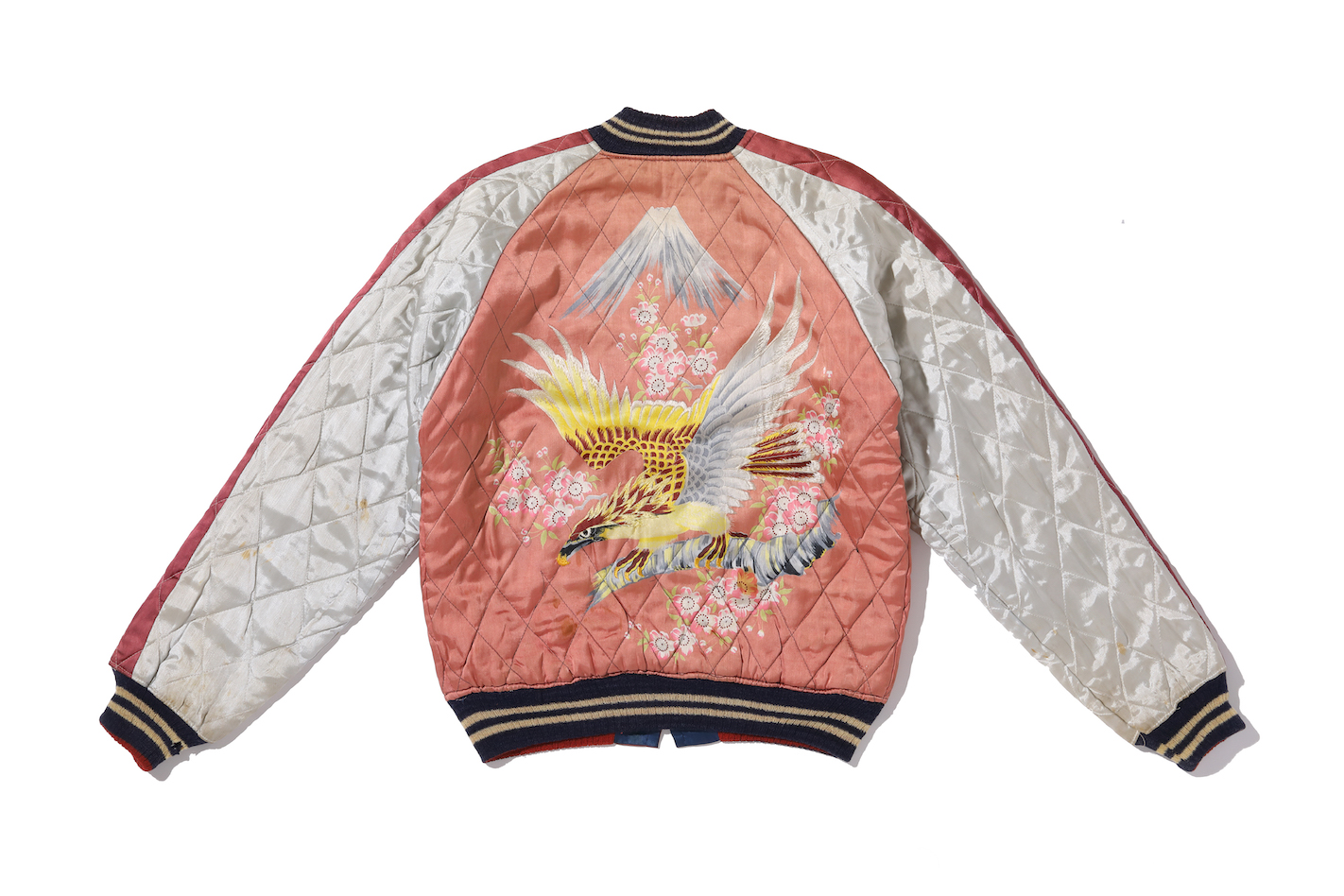
Mt. Fuji, Cherry Blossoms and Eagle Mid-1950s Taylor Toyo (Toyo Enterprises Co., Ltd.) collection
Unraveling the history of the coveted Sukajan and base culture
"Sukajan" is one of the rare fashion forms that can honestly be called born in Japan—yet it was shaped in conversation with the world. At a glance, it’s a glossy reversible jacket—often acetate or rayon satin, sometimes velveteen—embroidered with eagles, dragons, tigers, maps, and place names. But look closer and you see something more valuable than “cool”: a wearable archive of postwar streets, base-town commerce, craft technique, and cultural remixing that still echoes through global fashion.
The PRIDE OF YOKOSUKA Sukajan Exhibition (held at the Yokosuka Museum of Art, with discussions beginning on November 19, 2022) offers an ideal lens to understand why sukajan matters beyond trend cycles. It frames sukajan not as a novelty, but as a cultural artifact—one that carries the aesthetics of Japanese embroidery, the personalization culture of American servicemen, and the geography of Yokosuka’s Dobuita Street as a living “origin point” in the public imagination.
At the heart of this exhibition narrative is Tailor Toyo / Toyo Enterprises Co., Ltd., a name collectors recognize immediately. The brand is widely regarded as a continuity project preserving souvenir-jacket culture across generations—less a fashion “revival” and more an ongoing heritage craft lineage.
When an exhibition gathers around 140 pieces from a major collection, it stops being “a few good jackets” and becomes a proper timeline. You’re not just seeing isolated designs—you’re seeing how motifs evolve, how materials and silhouettes shift, how reversible constructions become the norm, how “Japan” becomes typography on cloth, and how craft constraints shape aesthetics.
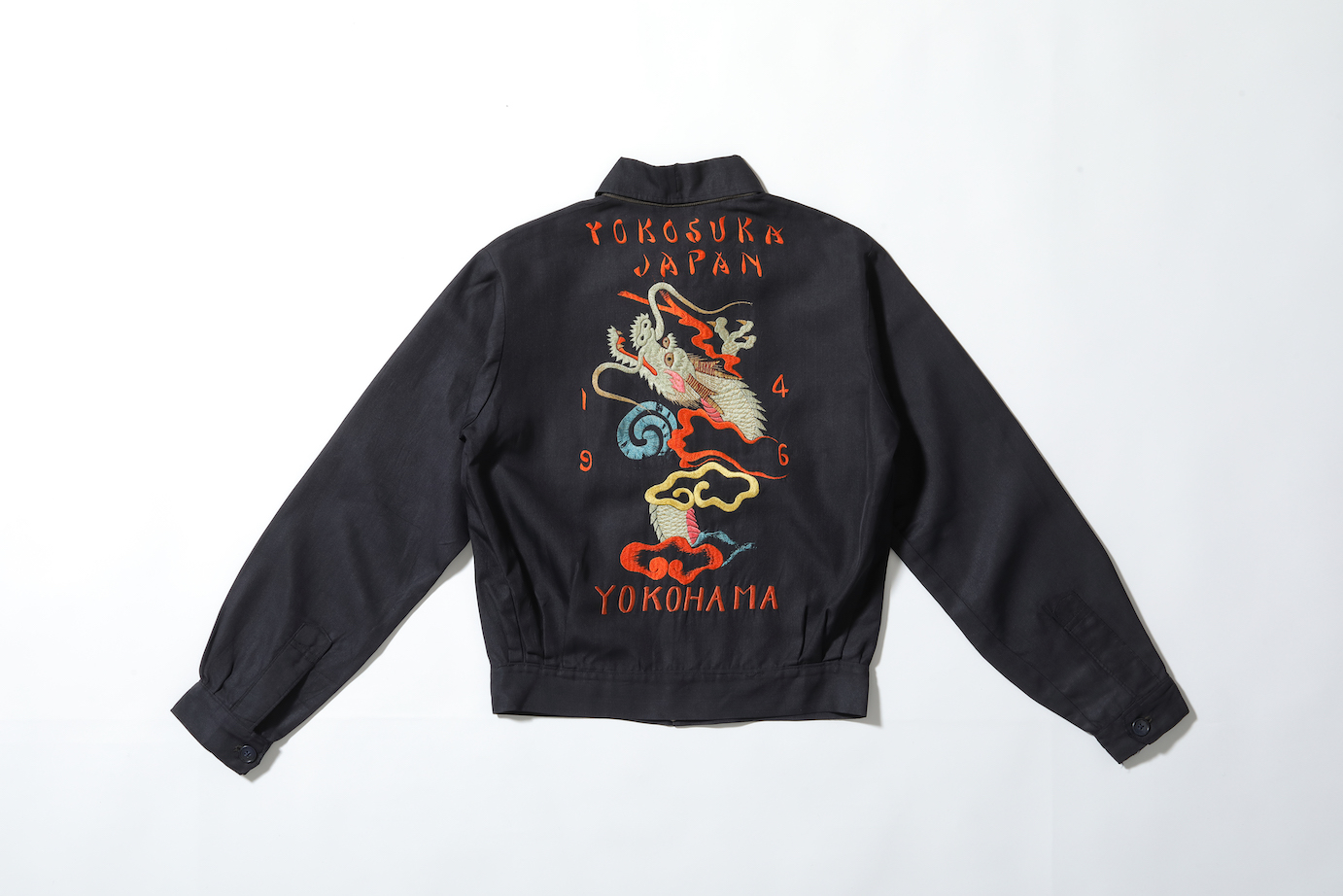
This “YOKOSUKA Dragon” is presented as especially significant—partly because early examples help define what collectors mean by vintage sukajan: high-impact back embroidery, confident iconography, and the kind of dimensional stitch work that can’t be replicated convincingly by cheap modern shortcuts.
The centerpiece of the exhibition is Tailor Toyo, a company whose long-running relationship to souvenir jackets anchors sukajan inside an actual manufacturing lineage. In a world where “heritage” is often a marketing mood, sukajan heritage becomes more concrete when you can trace the continuity of making, materials, and motif grammar across decades.
That matters because sukajan isn’t merely “embroidered imagery.” It’s a specific combination of: (1) reversible construction (two faces, two identities), (2) material sheen (acetate/rayon satin catching light like armor), (3) dense motif embroidery designed to read at distance, and (4) craft-driven irregularities that preserve the human hand in stitch direction, shading, and relief.
A distinctive feature often emphasized in serious sukajan contexts is horizontal embroidery (yokoburi). This is not standard machine embroidery. It’s a craft method associated with specialized horizontal machines and embodied control—guiding fabric by hand to build painterly gradients, raised surfaces, and thread paths that behave more like brushwork than flat fill. The result is embroidery that looks alive: dimensional, tactile, and quietly complex.
This is one of the cleanest “tell” signals between heritage-style embroidery (depth, thread shading, tactile relief) and modern mass embroidery (often flatter and more uniform). It is also why collectors speak about certain pieces as “thread paintings,” not just stitched graphics.
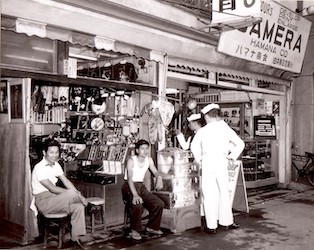
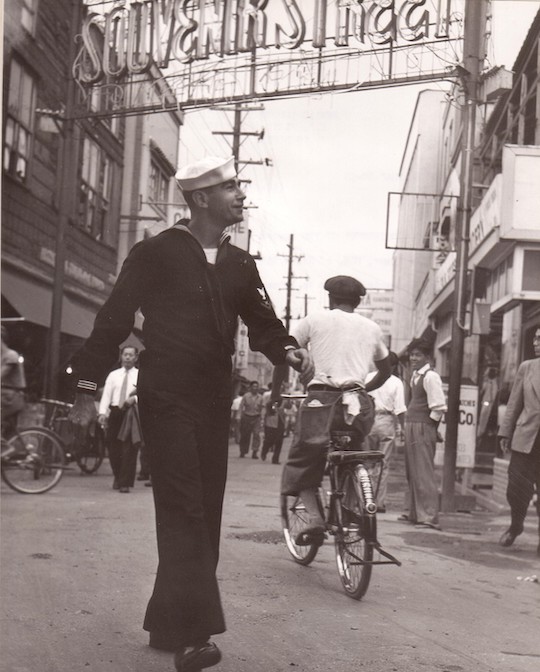
These street photographs do more than decorate the story: they show the consumer environment that made sukajan possible. It’s storefronts, foot traffic, English signage, and commerce built around a clear promise—take something home that proves you were here. This is why “base culture” is the correct frame: sukajan emerges from a service economy of personalization, not from abstract fashion inspiration.
Inside the exhibit, there is also a corner that introduces a part of the base culture that developed around U.S. military bases around the country after the war, through photos and documents from Dobuita Street, and products that were actually sold to U.S. soldiers. Using the strongly regional cultural representation of the sukajan as an entry point, this exhibition sheds light on American influence from the post-war period to the present—and the ways Japan reshaped that influence into its own craft language.
Why sukajan survives the trend cycle
Sukajan continues to recur in fashion because it solves three things at once:
-
Instant narrative density — even a simple tiger jacket feels like a story object.
-
Graphic authority — the back panel reads like a billboard, but crafted.
-
Cultural hybridity — it’s neither purely Japanese tradition nor purely American military style; it’s the seam where the two meet.
That hybridity is exactly why sukajan can appear in luxury contexts without feeling like costume. The jacket already contains the logic luxury brands chase: rarity aesthetics, craft legitimacy, recognizable iconography, and a strong “collector” identity.
Curator’s note: how to look at a sukajan like an exhibition piece
If you want the exhibition mindset (and to write about sukajan with authority), train the eye in five passes:
-
silhouette — baseball/stadium lineage, collar/cuffs/hem, reversible seams.
-
materials — satin sheen, acetate/rayon behavior, velveteen depth, lining quality.
-
embroidery physics — raised relief, thread direction changes, shading transitions.
-
motif grammar — eagle/dragon/tiger, maps, Fuji, place names, script choices.
-
context signals — era clues (color palette, stitching density, wording, layout).
This is how sukajan becomes more than “cool.” It becomes readable as postwar design history—stitched.