
Tibet and Nepal
Himalaya · Cloth and copper
Tibet and Nepal
On 4 July 1900 a Japanese Zen monk crossed into Tibet disguised as a Chinese pilgrim and stayed for almost two years, practising medicine and, on one occasion, meeting the thirteenth Dalai Lama. His story is the clearest bridge between Zen and the Himalayas, and a good way into why those mountains matter in a Japanese collection. The sections below add the two temples of the consorts, the monastery built as a map of the cosmos, the palace on the Red Mountain, the Bengali teacher, the Newar boy who built a pagoda for Kublai Khan, the great stupas of the valley, a thangka in the making, a glossary, fun facts, the news since 2015 and a collector's eye.
Fact sheet
Four ideas to carry in
- Two roads in. Tradition credits Songtsen Gampo's two foreign consorts, one Nepali and one Chinese, with bringing the first Buddha images to Tibet.1
- The Newar hand. Newar artists of the Kathmandu Valley were renowned across Asia, and Chinese and Tibetan temples imported their art and their artists.2
- A picture you can roll. A thangka is a painted cloth, mounted in silk, rolled for storage and unrolled for use.3
- Gold in the painting. In Nepal, 24-carat gold is sometimes plated on the painted surface.3
A Zen Monk on the Roof of the World
First lookEkai Kawaguchi was born on 26 February 1866. He trained at Manpuku-ji, the Obaku Zen temple, and was rector of the Gohyaku Rakan monastery in Tokyo until March 1891.5 He left Japan in June 1897 and entered Tibet on 4 July 1900, presenting himself as a Chinese monk. He worked as a doctor, obtained an audience with the thirteenth Dalai Lama, and left on 15 June 1902.5
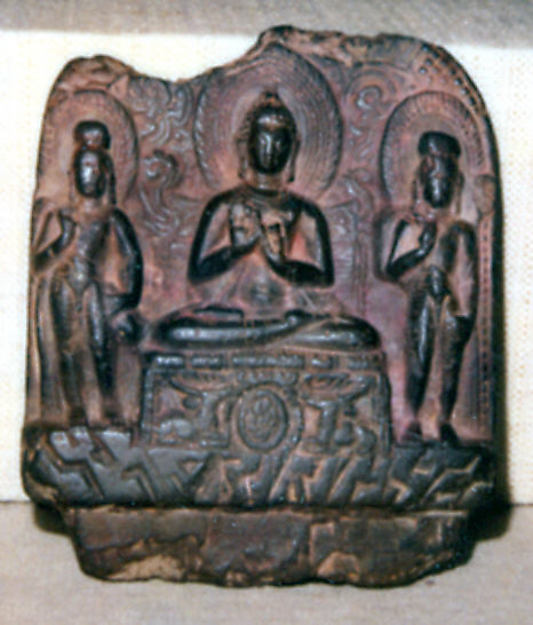
Nepal (Kathmandu Valley) · Licchavi period · 8th–9th century · Stone
Look closer: This stone plaque is only 11.7 centimetres tall. Look at the three figures: the Buddha in the centre, with his hands raised in front of his chest, flanked by two standing attendants whom the Met names as Maitreya and Padmapani. The scene is the First Sermon, taught at Sarnath and told in the first chapter of this wing, carved in the Kathmandu Valley in the eighth or ninth century.
The Metropolitan Museum of Art, New York, Purchase, Rodolitz Associates Gift, 1989, accession 1989.294. Public domain, Met Open Access. Museum record
His book, Three Years in Tibet, appeared in 1909, and in 1913 to 1915 he made a second journey.5 He died on 24 February 1945; Nepal issued a stamp for him in 2003.5 The Himalayan tradition and Japanese Zen met in one man's life, and that is the point of beginning here.
How the Teaching Crossed the Passes
The connoisseur's eyeTibetan tradition credits Songtsen Gampo, who reigned from 618 to 649, with introducing Buddhism, and says that his Nepali consort Bhrikuti and his Tang consort Wencheng each brought a statue of the Buddha.1 The state commitment came with Trisong Detsen in the later eighth century; Padmasambhava and the abbot Santaraksita, who lived from 725 to 788, are the roots of the Nyingma order.1
The debate at Samye, often called the Council of Lhasa, is dated to 793, and Tibetan sources say the Chinese master Moheyan lost it to Kamalasila, while a source from Dunhuang says otherwise; some scholars consider the whole episode fictitious.1 Persecution under Langdarma, who ruled in 841 and 842, was followed by an era of fragmentation in the ninth and tenth centuries.1
The second diffusion is the age of translators and teachers: Rinchen Zangpo, who lived from 958 to 1055; Atisa, who lived from 982 to 1054 and arrived in 1042, whose disciple Dromtonpa began the Kadam order; and the Sakya founder, Khön Könchok Gyelpo, who lived from 1034 to 1102.1 Milarepa belongs to the eleventh century; Sakya Pandita lived from 1182 to 1251; Je Tsongkhapa, who lived from 1357 to 1419, founded the Gelug order.1 In 1578 Sonam Gyatso received the title Dalai from Altan Khan, and the Fifth Dalai Lama later rebuilt the Potala, whose original structure, the article says, Nepali craftsmen had built.1
| Order | Founder or source | Date | Note |
|---|---|---|---|
| Nyingma | Padmasambhava and Santaraksita1 | 8th century1 | The oldest order |
| Kadam | Atisa and his disciple Dromtonpa1 | Atisa arrives 10421 | Later absorbed into the Gelug |
| Sakya | Khön Könchok Gyelpo1 | 1034 to 11021 | Sakya Pandita lived 1182 to 12511 |
| Gelug | Je Tsongkhapa1 | 1357 to 14191 | Dalai Lama title from 15781 |
Newar Bronzes: The Valley's Hand
The connoisseur's eyeThe Newars of the Kathmandu Valley, an area of about 200 square miles, are, the Met's essay says, renowned across Asia for their sculpture in stone, metal, wood and terracotta.2 Their metal is typically heavily gilded, with a reddish patina from a high copper content, and later pieces were inlaid with semi-precious stones.2 Their tradition grew out of the Gupta art of India and then the Pala, and an early standing Vajrapani of the sixth or seventh century shows the beginning.2 They favoured long, languid eyes and a wider face, and the tradition was conservative.2
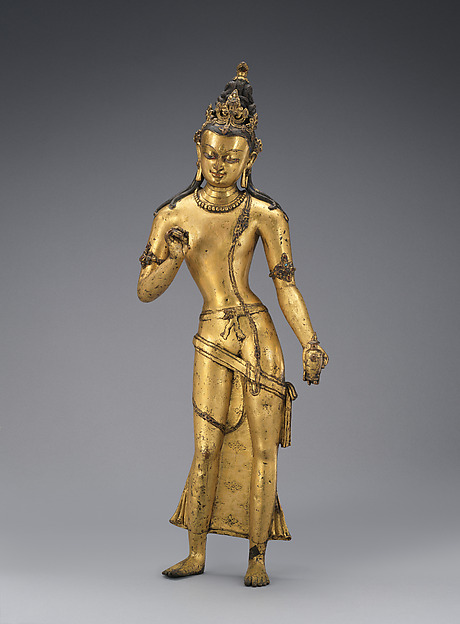
Nepal · Thakuri period · 11th century · Copper alloy with gilding and color
Look closer: A slender standing bodhisattva in gilt copper alloy, 66 centimetres high. The Met dates it to the eleventh century, the Thakuri period in Nepal, and calls the figure Maitreya, the Buddha of the future. Look at the swaying stance, the high crown and the long eyes, and at any place where the gilding has thinned: the Met's essay describes a reddish patina from a high copper content, which is the base metal showing through.2
The Metropolitan Museum of Art, New York, Rogers Fund, 1982, accession 1982.220.12. Public domain, Met Open Access. Museum record
Chinese and Tibetan temples imported Nepalese art and artists.2 In the thirteenth century, according to the Wikipedia article on the valley, a Newar named Araniko worked at Kublai Khan's court.4 The Met's essay adds a caution that scholars cannot distinguish a Hindu from a Buddhist style in the valley, and the same artists probably worked for both, since the two faiths coexisted in Nepal for almost two thousand years.2
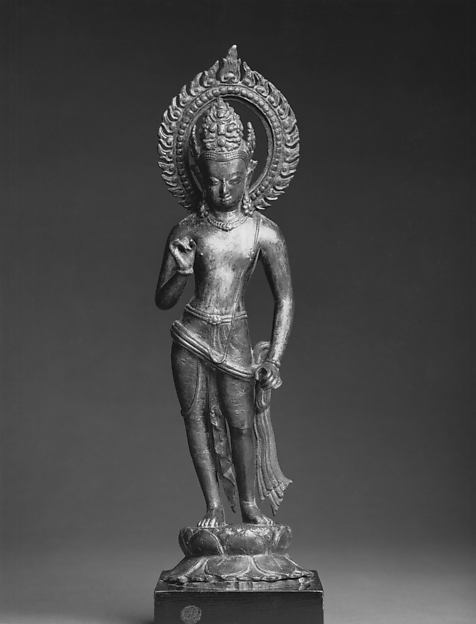
Nepal (Kathmandu Valley) · Thakuri period · 10th century · Copper alloy
Look closer: A tenth-century Avalokiteshvara from the Kathmandu Valley, in copper alloy, 33.6 centimetres high. The Met's record lists no gilding for this one, so compare its metal surface with the gilded eleventh-century Maitreya above.
The Metropolitan Museum of Art, New York, Rogers and Pfeiffer Funds, 1982, accession 1982.220.14. Public domain, Met Open Access. Museum record
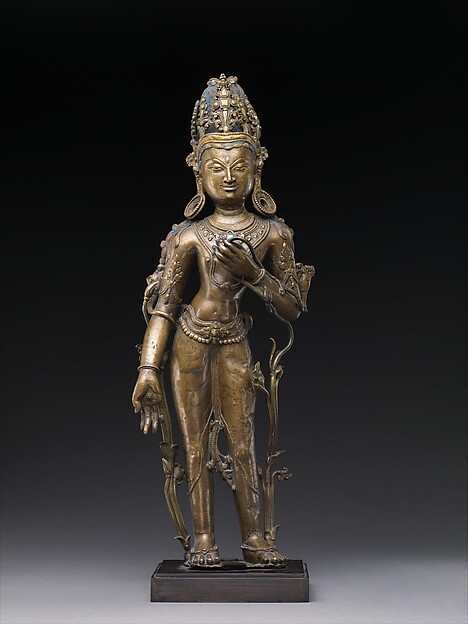
Tibet · 12th century · Bronze with later turquoise inlay
Look closer: A Tibetan Padmapani of the twelfth century in bronze, which the Met records as having later turquoise inlay. A connoisseur asks which parts of such a figure are original and which are additions, and a good record, like this one, says so.
The Metropolitan Museum of Art, New York, Gift of Ann and Gilbert Kinney, 2016, accession 2016.752. Public domain, Met Open Access. Museum record
Thangka: A Temple You Can Roll Up
The connoisseur's eyeA thangka is a painting on cloth, cotton or silk, in mineral and organic pigments bound in animal glue.3 The cotton is loosely woven and usually 40 to 58 centimetres wide.3 In Nepal, 24-carat gold is sometimes plated on the surface.3 After painting, the cloth is mounted with a textile backing and a silk cover, and rolled for storage.3
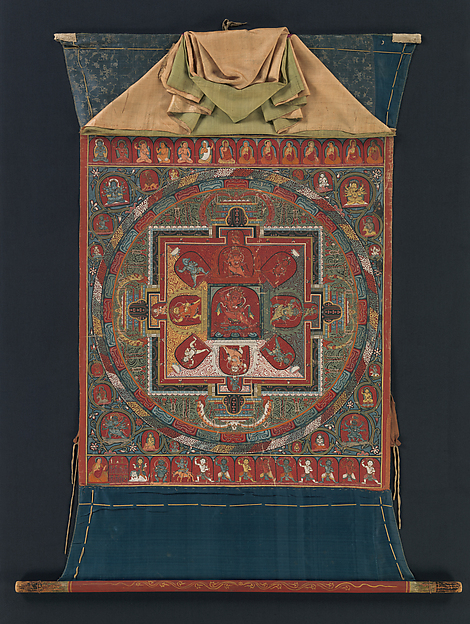
Central Tibet · late 14th century · Distemper on cloth
Look closer: Look at the painted square and at everything around it. A silk mounting frames the picture, with wooden rods at top and bottom and what looks like a silk cover at the head: the textile mounting that, as the Wikipedia article describes, lets a thangka be rolled up and unrolled. The Met catalogues this as a mandala of Raktayamari from central Tibet, late fourteenth century, in distemper on cloth.3
The Metropolitan Museum of Art, New York, Zimmerman Family Collection, Gift of the Zimmerman Family, 2012, accession 2012.444.3. Public domain, Met Open Access. Museum record
The Wikipedia article lists four types, painted, appliqué, embroidered and woodblock-printed, and names the subjects: deities, lamas, the life of the Buddha, mandalas and the Wheel of Life.3 The painter works to a geometric grid, and scripture sets the proportions of each deity.3

Central Tibet · ca. 1500 · Distemper on cloth
Look closer: Mahakala, the Protector of the Tent, in the centre, with rows of smaller figures around him. This painting is 162 centimetres high, against 95 for the mandala above. The Met dates it to about 1500, central Tibet.
The Metropolitan Museum of Art, New York, Zimmerman Family Collection, Gift of the Zimmerman Family, 2012, accession 2012.444.4. Public domain, Met Open Access. Museum record
The history is a lesson in survival. The earliest surviving Tibetan cloth paintings were found at Mogao, Dunhuang, and date from about 781 to 848; paintings from Tibet itself survive from the eleventh century; and the Newar paubha of the Kathmandu Valley dates from the thirteenth, with the earliest surviving Nepalese thangka from about the fourteenth.3
The grid and the mounting are what a collector can read first; pigment, condition and date need an expert and a conservator. The house describes its own thangka-style objects, wherever it can, by what can be seen and measured.
Why It Matters in a Japanese Collection
The deep endThe Himalayan and Japanese traditions share a root in the Indian Vajrayana, which the second chapter traced, and they diverged in dress. In Tibet the mandala is painted on cloth in mineral and organic pigment; the Kamakura hanging scroll shown in the second chapter is recorded by the Met as ink, colours and gold on silk. A Japanese hanging scroll and a Tibetan thangka are cousins who have grown up in different houses.3
The meeting point is human. Kawaguchi's journey of 1900 to 1902 and his book of 1909 give a Japanese account of the country.5 A collector who finds a thangka or a Newar figure in Japan is often finding the residue of that history: a monk, a scholar or a traveller who brought it home, with an honest provenance if the owner kept the record.
| Medium | Tibet and Nepal | Japan |
|---|---|---|
| Mandala painting | Distemper on cotton, mineral pigments, sometimes gold3 | Ink, colours and gold on silk, as in the Kamakura scroll of chapter 2 |
| Metal figure | Gilt copper alloy with a reddish patina; later inlay2 | Gilt bronze and gilt wood |
| Mounting | Silk borders, rods and a cover, rolled3 | Hanging scroll with brocade borders and rollers |
| Teacher | Padmasambhava, Atisa, Tsongkhapa1 | Kukai, Saicho, Honen, Dogen |
The Jokhang and the House of the Jowo
First lookEvery account of the first Buddhist temples in Tibet begins with a marriage. Tradition says that Songtsen Gampo took a Nepali princess, Bhrikuti, and a Tang princess, Wencheng, and that each came with a sacred image.17 The Wikipedia article on the Jokhang gives the standard version: Bhrikuti brought an Akshobhya image, called Jowo Mikyo Dorje, and Wencheng brought the gilded bronze Jowo Shakyamuni, about 1.5 metres tall and showing the Buddha at the age of twelve. The Shakyamuni is now the most revered statue in Tibet and sits in the inner sanctum of the Jokhang.7

The temple at the centre of the Barkhor, founded by tradition in the seventh century
Look closer: Look at the roof above the entrance: Wikipedia describes gilded bronze roof tiles, golden deer flanking a Dharma wheel, and a Buddha Hall of four storeys. It also says the temple faces west, towards Nepal, in honour of Princess Bhrikuti, and that carbon dating shows the wooden beams to be original.7
Photograph: Rene Heise. CC BY-SA 4.0, with attribution. Source: Wikimedia Commons. CC BY-SA 4.0 File record

The temple's own foundation story is a folk tale. The king is said to have thrown his hat, or in another version a ring, and vowed to build a temple wherever it fell. It fell into a lake, a white stupa rose from the water, and the temple was built over that spot. In a second version the queen founded the temple to house the image she had brought, and the lake was filled in, leaving a small pond as a well.7 The temple was first called Rasa Trulnang, and Wikipedia adds that the city of Lhasa took its name after the king's death.7

Pilgrims gathered at the entrance
Look closer: Watch what the people are doing. Wikipedia describes pilgrims walking the circuit of the temple, spinning prayer wheels, prostrating before the main image, chanting the mantra of Avalokiteshvara and draping white katak scarves on the statue. The Barkhor square in front of the temple has four stone incense burners, two at the front and two at the rear.7
Photograph: Jan Kranendonk. CC BY-SA 4.0, with attribution. Source: Wikimedia Commons. CC BY-SA 4.0 File record

The images did not always stay where they were first set. In the account on the same page, Wencheng's Shakyamuni was first enshrined at Ramoche, a temple in Lhasa, and later moved to the Jokhang, reportedly to protect it from Chinese attack, and during the persecution of 755 to 797 the Akshobhya image was hidden underground so well that about two hundred searchers failed to find it.7 Whatever the dates, the pattern is the one this wing keeps meeting: a faith arrives as a gift from a foreign court, takes its first shape in a house built for one image, and survives because someone hides or carries that image.
| Image | Brought by | Where it stands now, per Wikipedia | Note |
|---|---|---|---|
| Jowo Shakyamuni, gilded bronze, about 1.5 m | Wencheng, the Tang consort7 | The inner sanctum of the Jokhang | Shows the Buddha at twelve7 |
| Jowo Mikyo Dorje, Akshobhya | Bhrikuti, the Nepali consort7 | Accounts differ between Ramoche and the Jokhang | Said to have been hidden during the persecution7 |
The Jokhang is also a place where the weight of the twentieth century can be read. The Wikipedia article reports that Red Guards attacked the temple from 24 August 1966, that worship stopped for about a decade, and that renovation began in 1972 and was largely complete by 1980, after which the temple was re-consecrated.7 Wikipedia lists the Jokhang as part of the Historic Ensemble of the Potala Palace, which was inscribed on the World Heritage List in 1994, with the Jokhang added in an extension in 2000 and a further extension in 2001.79
Samye: The Monastery Laid Out as a Mandala
The connoisseur's eyeIf the Jokhang is the temple of the consorts, Samye is the temple of the king. Wikipedia names Trisong Detsen as its patron and Shantarakshita as the abbot who began construction, with Padmasambhava credited with subduing the local spirits who obstructed the work.8 The first Tibetan monks were ordained there in 779, according to the same article, and the temple is dedicated to Vairocana.8

Photograph of 17 June 2014, released to the public domain by the photographer
Look closer: Find the large central building, then look for the circular outer wall. Wikipedia says the plan follows a mandala: the main shrine at the centre stands for Mount Meru, smaller buildings at the corners and cardinal points stand for the continents, and a circular wall with four openings encloses the whole.8
Photograph: Gyurmed. CC0. Source: Wikimedia Commons. File record

The building is a diagram. The main shrine has three storeys in three styles, which the article gives as Indian, Chinese and Khotanese from the bottom up. Four stupas in white, red, green or blue, and black stand at the corners, and four Vajrakilaya stupas at the cardinal points were meant to block hostile forces.8 The same plan, the page adds, influenced the monastery of Odantapuri in Bihar. A visitor entering the wall is, by design, walking into a mandala of the kind that the Mandala of Raktayamari, shown in this chapter, paints on cloth.83
The later history is of fire and rebuilding. The Wikipedia article lists civil war in the eleventh century, fires and an earthquake between the seventeenth and nineteenth centuries, and damage in the twentieth, especially in the Cultural Revolution; several of those claims carry a citation-needed tag on the page, so we repeat them as reported rather than established.8 The monastery has been rebuilt since 1988, with major efforts led by the tenth Panchen Lama from 1986, and it is again an active monastery.8
- About 763Construction begun by Shantarakshita, in the article's account.8
- About 767Padmasambhava subdues the spirits that obstructed the work.8
- 779The first Tibetan monks are ordained at Samye, and the infobox gives 779 for completion.8
- Early 790sThe Samye debate between Kamalashila and Moheyan, which the page dates to a five-year range.8
- From 1988The monastery is rebuilt and returns to use.8
The Potala: A Palace Named for a Pure Land
The connoisseur's eyeThe Potala is named for Mount Potalaka, the legendary home of Avalokiteshvara, and the Wikipedia article offers a second origin in a hill at Cape Comorin without choosing between them.9 It stands on Marpo Ri, the Red Mountain, which tradition holds to be Avalokiteshvara himself, one of three protective hills of Lhasa.9

The palace on Marpo Ri, the Red Mountain
Look closer: Pick out the two colours. The white block is the White Palace, which the Dalai Lama's household occupied from 1649; the red block at the centre is the Red Palace, added between 1690 and 1694. Wikipedia gives the palace 13 storeys and more than 1,000 rooms, standing about 3,700 metres above sea level.9
Photograph: Ondřej Žváček. CC BY 2.5, with attribution. Source: Wikimedia Commons. CC BY 2.5 File record

A palace of Songtsen Gampo is said to have stood there in 637, and two chapels in the north-west corner are said to preserve parts of it. The palace seen today was begun in 1645 on the order of the Fifth Dalai Lama, on the advice of Konchog Chophel, with Wikipedia noting that the decision may have been taken during or soon after 1644 by the regent and Gushri Khan. The exterior took about three years and the interior about forty-five, and the Red Palace was added between 1690 and 1694, about twelve years after the Fifth Dalai Lama's death.9
The scale is part of the argument. The page gives the palace about 400 metres east to west and 350 metres north to south, with walls averaging 3 metres thick, 5 metres at the base, and copper poured into the foundations as protection against earthquakes. It counts more than 1,000 rooms, 10,000 shrines and about 200,000 statues.9 The Dalai Lamas lived there from 1649 to 1959, and the palace has been chiefly a museum since.9
- UNESCO inscribed the Potala ensemble in 1994, with extensions in 2000 and 2001, the first adding the Jokhang; Wikipedia gives restoration costs of RMB 55 million for 1989 to 1994 and RMB 180 million from 2002.9
- Visitor numbers are capped: 1,600 a day from 2003, raised to 2,300 after the Qingzang railway opened in 2006, and access to the roof was banned after 2006.9
Atisha and the Lamp for the Path
The connoisseur's eyeThe second diffusion of Buddhism into Tibet has a teacher at its centre. Wikipedia gives Atisha's dates as about 982 to 1054, and his birthplace most probably as the village of Vajrayogini in Vikrampura, one of the Pala capitals in Bengal. He became a senior scholar at Vikramashila, left in 1040 with the abbot's permission on condition that he return within three years, and travelled through Nepal with Naktso and Gya Lotsawa to Tholing, the capital of the Purang kingdom, where he spent three years.12
At Tholing he compiled the Bodhipathapradipa, the Lamp for the Path to Enlightenment, in sixty-seven verses. The article calls it his most influential work and the model for the lamrim texts that followed.12 His chief disciple, Dromtonpa, is regarded as the holder of his tantric lineage and as an enforcer of the ethical standards he taught, and Atisha and Dromtonpa are regarded as the founders of the Kadam school, which the Gelug tradition absorbed in the fourteenth century.12 The history section above gives 1042 for his arrival; the Atisha article gives 1040 for his departure from Vikramashila and does not date the arrival, so 1042 rests on the first source alone.112
Araniko, the Newar Boy Who Built for Kublai Khan
The connoisseur's eyeThe Met's essay says that Chinese and Tibetan temples imported Nepali artists, and the best-documented case is a boy.2 Wikipedia gives Araniko's life as 1245 to 1306 and tells the story this way: in 1260 Kublai Khan ordered the Sakya hierarch Phagpa to build a golden stupa in Tibet; Phagpa asked Nepal for one hundred artists; the king, Jayabhimadeva, sent eighty; and Araniko, about seventeen, was chosen to lead them.11
He supervised the stupa, built inside the main hall of Sakya Monastery, for about two years, then became Phagpa's disciple and went on to the Mongol court. He reached Shangdu around the end of 1262, restored a bronze figure that a Song emperor had given the court, and in 1273 became Director of All Artisan Classes. The White Pagoda of Miaoying Temple in Beijing, built between 1279 and 1288, stands about 50.9 metres high; Wikipedia credits it to him, and records damage in the Tangshan earthquake of 1976 and repairs from 1978.11
Almost everything we know comes from Chinese sources. Nepali records do not mention him, and the article records that his name is spelled Aniko, Anige or Araniko, that one Nepali scholar's early Sanskrit reconstruction of the name was a mistake, and that his birthplace in Patan and his Newar caste are suggestions rather than established facts.11 The Met's essay says the tradition is conservative; the life of Araniko is the evidence that a conservative tradition could still travel across a continent.2
Swayambhu and Boudha: The Great Stupas
The connoisseur's eyeThe Kathmandu Valley holds two stupas that every Himalayan Buddhist knows. Wikipedia calls Swayambhunath one of the most ancient and important stupas in the world, though it gives no construction date; the Swayambhu Purana tells that Manjushri drained the valley's lake with a sword, the only dated inscription mentioned is a damaged stone recording work ordered in 640, and the visit of Ashoka in the third century BCE is presented as tradition.13 The monkeys that live there give it the name of the Monkey Temple.13 For Newar Buddhists, daily practice at Swayambhu is central, and for Tibetans it ranks second only to Boudha.13

The largest spherical stupa in Nepal, in the Kathmandu Valley World Heritage property
Look closer: Read the monument from the ground up: a broad stepped base, a white dome, and a gilded spire above it. Wikipedia gives its maximum height as 36 metres and describes the layout as a large mandala; the Tibetan name Jarung Khashor is said to come from a king's approval, "let it be done", that slipped from his tongue.10
Photograph: Bernard Gagnon. CC BY-SA 4.0, with attribution. Source: Wikimedia Commons. CC BY-SA 4.0 File record

Boudha is the other. Newar chronicles, as summarised by Wikipedia, credit it to the Licchavi king Manadeva as atonement for a death he caused by accident; another source credits King Shivadeva, who lived about 590 to 604; and the Tibetan teaching recorded by Yeshe Tsogyal ascribes it to a poultry-farmer reborn from a goddess, whose four sons were reborn as Trisong Detsen, Shantarakshita, Padmasambhava and Bami Trizher.10 The present structure was most likely built in the fourteenth century, while the chronicles claim a stupa on the site as early as the fifth.10

The hilltop stupa of the valley, also called the Monkey Temple
Look closer: Look at the setting as well as the dome: Swayambhunath crowns a hill, and its complex also holds Hindu temples and deities, a point Wikipedia notes while classing the site as Buddhist. The page records a complete renovation in 2010, the first major one since 1921, and damage in the earthquake of April 2015.13
Photograph: Bijay Chaurasia. CC BY-SA 4.0, with attribution. Source: Wikimedia Commons. CC BY-SA 4.0 File record

After the uprising of 1959, many Tibetan refugees settled around the stupa, and the community has built over fifty gompas and monasteries, with restaurants, guesthouses and artisan businesses.10 Both stupas belong to the Kathmandu Valley World Heritage property, inscribed in 1979.1013
A Thangka in the Making
The connoisseur's eyeThe Wikipedia article on thangka gives the working order in outline. The support is loosely woven cotton, usually 40 to 58 centimetres wide, or silk. The drawing follows the grid. The pigments, mineral and organic, are bound in animal glue, applied warm and mixed shortly before use, which is why the article classes the medium as distemper and not gouache. In Nepal, 24-carat gold is sometimes plated over parts of the picture, which raises the price.3

Photograph by Luca Galuzzi, 2006
Look closer: The cloth is stretched on a frame and the figure begins as lines. Wikipedia explains that the composition is geometric, with the body and ritual objects placed on a grid of angles and intersecting lines, and that the proportions follow scriptural rules; the painter chooses from predesigned elements.3
Photograph: Luca Galuzzi (Lucag). CC BY-SA 2.5, with attribution. Source: Wikimedia Commons. CC BY-SA 2.5 File record

Most painted thangkas are about 20 to 50 centimetres high, and the small tsakli cards are up to about 15. The festival hangings called thongdrel, usually appliqué, can be sixty feet wide or more and were unrolled on monastery walls for brief periods.3 The article cautions that many sources call thangkas tapestries, but true woven tapestry is extremely rare; most so-called tapestries are embroidery, appliqué or a combination.3
Condition is the collector's first question. A thangka lasts a long time when it is kept rolled, unframed and protected by its silk cover, and moisture damages the silk. X-rays can reveal inscriptions under the paint, and the back often carries a mantra or notes of later ownership.3 The article also records that thangkas were made to earn merit and have become commercial, and that printed poster reproductions are widely used for devotion because originals are costly.3
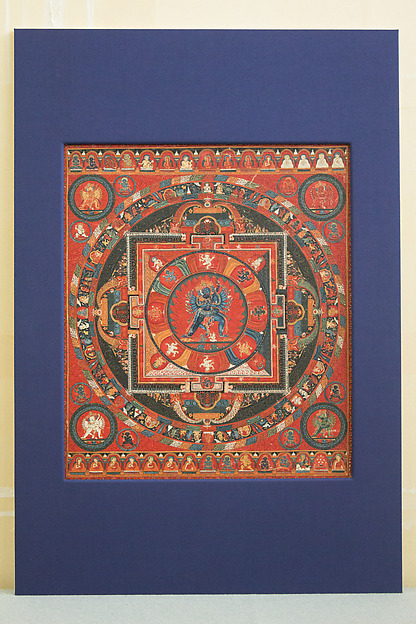
Tibet · 16th century · Ink and distemper on cloth
Look closer: A Hevajra mandala, catalogued by the Met as ink and distemper on cloth, attributed to the Sakya school, sixteenth century and measuring 54 by 45.6 centimetres. Find the central deity at the middle of the geometry and notice how the whole composition is laid out around it, as the grid described above.
The Metropolitan Museum of Art, New York, Gift of Henry and Louise Loeb, 1982, accession 1982.225. Public domain, Met Open Access. Museum record
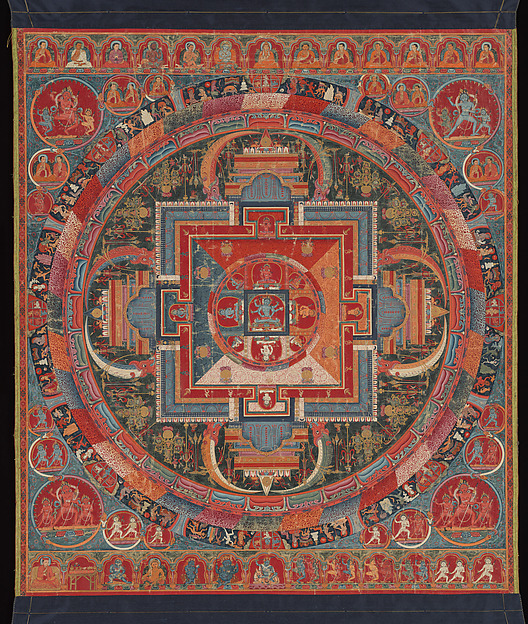
Tibet · late 14th century · Distemper on cloth
Look closer: A Mandala of Jnanadakini, dated by the Met to the late fourteenth century, in distemper on cloth. The image alone is 74.9 by 83.8 centimetres, larger than the Hevajra mandala beside it, and the Met records that it is shown with a traditional textile mount.
The Metropolitan Museum of Art, New York, Purchase, Lita Annenberg Hazen Charitable Trust Gift, 1987, accession 1987.16. Public domain, Met Open Access. Museum record
Kawaguchi's Journey, More Closely
The connoisseur's eyeWikipedia fills in the early life that the opening of this chapter only names. Kawaguchi was born Sadajiro on 26 February 1866 and was rector of the Gohyaku-rakan-ji monastery in Tokyo until March 1891; he then spent about three years as a hermit in Kyoto studying Chinese Buddhist texts and learning Pali.5 He left Japan in June 1897 for India on a cargo boat, refusing donations from friends, and in India he won the support of Sarat Chandra Das, who helped his passage north. He stayed several months in Darjeeling, living with a Tibetan family.5

Portrait photograph, recorded on Wikimedia Commons as in the public domain
Look closer: Set the portrait beside the facts. Wikipedia describes a man who from childhood kept vows of vegetarianism, chastity and temperance, who had no money and no map when he left Japan in 1897, and who learned Tibetan in Darjeeling from children and women in the household where he lived.5
Photograph: Zaida Ben-Yusuf. Public domain. Source: Wikimedia Commons. File record

The way in took almost four years, with stops at monasteries and a pilgrimage around Mount Kailash. In Lhasa he posed as a Chinese monk, gained a reputation as a doctor who practised both Chinese and Western medicine, studied at Sera Monastery, and had an audience with the thirteenth Dalai Lama.515 The end was frightening: told that his cover was blown, he fled, and several of the people who had sheltered him were tortured and mutilated. From outside Tibet he petitioned the Nepali prime minister, Chandra Shumsher Rana, who recommended that the Tibetan government release his friends, and it did.5
A diary of the flight has since come to light. The Buddhistdoor report of the discovery, which does not give the year of the find, says it covers 1 January to 17 August 1902 in seventeen pages written mainly in kanji and katakana, and describes the escape from Lhasa and a journey of about 400 kilometres to Darjeeling. It was found at the home of his niece, then ninety, in Tokyo, and the city of Sakai, his birthplace, announced it and planned an exhibition at the Sakai City Museum.15
What Has Changed in the Valley
The connoisseur's eyeThe most visible modern event in this chapter is the rebuilding of Boudha. The earthquake of 25 April 2015 severely cracked the spire and damaged the structure above the dome. Reconsecration began on 22 November 2015 with the insertion of a new central life-tree pole; all consecration relics were in place by 17 October 2016, and a 21-day ritual led by representatives of the Kagyu, Sakya, Gelug and Nyingma orders followed. The stupa reopened on 22 November 2016.10
Wikipedia gives the cost as about 2.1 million dollars and more than 30 kilograms of gold, funded entirely by private donations, with the work organised by the Boudhanath Area Development Committee, and it adds that this was the first earthquake-damaged World Heritage site in the valley to be rebuilt.10 These figures rest on a single reference article.
The wider tradition has also travelled. After the Dalai Lama left Tibet in 1959 and many clergy and citizens followed him into India, Tibetan Buddhist centres were established in Europe and North America from the 1960s, most now supported by non-Tibetan followers, and Kagyu Samye Ling, founded in 1967, is described as the first in the West.14 Tibetan Buddhism is also widely practised in Mongolia, where Altan Khan gave the title Dalai Lama to Sonam Gyatso in 1578, and in Bhutan, Sikkim, Ladakh and Tuva.14
Fun Facts from the Roof of the World
First lookEight small facts, each from a source cited in this chapter.
- The Jokhang's wooden beams are original, according to carbon dating reported on Wikipedia, and its Newari door frames, columns and finials from the Kathmandu Valley date to the seventh and eighth centuries.7
- A walled enclosure beside the Jokhang holds the stump of the Princess Willow, said to have been planted by Wencheng.7
- Samye's plan influenced the monastery of Odantapuri in Bihar, a reminder that the mandala plan was not confined to one country.8
- The Potala has copper poured into its foundations to protect against earthquakes.9
- Araniko's White Pagoda in Beijing was damaged by the Tangshan earthquake of 1976 and repaired from 1978.11
- Swayambhunath is called the Monkey Temple because families of wandering monkeys live on the hill.13
- The Boudha stupa rebuild took 30 kilograms of gold and about 2.1 million dollars of private gifts.10
- Kawaguchi is said to have planted two Himalayan cicada tree saplings near the gate of Obaku-san Manpuku-ji.5
The Same Teaching Elsewhere in Asia
The deep endThe Tibetan story overlaps with every other chapter in this wing. The Yuan dynasty adopted Tibetan Buddhism as its de facto state religion, according to Wikipedia, and the canon was largely finalised in the thirteenth century through the work of Buton Rinchen Drub during the Yuan period; Araniko's career belongs to that moment.1411 The Mongol conversion was later sealed by Altan Khan's gift of the Dalai Lama title in 1578.14
In Japan the nearest parallel is the esoteric teaching of the Shingon school, which the Wikipedia article on Tibetan Buddhism mentions only as a Japanese school that shares Vajrayana practices with the Tibetan tradition.14 The later Japanese record is the human one of Kawaguchi, who travelled to the source of the Tibetan tradition and wrote it down.5
A Short Glossary for This Chapter
First lookTerms in the order a reader meets them.
| Term | Meaning |
|---|---|
| Jowo | The title of the most revered image in a Tibetan temple; the Jowo Shakyamuni is the main image of the Jokhang.7 |
| Barkhor | The market square and pilgrim circuit around the Jokhang.7 |
| Katak | A white scarf draped on a statue as an offering.7 |
| Utse | The central temple at Samye, taken as Mount Meru in the mandala plan.8 |
| Marpo Ri | The Red Mountain on which the Potala stands.9 |
| Lamrim | The graded path to enlightenment, modelled on Atisha's Lamp for the Path.12 |
| Newar | The people of the Kathmandu Valley, whose artists were renowned across Asia.2 |
| Paubha | The Newar form of painted cloth, made in the valley since the thirteenth century.3 |
| Thongdrel | A very large festival hanging, usually appliqué, unrolled on a monastery wall for a short time.3 |
| Kora | The ritual walk around a holy place, of which the pilgrim circuit at the Jokhang is an example.7 |
| Tulku | A recognised reincarnation of a teacher, as in the line of the Dalai Lamas.14 |
A Collector's Eye on the Himalayan Pieces
The connoisseur's eyeFew objects in this chapter are in circulation as the originals they are named for. A collector in Japan meets the afterlife: gilt-copper figures in the Newar manner, bronzes of Tara and Avalokiteshvara, thangka-style paintings, mandala hangings and ritual metalwork brought home in the twentieth century. The questions are the ones a good museum record asks.
Is the metal copper alloy with a reddish patina, as the Met's essay describes for Newar work, and is the gilding thin where hands would have touched it?2 Has the piece later inlay, which the Met records for its twelfth-century Padmapani as turquoise? For a painting: is the support cotton or silk, is the paint distemper, are there inscriptions on the back, and is the mounting silk?3 What the piece cannot say about itself, a careful note says for it.
The house's wording rule is that a title which says Tibetan style or Himalayan art describes manner, and makes no claim about date or workshop.6 A sceptical buyer should be glad of that restraint, for the same Met essay warns that scholars cannot distinguish a Hindu from a Buddhist style in the valley, because the same artists probably worked for both.2
Himalayan Pieces in the House
The house holds a small number of Tibetan-style and Himalayan-style pieces found in Japan, among them figures catalogued under Tara, Vajrasattva, Tsongkhapa, Amitayus, Manjushri and Medicine Buddha, and hanging scrolls. Titles that say Tibetan Style or Himalayan Art describe manner, and make no claim about date or workshop; the ethics page explains the house's wording.6
The strip below fills from the live shelf on the day you read this. If it is empty, the pieces are between displays, and the links under it lead to the full shelves.
Pieces in the house now
- Asian Antiques Found in JapanTibetan, Himalayan, Chinese and Korean pieces
Filter by what you have just read
Answered plainly
How did Buddhism reach Tibet?
Tradition credits Songtsen Gampo, 618 to 649, with introducing it, and his Nepali and Tang consorts with bringing the first images. It became the state religion under Trisong Detsen in the later eighth century.1
What is a thangka?
A painting on cotton or silk, in mineral and organic pigments bound in glue, mounted in textile and rolled for storage.3
What are Newar bronzes?
Metal sculptures of the Newar artists of the Kathmandu Valley, typically heavily gilded with a reddish patina from high copper content.2
Who was Ekai Kawaguchi?
A Japanese Zen monk, 1866 to 1945, who entered Tibet in 1900 and returned in 1902, and wrote Three Years in Tibet, published in 1909.5
Is Nepalese Buddhist art different from Hindu art?
Scholars cannot reliably distinguish the styles, and the same artists probably worked for both traditions.2
Is Himalayan art the same as Tibetan art?
No. Nepal's Newar tradition is distinct, and Tibetan and Chinese temples imported its works and its artists.2
Who built the Jokhang?
Tradition credits Songtsen Gampo, with the two consorts Bhrikuti and Wencheng each bringing an image. Wikipedia gives around 640 in its introduction and 652 in its infobox for the temple, so the date is not settled.7
What is the most sacred statue in Tibet?
The Jowo Shakyamuni in the inner sanctum of the Jokhang, a gilded bronze about 1.5 metres high showing the Buddha at twelve, brought, in the usual account, by Wencheng.7
When was Samye monastery founded?
Sources differ. Wikipedia's infobox gives 779, another passage 780, the Testament of Ba gives dates in the 760s and 770s, and the Blue Annals of 1476 give 787 and 791.8
Who built the Potala Palace?
The palace seen today was begun in 1645 under the Fifth Dalai Lama, with the White Palace occupied in 1649 and the Red Palace added between 1690 and 1694; tradition places an earlier palace of Songtsen Gampo on the site in 637.9
Who was Atisha?
An Indian teacher, about 982 to 1054, who left Vikramashila in 1040, spent three years at Tholing, and compiled the Lamp for the Path to Enlightenment; he and Dromtonpa are regarded as founders of the Kadam school.12
Who was Araniko?
A Newar artist, 1245 to 1306, who led eighty Nepali artists to build a stupa in Tibet in 1260 and then worked for Kublai Khan, and who is credited with the White Pagoda in Beijing. Nearly all we know comes from Chinese sources.11
What is the Boudhanath stupa?
A stupa in Kathmandu, at 36 metres high the largest spherical stupa in Nepal, in the Kathmandu Valley World Heritage property inscribed in 1979. Its present form is most likely of the fourteenth century.10
Was Boudhanath damaged in the 2015 earthquake?
Yes. The earthquake of 25 April 2015 cracked the spire and damaged the structure above the dome; it was reconsecrated and reopened on 22 November 2016 after a rebuild funded by private donations.10
Why is Swayambhunath called the Monkey Temple?
Because families of wandering monkeys live on the hill and in the temple complex.13
How is a thangka painted?
On cotton or silk, to a geometric grid whose proportions follow scripture, with mineral and organic pigments bound in animal glue, sometimes with gold, and then mounted in silk.3
Is Tibetan Buddhism practised in Japan?
The Wikipedia article we read does not discuss it; it mentions only that Shingon shares Vajrayana practices. The Japanese link in this chapter is Ekai Kawaguchi's journey of 1900 to 1902.145
When did the Dalai Lama leave Tibet?
In 1959, with many clergy and citizens, settling in India, where the government in exile is based at Dharamsala.14
Where next
Sources and image credits
- Wikipedia, Tibetan Buddhist History Kings, teachers, debate, orders, the Dalai Lama title.
- The Metropolitan Museum of Art, Nepalese Sculpture (Kathryn Selig Brown, 2003) Newar art, gilding, style and the Hindu-Buddhist question.
- Wikipedia, Thangka Materials, mounting, types, subjects and earliest surviving examples.
- Wikipedia, Kathmandu Valley Newars, Araniko, World Heritage status.
- Wikipedia, Ekai Kawaguchi His life, journey and book.
- Japonista, The ethics of collecting religious objects How the house describes style and provenance.
- Wikipedia, Jokhang Foundation legends, the two images, Ramoche, architecture, 1966 to 1980, World Heritage extensions.
- Wikipedia, Samye Founding dates and their disputes, mandala plan, damage, rebuilding.
- Wikipedia, Potala Palace Legend of 637, the building of 1645 to 1694, dimensions, World Heritage dates, visitor limits.
- Wikipedia, Boudha Stupa Origin accounts, dimensions, the 2015 earthquake and reconstruction, the Tibetan community.
- Wikipedia, Arniko Life dates, the mission of 1260, Sakya stupa, White Pagoda, name and birthplace questions.
- Wikipedia, Atisha Life, Vikramashila, Tholing, the Lamp for the Path, Dromtonpa and the Kadam school.
- Wikipedia, Swayambhunath Legend and inscription, monkeys, sacredness, renovation of 2010, 2015 damage.
- Wikipedia, Tibetan Buddhism Four schools, canon, Mongolia, exile of 1959, spread to the West.
- Buddhistdoor, Rediscovered diary reveals Japanese Buddhist monk's escape from Tibet The 1902 diary, its contents and its discovery.
Last reviewed 28 October 2026. Dates in this chapter follow the cited pages; where the sources disagree, the chapter says so. Every picture is public-domain or openly licensed, and its credit and licence stand beneath it.
If a thangka, a gilt Himalayan figure or a Tibetan-style piece found in Japan has caught your eye, the concierge desk will search Japan on your behalf.
Private concierge
Looking for something in particular?
Describe the piece or the project you have in mind. A senior advisor in Tokyo reads every case file personally and replies within two business days, with fees set out in writing before any work begins.