
Lacquer for the Table: Negoro, Wajima and Shunkei
Surface Depth
Lacquer for the Table: Negoro, Wajima and Shunkei
Lacquer is the oldest finish in the Japanese house and the last of the great household crafts to be examined in this almanac. This chapter follows the sap of one tree from a Jōmon grave to the trays of Negoro, the bowls of Wajima, the clear Shunkei of Takayama and the boxes of Shibata Zeshin.
Fact sheet
At a glance
- 12,600 years. The oldest lacquer tree yet found, at the Torihama shell mound, is dated to the incipient Jōmon period by radiocarbon.
- Gold on wet lacquer. The method of sprinkling metal powder onto a drawn design, maki-e, was developed in Japan in the Heian period.
- Red that wears. Negoro ware is made with red lacquer laid over black, meant to wear away with use and show the black beneath.
- Wood grain showing. Shunkei lacquer is transparent lacquer over stained wood, so the grain can be seen.
- Japan’s greatest lacquerer. Shibata Zeshin, a lacquer artist of the Meiji era, has been given that title for his original designs.
A Finish Made from a Tree
Every other material in this part of the almanac has been shaped by a hand and a tool. Lacquer is different. It is a sap, tapped from a living tree, refined over months, and brushed in layer after layer onto a body of wood until it has the depth of glass. The result is hard, waterproof and warm, and it has been the finish of the Japanese table for thousands of years. The bowl for soup, the tray for tea, the box for a meal and the stand for a cup are all, in their different ways, forms that lacquer has taught the household to expect.
This chapter takes the long view. It begins with the Jōmon period, in which the sources find the oldest known lacquer tree and the first lacquered objects in the archipelago. It follows the craft through the Heian invention of maki-e, the export lacquer of the sixteenth century, the Rinpa designs of Hon’ami Kōetsu and Ogata Kōrin, and the great Meiji innovator Shibata Zeshin. Along the way it stops at three families of ware that suit the table: the worn red of Negoro, the diatomaceous-earth bowls of Wajima, and the transparent Shunkei of Takayama.
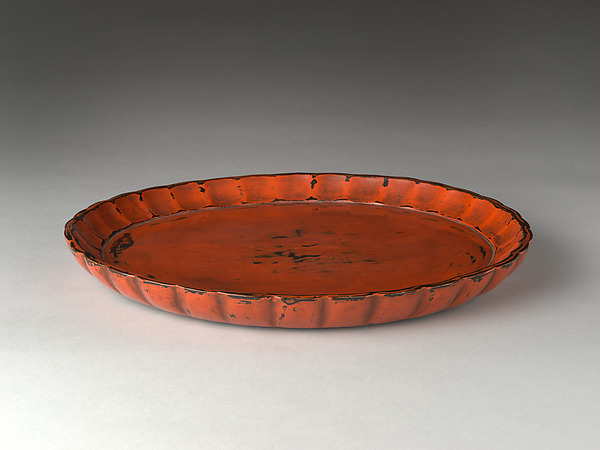
15th–16th century. Wood with layers of black and red lacquer (Negoro ware). The Metropolitan Museum of Art, accession 2019.193.18. Gift of Florence and Herbert Irving, 2019. Open Access.
Look closer: A lobed Negoro tray of the fifteenth or sixteenth century: red lacquer over black, worn at the centre with use.
The Metropolitan Museum of Art, public domain (Open Access). Source: https://www.metmuseum.org/art/collection/search/40295
The pictures are drawn from the open-access collection of the Metropolitan Museum of Art. The Negoro objects are old and plain, and most are trays and bowls from the fifteenth to the early seventeenth century. The works by Zeshin are later and richer, from the 1870s and 1880s. Together they show the two poles of lacquer: a surface that is meant to wear, and a surface that is meant to dazzle.
One caution runs through the chapter. Lacquer is a field of precise terms, and Wikipedia’s articles on it are sometimes thin or at odds with one another on dates. Where the sources disagree on a date, this chapter leaves the date out rather than choose.
Jōmon Origins: The Oldest Lacquer Tree
Wikipedia’s account of Japanese lacquerware begins in the Jōmon period. It reports that a lacquer tree has been confirmed in Japan from 12,600 years ago, in the incipient Jōmon period, by radiocarbon dating of wood from the Torihama shell mound, and that this is the oldest lacquer tree in the world found as of 2011. Lacquer itself was in use in Japan as early as 7000 BCE. Evidence for the earliest lacquerware was found at the Kakinoshima B excavation site in Hokkaido, where ornaments woven with lacquered red thread came from a pit grave of the first half of the initial Jōmon period, and at the Kakinoshima A site a spouted earthenware vessel painted with vermilion lacquer, made 3,200 years ago, was found almost completely intact.
The Jōmon, the article says, may have invented lacquering technology. They learned to refine urushi, the sap, in a process that took several months. Iron oxide, in the form of colcothar, and cinnabar, a mercury sulphide, were used to make red lacquer. Lacquer was applied to pottery and to many kinds of wooden object, and in some cases burial clothes were lacquered too. Many lacquered objects appear in the Early Jōmon period, which suggests that the craft was an established part of Jōmon culture.
Whether the technique came from China or was invented in Japan is a question on which, Wikipedia says, experts are divided. It cites Mark Hudson, who believes that Jōmon lacquer technology was developed independently in Japan rather than being introduced from China, as once believed. The matter is unsettled, and this chapter leaves it open.
The article also names one of the masterpieces of early lacquer, the Tamamushi Shrine, of the middle of the seventh century AD. It is made of lacquered hinoki, the Japanese cypress, and camphor wood. Its paintings are commonly called urushi, though since the Meiji period some scholars have argued that they were made in a different technique, mitsuda-e, an early type of oil painting using perilla oil with litharge as a drier. The object is a reminder that even for the oldest works the vocabulary of lacquer is not always settled.

12th century. Negoro ware, red and black lacquer. The Metropolitan Museum of Art, accession 2015.500.2.8. Gift of Florence and Herbert Irving, 2015. Open Access.
Look closer: A Negoro sutra tray of the twelfth century in red and black lacquer: the earliest of the Negoro objects shown here.
The Metropolitan Museum of Art, public domain (Open Access). Source: https://www.metmuseum.org/art/collection/search/40271
The names in English show how far the craft spread. Wikipedia notes that the terms japanning and urushiol, and maque, the Mexican Spanish word for lacquer, are derived from Japanese lacquerware. The same article gives the Japanese terms: shikki, meaning lacquer ware in the most literal sense, nurimono, meaning coated things, and urushi-nuri, meaning lacquer coating.
Maki-e, Export Ware and the Rinpa Designs
The characteristic decoration of Japanese lacquer is maki-e, the sprinkling of metal powder onto a design drawn in wet lacquer. Wikipedia explains that drawing a design with a brush from gold powder dissolved in lacquer is a common technique in other countries, but that drawing the design in lacquer and then sprinkling gold, silver or copper powder of various sizes and shapes over it, and then polishing, was developed in Japan, in the Heian period (794 to 1185). It made the gold and silver of lacquerware brighter than before. Several kinds of maki-e were developed in that period, one completed then and another developed in its latter half.
The sources name the other great steps. In the Kamakura period (1185 to 1333), carved lacquer of the Song dynasty was imported from China. Japanese craftsmen, however, mostly did not adopt the Chinese method of building up lacquer and carving it; they made Kamakurabori, in which wood is carved and then coated with lacquer. In the Muromachi period (1336 to 1573) the most complicated of the maki-e techniques was developed, together with new techniques using grinding stones and clay powders, and Japanese lacquer was exported in quantity to East Asia, Southeast Asia and even India.
The article gives a vivid detail from India. Japanese lacquer was known at Indian courts, and it figured among the gifts offered by Europeans to local rulers. Sir Thomas Roe, it says, knew it as a suitable gift for the emperor Jahangir, and noted in 1616 that rarities from China and Japan were highly desirable there. In China, Ming and Qing rulers generally called Japanese lacquer foreign lacquer, yangqi, and the Yongzheng Emperor is documented as taking a formidable interest in it, a taste that showed in work made in the imperial workshops during his reign.
In the Azuchi-Momoyama period (1568 to 1600), lacquer reached colonial Mexico by the Manila galleons and Europe by the Nanban trade. European aristocrats and missionaries were attracted to it, and Western-style chests and church furniture were exported to order. In the same period, one kind of decoration became very popular because it could be mass produced.
The Edo period (1603 to 1868) saw lacquer trees cultivated more intensively and techniques developed. Coloured lacquers came into wider use in the eighteenth century. Hon’ami Kōetsu and Ogata Kōrin brought the designs of the Rinpa school of painting into lacquerware; the article mentions a tiered stand with designs alluding to The Tale of Genji by Kōetsu, and a work by Kōrin that is a National Treasure. From the middle of the Edo period, the inrō, a small stacked case worn at the waist by men, became a fashionable accessory, and wealthy merchants and samurai collected inrō of high aesthetic value. Marie Antoinette and Maria Theresa are known collectors of Japanese lacquer, and their collections are now exhibited in the Louvre and at Versailles.
Negoro: Red That Is Meant to Wear Away
Negoro is the plainest and perhaps the most admired of the old lacquers. Wikipedia says it was produced at the Negoro-ji temple complex in Izumi province, and that the red layers of lacquer on Negoro wares are intended to gradually wear away with use, revealing the black lacquer underneath. This effect, it adds, has since been copied and emulated elsewhere. That is the whole idea of the ware in a sentence: a red surface laid over black, so that years of handling draw a pattern of black through it.
The Metropolitan Museum’s Negoro group, the gift of Florence and Herbert Irving, shows the idea at work across several centuries. A round Negoro tray, a kōban, of the first half of the fifteenth century, is 41.6 centimetres across, with a raised rim on a foot, and its face is worn through to the black in irregular patches. A large lobed tray, a rinka-bon, of the fifteenth or sixteenth century, is 37.1 centimetres across, with a scalloped rim, and the red has worn dark at its centre.

first half 15th century. Lacquered wood with coatings of red lacquer over black lacquer (Negoro ware). The Metropolitan Museum of Art, accession 2015.500.2.57. Gift of Florence and Herbert Irving, 2015. Open Access.
Look closer: A round Negoro tray of the first half of the fifteenth century, its red worn to the black beneath in patches.
The Metropolitan Museum of Art, public domain (Open Access). Source: https://www.metmuseum.org/art/collection/search/40280

late 16th–early 17th century. Negoro ware; red lacquer over black lacquer. The Metropolitan Museum of Art, accession 2015.500.2.12. Gift of Florence and Herbert Irving, 2015. Open Access.
Look closer: A footed Negoro bowl of the late sixteenth or early seventeenth century, in red over black.
The Metropolitan Museum of Art, public domain (Open Access). Source: https://www.metmuseum.org/art/collection/search/40302
A footed bowl of the late sixteenth or early seventeenth century stands 15.2 centimetres high and 40 centimetres across, in red over black. A bowl dated to 1580 is 32.6 centimetres across, darker and browner in tone than the bright bowls. A high-footed bowl of the early seventeenth century, 18.7 centimetres high and 37.5 across, is smooth and bright, with little wear.
The group includes older and more formal pieces. A Negoro sutra tray of the twelfth century, 30.8 by 40 centimetres, has a red interior and a black rim, and a storage case, a karabitsu, is dated 1422 and stands on four legs with gilt-bronze fittings. A table tray, a tsuigasane, of the early seventeenth century, 36.8 centimetres high, sits on a stand pierced with lobed openings.
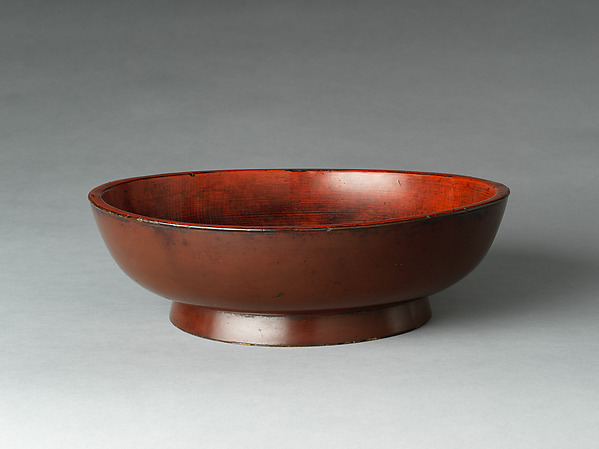
dated 1580. Red and black lacquer; Negoro ware. The Metropolitan Museum of Art, accession 2020.323.5. Gift of Florence and Herbert Irving, 2020. Open Access.
Look closer: A Negoro bowl dated 1580, darker and more worn in tone than the bright red bowls.
The Metropolitan Museum of Art, public domain (Open Access). Source: https://www.metmuseum.org/art/collection/search/40301

early 17th century. Negoro ware; red lacquer on black lacquer. The Metropolitan Museum of Art, accession 2015.500.2.13. Gift of Florence and Herbert Irving, 2015. Open Access.
Look closer: A high-footed Negoro bowl of the early seventeenth century, with a smooth, bright red surface.
The Metropolitan Museum of Art, public domain (Open Access). Source: https://www.metmuseum.org/art/collection/search/40304
What these objects teach is a lesson about the lacquered table. A lacquered object is not finished when it leaves the workshop. It is finished by use. The Negoro tray worn through at its centre has been held and set down and carried, and its patina is a record of that handling. A modern Negoro-style piece can imitate the wear, as Wikipedia notes, but the old pieces have earned theirs.

1422. Wood with layers of black and red lacquer (Negoro ware); gilt-bronze fittings. The Metropolitan Museum of Art, accession 2015.500.2.9a, b. Gift of Florence and Herbert Irving, 2015. Open Access.
Look closer: A Negoro storage case dated 1422, on four legs with gilt-bronze fittings.
The Metropolitan Museum of Art, public domain (Open Access). Source: https://www.metmuseum.org/art/collection/search/40272

early 17th century. Wood with black and red lacquer layers (Negoro ware). The Metropolitan Museum of Art, accession 2015.500.2.16. Gift of Florence and Herbert Irving, 2015. Open Access.
Look closer: A Negoro table tray on a pierced stand, of the early seventeenth century, in black and red lacquer layers.
The Metropolitan Museum of Art, public domain (Open Access). Source: https://www.metmuseum.org/art/collection/search/40307
Shunkei: Transparent Lacquer over Stained Wood
Where Negoro hides a black ground under red, Shunkei does the opposite. Wikipedia describes shunkei-nuri as lacquerware made with transparent lacquer on yellow-stained or red-stained wood, so that the natural grain can be seen. The article compares it, in this respect, with a second ware, kuroye nuri.
The name, the article says, is derived from an inventor who was active in Sakai during the reign of the Emperor Go-Kameyama, which it dates to 1368 to 1392. The method became popular in the seventeenth century in Takayama, in Hida province, and many articles for use in drinking tea were made with it. That is all the sources used for this chapter say. They give no detail of the process or of surviving early pieces, and so this chapter gives none.
It is worth setting Shunkei against its neighbours. A Negoro tray is a wear surface, a Wajima bowl a hidden structure of earth and lacquer, and a Shunkei box a window onto the wood. They are three answers to the one question of what lacquer should show. Negoro shows time, Wajima shows toughness, and Shunkei shows the tree from which the wood came.
No museum image of Shunkei is shown here. The open-access holdings used for this chapter do not identify any object as Shunkei, and the chapter does not guess.
Wajima-nuri: Earth Beneath the Lacquer
Wajima-nuri is the lacquerware of Wajima, on the Noto peninsula in Ishikawa Prefecture. Wikipedia says it represents a form and style distinct from other Japanese lacquerware, and names its main distinguishing feature: a durable undercoating made by applying multiple layers of urushi mixed with powdered diatomaceous earth, called ji-no-ko, onto delicate zelkova wood. The strength of the ware is in what cannot be seen, the layers beneath the surface.
The article places the establishment of the current Wajima technique in the Kanbun era, in the early Edo period. Wajima, at the northern tip of the Noto peninsula, was a port of call for the Kitamae-bune, the trading ships, and had by then widened its markets by shipping. There was also peddling by land, and the ware, which had a good reputation for its robustness, was used all over Japan. Chinkin, the technique of engraving the lacquer and filling the lines with gold, began in the Kyōhō era, in the middle of the Edo period, and maki-e in the Bunsei era, in the late Edo period.
The sources differ on the early history of Wajima lacquer, and the chapter does not attempt to settle them. Wikipedia’s article on Wajima-nuri speaks of production dating to ancient times, with excavated Heian finds and a Muromachi door, while its general article on Japanese lacquerware gives a different date for the ware. Both statements stand in the sources, and the chapter reports neither as the origin.
On the later history the sources agree. Exports declined because of the Sino-Japanese and Russo-Japanese wars, but Wajima lacquerware was shown at every overseas exposition and fetched an outstanding price among the lacquerware of the major production areas. Today it is widely sold as high-class lacquerware, and the Wajima Lacquer Art Museum in Wajima has become a tourist destination. Makers have also looked for new uses, such as Wajima lacquer violins, and studios have appeared that make one-of-a-kind pieces for patrons outside Japan.
The lesson of Wajima for the household is the lesson of the undercoat. A bowl for soup is knocked, washed and heated every day, and it lasts because of what lies beneath its black or red face. When the table is the test, the hidden layers decide.
Aizu, Tsugaru, Wakasa and Other Regional Wares
Beyond Negoro, Wajima and Shunkei, Wikipedia lists a number of regional wares, each with its own technique. They are set out in the table below. A short note on each follows.
Aizu ware developed in the late sixteenth century and peaked in the Meiji period. One Aizu technique is to etch designs or images into the lacquer and fill the space with gold or other material, and others involve the burnishing of clays and primers. Jōhana ware is generally known for maki-e and mitsuda-e, gold and lead decoration, and for the use of white or whitish lacquer.
Kawatsura lacquerware, from Yuzawa in Akita Prefecture, was originally used for sword sheaths, bows and armour, and now more commonly makes bowls, plates and household articles. Tsugaru ware features a technique supposedly developed by Ikeda Gentarō at the end of the seventeenth century, in which multiple layers of different coloured lacquers are used to create a colourful mottled effect. Wakasa ware uses a variety of colours and includes eggshell, rice chaff or other materials in the base coats, and silver or gold foil sealed under transparent lacquer.
Ryukyuan lacquerware, though frequently included among Japanese lacquer, developed largely independently, with strong influences from China and Southeast Asia, since the Ryukyu Islands did not come under Japanese control until 1609. The Craft x Tech Tohoku Project of 2024 put the old regional names back before an international public, pairing designers and technologists with artisans such as Kawatsura-Shikki of Akita and Tsugaru-Nuri of Aomori. Its work was shown at Art Basel and Design Miami and then at the Victoria and Albert Museum during the London Design Festival.
The Crafts Gallery of the National Museum of Modern Art, Tokyo, which collects works by Living National Treasures, moved to Kanazawa in Ishikawa Prefecture in 2020, a move made under the government policy of local revitalisation. Wikipedia describes Kanazawa as a city that flourished under the Maeda clan in the Edo period and has a thriving traditional industry.
| Ware | Place | Distinctive feature, according to Wikipedia |
|---|---|---|
| Negoro | Negoro-ji, Izumi province | Red lacquer over black, meant to wear away with use |
| Shunkei | Takayama, Hida province | Transparent lacquer over stained wood, with the grain visible |
| Wajima-nuri | Wajima, Ishikawa | Undercoat of urushi with diatomaceous earth on zelkova |
| Aizu | Aizu | Etched designs filled with gold; burnished clays and primers |
| Jōhana | Jōhana | Maki-e and mitsuda-e; white or whitish lacquer |
| Kawatsura | Yuzawa, Akita | Once for sword sheaths, bows and armour; now tableware |
| Tsugaru | Aomori | Layers of coloured lacquers for a mottled effect |
| Wakasa | Wakasa | Eggshell, rice chaff and foil under transparent lacquer |
| Ryukyuan | Ryukyu Islands | Largely independent, with Chinese and Southeast Asian influence |
Shibata Zeshin and the Lacquer Painters
The nineteenth century brought a crisis and a master. Wikipedia says that economic hardship in the early nineteenth century reduced demand for gold- and silver-decorated lacquerware. The Meiji era then saw a renewed interest in lacquer, as artists developed new designs, textures and finishes. Foremost among them was Shibata Zeshin, whom the article says has been called Japan’s greatest lacquerer. The appeal of his highly original style was in the choice of motif and subject rather than in embedded gold and silver. He even placed lacquer panels in frames, imitating Western oil paintings.
The article names two contemporaries who kept to a classical style that owed much to Japanese and Chinese landscape art, Nakayama Komin and Shirayama Shōsai, and says that maki-e was the most common technique for quality lacquer in the period. It also names two further decorative wares: Shibayama ware, invented in the 1770s, which combined lacquer with gold, silver, shell, ivory, coral, tortoiseshell and ceramics, and was popular in the Meiji period because it could be made more quickly and cheaply than traditional lacquer, and Somada ware, invented in the 1670s, which is characterised by a regular pattern of finely cut shell with gold and silver leaf.
The Metropolitan Museum holds several objects attributed to Zeshin, and they show his range. A writing box with a gourd, dated 1886, is a square box of black lacquer with gold and silver hiramaki-e and applied colour, 22.5 by 19.4 centimetres and only 3.8 centimetres high. A stacked food box, a jūbako, of the mid-nineteenth century, stands 41.9 centimetres high and is decorated with taro plants and chrysanthemums in hiramaki-e, takamaki-e and coloured togidashimaki-e. A tray of the 1880s, 37.5 centimetres long, shows rice stalks and a grasshopper on a tea kettle, in several kinds of maki-e on a ground that imitates bronze.

Shibata Zeshin, 1886. Black lacquer with gold and silver hiramaki-e, colored lacquer application. The Metropolitan Museum of Art, accession 36.100.142a–j. The Howard Mansfield Collection, Purchase, Rogers Fund, 1936. Open Access.
Look closer: A writing box of 1886 by Shibata Zeshin, black lacquer with a gourd in gold and silver hiramaki-e and applied colour.
The Metropolitan Museum of Art, public domain (Open Access). Source: https://www.metmuseum.org/art/collection/search/44868
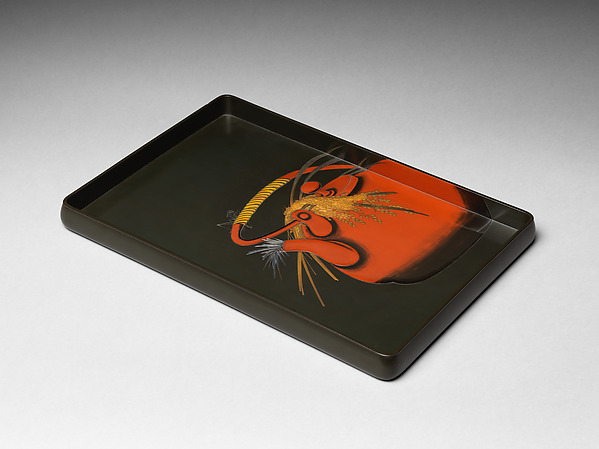
Shibata Zeshin, 1880s. Lacquered wood; gold, silver, red, yellow, black hiramaki-e and takamaki-e on “bronze imitation” (seido-nuri) ground. The Metropolitan Museum of Art, accession 2019.107. Purchase, Henrie Jo Barth Bequest, William R. Appleby Fund, and Gift of Mr. and Mrs. Spielman, by exchange, 2019. Open Access.
Look closer: A tray of the 1880s by Shibata Zeshin, with a bronze-imitating ground and a grasshopper on a kettle.
The Metropolitan Museum of Art, public domain (Open Access). Source: https://www.metmuseum.org/art/collection/search/52159
The smaller works are as telling. A set of sake cups of about 1878, each only 7 centimetres across and 2 centimetres high, is in plain red lacquer with black designs of the Three Friends. An inrō with stylised waves, 5 centimetres high, is of gold lacquer with pewter inlay, with a bronze and gold ojime bead and a netsuke carved from tortoiseshell in the form of a turtle. The cups and the inrō show the range of one hand, from a plain red surface to a jewel-like case.
Wikipedia credits Zeshin with another innovation, the use of colour. The limits of natural pigments, it says, allowed only five colours of lacquer, red, black, yellow, green and brown, until the nineteenth century, when various innovations appeared. Zeshin was a major innovator in this field, using not only colour but other substances mixed with his lacquer to produce a wide variety of effects, including the simulated appearance of precious metals, which were heavily restricted from artistic use at the time because of government concern about extravagance. The bronze-imitating ground of the tray is an example of the kind.
The Meiji government took an active interest in the export of lacquer and promoted it at a succession of world’s fairs. Wikipedia reports that lacquer from Japanese workshops was recognised as technically superior to what could be produced anywhere else in the world, and that richly decorated lacquerware in original designs was popular at home and even more so with Western buyers during the period of European and American fascination with Japanese art.

Shibata Zeshin, mid-19th century. Lacquered wood, gold and silver hiramaki-e, takamaki-e, and colored togidashimaki-e. The Metropolitan Museum of Art, accession 2015.300.289a–g. Mary Griggs Burke Collection, Gift of the Mary and Jackson Burke Foundation, 2015. Open Access.
Look closer: A stacked food box of the mid-nineteenth century by Shibata Zeshin, with taro leaves and chrysanthemums in several maki-e techniques.
The Metropolitan Museum of Art, public domain (Open Access). Source: https://www.metmuseum.org/art/collection/search/53416

Shibata Zeshin, ca. 1878. Red lacquer. The Metropolitan Museum of Art, accession 2019.193.43a–c. Gift of Florence and Herbert Irving, 2019. Open Access.
Look closer: Three red lacquer cups of about 1878 by Shibata Zeshin, each with a black design of the Three Friends.
The Metropolitan Museum of Art, public domain (Open Access). Source: https://www.metmuseum.org/art/collection/search/52161

Shibata Zeshin, 19th century. Gold lacquer with pewter inlay; Ojime: bronze and gold jar; Netsuke: carved tortoiseshell turtle. The Metropolitan Museum of Art, accession 36.100.249. The Howard Mansfield Collection, Purchase, Rogers Fund, 1936. Open Access.
Look closer: A gold lacquer inrō with pewter inlay, with a bronze and gold ojime and a carved tortoiseshell netsuke in the form of a turtle. Nineteenth century, by Shibata Zeshin.
The Metropolitan Museum of Art, public domain (Open Access). Source: https://www.metmuseum.org/art/collection/search/45456
Three Coats and Many Techniques
The process of making lacquerware, Wikipedia says, is fundamentally quite basic. An object is formed from wood, or sometimes leather, paper or basketry. Lacquer is applied to seal and protect it, and decoration is added. Generally three coats are used, an undercoat, a middle coat and a final coat, the last sometimes clear rather than black, so that decoration shows through. Alongside red and black lacquers, inlay is common, often of seashell or similar materials, as well as mica.
The article lists several traditional techniques. Ikkanbari, also called harinuki, is used to make tea wares: it applies layers of lacquer to paper shaped in a mould, and was invented by Hiki Ikkan in the early seventeenth century. Iro-urushi, colour lacquer, is made by adding pigments to clear lacquer. Raden uses inlays of shell and ivory, usually on a wooden base. Urushi-hanga, developed by Hakuo Iriyama, makes a printing plate from dry lacquer, carved and used like a woodblock but printed with pigmented lacquer.
Maki-e, in its several forms, is the crowning technique. In hiramaki-e, the metal powders are sprinkled onto wet lacquer and then covered with another layer of lacquer. Takamaki-e achieves a high relief by repeated layers, sometimes with charcoal, sawdust or clay added. Togidashi-e covers the first maki-e design with several layers of lacquer, then polishes down until the design appears. The powders, the article says, include gold, silver, copper and their alloys, and are spread with bamboo tubes or fine brushes.
The names on the Metropolitan Museum’s labels for the Zeshin objects, hiramaki-e, takamaki-e and togidashimaki-e, are exactly these techniques. A reader who has met them here can read a museum label with some confidence: hiramaki-e is flat, takamaki-e is raised, and togidashi is the polished-down kind where the design lies under the surface.
Living National Treasures and Collections Abroad
Lacquer is among the crafts for which Japan names Living National Treasures. Wikipedia lists the current holders, among them Kazumi Murose, Kōichi Nakano, Fumio Mae, Masami Isoi, Hitoshi Ōta, Yoshito Yamashita, Isao Ōnishi, Kunie Komori, Kiichō Masumura and Shōsai Kitamura, and past holders including Gonroku Matsuda, Shōzan Takano and Naoji Terai. The article says that the government’s designation of important craftsmen, with its encouragement of new urushi workshops, is gradually re-establishing the art.
It reports that the best lacquer technique of the end of the Edo and the Meiji period was almost lost in the westernisation of Japanese life, but that in 1985 a craftsman set up a studio and succeeded in recreating it, and that his works are collected in the Victoria and Albert Museum and the 21st Century Museum of Contemporary Art, Kanazawa.
Outside Japan, collections are rich. The Tokugawa Art Museum in Nagoya holds a lacquer collection that includes an Edo-period maki-e bridal trousseau designated a National Treasure. The Nasser D. Khalili Collection of Japanese Art has works by Zeshin and others, and the Charles A. Greenfield Collection in the United States covers the years 1600 to 1900. Marie Antoinette’s collection is split between the Louvre, the Guimet Museum and Versailles, and the Victoria and Albert Museum has about 2,500 pieces, mainly export lacquer.
The Metropolitan Museum’s Irving gifts and the Zeshin pieces used here are a small part of that story. They are chosen because they are open to all and because the objects speak plainly: the worn tray, the bright bowl, the box with a gourd.
Japanning, Maque and Chinese Yangqi
Lacquer was not unique to Japan, and the sources show the craft in conversation with its neighbours. China, the article notes, was the source of much early influence, and Song-dynasty carved lacquer reached Japan in the Kamakura period. In return, Chinese records of the Ming dynasty, as Wikipedia reports them, said that the art of decoration with lacquer coated with gold originated in Japan, and that a craftsman of the Xuande reign travelled to Japan to study its techniques, while a Japanese craftsman visited a Chinese imperial workshop in Beijing.
In Europe, the word japanning came to name an imitation of the technique using plant resins to make a different kind of lacquer, and the Mexican Spanish maque preserves the memory of the lacquer that came to Mexico on the Manila galleons. Lacquer thus left its mark on the vocabulary of other languages as well as on the objects in their houses.
In Southeast Asia and India, Japanese lacquer was known and valued from the Muromachi period, and the Ryukyu Kingdom made a lacquer tradition of its own. A table in any of these places might hold a lacquered object, and a collector who studies Japanese lacquer is studying a branch of a wider tree.
Lacquer by Date
Dates are those given in the sources named at the end of the chapter. Several are approximate, and where the sources disagree the date is omitted.
| Date | What happened | Source |
|---|---|---|
| 12,600 years ago | Lacquer tree dated at the Torihama shell mound | Japanese lacquerware, Wikipedia |
| From 7000 BCE | Lacquer in use in Japan, with early finds at Kakinoshima | Japanese lacquerware, Wikipedia |
| Mid-7th century | The Tamamushi Shrine, of lacquered hinoki and camphor wood | Japanese lacquerware, Wikipedia |
| Heian period, 794 to 1185 | Maki-e techniques developed | Japanese lacquerware, Wikipedia |
| 12th century | Negoro sutra tray now in the Metropolitan Museum | Metropolitan Museum Open Access |
| Kamakura period, 1185 to 1333 | Kamakurabori developed in answer to imported carved lacquer | Japanese lacquerware, Wikipedia |
| Muromachi period, 1336 to 1573 | Lacquer exported across Asia; the most complex maki-e developed | Japanese lacquerware, Wikipedia |
| 1422 | Negoro storage case in the Metropolitan Museum | Metropolitan Museum Open Access |
| 1568 to 1600 | Lacquer reaches Mexico and Europe by Nanban trade | Japanese lacquerware, Wikipedia |
| 1580 | Negoro bowl dated in the Metropolitan Museum | Metropolitan Museum Open Access |
| 1616 | Sir Thomas Roe notes Japanese rarities desired in India | Japanese lacquerware, Wikipedia |
| 1670s | Somada ware invented | Japanese lacquerware, Wikipedia |
| End of the 17th century | Tsugaru technique attributed to Ikeda Gentarō | Japanese lacquerware, Wikipedia |
| 1770s | Shibayama ware invented | Japanese lacquerware, Wikipedia |
| 1872 | A work by Shibata Zeshin of this date is illustrated by Wikipedia | Japanese lacquerware, Wikipedia |
| 1886 | Zeshin writing box with gourd in the Metropolitan Museum | Metropolitan Museum Open Access |
| 1985 | A lost late-Edo and Meiji technique recreated by a craftsman | Japanese lacquerware, Wikipedia |
| 2020 | Crafts Gallery of the National Museum of Modern Art moves to Kanazawa | Japanese lacquerware, Wikipedia |
| 2024 | Craft x Tech Tohoku Project shown at the V&A | Japanese lacquerware, Wikipedia |
Sites to Visit
Hours, fees and viewing arrangements change; check each institution’s own site before travelling.
| Place | What there is | Source |
|---|---|---|
| Wajima Lacquer Art Museum, Wajima, Ishikawa | A tourist destination devoted to Wajima lacquerware | Wajima-nuri, Wikipedia |
| Tokugawa Art Museum, Nagoya | A lacquer collection including a maki-e bridal trousseau that is a National Treasure | Japanese lacquerware, Wikipedia |
| Kanazawa, Ishikawa | The home since 2020 of the Crafts Gallery of the National Museum of Modern Art | Japanese lacquerware, Wikipedia |
| Takayama, Gifu Prefecture | The town where Shunkei became popular in the seventeenth century | Japanese lacquerware, Wikipedia |
| Victoria and Albert Museum, London | About 2,500 pieces of lacquer, mainly export wares | Japanese lacquerware, Wikipedia |
| The Metropolitan Museum of Art, New York | Negoro ware and works by Shibata Zeshin | Metropolitan Museum Open Access |
| The Louvre and Versailles | Parts of the collection of Marie Antoinette | Japanese lacquerware, Wikipedia |
Stories of the Tree and the Tray
The tree at Torihama. A scientist dated a piece of lacquer wood from a shell mound to 12,600 years ago, and with it the idea that the Jōmon were already tapping and refining a toxic sap. The sap, Wikipedia says, took several months to refine, and Jōmon craftsmen used it to colour burial clothes.
The gift for Jahangir. In 1616 Sir Thomas Roe, an English envoy, noted that rarities from China and Japan were highly desirable at the Indian court. Japanese lacquer was among the gifts that Europeans offered to local rulers there.
The temple tray. At Negoro-ji, red lacquer was laid over black on trays and bowls, and use wore the red away. The beauty that collectors now prize in a Negoro bowl is a beauty of wear, not of preservation.
The master who framed lacquer. Shibata Zeshin placed lacquer panels in frames in imitation of oil paintings, and made the sap behave like pigment, and even like metal. When a ground in lacquer looks like bronze, as on the Metropolitan Museum’s tray, it is the lacquerer’s trick of the late nineteenth century.
Fun Facts for the Curious
Each of these comes from the sources named at the end of the chapter.
- The oldest lacquer tree found, as of 2011, is dated to 12,600 years ago.
- The English word japanning and the Mexican Spanish word maque both derive from Japanese lacquer.
- Until the nineteenth century lacquer came in only five colours: red, black, yellow, green and brown.
- Wajima lacquer is also used to make violins.
- Zeshin set lacquer panels in frames to imitate oil paintings.
- Marie Antoinette and Maria Theresa were collectors of Japanese lacquer.
- The Victoria and Albert Museum holds about 2,500 lacquer pieces, mainly export wares.
- Shunkei is named after an inventor said to have worked in Sakai in the late fourteenth century.
- The Crafts Gallery of the National Museum of Modern Art, Tokyo, moved to Kanazawa in 2020.
- Ikkanbari makes lacquered tea wares from layers of lacquer on moulded paper.
Modern Facts: What Is Still Made
Lacquer is still made across Japan, in the regional centres named in this chapter. Wajima lacquerware is widely sold as high-class ware and its makers have tried new products. Tsugaru and Kawatsura ware, as Wikipedia reports, were taken up in 2024 in a project that paired their artisans with designers, and shown at Art Basel, Design Miami and the Victoria and Albert Museum.
The craft is also being kept alive from above. The government designates Living National Treasures and encourages new urushi workshops, and in 2020 the Crafts Gallery of the National Museum of Modern Art moved to Kanazawa in pursuit of local revitalisation.
For anyone who uses lacquer at the table, the points are practical and mostly local: the maker’s own advice, a gentle hand, and an awareness that every lacquered surface is a living finish that will mark with use.
Glossary of Lacquer
A short vocabulary of the terms in this chapter.
| Term | Meaning |
|---|---|
| Urushi | The sap of the lacquer tree; also the lacquer made from it |
| Shikki | Lacquerware, in the most literal sense |
| Nurimono | Coated things; lacquerware |
| Maki-e | Decoration made by sprinkling metal powder on wet lacquer |
| Hiramaki-e | Flat maki-e, with powder sprinkled on wet lacquer and covered by another layer |
| Takamaki-e | Raised maki-e, built up in repeated layers |
| Togidashi-e | Maki-e covered in lacquer and polished down until the design shows |
| Raden | Inlay of shell, often with ivory |
| Negoro | Red lacquer over black, made to wear; from the Negoro-ji temple complex |
| Shunkei-nuri | Transparent lacquer over stained wood |
| Wajima-nuri | Lacquer of Wajima, with an undercoat of diatomaceous earth |
| Ji-no-ko | Powdered diatomaceous earth, used in the Wajima undercoat |
| Kamakurabori | Carved wood coated with lacquer |
| Ikkanbari | Lacquered paper shaped in a mould, used for tea wares |
| Inrō | A small stacked case worn at the waist |
| Yangqi | Foreign lacquer; the Chinese name for Japanese lacquer |
A Collector’s Eye for Lacquer
This house does not value or authenticate individual pieces in its chapters, and the points below are a way of reading the sources.
Look at the wear. On Negoro the red is meant to wear and show black, and an authentic wear pattern follows use, at rims and at the centre of a tray. A pattern that looks uniform or decorative deserves a question.
Look at the ground. The Wajima undercoat is a layered ground of urushi and diatomaceous earth, and a good bowl is judged by its strength as well as its face. A bowl that has chipped should be seen by a specialist.
Look at the technique named on a label. Hiramaki-e, takamaki-e and togidashi are different methods, and the term should match what the eye sees: flat, raised, or under the surface.
Look at the maker and date. Lacquer has been reproduced and emulated for centuries, and the Negoro effect has been copied elsewhere. A date or an attribution needs a record, and a specialist should confirm it.
Look at the care. Lacquer is a living finish. Heat, strong sunlight and dryness are its enemies, and the maker’s advice is better than a general rule.
Lacquer on the Shelf
The house holds no lacquerware at present, and this chapter does not value or authenticate lacquer. For furniture and household objects of a related kind, see the temple furniture on the shelf, or write to the concierge desk with a question.
Answered plainly
What is urushi?
The sap of the lacquer tree, refined over months and applied in layers to wood and other bases to make lacquerware.
How old is Japanese lacquer?
A lacquer tree dated to 12,600 years ago was found at the Torihama shell mound, and lacquered objects date from the Jōmon period.
What is maki-e?
Decoration made by drawing a design in lacquer and sprinkling gold, silver or copper powder over it; developed in Japan in the Heian period.
What is Negoro ware?
Lacquerware made with red lacquer over black, produced at the Negoro-ji temple complex; the red is meant to wear away and reveal the black.
What is Shunkei?
Lacquerware made with transparent lacquer over stained wood, so that the grain can be seen; it became popular in Takayama in the seventeenth century.
What is Wajima-nuri?
Lacquerware of Wajima, Ishikawa, with a durable undercoat of urushi mixed with diatomaceous earth on zelkova wood.
Who was Shibata Zeshin?
A lacquer artist of the Meiji era, called Japan’s greatest lacquerer for his original designs and his use of colour.
What is an inrō?
A small stacked case worn at the waist, which became a fashionable accessory from the middle of the Edo period.
What colours was lacquer made in?
Red, black, yellow, green and brown until the nineteenth century, when new pigments and techniques appeared.
Is there Shunkei in the pictures?
No. The pictures show Negoro ware and works by Shibata Zeshin.
What is japanning?
A term for a later European imitation of Japanese lacquer, using plant resins to make a different kind of lacquer.
Can this house value a piece?
No. This house does not value or authenticate individual pieces.
Where next
Sources and image credits
- Japanese lacquerware, Wikipedia
- Wajima-nuri, Wikipedia
- The Metropolitan Museum of Art Open Access collection (Negoro ware and works by Shibata Zeshin)
Last reviewed 29 October 2026. Pictures, where shown, are public-domain or open-access and credited beneath each one.
Looking for lacquer or a piece of Japanese design with its history intact? The concierge desk replies within one to three business days.
Private concierge
Looking for something in particular?
Describe the piece or the project you have in mind. A senior advisor in Tokyo reads every case file personally and replies within two business days, with fees set out in writing before any work begins.