
Shigaraki: Tea Jars to Tanuki
Pottery Almanac · Shiga
Shigaraki: Tea Jars to Tanuki
Shigaraki ware is stoneware that shows its fire. Orange clay studded with white feldspar, scorched, ash-glazed and sometimes marked by the clogs it stood on, it began as farm jars, found its way into the tea room, and now has the tanuki as its emblem.
Fact sheet
At a glance
- Farm jars first. Early wares were jars, mortars and storage vessels for farmers, grown from the Sue ware tradition.
- Fire as decoration. Scorched colour, peach-blossom orange, deep green ash glaze and stippled feldspar come from the wood firing, not from applied pattern.
- The first wabi ceramics. JAANUS says Murata Jukō favoured Shigaraki jars, the first native Japanese ceramics thought suitable for wabi tea.
- Official tea jars. In 1632 Shigaraki kilns were designated producers of official glazed tea jars, to carry Uji tea to the Tokugawa shogun.
- Hibachi to tanuki. A Meiji-era trade in glazed braziers gave way to planters, and the tanuki statues that have flourished since the 1930s.
Clay East of Lake Biwa
Shigaraki ware is a stoneware made in the Shigaraki area, now part of the city of Kōka in Shiga Prefecture. The Six Ancient Kilns article places it east of Lake Biwa, and the Wikipedia article on the ware says the local sandy clay from the bed of the lake has a warm orange colour and makes very durable pottery. The Shigaraki Ceramic Cultural Park, an institution in the town, describes the clay as highly refractory, plastic and strong, suited to both large and small works, and notes that Shigaraki was a crossroads between Nara and Yamashiro and the Tokai region, close to Kyoto and Nara where the tea ceremony developed.
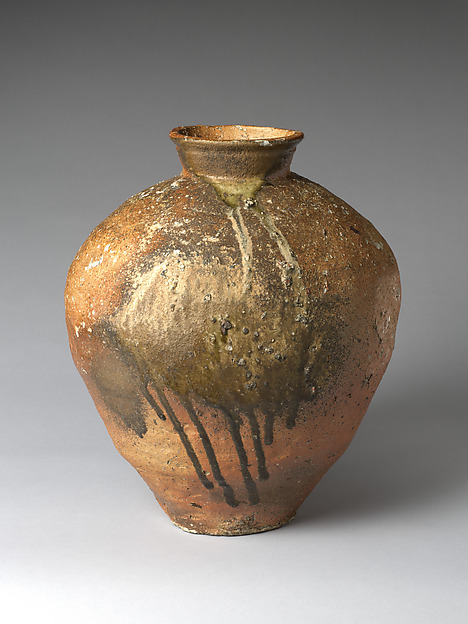
Large Storage Jar (Ōtsubo), late 15th century, Stoneware with natural ash glaze (Shigaraki ware). The Metropolitan Museum of Art, The Harry G. C. Packard Collection of Asian Art, Gift of Harry G. C. Packard, and Purchase, Fletcher, Rogers, Harris Brisbane Dick, and Louis V. Bell Funds, Joseph Pulitzer Bequest, and The Annenberg Fund Inc. Gift, 1975, accession 1975.268.428.
Look closer: the body is broad-shouldered with a short flared neck, the clay is orange-brown, and dark glaze runs down the side in streaks. The museum catalogues it as stoneware with natural ash glaze, of the late 15th century, 46.7 cm high.
Image: The Metropolitan Museum of Art, Open Access (CC0)
The ware has a long ancestry. Wikipedia says the development of the medieval kilns is thought to have come about through the transformation of Sue ware technology. In the later Heian period, Sue ware production declined, and potters began to make inexpensive wares such as tsubo, jars, kame, wide-mouthed bowls, and suribachi, grinding mortars. JAANUS agrees that the distinctive ware probably began at the end of the Heian period, with seed bowls, mortars and large jars for liquids, made in the villages of Nagano and Kōyama, and adds that Kamakura works are rare and Muromachi vessels far more common.
A palace is sometimes mentioned in the story. Wikipedia says Shigaraki ware is said to have begun when tiles were made for Emperor Shōmu's Shigaraki palace in 742, though it also reports that the evidence of old kiln remains dates to the Kamakura and early Muromachi periods. The article on the town adds that Shigaraki served as the imperial capital for several months in 745. The Met's large storage jar, pictured here, is catalogued as late fifteenth century, and is 46.7 centimetres high, which gives a sense of the scale of these early vessels.
Quartz, Feldspar and Natural Ash
JAANUS describes the character of the jars in a few lines. They are noted for their peach-blossom colour, large grains of quartz and white feldspar, and deep green to reddish-brown natural ash glazes. The firing produces scorched colouring and a thin coat of natural wood-ash glaze, and the white feldspar grains are drawn to the surface so that the body looks stippled. The effect called ishihaze, stone-burst, occurs when melted feldspar particles create small holes.

Pail‑shaped freshwater jar (Onioke mizusashi), ca. 16th century, Stoneware with natural ash glaze (Shigaraki ware). The Metropolitan Museum of Art, Mary Griggs Burke Collection, Gift of the Mary and Jackson Burke Foundation, 2015, accession 2015.300.273a, b.
Look closer: the wall is straight and slightly flared, the rim is heavy, and the surface is dark brown and speckled with grains. The museum catalogues it as stoneware with natural ash glaze, of about the 16th century, 23.5 cm high.
Image: The Metropolitan Museum of Art, Open Access (CC0)
The Shigaraki Ceramic Cultural Park names three fired colours: hiiro, a warm reddish flash, biidoro, a deep green from natural ash, and koge, a burnt black. Wikipedia adds the ware's other marks. It reflects geta-okoshi, the clog marks left where the clay rested on supports in the kiln, and fingerprints left by potters in the making. Depending on where a piece stood in the kiln, the coat of ash and minerals varies, and an oatmeal appearance, grey to reddish-brown, is the usual result.
The kiln matters to the look. Wikipedia says Shigaraki ware is fired in the anagama, the cave kiln, a single-chambered structure of sloping tunnel shape that needs wood fuel supplied constantly to reach the temperatures the clay requires. The Cultural Park notes that wood-fired anagama and noborigama, the multi-chambered climbing kiln, produce the three colours above. JAANUS says the introduction of the climbing kiln led to a wider range of goods, eventually including braziers, household utensils, ornaments and gardenware.
Wabi Jars for the Tea Room
JAANUS records that in the late fifteenth century the tea master Murata Jukō, who lived from 1423 to 1502, favoured Shigaraki jars, and that they were the first native Japanese ceramics considered suitable for the wabi style of tea. Wares made before 1573 are called Ko-Shigaraki, old Shigaraki. In the Momoyama period, JAANUS adds, tea masters including Sen no Rikyū, Furuta Oribe, Kobori Enshū, Katagiri Sekishū and Sen Sōtan noted the natural beauty of the ceramics.
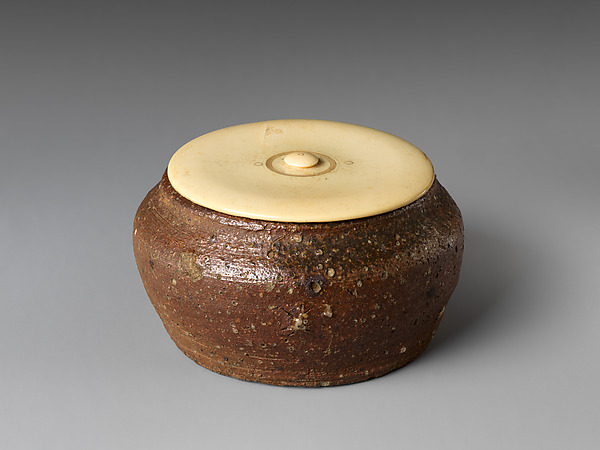
Tea Caddy (Chaire) in Taikai Shape, 16th century, Stoneware with natural ash glaze; ivory lid (Shigaraki type). The Metropolitan Museum of Art, Gift of Peggy and Richard M. Danziger, 2024, accession 2024.553.16a, b.
Look closer: the body is low and rounded in dark, speckled stoneware, and the ivory lid is flat with a small knob. The museum catalogues it as stoneware with natural ash glaze and an ivory lid, of the 16th century, 5 cm high.
Image: The Metropolitan Museum of Art, Open Access (CC0)
The tea vessels it lists are the mizusashi, fresh-water jar, the kensui, waste-water jar, and the hanaire, flower vase, together with glazed tea jars. Wikipedia describes the wabi ideal of simplicity, humility and intense appreciation of the immediate experience, and says the natural appearance of the pottery suited it. The Met's tea caddy pictured here is only 5 centimetres high, and shows the same material at the scale of the tea table.
The Edo period brought an official role. According to JAANUS, in 1632 the Shigaraki kilns were designated producers of official glazed tea jars, which held famed tea leaves from Uji for presentation to the Tokugawa shogun. The Cultural Park adds that tea jars were produced in large numbers in the Edo period, and that plum jars, miso jars, sake bottles and flameware were also mass-produced. The Met's seventeenth-century Shigaraki tea jar is catalogued with gold lacquer repairs, and stands 26 centimetres high.
Braziers, Planters and Tanuki
The Cultural Park traces the town's later trade. In the Meiji era, potters made hibachi, braziers, glazed with the newly developed namako, a mottled blue glaze, and the hibachi reached more than ninety per cent of the national market at one point. In the 1960s and 1970s electric and oil heaters sharply reduced demand and hurt the local economy, and craftsmen adapted the namako glaze to planters for bonsai and other plants, which sold well.
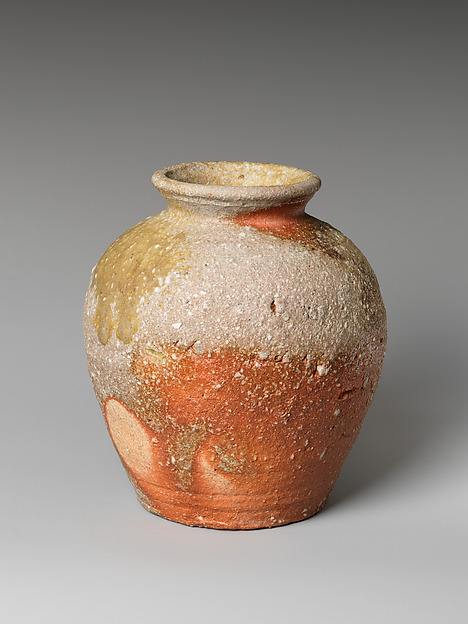
Flower Container, Uzukumaru Shape, ca. 1981–82, Stoneware, natural ash glaze; Shigaraki ware. The Metropolitan Museum of Art, Gift of Peggy and Richard M. Danziger, 2024, accession 2024.553.14.
Look closer: the upper half is pale and ash-flecked, the lower body is orange, and the neck is narrow. The museum catalogues it as stoneware with natural ash glaze, Shigaraki ware, made in the United States in about 1981 to 1982 by Gary Moler, 15.5 cm high.
Image: The Metropolitan Museum of Art, Open Access (CC0)
The best-known product today is a figure. Wikipedia says that since the 1930s the production of tanuki statues has flourished in Shigaraki, and that today they are a symbol of the town. The Cultural Park lists tanuki and frogs among the decorative ornaments, with planters, flower vases, tableware, architectural tile and garden furniture. In 1976, it records, the Japanese government designated Shigaraki ware a Traditional Handicraft.
Shigaraki's methods have also travelled. The Met catalogues the small flower container pictured here as Shigaraki ware, though it was made in the United States by Gary Moler, which shows that the museum's label describes a way of firing and a clay as well as a place.
Reading a Shigaraki Jar
Start with the body. White grains breaking the surface and pitting where a feldspar particle has burst are the signs JAANUS gives for the ware. Then look at the colour: peach-blossom orange, scorch, a thin film of ash glaze and the green that runs where ash has pooled, which the Cultural Park calls biidoro. Turn the piece to find the marks of its firing, the clog marks and the potter's fingerprints.
These are catalogued features, and the museum entries pictured below are the best companions for the eye. The Met's fourteenth to fifteenth-century jar is 40.6 centimetres high, the sixteenth-century jar is 27.3 centimetres, and the nineteenth-century jar in the gallery carries a thick dripped glaze over a wooden top. For the care of a piece, the house keeps a plain guide to ceramics, linked below.
Jars, Ash and Fire
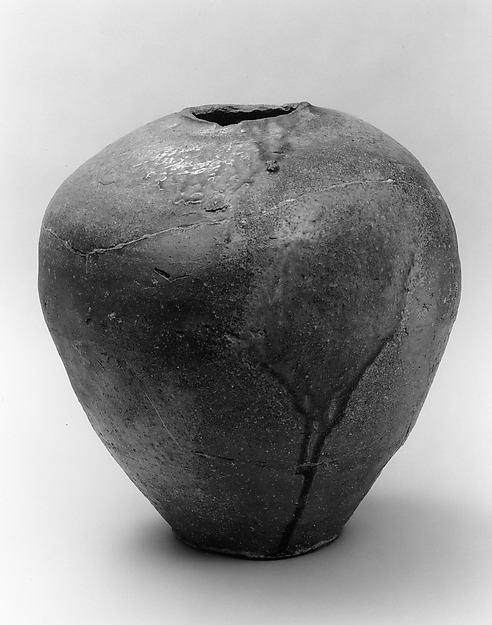
Storage jar, 14th–15th century, Stoneware with natural ash glaze (Shigaraki ware). The Metropolitan Museum of Art, Dr. and Mrs. Roger G. Gerry Collection, Bequest of Dr. and Mrs. Roger G. Gerry, 2000, accession 2002.447.15.
Look closer: the body is round and grey-brown with a narrow opening, and a dark trail of glaze runs from the shoulder down the side. The museum catalogues it as stoneware with natural ash glaze, of the 14th to 15th century, 40.6 cm high.
Image: The Metropolitan Museum of Art, Open Access (CC0)
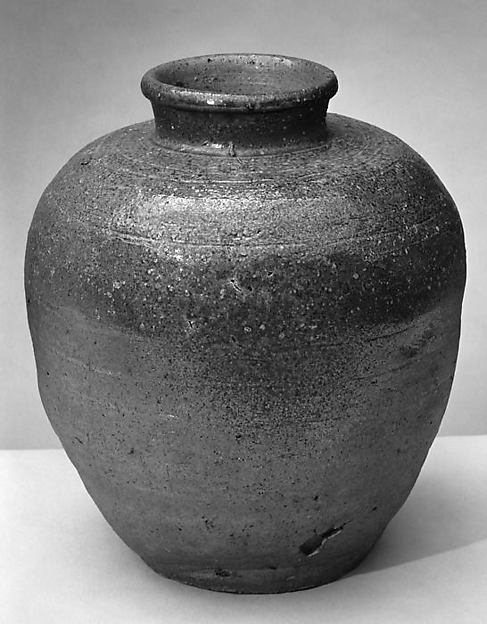
Storage jar, 16th century, Stoneware (Shigaraki ware). The Metropolitan Museum of Art, Purchase, Seymour Fund, Florance Waterbury Bequest, and Rogers Fund, 1972, accession 1972.53.
Look closer: the shoulder is grey and the lower body paler, with a defined neck and a rolled rim. The museum catalogues it as stoneware, of the 16th century, 27.3 cm high.
Image: The Metropolitan Museum of Art, Open Access (CC0)

Water jar, ca. 1600, Stoneware (Shigaraki ware). The Metropolitan Museum of Art, Gift of Herbert J. Stark, 1973, accession 1973.76.
Look closer: the wall is straight and heavily textured, and a dark run of glaze falls down one side. The museum catalogues it as stoneware, of about 1600, 20.3 cm high; the photograph is black and white.
Image: The Metropolitan Museum of Art, Open Access (CC0)

Shigaraki Tea Jar (Chatsubo), 17th century, Stoneware with natural ash glaze; gold lacquer repairs (Kyoto ware, Shigaraki type). The Metropolitan Museum of Art, Mary Griggs Burke Collection, Gift of the Mary and Jackson Burke Foundation, 2015, accession 2015.300.274.
Look closer: the clay is orange-brown, the neck is short, and fine pale lines cross the shoulder. The museum catalogues it as stoneware with natural ash glaze and gold lacquer repairs, of the 17th century, 26 cm high.
Image: The Metropolitan Museum of Art, Open Access (CC0)

Tea jar with cover, ca. 1745, Shigaraki ware. The Metropolitan Museum of Art, Fletcher Fund, 1925, accession 25.215.17a, b.
Look closer: the wall is brown and speckled, a band of impressed marks circles the shoulder, and the lid is pale. The museum catalogues it as Shigaraki ware of about 1745, 9.8 cm high.
Image: The Metropolitan Museum of Art, Open Access (CC0)
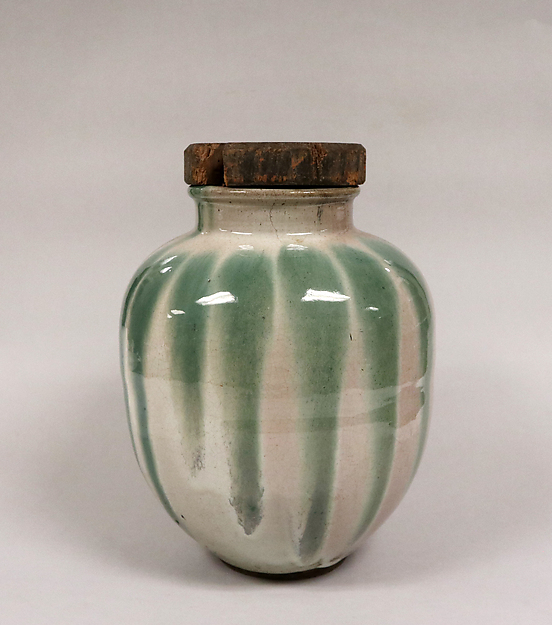
Storage jar, 19th century, Stoneware covered with thick glaze; vertical dripped glaze over wooden top (Shigaraki ware). The Metropolitan Museum of Art, Stanley J. Love Gift, 1988, accession 1988.373.2.
Look closer: vertical green drips run down a pale glazed body beneath a wooden lid. The museum catalogues it as stoneware covered with thick glaze, with vertical dripped glaze over a wooden top, of the 19th century, 33 cm high.
Image: The Metropolitan Museum of Art, Open Access (CC0)
Shigaraki at the Desk
At the time of writing no piece catalogued as Shigaraki ware is with the house. The concierge desk can say when one arrives. The plain guide to caring for ceramics and the journal's essay on collecting Japanese ceramics are good companions to this chapter.
Answered plainly
What is Shigaraki ware?
A stoneware made in Shigaraki, now part of Kōka in Shiga Prefecture, and one of the Six Ancient Kilns, known for orange clay, feldspar grains and natural ash glaze.
What are the marks of Shigaraki firing?
Scorched colour, peach-blossom orange, deep green natural ash glaze, stippled white feldspar, small stone-burst holes, and in some pieces clog marks and fingerprints.
Why were Shigaraki jars valued in tea?
JAANUS says Murata Jukō favoured them, and that they were the first native Japanese ceramics thought suitable for wabi tea.
Where do the tanuki come from?
Tanuki statues have flourished in Shigaraki since the 1930s, and are now a symbol of the town.
Where next
Sources and image credits
- Shigaraki ware, Wikipedia
- Shigaraki, Shiga, Wikipedia
- Six Ancient Kilns, Wikipedia
- Shigarakiyaki, JAANUS
- As to Shigaraki, Shigaraki Ceramic Cultural Park
- Object record, Large Storage Jar (Ōtsubo), The Metropolitan Museum of Art
- Object record, Pail‑shaped freshwater jar (Onioke mizusashi), The Metropolitan Museum of Art
- Object record, Tea Caddy (Chaire) in Taikai Shape, The Metropolitan Museum of Art
- Object record, Flower Container, Uzukumaru Shape, The Metropolitan Museum of Art
- Object record, Storage jar, The Metropolitan Museum of Art
- Object record, Storage jar, The Metropolitan Museum of Art
- Object record, Water jar, The Metropolitan Museum of Art
- Object record, Shigaraki Tea Jar (Chatsubo), The Metropolitan Museum of Art
- Object record, Tea jar with cover, The Metropolitan Museum of Art
- Object record, Storage jar, The Metropolitan Museum of Art
Last reviewed 28 October 2026. Pictures, where shown, are public-domain or open-access and credited beneath each one.
Looking for a Shigaraki jar or a view on one you own? The concierge desk replies within one to three business days.
Browse Japanese porcelain and ceramics · Make a private request
Private concierge
Looking for something in particular?
Describe the piece or the project you have in mind. A senior advisor in Tokyo reads every case file personally and replies within two business days, with fees set out in writing before any work begins.