
India: Ashoka, Nalanda, Ajanta
Homeland · Mauryan to Pala
India: Ashoka, Nalanda, Ajanta
In the eighth year of his reign, an Indian emperor carved into rock the number of people his army had killed, and then said he was sorry. The edicts that followed, the stupas, the monastery that taught pilgrims from China and the painted caves are the Indian foundations on which every Japanese temple quietly rests. Added below: the legends the monks told about Ashoka, the pillars and the lion that became a flag, the donors of Sanchi, the pilgrim centres of Bodh Gaya and Sarnath, the teachers and second life of Nalanda, a cave-by-cave guide to Ajanta, the conversions of modern India, and a glossary and collector's eye for the objects that descend from them.
Fact sheet
Four ideas to carry in
- A king's conscience. Ashoka's Thirteenth Rock Edict records the Kalinga war's toll and his remorse, in his own words.1
- Stupas first. The Great Stupa at Sanchi was commissioned by Ashoka; its gateways were added centuries later under the Satavahanas.3
- A monastery, not a modern university. Nalanda taught Mahayana, Vedas, logic, grammar and medicine, and scholars caution against calling it a university.4
- Painting survives. Ajanta preserves the largest surviving body of ancient Indian wall painting.6
The Emperor Who Counted
First lookThe Thirteenth Rock Edict is one of the strangest documents in ancient history. Ashoka, the Mauryan emperor, inscribes the toll of his conquest of Kalinga in his eighth regnal year, about 260 BCE: some 100,000 killed, many times that number dead by other causes, 150,000 carried off. He says he feels remorse.1 A scholar's note of caution belongs here: inscriptions found within the Kalinga region itself omit the remorse.1
The edicts are a library carved on stone. Wikipedia counts more than thirty inscriptions, fourteen of them Major Rock Edicts that speak of ethics and statecraft and never mention the Buddha, while the Minor Rock Edicts mention the Buddha and the Sangha.2 The language is Prakrit in the Brahmi script, with Kharoshthi in the northwest, and Greek and Aramaic at Kandahar.2 The Thirteenth names five Hellenistic rulers, Antiochus, Ptolemy, Antigonos, Magas and Alexander, in the same breath.2
The pillars carried the same message. About twenty survive, and seven still wear their animal capitals; they rise 12 to 15 metres and weigh as much as 50 tons.1 The legend adds that Ashoka raised 84,000 stupas, a figure that comes from later texts, not from the king.1 The Lumbini pillar, described in the first chapter of this wing, is one of his.2
The question of what Ashoka's Dhamma actually was has divided scholars. Some, such as Strong, see propaganda; others, such as Lamotte, argue that dhamma was not simply Buddhism; Romila Thapar holds that Buddhism spread mainly through merchants, landowners and guilds, not royal decree.1 Frauwallner and Gombrich, on the other hand, regard the traditional missions as historical.1 One of them, according to Sri Lankan tradition, is the mission of Mahinda to Sri Lanka, and in the same tradition a sapling of the Bodhi tree was planted at the Mahavihara in Anuradhapura.9 A responsible guide lays out both views.
Sanchi and the Empty Throne
First lookAt Sanchi the Great Stupa was commissioned by Ashoka in the third century BCE.3 The four gateways, the toranas, came later, built under the Satavahanas between about 50 BCE and the first century CE.3 They are crowded with narrative, and yet for a long time the Buddha himself does not appear. He is a wheel, a Bodhi tree, a pair of footprints, an empty throne, a horse with a canopy.3
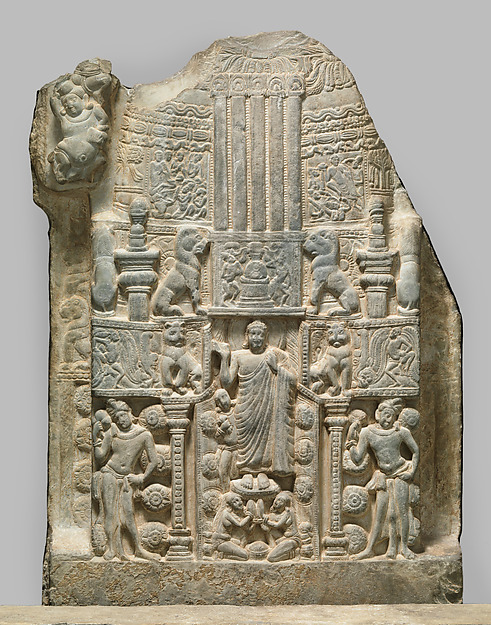
India, Nagarjunakonda Stupa Site 6, Guntur district, Andhra Pradesh · Ikshvaku · late 3rd century CE · Limestone
Look closer: A stupa is carved on the drum of a stupa. Find the standing Buddha at its base: by the late third century CE, the date the Met gives this panel from the Nagarjunakonda region, the empty throne has long since been replaced by a human figure. The Met titles the scene the Buddha's descent from Trayastrimsa Heaven.
The Metropolitan Museum of Art, New York, Rogers Fund, 1928, accession 28.31. Public domain, Met Open Access. Museum record
Why the human figure arrived when it did, between the second century BCE and the first century CE, is uncertain, and chapter 4 returns to the question at Gandhara.11

Sanchi, Madhya Pradesh, India. Domed stupa, stone railing and carved gateway (torana)
Look closer: The dome rises behind a ground-level railing, with a second railed terrace higher up, and the gateway in front has three stone crossbars carved with scenes. The Great Stupa was commissioned by Ashoka; the gateways, as above, came later, between about 50 BCE and the first century CE.
Photograph: Rohit Sharma. CC BY-SA 4.0, with attribution. Source: Wikimedia Commons. CC BY-SA 4.0 File record

Nalanda: Pilgrims, Texts and Doubts
The connoisseur's eyeThe Nalanda mahavihara stood in what is now Bihar. Wikipedia's article gives its founding about 427 CE, in the reign of Kumaragupta I, whose seal names him Shakraditya, and notes that Faxian, who travelled in India in the early fifth century, does not mention it.48 Harsha was a patron, endowing it with the revenue of a hundred villages, and the Pala dynasty that followed continued its support, though it favoured Vajrayana and founded rival monasteries.4
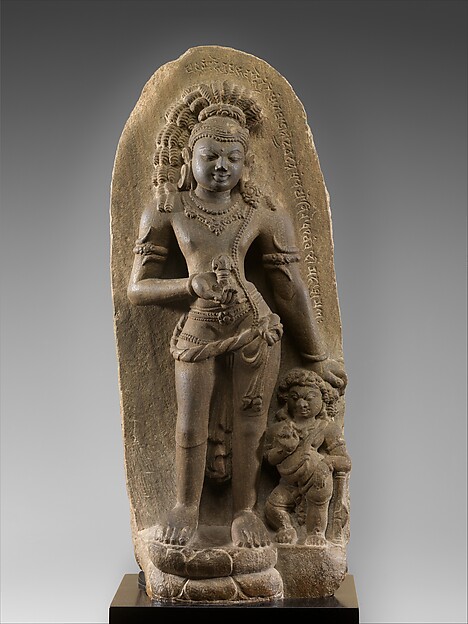
Eastern India, Bihar, probably Nalanda · 7th–early 8th century · Sandstone
Look closer: A slender bodhisattva in sandstone, one hand holding the thunderbolt-sceptre. The Met catalogues it as Vajrapani from Bihar, probably Nalanda, of the seventh to early eighth century. Vajrapani, the bearer of the vajra, appears in Gandharan art as a companion of the Buddha, and one scholar, Katsumi Tanabe, traces him to the Nio guardians of Japan, a thesis that remains contested.11
The Metropolitan Museum of Art, New York, Gift of Florence and Herbert Irving, 2015, accession 2015.500.4.9. Public domain, Met Open Access. Museum record
The famous visitors are two Chinese. Xuanzang arrived in 637 and again in 642, studied under Shilabhadra, and returned to China in 645 with 657 Sanskrit texts and seven Buddha statues.47 Yijing came by sea in 673, stayed ten years and went home in 695 with 400 texts.4 Xuanzang reported over 1,500 teachers and 10,000 student monks, but a modern scholar, Asher, notes that the site could not have held ten thousand, and that the figures may be exaggerated.4 The library, the Dharmaganja, comprised three multi-storey buildings.4 Britannica likewise places the monasteries in the Gupta period and their flowering under the Pala kings, from the eighth to the twelfth century.5 The curriculum taught Mahayana alongside the eighteen older schools, the Vedas, logic, grammar and medicine.4

Nalanda, Bihar, India. Brick ruin of a stepped temple mass with plinths and small votive bases
Look closer: The photograph shows how the site is read today: courses of brick, a collapsed upper mass, and low plinths where smaller shrines once stood. The excavations revealed eleven monasteries and six large brick temples, and this is one of the temples.
Photograph: Sumitsurai. CC BY-SA 4.0, with attribution. Source: Wikimedia Commons. CC BY-SA 4.0 File record

How it ended is also disputed. The usual story attributes its destruction to Bakhtiyar Khalji around 1200 CE, but Elverskog argues that the decline was not sudden, and the pilgrim Dharmasvamin found it damaged but still partly active around 1235.4 Excavations in 1915 to 1937 and 1974 to 1982 revealed eleven monasteries and six large brick temples on about twelve hectares.4 UNESCO inscribed the site in 2016, and a modern Nalanda University opened its first year on 1 September 2014.4
| Date | Event | Source |
|---|---|---|
| c. 427 CE | Founding of Nalanda in the reign of Kumaragupta I | Wikipedia4 |
| 637 and 642 | Xuanzang's visits; studies under Shilabhadra | Wikipedia4 |
| 645 | Xuanzang reaches Chang'an with 657 texts and seven statues | Wikipedia7 |
| 673 to 695 | Yijing's ten years; returns with 400 texts | Wikipedia4 |
| c. 1200 | Traditional date of sack, with caveats | Wikipedia4 |
| 1915 to 1937 | First excavations | Wikipedia4 |
| 2016 | UNESCO World Heritage | Wikipedia4 |
Ajanta: A Tiger Hunt and Two Thousand Years
The connoisseur's eyeAjanta is a series of rock-cut caves in the Waghur gorge in Maharashtra, about thirty in all.6 The first phase, in the second century BCE to the first century CE, belongs to the Satavahana era; the second, according to the scholar Walter Spink, belongs to about 460 to 480 CE, under the Vakataka king Harishena, who died in 477, while the Archaeological Survey of India dates it more broadly to the middle of the fifth to the middle of the sixth century.6
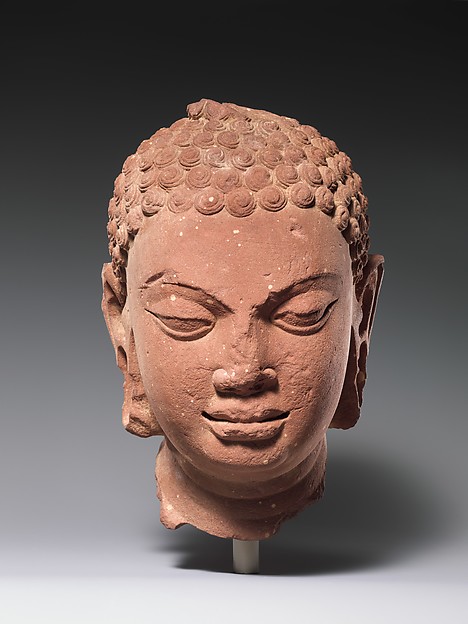
India (Uttar Pradesh, Mathura) · late Gupta period · late 5th–early 6th century · Red sandstone
Look closer: A head in red sandstone, catalogued by the Met as from Mathura in the late Gupta period. Look at the lowered eyelids, the tight spiral curls and the faint smile, then compare them with the Gandharan head in the next chapter and the Chinese and Korean Buddhas after it.
The Metropolitan Museum of Art, New York, Gift of Doris Rubin, in memory of Harry Rubin, 1989, accession 1989.236.1. Public domain, Met Open Access. Museum record
The paintings are the point. Caves 1, 2, 16 and 17 contain what the article calls the largest surviving corpus of ancient Indian wall painting, and Cave 1 is famous for its great bodhisattvas Padmapani and Vajrapani.6 Padmapani, the lotus bearer, is an Indian form of Avalokiteshvara, whom Japan knows as Kannon.

Ajanta, Maharashtra, India. Wall painting in Cave 1
Look closer: The crowned head bends to one side, a string of pearls lies on the chest, and what appears to be a pale blossom rests near the raised hand, which is why the figure is called the lotus bearer. The darkened surface around the figure shows how much of the surrounding scene has been lost or obscured; this is paint on rock.
Photograph: Abdulsayed. CC BY-SA 3.0, with attribution. Source: Wikimedia Commons. CC BY-SA 3.0 File record

The caves were forgotten until 28 April 1819, when John Smith of the 28th Cavalry, on a tiger hunt, was shown the entrance of Cave 10 by a shepherd boy.6 In the 1920s the Nizam of Hyderabad hired two Italians, Cecconi and Orsini, to restore the paintings.6 UNESCO inscribed Ajanta in 1983.6
What India Gave Away
The deep endBy about 1200, the great monasteries of the Ganges plain, Nalanda among them, were in decline.4 Much of what they had held had by then travelled: Xuanzang alone carried 657 texts to China,7 and the tantric teaching that flourished under Pala patronage at Nalanda and Vikramashila went to Tang China and, in the end, to Japan.12
The return trip is small but real. The wall paintings of the Mulagandhakuti temple at Sarnath, consecrated in 1931, are by the Japanese painter Kosetsu Nosu.10 The Sri Lankan reformer Anagarika Dharmapala, who founded the Maha Bodhi Society after his 1891 visit to Bodh Gaya, is part of the same modern story.13
A collector who understands this arc reads Japanese objects with more patience. A Kannon in gilt wood can be read as a descendant of the lotus-bearing bodhisattva painted at Ajanta; the thunderbolt-bearer of Nalanda is, on one contested thesis, an ancestor of the paired Nio guardians at a temple gate;11 and a mandala scroll belongs to the tantric tradition that, as the second chapter shows, Kukai carried home from Tang China.
| Site | What survives | Reader's note |
|---|---|---|
| Sanchi | Stupa and four carved gateways3 | The stupa that the Japanese pagoda translates into wood |
| Nalanda | Brick monasteries and temples4 | The pilgrim road Chapter 5 follows to Chang'an |
| Ajanta | Cave paintings and sculpture6 | Padmapani, the Indian lotus-bearer, is Kannon's Indian form |
| Sarnath | Stupa, pillar, ruins10 | Kosetsu Nosu's paintings of 193110 |
Ashoka in Legend and in Stone
First lookThere are two Ashokas, and the sources do not agree about either. The king of the inscriptions says almost nothing about his own life: the edicts do not describe his early years or name his ancestors. The Buddhist texts fill the silence. The Ashokavadana traces his line back to Bimbisara; the Sri Lankan chronicle Mahavamsa says he killed ninety-nine half-brothers to take the throne, and the Dipavamsa says a hundred. The Wikipedia article calls these numbers exaggerated and points out that the Fifth Rock Edict mentions 'the families of his brothers', which suggests that some survived.1
His conversion is told three ways. The inscriptions suggest a gradual course: in the Minor Rock Edicts he calls himself a lay follower, upasaka, who made little progress for a year and then drew nearer to the community; the Eighth Major Rock Edict says he visited the Bodhi tree about ten years after his coronation. The Sri Lankan tradition places his conversion in his fourth regnal year, before the Kalinga war. The legends of the Ashokavadana and Divyavadana give the credit to a monk named Nigrodha, who was secretly his nephew, to a monk called Samudra who escaped Ashoka's infamous prison, or, in one Chinese text, to a seven-year-old boy.1
The most famous legend is of the 84,000 stupas. The Ashokavadana says he gathered seven of the eight shares of the Buddha's relics and built 84,000 stupas in one day, the elder Yashas signalling that the work was done by covering the sun with his hand. The scholar Eggermont linked that detail to a solar eclipse on 4 May 249 BCE, and used it to support an accession of 268 or 269 BCE; John Strong rejects the link and reads the story as religious rather than chronological.1 Other legends are plainly sectarian: tales of torture and a massacre of 18,000 heretics appear in Buddhist sources, but Jain texts never mention them, and the Wikipedia article treats them as fabrications.1
The mission stories matter most to Japan, because they stand at the head of the long journey this wing follows. The Sri Lankan tradition dates nine missions to about 250 BCE and names Mahinda and Sanghamitta as the apostles of Sri Lanka; Sanghamitta carried a sapling of the Bodhi tree. Ashoka's own edicts never mention these missions, the North Indian tradition omits Mahinda, and Xuanzang says Mahinda was the king's brother, not his son.1 Rock Edict 13 does speak of conquests by dhamma, carried by messengers to five Hellenistic kings, but whether those messengers were Buddhist monks is a question scholars still dispute.1
The Lion That Became a Flag
The connoisseur's eyeAshoka called his pillars Dhamma thambha, 'pillars of the Dharma'. The Wikipedia article counts twenty that survive and seven complete animal capitals; the shafts average 12 to 15 metres, weigh up to 50 tons, are carved from a single piece of sandstone and finished with the glassy Mauryan polish.14 Where the stone came from is unsettled: the old claim that all of it came from Chunar near Varanasi can no longer be confidently asserted, and the page proposes two sources, spotted stone from the Mathura region and buff sandstone from Chunar.14 Faxian recorded six pillars in the fifth century and Xuanzang fifteen in the seventh, and at most five of those can be matched to pillars that survive.14

Bihar, India, about 3rd century BCE
Look closer: A single polished shaft, slightly tapered, with the lion facing north at the top. This is the monolithic construction that the Wikipedia survey describes; compare how little the shaft is decorated with how finely the capital is finished.14
Photograph: Amitabha Gupta. CC BY 4.0, with attribution. Source: Wikimedia Commons. CC BY 4.0 File record

Some pillars travelled. In 1356 the sultan Firuz Shah Tughluq moved the Topra pillar and the Meerut pillar to Delhi, where the first stands today in the Feroz Shah Kotla fortress. The Allahabad pillar, moved from Kausambi, carries three inscriptions in one shaft: an Ashokan edict of about 232 BCE, a Gupta-period record of Samudragupta of about 375 CE recording the extent of his empire, and a later Persian inscription of the Mughal emperor Jahangir.14 At Lumbini the shaft broke when it was struck by lightning, and the horse capital that Xuanzang mentioned is lost; the surviving pillar marks the Buddha's birthplace.14

Sarnath, Uttar Pradesh, about 250 BCE
Look closer: Four lions sit back to back above a drum of wheels and animals. The lotus bell below is the part some scholars link to Persepolis and others to the Indian vase-of-plenty motif.15
Photograph: lisa bat. CC BY 2.0, with attribution. Source: Wikimedia Commons. CC BY 2.0 File record

The capital found at Sarnath is the pillar most people know. F. O. Oertel dug it up in the winter of 1904 to 1905 to the west of the main shrine, and the museum built to house it, the first site museum of the Archaeological Survey of India, was completed in 1910.15 The capital is 2.1 metres tall: a bell of inverted lotus petals 61 centimetres high with sixteen petals, a drum carved with four wheels of twenty-four spokes alternating with a lion, an elephant, a bull and a galloping horse, and four lions seated back to back above. A larger wheel of about 84 centimetres and perhaps thirty-two spokes once crowned the lions, and only four fragments with the ends of thirteen spokes were found.15 The Wikipedia article on the Pillars records that the lions probably supported a twenty-four-spoke wheel, on the evidence of a thirteenth-century replica in Thailand, which shows that even the reconstruction is a hypothesis.14
The state accepted the emblem on 29 December 1947, and the wheel of the flag is the same wheel in a different setting.15 The scholarly arguments are real. Vincent Smith, Mortimer Wheeler and John Marshall suggested foreign artisans, Iranian or Hellenistic; John Irwin and V. S. Agrawala argued for indigenous roots in wood and copper. Many read the wheels as the Buddhist dharmachakra, while Irwin proposed that they are chariot wheels. Even the posture is debated: Oertel saw the lions as standing, and Abdullaev argued from the slope of their backs that they are seated.15
| Pillar | Capital | Where it is now |
|---|---|---|
| Vaishali | A single lion, facing north14 | Standing at Kolhua in Bihar |
| Sankissa | A damaged elephant, mostly unpolished14 | Capital only; no shaft found14 |
| Rampurva | A lion with edicts I to VI, and an uninscribed bull14 | The bull capital is in Rashtrapati Bhavan, New Delhi14 |
| Lauriya-Nandangarh | A single lion14 | On site, 23 km from Bettiah14 |
| Sanchi | Four lions and the Schism Edict14 | See the Sanchi section below |
| Sarnath | Four lions back to back, about 250 BCE14 | Column on site; capital in the Sarnath Museum14 |
| Allahabad | Abacus only14 | Allahabad Museum; the pillar stands in the fort14 |
| Delhi-Topra | Edicts I to VII14 | Moved in 1356 to the Feroz Shah Kotla14 |
Who Paid for Sanchi
The connoisseur's eyeSanchi is also a record of patronage. A Brahmi inscription on the southern gateway records a gift by Ananda, son of Vasithi, foreman of the artisans of King Siri Satakani; another credits the guild of ivory carvers of Vidisha with one relief; and three inscriptions name Yavana, Greek, donors.3 Ordinary men and women paid for scenes and had their names cut beside them.3 The Satavahana gateways are generally dated from the first century BCE, the earliest to the reign of Satakarni II, about 50 to 25 BCE, and the core brick stupa, begun under Ashoka, was enlarged in the Shunga period, when its diameter roughly doubled, its dome was flattened and three parasols were set on top.3

Sanchi, Madhya Pradesh, India
Look closer: A carved torana stands in front of the dome, and a railed square crowns its flattened top. Count the architraves of the gateway, then look at the dome: it is the Shunga enlargement of Ashoka's smaller brick mound, flattened and crowned with parasols.317
Photograph: https://www.flickr.com/photos/chromatic_aberration/. CC BY-SA 2.0, with attribution. Source: Wikimedia Commons. CC BY-SA 2.0 File record

Close by stood a pillar of a different faith. Heliodorus, an ambassador of the Indo-Greek king Antialcidas, dedicated a column near Vidisha about 113 BCE, though the article notes that other dates are also given.3 The relics of the Buddha's two chief disciples, Sariputra and Mahamoggallana, were unearthed at Satdhara, nine kilometres west of Sanchi, and are now kept in a new vihara there. The article states that they were placed in Stupa No. 3, and that a nearby site, Chetiyagiri, is thought to be where Mahendra visited his mother before sailing to Sri Lanka.3
The anatomy of the monument is worth keeping in mind. A stupa, as the Wikipedia article describes it, is a solid dome on a drum with vertical sides, usually on a square base, topped by a thin vertical element carrying one or more disc-shaped chatras, the symbolic umbrellas; large stupas add a railing, the vedika, outside the circumambulation path and four gateways, toranas, often carved. The path is always circled clockwise, which is the direction visitors walk at Sanchi today.17 In East Asia the stupa became the pagoda, and the page records that the Asian words for pagoda, Chinese ta and Japanese to, are thought to derive from the Pali thupa, an etymology it marks as uncertain.17 It also records a scholarly position that the Japanese torii derives from the toranas of Sanchi, presented as a position and not a fact.17
- Dome and drum: the solid mound over the relics.17
- Chatra: the stacked symbolic umbrellas, which survive only where restored.17
- Vedika: the railing outside the path of circumambulation.17
- Torana: the four carved gateways, the earliest generally attributed to Satakarni II.317
- Aniconic signs: wheel, Bodhi tree, footprints, empty throne and riderless horse stand where the Buddha would be.3
Bodh Gaya and Sarnath Today
The connoisseur's eyeTwo of the four places that the Mahaparinibbana Sutta names for pilgrimage, with Lumbini and Kushinagar, are in India and both are visited every day. Bodh Gaya is the site of the Awakening. The Mahabodhi Temple was inscribed by UNESCO in June 2002; its central tower is over 55 metres high with four smaller towers around it, and the diamond throne, the vajrasana, at the foot of the Bodhi tree is thought to have been set by Ashoka and is worshipped still.13 The present temple is generally dated to the Gupta period, the fifth to the sixth century, though one scholar suggests it restores a design of the second or third century on the evidence of a plaque from Kumrahar.13

Bihar, India
Look closer: Seated Buddhas in arched niches, framed by carved pilasters and bands of floral ornament, cover the wall of the temple. The tower above, not in this frame, is over 55 metres high; the diamond throne is at its foot.13
Photograph: Sumitsurai. CC BY-SA 4.0, with attribution. Source: Wikimedia Commons. CC BY-SA 4.0 File record

The modern history is as dramatic as the ancient. Burmese rulers restored the complex in the thirteenth and nineteenth centuries, and the British began a restoration under Alexander Cunningham and Joseph Beglar in the 1880s; a large Pala Buddha was reinstated in 1884. Anagarika Dharmapala visited in 1891, found the temple under Hindu control and founded the Maha Bodhi Society, which moved from Colombo to Calcutta in 1892.13 The Bodh Gaya Temple Act of 1949 passed control to a state committee, and on 7 July 2013 ten low-intensity bombs exploded in the complex, injuring five people; the main temple was undamaged.13

Uttar Pradesh, India
Look closer: The great cylinder of brick rises from a stone-faced base on a lawn in the Deer Park. The Wikipedia article says it marks the site of the first teaching, and gives its height as 39 metres, a figure still awaiting a citation.10
Photograph: Hardy Explorer. CC0. Source: Wikimedia Commons. File record

Sarnath, the Deer Park near Varanasi, is where the Buddha gave his first sermon, the Dhammacakkappavattana Sutta, to his five companions, which the Wikipedia article dates to about 528 BCE.10 The Dhamek stupa marks the place and is given as 39 metres high and 28 metres across, with the note that the figure lacks a citation. Alexander Cunningham, then a 21-year-old engineer, began the first systematic excavations in 1835 to 1836, and the pillar fragments were exhumed on 15 March 1905.10 The Chaukhandi stupa, 800 metres outside the park, marks the place where the Buddha rejoined his first five disciples, and Akbar built an octagonal tower on it in 1588 in memory of Humayun.10
Sarnath is now an international village of temples: Tibetan, Cambodian, Chinese, Japanese, Korean, Burmese, Sri Lankan, Thai and Vietnamese communities have each built in their own style, and the Thai temple unveiled a standing Buddha 24.3 metres tall in 2011.10 Attendance rose from 1,200,679 visitors in 2013 to 1,505,787 in 2018 and 1,468,751 in 2019, and the site was nominated for UNESCO inscription in 1998, a bid that a 2024 report described as gathering dust.10
Nalanda's Masters and Its Second Life
The deep endThe names attached to Nalanda read like a roll-call of Indian Buddhist thought. The Wikipedia article lists Nagarjuna, associated with the formal concept of emptiness; Dignaga, credited with founding Buddhist logic; Dharmakirti, a logician of the seventh century; Dharmapala, a Yogacara monk; Shilabhadra, the abbot who taught Xuanzang; and Shantarakshita, a former abbot who helped to establish Buddhism in Tibet.4 Each belonged to a school this almanac meets again: the school of emptiness in the Mahayana chapter, the mind-only teaching at Nara, and the logic that reached Tibet.
India (Uttar Pradesh, Mathura) · late Gupta period · late 5th–early 6th century · Red sandstone
Look closer: This head of the Buddha from Uttar Pradesh, late fifth or early sixth century, belongs to the Gupta world that built Nalanda. Look at the smooth, downcast lids and the cap of tight curls; the face has no trace of the Gandharan drapery that earlier schools had used.
The Metropolitan Museum of Art, New York, Gift of Doris Rubin, in memory of Harry Rubin, 1989, accession 1989.236.1. Public domain, Met Open Access. Museum record
The ground itself still argues. A layer of ash found in 1920 to 1921 across many buildings is usually blamed on the troops of Bakhtiyar Khalji, who raided the region around 1200, but Dharmasvamin dates a Turkic conquest from about 1193 to 1205; a passage often cited as proof describes the sack of nearby Odantapura, not Nalanda; and Johan Elverskog notes that the monastery still had students into the thirteenth century, among them Dhyanabhadra, born in 1289. The Tibetan historian Taranatha, writing in the sixteenth century, is of questionable reliability, and no evidence supports some later Tibetan legends of restoration.4

Bihar, India
Look closer: Fired-brick walls and a broad stair that once led to the upper cells. The excavated area is about twelve hectares, and the article warns that it may be only part of the original site.4
Photograph: Sumitsurai. CC BY-SA 4.0, with attribution. Source: Wikimedia Commons. CC BY-SA 4.0 File record

The excavated area measures about 488 metres north to south and 244 metres east to west, roughly twelve hectares, with eleven monasteries and six major brick temples, though some monastic rows run on beneath the modern village of Bargaon, so the excavated area may be only part of the original site.4 Francis Buchanan-Hamilton surveyed the ruins in 1811 to 1812 without recognising them, Markham Kittoe made the identification in 1847, and the Archaeological Survey of India surveyed them officially in 1861 to 1862.4
A new Nalanda has also been built. Parliament passed the Nalanda University Bill on 25 November 2010, and the first academic session began on 1 September 2014 with fifteen students at Rajgir.4 On 19 June 2024 the Prime Minister inaugurated the new campus there: the buildings include two academic blocks with forty classrooms, two 300-seat auditoriums, a hostel for 550, an amphitheatre for 2,000, and 100 acres of water bodies in what is described as a net-zero campus, and ambassadors from seventeen countries attended, because the university is a joint venture with the East Asia Summit nations.18
| Name | Tradition | Why he matters to this almanac |
|---|---|---|
| Nagarjuna | Madhyamaka4 | Emptiness, taken up in the Heart Sutra and in Japanese Sanron |
| Dignaga | Buddhist logic4 | Method used in the debate halls of Tibet and East Asia |
| Dharmakirti | Logic, 7th century4 | The second founder of Indian Buddhist logic |
| Dharmapala | Yogacara4 | Mind-only teaching, later the Hosso school at Nara |
| Shilabhadra | Abbot and Xuanzang's teacher4 | The teacher who sent Yogacara to China |
| Shantarakshita | Former abbot4 | Helped to establish Buddhism in Tibet |
A Walking Guide to Ajanta
The connoisseur's eyeA first visit to Ajanta is easier with a short list of caves. The Wikipedia article records thirty caves in the cliff of the Waghur gorge, carved into flood basalt of the Deccan Traps, and a UNESCO inscription of 1983. It divides them into viharas, monasteries, and chaitya-grihas, worship halls with a stupa at the back.6 The table gives the caves a visitor is told to see first.

Ajanta, Maharashtra, 5th century
Look closer: The crowned bodhisattva inclines his head, wearing a pearl necklace and a tall jewelled crown, with attendants pressed around him. At lower left a modern door frame gives the scale; at the foot the colour has flaked to bare plaster, which is why the replica caves were proposed.6
Photograph: Biswas Dibyendu. CC0. Source: Wikimedia Commons. File record

The dates are not agreed. Walter Spink dates the early phase to about 100 BCE to 100 CE under the Satavahanas, and argues that most of the second phase was done in a brief burst from 460 to 480 CE under the Vakataka king Harishena. Karl Khandalavala, Ajay Mitra Shastri, M. N. Deshpande and Hans Bakker argue for a longer timeline into the mid-sixth century, and the Archaeological Survey of India holds that the peak lay between the mid-fifth and the mid-sixth century. A Rashtrakuta inscription in Cave 26 shows the site was still in use in the eighth or ninth century.6
| Cave | Type | What to look for |
|---|---|---|
| 9, 10, 12, 13, 15A | Early phase6 | The Satavahana-era caves; Cave 10 is where John Smith found the entrance in 18196 |
| 1 | Vihara, Harishena's commission6 | Padmapani and Vajrapani, two over-life-size bodhisattvas flanking the shrine door6 |
| 2 | Vihara, incomplete6 | Paintings of many noble women, possibly reflecting a female patron6 |
| 16 | Vihara, minister Varahadeva6 | The crucial cave for dating the whole site6 |
| 17 | Vihara6 | Elegant Jataka paintings praised for their detail6 |
| 26 | Chaitya hall6 | A sleeping Buddha and a seated Buddha in the hall; the Rashtrakuta inscription6 |
Nearly everything about the visit is a conservation question. The paintings in Caves 1, 2, 16 and 17 form what the article calls the largest corpus of surviving ancient Indian wall painting; the Nizam of Hyderabad had the work restored in the 1920s, and the article says early mismanagement hastened the decay; and the caves are crowded on holidays, to the detriment of the paintings. In 2012 the Maharashtra Tourism Development Corporation proposed replica caves 1, 2, 16 and 17 at the visitor centre. Ellora, a second UNESCO site, lies about 100 kilometres away, and the nearest airports are Jalgaon and Sambhaji Nagar.6
India's Buddhists, Counted and Reborn
The connoisseur's eyeThe Buddhism of modern India is largely a twentieth-century event. On 14 October 1956 B. R. Ambedkar converted to Buddhism at Deekshabhoomi in Nagpur, and the Wikipedia article says about 365,000 followers converted at the same ceremony; two days later he gave Buddhism to more than 300,000 others at Chandrapur. He asked his supporters to take twenty-two vows after the Three Jewels and the Five Precepts, and his own reading of the faith, which he called Navayana, 'New Vehicle', is set out in The Buddha and His Dhamma.16
The census of 2011 counted 8.44 million Buddhists in India, of whom 5,757,576, or 68.2 per cent, belong to the Scheduled Castes, and the article puts Buddhists at 6 per cent of the population of Maharashtra.16 The numbers do not all fit together: the article reports 'nearly half a million' Dalit converts in one place, 400,000 supporters in another, more than 665,000 if the two ceremonies are added, and 'nearly three million' over the following years, and it admits that attendance and conversion counts at later events were often unclear.16 We give the range and let it stand.
Indian Forms and Their Japanese Echoes
The connoisseur's eyeA table is the quickest way to hold the chapter's arguments about transmission. The right-hand column gives the line of descent as the sources state it, with the doubtful links marked.

Mayadevi Temple, Lumbini, Nepal
Look closer: The plain polished shaft stands inside an iron railing, today wrapped in saffron cloth by devotees. It was struck by lightning, and the horse capital that Xuanzang described is lost; the pillar commemorates the Buddha's birthplace.14
Photograph: Rangan Datta Wiki. CC BY-SA 4.0, with attribution. Source: Wikimedia Commons. CC BY-SA 4.0 File record

| In India | In East Asia and Japan | How certain |
|---|---|---|
| The stupa, a solid dome with chatras17 | The pagoda, to; the Asian words are thought to derive from the Pali thupa17 | Etymology marked uncertain in the source17 |
| The Sanchi torana3 | The torii, on one scholarly position17 | A position, not established fact17 |
| Padmapani, the lotus-bearer of Ajanta6 | Kannon Bosatsu | Padmapani is an Indian form of Avalokiteshvara |
| Vajrapani with a club6 | Shukongoshin and the Nio guardians | Katsumi Tanabe's thesis; contested (see chapter 4) |
| The Lion Capital of Sarnath15 | No Japanese copy; India's own emblem since 194715 | Origins debated: foreign or indigenous15 |
| The Bodhi tree of Bodh Gaya13 | Bodhi trees grown from cuttings in temples across Asia, including the Sri Maha Bodhi of 288 BCE10 | The Sri Lankan planting date comes from the Mahavamsa |
A Short Glossary for India
The connoisseur's eyeWords the chapter uses, with the Japanese form where there is one.
| Term | Meaning |
|---|---|
| Dhamma (dharma, ho) | In the edicts a broad ethic of conduct, not limited to one religion1 |
| Rock Edict | An inscription cut into a rock surface; the Fourteen Major and the Minor Rock Edicts12 |
| Dhamma thambha | Ashoka's own name for his pillars, "pillars of the Dharma"1 |
| Dharmachakra | The Wheel of the Law; the wheel on the Sarnath capital and India's flag15 |
| Chatra | The symbolic umbrella set on top of a stupa17 |
| Torana | A carved gateway of a stupa17 |
| Vedika | The railing around a stupa's path of circumambulation17 |
| Pradakshina | Clockwise circumambulation17 |
| Vihara | A monastery; at Ajanta, the residential caves6 |
| Chaitya-griha | A worship hall with a stupa at the back6 |
| Mahavihara | A great monastery, the best name for Nalanda4 |
| Vajrasana | The diamond throne at the foot of the Bodhi tree13 |
| Navayana | Ambedkar's "New Vehicle"16 |
| Upasaka | A lay follower, as Ashoka calls himself1 |
| Jataka | A tale of the Buddha's former lives, the subject of most Ajanta paintings6 |
A Collector's Eye on the Indian Roots
The connoisseur's eyeIndian objects are rare in Japanese collections, but their descendants are everywhere. Three habits make them legible. First, notice the stupa in every pagoda, bronze reliquary and sotoba: the dome, the stacked discs and the base are the stupa's anatomy, and the finial of a pagoda is a row of chatras on a pole.17 Second, look for the lotus. Padmapani carries one, the Buddhas of Ajanta sit on one, and the Japanese Kannon holds a bud or a full flower; a figure that stands or sits on petals comes from this world.6
Third, treat age claims with the same discipline the sources demand. The Met's gallery of Indian sculpture dates its Gupta head to the late fifth or early sixth century and its Pala bodhisattva to the seventh or eighth, and each label states the region within India.4 A Japanese bronze that copies an Indian type is an homage, not an import, and the house describes it accordingly.13
For a first object that carries the theme, a small stupa-shaped reliquary, a pagoda finial or a lotus-seat Kannon is a graceful way to keep the Indian roots on the shelf.
Echoes of India in the House
The house does not offer Indian antiquities as such, and a careful reader should be wary of any shop that does. What it holds are Japanese Buddhist objects that carry the Indian roots plainly, in figures and ornament: seated Buddhas on lotus thrones, mandorlas, and a small group of Tibetan-style and Himalayan-style pieces found in Japan, among them a few figures of Tara, the Indian-born goddess of compassion.
The strip below fills from the live shelf. If it is empty, the pieces are between displays, and the links under it lead to the full shelves.
Pieces in the house now
- Asian Antiques Found in JapanHimalayan, Tibetan, Chinese and Korean pieces
- Buddhist Statues and Sacred ArtJapanese Buddhas, bodhisattvas and guardians
Filter by what you have just read
Answered plainly
Who was Ashoka?
A Mauryan emperor who reigned from about 268 to 232 BCE, according to inferred dates, and who left more than thirty inscriptions.12
What did Ashoka say about Kalinga?
His Thirteenth Rock Edict states that about 100,000 people were killed, many more died, and 150,000 were deported, and it expresses remorse. Inscriptions in the Kalinga region omit the remorse.1
Is Nalanda a university?
Scholars cited by Wikipedia caution against the label. It was a mahavihara, a great monastery, which taught Mahayana, the Vedas, logic, grammar and medicine.4
Who destroyed Nalanda?
The usual account blames Bakhtiyar Khalji around 1200 CE, but Elverskog argues the decline was gradual, and a Tibetan visitor in about 1235 found it damaged but still partly active.4
How were the Ajanta caves found?
On 28 April 1819, John Smith of the 28th Cavalry, on a tiger hunt, was shown the entrance of Cave 10 by a shepherd boy.6
Is there a Japanese link in India?
Yes. The Mulagandhakuti temple at Sarnath, opened in 1931, has wall paintings by the Japanese painter Kosetsu Nosu.10
What is the Ashoka Chakra?
The wheel at the centre of India's flag, taken from the dharmachakra carved on the Lion Capital of Sarnath; the state accepted the emblem on 29 December 1947.15
How tall were Ashoka's pillars?
On average 12 to 15 metres, weighing up to 50 tons, each cut from a single piece of sandstone; twenty survive.14
Who paid for the carvings at Sanchi?
Donors of every rank: a foreman of the artisans of King Satakani, the guild of ivory carvers of Vidisha, three named Greek donors, and ordinary men and women.3
How do you get to Ajanta?
The nearest airports are Jalgaon and Sambhaji Nagar and the nearest railway stations Jalgaon and Bhusawal; buses run from the visitor centre to the caves, and Ellora lies about 100 kilometres away.6
Has Nalanda University reopened?
A modern Nalanda University began teaching in 2014 at Rajgir, and its new campus was inaugurated on 19 June 2024.418
How many Buddhists are there in India?
The 2011 census counted 8.44 million, more than two-thirds of them Scheduled Caste.16
What are the twenty-two vows?
Vows that B. R. Ambedkar asked his followers to take at Nagpur on 14 October 1956, after the Three Jewels and the Five Precepts.16
Was Ashoka Buddhist before or after Kalinga?
The sources disagree: the Sri Lankan tradition says before, the inscriptions suggest a gradual course, and some scholars find an early conversion hard to square with the war.1
Which Indian places did the Buddha name for pilgrimage?
Lumbini, Bodh Gaya, Sarnath and Kushinagar, in the Mahaparinibbana Sutta.10
Where next
Sources and image credits
- Wikipedia, Ashoka Reign, Kalinga, pillars, 84,000 stupas, scholarly debate.
- Wikipedia, Edicts of Ashoka Inscriptions, languages, Hellenistic rulers, decipherment.
- Wikipedia, Sanchi The Great Stupa, toranas, aniconic symbols.
- Wikipedia, Nalanda mahavihara Founding, patrons, Xuanzang, Yijing, curriculum, destruction, excavation, UNESCO.
- Encyclopaedia Britannica, Nalanda Gupta foundation and Pala flowering.
- Wikipedia, Ajanta Caves Phases, paintings, discovery in 1819, restoration, UNESCO 1983.
- Wikipedia, Xuanzang Pilgrimage, Nalanda, return in 645.
- Wikipedia, Faxian Travels in India around 400 to 412.
- Wikipedia, Mahinda The Sri Lankan mission tradition.
- Wikipedia, Sarnath Mulagandhakuti and Kosetsu Nosu, 1931.
- Wikipedia, Greco-Buddhist art Vajrapani, the thesis linking him to the Nio guardians, and the arrival of the human Buddha image.
- Wikipedia, Vajrayana Pala patronage and the transmission of tantra to China.
- Wikipedia, Mahabodhi Temple Dharmapala and the Maha Bodhi Society.
- Wikipedia, Pillars of Ashoka Survival, size, polish, capitals, relocations and inscriptions.
- Wikipedia, Lion Capital of Ashoka Dimensions, Oertel excavation, emblem, scholarly disputes.
- Wikipedia, Dalit Buddhist movement Ambedkar conversion, 22 vows, 2011 census figures and discrepancies.
- Wikipedia, Stupa Parts of a stupa, pagoda etymology, torii position.
- Business Standard, PM Modi inaugurates new Nalanda University campus in Rajgir, Bihar (19 June 2024) Inauguration date, buildings, capacity, attendance.
Last reviewed 28 October 2026. Dates in this chapter follow the cited pages; where the sources disagree, the chapter says so. Every picture is public-domain or openly licensed, and its credit and licence stand beneath it.
If a seated Buddha, a bodhisattva or a Himalayan-style figure has caught your eye, the concierge desk will search Japan on your behalf.
Private concierge
Looking for something in particular?
Describe the piece or the project you have in mind. A senior advisor in Tokyo reads every case file personally and replies within two business days, with fees set out in writing before any work begins.