
The Platform Sutra of the Sixth Patriarch
Rokuso Dankyō · Southern Zen scripture
The Platform Sutra of the Sixth Patriarch
六祖壇経
A woodcutter who cannot read hears a single line of a sutra and walks to a monastery in the north. He is put to work pounding rice. When the abbot asks for a poem to prove who has understood, the illiterate rice-pounder has someone write his answer on the wall. This is the story at the head of the Platform Sutra, the only Chinese Buddhist text that Chan calls a sutra although it was spoken by a Chinese master and not by the Buddha. In Japan the woodcutter is Eno, the book is the Rokuso Dankyō, and the single moment of his awakening has been painted for eight centuries.12
Fact sheet
Five things to notice
- The platform. The title refers to the podium from which the teacher spoke.1
- The contest. Two verses on the wall of the Fifth Patriarch's monastery decide the succession.1
- The layers. The book grew over centuries; the late edition is about a third longer than the Dunhuang one.1
- The doubt. Dōgen is reported to have called the text apocryphal.5
- The picture. The moment of awakening is painted as Rokuso setchiku, the Sixth Patriarch cutting bamboo.23
A Sutra Without a Buddha
First lookThe Platform Sutra of the Sixth Patriarch is a Chan scripture composed in China between the eighth and thirteenth centuries. The platform of the title, 施法壇, is the podium on which a Buddhist teacher speaks. It is the one Chinese Buddhist text that Chan explicitly calls a sutra, a word otherwise reserved for discourses of the Buddha, and that choice tells us how much weight the tradition put on it.1

Double page from a woodblock-printed copy; see the Commons record for the print's details
Look closer: The full title of the long edition begins with the words Sixth Patriarch and Dharma Jewel. Compare its dense, evenly carved columns with the loose brushwork of the ink paintings further down the page.
Image: Korean printers (details on the Commons record). Public domain. Source: Wikimedia Commons. File record

Its heart is the notion of Buddha-nature, the idea that the fundamental nature of mind is made invisible to ordinary people only by their illusions.1 Around that heart the book collects stories and sermons ascribed to the sixth patriarch Huineng, called Eno in Japanese. They include the contest for the succession of the Fifth Patriarch, Hongren, and the discourses that Huineng is said to have delivered to a mixed audience of monks and laity.1
The text names the disciple Fahai as the one who recalled it, but the usual scholarly view is that it was composed or edited over a long period by Chan teachers drawing on several strands of the tradition.1 Seen from this angle the book is an act of reconciliation. It tries to join what the tradition remembers as the gradual teaching of the Northern school and the sudden teaching of the Southern school, while making the southern version the winner.1
Four Editions, One Book
The connoisseur's eyeNo one edition is the book. The oldest are two copies found among the Dunhuang manuscripts in the Mogao Caves, dated between 830 and 860 and thought to rest on an edition of about 780. Their full title is long and polemical: the Southern School's Sudden Doctrine, Supreme Mahayana Great Perfection of Wisdom, the Platform Sutra delivered by the Sixth Patriarch Huineng at Dafan Temple, in one roll recorded by Fahai.1 A scholar who has studied the Dunhuang finds calls the text a product of a long evolution with elements from several Chan groups, which accounts for its uneven character and internal inconsistencies.1
Later hands enlarged it. An edition of 967, which the Japanese Wiki Corpus attributes to a figure it calls Ekin, divided the text into two volumes with eleven chapters.5 In 1056 the scholar-monk Qisong produced a larger edition, the Precious Record of the Dharma. In 1291 the Yuan-dynasty monk Zongbao made the edition that entered the Ming canon, apparently based on Qisong's, about a third longer than the Dunhuang version and structured differently. Much of its chapters seven to nine was imported from the Jingde Chuandeng lu, the record of the transmission of the lamp.1
Modern scholarship is therefore a matter of choosing a layer. The Japanese scholar Yabuki Keiki produced an edition of one Dunhuang text in the 1920s, dividing it into fifty-seven sections. In 1934 D. T. Suzuki published an edition based on the Dunhuang text but corrected from Zongbao's. Philip Yampolsky's 1967 English translation, based on the Dunhuang text, is described as a landmark in Western scholarship on Zen and its history.1
| Edition | Date | What marks it |
|---|---|---|
| Dunhuang copies | 830 to 860, from an edition of about 780 | The oldest complete text; polemical title; found in the Mogao Caves1 |
| Edition of 967 | 967 | Two volumes and eleven chapters, per the Japanese Wiki Corpus5 |
| Qisong's edition | 1056 | A larger text called the Precious Record of the Dharma1 |
| Zongbao's edition | 1291 | About a third longer than the Dunhuang text; entered the Ming canon1 |
Rice, Bamboo and a Wall of Verses
The connoisseur's eyeThe traditional life is told in the first chapter and elaborated in later retellings. Huineng (638 to 713) was born in the south in the Tang dynasty, illiterate and poor; his father, an exiled official, died when he was young, and he supported his mother by selling firewood in the market.4 One day, delivering wood, he overheard a monk reciting the Diamond Sutra and understood it at once. Asked where the monk had learned it, he was told the Fifth Patriarch Hongren's monastery in the north. He went.47

Ink painting by Liang Kai, active in the thirteenth century
Look closer: The figure is caught in the instant of striking, the knife half-seen and the body drawn in a few loose lines. Japanese artists later copied this economy.
Image: Liang Kai (active 13th century). Public domain. Source: Wikimedia Commons. File record

Hongren greeted him dismissively: a southerner from the barbarian south could not become a buddha. Huineng's answer is the first great line of the book: Buddha-nature has no north or south. A modern retelling explains that the patriarch was testing him, as monks are still tested at training monasteries today.4 The newcomer was sent to the rice mill and the back of the monastery, where he pounded rice for the monks.2
Then comes the contest. The Fifth Patriarch summoned his followers and said that whoever could show an understanding of the essence of mind in a stanza would receive the robe and teaching and become the Sixth Patriarch. Shenxiu, the leading disciple, wrote a stanza anonymously on the south corridor wall at one in the morning. It compared the body to the bodhi tree and the mind to the stand of a bright mirror, and urged the reader to polish it constantly so that dust should not gather.1
Two days later the illiterate Huineng heard a young attendant chanting the verse. He asked to be led to the corridor, had a low-ranking official, Zhang Riyong, read it to him, and then dictated a stanza of his own. The monks who saw it were astonished by the work of a southern barbarian. The patriarch, wary of the jealousy it might provoke, wiped it from the wall and said its author had not reached enlightenment.1 The earliest version of the sutra preserves two versions of Huineng's verse, and a later version differs from both.1
| Shenxiu's verse | Huineng's answer | |
|---|---|---|
| Image | The body is the bodhi tree and the mind a bright mirror on a stand1 | Undercuts the substantiality of the very terms Shenxiu used1 |
| Instruction | Polish it constantly; let no dust gather1 | The basic meaning of the first proposition still remains1 |
| Traditional reading | The gradual approach1 | The sudden approach1 |
| John McRae's reading | Not gradual, but a constant practice of cleaning the mirror1 | Forms a pair with Shenxiu's verse, not a replacement1 |
Seated Meditation Without Seating Anything
The connoisseur's eyeThe sutra is not only a legend. Its ten chapters are a miscellany of sermons, dialogues and instructions, and a reader finds in them a distinctive tone: practical, a little impatient with ritual, and unwilling to separate practice from wisdom.1
Chapter two is a lecture on prajñā given after a recitation of the Great Perfection of Wisdom Sutra. When the mind works freely, without hindrance, and may come or go, one has attained the samadhi of prajñā, which is also called freedom from thought. But to refrain from thinking of anything, so that all thoughts are suppressed, is to be bound by the Dharma, and that is an erroneous view.1 In chapter four meditation and wisdom are declared to be one in essence: meditation is the body of wisdom and wisdom is the function of meditation.1
Chapter five, on seated meditation, is the one that surprises people who expect instructions. It says that one does not fix the mind on the mind, nor on purity, nor on stillness. The mind is like a phantasm, so nothing can fix on it; the nature is pure by itself, and the attempt to become attached to purity only makes a false purity.1 Here lies the root of the Zen suspicion of technique, and of the phrase about just sitting.
Chapter three records Huineng's answers to a lay audience. He tells the story of Bodhidharma and Emperor Wu of Liang, in which the monk said that the emperor's good deeds would bring no merit. He then discusses the Pure Land of the West and says that the state of one's mind matters more than a physical place. He concludes that practice by a layperson at home is better than following the forms of monastic renunciation without inner practice.1 Chapter six describes a repentance ritual, and chapter nine records that Huineng declined an imperial summons to court.1
The last chapter gives his final instructions to ten disciples, among them Fahai, Zhicheng, Fada and Shenhui. He tells them how to preach without losing the fundamental doctrine, by discussing the aggregates, the realms and the entrances, and by never departing from self-nature.1
Eno on the Ink Scroll
The connoisseur's eyeIn Japan the Sixth Patriarch is Eno and the sutra is the Rokuso Dankyō. Bodhidharma, with whom the lineage starts, appears in the Metropolitan's red-robed scroll shown here.8 The Japan Architecture and Art Net Users System glosses Eno, 638 to 713, as the sixth Zen patriarch and the 33rd from the historical Buddha, and the founder of the Southern school; accounts say he was suddenly enlightened around the age of twenty-four on hearing the Diamond Sutra, and that sudden enlightenment became the hallmark of his lineage.2
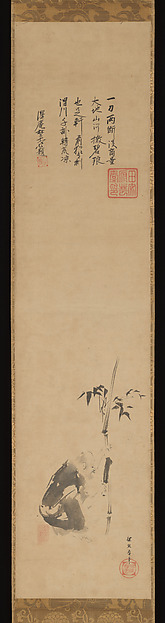
Japan · Edo period (1615–1868) · 1635–45 · Hanging scroll; ink on paper
Look closer: Kanō Tan'yū has left almost everything out. The body is a few broad washes, and the inscription by the Zen master Takuan Sōhō speaks of a single strike of the knife that cuts through all thoughts. The large seal below it belongs to the Tayasu family.
The Metropolitan Museum of Art, New York, The Miriam and Ira D. Wallach Foundation Fund, 2006, accession 2006.174. Public domain, Met Open Access. Museum record
The same source lists the three scenes by which painters know him. Rokuso taibō, 六祖碓房, shows him at the foot-mill for rice. Rokuso setchiku, 六祖截竹, depicts his sudden enlightenment while chopping bamboo, and the source cites Liang Kai and later Japanese artists. Rokuso hakyō, 六祖破経, shows him tearing a sutra, which it links to the Southern school's anti-textual leaning. They belong to the category of zenki-zu, pictures of Zen acts.2
The Metropolitan Museum's hanging scroll, painted between 1635 and 1645 by Kanō Tan'yū (1602 to 1674), leader of the Kanō school in Edo, shows the setchiku moment. Tan'yū based it on an early thirteenth-century painting by the Southern Song artist Liang Kai, now in the Tokyo National Museum. The inscription is by Takuan Sōhō (1573 to 1645), and the seal of the Tayasu family, the house of the ninth Tokugawa shogun Ieshige, shows that it was once in a very distinguished collection.3
The reception of the text itself was mixed. The Japanese Wiki Corpus reports that Dōgen called it apocryphal, without giving a date, and that the text was at first passed among masters as evidence of Dharma inheritance rather than published, spreading publicly after the ninth century.5 The twentieth-century Japanese editions by Yabuki Keiki and D. T. Suzuki were what put the Dunhuang text in front of modern readers.1
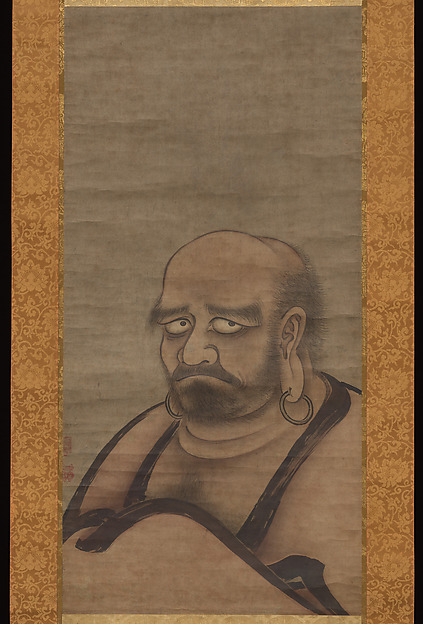
Japan · Muromachi period (1392–1573) · late 15th century · Hanging scroll; ink and color on paper
Look closer: Bodhidharma, the first Chan patriarch in the traditional count, is the figure with whom Huineng's lineage begins. His red robe is the usual way Japanese painters dress him.
The Metropolitan Museum of Art, New York, Purchase, Mary Livingston Griggs and Mary Griggs Burke Foundation and The Miriam and Ira D. Wallach Foundation Funds, and The Vincent Astor Foundation Gift, 2022, accession 2022.47. Public domain, Met Open Access. Museum record

Nanhai Guanyin Temple, Foshan, Guangdong
Look closer: In sculpture Huineng is shown seated and composed, a patriarch and not the woodcutter. The painters of the ink scrolls chose the opposite moment.
Photograph: Huangdan2060. CC0. Source: Wikimedia Commons. File record

Torn Sutras and Wiped Walls
The connoisseur's eyeThree moments in the sutra's story have become independent legends. The first is the wiped wall: the Fifth Patriarch rubs out Huineng's verse in public and tells the monks that its author has not understood, then goes to him secretly at night. The tradition says he gave him the robe and the teaching and told him to flee south.1
The second is the sutra torn by hand. It is not in the Platform Sutra but belongs to the pictorial cycle around it, and JAANUS notes that it is linked to the Southern school's anti-textual temper.2 It is a neat joke that a book which insists on non-reliance on books is nonetheless the main source for the story of the man who tore one.
The third is the declined summons. In chapter nine the court in the capital requests that Huineng attend, and he refuses.1 The Chan story is that the patriarch, who has refused the robe of office, refuses the robe of the court as well. Both strands, the humble origins and the independence from power, helped make Eno a favourite subject of Japanese Zen painters.
- 638Huineng is born in the south of China.24
- About 780The edition behind the Dunhuang copies is made.1
- 830 to 860The two Dunhuang copies are written.1
- 1056Qisong produces a larger edition.1
- 1291Zongbao's edition is produced, later entering the Ming canon.1
- 1635 to 1645Kanō Tan'yū paints the bamboo-cutting scroll.3
- 1934D. T. Suzuki publishes an edition corrected from Zongbao.1
- 1967Philip Yampolsky's translation of the Dunhuang text appears.1
Fun Facts and Loose Ends
First lookA scripture assembled by many hands collects odd facts. These are the ones that scholars like to repeat.
- The sutra is the only Chinese text explicitly called a sutra in Chan, although it records a Chinese teacher's words.1
- The long edition is about a third longer than the Dunhuang version, and chapters seven to nine were largely imported from another book, the Jingde Chuandeng lu.1
- The ten disciples addressed in the last chapter are named one by one: Fahai, Zhicheng, Fada, Shenhui, Zhichang, Zhitong, Zhiche, Zhidao, Fazhen and Faru.1
- Huineng is said to be the thirty-third patriarch in the Zen count from the historical Buddha.2
- The English translation by Wong Mou-lam (1930) was based on the Zongbao edition and is the earliest of the English translations listed.1
Nanhua Temple and the Modern Reader
The connoisseur's eyeThe sutra has a living address. Nanhua Temple in Maba town, about 25 kilometres south-east of central Shaoguan in Guangdong, was founded in 502 by an Indian monk, Zhiyao Sanzang, and called Baolin Temple. It received its present name in 968. Huineng once lived and taught there, and his statue is worshipped in the Sixth Ancestor Hall.6

Maba, Qujiang District, Shaoguan, Guangdong
Look closer: The gate bears the plaque Nanhua Chan Temple. The temple is an active monastery of more than 42 hectares, so the gate is the doorway into a working place of training and not a ruin.
Photograph: CenkX. Public domain. Source: Wikimedia Commons. File record

It is an active Chan monastery covering more than 42.5 hectares, with a Mahavira Hall, a Sutra Library, the Sixth Ancestor Hall and the Lingzhao Pagoda, and 690 Buddhist statues. Hanshan Deqing reformed it in the sixteenth century and Xuyun led a renovation in 1934; the body of Hanshan is described as one of its most precious relics.6
Readers have a choice of English translations: Wong Mou-lam's of 1930, Wing-tsit Chan's of 1963, Yampolsky's of 1967, Hsuan Hua's with commentary (1971), John McRae's of the long edition, Red Pine's of the second Dunhuang manuscript (2006), and Martin Verhoeven and Heng Sure's of the Taishō text (2014). They do not translate the same book, so a reader should always check which edition lies beneath.1
Korea and the Chan Source
The deep endBeyond China the sutra travelled to Korea, where it was printed in woodblock editions, one of which is the double page reproduced above, and to Japan, where it was received as the foundation text of the Southern school.15
The closest parallel is the Diamond Sutra. The two texts hold each other up: the Platform Sutra is the story of how the Diamond Sutra awakened a woodcutter, and the Diamond Sutra is the text that the Platform Sutra's hero hears and recites.147
A different parallel is the shift from monastic to lay practice. The sutra's chapter three argues that practice at home can be better than forms of renunciation without inner practice, and that the Pure Land is a matter of the state of one's mind.1
Reading a Zen Patriarch Scroll
The deep endA collector who meets a painting of the Sixth Patriarch should begin with the title. Is it taibō, setchiku or hakyō? The moment depicted tells the viewer which version of the story the painter has in mind. The Tan'yū scroll is a setchiku, and its inscription from Takuan Sōhō speaks of the single knife-stroke that cuts through all thoughts.23
Then read the seals and inscriptions. The Metropolitan's scroll shows how much information they carry: the signature Tan'yūsai hitsu, the inscription by Takuan, and a large collector's seal of the Tayasu family. A Zen scroll with an inscription by a recognised abbot is a different object from one without, and a seal of a known house is part of its provenance.3
Finally look at the brush. Zen painters of this school work with broad washes and few lines, because the subject is an instant. A heavily worked version is likely a different kind of picture. The house keeps a changing shelf of Buddhist sculpture, scrolls and ritual objects, and the concierge desk can search Japan for a particular subject or hand.
Words Worth Knowing
The terms below recur on this page and across the almanac.
| Term | Reading | Meaning |
|---|---|---|
| Rokuso Dankyō | Rokuso Dankyō | The Platform Sutra of the Sixth Patriarch.15 |
| Eno | Eno | Japanese name of Huineng.2 |
| Rokuso setchiku | Rokuso setchiku | The Sixth Patriarch cutting bamboo, a Zen picture.2 |
| Zenki-zu | zenki-zu | Paintings of Zen acts.2 |
| Tan | dan | The platform or dais from which the teacher speaks.1 |
| Buddha-nature | busshō | The fundamental nature that illusion hides.1 |
Related Pieces
The house keeps a changing shelf of Buddhist sculpture, scrolls and ritual objects from Japan. The shelf below fills with pieces on the day you read this, and the collection page lists them all.
Pieces in the house now
- Buddhist statues and sacred artSculpture, scrolls and ritual objects
Answered plainly
What is the Platform Sutra?
A Chan scripture composed in China between the eighth and thirteenth centuries, centred on the teachings and life story of the Sixth Patriarch Huineng. It is the only Chinese Buddhist text explicitly called a sutra in Chan.1
Who was Eno?
Eno is the Japanese name for Huineng, 638 to 713, the sixth Zen patriarch and founder of the Southern school.2
Why is it called the Platform Sutra?
The platform is the podium from which the teacher spoke. The title records that the sermon was delivered from a dais at Dafan Temple.1
Did Huineng really write it?
No. The text attributes its recollection to the disciple Fahai, but scholars believe it was composed or redacted over a long period.1
What is the story of the two verses?
Shenxiu wrote a verse comparing mind to a mirror to be polished; the illiterate Huineng answered with a verse that undercut those terms, and Hongren chose him as successor in secret.1
What did Dōgen think of it?
The Japanese Wiki Corpus records that Dōgen called the text apocryphal, without giving a date.5
Where can I visit its home?
Nanhua Temple, an active Chan monastery in Shaoguan, Guangdong, where a statue of Huineng is worshipped in the Sixth Ancestor Hall.6
Which edition should I read?
Read a translation based on the Dunhuang manuscript for the oldest layer, or one based on the Zongbao edition for the long traditional text; the two differ by about a third.1
Where next
Sources and image credits
- Wikipedia, Platform Sutra Text, editions, contents, translations, scholarship.
- JAANUS, Rokuso (Huineng) Eno, the Southern school and the three iconographic scenes.
- The Metropolitan Museum of Art, The Sixth Patriarch of Zen at the Moment of Enlightenment (Kanō Tan'yū) Painting, inscription by Takuan Sōhō, Liang Kai source.
- Martin Goodson, The Story of Eno Daikan (Huineng), Part I, Zen Gateway (6 October 2020) Biography up to the meeting with Hongren.
- Japanese Wiki Corpus, Rokusodankyo (Platform Sutra) Editions of 967, Dōgen's remark, transmission.
- Wikipedia, Nanhua Temple Founding, buildings, current status.
- Wikipedia, Diamond Sutra Role of the Diamond Sutra in the Huineng story.
- The Metropolitan Museum of Art, Bodhidharma in Red Robes (843779) Title, date and medium of the Bodhidharma scroll.
Last reviewed 28 October 2026. Dates in this chapter follow the cited pages; where the sources disagree, the chapter says so. Every picture is public-domain or openly licensed, and its credit and licence stand beneath it.
If this subject has drawn you to an object, the concierge desk can search Japan for it.
Private concierge
Looking for something in particular?
Describe the piece or the project you have in mind. A senior advisor in Tokyo reads every case file personally and replies within two business days, with fees set out in writing before any work begins.