
Ninja, History and Myth | Japonista
Heritage Wing · Shadow and Ink
Ninja, History and Myth
The ninja of the films wear black, throw stars and vanish in smoke. The ninja of the record were mercenary neighbours from two mountain provinces who burned castles, carried messages and wrote their trade down once the wars were over. The difference is the subject of this chapter.
Fact sheet
At a glance
- A trade, not a clan. The sources describe local warrior-farmers who sold services as spies, scouts and raiders, mostly in siege work.
- Two homelands. Iga and the neighbouring Koka district formed leagues for self-defence and hired themselves out.
- A fall. The Iga league was destroyed by Oda Nobunaga's army in 1581; survivors scattered, and some served the Tokugawa.
- A pen. Most of what is known of the craft was written down in the peaceful seventeenth century.
- A costume. The black suit comes from the kabuki stage, where black meant invisible to the audience.
Shinobi Before Ninja
Wikipedia’s article on the ninja starts with the word. Ninja is the on’yomi, Sino-Japanese, reading of the characters 忍者. The older native reading is shinobi, a shortening of shinobi-no-mono, and the article notes that historical documents mostly use shinobi. The root appears in the Man’yōshū, the great eighth-century anthology, where its literal sense is to steal away or to hide, and by extension to forbear.
Other names were used locally. The article lists monomi, nokizaru, rappa, kusa and Iga-mono. The female ninja of fiction, the kunoichi, is a modern invention, and the article says the word began as underworld slang for woman. None of this is a mystery. It is simply a reminder that the figure we know by one name was known to his contemporaries by several, and that the one that survived is the one that suited the screen.
Princes, Monks and Doubt
The legends begin early. Wikipedia mentions Yamato Takeru, a semi-legendary figure of the second century, and Prince Shōtoku (574 to 622), said to have used a spy named Otomono Sahito, whom the article calls the first person dubbed ninja while admitting that evidence for him is scarce. A boy named Hasetsukabe no Koharumaru, according to the tenth-century Shōmonki, was killed for spying on Taira no Masakado.
A school history, the Togakure-ryū, holds that a man named Daisuke Togakure and a Chinese monk formed ninjutsu in 1162. The article reports this as lore recorded by the school and not as verified fact. The Taiheiki, a fourteenth-century chronicle, does mention shinobi, and credits a castle fire to an unnamed highly skilled one. That is the first reasonably solid footprint. The article adds that spies were specially trained only from the fifteenth century, and that later manuals drew on Chinese strategy, Sun Tzu among them.
The reader’s rule here is simple. What is early is legend, what is late is documented, and the line between them runs through the fifteenth century.
Iga, Koka and the Ikki
The documented story begins in Iga Province and the neighbouring Koka district. According to Wikipedia, local warrior-farmers, jizamurai, formed leagues called ikki for self-defence and sold their services as mercenaries and spies. The article lists the roles: spy, scout, surprise attacker and agitator. It describes three ranks, jōnin at the top, who hired out mercenaries, chūnin as assistants, and genin as field agents drawn from the lower class.
Professional ninja, in the article’s phrase, were hired by daimyō between 1485 and 1581, mostly for siege work: night attacks, ambushes and arson. It gives episodes. In 1541, the Tamon-in Nikki records an Iga arson attack on Kasagi Castle. In 1558 Rokkaku Yoshikata’s forty-eight men entered Sawayama Castle carrying lanterns that bore the enemy’s crest and set it on fire, a trick called the ghost technique. The 1560 raid by eighty Koga men is attributed to a source the article marks as needing a citation, so we do not rely on it.
The leagues ended in turn. The Koka ikki lasted until 1574, when it became a vassal of Oda Nobunaga. The Iga ikki fell in 1581. Wikipedia’s article on the Tenshō Iga War describes three conflicts. In 1578 the Oda commander Takigawa Kazumasu began a castle at Maruyama, and Iga warriors attacked it in daylight on 24 November and burned it. In October 1579 Nobunaga’s son Nobukatsu sent three columns totalling 10,800 men into Iga and was ambushed; the article gives Oda losses as thousands, from the Iranki, and Iga strength as unknown.
In 1581 Nobunaga came himself. The article says two Iga residents offered to guide an invasion and were rewarded, and that the Oda force numbered about 42,000 in six columns against defenders of 10,000 at most, spread across the province. Kashiwara Castle surrendered on 8 October, ending organised resistance, and a fortress belonging to Momochi Tanba was burned. Nobunaga toured the province in early November. After this, the article says, Iga forces were hired as auxiliary troops by other armies. The link between the war and the later ninja tradition is something the article describes as believed, not established.
| Year | Event | Scale as stated |
|---|---|---|
| 1578 | Maruyama Castle attacked and burned by Iga warriors | Daylight attack, 24 November |
| 1579 | Three Oda columns enter Iga and are ambushed | 10,800 men; losses given as thousands |
| 1581 | Oda invasion; Kashiwara surrenders on 8 October | About 42,000 attackers; at most 10,000 defenders |
Hanzō and the Long Peace
Hattori Hanzō (1542 to 1596) is the most famous name attached to the story, and Wikipedia calls him a Tokugawa samurai. A tale in the Iga-sha yuishogaki, an Edo-period record, says that in 1582 he led three hundred ninja to escort Tokugawa Ieyasu through Iga. The historian Tatsuo Fujita doubts it and argues it was propaganda to raise the standing of Iga and Koka, and researchers at Mie University suggest that Koka warrior-farmers, not ninja, gave the help. The article treats it as disputed, and so do we.

Original chart drawn from the figures in the Wikipedia article on the ninja. Kishu is given as 200 or more; the rest are as stated.
Look closer: Roughly half the people in the chart worked for one domain, Kishu, and none of the others employed more than fifty.
Original diagram, The Japonista Curation and Concierge Team, Tokyo, Japan.
The Tokugawa peace ended the work. The article says the last written accounts of ninja in war come from the Shimabara Rebellion of 1637 and 1638, when Koga ninja recruited by Tokugawa Iemitsu reconnoitred Hara Castle and captured a Christian cross banner. Afterwards the survivors were employed by domains or became guards, doctors, merchants or martial artists, and some fell into banditry. The article gives domain figures: more than 200 in Kishū, 50 each in Kishiwada and Kawagoe, 30 in Matsue, 20 in Hirosaki, 12 in Fukui, 10 each in Hikone and Okayama and 5 in Akō. The Tokugawa also kept a secret police, the oniwaban, whose members came from the Koka and Iga clans.
The Craft Written Down
The craft was recorded when it was no longer needed. The Bansenshūkai, whose title is usually rendered Ten Thousand Rivers Flowing Together to Form an Ocean, was compiled in 1676 by Fujibayashi Yasutake. According to Wikipedia, it draws on Iga and Koga knowledge and summarises three volumes of an earlier text, the Kanrinseiyō, and it was written to preserve knowledge from the Ōnin War to the end of the Siege of Osaka, about 150 years. The article lists six groups of topics across 21 volumes: thought and philosophy, leadership, open disguise, hidden infiltration, astrology, and tools and weapons.
The Kanrinseiyō was long unconfirmed. In June 2022 a copy of its second volume, made in 1748, was found. The Shōninki, written in 1681 by Natori Masatake, comes from Kishū and has a preface, three scrolls and an epilogue. Its first scroll covers basic skills such as disguise, concealment and gathering information; its second covers defence against enemy spies and the reading of human nature; its last turns to emotional states. These two books, with the Ninpiden, are the three main sources of direct information, Wikipedia says.
A reader should notice what the manuals are. They are Edo-period books, written in peacetime to preserve a craft. They preserve method; they are not battle reports.
The Black Suit Comes From the Stage
The costume is the part of the legend that has least to do with history. Wikipedia’s article says peacetime ninja wore the dark-indigo-dyed work clothes of farmers, and that in combat they probably wore modified field clothes, likely dark brown, which blended better at night. A black suit in daylight would have been conspicuous, so they did not wear one then.
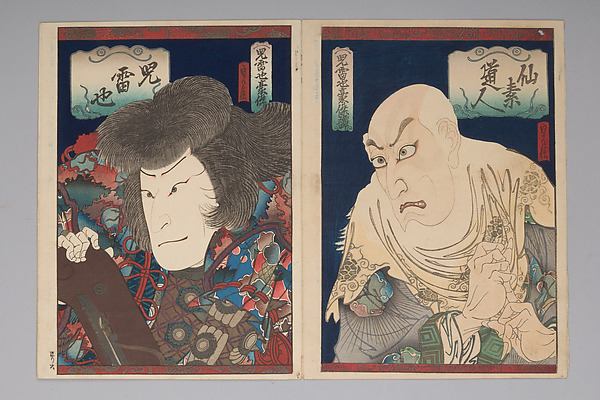
Hasegawa Sadanobu, pair of chuban woodblock prints, ink and colour on paper, each 24.8 x 18.1 cm. The Metropolitan Museum of Art, accession 2011.150. Purchase, Friends of Asian Art Gifts, in honor of James C. Y. Watt, 2011. Open Access.
Look closer: Look at the shaggy hair and the fierce expressions. These are stage faces, drawn to be read from a distance, and not scouts in disguise.
The Metropolitan Museum of Art, public domain (Open Access).
The black came from the theatre. The article says Edo theatre created many of the stereotypes. The black clothing imitates the kuroko, stagehands who are meant to be ignored, and the shuriken contrasted with the swords of onstage samurai. Kabuki portrayed ninja as dishonourable and often sorcerous. The article names the novel Jiraiya Gōketsu Monogatari, adapted for kabuki, as part of this folklore.
The Metropolitan Museum holds a pair of prints from 1854 by Hasegawa Sadanobu, showing the kabuki actors Ichikawa Ebizō V as Senso Dōjin and Jitsukawa Ensaburō as Jiraiya. They show the sorcerous Jiraiya as the Edo audience met him, in costume on the stage.
A Subject for Scholars
Wikipedia reports that Mie University founded what it calls the world’s first ninja research centre in 2017, and opened a graduate master’s course in Iga in 2018, taking about three students a year. Applicants must pass a test on Japanese history and be able to read historical ninja documents. The article attributes the first-in-the-world claim to the university and does not verify it.
What the evidence supports, in the end, is a modest and rather moving picture: neighbours from two mountain provinces who made a trade of information and fire, were beaten by a bigger army, found work with other armies, and wrote their methods down in a peaceful century. Everything else, including the smoke, is theatre, and good theatre.
Steel, Cloth and Stage
The warrior material of the house, from sword guards to armour, sits beside this chapter, and the concierge desk can answer questions about a particular piece.
Answered plainly
What does shinobi mean?
Wikipedia gives its literal sense as to steal away or to hide, and by extension to forbear. It is the older native reading of the characters that are now more often read as ninja.
Did ninja really wear black?
Wikipedia says peacetime ninja wore dark-indigo work clothes and that in combat they probably wore dark brown, which blended better at night. The black suit is a kabuki convention drawn from the kuroko stagehands.
What happened to the Iga ninja in 1581?
Oda Nobunaga invaded Iga with about 42,000 men in six columns against defenders of at most 10,000. Kashiwara Castle surrendered on 8 October and organised resistance ended; the survivors scattered, and some served others as auxiliaries.
Is the story of Hattori Hanzo and the three hundred ninja true?
It is disputed. The tale appears in the Iga-sha yuishogaki, an Edo-period record. The historian Tatsuo Fujita doubts it, and Mie University researchers suggest it may have been Koka warrior-farmers who gave the help.
What are the Bansenshukai and Shoninki?
Edo-period manuals of the shinobi craft: the Bansenshukai, compiled in 1676 by Fujibayashi Yasutake, and the Shoninki, written in 1681 by Natori Masatake.
Were ninja assassins?
Wikipedia says there is little evidence for it. The documented work is espionage, arson, siege work, night raids, reconnaissance and mercenary contracts.
Where next
Sources and image credits
- Ninja, Wikipedia
- Tenshō Iga War, Wikipedia
- Bansenshūkai, Wikipedia
- Shōninki, Wikipedia
- Ichikawa Ebizō V as Senso Dōjin; Jitsukawa Ensaburō as Jiraiya, Hasegawa Sadanobu, 1854, accession 2011.150, The Metropolitan Museum of Art
Last reviewed 28 October 2026. Pictures, where shown, are public-domain or open-access and credited beneath each one.
Looking for armour, a helmet or a warrior print with a documented history? The concierge desk replies within one to three business days.
Private concierge
Looking for something in particular?
Describe the piece or the project you have in mind. A senior advisor in Tokyo reads every case file personally and replies within two business days, with fees set out in writing before any work begins.