
Nehan-zu: Paintings of the Buddha’s Death
Hanging scroll · Heian to Edo periods
Nehan-zu: Paintings of the Buddha’s Death
涅槃図
Once a year, in the second month, a temple hall in Japan was darkened and a great scroll was unrolled before the congregation. It showed the historical Buddha lying on his right side beneath twin trees, surrounded by weeping disciples, calm bodhisattvas, gods, ordinary people and animals, while his mother hurried down from heaven.136 The scroll is called a nehan-zu, a nirvana picture, and it served as the principal image of a memorial service for the Buddha’s death.12 This page explains the scene, reads its figures, follows the oldest dated example and the later workshops, and sets out where the sources do not agree.123
Fact sheet
Five things to look for
- The couch. The Buddha lies on his right side, eyes closed, as if asleep, on a platform between sala trees.136
- The mother. Queen Maya descends from the upper right on clouds, reaching toward her son.146
- The calm and the grief. Bodhisattvas stay composed while disciples and many others weep openly.34
- The animals. Creatures of every kind gather, among them a white elephant, a lion and, in one scroll, more than thirty animals.346
- The scale. Scrolls range from a print sheet to a hall-filling banner, because they were meant to be hung for a rite.169
The Buddha Lies Down Between Two Trees
First lookThe painting shows an event that the scriptures place at Kushinagar. According to a Japanese art writer summarising the Mahaparinirvana Sutra, the Buddha at the age of eighty lay down between two sala trees and died.3 The standard Japanese art dictionary calls his death daihatsu nehan, great nirvana, and counts it among the eight great events of his life.1 Wikipedia explains the term: parinirvana is the state entered after death by someone who attained nirvana during life, a release from rebirth, and in Buddhist art it is shown by a reclining Buddha, often surrounded by disciples.7

Stone relief, Honolulu Academy of Arts. Photograph by Hiart
Look closer: This stone relief from Gandhara is recorded as about 100 CE and shows the same subject, the death of the Buddha, long before any Japanese scroll. Compare how the figures are grouped with the Japanese scrolls on this page.711
Photograph: Hiart. CC0. Source: Wikimedia Commons. File record

Several texts stand behind the scene. The Pali Mahaparinibbana Sutta is described as the principal reference in most standard studies, although it was first written down hundreds of years after the death.7 The Mahayana Mahaparinirvana Sutra was written hundreds of years later still, and uses the event as a springboard for ideas such as the eternity of the Buddha.7 A Japanese reference adds that the Mahayana sutra was translated into Chinese in the fifth century and that a later part was appended to it.2
The scene is not unique to Japan. Reclining Buddha images occur as statues, reliefs, murals and paintings in all Buddhist countries.1 What Japan added was the habit of making large painted scrolls for an annual rite, which is the subject of the sections below.
| Text | What the sources say |
|---|---|
| Pali Mahaparinibbana Sutta, Digha Nikaya 16 | Principal source in most standard studies; written down hundreds of years after the death7 |
| Mahayana Mahaparinirvana Sutra | Written hundreds of years later; uses the death to teach Mahayana ideas7 |
| Chinese version | Translated into Chinese in the fifth century, with a later section appended2 |
| Madhyama Agama | Cited for the Buddha shining like a golden mountain before his death3 |
Who Weeps and Who Stays Calm
The connoisseur's eyeA nehan-zu is a crowd scene with a still centre. The Japanese dictionary says the mourners are traditionally counted as fifty-two kinds of beings, including disciples, bodhisattvas, gods, lay people and animals, and that the Buddha’s mother Maya hurries down from the Heaven of the Thirty-three Gods.1
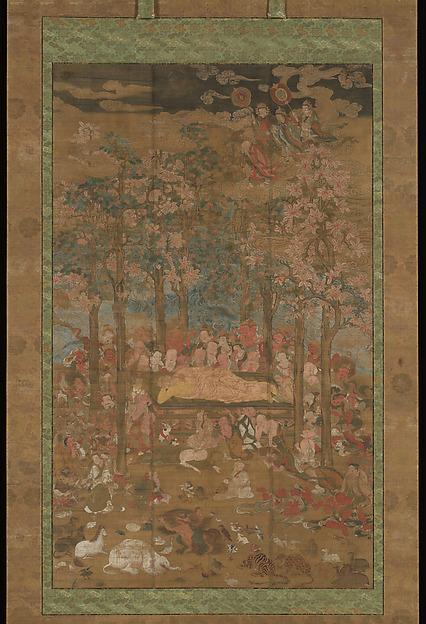
Japan, Muromachi period. Hanging scroll, ink, colour and gold on silk. The Metropolitan Museum of Art
Look closer: The museum describes calm bodhisattvas in princely dress, weeping shaven-headed disciples, more than thirty animals and Queen Maya descending at the upper right. Find the one bodhisattva dressed as a monk: the museum names him as Jizō holding a jewel.4
The Metropolitan Museum of Art, New York, Gift of Susan Dwight Bliss, 1944, accession 44.35.1. Public domain, Met Open Access. Museum record
The Metropolitan Museum of Art’s scroll shows how the painter sorts the crowd by understanding. The museum describes the bodhisattvas as calm and dressed in princely finery, except Jizō, who appears as a monk holding a jewel, while shaven-headed disciples weep openly, as do converted Hindu deities and guardians. People of every social class and more than thirty animals also grieve, even the blossoms on the sala trees change colour, and Queen Maya weeps as she descends at the upper right.4 The museum reads the differences in grief as differences in enlightenment.4
The Art Institute of Chicago describes its own scroll in similar terms: a gold-bodied Buddha on a lacquered platform in a grove of sala trees, wearing an expression of peaceful sleep while the scene around him is far from calm. A disciple blows his nose, Mahakashyapa, who arrived after the death, dries a mourner’s tears, a white elephant and a blue lion-dog cry out, and a woman-headed bird prays with clasped hands.6
The scene is also arranged by rank. In the Kongōbu-ji scroll described on the next page, Kannon, Monju and Fugen are placed at the Buddha’s head and the ten great disciples at his feet.3 For these figures, see the pages on Monju, Fugen and Jizō, and the page on Shaka Nyorai, the Buddha at the centre.
| Figure | Where it appears | Source |
|---|---|---|
| Queen Maya | Descending from the upper right on clouds, weeping or reaching toward her son | Met, Art Institute, Yale456 |
| Jizō | Dressed as a monk holding a jewel; at the front of the couch in the Yale scroll, not mourning | Met, Yale45 |
| Ānanda | Fainted, in the Yale scroll, with Aniruddha trying to revive him | Yale5 |
| Indra and Vaiśravaṇa | Behind the couch holding a portable stupa | Yale5 |
| Lion | Overturned and lamenting in the Kongōbu-ji scroll | Kongōbu-ji3 |
| Elephant and lion-dog | Crying out in the Art Institute scroll | Art Institute6 |
Statues First, Then Scrolls
The connoisseur's eyeIn Japan the story begins with sculpture. The standard dictionary says the oldest surviving example is a clay statue group at Hōryū-ji in Nara dated 711, and another Japanese reference says Hōryū-ji’s five-storey pagoda holds a clay nirvana scene.12 The sources do not mention how the scene is arranged inside the pagoda.

Heian period. Wikimedia Commons, public domain
Look closer: The Commons record places this small image at Sōyūji in Uda, Nara, in the Heian period, and the Japanese dictionary names Sōyūji among the Heian examples. At 364 by 476 pixels it is a record, not a close view.112
Photograph: Heian-period artist. Public domain. Source: Wikimedia Commons. File record

Painting became the preferred form because it was used in the Nehan-e rite.1 The Japanese reference says production began in the late Nara period at Tōdai-ji, Kōfuku-ji and Ishiyama-dera, and the dictionary says the rite was already being performed in the late Nara period.12 The Yale University Art Gallery notes that most temples of the Heian period used statuary for the rite, while Kōfuku-ji preferred the hanging scroll as its main format.5
Early painted examples named by the sources include the Kongōbu-ji scroll of 1086, examples at the Tokyo National Museum and Jōkyō-ji in Wakayama, murals in the Taishi-dō of Kakurin-ji in Hyōgo dated 1111, and paintings at Daian-ji, Shin’yakushi-ji, Darumaji and Sōyūji in Nara.12 From the Kamakura period the scrolls become more numerous and more crowded, with more mourners and animals, and the late Kamakura examples at Jimoku-ji in Aichi and Chōhō-ji in Wakayama are described as more emotional.2
For the building where the earliest clay scene stands, see the page on Hōryū-ji and the oldest wooden halls. Its Golden Hall once held wall paintings of a different kind, described on the page about the Golden Hall murals.
- 711Clay statue at Hōryū-ji, the oldest surviving reclining Buddha in Japan according to the dictionary.1
- Late Nara periodThe Nehan-e rite is already performed, and production of nirvana images begins at Tōdai-ji, Kōfuku-ji and Ishiyama-dera.12
- 1086The dated scroll at Kongōbu-ji on Mount Kōya.23
- 1111Murals in the Taishi-dō of Kakurin-ji, Hyōgo.2
- About 1320 to 1340The scroll by Myōson now at Yale.5
- Early MuromachiThe very large scroll at Tōfuku-ji, Kyoto, about 14.6 by 7.3 metres.1
- 15th centuryThe Metropolitan Museum scroll, 188 by 110 centimetres in the image.4
- About 1710sThe hand-coloured woodblock print now in Cleveland.9
- 1800sHakuen’s parody in the Ōtsu-e style.10
The Dated Scroll of Mount Kōya
The connoisseur's eyeThe Kongōbu-ji scroll is a National Treasure and is described as the standard work of eleventh-century Buddhist painting. It carries an ink inscription dating it to the seventh day of the fourth month of Ōtoku 3, which is 1086, and the article calls a dated Buddhist painting of the Heian period extremely rare.3 It is a hanging scroll in colour on silk, 267.6 centimetres high by 271.2 wide, and belongs to Kongōbu-ji in Wakayama.3
The composition is spare. The Buddha lies on a central treasure platform with his eyes closed in a peaceful pose, his face and chest painted in yellowish-white intermediate tones and his robes decorated with fine cut gold, called kirikane.3 The article counts thirty-eight bodhisattvas and disciples and one lion around him. Kannon, Monju and Fugen are at the head, the ten great disciples, including Pūrṇa and Upāli, at the feet, and Queen Maya at the upper right. The lion is shown overturned in grief, the bodhisattvas remain calm and the disciples weep.3
The text behind the picture is the Mahaparinirvana Sutra, in which the Buddha lies down between two sala trees at Kushinagar, and the Madhyama Agama, which describes him shortly before death as radiant like a golden mountain. The article says the painting’s tones are meant to convey that radiance.3
The dictionary names this scroll as its principal dated example and places it at Mount Kōya in Wakayama.1 A single article gives the exact size and the date of the inscription, so the figures here rest on that article and should be checked against the temple or the Agency for Cultural Affairs record before being quoted.
Myōson and the Nara Painters
The connoisseur's eyeLate scrolls can often be traced to a workshop. The Yale University Art Gallery’s scroll is dated to about 1320 to 1340 and is by Myōson, a painter of the Shōnami workshop that worked under the Ichijōin office of Kōfuku-ji in Nara. It measures 176.5 by 293 centimetres on silk.5

Myōson, Shōnami workshop of Kōfuku-ji, Nara. Yale University Art Gallery, 2005.58.1a-b
Look closer: The gallery notes Jizō lying at the front of the couch with a jewel and staff, not mourning, and Ānanda fainted while Aniruddha tries to revive him. Look for these two figures near the couch.513
Photograph: Myoson (Shonami workshop, Kofuku-ji). Public domain. Source: Wikimedia Commons. File record

The gallery places it in the second type of Butsu nehan-e, the type that emphasises the mourners and animals around the Buddha, and notes that it follows the first chapter of the Mahayana Mahaparinirvana Sutra, set at Kushinagar. The mourners include Nanda, the ascetic Subhadra, Ānanda, who has fainted, and Aniruddha, who tries to revive him, while Jizō lies at the front of the couch holding a jewel and a staff and is not shown mourning, in keeping with his role in Japanese Buddhism as a guide through the afterlife.5
The same workshop is linked to other scrolls: one made for Myōho-ji in Hyōgo in 1325, and one owned by Baron Fujita Heitarō.5 The Yale scroll passed in the early twentieth century through the dealer Yamanaka and Company, mounted with a Hannya Bosatsu mandala that is now at the Metropolitan Museum, and came to Yale in 2005.5
The Day the Scroll Is Unrolled
The connoisseur's eyeThe rite for which these scrolls were made is the Nehan-e, the nirvana service. The dictionary describes it as performed annually on the fifteenth day of the second month in memory of the Buddha’s death, and says it was already performed in the late Nara period.1 The Yale gallery adds that it took place in a temple’s main hall before a painting of the reclining Buddha and his mourners, with hymns, chants and a lecture on the painting.5
The Art Institute of Chicago says that large scrolls of this kind were ceremonially hung on the fifteenth day of the second lunar month, that monks and devotees often wept before them and that a scroll might be viewed only once a year.6 A Japanese reference notes that Nehan-e is a spring seasonal word, a kigo, used in haiku.2 The Japanese article on the Kongōbu-ji scroll says the growing use of the scroll as principal image at the service explains why production gradually increased.3
Outside Japan the day is observed too. Wikipedia’s article on Parinirvana Day says it is celebrated in East Asia, Vietnam and the Philippines, by most on 15 February and by some on 8 February, with readings from the Nirvana Sutra, meditation and visits to temples, and that Bhutan observes it on the fifteenth day of the fourth month of its calendar.8
Eight Scenes, Prints and Parody
The connoisseur's eyeThe basic scene has variants. The dictionary names the Shaka hassō nehan-zu, in which the death scene is surrounded by the other seven great events of his life or by incidents connected with his death, and the kinkan shutsugen-zu, which shows Maya’s descent from heaven to the Buddha’s deathbed.1 A Japanese reference adds that the kinkan scene shows her later return and final teaching.2

Japan, Edo period. Colour woodblock print. Cleveland Museum of Art, 1916.1141
Look closer: The museum says rectangular cartouches name the followers and that the hand-colouring in yellow and red does not always follow the printed outlines. Look for the cartouches and for places where colour crosses a line.914
Photograph: Unknown Japanese printmaker, Edo period. CC0. Source: Wikimedia Commons. File record
Printing carried the subject beyond the temple. The Cleveland Museum of Art has a hand-coloured woodblock print of about the 1710s, a sheet 54 by 27.8 centimetres, which it calls the earliest hand-coloured print in its collection. It records that every printed version of the subject is based on earlier paintings and that the earliest woodcut of the event dates to 1402.9

Japan, 1800s. Hanging scroll, ink and colour on paper. Cleveland Museum of Art, 2016.306
Look closer: The museum describes an oni pretending to be a priest, a wisteria maiden carrying water and an oni as a thunder god, all characters from Ōtsu-e folk painting, in place of the usual mourners.1015
Photograph: Hakuen (active 1850-1870). CC0. Source: Wikimedia Commons. File record
Humour followed devotion. In the nineteenth century the painter Hakuen made a hanging scroll, 201.9 by 78.7 centimetres, that the museum describes as a parody of the traditional representation, in which the mourners are replaced by figures from Ōtsu-e, a folk painting tradition. The museum says the work would have amused nineteenth-century viewers familiar with the usual imagery.10
Scale varies as much as tone. The dictionary gives the enormous scroll at Tōfuku-ji in Kyoto, of the early Muromachi period, as approximately 14.6 by 7.3 metres, and the Art Institute describes its own scroll as over fifteen feet tall.16
| Work | Date | Size |
|---|---|---|
| Kongōbu-ji scroll | 1086 | 267.6 by 271.2 cm3 |
| Yale scroll by Myōson | About 1320 to 1340 | 176.5 by 293 cm5 |
| Tōfuku-ji scroll | Early Muromachi | About 14.6 by 7.3 m1 |
| Metropolitan Museum scroll | 15th century | Image 188 by 110 cm; mounted 290.8 by 142.2 cm4 |
| Art Institute of Chicago scroll | Late 17th to early 18th century | Over 15 feet tall6 |
| Cleveland print | About 1710s | Sheet 54 by 27.8 cm9 |
| Hakuen, Ōtsu-e scroll | 1800s | 201.9 by 78.7 cm10 |
How to Read a Nehan-zu
The connoisseur's eyeA nehan-zu rewards slow looking, and the sources suggest a sequence. Start with the Buddha, who is placed at the centre, usually lying on his right side with eyes closed, and who in the finest scrolls appears to radiate light through gold.36 Then find Queen Maya at the upper right.46
Next, read the mourners by their faces. The sources describe composed bodhisattvas and weeping disciples, and they note that the grief of the others shows their levels of understanding.34 Look for the animals, whose presence is explained by one museum as acknowledgement that the Buddha’s law applies to all living creatures.9
Finally, think about use. These were not pictures hung for decoration. They were unrolled for a rite in a main hall and were seen by a congregation, which is why the best of them are large and carefully coloured, and why many were seen only once a year.56
A word of caution belongs here. Dating a scroll by style from a photograph is not reliable, and the sources give dated examples only where an inscription or a documented workshop survives. Treat any age given to an undated scroll as an opinion, and look for an inscription, a workshop name or a record of provenance.
Words Worth Knowing
The terms below recur on this page and across the almanac.
| Term | Reading | Meaning |
|---|---|---|
| Nehan-zu | nehan-zu | A painting of the Buddha’s death and entry into nirvana.1 |
| Nehan-e | nehan-e | The annual nirvana service in memory of the Buddha’s death.15 |
| Daihatsu nehan | daihatsu nehan | The Buddha’s great final nirvana, one of the eight great events of his life.1 |
| Sara sōju | sara sōju | The twin sala trees under which the Buddha died.1 |
| Mayabunin | mayabunin | Queen Maya, the Buddha’s mother, shown descending from heaven.1 |
| Hassō nehan-zu | hassō nehan-zu | A nirvana picture surrounded by the other great events of the Buddha’s life.1 |
| Kinkan shutsugen-zu | kinkan shutsugen-zu | A related subject showing Maya’s descent to the Buddha’s deathbed.12 |
| Kirikane | kirikane | Fine cut gold foil applied to the surface of a Buddhist painting.3 |
Related Pieces
The house keeps a changing shelf of Buddhist sculpture, scrolls and ritual objects from Japan. The shelf below fills with pieces on the day you read this, and the collection page lists them all.
Pieces in the house now
- Buddhist statues and sacred artSculpture, scrolls and ritual objects
Answered plainly
What is a nehan-zu?
A nirvana picture: a painting of the historical Buddha’s death, with Shaka lying on his right side under sala trees and mourners around him.12
What is the oldest nehan-zu in Japan?
The Japanese sources name the scroll at Kongōbu-ji on Mount Kōya, inscribed 1086, as the oldest surviving painting of the subject. The oldest reclining Buddha in Japan is a clay statue at Hōryū-ji dated 711.123
Who is the figure descending at the upper right?
Queen Maya, the Buddha’s mother, who comes down from the Heaven of the Thirty-three Gods.14
When is the Nehan-e service held?
On the fifteenth day of the second month in the Japanese dictionary’s account, and in mid-February in the Yale account, while Wikipedia gives 15 February for most observers. Check with the temple.158
Why are animals included?
The Metropolitan Museum counts more than thirty in its scroll, and Cleveland says the animals acknowledge that the Buddha’s law applies to all living creatures.49
Why is Jizō in a nehan-zu?
The Metropolitan Museum describes Jizō as the one bodhisattva dressed as a monk, and the Yale gallery places him at the front of the couch, not mourning, in keeping with his role as a guide through the afterlife.45
Are there comic nehan-zu?
Yes. Cleveland holds an Ōtsu-e scroll by Hakuen that replaces the mourners with folk-painting characters, described as a parody that would have amused nineteenth-century viewers.10
Where next
Sources and image credits
- JAANUS, Nehan-zu Definition, iconography, forms, Nehan-e, named examples.
- Kotobank, 涅槃図 Definition, textual basis, early examples, Kamakura developments.
- Into Japan Waraku, Kongōbu-ji Butsu Nehanzu Inscription, size, composition, figures, Nehan-e.
- The Metropolitan Museum of Art, Death of the Historical Buddha (Nehan-zu), 44.35.1 Date, medium, size, description.
- Wikipedia, The Final Death of the Buddha Sakyamuni Yale scroll, Myōson, iconography, Nehan-e ceremonies.
- Art Institute of Chicago, Finding Nirvana: The Death of the Buddha Scroll description, iconography, ritual use.
- Wikipedia, Parinirvana Concept, scriptural sources, art.
- Wikipedia, Parinirvana Day Dates and observances.
- Cleveland Museum of Art, The Parinirvana of the Buddha, 1916.1141 Print, date, size, description.
- Cleveland Museum of Art, Ōtsu-e Nirvana of the Buddha, 2016.306 Scroll, date, size, description.
- Wikimedia Commons, Parinirvana, Gandhara, c. 100 CE, Honolulu Academy of Arts Photograph, licence and credit.
- Wikimedia Commons, Butsu nehan zu (Soyuji Uda) Photograph, licence and credit.
- Wikimedia Commons, Myoson, The Death of the Buddha Sakyamuni (Nehan-zu), Yale University Art Gallery Photograph, licence and credit.
- Wikimedia Commons, The Death of the Buddha, Cleveland Museum of Art 1916.1141 Photograph, licence and credit.
- Wikimedia Commons, Hakuen, Parinirvana with Otsu-e Subjects, Cleveland Museum of Art 2016.306 Photograph, licence and credit.


Last reviewed 28 October 2026. Dates in this chapter follow the cited pages; where the sources disagree, the chapter says so. Every picture is public-domain or openly licensed, and its credit and licence stand beneath it.
If this subject has drawn you to an object, the concierge desk can search Japan for it.
Private concierge
Looking for something in particular?
Describe the piece or the project you have in mind. A senior advisor in Tokyo reads every case file personally and replies within two business days, with fees set out in writing before any work begins.