
Kannon in Japan
Temples, Pilgrims and Festivals
Kannon in Japan
日本の観音
Where the bodhisattva is met in Japan: a hidden gold image in Asakusa, a wooden stage over a hillside, a hall of a thousand and one statues and a pilgrimage of thirty-three temples, with the legends, the calendar and the news of recent years.
Identity card
Know the figure at a glance
- The crown and its small Buddha. Most images wear a crown with a tiny seated Amida set into it (kebutsu), the sign of Kannon’s lineage and the most common way to identify him (Art Net Users System).
- The willow. In the right hand in some forms, a branch used to sprinkle water. Wikipedia notes that the willow bends without breaking.
- The vase. A water vase, usually in the left hand, holding pure water said to relieve suffering.
- The lotus. Purity. Kannon often sits or stands on an open lotus bloom, and in many Japanese images holds a bud.
- The halo. The disc of light behind the head that marks a bodhisattva of high rank.
Water, moon, fish basket and a mother’s lap
As the bodhisattva moved east the forms multiplied, and they stopped being copies of Indian models. Wikipedia says that in China various native forms and legends were developed, and that in Japan several local manifestations of Kannon grew up that replaced some Japanese deities, some as late as the twentieth century. The tables below follow its lists, with the details given in the sources.
One thread runs through the Chinese forms, and it is the white robe. Wikipedia says the modern picture of a beautiful woman in white descends from an earlier form, Pāṇḍaravāsinī, the consort of Amitābha in the Lotus family of Buddhas, and that the colour was influenced by tantric sutras and by mandalas such as the Mandala of the Two Realms, which often show Guanyin dressed in white. The white-robed figures in the pictures here follow it from a Kamakura scroll of about 1200 to a Meiji album leaf of 1887.

Japan, Edo period (1615 to 1868). Hanging scroll; ink and color on paper. Miyagawa Chōshun.
Look closer: Miyagawa Chōshun painted the Fish-basket Kannon as a woman of the pleasure quarters, which is an eighteenth-century joke on the older legend.
The Metropolitan Museum of Art, Mary Griggs Burke Collection, Gift of the Mary and Jackson Burke Foundation, 2015 (2015.300.129). Public domain, Open Access.
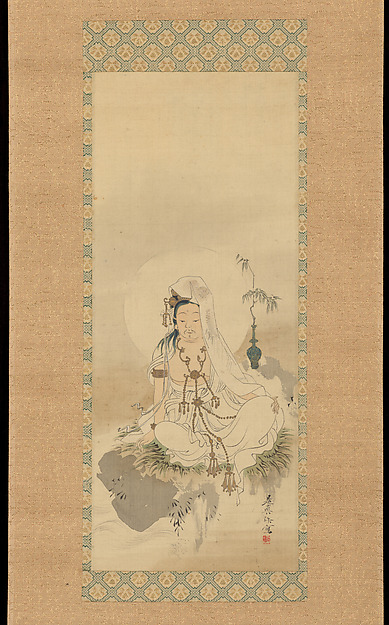
Japan, 19th century. Hanging scroll; color on silk.
Look closer: Shibata Zeshin, a lacquer master, painted the bodhisattva with a vase and willow. Look at the veil and the sprig.
The Metropolitan Museum of Art, Purchase, Gifts, Bequests, and Funds from various donors, by exchange, 1952 (52.160.2). Public domain, Open Access.
China and the sea
| Form | Chinese name | What the sources say |
|---|---|---|
| Water-Moon Guanyin | 水月觀音 Shuǐyuè | Traditionally masculine, linked to the Thousand-Armed form. Invoked for good rebirth, safe childbirth and enlightenment. Shown as a young man or woman at ease beside a pond with the moon reflected in the water, a metaphor for emptiness (śūnyatā). |
| Child-giving Guanyin | 送子觀音 Sòngzi | Venerated as a fertility goddess and invoked in prayers for children; usually a reclining white-robed woman with a child on her lap. Ming and Qing European travellers noted a striking likeness to the Madonna and Child. Taoism and folk religion know her as Songzi Niangniang. |
| White-Robed Guanyin | 白衣觀音 Báiyī | A feminine form closely linked to the Child-giving form; a young woman in a white robe that sometimes covers the head as a veil. |
| Fish-Basket Guanyin | 魚籃觀音 Yúlán | Born of a legend in which Guanyin descends as a beautiful young fisherwoman to convert a town of vicious men. Appears in Journey to the West, where she uses the basket to capture a sea demon. |
| Guanyin of the Southern Seas | 南海觀音 Nánhǎi | Popularised once Mount Putuo became her seat and a great pilgrimage centre. A young woman at ease on Putuo, often with bamboo, a vase of willow, or Shancai and Longnü beside her. |
| Burning-Face Mahāsattva | 面燃大士 Miànrán Dàshì | A hungry-ghost king who warned Ānanda of his death, and whom Chinese tradition regards as an emanation of Guanyin. The sutra behind him is the basis of most ghost-feeding rites in East Asia, and an effigy is enshrined at some, such as those at the Zhongyuan Festival. |
| Cundī | 準提 Zhǔntí | An eighteen-armed esoteric form with her own sutra, called Mother of the Seventy Million Buddhas; her mantra is among the Ten Small Mantras recited in the morning liturgy of most Chinese temples. |
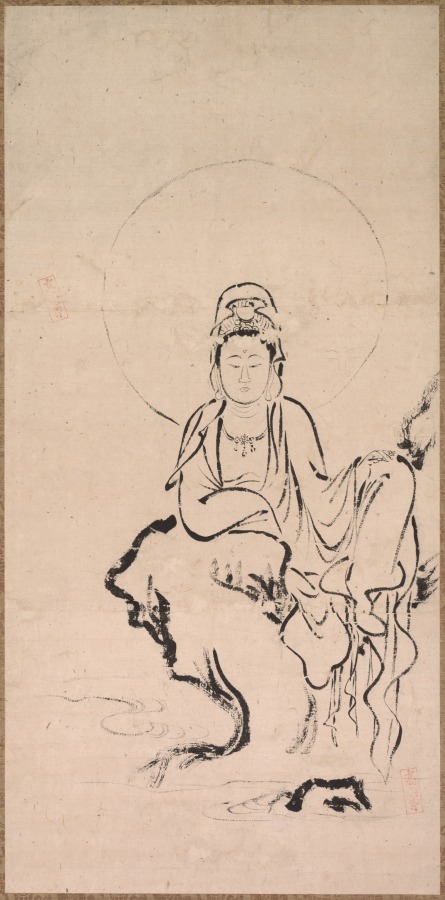
Japan, Kamakura period, c. 1200. Hanging scroll; ink on paper.
Look closer: Ink on paper, c. 1200. Look at how the white robe is left as bare paper and defined only by its outline.
Cleveland Museum of Art, John L. Severance Fund (1951.540). CC0, Open Access.
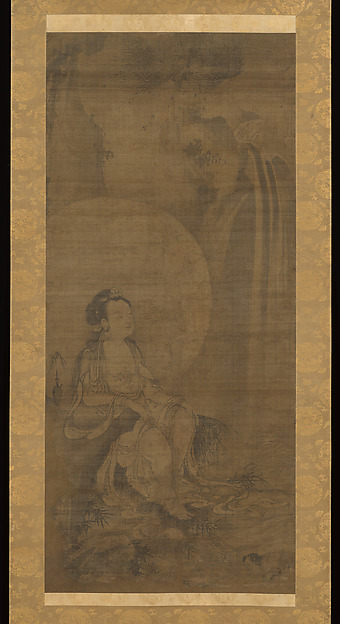
Japan, 14th century. Hanging scroll; ink on silk.
Look closer: Fourteenth-century Japan. The ink has darkened with age; look for the figure at the lower left, the pale halo and the waterfall behind.
The Metropolitan Museum of Art, Purchase, Bequest of Dorothy Graham Bennett, Herbert J. Coyne Gift, Seymour Fund and Fletcher Fund, by exchange, 1985 (1985.120.2). Public domain, Open Access.
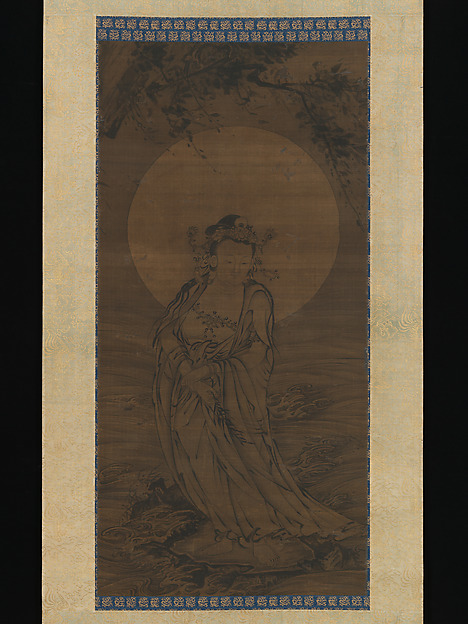
Japan, 15th century. Hanging scroll; ink on silk.
Look closer: A later version. Here the figure stands rather than sits; look at the water at her feet and the pine branch overhead.
The Metropolitan Museum of Art, Purchase, Mary Livingston Griggs and Mary Griggs Burke Foundation Gift, 1984 (1984.124). Public domain, Open Access.
Japan’s own
| Form | Reading | What the sources say |
|---|---|---|
| Bokefuji Kannon | Senility-healing | A twentieth-century invention by a religious goods manufacturer, answering a rising worry about senility and dementia. A woman with small figures of an elderly man and woman at her feet. |
| Jibo Kannon | Compassionate-mother | Kannon as a woman holding an infant. Especially popular once suppressed Christians used the image for the Virgin Mary and Christ Child. |
| Koyasu Kannon | Safe-childbirth | A woman holding or nursing an infant. It predates Jibo Kannon by several centuries and was also used by Christians. |
| Mizuko Kuyō Kannon | Memorial for the unborn | A woman surrounded by, or holding, several children. A twentieth-century development in response to abortion, stillbirth and miscarriage. |
| Maria Kannon | Mary as Kannon | A statue of the Virgin Mary disguised as Kannon, often with a Christian symbol hidden on the surface or inside. It arose when Christianity was banned under the Tokugawa shogunate. |
| Yōkihi Kannon | Yang Guifei Kannon | Named for Yang Guifei, the Tang beauty. Usually given a moustache so as to desexualise the figure and show that the capacity for enlightenment does not depend on sex. |
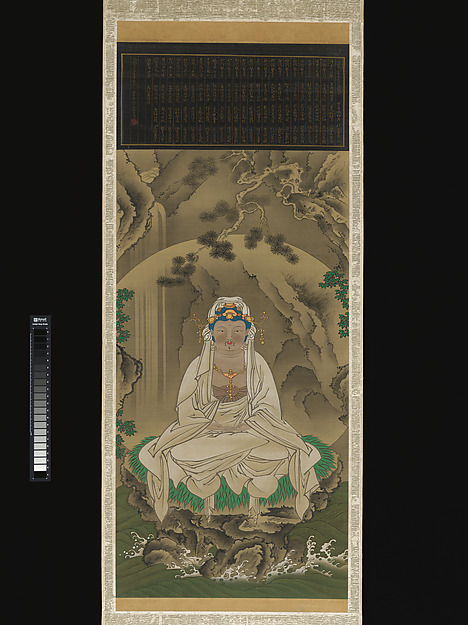
Japan, 1823. Hanging scroll; ink, color, and gold on silk.
Look closer: Hōitsu, 1823. Look at the blue crown, the green lotus petals and the waves at the foot, then at the panel of inscription above.
The Metropolitan Museum of Art, Purchase, Friends of Asian Art Gifts, 2017 (2017.293). Public domain, Open Access.

Japan, ca. 1887. Album leaf; ink and color on silk.
Look closer: Kyōsai, about 1887. Look at the confident brushwork of a master who painted for Meiji crowds.
The Metropolitan Museum of Art, Charles Stewart Smith Collection, Gift of Mrs. Charles Stewart Smith, Charles Stewart Smith Jr., and Howard Caswell Smith, in memory of Charles Stewart Smith, 1914 (14.76.61.1). Public domain, Open Access.
Sanskrit forms and what each holds
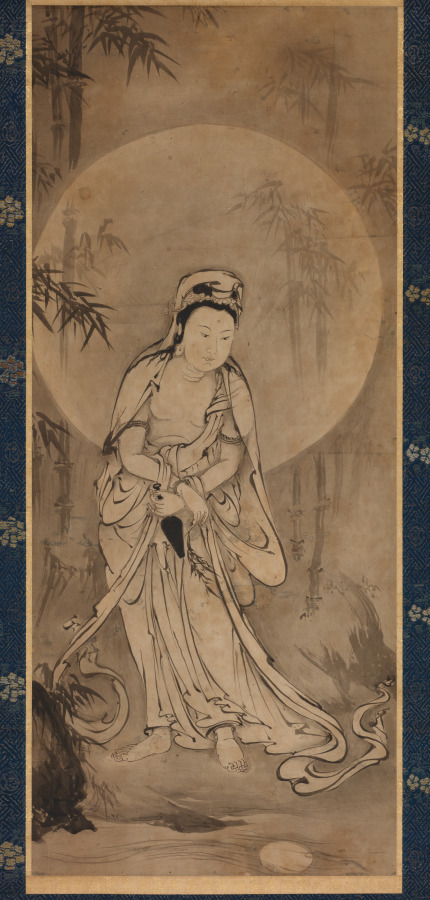
Japan, Muromachi period, c. 1500. Hanging scroll; ink on paper.
Look closer: The Water-Moon form. Look at the foot of the scroll for the small round moon on the water, and at the bamboo behind the large halo.
Cleveland Museum of Art, John L. Severance Fund (1985.110). CC0, Open Access.
Wikipedia’s survey of Avalokiteśvara lists many more forms than any one temple shows, and each is a short sentence about what the bodhisattva does.
| Form | Chinese | What it does or carries |
|---|---|---|
| Ārya Avalokiteśvara (root form) | 聖觀自在菩薩 | In the Mahāyāna Sublime Treasure King Sutra he gave birth to the sun and moon from his eyes; every pore of his body holds an unbounded pure world. |
| Four-Armed (Ṣaḍakṣarī) | 四臂觀音 | Two hands in añjali, one with a lotus, one with a mala; the embodiment of the Six Syllable Dhāraṇī. |
| Eleven-Faced | 十一面觀音 | The ten heads atop his head awaken beings in the ten realms of existence. |
| Thousand-Armed, Thousand-Eyed | 千手千眼觀音 | The Original Lord of the Great Compassion Dhāraṇī, often drawn with eleven heads and countless arms with eyes in the palms. |
| Infallible Lasso (Amoghapāśa) | 不空羂索觀音 | Uses a lasso to catch beings drifting in the ocean of suffering and set them on the shore of liberation. Japan: Fukūkenjaku. |
| Wish-Fulfilling Wheel (Cintāmaṇicakra) | 如意輪觀音 | Turns the Dharma wheel while granting wishes. Japan: Nyoirin. |
| Blue-Necked (Nīlakaṇṭha) | 青頸觀音 | His neck is blue from swallowing a demon’s poison to protect beings. |
| Lion’s Roar (Siṃhanāda) | 獅吼觀音 | Rides a roaring lion. |
| Lotus-Hand (Padmapāṇi) | 蓮華手菩薩 | Holds a lotus or a vase; another name for the bodhisattva. |
| Horse-Head (Hayagrīva) | 馬頭明王 | A wrathful form, also called Horse-Head Vajra. Japan: Batō. |
| Creator (Sṛṣṭikartā) | The cosmic form that emanates the gods; worshipped in Nepalese Buddhism. | |
| Triple Hari (Hariharihari-vāhana) | Seated on the shoulders of Vishnu, who rides Garuḍa, who is carried by a lion: the three vehicles, with the bodhisattva above all of them. |
Gestures, vessels and a deer-skin
The identity card above gives the five quickest tests. These tables give the longer list, from the sources that catalogue it. A single image seldom shows more than a handful of these features, and the useful skill is knowing which ones are decisive. The kebutsu in the crown is the most decisive, the vase or willow the next. The companions, child, girl, bird or warriors, decide whether a picture is Chinese in origin or Japanese.
What the Chinese sources catalogue
| Element | What it signifies, according to the sources |
|---|---|
| White robe | Tantric sutras and mandalas such as the Mandala of the Two Realms often clothe him in white. |
| Open or loose robe at the chest | A reminder of the male bodhisattva of India and of his power to change forms. |
| Necklace | Jewels symbolic of Indian or Chinese royalty. |
| Crown | Usually contains an image of Amitābha, his teacher. |
| Vase | One of the Eight Symbols of Good Fortune; holds pure water that relieves suffering. Poured, it may form a bubble that surrounds a young child. |
| Willow branch | Used to sprinkle water. The willow bends without breaking. Linked to esoteric rites that used willow branches in offerings. |
| Lotus | Purity. |
| Rice sheaves | Fertility; the necessities of life. |
| Fish basket | Patroness of fishermen. |
| Infant | Maternity; specifically the Child-giving form. |
| Qilin | Fertility, and a wholly vegetarian creature devoted to avoiding harm. |
| Dragon or sea-turtle underfoot | Power over the sea, and patroness of fishermen. |
| Shancai, Longnü, the white parrot | The boy pilgrim, the dragon girl, and the filial bird. |
| Guan Yu and Weituo | Two guardians of the Dharma who flank the figure, in the temple tradition. |

Japan, Heian period, 900s. Wood with traces of colour.
Look closer: The standard two-armed form, 900s. Look at the raised right hand, the lowered left and the traces of red and green on the robe.
Cleveland Museum of Art, Leonard C. Hanna Jr. Fund (1984.69). CC0, Open Access.

Japan, 12th century. Wood with traces of gold and color.
Look closer: A later Shō Kannon. Compare the proportions of the body with the earlier one.
The Metropolitan Museum of Art, Dr. and Mrs. Roger G. Gerry Collection, Bequest of Dr. and Mrs. Roger G. Gerry, 2000 (2002.447.2). Public domain, Open Access.
Gestures and limbs

Japan, 17th or 18th century. Wood with lacquer, gold leaf, cut gold leaf (kirikane), and metal.
Look closer: The patterns on the robe are made of cut gold leaf, kirikane. Look at the fine lines on the skirt.
The Metropolitan Museum of Art, Purchase, Friends of Asian Art Gifts; Charles Stewart Smith Collection, Gift of Mrs. Charles Stewart Smith, Charles Stewart Smith Jr., and Howard Caswell Smith, in memory of Charles Stewart Smith, Rogers Fund and Seymour Fund, by exchange, 2006 (2006.437a–e). Public domain, Open Access.
Hands tell the form, and the sources give a short list of gestures.
| Gesture or attitude | Where the sources show it | What it tells you |
|---|---|---|
| Abhaya-mudrā (the fearlessness gesture) | A Gandhāran Avalokiteśvara of the third century CE | The oldest pose in the record, an open raised hand |
| Dharmacakra-mudrā | A painted and gilded wooden Guanyin of the Song or Jin period, with damaged hands, probably performing it | The gesture of the Buddha setting the wheel of the teaching in motion |
| Añjali (palms joined) | The Four-Armed form; Kannon as attendant in Amida’s triad | Reverence; in the triad, welcome |
| Hand to the cheek, pensive | The Cintāmaṇicakra form: the first right hand | Reflection; the identifying gesture of Nyoirin Kannon |
| Hands holding the jewel, the beads, Mount Meru, a lotus and a wheel | The six arms of Cintāmaṇicakra: the second right hand holds the wish-granting jewel, the third prayer beads; the first left holds Mount Meru, the second a lotus, the third a Dharma wheel | Every attribute of the form is a vow |
| Eighteen arms with implements | Cundī, seated on a lotus | Each implement is a skilful means of the Dharma |
The deer-skin and the Ruru Jātaka
In Tibetan images Chenrezig sometimes wears a deer-skin over his left shoulder. Wikipedia, citing the iconographic tradition, reads it as a layered sign of renunciation, deep compassion and yogic practice, and traces it to the Ruru Jātaka, tale number 482. In that story the bodhisattva was once a splendid golden deer who could speak human languages. He rescued a man from drowning, and when the king later hunted him he offered himself in order to protect his herd. His selflessness moved the king to forbid hunting throughout the realm, and so a single act of compassion changed the law of a country.
Princess, pilgrim, dragon girl, parrot
The Chinese Kannon is surrounded by stories that the sutras do not tell. They live in popular texts such as the Precious Scroll of Fragrant Mountain and the Complete Tale of Guanyin and the Southern Seas, they mixed with local folklore as the faith spread, and they shaped what the figure looks like. A person who knows them can read an image the way a Chinese pilgrim once did: the child on the left is Shancai, the girl on the right is the dragon king’s daughter, and the white bird near her shoulder is a parrot with a good memory.
Miaoshan, who gave her eyes and arms
Wikipedia retells the central legend. Miaoshan was the daughter of a cruel king, Miaozhuang. When he told her to marry a rich man, she said she would obey only if the marriage could end three misfortunes: the suffering of age, of illness and of death. The only person able to relieve all three, she pointed out, is a physician, and her father, who wanted a husband of power and wealth, flew into a rage. He set her to hard labour and cut her food, and she did not yield. She begged each day to enter a temple, and her father let her, then told the monks to give her the hardest chores. Animals came to help her. He tried to burn the temple down, and she put out the fire with her bare hands, unburned. At last he ordered her executed.
In one version the executioner’s axe shattered into a thousand pieces, and then his sword, and the arrows veered away, so that in the end he used his hands. She forgave him, and took on the karmic weight of her own killing so that he would be free of it. In another version a tiger, the deity of the mountain, carried her away. In the version where she died, she descended to the hell realms, and by her presence alone, with music and flowers blooming around her, she turned hell into a paradise. Yama sent her back to protect his kingdom. The story ends when her father falls ill with jaundice, and a monk says that a medicine can be made from the arm and eye of one without anger. Miaoshan gives both. When her father learns whose they were, he begs forgiveness. She is transformed into the Thousand-Armed Guanyin, and the king and queen and her two sisters build a temple for her on Fragrant Mountain. She was about to cross into heaven when she heard a cry of suffering from the world below and, turning back, vowed not to leave until all suffering ended.
Wikipedia attributes the written form to the monk Jiang Zhiqi in the eleventh century, notes that many variants exist and that the story is likely to have origins in Taoism, and reports that the earliest extant version has the mountain deity darkening the sky and snatching her from the executioner’s sword. The story gives the figure a face that Chinese readers could relate to: a daughter who defied her father, and a woman who forgave.
Shancai on the cliff
Shancai is Sudhana, the “boy skilled in wealth” of the Gaṇḍavyūha Sūtra, a chapter of the Avataṃsaka Sūtra. In that scripture he visits fifty-three spiritual teachers on his road to enlightenment, and Guanyin is the twenty-eighth. In the Chinese legend he is a crippled boy from India who heard that a teacher lived on the rocky island of Putuo and made his way there. To test his resolve Guanyin conjured three sword-wielding pirates who chased her to the edge of a cliff. She leapt, and so did the pirates. Shancai, thinking only to save her, crawled to the edge and fell after them, and Guanyin caught him in mid-air and asked him to walk. He could. He looked into a pool and saw that he was handsome. From that day she taught him the whole Dharma (Wikipedia, “Guanyin”). In pictures he stands with palms joined and knees slightly bent to recall his former lameness.
The fish, the pearl and the dragon girl
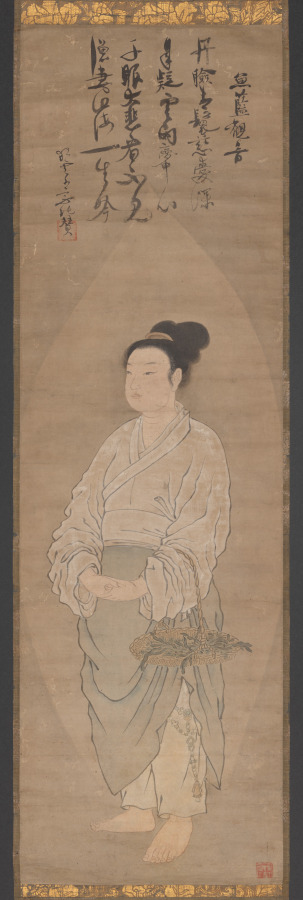
Japan, Muromachi period, 1400s. Hanging scroll; ink and colour on paper.
Look closer: Bokkei Saiyo painted this in the 1400s. Look for the basket at the figure’s side, the hint of the fish story told in the text.
Cleveland Museum of Art, Gift from the Collection of George Gund III (2015.465). CC0, Open Access.
Years later, the story goes, the third son of a Dragon King was swimming in the form of a fish when a fisherman caught him, and could not change back. Guanyin sent Shancai to the market with all the money she had. The fish, still alive hours after its capture, had caused a stir, and the crowd, persuaded that eating it would grant immortality, outbid Shancai, who could not match the price. When the crowd closed round him to pry the boy away from the fish, her voice came from far off: a life belongs to the one who tries to save it, and not to the one who tries to take it. The crowd saw its shame and dispersed. Shancai carried the fish back and she returned it to the sea. In gratitude the Dragon King sent his daughter Longnü, the dragon girl, with the Pearl of Light. Longnü asked to become her disciple, and Guanyin accepted on one condition, that Longnü keep the pearl.
The tale explains two of Guanyin’s Chinese forms. In the Fish-Basket form, Wikipedia says, Guanyin descends as a beautiful fisherwoman to convert a town of vicious men, and she also appears in Journey to the West where she uses the basket to catch a sea demon. In pictures the dragon girl carries a bowl or an ingot that stands for the pearl.
The filial parrot
A story that dates to the Ming dynasty and is set in the Tang tells of a family of white parrots. One young parrot was so clever that it could recite sutras, chant the name of Amitābha and, in some versions, compose poetry. Hunters killed its father and blinded its mother. When the young parrot went looking for cherries, or lychees, for its blind mother, it was caught by the same hunters, and by the time it escaped, its mother had died. After it mourned her and gave her a proper funeral, the Earth God suggested that it worship Guanyin, who was moved and allowed its parents to be reborn in the Pure Land. The tale was told in the Tale of the Filial Parrot and then in the later Precious Scroll of the Parrot. In pictures the parrot is white, hovers on her right, and carries a pearl or a bead in its beak, and it became a symbol of filial piety (Wikipedia, “Guanyin”).
Two lesser tales
In the story of Chen Jinggu, which Wikipedia gives from Quanzhou in Fujian, Guanyin turned into a beautiful woman who would marry any man who could hit her with silver, to pay for a bridge the townspeople could not afford. When one of the Eight Immortals, Lü Dongbin, helped a merchant strike her hair with silver, the hair floated away and became a white snake demon. Guanyin let her blood run down the river, a woman named Lady Ge drank from it and became pregnant, and her child, Chen Jinggu, grew up to kill the snake. In the Vietnamese verse tale of Quan Âm Thị Kính, a woman falsely accused first of trying to kill her husband and then, after disguising herself as a man to live in a temple, of fathering a child, endures every indignity and becomes the Goddess of Mercy.
In Japan: a dream, a camphor log and a river
The Japanese founding legends are different in tone, with a hermit and a log and a net. At Kiyomizu-dera, the legend written down in the Kiyomizu-dera Engi says that in 778 the monk Kenshin, later renamed Enchin, followed a dream to Mount Otowa and a golden stream. At its source he found a white-robed hermit, Gyōei Koji, who said he had waited many years and left for the eastern provinces, and Kenshin understood the old man to have been an incarnation of Kannon. At Hase-dera in Kamakura, a monk named Tokudō is said to have carved two Kannon from one enormous camphor tree in 721, one for Hase-dera in Nara and one cast into the sea to find the place with which it had a bond. It washed ashore at Nagai Beach on the Miura Peninsula in 736. At Sensō-ji, as told in the Asakusa section, two brothers drew a statue from the Sumida River while fishing. Three founding stories, then, and three ways of arriving: a dream, the sea and a net.
Brothers, a river and a hidden image
In Tokyo the great Kannon temple is Sensō-ji, whose official name is Kinryū-zan Sensō-ji and which is also known as Asakusa Kannon. Wikipedia gives its founding legend. In 628 two fishermen brothers, Hinokuma Hamanari and Takenari, pulled a statue of Kannon out of the Sumida River. The village headman, Haji no Nakatomo, became a monk and turned his house into a temple. In 645 a monk named Katsumi declared the statue a hibutsu, a secret image. It is reportedly gold and about 5.5 centimetres high, and its true details are unknown because it is never shown. The page notes that the origins are uncertain.
The main hall and the five-storey pagoda were destroyed in the firebombing of Tokyo on 10 March 1945. The hall was rebuilt between 1951 and 1958. Wikipedia reports that Sensō-ji is the most widely visited religious site in the world, with more than thirty million visitors a year, and that Sanja Matsuri, Tokyo’s largest festival, takes place there over three or four days in late spring.
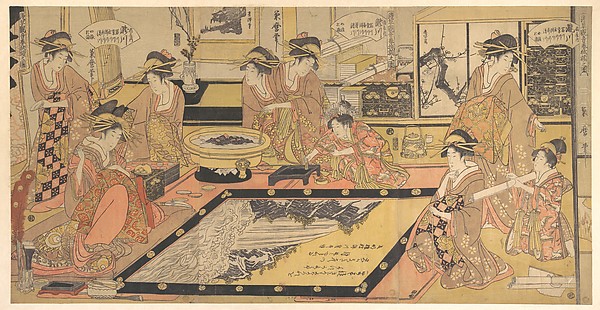
Japan, ca. 1800. Triptych of woodblock prints; ink and color on paper.
Look closer: A votive picture meant for the Kannon of Asakusa. Look at the figures kneeling around the painting.
The Metropolitan Museum of Art, Rogers Fund, 1914 (JP191). Public domain, Open Access.

Japan, 1871. Woodblock print; ink and color on paper.
Look closer: In 1871 a French circus played the grounds. The temple was a place of entertainment as well as prayer.
The Metropolitan Museum of Art, Gift of Lincoln Kirstein, 1959 (JP3315). Public domain, Open Access.
Thirty-three temples and a hundred sites
Thirty-three is the number of the forms in the Lotus Sutra, and the number of the temples in the pilgrimage circuit. Wikipedia calls the Saigoku Kannon Pilgrimage the oldest of its kind in Japan, passing through thirty-three temples with Kannon shrines. The Art Net Users System says the Saigoku circuit developed in the eleventh and twelfth centuries, a Kantō circuit of thirty-three temples was established after the Kamakura shogunate was founded in the thirteenth century, and a third of thirty-four completed a total of one hundred Kannon sites.
The Butuzou guide to Kannon makes the practical point that pilgrimage routes standardised expectations while leaving room for local styles.
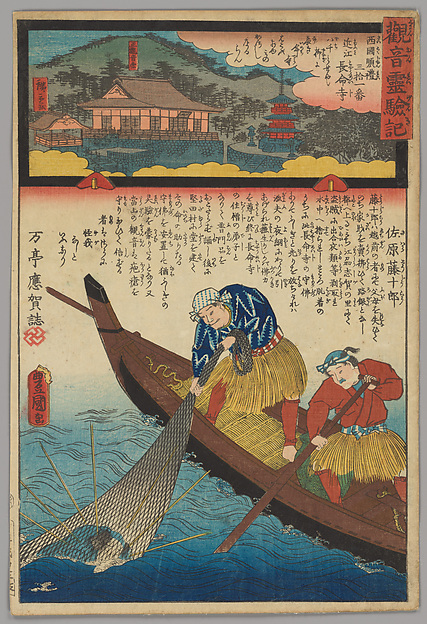
Japan, 1859. Woodblock print (nishiki-e); ink and color on paper.
Look closer: A scene of the Chōmei-ji pilgrimage temple from the series of Kannon miracles. Look at the fishermen and the hillside complex above.
The Metropolitan Museum of Art, Gift of Sue Cassidy Clark, in honor of John T. Carpenter, 2021 (2021.396.5). Public domain, Open Access.
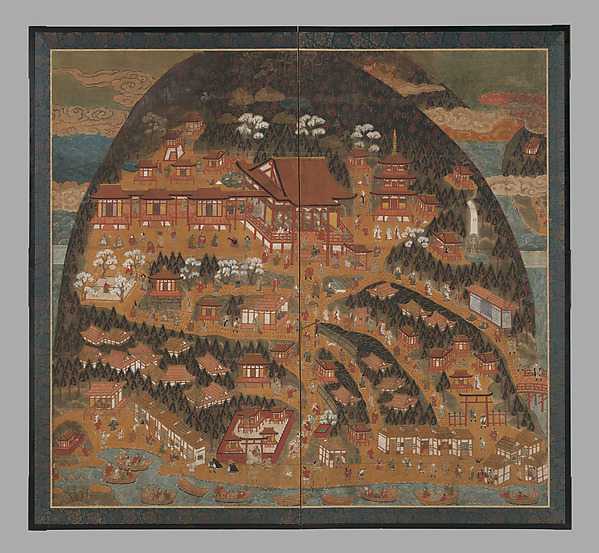
Japan, second quarter 16th century. Hanging scroll remounted as a two-panel folding screen; ink, color, gofun (ground shell pigment), and gold on paper.
Look closer: A sixteenth-century pilgrimage mandala of Chōmei-ji. The temple halls climb the slope above the boats.
The Metropolitan Museum of Art, Purchase, Sue Cassidy Clark Gift, in honor of D. Max Moerman, 2016 (2016.517). Public domain, Open Access.
| Circuit | Temples | Developed |
|---|---|---|
| Saigoku | 33 | 11th and 12th centuries |
| Kantō | 33 | After the Kamakura shogunate, 13th century |
| Third circuit | 34 | Completes a total of 100 sites |
A stage, a long hall, a hillside and a market street
Most readers will meet Kannon in a place before they meet the doctrine, and the four temples below give four different kinds of meeting. At one you are carried into a view, at another you walk a hall of statues, at a third you climb a hillside past hydrangeas, and at the fourth you push through a market street to a secret. The figures come from the temples’ Wikipedia pages and, where noted, from the news items read for the recent-work section.
Kiyomizu-dera, Kyoto: the stage over the valley
Kiyomizu-dera, the Pure Water Monastery, stands on the slope of Mount Otowa in eastern Kyoto and is the sixteenth stop on the Saigoku pilgrimage. Wikipedia says it is one of the few Kyoto temples that predate the founding of the capital, with Kōryū-ji and Kurama-dera, and one of Japan’s leading temples to Kannon, along with Ishiyama-dera and Hase-dera. Its main image is a hidden statue of the eleven-headed Kannon, which the temple’s own news page describes as the Eleven-headed Thousand-armed Kannon Bodhisattva. The main hall in its present form dates from 1633 and is a National Treasure. Its great veranda projects out over the hillside on tall pillars in the kakezukuri manner, and Wikipedia says there is not a single nail in the entire structure.
Beneath the hall is the Otowa waterfall, where three channels fall into a pond and visitors catch the water, which is believed to have wish-granting powers. Nearby is the Tainai Meguri, a dark tunnel said to be the womb of the bodhisattva Daizuiku, and the Jishu Shrine, dedicated to Ōkuninushi, with a pair of “love stones” ten metres apart: a pilgrim who walks from one to the other with eyes closed will, it is said, find true love. The most famous phrase attached to the place is “to jump off the stage at Kiyomizu”, the Japanese equivalent of taking the plunge. An Edo-period belief held that if you survived the thirteen-metre fall your wish would be granted. Of 234 recorded jumps in the period, 85.4 per cent of the jumpers survived, and the practice was banned in 1872 (Wikipedia, “Kiyomizu-dera”).

Kyoto, November 2016.
Look closer: The stage juts out from the hall on a lattice of tall wooden pillars. Look at the pillars under the veranda and at the maples that fill the valley below.
Martin Falbisoner, “Kiyomizu-dera, Kyoto, November 2016”, Wikimedia Commons, CC BY-SA 4.0. Source: commons.wikimedia.org (file page listed in the sources below).

Kyoto, November 2016.
Look closer: A second view from across the valley. Find the pagoda at the left and the hall with its great hipped roof, then the crowd standing along the stage.
Martin Falbisoner, “Kiyomizu-dera, Kyoto, November 2016”, Wikimedia Commons, CC BY-SA 4.0. Source: commons.wikimedia.org (file page listed in the sources below).
Sanjūsangen-dō, Kyoto: a thousand and one
Sanjūsangen-dō means the Hall of Thirty-three Bays. It is officially Rengeō-in, the Hall of the Lotus King, a temple of the Tendai school in Higashiyama, founded in 1164 by Taira no Kiyomori for the retired emperor Go-Shirakawa. The long hall is 120 metres from end to end and stands, in its present form, from 1266. It is a National Treasure. In the centre sits the principal image, a seated Thousand-Armed Kannon about eleven feet tall made by the Kamakura sculptor Tankei, and on both sides, in ten rows and fifty columns, stand 1,000 life-size Thousand-Armed Kannon of cypress covered in gold leaf. One hundred and twenty-four of these came through the fire of 1249, and 876 were made to replace the rest, over sixteen years, by three groups of sculptors, the Kei, En and In schools. The hall also holds twenty-eight guardian deities, many with origins in Indian mythology, as well as statues of the wind god Fūjin and the thunder god Raijin.
The hall has a sporting history too. During the Edo period a famous archery contest called Tōshiya, “passing arrow”, was held on the long west veranda for 255 years, with archers shooting from end to end, and the duel between Miyamoto Musashi and Yoshioka Denshichirō is popularly believed to have been fought just outside in 1604. Today, on the second Sunday of January, the temple holds the Rite of the Willow, in which worshippers are touched on the head with a sacred willow branch to cure and prevent headaches, and a modern Tōshiya in which roughly 2,000 participants shoot at targets 50 to 100 centimetres across, 60 metres away. In recent years the festival has shifted from a mostly male event to one mainly of women in kimono shooting at 120 metres. Cameras are not allowed inside, and a photobook is offered at the end of the guided tour.
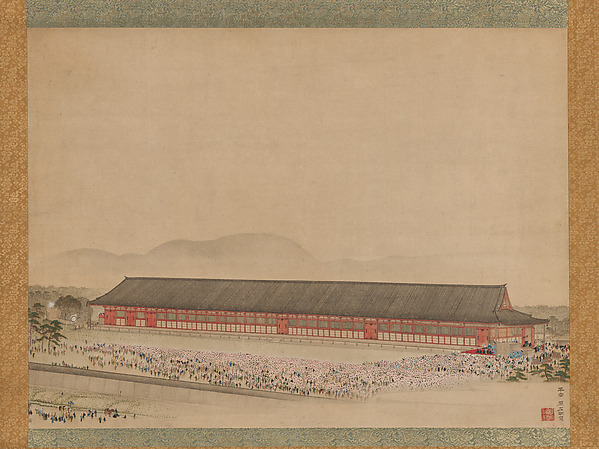
Japan, first half 19th century. Hanging scroll; ink and color on paper.
Look closer: The long veranda of the Rengeō-in at Sanjūsangen-dō, shown in the first half of the nineteenth century. Look at the length of the hall and the crowd along it.
The Metropolitan Museum of Art, Mary and Cheney Cowles Collection, Gift of Mary and Cheney Cowles, 2025 (2025.981.32). Public domain, Open Access.
Hase-dera, Kamakura: eleven heads of camphor
Hase-dera, called Hase-kannon, stands halfway up a hill southwest of Kamakura with a view over Yuigahama bay. Its main statue is an eleven-headed Kannon of gilded camphor wood, 9.18 metres tall, and one of the largest wooden statues in Japan. Each of its eleven heads, the temple says, represents a different phase of the search for enlightenment. Tradition places the founding in the Tenpyō era, between 729 and 749, though the temple’s own documents suggest it came into its own in the Kamakura period. It was a Tendai temple and has become an independent Jōdo-shū temple.
The grounds are built on two levels and include a cave, the Benten Kutsu, a long, low tunnel with images of Benzaiten, the sea goddess and the only woman among the Seven Lucky Gods. In June and July the Hydrangea Path is in bloom. The grounds are also covered with hundreds of small Jizō figures placed by parents mourning children lost to miscarriage, stillbirth or abortion; they are removed after about a year to make room for others, and Wikipedia estimates that some 50,000 have been placed since the Second World War. The temple is the fourth stop on the Bandō circuit and on the Kamakura Kannon pilgrimage, and a five-minute walk from Hase Station on the Enoden line.
Sensō-ji, Tokyo: the gates, the street and a secret
At Sensō-ji, in Asakusa, the pilgrim passes four stages before reaching the hall. The first is the Kaminarimon, the Thunder Gate, 11.7 metres tall, with a vast red paper lantern 3.9 metres high and about 700 kilograms in weight, painted in red and black to suggest storm clouds. The present lantern is the fifth and was made in 2013 by Takahashi Chōchin. Fūjin and Raijin guard the front. At the back stand two figures, the dragon god Tenryū and the goddess Kinryū, carved in 1978 by the 106-year-old master sculptor Hirakushi Denchū for the 1350th anniversary of the Kannon’s first appearance in Asakusa. The gate itself was last rebuilt in 1960 with a donation from Matsushita Konosuke, the founder of the company now called Panasonic, and the nameplate on the lantern base still reads “Matsushita Denki”.
The second stage is the Nakamise-dōri, about 250 metres long with around seventy-two shops selling fans, prints, kimono, Buddhist scrolls and sweets. Wikipedia gives two origins for it: the early twelfth century on the street’s own page, and 1685 on the temple’s page, when neighbours were permitted to open shops in return for sweeping the grounds. Sweet ningyōyaki, small cakes baked in the shapes of pagodas, the gate, pigeons and local gods, are the street’s signature food. The third stage is the Hōzōmon, the Treasure-House Gate, 22.7 metres tall, rebuilt in 1964 in fireproof concrete, with two five-metre Niō guardians on its south face and two straw sandals 4.5 metres long on its back. Its upper storey stores the temple’s sutras. Wikipedia reports a Lotus Sutra copy designated a National Treasure and a complete Chinese Buddhist canon designated an Important Cultural Property, and another list notes that an eleventh-century set of ten Lotus Sutra scrolls, decorated in gold and silver, is on loan to the Tokyo National Museum.
The fourth stage is the hall itself, rebuilt between 1951 and 1958 with a titanium-tiled roof that keeps the historic outline and is stronger and lighter than before. Behind the altar is the statue that gives the whole place its name, which nobody sees. Wikipedia repeats the tradition that it is gold and about 5.5 centimetres tall, and adds that its true details are unknown because it has never been displayed. The visitor makes an offering and draws a fortune, an omikuji, at one of the stalls, and then goes out through the crowd. The thirty million who do so each year make Sensō-ji, by Wikipedia’s count, the most widely visited religious site in the world.

Asakusa, Tokyo.
Look closer: The lantern is 3.9 metres tall. Read the name of the gate in the black characters, then look down at the people passing beneath it to judge the scale.
Tokumeigakarinoaoshima, “Lantern of Kaminarimon Gate”, Wikimedia Commons, CC0. Source: commons.wikimedia.org (file page listed in the sources below).

Tokyo.
Look closer: The visitor’s moment at the hall: a row of people before the offering box, with a lantern overhead and stalls of the temple precinct behind. Look at the dark wooden grille of the offering box and the red pillars.
Ray in Manila, “Sensō-ji, Asakusa, Tokyo”, Wikimedia Commons, CC BY 2.0. Source: commons.wikimedia.org (file page listed in the sources below).
A calendar for pilgrims
The dates below come from the temple pages and the Guanyin article. The days of the lunar year are those of Chinese Buddhist practice, and the Japanese dates are those given for the temples named. Dates and programmes change, so confirm each with the temple.
| When | Where | What happens | Source |
|---|---|---|---|
| Second Sunday of January | Sanjūsangen-dō, Kyoto | The Rite of the Willow, in which a sacred willow branch is touched to the head against headaches, and the Tōshiya archery festival on the long veranda. | Wikipedia, “Sanjūsangen-dō” |
| New Year and Obon | Kiyomizu-dera, Kyoto | The busiest times; booths fill the grounds with holiday foods and souvenirs. | Wikipedia, “Kiyomizu-dera” |
| Spring and autumn | Hōryū-ji, Ikaruga | The Guze Kannon of the Yumedono is shown to the public twice a year. | Japan Travel |
| Late spring, three or four days | Sensō-ji, Tokyo | The Sanja Matsuri, Tokyo’s largest festival; the streets around the temple are closed to traffic from dawn to late evening. | Wikipedia, “Sensō-ji” |
| June and July | Hase-dera, Kamakura | The hydrangeas bloom along the Hydrangea Path. | Wikipedia, “Hase-dera” |
| The nineteenth day of the sixth lunar month | Chinese Buddhist temples | The celebration of Guanyin’s attainment of Buddhahood. | Wikipedia, “Guanyin” |
| The Zhongyuan Festival | Chinese temples | An effigy of Mianran Dashi, Guanyin as king of the hungry ghosts, is enshrined during ghost-feeding rites. | Wikipedia, “Guanyin” |
| Annual | Sensō-ji, Tokyo | The Hagoita and Hozuki events draw large crowds to the temple. | Wikipedia, “Sensō-ji” |
| 12 December | Kiyomizu-dera, Kyoto | The Kanji of the Year ceremony, held at the temple on Kanji Day since 1995. | Wikipedia, “Kiyomizu-dera” |
Scaffolds, a thief and a homecoming
Kannon is not only a figure of the past. Several of the places and objects above have been the subject of long and costly work in the last decade, and one of them made the news for a quite different reason. Each item below was read in a news report or an official page, and the table at the end gives the dates.
Sanjūsangen-dō: forty-five years of dusting
On 22 December 2017 craftsmen carried the last of the restored statues back into the long hall at Sanjūsangen-dō, ending a conservation campaign that had begun in 1973. The Kyoto Shimbun reported that the statues, which are Important Cultural Properties, had been removed in batches to have the dust brushed from their surfaces and the gold leaf repaired. The pace was about twenty statues a year at first and forty a year from fiscal 2013, and five statues remained on loan to the Tokyo National Museum and other institutions. Buddhistdoor Global added that the work took about forty-five years and cost 920 million yen, about eight million US dollars, subsidised by the Agency for Cultural Affairs. It quoted an official of the temple, Seiko Tabuchi, who said the brightness after the work is completely different from before.
Kiyomizu-dera: a roof and a stage
At Kiyomizu-dera the temple’s own news page explains that the Great Renovation began in 2008, and that the re-roofing of the main hall, with new hinoki bark thatch, the first complete re-thatching in fifty years, began in February 2017 and was finished at the end of 2019. The scaffolding came down in February 2020, and in May 2020 work began on the stage floorboards. During the work part of the stage stayed open to visitors and the hall stayed open for prayer before the main image. Wikipedia adds that the temple was covered in semi-transparent scaffolding while it underwent restoration in preparation for the 2020 Olympics.
Tsushima: a stolen bodhisattva comes home
The most unusual item is a theft. In 2012 thieves stole two statues from Kannonji, a temple on the island of Tsushima in Nagasaki Prefecture, intending to sell them in South Korea. One, a seated figure of Kanzeon Bosatsu, a gilt-bronze piece of the fourteenth century, about fifty centimetres tall and designated a cultural asset of the prefecture, was recovered in South Korea, and the other was returned to Kannonji soon after. A South Korean temple, Buseoksa in Seosan, then sued, claiming it was the rightful owner. In 2023 South Korea’s Supreme Court ruled in favour of Kannonji and ordered Buseoksa to return the statue.
The return came in stages. The Star reported on 1 February 2025 that Buseoksa was holding the statue on a loan of a hundred days that was due to end on 11 May. The Associated Press, in a report dated 12 May 2025, described a handover ceremony at the Korean temple on the Saturday before, a truck carrying the statue in a wooden container reaching Kannonji, and temple members and residents lining the road to clap as it arrived.
| Date | Place | What happened | Source |
|---|---|---|---|
| 1973 to 22 December 2017 | Sanjūsangen-dō | Conservation of 1,001 statues, ending with the re-enshrinement | Kyoto Shimbun; Buddhistdoor Global |
| 2008 onward | Kiyomizu-dera | The Great Renovation programme | Kiyomizu-dera news page |
| February 2017 to end of 2019 | Kiyomizu-dera | Main hall re-roofed with hinoki bark thatch | Kiyomizu-dera news page |
| 2013 | Sensō-ji | Fifth Kaminarimon lantern made by Takahashi Chōchin | Wikipedia, “Sensō-ji” |
| February to May 2020 | Kiyomizu-dera | Scaffolding removed; stage floor rebuilding begins | Kiyomizu-dera news page |
| 2012 to 2025 | Kannonji, Tsushima | Theft, a court ruling in 2023, and the return of a fourteenth-century Kannon from Korea | Associated Press; The Star |
Mazu, Maria and the Madonna of Seoul
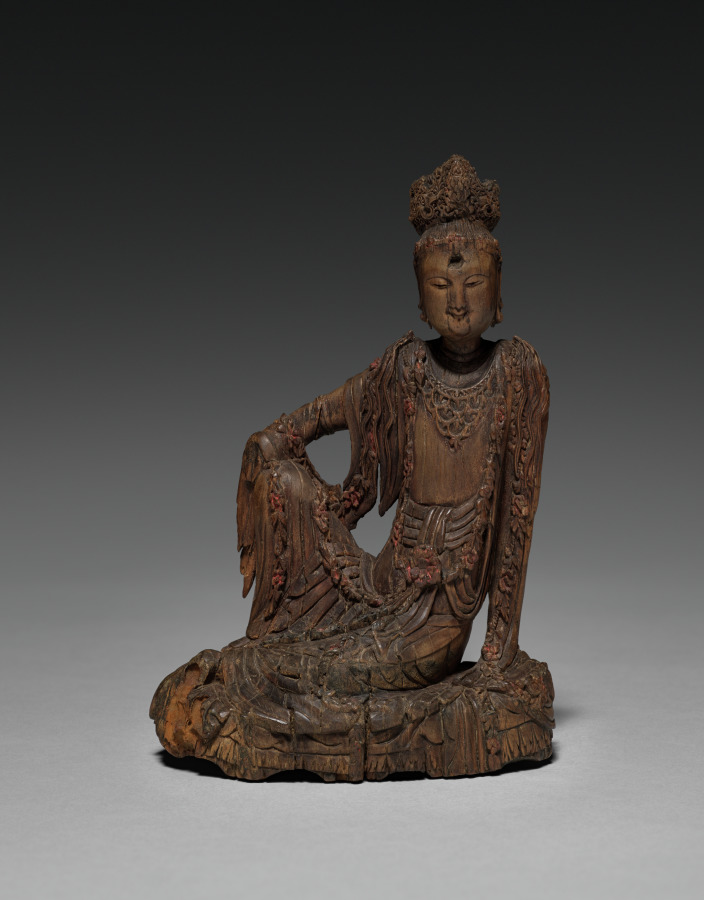
China, Five Dynasties, 900s. Carved sandalwood with traces of paint, 15.1 cm.
Look closer: Barely fifteen centimetres tall, this is the Guanyin of Mount Potalaka, seated on her island rock. Look at the pose of royal ease.
Cleveland Museum of Art, Gift of Mrs. A. Dean Perry (1965.556). CC0, Open Access.
Wikipedia calls Guanyin an extremely popular goddess in Chinese folk religion, Chinese Buddhism, Confucianism and Taoism, worshipped across East and Southeast Asia. The devotion has gone beyond what any one tradition owns, and the pages read for this chapter record a number of its extensions.
The folk goddess
In Taoism, records claim that Guanyin was a Chinese woman who became an immortal, Cihang Zhenren, in the Shang dynasty or as Xingyin, and some scriptures give her the title Guanyin Dashi. She is generally regarded as a protector of women and children, which Wikipedia attributes perhaps to iconographic confusion with images of the goddess Hārītī, and as a giver of children to couples. An old Chinese custom has a woman who wishes to have a child offer a shoe to Guanyin, and the borrowed shoe is returned after the birth with a new pair as a thank-you. Coastal and river areas see her as the protector of fishermen and sailors, and many believe that Mazu, goddess of the sea, is her manifestation. A story of the Great Flood has her sending down a dog with rice grains in its tail, so she is also worshipped as a goddess of agriculture. Business people sometimes treat her as a goddess of fortune, and Wikipedia adds that in recent years there have been claims that she protects air travellers.
New religions that took her in
| Movement | Her role, according to Wikipedia |
|---|---|
| Yiguandao (Taiwan) | The “Ancient Buddha of the South Sea”, who frequently appears in their spirit-writing sessions. Believers also recite the Heart Sutra. |
| Zaili and Tiandi teachings | The “Ancient Buddha of the Holy Religion”; in the Zaili teaching she is the main deity worshipped. |
| Ching Hai’s movement | Initiates are taught the “Quan Yin Method” of meditation, and followers revere Ching Hai as an incarnation of Guanyin. |
| Shinji Shumeikai (Japan) | Kannon is the deity of compassion who actively guided the founder, Meishusama, and stands for a middle way between Zen and Pure Land Buddhism. |
| Caodaism (Vietnam) | Quan Âm Như Lai, a Buddha and a teacher, one of the three lines of Caodai doctrine with Taoism and Confucianism; her role is to teach the Tao to women and save people from extreme suffering such as fire, drowning and wrongful imprisonment, and a prayer “Salvation from sufferings” is recited in dire conditions. |
Mary and Guanyin
Buddhist and Christian observers have long remarked on the likeness between Guanyin holding a child and Mary holding Christ. Wikipedia lists three episodes. During the Edo period, when Christianity was banned and punishable by death, some underground Christians venerated Jesus and Mary by disguising them as Kannon holding a child, and many of these Maria Kannon had a cross hidden in an inconspicuous place. The Taiwanese Buddhist organisation Tzu Chi, noticing the likeness between the Child-giving Guanyin and the Madonna, commissioned a portrait of Guanyin with a baby that closely resembles the Catholic Madonna and Child, and displays copies in its hospitals, since its supporters come from many faiths. And in Seoul, the statue of Gwanse-eum at Gilsangsa was sculpted by a Catholic sculptor, Choi Jong-tae, who modelled it on the Virgin Mary in the hope of encouraging religious reconciliation in Korean society.
A mountain in every country
Mount Potalaka, the bodhisattva’s abode in India, was reproduced in every country that took up the faith. Wikipedia lists the local counterparts, and the table below follows its list. Alongside the mountains there are pilgrimage circuits: Putuoshan is the main pilgrimage site in China, and Korea has its own thirty-three temple circuit that includes Naksansa.
| Country | Local Potalaka |
|---|---|
| India (as the sources describe it) | Mount Potalaka, possibly Mount Potigai in Tamil Nadu (see the origin section of the parent page) |
| China | Mount Putuo, in Zhejiang |
| Korea | Naksansa |
| Japan | Fudarakusan-ji |
| Tibet | The Potala Palace |
| Vietnam | The Hương Temple (a claim Wikipedia marks as needing a citation) |
A camera, a tea and a very tall statue
A figure this popular leaves traces in odd places. Wikipedia’s opening notes record that the spelling Kwannon, from an older Japanese pronunciation, was the earlier spelling of the camera maker Canon, which is named after the bodhisattva. Its disambiguation lines show how many unrelated things also carry the name: a Marvel comics character called Kwannon, an album by the band Sunn O))) called Kannon and a film called Avalokitesvara. A famous oolong, Tieguanyin, is named after her, and so is a soil: in China there is a white clay called Guanyin soil, long used in a travelling snack, chaoqi, in which dough pieces are cooked in the clay, because the soil was believed to help preserve the dough and settle the stomach.
Guanyin is also a literary figure. In Journey to the West, one of the four classic Chinese novels, she appears in her fish-basket form and uses the basket to capture a sea demon, and a popular image of the Guanyin of the Southern Seas with a fish basket appears in late sixteenth-century Chinese encyclopedias and in prints accompanying the novel Golden Lotus. In Hmong the name is Kab Yeeb, in Khmer Preah Mae Kun Si Im, “Goddess Mother”, and in Burmese Kwan Yin Medaw, “Mother Kwan Yin”.
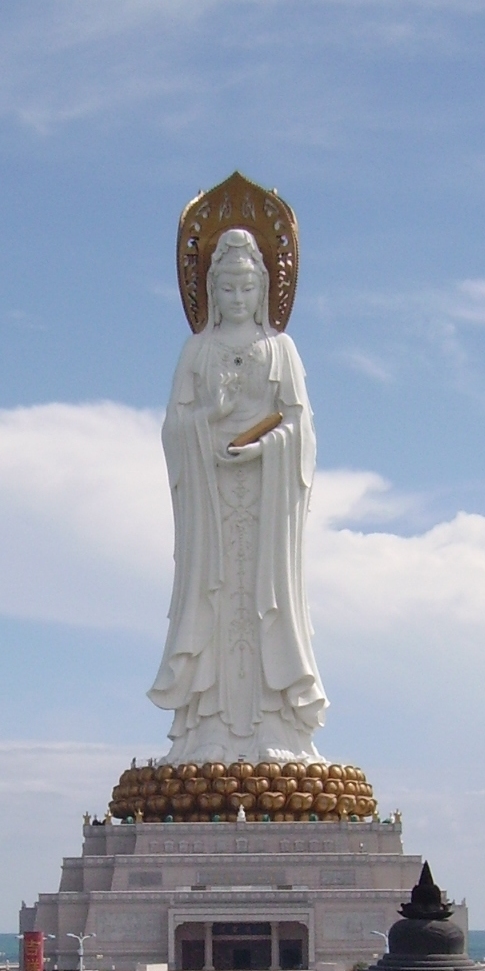
Hainan.
Look closer: The Nanshan statue at Sanya, ranked fourteenth among the tallest statues in the world by Wikipedia. Look at the white figure against the sky and the stepped base beneath it.
Jazon88, “Guan Yin of the South Sea of Sanya”, Wikimedia Commons, CC BY-SA 3.0. Source: commons.wikimedia.org (file page listed in the sources below).

Fujian.
Look closer: Tieguanyin, the oolong named after the bodhisattva, after brewing. Look at the dark opened leaves and the amber colour of the tea in the cup.
Laubrau (author assumed from copyright claims), “Tieguanyin”, Wikimedia Commons, CC BY-SA 3.0. Source: commons.wikimedia.org (file page listed in the sources below).
Records and superlatives
Each figure below is given in the sources named in the last column. They are not all of one kind, and the point of the list is to show the range of what “largest” can mean for a figure honoured in wood, bronze, clay and ritual.
| Superlative | The figure | Where | Source |
|---|---|---|---|
| Most visited religious site | Over thirty million visitors a year | Sensō-ji, Tokyo | Wikipedia, “Sensō-ji” |
| Tall Avalokiteśvara in a Mongolian monastery | The Migjid Janraisig, 26.5 metres, rebuilt 1996 | Gandantegchinlen Monastery, Ulaanbaatar | Wikipedia, “Avalokiteśvara” |
| Most statues in one hall | 1,001 Thousand-Armed Kannon in a hall 120 metres long | Sanjūsangen-dō, Kyoto | Wikipedia, “Sanjūsangen-dō” |
| One of the largest wooden statues in Japan | 9.18 metres, camphor wood | Hase-dera, Kamakura | Wikipedia, “Hase-dera (Kamakura)” |
| Most arms on a wooden image (as Wikipedia records) | 1,008 arms, more than twenty-five heads, 4.2 metres, Ming | Longshan Temple, Fujian | Wikipedia, “Guanyin” |
| The great red lantern | 3.9 metres tall, about 700 kilograms | Kaminarimon, Sensō-ji | Wikipedia, “Sensō-ji” |
| The leap of Kiyomizu | A 13-metre fall; 234 recorded jumps, 85.4 per cent survived | Kiyomizu-dera | Wikipedia, “Kiyomizu-dera” |
| Oldest dated Heart Sutra | 661 CE | Yunju Temple, near Beijing | Wikipedia, “Heart Sutra” |
| The smallest principal image in this list | About 5.5 centimetres, never shown | Sensō-ji | Wikipedia, “Sensō-ji” |
Small facts worth the detour
- The camera maker Canon takes its name from the bodhisattva. Kwannon, an older spelling of Kannon, was the company’s early name (Wikipedia, “Guanyin”).
- The statue at the centre of Sensō-ji has never been displayed. Tradition says it is gold and about 5.5 centimetres tall, and over thirty million people a year visit the temple that was built around it (Wikipedia, “Sensō-ji”).
- The red lantern at the Kaminarimon is 3.9 metres tall and weighs about 700 kilograms. The fifth lantern was made in 2013, and the nameplate on the gate’s lantern base still reads “Matsushita Denki”, after the donor who paid for the 1960 rebuilding.
- Of 234 recorded jumps from the stage at Kiyomizu-dera in the Edo period, 85.4 per cent of the jumpers lived. The practice was banned in 1872 (Wikipedia, “Kiyomizu-dera”).
- Sanjūsangen-dō holds 1,001 Thousand-Armed Kannon. A fire in 1249 spared 124 of them, and 876 were made to replace the rest over sixteen years by three workshops, the Kei, En and In schools.
- The last restored statue went back into Sanjūsangen-dō on 22 December 2017, after a campaign that had begun in 1973 and cost about 920 million yen (Kyoto Shimbun; Buddhistdoor Global).
- Hase-dera in Kamakura keeps about 50,000 small Jizō figures, set out by parents who have lost children and cleared after about a year to make room for others (Wikipedia, “Hase-dera (Kamakura)”).
- In Chinese custom a woman who wants a child offers a shoe to Guanyin and returns it, with a new pair, after the birth (Wikipedia, “Guanyin”).
- The Tōshiya archery contest at Sanjūsangen-dō was held on the long veranda for 255 years, and the 2,000 or so modern archers of the January festival shoot from 60 metres (Wikipedia, “Sanjūsangen-dō”).
- A Tsushima temple spent about thirteen years trying to recover a stolen fourteenth-century Kannon from South Korea, and won in the country’s Supreme Court in 2023 (Associated Press).
Neighbours who share the bodhisattva
Kannon is among the most widely honoured figures in Asia. The rows below record the names given in the sources I read.
| Where | Form and name | What the record shows |
|---|---|---|
| China | Guanyin (觀音); Guanshiyin (觀世音); Guanzizai (觀自在) | Guanshiyin means “[the one who] perceives the sounds of the world”; Guanzizai is often rendered “Lord of Contemplation”. |
| Korea | Gwan-eum (관음); Gwanse-eum (관세음) | The Korean readings. |
| Thailand | Kuan Im (กวนอิม); Phra Mae Kuan Im | “Phra Mae” means goddess. |
| Taiwan | The “Ancient Buddha of the South Sea” | The name Yiguandao gives her in its spirit-writing sessions (Wikipedia, “Guanyin”). |
Neighbours in the pantheon
Among the bodhisattvas Kannon is the one most often met in daily life, from a roadside shrine to the temple at the end of a pilgrimage. In the Thirteen Buddhas sequence of memorial rites he presides over the hundredth day after a death. The table below sets him between Yakushi on the forty-ninth day and Seishi at the first anniversary.
| Memorial occasion | Figure | Role |
|---|---|---|
| 49th day | Yakushi Nyorai | The Healing Buddha, seventh of the thirteen |
| 100th day | Kannon Bosatsu | Compassion, eighth of the thirteen |
| 1st anniversary | Seishi Bosatsu | Ninth of the thirteen |
| 2nd anniversary | Amida Nyorai | Tenth of the thirteen |
Where to see him
| Place | What to look for |
|---|---|
| Sensō-ji, Asakusa, Tokyo | The Kannon Hall, rebuilt 1951 to 1958, over a hidden golden image that is never shown. |
| Sanjūsangen-dō, Kyoto | Rows of thousand-armed Kannon statues (Wikipedia). |
| Hase-dera and Kiyomizu-dera | Two of the major Kansai Kannon temples widely visited by the late tenth century (Art Net Users System). |
More Kannon in scroll, shrine and print

Japan, ca. 1620. Fruitwood with lacquer, pigments, gold, metal fittings.
Look closer: A miniature shrine with its doors open. Look at the tiny image inside.
The Metropolitan Museum of Art, Purchase, Friends of Far Eastern Art Gifts, 1985 (1985.96). Public domain, Open Access.

Japan, late 18th–first half 19th century. Wood with lacquer, gold, pigments, metal fittings.
Look closer: A pocket temple for a Thousand-Armed Kannon. Look at the tiny arms around the figure.
The Metropolitan Museum of Art, Bequest of Susan Dwight Bliss, 1966 (67.55.62). Public domain, Open Access.
In the house
The house keeps Kannon figures in wood, bronze and porcelain. The strip below reads the live shelves, so it shows what is available now.
A short dictionary of Kannon
Terms are given in Japanese with the Sanskrit or Chinese root where the sources supply one.
- Jūichimen Kannon (十一面観音)
- The eleven-headed Kannon.
- Senju Kannon (千手観音)
- The Thousand-Armed Kannon, who can reach every being in need.
- Nyoirin Kannon (如意輪観音)
- The wish-fulfilling wheel Kannon, shown in a posture of ease with one knee raised.
- Batō Kannon (馬頭観音)
- The horse-headed Kannon, patron of horses and travellers.
- Juntei Kannon (准胝観音)
- The Cundī form, sometimes counted among the six in place of another.
- Fukūkenjaku Kannon (不空羂索観音)
- The Amoghapāśa form, “of the unfailing lasso”.
- Byakue Kannon (白衣観音)
- The White-robed Kannon, often painted in ink on a rock beside the sea.
- Gyoran Kannon (魚籃観音)
- The Fish-basket Kannon, carrying a basket of fish.
- Jibo Kannon (慈母観音)
- The merciful-mother Kannon with a child.
- Maria Kannon (マリア観音)
- A Kannon image used by hidden Christians as a Madonna.
- Hibutsu (秘仏)
- A hidden Buddha, a principal image that is never or rarely shown.
- Potalaka / Fudaraku (補陀落)
- The mountain home of the bodhisattva; Japan has its own, at Fudarakusan-ji.
- Saigoku Sanjūsan-kasho
- The thirty-three-temple Kannon pilgrimage of western Japan.
- Bandō circuit
- The Kantō Kannon pilgrimage, of which Hase-dera in Kamakura is the fourth stop.
- Kakezukuri (懸造)
- A hillside building raised on tall pillars, like the stage of Kiyomizu-dera.
- Omikuji (おみくじ)
- A paper fortune drawn at a temple; at Sensō-ji it is the classic souvenir of a visit.
- Ningyōyaki (人形焼)
- Small baked cakes in the shape of pagodas, doves and gods, sold along Nakamise-dōri.
Answered plainly
What is the Saigoku pilgrimage?
A circuit of thirty-three temples with Kannon shrines in western Japan, the oldest Kannon pilgrimage. It developed in the eleventh and twelfth centuries.
Why is the Sensō-ji image never shown?
According to the temple legend, the statue pulled from the Sumida River in 628 was declared a hibutsu, a secret image, in 645. It is reported to be gold and about 5.5 centimetres high.
Is Kannon the same as Guanyin?
Yes. Kannon is the Japanese reading of the Chinese Guanyin, itself short for Guanshiyin, and both render the Sanskrit Avalokiteśvara. The same figure is called Chenrézik in Tibet, Gwanse-eum in Korea and Quan Âm in Vietnam.
Why does Kannon have so many forms?
Chapter 25 of the Lotus Sutra says the bodhisattva takes thirty-three guises to reach different beings, and later traditions added the six forms for the six realms of rebirth, local forms such as the White-robed and Fish-basket Kannon, and the esoteric forms with many heads and arms.
Can I visit the Kannon of Hōryū-ji?
The Guze Kannon of the Yumedono is shown to the public twice a year, in spring and autumn. Confirm the dates with the temple before travelling.
What happened to the stolen Kannon from Tsushima?
South Korea’s Supreme Court ruled in 2023 that the statue belonged to Kannonji. It was held by a Korean temple on a hundred-day loan to 11 May 2025 and then returned to the Japanese island.
How many statues are in Sanjūsangen-dō?
There are 1,001 Thousand-Armed Kannon, one large seated principal image by Tankei and 1,000 life-size standing figures in ten rows and fifty columns.
Where next
Sources and image credits
- Wikipedia, Guanyin (names, Lotus Sutra, Heart Sutra, gender, iconography)
- Wikipedia, Kannon (Japanese forms and pilgrimage)
- Wikipedia, Sensō-ji
- Japanese Architecture and Art Net Users System, Kannon
- Japan Travel, Sealed Buddhist statue of Hōryū-ji
- Butuzou, How Avalokiteshvara became Kannon in Japan
- Wikipedia, Thirteen Buddhas
- Wikipedia, Avalokiteśvara
- Wikipedia, Heart Sutra
- Wikipedia, Lotus Sutra
- Wikipedia, Nakamise-dōri
- Wikipedia, Kiyomizu-dera
- Wikipedia, Sanjūsangen-dō
- Wikipedia, Hase-dera (Kamakura)
- Kyoto Shimbun, Sanjūsangen-dō statues return
- Buddhistdoor Global, 1,001 Bodhisattva statues restored at Kyoto temple
- Kiyomizu-dera, the main hall renovation
- The Star, former chief priest sees recovered statue in South Korea
- Associated Press (Irish Examiner copy, 12 May 2025), a Buddhist statue stolen from a Japanese temple is returned
- Cleveland Museum of Art, White-Robed Kannon (Byakue Kannon) (1951.540)
- Cleveland Museum of Art, Water-Moon Kannon (1985.110)
- Cleveland Museum of Art, Shō Kannon (1984.69)
- Cleveland Museum of Art, Fish Basket Kannon (Gyoran Kannon) (2015.465)
- Cleveland Museum of Art, Potalaka Guanyin (1965.556)
- Wikimedia Commons, Lantern of Kaminarimon Gate.JPG (Tokumeigakarinoaoshima, CC0)
- Wikimedia Commons, Guan Yin of the South Sea of Sanya.JPG (Jazon88, CC BY-SA 3.0)
- Wikimedia Commons, Tieguanyin.jpg (Laubrau (author assumed from copyright claims), CC BY-SA 3.0)


Last reviewed 28 October 2026. Pictures are public-domain or openly licensed, each credited beneath it. Diagrams on this page are drawn by Japonista.
Looking for a Kannon, a hanging scroll or a small altar figure? Tell us what you have in mind and we will look.
Private concierge
Looking for something in particular?
Describe the piece or the project you have in mind. A senior advisor in Tokyo reads every case file personally and replies within two business days, with fees set out in writing before any work begins.