
Ikebana Containers | Japonista
Craft and Ceremony Wing · Vessel and Water
Ikebana Containers
花入
The Japanese flower is rarely shown alone. It is set in a bronze that carries the memory of an altar, a dish as shallow as a pond, or a basket woven by a named maker. This chapter reads the vessel first.
Fact sheet
At a glance
- Function first. Wikipedia’s account says the Japanese seek, above all, the shape that will prolong the life of the flowers, so mouths are wide and vessels are chosen for the plant.
- Three placements in the tea room. A vessel can stand on the alcove floor, hang from a hook on the alcove post, or hang from the alcove’s outer frame.
- Bamboo has a pedigree. Flower baskets were first imported or copied from China, then developed into an independent Japanese art, signed from the late nineteenth century.
A Vase Is Half the Picture
Look at a Japanese print of a flower arrangement and you will notice how much room the vessel takes. In the Edo woodblock prints of the Metropolitan Museum’s collection, the container is drawn with a collector’s care: the glaze of the shallow dish, the stand beneath it, the scissors beside it. The art takes the vessel as part of the composition. Wikipedia’s article on ikebana says as much, observing that the vase is considered to be something more than a mere holder of the flowers, and that in some schools it is regarded only as a vessel to hold water and should be subordinate to the arrangement. The disagreement between schools is itself instructive.

Utagawa Toyohiro · ca. 1805 · One sheet of a triptych(?) of woodblock prints; ink and color on paper
Utagawa Toyohiro, A Woman Tying up a Curtain, a Flower Arrangement of Chrysanthemums in a Boat-shaped Hanging Vase, and Narcissus Arranged in a Flower Vase, ca. 1805. The Metropolitan Museum of Art, Gift of Estate of Samuel Isham, 1914 (accession JP1007). Public domain, Met Open Access. Record
The same article records the practical reasoning. Japanese flower vases are wide at the mouth because they do not rely on the neck to hold stems in place, and because, as the article explains the belief, the air entering the opening is as necessary to the plant as the water it takes up. Low, flat vessels are used more in summer than winter because they let bulbs and water plants stand as they would in nature and because, the article says, the visible water gives a cooler impression. For this reason the form of the vessel and the season of the flower belong in one sentence.
The vessel also tells you how old the habit of arranging flowers is. The Met catalogues a gilt bronze flower vessel to the thirteenth century, and metal remains the formal grade in the tea room today. Chapter one traces the art to the offering of flowers before Buddhist images; the bronze vessel is the visible trace of that origin, and the grade system still ranks it highest. That continuity is one reason a metal vase can seem solemn even when it holds a single spring branch.
There is a practical lesson in the print record, too. Look at the Toyohiro print reproduced above: the hanging boat holds chrysanthemums while a flat dish below holds narcissus, so the household possessed both a hanging form and a low form and chose between them by flower and by season. The collector’s habit follows the same logic. A house with one tall vase and one shallow dish can arrange nearly anything; a house with a cabinet of specialised forms is choosing, in each season, what to say.
This chapter belongs with Ikebana Schools and Styles, which explains the forms that these vessels were made to carry, and with the hub, The Ikebana Almanac.
How the Vessel Found Its Place
The vessel came before the art. Wikipedia’s article on ikebana traces the practice to ancient customs of decorating evergreen trees as yorishiro, objects that invite a god to descend, and says that when Buddhism arrived, offerings of flowers at the altar became common, using native flowers by season. The earliest vase style, tatebana or “standing flowers”, formed part of the mitsu-gusoku, the altar set of three implements. The first containers were therefore not made for rooms at all; they were made for altars.
The Zen monastery carried the habit into the house. Wikipedia’s article on the tokonoma gives two theories of the alcove’s origin. One derives it from the room plan of the shinden-zukuri style of the Heian period; the other from the monastery rooms of the Kamakura period (1185 to 1333), which had an oshiita, a board carrying Buddhist altar fittings, candlesticks, incense burners and vases, with a Buddhist hanging scroll on the wall behind. On the second theory the board and wall grew into the tokonoma of the shoin room in the Muromachi period (1336 to 1573). The vase stayed where it had always stood, in front of a picture, on a raised place of honour.

Suzuki Harunobu · probably 1765 · Woodblock print; ink and color on paper
Look closer: branches with yellow-green leaves rise from a small white vase on a low red-brown stand.
Suzuki Harunobu, Ike Bana (Flower Arrangement) in the Ike-no-bo Style, probably 1765. The Metropolitan Museum of Art, Gift of Estate of Samuel Isham, 1914 (accession JP863). Public domain, Met Open Access. Record
The oldest dated record of a named flower master at work is a diary entry. The Ikenobō article says the journal Hekizan Nichiroku records that in 1462 an Ikenobō master called Senkei made an arrangement in a golden vase for a visitor named Shunko. The container is the detail the diarist chose to note: a golden vase, which is to say a metal one, the formal grade that the tea room still uses. The same article names Senno, a Buddhist monk of the fifteenth century, as the founder of the organised school, and dates his manuscript Senno Kuden to 1542.
By the seventeenth century the practice had its first printed manuals. Wikipedia lists the Sendenshō as the oldest published manual, and the Kokon Rikka-shu of 1672 and the more famous Kokon Rikka-taizen of 1683 as the first printed works devoted to rikka, the “standing flowers” style that peaked in the Genroku era. Rikka, the article says, was built from nine branches that expressed the beauty of a landscape, and it was the grand style of the temples and, in the Momoyama period, of the castles. The wide, low dishes and loose baskets that came with later styles were answers to a different question, and the later sections of this chapter take them up one by one.
Shapes and Their Jobs
The vocabulary is easier to hold with the picture beside it. The table below pairs each form with the style it serves, using the definitions published in the glossary of an Ikebana International chapter and in the articles listed in the references.

Schematic outlines
Diagram by Japonista. Drawn from the facts cited in this chapter; schematic, not to scale.
| Form | What it is | Serves | Record |
|---|---|---|---|
| Tall narrow-mouthed vase | Upright vessel; stems are arranged without a pin holder | Nageire, called heika in the Ohara school | Wikipedia on nageire; Ikebana International glossary |
| Suiban | A flat, shallow container | Moribana; occasionally shōka | Ikebana International glossary |
| Usubata | A three-legged bronze or copper vase with a shallow flat basin and a well to hold a kenzan | Often used with shōka arrangements | Ikebana International glossary |
| Hanging vase | Hung from a hook, post or frame; a boat, a gourd or a bamboo section | Tea room and informal display | JAANUS; Wikipedia on ikebana |
| Basket (hanakago) | Plaited bamboo and rattan, with or without a liner | Summer and early autumn in the tea room; also ikebana | Tea-room guide; Met records |
| Bamboo tube | A cut section of bamboo, often with the node chosen with care | Chabana; all seasons | Tea-room guide |
Shin, Gyō and Sō in the Tea Room
The tea room keeps a ladder. Metal vases, the JAANUS entry on hanaire says, are used for formal ceremonies, shin; ceramic for semi-formal ones, gyō; and bamboo or basketwork for rustic, informal ones, wabi. A Kyoto tea-room guide, describing the alcove, ranks the same three grades by material: metal or celadon pottery is most formal, glazed pottery such as Seto or Tanba ware is in the middle, and bamboo or unpainted pottery is the most casual, sō. It adds a rule about the plate: a lacquered plate goes under a shin vase, a plain wooden plate under a sō vase, and a bamboo basket takes no plate at all.

Kōgetsu Sōgan · early 17th century · Bamboo, lacquer, gold
Look closer: the window cut into the bamboo shows where water and stems meet; the whole piece is one stalk, chosen at a node.
Kōgetsu Sōgan, Double-cut (Nijū-giri) Flower Container (Hanaire), named Cool Summer Morning (Shinryō), early 17th century. The Metropolitan Museum of Art, Purchase, Diane and Arthur Abbey Gift, 2019 (accession 2019.571a, b). Public domain, Met Open Access. Record
The seasons enter through the basket. According to the same guide, bamboo baskets are used chiefly in summer and early autumn, while a single section of bamboo, or pottery, can serve the whole year. The JAANUS entry also records three ways to place a vessel in a tea room: standing on a flat surface, hanging from a hook on the alcove post, or hanging from the outer frame of the alcove. The guide notes that a hanging vessel follows the same placement rule as a standing one.
The principle behind it is in the guide’s own phrasing: flowers should look as though they grew naturally in a field, with little decoration. Everything in the table of grades serves that sentence. A tea room owner who chose a shin bronze for a wabi gathering would be saying the wrong thing.
What the Vessel Is Made Of
The article on ikebana calls bronze especially popular, because to the Japanese the colour of bronze seems most like mother earth and so best suited to enhance a flower. The Metropolitan Museum holds examples across a wide span: a flower vessel in gilt bronze catalogued to the thirteenth century, and a slender bronze “crane’s neck” vase dated between the mid-eighteenth and late nineteenth century.

mid-18th–late 19th century · Bronze
Look closer: the long neck and low, heavy body give the vessel its name.
Flower Vase in "Crane's Neck" shape, mid-18th–late 19th century. The Metropolitan Museum of Art, Bequest of John L. Cadwalader, 1914 (accession 14.58.167). Public domain, Met Open Access. Record
Clay supplied the middle grade and some of the most daring forms. The Met’s Oribe flower holder with handles is dated to the early seventeenth century and glazed in brown and ash tones; its celadon hanaire is dated to the mid-seventeenth century. For the lowest grade in the room, the museum holds a bamboo container of the early seventeenth century by Kōgetsu Sōgan, a double-cut section with a window cut into the tube, known by the name “Cool Summer Morning”. A hanging flower vessel from the eighteenth century takes the face of an oni, and a porcelain hanging holder of about the 1660s to 1670s shows a woman holding a flag, so the whimsy was also a mark of the form.
The tools that live in the vessel are small but fixed. The Ikebana International glossary defines the kenzan as a heavy needle-pointed weight that holds stems and branches securely; the kubari as a Y-shaped piece of wood that, fitted inside the neck of a vase, supports the flower; and the komi as the crosspiece used with it. These belong to the performance: a kenzan sits in a suiban or the well of a usubata, a kubari in a tall vase.
Vases That Hang from the Wall
A flower can be set above the floor as well as on it, and the Japanese vase maker took the invitation seriously. Wikipedia’s ikebana article explains the origin: hanging vases arose from the idea that flowers sent by an esteemed friend should not be placed where they could be looked down on. The vessel is hung from a pillar or a wall by a nail or a hook, and the flower is raised to meet the eye.
The hanging bamboo vase carries a small poetry of its own. According to the same article, the large round top of the vase represents the moon, and the nail hole a star; the opening cut in the bamboo below the top is called the fukumuki, “wind drawing through a place”. A single flower or vine, in a vase made from a found root, is the smallest hanging vessel the article describes, and it is the peasant’s vase.
Ceramic hanging vases are equally varied in the Met. A porcelain flat-backed vessel, a hanging flower holder of the 1660s or 1670s in Arita-type Hizen ware, is square in section and painted in cobalt blue with a woman holding a flag. A hanging vase of the mid-nineteenth century is earthenware with lead and copper glazes in a tapering shape. Both are small, 21 and 15 centimetres high, and both were made to be hung and left alone.

ca. 1660–70s · Porcelain with cobalt blue under transparent glaze (Hizen ware, Arita type)
Look closer: the vessel is a slim square column, and the blue figure on its front stands on a small patch of ground.
Hanging Flower Holder (Hanaire) with Woman Holding a Flag, ca. 1660–70s. The Metropolitan Museum of Art, The Harry G. C. Packard Collection of Asian Art, Gift of Harry G. C. Packard, and Purchase, Fletcher, Rogers, Harris Brisbane Dick, and Louis V. Bell Funds, Joseph Pulitzer Bequest, and The Annenberg Fund Inc. Gift, 1975 (accession 1975.268.473). Public domain, Met Open Access. Record

mid-19th century · Earthenware with lead and copper glazes
Look closer: the glaze runs from deep rose to cream, and the narrow base points down.
Hanging Vase, mid-19th century. The Metropolitan Museum of Art, Edward C. Moore Collection, Bequest of Edward C. Moore, 1891 (accession 91.1.319). Public domain, Met Open Access. Record
Celadon, Porcelain and Bizen
Clay brings a different grade of feeling to the tokonoma. The JAANUS entry cited in this chapter assigns ceramic to the semi-formal, gyō, rank in the tea room, and the museum’s collection shows how wide that rank is. A flower vase of the mid-seventeenth century in Hizen ware, glazed in celadon, is a slender bottle with a long neck and a footed body, 29.7 centimetres high. A vase dated 1780 in Hirado ware is smaller still, 14.6 centimetres, in white porcelain with reserves painted in underglaze blue; the Met’s photograph of it is an older black-and-white one.
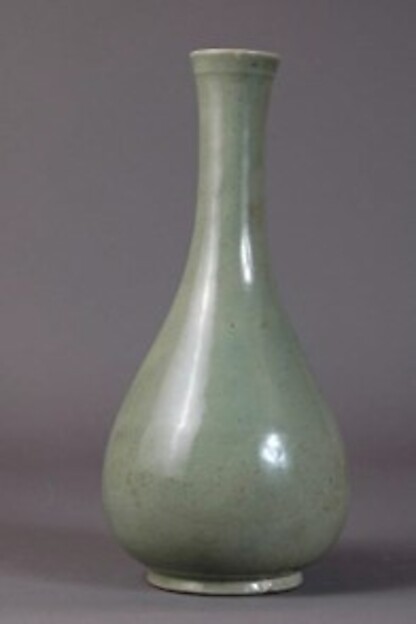
mid-17th century · Porcelain with celadon glaze; Hizen ware
Look closer: the glaze is an even grey-green and the neck rises in one line from a rounded body.
Celadon Flower Vase (Hanaire), mid-17th century. The Metropolitan Museum of Art, Mary and Cheney Cowles Collection, Gift of Mary and Cheney Cowles, 2024 (accession 2024.443.2). Public domain, Met Open Access. Record
Then there is the rougher end. A double-gourd vessel of the eighteenth century in Bizen stoneware has a natural ash glaze that falls in russet and gold across the shoulders, and a narrow neck. Wikipedia’s ikebana article notes that colours in vases are most often soft pastels, with bronze especially popular because it resembles “mother earth”; the Bizen gourd shows the other tradition, in which the clay is left to speak for itself.

1780 · White porcelain covered with a glaze and reserves with blue under the glaze (Hirado ware)
Look closer: pale sprays of flowers and leaves run across the dark ground in the photograph; the mouth is narrow.
Flower vase, 1780. The Metropolitan Museum of Art, Gift of Charles Stewart Smith, 1893 (accession 93.3.238). Public domain, Met Open Access. Record

18th century · Stoneware with natural ash glaze (Bizen ware)
Look closer: the body is a rounded gourd shape in two lobes, glazed russet with pale patches.
Double Gourd Vessel, 18th century. The Metropolitan Museum of Art, Gift of Samuel and Gabrielle Lurie, 2019 (accession 2019.570.1). Public domain, Met Open Access. Record
The Dish, the Frog and the New Schools
The shallow dish, suiban, changed the rules in the late nineteenth century. Wikipedia’s ikebana article says moribana, “piled-up flowers”, is arranged in a shallow vase or suiban, a compote vessel, or a basket, with the stems secured on a kenzan, a pointed needle holder also called a “metal frog”. The Ohara school was founded in 1895 by Ohara Unshin, and the exposed surface of water in the dish plays a part in the composition: the article says the water, with the earth, helps the arrangement look like a whole plant in natural conditions.
Low flat vases, the article notes, are used more in summer than winter, because they let bulbous and water plants sit in natural positions. In some schools, it adds, the container is only a water vessel and should be subordinate to the arrangement; in others it is a key element. Both views are recorded in the one source.
Twentieth-century schools widened the range further. Sōgetsu-ryū, founded in 1927 by Teshigahara Sofu, practises jiyūka, “free flowers”, in which any material is allowed, including non-flower materials; the school’s grand master Hiroshi Teshigahara made the 1957 film Ikebana.
The Basket Comes of Age
Baskets began as imports. Wikipedia’s article on Japanese bamboo weaving says flower baskets for ikebana, hanakago, were imported from China or copied from Chinese models, and that the Muromachi period (1392 to 1573) established the tradition of making Chinese-style baskets. These karamono, “Chinese-style”, baskets were formal, symmetrical and tightly plaited. In the sixteenth century, the same article says, the tea master Sen no Rikyū (1522 to 1591) promoted the austere wabi-cha style, which helped establish a Japanese bamboo art distinct from Chinese models, with asymmetric, natural baskets called wamono, “Japanese style”.

Hayakawa Shōkosai I · ca. 1870s–80s · Timber bamboo and rattan
Look closer: the tightly plaited band around the shoulder and the symmetrical profile are the marks of the Chinese-style basket.
Hayakawa Shōkosai I, Karamono-Style Flower Basket (Hanakago), ca. 1870s–80s. The Metropolitan Museum of Art, Edward C. Moore Collection, Bequest of Edward C. Moore, 1891 (accession 91.1.2068). Public domain, Met Open Access. Record
A second wave came with sencha. The rise of sencha tea around 1700 coincided with renewed admiration for Chinese culture among Japanese literati, and sencha flower baskets and tea-utensil baskets were in high demand in the Kansai, centred on Osaka and Kyoto. By the late nineteenth century, masters in the Kansai began to sign baskets as art. The Met’s record for a basket by Hayakawa Shōkosai I (1815 to 1897) says that he is believed to be the first master basket maker to sign his compositions, and that his Chinese-inspired works also showed they were made by a Japanese hand. The Met’s catalogue ties the baskets Edward C. Moore collected, mostly in the Osaka and Kyoto region about 1870 to 1890, to sencha tea or ikebana.
The rise continued in the twentieth century. Wikipedia lists Wada Waichisai I (1851 to 1901) of Osaka among the signing masters, and records that Shōnō Shōunsai (1904 to 1974) was the first bamboo artist named a Living National Treasure, in 1967. Later holders of the honour listed there include Iizuka Shōkansai (designated 1982), Maeda Chikubōsai II (1995) and Hayakawa Shōkōsai V (2003). When you see a signed basket in a fitted box, the signature is part of an established lineage rather than a decoration.
The Weavers Who Gave Their Names
The baskets in this chapter belong to a tradition that began by imitating China. Wikipedia’s article on Japanese bamboo weaving says the early hanakago were imported from China or copied in Chinese style, karamono, with formal, symmetrical structures and tightly plaited weaves. In the sixteenth century, the article says, Sen no Rikyū (1522 to 1591) promoted the simpler wabi style of tea, and Japanese baskets, wamono, were developed with natural, asymmetric forms. Baskets for sencha, the steeped-leaf tea, were in especially high demand in the Kansai region, around Osaka and Kyoto.
The first maker to sign is the best-known name. Hayakawa Shōkosai I, who lived from 1815 to 1897, is believed to be the first master to sign his baskets. He studied rattan plaiting and concentrated on sencha utensils. The Met holds a karamono-style flower basket by him from the 1870s or 1880s, and also his basket for transporting sencha utensils of about 1877 to the 1880s, made of rattan with brocaded silk. The workshop continued: the article lists Shōkosai II (1860 to 1905) as dying young, Shōkosai III (1864 to 1922) as developing a coarse weave, Shōkosai IV (1902 to 1975) as moving the workshop from Osaka to Kyoto after the Second World War, and Shōkosai V (1932 to 2011) as exhibiting from 1966 and being named a Living National Treasure in 2003.
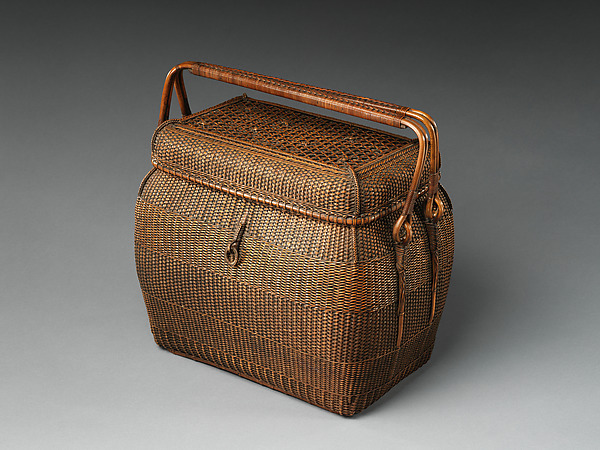
Hayakawa Shōkosai I · ca. 1877–80s · Rattan and brocaded silk
Look closer: a lidded rectangular basket with an arched handle across the top.
Hayakawa Shōkosai I, Basket for Transporting Sencha Tea-Ceremony Utensils (Chakago or Teiran), ca. 1877–80s. The Metropolitan Museum of Art, Gift of Diane and Arthur Abbey, 2019 (accession 2019.424.4a–c). Public domain, Met Open Access. Record
Other lineages complete the map. Iizuka Rōkansai (1890 to 1958), who led with his brother Iizuka Hōsai II (1872 to 1934) the movement that made the bamboo art of the Kantō region a fine art, developed bundled plaiting and embroidered plaiting, and won an award at the 1925 International Exhibition of Modern Decorative and Industrial Arts in Paris; his son Iizuka Shōkansai (1919 to 2004) became a Living National Treasure in 1982. Maeda Chikubōsai I (1872 to 1950) began with karamono and literati baskets and then turned to a rustic style of natural branches and roots; Chikubōsai II (1917 to 2003) became a Living National Treasure in 1995. Tanabe Chikuunsai I (1877 to 1937) developed the ryūrikyō style and made baskets explicitly for exhibition, a notable shift in Japanese bamboo art.
The nineteenth-century anonymous baskets in the Met show the tradition before names mattered. A flower basket of the mid-nineteenth century in bamboo and lacquer has a tapering body with two small rings at the shoulders; another is woven in the shape of a flower, with a flaring dish on a looped rattan foot; a tall basket for peonies, 61 centimetres high, has a tall arched handle that rises in a single sweep above a squat, round-bellied body. Each is a different answer to the question of how to hold a stem.

mid-19th century · Bamboo, lacquer
Look closer: the body tapers to a narrow base, with a ring on each side at the shoulder.
Flower Basket, mid-19th century. The Metropolitan Museum of Art, Edward C. Moore Collection, Bequest of Edward C. Moore, 1891 (accession 91.1.2099). Public domain, Met Open Access. Record

mid-19th century · Bamboo, rattan
Look closer: the broad shallow dish sits on a short stem above a looped rattan foot.
Flower Basket (Hanakago) in the Shape of a Flower, mid-19th century. The Metropolitan Museum of Art, Edward C. Moore Collection, Bequest of Edward C. Moore, 1891 (accession 91.1.2120a, b). Public domain, Met Open Access. Record
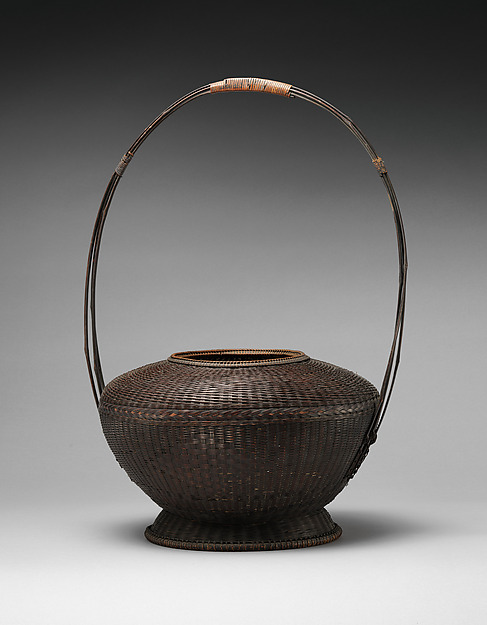
second half 19th century · Bamboo and rattan
Look closer: the round body is woven fine and dark, and the handle rises in a single curve far above the rim.
Basket for Peonies, second half 19th century. The Metropolitan Museum of Art, Edward C. Moore Collection, Bequest of Edward C. Moore, 1891 (accession 91.1.2070). Public domain, Met Open Access. Record
What to Check Before You Fill It
A curator’s note, from the practice of the house rather than the literature. Bronze should be inspected for cracks, especially at the lip and foot, and for later re-patination; ceramic, for hairline cracks that may seep; bamboo, for splits where it has dried. In a valuable vessel, use a separate liner instead of filling it directly with water. A kenzan should be set on a mat or pad so that it does not scratch a dish. These are matters of care, not of history, and they are as relevant to the person who will use a vessel as to the one who will display it.
The signature matters more than the decoration. A bronze with a cast or engraved cartouche, a ceramic with a kiln mark, a basket with a signature and a fitted box each says something about who made it, and the box inscription says who valued it. See also the house guides on ikebana vases, Meiji bronzes, box inscriptions and ceramics terms.
Hearths, Gates and Guests
Frank Lloyd Wright is a surprising witness for the alcove. Wikipedia’s tokonoma article records that the American architect, influenced by Japanese architecture, translated the meaning of the tokonoma into the fireplace, which became the ceremonial core of his houses. A recess where something is honoured, with a person seated before it: Wright saw the family hearth in the same terms.
The article also gives the etiquette that keeps the vessel safe. The most important guest sits closest to the tokonoma, at the place called kamiza, furthest from the entrance, and stepping into the tokonoma is strictly forbidden except to change the display, which requires its own etiquette.
Contemporary bamboo art has found a new stage. Wikipedia reports that the Metropolitan Museum held Japanese Bamboo Art: The Abbey Collection in 2017, its first exhibition devoted to bamboo basketry and sculpture, and that Tanabe Chikuunsai IV, born in 1973 and based in Sakai, made Godai, a work of almost six metres, for the Musée Guimet in 2016 and The Gate for the Met in 2017. The line from a signed sencha basket of the 1870s to a six-metre installation is shorter than it looks.
Dates from 1462 to 2026
Dates come from the articles cited at the foot of the page. Where a source gives a range, the table says so.
| Year | Event |
|---|---|
| 1185 to 1333 | Kamakura monasteries use an oshiita board for altar vases, incense burners and candlesticks |
| 1336 to 1573 | Shoin rooms make the tokonoma a place for scroll and vase |
| 1462 | Hekizan Nichiroku records Ikenobō Senkei arranging flowers in a golden vase |
| 1522 to 1591 | Sen no Rikyū’s lifetime; wabi tea shapes simple Japanese baskets (wamono) |
| 1542 | Senno Kuden manuscript dated |
| 1672 | Kokon Rikka-shu, the oldest published rikka work |
| 1683 | Kokon Rikka-taizen, the most famous rikka manual |
| 1815 to 1897 | Lifetime of Hayakawa Shōkosai I, thought to be the first to sign baskets |
| 1895 | Ohara Unshin founds the Ohara school |
| 1925 | Iizuka Rōkansai wins an award at the Paris decorative arts exhibition |
| 1927 | Sōgetsu-ryū founded by Teshigahara Sofu |
| 1957 | Hiroshi Teshigahara makes the film Ikebana |
| 2016 | Tanabe Chikuunsai IV’s Godai shown at the Musée Guimet |
| 2017 | Japanese Bamboo Art: The Abbey Collection and The Gate at the Met |
| 2003 | Hayakawa Shōkosai V named a Living National Treasure |
Curiosities of the Vessel
The container can be an element, or only a water vessel, depending on the school. Wikipedia says so directly, and it explains a good deal of the variety in this chapter: a house that keeps a Bizen gourd, a bronze and a basket is keeping three answers to one question.
Wide mouths keep water fresh. The ikebana article gives the practical reasoning that oxygen entering through the opening keeps the water “sweet” much longer than in a small-necked vase, and that Buddhist concern for the preservation of life shaped many vase shapes intended to prolong the flowers’ lives.
Solid bamboo can split in a dry climate outside Japan, says the article, while bamboo reed baskets work anywhere.
Terms Used on This Page
A short vocabulary, in the order a visitor is likely to meet the words.
| Term | Meaning |
|---|---|
| Hanaire | A flower container of any kind |
| Hanakago | A flower basket |
| Kake-hanaire | A hanging flower vase |
| Fukumuki | “Wind drawing through a place”; the opening in a hanging bamboo vase |
| Suiban | A shallow dish for moribana |
| Kenzan | A needle-pointed holder for stems, also called a metal frog |
| Nageire | An arrangement in a tall vessel, “thrown in” |
| Moribana | “Piled-up flowers”; arrangement in a shallow dish |
| Jiyūka | “Free flowers”; any material may be used |
| Rikka | “Standing flowers”; the grand early style |
| Shōka | The formal style that grew out of nageire |
| Tatebana | “Standing flowers”; the earliest vase style |
| Mitsu-gusoku | The three-implement altar set that included a flower vessel |
| Oshiita | The board that carried altar fittings in monastery rooms |
| Tokonoma | The alcove where scroll and vase are shown |
| Kamiza | The seat of honour nearest the alcove |
| Karamono | “Chinese things”; Chinese-style or imported ware |
| Wamono | “Japanese things”; natural, asymmetric baskets |
| Shin, gyō, sō | Formal, semi-formal and informal grades of vessel |
Who Makes and Keeps Them Now
Bamboo art has an international audience. Besides the Abbey Collection exhibition that the Met held in 2017, Wikipedia cites the Lloyd Cotsen collection at the Asian Art Museum in San Francisco, documented in Masters of Bamboo of 2008, as the other major Western record. The most prominent living names are those the article lists as Living National Treasures: Katsushiro Sōhō, born in 1934, and Fujinuma Noboru, born in 1945, both of Tochigi Prefecture.
The Ikenobō school, meanwhile, continues from its temple in Kyoto. Wikipedia names Ikenobō Sen’ei, born in 1933, as the 45th headmaster, and records that his eldest child, Yuki, born in 1965, is headmaster designate and will take the name Ikenobō Senkō IV, which the article notes breaks the tradition that only a son may succeed. The headquarters dōjō beside Rokkaku-dō has a museum and exhibition space.
Visitors most often search for the difference between a suiban and a vase, whether a basket holds water, why Japanese vases are wide-mouthed, and how to hang a flower in a tokonoma. The answers are in the questions below.
Vessels in the museum

early 17th century · Stoneware with natural ash, feldspar, and iron glaze (Mino ware, Kuro-Oribe type)
Look closer: ash and iron glazes run unevenly down the body; the lip is shaped in lobes.
Brown Oribe Flower Holder (Hanaire) with Handles, early 17th century. The Metropolitan Museum of Art, Purchase, William R. Appleby Fund and Gift of Mrs. Samuel T. Peters, by exchange, 2024 (accession 2024.123). Public domain, Met Open Access. Record

13th century · Gilt bronze
Flower Vessel, 13th century. The Metropolitan Museum of Art, Purchase, Barbara and William Karatz Gift, 2006 (accession 2006.180). Public domain, Met Open Access. Record

mid-19th century · Timber bamboo, dwarf bamboo, and rattan
Chinese-Style Flower Basket (Karamono hanakago), mid-19th century. The Metropolitan Museum of Art, Edward C. Moore Collection, Bequest of Edward C. Moore, 1891 (accession 91.1.2092). Public domain, Met Open Access. Record

mid-19th century · Bamboo, rattan
Look closer: the hanging rings are woven into the form.
Flower Basket in the Shape of a Cicada, mid-19th century. The Metropolitan Museum of Art, Edward C. Moore Collection, Bequest of Edward C. Moore, 1891 (accession 91.1.2108). Public domain, Met Open Access. Record

second half 19th century · Bamboo, rattan
Gourd-shaped hanging wall basket for flowers (Kake-hanakago), second half 19th century. The Metropolitan Museum of Art, Edward C. Moore Collection, Bequest of Edward C. Moore, 1891 (accession 91.1.2078a, b). Public domain, Met Open Access. Record

18th century · Clay covered with a partly-transparent glaze, with streaks (Kiyomizu ware)
Hanging Flower Vase, 18th century. The Metropolitan Museum of Art, Gift of Mr. and Mrs. Samuel Colman, 1893 (accession 93.1.97). Public domain, Met Open Access. Record

ca. 1615–1868 · Iron
Sword Guard (Tsuba) Depicting Bamboo Vase for Ikebana and Plum Branch, ca. 1615–1868. The Metropolitan Museum of Art, Edward C. Moore Collection, Bequest of Edward C. Moore, 1891 (accession 91.1.750). Public domain, Met Open Access. Record
The Vessel Shelf
Bronze, porcelain and enamelled vessels for flowers, each recorded with its dimensions and condition, are gathered on the ikebana shelf. The concierge desk can search Japan for a particular form.
Answered plainly
What is the difference between a suiban and an usubata?
A suiban is a flat, shallow container used mainly for moribana. An usubata, as the Ikebana International glossary defines it, is a three-legged bronze or copper vase with a shallow flat basin and a well to hold a kenzan, often used with shōka.
Why do Japanese vases have wide mouths?
Wikipedia’s account says the vessel is chosen to prolong the life of the flowers, and that wide mouths let air reach the plant and keep the water sweet, because the vase does not hold the stems by its neck.
What are shin, gyō and sō vessels?
The three grades of the tea room: metal or celadon for formal shin, glazed ceramic for semi-formal gyō, and bamboo or plain pottery for casual sō.
Who signed the first baskets?
The Metropolitan Museum’s record says Hayakawa Shōkosai I (1815 to 1897) is believed to be the first master basket maker to sign his compositions.
Can a basket hold water?
Baskets are often used with a separate liner. The liner protects the weave and is the safer practice for any valuable piece.
What is a kenzan?
A heavy base set with upright needles, also called a metal frog. It secures stems in a shallow dish for moribana arrangements.
What is moribana?
An arrangement of “piled-up flowers” in a shallow dish or basket, with stems secured on a kenzan. The Ohara school, founded in 1895, is connected with it.
Why are hanging flower vases used?
Wikipedia explains that flowers from an esteemed friend should not be placed where they could be looked down on, so the vessel is hung at eye level.
What is the fukumuki?
The opening cut below the top of a hanging bamboo vase, called “wind drawing through a place”. The round top is said to stand for the moon and the nail hole for a star.
Who first signed flower baskets?
Hayakawa Shōkosai I (1815 to 1897) is believed to be the first master to sign his baskets.
What is the difference between karamono and wamono baskets?
Karamono baskets are Chinese in style, formal and symmetrical with tight weaves. Wamono baskets are Japanese, natural and asymmetric, developed after Sen no Rikyū’s wabi tea.
What is a tokonoma?
An alcove in a Japanese room where scrolls and flower arrangements are displayed. It probably grew from the oshiita board of Zen monasteries and became a room feature in the Muromachi period.
Where did the Ikenobō school begin?
At the Rokkaku-dō temple in Kyoto. The organised school was founded in the fifteenth century by the monk Senno; the earliest dated record of an Ikenobō master at work is of 1462.
Why is bronze so popular for vases?
Wikipedia says it resembles “mother earth”, and the tea room treats metal as the formal grade of container.
Can a bamboo vase split?
Yes. Wikipedia says solid bamboo can split in dry climates outside Japan, so bamboo reed baskets, or a water-tight liner, are safer there.
Where next
References and image credits
- Ikebana, Wikipedia (vessels section)
- Japanese bamboo weaving, Wikipedia
- Hanaire, JAANUS (Japanese Architecture and Art Net Users System)
- The alcove for the Japanese tea room: flower and vase, Kyoto tea ceremony guide
- Glossary of Ikebana Terms, Ikebana International Chapter 167
- Karamono-Style Flower Basket (Hanakago), Hayakawa Shōkosai I, Metropolitan Museum of Art
- Tokonoma, Wikipedia
- Ikenobō, Wikipedia
- Metropolitan Museum of Art Open Access: Asian Art collection records (credited beneath each image)
Last reviewed 28 October 2026. Every photograph is public domain or openly licensed and credited beneath it; drawn diagrams are by Japonista.
Looking for a vessel for a particular form, or a signed basket with its box? The concierge desk replies within one to three business days.
Private concierge
Looking for something in particular?
Describe the piece or the project you have in mind. A senior advisor in Tokyo reads every case file personally and replies within two business days, with fees set out in writing before any work begins.