
The Altar’s Calendar: Higan, Obon and the Years of Remembrance
Sacred Wing · Household Practice
The Altar’s Calendar: Higan, Obon and the Years of Remembrance
A household altar is a clock as much as a cabinet. It marks the morning, the seventh day, the first year, the equinox and the August fires, and the objects on it are arranged to serve each hour.
Fact sheet
The calendar in four lines
- Each morning. Offerings are renewed and the family’s book of names is opened to the page for the day’s date.
- In the first weeks. Services fall on the seventh day, the forty-ninth, and most commonly on those two.
- Across the years. Memorial years are counted from the death, and the series ends in the thirty-third, fiftieth or hundredth year, depending on the family’s school.
- Twice a year, and once in summer. Higan brackets each equinox; Obon welcomes the household dead home for a few days and sends them back.
A cabinet opened at breakfast
In most Japanese homes that keep one, the Buddhist altar stands in the main room, a cabinet with doors, and its working life begins at the morning meal. Rice, tea and other food are placed before it, and the doors are opened for the ceremony or whenever someone wishes to speak to the ancestors. An anthropological summary of household observance records that, in many regions, the cabinet is called the ancestor shelf, senzodana, because its chief occupants are the memorial tablets of the family’s dead.
The Sōtō Zen school, which publishes plain instructions for lay households, names five basic offerings: incense, flowers, candles, water and food. It adds a small, exact habit. Keep the ancestors’ name book where it can be seen, and each morning open it to the page for that day’s date. The altar, in other words, does not wait for an anniversary to be useful. It holds a perpetual almanac of the household’s dead, and one page of it is read aloud, in effect, every day.
The arrangement of the cabinet follows the calendar too. On the Sōtō plan the Buddha stands at the centre of the upper shelf, with memorial tablets to left and right; facing the altar, older tablets go on the right and newer on the left. The tea and water sit at the centre of the middle shelf, and the lower shelf carries a vase, an incense burner and a candlestick. A bell, sutra book and rosary live in a drawer, ready to hand. Our guides to what a butsudan is, its components and the incense, candles and offerings take each of those objects in turn.
Seven days at a time
When a person dies, the household enters a count. Special offerings and sutra readings mark every seventh day for the first forty-nine. Local custom decides how much of that is observed in full: some families hold a service on each seventh day, some on several, and many on only the seventh day (shonanoka) and the forty-ninth (shijūkunichi). On the forty-ninth, in many traditions, the urn is interred in a ceremony called nōkotsu, and the family stays in mourning until then.
The reason for the number is medieval. A body of belief held that the soul passes before the Ten Kings of the underworld, each of whom has a compassionate Buddhist counterpart. The set of thirteen buddhas and bodhisattvas assigned to the thirteen memorial services grew out of that belief and remains in use, especially in Shingon households; on our page for the Thirteen Buddhas the sequence runs from Fudō Myōō on the seventh day to Kokūzō Bosatsu on the thirty-third year. The judges themselves are described in Enma and the Ten Kings of Hell, and the realms the soul might enter in Rokudō: The Six Realms.
A photograph of the deceased is placed at or near the altar. In the first year there is a quiet social rule as well: no New Year’s postcards are sent or received, and relatives and friends are told in advance so that nobody is surprised by the silence.
The memorial years
After the first weeks the count moves to years, and the unit is the anniversary of the death, called nenki or shūki. The usual rounds are the first, third, seventh, thirteenth, seventeenth, twenty-third, twenty-seventh and thirty-third years, followed by the fiftieth and hundredth. Depending on the family’s school, one of the last three, the thirty-third, fiftieth or hundredth, may close the series for that person.

Japan, late 18th to first half of the 19th century. Wood with lacquer, gold, pigments and metal fittings; the shrine stands 10.7 cm high.
Look closer: the doors fold back to show a gilt figure on a lotus throne and a tiered base, with a painted figure on the inside of each door. The figure itself is 4.2 cm high: a household altar reduced to what could travel.
The Metropolitan Museum of Art, New York, Bequest of Susan Dwight Bliss, 1966 (67.55.62). Public domain, Open Access.
The counting looks odd to outsiders until its rule is stated. Under traditional Japanese reckoning, the yearly cycles begin with the date of death counted as one, so the third memorial falls two years after the death and the first round is not a calendar year but the first cycle from the day itself. A temple that serves a Japanese-American congregation, which publishes its schedule in plain terms, lists the first as on or before one year, the third as two years after death, and the series continuing to the fiftieth and every fifty years after that.
Sources do not agree on every number, and a household’s own temple has the last word. One standard account gives the twenty-third and twenty-seventh years; the temple schedule we consulted lists the twenty-fifth instead; a general encyclopaedia says that services continue up to the thirty-ninth or fiftieth year. We give the commonly cited list below and flag it as a guide, not a rule.
| Memorial | When | Note |
|---|---|---|
| Seventh day, shonanoka | Day 7 | Most commonly observed in the first weeks |
| Forty-ninth day, shijūkunichi | Day 49 | Interment of the urn in many traditions; mourning ends for the family |
| First year | On or before the first anniversary | The first round of the yearly cycle |
| Third year | Two years after the death | Counted inclusively from the day of death |
| Seventh and thirteenth years | Six and twelve years after | Inclusive counting; the Thirteen Buddhas pair these with Ashuku Nyorai and Dainichi Nyorai |
| Seventeenth, twenty-third, twenty-seventh | Varies by school and region | Not every family observes each one |
| Thirty-third, fiftieth or hundredth | Final round, by school | Closes the series for that person |
Higan, the far shore
Higan (彼岸) means “the other shore”: in Buddhist language, this shore is the cycle of rebirth and the far one is nirvana. The observance lasts seven days, three before and three after each equinox, spring and autumn, and nearly every Japanese Buddhist school keeps it, with services at temples both in Japan and abroad. Its first recorded Buddhist ceremony is dated to 806, when the court chronicle Nihon Kōki notes the Diamond Sutra recited for seven days to calm the grievance of Prince Sawara. By the later centuries its purpose had shifted towards remembering ancestors, and many people return to their home towns to do so, as they do at Obon.
The pairing of equinox and paradise has an observable logic. On those two days, day and night are equal, the sun rises due east and sets due west, and practitioners turned their thoughts to the Pure Land in the west; see Pure Land Buddhism.
The Sōtō Zen calendar gives the domestic choreography. On the day before, clean the Buddha altar, arrange the implements and change the flowers. Offer rice dumplings on the first day, rice cakes covered in sweet bean paste, ohagi or botamochi, on the middle day, the equinox itself, and dumplings of rice flour on the last. Then go to the grave: clean the stone and its water basins and flower vases, offer water, incense and the ancestors’ favourite foods, and remove the food afterwards. The red spider lily, which blooms in the autumn Higan, is called higan-bana, the flower of the season.
Obon and the road home
Obon is the household’s largest ancestor observance. The founding story is about a son: Mokuren, a disciple of the Buddha, found his dead mother suffering in the realm of hungry ghosts and, on the Buddha’s advice, made offerings to the monks who had finished their summer retreat, and she was released. The festival was known at court by 733, and a tradition places it as early as the reign of Empress Suiko, 592 to 628.

Shibata Zeshin (1807 to 1891), circa 1860. Woodblock print (nishiki-e), ink and colour on paper; 23.2 by 16.2 cm.
Look closer: the lantern is the only strong colour on the sheet, held above the figure like a flame carried through dusk, and the small dog at her feet gives the scene its quiet.
The Metropolitan Museum of Art, New York, The Howard Mansfield Collection, Purchase, Rogers Fund, 1936 (JP2743). Public domain, Open Access.
It was once held on the thirteenth to fifteenth days of the seventh lunar month. Today it falls in July in some areas, notably Tokyo, and in August across most of the country; August 15 is the most commonly celebrated date. Obon is not a public holiday, but leave is customary.
The Sōtō timetable is concrete. On the thirteenth, greeting fires, kadobi, are lit with hemp stalks or pine torches to guide the ancestors home, and the Obon shelf, bondana, is usually set up that morning. Noodles are offered on the fourteenth and sweet bean dumplings on the fifteenth. The spirits are sent off on the fifteenth or sixteenth with lit hemp stalks and, in some places, small boats carrying offerings, which temples now often collect because of pollution. On the sixteenth come eggplant and cucumber, shaped as cow and horse: the horse is a vessel for the ancestors’ return, and the cow carries them back to the other world. Where a family has lost someone in the past year, the shelf is handled with particular care. Where no shelf is set up, the spirits are greeted at the Buddha altar itself.
The same logic is writ large in Kyoto. On August 16 five bonfires are lit on the hills around the city to send the dead off: the character “large” on Daimonji-Yama at 8 pm, then “Myō” and “Hō”, the boat, a second “large” and the shrine gate in intervals of five to ten minutes, each burning for about half an hour. The name Okuribi means “send-off fire”.
| Fire | Shape | Mountain | Lit at |
|---|---|---|---|
| Daimonji | The character for “large” | Daimonji-Yama (Nyoigatake) | 8:00 pm |
| Myō and Hō | “Wondrous dharma”, two fires | Matsugasaki | 8:10 pm |
| Funagata | A boat | Funa-Yama, Nishigamo | 8:15 pm |
| Hidari Daimonji | The character for “large” | Daihoku-san | 8:15 pm |
| Toriigata | A shrine gate | Mandara-san | 8:20 pm |
Other dates on the shelf
Ancestors are also honoured at New Year and at both equinoxes, and the Sōtō school keeps its own days for the founders of its line: Ryōsōki on September 29 for Dōgen and Keizan, whose death dates in the lunar calendar both fall on that date in the Western one, and Daruma-ki on October 5 for Bodhidharma, with thanks and a prayer for the coming harvest. A sect’s calendar is part of what its altar is for.
At Obon each Sōtō temple also holds a sejiki-e, a service in which offerings are made not only to the family’s ancestors but to spirits that have no living person left to remember them. It is the most generous idea in the whole year: that the altar’s hospitality should extend past the household.
What the calendar means for an altar changing hands
A butsudan that has moved between families has spent years on this timetable, and the calendar explains much of what you find in one: the drawer for bell and sutra book, the shelf made for tablets, the scorch marks left by incense in the shape of a stick. Care for the cabinet is a form of continuing the calendar; our care guide and installation guide are written with that in mind.
In some schools, a re-enshrinement ceremony follows when a family replaces or repairs its altar. If an altar is to be passed on, ask the family temple whether its school expects one, and whether any tablets should be returned or retired before the cabinet leaves the house. The household and Shinto alternatives are set out in Butsudan vs Kamidana, and the wider practice of keeping sacred images at home in the guide to displaying a Buddhist statue at home.
Objects that keep the calendar
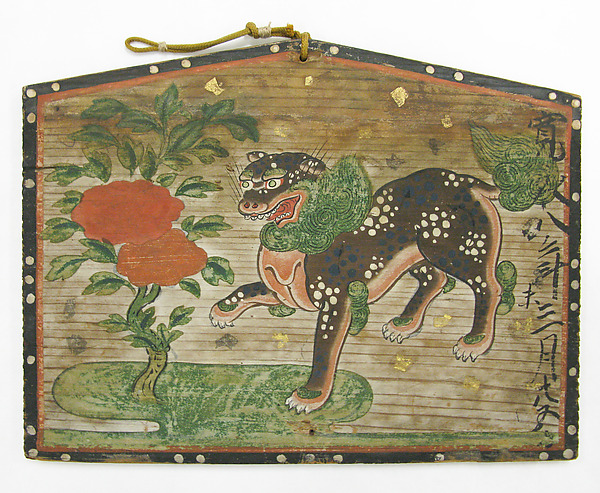
Japan, 1631. Ink, colour and gold leaf on wood; 18.7 by 24.8 cm.
Look closer: a lion with one paw raised beside a flowering peony, with an inscription down the right-hand edge. An ema is a gift left at a shrine, the public counterpart of the private altar.
The Metropolitan Museum of Art, New York, The Harry G. C. Packard Collection of Asian Art, 1975 (1975.268.139). Public domain, Open Access.
Altars and the objects around them
The house keeps a collection of household altars, altar implements and Buddhist objects from Japan, each described with its condition and measurements.
Answered plainly
When is Obon?
It depends on the region. Traditionally it fell on the thirteenth to fifteenth days of the seventh lunar month; today it is kept in July in some areas, including Tokyo, and in August across most of the country, where August 15 is the most common date. The Sōtō Zen calendar sets its schedule from the thirteenth to the sixteenth.
How long does Higan last?
Seven days: three before the equinox, the equinox itself and three after, in spring and again in autumn. Sōtō Zen describes it as a week centred on the equinox day, in March and September.
What are the forty-nine days?
The period after a death in which special offerings and sutra readings mark every seventh day. Many families observe only the seventh and the forty-ninth, and in many traditions the urn is interred on the forty-ninth.
Why is the third memorial two years after the death?
Traditional Japanese counting treats the date of death as the first of the cycle, so the third memorial falls two years later. A temple’s own schedule is the safest guide.
Which year ends the memorial series?
It depends on the family’s school. Depending on the sect, the thirty-third, fiftieth or hundredth year may close the series for that person.
Do all Buddhist households keep the same altar?
No. Layouts and objects differ by school. Jōdo Shinshū homes use pictures of the deceased rather than tablets, and Sōtō Zen households follow the arrangement described here. Ask the family temple.
Where next
Sources and image credits
- Soto Zen Buddhism, Events: Higan-e, Obon and the founders’ memorials
- Soto Zen Buddhism, Commemoration: setting up the home altar
- Encyclopedia.com, Domestic Observances: Japanese Practices
- Wikipedia, Obon
- Wikipedia, Higan
- Wikipedia, Japanese funeral
- Wikipedia, Butsudan
- Wikipedia, Gozan no Okuribi
- Buddhist Church of Oakland, Dates for family memorial services
- 500 Yojanas, Obon vs. Higan (Nichiren Shu perspective)
- The Metropolitan Museum of Art, Open Access: Portable Shrine (zushi) with Senju Kannon, 67.55.62
- The Metropolitan Museum of Art, Open Access: Lighting a Hanging Lantern for the Obon Festival, JP2743
- The Metropolitan Museum of Art, Open Access: Ema of a Chinese Lion and Peony Tree, 1975.268.139
Last reviewed 28 October 2026. Pictures, where shown, are public-domain or open-access and credited beneath each one.
Looking for a household altar, a statue or the implements that go with them? The concierge desk searches Japan on your behalf and replies within one to three business days.
Private concierge
Looking for something in particular?
Describe the piece or the project you have in mind. A senior advisor in Tokyo reads every case file personally and replies within two business days, with fees set out in writing before any work begins.