
The Three Sen Houses and Other Schools of Tea
Chanoyu Almanac · Lineage, Licence, Succession
The Three Sen Houses and Other Schools of Tea
Three houses in one Kyoto neighbourhood, each named for where it stood, each descended from the same grandfather. Their rivalry is gentle, their differences are small, and their influence on how the world learns tea is very large. This chapter explains who founded them, what each teaches, how a licence works, which other schools stand beside them, and where the sources disagree.
Fact sheet
At a glance
- One family, three houses. Omotesenke, Urasenke and Mushakōjisenke descend from the sons of Sen no Sōtan, grandson of Sen no Rikyū.
- Names from places. Omote means front and ura means rear, after the position of the estates; Mushakōji is a street.
- A system of licences. Students move through certificates that permit them to study certain procedures, and the heads, the iemoto, hold final authority.
- Ten craft houses. The Senke Jusshoku are ten craft lines that make the utensils the houses use.
- A recent loss. Sen Genshitsu, the fifteenth Urasenke head, died in Kyoto on 14 August 2025, aged 102.
What a Tea School Is
A reader who meets the tea ceremony for the first time soon meets three names: Omotesenke, Urasenke and Mushakōjisenke. They are usually called the san-Senke, the three Sen houses, and Wikipedia describes each as one of the three lines of the Sen family descending from Sen no Rikyū. The argument of this chapter is that these houses are best understood as three households that kept one tradition alive by dividing it, and that the rest of what the world calls a tea school, with its licences, its headmaster, its certificates and its craft suppliers, grew from that division.
The word school can mislead. In Japan a person who wishes to study tea, the article on the tea ceremony says, typically joins a circle, a group that meets regularly. The circle may meet at a junior or senior high school, a college, a community centre, a dedicated tea school or a private house. Behind the circle stands a ryū, a school in the sense of a lineage, with a head, a method and a way of granting permission. This chapter is about that second sense: the houses, the heads, the licences and the lines that run from one room in Kyoto to a table in Honolulu.
The chapter follows the family first, then each of the three houses in turn, then the system of licences that joins them, the ten craft houses that supply their utensils, the other schools that stand beside them, and the news of the present day. It ends with a table of the headmasters, a timeline, a glossary and the questions readers most often ask. A short companion chapter, Sen no Rikyū and Wabi-cha, tells the story of the founder; a collector who needs the objects will find them in the atlas of utensils.
The sources are Wikipedia's articles on Urasenke, Omotesenke, Mushakōjisenke, Sen no Sōtan, Sen Sōshitsu XV, the schools of Japanese tea, the iemoto and the tea ceremony; the Mushakōjisenke house's own history page; the Real Japanese Gardens page on Fushin-an; a dictionary entry on the ten craft houses; a news report of August 2025; and the catalogue pages of the Metropolitan Museum of Art for the objects shown. Where they disagree a box says so, and the disputed figure is left out.
How the Family Divided
Wikipedia's article on Urasenke gives the family's early geography. Rikyū's hometown was Sakai, in the province of Izumi, in present-day Osaka Prefecture. As his activities became centred on Kyoto he kept a house there. He also had his adopted son-in-law, Sen Shōan, who was married to his daughter Okame, move from Sakai to Kyoto, leaving his natural son, Sen Dōan, to tend the family home and business in Sakai. That, the article says, is the origin of the two branches of the family called the Sakai-Senke and the Kyō-Senke.
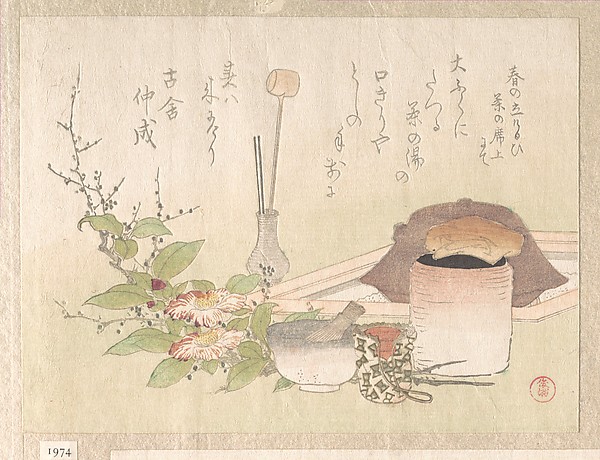
Kubo Shunman, Set of Utensils for the Tea Ceremony, 1810s, Woodblock print (surimono); ink and color on paper. The Metropolitan Museum of Art, H. O. Havemeyer Collection, Bequest of Mrs. H. O. Havemeyer, 1929, accession JP1974.
Look closer: a plum branch, a vase, a bowl and a lidded jar are arranged as a still life, with poems above. The museum catalogues it as Set of Utensils for the Tea Ceremony, a surimono of the 1810s by Kubo Shunman, a small woodblock print made as a greeting; it shows the things the schools teach people to handle, two centuries after Sōtan.
Image: The Metropolitan Museum of Art, Open Access (CC0)
The Kyoto branch, headed by Shōan, settled in a house on Ogawa Street, in the neighbourhood of Honpō-ji temple, which became the original Sen estate in Kyoto. Then came the catastrophe. After Rikyū's death both Dōan in Sakai and Shōan in Kyoto, the article says, were in danger of the same wrath of Toyotomi Hideyoshi that had killed Rikyū, and went into hiding to protect their homes and families. After some months both were able to return. Dōan left no successor and the Sakai branch ended. Shōan, on his return, already had a son by Okame, Sen Sōtan, to succeed him.
The article on Sōtan adds the detail that during these years, when the Sen family was disbanded, Shōan found shelter with the lord Gamō Ujisato at Aizu Wakamatsu, far to the north. Sōtan himself had been sent at about the age of ten to Daitoku-ji, at Rikyū's wish, to live at the sub-temple Sangen'in under the priest Shunoku Sōen, and he was able to stay safely there. When his father was at last permitted to return and reestablish the family in Kyoto, Sōtan left the priesthood and came home; his father soon left the headship to him and moved out.
This is the whole inheritance: a family scattered by a regent, a house rebuilt in Kyoto, and a grandson who had grown up in a Zen temple. The three houses are what he made of it.
Sōtan and His Four Sons
Sen no Sōtan, who lived from 1578 to 1658 and is also called Genpaku Sōtan, is counted as the third generation in all three houses. Wikipedia remembers him as Rikyū's third-generation successor in Kyoto, through whom, as the blood descendant, the ideals and style proposed by Rikyū were passed forward. The Metropolitan Museum's catalogue page for one of his letters says that he played a pivotal role in preserving and transmitting the tradition of Japanese tea, and that three of his four sons went on to establish schools that continue to the present day.
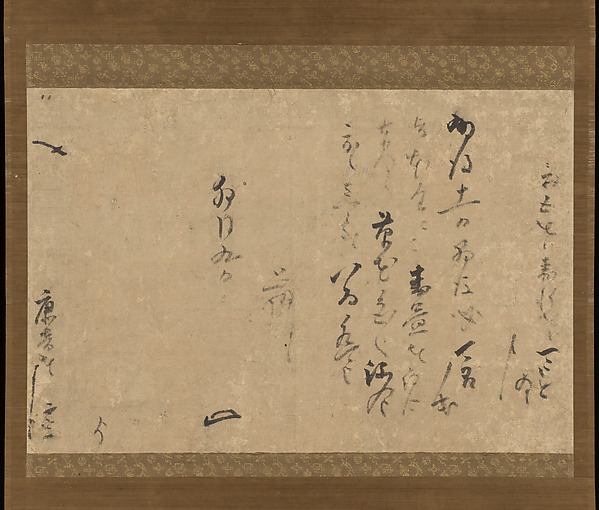
Sen Sōtan, Letter of Acceptance, first half 17th century, Hanging scroll; ink on paper. The Metropolitan Museum of Art, Gift of Peggy and Richard M. Danziger, 2024, accession 2024.553.18.
Look closer: the lines of brushed text are loosely spaced, ending in a signature at the lower left. The museum catalogues it as Letter of Acceptance, first half of the seventeenth century, ink on paper, image 26 by 39.2 cm, signed Fushin'an Sōtan; it is on view in Gallery 228 at The Met Fifth Avenue.
Image: The Metropolitan Museum of Art, Open Access (CC0)
He built the tea house Konnichian, the Hut of This Day, on the north side of the family residence, as the article puts it. According to the Urasenke article, around 1646, when he was roughly sixty-eight, he gave up the headship to his son Kōshin Sōsa and moved into quarters built at the rear of the house, which included the tiny hut. The three lines take their positions from these two places: the front house stayed with the heir, the rear quarters passed to a younger son.
The Urasenke article gives the children. Sōtan had five: the elder two, Kan'ō Sōsetsu and Ichiō Sōshū, by his first wife; and after her death two sons, Kōshin Sōsa (1613 to 1672) and Sensō Sōshitsu (1622 to 1697), and a daughter, Kure, by his second wife. The elder sons were set on other roads. The fourth son, Sensō, left the family as a young man to train as an apprentice under a local doctor, Noma Gentaku, and returned home in 1645 after the doctor's untimely death, and thereafter trained as a tea expert with his father's support. The three houses descend from Kōshin Sōsa, Sensō Sōshitsu and Ichiō Sōshū. Which of the elder two sons was the eldest, and which went to a lacquer family, is told differently by different pages; the box at the end of this chapter records the disagreement and leaves it unresolved.
Around Sōtan stood four close disciples, called his Four Heavenly Kings: Fujimura Yōken (1613 to 1699), Sugiki Fusai (1628 to 1706), Yamada Sōhen (1627 to 1708) and Kusumi Sōan (1636 to 1728). The Sōtan article adds that some lists put Miyake Bōyō or Matsuo Sōji in the fourth place instead of Kusumi. Two of the four, Yōken and Sōhen, founded schools of their own, which appear in the list of other schools below.
The Metropolitan Museum holds several works by Sōtan's own hand, all gifts of 2024. One is a letter dated the ninth day of the fourth lunar month, signed Fushin'an Sōtan, a name he used when writing from a tea house on the estate that became Omotesenke. It says he is pleased that the recipient will attend an informal tea gathering with several friends after a formal gathering, both two days off, and thanks the recipient for a gift of flowers. The record is small, and it is evidence that the formal chaji and the informal chakai were already a pair.
Front, Rear and the Street
The names are plain once their sources are laid out. Urasenke, Wikipedia says, literally means rear Sen house, and came into existence because of the location of this line's homestead in relation to what was originally the frontmost house, the omote, of the Sen estate. Omotesenke means front Sen house, and its name, the article says, came about as a natural occurrence from the same arrangement. The third, Mushakōjisenke, is named for the street on which its family's homestead stands, Mushakōji. The Omotesenke article makes the same point from the other side: its name arose naturally from the position of its homestead relative to the line at what was originally the rear of the Sen estate.
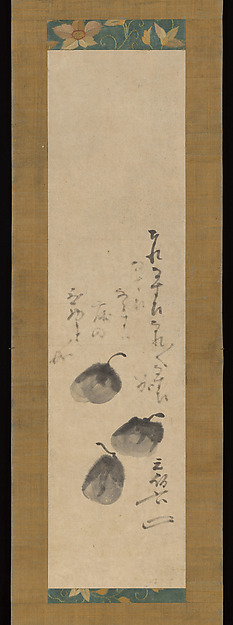
Sen Sōtan, Three Eggplants and a Poem, first half 17th century, Hanging scroll; ink on paper. The Metropolitan Museum of Art, Gift of Peggy and Richard M. Danziger, 2024, accession 2024.553.4.
Look closer: three eggplants are brushed in grey ink down a tall narrow scroll, with a few lines of writing beside them. The museum catalogues it as Three Eggplants and a Poem by Sen Sōtan, first half of the seventeenth century, image 48.6 by 12.4 cm. The word for eggplant, nasu, sounds like the verb for achieving, so the fruit has long been a symbol of success; the composition follows one by the Chinese Chan monk-painter Muqi.
Image: The Metropolitan Museum of Art, Open Access (CC0)
Each house is also known by its representative tea room. The Omotesenke estate, the article says, is known by the name of its tea room Fushin-an and lies on Ogawa Street in Kamigyō ward, Kyoto; the entire Urasenke estate in the same ward is referred to by the name of its representative tea room, the Konnichian. The Mushakōji house's own history page names its tea house Kankyū-an, and says that Sōtan wrote the calligraphy of the name that hangs over it. The meaning of Kankyū, the page admits, is not clear.
The Fushin-an page of Real Japanese Gardens gives the address as 536 Ogawa Teranouchi, Kamigyō ward, and the way there by city bus line 9 and a walk east to Ogawa Street; it lists opening hours of nine to five and then adds that the garden and tea house are not open to the public. The three estates are therefore private houses in a city street, not museums, and a visitor who wishes to see inside must arrange it through the house or its branches.
The three-part naming is the origin of a habit that surprises beginners. In everyday speech the schools are Omote, Ura and Mushakōji, and the heads are Sōsa, Sōshitsu and Sōshu. A hereditary professional name passes down with the headship. Wikipedia's tables give the Omotesenke name as Sōsa, the Urasenke name as Sōshitsu, and the Mushakōji name as Sōshu, and notes that on succession the new iemoto assumes the professional name; the current Urasenke head, for example, is officially Sen Sōshitsu XVI.
Omotesenke and Fushin-an
The front house descends from the heir. Wikipedia's article says the estate known by its tea room Fushin-an was where Rikyū's son-in-law Shōan reestablished the Kyoto Sen household after Rikyū's death; Shōan's son Sōtan succeeded as head, and the next heir was Sōtan's third son Kōshin Sōsa, counted as the fourth generation in the Omotesenke line. The hereditary name is Sōsa, and the current line runs through a long table of heads to the fifteenth Sōsa, born in 1970, who is listed as the current iemoto.
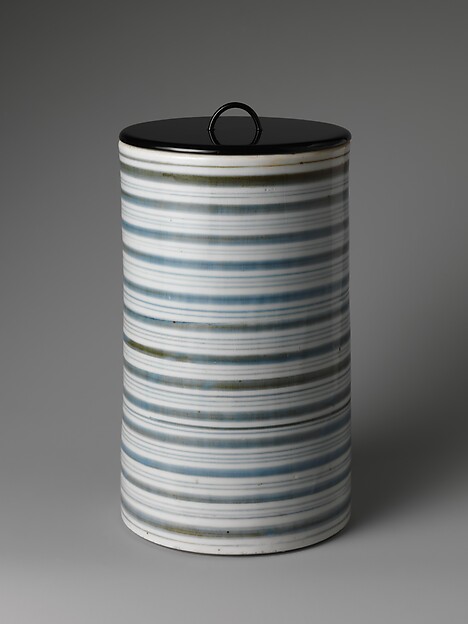
Tall Freshwater Jar (Hoso-mizusashi) with Striped Design, late 18th century, Porcelain with cobalt blue under transparent glaze (Hizen ware, Arita type). The Metropolitan Museum of Art, The Harry G. C. Packard Collection of Asian Art, Gift of Harry G. C. Packard, and Purchase, Fletcher, Rogers, Harris Brisbane Dick, and Louis V. Bell Funds, Joseph Pulitzer Bequest, and The Annenberg Fund Inc. Gift, 1975, accession 1975.268.468.
Look closer: blue bands of different widths circle a narrow white cylinder topped by a black lid with a small ring. The museum catalogues it as a Tall Freshwater Jar (hoso-mizusashi) with Striped Design, Hizen ware of the Arita type, late eighteenth century, porcelain with cobalt blue under transparent glaze, 20.3 cm high.
Image: The Metropolitan Museum of Art, Open Access (CC0)
The names in the table are worth reading slowly. Each head has a Buddhist name ending in sai: Hōgensai, Zuiryūsai, Kakkakusai, Joshinsai, Sottakusai, Ryōryōsai, Kyūkōsai, Rokurokusai, Seisai, Sokuchūsai, Jimyōsai and, for the fifteenth, Yūyūsai. They are the names by which an object is later remembered. A bamboo stand designed by the seventh head, Joshinsai (1705 to 1751), for example, appears in a catalogue note at the Metropolitan Museum for a tall water jar in blue-and-white porcelain: the note says the narrow jar was used only on certain occasions in the season of the portable brazier, especially to mark the season's end, and that in the Edo period it was often paired with a bamboo stand designed by Joshinsai. The jar is a piece of later eighteenth-century Arita porcelain; the museum does not say that it was made for any school.
Wikipedia's article describes one stylistic difference of the front house: that Omotesenke whisks the tea less than Urasenke, creating less foam on the top of the tea, and that Omotesenke uses both an untreated bamboo whisk and a susudake whisk, a darkened one, while Urasenke uses untreated bamboo. The article says that the differences between the schools are small. A reader may take the sentence as a fair summary of what a visitor might see, and as a reminder that each house teaches its own procedures and equipment.
The house also runs a public face. The Kitayama Kaikan in Kyoto, the article says, is a relatively modern Omotesenke facility where the school sponsors exhibitions, lectures and other programmes for the general public. And from the front house a branch grew in the east. The article on schools says Kawakami Fuhaku (1716 to 1807), who was not related to the Sen family by blood, trained under the seventh Omotesenke head and developed the Omotesenke style in Edo; his line is the Edosenke, and a further school, Fuhaku-ryū, split from it after his death, though the article gives no date.
Urasenke and the Hut of This Day
The rear house began as a retirement. Sōtan's quarters at the back of the family property, with the tiny hut he called Konnichian, became the home of his youngest son. The Urasenke article says Sensō Sōshitsu eventually became heir to the property, and that Sōtan found employment for his eldest son, Ichiō, with the Maeda clan of the Kaga domain, though Ichiō soon quit, an account that other pages tell otherwise. Sensō himself served the Maeda of Kaga as chadō magistrate, and later heads served the Hisamatsu clan of the Iyo domain, in present-day Ehime Prefecture.
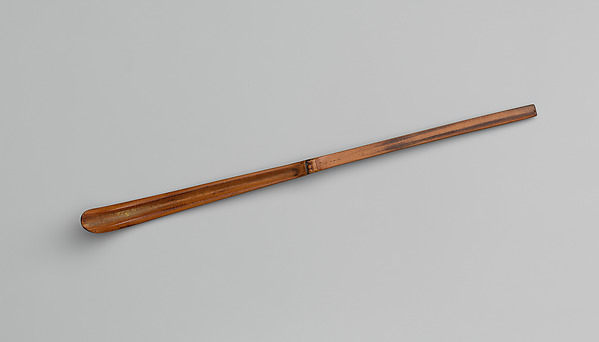
Sen Sōtan, Chashaku, named "Imogase", first half 17th century, Bamboo. The Metropolitan Museum of Art, Gift of Peggy and Richard M. Danziger, 2024, accession 2024.553.11a, b.
Look closer: the bamboo is smooth, with a single node and a small curved hook at the tip. The museum catalogues it as a chashaku named Imogase by Sen Sōtan, first half of the seventeenth century, bamboo, 17.5 cm long: the grandfather's own scoop, and the first utensil a student of any house learns to handle.
Image: The Metropolitan Museum of Art, Open Access (CC0)
The eleventh head, Gengensai (1810 to 1877), was born the fifth son of a minor lord, Matsudaira Noritomo of the Mikawa Okudono domain, and married into the family while also serving the Owari branch of the Tokugawa. Then the system collapsed. In 1868 the daimyō lost their positions and the hereditary stipends the three Sen houses had received ended, and it was after this, the article says, that the Sen families established their iemoto system. The houses had to become self-supporting teaching organisations, and Urasenke built the largest apparatus of the three.
That apparatus has several parts, all described in the article. The Urasenke Foundation, Konnichian, was registered by the government in 1949 in the era of the fourteenth head; its purpose is to preserve the school's cultural heritage, maintain the estate and support research and public education. The membership association, the Tankōkai, was begun in 1940 by the fourteenth head and registered as a not-for-profit association in 1953; it aims to standardise the rules and procedures of Urasenke tea, support research, encourage exchange among members and expand the number of practitioners around the world. In Japan it is divided into seventeen districts with 165 chapters and two sub-chapters, and there are 167 groups in its youth division. Outside Japan, the article says, there are 92 official associations in 37 countries.
The youth division, the Seinenbu, was begun in 1950 by the future fifteenth head, Sen Sōkō, to gather the strength of young practitioners toward rebuilding the war-torn nation; its first chapters were founded in Kure and Hiroshima in May 1950, its first national convention in 1966 drew over 2,200, and in 1974 a chartered Youth Ship with 418 participants sailed to Okinawa and Hong Kong. A training institute begun in 1962 became, in 1983, the Urasenke Gakuen Professional College of Chadō, accredited by the Ministry of Education and the only accredited school in Japan specialising in tea; it offers a three-year course, a one-year course and a research course, and an intensive one-year programme for non-Japanese students, the Midorikai, taught with lectures in English.
The rear house is also the one that went abroad. The Urasenke Tokyo branch opened in 1957 and moved in 1995 to Ichigaya in Shinjuku; it is the only Urasenke branch in Japan. From the middle of the 1960s the fifteenth head began to dispatch qualified instructors overseas. The article lists the dates: Hawaii and Boston in 1966, New York in 1967, Rome in 1969, Munich in 1972, when Urasenke donated a tea house called Kanshōan, Mexico City in 1973, Lima in 1974, London, Düsseldorf and Paris in 1976, São Paulo the same year, San Francisco in 1980, Seattle in 1981, and onward to Moscow and Beijing in 1991, Vancouver and Sydney in 1993 and Washington in 1994. The Urasenke Tea Ceremony Society, a registered non-profit corporation in the United States, has its headquarters at the Urasenke Chanoyu Center at 153 East 69th Street in New York, which opened in 1981.
Mushakōjisenke and Kankyū-an
The third house is the smallest of the three and the one with the most interesting origin. Wikipedia says that Mushakōjisenke is associated with Rikyū's great-grandson Ichiō Sōshu, one of Sōtan's four sons, who lived apart from the Sen house through much of his life and became a lacquer artisan. At the behest of his younger brothers, the article says, he set up his own tea house, the Kankyū-an, on Mushakōji street and devoted himself to the Way of Tea. The Sōtan article adds that he gave up the lacquer business to the artisan Nakamura Sōtetsu, which was the birth both of the Nakamura Sōtetsu line of lacquerers, who made much of the lacquer ware for the Sen families, and of the Mushakōjisenke line.

Ryūryūkyo Shinsai, Fire-Holder and Tea-Box, 19th century, Woodblock print (surimono); ink and color on paper. The Metropolitan Museum of Art, H. O. Havemeyer Collection, Bequest of Mrs. H. O. Havemeyer, 1929, accession JP1970.
Look closer: a rounded, darkly patterned fire-holder stands beside a bright red box with a pattern of small repeated marks, with a pale shell in front. The museum catalogues it as Fire-Holder and Tea-Box, a nineteenth-century surimono by Ryūryūkyo Shinsai, woodblock print with ink and colour on paper, 14 by 19.2 cm.
Image: The Metropolitan Museum of Art, Open Access (CC0)
The house's own history page gives more. Ichiō served the Konoe family and became tea teacher to the Takamatsu domain in Sanuki Province, and each head served that domain up to the generation of the eleventh head, Isshisai. The page says he received the name Sōshu from his Zen teacher, Gyokushū Sōban, the 185th head priest of Daitoku-ji, and that each head of the house uses it professionally. It lists the line to the present, with notes on each head.
The notes are an unusual record of a small house's survival. The fifth head, Bunshuku (1658 to 1708), was known for his judgement of utensils. The sixth, Seiseisai, a calligrapher who died at fifty-three, popularised the mincho script in vertical Zen scrolls. The seventh, Jikisai, saw Kankyū-an burn in 1772 and rebuilt it in 1774, and built the fifteen-mat Kōdō-an, a room of unprecedented size for the time. The eighth, Ittotsusai, rebuilt another room after the Tenmei fire and renamed it Hanpō-an, a room of four and a half mats. The tenth, Ishinsai, lost his sight in childhood, and the wife of the ninth head, Sōei, led the house with the help of Kizu Sōsen and adopted the next head. The eleventh, Isshisai, rebuilt the rooms and gardens in 1881 after fires in the Kaei era and laid the groundwork for tea's revival in the Meiji period.
The twentieth century brought revival. The twelfth head, Yūkōsai, rebuilt Kankyū-an in 1926 and restored Kōdō-an in 1940. The thirteenth, Urinsai, entered the house as a son-in-law in 1941, opened the Sen Sadō Bunka Gakuin in 1964, retired in 1989 and died in 1999. The fourteenth, Futetsusai, took the name Sōshu in December 1989, built a teahouse called Kifuken in 1993 and a black-lacquered tea room, Gyobunkaku, in 2005. His successor, given the name Sō'oku in April 2003 and the Buddhist name Zuiensai the same year, devised a table-based tea ceremony in 2007, worked in New York for a year from 2008 as a cultural exchange agent, and received an encouragement prize of the Kyoto Prefecture Cultural Award in January 2013. Wikipedia's article adds that the eleventh leader is credited with modernising tea ceremony in Japan; its table lists the fourteenth head as the current one.
Iemoto, Licences and the Price of Rank
The Wikipedia article on the iemoto defines the word as the founder or current grand master of a traditional Japanese art school, with sōke as a synonym for the family or house, and as the name of a hierarchical system of hereditary generations in the arts. The iemoto leads the school, protects its traditions and has final authority over its affairs. The article says iemoto-like family lines existed as far back as the Heian period, passing down secret traditions, and that the word itself first appears in extant records at the end of the seventeenth century, referring to families whose sons became priests at great temples; its use in the arts appears in documents in the mid-eighteenth century.
The system works through licences. The article says teachers must obtain a licence to teach from the iemoto, and that students earn licences or certificates at various stages that either permit study at a certain level or confirm a level of mastery. Recipients pay for the certificates, and at the highest level, the article says, they may cost several million yen. The tea ceremony article agrees from the classroom side: the certificate may warrant that the student has mastered a given procedure, or may give permission to begin studying it, and acquiring certificates is often expensive, because the student must pay for the preparation of the document and for taking part in the gathering at which it is bestowed, and is expected to thank the teacher with monetary gifts. The cost rises with the level.
Wikipedia's article on Omotesenke lays out the ladder of one house. The licences are called kyojō, menjō or sōden, and they allow students to study certain procedures. The steps begin with the entrance licence, nyūmon, which a student can apply for immediately or soon after starting study; then naraigoto, the things to learn; then kazarimono, the display procedures; then the tea-box procedures, satsūbako; then the Chinese-ware procedures, karamono, which the table links with the award of a tea name and a teaching permission; then the procedures with a tenmoku stand; then the square tray, linked with the rank of professor; then the daisu, the shelf stand, in its informal and its formal forms. A student does not begin by making tea at all. The article says the first skills are the warigeiko, practised separately from the procedures, which include the foundations of each temae.
The tea ceremony article describes the human side. New students typically begin by observing more advanced students and are taught mostly by them, while the most advanced are taught only by the teacher. They learn how to open and close sliding doors, how to walk on tatami, how to enter and leave the room, how to bow, how to wash and care for equipment, how to fold the fukusa and how to clean the tea implements; and how to behave as a guest, with the words to say, how to handle bowls and how to eat sweets. Only after the guest's part is learned do they prepare the powder, fill the caddy and, finally, measure the tea and water and whisk it. Study is through observation and hands-on practice, and many teachers discourage note-taking.
The system has critics. The iemoto article says it has been described as rigid, expensive, nepotistic, authoritarian and undemocratic, and it records a response: in 1898 Sensho Tanaka founded the Dai Nihon Chadō Gakkai to teach tea in a more democratic way, outside the iemoto structure. The same article says the historian Nishiyama Matsunosuke developed the concept of the iemoto system in the postwar period, describing a feudal-era structure of exclusive family control and instructor networks, and links it to the Japanese patterns of the household and the extended kin group. The fair way to read these claims is as a debate among writers, not as a verdict.
| Step | Procedure family | Note in the Omotesenke article |
|---|---|---|
| 1 | Nyūmon | Entrance; basics, light tea, thick tea and charcoal procedures. |
| 2 | Naraigoto | Things to learn. |
| 3 | Kazarimono | Display procedures with scrolls, jars, caddies, bowls and scoops. |
| 4 | Satsūbako | Procedures using the tea box. |
| 5 | Karamono | Chinese wares; the table links a tea name and a teaching permission. |
| 6 | Daitenmoku | Procedures using the tenmoku stand. |
| 7 | Bonten | A square tray; the table links the rank of professor. |
| 8 | Midarekazari | Procedures using a daisu. |
| 9 | Shindaisu | Procedures using a formal daisu. |
The Ten Houses That Make the Tools
Behind every school stand the makers. A dictionary entry on the Senke Jisshoku, the ten craft professions that make tea utensils for the Sen tradition, says that other craftsmen worked in similar ways but that the group was regarded as the current ten during the Meiji period. The name is not historical. It took hold, the entry says, after the Ten Jobs Exhibition at Mitsukoshi in Osaka in 1915; a society of the houses, the Jubi-kai, was formed around 1933 and holds exhibitions every three years, and a second body, the Jisshoku-kai, was founded in 1985 to advance technique and creativity while preserving tradition.
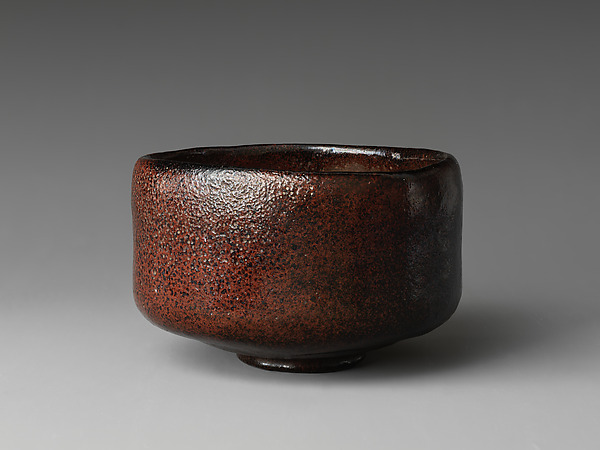
Raku Ichinyū, Black Raku Teabowl, named “Setting Sun” (Sekiyō), late 17th century, Earthenware with black raku glaze (Raku ware). The Metropolitan Museum of Art, Mary and Cheney Cowles Collection, Gift of Mary and Cheney Cowles, 2024, accession 2024.443.1.
Look closer: a vermilion-flecked glaze seems to float over black on a low, wide bowl. The museum catalogues it as a black Raku teabowl named Setting Sun (Sekiyō) by Raku Ichinyū, late seventeenth century, earthenware with black Raku glaze, 7.5 cm high and 11.1 cm across; the Raku house is the first of the ten.
Image: The Metropolitan Museum of Art, Open Access (CC0)
The Wikipedia article on the tea ceremony gives the same group the name Senke Jusshoku and says the ten artisans providing utensils to the three houses hold an honorary title. The Sōtan article ties one of the houses to the family story: when Ichiō Sōshu gave up the lacquer business to Nakamura Sōtetsu, that began the line of lacquerers who made much of the lacquer ware for the Sen families. Raku Chōjirō's bowls were made at Rikyū's request, and the Raku house still heads the list. The table below gives the ten specialities and the family name the dictionary entry gives for each.
A caution applies. Each of these houses passes down a name, and a name passed down is not a signature. The Metropolitan Museum's mid-seventeenth-century kettle is catalogued under Ōnishi Gorōzaemon, and its black Raku bowl of the late seventeenth century under Raku Ichinyū; the Senke Jusshoku entry names a later Ōnishi and a later Raku. A reader who finds a name on a piece should therefore ask which generation the name stands for.
| Craft | House named in the entry | What the chapters say |
|---|---|---|
| Tea bowls | Kichizaemon Raku | The Raku house, which the Raku chapter follows from Chōjirō. |
| Kettles | Seiwemon Ōnishi | Cast-iron kettles; the kettle chapter takes up the foundries. |
| Lacquer | Sōtetsu Nakamura | The line that began when Ichiō Sōshu gave up the lacquer business. |
| Joinery (sashimono) | Risai Komazawa | Wooden furniture and stands. |
| Metalwork (kanamono) | Jōeki Nakagawa | Metal fittings and implements. |
| Textile pouches | Yūko Tsuchida | Bags for caddies and bowls. |
| Mounting (hyōgu) | Kichibē Okumura | Scroll and screen mounting. |
| Ikkanbari | Ikkan Hiki | A lacquered paper craft. |
| Bamboo work | Shōgen Kuroda | Bamboo vessels and utensils. |
| Braziers and pottery | Zengorō Eiraku | Kyoto pottery and braziers. |
Other Schools of Tea
The three Sen houses are the best known but not the only ones. Wikipedia's article on the schools of Japanese tea lists dozens. It names the Sakai-Senke as extinct, the Edosenke and Fuhaku-ryū as offshoots of the front house, and then a long run of warrior-household schools, buke-cha, together with schools founded by Sōtan's close disciples.
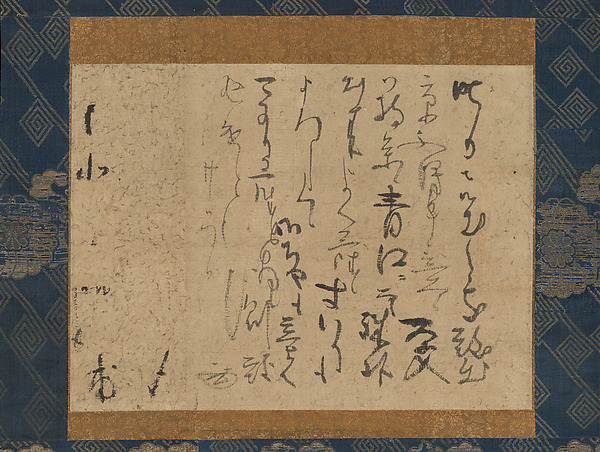
Kobori Enshū, Letter by Kobori Enshu, 17th century, Hanging scroll; ink on paper. The Metropolitan Museum of Art, Gift of Mr. and Mrs. H. Jack Lang, 1975, accession 1975.162.
Look closer: the cursive lines run in short rows, set in a mount with a blue geometric pattern. The museum catalogues it as a Letter by Kobori Enshū, seventeenth century, ink on paper, 22.3 by 29.9 cm; the translation says the caddy brought to the writer is the one named Aoe.
Image: The Metropolitan Museum of Art, Open Access (CC0)
The article groups a long run of schools as buke-cha, the tea of warrior households, among them Enshū-ryū, Oribe-ryū, Sekishū-ryū and Chinshin-ryū, and describes Yabunouchi-ryū as a mixture of wabi-cha and Oribe's warrior tea. Oribe, a disciple of Rikyū, taught the second Tokugawa shōgun; his own pupil Enshū taught the third. Because Oribe was ordered to take his own life, the article says, his family did not become an official tea-teaching family, and his school is now concentrated in Ōita in Kyūshū. Enshū's line, Enshū-ryū, is traced through his brother Masayuki (1583 to 1615) and has a seventeenth-generation head, Kobori Fuyuko.
The Metropolitan Museum owns two things related to this circle. One is a letter by Kobori Enshū, dated only to the seventeenth century, whose translation in the catalogue says that a tea caddy brought to the writer is the one named Aoe, that the writer went up to Kyoto after a visit the previous day, and that the caddy is of excellent workmanship and stable. The second is a double-cut bamboo flower container made by the Zen abbot Kōgetsu Sōgan (1574 to 1643), named Cool Summer Morning, with the letter in which he mentions making it. The catalogue says Sōgan was the son of Tsuda Sōgyū, one of the three greatest tea masters of Hideyoshi's court, became the 156th head abbot of Daitoku-ji, and in 1612 built the sub-temple Kohōan with Enshū.
A table of the other named schools follows, with the founder and the detail the article gives. It is a map of names, not a ranking. Where two figures of the same name appear in the sources with different dates, the table keeps only the one the schools article attributes to the school.
| School | Founder | What the sources say |
|---|---|---|
| Edosenke | Kawakami Fuhaku (1716 to 1807) | Not of the Sen blood; trained under the seventh Omotesenke head and carried Omotesenke style to Edo. |
| Yabunouchi-ryū | Yabunouchi Kenchū Jōchi (1536 to 1627) | Learned from Takeno Jō'ō; mixes wabi-cha and Oribe's warrior tea; its house lies in Shimogyō ward, hence the lower school. |
| Enshū-ryū | Kobori Masakazu, Kobori Enshū (1579 to 1647) | Disciple of Furuta Oribe; tea teacher to the shōguns Hidetada and Iemitsu. |
| Sekishū-ryū | Katagiri Sadamasa, Katagiri Sekishū (1605 to 1673) | Lord of Koizumi; taught Tokugawa Ietsuna, which made the style popular among the ruling class. |
| Sōhen-ryū | Yamada Sōhen (1627 to 1708) | One of four close disciples of Sen no Sōtan. |
| Yōken-ryū | Fujimura Yōken (1613 to 1699) | Another of the four close disciples of Sōtan. |
| Sōwa-ryū | Kanamori Sōwa (1584 to 1656) | Named in the list of schools. |
| Anrakuan-ryū | Anrakuan Sakuden (1554 to 1642) | A warrior-household school. |
| Chinshin-ryū | Matsura Chinshin (1622 to 1703) | Magistrate of Hizen Hirado; follows the warrior tea promoted by Katagiri Sekishū. |
| Oribe-ryū | Furuta Oribe | Oribe was ordered to take his own life, so his family did not become an official tea-teaching family; the school is now concentrated in Ōita. |
| Oie-ryū | Andō Nobutomo (1671 to 1732) | Claims descent from Rikyū through Hosokawa Sansai; the Andō were etiquette authorities under the Tokugawa. |
| Matsuo-ryū | Matsuo Sōji (1677 to 1752) | Learned under the sixth Omotesenke head and settled in Nagoya. |
| Hayami-ryū | Hayami Sōtatsu (1727 to 1809) | Learned under the eighth Urasenke head and founded the school in Okayama with his permission. |
| Ogasawara koryū | Furuichi Tanehide (1439 to 1505) | Studied under Murata Jukō; the Furuichi served the Ogasawara of Kokura. |
| Higo-koryū | Kumamoto tradition | Said to be faithful to Rikyū's style and led by three families. |
| Sansō-ryū | Takaya Sōhan (1851 to 1933) | Founded in the Shōwa era, according to the list. |
| Kogetsu Enshū-ryū Zen Sadō | Aoyagi Kankō (1894 to 1983) | A student of Enshū-ryū, noted for simplicity and for body use like that of martial arts. |
How the Schools Are Taught
Tea in Japan is mostly learned in circles. The ceremony article says the circle charges a monthly fee that covers tuition and use of the school's or teacher's bowls and other equipment, the tea itself and the sweets that students serve and eat at every class. Students must have their own fukusa, fan, paper and small cloth, and a wallet to hold them. For most occasions, particularly if the teacher is highly ranked, wearing kimono is mostly considered essential for women. Advanced students may be given permission to wear the school's mark in place of the usual family crests on formal kimono, and that permission usually accompanies the granting of a tea name.
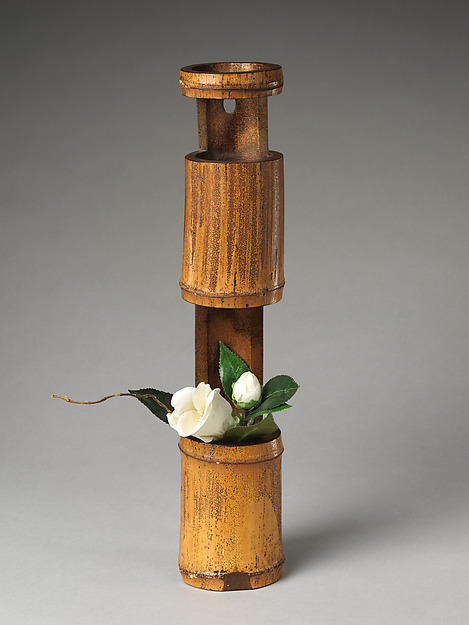
Kōgetsu Sōgan, Double-cut (Nijū-giri) Flower Container (Hanaire), named Cool Summer Morning (Shinryō), early 17th century, Bamboo, lacquer, gold. The Metropolitan Museum of Art, Purchase, Diane and Arthur Abbey Gift, 2019, accession 2019.571a, b.
Look closer: a pale bamboo tube is cut with two windows, one above the other, and a white camellia sits in the lower opening. The museum catalogues it as a Double-cut Flower Container (hanaire), named Cool Summer Morning (Shinryō), made by Kōgetsu Sōgan, early seventeenth century, bamboo, lacquer and gold, 42.9 cm high; it is not on view.
Image: The Metropolitan Museum of Art, Open Access (CC0)
Each class ends with brief instruction from the main teacher, usually about the contents of the tokonoma, the scroll alcove, which typically shows a hanging scroll of calligraphy, a flower arrangement and occasionally other objects, and about the sweets served that day. Related topics include incense and kimono and seasonal variations in equipment. The same article says that procedures vary from school to school and depend on the time of year, time of day, venue and other considerations, and that there are many styles of temae. The schools therefore teach not a single timeless procedure but their own.
The ryūrei style, in which the host sits on a chair at a special table and the guests are also seated at tables, can be conducted nearly anywhere, even outdoors; the name refers to the host's practice of bowing at the start and end standing. A table-based ceremony is also what the fifteenth Mushakōji successor devised in 2007, according to the house's own page, though the page does not say how it differs from the standard form. A separate tradition also exists. The ceremony article describes senchadō, the formal way of steeped leaf tea, typically with the high grade of sencha called gyokuro; it was introduced in the seventeenth century by Ingen, founder of the Ōbaku school of Zen, popularised in the eighteenth century by the Ōbaku monk Baisaō, who sold tea in Kyoto and is regarded as the first sencha master, and remains associated with the Ōbaku head temple of Manpuku-ji, which hosts regular sencha conventions.
News and the Present Day
The most recent news is a death. Sen Genshitsu, who as Sen Sōshitsu XV led Urasenke from 1964 to 2002, died in Kyoto on 14 August 2025, aged 102, after respiratory problems, according to Wikipedia; he had been in hospital since May after a fall. A news report of the same week describes him as a would-be kamikaze pilot who became a tea master and prepared matcha for world leaders and monarchs, and as the Flying Grand Master for his travel schedule. His motto was peacefulness through a bowl of tea; his ceremonies were held at the United Nations in New York and at the USS Arizona Memorial in Pearl Harbor. In a 2023 interview he said that a bowl of tea makes spirits very peaceful, and that when everyone is peaceful there will be no war.
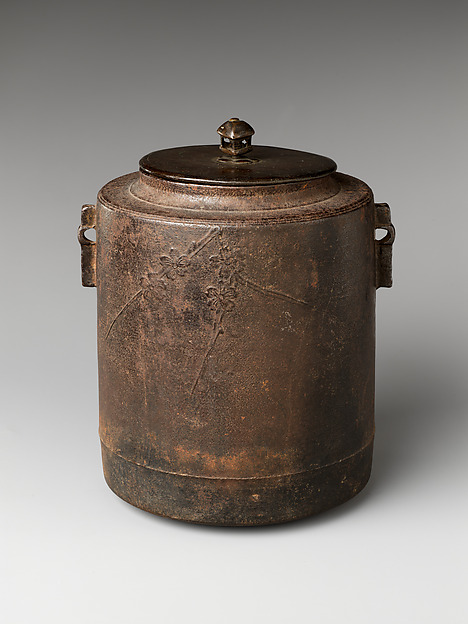
Ōnishi Gorōzaemon, Kettle (Kama) with Willow and Cherry, mid-17th century, Cast iron and bronze. The Metropolitan Museum of Art, Gift of Peggy and Richard M. Danziger, 2024, accession 2024.553.6a, b.
Look closer: the iron is dark and plain, with faint engraved branches and two loops at the shoulders. The museum catalogues it as a kettle (kama) with willow and cherry by Ōnishi Gorōzaemon, mid-seventeenth century, cast iron and bronze, 20.3 cm high; the Ōnishi name stands in the list of the ten craft houses.
Image: The Metropolitan Museum of Art, Open Access (CC0)
Wikipedia gives the outline of the life. He was born Masaoki Sen in Kyoto on 19 April 1923, the first son of the fourteenth head; during the war, as a student at Doshisha University, he was assigned to the navy air division as a kamikaze pilot, but the war ended and he later graduated in economics. He took Buddhist vows under the Daitoku-ji abbot Gotō Zuigan and received the Zen name Hōunsai in 1949. He became president of the Tankōkai in 1953, succeeded his father as iemoto in 1964, and in December 2002 handed the headship to his eldest son, Zabōsai, born on 7 June 1956, who took the name Sōshitsu and became the sixteenth head. Genshitsu then took the honorary title Daisōshō. He received Japan's Order of Culture from Emperor Akihito in 1997, the first in the tea world to receive it according to the article, and the Legion of Honour in 2020. He was a UNESCO Goodwill Ambassador from 2012, and had endowed a chair in Japanese history and culture at the University of Hawaiʻi.
The sixteenth head's wife is Masako Sen, who was born Princess Masako of Mikasa and is the principal of the Urasenke Gakuen. The article describes her as a granddaughter of Emperor Taishō. The Urasenke article says she chairs the educational foundation of the college.
The other houses have their own news. The Mushakōji house's page lists a table-based ceremony devised in 2007 and a prefectural encouragement prize awarded to its fifteenth successor in 2013. Omotesenke's Wikipedia table names a fifteenth head, born in 1970, as the current iemoto, with the Zen name Yūyūsai. And the Metropolitan Museum's catalogue pages place a Sōtan letter and a Sōtan painting of three eggplants, both gifts of 2024, in Gallery 228 at The Met Fifth Avenue, which a visitor should check against the museum's website before travelling.
Reading a School's Name on an Object
A collector meets the schools on boxes, in signatures and in the language of catalogues. The Metropolitan Museum's note for a Sōtan letter shows the first rule: read the signature name against the place. The name Fushin'an Sōtan, the note says, is one Sōtan used when writing from a tea house on the estate that became Omotesenke; a name belongs to a room and a time.
The second rule is that a school's name is not a grade. Raku, Ōnishi, Nakamura and the others on the list of ten are craft houses, and the house name tells a collector which tradition a piece belongs to; it does not tell the collector which generation made it or whether a piece is by the house at all. The same caution applies to style names such as Oribe, which Wikipedia describes as ceramics attributed to the influence of a tea master, not made by him.
The third is that rank in a school is a licence, not a seal of quality on an object. A certificate, the sources say, permits a student to study a procedure; it does not authenticate a bowl. A reader interested in boxes and their inscriptions should read the journal essay on tomobako and hakogaki, and the almanac chapter on the marks and seals of Japanese ceramics. The concierge desk will say in plain words what a given attribution does and does not claim.
Stories Told About the Houses
The first story is of a hut. When the old Sōtan moved to the quarters at the back of the house he built a tiny tea hut and gave it a name that has outlasted his house: Konnichian, the Hut of This Day. It is a name for a hut and also for a whole household, and the Urasenke article says the entire historical Urasenke estate is referred to by it.
The second is of a lacquerer. A son of the family, set aside and sent to a family of lacquer artisans, took up the work of his adoptive house, lived apart from his brothers and then returned at their urging to build a tea house on a street. The story is told in the Mushakōji house's history, in the Sōtan article and in the Urasenke article, with differences in the details that the box below sets out.
The third is of a fire. The Mushakōji house's page records that Kankyū-an burned in 1772 and was rebuilt in 1774, that the Tenmei fire required another room to be rebuilt as a four-and-a-half-mat hut, and that the rooms and gardens were rebuilt again in 1881. A house that survives through fires is a house of rooms rebuilt from memory.
The fourth is of a pilot who did not fly. Sen Genshitsu, trained as a kamikaze pilot, served tea to fellow soldiers during training, according to a news report, and his later ceremonies were held at the United Nations headquarters and at the USS Arizona Memorial in Pearl Harbor.
The fifth is of a character in a book. The Urasenke article records that a Choose Your Own Adventure gamebook, number 44, The Mystery of Ura Senke, concerns the theft of one of the school's most famous tea bowls, valued at millions of yen on the black market, and the investigation by a young reader and a friend whose elder brother is an apprentice of the school. It is the only mention of Urasenke in popular culture the article lists.
Fun Facts
- The three houses share their first three generations: Rikyū, Shōan and Sōtan, according to the Urasenke article.
- The Urasenke headmaster's professional name is Sōshitsu, the Omotesenke headmaster's is Sōsa and the Mushakōji headmaster's is Sōshu.
- Sōtan's four close disciples were called his Four Heavenly Kings, and two of them founded schools.
- Urasenke's Tankōkai counts 92 official associations in 37 countries outside Japan.
- The Urasenke Gakuen runs a one-year course for non-Japanese students called the Midorikai, which means the green group.
- The only Urasenke branch in Japan is in Tokyo; the others are overseas.
- The name Senke Jusshoku took hold after an exhibition at a department store in Osaka in 1915.
- The Mushakōji house's fifteen-mat room, Kōdō-an, was an unprecedented size when it was built.
- A tea-name licence usually comes with permission to wear the school's mark in place of family crests on formal kimono.
- Sen Genshitsu's 100th birthday was marked on 19 April 2023; he died aged 102 on 14 August 2025.
A Timeline of the Houses
The table gathers the dates used in this chapter in order. Where a source gives a date that cannot be checked against another, it is given as that source's.
| Date | Event | Note |
|---|---|---|
| 1522 to 1591 | Sen no Rikyū lives; he dies by Hideyoshi's order on 21 April 1591. | The founding master |
| 1546 to 1614 | Sen Shōan, Rikyū's son-in-law, refounds the Kyoto house. | Second generation |
| 1578 to 1658 | Sen no Sōtan lives; his sons found the three lines. | Third generation |
| About 1646 | Sōtan, aged about sixty-eight, gives the headship to Kōshin Sōsa and moves to the rear quarters with the Konnichian. | Urasenke account |
| 1772 and 1774 | Kankyū-an burns and is rebuilt under the seventh Mushakōji head. | Mushakōjisenke's own page |
| 1868 | The Tokugawa shogunate falls; the stipends of the three houses end. | Iemoto system follows |
| 1898 | Sensho Tanaka founds the Dai Nihon Chadō Gakkai outside the iemoto structure. | A democratic alternative |
| 1915 | The Ten Jobs Exhibition at Mitsukoshi in Osaka gives the Senke Jusshoku their name. | Craft houses |
| 1940 | The fourteenth Urasenke head founds the Tankōkai. | Membership body |
| 1949 | The Urasenke Foundation is registered. | Konnichian foundation |
| 1957 | Urasenke Tokyo branch opens. | The only branch in Japan |
| 1964 | Sen Genshitsu becomes the fifteenth Urasenke head; the Sen Sadō Bunka Gakuin opens at Mushakōjisenke. | Postwar growth |
| 1966 | Urasenke sends teachers to Hawaii and Boston. | First overseas branches |
| 2002 | Sen Genshitsu hands the Urasenke headship to his son Genmoku. | Sixteenth generation |
| 2007 | The fifteenth Mushakōji successor devises a table-based tea ceremony. | Mushakōjisenke's own page |
| 14 August 2025 | Sen Genshitsu dies in Kyoto aged 102. | News reports |
The Headmasters in Parallel
The table sets the three lines in parallel from the fourth generation, which is where they divide; the first three generations, Rikyū, Shōan and Sōtan, are shared. Names and dates are from Wikipedia's tables for each house, with the Mushakōji successor from the house's own page. The tables differ in how far they extend, so empty cells are left empty.
| Generation | Omotesenke | Urasenke | Mushakōjisenke |
|---|---|---|---|
| 4th | Kōshin Sōsa (1613 to 1672) | Sensō Sōshitsu (1622 to 1697) | Ichiō Sōshu (1605 to 1676) |
| 5th | Ryōkyū Sōsa (1650 to 1691) | Jōsō Sōshitsu (1673 to 1704) | Bunshuku Sōshu (1658 to 1708) |
| 6th | Gensō Sōsa (1678 to 1730) | Taisō Sōshitsu (1694 to 1726) | Shinpaku Sōshu (1693 to 1745) |
| 7th | Ten'nen Sōsa (1705 to 1751) | Chikusō Sōshitsu (1709 to 1733) | Kensō Sōshu (1725 to 1782) |
| 8th | Ken'ō Sōsa (1744 to 1808) | Ittō Sōshitsu (1719 to 1771) | Kyūō Sōshu (1763 to 1838) |
| 9th | Kōshuku Sōsa (1775 to 1825) | Sekiō Sōshitsu (1746 to 1801) | Nin'ō Sōshu (1795 to 1835) |
| 10th | Shōō Sōsa (1818 to 1860) | Hakusō Sōshitsu (1770 to 1826) | Zendō Sōshu (1830 to 1891) |
| 11th | Zuiō Sōsa (1837 to 1910) | Seichū Sōshitsu (1810 to 1877) | Issō Sōshu (1848 to 1898) |
| 12th | Keiō Sōsa (1863 to 1937) | Jikishō Sōshitsu (1852 to 1917) | Chōshō Sōshu (1889 to 1953) |
| 13th | Mujin Sōsa (1901 to 1979) | Tetchū Sōshitsu (1872 to 1924) | Tokuō Sōshu (1913 to 1999) |
| 14th | Sōsa (born 1938) | Sekisō Sōshitsu (1893 to 1964) | Sōshu (born 1945), current head in Wikipedia's table |
| 15th | Sōsa (born 1970), listed as current head | Hansō Sōshitsu, Sen Genshitsu (1923 to 2025) | Zuiensai Sō'oku (born 1975), named successor on the house's own page |
| 16th | Genmoku Sōshitsu (born 1956), current head |
A Glossary of Schools and Licences
These are the words the chapter uses, with the sense the sources give them.
| Term | Meaning |
|---|---|
| San-Senke | 三千家. The three Sen houses: Omotesenke, Urasenke and Mushakōjisenke. |
| Omote, ura | 表, 裏. Front and rear; the first two house names come from the position of the estates. |
| Iemoto | 家元. The head of a school; the title also names the whole hereditary system. |
| Sōke | 宗家. A synonym for the family or house an iemoto leads. |
| Menjō, kyojō, sōden | 免状, 許状, 相伝. Licences or certificates that allow a student to study certain procedures. |
| Chamei | 茶名. A tea name given to an advanced student, usually with permission to wear the school's mark. |
| Temae | 点前. A procedure for preparing tea or charcoal. |
| Warigeiko | 割稽古. Basic training in parts of a procedure before making tea. |
| Ryūrei | 立礼. Tea prepared at a table, with host and guests on chairs. |
| Chaji, chakai | 茶事, 茶会. A formal tea gathering and an informal one. |
| Konnichian | 今日庵. The Hut of This Day; Sōtan's retirement tea hut, and the name of the whole Urasenke estate. |
| Fushin-an | 不審庵. The representative tea room of Omotesenke. |
| Kankyū-an | 官休庵. The tea house of Mushakōjisenke. |
| Senke Jusshoku | 千家十職. The ten craft houses that make utensils for the Sen families. |
| Tankōkai | 淡交会. The Urasenke membership association, founded in 1940. |
| Buke-cha | 武家茶. Tea of the warrior households, as in Enshū-ryū and Sekishū-ryū. |
| Senchadō | 煎茶道. The way of steeped leaf tea, associated with the Ōbaku school of Zen. |
| Wakasōshō | 若宗匠. The young master, an officially recognised successor to an iemoto. |
The Three Houses Compared
The differences between the schools that the sources actually state are few. The table collects them, and Wikipedia itself warns that the stylistic differences between the schools are small.
| Omotesenke | Urasenke | Mushakōjisenke | |
|---|---|---|---|
| Meaning of name | Front Sen house | Rear Sen house | Named for Mushakōji street |
| Representative room | Fushin-an | Konnichian | Kankyū-an |
| Headship name | Sōsa | Sōshitsu | Sōshu |
| Founder, fourth generation | Kōshin Sōsa | Sensō Sōshitsu | Ichiō Sōshu |
| Whisking | Less foam, according to Wikipedia | More foam | Not stated |
| Whisks | Untreated bamboo and darkened bamboo | Untreated bamboo | Not stated |
| Domain served | Not stated | Maeda of Kaga; later Hisamatsu of Iyo | Matsudaira of Takamatsu |
| Public facility named | Kitayama Kaikan | Urasenke Gakuen, Tokyo branch, overseas branches | Sen Sadō Bunka Gakuin |
More Pieces from the Same Circle
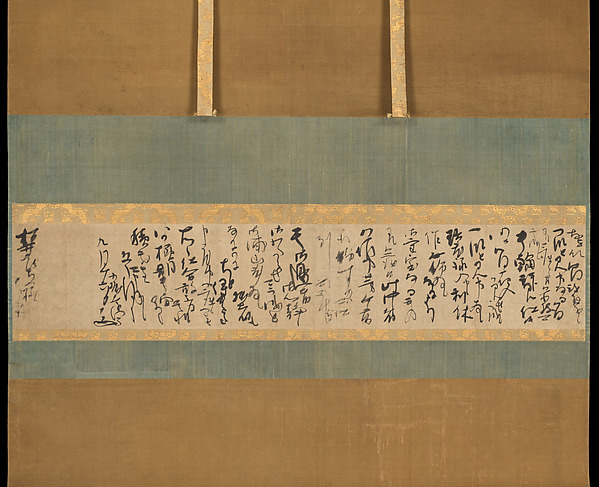
Kobori Enshū, Letter to Kashiwai, early 17th century, Hanging scroll; ink on paper. The Metropolitan Museum of Art, Mary and Cheney Cowles Collection, Gift of Mary and Cheney Cowles, 2025, accession 2025.981.5.
Look closer: a long band of cursive writing runs across a green-grey mounting with gold borders. The museum catalogues it as Letter to Kashiwai by Kobori Enshū, early seventeenth century, ink on paper, image 15.4 by 83.8 cm; the Japanese title gives the recipient's name, and the record does not say what the letter contains.
Image: The Metropolitan Museum of Art, Open Access (CC0)

Black Raku Tea Bowl, early 17th century, Earthenware with black raku glaze (Raku ware). The Metropolitan Museum of Art, Rogers Fund, 1917, accession 17.118.74.
Look closer: the bowl is hand-formed and black. The museum catalogues it as a black Raku tea bowl of the early seventeenth century, earthenware, tentatively attributed to Chōjirō, 9.2 cm high and 9.5 cm across.
Image: The Metropolitan Museum of Art, Open Access (CC0)
Tea Ware Near the Houses
Iron kettles, bamboo, lacquer and clay for tea pass through the house, and the concierge desk will say in plain words what each piece is and what it is not. The atlas of utensils and the glossary of tea utensils are companions to this chapter.
Answered plainly
What is the difference between Urasenke and Omotesenke?
Both descend from Sen no Sōtan's sons. Omote is the front house and ura the rear. Wikipedia says the differences are small: Omotesenke whisks less than Urasenke, so the tea has less foam, and it uses both an untreated and a darkened bamboo whisk, while Urasenke uses untreated bamboo.
What are the three Sen houses?
Omotesenke, Urasenke and Mushakōjisenke, the three lines of the Sen family descending from Sen no Rikyū, known together as the san-Senke.
Who founded the three houses?
Sōtan's sons: Kōshin Sōsa the Omotesenke line, Sensō Sōshitsu the Urasenke line and Ichiō Sōshu the Mushakōji line.
What does iemoto mean?
The founder or current grand master of a traditional art school; the word also names the hereditary system of such schools, in which the iemoto has final authority.
Who is the head of Urasenke now?
Genmoku Sōshitsu, born in 1956, the sixteenth head, who succeeded his father Sen Genshitsu in December 2002.
Did Sen Genshitsu die?
Yes. He died in Kyoto on 14 August 2025, aged 102, according to Wikipedia and news reports.
How does a tea licence work?
A student earns certificates at stages; they permit study of certain procedures or confirm a level of mastery. They are paid for, and the cost rises with the level.
What are the Senke Jusshoku?
Ten craft houses that make utensils for the Sen tradition, including Raku for bowls, Ōnishi for kettles and Nakamura for lacquer.
Are there tea schools beyond the Sen houses?
Yes. Wikipedia lists many, including Yabunouchi-ryū, Enshū-ryū, Sekishū-ryū, Sōhen-ryū and Oribe-ryū, and the Edosenke that grew from Omotesenke.
Can I visit Fushin-an or Konnichian?
The Real Japanese Gardens page on Fushin-an says the garden and tea house are not open to the public. The estates are private houses, and visits are arranged through the houses.
Do I need a kimono to study tea?
Wikipedia says wearing kimono is mostly considered essential for women on most occasions, particularly if the teacher is highly ranked, though some practitioners wear Western clothing.
Where next
Sources and image credits
- Urasenke, Wikipedia
- Omotesenke, Wikipedia
- Mushakōjisenke, Wikipedia
- Sen no Sōtan, Wikipedia
- Sen Sōshitsu XV, Wikipedia
- Schools of Japanese tea, Wikipedia
- Iemoto, Wikipedia
- Japanese tea ceremony, Wikipedia
- History of Mushakōji Senke Kankyū-an, Mushakōjisenke
- Fushin-an, Real Japanese Gardens
- Senke Jisshoku, Tenpyodo dictionary
- Japan's grand tea master Sen Genshitsu dies at 102, The Star
- Object record, Set of Utensils for the Tea Ceremony, The Metropolitan Museum of Art
- Object record, Letter of Acceptance, The Metropolitan Museum of Art
- Object record, Three Eggplants and a Poem, The Metropolitan Museum of Art
- Object record, Tall Freshwater Jar (Hoso-mizusashi) with Striped Design, The Metropolitan Museum of Art
- Object record, Chashaku, named "Imogase", The Metropolitan Museum of Art
- Object record, Fire-Holder and Tea-Box, The Metropolitan Museum of Art
- Object record, Black Raku Teabowl, named “Setting Sun” (Sekiyō), The Metropolitan Museum of Art
- Object record, Letter by Kobori Enshu, The Metropolitan Museum of Art
- Object record, Double-cut (Nijū-giri) Flower Container (Hanaire), named Cool Summer Morning (Shinryō), The Metropolitan Museum of Art
- Object record, Kettle (Kama) with Willow and Cherry, The Metropolitan Museum of Art
- Object record, Letter to Kashiwai, The Metropolitan Museum of Art
- Object record, Black Raku Tea Bowl, The Metropolitan Museum of Art
Last reviewed 28 October 2026. Pictures, where shown, are public-domain or open-access and credited beneath each one.
Looking for a kettle, a bowl, a scoop or a lacquer piece in the circle of the three houses? The concierge desk replies within one to three business days.
Browse tetsubin, chagama and tea ceremony pieces · Make a private request
Private concierge
Looking for something in particular?
Describe the piece or the project you have in mind. A senior advisor in Tokyo reads every case file personally and replies within two business days, with fees set out in writing before any work begins.