
Shinto: Kami, Shrines and the Household
Sacred Wing · Native Practice
Shinto: Kami, Shrines and the Household
A gate, a rope, a basin of water, a mirror on a shelf. Shinto is read less through scripture than through the objects and gestures that mark a place as set apart, and those objects are the ones a collector meets first.
Fact sheet
Four ideas to carry in
- Kami. Not omnipotent, not necessarily immortal, and found in all sorts of things, including the dead who are venerated as kami.
- Purity. The practical concern is to avoid kegare, impurity, and to restore harae, purity.
- The gate. The torii is usually the simplest way to know that you are at a shrine.
- The shelf. At home the kami are kept on a small shrine set high on the wall, above eye level.
What a kami is
Shinto revolves around the supernatural beings called kami, which are believed to inhabit all things. They are not regarded as omnipotent, omniscient or necessarily immortal, and human beings can become kami: the dead are sometimes venerated as such. The word Shinto is broadly translated as “the way of the kami”, though its meaning has shifted through Japanese history. Veneration of kami has been traced back to the Yayoi period, roughly 300 BCE to 250 CE, and the eighth-century texts Kojiki and Nihon Shoki recount the origins of the kami and of Japan.
Historians disagree about when Shinto became a distinct religion rather than a family of local practices. Some scholars argue that it was in effect invented in the Meiji era, 1868 to 1912, when Japan’s nationalist leadership expelled Buddhist influence from the worship of the kami and formed State Shinto; that arrangement ended after the Second World War. For a collector the practical point is that what survives in antiques, in shrine objects and in domestic shelves is mostly the older, local layer: the shrine of one village, the kami of one community, called its ujigami.
Two concerns recur in everything that follows. The first is purity. Shinto treats kegare, pollution or impurity, as a temporary condition that can be corrected through harae, purification, and a ritual such as misogi uses fresh water, salt water or salt to remove it. Full immersion in the sea is regarded as the most ancient form. The second is place: a kami is approached where it is, and the architecture of a shrine exists to mark where that is.
A shrine, from gate to hall
The simplest way to identify a shrine is by its torii, the gate at the entrance. Past it, a visitor purifies the hands and mouth at the chōzuya, the water basin, before approaching the offering box. A sacred rope, the shimenawa, is often tied around a great tree, one of the original yorishiro, objects in which a kami may take up residence. Pairs of stone “lion-dogs”, komainu, stand guard. Beyond lies the worship hall, the haiden, the only part open to the public, and behind it the main hall, the honden, where the patron kami is enshrined and which is closed to visitors and not used for prayer.
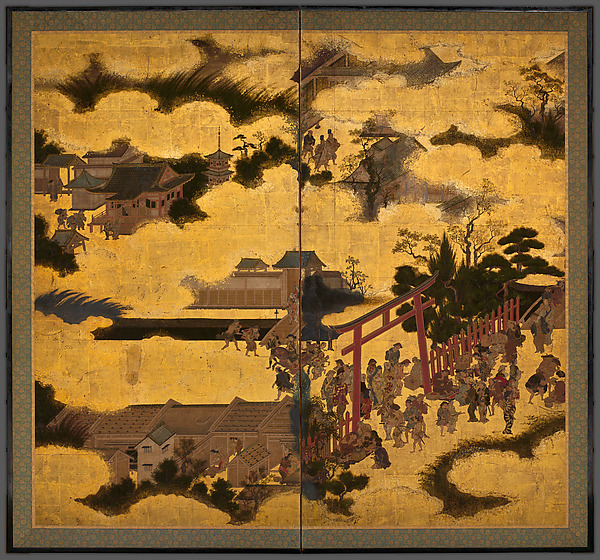
Japan, early 17th century. Sliding doors remounted as a two-panel folding screen; ink, colour and gold on paper; 152.4 by 163.2 cm.
Look closer: the red torii stands at the right with a crowd pressing in beside its fence, while the roofs of the precinct float among clouds of gold leaf and a pagoda rises at the upper left.
The Metropolitan Museum of Art, New York, Gift of A. I. Sherr, 1960 (60.164). Public domain, Open Access.
The kami is not the building and is not the object that houses it. The shintai, the “body of the kami”, is a symbolic repository that makes a kami accessible for worship: commonly a mirror, a sword or a jewel, or a natural object such as a mountain or waterfall. This is why a small circular mirror shows up so often in the shrine objects and household shelves that reach collectors.
The usual form of worship is short. Bow once before the torii, purify the hands and mouth, put an offering in the box, ring the bell two or three times if there is one, then bow twice, clap twice and bow once more, deeper. On leaving, bow again at the torii. At Usa Jingū and Izumo-taisha, the clapping is four times, not two.
Shrines are numerous. The register known as the Engi-shiki, dated 927, lists 2,861 shrines. The Agency for Cultural Affairs counted 79,467 in 1972, mostly affiliated with the Association of Shinto Shrines (Jinja Honchō); a figure of around 100,000 is often quoted, and an estimate of around 80,000 covers only shrines with resident priests, with the smaller roadside and household shrines said to roughly double that. Ise Grand Shrine is still rebuilt every twenty years, in the tradition of shikinen sengū, faithfully to its original design.
The shelf of the gods
In the house the shrine shrinks to a shelf. The kamidana, literally “god-shelf”, is a miniature household altar for enshrining a kami. It is placed high on a wall, above an ordinary person’s eye level, and never over an entrance or anywhere people will walk beneath it. Its contents are few. There is the shintai, most commonly a small circular mirror; a small water vessel, the mizutama; and, when one is enshrined, an ofuda, a charm or talisman, with offerings of water, liquor or food left before it and renewed regularly. A part of a kami, a bunrei, can be obtained from a shrine through a rite called kanjō. Family members should cleanse the hands or mouth before worshipping.
Ofuda are replaced before the end of each year, while the shelf itself can stay in the home until it is no longer usable. Both shelves and talismans can be obtained at any large shrine. Our own guide to the kamidana covers the architectural forms, the one-door ikkensha and the three-door sankensha, how the talismans are arranged, the implements and how to judge an antique shelf.
Families often keep both a kamidana and a Buddhist altar. The house guide Butsudan vs Kamidana describes the difference as one of orientation: the butsudan towards remembrance and continuity, the kamidana towards presence and purity. Where the first keeps time through the memorial years, as we set out in The Altar’s Calendar, the second keeps it through the year’s end, when the old talisman is replaced.
Gods and buddhas, together
Buddhism entered Japan at the end of the Kofun period, between about 300 and 538 CE, and spread rapidly. The mingling that followed, shinbutsu-shūgō, made the worship of kami and Buddhist practice functionally inseparable: kami came to be seen as part of Buddhist cosmology, and were increasingly depicted in human form. The imperial household adopted the syncretic practice in the centuries that followed. Most Japanese people still take part in both Shinto and Buddhist activities, reflecting a common view that the two need not be exclusive.

Japan, early 14th century. Hanging scroll; ink, colour and gold on silk; image 100.2 by 39.7 cm.
Look closer: read from the bottom: the torii, the approach through trees, the compound, the mountain and, above all of it, five figures seated in a row.
The Metropolitan Museum of Art, New York, Mary Griggs Burke Collection, Gift of the Mary and Jackson Burke Foundation, 2015 (2015.300.12). Public domain, Open Access.
The visual record is full of it. A hanging scroll in the Metropolitan Museum shows the precinct of Kasuga Shrine in the early fourteenth century: a torii and a winding approach at the foot of the scroll, a compound of buildings below a dark, wooded mountain, and five seated Buddhist figures hovering across the top. Our dictionary entries on Shinbutsu Shūgō and Gongen: Buddhas in the Form of Kami follow how scholars read pictures like this one.
What a shrine gives back
Shrines send their visitors home with small objects: ema, wooden plaques on which a wish is painted and left at the shrine; omamori, protective amulets; and goshuin, the calligraphed and stamped record of a visit. Our guide to Goshuin, Omamori and Ema sets out how to read and keep them. An older tradition of the same kind is the lucky charm in the home, covered in Maneki-neko, Daruma and Japan’s Good-Luck Charms.
Many of those charms sit at the meeting point of the two faiths. The daruma, a round papier-mâché figure sold with blank eyes, one of which is painted in when a wish is made and the second when it comes true, is based on Bodhidharma, the founder of Zen (see Daruma (Bodhidharma)). If you are unsure which tradition an object belongs to, ask which shrine or temple issued it.
Receiving a shelf, a mirror or a talisman
An antique kamidana is a piece of architecture in miniature, and our guide to the shelf lists what to look for: the original roof and finials, the doors and their hinges, and the quality of the cypress. A shrine mirror is best displayed as what it is, the object that houses a presence. Treat a talisman as you would any object that was issued for a purpose: with care, and returned to a shrine when its year has run.
If a shelf, an altar or a figure arrives from a family home, the polite thing is to ask the shrine or temple concerned how it prefers the object to be handled, and to avoid placing either above a doorway or where people will walk underneath. The household and temple objects the house keeps are gathered in the collection linked below.
A shrine in lacquer

Japan, 19th century. Coloured lacquer with gold, silver, blue and red togidashi on black lacquer; 8.8 by 6.5 by 2.4 cm.
Look closer: a small red torii shows between the cherry trees on the front of the case: the whole shrine is implied by its gate.
The Metropolitan Museum of Art, New York, H. O. Havemeyer Collection, Bequest of Mrs. H. O. Havemeyer, 1929 (29.100.783). Public domain, Open Access.
Household shrines and altar objects
The house keeps household altars, altar implements and Buddhist and Shinto objects from Japan, each with its condition and measurements.
Answered plainly
What is a kami?
A supernatural being in Shinto, believed to inhabit all things. Kami are not regarded as omnipotent, omniscient or necessarily immortal, and the dead are sometimes venerated as kami.
What does the torii tell you?
It is usually the simplest way to identify a Shinto shrine. It stands at the entrance, and visitors bow before passing through.
How do you pay respects at a shrine?
Purify the hands and mouth at the water basin, put an offering in the box, ring the bell if there is one, then bow twice, clap twice and bow once more. At Usa Jingū and Izumo-taisha the claps are four.
Where does a kamidana go?
High on a wall, above eye level, and not over an entrance or anywhere people will walk beneath it.
How often are talismans renewed?
Ofuda are replaced before the end of each year, while the shelf itself can stay in the home until it is no longer usable.
Can a household keep both a kamidana and a butsudan?
Yes. Most Japanese people take part in both Shinto and Buddhist activities, and many homes keep both altars.
Where next
Sources and image credits
- Wikipedia, Shinto
- Wikipedia, Shinto shrine
- Wikipedia, Kamidana
- The Metropolitan Museum of Art, Open Access: The Torii Gate of Gion Shrine, 60.164
- The Metropolitan Museum of Art, Open Access: Kasuga Shrine Mandala, 2015.300.12
- The Metropolitan Museum of Art, Open Access: Inrō with Cherry Trees and a Shintō Shrine, 29.100.783
- Japonista, Maneki-neko, Daruma and Japan’s Good-Luck Charms
Last reviewed 28 October 2026. Pictures, where shown, are public-domain or open-access and credited beneath each one.
Looking for a household shrine, an altar or a shrine object? The concierge desk searches Japan on your behalf and replies within one to three business days.
Private concierge
Looking for something in particular?
Describe the piece or the project you have in mind. A senior advisor in Tokyo reads every case file personally and replies within two business days, with fees set out in writing before any work begins.